The Neighborhood Watch Captain Tried To Tow Away The “Squatter” Until The Landowner Opened His Old Camper Door
Chapter 1: The Camper Blocking Everyone’s Favorite Shortcut
The first horn sounded at 7:12 on a Monday morning.
Then another.
Then three more.
Within ten minutes, a line of irritated vehicles stretched along the narrow private road, their drivers staring at the same unexpected obstacle.
A weathered vintage camper sat at the dead end where the shortcut began.
The shortcut mattered.
Everyone in the neighborhood used it.
Officially, it didn’t exist.
The road ended at a neglected lot covered with weeds and scrub grass. Unofficially, drivers cut across the open ground, rejoined a county road beyond the trees, and saved nearly fifteen minutes during rush hour.
For years nobody questioned it.
Now the camper blocked the path completely.
A man in a business suit climbed from his car.
“What is this?”
Nobody answered.
A woman leaned from her SUV.
“Can they even do that?”
The camper didn’t look threatening.
Its faded paint was chipped. The roof carried old repairs. One window was patched with carefully installed plexiglass.
A folding chair sat beside it.
A coffee mug rested on a small table.
Someone was clearly living there.
The sight irritated people more than it frightened them.
The first complaints appeared online before noon.
The neighborhood message board filled with photographs.
Who is this?
Is he homeless?
Why is nobody doing anything?
By evening, Patricia Adams had already posted seven times.
Patricia considered herself responsible for maintaining standards.
As captain of the Neighborhood Watch, she monitored everything.
Suspicious vehicles.
Untrimmed yards.
Unknown visitors.
Late-night noise.
Most residents appreciated her efforts.
At least they did when she solved problems.
This looked like a problem.
Patricia parked near the camper shortly before sunset.
The old man sat outside reading a hardcover book.
A thermos stood beside him.
He glanced up once when her vehicle arrived.
Then returned to reading.
That annoyed her immediately.
Most people became nervous when confronted.
This man acted as though she didn’t exist.
She stepped closer.
“Excuse me.”
No response.
The page turned.
“Sir.”
The man looked up calmly.
Gray hair.
Weathered face.
Steady eyes.
Nothing about him appeared frightened.
“Can I help you?” he asked.
“You certainly can.”
Patricia folded her arms.
“Residents are concerned.”
The man waited.
“You’ve parked here for three days.”
“Four.”
She blinked.
“What?”
“Four days.”
His voice remained polite.
Patricia disliked the correction.
“Fine. Four days.”
She pointed toward the blocked shortcut.
“People use that road.”
He glanced toward the dirt path.
“They shouldn’t.”
That answer surprised her.
“They shouldn’t?”
“No.”
“Why not?”
The old man closed his book.
“Because it’s not their road.”
Patricia laughed.
“It isn’t yours.”
The man regarded her for several seconds.
Then reopened the book.
The conversation was over.
At least for him.
Patricia walked away angry.
Not because he had insulted her.
Because he hadn’t.
He simply dismissed her.
The following morning, police arrived.
Two officers spoke with the man.
Neighbors watched from parked vehicles.
Some recorded videos.
The conversation lasted less than ten minutes.
Then the officers left.
The camper remained.
Patricia immediately called the station.
After several transfers, she finally received an answer she hated.
No violation.
No active complaints supported by law.
No grounds for removal.
The property situation was unclear.
The resident had provided documentation.
That phrase bothered her most.
Documentation.
What documentation?
The neighborhood became increasingly divided.
Some residents agreed with Patricia.
Others simply wanted the traffic shortcut reopened.
A few questioned whether the man had done anything wrong at all.
Among them was Jennifer Taylor.
Jennifer drove past every morning.
Unlike most neighbors, she had actually spoken with the old man.
Only briefly.
One afternoon her car battery died near the entrance road.
Before she could call for assistance, the old man appeared carrying a small tool bag.
Twenty minutes later the engine started.
He refused payment.
He returned to the camper.
That memory made Patricia’s posts feel excessive.
Jennifer kept that opinion mostly to herself.
Opposing Patricia publicly rarely ended well.
By the end of the week, the camper had become neighborhood obsession.
People speculated constantly.
Former criminal.
Drifter.
Scammer.
Trespasser.
Government informant.
Every theory appeared online.
Matthew Walker ignored all of them.
Each morning he drank coffee outside the camper.
Each afternoon he read.
Each evening he watched the sunset beyond the trees.
His refusal to react only fueled the rumors.
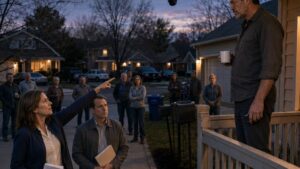
One Friday night Patricia attended a neighborhood gathering in a resident’s garage.
Nearly thirty people showed up.
The camper dominated discussion.
Voices grew louder.
Complaints multiplied.
Property values.
Safety concerns.
Traffic problems.
Community image.
Patricia listened carefully.
She enjoyed moments like this.
People looked to her for solutions.
Finally she stood.
The room quieted.
“We’ve waited long enough.”
Several heads nodded.
“The authorities aren’t doing their job.”
More agreement.
Patricia looked around the room.
“We’re going to handle this ourselves.”
Jennifer felt a knot form in her stomach.
“What exactly does that mean?” she asked.
Patricia smiled.
“It means I’m going to remove the problem.”
The garage fell silent.
No one laughed.
No one challenged her.
And for the first time, Patricia began treating the old man in the camper not as a nuisance.
But as an opponent.
Chapter 2: Rumors Travel Faster Than Facts
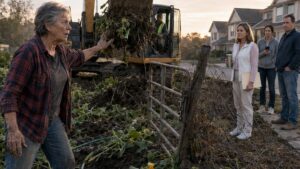
Patricia entered the community meeting carrying a stack of printed photographs.
That alone guaranteed attention.
The room filled quickly.
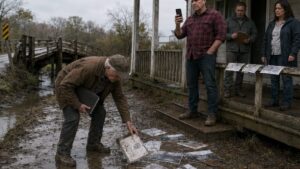
Neighbors gathered around folding tables while Patricia arranged the photos like evidence in a courtroom.
Images of the camper.
Images of Matthew sitting outside.
Images of tire tracks.
Images of the blocked shortcut.
When everyone settled, she tapped the table.
“This is what we’re dealing with.”
People leaned forward.
Jennifer stayed near the back.
Patricia pointed at a photograph.
“No permanent address.”
Another.
“No visible employment.”
Another.
“Unknown history.”
The room murmured.
Jennifer frowned.
Those weren’t facts.
Those were absences.
Patricia continued anyway.
“Nobody just parks somewhere like this.”
“What did the police say?” someone asked.
Patricia’s expression tightened.
“They haven’t acted.”
“Why not?”
“They claim he has paperwork.”
The room reacted immediately.
“What paperwork?”
“From where?”
“How is that possible?”
Patricia raised a hand.
“That’s exactly what I’d like to know.”
The meeting lasted nearly two hours.
By the end, concern had transformed into suspicion.
Patricia left satisfied.
Jennifer left uncomfortable.
The next morning she noticed Matthew repairing a loose panel near the camper door.
She almost kept driving.
Instead she pulled over.
Matthew looked up.
“Battery still working?”
She smiled despite herself.
“So far.”
He nodded.
Then returned to work.
Jennifer hesitated.
“You know people are talking.”
“I know.”
“You don’t seem worried.”
Matthew tightened a screw.
“Worry doesn’t improve much.”
Jennifer studied him.
“Why stay here?”
For a moment she thought he might answer.
Instead he looked toward the blocked shortcut.
“Sometimes people get used to crossing lines.”
Jennifer followed his gaze.
“What does that mean?”
“It means habits can be expensive.”
He returned to the repair.
Conversation finished.
Again.
The strange thing was that Matthew never seemed rude.
Only careful.
As though every sentence cost him something.
That afternoon another small incident complicated Patricia’s campaign.
A delivery van became stuck near a drainage ditch.
Several residents watched.
Nobody volunteered help.
Matthew did.
He appeared with chains, wooden boards, and a jack.
Within half an hour the van was free.
The driver thanked him repeatedly.
Matthew waved him off.
Several witnesses saw everything.
Including Jennifer.
Including Patricia.
Neither reacted the same way.
Jennifer saw generosity.
Patricia saw performance.
“He knows people are watching,” she told others later.
“That’s exactly why he’s doing it.”
The explanation spread quickly.
Soon the good deed became suspicious.
By the weekend, Matthew’s silence had acquired sinister meaning.
He wasn’t quiet.
He was hiding something.
He wasn’t private.
He was secretive.
Every neutral fact became negative.
Every unanswered question became proof.
Meanwhile Patricia increased pressure.
More calls.
More complaints.
More reports.
The answers never changed.
No violation.
No removal order.
No action.
The inability to win through official channels slowly transformed irritation into obsession.
One evening Patricia sat alone reviewing photographs.
Dozens covered her dining room table.
She noticed something unusual.
The camper rarely appeared unattended.
Matthew seemed aware of every vehicle entering the road.
Every pedestrian.
Every visitor.
Not paranoid.
Alert.
Disciplined.
The realization unsettled her.
Then anger replaced uncertainty.
She convinced herself it proved something.
People with nothing to hide didn’t behave that way.
At least that’s what she told herself.
The next day she stopped Jennifer outside a grocery store.
“You’ve talked to him.”
Jennifer instantly regretted making eye contact.
“A little.”
“What did he tell you?”
“Not much.”
Patricia narrowed her eyes.
“Don’t you find that strange?”
“No.”
The answer slipped out before Jennifer could stop it.
Patricia stared.
Jennifer continued.
“Maybe he just wants privacy.”
“Privacy?”
Patricia laughed.
“He’s living in a camper at the entrance to our neighborhood.”
Jennifer felt several nearby shoppers listening.
She lowered her voice.
“Maybe we’re making assumptions.”
Patricia’s expression hardened.
“No. We’re asking reasonable questions.”
Jennifer knew the conversation was over.
Patricia needed certainty.
Doubt threatened her position.
That evening another message appeared on the community board.
A request for volunteers.
Observation shifts.
Documentation.
Photographs.
Vehicle logs.
Patricia called it community protection.
Jennifer called it surveillance.
The response shocked her.
Nearly twenty people signed up.
The first volunteer shift started the next morning.
From his folding chair, Matthew watched a parked SUV remain in the same location for four hours.
He watched another appear after lunch.
Then another.
He knew exactly what they were doing.
Still, he said nothing.
The silence that had protected him for years was becoming a trap.
And somewhere beyond the visible arguments, a question continued growing.
What exactly were the neighbors hoping to find?
Chapter 3: The Property Nobody Wants To Discuss
The old survey map appeared by accident.
Or at least that’s how it started.
A resident cleaning out a garage discovered a tube of property records left behind by a previous owner.
Most people would have thrown it away.
Instead, the resident posted photographs online.
One image changed everything.
The map showed the shortcut.
Not as a road.
As private land.
Within hours the neighborhood message board erupted.
Patricia drove straight to the resident’s house.
She spread the documents across a kitchen table.
The lines were faded.
Some labels were difficult to read.
But one detail stood out.
The shortcut didn’t belong to the neighborhood association.
In fact, the ownership markings seemed to stop directly where Matthew’s camper sat.
Patricia refused to accept the implication.
“These maps are ancient.”
“Maybe,” the resident said.
“Maybe not.”
The uncertainty bothered everyone.
Not because they cared about land records.
Because they cared about convenience.
If the shortcut disappeared, daily commutes would become longer.
School routes would change.
Traffic would worsen.
People who had mocked the camper now worried about something else.
The road itself.
Jennifer watched the conversation shift in real time.
Nobody asked whether Matthew deserved respect.
They only asked whether he could stop them.
That realization left a bitter taste.
Meanwhile Patricia visited the county records office.
The clerk spent nearly an hour searching databases.
The result frustrated everyone.
Incomplete records.
Missing transfers.
Archived documents.
Conflicting surveys.
Nothing produced a clear answer.
Patricia left with copies and growing anger.
If the ownership question remained unresolved, she couldn’t force action.
Yet uncertainty created another problem.
What if Matthew actually had rights nobody understood?
The possibility followed her home.
For two nights she barely slept.
On the third day she drove to the property again.
Matthew sat outside the camper reading.
As usual.
The sight irritated her more than ever.
How could someone remain so calm while causing so much disruption?
She stepped out.
“You’re enjoying this.”
Matthew looked up.
“No.”
“You know exactly what’s happening.”
“Yes.”
“Then explain it.”
He closed the book.
For a moment Jennifer, who happened to be walking nearby, thought he finally would.
Instead he said, “People should understand where they’re walking before they complain about where they’re stopped.”
Patricia stared.
“That’s not an answer.”
“It wasn’t meant to be.”
The old frustration returned.
Matthew never lied.
But he rarely explained.
And that difference was driving everyone crazy.
Later that week another discovery emerged.
Several residents compared old property photographs.
The shortcut barely existed twenty years earlier.
It had gradually widened through repeated use.
Vehicle by vehicle.
Year by year.
A path became a habit.
A habit became an expectation.
An expectation became a perceived right.
The realization should have encouraged caution.
Instead it produced panic.
“What if he closes it permanently?”
“What if we lose access?”
“What if he’s planning something?”
The questions spread.
Patricia found herself receiving calls at all hours.
Residents wanted reassurance.
Solutions.
Leadership.
Pressure settled heavily onto her shoulders.
For the first time, she felt afraid of appearing powerless.
Then came the final trigger.
A county employee called regarding the record request.
Several files connected to the property were unavailable pending retrieval from storage.
The process could take weeks.
Weeks.
Patricia nearly slammed the phone down.
Weeks meant more waiting.
More uncertainty.
More loss of control.
That evening she stood at the dead end watching Matthew’s camper.
The setting sun painted the faded metal gold.
The vehicle looked less like a nuisance than a monument.
She hated that thought.
A group of residents gathered nearby.
“What now?” one asked.
Patricia stared at the camper.
Official routes had failed.
Records were delayed.
Questions remained unanswered.
Yet her certainty survived.
The man needed to leave.
Somehow.
Slowly, a decision formed.
A reckless one.
The kind made when pride begins replacing judgment.
Patricia looked toward the rusted front bumper of the camper.
Then toward the open road beyond it.
And for the first time, she began planning to solve the problem herself.
Chapter 4: The Night Of The Tow Chain
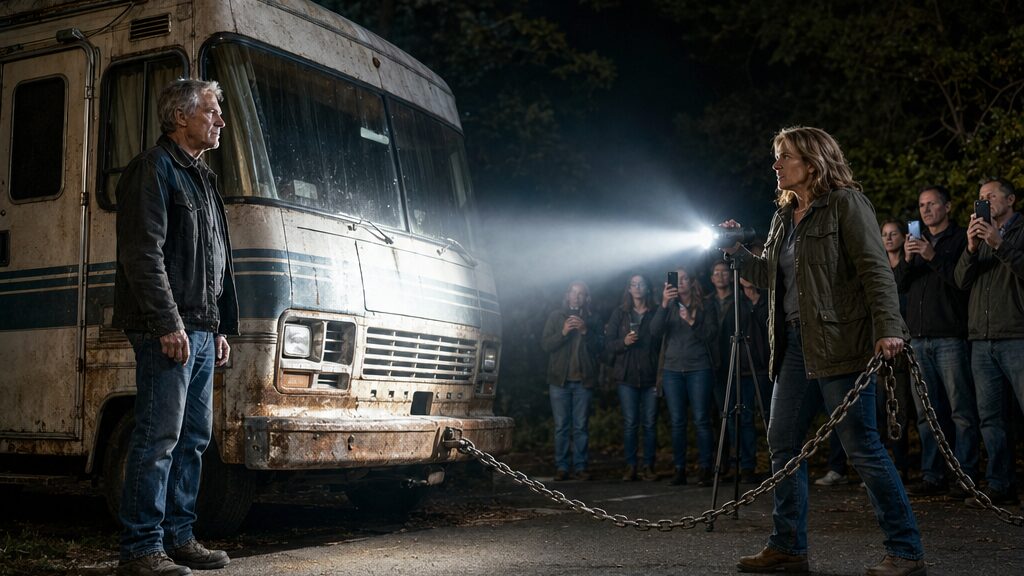
The first metallic crash echoed through the dead-end road shortly after sunset.
Matthew was awake before the second one came.
Inside the camper, he remained seated on the edge of his narrow bed.
Another impact.
Metal striking metal.
Deliberate.
Not an accident.
He exhaled slowly.
For nearly three weeks he had ignored rumors, insults, photographs, complaints, and surveillance.
Tonight felt different.
Outside, voices drifted through the darkness.
Excited voices.
Expectant voices.
An audience.
Matthew stood and moved to the window.
The sight waiting outside made him close his eyes for a moment.
A heavy tow chain hung from his front bumper.
Patricia Adams stood beside it.
Several residents surrounded her.
Some carried phones.
Some carried folding chairs.
One neighbor had brought drinks.
They looked less like concerned residents and more like spectators waiting for entertainment.
Patricia wore her Neighborhood Watch jacket like a uniform.
Beside her stood a portable lighting setup topped with a massive aircraft-aluminum tactical flashlight mounted on a tripod.
Its halogen beam blasted directly into the camper.
Someone laughed.
Someone else adjusted a camera angle.
Matthew remained motionless.
For several seconds.
Then he opened the camper door.
The conversations outside immediately quieted.
Patricia smiled.
“There he is.”
Matthew stepped down carefully.
His boots touched the dirt.
The crowd studied him.
Many had never seen him standing up close before.
The old man looked older than Patricia expected.
But he didn’t look weak.
That realization irritated her.
She pointed at the chain.
“You need to move.”
Matthew looked down at it.
Then back at her.
“No.”
Patricia gestured toward the blocked shortcut.
“You’ve caused enough trouble.”
“I haven’t caused any.”
The response earned scattered complaints.
Patricia stepped forward.
“You know exactly what you’ve done.”
Matthew looked past her.
At the road.
At the people.
At the cameras.
“You mean stopping people from using land they shouldn’t?”
The crowd reacted immediately.
Several neighbors exchanged looks.
Patricia pointed a finger.
“Nobody believes that.”
“That’s unfortunate.”
The answer sounded almost tired.
Not angry.
Not defensive.
Just tired.
Patricia hated that tone.
It suggested certainty.
She preferred uncertainty.
Uncertainty could be attacked.
The halogen beam intensified as someone adjusted the tripod.
The light struck Matthew directly in the face.
Most people would have shielded their eyes.
Matthew didn’t.
He simply stared into it.
The silence became uncomfortable.
One of the neighbors shifted nervously.
Jennifer stood near the back of the crowd.
She had arrived only minutes earlier after hearing rumors online.
The moment she saw the chain attached to the camper, she regretted coming.
This wasn’t a neighborhood discussion anymore.
It felt wrong.
Patricia reached toward the chain.
“We’re removing it.”
“No.”
“We absolutely are.”
“No.”
The calm repetition somehow sounded more forceful than shouting.
Patricia laughed sharply.
“You think you’re going to stop us?”
Matthew’s gaze moved to the chain.
Then to the mounted flashlight.
Then back to Patricia.
“Yes.”
The single word landed heavily.
The crowd sensed something changing.
Patricia sensed it too.
And rather than retreat, she pushed harder.
“Go ahead,” she said.
“What?”
“Stop us.”
Matthew looked at her for several seconds.
The old habit returned.
Silence.
The same silence that had protected him for years.
The same silence that had helped create this mess.
For a moment he nearly turned away.
Nearly walked back into the camper.
Nearly let it continue.
Then Patricia grabbed the chain.
The metal links scraped against the bumper.
Something inside Matthew finally snapped.
Not rage.
Decision.
He began walking.
Directly toward the light.
Several neighbors instinctively stepped aside.
Patricia remained where she stood.
The beam illuminated every line on Matthew’s face.
Every scar.
Every wrinkle.
He kept walking.
Steady.
Controlled.
Purposeful.
The crowd fell silent.
Jennifer felt her pulse quicken.
The atmosphere had changed completely.
Nobody seemed interested in recording anymore.
Nobody laughed.
Nobody spoke.
Matthew reached the tripod.
The flashlight continued blasting into his face.
Patricia suddenly looked uncertain.
Only for a second.
But Jennifer noticed.
So did several others.
Matthew stopped.
Looked directly into the blinding beam.
Then drove his boot into the tripod.
The impact was explosive.
Metal legs folded instantly.
The entire setup toppled sideways.
Gasps erupted across the crowd.
Before the flashlight even hit the ground, Matthew stepped forward.
His steel-toed boot came down with terrifying precision.
The thick lens shattered beneath it.
Glass burst outward.
The halogen bulb exploded.
The road went dark.
Silence followed.
A deep silence.
The kind that appears when people suddenly realize they may have misunderstood someone.
Matthew stared down at the ruined equipment.
Then looked at Patricia.
“Enough.”
Nothing more.
One word.
Yet nobody moved.
Nobody touched the chain.
Nobody spoke.
Patricia’s face reddened.
The cameras remained pointed toward her now.
Not toward him.
For the first time since the conflict began, she wasn’t controlling the scene.
The crowd sensed it.
She sensed it.
And panic started creeping beneath her confidence.
“You threatened me.”
Matthew said nothing.
“You destroyed property.”
Still nothing.
His calmness made the accusation sound weak.
Jennifer watched several neighbors quietly move farther away from Patricia.
Not because they supported Matthew.
Because they suddenly wanted distance.
The situation no longer felt safe.
Then someone finally called the police.
Patricia seized the opportunity immediately.
“Good.”
She pointed at Matthew.
“Let’s see what happens now.”
But even as she spoke, her certainty sounded forced.
The broken flashlight lay at Matthew’s feet.
The chain remained untouched.
And for the first time, Patricia looked like someone losing control rather than someone enforcing it.
In the distance, sirens began approaching.
Chapter 5: What The Light Revealed
The remains of the flashlight still smoked faintly when the police vehicles arrived.
Red and blue lights washed across the camper.
Across the crowd.
Across Patricia’s increasingly tense expression.
Matthew stood exactly where he had been standing for the last ten minutes.
Hands relaxed.
Shoulders straight.
Waiting.
Patricia rushed toward the first patrol car before the officer fully exited.
“There he is.”
She pointed immediately.
“He threatened people.”
The officer glanced at the shattered flashlight.
Then at the chain attached to the camper.
Then at Matthew.
His expression became cautious.
Not alarmed.
Cautious.
“What happened here?” he asked.
Everyone began talking at once.
Neighbors interrupted each other.
Accusations collided.
Defenses overlapped.
Videos appeared.
Competing versions of events emerged.
The officer looked exhausted within thirty seconds.
Matthew remained silent.
The same mistake again.
Jennifer recognized it immediately.
If he spoke, the situation might become clearer.
Instead he watched.
Observed.
Waited.
The officer eventually separated witnesses.
Jennifer found herself giving a statement.
So did several others.
The results were less helpful than Patricia expected.
Nobody could fully agree.
Some claimed Matthew had overreacted.
Others admitted Patricia initiated the confrontation.
A few quietly questioned why a tow chain had been attached to the camper in the first place.
That question lingered.
Patricia grew increasingly defensive.
“We were protecting the neighborhood.”
The officer frowned.
“By towing someone’s vehicle?”
“We weren’t actually going to—”
She stopped.
The unfinished sentence did not help.
Nearby, another officer examined the camper.
Then the chain.
Then the property.
The uncertainty spreading through the crowd became impossible to ignore.
For weeks everyone had viewed Matthew as the obvious problem.
Now nobody seemed entirely certain.
Jennifer watched him from across the road.
He wasn’t triumphant.
He wasn’t angry.
He looked disappointed.
As if the entire confrontation had been predictable.
As if he had hoped people would stop before reaching this point.
That realization unsettled her more than the confrontation itself.
One of the officers eventually approached Matthew.
“Sir.”
Matthew nodded.
The officer lowered his voice.
“Mind if I ask something?”
“No.”
“Why didn’t you call us earlier?”
Matthew glanced toward Patricia.
Then toward the crowd.
“I thought they’d stop.”
The officer looked at the destroyed flashlight.
“They didn’t.”
“No.”
The answer carried years of experience.
Years of understanding exactly how far people sometimes pushed.
The conversation ended there.
Another patrol vehicle arrived.
Then another.
The crowd noticed.
So did Patricia.
Her confidence briefly returned.
More officers meant more authority.
More authority meant someone would finally remove Matthew.
At least that was what she told herself.
Then a new vehicle appeared.
Not a patrol car.
A black SUV.
Several officers immediately straightened.
One stepped aside.
Another adjusted his uniform.
Jennifer noticed the reaction first.
Someone important had arrived.
The SUV door opened.
A tall man stepped out.
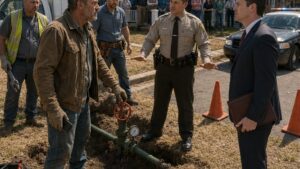
Police Chief Nicholas Hall.
Patricia smiled immediately.
This was perfect.
The chief himself.
A public resolution.
Exactly what she wanted.
She hurried toward him.
“Chief, thank goodness.”
Nicholas barely looked at her.
His attention had already moved past the crowd.
Past the officers.
Past the damaged equipment.
Directly toward Matthew Walker.
The chief stopped walking.
For a brief second he simply stared.
The expression on his face changed.
Confusion.
Recognition.
Disbelief.
Then something else.
Respect.
Deep respect.
Matthew looked back.
No surprise appeared on his face.
Only recognition.
The crowd sensed it immediately.
Patricia did not.
She continued talking.
“This man has been causing problems for weeks—”
Nicholas ignored her completely.
The chief began walking toward Matthew.
Fast.
The crowd parted instinctively.
Nobody understood what was happening.
Jennifer watched Patricia’s smile slowly disappear.
Nicholas reached Matthew.
Stopped.
And for a moment neither man spoke.
Then the chief extended his hand.
Not like an officer greeting a suspect.
Like a former subordinate greeting someone important.
Very important.
“Sir.”
The single word dropped into the silence.
Patricia’s face went pale.
Matthew shook his hand.
“Good to see you, Nicholas.”
The crowd stared.
Nobody spoke.
Nobody moved.
The entire situation had just changed.
But nobody yet understood how.
Nicholas looked around the road.
At the camper.
At the chain.
At the broken flashlight.
Then back at Matthew.
His expression hardened.
Not toward Matthew.
Toward everyone else.
And suddenly the question wasn’t whether Matthew Walker belonged there.
The question was why the police chief seemed to know him at all.
Chapter 6: The Man Everyone Thought Was A Squatter
Nicholas Hall stepped forward and wrapped both arms around Matthew Walker.
The gesture stunned the crowd more completely than anything that had happened all night.
Not the shattered flashlight.
Not the confrontation.
Not the police arrival.
This.
A police chief embracing the man everyone had spent weeks calling a squatter.
Patricia stared in disbelief.
“What is this?”
Neither man answered immediately.
Nicholas stepped back and looked at Matthew again.
“You should have called me.”
Matthew almost smiled.
“You’ve got enough problems.”
A few officers exchanged glances.
They clearly understood the significance of the interaction better than the crowd did.
Patricia pushed forward.
“No.”
Her voice rose.
“No, absolutely not.”
Nicholas finally looked at her.
The look alone stopped her for a moment.
Not anger.
Assessment.
The kind used by someone trying to understand how a situation became this bad.
Patricia recovered quickly.
“This man has been blocking access.”
She pointed toward the camper.
“He’s been creating problems for the entire neighborhood.”
Nicholas glanced toward the shortcut.
Then toward Matthew.
Then back to Patricia.
“Has he?”
The question carried a weight Patricia didn’t expect.
She rushed to fill the silence.
“We have complaints.”
“About what?”
“The road.”
Nicholas looked toward the dirt path.
One officer quietly approached and handed him a report.
The chief skimmed it.
His expression grew increasingly neutral.
A dangerous neutrality.
The kind that often appeared before unpleasant conclusions.
Meanwhile the crowd watched carefully.
People who had once spoken confidently now remained silent.
Nobody seemed certain where the situation was heading.
Jennifer noticed something else.
Matthew wasn’t enjoying this.
He wasn’t standing proudly.
He wasn’t taking victory laps.
He looked tired.
The same way he had looked during every conversation since arriving.
Nicholas folded the report.
“Matthew was my commanding officer.”
The statement landed like a stone dropped into still water.
Ripples spread through the crowd.
Patricia blinked.
“What?”
“My commanding officer.”
Nicholas didn’t raise his voice.
He didn’t need to.
“When I was a young Marine.”
The silence deepened.
Several residents looked at Matthew differently now.
Jennifer hated that.
Not because the information was unimportant.
Because it was already changing how people treated him.
The same people who ignored him yesterday suddenly seemed eager to respect him.
Matthew noticed it too.
His expression tightened slightly.
Nicholas turned toward him.
“You still carrying it?”
Matthew hesitated.
Then nodded once.
Without another word he walked toward the camper.
For the first time all evening, every eye followed him.
He disappeared inside.
Moments later he returned carrying a thick weathered folder.
Not dramatic.
Not ceremonial.
Just old.
Used.
Protected carefully over many years.
Patricia watched uneasily.
Nicholas accepted the folder.
Opened it.
Reviewed several documents.
Then another.
Then another.
The chief exhaled slowly.
“Well.”
Nobody spoke.
Nicholas held up a survey.
“This property isn’t abandoned.”
Patricia immediately interrupted.
“That doesn’t prove—”
“It proves quite a lot.”
His voice cut cleanly through hers.
He continued reviewing the paperwork.
Original surveys.
Transfer records.
Boundary confirmations.
Historical filings.
Enough pieces to create a picture even if some records remained archived.
The crowd listened as fragments emerged.
The shortcut.
The lot.
The access corridor.
The boundaries people ignored for years.
None belonged to the neighborhood association.
Several belonged directly to the parcel where Matthew sat parked.
The realization moved through the crowd visibly.
People looked toward the shortcut.
Toward the dirt path.
Toward the camper.
The blocked road suddenly meant something different.
It wasn’t an inconvenience.
It was a boundary.
One that had simply been ignored long enough to feel invisible.
Patricia shook her head.
“This can’t be right.”
“It is.”
“You haven’t checked everything.”
Nicholas looked at her calmly.
“Have you?”
That question landed harder than any accusation.
Patricia opened her mouth.
Nothing came out.
For weeks she had operated on certainty.
Now certainty was disappearing.
The crowd felt it.
Jennifer felt it.
Matthew certainly felt it.
But he remained silent.
Again.
The old habit.
The old instinct.
Let people figure it out themselves.
Avoid the spotlight.
Avoid the explanation.
Avoid becoming visible.
Nicholas closed the folder.
“There’s another issue.”
Patricia looked relieved.
Finally.
Something against Matthew.
Instead the chief pointed toward the chain.
Then toward the destroyed mounting equipment.
Then toward witness statements collected throughout the evening.
The relief vanished instantly.
Several officers exchanged meaningful looks.
The direction of the investigation had changed.
Completely.
Matthew stared at the chain attached to his camper.
At the crowd.
At Patricia.
For weeks he had endured everything.
The rumors.
The photographs.
The assumptions.
The surveillance.
Tonight had crossed a different line.
Nicholas lowered his voice.
“You want to pursue this?”
The question hung between them.
The crowd sensed its importance without hearing every word.
Matthew looked away.
Toward the shortcut.
Toward the path worn into land people assumed belonged to them.
Years of quiet tolerance had created this situation.
Years of saying nothing.
Years of letting people assume.
Maybe silence wasn’t peace.
Maybe it was permission.
Matthew looked back at Nicholas.
Then at Patricia.
For the first time since arriving, she looked genuinely afraid.
Not of punishment.
Of losing the identity she had built around being right.
Matthew didn’t answer immediately.
And the entire neighborhood waited to learn whether he would finally let the matter go.
Chapter 7: The Boundary Line Beneath Everyone’s Feet
The answer came the next morning.
At eight o’clock, two patrol cars rolled slowly onto the dead-end road.
A third vehicle followed.
Then another.
Neighbors emerged from houses and gathered near the shortcut.
Word had spread overnight.
Nobody knew exactly what would happen.
Everyone knew it would matter.
Matthew stood beside his camper holding a coffee mug.
The same folding chair sat nearby.
The same weathered camper occupied the same patch of land.
Yet the scene felt completely different.
People looked at him differently now.
Some nodded respectfully.
Some avoided eye contact.
A few appeared embarrassed.
Matthew disliked all of it.
Yesterday they had judged him without knowing him.
Today they respected him for reasons that had nothing to do with who he was.
The shift felt equally hollow.
Nicholas Hall stepped from his vehicle carrying a folder.
Several officers followed.
Patricia arrived moments later.
She looked exhausted.
The confidence that had fueled weeks of confrontation had vanished.
Still, she carried herself upright.
Still, she refused to retreat.
Residents parted as she approached.
Not out of respect.
Out of uncertainty.
Jennifer noticed it immediately.
The social gravity had shifted.
People who once followed Patricia’s lead now seemed reluctant to stand beside her.
Nicholas opened the folder.
“We have completed our review of the incident.”
Nobody spoke.
The chief continued calmly.
“Witness statements, photographs, recordings, and physical evidence establish that unauthorized attempts were made to interfere with Mr. Walker’s vehicle.”
Patricia’s jaw tightened.
“We were trying to solve a problem.”
Nicholas looked at her.
“You created one.”
The words were not harsh.
They didn’t need to be.
The facts were doing the work.
One officer stepped toward the camper and photographed the chain still attached to the bumper.
Another documented damage caused during the confrontation.
Patricia looked around as though searching for support.
Few eyes met hers.
Many turned away.
For the first time, Jennifer felt sympathy for her.
Not because Patricia was right.
Because humiliation was unfolding in public.
Because nobody deserves to discover they are alone while standing in a crowd.
But sympathy didn’t erase responsibility.
Patricia had chosen every step that led here.
The rumors.
The surveillance.
The escalation.
The tow chain.
The confrontation.
Each choice had seemed justified when made.
Together they had become something else.
Nicholas handed several papers to another officer.
The officer approached Patricia.
Her face drained of color.
“No.”
The word escaped before she could stop it.
The officer spoke quietly.
Professional.
Respectful.
Firm.
Patricia listened.
Shook her head.
Then listened again.
Around them, residents whispered.
Nobody seemed interested in defending her anymore.
The silence felt heavier than criticism.
Jennifer stepped forward unexpectedly.
Her own heart hammered.
She hadn’t planned to speak.
But she remembered the meetings.
The accusations.
The assumptions.
And she remembered how easy it had been to stay quiet.
“I saw him help people,” she said.
Several heads turned.
Jennifer swallowed.
“He fixed my car.”
Nobody interrupted.
“He helped the delivery driver.”
More silence.
“We kept acting like we knew who he was.”
Matthew looked down at his coffee.
Jennifer wasn’t speaking to defend him anymore.
She was speaking because she regretted not speaking sooner.
Patricia stared at the ground.
For the first time, she offered no argument.
No explanation.
No accusation.
Only silence.
And Matthew understood that silence better than anyone there.
He had lived inside it for years.
Sometimes silence protected dignity.
Sometimes it protected fear.
Sometimes it protected mistakes.
The officer finally produced handcuffs.
A collective breath moved through the crowd.
Patricia looked up.
Her eyes found Matthew.
Not angry.
Not defiant.
Lost.
The identity she had built around certainty had collapsed.
The neighborhood protector.
The problem solver.
The person who always knew what needed to be done.
Gone.
In its place stood an ordinary woman forced to confront what her certainty had cost.
Nicholas glanced toward Matthew.
The question lingered.
Even now.
Even after everything.
The charges could proceed.
Or not.
Matthew set his coffee mug down.
He walked slowly toward Patricia.
Several people tensed.
Patricia herself looked uncertain.
Matthew stopped a few feet away.
When he finally spoke, his voice was quiet.
“You never once asked my name.”
Patricia stared at him.
“You asked where I came from.”
Silence.
“You asked why I was here.”
More silence.
“You never asked who I was.”
Patricia looked away.
The statement struck harder than any insult could have.
Because it was true.
Matthew wasn’t talking about military service.
Or property records.
Or legal rights.
He was talking about something simpler.
The thing everyone had ignored.
Human dignity.
He stepped back.
Then looked at Nicholas.
“Proceed.”
The word carried no satisfaction.
No revenge.
Only finality.
The officers moved forward.
Patricia didn’t resist.
Tears appeared only after the handcuffs clicked shut.
Not dramatic tears.
Not loud tears.
Quiet ones.
The kind people shed when reality finally defeats the story they told themselves.
As she was escorted toward the cruiser, nobody cheered.
Nobody celebrated.
The moment felt too heavy for that.
The vehicle door closed.
The cruiser pulled away.
And the dead-end road became silent again.
Hours later, workers arrived.
Under county supervision, barriers were installed across the shortcut.
For the first time in years, vehicles would no longer cross the land.
Drivers complained.
Briefly.
Then adapted.
As people always did.
By late afternoon, only a few residents remained.
Jennifer stood near the new barrier.
“It’ll be strange,” she said.
Matthew looked toward the blocked path.
“It already was.”
She laughed softly.
For the first time since meeting him, he almost smiled.
“Are you staying?” she asked.
Matthew considered the question.
Weeks earlier, the answer would have been obvious.
Stay hidden.
Stay alone.
Avoid attention.
Avoid people.
But isolation had nearly become surrender.
And he was tired of surrendering pieces of himself to other people’s assumptions.
“Probably.”
Jennifer nodded.
“Good.”
She started to leave.
Then paused.
“Maybe next time we can have a conversation that lasts more than thirty seconds.”
Matthew’s smile finally appeared.
Small.
Real.
“We’ll see.”
Jennifer walked away.
The sun drifted lower.
Shadows stretched across the property.
Matthew remained beside the camper.
The deed rested inside.
The road stood closed.
The boundaries were finally visible.
But the most important thing wasn’t written on any survey map.
Ownership had never been the deepest issue.
Respect was.
The shortcut had taught an entire neighborhood something they should have known long before the camper arrived.
A person does not become worthy of dignity only after proving their status.
Matthew picked up his coffee mug and sat in his folding chair.
Cars traveled the longer route home.
The blocked road remained blocked.
And for the first time since arriving, nobody questioned whether he belonged there.
The story has ended.