The Forgotten Veteran They Tried to Turn Away Until One Callsign Silenced the Entire Military Gala
Chapter 1: The Man Waiting Outside the Velvet Rope
“Sir, step aside. Important guests are arriving.”
The young officer didn’t raise his voice. He didn’t need to.
The words carried the quiet certainty of someone accustomed to being obeyed.
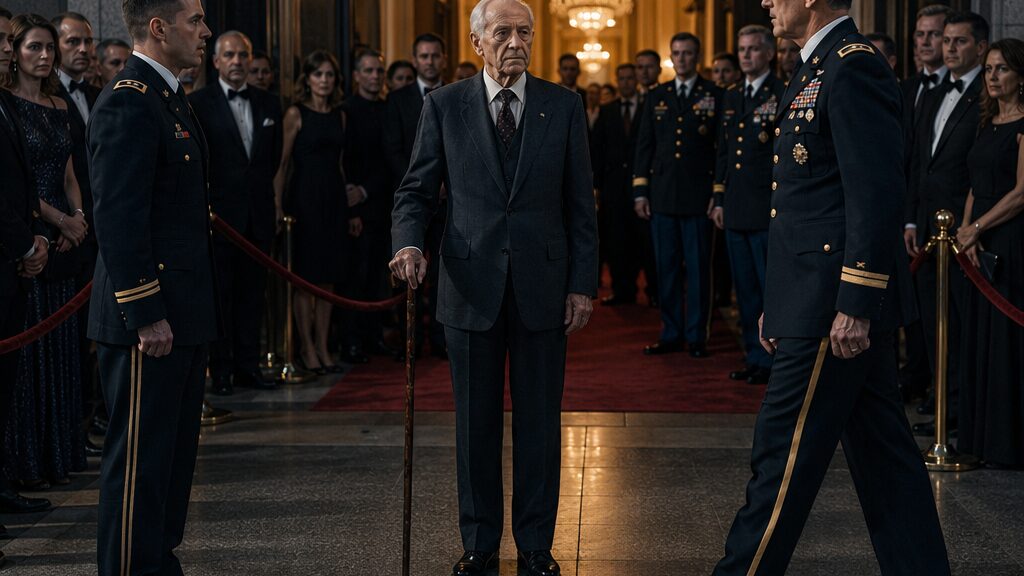
George Harris stopped just short of the velvet rope stretched across the entrance to the Grand Regency Ballroom. Behind the glass doors, chandeliers glowed like suspended stars. Uniformed officers moved beneath them. Politicians smiled for cameras. A military band played somewhere inside.
The officer gestured toward a waiting area near the curb.
George looked at the spot.
Then he looked back at the entrance.
“I’ll wait here,” he said.
The officer frowned.
“Sir, that’s not permitted.”
George adjusted his grip on his cane.
Its polished wooden handle had been worn smooth by decades of use.
He nodded once.
“I understand.”
Yet he remained exactly where he was.
A black sedan rolled forward.
Two decorated officers stepped out.
Security immediately opened the rope.
The guests were welcomed through without delay.
The officer glanced back toward George.
His expression shifted slightly.
Not hostility.
Annoyance.
The old man didn’t fit.
Everyone arriving wore tailored uniforms, evening gowns, or formal military dress.
George wore a dark suit that had clearly been altered more than once over the years.
His shoes were polished but old.
His silver hair was neatly combed.
Nothing about him suggested importance.
Nothing except the way he stood.
Despite leaning on a cane, his back remained perfectly straight.
The officer noticed it.
So did several others.
“Sir,” he tried again, “if you’re waiting for someone, I can help locate them.”
“No need.”
“Do you have an invitation?”
George reached into his coat.
The officer’s posture stiffened.
Instead of producing paperwork, George withdrew a folded handkerchief and quietly wiped his glasses.
“No.”
The officer blinked.
“No invitation?”
“No.”
“Then you can’t enter.”
George simply nodded.
The answer appeared to satisfy him.
Which somehow irritated the officer more.
Most people argued.
Most demanded exceptions.
Most tried to leverage status.
George did none of those things.
He accepted every obstacle without complaint.
Then refused to leave.
The line of arriving guests continued to grow.
A television crew appeared.
Flashes from cameras lit the sidewalk.
A few people began noticing the elderly man standing alone near the rope.
One woman assumed he was lost.
Another mistook him for a guest’s grandfather.
A pair of younger officers walked past him without a second glance.
George seemed unaffected.
He watched the arrivals.
Watched the uniforms.
Watched the medals.
Occasionally his gaze lingered on the youngest soldiers working security.
There was no bitterness in his expression.
Only observation.
The officer checked his watch.
“Sir.”
George looked up.
“You’re creating a problem.”
“Am I?”
“People keep asking why you’re standing here.”
“Then tell them I’m waiting.”
The officer exhaled slowly.
“What for?”
For the first time, George hesitated.
His eyes moved toward the ballroom.
Toward the glow behind the glass.
Toward the music.
Then he answered.
“A promise.”
The officer stared.
The response somehow felt less helpful than silence.
Another vehicle arrived.
A retired colonel emerged from the rear seat.
As the man passed through security, his eyes briefly settled on George.
For a moment he slowed.
Studied him.
Then continued inside.
George noticed.
The colonel had not recognized him.
That was unsurprising.
Most didn’t anymore.
Years had a way of erasing faces while preserving legends.
The problem was that legends rarely looked old.
The officer’s radio crackled.
A supervisor requested a status update.
He glanced toward George.
“Still here,” he muttered.
The reply came instantly.
“Move him.”
The officer winced.
That was easier said than done.
George wasn’t causing a disturbance.
He wasn’t breaking rules.
He wasn’t shouting.
He was simply existing in the wrong place.
Which made forcing him away far more awkward.
The officer approached again.
“Sir, I’m going to ask one final time.”
George waited.
“Please move to the designated area.”
“No.”
The answer was calm.
Firm.
Absolute.
The officer felt several nearby guests watching.
His face grew warm.
Now it looked as though he couldn’t control an elderly civilian.
The situation was becoming embarrassing.
For him.
Not for George.
“Why are you making this difficult?”
George looked genuinely puzzled.
“I wasn’t aware I was.”
The officer laughed once in disbelief.
“You don’t have credentials.”
“No.”
“You don’t have an invitation.”
“No.”
“You refuse to leave.”
“Yes.”
“Then help me understand.”
George considered the request.
For several seconds he said nothing.
Traffic rolled past.
The band inside shifted to a slower piece.
Camera flashes flickered against the glass entrance.
Then George asked quietly:
“Have you been in the service long?”
The question caught the officer off guard.
“Five years.”
George nodded.
“A good start.”
The officer waited.
George offered nothing else.
The conversation died there.
Somehow that irritated him even more.
A security manager now approached from inside.
A civilian event coordinator joined him.
Both glanced at George.
The coordinator whispered something.
The manager frowned.
They clearly assumed he had wandered into the wrong event.
The manager stepped forward.
“Sir, can someone come pick you up?”
George smiled faintly.
“No.”
“Do you know what event this is?”
“Yes.”
“Then perhaps you understand why access is restricted.”
“I do.”
The manager looked helplessly at the officer.
Neither knew what to do.
George wasn’t confused.
He wasn’t disruptive.
He wasn’t leaving.
And despite the awkwardness surrounding him, he seemed entirely at peace.
The coordinator folded her arms.
“Maybe call local assistance.”
George heard her.
He did not react.
The suggestion hung in the air.
The officer suddenly felt uncomfortable.
The old man deserved better than that.
Yet protocol was protocol.
He checked his watch again.
Inside, the evening program would begin soon.
The entrance had to be cleared.
“Sir.”
George looked up.
“Last chance.”
The old veteran slowly shifted his cane.
Tap.
The sound was soft.
Tap.
He took a single step forward.
Not enough to cross the rope.
Just enough to force the officer to meet his eyes.
For the first time that evening, something changed.
The officer realized there was no uncertainty in George.
No confusion.
No desperation.
No hope of being admitted.
The old man was waiting because he knew something the rest of them did not.
The realization sent a strange chill down his spine.
“Who are you?” the officer asked.
George studied him for a long moment.
Then he answered.
Quietly.
Almost gently.
“Tell your commander Iron Six is here.”
The officer froze.
Chapter 2: A Name That Stops Conversations
For three seconds Tyler Ramirez forgot how to breathe.
The name struck him with unexpected force.
Not because he understood it.
Because he recognized it.
Somewhere.
Buried beneath years of military schooling, briefings, and forgotten lectures.
Iron Six.
The words felt familiar.
Dangerously familiar.
George waited.
Tyler stared.
The sounds of the gala seemed to fade.
“What did you say?”
“Iron Six.”
The old man’s expression remained calm.
Tyler swallowed.
“That’s your callsign?”
George merely nodded.
Tyler’s pulse quickened.
A memory flickered.
A classroom.
An instructor.
A campaign map projected on a wall.
The name Iron Six spoken with unusual respect.
Then nothing.
The memory vanished.
Tyler reached for his radio.
“What exactly are you asking me to do?”
“Tell your commander.”
“That’s it?”
“Yes.”
Tyler almost laughed.
Instead he pressed the transmit button.
“Command, this is Entry Control.”
Static answered.
Then a voice.
“Go ahead.”
Tyler hesitated.
The hesitation itself drew attention.
“There’s… someone here.”
“Be specific.”
“He says his callsign is Iron Six.”
Silence.
Complete silence.
Tyler checked the radio.
For a moment he thought transmission had failed.
Then the voice returned.
Different now.
Sharper.
“Repeat.”
Tyler obeyed.
Again silence followed.
Longer this time.
Then:
“Do not leave him unattended.”
The channel went dead.
Tyler lowered the radio.
His stomach tightened.
Something had changed.
The old veteran remained exactly where he had been.
Tap.
Tap.
The cane touched pavement.
Steady.
Patient.
As if George had expected this outcome all along.
Word began spreading faster than Tyler realized.
Security staff whispered.
A coordinator overheard.
A retired officer standing nearby suddenly turned around.
“Did you say Iron Six?”
Tyler looked at him.
The retired officer stepped closer.
His eyes moved toward George.
For several seconds he simply stared.
Not recognition.
Something else.
Memory.
“Impossible,” the man murmured.
George offered a small nod.
The retired officer’s face went pale.
Without another word, he stepped aside.
Tyler noticed.
So did several others.
The atmosphere around the entrance shifted.
People who had ignored George now looked twice.
Then three times.
Questions spread.
Nobody had answers.
The ballroom doors opened.
A group of officers emerged.
One immediately approached Tyler.
“What happened?”
Tyler explained.
The officer’s expression darkened.
He glanced toward George.
Then away.
Then back again.
As though trying to compare the elderly man before him with some impossible image from decades earlier.
“Are you certain?”
“He said it himself.”
The officer rubbed his jaw.
“Stay here.”
He disappeared inside.
Tyler watched him go.
The growing unease in his chest was becoming difficult to ignore.
Who exactly had he been arguing with for the past twenty minutes?
Across the entrance, George remained motionless.
The noise surrounding him increased.
Yet somehow the old veteran appeared detached from it.
Like a stone standing in a river.
People moved around him.
Pressure flowed around him.
Nothing altered his posture.
Nothing bent his spine.
A young private standing guard near the doorway kept glancing over.
Paul Johnson.
Nervous.
New to ceremonial duty.
He watched the developing scene with fascination.
Their eyes met briefly.
George nodded.
Paul instinctively straightened.
Embarrassed, he quickly looked away.
Tyler noticed that too.
For reasons he couldn’t explain, the old man seemed capable of affecting everyone around him without saying much at all.
Another radio transmission arrived.
“Entry Control.”
Tyler answered immediately.
“Sir.”
“Keep him there.”
“I wasn’t planning to move him.”
A pause.
Then:
“You’d better not.”
The line disconnected.
Tyler stared at the device.
His career suddenly felt very fragile.
Inside the ballroom, activity changed.
People began leaving tables.
Several senior officers gathered near one side entrance.
Staff members moved hurriedly between rooms.
A rumor swept through the crowd.
Tyler caught fragments.
“Can’t be him.”
“He’s alive?”
“After all these years?”
“Someone verify.”
Nobody seemed interested in the gala anymore.
Only the name.
Iron Six.
Tyler found himself studying George again.
The veteran looked tired.
Older than before.
His hand rested lightly on the cane.
A slight tremor touched his fingers.
Age had finally claimed parts of him.
Yet the posture remained untouched.
Straight.
Rigid.
Uncompromising.
A spine built from something stronger than muscle.
Tyler approached.
Carefully this time.
“Sir.”
George looked up.
“What happened to you?”
The question escaped before Tyler could stop it.
George smiled faintly.
“Life.”
Tyler shook his head.
“No. I mean… why does everyone know that callsign?”
George’s eyes drifted toward the ballroom.
“Not everyone does.”
The answer somehow felt heavier than any explanation.
Before Tyler could ask more, movement erupted near the entrance.
Several officers stepped aside simultaneously.
Conversations died.
Heads turned.
A path opened through the crowd.
Tyler recognized the man immediately.
General Alexander Martin.
The guest of honor.
The senior officer scheduled to lead the evening’s ceremony.
The person whose appearance on stage had been delayed three times already.
And he was walking away from the ballroom.
Walking away from hundreds of waiting guests.
Walking directly toward the entrance.
Toward George Harris.
Tyler’s mouth went dry.
The general wasn’t hurrying.
Yet there was unmistakable purpose in every step.
The crowd sensed it too.
Whispers followed him.
Questions multiplied.
Nobody understood why one of the most respected generals in the country would leave the center of the gala to approach an unknown elderly man outside.
Except perhaps George.
George seemed unsurprised.
Tap.
The cane touched the ground once.
Alexander Martin reached the velvet rope.
Then stopped.
His eyes locked onto the old veteran.
And for the first time all evening, the general looked stunned.
Chapter 3: The Weight Behind the Callsign
“Sir.”
The word escaped Alexander Martin almost as a breath.
Not a greeting.
Not protocol.
Recognition.
The crowd fell silent.
Tyler had never heard the general sound uncertain before.
Yet uncertainty was exactly what crossed Alexander’s face.
Along with something else.
Respect.
Deep respect.
George regarded him calmly.
“Alexander.”
The general’s jaw tightened.
Only a handful of people in the military would dare address him that way.
Even fewer could make it sound natural.
“It’s really you.”
George smiled faintly.
“Looks like it.”
Alexander stepped closer.
For a moment it seemed he might shake George’s hand.
Instead he stopped.
Neither man moved.
Years hung between them.
Decades.
Tyler watched in confusion as the general’s eyes briefly dropped to the cane.
Then returned to George’s face.
“You should have told us you were coming.”
George’s answer arrived immediately.
“No.”
A small laugh escaped Alexander.
Not amusement.
Recognition.
The answer was exactly what he expected.
“Still stubborn.”
“Still talking too much.”
Several nearby officers exchanged glances.
The general ignored them.
“Come inside.”
George looked through the ballroom doors.
Music still played.
Guests continued watching.
“The ceremony should start.”
“It can wait.”
Alexander’s tone left no room for debate.
For the first time all evening, the rope was lowered without question.
Tyler stepped aside.
George entered.
Not quickly.
Not ceremonially.
Just an old man walking with a cane.
Tap.
Tap.
Tap.
Yet conversations stopped as he passed.
People moved aside instinctively.
Few understood why.
Many simply sensed they should.
Alexander led him away from the ballroom and down a quieter corridor toward a private holding room used by event organizers.
Once the door closed, the noise faded.
The room contained little more than a conference table and several chairs.
George immediately chose the simplest chair available.
Alexander remained standing.
For several seconds neither spoke.
Then the general laughed softly.
“I spent twenty years wondering if I’d ever see you again.”
George leaned on his cane.
“You weren’t missing much.”
Alexander stared.
“That’s not true.”
The older man looked away.
Silence followed.
Tyler remained near the door, uncertain whether he should leave.
Alexander noticed.
“Stay.”
The young officer froze.
“Yes, sir.”
“You should hear this.”
George sighed.
“I don’t know why.”
“Because it’s your story.”
“No.”
George’s gaze settled on the floor.
“It’s theirs.”
Alexander’s expression changed.
Tyler didn’t understand why.
But he sensed they were speaking about people who weren’t in the room.
People who never would be.
The general sat opposite him.
“You know they still teach it.”
George looked unimpressed.
“They shouldn’t.”
“The battle changed everything.”
“Lots of battles changed things.”
“Not like that one.”
George rubbed a thumb along the worn handle of his cane.
The movement seemed unconscious.
Like touching an old scar.
Tyler finally asked the question burning inside him.
“What happened?”
Alexander looked at him.
Then at George.
Permission silently passed between them.
The general spoke carefully.
“Thirty-eight years ago there was a mountain position everyone thought was lost.”
George remained silent.
Alexander continued.
“A company was surrounded. Communications were collapsing. Casualties were catastrophic.”
Tyler listened.
The room seemed smaller now.
“Every report predicted total failure.”
“And?” Tyler asked.
Alexander looked toward George.
“Someone refused to leave.”
The old veteran closed his eyes briefly.
Just once.
A tiny reaction.
But enough.
“You were Iron Six,” Tyler said.
George didn’t answer.
Alexander did.
“He held the line long enough for hundreds of soldiers to get out.”
Tyler stared.
“Hundreds?”
“Nobody knows the exact number.”
The room fell quiet.
George finally spoke.
“You’re making it sound heroic.”
“It was.”
“No.”
His voice sharpened.
The first hint of irritation all evening.
“It was ugly.”
Alexander nodded.
“Yes.”
“People died.”
“Yes.”
“Good people.”
The general lowered his gaze.
The conversation stopped.
Tyler understood something then.
The legend and the man were not the same thing.
The legend inspired.
The man remembered names.
And names weighed more than stories.
A knock interrupted them.
An event coordinator entered carrying a folder.
She stopped when she saw George.
“General, we’ve confirmed the records.”
Alexander barely looked at her.
“What records?”
“The historical archives.”
She opened the folder.
Photographs.
Commendations.
Unit histories.
Letters.
The accumulated paperwork of a lifetime.
“Media representatives would like a statement.”
“No.”
The answer came from George.
The coordinator blinked.
“We were thinking perhaps a formal introduction during the gala.”
“No.”
“A recognition ceremony.”
“No.”
Alexander hid a smile.
The coordinator looked increasingly desperate.
“Sir, people need to know who you are.”
George rose slowly.
Pain crossed his face for the briefest moment.
Then vanished.
He stood straight.
Perfectly straight.
The cane supporting his body.
Not his will.
“That’s exactly the problem,” he said quietly.
The room fell silent.
The coordinator frowned.
“I don’t understand.”
George looked at the photographs spread across the table.
Images of young men.
Uniforms.
Dust.
Smiles frozen in time.
“You know who I am.”
His finger rested on one photograph.
“Do you know who he was?”
Nobody answered.
George moved to another photograph.
“Or him?”
Another.
“Or her brother?”
Silence deepened.
The coordinator’s confidence disappeared.
Alexander looked away.
George withdrew his hand.
“That’s why I don’t do ceremonies.”
No one spoke.
Outside, faint music drifted through the walls.
The gala continued waiting.
The room did not.
Finally Alexander broke the silence.
“We already prepared a tribute.”
George looked at him.
The general held his gaze.
“We spent months organizing it.”
George nodded once.
Then delivered the answer that changed everything.
“No.”
Chapter 4: The Invitation He Never Answered
“No.”
The single word settled over the room.
The event coordinator stared at George as if she had misheard him.
Alexander leaned back in his chair.
“George.”
“No.”
“We already have the presentation prepared.”
“No.”
“People came here to honor you.”
George looked toward the photographs scattered across the table.
“That’s the problem.”
The coordinator picked up one of the folders.
“Sir, with respect, people deserve to know.”
George’s gaze drifted to the image she held.
A grainy photograph.
Young faces.
Dust-covered uniforms.
One of the men was laughing at something beyond the frame.
George remembered exactly what.
A joke about terrible coffee.
A complaint about rain.
A conversation that had lasted less than thirty seconds.
The young man in the picture had died before sunset.
“Do they know his name?” George asked.
The coordinator lowered the photograph.
“No.”
“Then they don’t deserve to know mine.”
Silence returned.
Alexander rubbed his forehead.
The reaction didn’t surprise him.
What surprised him was how much he wanted to argue.
The entire evening had been built around recognition.
Prestige.
History.
Tradition.
Now the man at the center of it wanted none of it.
A knock interrupted them.
Another staff member entered carrying a thin envelope.
“General.”
Alexander accepted it.
His eyes narrowed.
“What is this?”
“Archive records.”
The staff member glanced nervously toward George.
“We found additional correspondence connected to tonight’s invitation.”
George immediately looked away.
Alexander noticed.
That alone made him open the envelope.
Inside was a copy of a formal invitation.
Gold lettering.
Official seals.
Months old.
Alexander scanned it.
Then stopped.
“George.”
The veteran remained silent.
“This was delivered.”
“Yes.”
“You received it.”
“Yes.”
“You never replied.”
“No.”
Tyler looked from one man to the other.
The answer explained part of the confusion.
The event organizers had expected no response because they had received none.
Eventually someone had assumed the veteran was either unavailable or uninterested.
The invitation had remained on records.
The misunderstanding had grown.
Then tonight happened.
Alexander folded the paper carefully.
“You could have prevented all of this.”
George’s expression tightened.
“Yes.”
The admission surprised everyone.
No excuse.
No justification.
Just acceptance.
Tyler found himself asking, “Then why didn’t you?”
The old veteran studied the young officer for a long moment.
Before he could answer, another document slipped from the envelope.
A handwritten note.
Alexander unfolded it.
The paper was older.
Worn.
Creased.
His eyes moved across the page.
Then he frowned.
“What is this?”
George’s face changed.
Only slightly.
But enough.
The room noticed.
Alexander read silently.
Then again.
The handwriting was unmistakably George’s.
A reply that had never been mailed.
The coordinator stepped closer.
“What does it say?”
Alexander hesitated.
George sighed.
“Read it.”
The general looked uncertain.
Then he obeyed.
“I appreciate the invitation. Unfortunately, I cannot attend a ceremony that celebrates one survivor while remaining silent about those who never came home.”
Nobody spoke.
Alexander continued.
“If their names are not part of the evening, mine should not be either.”
The room felt smaller.
Tyler glanced toward George.
The veteran was staring at the floor.
Not embarrassed.
Not proud.
Just tired.
The coordinator slowly sat down.
The paper remained in Alexander’s hands.
“You wrote this?”
George nodded.
“Then why didn’t you send it?”
The question lingered.
For the first time, George didn’t answer immediately.
His fingers tightened around the cane.
Tap.
The rubber tip touched the floor once.
“Because I wasn’t sure.”
Alexander looked up.
“About what?”
“Whether staying away was helping anyone.”
The admission caught everyone off guard.
George had appeared certain about everything else.
Not this.
The old veteran exhaled slowly.
“For years I told myself silence was respect.”
He looked toward the photographs.
“Maybe it wasn’t.”
No one interrupted.
“I thought if people remembered me less, they’d remember them more.”
His voice remained steady.
“But that’s not how memory works.”
Alexander lowered the letter.
A realization was beginning to form.
Not only in him.
In Tyler.
In the coordinator.
Perhaps even in George himself.
The veteran’s silence had not protected the past.
It had allowed the past to fade.
Outside the room, distant applause erupted from the ballroom.
The evening schedule was falling apart.
Guests were waiting.
Questions were multiplying.
A coordinator’s phone buzzed repeatedly.
Media representatives wanted explanations.
Senior officials wanted updates.
Everything was becoming increasingly difficult to manage.
Alexander stood.
“We have a problem.”
The coordinator laughed weakly.
“Several.”
“The tribute is already scheduled.”
George frowned.
“What tribute?”
“Video presentation.”
“No.”
“Historical introduction.”
“No.”
“Recognition ceremony.”
“No.”
Alexander crossed his arms.
“You don’t get to say no forever.”
George looked genuinely annoyed.
“Watch me.”
Tyler nearly smiled.
The general did not.
“You came here.”
“Yes.”
“You crossed half the country.”
“Yes.”
“You stood outside for thirty minutes.”
“Yes.”
“Why?”
The room fell silent.
George looked toward the ballroom doors.
The answer hovered there.
Close.
Not yet spoken.
Instead he asked a question of his own.
“Who’s serving tonight?”
Alexander frowned.
“What?”
“The soldiers.”
“Security details. Honor guard. Ceremonial assignments.”
“How many are under twenty?”
The question confused everyone.
Alexander thought for a moment.
“Several.”
George nodded.
Then nothing.
The coordinator stared.
“That’s not an answer.”
“No,” George said quietly. “Not yet.”
A loud knock interrupted them.
A senior aide stepped inside.
His face was tense.
“General.”
“What is it?”
“Guests are demanding an explanation.”
Alexander sighed.
“Tell them the ceremony will begin shortly.”
The aide hesitated.
“There’s something else.”
Everyone looked at him.
“Word has spread.”
Alexander’s eyes narrowed.
“How far?”
The aide swallowed.
“Most of the ballroom knows Iron Six is here.”
The room went silent.
The situation had changed.
There would be no quiet exit.
No slipping away unnoticed.
The secret was already becoming public.
The aide shifted awkwardly.
“People want to see him.”
George closed his eyes briefly.
When he opened them again, something weary lived there.
Not fear.
Not anger.
Recognition.
The choice he had avoided for years was catching up with him.
Alexander folded the unsent letter and placed it carefully back into the envelope.
Then he looked directly at George.
“Tell me the truth.”
George met his gaze.
“About what?”
“Why did you really come tonight?”
The old veteran stared at the photographs for several long seconds.
When he finally answered, his voice was barely above a whisper.
“Because I made a promise.”
Chapter 5: The Men He Refuses to Leave Behind
The room emptied except for Alexander, Tyler, and George.
Outside, the gala continued waiting.
Inside, time seemed to slow.
Alexander leaned forward.
“A promise to who?”
George looked at the photographs.
Rows of young faces.
Some smiling.
Some serious.
All frozen at an age they would never leave.
“Friends.”
The answer sounded insufficient.
Because it was.
Everyone knew it.
George rested both hands atop his cane.
For a while he said nothing.
Alexander let the silence remain.
This was not a man who could be pushed.
Eventually George spoke.
“There were thirty-two of us on that mountain.”
Tyler listened carefully.
No one interrupted.
“We weren’t special.”
A faint smile appeared.
“We argued constantly.”
The smile vanished.
“We complained about food.”
Another pause.
“We made plans.”
His thumb brushed the cane’s handle.
“Most of those plans never happened.”
The room grew still.
For the first time, George wasn’t speaking about history.
He was speaking about people.
Alexander had heard dozens of versions of the famous battle over the years.
Military historians loved discussing strategy.
Command decisions.
Tactical significance.
George ignored all of that.
Instead he talked about names.
One soldier who carried photographs of his daughters.
Another who played cards badly.
One who could never wake up on time.
A medic who sang off-key.
Tiny details.
Insignificant details.
The kind that disappeared from official records.
Tyler slowly understood.
The battle had become a legend.
The people had not.
“Afterward,” George said quietly, “everyone wanted a story.”
Alexander looked down.
He already knew where this was going.
“They wanted heroes.”
George nodded.
“They wanted survivors.”
His jaw tightened.
“I didn’t want either.”
The words landed heavily.
For decades people had assumed George avoided recognition out of modesty.
The truth was uglier.
Recognition carried a cost.
Every time someone called him a hero, he remembered who wasn’t standing beside him.
Every speech felt like an absence.
Every ceremony felt incomplete.
Alexander finally asked, “Why didn’t you ever tell anyone that?”
George almost laughed.
“Would it have mattered?”
“Yes.”
“No.”
The answer came instantly.
“You would have listened.”
Alexander said nothing.
“Then eventually you’d have done exactly what everyone else did.”
“What?”
“Turn it into a story.”
The general couldn’t argue.
Because he wasn’t entirely sure George was wrong.
A knock sounded.
The coordinator entered carrying a small box.
“I’m sorry.”
Her voice was softer now.
Different from before.
“We found something in the archive display.”
She opened the lid.
Inside were several photographs intended for the evening’s presentation.
George immediately recognized them.
His expression changed.
Alexander noticed.
“What’s wrong?”
George reached into the box.
His fingers trembled slightly.
He removed one photograph.
A group picture.
Thirty-two young soldiers.
Taken days before deployment.
Tyler watched him stare at it.
Then something unexpected happened.
George whispered a name.
Then another.
Then another.
Thirty years vanished from his face.
He wasn’t seeing photographs anymore.
He was seeing people.
The room remained silent.
When he finished, his hand lingered on one face.
A young soldier standing near the edge of the picture.
Alexander recognized the expression immediately.
Pain.
Old pain.
“Who was he?” the general asked.
George swallowed.
“Best man at my wedding.”
Nobody spoke.
“He never met my wife.”
The words struck harder than any dramatic confession could have.
Because they were simple.
True.
Unavoidable.
The coordinator quietly sat down.
Even Tyler looked away.
George returned the photograph to the box.
Carefully.
Like something fragile.
For a long moment nobody moved.
Then Alexander spoke.
“There was something I never understood.”
George glanced at him.
“The reports said you stayed behind.”
“Yes.”
“Why?”
The old veteran stared at the photographs.
Tyler expected a tactical answer.
Instead George said:
“Because I was in command.”
Alexander shook his head.
“That wasn’t enough.”
George looked at him.
“No?”
“Others would have left.”
The room fell silent.
Finally George answered.
“Maybe.”
“Then why didn’t you?”
The veteran’s eyes drifted toward the ballroom.
Toward the music.
Toward the future waiting outside the room.
When he spoke again, his voice carried no pride.
Only certainty.
“Because they trusted me.”
No one had a response.
Not Alexander.
Not Tyler.
Not the coordinator.
The simplicity of it made it impossible to argue with.
A commander had stayed because his people believed he would.
Nothing more.
Nothing less.
The room remained silent until George slowly rose from his chair.
Pain flashed across his face.
Then disappeared.
He stood straight.
The same impossible posture.
The same stubborn spine.
Alexander stood as well.
“Where are you going?”
George looked toward the ballroom doors.
“It’s almost time.”
“For what?”
The old veteran’s gaze settled briefly on Tyler.
Then through the wall beyond him.
Toward hundreds of soldiers.
Toward a generation that knew the legend but not the lesson.
His voice softened.
“I didn’t come here to be honored.”
Alexander felt something shift.
The answer was finally coming.
George adjusted his grip on the cane.
Then he revealed the truth he had carried all evening.
“I came here to find someone worth remembering after I’m gone.”
Chapter 6: The Slow Salute
The ballroom fell silent before George even entered.
News traveled faster than announcements.
Hundreds of guests were already standing.
Conversations died one by one as the doors opened.
George stepped through first.
Tap.
The cane touched polished marble.
Every sound seemed louder now.
Tap.
Alexander followed several steps behind.
Tyler remained near the wall.
Watching.
Trying to understand how one elderly veteran had managed to become the center of a room filled with generals, politicians, and decorated officers.
George looked uncomfortable.
Not nervous.
Uncomfortable.
Like a man wearing someone else’s clothes.
Rows of tables stretched beneath glittering chandeliers.
Military banners hung from the walls.
At the far end of the room stood a stage prepared for celebration.
George had no interest in it.
Yet every eye followed him.
The room’s attention felt physical.
Heavy.
Alexander stepped onto the stage.
A microphone waited.
He ignored it.
Instead he looked directly at the audience.
“Many of you came here expecting a ceremony.”
His voice carried effortlessly.
“You’ll still get one.”
The room remained silent.
“But not the one we planned.”
A murmur moved through the crowd.
Then disappeared.
Alexander turned toward George.
The old veteran stood motionless.
Cane in hand.
Back straight.
Eyes steady.
The general continued.
“Tonight we intended to honor a military legend.”
George’s jaw tightened.
Alexander noticed.
“Unfortunately,” the general said, “we made a mistake.”
Now the audience leaned forward.
“We nearly left him standing outside.”
A ripple of discomfort swept through the room.
Several people exchanged uneasy glances.
Tyler felt heat rise into his face.
Alexander didn’t look away.
“That’s on us.”
The honesty surprised everyone.
George most of all.
“We became very good at recognizing uniforms.”
The general’s voice softened.
“Sometimes we forget to recognize people.”
The room grew quieter still.
Alexander stepped down from the stage.
Slowly.
Purposefully.
Every movement deliberate.
He crossed the floor toward George.
No one spoke.
No one moved.
Tap.
George’s cane touched the floor once.
The sound echoed through the silence.
Alexander stopped directly in front of him.
For a moment neither man said anything.
The distance between them felt filled with decades.
Memories.
Names.
Promises.
Losses.
The entire ballroom watched.
Then Alexander drew himself to attention.
Perfect posture.
Perfect stillness.
A breath passed.
Another.
Then the general raised his hand.
Slowly.
Painfully slowly.
The salute took seconds.
Long enough for everyone to understand it was intentional.
Long enough for the gesture itself to become a message.
This was not protocol.
This was respect.
Absolute.
Complete.
The room seemed to stop breathing.
George looked at him.
The old veteran’s eyes glistened briefly.
Then steadied.
Around them, chairs shifted.
Uniforms rustled.
One by one, officers rose.
Then soldiers.
Then civilians.
An entire ballroom followed.
Hundreds of people standing.
Hundreds of salutes.
A sea of stillness.
George found himself surrounded by something he had spent years avoiding.
Recognition.
Not for the battle.
Not for the legend.
For the man.
The weight of it settled over him.
For one dangerous moment he considered turning away.
Refusing.
Escaping.
Retreat had always been easier.
Silence had always been easier.
Then he remembered the promise.
Not to the dead.
To the living.
Slowly, George returned the salute.
The room exhaled.
But something had changed.
The gesture no longer belonged solely to him.
Respect had become collective.
Shared.
The applause everyone expected never came.
No one dared break the silence.
George lowered his hand.
Alexander stepped aside.
The stage waited.
The microphone waited.
The spotlight waited.
George ignored all of them.
Instead he looked across the ballroom.
Searching.
Watching.
The crowd parted instinctively as he began walking.
Tap.
Tap.
Tap.
The cane echoed through the room.
Rows of decorated officers stood at attention.
Political leaders stood at attention.
Guests stood at attention.
George walked past every one of them.
Confusion spread.
Where was he going?
The answer became clear when he finally stopped.
Near the back of the ballroom.
Beside a young private frozen in shock.
Paul Johnson.
The nervous soldier from the entrance.
Paul stared at him.
Unable to move.
Unable to understand why the most important man in the room was standing directly in front of him.
George studied the young soldier quietly.
Then lifted his hand.
And returned the private’s salute.
The entire ballroom watched.
Wondering why.
Chapter 7: Carry It Well, Son
Paul Johnson’s arm remained locked in salute.
He wasn’t sure whether he was breathing.
The entire ballroom had disappeared.
The generals.
The politicians.
The cameras.
The chandeliers.
All of it blurred beyond the elderly man standing in front of him.
George Harris held the salute for a moment longer.
Then slowly lowered his hand.
The room remained silent.
Paul lowered his own arm a second later.
His face burned.
He had rehearsed ceremonial duties for weeks.
None of those rehearsals included becoming the focus of hundreds of staring eyes.
“Sir,” he managed.
His voice cracked.
A few people smiled.
George did not.
Not out of coldness.
Out of seriousness.
The old veteran studied him carefully.
As if evaluating something important.
Something invisible.
“What is your name?” George asked.
“Paul Johnson, sir.”
George nodded.
“How long have you been in?”
“Eight months.”
“Enjoying it?”
The question caught Paul off guard.
A nervous laugh escaped him.
“Most days.”
Several people around them chuckled softly.
The tension eased.
Only slightly.
George’s eyes remained on him.
“What do you want from it?”
Paul opened his mouth.
Then stopped.
No one had ever asked him that.
Not like this.
Instructors asked about goals.
Commanders asked about performance.
Recruiters asked about plans.
This felt different.
George wasn’t asking for a career answer.
He was asking for the truth.
“I want to be good at it,” Paul finally said.
George nodded once.
“A reasonable goal.”
Silence followed.
The ballroom continued watching.
Alexander stood several yards away.
He realized something then.
George had not chosen Paul because he was exceptional.
He had chosen him because he wasn’t.
Because he represented every young soldier still at the beginning.
Every person who had not yet learned what service would cost.
George turned slightly.
Looking beyond Paul.
Toward the hundreds gathered behind him.
His gaze moved across rows of uniforms.
Young faces.
Old faces.
Some curious.
Some emotional.
Some ashamed.
The old veteran took a slow breath.
When he spoke, he didn’t raise his voice.
Yet somehow everyone heard him.
“When I was his age, I thought courage meant never being afraid.”
The room became perfectly still.
George rested both hands on the cane.
“I was wrong.”
Nobody moved.
“Fear isn’t the problem.”
His eyes returned to Paul.
“What matters is what you do after it arrives.”
Paul listened as though every word mattered.
Perhaps it did.
George looked around the ballroom again.
“I spent a long time avoiding places like this.”
Alexander lowered his eyes.
The statement was not an accusation.
Yet it carried weight.
“I told myself it was respect.”
A faint smile appeared.
“Sometimes it was just easier.”
The honesty surprised people.
Legends weren’t supposed to admit weakness.
George did.
Without hesitation.
“Talking about the past hurts.”
His thumb brushed the polished handle of the cane.
“Remembering hurts.”
No one interrupted.
“But forgetting hurts more.”
The words settled over the room.
Heavy.
True.
Tyler felt them more than most.
A few hours earlier he had nearly ordered this man away.
Not out of cruelty.
Out of assumption.
The realization would stay with him for a very long time.
George looked back toward Paul.
“You know why I stopped here?”
Paul swallowed.
“No, sir.”
“Because nobody knew who you were.”
The young private blinked.
The answer seemed impossible.
George continued.
“That’s where all of us start.”
Around the ballroom, expressions shifted.
The old veteran wasn’t talking about military history anymore.
He was talking about legacy.
About beginnings.
About responsibility.
George nodded toward the crowd.
“They know my name.”
A brief pause.
“That won’t help much.”
A few quiet laughs drifted through the room.
“But one day,” George said, “someone will be standing where I am now.”
His eyes settled on Paul.
“Maybe it’ll be you.”
Paul’s throat tightened.
“I don’t think so, sir.”
George smiled.
A real smile this time.
Neither proud nor sad.
Just genuine.
“Good.”
The answer confused him.
George tapped the cane lightly against the floor.
“People who expect greatness usually miss the point.”
The room relaxed again.
The old veteran turned slightly toward Alexander.
Then Tyler.
Then everyone else.
“You don’t earn respect because somebody remembers your name.”
He glanced at the photographs displayed near the stage.
The faces of soldiers long gone.
“You earn it because somebody remembers what you stood for.”
The silence that followed felt different.
Not solemn.
Thoughtful.
George had spent years refusing recognition.
Tonight he finally understood something.
The problem had never been memory.
The problem had been ownership.
The stories were never his alone.
They belonged to everyone who came after.
Alexander walked forward.
Slowly.
Carefully.
Not wanting to interrupt.
“George.”
The veteran looked at him.
The general’s eyes were bright.
“Thank you.”
George shook his head.
“No.”
Alexander smiled.
“Still stubborn.”
“Still talking too much.”
Laughter spread through the ballroom.
Warm laughter.
Human laughter.
For the first time that evening, George seemed at ease.
The burden remained.
It always would.
But something had shifted.
The weight no longer belonged entirely to him.
Paul suddenly straightened.
Not from nervousness this time.
From decision.
“Sir?”
George looked at him.
The young private hesitated.
Then raised his hand once more.
Not because protocol demanded it.
Not because anyone expected it.
Because he wanted to.
A simple salute.
Given freely.
George stared at him.
For a brief moment, memories crossed his face.
Young soldiers.
Lost friends.
Promises carried across decades.
Then he returned the salute.
Perfectly.
Steadily.
The same way he might have done it forty years earlier.
The room watched in complete silence.
No applause.
No speeches.
No ceremony could have improved the moment.
George lowered his hand.
“So,” he said quietly.
Paul swallowed.
“Yes, sir?”
The old veteran’s eyes softened.
“Carry it well, son.”
The young private nodded.
“I will.”
George believed him.
That was enough.
He turned toward the exit.
Tap.
The cane touched the floor.
Tap.
Another step.
The crowd slowly parted.
Not because they had been instructed to.
Because respect moved them aside.
The path stretched toward the ballroom doors.
George walked it alone.
Yet he no longer looked lonely.
The faces around him weren’t focused on a legend anymore.
They were focused on a lesson.
Alexander remained standing at attention until George reached the doors.
Then Tyler did the same.
Then Paul.
Then everyone else.
One by one.
A final sea of salutes.
George paused only once.
He looked back.
Not at the generals.
Not at the stage.
Not at the banners.
At the young private.
Paul stood straighter now.
Not because he had become someone important.
Because he had been reminded that importance was never the point.
George nodded.
Then he left.
The ballroom remained silent long after the doors closed behind him.
The story has ended.