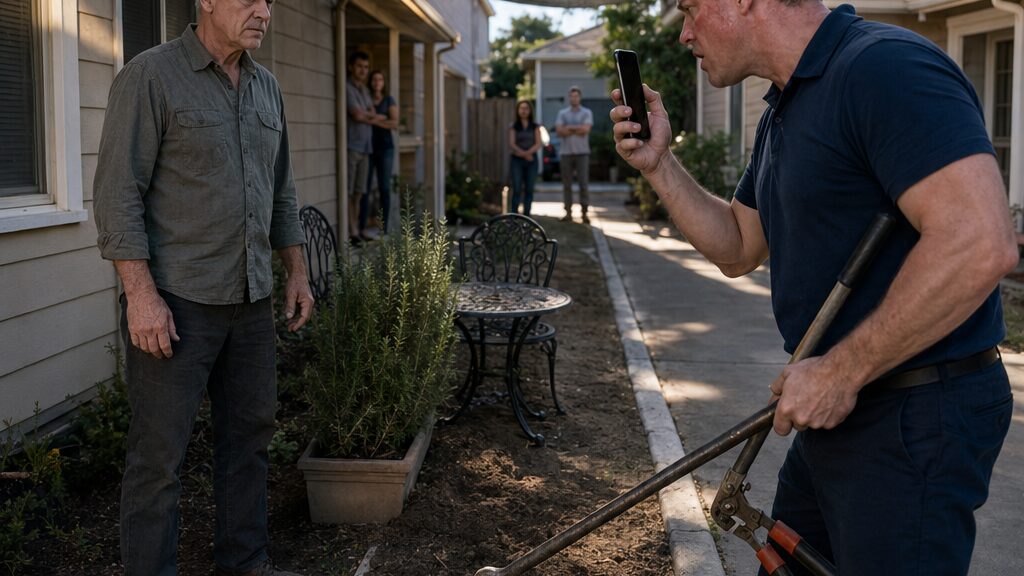
He Bent the Crowbar at the Boundary Line While His Neighbor’s Live-Stream Destroyed Everything
Chapter 1: The Chair Behind the Hidden Pin
The scrape marks were fresh.
Patrick Green saw them before he saw the overturned leaf, before he noticed the small crescent of loosened dirt beside the back leg of his garden chair. Four pale cuts ran through the packed soil at the edge of his shaded side-yard pathway, close enough to the buried surveyor’s pin that his hand tightened around the mug he was carrying.
He stood still under the shade cloth, coffee cooling against his palm.
The side yard was not much to look at from the street. A narrow strip of paving stones ran between Patrick’s house and Jerry Nelson’s driveway fence. On Patrick’s side, he had set a small iron table, two faded chairs, a planter of rosemary, and a simple shade cloth stretched between his wall and a wooden post. In the late afternoon, it became the only place on the property where the sun softened instead of burned. It was where Patrick read mail, cleaned garden tools, watched bees move through the rosemary, and let the street noise pass without asking anything from him.
Now someone had been digging near the chair.
Patrick set the mug on the table. The ceramic clicked too loudly.
He crouched slowly, knees complaining, and brushed loose grit away with two fingers. The scrape marks angled toward the spot where the surveyor had driven the metal pin below the surface three months earlier. Patrick had watched it go in, watched the man measure twice, check the plan, and mark the line that Jerry had spent years treating like a rumor.
The pin was not visible. Patrick had wanted it that way.
Visible things invited Jerry.
From the other side of the fence came the dull slam of a car door, then the rasp of something dragged across concrete. Patrick did not turn. He kept his fingers in the dirt until they found the packed circle above the hidden metal cap. Still there. Still seated.
A breath left him before he knew he had been holding it.
“Checking your treasure?”
Jerry Nelson’s voice carried over the low dividing fence with the ease of a man who had never believed walls applied to him. Patrick looked up.
Jerry stood in his driveway in a pressed work polo, sleeves tight around his forearms, phone in one hand, car keys in the other. He was in his forties, solid through the shoulders, with a sharp face that flushed quickly when he thought he was being challenged. He had the settled confidence of someone who mentioned how long his family had lived on the street before he mentioned his own name.
Patrick rose and wiped his fingers on his trousers.
“Afternoon, Jerry.”
Jerry smiled without warmth. “Funny place for a chair.”
“It’s where the shade falls.”
“It used to be where people walked.”
Patrick looked at the paving stones under his own shoes. “People still can, if they’re invited.”
Jerry’s smile flattened.
Patrick had learned not to answer more than he had to. Words gave Jerry handles. A correction became an argument. An argument became a story Jerry repeated from driveway to driveway until Patrick became the difficult one for remembering what had actually been said.
Jerry lifted his phone, not quite pointing it at Patrick, not quite hiding that he was recording. “Just documenting. You know how things get twisted.”
Patrick glanced at the lens. “Then document from your side.”
“This is my side as far as I’m concerned.”
There it was, said lightly, as if it had no weight. Patrick felt the old pull in his chest, the hot, immediate answer he kept locked down. Three years ago, before the survey, before the shade cloth, before he had promised himself to let paper and patience handle what temper never improved, he had once stepped toward Jerry during an argument over a wheelbarrow left across the path. Jerry had backed up fast, eyes wide, and Patrick had seen himself reflected there—not right, not wrong, only dangerous. He had hated that look enough to swallow a hundred smaller insults since.
A gate clicked across the street.
Sarah Taylor came out with a watering can in one hand and paused when she saw both men standing still. Her eyes moved from Jerry’s phone to Patrick’s dirt-smudged hand.
“Everything all right?” she asked.
Jerry answered before Patrick could. “Just asking Patrick why he keeps furniture in the old walkway.”
Sarah’s mouth tightened. She was in her fifties, careful in the way people became when they had survived enough neighborhood disputes to know peace was often purchased by silence. She watered the same potted fern three times a week and pretended not to hear half of what Jerry said.
Patrick said, “It’s my side yard.”
Jerry laughed once. “According to that survey you paid for.”
Sarah looked down at the ground. “Jerry’s been telling people it used to belong to everyone,” she said quietly, not quite looking at either of them. “That the path was shared before.”
“It was,” Jerry said. “Before everybody started hiding behind little metal markers and paperwork.”
Patrick felt the scrape marks behind his heel like a pressure. “The survey settled it.”
“The survey moved it,” Jerry said.
“No,” Patrick said. “It found it.”
For a moment, nothing moved except the shade cloth shifting faintly in the air. Then Jerry raised his phone a little higher.
“Say that again.”
Patrick did not.
Sarah’s watering can tipped, spilling a dark spot onto the sidewalk. “Jerry,” she said, “maybe don’t film people in their yards.”
Jerry turned the phone toward her. “Maybe don’t tell people what to do on a street my father helped build.”
Sarah went pale around the mouth. She looked at Patrick with an apology she would not say aloud, then walked back toward her porch.
Patrick bent, lifted the small garden chair with both hands, and moved it six inches inward, deeper into his side of the path. He did not do it for Jerry. He did it because he knew exactly where the line ran, because the surveyor had shown him, because law and dirt and memory were not the same thing.
Jerry watched the movement closely. Too closely.
“You know right where it is,” Jerry said.
Patrick’s hand stayed on the back of the chair. “I know where my property is.”
“Sure.” Jerry’s thumb moved over his phone screen. “That’s why you keep checking the dirt.”
Patrick looked at him then.
Jerry’s grin returned, smaller and meaner. “Don’t worry. I’m not the only one curious.”
The sound of the phone beginning to record was soft, almost cheerful. Jerry stepped out of his driveway and angled the lens toward Patrick’s table, the chair, the rosemary planter, the disturbed soil. He made a slow show of panning over the shaded strip as though filming a crime scene.
Patrick’s jaw tightened. “Turn it off.”
“This is a public concern.”
“You’re filming into my property.”
“I’m filming what you buried.”
Patrick moved one step forward, then stopped himself. The stop cost him. His hands closed, opened, closed again. Jerry noticed. He always noticed the moment a person chose not to do something and mistook it for surrender.
“Tomorrow,” Jerry said, lowering the phone only after he had what he wanted, “everyone’s going to see what you buried there.”
Chapter 2: The Street That Jerry Claimed
Jerry had the old photograph unfolded across the hood of his truck before Patrick finished taking the trash bins to the curb.
Two neighbors stood beside him, leaning in with the polite unease of people who had been caught by a man who liked holding court. Jerry tapped the photograph with one finger, then pointed across the street toward Patrick’s side yard as though the faded paper had more authority than the survey map Patrick kept in a drawer inside his kitchen.
Patrick stopped with one hand on the bin handle.
In the photograph, the street looked younger and wider, lined with smaller trees and cars with squared-off hoods. Jerry’s father’s house was visible in the background. Patrick’s own house was there too, but before the side fence, before the planter, before the shade cloth, before Patrick had bought it and tried to make one quiet corner of the world obey no one’s noise.
Jerry saw him watching.
“Here he is,” Jerry said loudly. “Man of the hour.”
The two neighbors turned. One gave Patrick a small nod. The other looked away.
Patrick left the trash bin at the curb and crossed only as far as his own driveway. “Morning.”
Jerry lifted the photograph. “You recognize this?”
“A street photo.”
“A history photo.” Jerry held it higher, the paper trembling slightly in his grip. “This path right here? People used it. Kids, delivery guys, neighbors helping neighbors. Nobody fenced it off with chairs like a private café.”
Patrick looked past the photo to the exact strip Jerry meant. “A photograph doesn’t show a boundary.”
“It shows how things were.”
“That isn’t the same thing.”
Jerry’s face reddened. “That’s what people say when they show up late and start changing rules.”
Patrick had lived there nine years. Long enough to repaint the porch twice, replace the rusted side gate, plant rosemary, lose sleep over taxes, and know which step creaked in the morning. To Jerry, nine years still counted as an arrival.
Elizabeth Nelson came out of their front door carrying a work bag and a travel mug. She stopped when she saw the gathering. Her face changed—not surprise, exactly. More like someone seeing smoke under a door she had been pretending was just shadow.
“Jerry,” she said, “not now.”
Jerry did not look back. “It matters now.”
“You have to leave in twenty minutes.”
“They can wait.”
Patrick noticed the shift in Elizabeth’s eyes, the quick flick toward the phone clipped in Jerry’s shirt pocket. She saw it before Patrick did. Jerry had the camera running again, angled low, catching voices and fragments without announcing itself.
“Turn that off,” Elizabeth said.
Jerry’s jaw hardened. “You could support me for once.”
The words landed harder than he seemed to expect. Elizabeth’s shoulders pulled in. One of the neighbors studied the ground.
Patrick almost spoke. He had the survey folded in the top drawer of his kitchen desk, clean and stamped. He could walk inside, bring it out, lay the official lines over Jerry’s old photograph, and end this performance with paper. Instead, he stood where he was.
Because if he brought the survey out here, Jerry would call it theater.
Because if he raised his voice, Jerry would use the clip.
Because if he stepped closer, Jerry would smile that little smile and say, See?
Patrick heard himself say, “I’m not discussing property records on a sidewalk.”
Jerry turned toward the neighbors with an open palm. “You hear that? He won’t discuss it.”
“I said not on a sidewalk.”
“You heard him,” Jerry said again, louder, as though volume could pin an interpretation in place. “He pays somebody to move a line, hides the marker, then won’t answer simple questions.”
Patrick felt the old anger rise like heat under a sealed lid.
“I did not move anything.”
“Then show it.”
Patrick looked at the photograph. He knew what Jerry was doing. The old path had looked shared because no one had cared where it ran until Jerry began using it as overflow for his tools, his bins, his bags of yard waste, his little claims. The first time Patrick had found muddy tire tracks pressed into his side yard, he had raked them smooth. The second time, he had asked politely. The third time, Jerry had laughed and said, “That strip has always been everybody’s.”
After that, Patrick called the surveyor.
He had not done it to punish Jerry. He had done it to stop waking up angry.
“I’ll show the survey to an officer, a surveyor, or a court,” Patrick said. “Not to your phone.”
Jerry’s eyes flashed. There was something tired beneath the anger, something cornered and ugly. “Of course. Hide behind the official people.”
Elizabeth stepped closer to him, voice low. “Jerry, go inside.”
He jerked his arm away before she touched him. “I said I’ve got it.”
That was when Patrick saw the first crack in the performance. Jerry did not look powerful then. He looked like a man defending a stage from the person who knew it was plywood.
Patrick went inside.
His hands were steady when he opened the desk drawer, but not because he felt calm. He took out the survey copy, held it for several seconds, then placed it on the kitchen counter instead of carrying it back out. The stamped pages looked plain and almost disappointing. Lines, numbers, initials, measurements. Nothing in them showed the years of little trespasses. Nothing showed Jerry’s smirk. Nothing showed Patrick standing in his own yard while being made to feel like a thief.
He returned empty-handed.
Jerry was still talking, but now the two neighbors had edged away. Elizabeth stood beside the truck, arms folded tight.
Patrick said, “I’m done for today.”
Jerry lifted his eyebrows toward the phone. “That’s convenient.”
Patrick took the trash bin and rolled it the last foot to the curb. The wheels clattered over a crack in the concrete. He turned his back before Jerry could pull more from him.
By noon, the edited clip was online.
Patrick would not have seen it if Sarah had not texted him. Her message had no greeting, no punctuation beyond the link.
I think you should know.
The video was less than thirty seconds. It showed Jerry’s old photograph. It showed Patrick saying, “I’m not discussing property records.” It cut before he said “on a sidewalk.” It showed Patrick going into the house and coming back without the survey. It ended with Jerry’s voice, lowered and grave for the camera.
“If there’s nothing under that dirt, why won’t he show anybody?”
Patrick watched it twice. The second time, he watched the corner of the frame where Elizabeth stood with her arms folded, looking not at him, but at Jerry.
The comments had already begun.
Most were vague. A few were cruel. One asked whether Patrick had moved the line himself. Another said people like him always hid behind paperwork.
Then he saw the comment that made the room feel smaller.
Is that the pin under his dirt?
Patrick stared at the words until the screen dimmed in his hand.
He had never told Jerry exactly where the pin was.
Chapter 3: The Loppers Beside the Lawn
The first sound Patrick heard after lunch was the snap of blades closing on nothing.
Metal clicked against metal, sharp and deliberate, from Jerry’s side of the fence.
Patrick was at the small table beneath the shade cloth, a sandwich untouched on a plate, the survey copy beside it now covered by a blank sheet of paper. He had brought it outside twice and hidden it twice, unable to decide whether evidence was protection or bait. When the blades snapped again, he looked toward the narrow opening near the driveway.
Jerry came around the fence with long-handled branch loppers balanced over one shoulder.
There were no branches hanging over the path.
Patrick stood. “Jerry.”
Jerry smiled as if surprised to see him in his own yard. “Doing some cleanup.”
“Not here.”
“It’s growth control.” Jerry opened the loppers and closed them once, the curved blades shining in the strip of sun beyond the shade. “Shared edge, shared responsibility.”
Patrick’s rosemary planter sat three feet inside his side. The shade cloth was tied high and clear, not touching Jerry’s fence. The small planted border along the path held mint, lavender, and two struggling marigolds. Nothing crossed into Jerry’s driveway except the smell of rosemary when the air moved right.
Patrick said, “There’s nothing to cut.”
Jerry’s eyes moved over the chair, the table, the planter, the cloth. “There will be by the weekend.”
The sentence was quiet enough that Patrick almost wished it had been louder. Loud threats had edges a person could point to. Quiet ones slid under the door.
Jerry stepped farther in.
Patrick lifted one hand, palm down. “Stop there.”
Jerry looked at the ground between them. “There? That magic line again?”
“Yes.”
“Funny how you know exactly where it is when you want to block people.”
Patrick looked toward Sarah’s porch. Her curtains shifted. A sliver of her face appeared, then vanished.
Jerry followed his glance and laughed. “Don’t look for backup. Folks around here know better than to jump into property nonsense.”
“This isn’t nonsense.”
“No,” Jerry said. “It’s theft with patio furniture.”
He angled the loppers toward the nearest chair. The blades opened around empty air just above the chair back, then snapped shut an inch from the metal frame. Patrick felt the sound in his teeth.
“Move them,” Jerry said.
Patrick took one step forward, then stopped at the same place he had stopped the day before. His body knew the distance now. Six inches before the buried pin. A foot before Jerry’s shoe crossed fully into the seating area. The line was invisible, but Patrick could feel it as clearly as a rope stretched across his chest.
“You are on my property,” Patrick said.
Jerry’s phone was in his back pocket this time, not in his hand. Somehow that made it worse. It meant this was not performance alone. It meant he wanted the chair gone even without an audience.
Patrick reached back, took the chair by its frame, and moved it inward. Not far. Just enough that all four legs sat unquestionably behind the boundary. The scrape of metal on stone sounded small and stubborn.
Jerry watched. “There it is. You admit it was in the way.”
“I’m making sure you have no excuse.”
“No excuse for what?”
“For touching it.”
Jerry’s lips thinned. His hand tightened on the lopper handles. For a second, Patrick saw the man behind the performance again—the pressure, the embarrassment, the need to win something simple because other things were slipping. But sympathy, Patrick had learned, did not make a trespass harmless.
Sarah appeared at the edge of her porch, keys in hand as if she had suddenly remembered somewhere to be. Patrick turned toward her.
“Sarah,” he said, “you saw him step in with those.”
Her eyes went to the loppers, then to Jerry.
Jerry smiled at her. “Careful.”
One word. Soft. Almost friendly.
Sarah swallowed. “I saw you both talking.”
“That’s not what I asked.”
Her face creased with apology. “Patrick, I don’t want to get dragged into this. Jerry makes life hard for people who cross him. You know that.”
Jerry spread his hands, loppers and all. “Listen to that. I’m the dangerous one because I don’t let people rewrite history.”
Sarah backed down the porch step. “I’m sorry,” she said to Patrick, and went inside.
The door closed.
Patrick felt something settle in him—not anger exactly, but the heavy knowledge that being right did not mean anyone would stand beside you. He had believed, foolishly, that if Jerry pushed far enough, someone would say enough. But people had lawns, work schedules, spouses, deliveries, grandchildren visiting on weekends. They had reasons to look away.
Jerry lowered the loppers. “That’s the street talking.”
“No,” Patrick said. “That’s fear talking.”
Jerry’s face changed. The flush rose fast up his neck.
“You think people are scared of me?”
Patrick should have let the question pass. He knew it as soon as Jerry asked it. But the chair had been threatened, the pin had been scraped, and Sarah’s closed door sat in his chest like a weight.
“Yes,” Patrick said.
Jerry took one step toward him. The lopper handles creaked in his grip.
Patrick did not step back.
For one thin second, the old memory opened under him: a younger man’s face in another yard, another dispute, another day when Patrick had moved too fast and seen fear bloom where anger had been. He remembered the shame afterward, the promise to never again use his size or strength as an answer. That promise had saved him from becoming loud. It had also taught men like Jerry where to press.
Jerry leaned close enough that Patrick could smell coffee and mint gum.
“You don’t know what this street was before you came here,” Jerry said. “You sit there under your little cloth acting like a king over dirt my family walked before you knew this place existed.”
Patrick’s voice came out lower than he intended. “Your family walking across something never made it yours.”
Jerry stared at him. Then he stepped back, smiling again, though his eyes had gone flat.
“All right.”
He walked to his driveway and tossed the loppers into a battered wheelbarrow. They landed with a clang. For a moment, Patrick thought he was done.
Then Jerry reached into the truck bed and lifted out a heavy iron crowbar.
It was old, dark, and thick, with rust along the curve and a sharpened wedge at one end. He dropped it into the wheelbarrow beside the loppers. The sound was deeper this time, final.
Jerry rested both hands on the wheelbarrow handles and looked across the narrow strip of ground between them.
“Then I’ll remove the lie myself.”
Chapter 4: The Video That Made Silence Look Guilty
Patrick’s phone lit up on the kitchen counter while he was rinsing dirt from his hands, and the title of the clip stopped him before the water did.
Neighbor Caught Hiding Property Marker.
The faucet kept running. Patrick stood over the sink, water striking his knuckles, the screen glowing beside the folded survey he still had not shown anyone. The thumbnail was a frozen image of his own side yard: the chair, the rosemary planter, the patch of disturbed dirt, the shade cloth making everything look more secret than it was.
He dried his hands slowly and tapped the video.
Jerry’s face filled the screen first, close enough that Patrick could see the broken capillaries at the side of his nose. He was not in the driveway anymore. He was sitting somewhere dim, probably in his truck, speaking with the solemn weight of a man delivering evidence.
“People keep asking why I care,” Jerry said. “I care because some of us still remember what this street was.”
The video cut to the old photograph on the hood of the truck. Then to Patrick saying, “I’m not discussing property records.” It did not include “on a sidewalk.” It did not include Jerry filming without permission. It did not include Elizabeth asking him to stop. It did not include the way Jerry’s voice had changed when he said support me for once.
Patrick watched himself return from the house empty-handed. The edit lingered there, making his empty hands seem like an admission.
“If there’s nothing under that dirt,” Jerry said over the footage, “why won’t he show anybody?”
Patrick set the phone down harder than he meant to. It slid against the survey paper.
The kitchen felt too small. Through the side window, the shaded path sat in late-day stillness. The chair he had moved stood behind the line. The dirt over the pin looked ordinary again. Nothing about it should have been interesting to strangers.
His phone buzzed with another message from Sarah.
I’m sorry. People are sharing it.
Patrick did not answer.
He opened the comments.
Some names were familiar. Neighbors, old street friends of Jerry’s, people Patrick had waved to and never known. Others were strangers drawn by the shape of conflict: a chair, a boundary, an older man accused of hiding something.
Jerry was still replying.
My dad poured concrete on this street before most of these people were born.
Ask him why he had it surveyed in secret.
Nobody hides a marker unless they’re ashamed.
Patrick’s thumb hovered over the comment box. He imagined typing the parcel number, the survey date, the professional stamp, the city record. He imagined attaching photographs of the official corner marks, copies of emails, the polite letter from the survey company warning that removing or disturbing a marker could carry legal consequences.
Then he imagined Jerry cutting it into pieces.
He could already hear the reply: Look how fast he produced paperwork when people started asking.
Patrick locked the phone and placed both palms on the counter.
The last time he had let anger choose the shape of him, it had been in another yard, years before he moved here. A contractor had backed a trailer over a row of newly planted hedges after ignoring two warnings. Patrick had crossed the gravel too fast, yanked the trailer hitch loose, and slammed it down hard enough to dent the tongue. The contractor’s young assistant had flinched as though Patrick had raised a hand to him.
No one had been hurt. No police came. The contractor even apologized later.
But Patrick remembered the assistant’s face.
He remembered how easily force had arrived once he invited it.
The phone buzzed again.
This time it was not Sarah. It was a notification from Jerry’s live page.
Jerry Nelson is live.
Patrick stared at it. Then he opened it.
Jerry was in his living room, standing beside a framed certificate on the wall. He wore a company-branded jacket over his shirt, the collar turned neatly down. Behind him, out of focus but deliberate, was a shelf with small award plaques and a photograph of Jerry shaking hands with a man in a suit. Patrick had never paid attention to what Jerry did for work beyond hearing him mention “regional oversight” loudly enough for mail carriers to hear.
Now Jerry was using it like a badge.
“I’ve handled crews, easements, compliance, access issues,” Jerry told the camera. “I know when something doesn’t smell right.”
Patrick narrowed his eyes. The word compliance caught like a burr.
Jerry stepped aside so the framed certificate showed more clearly, though the text blurred on the stream. The comments filled with approval. A few viewers asked whether Patrick had permits for the shade cloth. One told Jerry to call the city. Another wrote that people who moved into established neighborhoods always tried to carve them up.
A comment appeared from Elizabeth Nelson.
Jerry, take this down. This is enough.
Jerry’s eyes flicked to the screen. His face changed for less than a second, a tightening around the mouth. Then the comment vanished.
Patrick sat at the kitchen table.
Jerry smiled at the camera. “Sorry. Trolls.”
Patrick replayed the moment. Elizabeth’s comment had appeared, and Jerry had deleted it. Not ignored. Deleted. In front of everyone.
The video was no longer only about Patrick’s yard. It was about Jerry proving that even the people closest to him could be edited out when they complicated the story.
Patrick opened his laptop and began saving everything.
He saved the first edited clip. He saved screenshots of the comments. He saved the live stream while it was still running, using a screen recorder his nephew had once installed to help him save a family video. His hands moved without drama. File names, timestamps, folders. He saved the frame where Jerry’s jacket showed the company name. He saved the deleted-comment moment. He saved Jerry saying he knew access and compliance.
The work steadied him.
Then Jerry said, “Tomorrow morning, I’m going over there live.”
Patrick’s hand stopped on the trackpad.
Jerry leaned toward his phone, voice lower, intimate with the growing audience. “We’re going to dig up the truth. He wants to hide behind dirt and furniture? Fine. Sunrise. I’ll show you what’s under that chair.”
The comments jumped. Some posted laughing faces. Some told him to bring gloves. Someone wrote, Get the pin. Make him explain.
Patrick looked at the survey beside his laptop.
It would take one call to the police nonemergency line. One email to the survey office. One post with the full document. He had options. He had always had options. But each one required stepping into the spectacle Jerry had built and trusting strangers to tell the difference between proof and performance.
He picked up the survey, opened the back door, and walked to the side yard.
The air had cooled. The chair waited under the shade cloth. He crouched beside the disturbed dirt and pressed his fingers to the packed earth above the hidden metal cap.
Still there.
He did not uncover it.
Across the fence, Jerry’s voice carried from inside his house, amplified by the live stream delay on Patrick’s phone.
“Sunrise,” Jerry said again. “We dig up the truth.”
Patrick remained crouched, fingertips on the dirt, while the screen in his other hand filled with people waiting to watch someone cross a line.
Chapter 5: The Crowbar Finds the Dirt
The live-stream ping sounded before Patrick had finished setting down his morning cup.
It came from Jerry’s phone first, bright and artificial in the quiet sunrise, then echoed half a second later from Patrick’s own phone on the small iron table. Patrick had opened the stream only to record it. He had not expected the sound to arrive in the yard before Jerry did.
Then the wheelbarrow squealed.
Patrick turned.
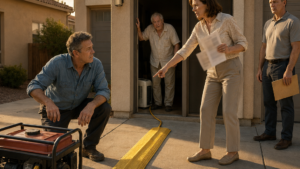
Jerry pushed it around the front edge of the driveway with both hands, the branch loppers laid across the top and the heavy crowbar angled like a dark rib against the metal tray. His phone was clamped to a small handheld grip, camera facing him as he walked. He had dressed for the performance: clean polo, dark pants, work shoes too polished for digging. His face was already flushed with victory.
“Here we go,” Jerry told the phone. “No editing. No hiding. We’re all going to watch.”
Patrick stood beside his chair.
The side-yard pathway was narrow enough that every object had meaning. The cup on the table. The chair legs set back. The rosemary planter tight against the house wall. The small patch of dirt near the curb where the official pin waited under less than an inch of packed soil.
Jerry stopped at the boundary but did not acknowledge it. The front wheel of the barrow crossed first, rolling onto Patrick’s paving stone with a little bump.
Patrick said, “Take that back.”
Jerry looked past the phone as if noticing him for the first time. “Morning, Patrick. Viewers want answers.”
“This is private property.”
Jerry panned the phone across the shade cloth and chairs. “Private property. Hear that? The old community path is private now.”
Patrick’s phone, faceup on the table, showed the stream lagging behind reality. Jerry in the screen. Jerry in the yard. Two versions of the same man, both stepping closer.
“Jerry,” Patrick said, “do not touch that dirt.”
Jerry lifted the crowbar from the wheelbarrow. “That dirt is the whole problem.”
The metal end struck the paving stone with a dull note.
Patrick’s fingers curled around the back of the chair. The old instinct moved through him fast: step in, take it, end it. He did not. Not yet. He felt the line beneath the morning. He felt the buried pin like a pulse.
Jerry set the phone grip upright in the wheelbarrow tray, angling the camera so it captured both men and the ground between them. He was careful. Too careful. Patrick understood then that Jerry had watched more than the yard. He had watched Patrick’s habits, the way Patrick checked the dirt without exposing the marker, the way he stepped around that one patch.
“You wondered how people knew,” Jerry said, voice cheerful. “You check the same spot every time.”
Patrick said nothing.
Jerry’s smile widened. “You showed me.”
The words went in quietly and cut deep. Patrick had thought restraint made him invisible. Instead, it had trained Jerry where to look.
Jerry bent, drove the wedge of the crowbar into the dirt, and pried.
The first bite lifted only soil. A dark chunk broke loose and rolled against the leg of the table. Patrick felt his breath shorten.
“That pin is not yours to touch,” he said.
Jerry looked up. “There it is. Finally.”
“Leave it alone.”
“Why? Because a man you paid hammered it there?”
“Because it is an official survey marker.”
Jerry laughed toward the camera. “Official. Hear that? This street had boundaries before he had a filing cabinet.”
He dug again, harder this time. The crowbar scraped something below the surface with a sound too faint for the phone, but not for Patrick. Metal kissing metal.
Patrick stepped forward.
Jerry lifted the branch loppers with his other hand. Not fully. Just enough that the long handles came up and the curved blades pointed toward the chair, the table, the shade cloth. “Careful.”
Patrick stopped.
The camera caught that. He knew it did. Jerry knew it.
“I’ve lived here longer,” Jerry said, voice rising. “This street knows who owns it.”
His shoe crossed fully into the seating area. The loppers snapped shut once in the air beside Patrick’s chair, close enough to make the chair vibrate.
From across the street, a curtain moved. A door cracked open. The neighborhood had arrived without arriving.
Patrick looked at the loppers, then at Jerry’s face. Under the anger, Jerry’s eyes were bright with something almost pleading. See me. Believe me. Tell me I still matter here. It did not soften what he was doing. It made it worse.
“Jerry,” Patrick said, “this is your last warning.”
“Or what?” Jerry drove the crowbar down again. “You’ll show another paper? Stand there and whisper? Move another chair six inches?”
The edge of the crowbar hooked under something. Jerry’s shoulders tightened as he tried to pry upward. The packed earth cracked around the hidden cap.
Patrick’s mind flashed backward to the contractor’s assistant, the flinch, the shame that had taught him to lock his hands at his sides. Then it returned to the present with brutal clarity.
Jerry was not afraid of Patrick’s rage.
He was counting on Patrick’s restraint.
On Patrick’s phone, comments flowed up the screen.
There it is.
He found it.
Make him explain.
Jerry grunted and leaned harder on the bar. The soil lifted. A small dull rim appeared beneath the dirt.
The official pin.
Patrick moved.
He did not rush. The decision arrived clean, colder than anger. Two steps took him to Jerry. His left hand caught the shaft of the crowbar below Jerry’s grip. Jerry jerked in surprise, but Patrick’s hand closed harder.
“Let go,” Jerry snapped.
Patrick looked at the wedge buried in the dirt, then at the phone recording them from the wheelbarrow. He saw exactly what Jerry wanted: a shove, a punch, a struggle, one ugly second that could be cut from everything around it.
Patrick tightened his grip.
Jerry pulled. “You’re on camera.”
“I know.”
“Then let go.”
Patrick’s other hand closed around the crowbar.
The metal was cold even in the warm morning. For one second both men held it, the buried pin beneath them, the camera watching, the neighborhood holding its breath behind curtains and doors.
Then Patrick pulled the crowbar free.
Chapter 6: The Iron Bent Over the Curb
Patrick pulled the crowbar from the dirt as Jerry shouted toward the camera that he was stealing evidence.
The wedge came loose with a dry crack, spraying clods across the paving stone. The official pin remained seated in the earth, its dull rim exposed now, scraped but not lifted. Patrick saw it, confirmed it, then stepped back with the crowbar held low in both hands.
Jerry lunged after it.
Patrick turned his shoulder, not his fist. Jerry’s hand slapped empty air and caught only the sleeve of Patrick’s work shirt for half a second before slipping off. The loppers clattered against the wheelbarrow as Jerry stumbled.
“You saw that!” Jerry yelled at the phone. “He attacked me!”
Patrick did not answer.
His pulse beat hard in his wrists. The crowbar felt heavier than it should have, not because of the iron, but because of what it invited. He could imagine every wrong use of it. He could imagine Jerry stepping close, daring him, baiting him into the one frame that would make all the others disappear.
The old shame rose, hot and familiar.
He did not give it his hands.
Patrick walked toward the curb.
Jerry followed, loud enough now for every house to hear. “Where are you going with that? That’s mine. That’s my tool. That’s evidence.”
Patrick stopped at the concrete edge where the side-yard path met the street. The curb was old, pale, chipped at the corner from years of tires and trash bins. It was not legal language. It was not a survey line. But it was hard, visible, and final.
He laid the crowbar across it.
Jerry’s voice cut out.
The phone in the wheelbarrow caught the angle: Patrick’s boots, the curb, the iron bar, Jerry in the background with his mouth half-open. Patrick knew because his own phone, still streaming from the table behind him, showed the same scene delayed by a breath.
Jerry took one step forward. “Don’t.”
Patrick looked at him. Not at the phone. Not at the neighbors beginning to appear on porches. At Jerry.
“You brought this onto my property to pry up a survey marker.”
Jerry swallowed, then recovered. “I brought it to expose you.”
“No,” Patrick said. “You brought it to cross the line.”
Jerry’s face twisted. “You don’t get to lecture me on lines.”
Patrick placed one boot on the iron.
For a second, he was back in the other yard years ago, the trailer hitch under his hands, the young assistant flinching. He remembered the thrill of power arriving too easily, remembered hating himself for how good it felt before the shame caught up.
This felt different.
There was no thrill.
Only a line and a tool used to break it.
Jerry rushed forward. Patrick lifted his hand once, palm out. He did not shove him. He did not threaten him. The gesture stopped Jerry anyway, maybe because something in Patrick’s stillness finally reached him.
“Patrick,” Jerry said, voice dropping. “Don’t be stupid.”
The sentence sounded almost human. Beneath it Patrick heard panic, not command. Jerry had planned for an argument, maybe a shove, maybe a messy scuffle his viewers could feed on. He had not planned for the tool to become the message.
Patrick pressed down.
At first the crowbar held. Thick iron did not bend for drama. It resisted. Patrick shifted his weight, placed his other boot more firmly on the concrete, and drove his heel down with the full controlled force of his body.
The bar groaned.
The sound moved through the street like an animal waking under the pavement.
Jerry whispered something Patrick could not hear.
Patrick pressed harder. His leg trembled once, not from weakness, from restraint narrowed to a single point. The iron gave in slowly, visibly, the straight line becoming a bowed curve over the curb. The rust along the bend cracked and flaked away.
No one spoke.
The live-stream comments flew up the small screen too fast to read.
Patrick stepped off.
The crowbar remained bent.
He lifted it once more, carried it three steps back, and dropped it at Jerry’s feet. It struck the driveway edge with a dead clang and settled there, crooked and useless.
Jerry stared at it.
The branch loppers lay in the wheelbarrow behind him, suddenly ridiculous. The phone kept recording from its grip. Its lens had no mercy and no loyalty.
Patrick walked back to the exposed pin. He crouched, brushed loose dirt away from the cap, and looked at the mark stamped into the metal. Scratched, but intact. He did not cover it yet.
Jerry’s voice came back jagged. “You destroyed my property.”
Patrick stood. “You tried to remove mine.”
“That’s assault.” Jerry snatched his phone from the wheelbarrow, hand shaking. “That’s assault and destruction and threatening behavior. Everybody saw it.”
“You should call someone, then.”
Jerry blinked, as if Patrick had skipped the next line of the script.
Then he jabbed at the phone with his thumb, switching screens without ending the live-stream. His voice rose, high and sharp, as he reported that his neighbor had attacked him with a metal bar. He used Patrick’s name twice. He said “dangerous” three times. He said “elderly” once, then seemed to regret making Patrick sound fragile.
Neighbors stood in doorways now. Sarah Taylor was on her porch, one hand at her throat. When Patrick looked at her, she looked away.
He felt no surprise. Only a small, tired ache.
Jerry paced near the bent crowbar, narrating between bursts to the dispatcher. “He’s standing right there. He’s still got that look. You need to send somebody now.”
Patrick had no bar in his hands. No loppers. No phone pointed outward. He stood beside the disturbed dirt and the official pin, palms empty.
His own phone continued recording from the table.
That was enough, he told himself. It had to be enough.
But when the first police lights washed blue and red across the side of his house, the scene rearranged itself the way official attention always rearranged a place. The chair looked like an obstacle. The dirt looked like a fight. The bent crowbar at Jerry’s feet looked like violence if a person saw only the final shape of it.
A responding officer stepped from the patrol car and raised one hand for both men to stay where they were.
Jerry moved first, pointing at Patrick, then at the bent iron, then at his own live-streaming phone.
“He attacked me,” Jerry said, breathless with relief that someone in uniform had arrived to hear him. “He attacked me, and I’ve got the whole thing on video.”
Chapter 7: The Call Everyone Heard
The responding officer pointed at the bent crowbar and asked, “Whose is that?”
Jerry answered so fast his voice cracked. “Mine. He took it from me.”
The officer looked at him, then at Patrick, then at the phone still held up in Jerry’s trembling hand. Red and blue light moved over the curb, over the wheelbarrow, over the exposed silver rim of the surveyor’s pin in the torn dirt. The branch loppers lay across the wheelbarrow like a second accusation no one had yet named.
Patrick stood with his palms open at his sides.
Jerry stepped closer to the officer. “He grabbed it. He bent it. He threatened me with it.”
“I did not threaten you,” Patrick said.
Jerry swung the phone toward him. “You hear him? Denying it. He’s denying it while the whole thing is live.”
The officer raised a hand between them. “Lower the phone.”
“It’s evidence.”
“Lower it enough that I can speak to both of you.”
Jerry lowered it only to chest height, lens still facing outward.
The officer’s eyes flicked to the screen, then back to the yard. He was not young, not old, with the weary focus of someone who had arrived at too many private wars already in progress. He did not look impressed by Jerry’s volume, but he did not look convinced by Patrick’s silence either.
“You called about an assault?” the officer asked.
“Yes,” Jerry said. “He attacked me and destroyed my property.”
“Were you injured?”
Jerry hesitated. “He could have injured me.”
“That is not what I asked.”
Jerry’s face flushed deeper. “He ripped the crowbar out of my hands.”
The officer turned to Patrick. “Sir?”
Patrick looked at the dirt first. The exposed pin sat in the ragged hole Jerry had made. That small dull circle mattered more than the crowd, more than Jerry’s phone, more than the way several neighbors now stood near their porches pretending not to listen.
“He was using it to pry up that marker,” Patrick said.
The officer followed his gaze. “Survey marker?”
“Yes.”
Jerry barked a laugh. “He says yes like that settles it.”
The officer crouched without touching the pin. “Nobody touch this.”
“I wasn’t touching it,” Jerry said.
Patrick looked at him.
The officer noticed.
Jerry rushed on. “I mean, I was exposing it. Because it was hidden. He hid it under dirt.”
“It was set below grade,” Patrick said. “By the surveyor.”
“By his surveyor.”
Patrick turned toward the table beneath the shade cloth. “The survey copy is inside. I also have the stream saved.”
Jerry’s eyes flashed. “Of course you do. He planned this.”
The officer stood. “Did you enter his side yard?”
Jerry pointed toward the old path. “That is the question. It’s disputed.”
“It is not disputed,” Patrick said quietly.
Jerry swung toward him. “You don’t get to decide that.”
“No,” Patrick said. “The survey did.”
For a moment the officer’s attention moved from one man to the other, measuring not just words but the spaces between them. Patrick knew how the scene looked if someone arrived late. A bent crowbar. A disturbed marker. One man calm, one man shouting. Calm could read as control or coldness. Shouting could read as fear or guilt.
Jerry had counted on that.
A soft voice came from across the street. “Officer?”
Sarah Taylor stood at the edge of her porch with both arms wrapped around herself. She had not come down the steps. Her face looked pale in the flashing lights.
Jerry turned before the officer did. “Sarah, stay out of this.”
The officer looked toward her. “Did you witness what happened?”
Sarah’s eyes went to Jerry, then to Patrick, then to the loppers.
“I saw some of it,” she said.
Jerry gave a sharp little laugh. “From behind your curtain?”
Sarah flinched.
Patrick almost told her she did not have to. The words rose on instinct, the same old reflex that had kept him swallowing the cost so no one else had to feel it. Then he saw the exposed pin, the loppers, Jerry’s phone lifted like a weapon even now.
He said nothing.
Sarah stepped down one porch step. “Jerry crossed into Patrick’s side first.”
Jerry’s mouth opened. “You don’t know where the line is.”
“I know where the chair was,” Sarah said, voice shaking but continuing. “I know Patrick moved it back yesterday. I saw Jerry come in with the loppers today. He raised them toward the chair before Patrick touched the crowbar.”
The officer turned to Jerry. “You had loppers?”
Jerry gestured angrily at the wheelbarrow. “For branches.”
The officer looked up. There were no branches hanging low over the side-yard path.
Sarah came one more step down. “He was digging at the dirt. Patrick warned him not to touch the pin.”
Jerry pointed at her. “You always were scared of making trouble.”
Sarah’s face changed. Not hardened exactly, but steadied by the insult. “No,” she said. “I was scared of you making trouble for me.”
The street went very still.
The phone in Jerry’s hand caught all of it.
Patrick felt the sentence move through the air and settle where years of smaller silences had been. Sarah looked startled by her own words. Jerry looked as if she had stepped onto land he thought belonged to him too.
The officer asked, “Does either of you have video from the beginning?”
Jerry thrust his phone forward. “Mine is live.”
“From before you entered the yard?”
Jerry’s thumb hovered. “It’s there.”
Patrick walked to the small table, picked up his own phone, and unlocked it. His hands were steady, but something inside him had loosened so suddenly it almost felt like weakness. He opened the recording, stopped before handing it over, and looked at the officer.
“It shows from the ping,” he said. “He came in with the wheelbarrow.”
The officer took the phone. He watched without expression.
Jerry kept talking at the live-stream. “This is what happens when people with connections try to bury regular families under paperwork. Now he’s giving the officer his edited version.”
Patrick did not answer. He watched the officer’s face instead.
On the screen, Jerry’s wheelbarrow crossed the paving stone. The crowbar came out. The first warning. The loppers lifting. The bite into the dirt. The scrape of metal under soil. The moment Patrick moved.
The officer rewound once. Watched Jerry raise the loppers again.
Then he looked toward the wheelbarrow. “Put your phone down on the hood of your truck, sir.”
Jerry stiffened. “Why?”
“Because I’m asking you to stop broadcasting while I determine what happened.”
“This is my protection.”
“It is also escalating the situation.”
Jerry’s jaw worked. For a second, Patrick thought he would refuse. Then the phone rang in his hand.
The sound was ordinary, almost ridiculous against the patrol lights.
Jerry glanced down. The name on the screen made his whole body pause.
Samuel Carter.
The officer saw the name. Patrick saw it. So did the live-stream, because Jerry had tilted the phone just enough for the camera to catch the incoming call before he could hide it.
Jerry turned away and answered. “Samuel, not now.”
The phone was still connected to the stream. The audio carried.
A man’s voice came through, clipped and controlled. “Jerry, are you currently live from your personal account?”
Jerry’s face drained. “I’m handling a neighborhood legal situation.”
“You are displaying company identification in earlier footage and referencing compliance authority while appearing to trespass with tools on another resident’s property.”
Jerry looked around as if the street itself had betrayed him. “That’s not what happened.”
“We have the recording.”
The officer’s eyes shifted toward Patrick’s saved video, then back.
Jerry lowered his voice, but the phone kept carrying it. “Samuel, I’ve given that company twenty years.”
“And you were warned last quarter about public conduct.”
Elizabeth appeared in Jerry’s open front doorway, one hand gripping the frame.
Jerry saw her and seemed to shrink for half a second. “This is being twisted.”
Samuel’s voice did not rise. “You are terminated, effective immediately.”
The words came through clearly enough that even Sarah, standing across the street, heard them.
Jerry stared at the phone as if it had spoken in a language he did not recognize. The live-stream comments surged too quickly to read. The officer said something about ending the broadcast. Elizabeth stood in the doorway without moving.
For the first time since Patrick had known him, Jerry had no line ready.
Chapter 8: The Chair Stayed Behind the Line
Elizabeth walked out with packed bags while Jerry was still trying to explain the firing to the officer.
She carried one suitcase in each hand, not large ones, just the kind used for weekends that had stopped being temporary sometime before anyone admitted it. Her mouth was set. Her eyes were dry. She had changed from the work clothes Patrick had seen earlier into jeans and a plain sweater, but her hair was still pinned neatly, as if some part of her had refused to let Jerry’s chaos decide her appearance too.
Jerry saw the bags and forgot the officer, the phone, the bent crowbar, everything.
“What are you doing?”
Elizabeth came down the front steps. “Leaving.”
“Not now,” Jerry said.
“That’s what you always say.”
The officer turned slightly, watching but not stepping in. Sarah remained near her porch. A few neighbors had come closer to the ends of their driveways, drawn by the sound of consequences they had helped avoid for years.
Jerry looked at them and lowered his voice. “Go inside.”
Elizabeth laughed once, not with humor. “You don’t get to edit me out this time.”
The words struck harder than shouting would have.
Jerry glanced at his phone. The stream was no longer in his hand; the officer had made him set it on the hood of the truck, face down, though the device still buzzed and lit against the paint. Without it, Jerry seemed incomplete, as if the audience had been holding him upright.
“Elizabeth,” he said, softer now, “I lost my job.”
“I know.”
“So this is when you leave?”
“This is why I packed before sunrise.”
Jerry froze.
Patrick, standing beside the exposed surveyor’s pin, looked at her then. She had not packed in reaction to the firing. She had packed before the crowbar, before the officer, before Samuel Carter’s call. She had known the morning would break something. Maybe she had hoped Jerry would stop before it did. Maybe she had needed to see whether he would choose their life over his performance.
He had chosen the phone.
Jerry’s face twisted. “You were planning this?”
“I was hoping I wouldn’t have to do it.” Elizabeth shifted the suitcase handles in her hands. “Then I watched you delete my comment. I watched you call me a troll because I asked you to stop humiliating us.”
“I was defending our property.”
“Our property is over there,” she said, nodding toward their driveway. “You were in his yard.”
Jerry pointed at Patrick with sudden fury, grateful for a target. “He did this. He set me up. He’s been baiting me for months with that chair and that fake little garden.”
Patrick almost answered. Then he looked at the rosemary planter, at the chair, at the torn dirt. There was nothing to defend in that sentence. It was too small for the damage around it.
The officer stepped between Jerry and the side yard. “Sir, stay where you are.”
Jerry threw up his hands. “Now I can’t even stand in my own driveway?”
“You can stand there. You cannot advance on him.”
Elizabeth’s face tightened, not with fear anymore, but with recognition. “Listen to yourself.”
Jerry turned on her. “You’re supposed to be my wife.”
“I have been,” she said. “That’s the problem.”
The street held its breath.
Elizabeth’s voice stayed level. “I have apologized to neighbors for you. I have asked people not to take your words personally. I have told myself you were stressed, or tired, or scared about work. I told myself you just needed one place where you still felt respected.”
Jerry’s eyes flickered.
For one second, Patrick saw him hear it. Really hear it. Not as an attack, but as the terrible shape of his own need spoken aloud by the person who had carried it longest.
Then Jerry rejected it.
“You’re doing this in front of everyone?”
Elizabeth looked at the bent crowbar near his feet. “You did this in front of everyone.”
Patrick turned away before the look on Jerry’s face could ask for pity. He crouched beside the disturbed dirt and brushed loose soil from the surveyor’s pin. The cap was scratched, a bright raw line across the dull metal, but it had not shifted. He pressed two fingers lightly against it.
Still seated.
The small fact moved through him with unexpected force.
Not victory. Not satisfaction. Relief, but heavier. The kind that came after holding a door shut through a storm and finding the hinges still attached.
The officer approached. “Mr. Green?”
Patrick stood.
“I’m going to need the survey documents and a copy of the recordings.”
“I have them.”
“And I’ll advise you to leave the marker uncovered until it can be photographed.”
Patrick nodded. “All right.”
Jerry laughed harshly. “Of course. Everybody’s on his side now.”
Sarah crossed the street then. Slowly, as if each step cost her. She stopped near Patrick’s curb but did not enter the side yard.
“I should have said something earlier,” she said.
Patrick looked at her. “You said it when it mattered.”
She shook her head. “It mattered before.”
He did not argue. Forgiveness offered too quickly could be another way of asking a person not to feel the weight of what they had done. Sarah had looked away. So had others. Patrick had done his own kind of looking away, hiding behind restraint until Jerry turned the whole street into an audience.
“We all knew he was getting worse,” Sarah said. “We just kept hoping he’d pick another day to stop.”
Patrick looked at Jerry, who stood beside the truck while Elizabeth loaded one suitcase into her car. The officer was speaking to him again, calm and firm. Jerry nodded too fast, eyes darting between the phone on the hood and Elizabeth’s open trunk.
“Some people don’t stop because the day changes,” Patrick said.
Sarah’s eyes moved to the bent crowbar. “No.”
Elizabeth closed her trunk. The sound was not loud, but Jerry flinched as if it were.
“Elizabeth,” he said.
She paused at the driver’s door.
For a moment, Patrick thought Jerry might say something honest. Not enough to fix anything, but enough to show that the man under the performance still knew the difference between loss and insult.
Instead Jerry said, “You’re going to regret making me look like this.”
Elizabeth’s hand tightened on the car door handle.
Then she turned around fully, standing in the open street with police lights fading across her face.
“I’m done defending you.”
No one spoke after that.
She got into the car. The engine started. Jerry took one step after her, but the officer said his name, and Jerry stopped. The car backed out of the driveway, slow and careful, then pulled away from the curb. It passed Patrick’s side yard, the shade cloth, the small table, the chair behind the line, and disappeared at the end of the street.
Jerry remained where he was, smaller without motion.
The officer finished taking statements. He photographed the loppers, the wheelbarrow, the disturbed dirt, the pin, the bent crowbar. Patrick brought out the survey in a plain folder and handed over the saved clips without commentary. There was no applause. No one cheered. A few neighbors drifted back inside once the most public part was over.
That suited Patrick.
By late morning, the street had quieted. Jerry sat on the edge of his driveway with his elbows on his knees, staring at the crooked iron near his shoes. The phone on the truck hood had gone dark.
Patrick returned to the side yard.
He did not cover the pin. Not yet. The officer had asked him to leave it visible. So he worked around it, sweeping dirt from the paving stones, lifting the chair, checking each leg before setting it down.
He placed it carefully behind the line.
Then he straightened the small iron table. The cup from sunrise still sat there, coffee untouched and cold. He carried it inside, rinsed it, and came back with water instead.
For a while, he stood beneath the shade cloth and listened.
No loppers. No phone ping. No crowbar scraping concrete. Only the faint sound of Sarah’s door closing across the street, a car passing at the far corner, rosemary moving lightly in the air.
Patrick lowered himself into the chair.
The official pin remained visible in the dirt a few feet away, scratched but unmoved. It was not impressive. It did not glow with vindication. It was only a small piece of metal set where it belonged.
Patrick rested his hands on his knees and looked across the boundary.
For years he had thought peace meant never giving anyone reason to fear him. Then he had thought it meant enduring whatever noise crossed the line, as long as he did not cross one of his own. Now, sitting in the shade he had built, he understood the harder truth.
Peace had a shape.
Sometimes it had to be defended before anyone else could see it.
Across the driveway, Jerry bent to pick up the crowbar, then stopped when the officer called out not to touch it yet. He straightened, empty-handed, with the useless iron still at his feet.
Patrick leaned back in the chair.
It stayed behind the line.
The story has ended.