She Built the Quantum Engine They Stole, Then Shut Down Their Launch in Front of the World
Chapter 1: The Engine Glowed Under Another Man’s Name
Tyler Sanchez’s badge flashed red at the inner control gate.
Not yellow. Not pending. Red.
The glass doors of the private aerospace test control center stayed sealed in front of her while, beyond them, the launch floor moved with the cold precision of a machine that had already decided she no longer belonged inside it.
“Access denied,” the gate speaker said.
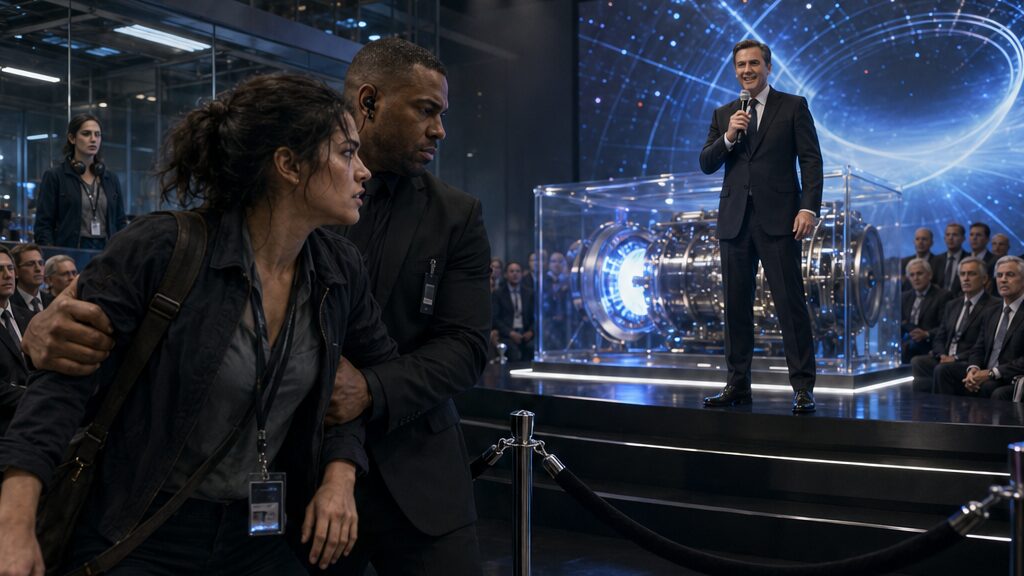
On the other side, the quantum engine pulsed in its transparent magnetic cradle at center stage, a quiet blue-white glow blooming and folding into itself like a star trying not to be born too soon.
Tyler stared at it through the glass.
For three years, she had watched that light begin as a line of unstable math on her workstation, then as a simulation that crashed every nine minutes, then as a containment problem that made two senior engineers quit and Amy Flores stop sleeping through weekends. Now the engine stood under theater lighting, surrounded by investors, press badges, board members, and a half-circle of polished chairs facing the massive LED wall.
The countdown rehearsal rolled across the screen.
PRIVATE ORBITAL DEMONSTRATION
QUANTUM PROPULSION IGNITION SEQUENCE
A BREAKTHROUGH BY NICHOLAS WALKER
Tyler’s hand tightened around the strap of her laptop bag.
A voice from inside the room boomed through the event speakers. “Ladies and gentlemen, in less than one hour, you will witness the future of private aerospace.”
Nicholas Walker stood beneath the LED wall in a dark tailored suit, one hand open toward the glowing engine as if he were warming himself by a fire he had made.
“My life’s work,” he said.
The words moved through the glass before the sound did. Tyler read them on his mouth first. Then she heard them, amplified and smooth, and something in her chest went very still.
A technician near the gate glanced up from the badge console. “Ma’am, you need to step back.”
“I’m lead systems architecture,” Tyler said.
The technician looked uncomfortable. He was young enough to have joined after the engine had already stopped failing in public. “Your access level is listed as observation only.”
“That’s wrong.”
He turned the small screen away as if politeness could hide the truth. “It updated last night.”
Behind him, the control center hummed. Glass rooms stacked inside glass rooms. Flight dynamics. Propulsion. Legal compliance. Investor relations. Launch safety. Each room bright with screens, each screen full of numbers Tyler knew by shape before she knew them by value.
A group of press guests laughed at something Nicholas said.
Tyler tapped her badge again.
Red.
“Run it manually,” she said.
“I can’t override executive access.”
“Then call Amy Flores.”
“She’s in the engineering enclosure. No external interruptions until after ignition readiness.”
Tyler looked past him.
Amy was there, behind the engineering glass, her dark hair pulled back, headset crooked over one ear. She was bent over a console beside two younger engineers, but Tyler saw the stiffness in her shoulders. Amy looked up as if she had felt Tyler through the room before seeing her.
Their eyes met.
For half a second, Amy did not move.
Then she pressed something flat against the inside of her console glass. A folded strip of thermal printout, narrow and pale, hidden from the floor by her body.
Tyler stepped away from the gate and moved along the glass wall, pretending to search for another entrance. The technician called after her once, then stopped when a cluster of investors passed between them.
At the seam where the engineering enclosure met the corridor wall, Amy slid the printout through a maintenance slot used for cable labels.
Tyler caught it with two fingers.
Amy did not speak. Her eyes flicked once toward Nicholas, then down to the paper.
Tyler unfolded it.
ADMINISTRATIVE CONTROL TRANSFER
ORIGINATING USER: TYLER SANCHEZ
RECEIVING USER: NICHOLAS WALKER
TIMESTAMP: 21:47:13
STATUS: ACCEPTED
CURRENT ARCHITECTURE ATTRIBUTION: EXECUTIVE-DIRECTED DEVELOPMENT
The room tilted slightly, though Tyler did not move.
She remembered the gold glow of Nicholas’s tablet the night before. His voice low enough that the security camera would record posture, not tone. The way he had said, “The board needs a unified key,” as if the launch were a sick child and Tyler was refusing medicine.
The printout trembled once in her hand. She crushed that tremor before anyone could see it.
Amy mouthed, I’m sorry.
Tyler looked from Amy to the engine.
The glow inside the magnetic cradle deepened. Blue-white. Blue-white. A rhythm almost like breathing.
No, Tyler thought.
Not sorry. Not yet.
She tucked the printout inside her jacket and turned toward the board section. Katherine Jones sat in the front row with a tablet across her knees, speaking to two investors in low, confident phrases. Her silver lapel pin caught the engine light each time she shifted. Board chair. Deal closer. The person who could stop a launch with two words if those two words protected valuation.
Tyler walked fast.
The event floor had been dressed overnight to hide the machinery. Black carpet over cable channels. White chairs in clean arcs. A champagne table nobody near propulsion had touched. A velvet rope cutting off the technical staff from the invited guests, as if the engineers were part of the equipment.
A security guard moved to intercept her.
Tyler slipped around a press camera and kept going.
“Ms. Sanchez,” the guard said. “You can’t be on the launch floor.”
Katherine looked up.
Tyler raised the printout. “Katherine, the attribution file has been changed. Nicholas transferred admin rights last night under false pretenses. The engine cannot launch under—”
Nicholas stopped speaking.
That was the first time the room noticed her.
Not the young technician. Not Amy. Not the engineers behind glass. The room. Investors turned in their chairs. Camera operators adjusted lenses. Someone from communications froze with both hands around a headset.
Nicholas’s face changed almost too quickly to call it change. The smile remained. The eyes hardened.
He lowered the microphone from his mouth and lifted one finger toward the side aisle.
Tyler saw the signal.
Two more security staff stepped away from the wall.
“Nicholas,” she called, louder now. “Do not do this.”
His smile widened as if she had given him exactly the line he needed.
The microphone rose again.
“Ladies and gentlemen,” he said lightly, “you’ll have to forgive a minor internal disruption. High-pressure projects can be difficult for people who are not prepared for the responsibility.”
A few people laughed because he gave them permission to.
Tyler felt heat rise into her face. Not fear. Not yet. Something more precise, sharper at the edges. The humiliation was not that he was lying. It was that he knew how easily a room believed a man with a microphone.
Katherine stood, but not toward Nicholas. Toward Tyler.
“Ms. Sanchez,” she said in a controlled voice, “this is not the forum.”
“It is exactly the forum,” Tyler said. “He is launching stolen architecture in front of investors and press.”
A murmur moved through the room.
Nicholas’s jaw tightened. For one second, Tyler saw beneath the performance: the fear, quick and animal, that someone might ask the right technical question.
Then Larry Smith stepped in front of her.
He was broad, expressionless, wearing an event security badge and an earpiece curled tight against his cheek. His hand did not touch her, but it hovered close enough to make the message clear.
“Ms. Sanchez,” Larry said, “Mr. Walker has ordered you removed from the launch floor.”
Chapter 2: The Signature She Could Not Take Back
Nicholas placed the gold-plated tablet on the table between them and said, “The project dies tonight unless you sign.”
The secure admin transfer room had no windows, only matte gray walls, a ceiling camera in a black dome, and a polished table that reflected the tablet’s screen like a small square of sunlight. Tyler had been awake for thirty-one hours. The numbers on the wall clock appeared to move with effort.
21:34.
Outside the room, somewhere beyond layers of locked doors and insulated walls, the test control center was being transformed for the launch. Crews laying carpet. Press screens being calibrated. The glowing engine sealed in its cradle under clean lights, waiting for morning.
Tyler stood with her laptop against her ribs. “The project does not die because architecture control remains with the person who built it.”
Nicholas leaned back in his chair. He had removed his suit jacket, but not his cufflinks. Even after fourteen hours in launch review, he looked arranged.
“That sentence is exactly why the board is nervous.”
“The board is nervous because you keep asking for administrative shortcuts three days before ignition.”
“The board is nervous,” Nicholas said, “because investors are flying in tomorrow and our lead systems architect refuses to understand chain of command.”
“Our lead systems architect,” Tyler repeated.
His mouth tightened.
She should not have said it. Not that way. She knew it as soon as his expression cooled. The room became smaller around them.
Nicholas touched the tablet. The authorization prompt bloomed gold against black.
ADMINISTRATIVE RIGHTS CONSOLIDATION
TARGET SYSTEM: Q-ENGINE FLIGHT INTEGRATION STACK
RECEIVING EXECUTIVE USER: NICHOLAS WALKER
CURRENT ADMIN USER: TYLER SANCHEZ
CONFIRM TRANSFER
“I’m not asking for your source notes,” he said. “I’m not asking for your precious draft history. I’m asking for administrative alignment before a launch with nine hundred million dollars of exposure.”
“It gives you authority to alter ignition readiness.”
“It gives the company authority.”
“You are not the company.”
His eyes flicked toward the ceiling camera, then back to her. When he spoke again, his voice softened.
“Tyler. You are brilliant. Nobody disputes that.”
She almost laughed. The compliment sat on the table like something baited.
“But brilliance without operational discipline becomes liability,” he continued. “Katherine is prepared to delay tomorrow’s launch if we cannot show unified executive access tonight.”
Tyler felt the first real crack of alarm. “Delay it, then.”
“And explain to every contractor, every board member, every investor, every team member sleeping under their desks, that Tyler Sanchez decided her personal discomfort mattered more than the mission?”
“That’s not what this is.”
“No?” Nicholas leaned forward. “You want Amy Flores to tell her team that their bonuses are gone? You want the propulsion contractors locked into another quarter of burn? You want the satellite window missed because you couldn’t trust the CTO of the company that pays you?”
Tyler looked at the tablet again.
Gold light. Black text. Her name. His name.
She had built safeguards for code injection, corrupted sensor streams, board pressure, even executive interference. She had not built one for exhaustion. For being cornered in a room where every responsible choice looked like surrender.
“What exactly does the transfer include?” she asked.
Nicholas slid the tablet closer. “Administrative surface control. Launch continuity. Executive sign-off authority.”
“Not master identity.”
His hesitation lasted less than a blink.
“No one asked for that.”
Tyler read the prompt fully. He was right. The request did not touch the master identity embedded under the engine’s trust architecture. It would give him visible command authority, enough for presentation, enough for board optics, enough to move through launch gates. But the deeper structure—the legal-technical spine she had buried after the first time Nicholas tried to rename her modules—would remain where it was.
Tied to her.
Nicholas watched her notice it.
Something passed between them, thin and dangerous.
“You’re overthinking,” he said.
That was when she knew he did not understand what he was asking for. Not fully. He understood access as possession. A green checkmark. A name at the top of a hierarchy. He did not understand that the engine’s deepest permissions were not decorative; they were load-bearing.
She could refuse.
The launch could stop.
The board could blame her. Nicholas could call her unstable. The team could lose months. The satellite window could close. Every person behind the glass tomorrow could become collateral in a fight Tyler had postponed for too long.
She heard Amy’s voice from two nights earlier, hoarse over coffee. If this launch works, nobody can bury the engine anymore.
Tyler looked down at her own hands. There was a thin burn mark across her left thumb from a containment test that had run too hot in February. She had not filed an incident report because the test had finally stabilized, and she had not wanted anyone shutting down the chamber.
That was always how it happened. A little silence for the work. A little pain for the mission. A little credit deferred because the engine mattered more.
Nicholas set a second document beside the tablet.
“What is that?” Tyler asked.
“Internal continuity memo. Standard.”
She picked it up.
Q-ENGINE PROGRAM DEVELOPMENT SUMMARY
EXECUTIVE-DIRECTED DEVELOPMENT UNDER CTO OFFICE
PRIMARY IMPLEMENTATION SUPPORT: SYSTEMS ARCHITECTURE TEAM
Support.
The word was small. Clean. Legal.
It did not say she had not built it. It simply made her building seem like assistance.
“No,” she said.
Nicholas exhaled through his nose. The softness left.
“Then I make the recommendation tonight that you be removed from launch operations pending review. I tell Katherine you are emotionally attached to your module history and unable to separate personal identity from company property. I have enough emails to support that concern.”
“My emails document safety issues.”
“Your emails document obsession if read by people who don’t speak in equations.”
For a moment, Tyler saw the path ahead with frightening clarity. If she fought in this room, he would make her the problem before morning. If she signed, she kept proximity. She kept the master identity. She kept the failsafe alive.
She told herself that was strategy.
She told herself the truth would protect itself if the work remained intact.
She took the stylus.
Nicholas did not smile. That was worse. He looked relieved.
Tyler signed the transfer first. The tablet warmed under her palm as her biometric confirmed the administrative handoff. A green checkmark flashed.
ADMINISTRATIVE CONTROL TRANSFER ACCEPTED
Then Nicholas tapped the continuity memo.
Tyler’s throat tightened.
“Just standard,” he said.
She signed that too.
The instant she lifted the stylus, regret moved through her body so sharply it felt physical. She wanted to snatch the tablet back, crack it against the table, force the words to unwrite themselves.
Instead, she closed her laptop bag.
“Do not alter ignition readiness without engineering review,” she said.
Nicholas stood, smoothing his cuffs. “That is why we value your support.”
She walked out before he could say anything else.
In the corridor, workers were mounting the last display panels for the morning event. One of them tested the LED wall feed. A draft slide appeared huge and bright at the far end of the hall.
A BREAKTHROUGH BY NICHOLAS WALKER
Tyler stopped.
The slide vanished a second later, replaced by a loading screen, but its afterimage stayed in her vision.
Behind her, in the admin room, Nicholas’s voice dropped into a call.
“Yes,” he said. “Send the final press deck to Katherine. Use the sole inventor language. No, don’t wait for engineering approval.”
Tyler stood with her hand on the cold corridor wall, the hidden master key still hers, the public story already leaving without her.
Chapter 3: A Failure Like You Carries Zero Weight
Tyler broke past the first security rope just as Nicholas said, “This engine represents my life’s work.”
The words landed cleanly in the launch event floor, amplified through overhead speakers, wrapped in applause from people who had never smelled burnt insulation at three in the morning or watched quantum containment fail by one decimal place for six consecutive weeks.
Tyler ducked under the velvet rope.
“Ma’am,” a guard snapped.
She kept moving.
The test control center had become a stage pretending not to be one. The massive LED wall showed a slow-motion rendering of the satellite unfolding above Earth. The real engine glowed beneath it inside its magnetic cradle, throwing blue-white light across Nicholas’s suit, across the polished shoes in the front row, across Katherine Jones’s composed face.
Nicholas held the microphone with one hand and the room with the other.
“The future does not arrive gently,” he said. “It is built by those willing to take command of impossible ideas.”
Tyler’s laugh came out once, sharp and disbelieving.
Several heads turned.
Nicholas saw her.
His smile remained, but his fingers tightened around the microphone.
Tyler raised the folded printout as she moved down the side aisle. “Katherine. I need thirty seconds.”
Katherine stood from the front row. “Ms. Sanchez, this is not appropriate.”
“Neither is fraud.”
That word did what numbers could not. It cut through the room. The applause died unevenly, section by section, like power failing across a grid.
Nicholas lowered his chin. “Security.”
Tyler stepped into the open aisle where every camera could see her. Her badge hung against her blouse, downgraded now, useless plastic on a blue lanyard. She felt its weight like a joke.
“My administrative rights were transferred last night under false pretenses,” she said. “The Q-engine architecture is not executive-directed development. I built the flight integration stack. Amy Flores and the engineering team can verify—”
Behind the glass, Amy rose halfway from her console.
Tyler saw her. So did Katherine.
“Ms. Flores,” Katherine said sharply, without turning her head, “any disruption during launch readiness may trigger breach penalties across every vendor contract attached to this demonstration.”
Amy stopped.
Her hand remained on the console edge. Her face changed in a way Tyler could read even from across the floor: apology, fear, calculation, shame.
The younger engineers behind her looked down at their screens.
Tyler’s mouth went dry.
So that was how silence spread. Not because no one knew. Because everyone knew exactly how expensive truth could be.
Nicholas gave a small laugh into the microphone.
It sounded almost kind.
“Tyler has been under tremendous strain,” he told the room. “A launch of this magnitude tests everyone. Some people rise. Some people confuse proximity to greatness with ownership of it.”
A murmur moved through the investors. Phones lifted. Cameras shifted from Nicholas to Tyler, hungry for disruption.
Tyler forced herself not to look away.
“You don’t understand the trust sequence,” she said. “You don’t understand the recovery path if ignition rejects executive control. You have admin surface rights, not master authority.”
Nicholas’s eyes sharpened at the last two words.
Katherine looked at him, then at Tyler.
For one fragile second, Tyler thought the phrase had landed somewhere useful.
Then Nicholas turned fully toward her, microphone close to his mouth, stage lights catching the silver at his temples.
“Let me be very clear,” he said.
The room stilled.
Tyler heard the countdown rehearsal in the background, low and automated, cycling through pre-ignition checks. She heard the containment magnets hum. She heard her own pulse in her ears.
Nicholas smiled.
“The whole world is honoring me. The words of a failure like you carry zero weight.”
The room did not explode. That would have been easier. Instead, it did something worse.
A few people laughed quietly.
Someone near the press riser whispered, “Is she former staff?”
A board aide stepped back from Tyler as if embarrassment were contagious.
Heat climbed up Tyler’s neck. For a second she was twenty-six again, standing beside a whiteboard while a senior manager repeated her solution louder and received the nods. Then thirty, in a budget meeting where Nicholas called her “implementation” after she had designed the architecture. Then last night, stylus in hand, signing a memo that turned years of creation into support.
The printout crumpled at the edges in her fist.
Larry appeared on her right. Another security guard moved in from the left.
“Ms. Sanchez,” Larry said under his breath, “don’t make this harder.”
Tyler looked at him. “Do you know what happens if he launches without master recovery?”
Larry’s expression did not change. “I know my instruction.”
Nicholas turned back to the audience, already reclaiming the moment. “Now, if we can return to what matters—”
“What matters is that you can’t reboot it,” Tyler said.
The microphone caught enough of her voice to scatter it through the speakers. Nicholas froze.
Tyler stepped forward before Larry could close the distance.
“If ignition enters a rejected trust state,” she said, louder now, “the system requires master identity to recover. Not admin. Not executive sign-off. Not your tablet.”
Nicholas’s smile had thinned into something almost flat.
“You are embarrassing yourself,” he said.
“No,” Tyler said. “I embarrassed myself last night when I trusted you to stop at access.”
That one was for him. For Amy. For the part of herself still trying to pretend silence had been strategy.
The LED wall behind Nicholas shifted.
The rehearsal graphics vanished.
A new countdown appeared.
T-MINUS 00:20
ACTIVE IGNITION SEQUENCE ARMED
A ripple went through the engineering glass.
Amy grabbed her headset. “That’s not rehearsal,” she shouted, her voice muffled by the enclosure.
Tyler turned toward the engine.
Its glow intensified, blue-white folding inward, then flaring at the rim. The pulse had changed. Slower. Deeper. A trust-state prelude.
Nicholas glanced at the LED wall, then toward his gold-plated tablet resting on the podium.
For the first time that morning, the performance cracked openly across his face.
Tyler saw it.
He was afraid.
The countdown voice filled the room, calm and inhuman.
“T-minus fifteen seconds.”
Larry reached for Tyler’s arm.
Chapter 4: The Safeguard Hidden Inside the Miracle
Tyler saw the engine flicker wrong.
Not brighter. Not failing. Wrong in a way only she would recognize, because she had built that particular pulse into the trust sequence after a winter night when Nicholas had tried to rename three core modules as “executive integration assets.”
Blue-white. Blue-white. Pause. Blue-white.
A missing third beat.
Her stomach dropped.
Larry’s hand closed around her arm. “Move.”
Tyler did not move. She stared past Nicholas, past the podium, past the gold-plated tablet resting near his hand, and watched the quantum engine enter pre-ignition trust review with stolen administrative authority sitting on top of an untouched master identity.
“Nicholas,” she said, and her voice came out quieter than she intended. “Stop the sequence.”
He lifted his chin. “Remove her.”
“Nicholas, you don’t have recovery authority.”
The words struck him differently now. The crowd could not tell, but Tyler saw the small tightening at the corner of his left eye, the way his thumb shifted toward the tablet. He knew enough to fear the phrase, not enough to understand its shape.
The countdown voice continued, steady and cold.
“T-minus fourteen seconds.”
Behind the engineering glass, Amy shoved her headset higher and slammed a command into her console. The screen flashed amber in reflection across her face.
Tyler twisted against Larry’s grip. “Amy!”
Amy looked up.
Tyler pointed toward the engine, then made two fingers tap against her own wrist, the old signal they used during silent chamber tests: trust sequence.
Amy’s face changed.
She saw it too.
The engineering enclosure erupted into motion. One younger engineer bent over a console. Another reached toward the emergency override panel. Amy spoke rapidly into her headset, then ripped it off when no one answered and ran to the glass seam nearest Tyler.
“Nicholas disabled override channels,” Amy shouted through the glass.
The room was loud enough that only Tyler heard the shape of the words. She stepped toward the seam, but Larry yanked her back.
“What?” Tyler shouted.
Amy pressed both palms to the glass. “Engineering override is locked out. It’s executive-only.”
Tyler’s blood went cold.
Nicholas had not simply taken the stage. He had shut the engineers out of the machine.
That was not confidence. That was fear dressed as control.
“T-minus thirteen seconds.”
Katherine Jones turned sharply toward Nicholas. “Is engineering locked out?”
Nicholas did not answer her directly. He smiled toward the audience as if all of this were still part of a controlled demonstration.
“Standard command consolidation,” he said. “Final launch authority must be clean.”
“Clean?” Tyler said. “You cut out the only people who know what it’s doing.”
“You mean the people who have spent three years turning a corporate investment into a private shrine to their own importance?” Nicholas snapped, and for the first time the microphone caught too much of him.
Several board members shifted.
The engine pulsed again.
Blue-white. Blue-white. Pause. Blue-white.
Tyler felt the memory come with it, not soft or nostalgic, but bright and hard.
The first version of the legal failsafe had been ugly code written at 2:12 in the morning after Nicholas had presented her containment stability model to the board without saying her name. She had been alone at her workstation, the engine simulation stuttering red on one monitor, a draft patent attribution file open on another. She remembered typing with her left thumb bandaged, angry enough to be clear.
If executive admin attempts launch without master-author validation, system may proceed only through active trust confirmation.
If command hardware is destroyed during unauthorized launch initiation, automated lockdown activates.
If lockdown activates, chain-of-custody logs publish to legal escrow and board compliance.
Amy had called it paranoid.
Tyler had called it load-bearing honesty.
Then the work had improved. The engine had stabilized. The anger had cooled into architecture. The safeguard stayed buried, documented in a place nobody looked because nobody wanted to admit why it had to exist.
Not a revenge switch.
A witness.
But she had never imagined she would be standing ten yards away while Nicholas marched the engine directly toward it.
“T-minus twelve seconds.”
Larry tightened his hold. “Last warning.”
Tyler looked at him, really looked. Not as an obstacle, but as a man following a clean instruction in a room built to make dirty things look clean.
“If he launches,” she said, “the system can lock itself beyond recovery.”
Larry’s eyes flicked to the glowing engine despite himself.
Nicholas saw it.
“Do not engage with her,” he barked. “She has no operational authority.”
Tyler laughed once under her breath. It was not humor. It was the sound of the last polite thing in her breaking.
No operational authority.
The phrase was perfect. The whole room had accepted it because it appeared on a badge screen.
Katherine moved toward the side aisle, flanked by a board aide. “Ms. Sanchez, step away from the floor. We will review your concerns after launch.”
“After launch, the fraud is airborne,” Tyler said.
Katherine’s face hardened. “After launch, we still have a company to protect.”
“There it is,” Tyler said.
Katherine did not flinch, but something behind her eyes did. She was not stupid. She was choosing. Choosing valuation, continuity, the clean chain of command, the version of events that would not detonate in front of press and investors.
“T-minus eleven seconds.”
Amy was still at the glass, her mouth close to the seam. “Tyler,” she called. “The software kill path is gone.”
Tyler heard the sentence beneath the sentence.
There was only physical interruption now.
Her gaze moved.
Engine. Podium. Tablet. LED control wall.
Nicholas had set the gold-plated tablet on the podium directly beneath the massive screen, as if displaying a royal instrument. Its black surface showed the active launch command interface. His name in the upper corner. Executive control. Administrative authority. A stolen crown, polished for the cameras.
Tyler could see the path to it.
Too many bodies. Larry at her arm. Another guard near the rope. Nicholas on stage. Katherine between hesitation and command. Amy trapped behind glass.
But the path existed.
That was enough.
“T-minus ten seconds.”
Tyler stopped pulling against Larry.
The sudden stillness made him loosen half an inch.
She looked at Amy. Not for permission. For witness.
Amy’s hand pressed harder against the glass. Her eyes were wet, furious, afraid.
Tyler thought of the printout in her jacket. The signed memo. The years of perfect work. The little silences she had stacked like insulation around the engine until Nicholas found them useful.
Her flaw had never been weakness. It was faith misplaced in systems that rewarded whoever stood closest to the microphone.
“T-minus nine seconds.”
Katherine raised her hand. “Security, remove her now.”
The order snapped across the room.
Larry shifted his weight to drag Tyler back.
Tyler moved first.
She drove her heel down onto the inside of Larry’s shoe, twisted her arm through the loosened space, and slipped free hard enough to tear the seam at her sleeve. The second guard lunged. Tyler ducked under his reach and hit the carpet with one knee, catching herself with her palm.
The room erupted.
“Stop her!” Nicholas shouted.
“T-minus eight seconds.”
Tyler came up running.
Not toward Nicholas.
Toward the tablet.
Larry recovered behind her with a curse and charged from the side. The guard near the rope cut in front of her, arms wide. Tyler grabbed the velvet stanchion and swung it down across the carpet. The base clipped his shin. He stumbled, not badly, but enough.
Amy’s voice broke through the noise. “Tyler!”
The engine’s glow flared at the rim.
Blue-white. Blue-white. Pause. Blue-white.
The trust sequence waited for a master who had been declared support.
Tyler saw Nicholas’s hand shoot toward the tablet.
She saw his fear fully now, stripped of polish. Not fear of danger. Fear of exposure. Fear that the machine would know what the room had refused to hear.
He reached the tablet first and closed his fingers around it.
Tyler was still three strides away.
The countdown voice filled the room.
“T-minus seven seconds.”
Chapter 5: When the Stolen System Testified
“T-minus fifteen seconds,” the countdown voice had said, and by seven seconds the room had stopped being an event and become a collision.
Tyler slammed into the edge of the stage as Nicholas snatched the tablet from the podium.
For one instant, they were close enough that no microphone was needed. The blue-white glow of the engine painted one side of his face and left the other gray.
“Don’t,” he said.
It was not a command this time.
It was a plea wearing the last scraps of authority.
Tyler reached for the tablet. Nicholas jerked it back against his chest.
“You don’t know what you’re doing,” he hissed.
That almost stopped her. Not because she believed him, but because it was the exact sentence he had spent years teaching rooms to say about her.
Behind her, Larry charged.
Tyler saw him in the black reflection of the LED wall: broad shoulders, outstretched arm, expression set in the clean obedience of a man certain that force would simplify the room.
“T-minus six seconds.”
Tyler dropped low.
Larry’s hand caught only the torn fabric at her shoulder. She turned with the pull instead of fighting it and drove her fist forward with every hour she had spent biting words in half.
The punch landed against Larry’s jaw with a flat, awful sound.
He staggered sideways into the console rail, knocking a row of event uplights crooked. One toppled and spun light across the ceiling. A woman in the front row screamed. The second guard froze just long enough to become part of the background.
Pain burst across Tyler’s knuckles.
She did not look at them.
Nicholas stared at Larry, then at Tyler, and in that split second she saw what frightened him more: not that she had hit a security guard, but that she had stopped asking the room to allow her forward.
“T-minus five seconds.”
Tyler lunged.
Nicholas tried to pivot away. She caught his wrist with both hands. The tablet’s gold edge dug into her palm. For a moment they struggled over it in front of the investors, the board, the press, the engine, the entire story Nicholas had dressed up for them.
“Tyler,” he said through his teeth. “Think.”
“I did,” she said.
She wrenched the tablet free.
The screen flashed under her thumb.
ACTIVE IGNITION
EXECUTIVE USER: NICHOLAS WALKER
CONFIRMATION PATH: ADMINISTRATIVE
Not master.
Never master.
For the first time that day, Tyler felt no need to explain.
“You wanted my access?” she said.
Nicholas’s face went slack.
“T-minus four seconds.”
Tyler turned and hurled the gold-plated tablet at the massive LED screen.
It spun once, catching stage light like a coin thrown into a well.
Then it hit.
The impact cracked across the wall in a jagged white burst. The tablet shattered against the display panel, driving a spiderweb of dead pixels outward. Sparks spat from the seam. The LED wall flashed white, then green, then a violent cascade of broken launch graphics.
The countdown voice clipped mid-word.
“T-minus th—”
Blackout.
For half a second, everything vanished.
No Nicholas. No board. No cameras. No false inventor slide. No bright engine presentation. Only darkness, the smell of scorched circuitry, and the low magnetic hum of the quantum engine still alive in its cradle.
Then sirens began.
Not the clean rehearsal tone. Emergency sirens. Raw and pulsing.
Red strobes erupted across the control center.
Someone shouted for medical. Someone else shouted for legal. A press camera kept recording, its little red light blinking in the dark like an accusation.
The engine changed color.
Blue-white collapsed inward, then flared red through the magnetic cradle. Not unstable red. Not thermal red. Protocol red.
Witness red.
A deep mechanical lock slammed somewhere beneath the stage.
LAUNCH ABORTED appeared in fragments across a surviving corner of the LED wall, then vanished.
Nicholas stumbled toward the broken screen. “No, no, no. Restore display. Restore command. Get the auxiliary feed up.”
No one moved quickly enough for him.
The engineering glass doors unlocked with a heavy magnetic clack.
Amy was the first through.
She ran to the emergency console, hands flying across the keys. Her face was pale under the red strobes.
“Katherine,” Nicholas shouted, voice cracking, “she attacked security and destroyed command hardware. Detain her. Now.”
Katherine stood frozen in the front row, one hand gripping the back of a chair. Her eyes were not on Tyler. They were on the engine.
The red glow pulsed once.
A backup projector flickered to life above the damaged LED wall. Its image was dim, broken at the edges, but readable.
EMERGENCY TRUST FAILURE
UNAUTHORIZED LAUNCH INITIATION DETECTED
The room quieted in layers.
Nicholas turned slowly.
“Kill that feed,” he said.
Amy looked over her shoulder. “I can’t.”
The words traveled farther than she meant them to.
The projector refreshed.
COMMAND HARDWARE DESTRUCTION DETECTED
AUTOMATED LEGAL LOCKDOWN ACTIVE
CHAIN OF CUSTODY PUBLISHING
Tyler stood at the foot of the stage, breathing hard, one hand throbbing, torn sleeve hanging loose. Larry groaned near the console rail, upright but dazed, one palm against his jaw. The second guard had not touched her.
Nicholas pointed at Tyler. “She designed this. This is sabotage.”
Tyler looked at him. “Yes. I designed it.”
A tremor moved through the room.
She felt Amy turn toward her.
Tyler did not soften it.
“I designed it after you tried to move the containment recovery modules under the CTO office without engineering review. I documented it in legal escrow. I tied it to unauthorized launch conditions. You met every condition.”
Nicholas barked a laugh. “Do you hear her? She admits it. She built a trap into company property.”
“A lock,” Tyler said. “For a stolen door.”
Katherine finally moved. “Show master authority.”
Amy’s hands paused.
Nicholas’s head snapped toward her. “Katherine—”
“Show it,” Katherine said.
Amy entered the command.
The projector flickered again.
MASTER KEY OWNER: TYLER SANCHEZ
ADMINISTRATIVE USER: NICHOLAS WALKER
ADMIN TRANSFER TIMESTAMP: 21:47:13
TRANSFER SCOPE: SURFACE CONTROL ONLY
IGNITION AUTHORITY: INVALID
The silence that followed had weight.
Tyler expected satisfaction. A clean surge of triumph. Instead she felt the sick heaviness of a system proving what people had chosen not to hear until proof became expensive enough.
The press riser erupted first. Whispers. Camera shutters. Someone said, “Get the market feed.” Someone else was already on a phone.
Nicholas’s mouth opened, then closed.
For years, Tyler had watched him recover rooms through language. He had words for delay, words for blame, words for ambition, words for other people’s work. Now the screen had taken the microphone from him.
The emergency feed advanced without permission.
LEGAL ESCROW PACKAGE SENT
BOARD COMPLIANCE NOTIFIED
REGULATORY HOLD INITIATED
SELF-DESTRUCT SEQUENCE TRIGGERED
A board member gasped.
“It won’t destroy the facility,” Tyler said quickly, before panic could stampede. “It destroys the launch authorization chain and quarantines the proprietary control stack. The engine is safe if no one forces recovery.”
Nicholas seized on the sentence. “If no one forces recovery? She is threatening us in real time.”
“I’m telling you how not to make it worse.”
“You made it worse!” he shouted.
There he was, finally. Not visionary. Not composed. A man standing in front of a stolen miracle he could not command, furious that the lock recognized the owner.
Katherine lifted her tablet with shaking control. “The stock feed.”
The board aide beside her hesitated.
“Katherine,” Nicholas said, almost softly now. “Don’t put that on the main display.”
She looked at him then, fully. Something cold settled in her face.
“You told us the attribution risk was contained.”
“It was.”
The surviving projector refreshed again, not from Amy’s console but from the automated legal feed.
MARKET RESPONSE ESTIMATE
LIVE TRADING IMPACT: -18%
PROJECTED CONTINUED DROP: -30%
A minute later, the number updated.
-22%
The investors began standing.
Not all at once. One chair, then three, then an entire row. Phones lit faces in the red strobes. The champagne table stood untouched at the back, absurd and shining.
Nicholas backed away from the stage edge. “This is temporary. We can restore from backup. Amy, restore from backup.”
Amy did not move.
Nicholas turned on her. “That is an order.”
Amy looked at Tyler, then at the engine, then at the shattered gold tablet lying in pieces under the broken LED wall.
“No,” she said. “It isn’t.”
The word was small, but it cut deeper than the sirens.
Nicholas stared at her as if betrayal had no right to come from a person he had never counted as capable of choosing.
Larry pushed himself fully upright, hand still at his jaw. His eyes went to Tyler, then to the screen. For the first time, uncertainty replaced obedience.
Katherine’s tablet chimed.
Then chimed again.
The emergency projector updated.
STOCK DOWN 30%
TEN-MINUTE VOLATILITY HALT REQUESTED
LEGAL LOCKDOWN CONFIRMED
The red light from the engine washed over Tyler’s hands. Her knuckles had begun to swell.
Nicholas pointed at her again, but the gesture had lost its stage.
“Arrest her,” he said.
No one moved.
Then Katherine spoke into the red-lit silence.
“Secure Ms. Sanchez in a holding room until legal arrives.”
Tyler looked at Amy.
Amy took one step toward her, but two compliance officers entered through the side doors. They did not grab Tyler. They did not need to. The room had shifted from public spectacle to institutional containment.
Tyler walked between them with her head up, past the broken tablet, past the engine glowing red in its cradle, past Nicholas standing under the dead screen.
Behind her, the projector continued to burn the truth into the wall.
SELF-DESTRUCT SEQUENCE TRIGGERED
AUTOMATED LEGAL LOCKDOWN ACTIVE
STOCK DOWN 30%
Chapter 6: The Board Learned Who Owned the Key
“Nicholas Walker initiated unauthorized launch control,” the emergency screen said while Nicholas pointed at Tyler and demanded her arrest.
The words appeared in red on every available surface: the fractured LED wall, the side monitors, the glass of the engineering enclosure, even the small compliance tablet Katherine Jones held so tightly her knuckles paled.
Nicholas’s voice cracked over the sirens. “She built malicious architecture into the system. She assaulted security. She destroyed company property in front of investors.”
Tyler stood between two compliance officers near the side corridor, her torn sleeve hanging open, her right hand swelling. Larry leaned against the console rail with an ice pack someone had handed him, his expression no longer certain enough to be useful to anyone.
Katherine did not look at Tyler first. She looked at Amy.
“Can the feed be contained?”
Amy’s jaw tightened. “No.”
“I am asking if it can be contained internally.”
“No,” Amy said again. “Legal escrow already published chain-of-custody packets to board compliance and regulatory hold recipients. That was the point.”
Nicholas rounded on her. “You knew about this?”
Amy’s silence answered too late.
Tyler felt it like a pressure change. Amy had not known all of it, not the exact trigger path, not the command hardware destruction clause. But she had known Tyler’s fear was real. She had known Nicholas had been reaching for the engine for months. She had known enough to be ashamed.
Katherine lifted her tablet and tapped through the emergency packet. The red strobes continued to pulse, but the sirens dropped to a lower tone, less panic than judgment.
A timeline opened on the wall.
19:12:44 — CTO OFFICE REQUESTED MODULE ATTRIBUTION REVIEW
21:47:13 — ADMINISTRATIVE RIGHTS TRANSFER ACCEPTED
21:49:02 — INTERNAL MEMO UPDATED: EXECUTIVE-DIRECTED DEVELOPMENT
08:36:18 — ENGINEERING OVERRIDE CHANNELS DISABLED
09:02:05 — ACTIVE IGNITION SEQUENCE ARMED BY ADMINISTRATIVE USER
09:02:12 — MASTER AUTHORITY INVALID
Each line appeared without drama. That made it worse.
Nicholas stared at the timeline as if he could intimidate text.
“That is incomplete,” he said. “It lacks context.”
Katherine’s head turned slowly. “Then provide it.”
He opened his mouth.
Nothing came quickly.
The board aide’s phone rang, then another phone, then another. A low, spreading music of collapse. Across the room, one investor walked out while speaking into his cuff microphone. A press camera near the back remained trained on the emergency screen until a communications staffer stepped in front of it and was pulled away by someone who understood optics better.
Tyler watched the stock feed appear on a side monitor.
DOWN 30.4%
The number did not feel like justice. It felt like mass. Like the building had gained weight.
Those were jobs. Contractors. Families. Younger engineers who had done nothing except work too late under people who took credit too easily. Tyler had known the lockdown would be catastrophic. She had not imagined the number would look so blunt.
Katherine saw her looking.
For the first time that morning, the board chair spoke to her without contempt. “Did you know this would happen?”
“I knew legal lockdown would publish,” Tyler said. “I knew it could affect valuation.”
“Could?”
Tyler did not defend the word. “I did not know he would disable engineering override and arm active ignition in front of a live audience.”
Nicholas stepped forward. “Because I was trying to save this launch from paralysis. That is what leadership requires. Decisions. Ownership. The willingness to carry risk.”
“Risk you put under her name when it was dangerous,” Amy said.
The room turned.
Amy had stepped away from the engineering console. Without the glass between them, she looked smaller than she had during launches and larger than she had during meetings. Her headset hung around her neck.
Nicholas’s face hardened. “Careful.”
“No,” Amy said. Her voice shook once, then steadied. “You don’t get that word anymore.”
Katherine fixed on her. “What exactly are you saying?”
Amy swallowed. “Tyler warned us months ago that executive misuse of admin authority could corrupt launch recovery. She asked for independent review. Nicholas buried the ticket. Then he asked engineering to route all presentation queries through his office so the board wouldn’t see module ownership history.”
Nicholas laughed, but it was thin. “That is an interpretation from a senior engineer protecting a colleague.”
Amy looked at Tyler.
There was apology in it, yes, but not only apology. Fear too. Fear of blacklisting, breach penalties, legal retaliation. The same fear that had held her behind the glass twenty minutes earlier.
Then Amy turned back to Katherine.
“I stayed quiet because I thought the safest thing was getting through launch,” she said. “I was wrong.”
The sentence moved through Tyler more sharply than praise could have.
Katherine looked down at the tablet again. A new compliance packet opened. Tyler saw the heading from where she stood.
PRIOR ENGINEERING WARNINGS
SUBMITTED BY: TYLER SANCHEZ
CC: AMY FLORES
STATUS: CLOSED BY CTO OFFICE
Katherine’s face closed around something like anger, though Tyler could not tell whether it was anger at Nicholas, at herself, or at the fact that the truth had arrived in a form that could not be managed.
Nicholas saw it too. He changed tactics.
“Katherine,” he said quietly, stepping closer. “We can contain this if we act as one company. We classify the lockdown as internal sabotage. We commit to a third-party investigation. We restore investor confidence. But not if we let a systems architect dictate public narrative from the wreckage she created.”
There it was: the reasonable voice. The salvage voice. The voice that could make harm sound like governance.
For a moment, Katherine listened.
Tyler understood why. The whole building had been designed to reward that voice. A launch could fail. A market could punish. But institutions survived by choosing the version of events that cost the least to print.
Then the emergency screen updated again.
MASTER KEY OWNER: TYLER SANCHEZ
CREATOR SIGNATURE HASH: VERIFIED
AUTHORITY DISPUTE: LEGAL ESCROW ACTIVE
REINSTATEMENT OR RECOVERY REQUIRES OWNER CONSENT
A sound moved through the engineers behind Amy. Not applause. Not yet. A release of breath.
Nicholas looked at the line requiring Tyler’s consent.
His face emptied.
Katherine looked at Tyler then, fully.
The room waited for something from her. A speech. An accusation. A victory claim.
Tyler gave them none of it.
“My consent is not available today,” she said.
Nicholas snapped. “You self-righteous—”
“Enough,” Katherine said.
That single word did what Tyler’s proof had not. It stopped Nicholas.
Katherine turned to the compliance officers. “Take Ms. Sanchez to Holding Room Three. No external questioning until counsel is present. Do not process her as security removal. This is now legal containment.”
Legal containment. Not vindication. Not freedom.
Tyler almost laughed again.
The compliance officers guided her toward the side corridor. Amy took two steps after her.
“Amy,” Katherine said.
Amy stopped.
Tyler glanced back.
Nicholas stood beneath the broken LED wall, no longer under a title slide, no longer beside a future he could claim. Only red system light cut across him.
The corridor door closed between Tyler and the launch floor.
Holding Room Three was small, white, and too cold. A metal table. Two chairs. A wall monitor showing only the company logo, though the logo had begun to feel like a bad disguise.
Tyler sat. Her hand throbbed. The torn edge of her sleeve brushed her wrist every time she moved.
For the first time since the badge flashed red, there was no crowd, no siren, no engine glow in front of her. The quiet should have been relief.
Instead it gave the cost room to enter.
She had saved the engine from being stolen cleanly. She had also burned the launch, detonated the stock, and left the team inside the blast radius. Nicholas had caused it. Katherine had enabled it. But Tyler had known where the lock was. She had thrown the key into the wall herself.
The door clicked.
It opened only a few inches.
Amy’s hand appeared through the gap, holding a folded sheet of paper.
A compliance officer muttered, “You have ten seconds.”
Tyler stood.
Amy did not try to hug her. Did not apologize again. Did not say it was over.
She pushed the paper into Tyler’s hand.
Tyler unfolded it after the door shut.
At the top was Amy’s name.
Below it, one sentence in clean black type:
I hereby resign from my position, effective immediately.
Chapter 7: The Empty Office Filled One Door at a Time
Tyler unlocked the office with a key that still had a paper tag on it.
The tag said SUITE 4B in blue ink, though the door itself had no number, no company name, no logo, no sign that anyone with sense would build aerospace hardware there. The hallway smelled faintly of paint and old carpet glue. Somewhere behind another door, a printer jammed and beeped with exhausted persistence.
Her right hand hurt when she turned the key.
She switched to her left.
The lock gave.
Inside, the office was bare except for a folding table, two metal chairs, a trash can, and a wall of glass that looked down over a parking lot and the far edge of the city’s industrial district. No reception desk. No server racks. No magnetic containment chamber. No engine glow.
Just one printed blueprint rolled under Tyler’s arm, rescued from her apartment before sunrise.
She stepped in and let the door close behind her.
The quiet landed differently than the holding room’s quiet. That room had been silence imposed by legal containment. This was empty space. Terrifying, useless, possible.
Tyler crossed to the folding table and unrolled the quantum engine blueprint. Its corners curled up immediately. She found a chipped mug left by a previous tenant near the sink and used it to weigh down one side. Her laptop weighed down the other.
The drawing looked too large for the table.
Containment rings. Trust architecture. Flight integration stack. Recovery gates. Notes in her own cramped hand along the margins, written before the engine had become a trophy, before Nicholas had stood under lights and called it his life’s work.
Her phone buzzed.
She did not pick it up.
It had been buzzing since 4:00 a.m. Unknown numbers. Legal counsel. A company representative. Two reporters. One automated alert from a financial app she did not remember installing, announcing another trading halt request as if the world needed one more polite way to say collapse.
At 5:30, an official message had arrived from Katherine Jones.
The company is prepared to discuss immediate reinstatement, title correction, compensation adjustment, and controlled public clarification, contingent on your cooperation with recovery efforts and non-escalation by engineering staff.
Tyler had read it twice, then set the phone face down.
Reinstatement.
The word had looked generous if you ignored everything built beneath it. A polished hallway. A corrected title. A new badge that flashed green because the same people who had erased her had decided it was useful to restore her.
Her hand tightened at the edge of the folding table.
The office door opened.
Tyler turned too quickly, pain sparking through her knuckles.
Amy Flores stood in the doorway with a cardboard box against her hip and a white envelope on top of it. She looked as if she had not slept at all. Her hair was pinned badly. Her eyes were red. Her badge lanyard was gone.
For a second, neither of them spoke.
Then Amy stepped inside and placed the envelope beside the blueprint.
“We’re with you,” she said.
The sentence did not echo. The office was too small for that. It simply stayed there, plain and solid, between the folding table and the bare wall.
Tyler looked down at the envelope.
Amy Flores
Senior Engineering Lead
Resignation — Effective Immediately
“You shouldn’t have done this alone,” Tyler said.
Amy gave a tired laugh without humor. “I know.”
“I meant now.”
“So did I.”
Tyler looked at her then.
Amy’s face did what the emergency screen had not. It made the victory hurt. This was the person who had pressed the printout through the maintenance slot. The person who had stayed behind glass. The person who had said no to Nicholas when it was too late to save the launch but not too late to save herself.
“I froze,” Amy said.
Tyler did not rescue her from the sentence.
Amy nodded once, accepting that. “Katherine told us any disruption would trigger breach penalties. Nicholas told us you were too attached to the architecture. I told myself I was protecting the team by staying calm.” She glanced at the blueprint. “I think I was protecting my job.”
Tyler leaned against the table. The easy thing would have been forgiveness on contact. A clean speech about pressure and fear. But the story had already done enough damage by making silence sound noble.
“I signed the transfer,” Tyler said. “I told myself the failsafe was enough.”
Amy’s eyes lifted.
“I didn’t warn you,” Tyler continued. “Not fully. I thought if I kept the engine safe, the truth would eventually force its way out.”
“It did.”
“It almost launched under his name first.”
Amy absorbed that without argument.
Then she opened the cardboard box.
Inside were three more envelopes.
Tyler stared at them.
Amy set them down one by one beside her own. “These are from the integration team. More are coming. Some need to talk to spouses first. Some are scared. Some got settlement calls before breakfast.”
“Katherine?”
“Company counsel. Same script. Retention bonus, revised titles, quiet cooperation.” Amy pulled a folded page from her back pocket. “They offered me director.”
Tyler looked at the page but did not touch it.
Amy dropped it into the trash can.
The sound was small and final.
The door opened again.
Two engineers entered, each carrying a backpack and a resignation envelope. No dramatic announcement. No applause. One had a coffee stain down his sleeve. The other kept looking at the blueprint as if expecting it to accuse him personally. They placed their envelopes on the table and stepped back.
Then another came.
Then two more.
The empty office began to fill one door at a time.
Cardboard boxes gathered against the wall. Laptops opened on the floor because there were not enough chairs. Someone found an extension cord in a closet. Someone else taped paper over the glass door so the hallway could not see the blueprint. A quiet, practical urgency replaced the previous day’s sirens.
Nobody called it a company at first.
They called it here.
Put that here.
Can I set up here?
Is this safe here?
Do we have access here?
The word changed the room before any paperwork could.
Tyler stood at the folding table while the team arranged themselves around her stolen miracle’s surviving map. They did not look triumphant. They looked frightened, exhausted, newly unemployed, and more honest than they had looked behind the engineering glass.
Amy’s phone rang. She checked the screen and held it up.
Katherine Jones.
The office went still.
“Speaker?” Amy asked.
Tyler hesitated, then nodded.
Amy answered.
“Katherine,” she said.
Katherine’s voice came through clipped and controlled. “Amy. I assume Tyler is with you.”
Tyler folded her arms, careful of her hand. “I am.”
A brief silence. “Then I’ll speak plainly. This mass resignation is unnecessary and potentially damaging to everyone involved.”
Amy looked around the office. Nobody moved.
Katherine continued. “We are prepared to make corrected offers. Titles, compensation, authorship clarification, internal protections. Tyler, the board understands now that your role was misrepresented.”
“Misrepresented,” Tyler said.
Katherine exhaled. Not quite impatience. Not quite shame. “Stolen, then. If that is the word you need.”
“It’s the word that happened.”
“Yes,” Katherine said, quieter. “It is.”
The room changed around that admission. Not softened. Sharpened.
“But destroying the company will not rebuild your engine,” Katherine said. “You need facilities. Capital. Legal clearance. Launch partnerships. We can give you those.”
Tyler looked at the blueprint, at the trust architecture lines she had drawn to keep powerful people honest after she had stopped believing they would choose it freely.
“You had all of that yesterday,” she said.
Katherine did not answer.
Tyler heard, faintly through the phone, the background noise of the corporate lobby: voices, footsteps, the sterile chime of elevators. Somewhere behind Katherine, screens were probably still showing the stock chart in red.
“What happens to Nicholas?” Tyler asked.
Another silence.
“He has been placed on leave pending investigation.”
A few people in the office exchanged looks.
Tyler almost smiled, but there was no joy in it. “Pending.”
“That is how process works.”
“No,” Tyler said. “That is how delay works when power needs time to rename itself.”
Katherine’s voice hardened. “Be careful. You are not untouchable because the system identified you as master-key owner.”
“I know.”
And she did know. Better than anyone in the room. Lawsuits would come. Depositions. Articles. Maybe charges from someone angry enough to confuse the destruction of stolen command hardware with the destruction of truth. The new office might collapse under its first month of rent. The team might regret this by Friday.
But the old building could not become safe simply because the emergency screen had embarrassed it.
Tyler looked at Amy. At the envelopes. At the engineers waiting without asking her to be perfect.
“I’m not coming back,” Tyler said.
Katherine’s voice lowered. “And the team?”
Tyler did not answer for them.
That was the first rule.
Amy stepped closer to the phone. “We’re not coming back either.”
No one cheered. It was stronger without cheering.
Katherine said nothing for a long moment.
Then, distant and muffled, another voice near her said, “The lobby feed is still dropping.”
The call ended.
Across town, in the corporate lobby Tyler could picture without wanting to, Nicholas Walker stood beneath the same launch-day promotional screen that had survived in public rotation because nobody had thought to turn it off quickly enough. His face appeared on the display behind him beside the words VISIONARY CTO, while the market ticker at the bottom bled red.
Employees passed without meeting his eyes.
On the screen, the stock dropped again.
In Suite 4B, Amy found a dry-erase marker in the cardboard box and held it out to Tyler.
“For the door,” she said.
Tyler took it.
Her hand shook once, partly from pain, partly from everything else. She walked to the glass panel beside the entrance and paused. For years she had waited for someone with a title to put her name where it belonged.
Now the glass was blank.
She uncapped the marker and wrote slowly.
SANCHEZ ORBITAL SYSTEMS
The letters were uneven. Temporary. Not legally filed yet. Not funded. Not safe.
Behind her, the quantum engine blueprint lay open under the chipped mug and the first stack of resignation letters. No cradle. No spotlight. No applause. Only the people who had chosen the work after seeing what it cost.
Tyler stepped back from the door.
In the glass reflection, she saw Amy beside her, the team behind them, and her own name written where no one had given her permission to put it.
The story has ended.