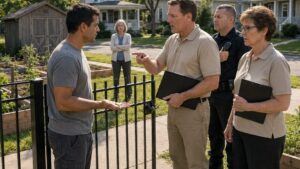
The HOA Contractor Brought a Loader to Crush His Wildflowers, Then Richard Showed Him the Federal Deed
Chapter 1: The Bucket Stopped Above the Wildflowers
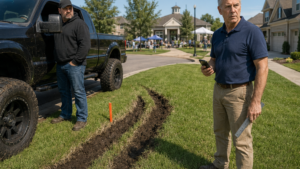
The steel bucket dropped so close to the wildflowers that the tallest purple stems bent beneath its shadow.
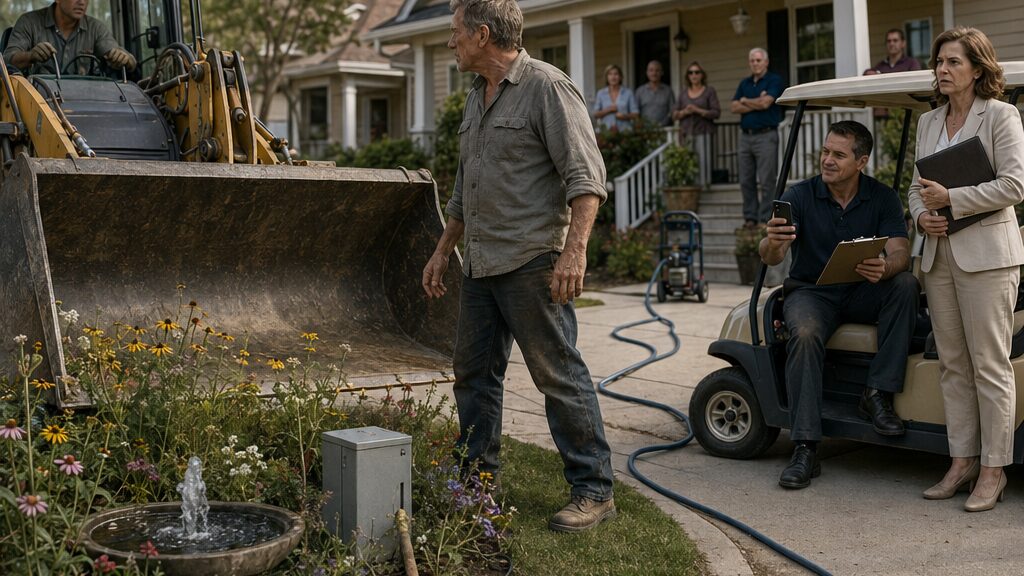
Richard Clark was kneeling beside the drip fountain when it happened, one hand on the red valve, two fingers pinching a thin black irrigation tube that had started pulsing unevenly. The fountain was no showpiece, just a shallow stone basin he had built from leftover slate and a small solar pump. Water ticked through copper holes along the rim, fell in clean beads, and disappeared into the roots of the wildflowers before the sun could waste it.
Then the front-end loader groaned at the curb, lurched over the lip of his lawn, and lowered its bucket with a scrape of metal that made the little water sounds vanish.
Richard did not move right away.
The bucket teeth stopped inches from the first row of flowers. Behind the windshield, the operator’s face was half hidden by glare. The engine idled with a heavy, impatient cough.
From the street came the high, pleased voice of Anthony Scott.
“Paint your house now, Richard, or I scrape this garden flat.”
Richard rose slowly. His knees were stiff from the stones. One wet hand hung at his side. The other remained on the red valve, as if the whole morning might still be brought back under control by shutting off one line of water.
Anthony sat in a polished white golf cart with his company logo removed from the side but not from anyone’s memory. He wore a pressed work polo, dark pants without a smear of dust, and sunglasses pushed up on his head. Two crew members stood near a trailer where a pressure washer rested like a threat waiting for fuel. On the trailer beside it were hoses, tarps, a chemical tank, and a stack of paper masks.
“Morning,” Anthony said, smiling too wide. “Looks like we got your attention.”
Richard looked past him to the loader, then to the thin line where his yard curved around the old gray relay box at the edge of the garden. The box stood waist-high on a concrete pad, plain and ugly, with a faded government plate fixed to its front. Most neighbors treated it like an eyesore. Richard had planted around it carefully, leaving a clean access path and low flowers that never touched the metal door.
“You’re on my lawn,” Richard said.
“I’m on association-authorized correction work.” Anthony lifted a clipboard from the passenger seat of the cart and slapped the pages with the back of his hand. “Different thing.”
The engine rumbled. A finch shot out from the wildflowers and vanished across the street.
Richard took one step toward the bucket. “Tell your operator to lift that.”
“He’ll lift it when you agree to comply.”
“With what?”
Anthony’s expression sharpened, delighted by the chance to perform. He turned halfway toward the houses across the street, where curtains had begun to shift. “Don’t act confused. The notice was taped to your door for ten days. Exterior color violation. Nonconforming shade. Detrimental to neighborhood value.”
“My house is beige.”
“Not approved beige.”
Richard stared at him.
Anthony pulled one page free and held it up, though not close enough for Richard to read. “The board received a complaint that your paint color lowers property values. You ignored the correction window. So now we correct.”
“With a loader?”
“With whatever equipment my company deems necessary to restore compliance.”
The fountain clicked behind Richard, water still finding its way through the tubes. He could hear one clogged emitter spit, clear, then tick again. It was such a small sound under the machine that it made him angry.
A door opened across the street. Karen Perez stepped onto her porch in house slippers, phone already in her hand. She did not raise it fully. Not yet. Two other neighbors came out and stood behind their hedges. Their faces carried the careful blankness people wore when they wanted to watch without being pulled in.
Richard noticed all of them. Anthony noticed him noticing.
“That’s the problem with you,” Anthony said. “Always acting like the rules are personal.”
Richard wiped his wet fingers on his work pants. “This garden doesn’t touch my house paint.”
“It’s part of the exterior presentation.”
“It’s watered by a conservation system.”
“It’s weeds around a utility box.”
Richard’s jaw tightened, but his voice stayed flat. “It’s wildflower ground cover. The relay box has a three-foot service path. The feeder line runs six inches inside the stone border. The fountain head is low pressure. The only thing your bucket can do there is damage what you don’t understand.”
Anthony laughed, and the sound was worse than if he had shouted.
“Listen to him,” he called toward the crew. “Fountain head. Feeder line. Stone border. You’d think he built a national monument.”
Richard glanced at the relay box. He had trimmed around its concrete pad yesterday evening. The access side was clear. The old plate caught a slice of sun, dull as a coin left in dirt.
Anthony stepped out of the golf cart and walked up the driveway without asking permission. He carried the clipboard in one hand and a folded document in the other. His polished shoes stopped at the edge of the garden.
“Here.” He snapped the folded paper open. “HOA work authorization. Visual nuisance correction, exterior surface remediation, landscape adjustment if necessary. Signed and dated.”
Richard looked at the words. Visual nuisance correction. Exterior surface remediation. Landscape adjustment if necessary. Nothing about a loader. Nothing about the relay box. Nothing about federal access. Nothing specific enough to justify the steel mouth hanging over living roots.
“That paper doesn’t say what you’re doing,” Richard said.
“It says enough.”
“No.”
Anthony’s smile thinned. “No?”
“No.”
The word reached the neighbors. Karen’s phone lifted another inch.
Anthony turned his head toward the trailer. “Get the washer off.”
One of the crew members hesitated. The other dropped the ramp with a bang. A hose spool rolled forward and bounced against the driveway. The pressure washer’s frame rattled. The long black hose began to uncoil across the concrete, then over the grass, drawing a dark line toward Richard’s house.
Richard took another step, placing himself between the hose and the corner of the garden. He was not a large man, but he stood with the settled weight of someone who had spent his life lifting things correctly. Gray hair. Faded work shirt. Old yard shoes darkened with water at the toes.
Anthony watched him and lowered his voice enough to make the threat feel intimate.
“You’re going to make this ugly in front of everyone?”
Richard’s eyes moved to the house fronts, the half-open doors, the phones appearing now like small black windows. He felt heat rise beneath his collar. He had lived on this street for eighteen years and had been quiet for almost all of them. He fixed things. He nodded. He brought trash cans back from the curb when wind knocked them over. He did not put his grief in anyone’s driveway.
Now a man in polished shoes was turning his front yard into a stage.
“Lift the bucket,” Richard said.
Anthony looked back at the loader. “Justin.”
The operator shifted in the cab.
Richard’s eyes went to him. The man behind the windshield looked younger than Anthony, uncomfortable, one hand still on the hydraulic control.
“Justin,” Anthony repeated, louder. “Lower it another foot.”
Justin’s mouth moved as if he had answered, but the engine swallowed the words.
Richard stepped closer to the steel teeth.
Anthony lifted his phone, ready to record or call or both. “Just enough,” he said, “until Richard understands what compliance sounds like.”
The loader growled. The bucket dipped, and the wildflowers disappeared beneath its shadow.
Chapter 2: The Paint Complaint Was Never About Paint
“You could’ve paid me once,” Anthony said. “Now you pay in front of everyone.”
The words landed harder than the bucket.
Richard stood between the loader and the wildflowers, the pressure washer hose lying across his driveway like a black vein. For the first time that morning, Anthony had said the real thing out loud. Not beige. Not property value. Not exterior standards. Paid me.
Karen Perez’s phone came up fully now, but she held it low against her chest, the lens angled past Richard toward the loader. She was recording the danger, maybe, but not the whole truth. If anyone asked later, she could say she was filming her own street, her own curb, her own concern.
Richard did not blame her. Not completely. That was how the neighborhood worked. Everyone saw. Nobody witnessed unless the winning side asked them to.
Anthony walked along the hose toward him. “You remember the estimate?”
“I remember throwing it away.”
“You asked me to look at your landscaping.”
“I asked if your crew knew how to keep clearance around the relay box.”
Anthony gave a short laugh. “You wanted free advice.”
“You gave me a six-thousand-dollar quote for gravel, two shrubs, and a timer valve I already owned.”
“Approved materials cost money.”
“Approved by who?”
Anthony tapped his chest with the clipboard. “By people who know how to keep a neighborhood from looking like a county roadside.”
A murmur moved across the street. Someone pulled a child back into a doorway. The pressure washer coughed as one of the crew members primed it, then went silent again.
Richard looked at the wildflowers. They had taken three seasons to become dense enough to hold the soil in summer heat. Blanketflower, blue flax, coneflower, black-eyed Susan. Elizabeth had once written the names on wooden sticks in red marker until the sun faded them to ghosts. Richard had replaced the sticks with small stamped tags, low to the ground, because he did not like seeing handwriting disappear twice.
“They’re not roadside weeds,” he said.
Anthony turned toward the watchers. “Hear that? The man cares more about weeds than the rules he agreed to when he bought here.”
Richard’s hands curled once, then relaxed. “I bought before your contract existed.”
“But not before the association.”
“I never agreed to let you threaten my house with a power washer.”
“Nobody’s threatening your house. We’re correcting the color.”
“With chemicals.”
“With approved wash and overlay.” Anthony pointed toward the wall beneath Richard’s front window. “We spray that nonconforming shade down, neutralize, and prime. You repaint within thirty days or the board bills you.”
“You touch that wall, you damage the siding.”
“You should’ve thought of that before deciding your taste mattered more than everyone’s value.”
Karen shifted on her porch. Her phone lens dipped. Richard caught the movement and saw her face tighten with the small shame of being seen watching.
Anthony saw it too. He smiled.
“Karen,” he called. “You know what I’m talking about. You filed color corrections on your shutters last year. You complied. That’s why your place looks clean.”
Karen’s mouth opened, then closed. She looked down at her phone.
Richard understood then that Anthony had not only brought machines. He had brought pressure points. Every neighbor had one. A correction letter. A late fee. A rejected porch light. A roof tile that needed approved replacement. Anthony knew them because his crews got the work after the notices.
The crew member at the trailer started feeding the washer hose toward the side of the house. It dragged over the grass and bumped against the stone border Richard had laid by hand.
“Keep that hose out of the bed,” Richard said.
The crew member stopped.
Anthony snapped his fingers. “Keep moving.”
The man looked from Anthony to Richard, then tugged the hose gently around the border.
Anthony rolled his eyes. “This is exactly why the board lets me handle these things. Everybody wants standards until standards have to be enforced.”
A silver sedan turned into the street and stopped behind the loader. Brenda White got out wearing a cream blazer and the expression she wore at HOA meetings when someone complained too long about mailbox height. Her hair was neat. Her lips were tight. She carried a folder against her chest like a shield.
Anthony straightened at once.
“Brenda,” he said. “Good. Maybe you can explain to Richard that today is not optional.”
Brenda looked at the bucket, then at the neighbors, then at Richard. For half a second, her face showed alarm. Then it folded itself into procedure.
“Richard,” she said, “we sent multiple notices.”
“You sent one letter about paint color.”
“And you failed to respond.”
“I responded by email. Twice.”
“To the general inbox. Not through the compliance portal.”
Richard stared at her. “That is what this is?”
“What this is,” Brenda said, voice sharpening, “is a resident ignoring a valid exterior correction until the association has to intervene.”
“With a front-end loader in my garden.”
“The equipment is Anthony’s decision as licensed contractor.”
“Licensed for what? Threatening flowers?”
Anthony smirked, but Brenda did not. She looked uncomfortable now, not because Richard was wrong, but because he was saying it where people could hear.
“The board voted by emergency consent,” she said. “The visual issue affects the whole cul-de-sac.”
Richard looked at the houses again. A few faces vanished behind blinds. Karen remained on the porch, but her shoulders were drawn inward.
“Who complained?” Richard asked.
Brenda’s eyes slid toward Anthony.
There it was. Small, fast, but enough.
Richard nodded once. “Him.”
Anthony spread his hands. “I own property here too.”
“You own a rental two streets over.”
“Still makes me invested.”
“In getting contracts.”
Anthony’s face hardened. “Careful.”
Richard stepped over the pressure washer hose and came closer to Brenda. “Your letter says paint. He’s aiming a loader at the garden because I wouldn’t buy his landscaping package.”
Brenda’s grip tightened on the folder. “Richard, this is not the place.”
“It became the place when you parked equipment in my yard.”
Anthony’s voice cut in. “The garden is a noncompliant exterior feature. The paint is a noncompliant exterior surface. We’re correcting both.”
Brenda turned sharply toward him. “Anthony.”
“What?” he said. “It’s in the authority.”
“You said adjustment if necessary.”
“It is necessary. He’s blocking access.”
Richard gave a dry laugh before he could stop himself. “Access to what? The flowers?”
“To the wall,” Anthony said. “To compliance. To a neighborhood that doesn’t look like one man’s junk project.”
The words cracked across the yard.
Richard felt every face turned toward him. Old man. Junk project. Weeds. Noncompliant. For years he had avoided meetings because he knew how quickly a room could decide a quiet person was difficult simply because he would not perform friendliness on command. Elizabeth had been better at that. Elizabeth had smiled while reading fine print. Elizabeth had brought cookies to meetings and left with copies of bylaws.
Richard had kept the copies. He had kept everything.
But not in his hand.
Not yet.
Brenda opened her folder and pulled out another page. “Richard, under emergency authority, the board has the right to remove or correct exterior features contributing to a continuing violation.”
“You know that doesn’t apply here.”
“I know the board voted.”
“Then you voted wrong.”
Her cheeks flushed. “You have until sundown to stop obstructing correction.”
Anthony’s smile returned.
“Sundown?” Richard said quietly.
“That is the deadline,” Brenda said. “After that, costs, fines, contractor delay fees, and enforcement penalties will be assessed to your account.”
“And if I don’t move now?”
Anthony answered before she could.
“Then we remove the noncompliant exterior features and bill you for making us do it the hard way.”
The pressure washer engine caught with a sharp mechanical bark. The hose twitched at Richard’s feet. Behind him, the loader’s bucket hung lower, its steel teeth lined up with the flower bed as if the garden had already been measured for burial.
Brenda turned toward Justin in the cab and lifted her chin.
“The association has authority to remove noncompliant exterior features by sundown,” she said.
Anthony looked at Richard as if the sentence itself were a blade.
Chapter 3: The Relay Box Nobody Wanted to Notice
Justin almost crushed the buried line when he backed the loader six inches to straighten his angle.
The left front tire rolled toward the narrow trench Richard had filled three years earlier, where the main irrigation tube ran from the fountain basin to the far side of the wildflower bed. Richard saw the tire edge cross the mulch, saw the soil compress, and something in him snapped louder than he intended.
“Stop!”
The word hit the yard hard enough that Justin froze with both hands raised inside the cab.
The loader rocked on its tires. Diesel fumes drifted over the flowers. The pressure washer rattled against its frame near the driveway, waiting for someone to point it at the house.
Anthony turned slowly. “There he is.”
Richard stepped to the tire and pointed at the ground. “You’re over the feeder line.”
Justin leaned toward the side window, squinting. “I didn’t see a marker.”
“It’s under the mulch because it feeds the bed. Back straight out. Don’t turn the wheel.”
Anthony strode over, irritated now that Richard was giving directions to his operator. “Don’t take orders from him.”
Justin’s hands settled back on the controls but did not move. “If there’s a line under there—”
“It’s irrigation,” Anthony said. “Not gas.”
“It’s still damage.”
“It’s weeds and plastic tubing.”
Richard looked at Justin. “Back straight out.”
For a moment, the machine did nothing but breathe. Then Justin eased the loader backward, slow enough that the tire lifted off the mulch without twisting. The soil remained pressed but unbroken.
Richard crouched despite the eyes on him and brushed mulch away with his fingers. The black tube showed beneath, flattened slightly but intact. Water pulsed through it, a tiny movement against dirt. He pressed around the kink until it rounded again.
When he looked up, Anthony was watching with contempt sharpened by embarrassment.
“You done petting your hose?”
Richard stood. “You nearly damaged it.”
“I’m going to remove it.”
“No,” Richard said. “You’re not.”
Brenda exhaled in annoyance. “Richard, the system was not approved.”
“It didn’t need approval for the strip it’s on.”
Anthony seized on that. “There. Hear him? The strip. He thinks he has special land.”
Richard’s gaze shifted to the relay box. It stood a few feet behind the fountain, dull gray, its front plate scratched but legible if you knew to look closely. A small service path of flat stones led from the curb to its door. Richard had kept that path clear through heat, weeds, leaf fall, and the winter when his hands had shaken too badly to prune neatly.
“That box has to stay accessible,” Richard said.
Anthony glanced at it. “Nobody cares about the box.”
“Someone does.”
“Who? The ghost of whoever installed it?”
Richard said nothing.
Anthony walked to the golf cart and came back with a rolled plan sheet secured by a rubber band. He snapped it open with a flourish, then held it against the hood of the cart. “Since you like details, let’s do details.”
Brenda stiffened. “Anthony, maybe we should—”
“No, he wants to play property expert.” Anthony jabbed a finger at the paper. “Here’s the association plat used for maintenance routing. Lot 14. Your house. Common visual easement along the front. Shared landscape buffer by the utility structure. Maintained under HOA exterior standards.”
Richard stepped close enough to see the clean blue lines. It was newer than his documents. Computer-drawn. Laminated. Stamped with the association’s management company name. On that paper, the narrow strip containing the relay box had been washed into a pale block labeled common-area landscaping.
Karen had crossed the street now, though she stayed near the curb. Her phone was down at her side. She looked at the map, then at Richard.
Anthony noticed the effect. He lifted the plan higher, turning it so the neighbors could see. “This is why we don’t let every resident invent their own survey.”
Richard studied the map without speaking.
The line was wrong.
Not wildly wrong. That was the trouble. It was wrong in the tidy way mistakes became policy. A missing notation. A simplified boundary. A federal carve-out swallowed by an HOA maintenance overlay. To anyone standing in the street, Anthony’s map looked official enough to flatten him.
Brenda regained her footing. “This is the record we operate under.”
“It’s incomplete,” Richard said.
“Do you have a current survey contradicting it?”
Richard looked toward the fountain base.
Anthony followed his glance. “What, you bury one under there?”
The old weatherproof tube was not under the fountain, not exactly. It was sealed inside a capped sleeve Elizabeth had insisted they mount inside the low stone wall near the relay path. “Dry, shaded, and boring,” she had said. “The three things paper loves.”
Richard could see her kneeling where Anthony stood now, red marker between her teeth, hair pinned badly because she had no patience for fussing when there was work to do. She had written FEDERAL STRIP — DO NOT BLOCK on the folder tab, then laughed at herself for sounding like a clerk in a disaster movie.
He had not opened that tube in almost two years.
Brenda’s voice pulled him back. “Richard?”
He looked away from the stone wall. “I have original records.”
“Then you should have brought them to the board,” she said.
“I emailed the board.”
“You sent statements, not certified documents.”
Anthony slapped the plat map with the back of his hand. “We have documents. You have stories.”
Richard’s mouth went dry. He knew what was in the tube. He knew Elizabeth had copied the deed language, highlighted the Post Office ownership note, marked the service boundary in red. He knew because he had watched her do it. He knew because after she died, he had opened the folder once and then shut it again so fast the clasp pinched his thumb.
But knowing a thing alone in your kitchen was different from proving it while a street watched you get smaller.
Karen came a few steps closer. “Richard,” she said, not quite loud enough for everyone, “I remember a postal truck there last winter.”
Anthony turned. “What?”
She looked startled by her own voice. “Nothing. I just—there was a truck. For the box.”
Brenda’s eyes narrowed. “Federal service vehicles check all kinds of shared utilities.”
“It wasn’t a utility truck,” Karen said, then immediately seemed to regret it.
Anthony rolled the plat map against his palm. “This is exactly the nonsense that happens when people treat a maintenance box like sacred ground.”
“It is not abandoned,” Richard said.
“Fine. We won’t damage the precious box.” Anthony pointed to the loader. “We push the bed from this angle, clear your homemade irrigation, and leave the ugly gray thing standing. Everybody wins.”
“No one touches the bed.”
Brenda closed her folder with a sharp snap. “Richard, I need to be very clear. If you damage Anthony’s equipment, obstruct the contracted work, or interfere with the crew, the association will treat it as criminal interference and pursue costs.”
Richard looked at the loader, the pressure washer, the map in Anthony’s hand, the phone in Karen’s lowered grip. His certainty was still there, but it no longer felt clean. Anthony had a laminated map. Brenda had a folder. The crew had machines. Richard had memory and a sealed tube he had refused to open because opening it meant letting Elizabeth’s handwriting back into the light.
Anthony climbed halfway onto the loader step and slapped the side of the cab.
“Reposition,” he told Justin. “Straight push through the garden. Keep clear of the box so he can’t cry about it.”
Justin looked at Richard through the glass.
Richard stood beside the fountain, water ticking behind him, and said nothing as the loader began to turn toward the wildflowers.
Chapter 4: The Line Elizabeth Marked in Red
Anthony’s boot came down on a fallen wildflower before the loader finished turning.
It was only one stem, already bent loose from the bucket’s shadow, but Richard saw the yellow petals flatten into the damp grass under Anthony’s polished sole. Anthony did not notice. Or worse, he did and liked that Richard noticed.
Richard moved before he could stop himself.
“Get off it.”
Anthony looked down slowly. “Off what?”
Richard pointed, his hand too rigid. “That.”
Anthony lifted his shoe. A smear of green clung to the tread. “You’re losing it over a flower.”
The neighbors were closer now, arranged along the curb and porch steps in a loose, silent jury. Karen stood near the mailbox post with her phone down at her hip. Brenda had retreated beside Anthony’s golf cart, folder pressed to her blazer, watching the loader angle itself toward the garden.
Richard heard the fountain behind him. Tick. Tick. Tick. The water still moved, patient and exact, as if none of this mattered if the line stayed open.
Elizabeth had loved that sound.
Not the fountain itself at first. When Richard had brought home the slate pieces from a demolition job and laid them out behind the garage, she had stood in the doorway with her arms folded and asked, “Is this another project that will be beautiful after it tries to kill your back?”
“It saves water,” he had said.
“That is not an answer to my question.”
But two evenings later she was on her knees beside him, sorting copper fittings into coffee cans and marking measurements on masking tape. She cared about waste. Richard cared about making things last. Between them, the ugly strip around the relay box had become a system.
Not a garden for showing off. A living argument that something unwanted could still be useful.
Now Anthony had men and machines around it.
“Richard.”
Karen’s voice came from the side, low enough that Anthony, arguing with Justin about the loader’s angle, did not turn.
Richard looked at her.
She stood just beyond the service path stones. Her face had lost the safe blankness. “Last winter,” she said, “there was a postal truck. I saw a man open that box. He had a badge on his belt. Not the utility company.”
“Say it louder,” Richard said.
Karen glanced toward Brenda. “I don’t want to get dragged into—”
“You are already standing here.”
“I know what it looks like.”
“What does it look like?”
She swallowed. “Like if I say the wrong thing, I get a notice next.”
That stopped him because it was true.
He wanted to be angry at her. It would have been easier. But Karen had replaced her shutters last year after three letters and a fine that everyone pretended not to know about. Anthony’s crew had done the work. Brenda had praised her at a meeting for “timely correction.”
Richard looked back at Anthony’s golf cart, the laminated map still spread across its hood. Clean lines. Wrong lines. Official-looking lines.
The weatherproof tube was three feet away.
He could walk to the low stone wall, twist off the cap, pull out the folder Elizabeth had labeled in red, and end the argument before the loader moved another inch.
His feet did not move.
The problem was not the paper. The paper was safe. The problem was her handwriting.
He had not meant to make a shrine of the tube. He had meant to keep records dry. That was all. But after Elizabeth died, the red marker on those folders became the last place where her certainty remained intact. He could handle tools she had touched. He used her pruning shears every week. He drank from the mug with the chipped rim. But the deed packet was different. It was her voice in proof form, and once he opened it in front of Anthony, Brenda, Karen, and half the street, it would not belong to the quiet anymore.
Anthony clapped his hands once. “Washer first. If he wants to hug the weeds, we start on the house.”
The crew member at the pressure washer looked uncertain. “The siding’s old.”
“It’s paint,” Anthony snapped. “It comes off.”
Richard turned. “Do not spray my house.”
Anthony took a step toward him. “You had ten days.”
“To repaint beige with a different beige.”
“To comply.”
“To pay you.”
Anthony’s face tightened. For a moment the smugness slipped, and Richard saw what lived beneath it: not confidence, but fear dressed up in volume. Anthony needed this to work. Needed the board to see him handle the resident nobody else wanted to confront. Needed the neighbors to believe his equipment meant inevitability.
Then Anthony pointed at the wall under Richard’s front window. “Start with that corner.”
The pressure washer roared awake.
The sound ripped through the yard, high and violent, nothing like the loader’s heavy growl. The hose stiffened. The crew member held the wand in both hands, looking toward Brenda as if hoping she would stop him.
Brenda did not.
“Anthony,” she said, “stay within the correction order.”
“I am.”
Richard stepped toward the washer, but Anthony moved into his path. “Touch my crew, and you’ll wish you’d only owed a paint bill.”
Richard’s hands flexed. He saw the sledgehammer leaning against the inside wall of the open garage, where he had left it after driving stakes for the back fence. Eight-pound head. Hickory handle dark from years of use. A tool made to strike what needed breaking, not what needed saving.
Elizabeth would have told him to get the documents first.
No, that was not true. Elizabeth would have told him to get the documents six months ago, when the first letter came and he tossed it into the drawer because he would not dignify nonsense with a reply through a portal. She would have sat at the kitchen table with her red pen and made copies, labeled tabs, called numbers, annoyed clerks until their voices flattened.
Richard had sent two emails and waited for the truth to be enough.
The washer wand lifted.
A white fan of water hit the corner of his house.
For one second nothing happened. Then the beige paint blistered under the force, and a pale raw scar opened across the siding beneath the window Elizabeth used to sit beside in the afternoons. The spray mist blew back across the garden, dotting the wildflowers with chemical foam.
“Stop!” Richard shouted.
The crew member flinched and lowered the wand.
Anthony’s mouth curved. “Now we’re getting somewhere.”
Richard turned toward the stone wall.
His breath was hard in his chest, but his hands were steady when he crouched by the fountain base. The capped sleeve was hidden behind a flat piece of slate, exactly where Elizabeth had wanted it—dry, shaded, boring. He brushed away mulch, found the cap, and put his palm on it.
A memory struck sharp and bright: Elizabeth kneeling there with the red marker, drawing one line across the deed copy and saying, “This is the part they’ll pretend not to see someday.”
He had laughed then. “Who’s they?”
She had smiled without looking up. “Whoever shows up with a clipboard and more confidence than sense.”
Behind him, Anthony raised his voice. “Look at that. Digging now. He knows he’s bluffing.”
Richard’s fingers closed around the cap.
Then the loader engine revved.
He looked over his shoulder. Justin had straightened the machine. The bucket was aligned now, not angled near the tire line, but aimed clean through the wildflower bed toward the fountain.
Anthony pointed to the garden.
“Spray crew, hold. Justin, get ready.”
Richard still had not opened the tube.
The pressure washer coughed behind him, the pale scar on the house dripping in the sun, and Anthony said loudly enough for every neighbor to hear, “One more delay, and we clear the whole bed.”
Chapter 5: Glass Louder Than the Engine
The loader moved while Richard was still crouched beside the stone wall.
It was not much at first, only a low mechanical creep, the bucket teeth trembling over the flowers as Justin eased his foot down. But the movement changed everything. Until then, even with the scar across the siding and the washer mist drying on the petals, there had been room for someone to stop pretending. Brenda could withdraw the order. Anthony could laugh and say Richard had made his point. Justin could climb down and refuse.
Then the steel crossed the first line of shade over the fountain basin, and Richard knew no one was going to save the garden by becoming reasonable.
He rose without the tube.
“Stop the machine.”
Justin’s eyes flicked through the windshield toward Anthony.
Anthony stood beside the golf cart, phone in hand now, recording in portrait mode. “For the record, resident is obstructing lawful correction work.”
Richard walked into the path of the bucket.
Several neighbors made sounds at once. Karen said his name. Brenda stepped forward, then stopped.
The loader halted with a jerk. Its bucket hung waist-high, close enough that Richard could see old dirt packed along the seams where steel had met earth on other jobs. The diesel engine shook through his shoes.
Anthony’s phone followed him. “You see this? He’s putting himself in front of equipment and creating an unsafe situation.”
Richard did not look at the phone. He looked at Justin. “Shut it down.”
Justin’s face was pale behind the glass. “I can’t have you standing there.”
“Then shut it down.”
Anthony barked, “Keep it idling.”
Brenda came beside Anthony and spoke through tight teeth. “This is out of hand.”
“Because he’s making it out of hand,” Anthony said, still filming.
“You said the garden could be adjusted,” she said. “Not that he’d stand in front of the bucket.”
“That’s on him.”
Richard heard her voice, heard the opening in it, and for one foolish second hoped she would take it. Instead she noticed Karen’s phone raised in the background, and her face closed around procedure again.
“Anthony,” Brenda said, louder now, “finish the correction carefully.”
Karen’s phone captured it. Richard saw the lens angle up at exactly the wrong—or right—moment.
Anthony smiled, relieved and emboldened. “You heard her.”
Justin’s hands tightened on the controls, but the loader did not move.
“Justin,” Anthony said.
The young man swallowed. “He’s in front of it.”
“He won’t stay there.”
Richard reached into his pocket and pulled out the folded scrap of paper he had carried for years without admitting why. It was not the deed. It was Elizabeth’s copied note, torn at the edge where the fold had weakened: Maintain three-foot service path from curb. Do not obstruct federal relay access. Boundary line begins at marker pin north edge.
The red ink had faded brown.
Richard held it up, not toward Anthony, but toward Justin.
“North edge,” he said. “Marker pin. Relay access. Federal strip. I am telling you exactly where you are.”
Anthony lowered the phone just enough to glare. “That is not a legal document.”
“No,” Richard said. “It’s the warning before I get the legal document.”
Brenda’s eyes moved to the paper. Something in her expression shifted—not belief, exactly, but calculation. “Richard, if you have documentation, you should present it through the management office.”
“The management office sent him,” Richard said.
Anthony laughed hard. “You hear that? He’s got a pocket note, and now we’re all federal criminals.”
Richard folded the note once and put it back in his pocket. “Move that machine one more inch, and you will be.”
The yard went strangely quiet beneath the engine. Even the crew member with the pressure washer lowered his wand to the grass.
Anthony’s face flushed. He looked at the neighbors, the phones, Brenda, the loader, and Richard standing in the bucket’s path. The scene had stopped obeying him. That was what Richard saw, clearer than any map. Anthony had not come to enforce a rule. He had come to be seen enforcing it.
If he backed down now, his power would have a crack in it.
Anthony lifted his phone again and raised his voice. “Resident has now threatened contractor and crew. Resident appears unstable. We are proceeding to complete correction under board authority.”
Justin shook his head once. “Anthony—”
“Forward slow.”
“I don’t want—”
“Forward slow.”
Richard’s eyes went to the garage.
The sledgehammer leaned where it had been all morning, half in sun, half in shadow. He had used it to drive metal stakes when the ground was stubborn. He had used it to break concrete that had outlasted its purpose. He had never used it to make a point in front of neighbors.
The loader jolted.
Not far. Maybe three inches. Enough for the bucket’s edge to brush the tallest flowers and shear their heads sideways.
Something moved through Richard, too old to be anger and too clean to be panic.
He stepped out of the bucket’s direct path, but not backward. He moved left, toward the garage. Anthony’s phone tracked him.
“Now he’s retreating,” Anthony narrated. “You see that? He knows.”
Richard walked into the garage and took the sledgehammer from the wall.
Its weight settled into his hands like a language he had not spoken in public for years.
When he stepped back out, Brenda said, “Richard. Do not.”
Anthony’s smile sharpened. “Perfect. Keep filming, Karen.”
Karen’s voice shook. “Anthony, stop the machine.”
“Stay out of it.”
Richard walked past the loader, not toward Justin, not toward the crew, not toward Anthony’s body. He walked toward the golf cart.
Anthony’s confidence faltered. “Hey. Hey, don’t touch my property.”
Richard stopped at the front of the cart. The windshield was a single clear sheet, spotless except for dust along the lower edge. Behind it lay Anthony’s clipboard, the HOA authorization, the laminated plat map, all the clean paper that had made wrong look official.
Anthony took two fast steps. “You swing that, I call the police.”
Richard looked at him then. “Call them.”
He lifted the sledgehammer.
For a heartbeat, the whole street held still: Brenda with one hand at her throat, Justin frozen in the loader cab, Karen’s phone finally aimed straight, Anthony’s mouth open around the beginning of another threat.
Richard roared.
The sound tore out of him raw and unfamiliar, carrying years of swallowed meetings, unanswered emails, polite dismissals, Elizabeth’s red line hidden in darkness, and the sight of flowers folding under steel.
The sledgehammer came down.
It struck the golf cart windshield dead center.
The crack was louder than the engine.
Glass burst outward in a bright, hard sheet, fragmenting across the hood, the seats, the clipboard, Anthony’s laminated map. The loader engine sputtered as Justin jerked back from the controls. The pressure washer wand clattered to the driveway. Someone screamed, then cut themselves off.
Richard stood with the sledgehammer head lowered, breathing hard, glass glittering at his feet.
Anthony stared at the ruined windshield, then at Richard, and the first real fear of the morning crossed his face.
Then he raised his phone with a shaking hand.
“You’re done,” Anthony said. “You just gave me everything.”
Chapter 6: The Deed Inside the Weatherproof Tube
Anthony screamed for police while glass slid from the golf cart frame in bright, harmless pieces.
“You all saw it!” he shouted, voice cracking as he backed away from the ruined windshield. “He attacked my equipment. He threatened my crew. He’s unstable.”
Richard still held the sledgehammer, but the roar had gone out of him. The street had gone silent in that stunned way people became quiet after a thing they had wanted to see finally happened and frightened them.
Justin shut the loader down.
The sudden absence of diesel made the yard feel too exposed. Without the engine, the soft ticking of the drip fountain returned, thin but stubborn. Water moved beneath the chaos, feeding what had not yet been crushed.
Anthony pointed at Justin. “Why did you turn it off?”
Justin did not answer immediately. He climbed down from the cab slowly, boots hitting the grass with careful weight. “Because I’m not driving at a man.”
“You weren’t driving at him. He moved.”
“He was in the work path.”
“He was obstructing.”
Justin looked at the bucket, at the flowers bent beneath its shadow, then at the relay box. “Maybe. But I’m not putting that in my report.”
Brenda snapped her head toward him. “Report?”
Justin’s face tightened. “Equipment incident report. My company requires it.”
Anthony’s fear sharpened into fury. “Your company is my subcontractor.”
“And I still write my own incident report.”
Karen stood near the curb, phone in both hands now. Her thumb moved over the screen. She replayed something, the tiny speaker giving back Anthony’s voice in a faint, tinny echo.
Finish the correction carefully.
Brenda heard it. So did Anthony.
Karen looked up, startled by what she had caught.
Anthony lunged a step toward her. “Don’t edit that.”
Karen pulled the phone against her chest. “I’m not editing anything.”
“Then send it to me.”
“No.”
The word surprised everyone, Karen most of all.
Richard set the sledgehammer down on the grass. Not dropped. Set down. He left it where everyone could see it was no longer in his hands.
Anthony pointed the phone at him again. “Police are on their way. You’re paying for the cart, the delay, the crew, everything.”
“No,” Richard said.
It was not loud. It did not need to be. The machine was off.
He walked to the low stone wall by the fountain. His fingers found the slate piece, lifted it, and revealed the capped sleeve beneath. The cap resisted at first; grit had worked into the threads. For one awful second, his damp hands slipped, and shame rose hot in him. After all that waiting, all that silence, would the truth stick in a plastic tube while Anthony built a crime story around him?
He wiped his palm on his shirt and tried again.
The cap turned.
Inside was the weatherproof tube, cloudy with age but dry. Richard pulled it free. The folder within had been wrapped in a plastic sleeve, sealed with tape yellowed at the edges. Across the tab, in Elizabeth’s red marker, were the words he had avoided seeing:
FEDERAL STRIP — DO NOT BLOCK.
His throat closed.
Anthony laughed once, too loudly. “That’s your big proof? A craft project?”
Richard did not answer him. He opened the sleeve, removed the folder, and unfolded the top page. The paper had the faint smell of sealed dust. Elizabeth’s notes marched along the margins, precise and impatient.
Brenda came closer despite herself.
Richard held up the first page. “Original deed transfer. Parcel exception. Relay access and equipment strip retained for Federal Post Office use.”
Brenda’s face lost color. “Let me see that.”
“No.”
“You have to let the board verify—”
“The board sent machinery.”
Anthony snorted. “He’s reading words off old paper. Our plat map is current.”
Richard pulled the second page forward. A copied survey. A red line along the narrow strip. A marker note at the north edge. A service path drawn exactly where the flat stones lay. He turned it so the street could see, though he knew most could not read the text from there.
“This strip was never common-area landscaping,” he said. “It was never yours to enforce. The relay box belongs to the Federal Post Office. The access path belongs with it. The garden was planted low to preserve clearance. The irrigation runs outside the service door swing. Elizabeth checked it with the original office before we built.”
Brenda’s voice thinned. “That is not what the management map shows.”
“Because your map swallowed the exception.”
“That’s an allegation.”
“It’s a boundary.”
Anthony shoved the laminated plat map toward him, its surface glittering with bits of windshield glass. “Here’s the boundary we work from.”
Richard looked at the clean blue block labeled common-area landscaping. “That map is wrong.”
“You don’t get to decide that.”
“No,” Richard said. “The deed does.”
Karen stepped forward, phone still in hand. “I have him warning you.”
Anthony turned on her. “Karen.”
Her face was pale, but she kept coming. “He said federal strip before the loader moved again. He said marker pin. Relay access. It’s on the video.”
Brenda reached for procedure like a railing. “No one authorized machinery near federal property.”
Anthony stared at her. “You signed the emergency consent.”
“I authorized exterior correction. I did not authorize reckless operation beside a federal relay box.”
“You stood right there and told me to finish.”
Brenda’s mouth opened, but Karen’s phone had already answered. Finish the correction carefully, tiny and cold through the speaker.
Richard looked at Brenda and saw not a villain, not exactly. He saw a woman who had spent years letting other people do the ugly part of her authority so she could call herself orderly. Now the ugliness had left fingerprints on her folder.
Justin stepped away from the loader, putting visible space between himself and Anthony. “I was told the permissions were cleared.”
“They were,” Anthony snapped.
Justin looked at Richard’s red-marked survey. “Not for that.”
Anthony’s phone rang in his hand. He glanced at it, ignored the call, and stabbed at the screen again. “I’m calling this in as vandalism and threats.”
“Call it in,” Richard said. “Tell them where you parked the loader.”
Anthony’s mouth tightened.
Richard picked up the deed pages and walked to the relay box. He stood beside it, one hand resting on the dull gray metal, feeling sun-warmed paint and years of neglect that had saved it from anyone’s attention.
“This box was here before half these houses changed siding,” he said. “Most of you hate looking at it. Elizabeth didn’t. She said if something has to remain, you learn how to live with it properly. You don’t bury it. You don’t block it. You don’t pretend a prettier map makes it disappear.”
No one spoke.
The words cost him more than the sledgehammer swing.
He looked at the wildflowers, bent but not gone, then at the pale scar on his house. “I kept the papers in the wall because I thought the line was enough. I thought if I knew where it was, that would protect it.” His eyes moved to Karen, then Brenda, then Justin. “I was wrong.”
Anthony’s phone was still raised, but his hand had dropped lower.
At the far end of the street, a white vehicle turned in behind the loader and slowed. It was not a police cruiser. It had a plain government seal on the door and a roof light that was not flashing.
Brenda saw it and went still.
The vehicle stopped beside the curb. A postal inspector stepped out, eyes moving from the loader bucket to the relay box, from the shattered golf cart windshield to the deed pages in Richard’s hand.
Anthony lowered his phone before he seemed to realize he had done it.
Chapter 7: The Board That Hid Behind the Bucket
The notice appeared on the community board before Richard had finished coiling the torn irrigation tube.
It was taped under the glass case by the mail kiosks, printed on HOA letterhead, with Brenda White’s signature at the bottom and a title bold enough to be read from the sidewalk:
Resident Equipment Damage and Disorderly Conduct
Richard stood in front of it with dirt on his forearms and dried white spray dust still caught along one sleeve. His house had a pale stripe across the corner under the front window. The wildflowers were bent in a flattened arc where the bucket had hovered. Anthony’s golf cart had been hauled away two hours earlier, leaving only a few glittering fragments in the curb grass.
The notice did not mention the loader.
It did not mention the relay box.
It did not mention the postal inspector, who had spent twenty minutes photographing the bucket’s position, the service path, the relay-box plate, and the deed pages while Anthony spoke less and less.
The notice said the association condemned threatening behavior against approved contractors and would pursue all available remedies for damage to equipment and disruption of contracted maintenance.
Richard read it twice.
Karen came up beside him, keeping a few feet of space as if shame had a field around it. “I didn’t know they were putting that up.”
Richard looked at the signature again. “Someone knew.”
“I sent the video to myself,” she said quickly. “And to my sister. In case my phone disappeared.”
“That was smart.”
She seemed to expect anger and did not know what to do with the lack of it. “I should’ve spoken sooner.”
Richard pulled the folded deed copy from his back pocket. He had carried the originals inside after the postal inspector advised him not to let them out of his possession. The copies remained with him like a weight. “Most people should.”
Karen flinched, but he had not meant it cruelly. Or maybe he had. That was the part he did not like.
By late afternoon, the neighborhood had divided itself into whispers. Some said Anthony had gone too far. Some said Richard should not have swung the sledgehammer. Some said both things in the same breath, relieved by balance because balance asked nothing of them. Justin had returned alone to pick up the traffic cones and washer hose. He had avoided Richard’s eyes until the last coil was on the trailer.
Then he had come to the garden edge and said, “I wrote it down.”
“What?”
“That I was ordered forward after you warned them. That I didn’t see any clear permission for the box area.” Justin rubbed the back of his neck. “I need the work, but not that bad.”
Richard had only nodded. It was all he could manage.
The postal inspector called the next morning. His voice was dry and careful. The relay-box strip was, at minimum, under federal control with retained property interest requiring access protection. The office would review the deed language and the attempted machinery operation. He advised Richard to keep copies of all HOA communications and to speak with counsel if the association continued its claims.
By noon, a letter from the HOA’s insurer arrived by courier.
Richard opened it at the kitchen table beneath the window with the scarred siding outside. The paper was smooth, expensive, and bloodless. It offered a resolution payment for paint repair, landscaping disturbance, and “miscommunication regarding work boundaries,” contingent upon confidentiality and a mutual non-disparagement agreement. The amount was larger than any check Richard had ever held, but smaller than the damage hidden inside the words.
Miscommunication.
Elizabeth would have circled it in red until the pen tore through.
Richard set the letter beside her deed notes. The contrast was almost insulting: her slanted handwriting, practical and alive, beside paragraphs designed to make a loader sound like weather.
A knock came at the kitchen door.
Karen stood outside holding a flash drive in one hand and a folded paper in the other. “I made copies of the video,” she said. “The whole thing, not just when you broke the windshield.”
Richard opened the door wider.
She entered like someone stepping into a room where a serious illness had been named. Her eyes went to the deed notes on the table. “That’s her handwriting?”
“Yes.”
“Elizabeth?”
Richard looked at her.
Karen pressed her lips together. “She helped me once. When we moved in. I got a letter about our mailbox numbers being the wrong finish. I was crying in my garage because it was our third week here and I thought we had made a mistake buying. She came over with a screwdriver and a sandwich.”
Richard remembered the screwdriver. Not the sandwich.
“She told me,” Karen said, “never let people who love rules more than neighbors be the only ones keeping records.”
Something in Richard’s chest shifted, small and painful.
Karen placed the flash drive on the table. “I forgot that until yesterday.”
The folded paper was a screenshot from her video. Brenda’s face was turned toward Anthony, mouth open mid-order. Behind her, the loader bucket pointed at the wildflowers. Karen had printed the timestamp at the bottom.
Richard stared at it. “She’ll say she meant the paint.”
“She already is.”
That evening, a lawyer recommended by a former coworker came to Richard’s house, walked the yard, photographed the relay box, and listened without interrupting. Richard liked that most about him. He did not fill silence to prove he was earning his fee.
Inside, he spread the papers into groups: HOA notice, Anthony’s estimate from months earlier, correction letters, Brenda’s emergency consent, insurer offer, postal inspector contact, Karen’s video stills, Justin’s written statement, Elizabeth’s deed packet.
The lawyer tapped Anthony’s old landscaping estimate. “This matters.”
“It was just a bad quote.”
“It shows motive. If his company benefits from enforcement, and the board gave him discretion to decide what needed removal, that is more than bad judgment.”
Richard looked toward the window, where the pressure-washer scar glowed pale in the lowering light. “They offered money to keep it quiet.”
“They offered money to keep it small.”
“Can they make the golf cart my fault?”
“You did break the windshield.” The lawyer did not soften it. “But context matters. So does the fact that the vehicle was part of an active intimidation scene involving machinery positioned near a federally controlled strip after warnings. This is not clean for them.”
Richard almost smiled. “Nothing about that cart was clean after the glass went.”
The lawyer’s face remained neutral. “Anthony has already sent a demand letter.”
Richard turned back.
The lawyer took a page from his folder and slid it across the table. Anthony’s company letterhead. Claim for property damage, delay costs, reputational harm, and civil intimidation. At the bottom, Anthony had written in a hard slant: He staged the deed reveal after provoking lawful enforcement.
Richard read that line until the words blurred.
Staged.
As if Elizabeth’s handwriting had waited in the wall for drama. As if the flowers had bent themselves under the bucket for effect. As if Richard had wanted his house scarred and his street watching him roar like a cornered animal.
“He wants you angry,” the lawyer said.
Richard set the letter down carefully. “He already got that.”
“Then don’t give him the rest.”
For the first time, Richard looked at the sledgehammer leaning by the back door. He had brought it inside after the inspector left, not because he needed it, but because leaving it in the yard felt like leaving part of himself exposed. Now it looked different. Not heroic. Not shameful. Just a tool that had done a job no tool should have had to do.
Karen, who had stayed quiet by the counter, said, “What happens if he takes the quiet settlement?”
The lawyer looked to Richard, letting him answer.
Richard thought of the notice on the community board. Of Brenda’s signature beneath a lie. Of Justin’s pale face in the cab. Of Karen whispering what she knew because fear had trained her to whisper. Of Elizabeth’s red line hidden where only he could see it.
“I waited too long,” he said.
Karen’s eyes lifted.
“I had the papers. I knew enough. But part of me wanted him to show everyone what he was before I stopped him.” Richard’s voice roughened, but he held it steady. “That nearly cost the garden. It could’ve hurt somebody.”
The lawyer said nothing.
Richard touched the edge of Elizabeth’s deed note. “I don’t want revenge.”
Outside, the repaired feeder tube gave a soft, uneven tick through the open window.
“I want it on record,” Richard said. “The real record. Not theirs.”
The lawyer nodded once and opened a fresh folder.
By the next morning, the counterclaim was filed with the board, Anthony’s company, the management office, and the insurer named in careful, unsparing order. It included the emergency authorization, the contract language, Karen’s footage, Justin’s statement, the postal inspector’s preliminary findings, the pressure-washer damage, the loader’s position, and the federal-property violation.
Richard carried his copy to the community board himself.
The HOA notice was still there behind the glass.
He did not tear it down.
He taped his filing notice beside it, straightened the corners, and stepped back as neighbors began drifting toward the mail kiosks to read what the board had tried to leave out.
Chapter 8: The Water Came Back Quietly
Richard repaired the broken irrigation line before he opened the settlement letter.
The envelope sat on the porch step in a courier sleeve, thick enough to be important, while he knelt beside the fountain with a coupling, a utility knife, and a short length of new tubing. The old line had been bruised by the loader tire. It still carried water, but not cleanly. It pulsed, hesitated, then spat too hard at the roots nearest the relay path.
He cut out the damaged section and held it in his palm.
A month ago, he might have kept it. Proof. Evidence. Another small object in the growing archive of what had happened. Instead he dropped it into the trash bucket with the cracked emitter heads and trimmed stems.
The new coupling clicked into place. He turned the red valve.
For a moment nothing came. Then water moved through the tube, filled the fountain rim, and began to fall in steady beads. Tick. Tick. Tick. Soft, regular, stubbornly alive.
Only then did Richard wash his hands and open the letter.
The terms had been argued through weeks of calls, filings, statements, and one tense meeting where Brenda sat at the far end of a conference table without her cream blazer, looking smaller in a gray cardigan. Anthony did not attend in person. His lawyer spoke for him, which suited Richard fine. Anthony’s voice had filled enough of Richard’s yard.
The final settlement covered the siding repair, irrigation damage, legal fees, and a payment large enough to clear the remaining mortgage on Richard’s house. The HOA’s board agreed to dissolve under court-supervised restructuring. Enforcement authority would transfer away from the old association structure. Anthony’s company lost all preferred contractor access and withdrew its demand for the golf cart windshield.
The letter did not say victory.
Richard was glad.
Victory sounded too loud for what was left.
He signed where his lawyer had marked and placed the pen beside Elizabeth’s red-marked deed copy. For a while he sat at the kitchen table, listening through the open window to water and distant hammering from a neighbor’s fence repair. Ordinary sounds. Sounds without engines idling in threat.
A knock came from outside.
Karen stood by the porch rail with a folded notice in her hand. She had stopped hovering at the edge of his property over the last two weeks, but she still approached carefully, as if trust were new concrete she did not want to mark too soon.
“They posted it,” she said.
Richard stepped out. “Where?”
“Community board.”
She unfolded the paper first. Official notice of dissolution. Board authority suspended. Pending transfer of common maintenance obligations. Contact number for residents with records, disputes, or concerns.
Brenda’s name was nowhere on it.
Richard read the page without expression. Karen watched him, waiting for something larger than he had to give.
“Good,” he said.
She laughed once, surprised. “That’s it?”
“That’s enough.”
They walked together to the garden. Many of the bent flowers had lifted again. Some had not. Richard had cut the broken stems low and left the roots to decide. The pale scar on the house had been primed but not yet painted; he had chosen the replacement color himself from a manufacturer’s card that called it Warm Sand, which looked exactly like beige and nothing like surrender.
Karen stopped beside the low stone wall. “Where was Elizabeth’s red line?”
Richard looked at her.
She nodded toward the relay box. “You said she marked it. I want to see it correctly. Not the map version.”
For a second, the old instinct returned: keep the documents inside, keep the meaning private, keep the line safe by keeping it unseen.
Then Richard went into the house and came back with a laminated copy of the deed page. Not the original. He had learned that much. He also brought four small wooden stakes and a length of twine.
He placed the first stake near the north marker pin, partly hidden beneath a patch of low leaves. “Here.”
Karen crouched, careful not to step into the bed.
He placed the second along the service path, the third near the fountain edge, the fourth by the relay-box concrete pad. The twine made a simple line, not pretty, not permanent, but clear.
“Elizabeth marked it in red,” Richard said. “Not to keep people away from me. To keep people from pretending they didn’t know.”
Karen looked down at the flowers inside the line. “She sounds like someone I should’ve remembered better.”
“She didn’t make that easy,” Richard said. “She corrected people’s forms for fun.”
Karen smiled. “That sounds right.”
Across the street, two neighbors stood at the mail kiosks reading the dissolution notice. One looked toward Richard’s yard, then lifted a hand awkwardly. Richard returned the gesture. Nothing more. He did not need apologies lined up at the curb. He had seen what fear did to people. He had seen what silence did to himself.
Karen bent and picked something from the grass near the driveway. A tiny curved shard of golf cart windshield, missed by the cleanup, caught sunlight in her palm.
“Want this?” she asked.
Richard took it.
The glass was smooth along one edge, sharp along another. For a moment he saw it again: the sledgehammer falling, Anthony’s face changing, the street frozen in the sound. He could keep the shard in a drawer. He could set it beside the deed copy as a reminder that he had stopped the machine. He could turn it into a story about the day he finally hit back.
Instead he walked to the trash bucket and dropped it in.
The sound was small. Barely anything.
Karen watched without speaking.
Richard went back to the garden and removed the twine, leaving the stakes for the afternoon so anyone who wanted to look could look. Then he opened the valve another quarter turn. Water filled the fountain rim and slipped through the copper holes, each bead catching light before it disappeared into the soil.
A week later, the dissolved-HOA notice flapped behind glass at the community board, curling at one corner in the heat. The old notice blaming Richard was gone. No one admitted removing it.
Richard repainted the scarred corner of the house himself. Warm Sand dried slightly darker than the rest of the wall, but he left it. Not every repair needed to hide the break completely.
By the relay box, the wildflowers bloomed unevenly. The crushed patch near the bucket line had thinned, but new green had begun pushing through. Richard knelt there in the late afternoon, adjusting an emitter so it would not overspray the service path.
Karen stopped at the curb with a bag of replacement marker stakes. She did not cross into the yard until he waved her in.
“These are plain,” she said. “No approved finish.”
“Risky.”
“I’m learning.”
He took the bag, and together they placed the stakes low enough not to crowd the flowers. On one of them, Karen had written in red marker: ACCESS CLEAR.
Richard looked at the words for a long time.
Then he pressed the stake into the soil beside the path Elizabeth had insisted they preserve.
The water came back quietly, ticking through the fountain as the sun lowered behind the houses. The relay box stood untouched at the edge of the bed, dull and necessary. Behind Richard, the notice of dissolution moved in the faint wind at the mail kiosks. In front of him, the wildflowers leaned toward the water and held.
Richard rested one hand on the red valve, not to shut anything off, but to feel the line running steady beneath it.
The story has ended.