They Called His Legal Garage a Chemical Leak, Then the Warrant Came for Their Commander
Chapter 1: The Camera Slid Under the Wrong Door
The black cable appeared under the garage door like a snake testing a crack in a wall.
For one hard second, Frank Torres did not move. He stood in the dim white glow of his garage monitors, one hand still on the inner deadbolt, his boot planted on the painted concrete just behind the threshold line he had marked years ago in narrow gray tape. The cable tip paused, withdrew an inch, then nosed forward again.
Outside, a voice barked, “Hold position.”
Frank’s jaw tightened.
Then the scene snapped back into noise.
An hour earlier, the first cruiser had stopped crooked in front of his gate with its lights flashing but no siren. Frank had watched it from the inside security screen, the garage humming softly behind him. The battery bank along the west wall glowed with steady green indicators. No smoke. No vapor. No spill. No heat warning. The thermal overlay on the screen showed the same clean blue and yellow pattern it showed every afternoon.
Then a second cruiser arrived.
Then a third.
By the time Frank stepped from the garage office to the reinforced side door, six police vehicles had lined the quiet street outside his compound. Neighbors had come out before the officers even reached the gate. Some stood barefoot on their lawns. Some held phones. Karen Martin, from two houses down, stood with both arms folded as if she had been waiting all year for this.
Frank pressed the intercom.
“State your business.”
A uniformed officer looked up at the camera above the gate. “Sir, we received a report of a chemical leak from this property. We need you to open the gate and step out.”
“There is no chemical leak,” Frank said.
“Open the gate, sir.”
“Do you have a warrant?”
The officer’s face changed before his mouth did. A small tightening. A look toward the cruisers. “This is a safety response.”
“That doesn’t answer my question.”
Behind the officer, George Baker lifted his phone higher. Frank saw his own gate reflected on the small black screen in George’s hand.
A second officer moved toward the keypad.
Frank’s thumb found the remote lock. The gate gave a deep mechanical clunk, its deadbolt sliding into the reinforced catch. The sound carried. Several neighbors turned their heads toward it.
Inside the garage, the battery system continued its low, even hum.
The uniformed officer stepped back. “Sir, locking the gate is not helping you.”
“No warrant,” Frank said. “No entry.”
The west wall of the garage held what the neighbors had spent months guessing about. A custom high-voltage PHEV battery bank, mounted in fire-rated cabinets, each module labeled, each cable routed cleanly, each containment tray spotless beneath it. Frank had built the system over three years, not for spectacle, not for bragging, and certainly not for Karen Martin’s approval. It powered his workshop, charged his old plug-in hybrid, and kept his machines alive during outages that made the rest of the block complain into the dark.
It did not leak. It did not hiss. It did not smell.
But from outside, through frosted bullet-resistant glass, it looked like secrets.
The street kept filling.
The final vehicle arrived without markings. A dark sedan stopped just short of the gate, and a man in plainclothes got out with the impatient confidence of someone who expected uniforms to make room for him. He had a sharp face, sleeves rolled to the forearms, and a badge clipped at his belt as if he wanted it seen but not questioned.
The officers shifted when he walked up.
Frank knew authority before he heard the name.
The man looked straight at the camera. “Frank Torres?”
“You have my gate camera,” Frank said.
“I’m Commander Brandon Carter. We have reports of a massive unstable chemical leak coming from your garage. Open the gate.”
“There is no leak.”
“Then you won’t mind proving it.”
“I’ll prove it to a judge. Get a warrant.”
Brandon looked once toward the neighbors. That was the first thing Frank noticed. Not toward the garage. Not toward the ground for signs of runoff. Not toward the air like a man worried about fumes. Toward the audience.
Karen stepped forward until an officer held a palm out to keep her back. “Tell him about the smell,” she said loudly.
Frank leaned closer to the intercom speaker. “What smell?”
“The chemical smell,” Karen snapped.
“There is no smell,” Frank said.
George’s phone remained pointed at the gate. “He’s been bringing in heavy equipment for months. At night. Big crates. You can see them on my camera.”
“Deliveries are not evidence of a leak,” Frank said.
Brandon raised one hand, silencing everyone without looking at them. “Mr. Torres, you’re behind a locked gate, refusing access to emergency responders, while your neighbors report a hazardous condition.”
“My neighbors are lying or mistaken.”
Karen gave a short laugh. “Of course. Everyone’s lying except the man hiding behind military glass.”
The phrase hit the crowd exactly as she intended. A little ripple moved through the lawns and sidewalks. Military glass. Chemical leak. Hiding. Frank watched it settle over them, the shape of guilt made from other people’s words.
The officer nearest the gate shifted uncomfortably. His nameplate read Jones. Michael Jones, Frank saw when the camera zoomed in. Younger than Brandon, old enough to know when something felt wrong.
Michael said, “Sir, can you confirm if there are any lithium storage units inside?”
Frank looked over his shoulder at the cabinets. Green lights. White labels. The hum.
“Yes,” he said. “A permitted PHEV battery storage bank. Inspected. Contained. Fire-rated. No leak.”
Brandon stepped closer to the intercom. “Then open the gate for a safety check.”
“No.”
“No?”
“No warrant,” Frank said. “No entry.”
Brandon’s mouth bent, not quite a smile. “You keep saying that like it’s magic.”
“No,” Frank said. “I keep saying it because it’s the line.”
For a moment, all Brandon did was stare at the camera. Then he turned away and began giving orders.
Officers spread down the sidewalk. One cruiser pulled across the intersection to the north. Another blocked the south end of the street. A neighbor tried to drive out and was waved back into his driveway. Frank watched the map of his property on the monitor as blue icons from his cameras lit and tracked movement along the fence.
His private workspace had become a stage.
Karen and George stood together near Karen’s mailbox. Karen looked tense but satisfied, as if the number of police cars proved she had been right all along. George kept filming, his eyes flicking between his screen and Frank’s upper windows.
Frank’s phone buzzed on the metal workbench. Unknown number. Then another. Then a message from a neighborhood thread he had muted months ago.
Is it true there’s acid leaking?
Police are saying chemical emergency.
Frank always knew silence had a cost. He had accepted it. Privacy was not free. Privacy made people invent what they were not allowed to know.
But watching strangers stare at his garage like it was a bomb, he felt the old heat rise under his ribs.
Years ago, a supervisor had stood over him with the same expression Brandon Carter wore now. Just let us look. If you did nothing wrong, why not open it? Frank had opened then. Opened files. Opened systems. Opened the private work he had built on his own time. The damage had taken two years to outlive, and even then, something in him had never come back.
He had built this garage after that.
Heavy deadbolts. Frosted glass. Recorded access logs. No casual entry. No friendly tours. No exceptions for curiosity dressed as concern.
Outside, Brandon walked the length of the fence with two officers behind him. He paused at the driveway seam, then at the service gate, then near the low retaining wall where the fence met the hedge.
Frank pressed the intercom again. “Commander Carter.”
Brandon looked up.
“Unless you have a warrant, stay outside the gate.”
Brandon’s eyes narrowed. “Mr. Torres, if this is an emergency, I don’t need your permission.”
“If this were an emergency, you’d have evidence.”
“Your neighbors gave us evidence.”
“They gave you words.”
Karen shouted, “We gave them the truth.”
“No,” Frank said, and heard his own voice turn colder than he meant it to. “You gave them a story.”
Brandon stepped closer to the gate. “You want to play constitutional scholar while people may be in danger?”
“No one is in danger.”
“You don’t get to decide that.”
“I decide who enters my property without a warrant.”
The street went quiet enough for the garage hum to seem louder in Frank’s bones.
Brandon turned slowly toward the officers. “Block both ends. Nobody in or out until we clear this hazard.”
Michael Jones hesitated. “Commander, maybe we should start with fire department hazmat confirmation before—”
Brandon cut him off. “We have a reported chemical leak and a noncompliant resident with high-voltage storage. Treat it like a barricaded hazard.”
The word barricaded moved through the officers like a change in weather.
Frank’s hand tightened on the intercom switch.
Brandon looked back at the camera, and for the first time, Frank saw something beneath the anger. Not concern. Not even suspicion.
Urgency.
“If he won’t open it,” Brandon said, loud enough for the street to hear, “we’ll find another way in.”
Chapter 2: The Neighbors Pointed Before They Knew
Karen Martin pointed at the pale streak beside Frank’s driveway as though she had found a body.
“There,” she said. “That’s what I told them about.”
The streak ran from the edge of the concrete toward the gutter, thin and chalky, drying in the sun. It had been there since morning, left behind when condensation from a cooling unit had dripped through dust after a delivery truck pulled away. Frank had noticed it, made a mental note to rinse it, then returned to work.
On Michael Jones’s body camera, it probably looked like nothing.
On George Baker’s phone, zoomed tight with Karen’s finger stabbing into frame, it looked like proof.
Frank watched from his monitor bank as Karen leaned toward the nearest officer. “It wasn’t there last week. And then he gets those crates, and now this? You tell me that’s normal.”
George stood beside her, filming over her shoulder. “I’ve got footage of the deliveries. Late afternoon, sometimes after dark. Big industrial boxes. No labels. He never tells anyone what he’s doing.”
“Deliveries are not illegal,” Frank said through the intercom.
Karen flinched at his voice but recovered quickly. “Neither is asking not to be poisoned in our own homes.”
The neighbors behind her murmured. A woman across the street pulled her small dog closer. Someone whispered the word battery like it meant explosive.
Frank looked back at the clean rows of modules behind him. He had wiped down the cabinet faces that morning. Checked torque marks. Logged cell temperatures. The system was safer than most appliances on this street, safer than George’s old gas cans stacked beside his shed, safer than the cracked extension cords Karen ran under her holiday lights every December.
But his equipment sat behind frosted glass and deadbolts.
Their mess sat in plain sight, so nobody feared it.
Michael Jones crouched near the streak but did not touch it. He leaned in, sniffed once, and straightened with a restrained expression.
Brandon noticed. “What?”
Michael kept his voice low, but Frank’s exterior mic caught enough. “I don’t smell anything. No vapor. No irritation. No runoff from under the door.”
Brandon’s head turned sharply toward him. “Are you hazmat certified?”
“No, Commander.”
“Then don’t clear what you can’t clear.”
“I’m not clearing it. I’m saying—”
“You’re saying less than you think.”
Michael closed his mouth.
Frank felt the old frustration bite at him. Procedure could protect a person. Procedure could also become a leash in the hands of someone who knew how to jerk it.
He opened a folder on the garage computer and sent three files to the printer: building permit, electrical sign-off, battery storage inspection. The printer whirred beside the workbench, absurdly calm beneath the radio chatter outside.
Brandon returned to the gate. “Mr. Torres, last chance before I escalate this.”
“You already escalated it.”
“I’m trying to keep this neighborhood safe.”
“Then start by verifying the report.”
“That’s what entry is for.”
“That’s what warrants are for.”
Brandon stared at the camera again. Frank saw himself reflected in one of the monitor screens: broad shoulders under a faded gray shirt, dark work pants, heavy boots, a face that looked harder than he felt. He had always hated that. The way quiet men got mistaken for threatening men as soon as they said no.
He pressed the intercom. “Officer Jones.”
Michael looked up, surprised to be addressed directly.
“I am uploading permit numbers to the department public records portal. I will read them aloud. You can verify them without entering.”
Brandon said, “You’ll send them to me.”
“No. I’ll read them into the record.”
George shifted his phone toward Brandon. Karen smiled like Frank had made a mistake.
Frank read the permit number for the garage retrofit. Then the electrical inspection. Then the fire-rated storage approval. His voice remained steady. He had practiced steadiness for years, long before this street wanted to test it.
Michael wrote the numbers down. Another officer typed them into a tablet.
For three minutes, no one shouted.
Then the officer with the tablet looked up. “Commander. Records show permits issued. Final inspection signed.”
Karen’s mouth opened.
George lowered his phone half an inch.
Frank let himself breathe once.
Brandon did not move.
“Permits prove he installed something,” Brandon said. “They do not prove it isn’t leaking today.”
Michael’s eyes flicked toward the dry driveway streak. “No, but combined with no visible—”
Brandon’s hand came up again.
The officer stopped.
Frank leaned toward the intercom. “You asked what was inside. I answered. You asked whether it was permitted. I proved it. Now leave or get a warrant.”
Brandon stepped so close to the gate camera that his face filled the monitor. “You don’t get to set the terms of an emergency response from behind a fortified door.”
“No,” Frank said. “The law does.”
Karen’s voice cut in from the sidewalk. “He does this every time. He hides behind rules. We tried to talk to him months ago.”
Frank looked at her on the screen.
There it was.
Months ago, Karen had come to his gate with a clipboard and a forced smile, saying the block was organizing a “safety awareness evening.” She had asked if he would present “whatever project was going on in the garage.” Frank had told her no. Not rudely. Not warmly either. Just no.
George had been there too, pretending to check his mailbox while recording.
After that, the questions changed tone. How much power does that thing hold? Is that glass legal? Why does he need all those locks? Why does a normal man need a garage like that?
Frank had answered none of them.
Silence had felt clean at the time.
Now it felt like an empty room other people had filled with smoke.
“You mean the meeting where you wanted me to give a neighborhood tour of my private workspace?” Frank asked.
Karen flushed. “Nobody asked for a tour. We asked for transparency.”
George lifted his phone again. “People have a right to know if there’s dangerous equipment next door.”
“You have a right to call inspectors,” Frank said. “You don’t have a right to invent a chemical leak.”
Karen turned toward the officers. “Hear that? He’s accusing us now.”
Brandon smiled faintly. It was the first real smile Frank had seen from him. “You’re not helping yourself, Mr. Torres.”
“I’m not trying to help myself look innocent,” Frank said. “I’m protecting my property.”
George’s thumb moved over his phone screen. A moment later, Frank’s muted neighborhood thread flashed again.
CHEMICAL LEAK HOUSE REFUSING POLICE ENTRY.
The message came with George’s live video attached.
Frank stared at it longer than he should have.
In the video frame, his gate looked darker. Taller. The frosted glass behind it glowed with blurred machinery. His own voice came through tinny and cold. No warrant. No entry. Without the battery readings, without the permits, without the dry air and clean containment trays, he sounded exactly like the man Karen had been describing for months.
A stranger commented before Frank closed it.
If he’s innocent, why not open up?
Frank looked toward the garage door. The deadbolt sat fully engaged. The threshold line remained clean and straight beneath it.
Michael Jones approached Brandon again. “Commander, the permit numbers check out. We could hold perimeter and request a judge. No need to force anything before—”
Brandon’s eyes stayed on the garage. “He opens the door, or we treat the refusal as part of the hazard.”
“Refusal isn’t a hazard.”
Brandon turned on him quietly. “No. But a high-voltage battery bank behind ballistic glass, a reported chemical leak, hostile noncompliance, and an owner refusing visual confirmation? That becomes one.”
Michael looked away first.
Frank saw it happen: the small collapse of a man who knew better but still stood inside the chain of command.
Brandon faced the gate. “Mr. Torres, your permit numbers are not enough. Open the garage door.”
“No.”
“Then everything that happens next is on you.”
Frank released the intercom button. He looked at the live video again, at the rising comments, at George’s caption making its way through the neighborhood faster than truth ever could.
Outside, Karen watched the phones lighting up around her and smiled with trembling satisfaction.
Inside, behind the frosted glass, Frank listened to the steady hum of a system built to hold charge without spilling it.
For the first time that day, he wondered whether restraint looked too much like guilt from the wrong side of a locked gate.
Chapter 3: The Warrant Was Suddenly Too Slow
“There are children within range of the hazard,” Brandon Carter said into his radio.
Frank froze with his hand above the keyboard.
On the north camera, the nearest child was three lawns away, being dragged indoors by a parent who had spent the last twenty minutes watching police lights bounce off Frank’s garage windows. The street itself was blocked. No school bus. No playground. No crowd of children in danger. Just Brandon standing beside the command sedan, turning absence into urgency.
Michael Jones looked toward the empty sidewalk, then toward Brandon. He did not speak.
Frank saved the exterior audio clip.
The garage computer accepted it with a soft tone. Timestamp. Camera angle. Command channel bleed.
The hum of the battery bank filled the silence after.
Frank opened the system dashboard and projected the live diagnostics onto the wall monitor. Cell temperatures stable. Air quality normal. Containment trays dry. Fire isolation circuits ready. Remote shutoffs online. The garage had four independent sensors that would scream before a real leak became visible. None had moved beyond baseline all day.
Outside, Brandon kept talking.
“Owner refusing access. Possible chemical instability. High-voltage storage. Secure structure. Unknown secondary materials.”
Unknown, Frank thought, because I will not let you browse.
He clicked through the inspection folder and opened the photographs from the last fire-rated separation review. Every cabinet face. Every conduit. Every warning placard. Every shutoff. The kind of records that should have ended the conversation before the third cruiser arrived.
He sent another packet to the department portal, copying the public emergency intake address. Not because he trusted it to help. Because timestamps mattered.
A knock hit the gate frame outside. Metal on metal.
Frank switched cameras.
Brandon stood near the service entrance with a baton in his hand, not striking hard enough to damage anything. Testing. Listening. Behind him, two officers watched the fence line.
“You’re being recorded,” Frank said through the intercom.
Brandon glanced up at the camera. “Good.”
“You just reported children in immediate danger. Identify them.”
Brandon’s expression did not change. “You don’t get to interrogate command.”
“You made a false condition statement on an emergency channel.”
“I made a risk assessment.”
“You made pressure.”
Brandon stepped closer to the service gate. “Open up and prove me wrong.”
Frank did not answer.
That was the part of himself he knew too well. When people pushed for words, he withdrew into precision. When they wanted warmth, he gave them records. When they wanted reassurance, he gave them locked doors and clean numbers. He had told himself for years that other people’s discomfort was not his responsibility.
Maybe that was true.
Maybe it was also why the whole street now found Karen easier to believe.
A movement on the side camera pulled his attention. Brandon had walked away from the service gate and was circling toward the narrow strip where the fence met the hedge. He crouched there, one knee almost touching the mulch, and pushed aside leaves with the baton.
Frank zoomed in.
That section had no breach. It had a three-inch drainage gap behind a steel mesh insert, too small for a hand, too reinforced for casual cutting. Frank had installed it after the first heavy rain collected under the fence. Nobody knew it was there unless they had studied the property or walked the line carefully.
Brandon studied it like he expected it.
“Jones,” Brandon called. “Get me eyes on the side window from here.”
Michael came over slowly. “There’s no line of sight. Frosted glass.”
“What about lower angle?”
“Still frosted.”
“I need to know if the records cabinet is visible from that side.”
Frank’s fingers stopped on the camera controls.
The records cabinet.
Not battery cabinets. Not containment trays. Not vapor source. Records cabinet.
Michael’s voice dropped. “Why would the records cabinet matter in a chemical response?”
Brandon looked at him, and the pause was just long enough.
“Because,” Brandon said, “if he has material sheets, emergency responders need them.”
“There should be digital copies.”
“If he gave us real ones.”
Frank saved that clip too.
He turned from the monitor and looked across the garage toward the gray cabinet beside the office door. It contained binders, invoices, old inspection originals, service contracts, and paper records he kept because digital files could vanish quietly when powerful people wanted them gone. Most of it was ordinary. Some of it was valuable only to him.
Some of it, apparently, was valuable to Brandon Carter.
Frank crossed the floor. The soles of his boots clicked against the painted concrete. Past the battery cabinets, past the emergency shutoff, past the yellow threshold stripe leading to the main garage door. He unlocked the records cabinet with a key from his belt.
The smell of paper came out dry and faint.
He pulled the PHEV binder first. Permits. Inspections. Module serials. Cooling delivery logs. Then the contractor folder from two years earlier, when a private energy firm had sent a representative to ask whether Frank would sell unused modules and design data. Frank had declined before the man finished his pitch.
The representative had not liked being told no.
Frank remembered the logo on the business card more than the name. A stylized blue current. A bland promise about “adaptive emergency energy solutions.” He had kept the invoice because the representative had insisted on paying for a consultation Frank had not requested, and Frank had refunded it by certified mail to keep the record clean.
He found the folder under Service Contacts.
Inside was the original inquiry sheet. Attached email printouts. A copy of the rejected purchase proposal. A delivery dispute notice from a later week, when a shipment of spare thermal sensors had arrived with the wrong recipient code.
Frank had nearly forgotten the name typed at the bottom of the dispute email.
B. Carter.
Not Brandon. Just B. Carter. Procurement liaison.
His throat tightened.
He flipped another page. The contractor’s local contact line listed an office number, an extension, and a handwritten note Frank had made after the second call.
Caller implied municipal inspection problems if sale refused. Do not engage further.
Frank had written that in blue ink and then shut the folder away because shutting things away was what he did when he wanted life to continue.
Outside, Brandon rose from the hedge gap and brushed his hands off as if he had found what he needed.
Frank carried the folder back to the monitor.
“Commander Carter,” he said.
Brandon looked up, irritated. “What now?”
“Were you connected to Adaptive Current Solutions?”
The effect was small. Too small for the neighbors to read. But Frank saw it on the zoomed camera: Brandon’s right hand flexed once. His eyes shifted toward the side gate, then back to the camera.
“I don’t know what you’re talking about,” Brandon said.
“You asked about my records cabinet.”
“I asked about safety documentation.”
“You asked whether the records cabinet was visible from the side window.”
Michael Jones turned his head toward Brandon.
Frank kept going. “Two years ago, someone tied to that company tried to pressure me into selling battery modules and design documentation. A B. Carter was listed on a procurement dispute.”
Brandon took two steps toward the gate. “Mr. Torres, making wild accusations during an emergency response is not wise.”
“Neither is searching for a records cabinet during a chemical leak.”
The street quieted in pieces. Neighbors could not hear everything through the intercom, but they heard enough to sense the shape of a new story forming.
Karen looked from Brandon to the garage.
George lowered his phone, then raised it again.
Brandon turned away sharply. “Jones. With me.”
Michael did not move at first.
“Now,” Brandon said.
They walked toward the hedge gap. Brandon crouched again, this time with more urgency. His shoulder blocked the camera for a moment. One officer opened the trunk of a cruiser and pulled out a black equipment case.
Frank watched the case.
A coldness settled over him, cleaner than anger.
He had thought the line was the gate. Then the door. Then the law.
Now he understood Brandon had been looking for a smaller line all along, one narrow enough to pretend he had not crossed it.
Frank opened the contractor folder fully and scanned the last page. There, below the refunded consultation notice, was the handwritten delivery code from the shipment dispute. The same code printed years ago on a crate that had sat for one afternoon outside his garage before he rejected it.
Next to the code was the full contact name he had not bothered to remember.
Brandon Carter.
Frank looked from the paper to the monitor, where Brandon knelt at the edge of his fence like a man trying to slip inside before the past caught up with him.
Chapter 4: The Hum Behind the Frosted Glass
Frank’s hand closed around the deadbolt before he realized he had crossed the garage floor.
Michael Jones stood alone at the gate on the monitor, palms visible, his voice lowered so far the exterior mic barely caught it over the police radios.
“Mr. Torres,” Michael said, “one visual confirmation. Through the side glass. You don’t have to open the gate. Just enough for me to tell them there’s no leak.”
Frank’s thumb found the latch release inside the reinforced side door.
One turn. One controlled showing. No entry. No surrender.
On the screen, Michael looked exhausted. Not hungry for authority. Not triumphant like Brandon. Just a uniformed man trapped between a bad order and the fear of disobeying it.
Frank almost gave him the inch.
Then he saw Brandon in the background, watching from beside the command sedan, arms crossed, head slightly tilted. Waiting.
Frank removed his hand from the deadbolt.
“No,” he said through the intercom.
Michael’s shoulders lowered a fraction. “Sir—”
“I’ll send records. I won’t open sightlines.”
“You may be making it worse.”
“I know.”
The admission surprised them both.
Frank stepped back from the door. The hum from the PHEV bank filled the space behind him, steady and low, like a machine breathing without fear. It had been the first sound he trusted after losing the old job. Back then, the room had been smaller, just a rented industrial bay with two workbenches and a computer cabinet. His supervisor had stood in that doorway with two security staff and said almost the same thing Michael had just said.
Just let us check. If nothing’s wrong, it ends today.
Frank had opened the system. Opened private prototypes. Opened messages. The official accusation had fallen apart within a week, but the damage kept walking around long after the truth came out. Colleagues stopped asking him to lunch. Contracts disappeared quietly. A design he had built on weekends surfaced months later under another team’s name.
No one apologized in a way that cost them anything.
He had learned the shape of a boundary only after watching one fail.
Now the garage around him held the answer he had built from that lesson: frosted bullet-resistant glass that admitted light but not eyes; deadbolts with logged positions; cameras that saw without inviting; cabinets that kept power contained and records dry. It was not a fortress because he wanted war. It was a fortress because polite doors had once ruined him.
Outside, Karen Martin’s voice cut through the command noise. “If he had nothing to hide, he would show somebody.”
Frank looked at the monitor and saw Pamela Rodriguez at the edge of the crowd. She stood near Karen’s mailbox, arms wrapped around herself, eyes moving between the gate and the driveway streak. Pamela had lived across the street for eight years and had spoken to Frank maybe six times. Once, in a rainstorm, she had knocked because her hybrid would not start and her husband was out of town.
Frank had brought a portable pack to the curb. He had not gone inside her house. He had not accepted coffee. He had shown her which warning light mattered and which one did not, then walked back home before she could ask about the garage.
Now Pamela moved toward Michael Jones.
“There wasn’t a smell,” she said.
Karen snapped her head toward her. “Pamela.”
Pamela swallowed. “I’m saying, I didn’t smell anything. Not today.”
George lowered his phone. “You weren’t outside when I saw the runoff.”
“It was water,” Pamela said. “Or it looked like water.”
Karen’s face tightened. “You don’t know that.”
“No,” Pamela said quietly. “But neither do you.”
The words did not clear Frank. They did not end the siege. But they changed the air on the sidewalk. For the first time, someone outside the gate had said uncertainty aloud.
Frank stood still for several seconds, then returned to the office computer. He packaged the inspection records into a single file and sent them to Michael Jones’s department address, the one printed beneath his name on the public staff page. He added photographs from that morning’s diagnostic check. He added the live sensor log. He added the thermal readings.
He hesitated over the contractor folder.
Not yet.
He sent the safety packet.
Michael’s phone vibrated. On camera, the officer looked down, opened the file, and walked toward Brandon.
“Commander,” Michael said. “He sent full inspection records. Current diagnostics. Photos. Fire-rated separation, containment trays, shutoff documentation.”
Brandon did not take the phone. “Digital records?”
“Yes.”
“Generated by him?”
“They match the permit files.”
“Could be fabricated.”
Michael’s jaw worked. “Commander, that is a stretch.”
Brandon stepped close enough that Michael leaned back without seeming to mean to. “A reported chemical leak from high-voltage storage behind a reinforced barrier is not cleared by files emailed from the suspect.”
“Property owner,” Michael said.
The word hung between them.
Brandon’s eyes hardened. “What?”
Michael looked toward the gate, then back. “He’s a property owner. We don’t have evidence of a crime.”
“We have an emergency.”
“We have a report.”
Brandon turned away before Michael could say more. “Draft emergency entry language. Noncompliant owner. Potential hazardous materials. Unknown battery instability. Refusal to allow visual inspection.”
Michael stared at him. “For a forced entry?”
“For a controlled breach if necessary.”
Frank listened from inside the garage with the strange calm that came when anger became too precise to burn. Brandon was building a bridge out of words. Not proof. Words. Enough of them stacked in the right order could carry boots over a threshold.
On the far monitor, a dark SUV had been parked half a block down for nearly twenty minutes. Frank had noticed it earlier because it did not belong to any neighbor and had not joined the police line. Its windows were dark, engine idling, front wheels turned slightly toward the curb.
Inside it, a man in a plain jacket watched the same street without touching a phone.
Frank zoomed the camera. The man’s profile was still, almost patient. Beside him, another figure held a tablet.
Frank’s system tagged the vehicle as unknown.
Outside, Brandon walked back toward the hedge gap with an equipment officer carrying a black case. Michael followed at a distance, no longer matching Brandon’s pace.
Frank opened a new recording window and labeled it manually.
Unauthorized entry preparation.
His hands were steady. That bothered him more than shaking would have.
The phone on the workbench buzzed again. This time it was not the neighborhood thread. It was an old contact from a federal procurement compliance office, someone Frank had dealt with once after rejecting the Adaptive Current proposal and filing a complaint that vanished into silence.
The message contained only six words.
Stay inside. Keep everything recording.
Frank stared at it until the screen dimmed.
Outside, in the dark SUV, the man in the plain jacket lifted a radio to his mouth. Frank could not hear him through the glass, but the side camera caught his lips moving.
Down the block, James Roberts watched Brandon Carter bend over the fence line again and said to the people in the vehicle with him, “Carter just made the move we needed.”
Chapter 5: The Line Was Right There
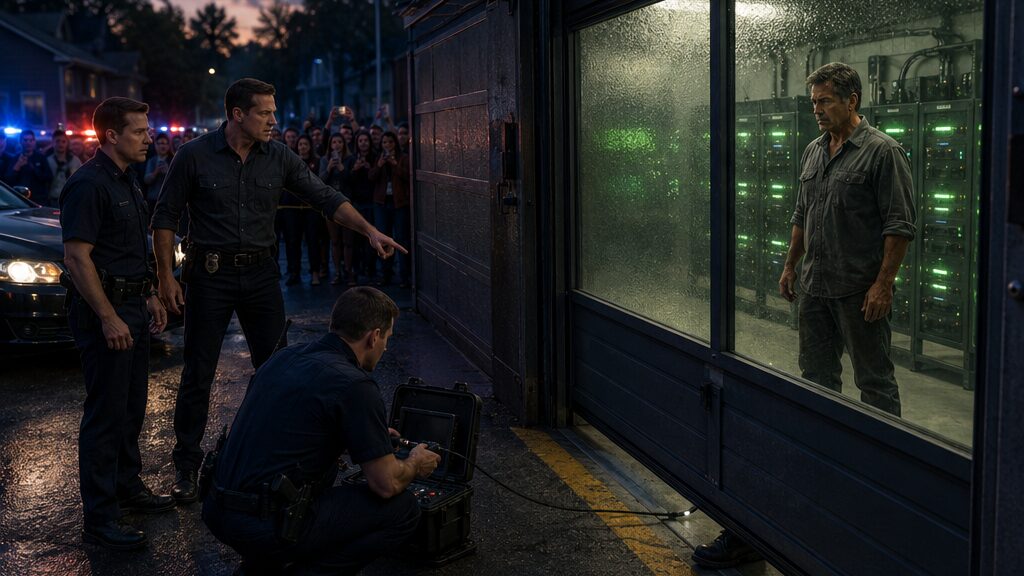
The black cable came out of the equipment case in a slow coil, glossy and thin, as if someone had emptied a vein onto the pavement.
Frank watched it on three screens at once.
One camera showed the officer kneeling near the main garage door with the fiber-optic unit braced on his thigh. Another showed Brandon Carter standing over him, one hand at his belt, his face lit red and blue by the cruisers. The third showed Michael Jones at the edge of the frame, staring at the cable with the expression of a man watching an order become evidence.
Dusk had turned the frosted glass into a pale wall. Behind it, Frank’s battery bank hummed under the steady green of the status lights. Outside, neighbors had gone quiet enough to hear the small clicks of equipment being fitted together.
Brandon pointed toward the bottom seal of the garage door. “Under there.”
Michael moved fast. “Commander, the warrant is still not signed.”
Brandon did not look at him. “We’re not entering. We’re assessing.”
“That camera crosses into the structure.”
“It crosses under a door.”
“Into the structure.”
Brandon turned slowly. The streetlights had come on, drawing a hard line along his jaw. “Then don’t write that part down.”
Michael’s face changed.
Frank saved the clip.
The equipment officer hesitated, fingers on the snake camera controls. “Commander?”
“Do it.”
Inside the garage, Frank looked at the yellow tape on the concrete just behind the door. He had laid it down when he installed the first threshold sensor, not for beauty, not even for warning, but as a reminder to himself: this side is yours. That side is not. He had never expected anyone else to care about the distinction.
He moved toward the door.
The heavy combat boots by the workbench were not for intimidation. They were old shop boots, steel-toed, thick-soled, scuffed across the front from years of moving equipment. Frank had worn them when installing the battery cabinets. He had worn them when mounting the deadbolt plates. He wore them now because the garage floor was his workplace and the world outside had decided to become careless with it.
He stepped into them without sitting down.
On the monitor, the snake camera’s tip nosed toward the gap beneath the garage door. Its small lens caught the outside light and flashed once, like an eye.
Frank pressed the intercom. “Commander Carter.”
Brandon smiled before answering. “Yes, Mr. Torres?”
“If that device enters my garage without a warrant, it is trespassing.”
“It’s a safety inspection device.”
“It is a camera.”
“It’s outside.”
“It is about to be inside.”
Brandon spread one hand for the crowd. “You hear that? He’s more worried about a camera than a chemical leak.”
Karen seized the cue. “Because there is something in there.”
George’s phone was up again, though his face showed less certainty now. Pamela Rodriguez stood several feet away from them, arms still folded, watching Brandon instead of Frank’s gate.
Michael stepped between Brandon and the equipment officer. “Commander, wait for the judge.”
Brandon’s voice dropped. “You want to be the reason we lose time on a hazardous scene?”
“There is no hazardous scene documented.”
“You don’t know that.”
“I know what we can prove.”
Brandon leaned close. “I have spent fifteen years making calls under pressure while people like you worry about paperwork after the fact. If there is a failure in that garage, everyone on this street will ask why we waited.”
For a moment, something almost human crossed his face. Fear, maybe. Not fear for the neighbors. Fear of delay. Fear of losing the shape of the moment. Frank saw it and understood that Brandon did believe part of what he said. He believed command meant never letting hesitation look stronger than him.
Then Brandon looked toward the garage door and the human part disappeared.
“Run it,” he ordered.
The equipment officer fed the cable forward.
The lens disappeared beneath the rubber seal.
Frank lowered his gaze from the monitor to the actual threshold. For a second there was only the hum, the radios, and the slight scrape of something delicate against concrete.
The camera tip emerged under the door.
It stopped with its lens still half in shadow, just outside the yellow tape. Frank did not move.
The cable advanced another inch.
Still outside.
Another.
The lens crossed the tape.
Frank lifted his boot.
There was time to think of the old office. The supervisor’s hand on the server cabinet. The polite tone. The lie that opening a private thing would make suspicion vanish. There was time to think of Karen’s clipboard, George’s camera, Michael’s lowered eyes, Brandon crouched beside the fence looking for the smallest possible gap.
There was time to understand that restraint did not always mean stillness.
Frank brought his boot down.
The lens crushed with a sharp, crystalline snap. Not loud like a gunshot. Worse, somehow, because everyone heard what it was: expensive glass and tiny optics grinding into dust under a man’s heel.
The cable jerked once.
Outside, the equipment officer shouted and pulled back, but the tip stayed pinned beneath Frank’s boot. He pressed harder until the housing cracked flat.
Then he took one step back.
A small glittering smear remained on the concrete, entirely on his side of the yellow line.
Frank pressed the intercom. “Now you’ve trespassed.”
For half a breath, nobody moved.
Then Brandon erupted.
“He just destroyed police equipment!”
Michael said, “After it crossed the threshold.”
“Shut up.”
“Commander—”
“Shut up.” Brandon pointed at the garage door. “Breach team forward.”
Several officers shifted, but not all of them. That hesitation spread faster than any order. The equipment officer stood with the damaged cable in his hand, staring at the broken end as if he wished he could feed time backward through it.
Karen covered her mouth. George kept filming, but his phone trembled.
Frank stepped back from the door and saved the interior camera angle. The crushed lens lay clear in the frame, the yellow line visible beneath fragments of glass dust. He copied it to three storage locations. One local. One offsite. One locked.
The battery hum continued without interruption.
Brandon’s voice came through the exterior mic, raw now. “He doesn’t get to attack police property and hide behind the door.”
Michael stood between him and the first officer moving toward the ram. “The warrant is not here.”
“He created exigency.”
“No, you created an illegal search.”
The words landed so hard that even Karen looked at Michael.
Brandon stared at him. His face had gone pale beneath the flashing lights. “Are you refusing a lawful order?”
Michael’s hand hovered near his radio, not his weapon, not his cuffs. A small choice, but Frank saw the cost of it.
“I’m saying we need command review.”
“I am command.”
A cruiser engine sounded from the south barricade. Headlights turned into the street. At first Frank thought it was the warrant vehicle, and maybe Brandon did too, because he smiled with sudden relief.
Then another set of headlights appeared behind it.
Black vehicles. No roof lights. Moving together.
Inside the dark SUV down the block, James Roberts opened his door.
Brandon did not see him yet. He was pointing toward the garage, voice rising.
“Take the door.”
Chapter 6: The Warrant Arrived With Handcuffs
Two vehicles reached the gate line at the same time, and for one confused second the whole street seemed to forget which authority it was supposed to fear.
A local department sedan rolled in first from the south, its passenger window lowered, a uniformed officer holding a folder out like it might burn his hand. Behind it, black federal vehicles stopped with disciplined spacing across the street. Doors opened almost together. Men and women in tactical vests stepped out without shouting, weapons held low, eyes moving over officers, neighbors, windows, hands.
Brandon Carter turned toward the local sedan and smiled as if the night had finally corrected itself.
“Bring it here,” he said.
The officer hurried over with the folder. “Judge signed. Narrow scope. Visual confirmation of reported hazardous leak, no general search.”
“Good enough.” Brandon snatched it, barely glancing at the first page. “Breach team, on my order.”
“Commander Carter.”
The voice came from behind him.
Frank, watching through the garage camera, saw Brandon’s body stop before he turned. James Roberts crossed the pavement with a folded document in one hand and two Marshals slightly behind him. His vest identified him in block letters. His face carried no anger. That made the street colder.
Brandon looked him over. “This is an active emergency scene.”
“It is now a federal arrest scene,” James said.
Karen whispered something Frank could not hear. George’s phone lowered until it pointed at the sidewalk.
Brandon gave a short laugh. “You people have terrible timing.”
“No,” James said. “We waited for yours.”
Michael Jones stepped away from the breach team. Slowly, almost invisibly, but Frank saw it. So did Brandon.
James unfolded the document. “Brandon Carter, you are under arrest pursuant to a federal warrant for corruption, deprivation of rights under color of law, obstruction, and related offenses.”
For the first time all day, Brandon looked genuinely surprised.
Then furious.
“This is nonsense,” he said. “I have a signed warrant.”
“For a narrow safety confirmation,” James said. “Obtained after you attempted warrantless electronic surveillance inside a private structure.”
Brandon pointed toward the garage. “He destroyed department equipment.”
“After your device crossed under his door.”
“That’s his claim.”
Frank pressed a key. The exterior speaker crackled, then his own interior camera feed appeared on the small public-facing monitor mounted beside the gate. He had installed it for deliveries, not trials. It now showed the yellow threshold line, the snake camera lens sliding under the door, the pause, the final inch, the boot coming down only after the lens crossed fully inside.
No one on the street spoke.
Frank’s voice came through the intercom. “Timestamped. Stored. Duplicated.”
James looked once at the monitor, then back to Brandon. “Thank you, Mr. Torres.”
Brandon’s jaw tightened. “You were watching this?”
James did not answer directly. “Hands where my team can see them.”
A couple of local officers shifted uneasily. One took a step backward from Brandon. The equipment officer set the broken snake camera unit on the pavement as if it had become contagious.
Brandon turned to Michael. “Jones. Tell them who had command.”
Michael looked at him. The red and blue lights moved across his face. All afternoon he had seemed younger than his uniform. Now he seemed older.
“You did,” Michael said.
“And you followed orders.”
Michael swallowed. “Until you told me not to write down the part that mattered.”
The silence after that belonged to everyone.
Brandon’s face went hard. “You think they’re here for me only? You think any of you come out clean if this becomes federal?”
That was his last weapon, Frank realized. Not rank. Not law. Contamination. The promise that everyone near him would share the stain unless they protected him.
No one moved to help him.
James nodded once. Two Marshals stepped in. Brandon pulled back half a step, not enough to run, enough to make hands rise across the line of federal vests.
“This is interference with an emergency response,” Brandon snapped. “There is a reported chemical leak. There is a warrant now. If something happens in that garage while you posture—”
“The local warrant can be served by lawful personnel within its scope,” James said. “You will not be part of it.”
“I am the incident commander.”
“Not anymore.”
The words were not loud. They did not need to be.
The Marshals took Brandon’s arms. He twisted once, more insulted than resisting, and the movement sent a ripple through the neighbors. Karen backed into her mailbox. George lifted his phone again by reflex, then seemed to realize what he was recording and lowered it halfway.
Brandon looked toward Frank’s garage, toward the frosted glass and the locked deadbolts and the glowing status lights blurred behind them.
“You think this makes him clean?” he shouted. “You still don’t know what he has in there.”
Frank stood inside with both hands resting on the workbench. The urge to answer rose, hot and immediate. To list every inspection. To name every module. To explain the system until even Karen understood how ordinary safety could look frightening from outside.
He did not.
Not yet.
Michael picked up the signed local warrant from where Brandon had dropped it. He read the first page, then walked to the intercom, stopping outside the gate.
“Mr. Torres,” he said, voice rough. “The warrant is limited. Visual confirmation of leak condition only. No search of cabinets. No records. No seizure.”
Frank looked at the paper through the camera. He looked at Michael’s face.
“No forced entry,” Frank said.
Michael glanced back at James, then at the breach team, then at the broken cable on the pavement. “No forced entry unless there is visible imminent danger.”
“There isn’t.”
“I believe that now.”
That should have felt like victory.
It did not. It felt like a man late to a truth that had been standing in front of him all day.
Frank opened a side camera feed and sent Michael the live view of the battery bank from inside: cabinets closed, status lights green, trays dry, air monitor normal. He did not unlock the door. He did not open the gate. He gave exactly what the warrant asked for and nothing more.
Michael received it on his phone. He stared, then showed it to James and the nearest local supervisor.
“No visible leak,” Michael said. “No vapor. No spill. System reads normal.”
A woman down the sidewalk exhaled loudly, almost a sob. Pamela Rodriguez covered her face with one hand. George Baker looked suddenly smaller.
Karen Martin shook her head. “But the stain. The smell. George saw—”
James turned toward her.
The motion was small, but Karen stopped speaking at once.
Behind him, Brandon was being guided toward a federal vehicle. His anger had not faded; it had compressed into something bitter and bright. As he passed Michael, he leaned close enough to speak without the whole street hearing, but Frank’s gate mic caught it anyway.
“You’ll regret choosing them.”
Michael did not answer.
The Marshal put a hand on Brandon’s head and guided him into the back seat. The door shut with a heavy sound that seemed to remove the center from the scene.
For several seconds, everyone looked at the closed federal vehicle.
Then James Roberts turned back toward the local officers, the neighbors, the cameras, and Frank’s still-locked gate.
“Who made the original chemical-leak report?”
Karen Martin’s face went pale before anyone said her name.
Chapter 7: The Deadbolt Clicked After Everyone Heard
Michael Jones turned from the federal vehicle to Karen Martin and George Baker with the look of a man who had just found the loose wire that started the fire.
“Which one of you used the words massive chemical leak?”
Karen’s lips parted, but no sound came out.
George looked at his phone as if it might answer for him. The live video was still open, comments crawling upward in a bright nervous stream. He locked the screen with his thumb and tried to slide it into his pocket.
Michael saw the movement.
“Don’t delete anything,” he said.
George froze.
The whole street had changed shape. Ten minutes earlier, everyone had faced Frank’s garage. Now the line of attention bent backward toward the sidewalk, toward the two people who had stood there all afternoon feeding fear into every uniform that would take it. The cruisers still flashed. The garage still stood sealed behind its gate. The crushed snake-camera lens still glittered on the interior feed, a small bright wound on Frank’s side of the threshold.
Inside, Frank watched without touching the intercom.
He had thought the moment of vindication would feel clean. It did not. It felt crowded. Messy. A street full of people realizing late that they had borrowed certainty from the loudest voices available.
James Roberts stood beside Michael, calm enough to make the local officers look restless. “We need the original callers separated.”
Karen’s chin lifted too quickly. “We called because we were scared.”
Michael said, “Scared of what, specifically?”
“The leak.”
“What leak?”
Karen looked toward George. “The chemical runoff. The smell.”
“There was no smell,” Pamela Rodriguez said.
Her voice was not loud, but everyone heard it because nobody expected her to speak again.
Karen turned on her. “You don’t know what I smelled.”
“No,” Pamela said. “But I know what you said yesterday.”
Frank leaned closer to the monitor.
Karen’s face tightened. “Pamela, stop.”
Pamela’s arms were folded so hard her fingers pressed white into her sleeves. “You said if the city wouldn’t inspect his garage, somebody had to make them. You said people only take action when the words sound serious.”
George whispered, “Pamela.”
She looked at him. “You showed me the video of the delivery. The cooling fluid containers. You said it looked bad enough.”
Frank’s gaze moved to the storage shelf beside the battery bank, where the sealed, harmless coolant containers from last week’s delivery sat behind a barcode label. A battery thermal management shipment. Nonhazardous. Ordinary. George had filmed it from across the street, through leaves and angle and ignorance, and made it into poison.
Michael stepped toward George. “You reported corrosive runoff.”
George shook his head. “I said it looked like that.”
“In the call log,” Michael said, “the caller stated corrosive runoff was visible from the driveway.”
George swallowed. “I was trying to get someone to check. That’s all.”
“You said massive unstable chemical leak.”
Karen’s eyes flashed. “Because what else were we supposed to do? He ignores everyone. He puts up bulletproof windows, brings in industrial crates, refuses meetings, refuses questions. We live here too.”
Frank felt the words strike the glass between them. Not because they were fair. Because buried beneath their dishonesty was the small hard fact he had refused to look at all day. He had let the neighborhood see only walls. He had expected them to respect what they could not understand. He had given Pamela a jump-start in silence, turned away from Karen’s clipboard in silence, watched George’s phone appear at his fence and answered it with more silence.
None of that justified a lie.
But silence had left the lie plenty of room.
James Roberts spoke before Michael could. “Concern does not authorize a false emergency report.”
Karen laughed once, sharp and frightened. “So now we’re criminals because we worried about our homes?”
Michael looked down at his phone. “Dispatch recording says you claimed you saw vapor coming from under the garage door.”
Karen’s face lost another shade of color.
“There was mist,” she said.
“No,” Pamela said. “There was condensation by the driveway after a delivery truck left. You knew that.”
George’s shoulders sagged. “I thought if we said battery cooling chemicals, they’d send an inspector.”
Karen snapped, “George.”
But the word had already landed.
Frank closed his eyes briefly.
There it was. Not panic. Not honest fear. A chosen exaggeration sharpened into a weapon because the truth had not been powerful enough to force Frank’s gate open.
Michael turned to another officer. “Separate them. Preserve their phones.”
Karen took a step backward. “Wait. This is ridiculous.”
The officer did not touch her yet. That made it worse. He simply moved into the space beside her, making retreat look childish.
George raised both hands, one still holding the phone. “I didn’t mean for all this.”
“You filmed all this,” Michael said.
George looked at the blank screen in his hand and seemed to understand for the first time that attention could turn around.
Inside the garage, Frank looked at the intercom button.
He could say nothing. He had earned that. He could let James and Michael dismantle the lie. He could remain behind glass, behind locks, behind recordings and precise files. No one on that street deserved a window into him after what they had done with the faintest shadows.
Karen saw the movement of the camera and looked straight toward it.
“Frank,” she said, voice cracking now that the officers were close. “Tell them. Tell them we were just worried. You know how it looked.”
The use of his first name felt worse than the accusations had. All afternoon he had been Mr. Torres, the noncompliant owner, the hazard, the man behind military glass. Now, with handcuffs near, he was Frank.
His thumb hovered over the switch.
On the floor by the garage door, glass dust from the crushed camera lens caught the white overhead light. The broken optics lay precisely where the cable had crossed the yellow line. Frank stared at it until his breathing settled.
Then he pressed the intercom.
Every head outside turned toward the speaker.
“My garage is legal,” Frank said.
His voice sounded flatter than he felt. He did not soften it.
“It was permitted, inspected, and documented before any of you decided it was easier to fear it than understand it. There was no chemical leak. No vapor. No spill. No emergency inside my property.”
Karen closed her eyes.
Frank looked at Pamela on the monitor, then Michael, then the officers still standing near the breach equipment.
“I did not open the door because a locked door is not evidence. I did not open the gate because a crowd wanted access. I did not explain my private work because curiosity is not authority.”
He paused.
The hum behind him remained steady.
“But I heard what Pamela said. I know what silence can let people build around it. So this is the explanation you get from me, on my terms: the system inside this garage is a high-voltage PHEV battery bank with containment, shutoffs, fire separation, and active monitoring. The records have already been sent to lawful authorities. No one needed to lie. No one needed to trespass. No one needed to turn my home into a stage.”
George lowered his head.
Karen’s face twisted, halfway between shame and anger. “I’m sorry,” she said quickly. “Frank, I’m sorry. I didn’t know it would go this far.”
Frank looked at the officer beside her. Only now had the apology come. Not when cruisers blocked the street. Not when Brandon ordered equipment toward the door. Not when George’s live video made Frank’s refusal into a public accusation. Only when Karen saw the cost move toward her wrists.
Frank released the intercom button, then pressed it once more.
“You knew it was false enough to improve it.”
Karen flinched.
Michael nodded to the officer.
The handcuffs sounded small when they closed around Karen’s wrists. A neat metallic click, almost delicate. George began talking then, too quickly, saying he never meant chemical in the technical sense, saying he only wanted someone official to look, saying everyone on the street had wondered. Another officer took his phone and turned him gently but firmly toward the cruiser.
No one cheered. No one clapped. The neighbors watched with the embarrassed stillness of people who had nearly joined a punishment before learning it had been built from their own appetite.
Pamela stood alone near the mailbox, crying silently now, though Frank could not tell whether it was from guilt or relief.
Michael walked back to the gate. He stopped short of it this time, leaving space between his boots and Frank’s property line.
“Mr. Torres,” he said. “I was late.”
Frank did not answer.
Michael accepted that with a small nod. “Your records are attached to the incident file. The narrow warrant is satisfied by the visual feed you provided. No entry will be made tonight.”
James Roberts joined him. “A federal evidence team may contact you for copies of your recordings.”
“They can request them in writing,” Frank said.
James almost smiled. Not mockery. Recognition. “I assumed.”
Behind them, the federal vehicle carrying Brandon pulled away from the curb. Its lights were not flashing. It did not need spectacle. Brandon Carter vanished down the same street he had blocked, behind dark glass that gave the neighbors nothing to feed on.
The local cruisers began to reposition. The barricade at the south end opened first. Neighbors drifted backward onto lawns and porches, carrying their phones like objects they no longer trusted. The street remained bright with emergency lights, but the siege had gone out of it.
Frank looked around the garage.
The battery cabinets stood undisturbed. The records cabinet remained locked. The side door had never opened. The main deadbolt had held through accusation, pressure, equipment, warrant, and apology.
He crossed to the threshold and crouched near the crushed lens. For a moment he considered sweeping it up. Then he left it where it was, a glittering reminder that the line had not been imaginary simply because someone powerful pretended not to see it.
At the intercom, Michael said, “Good night, Mr. Torres.”
Frank waited until Michael stepped back.
Then he reached for the inner lock panel. The deadbolt was already engaged, but he turned the manual latch anyway, feeling the weight of the mechanism settle fully into place.
The sound moved through the garage like a final word.
Behind frosted bullet-resistant glass, with the hum steady at his back and the broken camera lens at his feet, Frank Torres stood in the quiet he had defended.
The story has ended.