The Old Soldier Opened His Medal Box Only After Every Other Possession Failed
Chapter 1: The Box He Would Not Open
“If we wait until morning, surgery may no longer help him.”
The veterinary surgeon said it quietly, but the words struck Thomas Hernandez harder than if she had raised her voice.
Through the glass door behind her, his service dog lay beneath a silver warming sheet. One hind leg protruded from it, motionless except for the slight rise and fall of his breathing. A clear tube ran into the shaved patch above his paw. The dog had always watched Thomas whenever strangers entered a room. Now his eyes remained closed.
Thomas pressed two fingers against the edge of the plastic chair until the tremor in his hand slowed.
“How long?”
“The bleeding is getting worse.” The surgeon held a clipboard against her chest. “We have an operating team tonight. I can hold the slot until seven. After that, they have another emergency scheduled, and his condition may deteriorate before another team is available.”
The clock over the reception desk showed five twenty-three.
Thomas looked down at the estimate folded across his knee. The amount printed at the bottom seemed larger each time he read it. Diagnostics. Anesthesia. Blood products. Surgery. Overnight monitoring.
He had enough for less than a quarter of the required deposit.
“I’ll bring it,” he said.
The surgeon studied him. “The deposit has to be confirmed before we begin.”
“I understood you.”
She lowered her voice. “There may be assistance programs we can apply for tomorrow.”
“You said tomorrow may be too late.”
Her silence answered him.
Thomas stood. His left knee caught before it straightened, and the room tilted for half a second. If the dog had been beside him, a broad shoulder would already have pressed against his leg. The animal had been trained to feel the change in Thomas’s balance before Thomas did. Twice in the last year, that pressure had kept him from striking the floor.
Now there was only the plastic chair.
He placed one hand on it until the room steadied.
“Please hold the slot,” he said.
“I’ll do what I can.”
Thomas walked to the kennel door. He was not permitted inside, so he rested his palm against the glass. The dog’s ear moved once beneath the warming sheet.
“I’m coming back,” Thomas said.
The promise sounded familiar in a way he did not let himself examine.
Outside, evening traffic filled the avenue with exhaust and impatient horns. Thomas sat at the bus stop and opened the old canvas satchel he had brought from home. Inside were the things he had gathered in ten minutes after leaving the dog at the clinic: a silver watch that no longer kept perfect time, three carpenter’s tools wrapped in cloth, and his late wife’s wedding ring inside a paper envelope.
Beneath them lay another object.
The faded velvet box was small enough to fit inside both hands. Its corners had gone pale with age. Thomas did not take it out. He touched it through the lining of the satchel, then moved the watch and tools over it again.
His phone rang.
Amanda’s name appeared on the cracked screen.
Thomas waited through one ring before answering. “Hello, sweetheart.”
“Is he okay?”
Behind her voice came the faint sound of a television in the neighbor’s apartment.
“He’s resting.”
“Is he coming home before bedtime?”
Thomas watched the bus turn onto the avenue. Its headlights passed over the estimate in his hand.
“They’re keeping him for a few tests.”
“That means no?”
“It means they’re being careful.”
Amanda was quiet. At nine years old, she had already learned that adults often added words when the true answer was no.
“Can I talk to him?”
“He’s asleep.”
“Did he get scared?”
Thomas looked back toward the clinic windows. “He knows I’m coming back.”
Amanda breathed against the phone. “You always come back.”
He closed his eyes.
The dog had begun sleeping outside Amanda’s room after her mother died. At first, Amanda would not sleep unless she could rest her fingers in the thick fur at his neck. Even after the nightmares became less frequent, he remained there every night, positioned between her bed and the hallway.
Thomas had told himself the animal stayed for Amanda.
The truth was that some nights Thomas also woke disoriented, his heart hammering against old memories, and listened for the dog’s nails shifting on the floorboards. That small sound told him where he was.
“I’ll see you soon,” he said.
“Bring him home.”
“I will.”
The lie remained in his mouth after the call ended.
On the bus, Thomas took out the emergency savings envelope. He already knew what it contained, but he counted the bills anyway.
Forty-three dollars.
He had kept nearly eight hundred there two months earlier. Then the furnace had failed during a cold week, followed by the utility warning. He had paid enough to keep the gas connected and repaired the furnace with a used part. Amanda had never known how close the house had come to going dark and cold.
The dog’s annual examination had been postponed.
Then postponed again.
Thomas placed the bills back into the envelope. The decision had seemed simple at the time. Heat first. Medical care later. One emergency held off by borrowing from another.
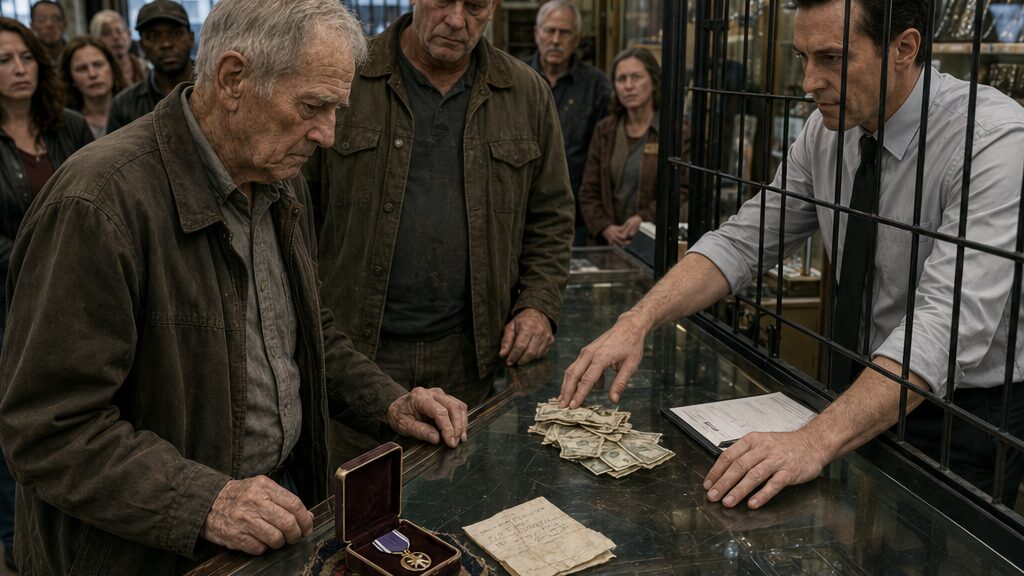
The bus stopped beside a row of shuttered storefronts. Across the street, a red sign flickered above a jewelry-and-loan shop. Half the letters in JEWELRY were dark. Metal bars covered the windows, behind which watches and gold chains rested on faded black pads.
Thomas had passed the place many times and never imagined entering it.
Inside, fluorescent lights flattened every face. A security grille separated the counter from shelves of electronics, instruments, tools, and jewelry. The air smelled of dust, metal polish, and something burned from a heater in the back room.
Three customers waited ahead of him.
Thomas stood with one hand on the satchel strap. Each register click seemed tied to the clock at the clinic.
When his turn came, a man with a narrow tie and rolled shirtsleeves glanced at the bag.
“Selling or borrowing?”
“Selling.”
The clerk’s name tag read BRANDON KING.
Thomas placed the watch on the scratched glass. Then the tools. Last came the paper envelope containing his wife’s ring.
Brandon inspected each item without comment. He weighed the ring, tested it, and wrote numbers on a pad.
Thomas watched the wall clock move toward six.
“That’s everything?” Brandon asked.
“For now.”
Brandon slid the watch and tools aside. His gaze dropped to Thomas’s coat, where the corner of the satchel pressed outward against the fabric.
“These won’t get you much.”
“How much?”
Brandon named a figure.
Thomas looked at the veterinary estimate. It would not cover even the blood work already performed.
He gathered the objects slowly.
Brandon did not look away from the shape beneath Thomas’s coat.
“What are you still hiding inside there?”
Chapter 2: Everything Worth Selling Falls Short
Brandon placed the wedding ring in a shallow testing tray and said, “Eighty dollars.”
Thomas stared at him. “The diagnostic charge alone is more than that.”
“I don’t set veterinary prices.”
“You said it was gold.”
“I said part of it is gold.” Brandon tapped the ring with a metal probe. “It’s thin. Worn. Personalized. Harder to resell.”
Thomas reached for it.
Brandon covered the tray with two fingers. “Eighty-five, if it stays with the other items.”
The fluorescent tubes buzzed above them. Behind Thomas, a customer cleared his throat with deliberate impatience. Someone near the door shook rain from a plastic shopping bag.
Thomas looked at the ring. His wife had worn it for forty-six years. The inside was polished nearly smooth where an inscription had once been clear.
He had removed it from her hand himself at the hospital.
“Put it back in the envelope,” he said.
Brandon’s expression did not change, but he returned the ring. “Sentiment doesn’t improve resale.”
“No.”
Thomas laid out the tools instead: a small plane, a worn measuring square, and a folding rule. He had used them when Amanda’s mother was young and again when he built Amanda’s narrow bookshelf.
Brandon lifted the plane. “Old.”
“It still cuts.”
“People don’t buy tools like this anymore.”
“People who know how to use them do.”
For the first time, something almost like respect crossed Brandon’s face. He checked the blade, sighted along its edge, and opened the rule carefully instead of snapping it flat.
“One hundred sixty for the set,” he said.
Thomas waited.
Brandon glanced at the clock. “One seventy-five.”
It was more than Thomas expected and nowhere near enough.
“You can do better.”
“I just did.”
A telephone rang behind the security grille. Brandon ignored it. On a clipboard beside the register, a red sheet displayed columns of weekly figures. Several lines were circled. At the top, in heavy print, were the words FINAL PERFORMANCE REVIEW.
A second clerk carried a tray from the back room. “Owner called again.”
“I’ll call him after closing,” Brandon said.
“He said before.”
Brandon’s jaw tightened. “Then tell him I’m with a customer.”
The second clerk looked at Thomas’s old tools and gave Brandon a doubtful glance before walking away.
Thomas understood then that Brandon needed something from the evening too. The knowledge did not make the man kinder. It only made his attention sharper.
Thomas placed the silver watch on the counter.
Brandon opened the back, checked the mechanism, and shook his head. “Thirty.”
“It was serviced last year.”
“Then the service cost more than the watch.”
“It belonged to my father.”
“That lowers its value to you, not to me.”
Thomas’s hand closed around the edge of the counter. The tremor had begun again, first in two fingers, then through his wrist. He tucked the hand beneath the satchel.
Brandon saw the movement.
“How much are you trying to raise?”
Thomas unfolded the veterinary estimate and laid it on the glass.
Brandon’s eyes moved quickly down the page. He did not need long to find the required deposit or the deadline.
“Service dog?” he asked.
“Yes.”
“What happened?”
“Internal bleeding.”
Brandon read the total again. “You’re not getting this amount from what you brought.”
“I know what I brought.”
“Then you know you need another plan.”
Thomas’s phone vibrated. A message from the clinic filled the screen.
SURGICAL SLOT WILL BE RELEASED IN 40 MINUTES WITHOUT CONFIRMED FUNDING. PLEASE CALL IMMEDIATELY IF YOU NEED TO DISCUSS OPTIONS.
He read it twice.
Brandon leaned forward just enough to see the first line. “Forty minutes.”
Thomas folded the phone shut in his palm.
“I could combine everything,” Brandon said. “Watch, tools, ring. Two ninety.”
“You said one seventy-five for the tools.”
“And eighty-five for the ring. Thirty for the watch.”
“That is two ninety.”
Brandon shrugged.
“You called it combining as though you added something.”
“I’m giving you certainty.”
Thomas looked past him at the shelves. A trumpet with a dented bell. A boxed power drill. A row of phones with price tags hanging from their cords. Every object had arrived with an explanation. Rent. Medicine. A broken car. A late bill.
Behind the scratched glass, explanations became numbers.
Thomas pushed the tools closer to Brandon.
“Two hundred for those.”
Brandon’s eyes narrowed. “One eighty-five.”
“You know the plane is worth more.”
“I know I may wait months for the right buyer.”
“One ninety.”
Brandon hesitated, then pulled the tools toward his side. “Done.”
The small victory made Thomas feel worse. Brandon could bend when he wished. Every refusal was a choice.
The transaction slip printed with a mechanical chatter. Thomas took the cash but left the ring and watch on his side of the glass.
“One ninety won’t hold the surgical slot,” Brandon said.
“It buys me time.”
“No. It buys you an unpaid balance.”
Thomas turned toward the door.
The room shifted.
He caught the counter before his knee folded. The satchel swung against his ribs, and something inside struck the glass with a muffled knock.
Brandon stood quickly, not to help him but to watch the bag.
“You’re not making it to another shop,” he said.
Thomas straightened. Heat rose along the back of his neck.
“I can walk.”
“I didn’t say you couldn’t.”
“You thought it.”
Brandon glanced at the clock. Six twenty-two.
The next nearest loan shop was eight blocks away. Thomas could not cover that distance quickly. A bus transfer would take longer. The clinic’s message remained on his screen.
Brandon lowered his voice. “Whatever else you have, this is the time.”
Thomas drew the satchel onto the counter. His fingers passed over the watch, the ring, and the empty space where the tools had been.
Then they stopped on faded velvet.
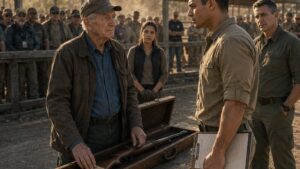
For years, the box had stayed in the back of a locked drawer beneath folded service papers. He had taken it out only to dust the drawer. He had never displayed it. He had never worn what lay inside to ceremonies, schools, or veterans’ dinners.
The medal had been delivered to him after men were already buried.
It had never felt like his.
His phone vibrated again. This time the clinic was calling.
Thomas silenced it.
He removed the velvet box.
The worn fabric looked almost gray beneath the fluorescent lights. One corner had split along the seam. Brandon’s face remained blank, but his attention changed.
“What is it?” he asked.
Thomas kept one hand on the lid.
The dog lay under a silver sheet. Amanda waited in a neighbor’s apartment, trusting him to bring her companion home. The furnace worked because the savings did not.
Thomas opened the box.
The Medal of Honor caught the light with a cold, perfect gleam.
A woman near the next counter stopped speaking.
Brandon stared for one second, then moved with sudden efficiency. He reached beneath the counter, pressed a switch, and the lock on the front display case snapped shut.
Chapter 3: The Price Beneath the Scratched Glass
Brandon turned the medal over, read the engraved name on its back, and lowered his voice.
“Thomas Hernandez.”
Thomas did not answer.
Brandon had put on thin white gloves. The faded box remained open on the dirty glass while he held the medal beneath a magnifying lamp. He examined the ribbon, the suspension ring, the engraving, and every edge of the star.
“Do you have documentation?”
“At home.”
“Citation?”
“Yes.”
“Photographs? Presentation records?”
“I said they’re at home.”
Brandon looked up. “I have to establish ownership.”
“My name is on it.”
“Names can be engraved.”
Thomas placed his driver’s license on the counter. Brandon compared the name, then the date of birth, then Thomas’s face.
The clerk’s manner had changed. He no longer sounded bored. Every motion was controlled now, careful enough to appear respectful without becoming respect.
Thomas reached for the medal.
Brandon drew it back slightly. “I’m still examining it.”
“You can examine it where I can touch it.”
A pause passed between them.
Then Brandon placed it on a black appraisal pad, nearer Thomas’s side.
The medal looked unnaturally bright against the stained glass and frayed velvet. Thomas had kept it wrapped inside its box for decades. No fingerprints dulled its surface. No scratches showed along its points.
Brandon bent beneath the counter and brought up a tablet. His fingers moved quickly across the screen.
Thomas could see only reflected blocks of text in the glass.
“Military decorations are difficult,” Brandon said.
“You recognized it.”
“I recognize what it appears to be.”
“You read my name.”
“That does not establish what I can legally do with it.”
The tablet emitted a soft tone. Brandon’s eyes shifted across the screen. His breathing changed, not much, but Thomas saw his shoulders stiffen.
“What does it say?” Thomas asked.
“General reference material.”
“Show me.”
“It’s an internal database.”
Brandon scrolled once. Thomas caught a glimpse of a photograph—his own younger face, grainy and formal—before Brandon turned the tablet away and closed the page.
“You found me,” Thomas said.
“I found a matching record.”
“A record with my face.”
Brandon removed the gloves one finger at a time. “Records can create more complications, not fewer.”
Thomas touched the ribbon. “The blue is correct.”
“What?”
“You were looking at the shade as if it might be wrong. It isn’t.”
Brandon gave a small, cautious smile. “You know the construction.”
“I know this one.”
“What action was it for?”
Thomas closed his fingers around the edge of the box.
“That is not part of your appraisal.”
“It affects provenance.”
“It affects nothing I came here for.”
A customer had moved closer under the pretense of examining a rack of used bracelets. Brandon noticed and lowered his voice further.
“If this is authentic, attention creates risk. Theft. Fraud. Publicity.”
Thomas looked toward the locked display case. “Is that why you locked the door?”
“I locked the case.”
“You locked every item behind you after seeing mine.”
“Standard precaution.”
The wall clock showed six twenty-nine.
Thomas unfolded the veterinary estimate again. “I need the deposit shown there.”
Brandon glanced at the total.
“That amount is not realistic.”
“You have not made an offer.”
“I’m trying to explain the market.”
“You said it was difficult. You did not say worthless.”
Brandon leaned both hands on the counter. “There are restrictions, reputational issues, collectors who will not touch certain medals, questions about transfer. The metal itself has limited value.”
Thomas looked at him for a long moment. “Metal.”
“That is one measurable component.”
“The ribbon too?”
“Textile has no meaningful resale value.”
Thomas thought of smoke caught in cloth. Mud. Blood dried black at the edge of a sleeve. Stephen Nelson shouting through noise Thomas had spent fifty years trying not to hear.
He drew the medal closer.
When he did, several papers slipped from inside his coat. They scattered across the floor near Brandon’s shoes.
A yellow utility notice landed face up.
FINAL DISCONNECTION WARNING.
Another sheet showed the amount past due.
Brandon bent and collected them before Thomas could move. He placed the veterinary estimate on top, aligning the pages with unnecessary care.
His eyes now held the full shape of Thomas’s need.
“Household problems too,” he said.
Thomas took the notices from him. “They are not for sale.”
“No. But they explain the deadline.”
“They explain nothing to you.”
“They explain why you’re standing here.”
Thomas shoved the papers into his coat. His fingers no longer obeyed him cleanly. One notice remained half exposed.
Brandon saw the tremor and glanced toward the clock.
“You need a decision,” he said. “Not a history lesson.”
“Then make the offer.”
Brandon opened the register.
The drawer slid out with a metallic crack. He counted several bills, paused, removed two, and pushed the smaller stack across the glass.
Thomas looked down.
The amount was less than Brandon had paid for the tools.
“That cannot be your offer.”
“It is.”
“For a Medal of Honor.”
“For an item with uncertain resale options and almost no intrinsic metal value.”
“You searched my name.”
“I verified that the situation is complicated.”
“You saw something on that screen.”
“I saw enough to know I would be taking a risk.”
Thomas did not touch the money.
Brandon’s voice softened, adopting the tone of someone explaining an unpleasant necessity to a child. “You came into a loan shop. That means you want liquidity, not ceremony. I can provide that immediately. You can take the cash to the clinic and at least show good faith.”
“It will not secure the surgery.”
“It may buy time.”
“The clinic already gave me time.”
“Then perhaps this is the only offer you have left.”
The hard metallic ring of the register seemed to remain in the air.
Thomas looked at the medal. He saw no battlefield in its polished surface. Only the fluorescent tubes, the security grille, Brandon’s white shirt, and his own bent reflection.
He had once believed the worst thing a man could carry was the memory of leaving someone behind.
Now the dog lay waiting because Thomas had delayed asking for help. Amanda sat in another person’s home because Thomas had hidden the bills. Every silence he called protection had narrowed the road until it ended at this counter.
Brandon slid a form toward him.
“Sign here. The transfer language is standard.”
Thomas picked up the pen.
The weight of it surprised him.
Brandon placed one finger beside the signature line. “Once it’s processed, the cash is yours.”
Thomas imagined the clinic accepting whatever partial payment he could bring. Perhaps they would hold the team. Perhaps they would see the medal’s absence in his face and understand nothing.
The pen hovered above the paper.
Brandon watched his hand shake.
Then he said, “If you really cared about what this represents, you wouldn’t be in a pawn shop trying to sell it.”
The woman near the bracelets turned fully toward them.
Thomas felt the insult enter the space between his ribs. For one instant, it cleared the trembling from his hand.
He could have closed the box.
He could have walked out.
Instead, the image of Amanda kneeling beside an empty dog bed rose before him.
Thomas lowered the pen toward the signature line.
Chapter 4: The Stitching Under the Velvet
Before the pen touched paper, a broad hand came down over the crumpled bills.
“Do you know whose insignia you’re insulting?”
The voice came from Thomas’s right.
Brandon pulled his hand back from the money. Thomas lifted the pen but did not release it.
A man in a faded work coat stood beside him. He appeared to be in his early sixties, heavy through the shoulders, with closely cut gray hair and the rigid posture of someone who still noticed exits before faces. A canvas tool bag hung from one hand. He was not looking at the medal.
He was looking at the underside of the velvet box.
When Thomas had drawn it closer, the box had tilted against the counter. Beneath it, nearly hidden by frayed velvet, was a small cloth insignia secured with uneven dark thread. Its colors had faded until only the shape remained clear.
Brandon glanced between the stranger and Thomas. “This is a private transaction.”
“Then stop conducting it loudly enough for the room to hear.”
“I wasn’t speaking to you.”
The stranger kept his palm over the bills. “Paul Campbell.”
Thomas did not offer his own name.
Paul’s gaze moved to the engraving on the medal. Recognition sharpened his face.
“Hernandez,” he said. “That unit was at the eastern evacuation corridor.”
Thomas’s fingers tightened around the pen.
Brandon straightened. “Military memorabilia attracts stories. Stories do not determine value.”
Paul turned toward him. “That isn’t memorabilia.”
“Legally and commercially, there are complications.”
“You offered him less than you paid for a set of hand tools.”
Brandon’s eyes flicked toward the second clerk. The clerk looked away.
Paul lifted his hand from the cash but remained between Thomas and the signature line. “I learned that insignia before I learned half the regulations they expected me to memorize. The men from that unit held the corridor open while wounded were moved out.”
The woman near the bracelets stepped closer. Two other customers stopped pretending not to listen.
Thomas felt the room narrowing around him.
“Enough,” he said.
Paul looked at him.
“You recognize cloth,” Thomas continued. “That does not give you the rest.”
Paul’s expression softened, but his voice carried. “You were the one who kept going back.”
Thomas’s chair scraped the tile as he pushed himself upright.
“No.”
The single word silenced the counter.
Paul blinked.
“Three men carried the wounded,” Thomas said. “Not one. Three.”
“I only meant—”
“You meant the version that fits on a plaque.”
Thomas turned the velvet box over and covered the insignia with his palm.
“Stephen Nelson held the passage after the rest of us moved,” he said. “He did not come out. Do not reduce him so you can make me larger.”
Paul’s mouth closed.
The fluorescent hum returned to the space between them.
Thomas rarely spoke Stephen’s name. He had imagined that silence preserved something. Now, hearing it beneath the shop lights, he felt not relief but exposure, as if he had opened a second box he could not shut.
Paul lowered his voice. “You’re right.”
Thomas expected argument, apology, or praise. Paul gave him none.
“I was told the clean version,” Paul said. “I should have known better.”
Brandon drew the transfer form toward himself. “This discussion has nothing to do with the appraisal.”
“It has everything to do with the appraisal,” Paul said.
“No. You’re confusing historical meaning with liquidity. I run a business.”
“And you found his record before you made that offer.”
Brandon’s face hardened. “You have no idea what I found.”
“I know what you hid.”
Thomas saw Paul glance toward the dark tablet behind the register. Brandon moved it farther from view.
Paul reached inside his coat and removed a wallet. “What does the clinic require?”
Thomas looked at him. “Put that away.”
“How much?”
“The medal is not yours to buy.”
“I’m not asking for a bargain.”
“It makes no difference.”
Paul placed several folded bills on the glass. “I’ll give you the full deposit. You hand me the box, and after the surgery—”
“No.”
Paul stopped.
Thomas’s voice was quieter now, but steadier. “Changing buyers does not change what is being sold.”
“I’d give it back.”
“Then it is not a purchase.”
“Call it collateral.”
“No.”
Paul looked down at the insignia hidden beneath Thomas’s hand. “Then call it whatever lets you walk out of here with enough money.”
“That is what he did.”
Thomas nodded toward Brandon.
Paul’s jaw shifted. “I am not him.”
“You both think the answer is deciding what this box is worth to you.”
“That isn’t what I’m doing.”
“It is what your money says.”
Paul withdrew his hand from the bills. For the first time since stepping forward, he appeared uncertain.
Brandon seized the opening. “Mr. Hernandez came here voluntarily. He requested an appraisal. I made an offer based on risk. No one forced him.”
“You used his deadline against him,” Paul said.
“A deadline does not alter an object’s market.”
“It altered your offer.”
Brandon’s eyes moved toward the performance sheet beside the register. “You think businesses survive by paying for emotions?”
“No,” Paul said. “I think some fail because the people behind the counter forget they’re dealing with human beings.”
The remark landed harder than shouting would have. Brandon’s hand curled around the edge of the tablet.
Thomas closed the medal box.
The soft click brought every eye back to him.
He should have taken it and left. The door was less than twenty feet away. The box could return to the locked drawer. Stephen’s insignia could disappear into darkness again.
Then his phone rang.
The clinic number glowed on the cracked screen.
Thomas answered immediately. “Hernandez.”
The surgeon’s voice came fast and controlled. “His blood pressure is dropping. We repeated the imaging. The bleeding has increased.”
Thomas looked at the wall clock. Six thirty-eight.
“I’m arranging the deposit.”
“I need authorization now. We can hold the team ten more minutes, but not longer.”
“Ten?”
“I’m sorry. If we lose the operating window, I cannot promise he’ll remain stable.”
Thomas pressed the phone tighter to his ear. Behind the surgeon, he heard a metallic clatter and someone calling out a dosage.
“Is he awake?”
“Barely.”
Thomas saw the dog beneath the warming sheet, one ear twitching at his voice.
“Tell him I’m coming back.”
The surgeon paused. “Mr. Hernandez, I need more than that. I need your authorization and confirmed funding.”
Thomas looked at the closed velvet box.
Paul’s money remained on the glass. Brandon’s smaller stack lay beside the unsigned paper. The two offers seemed different only in amount, both waiting for Thomas to surrender something before he could save what was living.
“Ten minutes,” the surgeon repeated.
The call ended.
Thomas kept the phone against his ear after the line went silent.
Paul spoke first. “Let me pay.”
Thomas lowered the phone.
“For what?” he asked.
“The surgery.”
“And what do you take home?”
“Nothing.”
“Then why did you ask for the box?”
Paul looked at the money he had placed down. “Because I thought you needed a way to accept.”
“You thought I needed a transaction.”
“I thought you needed time.”
“What I need is not the same as what I can sell.”
Paul slowly gathered the bills, but he did not return them to his wallet.
Thomas placed both hands around the velvet box.
For the first time that evening, he pulled it fully away from Brandon’s side of the counter.
Chapter 5: What His Silence Had Already Cost
Thomas’s phone rang again before anyone could speak.
Amanda’s voice came through thin and frightened.
“Grandpa, should I sleep in my coat again if the heat stops?”
The room around Thomas seemed to lose depth.
Paul looked away. Brandon looked directly at the yellow notice still protruding from Thomas’s pocket.
“Why would you ask that?” Thomas said.
There was a pause. “The neighbor said her heater is loud, so I can stay there. But I can wear my blue coat at home. It’s warm.”
“The heat is on.”
“I know.”
“Amanda.”
“I saw the paper on the table last week.”
Thomas closed his eyes.
He had left the disconnection notice beneath a grocery circular while he searched for the utility account number. He thought she had been doing homework in her room.
“I paid enough to keep it on,” he said.
“Did you use the dog’s money?”
No one in the shop moved.
Thomas turned toward the security grille, seeking a corner that did not exist. Every surface reflected something: gold chains, cracked screens, his own tired face.
“Sweetheart, listen to me. Stay with the neighbor.”
“Is he going to die?”
Thomas had answered gunfire more easily than that question.
“The doctors are working.”
“That means maybe.”
“Yes.”
Amanda took a shaky breath. “You said it was tests.”
“I should not have said that.”
“You said you’d bring him home.”
Thomas pressed his thumb into the seam of the velvet box.
“I’m trying.”
“Are you scared?”
His first instinct rose automatically.
No.
The word reached his teeth and stopped.
“Yes,” he said.
Amanda went silent.
“I’m scared too,” she whispered.
“I know.”
“No, you don’t. I don’t tell you.”
Thomas leaned against the counter.
“Why?”
“Because you already look tired.”
The fluorescent light blurred above him. He did not cry. The pressure settled behind his eyes and remained there, heavy and disciplined.
“I will call you when I know more,” he said. “Keep the phone close.”
“Okay.”
“And do not sleep in your coat. The heat is staying on tonight.”
He had no proof of that promise.
When the call ended, Brandon pulled the intake form toward him and tapped the lower half.
“We need to finish this if you expect to leave with funds.”
Thomas turned.
“The medal is not for sale.”
Brandon’s mouth tightened. “You initiated the appraisal.”
“I withdrew.”
“You signed the intake line.”
“I did not sign the transfer.”
“The intake grants temporary possession during appraisal and processing.”
Paul stepped forward. “He just told you he’s withdrawing it.”
Brandon lifted the paper. “This is not a street collection. There are procedures.”
“Show me the language,” Thomas said.
Brandon hesitated.
“The language that says you own it.”
“I did not say ownership.”
“You said possession.”
“For processing.”
Thomas extended his hand. “Give me the form.”
Brandon kept it beyond his reach. “The item is logged.”
“The box is in my hands.”
“The medal was accepted for appraisal.”
“Accepted is not transferred.”
“You cannot tear up records because you dislike the offer.”
“I have not touched your records.”
Thomas’s voice remained low. That made the customers listen harder.
“Give me the copy I signed.”
Brandon glanced toward the red performance sheet. His expression did not soften, but something underneath it frayed.
“You walk away,” he said, “and I have spent time authenticating an object I may not legally purchase. I have other customers. I have an owner demanding numbers. Every person who enters this place believes their emergency should become my loss.”
Thomas looked at him carefully.
There it was: not innocence, not justification, but the shape Brandon used to live with himself.
“You could have told me the truth about its value,” Thomas said.
“Value to whom?”
“To the screen you hid.”
Brandon’s eyes flickered.
“You saw my deadline and made it smaller,” Thomas continued. “That was your choice.”
A phone rose near the back of the shop.
Its camera pointed toward Thomas.
Then another appeared beside the jewelry rack.
Paul noticed them. “Put those down.”
A customer murmured, “People should see this.”
“No,” Thomas said.
The word stopped Paul as much as anyone else.
Thomas looked across the room. “No recordings.”
The first phone remained raised.
“He’s trying to rob you,” the customer said.
“And you are trying to take something too.”
The phone lowered slightly.
Thomas held up the velvet box. “This does not become a performance because the buyer changed.”
One by one, the screens disappeared. The woman near the bracelets turned her phone face down on the glass.
Paul moved closer, then stopped himself. He had spent the last several minutes speaking as if volume could restore what Brandon had taken. Now he asked, “What do you want done?”
The question unsettled Thomas more than the offers.
He looked at the veterinary estimate, the utility notice, Brandon’s cash, and Paul’s folded bills.
The old answer was simple: sell something. Pay the debt. Reveal nothing.
That answer had brought him here.
Thomas set the box on the counter and closed his palm over the insignia stitched beneath it.
“Stephen Nelson sewed this patch there,” he said. “The night before the evacuation.”
Paul said nothing.
“He said the velvet was too clean. Said it needed to belong somewhere before anyone put anything inside.”
Thomas’s thumb followed the uneven thread.
“After he died, they gave me the medal. People said I had earned it. I heard them. But every time I opened this box, I saw what did not come home.”
Brandon lowered the intake form.
“I promised myself I would never turn their deaths into comfort,” Thomas said. “Never use the medal to open doors. Never take money because of it.”
Paul’s eyes remained on the patch.
“But I used the dog’s medical savings to keep heat in the house. I delayed his examination. I told my grandchild there was nothing wrong because I did not want her to know I could not manage.”
The admission felt less like setting down a burden than discovering how deeply it had cut into his hands.
Thomas looked at the customers.
“I cannot pay for the surgery. I cannot settle the utility balance tonight. And I will not sell this medal.”
No one spoke.
Thomas drew the transfer page toward him. Brandon’s hand closed around the top edge.
“You cannot destroy the original.”
“Then let go of my copy.”
For a moment, neither man moved.
Brandon released it.
Thomas read the small print beneath his signature. It authorized examination and nonbinding valuation. Nothing more.
He placed the page flat.
“You never had possession beyond what I allowed.”
Brandon did not answer.
Paul removed the bills from his wallet again. This time he placed them beside the veterinary estimate, several inches from the velvet box.
“This is not for the medal,” he said.
Thomas’s chest tightened.
“I know what you said about taking help,” Paul continued. “I also know I was trying to build a transaction because I thought pride needed paperwork. I was wrong.”
Thomas looked at the money.
Paul did not push it toward him. “Tell me where the clinic is.”
A woman standing behind Paul opened her purse.
“Can they take payment over the phone?” she asked.
Thomas turned toward her.
She held a folded bill between two fingers, not offering it yet.
“Where should it be sent?” she asked.
Chapter 6: No One Bought the Medal
Thomas tore the unsigned transfer page in half.
“You never owned this.”
The sound of paper splitting cut through the fluorescent hum.
Brandon watched the two halves fall onto the scratched glass. His face had gone pale around the mouth.
“That was a shop document.”
“That was my unsigned copy.”
“The intake remains in our system.”
“Keep a record that I refused your offer.”
Thomas placed the closed velvet box inside his coat. The weight settled against his ribs, not hidden now but secured.
Around the counter, the customers shifted closer. Paul gathered the veterinary estimate and held it where he could read the clinic’s number.
“I’ll call,” he said.
Thomas took the paper from him.
“I will.”
He dialed with both hands to steady the phone. The surgeon answered after one ring.
“This is Thomas Hernandez. I authorize the operation.”
“I still need confirmation of the deposit.”
“People here want to pay it directly.”
A silence followed. “Who is there?”
“A group at a shop.”
The answer sounded as unlikely aloud as it felt.
The surgeon lowered her voice. “We cannot begin based on pledged cash. Payment must be verified electronically or entered through our billing desk.”
“Give me the correct instructions.”
Thomas took a pen from beside the register. The clerk recited a secure payment number and an online address. Thomas wrote them on the back of Brandon’s torn offer.
Paul leaned over only when Thomas handed him the paper.
“How much remains?” he asked.
Thomas named the amount.
Paul placed his own contribution on the counter. The woman behind him added hers. A man carrying a boxed drill took two twenties from his wallet. Another customer emptied coins and small bills from a work envelope.
The money began to spread across the glass.
Brandon looked toward the door. “You cannot conduct an unlicensed collection inside the shop.”
“No one is collecting it,” Paul said. “We’re paying a clinic.”
“You are piling cash on my counter.”
“Then let us use the empty end.”
“This is still a business.”
Thomas faced Paul. “No arguments.”
Paul exhaled through his nose but stepped away from Brandon.
Thomas turned to the room. “Cash here does not help unless it becomes verified payment. Anyone who wants to contribute should call the clinic or use the address they provided.”
The woman near the bracelets picked up her phone. “I can do the website.”
A younger customer said, “I can take the cash and put it on my card.”
“No,” Thomas said immediately.
The customer froze.
“No single person holds it,” Thomas continued. “Count it in view. The clinic confirms every amount.”
His conditions formed as he spoke, not from distrust of the people but from the need to keep the moment from becoming another bargain made over his head.
“And no one records Amanda’s name,” he added. “No photographs of the medal. No one purchases anything from me.”
Paul nodded. “Understood.”
Brandon gave a dry laugh. “You are worried about procedure now?”
Thomas looked at him. “Procedure without truth is what brought us here.”
The second clerk returned from the back room. She glanced at the money, then at Brandon’s tablet.
“The owner is still holding,” she said.
“Tell him—”
She did not move. “The valuation page is open.”
Brandon turned too late.
On the tablet screen, visible above the counter, was Thomas’s service photograph beside a record summary. Beneath it ran auction comparisons, collector inquiries, and historical references. The numbers were not precise, but they were many times larger than the crumpled bills Brandon had offered.
The woman at the website looked up. “You knew.”
Brandon reached for the tablet and darkened the screen.
“I knew the object had historical interest,” he said. “That does not mean I could resell it legally or safely.”
“You called it melt value,” Paul said.
“I described one recoverable component.”
“You described the smallest one.”
Brandon’s voice rose. “Because this shop assumes the risk. None of you have to answer to an owner. None of you have to explain why money went out for something that may become unsellable the moment it attracts attention.”
The customers stared at him.
Thomas did not.
“Leave it,” he said.
Paul turned. “He lied to you.”
“Yes.”
“He should answer for it.”
“He can answer after the dog reaches surgery.”
Thomas pushed the estimate toward the woman entering payments. “How much has the clinic confirmed?”
She checked her screen. “Not enough.”
The total was still several hundred short.
The wall clock clicked to six forty-five.
Paul looked at the people nearest the door. “This dog is not only a pet.”
Thomas stiffened.
Paul stopped. “May I explain?”
The question mattered.
Thomas nodded once. “Only what is necessary.”
Paul faced the room. “The dog is trained to brace him when his balance goes. He also sleeps outside the child’s room. That is all anyone needs.”
No unit history. No battle. No title beyond what the medal had already exposed.
The man with the drill added another bill.
The second clerk removed a small amount from her purse and set it down without looking at Brandon. “My brother uses a service dog,” she said.
Brandon stared at her as though the contribution were a personal betrayal.
She met his gaze. “I still need this job. That does not mean every choice you made was mine.”
The sharpness left Brandon’s face for a moment. He looked at the performance sheet, then the locked display case, then at the line of people calling the clinic in amounts as small as five dollars.
The scene did not absolve him. It only removed the shelter of believing everyone under pressure would choose as he had.
The clinic called Thomas back.
“We’ve confirmed several payments,” the billing clerk said. “You are still short.”
“How much?”
She told him.
Thomas repeated the number aloud.
Paul checked the counted cash. “We have it here.”
“It has to clear,” Thomas said.
The woman with the website entered the final amount on her card while the others placed the cash into her open purse in full view of the second clerk. Her bank rejected the charge.
“Fraud alert,” she said.
The clinic’s hold music filled Thomas’s phone.
Paul took out his own card. His first attempt also failed.
“Too many unusual transactions,” he muttered.
Brandon looked at the register.
Thomas saw the thought pass across his face: the shop could process a card charge, issue cash, perhaps even claim a service fee. Another transaction.
Brandon opened his mouth.
“No,” Thomas said before he could speak.
The refusal surprised them both.
Thomas would not let the rescue pass through the same machinery that had priced his desperation.
The second clerk lifted the shop telephone. “The clinic’s billing desk can take separate cards verbally. Put it on speaker.”
Brandon said her name sharply.
She held the receiver toward Thomas. “Fire me after closing.”
Thomas gave the clinic permission to speak with the contributors one at a time. Paul paid part. The woman paid part. The man with the drill added what he could. Coins were exchanged for bills among customers, each amount counted twice.
The counter changed beneath their hands. It remained scratched glass, still lined with objects surrendered under pressure. But for several minutes, nothing on it was being purchased.
Thomas stood in the center of the movement with the medal box pressed inside his coat.
A memory came without warning.
Stephen’s arm beneath his shoulder. Stephen shoving him toward the evacuation line after Thomas insisted he could walk alone.
Stop making us carry your pride too.
Thomas had forgotten the exact words for years. Or perhaps he had chosen a different memory because it hurt less.
Stephen had not died to teach him solitude. He had died moving other men toward home.
The clinic clerk returned to the line.
“The deposit is confirmed.”
Thomas gripped the counter.
“Begin.”
“We’re taking him in now.”
A breath moved through the shop, but no one applauded. The quiet was better.
Thomas looked at the remaining bills.
“The utility account,” Paul said gently.
Thomas almost refused.
Instead, he removed the yellow notice and placed it beside the estimate.
“Payment goes directly there,” he said. “Nothing comes to me.”
Paul nodded.
“And no one tells Amanda this medal paid for anything.”
“It didn’t,” Paul said.
Thomas placed his palm against the box beneath his coat.
No one had bought it.
The surgeon came onto the line moments later. Her voice was urgent, already moving away from the phone.
“We have him prepared. I need you to understand that the payment gives us the chance to operate. It does not guarantee he will survive the night.”
Thomas looked at the torn offer, Brandon’s abandoned cash, and the people still standing around the counter.
“I understand,” he said.
Then the line went dead as the surgical team took his dog through the operating-room doors.
Chapter 7: The Warm Bed Waiting at Home
The surgeon entered the waiting room before dawn carrying the dog’s collar.
Thomas stood so quickly that his knee struck the low table.
The collar hung from the surgeon’s hand, its metal tags resting silently against her wrist. Her face revealed nothing. Paul rose from the chair beside the vending machine but stayed several steps back.
Thomas could not make himself ask whether the dog was alive.
“The surgery is finished,” the surgeon said. “He survived it.”
Thomas gripped the edge of the table.
The surgeon continued before relief could become certainty. “We controlled the bleeding and removed the damaged tissue. His blood pressure is still unstable, and the next twelve hours matter. Recovery will be slow.”
“Can I see him?”
“For a minute.”
She handed Thomas the collar. Its leather was warm from her palm.
The dog lay in a recovery kennel beneath another silver sheet. A monitor traced green lines above him. His breathing came shallowly through a tube, and the fur along his abdomen had been shaved beneath a wide bandage.
Thomas crouched despite the pain in his knee.
He placed the collar beside the dog’s head.
“I came back,” he whispered.
One eyelid moved, though Thomas could not tell whether the dog had heard him.
Paul waited outside the treatment area. He held two paper cups of coffee, offering one without comment.
Thomas accepted it.
They sat beneath a television with the sound turned off. The velvet box rested inside Thomas’s coat. The paid estimate, newly printed by the billing desk, lay folded in his pocket with the utility confirmation. The papers should have felt like victory. Instead, they felt like proof of how close he had come to losing everything while insisting nothing was wrong.
Paul drank half his coffee before speaking.
“There are organizations that can help with the recovery costs.”
Thomas’s answer rose before Paul finished. “I don’t need—”
He stopped.
Paul looked into his cup, giving him room to retreat or continue.
Thomas felt the old refusal waiting inside him, polished by years of use. It had protected him from questions, gratitude, obligation, and pity. It had also emptied the medical envelope and taught Amanda to hide beneath a coat.
“What documentation do they require?” he asked.
Paul looked up.
“Service records, probably. Proof of guardianship if household support is included. The clinic can provide the medical forms.”
“I have the records.”
“I thought you might.”
“They stay in my possession.”
“Of course.”
“And no stories sent to newspapers.”
“I’ll make that clear.”
Thomas nodded. The agreement was small, practical, and harder than opening the medal box had been.
Amanda arrived after sunrise with the neighbor. She ran through the waiting-room doors wearing her blue coat over her pajamas. Thomas caught her before she reached the treatment corridor.
“Can I see him?”
“Not yet.”
“Is he alive?”
“Yes.”
Her shoulders collapsed against him. Thomas held her with one arm while the other kept the coffee from spilling.
“He is very sick,” he said. “The surgery helped, but he has to stay here.”
Amanda pulled back. “For how long?”
“We don’t know.”
“You said you would bring him home.”
Thomas looked at her coat. It was zipped to her chin though the waiting room was warm.
“I said things because I thought they would keep you from being afraid.”
“They didn’t.”
“I know.”
Paul stood and moved toward the far end of the room. The neighbor followed, understanding without being asked.
Thomas sat with Amanda beside him.
“The money we saved for the dog,” he said, “I used it when the furnace broke and the gas company threatened to turn off the heat.”
Amanda stared at the floor.
“I should have told you. I should have asked for help before the dog became this sick.”
“You always fix things.”
“Not always.”
“You act like you do.”
The words were not angry. That made them heavier.
Amanda rubbed her sleeve across her eyes. “I knew the house was cold before you fixed it. I slept in my sweatshirt and two pairs of socks.”
“Why didn’t you tell me?”
“Because you were tired. And because when I ask if something is wrong, you say no.”
Thomas looked at his own hands. They had stopped trembling.
“I taught you that,” he said.
Amanda leaned against him, but she did not answer.
Thomas removed the velvet box from his coat. In the gray waiting-room light, it looked smaller than it had beneath the pawnshop lamps.
“I almost sold what was inside this.”
Amanda knew the box existed but had never been allowed to touch it. Thomas had kept it locked away as though the dead required darkness.
He opened it.
The medal lay untouched against the pale lining.
“Did that pay for the surgery?” Amanda asked.
“No.”
“Then how did you pay?”
“People helped.”
“People you know?”
“One of them.” Thomas glanced toward Paul. “Most were strangers.”
“Why?”
“Because they heard what was happening, and they chose not to look away.”
Amanda considered this. “Do we owe them?”
“Yes,” Thomas said.
Her face tightened.
“Not money,” he added. “We owe them the same choice when someone else needs help.”
He closed the box and placed it in her hands.
She held it carefully, then turned it over. Her fingers found the frayed insignia stitched beneath the velvet.
“This part is coming loose.”
“It has been loose a long time.”
“We can fix it.”
Thomas almost told her not to touch the stitching. The words came from the same locked room as every refusal.
Instead, he said, “We can.”
The surgeon allowed Amanda to stand at the kennel window. When the dog shifted beneath the sheet, she pressed both palms to the glass and smiled through her tears.
By midmorning, his blood pressure had stabilized enough for Thomas to leave briefly. Paul offered them a ride home.
“The bus is fine,” Thomas began.
Amanda looked at him.
Thomas let out a breath. “A ride would help.”
Their house was warm when they entered. The utility payment had cleared during the night. Heat rose through the floor vent beside Amanda’s bed.
On the small table near the hallway, Thomas placed the paid veterinary estimate. He set the velvet box on top of it.
Amanda disappeared into her room and returned carrying the dog’s folded recovery blanket. She arranged it beside the box, ready for a homecoming no one could yet promise.
The medal was no longer hidden in a drawer.
Paul remained near the front door, his hands in his coat pockets.
Thomas walked him outside. Morning traffic passed at the end of the narrow street.
“My grandchild is going to sleep in a warm bed tonight because of you,” Thomas said.
Paul shook his head. “There were a lot of people in that shop.”
“Yes.”
Thomas looked through the window. Amanda sat beside the folded blanket, repairing the loose insignia with a needle and dark thread.
“I’ll tell her that,” he said. “It happened because many people chose not to look away.”
Paul nodded and started down the steps.
“Paul.”
He turned.
“When you contact those organizations, tell them I will complete the forms.”
“I will.”
Thomas rested one hand against the doorframe. Accepting the next kindness did not erase what had been paid before it. It did not sell Stephen’s memory or diminish the medal. It simply left room for someone else to take part in carrying the living home.
Inside, Amanda held up the repaired velvet box for him to inspect.
Thomas went back into the warm house and closed the door.
The story has ended.