The Teacher Who Refused To Sign Away A Scholarship Child’s Future
Chapter 1: The Certificate On The Boardroom Table
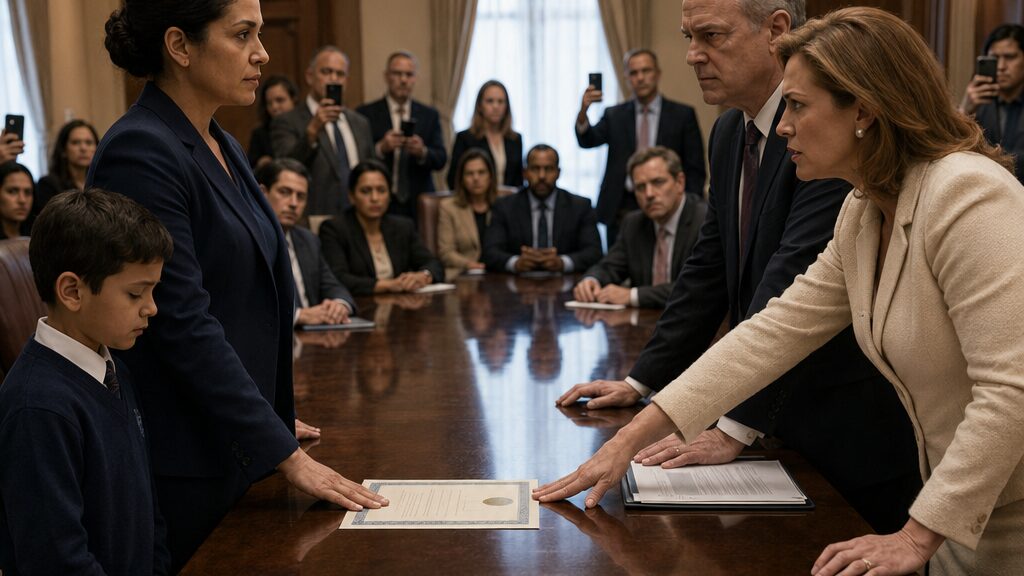
Pamela Hill’s palm struck the boardroom table so hard that John Williams flinched behind Shirley Perez.
“Scholarship kids don’t belong at this school.”
The words did not echo. The room was too full of soft things for that—thick carpet, padded chairs, curtains heavy enough to swallow sound—but they landed anyway. Every parent at the back heard them. Every board member seated under the framed portraits heard them. John heard them most of all.
His award certificate lay on the table in front of Pamela, no longer in its gold folder on the ceremony easel downstairs. Someone had removed it before the award ceremony even began. Shirley noticed that first, before she noticed the phones rising at the back of the room, before she noticed Principal Robert Adams standing near the projector with his jaw clenched in the way he used when he wanted a problem handled quietly.
John stood close enough behind Shirley that she could hear the uneven pull of his breathing. He had dressed for the ceremony in a pressed white shirt with sleeves a little too long, his school tie carefully knotted but slightly crooked. His mother, Deborah Brown, sat in the second row with both hands locked around her purse strap.
Shirley stepped half a pace forward.
“Mrs. Hill,” she said, keeping her voice level, “that is not an acceptable way to speak about any student.”
Pamela’s smile was polished and cold. Her earrings caught the light when she turned toward the board. “This is exactly the problem. Every time someone asks a reasonable question about standards, we’re accused of being unkind.”
“A reasonable question,” Shirley said, “doesn’t begin by telling a child he doesn’t belong.”
John’s eyes dropped to the certificate.
It was beautiful in the way school awards were designed to be beautiful: cream paper, embossed crest, blue ribbon printed along the border, his name centered in dark calligraphy. John Williams. First Place, Innovation and Research Award. Shirley had watched him read it three times after rehearsal, as if the ink might vanish if he looked away.
Now it sat closer to Pamela’s hand than his.
Robert cleared his throat. “Let’s keep this orderly. This is an emergency review, not a public debate.”
One of the board members shifted. Melissa Roberts, seated near the end, had a pen poised over a yellow legal pad. She was not recording like the parents at the back, but she was watching the certificate with the same attention Shirley was.
Pamela leaned forward. “My concern is simple. That project was beyond the capability of a student with John’s background.”
A sound moved through the room—not quite a gasp, not quite agreement. Deborah’s knuckles tightened around her purse strap.
Shirley felt the old impulse rise in her: document the language, correct the procedure, keep the record clean. Calm professionalism had saved difficult meetings before. It had moved angry parents into hallways, kept children from hearing adult cruelty, turned accusations into forms and forms into outcomes.
But John was already hearing it.
“John’s background,” Shirley said, “is that he completed the work. He attended every lab session. He submitted every draft I required.”
Pamela’s eyes flicked toward John. “With your help.”
“As his teacher,” Shirley said. “Yes.”
“As his advocate,” Pamela corrected.
Robert moved to the table and placed a folder beside the certificate. It was dark blue, official, the kind the school used for disciplinary matters. Shirley’s stomach tightened before he opened it.
“Ms. Perez,” he said, “we have tried to avoid making this more difficult than it needs to be.”
“That depends on what this is.”
He slid out two stapled pages and turned them toward her.
John’s name was printed at the top.
Disciplinary Report: Academic Integrity Violation.
Shirley did not touch it.
For one moment, the entire room seemed arranged around that paper: Pamela’s satisfied stillness, Robert’s careful posture, John’s lowered eyes, Deborah’s shallow breathing. The report had not been drafted in uncertainty. It had been prepared in advance, with blank lines waiting only for the right signatures to make the decision look official.
“Why is there a disciplinary report?” Shirley asked.
Robert looked briefly toward the parents at the back. Too many phones. Too many witnesses for irritation. “It is a preliminary document.”
“It accuses John of cheating.”
“It records a concern.”
“It uses the word violation.”
Pamela gave a small laugh. “Because there was one.”
“No,” Shirley said. “There was an accusation.”
Robert’s face tightened. “Ms. Perez, the board has to consider the school’s reputation.”
Shirley heard Deborah inhale at that word. Reputation. It was the word schools used when the child being harmed had less power than the adult doing the harming.
John shifted behind her. “Ms. Perez,” he whispered.
She turned just enough to see him. His face was calm in the fragile way a glass is calm before it cracks.
“It’s okay,” he said quietly.
It was not okay. But the fact that he thought he needed to say it told her more than any report could.
Pamela reached toward the certificate, tapping one manicured nail against John’s name. “The award cannot stand while this is under review.”
“The award was earned,” Shirley said.
“That’s exactly what’s in question.”
Robert took a pen from his jacket pocket and placed it beside the report. He did not slide it forward yet. Not quite.
“Shirley,” he said, using her first name in front of the board, “we can protect John from a harsher outcome if we handle this before the ceremony. You sign as the supervising teacher. I sign as principal. The award is withheld pending review. No suspension. No public announcement.”
“No public announcement?” Shirley looked at the phones along the back wall. “You brought him into a boardroom full of adults and put his certificate on the table like evidence.”
Pamela’s mouth hardened. “This room is full because parents care about standards.”
“No,” Shirley said. “This room is full because a child was accused before anyone proved anything.”
Robert’s fingers touched the pen. “If you force a formal investigation, I cannot guarantee your role in this will be viewed favorably.”
There it was. Not shouted, not slammed, not spoken with Pamela’s sharp contempt. A soft administrative threat, clean and practiced.
Shirley looked at the disciplinary report again. The signature line waited at the bottom. Her name had already been typed beneath it.
Shirley Perez, Supervising Faculty Adviser.
She remembered another room, another student, years ago at a different school. A boy who had stopped coming after an incident everyone agreed should be “handled quietly.” She had been younger then, praised for being professional, thanked for not making things harder. She still remembered the empty desk.
John was behind her now, trying to become small.
She moved fully in front of him.
“John will not stand alone in this room,” she said.
Pamela’s expression flickered. Robert’s did not. He had expected resistance, then surrender. Not this.
“Ms. Perez,” he said, the warmth gone, “I need you to think carefully.”
“I am.”
“This report prevents escalation.”
“This report creates a lie.”
Robert finally slid the pen across the table. It stopped near the edge, close enough that Shirley could pick it up without leaning.
“If you care about this student,” Robert said, each word measured for the board, “you will help us end this before the board vote. Your position here depends on whether you understand that.”
Shirley looked at the pen, then at John’s certificate, then at the child whose name lay trapped between them.
The room waited for her hand to move.
Chapter 2: The Report That Was Written Too Early
The first line of the report said faculty confirmed misconduct.
Shirley read it twice, because the first reading felt impossible and the second made it worse. Faculty confirmed. Not suspected. Not alleged. Confirmed. Her typed name sat under a statement she had never made.
She did not pick up the pen.
“Who wrote this?” she asked.
Robert’s brows drew together. “The language is standard.”
“That wasn’t my question.”
Pamela folded her arms. “Does the wording matter more than the integrity of the award?”
“The wording is the integrity,” Shirley said. “This says I confirmed John cheated. I did not.”
John’s shoulder brushed the back of her jacket. A small accidental contact, gone almost immediately. Shirley stayed where she was.
Robert reached for the report as if to smooth it, but Shirley placed two fingers on the top edge first. Not to claim it. To stop it from disappearing.
“It also says the project was submitted after review concerns were raised,” she said.
Robert’s eyes moved to the page.
“That is not possible,” Shirley continued. “The project submission deadline was three weeks before today. I reported that to you.”
Pamela’s smile thinned. “You reported your opinion.”
“I reported the schedule.”
“You are not neutral here, Ms. Perez.”
The title scraped. A few minutes ago Robert had called her Shirley to soften the threat. Pamela used Ms. Perez to distance her from authority.
“I am John’s teacher,” Shirley said. “My responsibility is to the facts.”
“Your responsibility,” Pamela replied, “is to every family in this school. Including the ones who pay full tuition and expect excellence.”
Deborah looked down at her lap.
John saw it. Shirley saw him see it. That hurt worse than Pamela’s words. The boy did not cry, did not speak, did not defend himself. He simply absorbed the message, as if every cruel word had to pass through him before anyone else could decide whether it mattered.
Melissa Roberts tapped her pen once against her legal pad. “Principal Adams, when was this report drafted?”
Robert looked annoyed by the procedural turn. “Earlier today, after the concern was escalated.”
“Before or after Ms. Perez reviewed it?”
“It is preliminary.”
Melissa did not write that down. “Before or after?”
Robert’s jaw worked. “Before.”
Pamela leaned in. “Because we had to move quickly.”
“Quickly,” Shirley said, “or quietly?”
That changed the air in the room.
A parent at the back lowered their phone slightly, then lifted it higher. Another whispered something. The board chair murmured for order, but softly, as if he did not want order badly enough to demand it.
Robert spread his hands. “The ceremony begins in less than an hour. If this is not resolved now, the entire event becomes a spectacle.”
“It became a spectacle when John’s certificate was removed.”
“The certificate was held pending review.”
“Without telling his mother.”
Deborah’s head came up, startled by being named. She was a small woman with tired eyes and a navy cardigan buttoned wrong at the top. She looked as if she had spent all afternoon making sure she was not in anyone’s way.
Robert glanced at her, then away. “Mrs. Brown was invited to attend this meeting.”
“After the decision was prepared,” Shirley said.
Pamela gave a little shake of her head. “This is emotional manipulation. The issue is academic honesty.”
John leaned closer, voice barely audible. “Ms. Perez. Please.”
Shirley turned toward him.
He looked at the report, not at her. “They already decided.”
The sentence was so quiet the room might not have heard it, but Shirley did. Deborah did too; her face tightened with shame that did not belong to her.
John was not confessing. He was warning her. He had read the room faster than most adults in it. He knew when power dressed itself as procedure. He knew that the decision had arrived before the meeting, printed and stapled.
Shirley’s anger went still.
“No,” she said softly to him. “They printed something. That is not the same as deciding the truth.”
Pamela exhaled through her nose. “How touching.”
Shirley turned back. “John submitted drafts through the classroom laptop and the online portal. His local project files will show creation dates. The portal records will show upload history.”
Robert’s expression changed by only a fraction, but Shirley caught it. Not surprise. Recognition.
“I asked you yesterday to pull the archive,” she said.
Robert closed the folder a little too quickly. “The system archive is not available at the moment.”
Melissa lifted her pen. “Not available how?”
“Our technology staff are preparing for the ceremony.”
“That does not answer the question.”
Robert’s smile was strained now. “Access requires administrative authorization, and this is not the appropriate setting for a technical review.”
“This is the setting where you are asking me to sign a report saying a technical review already happened.”
Pamela’s hand moved toward the certificate again, resting beside John’s name. Shirley noticed how easily she touched it, as if paper became hers when she decided it should.
“Mrs. Hill,” Shirley said, “please remove your hand from John’s certificate.”
Pamela did not. “It should not be his certificate until this is settled.”
“It has his name on it.”
“That may be the problem.”
A faint sound came from Deborah, almost a breath, almost a word. John’s eyes closed for one second.
Shirley felt the line inside her shift. The old belief—that procedure would hold if she held steady—began to crack. Robert was not failing to produce the archive. He was choosing when truth would be allowed to enter the room. Pamela was not waiting for a review. She was trying to make humiliation feel like proof.
Robert stepped closer and lowered his voice, though not enough to keep the board from hearing. “You are making this worse for him.”
“No. The accusation did that.”
“You are risking his scholarship.”
Pamela tilted her head. “His scholarship is exactly why this requires scrutiny.”
Shirley looked at her. “Why?”
“Because access matters. Opportunity matters. We cannot pretend every student has the same resources.”
“That is the first true thing you have said.”
Pamela’s eyes sharpened. “Then explain why a scholarship student had after-hours access to a classroom laptop that other students did not.”
The question landed differently from the others. It had shape. It sounded like policy, like fairness, like something reasonable adults could discuss while ignoring what it was being used to do.
Robert did not correct her.
John’s face went pale.
Shirley looked from Pamela to Robert and understood the next trap before anyone named it: if they could not make the project look stolen, they would make John’s access look improper.
At the back of the room, phones stayed raised.
Pamela tapped the certificate once more, directly over John’s printed name.
“So,” she said, “who gave him special access?”
Chapter 3: The Laptop They Did Not Want Opened
“The classroom laptop should be brought here,” Shirley said.
Robert answered too quickly. “That device is school property under administrative hold.”
“Then release it into the room.”
“It is not that simple.”
“It is exactly that simple if this is an evidence review.”
Pamela leaned back, satisfied with the new direction the accusation had taken. The certificate still lay near her, but now everyone’s attention had shifted to an object not yet in the room: the laptop John had used after school, the laptop that might prove his work or become another weapon against him.
Shirley could feel John waiting behind her. He knew the machine. He knew every slow startup sound, every dead key on the left side, every folder he had made and remade to keep track of his project. She had seen him hunched over it in the computer lab long after other students had been collected by drivers or parents or older siblings. John stayed because he had permission. Because Shirley had given it.
And because his mother’s old phone could not run the software.
Robert glanced toward the board chair. “We cannot allow unrestricted faculty access to a device connected to a disciplinary matter.”
“You allowed a disciplinary report to be written without the device,” Shirley said.
Melissa Roberts’s pen moved at last. “Principal Adams, is there a reason the laptop cannot be examined here, with the board present?”
Robert’s face showed the flicker again. Not surprise. Calculation.
“Technically, it can be brought in,” he said. “But any files would need administrative verification.”
“Then bring it in,” Melissa said.
Pamela turned toward her. “With respect, Melissa, we should not be turning a board meeting into a computer lab because one teacher refuses to accept reality.”
Melissa’s gaze remained on Robert. “Reality is usually easier to accept when someone lets us see it.”
For the first time, Pamela’s expression tightened at someone other than Shirley.
Robert stepped toward the side door that led to the administrative corridor. “I will ask staff to retrieve it.”
“I’ll go,” Shirley said.
“No.”
The refusal was sharp enough to stop the whispering.
Robert corrected his tone. “You are needed here.”
“To sit beside a report you want me to sign?”
“To maintain order.”
Shirley almost laughed, but John’s presence held her back. “Order is not the same as truth.”
Robert opened the side door and spoke quietly to someone outside. While he did, Shirley turned to John.
“You had permission to use the laptop,” she said, deliberately loud enough for the nearest board members to hear.
John nodded.
“From me.”
Another nod.
Pamela’s voice cut in. “Was that permission documented?”
Shirley kept her eyes on John. “In my lab sign-out log.”
Robert closed the side door. “The log is in the science office.”
“Then bring that too.”
His look said she was pushing too far. Maybe she was. Maybe she should have gathered every log, every draft, every email before today. She had trusted that once Robert saw the timeline, the school would correct itself. Yesterday, when she had stood in his office and told him John’s files predated the accusation, Robert had said, “Let me handle it.”
She had let him.
Now John’s certificate lay on a table under Pamela’s hand.
A staff member entered carrying the classroom laptop with both palms, as if it were breakable. The machine was old by the school’s standards, silver finish worn near the trackpad, inventory sticker peeling at one corner. John’s eyes moved to it with painful recognition.
Robert took it before Shirley could.
“I will enter the administrative credentials,” he said.
“John knows where his files are,” Shirley replied.
“He can direct us verbally.”
Pamela gave a soft laugh. “How convenient.”
Shirley faced her. “Mrs. Hill, every time evidence may exist, you call it convenience. Every time John is asked to prove something other students are allowed to simply submit, you call it standards.”
Pamela’s cheeks colored. “Other students did not produce work suspiciously beyond their profile.”
“His profile,” Shirley said, “is excellence.”
The room went quiet enough that the laptop’s startup chime sounded too bright.
John looked at Shirley then. Not with relief exactly, but with a flicker of something dangerous to hope. Deborah wiped one finger beneath her eye and immediately folded her hands again, as if even that movement had taken too much space.
Robert typed the password. The projector showed the laptop screen on the boardroom wall.
Desktop icons appeared. A recycling bin. A folder labeled Shared Lab Materials. A browser shortcut. A school crest wallpaper.
“Project files,” Robert said.
John swallowed. “Documents. Then Innovation Award. Then water mapping model.”
Robert clicked Documents.
Shirley watched his hand. He moved too slowly for someone trying to clear a student, too quickly for someone trying to search carefully.
The Innovation Award folder appeared.
“Open it,” Melissa said.
Robert clicked.
Inside were three folders: Templates, Rubric, Practice Data.
No water mapping model.
John’s mouth parted.
Robert sat back. “There is no project folder here.”
Pamela’s chair made a soft sound as she leaned forward. “Well.”
“No,” John whispered.
It was the first word he had spoken to the room rather than Shirley, and it came out broken with disbelief.
Shirley stepped closer to the table. “Check recent files.”
Robert did not move. “Ms. Perez—”
“Check recent files.”
He clicked with visible reluctance. A list opened. It showed spreadsheets, templates, old demo projects. Nothing with John’s project title.
Pamela turned toward the board, voice low enough to sound grave. “This is what I feared. We are being asked to accept a story without evidence.”
Shirley looked at the screen, then at John. His face had gone still again, but this stillness was different. It was not surrender. It was confusion. He knew something should be there.
She remembered him sitting alone under the lab’s fluorescent lights, sleeves rolled up, tapping notes into a model that mapped runoff patterns near older neighborhoods. He had stayed late because the software crashed on cheap devices. He had apologized for using school electricity. Apologized.
“John,” she said, “when did you last open it here?”
“Tuesday,” he said, barely audible. “After practice presentations.”
“Did you move it?”
“No.”
“Did anyone else use the laptop after you?”
His eyes flicked toward Pamela and then away.
Pamela saw it. “Careful.”
Shirley heard the threat beneath the word.
Melissa leaned forward. “Principal Adams, are deletion logs available?”
Robert closed the folder window. “Not in a way that would be meaningful tonight.”
“Everything meaningful seems unavailable tonight,” Melissa said.
Pamela stood halfway, one hand on the table. “Or perhaps the meaningful fact is that the folder does not exist.”
Shirley saw John’s hands curl at his sides. Not fists. Braces against collapse.
The certificate, the report, the empty projected folder—they had built a cage around him while calling it process.
Robert reached for the laptop lid. “I think we have seen enough for the board to proceed.”
“No,” Shirley said.
Her voice came sharper than she intended. It made Robert pause.
She forced herself back into control. “You will not close that laptop while a student’s name is under accusation and the search has barely begun.”
Pamela looked at the room as if inviting them to witness Shirley’s instability. “This is exactly the overinvolvement I mentioned.”
Shirley did not answer her. She looked at John.
“Think,” she said. “Not what they want you to remember. What you actually did. Did you ever save it anywhere else?”
John stared at the projected empty folder. His lips moved once without sound.
Robert’s hand remained on the laptop lid.
Then John shook his head slowly, devastated. “It was there.”
Robert shut the laptop halfway before Melissa said, “Leave it open.”
He stopped.
The screen still showed the empty folder, bright and clean and damning, while every phone in the back of the room recorded the absence where John’s work should have been.
Chapter 4: The Empty Folder And The Donor Whisper
“No folder, no project,” Pamela said.
She did not say it loudly. She did not need to. The words carried because the room wanted them to carry. They gave the empty screen a meaning before Shirley could stop it.
The projected folder remained open on the wall: blank white space under a heading that should have held weeks of John’s work. Practice Data. Templates. Rubric. Nothing else. It looked clean enough to be innocent, and that was the worst part. A missing file did not shout. It simply let people decide what absence meant.
John stared at the screen as if he could force the folder to refill itself.
Robert reached for the laptop lid again, slower this time. “We cannot keep circling the same point.”
“We haven’t circled it,” Shirley said. “We barely looked.”
Pamela turned toward the parents at the back. “This is why standards matter. When a process depends on one teacher’s special arrangement with one scholarship student, the school is placed in an impossible position.”
Deborah’s face tightened, but she stayed seated. Shirley knew that posture. The carefully folded shoulders. The refusal to give anyone a bigger target. Deborah had learned the rules of rooms where her voice could be called defensive before it was heard.
Melissa Roberts leaned toward the board chair and spoke under her breath. The chair nodded reluctantly.
“We will take a brief recess,” Melissa announced. “Ten minutes. Principal Adams, please keep the laptop open and in view.”
Robert’s fingers lifted away from the lid. “A recess may not be necessary.”
“It is now,” Melissa said.
The board members stood, their chairs rolling softly over the carpet. Parents in the back broke into whispers. Phones lowered, but not all the way. Pamela remained seated, one hand still near the certificate, as if guarding it from the boy whose name it carried.
Robert picked up the certificate and turned it face down.
John saw it happen. His jaw tightened once, then went still.
Shirley moved before she could consider whether it was wise. She reached across the table and turned the certificate face up again.
Robert looked at her hand. “Ms. Perez.”
“His name is not evidence to hide,” she said.
Pamela’s laugh had no humor in it. “You are determined to make this theatrical.”
“No,” Shirley said. “You are determined to make it degrading.”
Robert closed his eyes for half a second. When he opened them, he gave the kind of small smile he used in faculty meetings before rejecting a request. “I need a word with the board chair.”
He stepped away with the chair toward the far window. Pamela rose at the same time and crossed to the coffee station near the side wall, where polished silver urns and untouched cookies sat under linen napkins. Shirley watched Robert’s reflection in the dark glass, his shoulders angled away from the room, phone in his hand.
John remained by the table. Deborah approached him carefully, as though too much comfort might embarrass him further. She touched his sleeve. He did not lean into her, but he did not move away.
“I didn’t delete it,” he whispered.
“I know,” Deborah said.
Shirley heard him anyway. The words went through her.
She should have made copies. Yesterday, when Robert promised to pull the archive, she should have insisted on seeing it herself. She should not have trusted the sentence that always sounded responsible when spoken by someone with authority: Let me handle it.
The old empty desk returned to her, unwanted. Another student. Another quiet handling. Another adult room where everyone had agreed that a child’s future could be adjusted to preserve institutional peace. Shirley had thought she had learned from that. Yet here she stood, watching a different student pay for her trust in procedure.
Pamela’s voice came from the coffee station. “Robert, this cannot drag past tonight.”
Robert looked sharply toward her, but she was not looking at him. She was looking down at her own phone, thumb moving fast.
Deborah stood near the end of the table, close enough to Robert’s place that when his phone lit up beside his folder, the screen reflected in the glossy wood.
She froze.
Shirley noticed because Deborah’s hand stopped midway to her purse strap.
Robert was still by the window with the board chair. His phone sat unattended beside the false report. The screen glowed for only a few seconds, but Deborah’s eyes moved across it, quick and unwilling.
Then she looked at Shirley.
Not dramatically. Not with certainty. With fear.
Shirley stepped closer to her. “Deborah?”
Deborah shook her head once.
Pamela returned to the table with a paper cup she did not drink from. Robert came back at nearly the same moment, took his phone, and turned it facedown.
Shirley saw the move. She saw Deborah see it too.
“What did you notice?” Shirley asked quietly.
Deborah’s lips parted, but no sound came. Her gaze went to John. Then to Pamela. Then to Robert’s jacket pocket, where the phone had disappeared.
“You do not have to say anything,” Shirley said, and hated that she meant two things at once. She wanted Deborah safe. She wanted the truth. Wanting both in this room felt like asking a locked door to open without a key.
Deborah swallowed. “It was from her.”
Pamela turned. “Excuse me?”
Deborah’s shoulders drew in.
Shirley shifted slightly between them, the same way she had stood between Pamela and John. “What was from her?”
Robert’s face tightened. “This is inappropriate.”
“What was on the screen?” Shirley asked.
Deborah looked at the table, not at Pamela. “I only saw part of it.”
Pamela set the cup down. “Then perhaps you shouldn’t imply anything.”
Deborah flinched, but this time she did not go silent. “It said donor commitment.”
The room, still half in recess, quieted around those two words.
Robert’s hand went to his pocket. “Private messages are not relevant to a student discipline matter.”
Melissa, who had been speaking with another board member near the door, turned back. “They may be if they concern the matter.”
Pamela’s face hardened. “My family’s support for this school is not a secret. It is also not a crime.”
“No one said crime,” Shirley said. “You said standards. Now we’re hearing donor commitment.”
Pamela’s eyes flashed. For the first time, something under the polish showed itself. Not guilt, not yet. Fear. Anger at being seen fearing anything.
“You have no idea what it takes to keep a school like this excellent,” Pamela said. “Programs cost money. Labs cost money. Scholarships cost money.”
The last word landed strangely. Scholarships. She regretted it as soon as she said it; Shirley saw the small tightening near her mouth.
Robert cut in. “Enough. The recess is over.”
“It has been four minutes,” Melissa said.
“And the situation is deteriorating,” Robert replied. “We have an absent project folder, a contested award, and public speculation about private donors. We need to return to procedure.”
“Procedure,” Shirley said, “is not a curtain.”
Pamela stepped closer to the table and placed both palms on it. “No, procedure is what protects families from teachers who become emotionally attached to children they favor.”
John lowered his gaze again.
Shirley felt the accusation hook into the one place it could hurt her. She had given John lab access. She had stayed late with him. She had pushed him to enter the competition when he said students like him did not win things here. She had cared, and Pamela had found a way to make care sound like misconduct.
Robert sensed it. “Shirley, think carefully before you turn a manageable concern into an attack on the school’s donors.”
A manageable concern. A missing folder. A face-down certificate. A report already written.
Shirley looked at Deborah, whose courage had cost her visible effort. If Shirley used what Deborah had seen, Pamela could turn on her. Robert could find a reason to revisit John’s scholarship file. If Shirley did not use it, the donor pressure would remain hidden beneath clean words.
Melissa returned to her seat. The other board members followed, reluctantly, as though the room itself had pulled them back into order.
“We need a path forward,” Melissa said.
Robert stood at the head of the table. He straightened the false report and placed the pen beside it again. “The board will vote on whether to withhold the award pending a formal review. Unless there is verifiable evidence presented now, that is the cleanest option.”
“Cleanest for whom?” Shirley asked.
Robert ignored her.
Pamela sat down, controlled again. “I agree. We have already given this more time than it deserves.”
Deborah’s face closed. John’s hand slipped into his pocket and came out empty.
Melissa checked the clock on the wall. The ceremony downstairs would begin soon. Somewhere below them, chairs were being filled, programs handed out, families taking pictures beneath banners that still promised excellence and opportunity.
Melissa placed her pen flat across her pad. “Ten minutes,” she said. “If anyone has verifiable records, project drafts, access logs, or submission evidence, bring it forward before then. After that, the board votes.”
Shirley looked at the laptop’s empty folder, the unsigned report, and John’s certificate shining under the boardroom lights.
Ten minutes was not mercy.
It was a fuse.
Chapter 5: The Notebook John Tried To Hide
“You should let it go,” John whispered.
The hallway outside the boardroom was narrow and too bright, lined with framed photographs of graduating classes and donors smiling beside ribbon cuttings. Behind the closed door, adult voices blurred into a low, expensive hum. In front of Shirley, John stood with his back nearly against the wall, one hand gripping the strap of his backpack as if it might be taken from him too.
Shirley had asked Melissa for two minutes with her student. Robert objected. Pamela objected more. Melissa allowed it, but only with the door left partly open and the laptop still on the boardroom table.
Now John would not look at Shirley.
“John,” she said, “your work is not something to let go of because they made the room ugly.”
“If they take it,” he said, “then it’s over.”
“No.”
“If you keep fighting, they’ll make it about you.” His voice was still low, but it was not empty now. It trembled with a logic he had been carrying alone. “They already said you gave me special access. They’ll say you helped me too much. They’ll say my mom knew.”
Shirley felt the words land one by one. Not because they were childish fears, but because they were adult fears in a child’s mouth.
“Your mother did nothing wrong.”
“That doesn’t mean they won’t punish her.”
Through the gap in the door, Shirley saw Deborah seated with her hands folded, eyes fixed on the table. Pamela was speaking to Robert, one hand gesturing in sharp little motions. The certificate remained face up. Shirley made herself notice that. One small thing had not been taken back.
“What are you afraid they’ll find?” Shirley asked.
John’s eyes snapped to hers.
There it was. Not guilt. Alarm.
He looked away fast. “Nothing.”
“John.”
“It won’t prove anything.”
“What won’t?”
His grip tightened around the backpack strap. Shirley waited. The clock above the hallway trophy case made a small mechanical click with every passing second. Ten minutes had already become less.
John drew a worn spiral notebook from his bag. Its blue cover was soft at the corners, the wire bent out of shape near the bottom. He held it against his chest and did not give it to her.
“I didn’t hide it because I cheated,” he said.
“I know.”
He looked at her then, searching her face as if the wrong expression would close him forever.
“I hid it because of what’s in it.”
Shirley kept her hands still. “Tell me.”
John opened the notebook to the middle. The pages were filled with tight handwriting, diagrams, rough maps, arrows, data labels, water flow sketches, and little notes in the margins. This was John’s mind before it became a project. Messy, precise, alive.
Then Shirley saw a page with a date written at the top. Three weeks before the final submission. Under it was a list of file names.
runoff_model_v4_local
final_map_test_jw
backup_oldname_drainage
Her pulse changed.
“That last name,” she said.
John nodded. “I saved it weird because the software kept crashing when the file name was too long. I forgot until just now.”
“Why didn’t you say this in there?”
He flipped to another page.
This one had fewer diagrams. It had questions written as if copied quickly.
How did you make the school zone overlay?
What data source did you use for flood reports?
Can it run without the paid plug-in?
Did Ms. Perez show you the formula?
Shirley read the questions, then read the date.
“Who asked these?”
John’s face shut down again.
“John.”
He looked toward the boardroom door. “Pamela Hill’s child.”
Shirley closed her eyes for half a second. Not because she was surprised by the possibility, but because the notebook did not prove enough. It suggested. It darkened the shape of the accusation. It showed interest before imitation. But in that room, Pamela would tear it apart as hearsay written by a child desperate to save himself.
“Did anyone else hear those questions?”
“He asked after practice presentations. Some people were still packing up.”
“Did you tell him?”
“Some things. Not everything.” Shame flickered across his face. “I thought he just liked my project.”
That hurt Shirley in a different way. John had mistaken interest for respect because he was hungry for a version of the school where that was possible.
The boardroom door opened wider. Robert stood there.
“Time,” he said.
“We have eight minutes,” Shirley replied.
“You have less if you’re using it to coach him.”
John shoved the notebook partly behind his back.
Pamela’s voice carried from inside. “Is he producing new evidence now?”
Shirley turned so her body blocked the notebook from view. “He is speaking with his teacher.”
Robert’s eyes went to John’s backpack. “Anything relevant must be presented to the board.”
“Then we will present it.”
John’s head jerked slightly.
Shirley saw the fear and knew she had moved too fast. Again. Procedure, evidence, presentation—she was still thinking like the room could be won by the right sequence. John was thinking about the cost after everyone went home.
Robert stepped closer. “Ms. Perez, if you withhold material during an active review, you make your position worse.”
“My position,” Shirley said, “is not the one you should be worried about.”
“Your position is exactly the one I am responsible for.”
The sentence sounded almost kind. That was Robert’s skill. He could make pressure feel like concern, make cowardice sound like stewardship.
Shirley turned back to John. “I need to ask you something, and you can tell me no.”
He gave a small, bitter smile. “Can I?”
“Yes.”
The answer surprised him.
She lowered her voice. “May I use the notebook to ask for the backup file? Not to accuse anyone’s child. Not yet. Just to find your file.”
John looked down at the page with the strange file name. His thumb rubbed the bent spiral wire.
“If they say I made it up—”
“I will not let them make your notebook into a confession.”
“They can make anything into anything.”
He was not wrong. That was the worst of it.
Shirley remembered the student from years ago again, the empty desk, the praised discretion. She had not lied then, but she had allowed silence to do the work lying wanted done. She had told herself the student’s family wanted privacy. Maybe they had. Maybe they had simply wanted to survive.
“I stayed quiet once,” she said.
John looked at her.
“At another school,” Shirley continued. “A student was blamed for something that was easier for adults not to examine. I followed the process. I waited for the right meeting, the right review, the right person to read the right form. He left before any of that mattered.”
John’s grip on the notebook loosened.
“I have regretted that for years,” she said. “But my regret does not give me the right to spend your courage for you. So I am asking.”
For the first time since Pamela’s hand struck the table, John stood a little straighter.
He tore the page with the file names from the notebook carefully, along the spiral. The sound was small and enormous.
“Use this,” he said. “Not the other page.”
Shirley accepted it with both hands.
Robert watched from the doorway. “We need to return.”
“In a moment.”
“Now.”
John tucked the notebook deep into his backpack. Then he paused.
“There’s something else,” he said.
Robert stepped forward. “The board is waiting.”
John spoke faster, eyes on Shirley. “The backup might not be in Documents. When the model crashed, it saved under the old demo folder. Practice Data. But not with my project name.”
Shirley’s hand tightened around the torn page.
Robert went still.
It was very slight. A held breath. A pause where there should not have been one.
Shirley saw it.
So did John.
Inside the boardroom, Melissa’s voice rose. “We have six minutes.”
Shirley folded the torn notebook page once and held it at her side.
When they stepped back into the boardroom, the empty folder still glowed on the wall, but now Shirley knew it was not empty enough.
Chapter 6: The Timestamp On The Project File
Robert called the board back to order before Shirley reached her chair.
“We cannot accept unofficial material introduced outside the meeting,” he said.
Shirley stopped with the torn notebook page still in her hand.
Pamela looked at it immediately. Her eyes narrowed. “What is that?”
“A file name,” Shirley said.
Robert shut the laptop halfway. “This is precisely why boundaries matter. We have an established record.”
“You have a prewritten report and an incomplete search.”
“We have a missing project folder.”
“We have a laptop you won’t let the student navigate.”
Melissa leaned forward. “Principal Adams, open the laptop.”
Robert’s hand remained on the lid. “Board Member Roberts, with respect, we are nearing the ceremony start time. The responsible course is to withhold the award pending formal review.”
“Open it,” Melissa repeated.
This time he did.
The screen woke to the empty folder, still projected large enough for everyone to stare into the absence. Shirley moved beside the table, but not too close. If she crowded Robert, he would use it. If she sounded emotional, Pamela would use that. Calm had not been enough, but control still mattered.
“John remembered an auto-backup name,” Shirley said. “The software may have saved the file under Practice Data after a crash.”
Pamela gave a short, incredulous laugh. “How convenient that he remembers this after the folder is empty.”
John looked down but did not retreat behind Shirley this time.
“Search the file name,” Shirley said.
Robert did not move.
Melissa’s pen tapped once. “Principal Adams.”
Robert opened the search bar. “Name?”
Shirley unfolded the torn page. “backup_oldname_drainage.”
Robert typed it with the reluctance of a man entering a code that might open the wrong door. The search wheel spun.
Nothing.
Pamela exhaled.
John’s face tightened, but Shirley kept reading the torn page. “Try final_map_test_jw.”
Robert typed.
The screen refreshed. A result appeared, then disappeared as the system continued searching.
“Wait,” Shirley said.
“I saw it,” Melissa said.
Robert’s hand left the trackpad.
Pamela sat straighter. “Saw what?”
Melissa pointed. “There was a result. Search again.”
Robert’s mouth had gone flat. He typed slower this time. The result appeared.
final_map_test_jw.autosave
Location: Shared Lab Materials > Practice Data > Demo Set
Created: three weeks earlier
The room changed without a sound.
John made a small movement, not quite a step. Deborah pressed both hands over her mouth.
Shirley did not smile. Not yet.
“Open it,” she said.
Robert did nothing.
“Open it,” Melissa said.
The file loaded slowly, the old laptop struggling under the room’s attention. A map appeared on the projector: neighborhood outlines, water flow paths, color-coded risk zones, data notes in John’s format. It was unfinished in places, rawer than the version he had submitted, but unmistakably his project. The sidebar showed layers named in his clipped, practical style.
“Creation date?” Melissa asked.
Robert’s voice was quiet. “Displayed on screen.”
“Read it.”
He did not.
Shirley read it instead. “Created three weeks before the final submission deadline. Modified repeatedly over the next twelve days.”
A murmur moved through the parents at the back. Phones rose higher.
Pamela’s face flushed. “A local file does not prove authorship. Anyone could have—”
“It was saved under his user profile,” Shirley said.
Robert seized the opening. “Local timestamps can be misleading. Devices can be altered. Without administrative verification, the board should avoid drawing conclusions.”
There it was again: the door closing just as light came through.
Shirley turned toward him. “Then verify it.”
“That cannot be completed tonight.”
“You said the archive was unavailable. You said the folder did not exist. Now a file exists, and you say it cannot be trusted.”
Robert’s voice hardened. “I am protecting the integrity of the process.”
“No,” Shirley said. “You are protecting the process from the integrity of the evidence.”
Pamela pushed back from the table. “This is outrageous. My family has given this school years of support, and now we are being treated as if we are on trial because a teacher found a stray file.”
Shirley looked at her. “John has been on trial since before he entered this room.”
Pamela’s eyes flashed. “Because there are standards here.”
“And somehow those standards required his certificate to be removed before evidence was shown.”
Robert lifted the false report. “The report is still unsigned because Ms. Perez has refused to cooperate. That does not make the concern disappear.”
The report looked different in his hand now. Less like paperwork. More like a weapon that had failed to fire.
Melissa stood. The room quieted enough that the projector fan became audible.
“Principal Adams,” she said, “did you review any system archive related to John Williams’s project before this meeting?”
Robert’s expression closed. “I reviewed preliminary information.”
“That is not what I asked.”
Pamela turned sharply toward Melissa. “This is beyond the scope of—”
“No,” Melissa said, not loudly. “It is exactly the scope.”
Robert set the report down. “I was informed there were concerns about similarity between projects.”
“Did you review the archive?”
His eyes moved to the laptop, then to Shirley. For one instant Shirley saw his anger stripped of polish. It was not only fear of Pamela. It was anger at Shirley for making him choose in public when he had already chosen in private.
“I reviewed enough to determine that further review was necessary,” he said.
Shirley stepped closer to the table. “Yesterday, in your office, I told you John’s project files predated the accusation. You said you would handle it.”
Robert’s face darkened. “Private personnel conversations are not appropriate here.”
“This is not private anymore. You made John’s name public when you put it on that report.”
The board chair shifted uncomfortably. “Ms. Perez—”
“No.” Shirley placed her palm flat beside the unsigned report, not on it. “If my refusal to sign is part of the record, then enter this too: I requested the archive yesterday. Principal Adams had notice that timestamps could clear John before this meeting was called.”
John looked at her, startled by the force in her voice. She had not shouted. That mattered. She was not breaking down. She was breaking the shape of the room.
Robert leaned in. “Be very careful.”
“I am done being careful in ways that only protect adults.”
The sentence landed harder than she expected. Deborah lowered her hands from her mouth. Melissa wrote it down.
Pamela stood fully now. “You cannot let her continue this performance.”
Melissa did not look at Pamela. “Principal Adams, are administrative access logs available on the laptop?”
Robert hesitated.
Shirley saw it. So did Melissa.
“Not the full archive,” Robert said.
“Access logs,” Melissa repeated.
“The device may show local history.”
“Show it.”
Pamela’s voice sharpened. “Melissa.”
Melissa turned at last. “If the evidence supports your concern, Mrs. Hill, it will support it on screen.”
Pamela’s mouth closed.
Robert navigated through system menus with the tense precision of someone hoping a path did not exist. Shirley watched the projected screen. Recent access. Administrative log. Archive preview.
A line appeared.
Viewed by: Robert Adams
File history accessed: previous day, 4:42 PM
Project: final_map_test_jw.autosave
The room went silent.
Robert clicked away too fast.
“Go back,” Melissa said.
“It was a cached preview,” Robert said.
“Go back.”
He did not.
Shirley stepped forward. The torn notebook page was still in her hand, soft now from her grip. “The board needs to see the full archive.”
Robert turned on her. “You are not in a position to demand anything.”
“I am if you want my signature.”
She reached for the false report and turned it so the signature line faced the board, blank and waiting.
“I will not sign this. And if this meeting continues to a vote without the full archive projected, I want my refusal entered into the minutes with the reason: evidence was withheld.”
Pamela’s face had gone pale beneath her makeup. “This is manipulation.”
“No,” Shirley said. “This is a choice.”
Melissa looked at the board chair. Something passed between them—hesitation, fear of scandal, recognition that the scandal already existed.
Then Melissa stood beside the projector table.
“Project the full file history,” she said. “Now.”
Robert stared at her for a beat too long.
The cursor moved.
A window opened on the wall. Lines of metadata filled the screen, stark black text against white light. File created. File modified. User profile. Submission sync. Backup path. Archive access.
Near the top, highlighted by the projector’s glare, were the words that finally made the room stop breathing:
Original file — John Williams — created three weeks earlier.
Chapter 7: The Nameplate Removed From The Table
“The timestamp doesn’t change what this school represents,” Pamela said.
No one answered at first. The projected archive remained on the wall behind her, bright enough to wash the color from the framed portraits. Original file — John Williams — created three weeks earlier. The words hung above the table like something heavier than proof. They had not made the room kinder. They had made it unable to keep pretending.
Pamela stood with one hand on the back of her chair, her posture straight, chin lifted, as if she could still make the room remember who she was.
“This school represents excellence,” she said. “And families have a right to ask hard questions when excellence is compromised.”
John stared at the wall. His name looked too large up there. Too exposed.
Shirley moved beside him, close enough that he knew she was there, not so close that she seemed to be holding him upright. He was standing on his own. That mattered.
Melissa Roberts looked from the projected archive to Robert Adams. “Principal Adams, return to the access log.”
Robert had not sat down. He stood near the laptop with one hand resting on the table, fingers spread, as if the wood were the only thing keeping him steady.
“The file history is already visible,” he said.
“The access log,” Melissa repeated.
Pamela turned toward her. “Melissa, you are letting this become punitive. A concern was raised. The file was found. Fine. Restore the award pending a more careful review.”
“Pending?” Shirley said.
Pamela’s eyes cut to her. “Yes, pending. Because unlike you, I’m not willing to turn one screen into a verdict.”
“You were willing to turn an empty folder into one.”
A few parents at the back shifted. Someone’s phone camera adjusted with a small digital click.
Robert touched the laptop. “We should not continue with parents recording. Student privacy is at stake.”
Shirley looked at the false report still lying on the table. “Student privacy was at stake before his name was printed under ‘academic integrity violation’ and placed in front of a room.”
Robert’s mouth tightened. “That document was preliminary.”
“It was a lie waiting for a signature.”
Melissa stepped closer to the projector. “Return to the access log, Principal Adams.”
For a moment, Shirley thought he would refuse. Not because refusal would help him, but because obedience now would mark the end of his control. Robert had built his career on quiet rooms, soft language, decisions made before anyone arrived. The public click of a trackpad had become a sound he could not manage.
He opened the log.
The first lines showed the current session. Then earlier entries. Shirley saw Robert’s name appear again.
Melissa leaned in. “Scroll to yesterday.”
Robert did. Slowly.
There it was.
Viewed by: Robert Adams
File history accessed: previous day, 4:42 PM
Project: final_map_test_jw.autosave
Archive preview opened
Submission sync reviewed
Melissa read it aloud.
She did not add commentary. She did not need to. The words themselves were enough, stripped of Robert’s tone, stripped of Pamela’s money, stripped of the false urgency that had filled the room since the certificate was removed.
Deborah made a sound like a breath finally released.
John did not move.
Robert straightened. “I reviewed many materials yesterday. That does not mean I reached a final conclusion.”
“You reached enough of one to write this.” Shirley picked up the false report, but only by the corner, as if touching it too fully might stain her. She turned it toward the board. “It says faculty confirmed misconduct.”
Robert’s eyes went to the blank signature line.
“And you asked me to sign it,” Shirley said. “After you had already opened the file history that showed John’s work came first.”
Pamela stepped forward. “This is being framed unfairly. Robert was trying to protect the school from reputational harm.”
Melissa looked at her. “Did you send Principal Adams a message today regarding donor commitment?”
Pamela’s expression froze.
The room seemed to lean toward her.
“My family’s philanthropy is not up for interrogation,” she said.
“That was not my question.”
Pamela’s fingers tightened on the chair. “I reminded him that families invest in this school because we trust its standards.”
“Did you threaten to withdraw a pledge if John received the award?”
Robert closed his eyes.
It was not an answer, but it was enough to make Pamela see that the ground had shifted beneath both of them.
“Words get emotional in private conversations,” Pamela said. “Parents advocate for their children.”
Shirley heard the careful turn. Not denial. Reduction. A threat becoming emotion. Influence becoming advocacy.
Melissa looked at Robert. “Was there a donor commitment tied to this award decision?”
Robert’s face had gone gray. “There were concerns about optics.”
The word sat there, ugly and small.
Optics.
John looked away from the screen for the first time. His gaze went to the certificate.
Shirley followed it. His name was still on the table, the blue ribbon catching the light. For most of the meeting, that paper had been treated like a prize Pamela could confiscate, a problem Robert could turn facedown, a thing John had to deserve again under adult suspicion.
But it had never stopped being his.
Melissa drew a breath. “The award review is concluded. Based on the file history, the local backup, and the administrative access log, the board recognizes John Williams as the rightful recipient of the Innovation and Research Award.”
Pamela’s chair scraped back. “You cannot make that decision this way.”
“We just did,” Melissa said.
No applause followed. That made it stronger. The room was too ashamed for celebration.
Deborah covered her face with one hand. John looked at her, then at Shirley, uncertain what to do with relief when it arrived in front of people who had made him bleed without touching him.
Melissa turned to Shirley. “Ms. Perez, the disciplinary report will not be entered into John Williams’s record.”
Shirley held the report a little higher. “It also should not disappear.”
Robert’s eyes sharpened. “Careful.”
There was the word again. The word every powerful person used when they meant stop.
Shirley placed the report on the table, unsigned, facing the board.
“This document was prepared before evidence was reviewed, used to pressure a teacher, and presented to a child and his mother as if the outcome were already settled,” she said. “If the board wants a record, start with that.”
The board chair rubbed his forehead. Melissa wrote something on her pad, then turned to him. He nodded once, slowly.
“Principal Adams,” Melissa said, “pending formal review of tonight’s handling of this matter, you will not preside over the award ceremony.”
Robert stared at her.
Pamela’s voice rose. “This is absurd.”
Melissa did not look away from Robert. “The board will also review donor communications related to student awards, scholarship status, and disciplinary recommendations.”
Pamela’s face drained then. Not completely. She was too practiced for collapse. But something bright and certain left her expression.
“My family has supported three major school programs,” she said.
“And that support,” Melissa replied, “did not purchase the right to remove a child’s name from his own achievement.”
The room went still again, but this stillness was different. It did not belong to Pamela anymore.
Deborah stood. The movement was small, but every adult near her seemed to notice. She did not speak at first. She came to John’s side and touched his shoulder, asking with her fingers before claiming the space. John let her hand stay.
Melissa picked up the award certificate.
Pamela moved instinctively, one hand lifting as if to stop her.
Shirley stepped in before Pamela reached the table. She did not grab. She did not shove. She simply placed one firm hand flat beside the certificate, between Pamela’s hand and John’s name.
“No,” Shirley said.
It was only one word. It held the whole meeting.
Pamela stared at her, breathing hard through her nose. Then, slowly, she lowered her hand.
Melissa lifted the certificate and carried it around the table. For a moment Shirley thought she would hand it to her, as the adult who had defended the record.
But Melissa stopped in front of John.
“This belongs to you,” she said.
John did not take it right away.
His eyes went to the phones, to the board, to Robert standing rigid near the projector, to Pamela looking anywhere except at him. He looked at his mother last. Deborah nodded once, tears on her face but her mouth steady.
John accepted the certificate with both hands.
The paper trembled. Not much. Enough for Shirley to see.
“Would you like a moment before going downstairs?” Melissa asked.
John looked at the certificate. Then he looked at Shirley.
“Can I say something?”
The question startled the room more than any proof had. Shirley felt it in the way every adult became careful, suddenly aware that the child they had discussed for nearly an hour had a voice.
Melissa nodded. “Yes.”
John swallowed. He did not step to the front. He did not make himself bigger. He stood where he was, beside his mother and his teacher, holding the certificate that had been taken from display before he ever got to touch it in ceremony light.
“I didn’t say anything,” he said, “because I thought truth only mattered here when rich families said it first.”
No one moved.
Shirley felt the sentence go through the room and find every place where politeness had hidden cruelty.
John looked down at the certificate, then back up. “I was wrong.”
Deborah’s hand tightened on his shoulder.
Pamela turned away as if the portraits on the wall had become suddenly important.
Robert gathered the false report, but Melissa reached across the table before he could take it.
“That stays with the board record,” she said.
His hand hovered, then withdrew.
The board chair murmured to a staff member at the side door. The staff member entered quietly and moved to Robert’s place at the head of the table. For a second, no one understood what he was doing.
Then he lifted Robert’s principal nameplate.
Robert’s face changed.
It was not a dramatic removal. No declaration, no raised voice, no ceremonial disgrace. Just a rectangle of engraved metal being taken from the polished table while the projector still showed the timestamp Robert had tried to leave out of the room.
The staff member carried it away.
Shirley looked down at the false report. Her typed name still waited above the blank line.
She picked it up once more. Robert watched her. Pamela watched too. For one last second, the old training rose in her—the instinct to file, soften, defer, let official hands take official papers.
Instead, Shirley laid the report facedown beside the empty space where Robert’s nameplate had been.
Unsigned.
John held his certificate upright against his chest.
Downstairs, faint through the floor, the ceremony music began.
The story has ended.