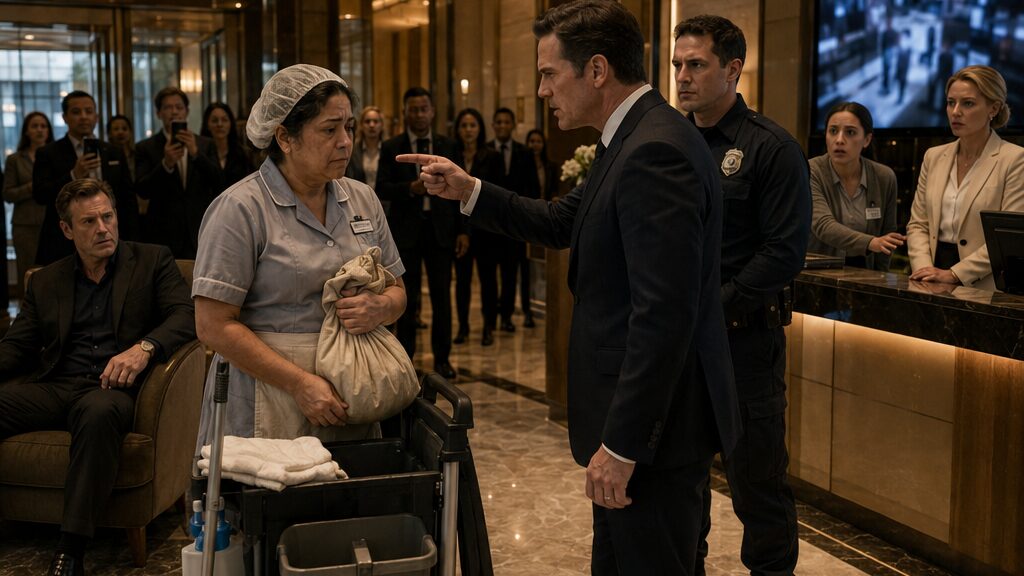
Maria Lopez Refused To Sign The Lie After Her Bag Was Emptied On Marble
Chapter 1: The Watch Vanished Under Golden Lobby Lights
Maria Lopez saw the flash of silver before anyone said the word missing.
It winked once beneath the golden lobby lights, sharp and cold, near the edge of the VIP seating area where the leather chairs were too soft for people who never carried their own bags. Maria had bent to guide her mop around the leg of a marble-topped side table, careful not to touch the polished shoes of the man sitting there with a glass of mineral water and a phone pressed to his ear.
Then Patrick Nelson’s voice cut across the lobby.
“Maria. Cart back. Now.”
She straightened too quickly, one hand going to the handle of her mop, the other to the small ache in her lower back. Her cleaning cart was already behind the brass line that separated guest space from service space, but Patrick stood near the reception desk with his jaw set as if she had dragged mud across a wedding dress.
“I’m only finishing this side,” she said quietly.
“The guests shouldn’t have to look around you.”
He did not shout. He rarely did at first. Patrick had a manager’s talent for making a sentence sound like policy even when it was only contempt. His suit was dark, his pale shirt clean enough to catch the light, his hair combed neatly back. The gold nameplate on his lapel looked heavier than Maria’s entire badge.
Maria lowered her eyes before she could stop herself. It was the habit she hated most, the one that kept food in her kitchen and shame in her throat.
“Yes, Mr. Nelson.”
She pulled the cart back toward the service corridor. The wheels made a soft rubber hush over the marble. On the lower shelf sat a gray bucket, fresh cloths, a spray bottle, and her own faded cloth bag tucked behind the mop heads where it would not be mistaken for a guest item. Inside were her lunch container, work gloves, a folded stack of receipts, a small pill organizer she kept though she rarely used it, and a family photo folded twice along the same soft crease.
She had looked at the photo during her break because the hotel’s staff room smelled of burnt coffee and floor cleaner, and because some nights the silence after midnight made her miss her husband with the dullness of an old bruise. In the photo, he was still alive, still laughing with one hand on her shoulder in front of an apartment window they had never quite managed to repair.
She had folded it again and put it away before anyone could see.
The lobby behind her glowed with expensive quiet. Guests moved through it as if the marble belonged to them by nature. A child in a cream coat pressed both hands to the glass doors. A woman with jeweled earrings asked the receptionist whether the hotel car could arrive two minutes sooner. David Anderson, the VIP in the leather chair, ended his call and adjusted his cuff.
Maria noticed things because cleaners had to. A red wine dot drying under a chair. A luggage tag fallen near the elevator. A man’s hand leaving a wet ring on a table. Patrick stepping out of the service corridor with his left hand low against his jacket pocket.
That was when she saw the silver again.
Not clearly. Just a glint at his side before he turned toward David with a smile so smooth it looked placed on his face.
“Mr. Anderson, is everything satisfactory this evening?”
David barely looked up. “Fine. Though the lounge feels understaffed.”
“I’ll handle it personally.”
Patrick’s eyes flicked once toward Maria. She moved her cart another foot back, ashamed of being noticed, angry at herself for caring.
At the security desk near the far wall, Jessica Moore leaned over a monitor with a cable looped around her wrist. She was young enough that some guests mistook her for an intern, though Maria had seen her fix three frozen terminals in one night while two managers stood behind her pretending to understand. Jessica’s hair was tied in a quick knot, and her badge hung crooked from her cardigan.
One of the security screens blinked black.
Jessica tapped a key. The image returned, then stuttered again: the service corridor outside the linen alcove, empty, timestamp glowing white in the corner. 11:47 PM.
Maria saw Jessica glance over her shoulder just as Patrick walked behind the desk.
“Problem?” Patrick asked.
Jessica’s hands stilled. “Just a feed hiccup.”
“Not tonight.”
“No. I mean, it’s recording. It’s just the live view—”
“Fix it before someone asks why we can’t manage a hallway camera in a five-star hotel.”
Jessica nodded, color rising in her face. Patrick did not wait for an answer. He moved on, already smoothing his tie, already becoming pleasant again before he reached the VIP chairs.
Maria watched Jessica’s mouth tighten. Their eyes met for half a second. Jessica looked away first.
Maria understood that too. Looking away was a language staff learned early.
She turned her attention to the cleaning schedule clipped to her cart. Every corridor. Every spill. Every restroom check. Every time marked because Patrick had once accused night cleaners of “wandering without purpose.” Maria had learned to write everything down. At 11:40 she had cleaned the east elevator spill. At 11:44 she had crossed the lobby edge. At 11:46 she had been ordered back. Her pen marks were small and even.
She added: 11:48, lobby VIP edge, cart moved back per Patrick.
Her hands were tired, but the writing steadied her.
Behind her, David Anderson’s voice rose suddenly.
“My watch.”
The lobby changed before anyone moved. The receptionist’s smile vanished. The guard at the doors turned his head. Jessica looked up from the monitor.
David stood, patting his wrist, then his jacket pocket, then the side table. “My watch was right here.”
Patrick was at his side in three steps. “Are you certain, Mr. Anderson?”
“Of course I’m certain. I took it off while I was on the call. It was on this table.”
A woman nearby lowered her drink. Another guest lifted her phone, not yet recording, only curious. Luxury hotels trained people to make panic look elegant, but panic had entered anyway.
Patrick’s eyes swept the table, the chair, the floor. Then they landed on Maria’s cart.
Maria felt the look before she understood it.
“I was not near the table,” she said.
The words escaped too early, too small. She hated how they sounded: defensive before accused.
Patrick turned slowly.
“No one said you were.”
The silence after that was worse than if he had shouted. David looked at Maria then, really looked, taking in the gray uniform, the work shoes, the cloth bag tucked on the cart. Not as a person. As a possible explanation.
“I logged my route,” Maria said, touching the clipboard. “I was at the east elevator.”
Patrick gave a short sigh, the kind he used when an employee disappointed him in front of guests.
“Andrew,” he called.
Andrew Walker, the security guard near the revolving doors, approached with the stiff posture of a man hoping orders would be clear enough to excuse him from judgment. His eyes flicked once to Maria’s face, then down to her cart.
“Mr. Nelson?”
Patrick did not look away from Maria.
“Secure the lobby.”
Maria’s fingers tightened around the clipboard. “Secure?”
David stepped closer. “I don’t care who took it. I want it back.”
“Of course,” Patrick said. “We’ll handle this discreetly.”
But he was no longer moving discreetly. He stepped into the open space between the VIP chairs and the reception desk, where the gold light made every expression visible.
The receptionist whispered to another staff member. A guest’s phone rose. Jessica stood halfway from her chair.
Maria’s throat dried. She thought of the folded photo in her bag. She thought of rent due on Friday. She thought of how often she had survived by letting insult pass over her like dirty water down a drain.
Patrick lifted his arm and pointed across the lobby as if he had found what everyone else had missed.
“Check the janitor’s pockets.”
Chapter 2: Her Cloth Bag Hit The Marble First
Andrew Walker did not move at first.
Maria saw the hesitation travel through him: his hand lifting, stopping, lowering slightly as if the air between him and her cart had become thicker. Patrick noticed it too.
“Now,” Patrick said, loud enough for the marble to carry it.
Andrew swallowed. “Ms. Lopez, I need you to step away from the cart.”
“My pockets are empty,” Maria said.
“Then you should have no objection.” Patrick’s smile was thin. He turned toward the guests, toward David Anderson, toward the phones now openly raised. “We are simply making sure the property is recovered.”
Maria stood beside her cart with the mop still in one hand. The absurdity of it struck her before the fear did. Ten minutes earlier, she had been trusted to clean broken glass from a guest restroom, to enter suites while strangers slept, to carry master supply keys through hallways lined with expensive doors. Now her hands, the same hands, were suddenly suspicious because someone with a better jacket had pointed.
Andrew stepped closer. His face had gone tight.
“Please,” he said under his breath, so only she could hear.
That word hurt more than an order. Please, as if she were making it difficult for him.
Maria released the mop handle. It leaned against the cart and slid, clattering against the bucket. Several guests flinched.
Patrick took one step forward. “People like that always steal when they think no one is watching.”
Something hot moved behind Maria’s eyes, but no tears came. She would not give Patrick that.
Andrew patted the pockets of her gray uniform with awkward, shallow movements, avoiding her eyes. Nothing. A tissue. A key to her locker. A capped pen. He held each object up as if the emptiness needed witnesses.
“No watch,” he said.
Patrick’s gaze dropped to the lower shelf.
“The bag.”
Maria reached for it before she knew she had moved. “That is mine.”
“All the more reason.”
Andrew pulled the cloth bag from behind the mop heads. It was soft from years of washing, the handles repaired with uneven stitches Maria had made under her kitchen light. When he opened it, he did so carefully at first. Then Patrick snapped, “Empty it.”
The bag hit the marble first.
Not dropped. Turned over.
Her gloves fell out, palms flattened like tired hands. Her lunch container cracked open, releasing the smell of rice and beans. A spoon skidded under the cart. Receipts fluttered across the floor like small accusations. The pill organizer clicked twice and stopped near the brass line. The folded family photo slid farther than everything else, coming to rest near Patrick’s shoe.
A guest whispered, “Oh my God.”
Another phone rose higher.
Maria could not breathe for a moment. It was not that they saw the lunch or the receipts. It was that they saw the smallness of her life spread out under chandelier light. The cheap container. The bus transfers. The gloves she patched instead of replacing. The private photo she touched only when the night was long.
Patrick crouched and picked up a receipt between two fingers.
“What is this?” he asked.
“Bus fare,” Maria said.
“And this?”
“Staff meal.”
“And this one?”
She stared at the slip, trying to read it upside down. “Pharmacy.”
Patrick stood, holding the receipts as if they were evidence of a crime. “Mr. Anderson, your watch is worth more than three months of her wages.”
David’s expression shifted, not fully convinced, but not defending her either. “I just want it back.”
Maria bent toward the family photo. Patrick’s shoe moved, not quite stepping on it, but close enough that the sole touched the edge.
“Please,” she said, and hated that word in her own mouth.
Patrick looked down. “Interesting what people protect.”
She reached anyway. Her fingers shook as she picked up the photo, but she did not open it. The crease was bent more sharply now. She held it once against her chest before tucking it against her palm.
Andrew’s eyes followed the movement. Something in his face changed, but he did not speak.
The receptionist had stopped whispering. Jessica stood near the security desk, one hand still on the back of her chair, her lips parted as if a sentence had reached them and died there. Patrick saw her looking and narrowed his eyes slightly. Jessica sat down.
“There is no watch in my bag,” Maria said.
Patrick turned one of the receipts toward her. “You’re behind on everything, aren’t you?”
Maria felt the lobby lean closer.
“These are not debts.”
“No? Bus, pharmacy, cheap meals. A person gets desperate.”
Maria looked at David then. “Sir, I did not touch your watch.”
David glanced toward Patrick. That glance told her enough. In this room, truth needed permission from someone above her pay grade.
Patrick took the photo from her hand before she could stop him.
“Don’t,” Maria said.
He opened it.
The lobby blurred at the edges. In the photo, her husband’s smile faced the ceiling lights. Patrick looked at it for only a second.
“Sentiment doesn’t make a person honest,” he said, and handed it back as if it had dirtied his fingers.
Maria folded it again, slower than necessary. If she moved too quickly, she might break apart. If she broke apart, they would call that guilt too.
Andrew crouched to gather the spilled things.
“Leave them,” Patrick said.
Andrew froze.
Patrick reached toward Maria’s chest. His fingers closed around the plastic badge clipped to her uniform.
Maria stepped back. “Mr. Nelson—”
“Until this is resolved, you are not authorized to represent this hotel.”
He pulled.
The clip tore free with a small snap that sounded louder than the phones, louder than the whispering, louder than David’s impatient breath. Maria looked down at the blank place on her uniform where her name had been.
Maria Lopez.
Night Cleaning Staff.
It had never been much. It had still been hers.
Patrick placed the badge on the reception counter, then took a folded paper from inside his jacket. Not from the desk. Not printed just now. Already prepared.
Maria saw the lines before she read them. Statement of admission. Voluntary resignation. Return of hotel property. Final pay subject to review.
Her hands went cold.
“Sign this,” Patrick said, his voice low enough now to sound merciful. “You can leave quietly. We recover the watch, Mr. Anderson avoids police, and you avoid making this worse.”
“I did not take it.”
Patrick clicked a pen and placed it on top of the paper. “Don’t make me involve law enforcement.”
A strange calm opened inside Maria. It did not feel like courage. It felt like reaching the bottom of fear and finding there was nowhere else to fall.
She looked at her lunch on the floor. Her gloves. The receipts Patrick had turned into shame. The family photo bent in her hand. She thought of her husband telling her, years ago, when they were both younger and foolish enough to believe hard work protected people, Your name is the one thing they don’t get to take unless you hand it over.
She had handed over many things since his death. Extra shifts. Holidays. Silence. Apologies for messes she had not made. Smiles when guests looked through her.
Not this.
Patrick pushed the paper closer. “Sign.”
Maria looked at the confession, then at the pen, then at the faces waiting for her to become the kind of person Patrick had already described.
“No,” she said.
Patrick’s expression hardened.
The word had come out rough, so she said the rest more clearly.
“I won’t sign a lie.”
Chapter 3: The Confession Room Had No Cameras
Patrick’s voice dropped so sharply that the lobby seemed to lean in just to hear it.
“You can still leave with some dignity,” he said, folding the confession paper once and pressing it flat with two fingers. “But not if you continue performing for guests.”
Maria stood with her cloth bag hanging from one hand, half its contents still scattered at her feet. She had managed to put the family photo back inside, but the rest remained on the marble because Andrew had not been allowed to touch it. Her lunch container lay open. A few grains of rice had dried near the wheel of her cart.
“I’m not performing,” she said.
“No, you’re creating a scene.”
Patrick gestured toward the hallway beside the reception desk. It led to the conference rooms, the staff office, and the smaller service elevator that guests never saw. Maria knew the hallway well. She had polished its baseboards after midnight and cleaned fingerprints from the framed art along its walls. She also knew the third room on the right: a narrow conference room with frosted glass, a heavy table, and no camera dome in the ceiling.
“Inside,” Patrick said. “We’ll discuss this privately.”
Maria did not move.
Andrew shifted near her cart. David Anderson crossed his arms. Phones remained raised, but people had grown unsure now, sensing that the entertainment had become something uglier.
Patrick stepped closer. “Maria, listen carefully. You are one signature away from walking out before police are involved.”
The way he said her name made it sound temporary, already removed from the badge on the counter.
Jessica Moore watched from the security desk. On her screen, the service corridor feed had returned, frozen for three seconds, then jumped forward. She clicked the playback bar, eyes flicking to the timestamp.
11:47 PM.
Offline marker.
Her stomach tightened.
She looked toward the lobby. Maria’s shoulders were square but small beneath the gray uniform. Patrick stood angled between her and the guests, blocking part of her from view. He was good at that, Jessica thought suddenly. Blocking what he did not want seen.
“Jessica.”
She jumped. Patrick had not turned, but his voice had found her.
“Is the security system stable?”
Her hand hovered over the mouse. “Mostly.”
“Mostly is not an answer.”
“The main feeds are recording.”
“Good.” He smiled without warmth. “Then there’s no need for you to involve yourself.”
Jessica’s face burned. Two weeks earlier, Patrick had placed a warning in her file for “failure to maintain executive-floor connectivity” after a storm knocked out a router. He had told her, almost kindly, that young employees who looked replaceable should not make themselves memorable for the wrong reasons.
She had remembered.
Now she looked at the service corridor feed again. The live view showed nothing but clean carpet and a closed linen alcove door. The playback at 11:47 showed a black block where the image should have been.
Not failed. Marked offline.
Maria finally spoke. “There are cameras here.”
Patrick’s smile returned. “And there are guests here. Unless you want everyone to watch you deny the obvious until officers arrive, you will come inside.”
“The room has no camera,” Maria said.
Patrick went still for half a breath.
Andrew looked up.
Maria had not meant to say it. Not aloud. Not with that much certainty. But she had cleaned that room every week. She knew where cameras were because she cleaned around them. She knew which corners had dust because no lens watched them.
Patrick’s eyes narrowed. “You’ve been studying security placement?”
“No. I clean.”
A few guests murmured. The answer was too simple to mock.
Then a new voice cut in from near the revolving doors.
“What is happening in my lobby?”
Catherine Wilson crossed the marble with the speed of someone accustomed to making people rearrange themselves around her. She wore a cream blazer and carried a phone in one hand, her hair pulled back so neatly it seemed part of the hotel’s architecture. Maria had seen her many times from a distance, usually beside flower arrangements or visiting executives, never close enough to be more than an instruction passed down through Patrick.
Patrick turned immediately. “Catherine, I have it under control.”
“That is not what this looks like.” Catherine’s eyes moved over the spilled bag, the open lunch, the guests filming, David’s rigid posture, Maria’s missing badge. Her expression tightened, not with sympathy first, but with alarm. “Why is this happening in the lobby?”
David stepped forward. “My watch was stolen.”
“Misplaced,” Catherine corrected automatically, then looked to Patrick.
Patrick’s jaw worked once. “We have reason to believe Ms. Lopez may be involved.”
Maria felt the old instinct rise: look down, stay quiet, survive the person with more authority. Catherine’s gaze landed on her, assessing, already measuring damage.
“I did not take anything,” Maria said, but softer than before.
Catherine’s attention flicked to the phones. “This needs to move out of public view.”
Patrick seized the sentence. “Exactly.”
He reached for Maria’s elbow.
She stepped back, but not quickly enough. His fingers closed around the sleeve of her uniform. Not hard enough to bruise. Hard enough to guide.
Andrew shifted forward, then stopped.
“Let go,” Maria said.
Patrick kept his smile in place for the room. “Don’t embarrass yourself further.”
The phrase struck her more deeply than the grip. Further, as if everything on the floor had been her doing. As if shame were a spill she had caused and failed to clean.
Jessica stood.
No one noticed at first. She unplugged nothing, touched nothing, only stood with her hands curled into fists beside the security chair. On the monitor behind her, the offline marker blinked beside 11:47 PM. Below it, a smaller system note displayed a file path she recognized from a redirect she had installed months earlier after water damage near the linen alcove.
Backup active.
Jessica swallowed.
Patrick had used the conference room before. She remembered two names not because she knew the women well, but because their badges had stopped working the next day. One had cried near the staff lockers. One had left without picking up her final envelope. Patrick had called both incidents “private personnel matters.”
Maria looked toward the hallway, then at the badge lying on the counter.
Catherine said, “Ms. Lopez, cooperate now. We can sort out details away from guests.”
There it was again. The polite version of the same hand on her sleeve.
Maria’s fingers tightened around the cloth bag. She could feel the folded photo inside, bent but present.
“I want the cameras checked,” she said.
Patrick laughed once. “You don’t give instructions here.”
Jessica stepped around the security desk.
Her knees felt unreliable. Her warning letter. Her rent. Her mother’s voice telling her not to challenge bosses unless she had another job ready. All of it moved with her across the lobby.
“Jessica,” Patrick said.
This time she did not stop.
She looked first at Catherine, because Catherine was the only person Patrick might have to obey. Then she looked at Maria, who was still standing with her bag half-empty and her name removed.
Jessica pointed toward the lobby monitor above the reception wall.
“Then show the backup feed.”
Chapter 4: The Monitor Showed Almost Enough Truth
The lobby monitor flickered from a looping video of champagne glasses to Maria’s gray uniform moving across a grainy security screen.
For one breath, nobody spoke.
There she was: small beneath the high lobby ceiling, pushing her mop along the east elevator bank while David Anderson sat in the VIP chair across the room. The timestamp glowed in the corner. 11:44 PM. Maria watched herself work in silence, watched herself bend to pick up a dropped napkin, watched herself turn her cart away from the seating area after Patrick’s order.
Jessica stood at the reception terminal with both hands on the keyboard. “She wasn’t at the table.”
The words moved through the lobby like a draft under a door.
David leaned forward, squinting at the screen. “That’s not the whole time.”
Patrick did not look at the monitor. He looked at Jessica.
“Careful,” he said.
Catherine Wilson stepped beside the desk, her expression fixed between relief and concern. “Jessica, show the angle covering the VIP chairs.”
Jessica clicked. The monitor changed. David’s table appeared from above: his glass, his phone, his jacket sleeve. The watch was a small bright shape on the marble top.
“Pause,” David said.
Jessica froze the image.
“There,” he said. “That’s it.”
Patrick folded his arms. “Continue.”
The footage played. David took a call. Maria appeared only at the far edge of the frame for a moment, guiding her cart along the brass line before Patrick entered and spoke to her. She backed away. The watch remained on the table.
Then a man crossed between the camera and the table, blocking the view for two seconds with a luggage cart stacked with garment bags.
When the cart passed, the watch was gone.
A ripple of noise passed through the staff.
David turned sharply. “Who was that?”
“A bell cart,” Patrick said at once.
Jessica frowned. “The bell staff log might show—”
“It won’t matter,” Patrick cut in. “The watch was likely removed from the table and passed off, or hidden. Ms. Lopez had access to the cart area immediately after.”
Maria felt the room tilt back toward her. Not all the way. Not as easily as before. But enough.
“I did not go to that table.”
“No,” Patrick said, turning to her with a calm that felt rehearsed. “You went near the service corridor. Which, conveniently, is where the camera had an interruption.”
Jessica’s fingers stopped above the keyboard.
Catherine noticed. “What interruption?”
Patrick gestured toward the monitor. “The corridor feed has been unreliable. Jessica already reported it.”
Jessica’s face went pale. “I said the live view hiccuped. The recording should still—”
“Should,” Patrick said. “A dangerous word when a guest’s property is missing.”
Maria looked from Patrick to the monitor. The first video had cleared one small patch of floor under her feet, but now Patrick was building another trap beside it. A blind spot. A corridor. A missing angle. A person poor enough to need money and invisible enough to know where cameras failed.
She had seen him near the service corridor. She knew it. The flash of silver near his jacket. But the memory came wrapped in exhaustion and fear. What if she said it and the monitor did not show it? What if he asked why she had not spoken sooner?
Because no one believes women who mop floors over men who manage marble.
The thought came so clearly that she almost said it aloud.
Andrew stood near Maria’s cart, stiff and quiet. Her belongings still lay scattered under the lobby lights. The cloth bag had been placed upright now, but it looked wounded, collapsed at the sides. Her spoon remained under the cart, shining like a small lost thing.
Catherine lowered her voice. “Mr. Nelson, we need to isolate the facts. The lobby feed shows Ms. Lopez away from the watch before the obstruction. That matters.”
Patrick’s cheek twitched. “And the watch did not vanish into air.”
David looked toward Maria’s cart. “Search the area around her supplies.”
Maria turned. “You already searched my bag.”
“Then you have nothing to fear,” Patrick said.
Andrew hesitated again.
Patrick’s patience snapped at the edges. “Check behind the cart. Under the linens. Inside the side compartment.”
Maria moved toward the cart, but Patrick lifted a hand.
“Do not touch anything.”
The command froze her in place.
Andrew crouched beside the cart. He opened the side compartment where extra trash liners were folded. Nothing. He checked beneath the bucket. Nothing. He lifted the stacked microfiber cloths. Maria watched each movement with a strange emptiness. Those were her tools. She knew how she arranged them. Blue cloths left, white cloths right, rough pads in the back because they scratched if they brushed against the spray bottle.
Andrew reached behind the lower shelf and stopped.
Patrick’s expression did not change, but Maria saw his shoulders ease.
“What is it?” David demanded.
Andrew pulled out the watch.
The silver caught the lobby light so brightly it hurt to look at. A few guests gasped. The receptionist covered her mouth. David stepped forward, reaching for it, but Andrew held it carefully in his gloved hand.
“I found it behind the cart,” Andrew said, voice low.
Maria could not speak. The truth had been on the monitor. She had been away from the table. And still the watch sat there now, close to her cart, close to her bag, close enough for Patrick to point at.
“There,” Patrick said, almost softly. “I wish I had been wrong.”
Maria stared at the watch. She had cleaned around that cart all night. She had pulled it backward, turned it, reached behind it for trash liners twice. The watch had not been there. She knew the empty space behind the lower shelf because one wheel caught if anything blocked it.
“It was planted,” she said.
Patrick shook his head, disappointed. “Maria.”
The way he used her name made the word feel like a door closing.
Jessica leaned closer to her screen. “The corridor backup may show who came near the cart.”
Patrick turned on her. “You already said the camera was interrupted.”
“I said the main feed was.”
“Enough.” Patrick faced Catherine. “We have the guest’s property, recovered from the employee’s cart. We have a missing corridor feed. We have an employee refusing to cooperate. At what point does the hotel protect itself?”
Catherine’s eyes moved to the guests recording near the lounge. Maria saw the calculation pass across her face. Damage. Liability. Reputation. Not cruelty, exactly. Something colder because it wore a professional expression.
“Everyone stop filming,” Catherine said to the room.
No one did.
Maria looked at the monitor. It had gone still on the image of her own body bent over the elevator floor, innocent and useless. Proof that did not prove enough. Truth trapped at the edge of a frame.
Patrick picked up the confession paper again.
“This can still end quietly,” he said.
The old Maria, the one who survived, almost reached for the pen.
Not because she had done it. Because the watch in Andrew’s hand had made the lie heavy. Because Catherine looked uncertain. Because David looked angry. Because Jessica looked frightened. Because rent was due Friday and a widow’s pride did not pay electricity.
Then Maria looked at her cart.
Behind it, above the service corridor entrance, beyond the main camera dome Patrick kept mentioning, there was the linen alcove. Months ago, after a leak stained the wallpaper there, Maria had stood on a step stool to clean a brown water mark from the wall. She had noticed a small black maintenance recorder fixed above the alcove door, older than the hotel’s newer camera system, aimed not at guests but at the service passage where carts were stored when the lobby was full.
It had a red light then. Not part of the polished system. Not on the main screens.
She had cleaned around it carefully.
Maria turned toward Jessica. “There is another camera.”
Patrick’s eyes sharpened.
Jessica looked up. “Where?”
“Above the linen alcove. The old one.” Maria’s voice shook once, then steadied. “The one from the water leak repairs.”
Jessica’s mouth parted.
Patrick laughed, but it came too quickly. “There is no relevant camera there.”
Maria faced Catherine now, not Patrick. “That one doesn’t belong to your system.”
Chapter 5: The Recorder Above The Linen Alcove
Patrick reached the linen alcove first.
By the time Maria, Jessica, Andrew, and Catherine crossed from the lobby into the service corridor, he was already standing beneath the small black recorder with one hand raised toward it and the other gripping his phone. The corridor smelled of starch, brass polish, and the faint dampness that never fully left the wall after the old leak.
“Seal this area,” Patrick ordered.
Andrew stopped three steps behind him.
Patrick turned. “I said seal it.”
Andrew’s eyes flicked to Maria, then to Catherine.
Catherine’s voice was controlled. “No one is sealing anything until I understand what this device is.”
“It’s maintenance equipment,” Patrick said. “Not guest security. Probably inactive.”
Jessica pushed past Andrew, her fear now hidden under the sharper focus Maria had seen when machines failed at midnight. She looked up at the recorder. A tiny red light blinked once, then again.
“It’s active,” she said.
Patrick’s hand dropped.
Maria stood behind Jessica with her cloth bag clutched against her stomach. Before leaving the lobby, she had bent and gathered the family photo from inside the bag, smoothing the damaged crease with her thumb. She had placed it deep inside beneath her gloves and the pharmacy slip. She had not gathered everything else. Her lunch and receipts still lay under lobby lights, but the photo was back where it belonged.
That small act had kept her from shaking apart.
Jessica pulled a folding maintenance step from the alcove and climbed high enough to read the label beneath the recorder. “It’s an auxiliary unit. Older model. It was installed after the linen-storage leak to document contractor access.”
Patrick exhaled sharply. “Exactly. Contractor access. Not employee discipline. We cannot use unauthorized footage against a manager in front of a guest.”
Maria heard it then: not “there is no footage,” but “we cannot use it.”
Catherine heard it too. Her gaze cut toward him.
Jessica looked down from the step. “I redirected its storage after that leak because the local card kept failing.”
Patrick’s voice lowered. “Jessica.”
She gripped the top of the ladder. “It copies to cloud storage every five minutes.”
The corridor seemed to narrow around Patrick.
Maria looked at him and remembered the silver flash again. His hand near his jacket. His smooth smile. His certainty when he pointed.
Andrew spoke quietly. “Mr. Nelson told me not to follow normal lost-item procedure.”
Patrick turned on him. “Excuse me?”
Andrew’s shoulders rose, but he did not look away this time. “You said not to log the missing watch until after we searched Ms. Lopez.”
“That was because the guest was standing there.”
“Protocol says we secure the immediate area first. We didn’t. We searched her first.”
Patrick stepped toward him. “You are not qualified to interpret protocol.”
“No,” Andrew said. “But I know what you told me.”
Maria looked at Andrew’s hands. The same hands that had emptied her bag. They hung open now, useless and ashamed.
Jessica climbed down with a cable in one hand. “I can pull the file from the security office terminal.”
“No,” Patrick said.
The word cracked through the corridor.
Catherine drew herself up. “Patrick.”
He turned to her, and for the first time that night, the polish slipped. “Do you understand what happens if we play internal maintenance footage in front of guests? Do you understand the exposure? Mr. Anderson’s watch has been recovered. The employee can be suspended pending review. We handle it properly, privately, legally.”
Maria heard how reasonable he sounded. That was the most dangerous part. He could wrap a lie in words that made honest people feel reckless for resisting it.
Catherine hesitated.
Maria felt the old silence reaching for her again. Catherine might choose the hotel. Jessica might lose courage. Andrew might retreat into orders. Patrick might win because everyone else wanted the ugly thing moved out of sight.
Maria stepped beneath the recorder.
“When my bag was opened,” she said, “it was not private.”
No one answered.
“When my badge was taken, it was not private. When he said I stole because of what I earn, it was not private.”
Patrick’s face hardened. “You are making accusations you cannot support.”
“Then let me support them.”
Jessica looked at her, and something passed between them—not rescue, not pity. Recognition.
They moved to the security office together. The room was narrow, colder than the lobby, with three monitors, a wall clock, a locked cabinet, and binders labeled with incident dates. Maria had cleaned this room every Tuesday. She knew the coffee stain behind the left monitor, the trash bin that always tore liners, the vent that rattled when the air turned on.
Jessica sat at the terminal. Her fingers moved quickly, then stopped.
“What?” Catherine asked.
Jessica’s face tightened. “There are restricted files under staff incident tags.”
Patrick stood near the doorway, Andrew between him and the terminal now. “Staff records are confidential.”
Jessica clicked one folder. “Two names from last year. Both linked to missing guest property. Both conference room reviews. Both resignation forms scanned by your account.”
Catherine moved closer. “Show me.”
Patrick’s hand shot toward the power strip behind the desk.
Andrew caught his wrist.
For a second, nobody breathed.
Patrick stared at Andrew as if the guard had turned into a stranger. “Let go.”
Andrew’s grip tightened once before he released him. “Don’t touch it.”
Patrick adjusted his cuff, trying to recover dignity from a gesture everyone had seen. “This is absurd.”
Jessica plugged in the cable. “The recorder files are already copied. Unplugging won’t delete them.”
Maria stood beside the desk, one hand on the back of Jessica’s chair. On the nearest monitor, folders populated by timestamp. 11:42. 11:47. 11:52.
Jessica clicked 11:47.
The file hesitated, then opened.
The first image was grainy and angled downward from above the linen alcove. The service corridor appeared empty except for Maria’s cart near the wall, parked exactly where she had left it after Patrick ordered it away from the VIP area.
Then Patrick entered the frame.
Maria’s breath caught, but she did not look away.
On the screen, Patrick moved quickly, not like a manager crossing a hallway, but like a man listening for footsteps. He paused near the alcove and looked over his shoulder. His hand went into his jacket.
Silver flashed.
David stepped closer behind them, his face draining of color. Catherine’s hand rose slowly to her mouth but did not touch it. Andrew whispered something Maria did not catch.
On the monitor, Patrick held the watch.
Not near it. Not discovering it. Holding it.
The video continued: Patrick crouching beside Maria’s cart, reaching behind the lower shelf, placing the watch where Andrew would later find it.
Jessica’s fingers froze above the keyboard.
Patrick said nothing.
Maria stared at the small figure on the screen, the man in the dark suit bending beside her cart with David’s watch in his hand. She expected triumph to come first. Instead, a deep and terrible tiredness moved through her. He had made them look at her lunch. Her receipts. Her husband’s photo. He had done all of that while knowing exactly where the watch was.
Catherine whispered, “Patrick.”
Maria turned from the screen to Catherine.
“Show it in the lobby,” she said.
Catherine blinked. “Maria—”
“They saw the lie there.”
Patrick stepped forward. “You don’t get to dictate—”
Maria looked at him, and he stopped.
Her voice did not rise. It did not need to.
“They will see the truth there too.”
Chapter 6: The Man Who Planted The Watch
Patrick lunged for the monitor controls just as Jessica brought the recovered file onto the lobby screen.
Andrew moved faster.
He caught Patrick by the forearm, not roughly, but firmly enough to stop him in front of everyone who had watched Maria’s bag spill across the marble. The sudden movement sent a murmur through the guests. Phones rose again. David Anderson stood near the VIP seating area with his recovered watch in one hand, no longer looking relieved to have it back.
“Take your hand off me,” Patrick said.
Andrew’s jaw tightened. “Step away from the screen.”
Jessica stood behind the reception desk, pale but steady, one hand on the keyboard. Catherine was beside her, the professional mask gone thin around the eyes. Maria stood below the monitor, her cloth bag pressed against her side. Her spilled receipts still lay near the cart. No one had been told to pick them up.
The lobby monitor flickered.
Then Patrick Nelson appeared above them, grainy and unmistakable, walking into the service corridor at 11:47 PM.
A sound moved through the lobby—not one gasp, but many small reactions colliding. The receptionist whispered, “No.” A guest near the elevators lowered her phone, then raised it again. David’s hand closed around the watch until his knuckles whitened.
On-screen Patrick looked over his shoulder.
Real Patrick said, “This is taken out of context.”
No one answered.
On-screen Patrick reached into his jacket and removed the watch.
The lobby changed shape around Maria. Before, every stare had pressed her down. Now the attention moved past her, upward, toward the polished man on the screen crouching by her cart.
Jessica let the footage continue.
On-screen Patrick placed the watch behind the lower shelf of Maria’s cleaning cart, the exact place where Andrew would later find it. He adjusted the cloths once, carefully, then stood and smoothed his suit jacket. A moment later, he walked out of frame toward the lobby.
The video ended.
For two seconds, silence held.
Patrick broke it. “I was conducting an integrity check.”
Catherine turned her head slowly. “What?”
Patrick seized the sentence like a rope. “We had concerns. Repeated concerns about unsecured employee access to guest valuables. I placed the watch there to test whether property would be reported.”
David stared at him. “You took my watch to test a cleaner?”
“To protect your property,” Patrick said, voice sharpening. “To protect this hotel from exactly this kind of vulnerability.”
Maria looked at him in wonder. Not because she believed him, but because the lie was still trying to live after being shown its own face.
Andrew stepped forward. “That’s not procedure.”
Patrick glared. “You are security, not management.”
“No,” Andrew said, louder this time. “But procedure says test items have to be logged before placement. Two witnesses. Written approval. Marked property. You told me not to make a log until after we searched her.”
Catherine looked at Andrew. “Is that true?”
“Yes.”
Patrick’s mouth tightened. “He misunderstood.”
Jessica clicked once more. “The system has no pre-test entry.”
“Because it was urgent,” Patrick snapped.
Maria bent slowly and picked up one of her receipts from the floor. The paper had a shoe mark across the date. She held it between two fingers and looked at Patrick.
“You had time to print a confession,” she said.
The room heard it.
Patrick’s eyes flicked toward the folded paper on the reception counter. Catherine followed his glance.
Jessica opened another window. “The confession form was created at 10:18 PM.”
David took one step back as if the marble beneath him had shifted.
Maria felt the fear in her chest loosen, not disappear. It made space for something steadier. “Before the watch was reported missing.”
Patrick’s face flushed. “Standard forms exist for a reason.”
Catherine’s voice turned cold. “You prepared a resignation before the incident?”
Patrick looked at the guests, the phones, the staff. His world was still made of image; Maria could see him trying to choose which face might save him. Concerned manager. Misunderstood professional. Protector of the hotel.
He chose anger.
“You are all forgetting what is at stake here,” he said. “A VIP guest’s property vanished. A hotel like this survives on trust. If word spreads that staff can move unchecked through private spaces—”
“Staff?” David interrupted.
Patrick stopped.
David looked at Maria. Shame did not soften his face completely, but it altered him. “I let you point me at her,” he said to Patrick. “Because she looked like someone who shouldn’t have been near something expensive.”
Maria did not rescue him from the confession. She let the words stand.
David turned to her. “That was wrong.”
It was not enough. It was still something.
Catherine reached for the keyboard. “Stop the playback. We need to move this to the office now.”
Maria’s hand came down on the counter before Catherine could touch anything.
The sound was small. Her palm against polished stone. But everyone near the desk heard it.
“No.”
Catherine stared at her.
Maria’s heart pounded so hard she felt it in her throat. Every part of her old life told her to stop. Do not push. Do not anger the director. Take the apology if one comes. Take whatever money they offer. Go home. Pay rent. Fold the photo flat again.
But the lobby still held the shape of her humiliation. Her lunch open on the floor. Her name badge on the counter. Her receipts marked by shoes. The guests who had watched her become guilty because Patrick had needed her to be.
“You saw enough to know I did not steal,” Maria said. “They saw enough to think I did.”
Catherine’s face shifted, not with anger, but with the discomfort of being forced to choose in public.
Patrick gave a short laugh. “This is exactly why matters like this are handled privately.”
Maria turned toward him. “No. That is why you wanted the room with no cameras.”
A low murmur ran through the staff.
Jessica looked at the incident folders still open on the terminal. Her fingers hovered, then clicked.
“Catherine,” she said. “There’s more.”
Patrick’s head snapped toward her. “Close that.”
Jessica flinched but did not close it. “There are prior staff incident files under Patrick’s account. Missing bracelet, guest cash envelope, executive keycard. Each one has a signed resignation attached.”
Catherine moved closer to the screen. “Names?”
Jessica hesitated. “The employees aren’t here.”
“Show me the metadata.”
Patrick stepped back. It was the first time all night Maria had seen him retreat.
Jessica opened the folder list onto the lobby monitor by accident or decision; Maria could not tell which. Lines of filenames appeared huge above the reception desk. Dates. Incident numbers. Staff initials. Resignation forms. Conference room review. Patrick’s user ID repeated again and again.
The lobby did not gasp this time. The quiet was worse.
Andrew stared at the list. “Those were the two who left last winter.”
Patrick pointed at Jessica. “You are exposing confidential personnel records in a public area.”
Catherine said, “Patrick, stop talking.”
The words landed with the force of a door lock.
David pulled out his phone. “I’m calling the police myself.”
Patrick’s polished face finally cracked. “There is no need for police.”
“You accused her of theft in front of all of us,” David said. “You planted my property. There is every need.”
Maria looked at the monitor, then at her cloth bag. Something in her wanted to sit down on the marble and gather every receipt, every grain of rice, every small exposed piece of her life. But if she bent now, the room might move on. Someone would say the important part had happened. Someone would clean up the rest.
So she stayed standing.
Catherine turned to Maria. Her voice lowered. “Ms. Lopez, I am sorry.”
Maria held her gaze. “Not here,” she said.
Catherine seemed confused.
Maria glanced around the lobby. At the reception staff. At Andrew. At David. At the guests with phones. At Patrick, pale and cornered under the bright evidence of himself.
“Say it where you let him say I was guilty.”
Catherine did not answer.
Police lights flashed faintly beyond the glass doors, blue and red crossing the gold lobby in brief, unreal strokes. A siren cut off outside. The revolving door turned.
Patrick looked toward the entrance, then toward the service corridor, measuring distance.
Andrew stepped into his path.
On the monitor above them, Jessica opened one final file. It was not video. It was a scanned list of signed confessions, each tied to Patrick Nelson’s staff account, each marked resolved without severance review.
Maria read the first line, then the second.
She was not the first.
The knowledge did not break her. It straightened her.
Catherine looked up at the list, then down at Maria’s scattered bag, and the apology she had almost given privately died before it could hide anything.
Chapter 7: The Badge Returned In Front Of Everyone
Police handcuffed Patrick Nelson in the same strip of marble where Maria’s lunch had split open.
He kept his chin raised while one officer guided his wrists behind him, but the movement was awkward inside the expensive suit. The jacket pulled tight across his shoulders. His gold nameplate flashed once before the officer removed it and placed it into an evidence pouch beside David Anderson’s watch.
“This is unnecessary,” Patrick said, but his voice no longer filled the lobby.
No one moved to agree with him.
Maria stood beside her cleaning cart, one hand gripping the cloth bag, the other hanging at her side. Her fingers felt stiff, as if they belonged to someone who had been holding on too long. The receipts were still on the floor. The spoon still lay under the lower shelf. A dark print from someone’s shoe crossed the pharmacy slip.
Andrew bent to gather the scattered things.
Maria almost stopped him. The instinct came fast and sharp: Don’t touch what is mine. Not again.
Andrew seemed to feel it. He paused with one hand above the receipts.
“May I?” he asked.
The question was quiet, but it reached the people nearest them.
Maria looked at him. His face held the strain of a man who had followed an order and discovered too late what the order had made him. He was not asking to be forgiven. Not yet. He was asking permission for one small thing he had failed to ask before.
Maria nodded once.
Andrew picked up the receipts carefully, smoothing each one before placing it on the cart. He retrieved the pill organizer, the gloves, the cracked lunch container. When he reached under the cart for the spoon, Patrick turned his head and saw him.
“You think this saves your job?” Patrick said.
Andrew did not look at him. “No.”
The officer guided Patrick toward the revolving doors. For a moment, Patrick’s eyes found Catherine Wilson. He seemed to expect something from her, a last protection from the institution he had claimed to protect.
Catherine did not step forward.
The doors turned, and Patrick disappeared into the red and blue wash of police lights beyond the glass.
Only then did the lobby begin to breathe again.
David Anderson stood near the reception counter, his recovered watch sealed away, his bare wrist visible below his cuff. He looked smaller without the anger that had carried him through the first accusation.
“I’ll make a statement,” he said to Catherine. “Whatever the officers need.”
Catherine gave a curt nod. “Thank you.”
David’s gaze moved to Maria. “And to Ms. Lopez.”
Maria did not know what he wanted from her face, so she gave him nothing false. He had admitted his mistake, but the admission did not erase the feeling of his eyes on her bag when Patrick first pointed.
David looked down. “I should not have believed it because it was convenient.”
“No,” Maria said.
It was not an insult. It was an answer.
Catherine lifted Maria’s badge from the reception counter. It had sat there through everything: the accusation, the footage, the police. Maria Lopez. Night Cleaning Staff. The plastic was scratched where Patrick had torn the clip loose.
Catherine held it with both hands.
“Ms. Lopez,” she said.
Maria saw the director preparing herself. Not for truth, exactly. For performance. Her shoulders squared. Her voice softened. She looked toward the guests, the staff, the phones that still hovered. She knew how to speak in public. She knew how to make a bad moment sound like a controlled incident.
“I owe you an apology,” Catherine said.
Maria waited.
Catherine’s eyes flicked toward the lobby monitor, where the list of prior confessions still glowed behind them.
“I owe you a public apology,” she corrected.
That was closer.
But Catherine’s voice remained careful. Too careful. “What happened tonight was unacceptable. Mr. Nelson acted outside hotel policy and misrepresented—”
“No,” Maria said.
The word came before she had fully planned it. A few staff members turned toward her.
Catherine stopped. “No?”
Maria’s heart beat hard, but she did not lower her eyes. “Not outside policy.”
Catherine’s face tightened.
Maria pointed, not at Catherine, but at the floor. “My bag was opened because he said so. My badge was taken because he said so. I was told to go to a room with no camera because that was easier for everyone. People watched because he made it look official.”
No one interrupted.
“If policy can look like that,” Maria said, “then the policy helped him.”
Catherine’s hand closed slightly around the badge.
From the security desk, Jessica looked at Maria with something like fear and admiration tangled together. Andrew stood beside the cart holding Maria’s folded apron cloths. David looked at the marble.
Catherine lowered her voice. “Ms. Lopez, we can discuss compensation and corrective steps in my office.”
There it was. The private room again. Softer this time. Cleaner. With apology instead of accusation. But still a door closing.
Maria looked toward the conference hallway. She could almost see herself going there, sitting across from Catherine, signing papers that would help her immediately. Back pay. Settlement. Maybe enough to breathe for a few months. Enough to fix the apartment window that still leaked in hard rain. Enough to replace the shoes that hurt by the end of every shift.
Her hand tightened around the cloth bag.
Inside it, the folded family photo pressed against her gloves. Her husband’s face, bent but not destroyed. The promise she had made after he died had been simple: survive. Keep the job. Keep the apartment. Do not gamble dignity when bills are real.
She had lived by that promise for years.
But Patrick had used that same promise against her. He had counted on it.
“How many others?” Maria asked.
Catherine’s eyes shifted toward the monitor. “We don’t know yet.”
“Find out before you ask me to go private.”
Catherine did not answer.
Jessica stepped forward, voice low but clear. “The scanned resignations were close to severance review dates.” She swallowed. “At least two. Maybe more.”
Catherine turned to her. “You’re certain?”
“I’m certain enough that someone should check payroll.”
Andrew placed Maria’s last receipt on the cart. “He told us those employees admitted misconduct.”
The receptionist near the desk whispered, “I remember one of them crying.”
Maria looked at the staff then. Not with accusation only. With recognition. They had all learned not to look too long. Some from fear. Some from comfort. Some because looking would have required action.
Catherine seemed to feel the floor shifting beneath her.
“Security will preserve all files,” she said. “Human Resources will review every related resignation. Anyone affected will be contacted.”
“Not later,” Maria said.
Catherine’s mouth tightened.
Maria’s voice stayed steady. “Tonight, you say my name. You say I did not steal. You say he planted the watch. You say the search was wrong.”
Catherine looked toward the cameras held by guests. For a moment, Maria saw the director’s first instinct fight its way up: protect the brand, narrow the language, soften liability. Then Catherine looked at the badge in her hand, at Maria’s bag, at the list on the monitor.
When she spoke again, her voice carried across the lobby.
“Everyone, please listen.”
The lobby went quiet.
Catherine turned so she faced not only the guests, but the staff clustered by the reception desk, the doorway, the lounge entrance, the security station.
“Maria Lopez did not steal Mr. Anderson’s watch,” she said. “Patrick Nelson took it and planted it near her cleaning cart. The search of her belongings should not have happened in this lobby. Her badge should not have been removed. She should never have been pressured to sign a confession.”
Maria’s breath caught, not because the words were beautiful, but because they were exact.
Catherine stepped toward her and held out the badge.
“Maria Lopez deserves an apology.”
For a moment, Maria could not take it.
The badge looked too small to carry what had been taken. Plastic, pin, scratched surface, black letters. But when Maria reached for it, her hand no longer shook.
She clipped it back onto her uniform herself.
Then she opened her cloth bag. She placed the folded family photo inside first. Beside it, she placed her gloves. Then, after a pause, she placed the badge’s broken clip backing in the bag too, the damaged piece Patrick had left behind.
Catherine watched. “You will be compensated for tonight and for any harm caused. Your suspension is void. Your record will be corrected.”
Maria looked up. “And the others?”
Catherine nodded once, slower than before. “The others too, if the records show what we believe they show.”
“No,” Maria said. “Not if. You look until you know.”
Jessica’s eyes dropped, then lifted again. “I’ll help preserve the files.”
Andrew said, “I’ll give a statement.”
David added, “So will I.”
Catherine looked at each of them, then back at Maria. “Tomorrow morning,” she said, “staff meeting. Full review begins. Public accusation procedure is suspended until rewritten.”
Maria felt no victory rush. Only the heavy release of a door that had been held shut too long.
Around her, people began lowering their phones. Andrew pushed her cart closer, but did not touch the handle after that. He left it for her.
Maria took it.
The wheels rolled over the marble with the same soft hush as before, but the sound was different now because the lobby had heard her name corrected.
Chapter 8: What Maria Put Back In The Bag
One week later, the lobby monitor was not showing champagne.
Maria stopped just inside the glass doors, her cloth bag hanging from her shoulder, and looked up at the screen above the reception wall. Where golden bubbles and smiling guests usually looped in silence, a white notice filled the monitor.
Staff Property And Guest Incident Procedure
No public searches without documented cause.
No removal of employee badge without director review.
All incident rooms must be recorded or witnessed.
Employees may request camera review before signing statements.
Maria read it twice.
A bell cart rolled behind her. The brass wheels whispered over the marble. The lobby smelled of lilies and floor polish. Guests crossed toward the elevators without knowing that, one week earlier, a man had been led through those same doors in handcuffs and Maria’s lunch had dried under the same light.
Her badge sat on her uniform again. The scratched plastic had been replaced, but she had kept the old one. Not because she wanted to remember Patrick. Because she wanted to remember the exact size of the thing he thought he could take.
“Ms. Lopez?”
A new cleaner stood near the service corridor with a folded towel in both hands. She was young, nervous, and still wearing shoes too clean for night work. Her badge had no scratches yet.
Maria turned. “Yes?”
The cleaner glanced toward the reception desk, then lowered her voice. “Where do we keep personal things now? They said lockers, but mine doesn’t lock right.”
Maria felt the question settle in her chest. The old fear had not vanished. It had only changed rooms.
“Come with me,” Maria said.
She led her through the service corridor, past the linen alcove where the small recorder still blinked red above the door. It had been cleaned. Maria knew because she had cleaned around it herself that morning, carefully, leaving the lens clear.
At the staff lockers, she showed the new cleaner the temporary lock cabinet Catherine had ordered installed. Not perfect. Not enough. But real.
“Write the locker number on your route sheet,” Maria said. “If something is wrong, you report it before your shift starts. Not after someone accuses you.”
The cleaner nodded quickly. “They said you teach the route logs now.”
“For now.”
“Is it better?”
Maria looked at the row of lockers. One still had a dent near the handle. Another had a strip of tape where a name label had been removed. Better was not the same as safe.
“It is harder for them to pretend,” Maria said.
The cleaner seemed to understand.
Back in the lobby, Andrew Walker stood near the security desk with his hands clasped in front of him. He had returned after two days of internal interviews looking older, as if sleep had not been enough to settle what he had said and done.
When Maria approached, he stepped aside to give her room, though she had not needed him to.
“Ms. Lopez,” he said.
“Andrew.”
His eyes flicked toward her cloth bag, then away. “I wanted to say it without everyone listening.”
Maria waited.
“I’m sorry I opened it like that.” His voice caught on the last words. He cleared his throat. “I knew the procedure. I followed him anyway.”
Maria studied him. There was no demand in his face, no silent request that she lift the guilt from him so he could feel clean again. That made the apology easier to hold.
“Next time,” she said, “ask before you touch what belongs to someone.”
He nodded. “I will.”
Jessica appeared from behind the security station carrying a tablet, her badge straight for once. “The archived files were preserved,” she said. “Catherine sent confirmation. Two former cleaners have already been contacted. Maybe three more after payroll finishes matching the dates.”
Maria looked toward the monitor. The policy notice remained bright and plain.
Jessica lowered her voice. “I almost didn’t say anything that night.”
“I know.”
Jessica winced.
Maria did not soften the truth, but she did not sharpen it either. “You did speak.”
“After you refused.”
Maria adjusted the strap of her bag. “Then remember that part too.”
Jessica looked at her for a long moment, then nodded.
Near the reception desk, Catherine Wilson was speaking with two staff members, a folder tucked under one arm. She no longer moved through the lobby as if the floor itself had agreed with her. She saw Maria and came over.
“Your new position paperwork is ready,” Catherine said. “Training lead for night service logs and incident procedure. Same shift preference. Higher hourly rate. Back pay has been processed, and compensation documents are in review.”
Maria noticed the careful language. Documents. Review. Processed. Catherine still spoke like a hotel director. Maybe she always would.
“Do the contacted workers have names in the review?” Maria asked.
Catherine held her gaze. “Yes. Full names. Full dates. No initials.”
Maria nodded.
Catherine handed her a folded copy of the new procedure. “This is yours.”
Maria took the paper. It felt heavier than it should have.
For a moment, she saw again the confession Patrick had pushed toward her. The line waiting for her signature. The pen clicking under his thumb. The room with no cameras waiting down the hall.
This paper had lines too. Rules. Names. Witness requirements. Camera review rights. It would not make cruel people kind. It would not make poor workers safe everywhere. But it made one kind of lie harder to carry out in silence.
Maria opened her cloth bag.
Inside were her lunch, packed in a new container Jessica had quietly left in the staff room; her gloves; the folded family photo, pressed flat between two clean napkins; and the old scratched badge Patrick had torn from her uniform.
She placed the new policy beside the photo.
Not on top of it. Beside it.
Then she closed the bag.
The lobby continued around her. Guests checked in. Phones rang. The revolving door turned. Marble reflected shoes, luggage, light. Work waited: fingerprints on glass, water near the elevators, a trail of crumbs by the lounge.
Maria took the handle of her cart.
The new cleaner watched from the service corridor. Andrew watched from security. Jessica watched from the monitor station. Catherine stood near the reception desk with the folder against her side.
Maria did not look down to make herself smaller.
She pushed the cart across the lobby, past the place where her bag had been emptied, past the monitor that no longer sold luxury for a few silent seconds, past the brass line Patrick had once used to separate who belonged from who merely served.
At the edge of the VIP seating area, she paused to pick up a fallen napkin before any guest could step on it.
Then Maria Lopez clipped her route sheet to the cart, wrote the time in clear small numbers, and walked on with her head raised.
The story has ended.