The MP Kicked Away the Old Man’s Cane Before Learning Who Had Entered His Station
Chapter 1: The Cane Struck the Floor Before Anyone Asked His Name
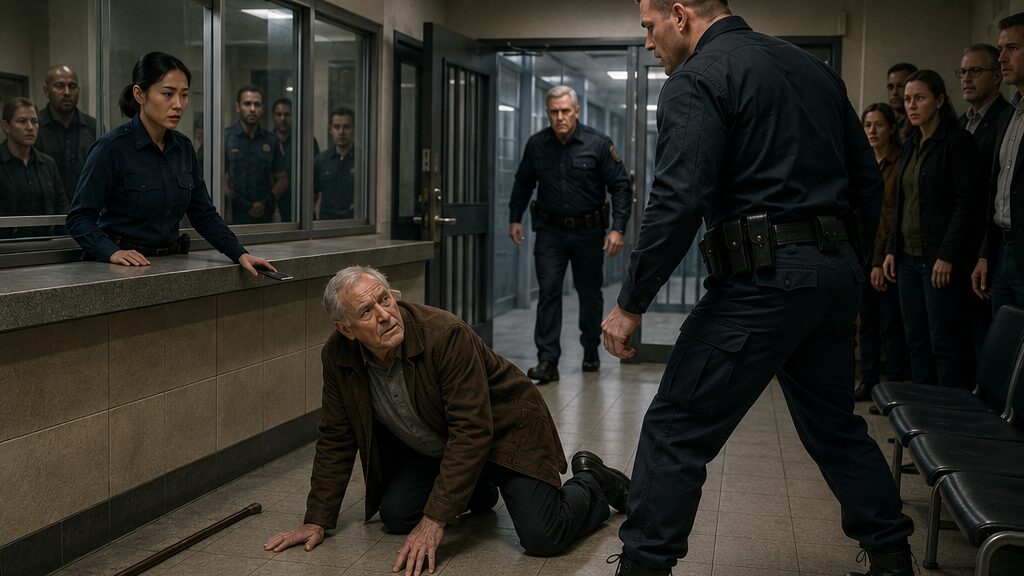
Jason Miller’s boot hit the walking cane before Edward Allen could finish saying his name.
The cane shot across the police-station lobby, struck the metal base of a bolted chair, and spun beneath the intake counter with a hard wooden clatter. Edward’s right hand closed on empty air. His damaged hip failed before he could shift his weight.
He fell against the edge of the counter, then onto the tile.
A woman waiting with a child gasped. A civilian contractor near the South Gate corridor stopped halfway through removing his belt for screening. Behind the desk, Officer Stephanie Lee rose so quickly that her chair rolled into a filing cabinet.
“Stay down,” Jason said. “We’ve been looking for you.”
Edward lay on his left side, one palm flat against the floor. Pain moved through his hip in a clean white line, sharp enough to narrow the fluorescent lobby into a few exact details: the grit beneath his fingertips, the clock above the intake window, the camera mounted high in the northwest corner.
He breathed once before looking up.
Jason stood over him in an MP uniform, broad shoulders squared as if he had just prevented an attack. One hand rested near his holster. His expression held the eager certainty of a man who had already decided what every movement meant.
“I came to ask a question,” Edward said.
“You came through the South Gate under a false name.”
“No.”
Jason pulled a folded bulletin from his vest pocket and held it beside Edward’s face. The photograph showed a bearded man with hollow cheeks, no older than fifty. The print beneath it described a suspect wanted for entering restricted maintenance property and stealing tools.
Edward was clean-shaven. His silver hair was neatly cut. His worn brown coat was old but brushed clean. A paper receipt protruded from his inside pocket.
Stephanie moved around the desk. “Sergeant, the height on that bulletin—”
“Back behind the counter, Lee.”
“He’s at least twenty years older.”
“I said behind the counter.”
She stopped.
Jason crouched and seized Edward by the shoulder. “Where’s the bag?”
“What bag?”
“The one you had when you entered the restricted district.”
“I entered through the public door.”
Jason’s fingers tightened. “You people always think changing clothes makes you invisible.”
Edward studied him. There was strain behind the aggression—something practiced too hard. Jason kept glancing toward the South Gate corridor, where two military personnel watched through a glass partition. He wanted them to see control. He needed them to see it.
“My identification is in my inner pocket,” Edward said. “You may remove it.”
“You don’t give instructions here.”
“I’m giving consent.”
Jason yanked the coat open and searched him with unnecessary force. He found a plain wallet, an old phone, a folded property receipt, and a small envelope stamped with the station’s evidence-unit address.
He tossed the wallet and phone onto the counter.
The receipt fluttered to the floor.
Edward’s gaze followed it. The name printed near the top was visible even from where he lay.
ANTHONY JACKSON.
Jason picked it up first.
“What’s this?”
“The reason I came.”
“You’re Anthony Jackson?”
“No.”
“Then why are you carrying his property receipt?”
“That is the question I was trying to ask.”
Jason’s mouth tightened. He looked at the wanted bulletin again, then at Edward, as though contradiction itself were proof of deceit.
Stephanie leaned forward from behind the counter. “We can run the ID.”
Jason turned sharply. “You think I don’t know what I’m looking at?”
“I think procedure—”
“Procedure is why someone got through the South Gate last month.” His voice carried toward the glass corridor. “I’m not letting that happen again because someone feels sorry for an old trespasser.”
The words settled over the lobby. Edward saw Stephanie’s eyes flick toward the military personnel beyond the glass. So that was the wound. Someone had passed Jason before, and now every civilian was a chance to erase the memory.
Edward pushed his left palm against the floor.
Jason planted a boot beside his ribs. “I told you to stay down.”
“My hip is injured.”
“Then stop resisting.”
“I am trying to sit.”
Jason caught the back of Edward’s coat and drove him against the lower edge of the counter. The impact sent another streak of pain through his side. Edward’s breath escaped, but he did not cry out.
The woman with the child turned the child’s face into her coat.
Stephanie said, “Sergeant, he isn’t resisting.”
Jason looked toward her with something close to panic, then pressed harder. “You saw him reach.”
“For his cane.”
“He could have a blade in it.”
Edward’s eyes moved to the northwest corner.
“The camera above the public-entry sign records this section at a thirty-seven-degree angle,” he said. “The second camera behind your desk covers my right hand.”
The lobby went still.
Jason followed his gaze despite himself.
Edward continued, “Neither will show a weapon.”
“How do you know the camera angles?”
“Because I looked when I entered.”
“That’s what criminals do.”
“That is what observant people do.”
Jason’s face changed. The uncertainty lasted less than a second, but it was enough. Then he chose anger.
He dragged Edward’s right arm behind him.
Pain rose from Edward’s shoulder as a cuff closed too tightly around his wrist.
Stephanie stepped out again. “His identification says Edward Allen.”
Jason glanced at the wallet she held.
“Could be fake.”
“The date of birth doesn’t match the bulletin.”
“Fake IDs have dates.”
“The photograph matches him.”
Jason forced Edward’s other wrist back. “Log him as resisting detention.”
Stephanie stared at him. “He didn’t.”
“Log it.”
The second cuff clicked shut.
Edward closed his eyes briefly. Years earlier, in rooms without windows, he had learned that panic wasted information. He counted the clock’s ticks. He noted the position of the cane. He noted who had looked away and who had not.
Most of all, he noted Stephanie’s hand trembling around his wallet.
Jason rose and addressed the watching lobby. “Situation’s under control.”
No one answered.
Edward opened his eyes.
His voice was low, but it crossed the room cleanly.
“Officer Lee.”
Stephanie looked at him.
“My phone is on your counter.”
Jason laughed. “Who are you going to call? Your shelter?”
Edward did not look at him.
“Give me my phone,” he told Stephanie. “Start the clock when he answers.”
Chapter 2: Five Minutes Began With One Quiet Sentence
Stephanie moved before Jason understood she had made a choice.
She picked up Edward’s phone, came around the intake counter, and slid it across the tile. The dark device stopped inches from his cuffed hands.
“Lee,” Jason snapped. “What are you doing?”
“Allowing a detainee to make a call.”
“I didn’t authorize it.”
“You already logged the detention.”
The answer was quiet, almost apologetic, but she did not take the phone back.
Edward shifted onto one elbow. The movement dragged fire through his hip. With both wrists restrained behind him, he could not reach the screen.
“Uncuff one hand,” Stephanie said.
Jason gave a short, disbelieving laugh. “Absolutely not.”
Edward looked at the clock. “Then place the phone beside my face.”
Stephanie crouched and did so.
Jason stepped forward. “This is ridiculous.”
Edward ignored him. He touched the screen with his knuckle, opened the emergency-access panel, and spoke a short voice command.
“Call Richard Davis.”
The name meant nothing to most people in the lobby.
It meant something to the military personnel behind the glass. One of them straightened. The other looked toward Jason.
The line rang once.
“Edward?”
Richard’s voice came through the speaker clear and immediate. No greeting beyond the name. No hesitation.
Edward watched the second hand on the clock reach twelve.
“General,” he said, “your boys at the South Gate just put hands on me. You have five minutes before I end their careers.”
The silence on the line lasted less than a breath.
“Understood, Director.”
Jason’s face lost its color so quickly that Stephanie noticed before he did.
Richard continued, his tone stripped of everything but function. “Extraction or containment?”
“Preserve first.”
A faint sound came through the phone—chairs moving, a door opening, several voices receiving orders at once.
Richard said, “Location confirmed. Medical team rolling. Legal hold notices are being issued. Security convoy is six minutes from the South Gate.”
“Five.”
“It will be five.”
The call remained open.
Jason stared at Edward. “Director of what?”
Edward did not answer.
At a corporate security center several miles away, Richard Davis stood before a wall of active screens. He was sixty-six, silver at the temples, still built like the officer he had once been. Around him, people in dark field clothing rose from workstations and collected sealed equipment cases.
“Two vehicles only,” he ordered. “No visible weapons outside the gate. Notify local command, station counsel, and the municipal records administrator. I want every camera buffer copied before anyone discovers a technical problem.”
A security officer asked, “Are we entering?”
“Not without his order.”
“And if they refuse access?”
Richard looked at the live map of the police station.
“They will not refuse twice.”
Back in the lobby, Jason’s phone began to ring.
He looked down.
POLICE CHIEF.
The sound seemed louder than the wall clock.
Jason answered. “Chief, I have a possible wanted—”
“What the hell did you just do?”
Benjamin Wilson’s voice burst through the phone loudly enough for the nearest civilians to hear.
Jason turned away. “Sir, the subject matched a bulletin and resisted—”
“His name is Edward Allen.”
“I saw the ID, but it could be—”
“Stop talking.”
Jason stopped.
Benjamin’s next words came slower, which made them worse. “Do not move him. Do not question him. Do not write another word until I arrive. And if a single second of station footage disappears, I will personally put you in the room where investigators ask why.”
Jason’s eyes went to the northwest camera.
Edward saw it.
So did Stephanie.
The clock ticked past one minute.
Jason lowered the phone. He looked at the cuffs around Edward’s wrists, then at the cane lying under the intake counter. His authority had not vanished, but it had become visible for what it was: borrowed, conditional, and suddenly revocable.
“Get him up,” Jason told Stephanie.
Edward said, “No.”
Jason blinked. “What?”
“You put me here. You can wait for the person who told you not to move me.”
“I was trying to secure the lobby.”
“You were trying to be seen securing it.”
The words landed harder than an accusation shouted across the room.
Jason glanced toward the glass corridor. The military personnel no longer watched him with approval. One had taken out a phone.
Richard’s voice came through Edward’s speaker. “Director, convoy is approaching the outer checkpoint.”
Edward’s gaze sharpened. “Hold outside.”
A pause.
“Edward—”
“Do not enter this station.”
“If your condition is unknown, I will not leave you on a floor because a local chain of command requests courtesy.”
“It is not a request from them.”
Richard exhaled through his nose. Edward knew the sound. It had preceded arguments in deserts, airports, and sealed rooms beneath government buildings.
“Medical?” Richard asked.
“Stand by.”
“Armed response?”
“Stand down.”
“That is not the same as stand by.”
“No. It is not.”
The clock passed two minutes.
Stephanie crouched beside Edward. “Sir, are you hurt badly?”
“Badly enough to remember it.”
Her eyes dropped.
Edward shifted his attention to the paper still lying near Jason’s boot. “The receipt.”
Stephanie picked it up and brought it closer.
Three strings of numbers appeared on the page. One had been printed at intake. A second had been stamped in blue beside the property description. A third had been handwritten in the margin.
Edward had noticed them the night before, when the receipt arrived in an evidence envelope with documents the station had returned to him after a routine identity-verification matter. He had assumed a clerical error until he tried searching the public case portal. Only one number produced a result.
He had come to ask why.
“Officer Lee,” he said, “which number belongs to Anthony Jackson?”
She looked at the page.
“The first should be the incident number.”
“And the second?”
“Property control.”
“The third?”
Her brow tightened. “I don’t know.”
Jason said, “It’s probably a transfer code.”
Stephanie looked at him. “Transfer codes don’t use that prefix.”
The clock passed three minutes.
Edward heard distant engines beyond the South Gate. Several heads turned toward the glass corridor.
Richard said through the phone, “We are in position.”
“Remain there.”
“Confirmed.”
Edward studied Stephanie. Her fear had changed shape. It was no longer fear of Jason. It was fear of what she already knew.
“Run all three,” he said.
“I need authorization.”
Jason laughed weakly. “Now procedure matters?”
Edward looked at her, not him. “You have a chief inbound, a preservation request pending, and a detainee whose property record may have been misfiled. Use whichever reason lets you live with opening the screen.”
Stephanie stood and returned to the desk.
Her fingers moved across the keyboard.
Jason’s phone rang again, but he did not answer.
Stephanie’s face tightened as the results appeared.
“The first number is a closed loitering complaint,” she said.
“Anthony Jackson?”
“Yes.”
“The second?”
“Property intake. Identification card, medication pouch, employment documents.”
Edward’s gaze settled on the third number.
Stephanie entered it again.
The system returned a blank page.
“That incident doesn’t exist,” she said.
Edward looked at the lobby camera, then at Jason.
“General,” he said into the phone, “you still outside?”
“Yes.”
“Stay there.”
Then he turned his head toward Stephanie.
“Tell me why one man’s property receipt carries three incident numbers.”
Chapter 3: The Wrong Receipt Opened the Right File
Benjamin Wilson entered the lobby already apologizing.
“Director Allen, this is unacceptable. I assure you, we will address—”
He stopped when he saw Edward still on the floor.
For one moment, the Police Chief’s face showed genuine alarm. Then calculation covered it. He took in the civilians, the cameras, Jason’s rigid posture, Stephanie at the computer, and the phone beside Edward’s shoulder.
“Get those cuffs off him,” Benjamin ordered.
Jason reached for the key.
Edward said, “Officer Lee.”
Stephanie came around the desk and knelt. She unlocked one cuff, then the other. Red grooves circled Edward’s wrists.
Jason extended a hand. “Sir, let me help you.”
Edward looked at it until Jason withdrew it.
Stephanie retrieved the cane from beneath the counter. When she offered it, Edward inspected the shaft before taking hold. A fresh scrape cut across the dark wood where it had struck the chair base.
He planted its rubber tip against the tile and pushed himself up.
His damaged hip trembled. The room tilted briefly, and Stephanie moved closer, but Edward raised one finger. Not refusal in anger. A request for space.
He stood without Jason’s hand.
Benjamin lowered his voice. “An ambulance is on the way.”
“Cancel it.”
“Sir, you fell hard.”
“A medic can examine me here.”
“We have a private office.”
“The lobby will do.”
Benjamin glanced toward the waiting civilians. “This should be handled with discretion.”
“Discretion for whom?”
Benjamin’s jaw worked once. “For the integrity of the review.”
Edward leaned on the cane and looked down at Anthony Jackson’s receipt. “Then begin with the three numbers.”
Benjamin turned to Stephanie. “What numbers?”
She held out the paper.
His eyes moved across it too quickly.
Edward noticed.
“You recognize the format,” he said.
“I recognize station paperwork.”
“That was not my question.”
Benjamin handed it back. “Property systems create duplicate references. Clerical problems happen.”
“Then the correction should be easy.”
“It will be.”
“Now.”
Benjamin’s gaze shifted to Jason. The MP stood beside the intake counter, shoulders still squared, but sweat had appeared above his collar.
“Sergeant Miller made an identification error,” Benjamin said. “A serious one. We can separate that from an unrelated records issue.”
Edward’s phone remained connected on the floor.
Richard’s voice came through it. “It is not unrelated.”
Benjamin looked down. “General Davis.”
“Chief Wilson.”
The courtesy between them held no warmth.
Benjamin said, “Your vehicles are obstructing a controlled entrance.”
“They are parked on the public approach.”
“You have armed personnel outside a police facility.”
“They are secured inside the vehicles. At Director Allen’s order.”
Edward bent slowly, retrieved the phone, and ended the call.
The silence afterward felt larger.
“My call was not an execution order,” he said. “The five minutes were for preservation.”
Benjamin’s expression flickered.
Edward continued, “People who believe a threat is personal protect themselves. People who understand it concerns records protect the records.”
Stephanie looked toward the camera.
Jason saw her do it. “The footage will show he resisted.”
Edward turned to him. “Will it?”
Jason reached for a report form on the counter. “I’m documenting what happened.”
Benjamin said, “You were told not to write anything.”
“I started before your call.”
Jason held up the form. Several lines were already filled in.
Stephanie read them from where she stood. “‘Subject swung an object resembling a concealed weapon.’”
Her voice had changed. The caution remained, but shame now pressed through it.
Jason tapped the paper. “He reached for the cane after being ordered down.”
“You kicked it away before he reached.”
“He turned toward me.”
“He was falling.”
“You don’t know what I perceived.”
Edward watched Benjamin. The chief’s attention was fixed not on the lie but on the witnesses to it.
“Officer Lee,” Edward said, “run the three numbers again. Aloud.”
She returned to the terminal.
“The first is a loitering complaint involving Anthony Jackson. Closed with no charge.”
“Date?”
“Six weeks ago.”
“The second?”
“Property control entry from the same date.”
“Items?”
“State identification card. Prescription medication pouch. Employment documents. Seventeen dollars cash.”
Jason said, “Abandoned property.”
Stephanie looked at him. “The entry says confiscated during detention.”
Benjamin stepped toward the desk. “That file is outside the scope of today’s incident.”
Edward’s grip tightened on the cane.
He had come intending to ask a question, return the misdirected receipt, and leave. Even after Jason threw him down, a part of him had wanted only correction: name verified, cuffs removed, door opened.
That part of him had governed most of his retirement. It had told him silence was discipline. That walking away was proof he no longer needed to control rooms.
Now Jason’s report lay on the counter, manufacturing resistance before the bruise on Edward’s hip had fully formed.
“Open the third number,” Edward said.
Stephanie entered it.
Blank.
She tried the internal archive rather than the public portal. A login prompt appeared.
Benjamin moved beside her. “That requires command authorization.”
“You have it,” Edward said.
Benjamin faced him. “You do not hold office here.”
“No. You do.”
The words left Benjamin nowhere to redirect responsibility.
He entered his credentials.
The third number opened a hidden cross-reference page. Most fields were empty. At the bottom, a notation read: RECLASSIFIED—ADMINISTRATIVE CONTACT. ORIGINAL ACCESS RESTRICTED.
Stephanie whispered, “That removes it from complaint statistics.”
Benjamin said, “There may have been a classification correction.”
“Who approved it?” Edward asked.
The approval field contained only an office code.
Benjamin knew the code. His eyes gave him away before his voice did.
“We need time to review this properly.”
A uniformed supervisor emerged from the secured corridor. “Chief?”
Benjamin turned too quickly. “What is it?”
“The lobby video system is showing an error.”
No one spoke.
The supervisor swallowed. “The archive can’t retrieve the last ten minutes.”
Edward looked at the northwest camera. Its small green indicator still glowed.
“Live feed?” he asked.
“Active.”
“Earlier footage?”
“Available.”
“Only the period covering my detention?”
The supervisor hesitated. “It appears so.”
Jason folded his report and slipped it beneath one hand.
Edward saw the movement.
So did Stephanie.
Benjamin’s face hardened, but not with surprise. With the exhausted anger of a man whose private compromise had chosen the worst possible moment to become visible.
Edward rested both hands on the scratched handle of his cane.
He no longer wanted the door opened.
He wanted to know who had learned that truth could be made temporarily unavailable—and how many times the station had allowed it.
Chapter 4: The Camera Failed Exactly When the Report Changed
“The missing section is eight minutes and twelve seconds,” the surveillance supervisor said. “Everything before it plays. Everything after it plays.”
Edward sat in a narrow interview room with his cane upright between his knees. A medic had cleaned the abrasions on his wrists and pressed along his hip until the pain made his vision sharpen. Nothing appeared broken, but the swelling had begun beneath his coat.
Across the table, Benjamin Wilson stared at a printed system log as though concentration might turn it into a harmless malfunction.
“Hardware failure?” he asked.
The supervisor shifted his weight. “A hardware failure would affect the live stream or the entire archive segment. This looks like the file was marked for deletion.”
“By whom?”
“I can’t tell from this report.”
“You run the system.”
“I maintain it. Administrator actions come through command credentials.”
Benjamin looked up. “Are you accusing command staff?”
“I’m explaining the log.”
The wall phone rang. Benjamin silenced it without answering.
Edward lowered his gaze to the cane. Near the handle, beneath years of scratches, a small triangular notch had been cut into the wood. His thumb settled into it automatically.
A medic had carved that notch with a field knife while they waited for an evacuation aircraft that arrived too late for two men. Edward had been younger then, still convinced certainty was a virtue. He had delayed the extraction because one intelligence report remained unconfirmed.
The cane had come later, but the notch had been transferred from the splint they used to carry him.
“Director Allen,” Benjamin said, “you need imaging at a hospital. We can arrange private transport and conduct this review after you’ve been treated.”
“Will the missing footage return while I’m gone?”
“No.”
“Then my hip can wait as well.”
The door opened. Stephanie entered holding a black notebook against her chest.
Jason had been moved to an administrative office, but his presence remained in every careful glance and unfinished sentence.
Benjamin frowned at the notebook. “What is that?”
“Personal notes.”
“About what?”
Stephanie did not answer him. She placed the notebook on the table in front of Edward.
The pages contained dates, abbreviated names, property numbers, and arrows connecting incident reports to revised classifications. Some entries were written in blue ink, others in pencil. Several had Jason’s initials beside them.
Edward turned one page.
ANTHONY JACKSON appeared halfway down.
Beside the name were two incident numbers and a third crossed out.
“You kept this off-system,” Edward said.
Stephanie stood rigidly. “I started after reports stopped matching what I remembered entering.”
Benjamin’s face tightened. “You maintained an unauthorized record of police information?”
“I kept dates and public numbers. No addresses. No medical details.”
“You should have reported discrepancies.”
“To whom?”
The question left a mark.
Benjamin leaned back. “You are not helping yourself.”
“I know.”
Stephanie looked at Edward rather than the chief. “Six weeks ago, Jason stopped Anthony near the South Gate bus shelter. Anthony had been waiting for a ride after a temporary maintenance shift. Jason said he matched a trespass description.”
“Did he?” Edward asked.
“No.”
“Did you say so?”
“Not soon enough.”
Her fingers pressed into the notebook’s cover.
“I watched Jason shove him against a patrol vehicle. Anthony kept asking for his medication. Jason said the pouch could contain stolen tools. I signed the report that called it a voluntary property surrender.”
Benjamin said, “You signed what you believed was accurate at the time.”
“No.” Stephanie’s voice barely rose. “I signed what I was told would keep a disagreement from becoming a formal use-of-force complaint.”
Edward studied her.
“Why?”
“My mother lives with me. I cover the mortgage and her care. Jason said officers who couldn’t support the South Gate assignment would be transferred. The available transfer was nights across the county.”
“That explains your fear,” Edward said. “It does not erase your signature.”
“I know that too.”
She did not ask him to protect her. That mattered more than an apology would have.
Benjamin stood. “We are allowing this to drift far beyond today’s incident.”
“It drifted six weeks ago,” Edward said. “You merely kept changing the label.”
The door opened again. The surveillance supervisor held a tablet.
“We found another angle.”
Benjamin crossed the room first.
The exterior camera faced the public entrance through reinforced glass. Its view of the lobby was distorted by reflection, but the footage showed Jason standing over Edward after the fall. It showed Stephanie sliding the phone. It also showed Jason later bending to retrieve the cane and carrying it toward the intake counter.
The cane was nowhere near Edward’s hands.
Jason’s written claim that Edward had swung it could not survive the image.
Benjamin’s shoulders sagged by a fraction.
“Copy it,” Edward said.
The supervisor looked at Benjamin.
“Copy it,” Benjamin repeated.
Richard called Edward’s phone before the supervisor left.
“Your digital systems are being altered,” Richard said. “Authorize entry, and my team can secure every server in that building.”
“No.”
“Edward, preservation requests are not magic. Someone inside has already destroyed evidence.”
“Then document the destruction.”
“I can stop it.”
“You can contaminate it.”
Richard’s silence sharpened.
Edward continued, “You enter with armed contractors, every defense attorney in the county will say the records were seized by a private force serving an angry former official.”
“They put you on the floor.”
“Yes.”
“And you are protecting their process?”
“I am protecting what must survive it.”
Richard exhaled. “Two minutes. Then I ask again.”
“You may ask.”
Edward ended the call.
Benjamin walked to the window overlooking the South Gate approach. Dark vehicles waited beyond the barrier, engines running.
“You don’t understand what happens if this partnership collapses,” he said. “Local staffing cannot cover the station, the gate, and the industrial district. We had an unauthorized entry last month. Equipment disappeared. Federal inspectors were already questioning our readiness.”
“So complaints became dangerous.”
“Instability became dangerous.”
“And men like Anthony Jackson became affordable.”
Benjamin turned. “I made compromises to keep officers on the street.”
“You made the victims pay for your staffing problem.”
“I prevented a larger failure.”
Edward looked at Jason’s false report, Stephanie’s notebook, and the frozen frame of the cane in Jason’s hand.
Every person in the room had taken fear and renamed it duty.
A uniformed officer appeared at the open door. “Chief, there’s a man outside asking about recovered property. He gave the name Anthony Jackson.”
Stephanie’s breath caught.
Edward pushed himself upright with the cane. Pain rolled through his hip, but he remained standing.
Through the interior glass, the station steps were visible. A thin man in a faded work jacket stood near the entrance, holding an old envelope. He looked toward the lobby.
Jason, being escorted across the corridor, passed behind the glass.
Anthony saw him.
His body locked. Then he stepped backward, turned, and started toward the parking lot.
Edward tightened his grip on the cane.
The witness they needed had come to the door.
The sight of Jason was enough to send him away.
Chapter 5: The Man Outside Refused to Become Their Evidence
Anthony Jackson did not stop when Edward called his name.
He crossed the visitor parking area with his shoulders hunched, moving quickly without running. The envelope in his hand bent beneath his grip.
Edward followed as far as the station steps before his hip forced him to slow.
“Mr. Jackson.”
Anthony glanced back. His eyes moved from Edward’s worn coat to the cane, then to the swelling visible above Edward’s wrist.
“You’re the man from inside,” he said.
“Yes.”
“The important one.”
Edward paused.
Behind him, the glass doors opened. Stephanie emerged but stayed near the entrance. Benjamin remained inside.
Anthony gave a humorless smile. “I saw the vehicles at the gate. People like me don’t bring convoys.”
“They are not mine.”
“They came for you.”
“Yes.”
“Then they’re yours enough.”
Anthony turned away again.
Edward descended the last step carefully. “Your property receipt was delivered to me by mistake.”
“That why you called me?”
“It is why I came here.”
Anthony faced him. “They lose my identification, my medicine, and papers I need for work. Six weeks, nobody calls. Then they hurt somebody with connections, and suddenly my phone won’t stop ringing.”
“I did not give them your number.”
“Doesn’t matter who did.”
“No,” Edward said. “It does.”
Anthony studied him, perhaps surprised that he had not denied the larger accusation.
The station doors opened again. Richard stepped outside alone.
He wore a dark suit without insignia. His posture made the absence of a uniform feel deliberate. He stopped when Edward raised one hand.
“Stay there,” Edward told him.
Richard’s jaw tightened, but he obeyed.
Anthony looked between them. “He takes orders from you.”
“He sometimes remembers to.”
“I’m not going inside to help you ruin that guard.”
“Jason Miller.”
“I know his name.”
Anthony’s voice remained controlled, but his fingers crushed the envelope further.
“He took my ID after my shift. Said I was hanging around restricted property. I showed him the bus schedule. He said schedules could be fake. I told him my medication was in the pouch. He opened it on the hood of his vehicle and laughed because the label said I needed to take it with food.”
Stephanie closed her eyes.
Anthony saw her.
“You were there.”
“Yes,” she said.
“You typed while he called me a drifter.”
“Yes.”
“You told me signing the property form would get me home faster.”
Stephanie swallowed. “Yes.”
Anthony looked at Edward. “Now I’m supposed to trust their forms?”
“No.”
The answer stopped him.
Edward leaned on the cane, feeling the ache deepen each time he shifted his weight.
“You should not trust a process because I tell you to,” he said. “You should not enter that station because my anger needs evidence.”
“Then what do you want?”
“I wanted your statement preserved before more records changed.”
Anthony laughed once. “There it is.”
Edward waited.
“The same boot finally lands on someone important, and now the records matter.”
Richard took a step forward. Edward looked at him, and he stopped again.
Anthony’s words struck more cleanly than Jason’s boot had.
Edward could have explained that he had come before the assault. He could have shown the misdirected receipt, described the three numbers, proved that his concern began earlier.
All of it would have been true.
None of it would have answered Anthony.
“You are right,” Edward said.
Stephanie looked up.
Anthony’s expression hardened, as though agreement might be another tactic.
Edward continued, “I saw something wrong on a receipt and came to ask a question. If they had answered politely, I might have returned your paper and gone home.”
“You would have.”
“Yes.”
The admission hung between them.
“I spent years believing restraint meant leaving power unused,” Edward said. “Sometimes it meant leaving other people alone with the consequences.”
Anthony looked toward the station. Jason was no longer visible, but his absence did not make the building safer.
Richard’s phone vibrated. He checked the message and approached only close enough to speak quietly.
“We found five complaints connected to Miller’s assignments,” he said. “Three were downgraded from use-of-force allegations to administrative contacts. Two property cases were classified as abandoned.”
“Can you retrieve the originals?” Edward asked.
“Technically, yes. Legally, not without system-owner consent or a court order. If we access them now, they may challenge every record we touch.”
Anthony shook his head. “So even your people can’t fix it.”
“They can break it quickly,” Edward said. “Fixing it is slower.”
Richard did not appreciate the distinction, but he did not contradict it.
Anthony looked down at Edward’s cane. The fresh scrape along the shaft caught the light.
“He kicked that away from you?”
“Yes.”
Anthony’s mouth tightened. “He said people with canes use them to make others feel sorry for them. Called them helpless drifters.”
Edward’s fingers found the triangular notch near the handle.
“What would make going back inside worthwhile?” he asked.
Anthony frowned. “You already know. My statement.”
“No. That is what I want. What do you want?”
For the first time, Anthony had no immediate answer.
Cars moved along the road beyond the parking lot. At the gate, Richard’s dark vehicles remained still, contained power waiting for permission.
“My ID back,” Anthony said finally. “My medication pouch, even if it’s empty. My work papers. And the report changed to say they took them. Not abandoned. Taken.”
“That can be requested.”
“Not just mine.”
Edward watched him.
Anthony lifted the bent envelope. “At the shelter, people talk. They take bags from men sleeping near the bus line. They take documents because without ID, you can’t challenge anything. Then they log it abandoned and say nobody came back.”
Stephanie’s face had gone pale.
“How many?” Edward asked.
“I don’t know.”
“Names?”
“Some.”
Benjamin appeared behind the glass doors but did not come out.
Anthony looked directly at Edward. “I go inside, they’ll make this about what happened to you. Retired director attacked. Big mistake. Bad guard. Everyone apologizes.”
“I will not permit that.”
“You can’t control every headline.”
“No.”
The word cost Edward more than the earlier admission.
He had spent his career controlling versions of events—who knew, when they knew, what facts could safely survive. Retirement had not cured the instinct. It had only denied it an office.
Anthony stepped closer.
“I’ll go in on one condition.”
“Name it.”
“Every property entry marked abandoned during his South Gate shifts gets checked. Not just mine. Not just the people who know how to complain.”
Richard watched Edward carefully. The request reached beyond Jason. It threatened the partnership, Benjamin’s command, and officials Edward had known for decades.
Edward could feel the old machinery waiting inside him, offering easier options: pressure one chief, sacrifice one guard, return one man’s property, close the incident.
He turned toward the station.
“Officer Lee,” he said.
Stephanie straightened.
“Open the door.”
Anthony did not move.
Edward faced him again. “The review includes every abandoned-property entry connected to those shifts. Your statement remains yours. You may stop at any time.”
“And if the chief says no?”
“Then he says it on the record.”
Anthony looked past him toward Benjamin.
Then, slowly, he walked back toward the station.
Chapter 6: The Director Chose the Records Over Revenge
Richard entered the briefing room alone and placed two folders on the table.
“One vehicle can take you to a hospital now,” he said. “The second option shuts this station’s systems down under an emergency preservation action until outside investigators arrive.”
Edward sat opposite him with his cane laid horizontally across the table.
Benjamin occupied the chair at one end. Stephanie stood near the wall with her black notebook. Anthony waited in the adjoining interview room, the connecting door left open at his request.
Jason was supposed to remain in an administrative office under supervision.
“Those are not the only options,” Edward said.
“They are the two that prevent further damage.”
“They prevent uncertainty.”
Richard’s eyes hardened. “You were assaulted in a controlled facility. Evidence disappeared within minutes. Uncertainty has already been used against you.”
“And force will be used against the evidence if your people seize it.”
“My people know evidence protocols.”
“They are paid by an organization connected to me.”
“They are paid to do their jobs.”
Benjamin touched the thinner of the two folders. “A limited internal investigation can begin today. Sergeant Miller can be suspended, the incident referred to military command, and Mr. Jackson’s property matter corrected.”
Anthony’s voice came through the open door. “There it is.”
Benjamin looked toward him. “Mr. Jackson, I am trying to create an actionable scope.”
“You’re trying to make the room smaller.”
Edward watched Benjamin’s hand remain on the folder.
“What happens to the South Gate agreement if the scope widens?” he asked.
Benjamin withdrew his hand.
Richard answered first. “Funding is frozen pending review. Joint staffing may be suspended.”
Benjamin gave him a cold look. “Which leaves civilian officers covering an industrial corridor, a transit hub, and a restricted perimeter with eighteen vacant positions.”
“And that justified altered complaints?” Edward asked.
“No. It explains why classifications were managed carefully.”
Stephanie lowered her eyes.
Edward said, “Carefully.”
Benjamin’s control finally cracked. “We had a breach. A man walked through the South Gate carrying a stolen contractor badge. He entered a maintenance yard and took equipment that could have been used against the district. Inspectors said one more failure would terminate the partnership.”
“So you demanded more aggressive stops.”
“I demanded vigilance.”
“Jason supplied aggression.”
“And complaints multiplied.” Benjamin pressed both palms against the table. “Most involved no charge, no lasting injury, and no prosecution. I was told if every contact became a force complaint, the entire agreement would be judged unstable.”
“Who told you?”
Benjamin looked toward the closed blinds. “People who will deny the wording.”
“You still chose.”
“Yes.”
The word was quiet.
“I approved reclassification of complaints I believed were minor. I told myself keeping the gate staffed protected thousands of people. I told myself officers could be corrected privately.”
Anthony appeared in the doorway. “Did you correct him?”
Benjamin did not answer.
Richard opened the thicker folder. “My counsel has prepared notices for municipal oversight, military command, and the state records office. One signature from Director Allen initiates all of them.”
Edward looked at the pages.
There it was again: a clean instrument waiting to replace judgment. Sign, mobilize, contain.
His thumb pressed into the notch in his cane.
“Years ago,” he said, “I had an extraction team waiting for my order.”
Richard’s attention shifted.
Edward rarely spoke of the operation. Richard knew only the official summary.
“We had two reports,” Edward continued. “One said the route was clear. The other said an armed unit had moved into the area. I waited for confirmation.”
Stephanie watched him carefully.
“The team commander requested permission twice. I refused twice. When confirmation came, the route was no longer clear.”
His hip seemed to remember before the rest of him did. The smell of fuel. Dust against his teeth. A medic cutting a notch into a splint because Edward kept losing track of which side was fractured.
“Three people did not come home,” he said. “Two died during the delay. One died after getting me out.”
Richard’s face had gone still.
Edward looked at the folders. “For years, I called that restraint. The report called it procedural caution. Neither phrase carried their bodies.”
Benjamin sat back.
“I will not wait for perfect proof again,” Edward said. “But I will not mistake speed for justice either.”
Stephanie stepped forward and placed her black notebook beside the cane.
“These are all the numbers I kept,” she said. “Dates, original classifications, changes I noticed. Some entries are incomplete.”
Benjamin looked at her. “You understand you may be disciplined.”
“Yes.”
“Possibly charged if confidential information was mishandled.”
“Yes.”
She did not look at Edward for rescue.
“I signed reports I knew were softened,” she said. “I want that included too.”
Edward closed Richard’s folder without signing.
Richard’s disappointment showed only in the tightening around his mouth. “Then what are you authorizing?”
“Independent preservation through lawful channels. State records officers. Municipal oversight. Military investigators for Jason’s assignment conduct. No seizure by your personnel.”
“That gives them time.”
“It gives the evidence a chance to remain admissible.”
“And if they destroy more?”
“Then destruction becomes evidence.”
A radio crackled outside the room.
A uniformed officer appeared at the door. “Chief, Sergeant Miller left the administrative office.”
Benjamin stood. “Where is he?”
“South corridor. He says he was ordered back to military control.”
“By whom?”
“He wouldn’t say.”
Richard was already reaching for his phone. “My team can close the gate in thirty seconds.”
“No,” Edward said.
“Edward.”
“No private personnel.”
“If he leaves, records and devices may leave with him.”
Benjamin called into his radio. “Lock the vehicle barrier. Local officers only. Do not approach unless you have lawful grounds.”
The reply came in fragments. Jason was at the South Gate. He had a duffel bag. He was arguing with checkpoint staff.
Richard pushed the thicker folder toward Edward. “You can end this now.”
Edward looked through the interior window. Beyond the lobby, officers moved toward the corridor. The dark convoy remained outside the gate, powerful enough to turn the arrest into a spectacle and compromised enough to poison everything afterward.
“What grounds do you have?” Edward asked Benjamin.
“False reporting, potential evidence tampering, leaving assigned supervision. We need confirmation before detention.”
Stephanie opened her notebook and pointed to an entry. “The exterior footage proves the cane statement false. His written report is signed.”
Benjamin looked at the surveillance supervisor, who stood in the hall holding the copied video.
“Secure the original report,” Benjamin ordered. “Prepare the warrant affidavit. Contact military command and tell them he is not to be transferred.”
Richard’s phone continued vibrating in his hand.
Edward placed both palms on the cane.
“Your people remain outside,” he said.
Richard’s voice dropped. “You are choosing a system that failed you.”
“I am choosing to make it answer for the failure.”
From the corridor came the distant sound of the gate alarm, followed by shouted commands.
Benjamin moved toward the door.
Edward stopped him with one sentence.
“Chief.”
Benjamin turned.
“No special detention. No private room. No missing camera.”
Benjamin held his gaze, then nodded once.
Over the radio, an officer reported that Jason had been stopped beside the locked vehicle barrier. He was demanding protection from military command and insisting the station had no authority to hold him.
Edward did not rise. He did not call Richard’s convoy forward. He did not give the order that everyone in the room expected from the man Jason had put on the floor.
He looked at Benjamin and the local officers gathering in the corridor.
“Follow your own warrant procedure,” he said. “Let the record survive us all.”
Chapter 7: He Walked Out While the Locked Files Opened
The lobby television was already telling the wrong story.
A red banner crawled beneath the image of the station entrance: RETIRED INTELLIGENCE DIRECTOR ASSAULTED IN SECURITY INCIDENT.
The reporter stood outside the South Gate, framed by Richard’s dark vehicles and a line of cameras that had gathered along the public approach. Edward’s former title appeared beneath an old photograph of him in a suit.
Nothing on the screen mentioned Anthony Jackson.
Benjamin muted the television.
“We need to make a statement before speculation takes over,” he said. “You and I can appear together. We acknowledge the failure, announce Sergeant Miller’s suspension, and confirm an independent review.”
Edward stood beside the evidence counter, waiting while a clerk completed the release form for his cane. His hip had stiffened enough that every shift of weight required planning.
“A review of what?” he asked.
“Today’s incident.”
“Then you have learned nothing.”
Benjamin looked toward the civilians still waiting in the lobby. Most had stayed through the afternoon, held by interviews or curiosity. Some watched Edward openly now. Others watched Benjamin.
“The public knows your name,” Benjamin said quietly. “We cannot pretend that is irrelevant.”
“It became relevant when your officers answered my call faster than they answered Anthony’s complaint.”
“That is precisely why your presence would reassure people.”
“My presence would reassure the people who already believe important men receive justice.”
The clerk returned with the cane sealed in a clear property sleeve.
Edward examined the label. The item had been entered as POTENTIAL WEAPON—WALKING STICK.
He slid the form back across the counter.
“Correct the description.”
The clerk glanced at Benjamin.
Benjamin said, “Do it.”
The clerk typed again and printed a new label: PERSONAL MOBILITY AID—RETURNED TO OWNER.
Only then did Edward sign.
He removed the cane from the sleeve and tested its tip against the tile. The fresh scrape along the shaft remained. So did the triangular notch beneath his thumb.
Across the lobby, Jason sat behind the glass wall of an interview room. His uniform shirt had been removed and folded beside him. Local officers had taken his duty belt and phone under documented procedure. He was not handcuffed. A camera above the door showed a steady green light.
He caught Edward looking at him.
For an instant, Jason’s face held the old reflex—chin raised, shoulders squared, defiance prepared for an audience.
Then his eyes dropped to the cane.
Edward did not approach the glass.
A secured door opened near the records corridor. Two state records officers entered with sealed drives and a municipal attorney. The surveillance supervisor followed, carrying the exterior-camera copy in a numbered evidence bag.
Stephanie walked beside them with her black notebook.
She looked exhausted. Her badge was still pinned to her shirt, though Benjamin had temporarily removed her from desk duties pending review.
One of the records officers stopped near Edward. “The archive hold is active. We have located seven reclassified contacts tied to South Gate assignments and eleven abandoned-property entries requiring comparison with original intake logs.”
“Eleven?” Anthony asked.
He stood near the public counter holding a small cardboard property box.
The officer nodded. “That is the current number. It may change.”
Anthony opened the box.
His state identification card lay inside a plastic sleeve. Beneath it were folded employment papers, seventeen dollars in an evidence envelope, and a blue medication pouch with its zipper partly broken.
He held the pouch without opening it.
Stephanie placed a correction form on the counter. “The property status now reads confiscated during detention. The original incident number has been restored.”
Anthony read every line.
“What about the complaint?”
“It has been reopened under that same number,” she said. “Your statement will be attached only if you approve it after reviewing the transcript.”
He looked at her. “You writing it?”
“No. An outside investigator.”
“That your choice?”
“No.” She paused. “But telling them what I changed before is.”
Anthony signed the receipt.
Stephanie did not thank him. He did not forgive her. The absence of either gesture made the exchange feel more honest.
Benjamin’s phone vibrated again. He checked the screen, then faced Edward.
“The press conference begins in ten minutes. Military command will participate. They want confirmation that the partnership remains operational during review.”
“Will it?”
“Under temporary supervision.”
“And the abandoned-property cases?”
Benjamin glanced toward the open records corridor.
“They will be named as part of the inquiry.”
“Not as part of my assault.”
Benjamin’s mouth tightened. “The media will connect everything to you regardless.”
“That is their choice. Your statement is yours.”
Richard entered from the South Gate corridor. He had remained outside through Jason’s detention, allowing only legal staff and one medic through the barrier. Now his gaze went first to Edward’s posture, then to the cane.
“You should not be standing,” he said.
“I have spent enough of today on the floor.”
Richard offered his arm.
Edward looked at it.
The offer was not ceremonial. Richard’s concern had outlasted his anger, but the habit beneath it was the same: identify weakness, take control, remove uncertainty.
Edward rested both hands on the cane and stepped forward without accepting.
Richard lowered his arm.
“You leave now,” Richard said, “and they will shape the account without you.”
“They would shape it with me standing beside them.”
“You can correct the record.”
“I can become the record.”
Richard glanced at the television. Edward’s old photograph remained on the screen.
“The public understands names,” Richard said.
“The people in those files have names.”
The words brought Anthony’s attention from his property box.
Edward continued, “Benjamin will announce the civilian complaint review, the preservation order, and the outside investigators. He will not use my former title as proof the process works.”
Benjamin looked toward the cameras outside. “Refusing to appear may be interpreted as a lack of confidence.”
“In you?”
“In the investigation.”
“You still want borrowed authority.”
The chief’s face reddened, but he did not answer.
Edward softened his voice without softening the point. “Stand there without me. Tell them what failed. Tell them what happens next. Then let your conduct decide whether anyone believes you.”
Benjamin studied him for several seconds.
“I protected the agreement because I thought losing it would endanger the district,” he said.
“And now?”
“Now I know preserving it this way endangered people who were easier not to count.”
It was not absolution. Edward had none to give.
Benjamin turned toward the doors.
“Chief,” Anthony said.
Benjamin stopped.
Anthony held up the corrected receipt. “Say what they called the property.”
Benjamin looked at the paper.
“Abandoned,” he said.
“Say it outside.”
Benjamin nodded once and left for the press line.
The television volume returned as someone near the counter found the remote. Outside, Benjamin stepped behind a row of microphones alone.
He began without Edward’s name.
“This afternoon, evidence emerged that civilian complaints and confiscated property may have been improperly reclassified during joint South Gate operations.”
The lobby quieted.
Jason lifted his head behind the interview-room glass.
Benjamin continued, naming the outside agencies, the preservation order, and the process for earlier detainees to reclaim records without entering the station. His voice faltered only once, when he acknowledged his own approval of some classification changes.
No one applauded.
Edward preferred it that way.
A records officer unlocked the final archive cabinet. Metal drawers rolled open one after another, each producing a low mechanical knock. Stephanie surrendered her notebook into an evidence sleeve and signed across the seal.
Richard listened to the press statement with his arms folded.
“You gave him room to recover,” he said.
“I gave the record room to outlive him.”
“And Miller?”
“Will answer for what can be proved.”
“That may feel insufficient.”
“To you?”
“To everyone who saw him put his boot beside your ribs.”
Edward looked through the glass.
Jason sat alone, no longer performing certainty for anyone. He appeared younger without his uniform equipment, but not innocent. His fear explained the choices he had made. It did not excuse them.
“Fear is not a verdict,” Edward said. “Neither is anger.”
Richard looked toward the gate. “The vehicles can move when you are ready.”
Anthony approached with the cardboard box tucked beneath one arm.
“You came here to return my receipt,” he said.
“That was the plan.”
“Bad plan.”
“Yes.”
Anthony held out the original misdirected paper. “Keep it.”
Edward shook his head. “It belongs with your corrected file.”
Anthony considered this, then placed it inside the box beside his identification.
“They’ll call this the day they attacked a director,” he said.
“Some will.”
“I’ll call it the day they gave my name back.”
He left through the public doors without looking at the cameras.
Edward watched until he disappeared beyond the steps.
Then he moved toward the South Gate corridor.
Each step sent a muted ache through his hip. Richard walked beside him without offering his arm again. Behind them, the records drawers continued opening. Printers fed out preservation logs. Phones rang at desks where no one could now pretend the matter concerned one mistaken identity.
At the gate, the barrier remained lowered. Richard’s convoy waited beyond it in two silent rows.
A checkpoint officer reached for the control.
“Leave it down,” Edward said.
Richard looked at him.
“We can walk through the pedestrian exit.”
The smaller gate clicked open.
Edward paused beneath the security camera. Its green light remained steady above him. He adjusted his grip on the scratched cane and stepped across the boundary under his own weight.
Richard followed.
The convoy did not move until Edward had cleared the South Gate.
Behind him, inside the station, the locked files remained open.
The story has ended.