They Laughed at the Young Soldier Until Every Target Fell Into Silence
Chapter 1: The Plaque Beside the Firing Line
“Ten dollars says she cries when the rifle kicks.”
Kevin Taylor’s voice carried farther than the range command.
He stood beneath the fundraiser banner with one hand resting on an expensive hard rifle case, pointing openly at Nicole Carter as she crossed the family-support recreation area. The men around him turned together. Their laughter followed his finger to her faint limp, her battered issue bag, and the long parcel wrapped in gray protective cloth beneath her arm.
Nicole kept walking.
The parcel was heavier than it looked. Its cold metal edge pressed through the wrapping into her palm each time her left boot struck the pavement. Beyond the tents, rifles cracked against the berm. Children shouted near the food tables. A generator coughed beside the registration booth.
The sounds crowded together until none of them had clean edges.
She watched instead.
Red flag above the firing line. Patrick King at the center lane. Two participants stepping back from the benches. His mouth moving beneath hearing protection.
Kevin moved into her path without quite blocking it.
“Memorial detail?” he asked, glancing at the wrapped plaque. “Other side of the range.”
“I know.”
His eyes dropped to her gear bag. The faded fabric had been repaired twice near the zipper.
“They issue that before you were born?”
The men behind him laughed again. They wore matching shirts from the same selection class, though the fundraiser required no uniform. New boots. Custom glasses. Equipment laid out as neatly as an advertisement.
Nicole shifted the plaque higher under her arm.
Kevin leaned toward his platoon. “Maybe recoil isn’t the problem. Maybe she’ll fall over before she gets to the line.”
A hard whistle cut through the noise, but Nicole caught only the pressure of it, not its direction. She fixed her eyes on Patrick. He had lifted one hand, palm outward. The active lanes were closing.
She stepped behind the painted boundary.
Kevin noticed.
Something brightened in his expression, as if caution had confirmed whatever story he had already decided to tell.
Nicole passed him and reached the memorial walkway beside the range. The old plaque had been removed that morning after its lower mounting edge cracked. Four empty bolt holes remained in the stone base beneath a folded flag display. She set the replacement parcel on a bench and lowered her issue bag beside it.
The metallic click drew her back into the present.
At the next table, a civilian trainee was struggling with a pair of foam earplugs. She was young, perhaps close to Nicole’s age, with a borrowed rifle case and hands that trembled each time another shot rolled across the range.
Kevin saw her too.
“Push them in, Ashley,” he called. “They don’t work by being scared of your ears.”
Ashley Lee flushed. She pressed one plug against the outer part of her ear without rolling it first.
Two of Kevin’s classmates watched with amused patience.
“Maybe she needs somebody to hold her hand,” one said.
Kevin picked up a pair of over-ear protectors and shoved them across the table. They struck Ashley’s case and nearly slid off the other side.
“Use both,” he said. “Wouldn’t want the noise making you cry before the rifle gets a chance.”
Ashley caught the protectors against her stomach. Her fingers tightened around them.
Nicole had already turned away from the memorial bench.
She approached without touching Ashley or the equipment.
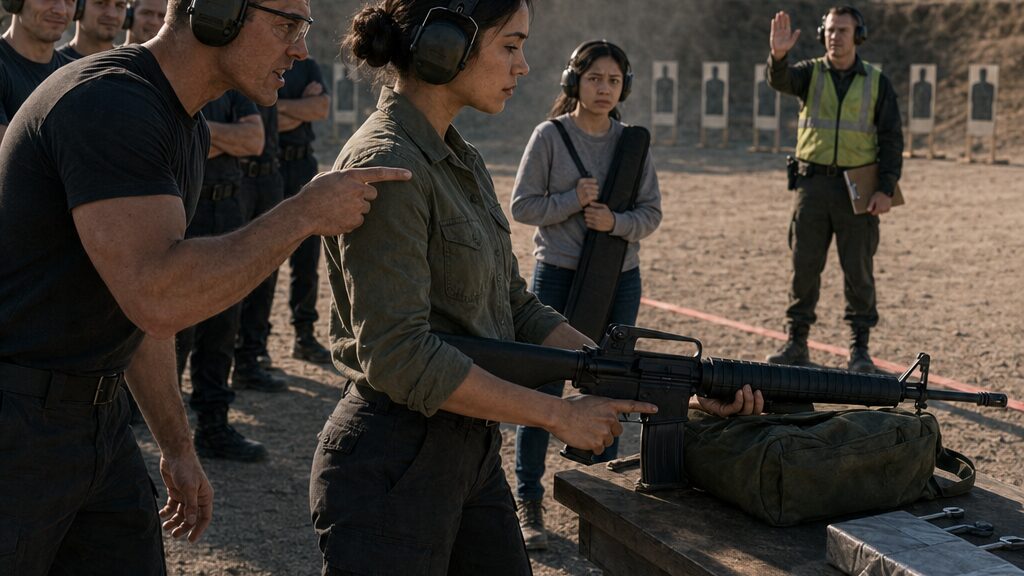
“Roll the plug narrow first,” she said. “Pull the top of your ear back. Hold it in place while it expands.”
Ashley looked at her, embarrassment sharpening into defensiveness.
“I know.”
Nicole waited.
Ashley tried again. This time the plug seated correctly.
“Now the outer protection,” Nicole said. “Check that your hair isn’t breaking the seal.”
Ashley tucked loose hair away from her ears and lowered the cups. Her shoulders eased by a fraction.
Kevin gave a short laugh. “Range expert now?”
Nicole looked at the rifle case beside Ashley. The muzzle end pointed toward the public walkway.
“Turn the case before you open it,” she said.
Ashley stared down and quickly rotated it toward the berm.
The laughter behind Kevin thinned.
He had been close enough to see the mistake. He had been watching Ashley’s hands rather than the direction of the case.
Patrick called from the firing line. His voice reached Nicole as a flattened vibration beneath the generator and conversation. She saw him gesture toward the registration table.
Ashley did not move.
Nicole pointed. “He wants the next group to check in.”
They walked together. Kevin and his classmates followed, carrying their polished cases.
At registration, Patrick inspected the assessment cards. He was broad-shouldered, with a sun-lined face and the controlled impatience of someone responsible for too many people standing near loaded weapons.
“Ashley Lee, lane four,” he said. “Kevin Taylor, you’re finished unless you paid for another run.”
“Happy to donate again.”
Patrick looked toward Nicole. “You participating?”
She had intended to say no. Replace the plaque. Return the damaged one. Leave before the crowd thickened.
Then Ashley glanced toward Kevin and folded her assessment card in half.
Nicole set one hand on the worn issue bag.
“One slot,” she said.
Kevin leaned an elbow on the table. “This I’ve got to see.”
Patrick handed Nicole a card and pointed toward the staging line. His mouth moved while a burst of gunfire broke from the far lanes. Nicole caught only pieces.
“—case closed—wait behind—”
She followed the direction of his arm and took position behind the white stripe.
The line went cold. Participants stepped back. Patrick inspected the benches, then turned toward the waiting group and spoke through the portable amplifier.
The speaker distorted his words. Nicole watched a volunteer cross between her and Patrick at the wrong moment.
Ashley moved forward.
Nicole remained still.
Patrick repeated something and gestured sharply.
Kevin looked from him to Nicole.
“She can’t even follow the first command,” he said.
His voice was nearer and easier to catch than Patrick’s amplified words.
Heads turned.
Nicole searched Patrick’s hands. He pointed toward an empty safety table where cased rifles were to be placed for inspection.
She started forward.
“Bit late,” Kevin said. “You planning to guess through the whole assessment?”
Patrick came around the registration table. He did not look amused.
“I told you to take your equipment to the safety station.”
“I understand.”
“You didn’t move.”
A high tone spread through Nicole’s right ear, thin as wire drawn tight. She pressed her thumb against the metal corner of the wrapped plaque still resting against her hip.
Cold. Solid. Present.
Kevin shook his head toward his classmates. “Too young, too broke, too fragile. Step away before somebody gets hurt.”
Nicole saw Ashley’s face close in on itself.
The easy choice was only thirty yards away. Carry the plaque to the memorial base. Complete the repair. Let Patrick remove her card. Let Kevin keep talking.
Then Ashley began folding her card again.
Nicole placed her issue bag on the safety table.
Patrick took the assessment card from her hand and laid it face down.
“One missed command on an active line is enough,” he said. “Is there a medical reason you didn’t hear me?”
The question traveled beyond Nicole to every person who had gone quiet enough to listen.
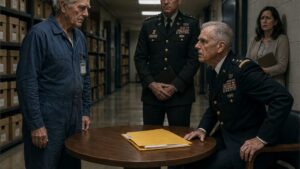
Chapter 2: The Command She Could Not Hear
Patrick kept Nicole’s card beneath two fingers as though a gust might carry it back into the active queue.
“One missed command is enough to end your participation,” he said.
The thin ringing in Nicole’s ear remained. She could hear Patrick now because he stood directly in front of her, but each word arrived wrapped in the murmur from the tents and the generator’s rough pulse.
She looked past him toward the memorial bench.
The replacement plaque lay under gray cloth. One corner had come unwrapped, exposing a mounting hole and the smooth rim of new steel. A loose bolt sat near the tools. Nicole picked it up and rolled it between her fingers.
The threads bit gently into her skin.
Patrick noticed the motion. “I asked you a question.”
“I heard you.”
“This time.”
Kevin stood a few feet away with his arms folded. His classmates had arranged themselves behind him as if the safety table were another stage.
Patrick turned his head. “Taylor, clear the area.”
“I’m waiting for my second run.”
“You can wait without an audience.”
Kevin spread his hands. “I’m not the one who ignored a command.”
“No. You’re the one who made it a joke.”
A few faces shifted away from him.
Kevin’s smile held, but the muscles at his jaw tightened. “With respect, a person who can’t hear on a live range is a safety problem. Everybody here knows it. I was the only one willing to say it.”
The words landed cleanly because they contained something true.
Nicole looked at the bolt turning between her thumb and forefinger. She had chosen a position where she could see Patrick. She had tracked the flag and the line. She had stayed behind the boundary. None of that changed the fact that she had failed to respond.
Patrick faced her again.
“Do you have a hearing limitation?”
The answer should have been simple.
Nicole had given it in clinic rooms with doors closed. She had marked boxes on forms that remained inside medical systems. She had learned where to stand during briefings and how to read the first movement of a range officer’s shoulder before the hand signal came.
She had not learned how to say it beneath a fundraiser banner while strangers waited to decide what it meant about her.
“Artillery exposure,” she said at last. “Tinnitus. Reduced hearing on the right.”
Ashley stopped beside the equipment bench. The folded card remained in her hand.
Patrick’s expression changed, but not into pity. That helped.
“Can you reliably receive range commands?”
“When I can see the officer’s face and hand signals.”
“And when you can’t?”
“I don’t move.”
“That is what happened?”
“Yes.”
Patrick glanced toward the line, measuring the distance and the angles. “Did you declare this when you registered?”
Nicole said nothing.
He lifted the card from the table and turned it over. The accommodation box was empty.
“Did you tell the volunteer?”
“No.”
“Did you tell me before entering the queue?”
“No.”
Kevin exhaled through his nose. It was almost a laugh.
Patrick looked at him once, and the sound stopped.
Then he leaned toward Nicole. His voice lowered, forcing the crowd to strain if they wanted it.
“You made an adaptation by yourself and expected the event to operate around it without knowing. That is not the same thing as a safety plan.”
“I know.”
“Do you?”
The bolt stopped turning.
Nicole’s first impulse was to defend every precaution she had taken. She could describe the flag, Patrick’s hand, the volunteer who had blocked her view. She could point out that she had stayed still when uncertain—the safest possible response.
But the blank box remained between them.
Patrick was not accusing her of weakness. He was asking why she had hidden information needed to control the line.
Kevin had mocked her for the wrong reason. That did not make Patrick’s concern wrong.
“I should have declared it,” Nicole said.
Patrick set the card down, still face down.
“Until I can establish a reliable command method, you’re out of the assessment.”
Behind Nicole, another rifle report cracked. The sound reached her left ear as a dull impact. The tone on the right sharpened.
She pressed the bolt into her palm.
Kevin shifted closer to Patrick. “Probably best for everyone.”
Patrick rounded on him. “You suspected she couldn’t hear.”
Kevin’s confidence faltered by half a step. “I said she wasn’t responding.”
“And instead of alerting me, you encouraged your platoon to laugh.”
“I was making a point.”
“You were performing.”
The word struck deeper than shouting would have. One of Kevin’s classmates studied the ground.
Kevin recovered quickly. “Selection doesn’t make allowances for hesitation.”
“This is not your selection course,” Patrick said. “It is a community safety assessment.”
Kevin’s eyes went to the people watching. His status was still there, but now he had to hold it up by hand.
“I’m trying to keep standards from becoming feelings.”
Patrick slid Nicole’s card away from the queue. “Then start by meeting the standard of raising a concern without humiliating somebody.”
For a moment, Nicole felt the balance shift.
It was a small correction, not a victory. Patrick had rebuked Kevin, but her card was still removed. Her own silence had given him the strongest argument on the range.
Ashley moved nearer.
“You knew exactly what was wrong with my ear protection,” she said to Nicole.
Nicole nodded.
“And you still didn’t tell them about yours.”
The question held no accusation at first. Then Ashley looked toward Kevin’s group and her mouth tightened.
“I thought you were just calm,” she said. “Like none of it could get to you.”
“It gets to me.”
Ashley gave a brittle smile. “That’s not very reassuring.”
She set the borrowed hearing protection inside her rifle case.
Nicole watched her fold the foam plugs into their wrapper with deliberate care, as though returning every object properly might erase the fact that she had ever touched it.
“You haven’t completed your assessment,” Nicole said.
“I know.”
“You corrected the case direction.”
“You corrected it.”
“You did it.”
Ashley closed the lid.
Across the range, volunteers called the next group. The words blurred for Nicole, but she saw the participants move.
Kevin had turned away, speaking quietly to his classmates. He no longer needed to say anything directly. The scene had already done the work for him: Ashley shaken, Nicole removed, Patrick managing a disruption.
Ashley pulled the zipper around the first corner of the case.
“My father taught me the basics,” she said. “He said a range was the one place where being careful mattered more than looking confident.”
“Sounds right.”
“He also said people could tell when you didn’t belong.”
Nicole looked at her.
Ashley’s hand trembled on the zipper pull. “Kevin was right about people like me. I’m just making everyone nervous.”
She lifted the case from the bench.
“I’m leaving.”
Chapter 3: The Girl Packing Her Rifle Away
The zipper rasped around Ashley’s rifle case while Kevin’s platoon cheered another score from the line.
Nicole heard the cheering more clearly than the score announcement. It came in a low wave, followed by Kevin’s voice, then scattered applause from the fundraiser tents. Ashley pulled the zipper harder when it caught near the muzzle end.
“Stop,” Nicole said.
Ashley’s shoulders stiffened. “I already turned the case.”
“The sling is caught.”
Ashley looked down. A strip of nylon protruded between the zipper teeth. She freed it and closed the case without answering.
Nicole stood beside her, the steel mounting bolt still warm in her palm.
“You don’t have to prove anything to him,” she said.
“That’s easy for you to say.”
Nicole glanced toward the safety table where her assessment card remained beneath Patrick’s clipboard.
Ashley followed her eyes. “Actually, maybe it isn’t.”
The fundraiser continued around them. A child carried two paper cups past the benches. Volunteers called ticket numbers for lunch. At the memorial walkway, wind lifted one corner of the gray cloth covering the plaque.
Ashley adjusted the borrowed case strap.
“I saved for four months to come here,” she said. “The entry fee, the rental, the ammunition. My father taught me with an old rifle when I was a kid. After he died, I stopped.”
Nicole said nothing.
“I thought this would be a way to start again.” Ashley looked toward Kevin. “Now every time I touch something, I’m waiting for somebody to tell me I’m dangerous.”
“That feeling doesn’t improve your handling.”
Ashley gave her a wounded look. “There. You’re doing it too.”
“Doing what?”
“Correcting me like I’m a problem.”
Nicole almost stepped back.
She had meant to help. Intention did not change the effect. Gregory Wilson had taught her that, though she had learned it too late.
“You’re right,” Nicole said.
Ashley seemed more surprised by the admission than she had been by the correction.
Nicole placed the bolt on the bench. “Can I show you one thing without touching your equipment?”
After a pause, Ashley lowered the case.
Nicole held her empty hands where Ashley could see them.
“When your hands start shaking, don’t fight them first. Set your feet. Let your shoulders drop. Breathe out longer than you breathe in.”
Ashley watched.
“Then check one thing at a time,” Nicole continued. “Muzzle direction. Action. Finger. Target area. You don’t need to feel confident before you act safely.”
Ashley tried the breath. Her first exhale broke halfway through. The second lasted longer.
“You do that?” she asked.
“All the time.”
“With the ringing?”
Nicole’s fingers found the exposed edge of the plaque behind her. Cold metal under the cloth.
“Yes.”
Ashley noticed the gesture.
“What is that?”
“A replacement.”
“For the memorial?”
Nicole pulled back the cloth enough to reveal the dark engraved surface.
GREGORY WILSON.
The rest of the inscription remained hidden beneath the fold.
Ashley read the name. “You knew him?”
Nicole covered the plaque again.
“We served in the same artillery section.”
“What happened to the old one?”
“The lower edge cracked. Weather got under the mount. Somebody tried to pry it loose after that.”
“You volunteered to replace it?”
“Yes.”
Ashley studied her face, waiting for more.
Nicole offered none.
From the firing line, Kevin called, “Patrick, are participants allowed to coach each other now?”
Nicole turned.
Kevin stood beyond the white stripe with his rifle already cased. Patrick was recording scores while a volunteer reset the lane markers.
“I’m not coaching her through the assessment,” Nicole said.
Kevin approached, loud enough for nearby families to hear. “You’re giving handling instruction after being removed for missing a command.”
Ashley’s breathing shortened again.
Patrick came around the table. “What happened?”
“I showed her a breathing routine,” Nicole said. “No weapon handling.”
Kevin nodded toward Ashley’s case. “She was about to leave. Now Carter’s talking her back onto a range where she’s already nervous.”
“I was nervous because you kept mocking me,” Ashley said.
The words emerged quietly, but they stopped Kevin.
Only for a second.
“If words make you unsafe, live fire isn’t the place to work through it.”
Nicole saw why people followed him. He rarely sounded careless when challenged. He could take cruelty and fit it inside the language of standards.
Patrick looked at Ashley. “Do you feel capable of continuing safely?”
Ashley’s hand tightened around the strap. Her eyes went first to Kevin, then Nicole.
“I don’t know.”
“Then you do not go to the line until you do know,” Patrick said. “There is no shame in withdrawing.”
Kevin lifted his eyebrows as though the matter had been settled in his favor.
Nicole felt the familiar urge to let silence close over everything. Patrick’s answer was responsible. Ashley could return another day. Nicole could install the plaque and leave. No additional risk. No further disclosure.
Then she looked at the engraved shape beneath the gray cloth.
Gregory had once stood beside a planning table while senior soldiers talked over him. He had raised his voice because quiet warnings had already failed. Nicole had looked down at her notes and allowed everyone else to call his insistence weakness.
Now Ashley was waiting for permission to disappear.
Kevin turned to Patrick. “For the event record, I think both of them should be removed from the assessment area. This has become a distraction.”
Patrick’s face hardened. “You don’t make that decision.”
“I’m making a recommendation.”
“You’ve made enough.”
Kevin glanced toward his platoon. Their attention restored him. “So we’re lowering standards because the fundraiser needs a good story?”
Nicole released the plaque.
“No,” she said. “Use the standard.”
Kevin faced her.
Nicole walked to the registration table. Her limp became more visible when she moved quickly, and she knew he saw it. She took folded bills from the inner pocket of her issue bag and counted the assessment fee onto the table.
Patrick did not reach for the money.
“You are not cleared,” he said.
“Give me one supervised slot.”
“Under what command method?”
“Visual confirmation. You face me before every stage. I repeat the signal before I move. If I lose sight of you, I stop.”
Patrick studied her.
Kevin gave a soft, disbelieving laugh. “This is proving my point.”
Nicole looked at him for the first time without looking away.
“No. Your point was that I would cry.”
A few people near the table heard it. Kevin’s smile disappeared.
Patrick tapped his clipboard against his leg. “A visual protocol needs to be reviewed. And your condition should have been declared before today.”
“I know.”
“You may still be denied.”
“I know.”
“And if I approve it, there will be no improvisation. One failure to confirm and the run ends.”
Nicole slid the fee closer.
“Then make the conditions clear.”
Ashley set her rifle case back on the bench.
Patrick looked from Nicole to the plaque, then to the active lanes. He took the money but did not return her card to the queue.
“Bring your equipment to the range office,” he said. “We assess the procedure before anything goes live.”
Nicole lifted the battered issue bag.
Behind her, Ashley opened her case strap again.
Kevin remained beside the white line, watching as Nicole placed both hands on the safety table and said, “One supervised slot. Every command visual.”
Chapter 4: What the Memorial Name Concealed
Patrick stopped halfway through the range office door and looked back at the plaque under Nicole’s arm.
“Gregory Wilson?”
Nicole’s grip tightened around the wrapped steel.
Patrick’s eyes settled on the exposed strip of engraving. “The same Gregory Wilson whose safety complaint went to command review?”
Outside, a rifle cracked. The sound struck Nicole’s left ear cleanly and dissolved into a high electric tone on the right.
Ashley stood near the doorway with her case at her feet. Kevin remained beyond the staging line, close enough to watch without appearing to follow.
Nicole pulled the gray cloth over Gregory’s name.
“I was told to replace the plaque.”
“That wasn’t my question.”
Patrick led them into the small range office. Metal cabinets lined one wall. Safety diagrams and evacuation routes covered another. The room’s single window faced the firing line, allowing the commander to see every lane.
Nicole chose the chair nearest the window.
Patrick noticed.
He set her assessment card on the desk. “Before I approve anything, I need to know whether the visual procedure is reliable and why it wasn’t declared.”
“I use visual confirmation at work.”
“Informally?”
“Mostly.”
“That means yes.”
Nicole rested the plaque against her boots. The metal touched her shin through the wrapping.
Patrick pulled a blank risk-assessment form from a drawer. “Gregory argued that informal workarounds were part of the problem.”
Her thumb found the plaque’s sharp lower corner.
He knew enough to make silence impossible.
Gregory had never known how to soften a warning. At the planning table, he would tap a schedule with one blunt finger and say the firing tempo was wrong. He complained about damaged headsets, rushed checks, and crews pretending that ringing ears were normal.
The others called him difficult.
Nicole had called him that too, though never to his face.
“He believed cumulative blast exposure wasn’t being tracked properly,” Patrick said.
“He was right.”
“And you were in that section.”
“Yes.”
Ashley remained by the door, uncertain whether she was allowed to hear any of this. Nicole could have asked her to leave.
She did not.
Patrick sat across from her. “What happened?”
Nicole looked through the window at the red range flag.
“We had a compressed training schedule. Several crews rotating through the same position. Too many rounds in too little time.”
“Equipment failure?”
“Not exactly.”
The answer tasted dishonest.
“One headset had an intermittent seal,” she added. “Some of the hearing protection was old. Gregory reported it. He also challenged the firing schedule.”
“And command rejected the complaint?”
“They adjusted part of it.”
“Part?”
“They replaced the headset.”
“But not the schedule.”
Nicole shook her head.
The tone in her right ear thickened. She pressed two fingers to the plaque through the cloth and followed the cold edge until it reached the mounting hole.
Gregory had stood in the section office with his jaw clenched, asking them to sign a written concern with him. No one had moved.
Nicole had kept her eyes on a maintenance checklist.
She had been twenty-one and desperate not to become the other difficult soldier.
“He asked us to support him,” she said.
Patrick waited.
“I didn’t.”
Ashley shifted slightly.
Nicole continued before the silence could close again.
“Three weeks later, we had another high-tempo exercise. I lost most of the hearing on my right side by the end of the day. Two others reported symptoms. Gregory’s had already been getting worse.”
“Was there an accident?”
“There was no single dramatic event. That made it easy to dismiss. Nobody fell. Nothing exploded where it wasn’t supposed to. We finished the exercise.”
Patrick looked at the plaque.
“And Gregory?”
“He kept reporting headaches, balance problems, hearing loss. He transferred out later. His health kept declining.”
Nicole did not explain the final months. The missed calls. The message she had answered too late. Gregory’s insistence that she stop pretending the ringing would pass.
The memorial inscription reduced all of it to dates and service.
Patrick picked up the risk form, then set it down again.
“Your hearing worsened during the same period.”
“Yes.”
“When did you seek evaluation?”
“Not then.”
“How long after?”
Nicole stared at the blank accommodation box on her card.
“Almost a year.”
Patrick leaned back. His disappointment was quieter than anger.
“You understood the risk.”
“I thought I could manage it.”
“You did manage it. Until today.”
The words cut because they were fair.
Ashley stepped farther into the room. “She stopped when she couldn’t confirm the command.”
Patrick nodded. “That was correct. Entering the queue without telling us was not.”
Nicole looked at Ashley. “He’s right.”
Ashley’s expression tightened, as if she had expected Nicole to defend herself.
Patrick turned the card over. “A visual-command procedure can be safe. The range officer faces the participant. Each stage begins only after the participant mirrors the signal. Loss of visual contact means an automatic stop.”
“That works.”
“We rehearse it dry before live fire.”
“Yes.”
“And the accommodation is stated clearly to every official on the line.”
Nicole’s answer caught behind her teeth.
Patrick saw it.
“You want the protocol,” he said, “but you don’t want anyone to know why.”
“They only need to follow it.”
“They need to understand that it is not optional.”
“Tell the officials.”
“The participants will see it.”
Nicole glanced through the window. Kevin stood beside his class, talking with one hand while the others watched him. If Patrick announced her hearing loss, Kevin would not need to invent fragility. She would hand him the word herself.
“I don’t need a public explanation.”
Patrick’s jaw shifted. “You asked me to alter an active range procedure in front of a public group. If I do it secretly, it looks improvised. Improvisation is exactly what I cannot allow.”
“I can complete the assessment without an announcement.”
“Then complete it under verbal commands.”
The ringing rose again.
Nicole pressed the plaque harder against her leg.
Ashley’s voice came from beside the door.
“You told me I didn’t need to feel confident before acting safely.”
Nicole looked at her.
Ashley’s hands were still unsteady, but she did not hide them behind her case.
“If they don’t know why the signal changes,” Ashley said, “they’ll think it is something shameful. Or that you got special treatment because you couldn’t handle the normal way.”
Kevin’s words in another mouth, but stripped of cruelty.
Nicole looked down at Gregory’s name beneath the cloth.
He had asked people to sign their names beside his concern. Not because he wanted attention. Because an unnamed warning could be ignored.
She had spent two years adapting in doorways, briefing rooms, vehicles, and ranges while insisting that nobody call the adaptation what it was.
The result was a blank box and a missed command.
Patrick waited with the assessment card in front of him.
Nicole pulled the cloth away completely.
Gregory Wilson’s engraved name caught the fluorescent light.
“I thought staying quiet meant I could keep doing the work,” she said.
Patrick did not answer.
Nicole traced the first letter of Gregory’s surname. Cold steel. A familiar edge. A name she had once refused to place beside her own.
She stood.
“Approve the procedure.”
“I will, if you accept the conditions.”
“All of them.”
Patrick picked up the card.
Nicole lifted the plaque beneath one arm and opened the office door. Kevin’s group turned toward her almost immediately.
She crossed the staging area until she reached the white line. Patrick came behind her carrying the clipboard.
The firing lanes settled as he raised one hand.
Nicole faced him before he could speak.
“Explain the visual protocol aloud,” she said. “Tell everyone why I’m using it.”
Chapter 5: The Safety Brief Before the Silence
Patrick’s amplified voice carried over the firing line.
“Participant Nicole Carter will use approved visual command confirmation due to service-related hearing loss.”
The sentence crossed the range without distortion because Nicole watched his mouth form every word.
People at the fundraiser tables turned. A volunteer paused with a stack of targets. Kevin stood with his class near lane two, his expression carefully neutral.
Patrick continued.
“I will face the participant before each stage. She will repeat the hand signal before taking action. If visual contact is lost, she will stop immediately. This procedure does not alter any safety or scoring standard.”
Nicole set her battered issue bag on the bench.
Kevin tilted his head. “So the concern was valid.”
Patrick lowered the amplifier. “The concern was valid. Your conduct was not.”
“I said she couldn’t hear the commands.”
“You joked about recoil before she entered the queue.”
Kevin looked toward his classmates. “I was testing how she handled pressure.”
“This is a community fundraiser,” Patrick said. “Not your selection class.”
“Pressure doesn’t care what banner is hanging overhead.”
Nicole opened the issue bag. Inside, each piece of equipment was clean, plain, and arranged with no wasted space.
Kevin’s equipment cost more. That fact had mattered to him from the moment she arrived.
It did not matter to the rifle.
Ashley stood behind the safety boundary wearing both layers of hearing protection correctly. Her borrowed case remained closed at her feet.
Kevin watched Nicole lift the unloaded rifle for inspection.
“If she needs a separate system,” he said, “then she proved my point. In the field, nobody pauses everything to make sure one person is comfortable.”
Nicole kept the muzzle toward the berm.
Ashley answered before Patrick could.
“You thought she couldn’t hear.”
Kevin looked at her.
“And you kept joking,” Ashley said. Her voice shook, but the sentence did not. “You didn’t stop the line. You didn’t tell the range commander. You wanted everybody to laugh first.”
One of Kevin’s classmates shifted away from him.
The movement was small. Nicole saw it anyway.
Kevin did too.
“I raised the issue,” he said.
“After she missed the command,” Ashley replied. “Not when you first suspected it.”
Patrick stepped between them. “Enough. No further comments during the assessment.”
Nicole placed the rifle on the bench with the action open.
Patrick inspected the chamber, magazine well, and controls. Then he took position where she could see him clearly.
“Dry rehearsal,” he said.
Nicole nodded.
He raised one hand, palm outward.
She mirrored the signal.
He pointed toward the rifle.
She pointed, then waited.
Patrick gave the next signal.
Nicole lifted the rifle, settled the stock, and kept her finger indexed outside the trigger guard.
The range narrowed.
Patrick’s face. His hands. The line of the berm. The cool weight against her shoulder.
Sound became secondary.
He signaled stop.
Nicole lowered the rifle and opened the action.
Again.
The second sequence moved more quickly. Patrick varied the timing, forcing her to wait rather than anticipate. Nicole mirrored each signal exactly.
Behind the boundary, nobody laughed.
Patrick moved one step to his left for the final rehearsal. The angle remained clear.
Nicole rested two fingers along the receiver.
The steel was cold beneath her fingertips.
A tone flashed through her right ear.
Not gradual this time.
It arrived at full intensity, swallowing the edges of the range. Patrick’s face seemed to shift farther away. The rifle’s weight changed in her hands, suddenly connected to another place—a training position, dust in her mouth, Gregory shouting something she could not hear.
Patrick raised a signal.
Nicole could see his arm but not the shape of his hand. Sunlight reflected off a metal target frame behind him.
Her body knew the next action.
That was the danger.
She lowered the rifle to the bench, opened the action, and raised her empty hand.
“Stop.”
Kevin exhaled audibly.
Nicole did not look at him.
Patrick approached without crossing the muzzle line. “Status?”
“Tinnitus surge. Visual interference behind your hand.”
“Can you continue?”
“Not yet.”
He nodded once and turned toward the officials. “The line remains cold.”
Nicole closed her eyes for one second, then opened them. She fixed on the dark line where the bench met the pavement.
Cold steel under two fingers.
Her boots square beneath her.
Air leaving her lungs more slowly than it entered.
She had once treated these actions like private repairs—small hidden things performed before anyone could notice the damage.
Now every person on the line could see her stop.
The shame came first.
Then something unexpected followed.
Nothing collapsed.
Patrick did not remove her. Ashley did not look disappointed. Even the classmate who had stepped away from Kevin watched with attention rather than contempt.
Kevin’s voice broke the silence.
“In selection, that hesitation ends your run.”
Patrick turned on him. “On my range, recognizing that you cannot safely confirm a command is the correct response.”
“It still costs time.”
“This is a safety assessment.”
Kevin’s mouth closed.
Patrick moved his position until the sun no longer reflected behind his hands.
“Better angle?”
Nicole studied the background. “Yes.”
“We resume only when you are ready.”
Not comfortable. Not fearless.
Ready.
The ringing thinned from a solid tone into separate pulses.
Nicole looked toward Ashley.
Ashley had one hand resting on her closed case. She breathed out slowly, copying the rhythm Nicole had shown her.
Nicole faced Patrick again.
“Ready.”
They repeated the dry sequence from the beginning. Nicole did not rush to recover lost dignity. She confirmed every signal, lowered the rifle when instructed, opened the action, and waited.
Patrick completed the rehearsal.
“Procedure approved,” he said.
A volunteer brought the ammunition and placed it at the edge of the bench. Patrick checked the active lanes, then raised the amplifier.
“Live assessment. Standard scoring. Standard safety rules.”
Nicole loaded only when signaled.
Beyond the line, Kevin folded his arms. The classmate who had moved away did not return to his side.
Patrick stepped into Nicole’s visual field and raised his hand.
She mirrored it.
He gave the command to prepare.
Nicole placed the stock against her shoulder. Two fingers moved once along the receiver, not to hide the ringing, but to mark the tool beneath her control.
Patrick’s hand closed into the signal they had rehearsed.
The range went still.
Nicole raised her free hand, confirmed the command, and drove the bolt forward in one precise stroke.
Chapter 6: Every Target Fell Without an Answer
The first target dropped before Kevin finished folding his arms.
Nicole caught the movement at the edge of her sight—a dark marker snapping down against the berm—then shifted to the next target without searching for anyone’s reaction.
Patrick stood beyond the lane marker, visible above the rifle’s sights.
Her world had four fixed points.
His hands.
The front sight.
The target sequence.
The cold steel beneath her supporting fingers.
The second marker fell.
Then the third.
The shots reached Nicole unevenly. Some struck her left ear as blunt cracks. Others vanished beneath the high tone in her right. She did not build rhythm from sound. She built it from recoil, breath, and the controlled return of the sight picture.
Patrick signaled the end of the first string.
Nicole lowered the rifle, opened the action, and mirrored the stop signal.
A volunteer called the score.
Perfect.
No applause followed. The absence of it sharpened the moment. People seemed afraid that noise might break whatever had replaced their earlier assumptions.
Nicole reset for the next stage.
Kevin’s best score remained posted on the board near registration. His name sat at the top beside a time that had been praised all morning.
Nicole did not look at it.
Patrick gave the prepare signal.
She confirmed.
The second string required alternating targets at different distances. Nicole adjusted her position, ignoring the ache in the leg she had favored since the same training cycle that damaged her hearing.
The rifle settled.
She remembered the months after evaluation, when she had gone to empty practice lanes and rebuilt every procedure around what remained reliable. She had learned to see commands before reacting, to stop when uncertain, to feel mechanical changes through the receiver.
No elite course. No hidden title.
Repetition performed without witnesses.
Patrick signaled.
Nicole fired.
The targets fell in sequence.
Near the end of the string, a volunteer stepped too close behind Patrick, momentarily blending with his outline. Nicole completed the current shot and stopped.
The timer continued.
Patrick raised a command, but his hand was partially hidden.
Nicole kept the rifle pointed downrange and waited.
A murmur moved through the spectators.
Kevin leaned forward.
Every second widened the difference between Nicole’s time and his.
Patrick shifted right and repeated the signal clearly.
Nicole mirrored it before continuing.
Two final shots.
Two markers down.
When she opened the action, Patrick checked the timer and score sheet.
“Procedurally clean,” he announced.
Kevin gave a quiet laugh. “And slower.”
Nicole set the rifle down.
Patrick looked toward him. “The pause was required under the approved protocol.”
“It still took time.”
“Her score remains perfect.”
Kevin gestured at the board. “This assessment includes time.”
He was correct again, but his need for the fact showed more clearly now.
Patrick marked the sheet. “It also includes penalties. Your earlier run received a procedural warning for moving before the full prepare command.”
The class around Kevin went still.
Kevin’s eyes narrowed. “No penalty was assigned.”
“A warning is not a penalty.”
“Then why bring it up?”
“Because you keep confusing speed with perfection.”
One of Kevin’s classmates looked toward the posted score as though seeing it differently.
Nicole lifted the rifle for the final sequence.
This stage was faster. Multiple transitions, shorter exposure times, less space between Patrick’s signals. They had rehearsed the visual procedure, but not at this pace.
Patrick approached the bench.
“You may withdraw without losing the completed score,” he said quietly.
Nicole looked toward the last row of targets.
“Is the procedure safe?”
“If we maintain visual contact.”
“Then continue.”
He studied her for a moment. “Do not anticipate.”
“I won’t.”
Patrick took his position.
Nicole checked the lane and settled the stock.
Behind the boundary, Ashley stood with her shoulders lowered and her feet planted evenly. Her hands were no longer hidden.
Nicole had come to the line thinking the cleanest answer would be to beat Kevin so thoroughly that nobody could argue.
That desire felt smaller now.
A target score could silence him for a minute. It could not teach Ashley what to do when confidence failed. It could not place Nicole’s name beside the warning she had once refused to support.
Only the way she completed the run could do that.
Patrick raised the prepare signal.
Nicole mirrored it.
The tone in her right ear remained, but it no longer filled the world.
His next command came quickly.
She confirmed.
The rifle moved.
First target.
Second.
Bolt.
Third.
The sequence demanded a transition before the previous sound had faded. Nicole followed movement rather than noise. Her hands were fast because every step had been made exact long before speed was required.
Patrick signaled shift.
She mirrored.
Two more targets appeared.
Both fell.
A final row rotated into view, smaller and farther across the lane. The timer’s light flashed. Nicole saw Kevin’s posture tighten beyond the boundary.
Patrick’s hand rose.
For half a second, Nicole could not tell whether he had signaled engage or hold. His wrist was clear, but the fingers were angled away.
Her body wanted to move.
The targets were exposed. Time was disappearing. Kevin’s score waited on the board.
Nicole kept her finger indexed and raised her confirming hand.
Patrick turned his palm fully.
Hold.
The targets rotated out of view.
A collective breath left the spectators.
Nicole remained still.
Patrick reset the stage. The lost opportunity would force a faster final transition if she intended to complete the sequence within the allowed window.
He looked directly at her.
She nodded once.
The targets returned.
Patrick gave the engage signal.
Nicole confirmed and fired.
The first marker dropped.
She shifted.
The second fell.
Her hand drove the bolt with hard, economical precision. No flourish. No anger. Steel against steel, a clean mechanical strike.
The final target appeared at the far edge.
Nicole saw Ashley behind the line, watching not the target but Patrick’s hands.
Nicole pressed the shot.
The last marker snapped down.
Silence reached the line before the echo faded from the berm.
Patrick raised the stop signal.
Nicole mirrored it, lowered the rifle, opened the action, and stepped back.
Only then did she look at the board.
The volunteer recorded the result beneath Kevin’s.
Perfect score.
No penalties.
A final time fractionally better after adjustments were applied.
Kevin stared at the numbers. His face did not collapse into humiliation. It tightened around the effort not to show how much the result mattered.
Patrick inspected the rifle and declared it clear.
Nicole began packing her equipment.
The crowd remained silent. Not stunned by impossible skill, but by the absence of anything left to mock. Her old bag had not changed. Her limp remained. Her hearing had not returned. She had stopped twice under scrutiny and still finished above every score posted that day.
Kevin separated from his class.
He reached into his pocket as he approached.
Nicole closed the rifle case and straightened.
In Kevin’s open hand lay an active-duty unit coin, held high enough for everyone near the line to see.
“You earned this,” he said.
Chapter 7: Give Your Respect to Her
Kevin held the coin high enough for everyone near the firing line to see it.
“You earned this,” he said. “You’re the kind of soldier my class respects.”
The metal rested on his open palm, polished and heavy, stamped with the emblem of the unit he hoped to join. His voice carried the practiced firmness of a formal presentation. The gesture looked generous from a distance.
Nicole saw the calculation beneath it.
If she accepted, Kevin could become the man who recognized her. The laughter, the comments about her limp, the way he had used a real safety concern as public entertainment—all of it could be folded into a clean ending controlled by him.
She looked at the coin but did not reach for it.
Behind Kevin, his classmates waited. One watched Nicole. Another watched Kevin, as though trying to determine which response would be safest to imitate.
Patrick stood beside the score table with the completed assessment sheet. Ashley remained behind the boundary, her borrowed rifle case resting at her feet.
Kevin extended his hand another inch.
“No hard feelings,” he said.
The phrase made Nicole’s right ear seem to ring more sharply.
She thought of Gregory standing beside the planning table, asking people to sign a concern that none of them wanted attached to their names. She remembered how easily silence had allowed everyone to claim there had been no disagreement.
Nicole raised her hand.
Kevin’s expression loosened in relief.
Instead of taking the coin, she closed his fingers around it.
His hand stiffened beneath hers.
“Give your respect to her,” Nicole said.
She released him and pointed toward Ashley.
Kevin looked over his shoulder.
Ashley did not move.
The entire firing line seemed to turn with him. She stood in plain civilian clothes, wearing borrowed hearing protection and holding no score worth announcing. Her hands still trembled slightly against the strap of her case.
Kevin lowered the closed fist containing the coin.
“She didn’t complete the assessment,” he said.
“That isn’t what I said.”
His face tightened. “I was trying to recognize what you did.”
“What I did doesn’t erase what you did to her.”
Kevin glanced toward Patrick, perhaps expecting the commander to close the exchange before it went any further.
Patrick remained silent.
Nicole stepped away from the bench, leaving the perfect score behind her.
“You thought she was nervous,” she said. “You made her more nervous because your class was watching.”
“I told her the range requires control.”
“You told them she might cry.”
A classmate looked down.
Kevin’s jaw shifted. “People under pressure show you who they are.”
“Yes.”
The single word stopped him.
Nicole looked at his closed hand.
“You showed us.”
For the first time since she had arrived, Kevin had no audience response to lean on. No laughter came. No one stepped forward to defend him.
His gaze settled on Ashley.
The apology seemed difficult for him not because he lacked the words, but because he could not turn it into a performance without proving Nicole right.
“I shouldn’t have mocked you,” he said.
Ashley watched him.
Kevin waited.
She did not offer forgiveness.
After several seconds, she said, “No. You shouldn’t have.”
Then she bent, lifted her case, and carried it to the safety table.
The movement broke the stillness more effectively than applause could have.
Patrick walked over to her. “Do you want to withdraw?”
Ashley looked toward Nicole.
Nicole did not nod or encourage her. The decision had to remain Ashley’s.
“I want to rehearse again,” Ashley said. “From the beginning.”
Patrick pointed to an empty dry-practice station. “Then we start there.”
Ashley placed her case down with the muzzle end toward the berm.
Kevin watched her check the direction before opening it.
Nicole returned to the memorial bench and packed the last loose item into her issue bag. The replacement plaque remained wrapped beside the mounting tools. She lifted it carefully, feeling the familiar weight settle against her forearm.
Patrick approached carrying two forms.
“One is the incident report,” he said. “The other documents the visual-command accommodation.”
Nicole looked at the blank lines.
“Today only?”
“That is one option.”
“And the other?”
“We add the procedure to future community assessments. Participants can request visual confirmation during registration. Officials rehearse it before the line goes active.”
The old instinct rose immediately.
Sign the incident account. Leave the accommodation temporary. Avoid creating a record that might travel farther than the recreation range.
Patrick seemed to read the hesitation.
“I can’t promise how every person will interpret it,” he said. “I can promise the line will be safer if the requirement is known before somebody misses a command.”
Nicole took the pen.
The tabletop vibrated faintly when another lane resumed firing. She heard the shots unevenly, but she could see Patrick’s face and the red flag above the line.
She printed her name beneath the description of her hearing limitation.
Then she checked the box requesting permanent availability of visual command confirmation.
The pen paused above the signature line.
For a moment she saw Gregory’s hand holding out the old safety complaint. He had been angry that day, too blunt, unwilling to make the truth comfortable. Nicole had mistaken the cost of standing beside him for evidence that he was wrong.
She signed.
Patrick collected the forms without praising her.
“I’ll file these before the next event.”
“That’s enough.”
At the dry-practice station, Ashley mirrored a stop signal and lowered the unloaded rifle. Her hands were still not perfectly steady. Her muzzle remained controlled.
Nicole carried the plaque to the memorial base.
Kevin stood near the firing line alone now. His classmates had moved toward the equipment tables. The rejected coin remained trapped inside his fist.
Ashley finished the rehearsal and approached the memorial while Patrick prepared her assessment lane.
“Do you need help?” she asked.
Nicole opened the tool pouch.
She took out the fasteners, the driver, and the small level. Then she placed them in Ashley’s hands.
“Start with the upper left,” she said. “Don’t tighten it all the way until the others are seated.”
Ashley positioned the plaque over the stone base. Nicole supported its weight while Ashley aligned the first bolt.
The engraved name emerged fully from the gray cloth.
Gregory Wilson.
Ashley fitted the driver to the fastener.
Behind them, Patrick raised the red flag for another range change. The movement passed in silence through Nicole’s awareness—clear, visible, impossible to mistake.
Ashley pressed the tool forward.
The first strike of metal against metal rang across the memorial walkway.
Nicole did not flinch from it.
She held Gregory’s plaque steady while Ashley drove the fastener into place. Beyond them, the firing line remained tense and quiet, and Kevin stood with his unopened hand closed around the coin no one had allowed him to use as forgiveness.
The story has ended.