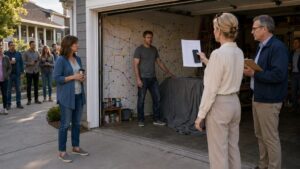
The HOA Sent A Crew To Tear Out The Ramp Beside His Mountain Cabin
Chapter 1: The Crew Was Already Pulling Up The Ramp
The first crack came before Edward Walker had both boots on.
It snapped through the cabin wall like a bone breaking—sharp, wrong, too close to the front door. Edward froze beside the kitchen chair, one socked foot half inside his muddy boot, his hand still gripping the heel. A second sound followed: metal biting wood, then the strained squeal of a board being levered loose.
From the bedroom, Emma called, “Edward?”
He did not answer right away. He stood still long enough to hear the scrape again. Not wind. Not a branch. Not one of the pine limbs dropping after a cold night.
A pry bar.
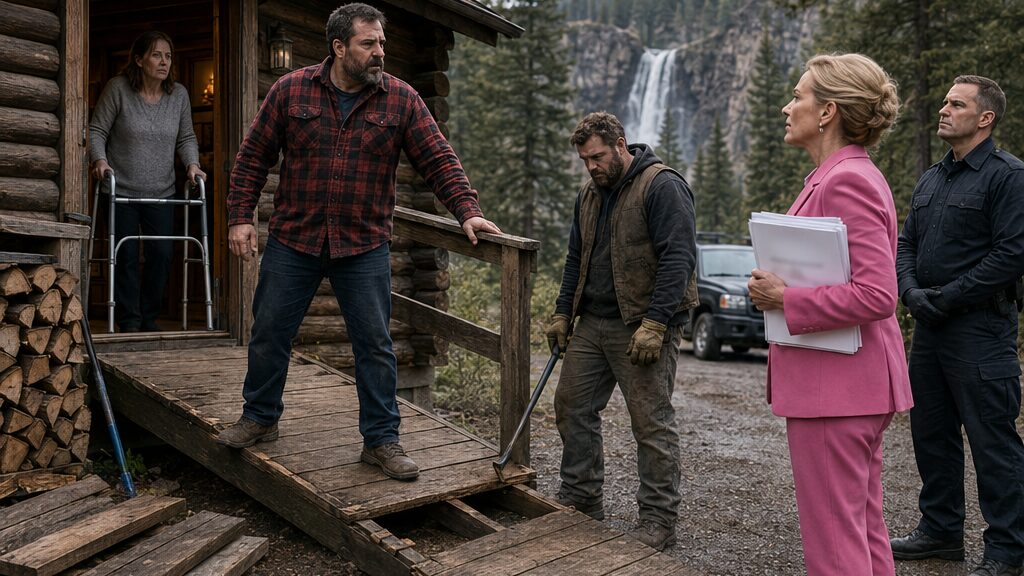
Edward shoved his foot down into the boot, grabbed the red-and-black plaid shirt from the back of the chair, and crossed the kitchen in three strides. Through the narrow window beside the door, he saw two men in work gloves bent over the ramp.
His ramp.
One of them had already lifted the outer board at the lower landing. Another stood near the posts with a cordless saw hanging from one hand. Beside the driveway, a white truck idled with its tailgate down. Orange cones marked the gravel like the cabin had become a work site. Three loosened boards lay on the ground near the firewood stack, pale undersides showing against the dark split logs.
Edward opened the door hard enough for the handle to hit the inside wall.
“Stop.”
The worker with the pry bar looked up first. He was a broad man with a short beard and a yellow vest over a dark hoodie. The name printed on his vest was partly hidden by a strap. He straightened, keeping one boot on the ramp board as if it might jump back into place.
“Morning,” he said, not sounding like it was.
“Put the bar down.”
The second worker lowered the saw, but not all the way. The motor was off. The blade still faced the handrail.
The man with the pry bar glanced toward the driveway. “You Edward Walker?”
“You’re standing on my porch.”
“That’s what I’m asking.”
Edward stepped onto the top platform of the ramp. It flexed beneath him because they had already pulled loose two screws from the outer edge. He felt the movement through his boot, a small shift that sent heat up the back of his neck.
“I said stop.”
The broad man took the pry bar off the board, but he did not set it down. “I’m Andrew Baker. We were contracted for removal.”
“By who?”
Andrew’s eyes moved again toward the driveway. “Association.”
Edward looked past him.
A dark SUV had stopped behind the work truck. Its door opened, and Catherine Roberts stepped out as if she had arrived for a hearing instead of a demolition. Bright pink pantsuit. Heels that had no business on gravel. Blonde hair pinned back tightly enough to pull her expression into something already sharpened. Under one arm she carried a white folder thick with papers. Behind her came Daniel Smith in a dark community security uniform, one hand resting near his belt, his face set into the careful blankness of a man who had been told not to take sides.
Catherine looked at the half-loosened ramp, then at Edward, then at the open cabin door behind him.
“Mr. Walker,” she said. “Please step away from the structure.”
Edward did not move.
“It’s not a structure,” he said. “It’s the way my wife gets out of this house.”
Catherine came closer, lifting the folder as if it were a shield. “It is an unauthorized exterior alteration installed without final board approval.”
Andrew shifted his weight. The loosened board creaked under him.
Edward heard Emma’s walker inside before he saw her. Two small rubber-tipped thuds. A pause. Another thud. He turned just enough to see her in the dim doorway behind the screen, one hand tight around the walker grip, the other braced against the frame. She had not put on her sweater. Her hair was still loose from sleep. Her eyes went first to the missing board, then to the gap between the threshold and the ramp.
She stopped.
Edward’s hand curled around the porch rail.
Catherine saw her too. For one second, something in her face changed—not remorse, not softness, but calculation. The folder lifted higher.
“Mrs. Walker should stay inside until the area is cleared,” Catherine said. “This is exactly why unauthorized construction creates liability.”
Edward turned back slowly.
“You removed the boards that made it safe,” he said.
“We are removing non-compliant work that never should have been installed.”
“You started before you spoke to me.”
“We are not required to debate enforcement on-site.”
“No. You’re required to notify the homeowner before sending men with saws onto his property.”
Daniel took one step forward, palms open. “Mr. Walker, let’s keep this calm.”
Edward looked at him. “Then tell them to stop.”
Daniel’s gaze flicked toward Catherine.
That was enough.
Edward took out his phone and started recording. He held it low at chest height, pointed toward the boards, the crew, Catherine’s folder, Daniel’s uniform, the open doorway where Emma stood trapped behind the gap.
Catherine’s mouth tightened. “You do not have permission to record association enforcement personnel.”
“I’m on my property.”
“You are interfering with authorized compliance work.”
“I’m documenting trespass and damage.”
Andrew lowered the pry bar a few inches. The second worker took his finger off the saw trigger.
Catherine stepped close enough that Edward could see the tiny gold clasp on the folder. “The board issued its decision. You were instructed to remove the ramp voluntarily. You refused.”
“I received no decision.”
“The notice was served.”
“When?”
Catherine opened the folder, pulled out a sheet, and held it up without handing it to him. Her manicured finger tapped a line near the top. “The denial was entered two days ago.”
Edward stared at the date.
Two days ago, he had driven Emma down the mountain for an appointment because the original steps had been too slick from runoff to trust. Two days ago, he had checked the mailbox at the bottom of the road. Nothing. Checked his email. Nothing. Checked the porch. Nothing but pine needles and the grocery delivery receipt tucked under the mat.
“You entered it,” he said. “You didn’t serve it.”
“We have a delivery record.”
“Show it to me.”
Catherine lowered the paper back into the folder. “You can request copies through the management portal.”
Edward almost laughed, but Emma shifted behind him and the sound died in his chest. Her walker scraped against the threshold. She was testing the distance with her eyes, calculating whether she could cross it. He knew that look. He had seen it at the clinic entrance when the automatic doors had failed. At the grocery store when someone parked over the curb cut. At their own old steps the night she fell and refused to cry until he had carried her inside.
“Emma,” he said without turning, “don’t try.”
“I can see that,” she said quietly.
Andrew looked at her then. Really looked. His grip changed on the pry bar.
Catherine’s voice sharpened. “Mr. Baker, continue.”
Andrew did not move.
Edward stepped down one level on the ramp, placing himself between Andrew and the remaining boards. The whole frame shifted under him where the screws had been pulled, but he kept his balance and lifted the phone a little higher.
“No more boards come off,” he said, “until I have the order in writing and you acknowledge, on camera, that this ramp is a medical accommodation.”
Catherine’s eyes widened. For a moment, she looked exactly like someone who had expected anger and found a wall instead.
“It is not a medical accommodation just because you say so.”
“It became one the night my wife couldn’t climb those steps.”
“Then you should have submitted complete documentation.”
“I submitted an emergency request.”
“You submitted an incomplete request for a visually non-conforming ramp.”
Edward looked toward the firewood stack. The boards they had already removed lay beside it, lined up like scrap. He had sanded those edges himself. Measured the slope twice. Rebuilt the lower landing when the first angle was too steep. Emma had stood in the doorway that evening and said it looked like a bridge.
Now Catherine was calling it a violation.
Daniel cleared his throat. “Catherine, maybe we should pause until—”
“The board has already denied the ramp,” Catherine said, cutting him off. “The removal order stands.”
Edward turned back to her. “Denied when?”
“I told you. Two days ago.”
“And I’m telling you,” Edward said, his voice low enough that Andrew had to lean in to hear it, “nobody told me.”
Chapter 2: The White Folder Did Not Show Everything
Edward found the denial letter folded behind a glossy photograph of his own ramp.
Catherine had not meant to leave the folder on the porch rail. She had set it there only long enough to take a call from someone at the association office, pacing near the SUV with her back to the cabin, her pink sleeve bright against the dark pines. Daniel stood halfway between her and Edward, pretending not to watch the phone still recording in Edward’s hand. Andrew and the crew had backed away from the ramp, tools idle, boards still stacked beside the firewood like evidence no one had agreed to call evidence yet.
The folder sat open.
Edward did not touch the loose papers at first. He only looked.
The top page showed a color photo of the ramp taken from below, the angle chosen to make it look larger than it was. The medical rail on the right side had been cropped out. So had the slick original stairs. So had the trench where water ran under the lowest step when the waterfall trail overflowed.
Across the photo, someone had typed: UNAUTHORIZED EXTERIOR STRUCTURE.
Edward felt the words settle against his ribs.
He reached for the paper beneath.
“Edward,” Emma said from inside.
He looked back. She sat in the chair he had dragged near the doorway, the walker folded beside her, her hands clasped too neatly in her lap. The missing board made a dark mouth between the threshold and the ramp.
“I’m not stealing,” he said.
“I didn’t say you were.”
He unfolded the denial letter.
The date was two days old. The language was older than that, or at least it felt like it had been written long before anyone cared whose door it belonged to. Pursuant to Article Seven. Visual consistency. Exterior alteration. Failure to obtain final approval. Removal required. Costs billed to owner.
Near the bottom, a line read: Medical necessity not established by submitted materials.
Edward read that line twice.
Then again.
Catherine returned before he could fold it back. Her eyes dropped to the letter in his hand. “That is association property.”
“This is about my property.”
“You were not authorized to review the full enforcement file.”
“You left it on my rail.”
“That does not give you permission to remove documents.”
He held it out, not letting go when she took the other edge. “Medical necessity not established,” he said. “That’s what you wrote.”
“That is what the board determined.”
“You had the clinic note.”
“A note saying your wife had limited mobility and would benefit from reduced stair use is not the same as a complete accommodation packet.”
Edward’s jaw tightened.
Emma looked down at her hands.
Catherine noticed. Her voice shifted into something almost gentle, which made it worse. “No one is questioning that Mrs. Walker has difficulty. But the association cannot approve permanent exterior modifications based on vague language. We have standards. We have liability. If every owner installs whatever they consider necessary, the entire mountain side becomes inconsistent.”
“The mountain side?” Edward said. “You mean houses won’t match.”
“I mean emergency access, insurance exposure, structural safety, slope requirements—”
“I built it to code.”
“You are not the board’s engineer.”
“No. I’m the person who watched my wife fall on those steps.”
The words landed harder than he expected. Emma’s hands tightened. He had not said it outside the house before. He had barely said it inside.
Daniel stepped nearer, lowering his voice. “Mr. Walker, I didn’t know there was a fall.”
Edward looked at him. “Did anybody ask?”
Daniel said nothing.
Catherine slid the denial letter free and tucked it back into the folder. “The appeal process remains available. Until then, the removal order—”
“Was scheduled before the appeal window closed,” Daniel said.
Catherine turned.
The words had come out quietly, but in the mountain air quiet traveled.
Edward looked at Daniel. “What did you say?”
Daniel swallowed. His face had lost some of its official stillness. “The crew schedule came through yesterday afternoon. I was assigned this morning. I assumed notice had already been served.”
“It had,” Catherine said.
Daniel kept his eyes on the ramp. “The work order said removal to begin at eight.”
Edward glanced at the cabin clock through the window. It was not yet eight-thirty.
“When was the notice delivered?” Edward asked.
Catherine’s smile looked stapled on. “Again, records can be requested.”
“When?”
She closed the folder. “This morning.”
The second worker near the truck looked away.
Edward let the silence hold.
“This morning,” he repeated. “When the crew was already here.”
Catherine’s face flushed above the collar of her jacket. “Door notice is a recognized method of service under the association rules.”
“You taped a denial to the door after your crew started pulling boards.”
“I did not personally tape anything.”
“That makes it better?”
Catherine drew herself up. “Mr. Walker, you installed this without final approval.”
Edward went inside before he answered. Not because he was finished, but because if he kept standing on that broken ramp, he would say too much in front of people who would turn every word into a note.
At the kitchen table, he pulled his own folder from the drawer beside the stove. Brown, worn at the corners, soft from years of tax receipts, appliance warranties, and cabin permits. He opened it in front of Emma.
There was the materials receipt from the lumberyard. The handrail invoice. The sketch he had made on graph paper with the slope marked in pencil. The emergency request form. The email confirmation from the management portal: Submitted.
And the clinic note.
Emma watched him lay it down.
“That’s the one you sent?” she asked.
Edward did not answer quickly enough.
Her eyes lifted to his.
“It says reduced stair use,” he said.
“I know what it says.”
“You asked me not to make you a file.”
“I asked you not to let strangers talk about me like I was furniture.”
He looked away.
Outside, Catherine’s voice rose and fell, clipped and controlled. Andrew answered once, too low to make out. The truck engine idled. The waterfall beyond the trees kept pouring over stone, steady as if none of this mattered.
Edward touched the edge of the clinic note.
The full letter was not in the folder. He knew exactly where it was: sealed in the blue envelope Emma had brought home from the specialist, tucked in the bottom drawer of their bedroom dresser because he had not been able to make himself upload it. The letter did not just say reduced stair use. It said progressive weakness. Increased fall risk. Medically necessary barrier-free entrance. Avoid independent stair use during wet or icy conditions.
It said things Emma hated seeing written.
It said things Edward hated knowing were true.
He heard Catherine outside again: “Mr. Baker, you are still under contract.”
Andrew replied, “I’m not touching anything else until someone sorts out notice.”
Edward almost felt grateful, then stopped himself. Andrew had still pulled up the boards.
Emma pushed herself up from the chair, one hand on the table, the other reaching for the walker. Edward rose automatically.
“Don’t,” she said.
He froze.
She got herself standing. It took longer than it should have. Longer than it had last spring. Her mouth stayed flat with effort, but she made it upright, squared the walker, and faced him across the table.
“You told them enough to make it sound optional,” she said.
“I was trying to keep your privacy.”
“No,” she said. “You were trying to keep your promise without letting anyone see what it cost.”
Edward looked toward the porch, where the missing board had turned their front door into a ledge.
Emma’s voice softened, but it did not let him go.
“Why didn’t you show them the full doctor’s letter?”
Chapter 3: The Board Called Safety An Appearance Problem
The first slide at the hearing showed Edward’s ramp from the worst possible angle.
It filled the screen at the front of the mountain community lodge, larger than life, larger than the room, larger than the truth. The photo had been taken from the gravel driveway looking upward, so the rail seemed to jut from the cabin like an unfinished deck. The missing boards from the removal attempt were not visible. Neither was Emma’s chair by the doorway, or the walker folded beside it, or the old stairs darkened by runoff.
Only the ramp.
Only the accusation.
Under the image, in bold black letters, Catherine Roberts had written: UNAUTHORIZED STRUCTURE — WALKER PROPERTY.
Edward sat in the second row with his worn brown folder across his knees. Emma had stayed home. Not because Catherine had asked, though Catherine had suggested in an email that “attendance by medically fragile household members may not be productive.” Emma had stayed because the ramp was still missing a board and the temporary plywood Edward had screwed across the gap was safe enough for him, not for her.
That was the part he had not said when he left.
He had kissed the top of her head, promised to call, and carried more guilt than paper down the mountain road.
Catherine stood beside the screen in the same pink suit, the white folder open on the table before her. Around the long table sat the HOA board members, faces lit by the projector. Rachel Allen, the treasurer, sat near the end with a pen in her hand and a stack of budget reports she had not touched. Daniel Smith stood by the back wall in uniform, officially present for “meeting security,” though Edward noticed he had chosen a place where he could see both Catherine and the door.
Catherine clicked to the next slide.
A sample deck from another cabin appeared: stained wood, matching rails, approved dimensions.
“Our standards are not arbitrary,” Catherine said. “They preserve consistency, reduce insurance risk, and prevent unsafe modifications on steep lots. Mr. Walker’s installation did not receive final approval, did not match approved materials, and was built before review was complete.”
A board member asked, “Did he submit anything?”
Catherine turned a page. “An emergency alteration request was submitted. It lacked engineering signoff, complete medical accommodation documentation, and exterior finish specifications.”
Edward stood.
Catherine looked at him over the folder. “Public comment will occur after the compliance summary.”
“I’m not the public,” Edward said. “That’s my house on your screen.”
A few residents seated in the back shifted in their folding chairs.
Catherine’s eyes narrowed, but she gave a small nod. “Briefly.”
Edward opened his folder. The paper edges trembled once before he steadied them with his thumb. “I submitted the request the morning after my wife fell. I included a clinic note, a materials list, and a drawing with measurements. Nobody responded for twelve days.”
“Because the packet was incomplete,” Catherine said.
“You didn’t say that for twelve days.”
“The management office receives many requests.”
“Not many that decide whether somebody can leave their house.”
The room changed at that. Not dramatically. No gasp. No murmur big enough to be called one. But several heads turned. Someone in the back stopped whispering.
Catherine pressed her lips together. “Again, no one disputes that your household may have needs. But the board cannot be expected to ignore procedure because a resident chooses to begin construction early.”
Edward almost reached for the full doctor’s letter.
He had brought it. It sat in the folder inside the blue envelope, still sealed again after Emma had handed it to him and said, If you use it, use all of it. Don’t make me sound smaller than I am.
His fingers found the envelope edge.
Then he saw Catherine waiting.
Waiting for him to turn Emma into the subject of the room. Waiting to bring it back to incomplete documentation. Waiting to make his wife’s body a form.
He let go of the envelope.
“I’m asking why your denial letter was served after your crew started removal,” he said.
Catherine clicked off the projector. “Service was completed in accordance with our rules.”
Daniel’s gaze lowered.
Edward turned slightly. “Mr. Smith was there.”
Catherine’s voice sharpened. “Mr. Smith is not on the board.”
“But he saw your crew already pulling boards.”
Daniel’s face tightened. Rachel Allen’s pen stopped moving.
Catherine closed the folder. “Mr. Walker, this hearing concerns the violation itself. If you wish to file a procedural complaint, you may do so separately. The issue before the board is whether an unauthorized structure may remain.”
Rachel looked up then. “May I ask something?”
Catherine glanced toward her. “If it concerns the alteration.”
“It does.” Rachel turned to Edward. “Your old front steps. Were they damaged before you built the ramp?”
Edward felt the question land somewhere beneath the table.
“Yes.”
“Damaged how?”
Catherine’s hand closed over the folder. “Rachel, structural issues with preexisting steps are not part of this violation.”
Rachel’s face colored faintly, but she kept looking at Edward.
He answered anyway. “The lower tread shifts when it’s wet. The posts have been soft since spring. Water runs under them from the trail side after heavy rain.”
Catherine said, “That is the owner’s maintenance responsibility.”
“The water comes from above my lot.”
Rachel’s pen moved once across her notepad. “From the waterfall channel?”
The room went still.
Catherine turned her head slowly. “We are not opening common-area drainage tonight.”
“I only asked because it may affect urgency,” Rachel said.
“The urgency was created by unauthorized construction.”
Edward stared at Rachel, but she looked back down before he could read her face. Her question had not sounded casual. It had sounded like a door opened one inch and shut by fear.
The board moved on. Catherine restored the projector and showed more photos: the ramp rail, the landing, the mismatched fresh boards against the older cabin logs. She used words like precedent and exposure and architectural integrity. Edward heard them, but he kept thinking of the way Rachel had said waterfall channel.
At the end, Catherine proposed the board’s resolution. The fine would stand. The ramp would remain removed. Edward could submit a new application after removal was complete, including engineering drawings and full documentation. If approved, construction might begin in six to eight weeks, weather permitting.
“Winter’s in less than that,” Edward said.
“Then you should have waited for approval before building.”
He rose so fast the chair legs scraped the lodge floor. “My wife fell.”
Catherine’s expression did not soften. “And I am sorry for that. But personal circumstances do not erase community rules.”
There it was. Clean. Polite. Cruel because it sounded reasonable.
A board member suggested reducing the fine if Edward agreed not to reinstall any portion of the ramp until the new application was reviewed. Catherine accepted the amendment. Rachel did not speak. Daniel watched the floor.
Edward looked at the photo still on the screen. His ramp, stripped of context. His work turned into proof against him. His silence turned into Catherine’s strongest argument.
He gathered his folder and walked out before they finished talking about him like he had already left.
The air outside the lodge was colder than inside, carrying the wet mineral smell from the falls. Edward had made it halfway to his truck when footsteps hurried behind him.
“Mr. Walker.”
Rachel Allen came down the lodge steps with her coat open and her budget papers pressed against her chest. She looked back once before crossing the gravel.
“I shouldn’t be doing this,” she said.
Edward waited.
She took a torn corner from her notepad and pressed it into his hand. On it was a date from three years earlier and three words written beneath it.
Waterfall channel repair.
Edward looked up.
Rachel’s voice dropped almost to nothing.
“Ask about the waterfall channel.”
Chapter 4: The Water Had Been Cutting Under The Steps
The lower stair sank under Edward’s boot before he put his full weight on it.
It did not crack. It gave way slowly, with a wet inward sigh, the kind of movement wood made when it had stopped being wood in the places that mattered. Edward grabbed the porch post and caught himself, his shoulder slamming against the rail they had not yet removed. Beneath his boot, brown water welled up through the seam between the tread and the riser.
He stood there a moment, breathing through his nose.
The ramp had hidden the worst of it.
Not hidden from him, exactly. He had known the steps were bad. He had replaced two boards in spring, tightened the loose rail, wedged gravel under the lowest post, told himself he had bought enough time until the association dealt with the drainage above the property line.
Then Emma fell.
Then time stopped being something he could buy.
Edward stepped back onto the porch and crouched, phone in one hand, flashlight in the other. He filmed the lower tread from above, then from the side, then the dark line where water had cut under the foundation stones. The missing ramp board left a raw rectangle near the landing. Mud filled two of the screw holes where the crew had backed the fasteners out. He touched one finger to the hole and brought it up slick with black grit.
From inside the cabin, Emma called, “What was that?”
“Step moved,” Edward said.
“How much?”
He looked at the sagging tread.
“Enough.”
“That means don’t stand on it.”
“I’m not.”
“You always say that while standing on the thing.”
Edward almost smiled. Almost. Then he saw the water move again.
It seeped from uphill, not from beneath the cabin. A thin steady thread ran along the side of the old stone edging, down through pine needles, and under the step where the soil had hollowed away. He followed it with his eyes toward the tree line.
The waterfall itself was farther back, beyond the community trail, spilling down the rock face in a silver sheet visitors loved to photograph. But its runoff did not stay picturesque. After rain, it gathered in a channel above the cabins, crossed under the trail through a culvert, and spread into the lots below when the trench clogged. Edward had complained once at a seasonal meeting, then twice through the portal, then stopped when the replies came back with phrases like owner-side grading and natural mountain drainage.
He had thought the problem was slow.
Now he was looking at the underside of the stairs and seeing what slow could do.
He took the scrap of paper from his shirt pocket. Rachel’s handwriting was cramped, almost apologetic.
Waterfall channel repair.
The date was three years old.
Edward went behind the cabin to the narrow strip of land where pine roots broke through the soil. He moved carefully, one hand brushing trunks for balance. The runoff line was easy to follow once he stopped pretending it was random. It had carved a shallow path through the needles, dark as a vein. At the upper edge of his lot, half-buried under leaves, he found an old orange marker flag, sun-bleached nearly white.
Someone had marked this before.
He crouched and filmed it.
A truck door closed down by the driveway.
Edward turned.
Andrew Baker stood beside the firewood stack, hands out of his pockets, wearing the same work vest without the confidence he had worn the first morning. No crew this time. No saw. No pry bar. Just him, looking at the ramp boards that still lay where his men had stacked them.
“I didn’t come to work,” Andrew said.
Edward stayed where he was. “Then why are you here?”
Andrew glanced toward the cabin. “Wanted to see if the temporary board held.”
“That concern part of the contract?”
“No.”
Edward walked down the slope, phone still in his hand. “Catherine send you?”
Andrew shook his head. “She’d be unhappy if she knew I was here.”
“That supposed to help me trust you?”
“No.” Andrew looked at the lower steps. “It’s supposed to be true.”
Edward stopped a few feet away.
Andrew pointed at the sagging tread. “That wasn’t in the photos.”
“You mean the photos she showed the board?”
“I mean the photos we were told to take.” Andrew’s jaw shifted. “We photographed the ramp from the driveway, the rail, the landing, side view. We were told not to photograph under the stairs.”
Edward felt something cold move through him that had nothing to do with the mountain air.
“Who told you that?”
Andrew did not answer at first. He looked toward the trees, then down at his boots. “The work packet said removal was limited to non-compliant structure. Avoid unrelated owner-maintenance areas.”
“That’s not who. That’s paper.”
Andrew’s mouth tightened. “Catherine called me the night before. Said the owner was combative. Said if we started discussing the old stairs, you’d try to delay enforcement.”
Edward stared at him.
Andrew added, quieter, “She said the ramp was a deck extension.”
“My wife was standing in the doorway.”
“I saw.”
“After you pulled boards.”
“I know.”
The admission did not fix anything. Edward hated that part of him wanted it to. He looked past Andrew at the boards beside the firewood, their screw holes torn wide where the pry bar had split a corner. He had built them straight. Andrew had undone them cleanly at first, then roughly when the screws resisted.
“Why tell me now?” Edward asked.
Andrew rubbed a thumb over the edge of his vest. “Because I bid jobs for that association. Stairs, decks, railings, drainage sometimes. If I make Catherine mad, I lose work. But if somebody gets hurt because I helped hide a bad step, that’s on me too.”
“Is that conscience or liability?”
Andrew gave a short breath. “Both.”
That was the first honest thing Edward had heard from anyone wearing an association logo.
He walked to the stairs, crouched, and aimed the phone under the lowest tread. “Say what you just said.”
Andrew’s head lifted. “On video?”
“You came here to tell the truth. Tell enough of it.”
“I can’t accuse—”
“I didn’t ask you to accuse. I asked what you were instructed not to photograph.”
Andrew looked toward the cabin door. Emma stood behind the screen, one hand on the walker, watching both men. She was too far to hear all of it, but close enough to know the shape of the conversation.
Andrew saw her and swallowed.
Edward pressed record.
Andrew gave his name. He gave the date. He said the crew had been instructed to document the ramp but not the stair condition. He said the removal began before he personally saw any proof that Edward had been served. He said, after a long pause, that he had not understood the ramp was being used as an access accommodation until Emma appeared at the doorway.
When he finished, the waterfall filled the silence.
Edward stopped recording. “You willing to say that at the appeal?”
Andrew looked at the truck. “I didn’t say there’d be an appeal.”
“There will be.”
Before Andrew could answer, another vehicle came up the gravel road. Not Catherine’s SUV. A smaller association car with the mountain community seal on the door. It stopped behind Andrew’s truck. Daniel stepped out first, expression tight. Catherine followed.
Not in pink this time. Dark coat, white folder, no heels. She looked at Andrew, then at Edward’s phone, then at the open dirt under the stairs.
“You should not be on this property,” she said to Andrew.
Andrew’s face closed.
Edward stepped between them. “He was invited.”
Catherine held up a new paper. “Mr. Walker, continued obstruction of authorized enforcement has been documented. The board has issued an additional notice.”
Daniel did not meet Edward’s eyes.
Catherine extended the page.
Edward took it without looking away from her.
The words were bold across the top: INTERFERENCE WITH COMPLIANCE ACTION.
A fine amount sat halfway down the page. Larger than the first.
“You’re fining me because I stopped you from leaving my wife without an entrance,” Edward said.
“We are fining you because you interfered with lawful association enforcement and attempted to expand the matter into unrelated owner maintenance.”
Edward folded the notice once, very carefully, and put it in his shirt pocket with Rachel’s note.
Then he walked past Catherine to the old stone edging under the pines. The water still ran there, thin and steady. He knelt and brushed away wet needles until his fingers hit something flat.
Not rock.
A piece of stained concrete, old and squared at the corner. Beside it, half buried in silt, another orange marker flag lay pressed into the mud.
Edward cleaned the surface with his thumb. A dark line cut across the concrete at the same height as a stain on the stair post below.
He looked from the stain to Rachel’s date, then up toward the waterfall channel.
Someone had marked the water path years before Emma ever fell.
Chapter 5: Emma Refused To Be Protected In Silence
Emma reached the porch gap before Edward could stop her.
He had been at the kitchen table with the interference notice, Rachel’s note, Andrew’s recording, and the full doctor’s letter all spread before him in separate piles, as if distance could keep them from becoming the same problem. The screen door creaked behind him. By the time he turned, Emma had the walker squared at the threshold and one foot angled toward the temporary plywood.
“Emma.”
She did not look back.
The evening light cut across the porch, catching the empty slot where the removed board should have been. Edward had fastened plywood over it, two screws at each end, strong enough for him to cross with a load of groceries. But he knew its slight bow. He knew the way it shifted if weight came down near the edge. He had meant to fix it again before dark.
Emma set the walker forward.
“Don’t,” he said, sharper than he meant.
She stopped. Her shoulders lifted once with breath. Then she turned her head just enough for him to see the anger in her profile.
“Do you hear yourself?”
He stood but did not step toward her. “That board isn’t right.”
“No,” she said. “It isn’t.”
The words stayed between them.
Outside, the removed ramp boards lay beside the firewood in the blue-gray dusk. The same boards Edward had measured, sanded, sealed. They looked different now, not like lumber waiting to be used but like parts of the house that had been taken from it. The firewood stack rose neatly behind them, winter-ready, practical, obedient. The boards lay at its base like something punished.
Emma backed the walker inside and sat in the chair near the door. Not because she wanted to. Because she had to. Edward saw the effort it took her to keep the frustration from her face, and that made him feel worse than if she had shouted.
“I was going to reinforce it,” he said.
“You were going to do everything.”
He looked down at the papers on the table.
Emma followed his gaze. “Did you watch Andrew’s video again?”
“Once.”
“Three times,” she said.
He did not deny it.
She pushed the walker aside and reached toward the bedroom hallway. “Bring me the blue envelope.”
Edward’s hand tightened on the chair back. “We don’t have to decide tonight.”
“Yes, we do.”
“The hearing’s tomorrow.”
“That’s why.”
He went to the bedroom because refusing would have been another kind of answer. The envelope was in the bottom drawer, beneath folded scarves she rarely wore now and the thick socks she used when the floor made her feet ache. He brought it out with both hands, though it weighed almost nothing.
Emma took it from him and pulled out the letter.
“You already opened it,” she said.
“I put it back.”
“That’s not what I asked.”
Edward sat across from her. The table between them was covered in proof of everything he had tried to manage without making it real.
Emma unfolded the letter. Her fingers were steady. That struck him most. His were not.
She read the first paragraph silently, then the second. Her mouth tightened at the phrases he had avoided. Progressive weakness. Increased fall risk. Barrier-free entrance. Avoid independent stair use during wet or icy conditions. The language was clean, clinical, and merciless.
“This is what they needed,” she said.
“I didn’t want them passing it around a board table.”
“I didn’t either.”
“That’s why I sent the clinic note.”
“You sent a softer version because you wanted them to understand without seeing.”
Edward leaned back. “Is that so wrong?”
Emma looked at him for a long moment. “It became wrong when they started tearing out the ramp.”
The house was quiet except for the refrigerator hum and the waterfall beyond the trees. Edward hated how loudly he could hear both.
“I promised you we’d stay here,” he said.
“I know.”
“I promised you I’d make it work.”
“You did make it work. Then you hid the reason it had to work.”
He looked toward the door.
Emma lowered the letter to the table. “Do you think I don’t know what I look like when I use the walker?”
“Don’t.”
“No. You don’t.” Her voice was not loud, but it cut through the room. “You look away before I have to see you seeing it.”
Edward’s face went hot.
“That isn’t shame,” he said.
“I didn’t say it was.”
“Then what are you saying?”
“I’m saying you keep standing in front of me like love means nobody gets to know I’m here.”
The words found the place he had been guarding and pressed until it gave.
He wanted to tell her about the night she fell, as if she had not been there. About lifting her from the wet steps with mud on her sleeve, about the way she had apologized before she let herself cry, about the promise that had formed in him before he could think better of making promises to mountains and bodies and time. He wanted to say he was scared. He wanted to say it plainly.
Instead he said, “I didn’t want them using you.”
Emma’s expression softened just enough to hurt. “Then don’t let them. But don’t erase me to protect me from being used.”
A vehicle door closed outside.
Edward stood at once.
Emma looked toward the window. “Who is it?”
He moved the curtain aside. Catherine’s SUV sat in the driveway, engine running. She stood alone this time beside the hood, white folder tucked under one arm, a different envelope in her hand.
Edward opened the door but did not step onto the plywood. “It’s late.”
“This will only take a moment,” Catherine said.
Emma reached for the walker behind him.
Edward heard it and closed his eyes once.
Then he stepped aside.
Catherine’s gaze moved past him into the cabin. She saw Emma at the table, the unfolded doctor’s letter, the papers laid out in rows. Something flickered in her face, annoyance or concern or calculation.
“I’m here to offer a practical resolution,” Catherine said.
Edward stayed by the door. “The hearing is tomorrow.”
“And unnecessary conflict helps no one.” She held out the envelope. “The board is prepared to waive the new interference fine and reduce the original violation penalty if you agree to remove the remaining ramp components and resubmit through the proper process.”
Emma laughed once. It had no humor in it.
Catherine continued, eyes on Edward. “We would also agree not to pursue additional enforcement for the temporary plywood, provided it is removed within ten days.”
Edward took the envelope but did not open it. “And the waterfall channel?”
Catherine’s expression hardened. “That is a separate maintenance matter.”
“Is it in this offer?”
“No. Because it is not relevant to the violation.”
Emma pushed herself upright with both hands on the table. Edward turned instinctively, but she was already standing.
“It is relevant to my stairs,” she said.
Catherine adjusted her folder. “Mrs. Walker, I understand this is difficult.”
“Do you?”
The question was quiet. Catherine did not answer it.
Edward opened the envelope. The agreement was two pages, already marked with tabs where he was supposed to sign. He read enough.
Withdraw interference fine. Reduce violation fine. No admission of error. Owner agrees not to raise unrelated drainage claims in connection with ramp appeal.
There it was. Clean as a blade.
He laid it on the table beside the doctor’s letter.
Emma looked at him. Not pleading. Not directing. Waiting.
For years, Edward had loved her partly by moving first—opening doors, clearing snow, carrying baskets, fixing rails before she asked. He had told himself that was what steadiness meant. But now the door was open, and the next step was not his alone unless he made the same mistake again.
He picked up the agreement.
Catherine said, “I would advise you to think carefully. Hearings create records.”
Edward looked at the full doctor’s letter. Then at Rachel’s note. Then at the boards outside, stacked beside the firewood in the fading light.
He tore the agreement once across the signature line.
Catherine’s face went still.
Edward tore it again, slower this time, and set the pieces on the table.
“We’ll keep the hearing,” he said.
Chapter 6: The Hearing Turned On The Missing Minutes
“This hearing is not about medical history,” Catherine Roberts said before Edward had even sat down.
Her voice carried cleanly across the community lodge meeting room, polished and ready, as if the sentence had been waiting in her white folder all morning. Behind her, the projector screen showed no photo this time. Only the association seal and the words WALKER APPEAL — EXTERIOR ALTERATION VIOLATION.
Edward stood in the doorway with Emma beside him.
That was the part Catherine had not prepared for.
Emma’s walker touched the floor once, then again. Every head turned toward the sound. Edward kept his hands at his sides. He did not reach for her elbow. He did not move ahead to clear the aisle. Emma had made him practice that in the kitchen before they left.
“If I want help, I’ll ask,” she had said.
Now she moved under the lodge lights at her own pace, chin lifted, the full doctor’s letter in a folder pressed against the walker seat. Edward walked beside her, not in front.
Daniel Smith stood at the back wall again, but his posture changed when he saw them. Andrew Baker sat near the side aisle in a clean work shirt, hat in his hands. Rachel Allen was at the board table, pale, with a thick binder closed before her.
Catherine recovered first. “Mrs. Walker, accommodations could have been arranged if we were notified you planned to attend.”
Emma stopped beside the second row. “I am attending because the accommodation at my house was removed.”
No one spoke.
Edward pulled out a chair for her, then stopped before touching it. Emma gave him a small glance, and he let go. She sat when she was ready.
Catherine turned back to the room. “As I said, this hearing concerns whether Mr. Walker installed an unauthorized exterior structure without final approval. The board cannot allow emotionally difficult circumstances to override governing documents.”
Edward opened his folder. Not the worn brown one alone now. Beside it lay Emma’s folder, Andrew’s statement, photos of the stairs, Rachel’s handwritten note, and printouts of every portal submission he could find.
When Catherine invited him to speak, her tone suggested he had five minutes to be unreasonable.
Edward stood.
“My wife fell on the original steps after water undermined the lower tread,” he said. “I submitted an emergency request for a ramp. The association did not respond before I built it. Then a crew arrived and began removal before I received the denial.”
Catherine lifted a hand. “The medical claim remains unsupported within the original packet.”
Emma’s fingers tightened on the walker.
Edward felt it more than saw it. He reached for the blue folder but did not open it yet.
“Correct,” he said.
Catherine blinked. She had not expected agreement.
Edward looked at the board. “The original packet did not include the full letter because I chose not to include it. That was my decision. Not my wife’s.”
Emma turned her head slightly toward him.
He kept going before he could retreat into safer words. “I thought I was protecting her privacy. What I did was give this board a reason to pretend the ramp might be optional.”
Catherine’s mouth pressed flat. “That does not change the fact that—”
“It changes whether you understood what you were removing.”
He placed Emma’s doctor’s letter on the table, but he did not read it aloud. He slid it to the board secretary. “The board can review it privately for the accommodation record. My wife is here to speak for herself if she chooses.”
A long quiet followed.
Emma did not stand. She did not need to. “The ramp is not a convenience,” she said. “It is how I leave my home without deciding whether today is the day I fall again.”
No one moved.
Catherine looked down at her folder. “The association is sympathetic. But sympathy does not eliminate architectural review.”
Rachel Allen opened her binder.
The sound was small, but Catherine heard it. Her head turned.
Rachel removed a stack of copied minutes and placed them in front of her. “Before architectural review, I need to correct something.”
Catherine’s voice lowered. “Rachel.”
Rachel did not look at her. “The lower step damage may not be solely owner maintenance.”
The room shifted, not loudly, but with the collective movement of people realizing a meeting had changed shape.
Rachel pushed the first page toward the center of the table. “Three years ago, the board discussed repairs to the waterfall trail drainage channel above the Walker lot. The work was postponed because bids came in higher than expected.”
Catherine closed her folder. “Those minutes concern common-area maintenance budgeting. They are not relevant to whether Mr. Walker built without approval.”
Rachel turned another page. “The issue came up again the following spring after water spread across two downhill lots.”
Edward looked at her hands. They trembled once before she flattened them on the paper.
“Why didn’t you say that last meeting?” a board member asked.
Rachel swallowed. “Because I was afraid of what it would cost.”
No one rescued her from the sentence.
She continued, quieter. “As treasurer, I advised delaying the repair. I told myself we could monitor it another season. I did not connect that decision to Mrs. Walker’s fall until I saw the ramp photo and realized where the water line would run.”
Catherine’s face showed anger first, then fear behind it. “You are speculating.”
Edward opened his phone and played the video from the morning after the first hearing. His boot on the lower stair. The tread sinking. Water rising through the seam. The camera moving uphill to the old orange marker flag. Andrew’s voice came next, low and uncomfortable, explaining that the crew had been told not to photograph under the stairs.
Andrew stared at the floor while his recorded voice filled the room.
Catherine interrupted before the clip ended. “Mr. Baker is not qualified to determine drainage responsibility.”
Andrew stood. “No. But I’m qualified to know when a work packet tells me where not to point a camera.”
Daniel lifted his head.
Edward looked back at him. “And you were there when the removal started.”
Daniel’s throat moved. He stepped away from the wall. “The crew was already working when I arrived with Ms. Roberts. I did not see a notice on the door before removal began.”
Catherine turned sharply. “Daniel.”
He looked at her, then at Emma’s walker, then at Edward. “I assumed service had been completed. I should not have assumed.”
Edward felt no triumph. Only the slow, grim relief of a locked thing beginning to open.
A county accessibility officer sat near the side table, invited by Edward after three unanswered calls and one written request that finally landed in the right office. Until now, the officer had taken notes without speaking. She leaned forward.
“Ms. Roberts,” she said, “is the association’s position that it removed a documented access accommodation before completing notice and appeal review?”
Catherine’s fingers tightened around her pen. “The association’s position is that the structure was not documented as an accommodation at the time enforcement began.”
“Then you are now aware of the documentation.”
“We are.”
“And you are aware of possible common-area contribution to the unsafe original access.”
“That has not been established.”
“Understood. Is the association prepared to continue defending removal while those issues are reviewed?”
Catherine looked toward the board members. One would not meet her eyes. Another was reading Rachel’s copied minutes. Rachel sat very still.
Catherine inhaled through her nose. “The board may be willing to consider temporary reinstatement pending proper review.”
Edward knew the shape of the trap before she finished.
Temporary. Pending. Proper.
Words that sounded like movement and left Emma waiting.
Catherine continued, “If Mr. Walker agrees the ramp remains subject to removal after review, and if he agrees not to make drainage allegations part of the accommodation request—”
“No,” Edward said.
The word came out calm.
Catherine stared at him. “I would advise you not to reject a reasonable compromise.”
Edward turned to Emma. Not to ask permission in front of them. They had already spoken. He turned because this time he wanted the room to see he was not standing in her place.
Emma lifted her eyes to his and nodded once.
Edward faced the board. “Access that can be taken back whenever it becomes inconvenient is not access. It’s permission to wait quietly.”
Catherine’s cheeks flushed.
He placed the photo of the ramp boards on the table. The boards lay beside the firewood stack, stripped and muddy, with the cabin door visible behind them.
“This is what your process did before anybody in this room admitted what the ramp was for,” he said. “My wife will not wait six weeks to leave her home safely. The drainage record gets reviewed. The notice record gets reviewed. And the ramp stays.”
The county accessibility officer looked at Catherine.
“Ms. Roberts,” she said, pen poised over her notes, “does the association want to remain on record defending removal of a documented accommodation under these facts?”
Chapter 7: The Boards Went Back Where They Belonged
Andrew Baker returned with tools in the back of his truck, and this time Edward did not hear a pry bar first.
He heard a level clink against a sawhorse, then the low thud of lumber being set down carefully on gravel. The sound woke him before the alarm did. For one breath, his body remembered the first morning wrong. His hand closed around the edge of the blanket, already braced for the crack of wood coming apart.
Then he heard Andrew call from outside, “Mr. Walker? I’m not starting until you open the door.”
Edward sat up.
Beside him, Emma was already awake.
“Different sound,” she said.
He looked at her. “Still made me mad.”
“That’s because you have excellent emotional range.”
He almost smiled. It came easier now, though not easily.
At the front door, he stopped where the missing section of ramp had been bridged with temporary plywood for the past week. The board had held, but he hated it. It looked like a warning. It bowed under his weight, and each time he crossed it, he felt again the moment Emma had stopped at the threshold, furious at needing permission to leave her own home.
Andrew stood by the firewood stack with his hat in his hands. Behind him, the ramp boards had been sorted into two piles: usable and damaged. The usable boards were lined up on sawhorses. The damaged ones lay aside, ends split where the removal had torn through screw holes. New boards leaned against the truck, already sealed, their pale grain catching the morning light.
“No work starts until you’re ready,” Andrew said.
Edward looked at the boards beside the firewood. “You bring a written order this time?”
Andrew nodded toward the truck. “Approval packet, revised drawing, county note, and board authorization. Copies for you.”
Edward opened the screen door and stepped out. “Show me.”
Andrew did.
Not with irritation. Not with the old contractor’s impatience Edward had seen in men who thought paperwork belonged to someone else. He laid the pages on the hood of his truck and pointed to each one: temporary accommodation approval converted to standing approval, ramp slope correction at lower landing, reinforced handrail, drainage protection note pending common-area repair, work authorized by owner and association.
Edward read every line.
Andrew waited through all of it.
Only when Edward reached the final signature did the second vehicle come up the road.
Catherine Roberts parked behind the truck and stayed in the driver’s seat a moment too long. When she stepped out, she wore a dark coat over a cream blouse, not pink. The white folder was still with her, tucked under one arm, but it looked thinner. Or maybe Edward only saw it differently now.
Daniel Smith was not with her.
Catherine crossed the gravel carefully, avoiding the muddy runoff line that still cut beside the steps. Her eyes moved over the porch, the temporary plywood, the boards, Andrew’s copies, then finally to Edward.
“Mr. Walker.”
“Ms. Roberts.”
She removed one document from the folder. “The board voted to withdraw the violation and the interference fine. The revised ramp is approved under the accommodation policy, with the handrail and landing adjustments shown there.”
Edward did not reach for it immediately.
“And the drainage?”
Catherine’s jaw tightened, but she did not look away. “The waterfall channel repair has been scheduled for assessment this week. Temporary diversion work is authorized before the next storm. Permanent repair will require bids.”
“That sounds like the start of another delay.”
“It is the start of a process,” she said, then seemed to hear herself and stopped. Her fingers pressed into the folder’s edge. “The county officer will receive copies of each step. So will you.”
Edward took the paper.
It was not an apology. Not really. There was no softness in the letterhead, no warmth in the legal language. The association denied liability in one paragraph and authorized corrective work in the next. It withdrew fines without admitting the fines had been wrong. It approved the ramp while preserving architectural standards. Catherine’s signature sat at the bottom, sharp and controlled.
Edward folded it once.
“Emma will want to read it.”
Catherine looked toward the cabin door.
Emma stood behind the screen with the walker in front of her. Not hidden in shadow this time. Not waiting for Edward to explain her. She had dressed before sunrise, sweater buttoned, hair brushed back, face pale from effort and lit by a stubborn calm.
Catherine’s expression shifted. It did not become kind. It became less certain.
“Mrs. Walker,” she said. “The board has authorized restoration.”
Emma opened the screen door. Edward stepped toward her, then stopped himself. She glanced at him, and something like approval touched the corner of her mouth.
“I heard,” she said.
Andrew cleared his throat. “Ma’am, I’m going to reinforce the lower landing first so there’s no flex. I’ll keep the temporary board until the new section is secured.”
Emma nodded. “Thank you for telling me before you touched it.”
Andrew looked down. “Yes, ma’am.”
Work began slowly.
Edward did not help at first. He stood on the gravel with Catherine’s approval in one hand and watched Andrew lift the first original board from the sawhorse. The board still had the marks from its removal, torn around one screw hole, darkened along the underside where mud had dried. Andrew had trimmed the damaged end clean. He set it back near the landing, not exactly where it had been, but close enough that Edward recognized the grain pattern.
The sound of the drill made Emma flinch inside the doorway.
Edward turned.
“I’m all right,” she said before he could ask.
He nodded and stayed where he was.
That was harder than crossing the gap for her.
By midmorning, the frame had stopped looking wounded. New blocking went under the lower landing. The handrail rose again on the right side, sturdier than before. Andrew added a second grip lower along the inside, not because the association required it, but because Emma had mentioned at the hearing that mornings were harder on her hands.
Catherine watched from near her SUV for nearly an hour. She took no photographs. She made no speeches. Once, her phone rang and she stepped away, speaking in a low voice about bids, drainage flags, and emergency authorization. Edward heard enough to know she was being pressed now from more than one direction.
When she returned, Rachel Allen’s small car came up the road.
Rachel parked below the driveway and walked up carrying a binder against her chest. She stopped beside Catherine, not Edward. For a moment they stood together in silence, two women on the association side of the line that no longer looked clean.
“I sent the full minutes to the county officer,” Rachel said.
Catherine looked at her. “I know.”
“And to the board.”
“I know that too.”
Rachel’s face tightened as if she had expected a fight and found something worse: consequence without drama.
Catherine looked toward the runoff trench. “You should have spoken earlier.”
Rachel absorbed it. “So should you.”
Neither woman said anything after that.
Edward did not step into their silence. It was not his to fix. That was another kind of restraint, and he found it unfamiliar.
By afternoon, the ramp was whole enough for testing.
Andrew swept sawdust from the boards, then backed away. “It’s ready when she is.”
Edward stood at the top platform. Emma waited inside the doorway with both hands on the walker. The new boards stretched between them, not beautiful, not invisible, not matching the old cabin logs the way Catherine’s slides wanted things to match. But the slope was true. The rail was solid. The landing did not shift.
Edward wanted to say, Take your time.
He wanted to say, I’ve got you.
He wanted to say a dozen things that were really for his fear and not for her.
So he said nothing.
Emma moved the walker forward. The front legs touched the first board. She paused, testing. The board held. Another step. Then another. The wheels whispered over the wood. Her hand found the rail Andrew had set lower. She looked down at it, then across at Edward.
“You told him about the lower grip?”
Edward shook his head. “You did.”
She considered that, then kept moving.
No one clapped. No one filmed. The waterfall kept falling beyond the trees. Andrew looked away respectfully. Rachel wiped at one eye and pretended she hadn’t. Catherine stood with her folder held against her side, face unreadable.
Emma reached the lower landing and turned herself carefully, not because she needed to prove anything, but because she wanted to see the cabin from there. The porch. The door. The woodpile. The boards no longer stacked like scrap.
Edward walked down to meet her, stopping one pace away.
“You all right?” he asked.
Emma looked at the ramp beneath her feet. “I’m outside.”
That was all she said.
It was enough.
The drainage crew came two days later to cut a temporary channel away from the old steps. Bright flags appeared along the tree line, orange against wet pine needles. The permanent repair would take longer. There would be bids, meetings, arguments over cost, letters careful enough to bruise. Catherine’s name stayed on some of them. Rachel’s too. The mountain community did not become gentle overnight because one ramp had been put back.
But the next storm sent water away from the lowest tread instead of under it.
Edward filmed that too.
In early winter, he stacked firewood beside the repaired ramp. He worked slowly, placing split logs bark-side out, building the stack square the way his father had taught him. The air had the clean edge it got before snow. The waterfall sounded thinner under the first skin of ice. At the base of the ramp, one of the old boards still showed a faint scar where Andrew had trimmed the tear from the screw hole.
Edward left it visible.
Not as damage.
As memory.
Behind him, the cabin door opened.
He turned out of habit, one log still in his hands. Emma stood at the threshold with her sweater pulled close and her walker angled toward the ramp. He took one step, then stopped.
She saw it. She smiled a little.
“Finish your stack,” she said.
Edward looked from her to the ramp, then to the space beside him where the firewood rose neat and ready for the cold. He set the log in place.
Emma opened the door wider and came out on her own.
The story has ended