The HOA Sent a Crew to Tear Out the Dock Ramp That Kept His Wife Home
Chapter 1: The Pink Suit Arrived With a Running Saw
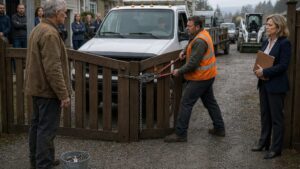
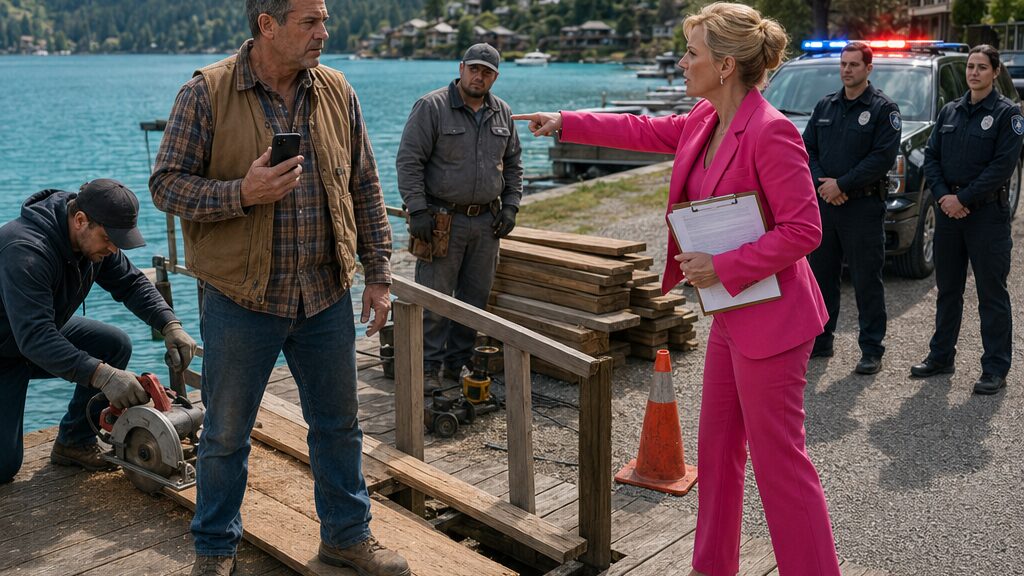
The saw was already biting into the first ramp board when Mark Anderson reached the dock.
The sound carried clean across the lake, a high metal scream against morning water, and for half a second Mark thought some neighbor had started work on their boat lift early. Then he saw the orange cones lined along his path, the white truck nosed into his gravel drive, and the red-blue flash of the HOA vehicle blinking against the cedar siding of his house.
A worker in knee pads had one boot on Mark’s new ramp.
Mark moved faster than he had in years.
“Stop.”
The worker looked up but did not lift the saw. It kept whining in his gloved hands, the blade hovering a finger’s width above the second board.
“I said stop.”
Two uniformed compliance officers stood at the head of the dock in dark shirts with the lake association badge on their sleeves. Between them, just beyond the cones, Catherine King turned as if she had been waiting for him to notice.
She wore the same bright pink suit she wore to board meetings, the one that made her visible from one end of the marina to the other. On someone else, the color might have seemed cheerful. On Catherine, with her shoulders squared and her clipboard tucked beneath one arm, it looked like a warning flag.
“Mr. Anderson,” she said. “Please step away from the work area.”
“My work area?”
“The association has authorized removal of the non-compliant structure.”
Mark stepped onto the first plank of the dock. The old boards creaked under him. The new ramp boards did not. He had installed them two weekends ago, measuring the slope three times, shaving the edges smooth, setting the handrail where a hand would reach for it without thinking. The wood was still pale from the lumberyard. He could see the pencil mark he had forgotten to sand off near the third post.
The worker cut the saw.
Silence fell so sharply that the lake seemed to widen around them.
Mark looked at the half-cut board. “Who told you to touch this?”
Catherine lifted her chin toward the workers. “The board issued authorization after your refusal to restore the property to its approved condition.”
“No one refused anything.”
“You were noticed.”
“When?”
She held out a thin stack of paper, but not close enough for him to take. “A violation was prepared.”
“Prepared isn’t delivered.”
One of the compliance officers shifted his stance. The worker glanced from Catherine to Mark, then back to Catherine. Mark knew that look. He had seen it at marinas when the owner and the inspector disagreed and the man holding the tool did not want to be the one blamed later.
Mark pulled his phone from his shirt pocket and started recording.
Catherine’s eyes narrowed. “That is unnecessary.”
“Then it won’t bother you.”
He turned the phone slowly over the dock, the cones, the saw, the cut line, the HOA vehicle flashing near his house. He kept his voice level. He had learned years ago that anger made people stop listening to the facts.
“This is Mark Anderson, Lot Seventeen, Lake Hollow Association. It is Monday morning. An HOA crew is on my dock cutting out a safety ramp before I have received a written removal order.”
Catherine stepped toward him so quickly that the closest officer moved with her. She pointed past the phone, not quite at it, not quite at Mark’s chest.
“You installed an exterior alteration without final approval,” she said. “You were instructed to cease work.”
“I ceased when the ramp was safe.”
“That is not your determination to make.”
“It is when someone has to cross it.”
Her mouth tightened. Behind her, the lake was absurdly bright, turquoise where the sun struck the shallow shelf beyond the dock. Sheep from the community pasture moved in a slow white line near the far hill, as if this were a postcard morning instead of a trespass with power tools.
Catherine turned to the crew supervisor. “Continue.”
Mark stepped between the saw and the next board.
The crew supervisor held up one hand. “Ma’am, I’m not cutting with him standing there.”
Catherine stared at Mark. “You are obstructing authorized enforcement.”
“I am standing on my dock.”
“You are standing on a violation.”
Mark looked down at the ramp. It was wider than the old sloped strip, with a rail bolted to the lake side and a low lip along the edge where a foot might slide. It had taken him two long afternoons to build it because he had to stop every hour and check on Nancy. He had built most of it after dark, under a clamp light, because the next morning she had needed to get down to the boat landing for the first time in three weeks.
“It’s not decorative,” he said.
Catherine’s answer came quickly. “It changes the exterior appearance of the lakefront.”
“It keeps someone from falling.”
“Then you should have waited for approval.”
“I requested approval.”
“You did not receive approval.”
“I requested it three times.”
“That is not the same thing.”
The words landed harder than they should have. Mark felt the old, stupid heat rise up his neck. Not because she was wrong about the paperwork. Because she knew exactly which sentence was safest for her to keep repeating.
He lowered the phone, then raised it again before his hand could betray him.
“Show me the written order that allows you to remove materials from my property today.”
Catherine pulled a paper from the stack and held it out. Her nails were pale, square, perfect. The paper shook just slightly in the breeze.
Mark did not take it. “Read the date.”
Her eyes flicked down.
“Read it.”
“Today’s date,” she said.
“What time was it delivered?”
“It was posted this morning.”
The crew supervisor looked at the cut board.
Mark kept the camera on Catherine. “Posted before or after your saw started?”
The question sat there between them. A small boat engine coughed somewhere across the lake. One of the officers looked toward the driveway.
Catherine’s face changed—not much, but enough. The confidence stayed, the posture stayed, but something behind her eyes shifted from accusation to calculation.
“We are proceeding,” she said.
“Not until I have your full name, your position, the board authorization, and the removal order in writing.”
“You know who I am.”
“I want it on paper.”
“You are making this more difficult than it needs to be.”
“No,” Mark said. “You did that when you sent men with saws before knocking on my door.”
For the first time, Catherine looked past him toward the house.
Mark’s stomach tightened.
Nancy was not visible from the kitchen window. He had checked before stepping outside. Still, he imagined her hand on the counter, her weight tipped slightly to one side, listening.
Catherine followed his glance and then returned to him. “If this is about personal inconvenience, the board can review it at the next meeting.”
“It’s about access.”
“Access to a private dock is not an emergency.”
Mark almost said her name. Nancy’s. It rose to his mouth, the one fact that would make the whole scene harder for Catherine to flatten into a rule. But Nancy had asked him, more than once, not to let the neighbors turn her into a problem to be discussed over coffee and minutes.
He swallowed it.
“The ramp stays,” he said.
Catherine’s voice cooled. “The ramp will be removed. If not by this crew today, then by a crew with additional enforcement. Any cost will be assessed to your account.”
The crew supervisor shifted again. “Do you want us to pull the cut section and stop there?”
“No,” Catherine said. “Continue with full removal.”
Mark stayed where he was.
The compliance officer nearest him took one step forward. “Sir, nobody wants this to escalate.”
“Then nobody touches another board.”
Catherine’s pink jacket caught the flashing red from the HOA vehicle and threw it back in brief, ugly pulses. She opened the folder against her forearm, signed the top page with a hard motion, and finally pushed it toward him.
This time Mark took it.
The first line read: NOTICE OF VIOLATION AND IMMEDIATE REMOVAL AUTHORIZATION.
The date was that morning.
The time handwritten beside the posting line was 8:15 a.m.
Mark looked at his phone.
It was 8:12.
Chapter 2: The Ramp Was Never Just a Dock
“Why can I hear saws?”
Nancy’s voice reached him before he had closed the back door. She stood at the kitchen island with one hand pressed flat to the butcher-block top and the other wrapped around the handle of her cane. She had not used the cane in the house until that spring. At first it had leaned by the mudroom door like an insult neither of them wanted to acknowledge. Now it followed her from room to room.
Mark folded the violation notice once and slid it beneath the mail.
“What saws?” he asked.
Nancy looked at him.
He hated himself immediately.
The window over the sink faced the dock path. From where she stood, she could see the orange cones, the workers, the gap where the first board had been cut. She could see enough to know he had come back inside carrying less than the truth.
“Mark.”
“They started removing the ramp.”
Her fingers tightened on the cane. “Started?”
“I stopped them for now.”
“For now,” she repeated.
He moved to the sink and looked out. Catherine stood beside the HOA vehicle, talking on her phone. The workers had backed away from the ramp but had not packed up. One man sat on the tailgate of the truck, drinking from a silver thermos, as if this were a normal job paused for a normal reason.
Nancy came slowly to the window. Mark reached toward her elbow and stopped before touching her.
She noticed. She always noticed.
The empty cut line in the ramp showed like a wound from the house. One board raised at the edge where the saw had bitten into it. The handrail still stood, but without the first board beneath it, the structure already looked uncertain, already looked like something halfway taken from them.
Nancy breathed in through her nose. “Did she come herself?”
“Pink suit and all.”
“That woman dresses like a highlighter.”
Mark almost laughed. The sound caught in his throat.
Nancy’s eyes stayed on the dock. Before the weakness in her left side had made slopes treacherous, she had crossed that path faster than anyone. She had spent twenty years guiding nervous guests into rental kayaks, reading wind on the water before the weather app caught up. She knew every shallow, every hidden rock, every dock cleat that loosened after a hard freeze.
Now she measured rooms in steps and furniture edges.
“I told you not to build it until they answered,” she said.
“I told them three times it couldn’t wait.”
“You also told me they’d be reasonable.”
“That was my mistake.”
She turned from the window. “No. Your mistake was thinking if you kept my name out of it, they would judge the ramp on common sense.”
Mark did not answer.
He went to the small desk near the pantry and opened the top drawer. The folder was where he had left it, blue, unmarked, ordinary. He pulled out the printed emails one by one.
First request: four weeks ago. Dock access ramp and handrail modification due to safety concern. Included photos. Included dimensions. Included offer to use association-approved cedar stain.
Second request: three weeks ago. Follow-up due to increased hazard. Attached note from physical therapist, with Nancy’s diagnosis cropped out because she had asked him to remove it.
Third request: ten days ago. Emergency installation notice. Old dock slope unsafe for resident access. Temporary ramp installed pending review.
And one reply, from the HOA office.
Pending review at next architectural committee meeting.
No date. No signature beyond the office account.
Nancy watched him lay the pages on the island.
“You printed them?”
“I print everything from them now.”
“That sounds like something old men say right before they call a local news station.”
“I’m not calling anybody.”
“I know.” Her voice softened, and somehow that was worse. “You’d rather stand in front of a saw.”
Mark stared at the emails. “It worked.”
“For twelve minutes.”
He looked up.
She held his gaze, tired but not fragile. Nancy had never liked being treated as fragile. The first time a neighbor had called her “brave” for walking to the mailbox, she had come home furious and reorganized the spice drawer with such force that he had not been able to find the paprika for a week.
“They have a meeting tonight,” Mark said. “I’ll go.”
“And say what?”
“That the ramp is necessary.”
“For who?”
He folded his arms. “For the house.”
“Mark.”
“For access.”
“Whose access?”
He looked toward the window again, toward the men still waiting near the truck.
Nancy tapped the cane once against the floor. Not hard. Just enough to pull his attention back.
“I don’t want them discussing my body in that room.”
“I know.”
“I don’t want Amanda Rivera lowering her voice at the mailbox like I’m already gone.”
“I know.”
“I don’t want Catherine King using me as a line item between landscaping complaints.”
“I know.”
“Then don’t go in there and make me sound helpless.”
The word struck both of them. Nancy looked away first.
Mark gathered the papers too carefully. “You’re not helpless.”
“No. But you’re acting like the only two choices are hiding me or defending me.”
He had no answer for that because it was close enough to true.
The clinic had offered a transport van for Nancy’s therapy appointments, but the driveway grade made pickups difficult when the gravel washed out. The boat landing path, before the old dock slope warped, had been the easier route to the lower road where the van could stop without backing down the hill. That was why the ramp mattered. Not for summer guests. Not for a view. Not for pride.
For getting his wife from their kitchen to the world without turning every trip into a negotiation with gravity.
A low engine rumbled outside.
Mark turned.
A tow truck had pulled up behind the HOA vehicle. Its bed was empty, tilted slightly, ready to receive whatever the workers decided belonged to someone else now. The crew supervisor pointed toward the stacked boards near the dock path. Catherine, still on her phone, nodded once.
Nancy saw it too.
“They’re taking the wood?”
Mark picked up his phone and the blue folder.
“Not without a receipt.”
“Mark.”
He stopped at the door.
Nancy’s face was pale in the kitchen light, but her voice was steady. “Don’t let them make you so angry that they get to call you unreasonable.”
He put his hand on the doorknob.
Outside, the tow truck’s winch clicked into motion, a dry metal rattle moving closer to the dock.
Chapter 3: The Board Called Safety an Appearance Problem
The first thing Mark saw when he walked into the clubhouse meeting room was a photograph of his half-demolished dock projected ten feet wide on the wall.
Someone had taken it from the water side, low enough to make the ramp look bulky and strange, the handrail jutting above the clean lines of the neighboring docks. The saw-cut board showed clearly. So did Mark, standing with his phone raised, caught mid-sentence with his jaw tight and his shoulders squared.
Under the photo, in Catherine King’s neat all-capital letters, were the words: UNAPPROVED EXTERIOR ALTERATION — LOT 17.
The room was already half full.
Lake Hollow residents sat in folding chairs arranged in rows beneath framed photographs of fishing tournaments and summer picnics. A few turned when Mark entered. Most looked away quickly, the way people did when they wanted to witness trouble without being seen participating in it.
Catherine stood near the projector in the pink suit, though she had changed her shoes. The compliance officers were gone, but one of the removed ramp boards leaned against the wall beside her table. It had been wiped clean. Mark could still see the saw mark.
He carried the blue folder under one arm.
“Mr. Anderson,” Catherine said, as if his arrival were a scheduled inconvenience. “We were about to begin.”
“You started before the posted time?”
“The board was reviewing materials.”
“Materials taken from my dock?”
A few faces shifted toward the board.
Catherine smiled without warmth. “Evidence of the violation.”
Mark took a seat in the front row. He did not want to sit. Sitting made him feel like someone waiting to be judged. But standing would help Catherine more than it helped him.
Rachel Martin sat at the board table to Catherine’s left, her treasurer’s binder open in front of her. She did not look at Mark for long, but when she did, he saw something there that was not quite apology and not quite warning.
Catherine called the meeting to order with a small wooden gavel that always made Mark think the HOA wanted to be a courthouse when it grew up.
“The issue before us,” she said, “is the unauthorized dock alteration installed at Lot Seventeen without final architectural approval, in violation of community exterior standards and lakefront uniformity provisions.”
Mark opened his folder.
Catherine clicked to the next slide. Another photo appeared, this one taken from across the lake. The ramp looked wider from that distance. It looked almost like a platform.
“This is visible from multiple properties,” Catherine said. “The association received a written complaint regarding the alteration’s appearance, possible liability implications, and precedent for unapproved shoreline modifications.”
Mark did not have to turn to know who had filed it. Amanda Rivera sat two rows behind him. He had seen her car outside.
A board member asked, “Is the homeowner claiming emergency status?”
“I am claiming,” Mark said, “that I submitted the modification request three times and received no decision.”
Catherine’s eyes moved to him. “You will have an opportunity to speak.”
“I’m speaking to the question.”
“You are interrupting the process.”
A laugh breathed through the room and died quickly. Mark could not tell whose side it had been on.
Rachel cleared her throat. “Let him answer that point. It may matter.”
Catherine’s mouth tightened, but she nodded once.
Mark stood, opened the folder, and laid three printed emails on the table in front of the board. He did not pass around Nancy’s therapist note. Not yet. Maybe not at all.
“First request,” he said. “Four weeks ago. Second, three weeks ago. Third, ten days ago. I included dimensions, materials, photos of the old dock slope, and an offer to match stain. The only response I received said pending review.”
Catherine looked at the pages but did not touch them. “Pending review is not approval.”
“I didn’t say it was. I said you knew.”
“You were told review was pending.”
“And the boards were flexing underfoot while review was pending.”
Amanda spoke from behind him. “Everyone has boards that flex.”
Mark turned then.
Amanda Rivera sat with her purse clutched in her lap, her dark hair pulled back tightly. Her lake house stood two coves down, newer than Mark’s, with wide windows and a dock that always had matching chairs arranged like a magazine photo. She looked angry, but beneath it there was something else. A stiffness around the mouth. Fear, maybe.
She lifted her chin. “That’s what happens on a lake. You don’t get to build whatever you want because maintenance is inconvenient.”
“Inconvenient?” Mark said.
Catherine stepped in. “Mrs. Rivera’s complaint raised a serious issue. If individual homeowners begin altering docks without approval, the association may face increased liability exposure.”
“Liability for making a dock safer?”
“For unauthorized construction,” Catherine said. “There is a difference.”
Mark looked at the board leaning against the wall. “Not to the foot that goes through rotten wood.”
A murmur moved through the room.
Catherine clicked again. The next slide showed a section from the community standards manual. Approved dock profiles. Approved rail heights. Approved stain colors. It looked clean and reasonable on the screen, the way rules often did when no person was standing beside what they cost.
“Lake Hollow has maintained consistent shoreline appearance for thirty years,” Catherine said. “That consistency protects property values, insurance clarity, and shared community expectations.”
Mark heard Nancy’s voice in his head: Don’t make me sound helpless.
So he said, “The ramp was built for safe access. The slope that was there before was too narrow and unstable.”
“For whom?” Catherine asked.
It was a careful question, asked in a careful tone, and Mark understood the trap. If he refused to answer, he looked evasive. If he answered, he brought Nancy into the room without her consent.
“For a resident of my home,” he said.
“Is there a formal accommodation request on file?”
“The modification request explains the safety issue.”
“That is not what I asked.”
“No,” Mark said. “It’s what I’m willing to answer tonight.”
Catherine let the silence stretch. She was good at silence when it made someone else look difficult.
Rachel turned a page in her binder. “Was the emergency installation reviewed by the architectural committee before removal began?”
Catherine did not look at her. “The structure was plainly non-compliant.”
“That is not the same as reviewed.”
The room shifted again. Mark saw Amanda glance toward Rachel.
Catherine’s voice stayed even. “The board has authority to act on visible violations that create liability.”
Mark picked up the top email. “Then why didn’t the board act on the visible hazard when I sent photos?”
No one answered immediately.
Catherine closed the standards manual in front of her. “Mr. Anderson, submission of paperwork does not grant permission to proceed. Your ramp exceeded the approved width, altered the rail profile, and changed the appearance of the lakefront. The removal crew was authorized to restore the property to its prior condition.”
“It wasn’t safe in its prior condition.”
“That has not been established by an approved inspection.”
“Because no one came.”
Again, a murmur.
Catherine looked toward the residents. “This is precisely why the process matters. When homeowners self-determine emergencies, the board loses the ability to manage safety consistently.”
Mark almost laughed at that. Not because it was funny. Because he had spent the morning watching consistency arrive with a saw.
He gathered the emails and returned them to the folder before his hands could shake.
“Fine,” he said. “Who inspected the dock before you ordered removal?”
Catherine blinked once.
Rachel lowered her eyes to her binder.
Mark saw it and turned slightly toward her. “Who inspected it?”
Catherine answered, “The violation was visually confirmed.”
“By who?”
“Compliance.”
“From the shore? From across the lake? Did anyone step on the old slope? Did anyone check the supports? Did anyone look where the handrail posts were set?”
Amanda’s face had gone still.
Catherine reached for the gavel. “This meeting will not become an interrogation.”
“It became one when you put my dock on the wall.”
Rachel closed her binder. The sound was small, but it cut through the room.
After the meeting adjourned without a vote, residents broke into low clusters near the coffee urn and doorway. Catherine stayed at the board table, speaking to two members in clipped, private phrases. Amanda left without looking at Mark.
Mark was putting the emails back into the blue folder when Rachel passed behind him.
She did not stop. She did not face him. She only slowed enough for her words to reach him.
“Ask who inspected the other docks,” she said.
Then she walked out into the dark parking lot, leaving Mark with the folder in his hand and the removed board still leaning against the wall like it had been waiting for someone else to confess.
Chapter 4: The Permit Proved Less Than Mark Needed
“This proves danger,” the clerk said, sliding Mark’s photos back across the counter, “not permission.”
Mark stood under the fluorescent lights of the county building with the blue folder open in both hands. His dock stared up from the glossy printouts: warped old slope, new ramp, saw-cut board, empty space where the crew had stopped. Behind him, two contractors argued softly over a permit fee. Somewhere deeper in the office, a printer coughed out page after page as if paperwork were a weather system no one could escape.
“I’m not asking permission to decorate,” Mark said.
The clerk’s expression did not change. “I understand.”
“It’s a safety repair.”
“I understand that too.”
“Then what am I missing?”
She looked past him toward the next person waiting. “County can note observed hazards and confirm whether your repair violates county shoreline requirements. We do not override private association standards unless there is a formal accommodation order, code enforcement action, or court directive.”
Mark pressed his thumb against the edge of the folder until the paper bent.
A door opened behind the counter, and a man in a field jacket stepped out carrying a coffee cup and a rolled plan set. He paused when he saw the dock photos.
“You’re Lot Seventeen at Lake Hollow,” he said.
Mark turned. “Yes.”
“I’m Eric Nelson. I looked at your email this morning after the front desk flagged it.”
The clerk looked relieved enough to hand Mark over without another word.
Eric led him to a small conference table near a window facing the parking lot. He moved with the practical economy of someone who spent more time around failing structures than around meetings. He spread Mark’s photos out one by one and put on reading glasses.
“This is the old slope?”
“Yes.”
“And this is after your modification?”
“Yes.”
Eric tapped the photo with one finger. “You widened the approach here.”
“For stability.”
“And added the rail on the lake side.”
“That side drops straight to the water.”
Eric nodded, then pulled the photo closer. “Where was the flex?”
Mark pointed. “Here. Between the second and third support. It had been getting worse since the winter thaw.”
“Did you photograph underneath?”
“Not before I put the ramp in. I should have.”
Eric looked at him over the glasses. “Most people don’t take evidence photos before fixing the thing that might hurt someone.”
The sentence should have comforted him. Instead, it made Mark feel tired.
“I need something that stops them from tearing out the rest.”
“I can inspect it,” Eric said. “I can issue an observed hazard note if the old section was unsafe or if the current removal creates a hazard. But your association can still say the design needs review.”
“They already said that.”
“They will keep saying that.”
Mark leaned back, the chair giving a small squeak beneath him. “So the county can say the dock was dangerous, but the HOA can still punish me for making it safer.”
Eric did not answer quickly. That told Mark more than a quick answer would have.
“The county can document,” Eric said at last. “Documentation matters. It just doesn’t always matter as fast as people need it to.”
By midmorning Eric was standing on Mark’s dock with a tape measure clipped to his belt and one hand on the remaining rail. Catherine’s crew was gone. The orange cones remained, their plastic bodies trembling lightly in the wind. The first cut board had been pulled, leaving a rectangular gap that forced Mark to step around his own work like it had become a trap.
Eric crouched near the anchor holes where the handrail posts had been set. “You placed these exactly where the lateral movement would have been worst.”
“I followed the give in the boards.”
“You worked on docks?”
“Marinas. Long time ago.”
“That shows.”
Mark watched him press his boot gently against the old section beside the ramp. The plank dipped.
Eric looked up.
Mark saw the confirmation before Eric said anything.
“That would have failed,” Eric said.
“When?”
“Hard to say. Maybe under a bad step, maybe under weight on the wrong edge. Maybe not today. But it was no longer just cosmetic wear.”
Mark looked toward the house. Nancy was not at the window this time. He had asked her to stay away from it because he did not want her seeing another official bend over the place where her access had been interrupted. She had given him a look that told him he was still confusing protection with control.
Eric wrote on a carbon form clipped to a metal board. He tore off the top sheet and handed it to Mark.
Observed hazard. Existing dock access slope shows structural flex and edge instability. Temporary modification appears targeted to access stability. Further removal may create unsafe transition if not immediately secured.
Mark read it twice.
“This helps,” Eric said.
“Does it stop them?”
“It should slow them down if they care about exposure.”
Mark gave a dry laugh. “They care about exposure. Just not the same kind.”
His phone vibrated before Eric reached the driveway.
The email subject line sat on the screen like a stamp: FINAL VIOLATION HEARING AND ASSESSMENT NOTICE.
Mark opened it standing beside the dock gap.
Catherine’s message was brief. The board would hold a final hearing Monday evening. If the ramp was not removed or brought into approved compliance before then, daily fines would begin Tuesday morning. The association reserved the right to complete removal and assess all costs to the homeowner.
Attached was a photo of Mark standing in front of the worker’s saw.
He stared at the picture longer than he meant to. From Catherine’s angle, he looked larger than he felt. Obstructive. Hard. A man using his body as an argument while everyone else stood in lines and titles.
Eric, halfway to his truck, saw his face and stopped. “Bad news?”
“Final vote. Fines after the weekend.”
Eric came back two steps. “Bring the hazard note.”
“They’ll say it’s not approval.”
“They’re right.”
Mark folded the paper slowly. “That doesn’t make them right.”
“No,” Eric said. “It just means you need the right question in front of them.”
“And what question is that?”
Eric looked toward the house, then at the ramp. He did not ask who needed it. Maybe he had inspected enough homes to know that the reason for a rail was usually inside, not outside.
“Not whether you broke their rule,” he said. “Whether their rule gives them the right to make the property unsafe.”
After Eric left, Mark stayed at the dock until the wind pushed cold through his shirt. He photographed the anchor holes, the cut board, the gap, the tire marks where the HOA truck had been. Then he walked back up the path and found Nancy sitting at the kitchen table with the printed emails arranged in date order.
She had added one paper to the stack.
It was her physical therapy summary, the version with the diagnosis visible.
Mark stopped in the doorway.
Nancy did not look embarrassed. That made it harder.
“I thought you didn’t want that in the meeting.”
“I don’t.”
He set the county note on the table. “Then why is it out?”
“Because you’re about to lose the ramp trying to protect me from being named.”
Mark sat across from her.
The kitchen was quiet except for the refrigerator hum and the faint tap of a loose halyard from a boat down at the water. Nancy rested both hands around a mug she had not drunk from.
“I don’t want Catherine King saying my diagnosis like she owns it,” Nancy said. “I don’t want neighbors measuring how far I can walk. I don’t want sympathy from people who never came by when I stopped guiding.”
“I know.”
“But I also don’t want to be erased so politely that the board gets to pretend this is about stain color.”
Mark looked at the county note. Observed hazard. Targeted to access stability. Further removal may create unsafe transition.
It was true. It was useful. It was still less than he needed.
“I can say resident access,” he said.
“You already did.”
“I can say medical access.”
“You should.”
He looked up.
Nancy’s mouth tightened, but she kept her eyes on him. “You can use my name,” she said. “But not as a weapon.”
Chapter 5: The Neighbor Who Complained Had Her Own Fear
Amanda Rivera’s dock had the same bowed planks.
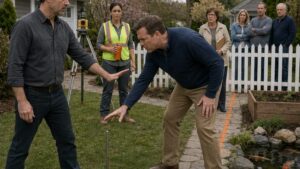
Mark saw them from the lakeside road before he saw Amanda. Two yellow strips of warning tape had been wrapped around the outer posts, fluttering in the weekend wind like someone had tried to bandage the dock without admitting it was injured. One board near the middle sat higher than the others. Another sagged at the edge, dark with old water.
He stopped at the foot of her drive, the blue folder tucked beneath his arm.
Amanda was on the dock with a broom, pushing pine needles into the lake. She looked up, saw him, and gripped the broom handle as if it were a railing.
“If you came to yell,” she called, “I’m not doing this alone with you.”
“I didn’t come to yell.”
“That’s what people say before they yell.”
Mark stepped only as far as the gravel turnout. “Your dock’s moving.”
Her face closed. “It’s scheduled for maintenance.”
“When?”
“That’s not your concern.”
“It became my concern when your complaint helped send a saw to my house.”
Amanda looked toward the nearest cottage, then back at him. Her anger seemed thinner in daylight, less like certainty and more like something stretched over fear.
“I filed a complaint about an unapproved structure,” she said. “I didn’t tell Catherine to send a crew.”
“But you knew she might.”
“I knew the board had to do something before everyone started building their own fixes.”
“My fix was because the old dock was unsafe.”
“Everyone says that when they want an exception.”
Mark almost turned around then. He had not come to stand on another dock and repeat the same sentences Catherine had already flattened. But a gust lifted the warning tape, and Amanda’s eyes followed it too quickly.
“Someone fell,” he said.
She went still.
Mark waited.
Amanda set the broom against a post. “My father.”
Mark’s grip loosened on the folder.
“Last October,” she said. “Not here. At my brother’s place south of the county line. Old dock, loose edge, no rail where there should’ve been one. He stepped sideways to let my niece pass. The board rolled. He went in between the dock and the boat.”
She looked down at the planks beneath her feet.
“He lived,” she said, before Mark could ask. “But he doesn’t walk the same. He won’t go near water now.”
Mark said nothing.
Amanda let out a short breath. “So when I saw your ramp from across the lake, I thought, there it starts. Everyone doing their own work. Different rails, different slopes, nobody checking anything. One accident and the insurance company walks away.”
“Who told you that?”
She looked toward the clubhouse roof visible over the trees.
“Catherine said unauthorized modifications could void parts of the lakefront policy. She said if we didn’t enforce evenly, claims could be denied.”
Mark looked again at the tape on her dock. “Did she send anyone to inspect yours?”
Amanda’s face changed.
“That’s not the same.”
“It looks the same.”
“It’s scheduled.”
“You keep saying that.”
Her voice sharpened. “Because it is.”
“When?”
She did not answer.
Mark stepped closer, not onto the dock, but near enough to see the split running along the raised board. He could smell wet cedar and old algae. His hands wanted a drill, screws, blocking lumber. His mind started measuring before he told it to stop.
Amanda watched him watching the boards.
“I didn’t know about Nancy,” she said.
He looked up.
Her face colored. “I mean, I heard she wasn’t guiding anymore. People said she was taking time. I didn’t know the ramp was for her.”
“I didn’t tell anyone.”
“Why not?”
Because she asked me not to. Because I thought I could handle it. Because I would rather have the neighborhood call me stubborn than have them lower their voices around my wife.
He said, “Because it’s hers to tell.”
Amanda’s fingers tightened around her sleeve. “Then maybe you should’ve waited.”
“And if she fell while we waited?”
The words came out harder than he intended.
Amanda flinched, but she did not look away. “Then you would have blamed the board.”
“Yes.”
“And if every homeowner builds first and explains later, someone else gets hurt and blames the board too.”
There it was. Not cruelty. Not exactly. Fear wearing the shape of enforcement.
Mark drew a breath. “Amanda, your dock has warning tape on it.”
Her mouth pressed shut.
“Mine had a ramp.”
She looked toward the water, where the wind broke the lake into quick flashes.
“I’m not your enemy,” she said, but she sounded unsure.
“No,” Mark said. “You’re not. But your fear gave Catherine cover.”
A car slowed on the road behind him.
Rachel Martin’s gray sedan pulled onto the shoulder. She did not wave. She looked first at Amanda’s dock, then at Mark, then toward the clubhouse as if checking who might see her there.
Amanda stepped off the dock. “Rachel, what is going on?”
Rachel got out with a folder held tight against her side. She looked tired in a way Mark had not noticed at meetings. Not sleepy. Cornered.
“You both need to understand something,” Rachel said. “The board cannot afford a lake-wide dock repair order right now.”
Amanda’s face hardened. “So you ignored them?”
“I didn’t say that.”
“You didn’t have to,” Mark said.
Rachel opened the folder just enough to show a spreadsheet marked with maintenance reserves, projected assessments, and dock inspection contingencies. Most of it meant little at a glance, but the red numbers did not need translation.
“The insurance review flagged lakefront structures last year,” Rachel said. “Not as failed. As needing documented inspection. Catherine pushed to delay formal inspections until after the premium renewal.”
Amanda whispered, “Why would she do that?”
“Because documented hazards become required repairs. Required repairs become assessments. Assessments become angry homeowners.” Rachel looked at Mark. “And angry homeowners replace board members.”
The wind lifted the corner of Mark’s county note from his folder. He pressed it flat.
“So my ramp was a problem,” he said, “because it pointed at what you didn’t want inspected.”
Rachel did not deny it.
Amanda looked back at her dock. Her complaint, Mark realized, had been both more understandable and more damaging than he wanted it to be. She had been afraid of loose boards. The board had used that fear to punish the one person who had actually fixed them.
Rachel closed the folder. “I can’t hand you board records from the treasury files. Not like this.”
“Then why are you here?”
“Because Monday’s vote is already being counted. Catherine has two members with her. One undecided. Me. If you walk in with only your emails and that county note, she’ll call it incomplete permission and fine you anyway.”
Amanda looked at Rachel. “What should he walk in with?”
Rachel did not answer. A car passed slowly on the road, and all three of them turned their faces away from it like people caught doing something wrong.
That evening, after Mark had gone home and helped Nancy move from the kitchen to the den, a brown envelope slid under his front door.
There was no knock.
By the time he opened the door, the porch was empty.
Inside the envelope was a five-year-old maintenance report with Lake Hollow Association printed across the top. Mark read the first page standing in the hall.
Deferred inspection of multiple private dock access points may create foreseeable safety exposure.
Lot Seventeen was listed in the third paragraph.
So was Amanda Rivera’s.
Chapter 6: Mark Finally Names What the Ramp Protects
“Lot Seventeen,” Catherine King said, “is not a hardship case. It is a deliberate act of noncompliance.”
Mark stood at the back of the clubhouse meeting room with the old maintenance report in one hand and Nancy’s signed statement in the other. The room was fuller than it had been the first night. Residents lined the walls. Someone had brought extra chairs from the card room. Amanda Rivera sat near the aisle with her purse in her lap and her eyes fixed on the board table.
The removed ramp board was back too.
Mark had carried it in himself. He had set it beside the front table before Catherine arrived, saw mark facing outward, pale raw wood catching the overhead lights. Catherine had looked at it once and then looked away.
On the screen behind her was the same photograph of his dock, but this time the image had been cropped tighter. No HOA vehicle. No saw. No cones. Just the ramp, made to look like an object without a morning attached to it.
Catherine continued. “The issue before us is whether an owner may unilaterally alter lakefront structures and then retroactively demand approval by claiming urgency.”
Mark felt every word aimed at his temper.
He stayed still.
Rachel sat to Catherine’s left, hands folded over her binder. She had not looked at him since he entered. He had no idea whether the envelope had come from her directly or through someone else. He had no idea whether she would admit anything if pressed.
Nancy had stayed home. That had been her choice. Her statement, folded once in Mark’s hand, was the compromise they had reached at the kitchen table after reading the maintenance report in silence.
You can say what it protects, she had told him. You don’t get to make me sound like a locked door.
Catherine called the crew supervisor first.
He stood awkwardly near the front and confirmed that his company had been hired to remove “non-compliant ramp materials” from Lot Seventeen. He confirmed that removal began the morning of the notice. When Mark asked whether he had seen the written authorization before starting, Catherine objected.
“This is not a cross-examination.”
“It’s a timeline,” Mark said.
The supervisor shifted. “We had verbal clearance from the association office and were told paperwork would be on site.”
“At what time did you start cutting?”
“I don’t know exactly. A little after eight.”
Mark took out his phone.
Catherine’s expression sharpened. “Mr. Anderson, recordings of association personnel may violate meeting policy.”
“This was recorded on my property.”
He played the video before she could answer.
The room filled with the saw’s scream.
Several people flinched. The sound was worse indoors, trapped between wood paneling and framed picnic photos. Then Mark’s own voice came through, controlled but tight: This is Mark Anderson, Lot Seventeen, Lake Hollow Association. It is Monday morning. An HOA crew is on my dock cutting out a safety ramp before I have received a written removal order.
Catherine’s voice followed: The association has authorized removal of the non-compliant structure.
Then Mark’s question: Read the date.
Then Catherine: Today’s date.
Then Mark: What time was it delivered?
By the time the video reached his final line—It is 8:12—the room had gone quiet enough that Mark could hear the old projector fan ticking.
Amanda looked down at her hands.
One board member leaned toward Catherine and whispered. Catherine kept her gaze on Mark, but something rigid had entered her face.
“The delivery time,” she said, “does not change the underlying violation.”
“No,” Mark said. “It changes what you were willing to do before I had a chance to respond.”
He walked to the front, picked up the county hazard note, and placed it on the table beside the removed board.
“This is from Eric Nelson at the county. He inspected the remaining dock section. The old access slope had structural flex and edge instability. The temporary ramp was placed where stability was needed.”
Catherine folded her hands. “The county did not approve your design.”
“You’re right.”
The room stirred. Catherine had expected resistance, and for one visible second she did not know what to do with agreement.
Mark set down the printed emails. “These show I requested approval three times before finishing the ramp. They show the board knew there was a safety issue. They show the only response I received was pending review.”
“Pending review,” Catherine said, regaining her footing, “is not approval.”
“I know.”
He placed Nancy’s signed statement beside the emails. He rested his hand over it for a moment before letting go.
“This is from my wife, Nancy Anderson. She gave me permission to read one part.”
His throat tightened unexpectedly. Not because he was ashamed. Because once he read it, he could not put it back into the privacy of their kitchen.
He unfolded the paper.
“My ability to leave and enter my home safely has changed. The dock access ramp and handrail allow me to reach the lower road for medical transport and to remain in the house where I have lived and worked for more than twenty years. I do not ask to be discussed as an object of pity. I ask that safety access not be treated as decoration.”
No one moved.
Mark folded the paper again.
He looked at Catherine. “The ramp protects Nancy’s home. Not my pride.”
A woman near the wall wiped at her cheek and looked embarrassed that she had done it. Mark wished she had not. He did not want tears to become the point. Nancy had asked not to be used as a weapon, and pity could be a weapon even when held gently.
Catherine leaned forward. “No one disputes Mrs. Anderson’s dignity.”
“You disputed the ramp that let her keep it.”
A board member said, “Can the ramp be modified to meet standard?”
“Yes,” Mark said. “I said that in the first request. I’ll use approved stain. I’ll adjust the rail profile if it remains safe. I’ll pay for proper inspection. What I won’t do is remove access and wait months while the board decides whether my wife can get down to the road.”
Rachel opened her binder.
Catherine saw the motion. “We should be careful not to create an exception that exposes the entire association.”
Rachel’s hand stopped on the binder rings.
Catherine turned toward the room, and for the first time her voice lost some of its polish. “I understand this is emotional. But there are broader consequences. If we approve one unreviewed modification after installation, every lakefront owner with aging boards will claim emergency status. Our insurance carrier has already warned us about inconsistent dock alterations. We cannot place the whole community at risk because one owner decided process did not apply to him.”
That was the first honest thing Catherine had said all night, Mark thought. Not right. But honest enough to show its fear.
Amanda stood.
People turned.
Catherine looked irritated. “Mrs. Rivera, public comment period has closed.”
Amanda swallowed. “I filed the complaint.”
The room shifted again, a living thing.
“I saw the ramp from my dock,” Amanda said. “I thought it was unapproved. I thought it might create liability. Catherine told me unauthorized changes could affect insurance, and I believed pushing enforcement was the responsible thing.”
Mark watched her hands tremble slightly around the strap of her purse.
“Then I learned my dock was in the same maintenance category,” she said. “And that the association had delayed inspections before Mark built anything.”
Catherine’s face went still.
Rachel looked down.
Amanda continued, quieter now. “My father fell on an unsafe dock last year. That’s why I complained. I was afraid of everyone doing their own repairs. But fear doesn’t make it right to tear out the one repair that was actually keeping someone safe.”
Catherine reached for the gavel. “This is outside the scope.”
“No,” Rachel said.
The word was not loud, but it stopped Catherine’s hand.
Rachel opened her binder and removed a photocopy of the maintenance report. Mark saw the same paragraph, the same list of lot numbers, the same language about foreseeable safety exposure.
“As treasurer,” Rachel said, “I need to disclose that lakefront inspection costs and potential repairs were deferred during budget planning. The board did receive prior notice that several dock access points required review, including Lot Seventeen. We did not complete that review before enforcement began.”
Catherine’s voice dropped. “Rachel.”
Rachel did not look at her. “I am not comfortable assessing fines for a safety modification when the association failed to inspect the underlying hazard.”
A board member rubbed both hands over his face.
Another said, “Are we exposed if we withdraw?”
“We’re exposed if we don’t,” Rachel said.
Catherine stood. “If we approve this tonight, we invite every owner in this room to bypass procedure.”
Mark picked up the removed ramp board. It was heavier than it looked. He laid it flat across the front table, between Catherine’s standards manual and Rachel’s report.
“No,” he said. “You invite every owner to report danger before someone falls. You create an emergency process. You inspect the docks. You approve temporary safety work with deadlines and standards. You stop using silence as a rule.”
The room held its breath.
Catherine looked at the board, at the documents, at the residents watching her, at the pink sleeve of her own suit as if remembering the dock morning from outside her body.
“This will require a vote,” she said.
Rachel closed her binder and stood.
“Then I move that the violation against Lot Seventeen be suspended immediately, that fines be withheld pending review, that emergency safety access be considered separately from cosmetic alterations, and that the board call an emergency vote tonight on temporary approval and inspection.”
Catherine stared at her.
Rachel did not sit down.
“I also move,” Rachel said, “that no further removal occur on Lot Seventeen.”
For the first time all night, Catherine had no sentence ready.
Chapter 7: The Empty Space Gets Built Back Right
The crew came back on a Monday morning with lumber instead of a saw.
Mark heard the truck before he saw it, and for one sharp second his body remembered the first sound—the blade, the cones, Catherine’s voice telling men to continue. He was halfway across the kitchen before the engine settled into idle. Through the window, two workers were unloading cedar boards onto the gravel, not stacking removed pieces onto a truck bed.
Nancy stood beside the island with both hands on her cane. “Are they early?”
“Ten minutes.”
“Then don’t look so betrayed by punctuality.”
Mark let out a breath that was almost a laugh. “I’m working on it.”
Outside, the lake was still enough to hold the mountains upside down. The orange cones were gone. The HOA vehicle was gone too. In its place sat a plain contractor’s truck with a county inspection tag taped inside the windshield and a roll of drawings on the dashboard.
The crew supervisor saw Mark coming down the path and lifted one hand.
“Morning,” he said carefully.
“Morning.”
“No cutting unless you sign off on the layout.”
“That’s a better start.”
The man gave a small nod, neither apology nor defense. “We’re building to the revised standard. Wider approach, rail profile lowered two inches from yours, same slope. Approved stain after cure. County inspection tomorrow.”
Mark looked at the boards laid in the grass. They were clean, straight, unmarked. For a moment, all he could see was the one Catherine had leaned against the clubhouse wall like evidence.
“Who sent you?” Mark asked.
“Association work order.”
The supervisor hesitated, then added, “Different language this time.”
He handed over the paper.
Temporary emergency safety access restoration, pending final accommodation review. No admission of owner violation.
Mark read the sentence twice. It was not generous. It was not warm. It was something written by people who wanted to fix a thing without admitting how badly they had broken it.
But it said restoration.
He signed.
By noon, the empty space had begun to lose its accusation. Posts went in first, set where the old anchor holes had been but reinforced with steel brackets Eric Nelson had recommended. The workers measured twice and called Mark over before drilling. He found himself answering with the old precision of marina days, pointing where a hand would naturally fall, where a wheel could catch, where a wet shoe might slide. No one told him he was obstructing.
At the top of the path, Catherine King arrived without the pink suit.
She wore gray slacks, a cream jacket, and sunglasses she did not need. Rachel Martin walked beside her with a folder tucked under one arm. Amanda Rivera followed a few paces back, stopping near the gravel as if unsure whether she had earned the right to come closer.
Mark wiped sawdust from his hands and climbed up from the dock.
Catherine removed a paper from the folder. “The board voted to withdraw the immediate removal authorization and suspend all fines related to the Lot Seventeen ramp pending final inspection.”
Rachel’s eyes flicked to Mark’s face, then away. It was the closest thing to relief she allowed herself.
Catherine held out the paper.
Mark took it. The violation number was printed at the top. Beneath it, in careful official language, the association withdrew the assessment and acknowledged that emergency safety access requests would now be reviewed under a separate process from cosmetic exterior alterations.
He waited.
Catherine’s mouth tightened. She looked past him toward the dock, where the workers were setting the handrail.
“The board recognizes,” she said, “that the timing of enforcement created confusion.”
“Confusion,” Mark repeated.
Rachel looked down.
Amanda closed her eyes briefly.
Catherine’s jaw worked once. “And hardship.”
Mark folded the paper but did not put it away. “The crew started before the notice time.”
“I have instructed the office that will not happen again.”
“That isn’t the same as saying it happened.”
Catherine looked at him then, not with the bright public force she had carried on the dock, but with something smaller and more guarded. “It happened.”
The wind moved between them. Down on the dock, a drill started and stopped, one clean burst.
“I believed,” Catherine said, each word chosen as if it cost her, “that failing to enforce would expose the association to greater risk.”
“You were looking at the association.”
“Yes.”
“And not at the house.”
Her face did not soften. Catherine King was not built for easy softness. But her eyes moved toward the kitchen window, where Nancy was not standing.
“No,” she said. “Not enough.”
It was not an apology. Not fully. Mark accepted it only as far as it reached.
Amanda stepped forward after Catherine moved away to speak with the supervisor.
“I’m sorry,” she said.
Mark looked at her. She held his gaze for a moment, then looked toward her own cove.
“My dock inspection is Wednesday,” she said. “Rachel said four others are being scheduled.”
“That’s good.”
“It’s expensive.”
“Falls usually are.”
She nodded as if she deserved that.
“I should have asked you before I filed the complaint,” she said. “I thought I was preventing danger.”
“I know.”
“That doesn’t undo what I did.”
“No.”
Amanda swallowed. “If Nancy ever wants company at the lower road after an appointment, not help, just company—”
“I’ll tell her you offered.”
“Tell her I said company, not help.”
That time Mark did laugh, quietly. “She’ll appreciate the distinction.”
By late afternoon, the ramp was whole enough to cross but not finished enough for anyone to relax. Eric Nelson arrived with a clipboard and walked it slowly, his boots landing in deliberate sequence. He pressed the rail, checked the brackets, measured the slope, then made the crew adjust one transition edge by less than half an inch.
“Half an inch matters?” Rachel asked.
Eric looked at Mark.
Mark said, “Half an inch always matters when somebody’s tired.”
Eric nodded and wrote his note.
Nancy came out after the workers cleared their tools.
She had refused the wheelchair from the clinic. She had refused Mark’s arm at the door. She accepted only the cane, the rail, and time.
Mark walked beside her but not close enough to crowd her.
At the top of the ramp, she paused. The lake opened below them, bright and indifferent, the way it had been on every good and terrible day they had lived there. New boards stretched beneath her feet. The handrail waited at the exact height her hand expected.
Catherine stood near the driveway, watching. Rachel stood beside her. Amanda had remained by the gravel, arms folded against the wind.
Nancy set her cane down on the first board.
Mark’s whole body leaned toward her without moving. He kept his hands at his sides.
She took one step. Then another.
The ramp held.
At the midpoint, where the old dock had always dipped, Nancy stopped and looked at the water. Mark saw her fingers tighten once on the rail, not from fear, but from memory. For years, she had crossed that same stretch carrying paddles, coolers, wet rope, the names of guests who could not tell port from starboard. Now she crossed it with a cane and three people pretending not to watch too hard.
She turned her head slightly. “You’re hovering.”
“I am ten feet away.”
“I can feel it.”
He stepped back one more pace.
Nancy smiled without looking at him and continued down.
When she reached the lower landing, she did not turn immediately. She stood facing the lake, one hand on the rail, cane tip planted between her shoes. Then she lifted her free hand, not high, not for the group behind her, but toward the water.
Mark understood. Not victory. Recognition.
The house had not given her up.
That evening, after the crew left and the inspection tag was taped to the inside of the mudroom window, Mark sat at the kitchen table with the blue folder open. He placed the withdrawn violation notice behind the county hazard note, Nancy’s statement, the printed emails, the old maintenance report, and the new emergency repair policy Rachel had sent for homeowner comment.
Nancy watched from the doorway. “You keeping it?”
“Yes.”
“For evidence?”
“For memory.”
“That sounds more dangerous.”
“It probably is.”
He wrote on a blank divider in black marker: Emergency Repair File.
Then, after a moment, he moved the violation notice to the front.
Not because it was the most important paper. Because it was the first one that had tried to make the ramp look like the wrongdoing.
The story has ended.