The Old Woman They Tried to Evict Was the Bank’s Forgotten Owner
Chapter 1: The Orange Tape on the Side Table
The neon-orange notice was not on the door where a stranger would have put it.
It had been slid beneath the brass frame of Pilar Navarro’s favorite photograph, the one of her late husband standing beside the fireplace with his hand resting on the mantel as if he had built the whole house by holding it steady. The paper’s corner lifted against the glass, bright and ugly against the sepia print.
Pilar saw it before she saw the envelope.
For several seconds she did not touch it. She stood in the middle of her living room with the morning light falling cleanly across the polished floorboards, one hand resting on the back of her old armchair, the other curled around the folded dish towel she had carried from the kitchen.
Her house was quiet in the way only a house kept for decades could be quiet. Not empty. Listening.
The side table had been waxed the evening before. The photographs on the bookshelves had been straightened. The old clock above the fireplace had been wound. Pilar had lived alone long enough to know the sound of every pipe, every settling board, every car that slowed too long outside.
She had not heard anyone enter.
The notice crackled when she pulled it free.
FINAL ENFORCEMENT OF PROPERTY SEIZURE.
The words were printed in thick black letters, but the border was orange, the color of road warnings and emergency cones. Pilar read the first line. Then the second. Then the numbers.
Her name.
Her address.
A debt amount so large it seemed less like money than an accusation.
Pilar lowered herself into the armchair slowly, not because she was weak, but because her knees had learned to negotiate with gravity before making promises. The paper trembled once in her fingers. She flattened it against her skirt.
“No,” she said.
The room received the word.
Above the mantel, her husband smiled from behind the glass. Around him stood the shelves of family proof: school portraits, wedding photographs, a faded picture of her mother on the front steps, a black-and-white image of men in rolled shirtsleeves standing outside a small bank office in 1950. Pilar had dusted that photograph yesterday. She had dusted all of them.
Nothing in this house was neglected. Nothing here was abandoned. Nothing here belonged to the bank.
She rose and went to the narrow writing desk by the window. The top drawer resisted her, swollen slightly from age. She gave it the sharp pull it required. Inside were rubber-banded receipts, insurance papers, property tax confirmations, yellowed envelopes, and, beneath a stack of old greeting cards, three more bank letters.
She looked at them as if someone had placed insects in her drawer.
The first had arrived six weeks ago. She had opened it, read the strange loan number, and set it aside. The second had been sterner. The third had used the word default. She had told herself each time that someone at the bank would find the mistake once they noticed the age of the mortgage release, the property records, the impossibility of it all.
She had not called Mariana.
She had not called anyone.
The knock came before she could close the drawer.
Pilar tucked the orange notice beneath the top sheet of receipts and smoothed the drawer shut with her hip.
“Mrs. Navarro?” Mariana Cruz’s voice came through the front door. “It’s me. I saw a car slow down earlier. Are you all right?”
Pilar closed her eyes for one second. Then she opened the door.
Mariana stood on the porch in gardening gloves, her dark hair pinned messily at the back of her head. She lived next door and had the habit of noticing everything, which Pilar both appreciated and resented depending on the day.
“You’re up early,” Pilar said.
“So are you.” Mariana’s eyes moved past her shoulder. “May I come in?”
“I was just cleaning.”
“You clean when you’re angry.”
Pilar almost smiled. “Then my house must be furious.”
Mariana stepped inside and stopped at the sight of the brass-framed photograph on the mantel. Its bottom edge was slightly off-center where Pilar had moved it. Mariana noticed. Of course she did.
“What did they leave?”
Pilar turned toward the writing desk. “Nothing that matters.”
“Pilar.”
The name, said softly, did more damage than a sharper tone would have. Pilar had outlived orders. She had not outlived concern.
Mariana crossed to the desk and opened the drawer before Pilar could stop her. Not all the way. Just enough.
The orange edge showed immediately.
Mariana’s face changed. She removed the notice and read it standing beside the desk, her gardening gloves leaving faint soil prints on the paper’s white margin.
“Tomorrow?” Mariana said.
Pilar looked toward the fireplace.
“They say tomorrow.”
“With officers?”
“They say many things.”
“They say seizure.” Mariana turned the notice toward her. “They say final enforcement. They say you owe—Pilar, this number is impossible.”
“That is what I have been saying.”
“To whom?”
Pilar did not answer.
Mariana looked down into the drawer. Her hand hovered over the other letters.
“This isn’t the first one.”
“I thought they would correct it.”
“By themselves?”
“A bank has records.”
“A bank has departments,” Mariana said. “That is different.”
Pilar reached for the letters, but Mariana held them gently out of reach.
“You hid these.”
“I filed them.”
“You hid them in a drawer with Christmas cards.”
“They were upsetting the room.”
Mariana stared at her, and for one moment Pilar could see the younger woman fighting the urge to say too much. Mariana had lost her own mother to a slow illness that made every forgotten bill feel like a warning. Pilar knew that fear. She hated being mistaken for it.
“I am not confused,” Pilar said.
“I didn’t say you were.”
“You thought it.”
“I thought you were alone with something heavy.”
Pilar’s mouth tightened. “There is a difference.”
Mariana took off her gloves and placed them on the desk. “Then let me help you carry it without deciding what it means.”
Pilar looked away first.
The drawer was still open. Beneath the modern receipts and letters, beneath the evidence she had allowed the present to produce, there was an older folder wrapped in a cloth sleeve. Its corners were soft from handling. Its cover had once been deep brown, but time had rubbed it toward gray.
Mariana saw Pilar’s gaze catch there.
“What is that?”
“Nothing for this.”
“Pilar.”
“It is old.”
“That doesn’t mean it’s nothing.”
Pilar slid the drawer farther open. Her fingers hesitated before touching the folder. The cloth felt dry. Familiar. She had not opened it fully in years. She had moved it from cabinet to cabinet, always knowing exactly where it was, always telling herself that remembering was not the same as using.
She lifted the folder just enough for the front page to slip sideways.
A stamped seal appeared at the edge, embossed and faded but still firm in the paper: 1950.
Mariana leaned closer. “Is that from the bank?”
Pilar closed the folder at once.
“It is from before the bank forgot what it was.”
The words came out sharper than she intended. Mariana did not flinch, but she did step back, giving Pilar the room she had not asked for.
Outside, a delivery truck passed slowly. Pilar watched its reflection slide across the glass of the family photographs.
“You need to call someone,” Mariana said.
“I will call the bank.”
“You already trusted the bank to notice.”
“I will make them notice.”
“And if they don’t?”
Pilar placed the old folder on the writing desk, then set one palm flat on it. The bones in her hand rose beneath the skin like pale roots.
“This house was paid for before that man on the notice was born,” she said.
“What man?”
Pilar took the orange paper from Mariana and read the line near the bottom.
AUTHORIZED FIELD REPRESENTATIVE: DIEGO RUIZ.
She said the name without expression, but it seemed to enter the room and leave a mark.
Mariana picked up the phone from the side table. “Then call before he comes.”
Pilar took it, dialed the number printed on the notice, and listened through the mechanical menu, the transfers, the music that rose and fell as if trying to soothe people into surrender. She gave her name. Her address. Her account history. The release date of the mortgage. The tax parcel number. The woman on the line asked her to hold.
Pilar held.
Mariana stood by the mantel, reading the room the way people read a face.
When the line clicked, a recorded voice came on.
“This message is to confirm field enforcement scheduled for tomorrow at nine a.m. Asset seizure specialist Diego Ruiz will arrive with authorized personnel to secure the property. Occupants are advised to cooperate fully. Failure to comply may result in additional legal action.”
Pilar did not move until the message ended.
Then she lowered the receiver back into its cradle with careful precision.
Mariana whispered, “Pilar.”
The old woman looked at the photograph of her husband again, at the brass frame still slightly crooked from the orange notice that had violated it.
“They are coming into my living room,” she said.
On the desk, beneath her hand, the old folder waited like something alive.
Chapter 2: The Debt That Did Not Belong to Her
Diego Ruiz circled Pilar Navarro’s address in red and pressed so hard the pen tore the top sheet.
The clerk on the other side of his desk noticed but said nothing. Everyone in the branch had learned to notice Diego quietly. His white shirt was too crisp, his tie too tight, his shoes too polished for someone who spent half his week knocking on doors where people cried.
“Eighty years old,” he said, tapping the file. “Owner-occupant. Claims no debt. Claims mistake. Claims confusion on our end.”
The clerk kept her eyes on the screen. “There may be confusion on our end.”
Diego looked up.
She regretted it immediately.
“What was that?”
“The property address matches,” she said, turning the monitor slightly. “But the loan history has irregular fields.”
“Irregular fields.” Diego leaned back. “Is that what we call nonpayment now?”
“No. I mean the borrower details are strange. The active loan file shows a business line converted into residential attachment, but the listed collateral history—”
“Does the enforcement order exist?”
“Yes.”
“Is it signed?”
“Yes.”
“Is the property address hers?”
“Yes, but—”
“Then it is not strange. It is enforceable.”
The clerk pressed her lips together. She was young enough to still believe that pointing at a wrong number might stop a machine already moving. Diego almost envied that. Then he remembered envy was for people with time.
On the wall outside his glass office, a digital board listed recovery totals for the quarter. His name was third. It had been first once. Before the warehouse seizure that collapsed after a title dispute. Before Pablo Vidal told him, with practiced softness, that efficiency mattered only when it survived review.
Diego had survived review. Barely.
Now an old woman in a paid-off-looking house was standing between him and a clean recovery before the audit window closed.
His phone buzzed.
PABLO VIDAL.
Diego answered on the second ring. “I have the Navarro enforcement file in front of me.”
“Good,” Pablo said. “Tomorrow morning?”
“Nine.”
“You are bringing officers?”
“Already arranged.”
A pause. Diego heard voices behind Pablo, the muted life of a manager’s office where every problem became softer once it was behind glass.
“There have been inquiries on that file,” Pablo said.
“From the debtor?”
“From the system.”
Diego looked at the clerk. She looked away.
“What kind of inquiries?”
“Old record flags. Historical ownership references. Nothing that changes the order.”
“Then why mention it?”
“Because compliance is watching misattachments this month.”
Diego laughed once without amusement. “That would have been useful before legal approved it.”
“Legal approved what the system produced.”
“And I enforce what legal approves.”
“That is the idea,” Pablo said. “But I need this completed cleanly. No shouting match, no neighbor recording you, no officer complaint.”
“Then send someone else.”
Another pause. This one had teeth.
“You asked for high-value residential recovery assignments again,” Pablo said. “This is one. Finish it before noon, document condition, secure tagged assets, and get signatures. We need the file closed before the audit pull.”
Diego looked at the red circle bleeding into the page.
“Understood.”
After the call, the clerk said, “Should I print the irregular fields for review?”
“No.”
“It might protect the bank.”
“What protects the bank is following court orders.”
“What if the court order came from a bad merge?”
He stood. Not fast. Not loudly. But the clerk’s shoulders tightened anyway.
“Do you know why people lose houses?” he asked.
She did not answer.
“Because they sign papers, forget papers, ignore papers, and then, at the end, they become very good at sounding wounded. Your job is not to be moved by tone. Your job is to maintain the file.”
Her face flushed.
Diego picked up the thick red marker from his desk and slipped it into the clipboard slot with the field forms. “Print the seizure labels.”
“Mr. Ruiz—”
“Print them.”
Across town, Pilar had arranged her own papers in four careful stacks on the living room table.
Paid mortgage release.
Property taxes.
Insurance.
Bank correspondence.
Mariana sat across from her, reading each document more slowly than Pilar wanted and faster than Pilar trusted.
“This release is from 1988,” Mariana said.
“Yes.”
“And you have every tax confirmation?”
“Yes.”
“Then why does their notice say the loan originated in 2017?”
Pilar’s eyes moved to the modern bank letter. “Because it did not originate with me.”
“But it has your address.”
“So does every birthday card I receive. That does not make the cake mine.”
Mariana almost smiled. Then she saw Pilar rubbing the base of her thumb.
“Does your hand hurt?”
“It is eighty years old. It has opinions.”
“Pilar.”
“I am fine.”
The old folder lay on the writing desk, separate from the neat stacks. Mariana had not asked about it again. Pilar appreciated the restraint and disliked the silence it created.
She reached for the phone and dialed the number again. This time, after two transfers and one dropped connection, she reached a person who sounded young, tired, and far away.
“I am disputing an eviction enforcement scheduled for tomorrow,” Pilar said. “The debt is not mine.”
“Can I have the account number?”
Pilar read it.
“Thank you. And can you confirm the property address?”
She did.
“And the last four digits of the borrower’s business tax ID?”
Pilar paused. “I do not have a business tax ID.”
“It is required for verification.”
“I am not the borrower.”
“I understand, but I can’t access the file without verification.”
“You just accessed enough to ask me.”
“I’m sorry, ma’am. The system requires—”
“Listen carefully,” Pilar said, and Mariana looked up. “I am eighty years old. I have lived in this house for more than fifty years. I do not owe this money. Tomorrow a man from your bank intends to enter my home with officers. You will put in the record that I called today to dispute the debt.”
“I can note that you called.”
“You will note that I disputed the debt.”
A silence followed. Typing clicked faintly through the line.
“I can note customer states debt is disputed.”
“I am not your customer in this matter.”
More typing.
“Is there anything else I can help you with?”
Pilar looked at the old folder. The cloth sleeve seemed dull in the afternoon light.
“No,” she said. “Apparently not.”
She hung up.
Mariana exhaled. “That was not nothing.”
“It was less than something.”
“But it’s in the record now.”
Pilar gathered the paid mortgage release and slid it into a fresh envelope. “Records are only useful when someone reads them.”
Mariana nodded toward the old folder. “Then make them read that.”
Pilar’s hands stilled.
“You don’t know what it is.”
“No. But I know how you look at it.”
Pilar remained quiet long enough for the clock to tick eleven times.
“My husband hated what the bank became,” she said at last. “Not the building. Not the people who came needing loans for roofs and shops and trucks. He hated the way men in newer suits learned to talk about people as risk.”
Mariana softened. “Was he part of it?”
“Once.”
“And you?”
Pilar slid the tax confirmations into place. “I kept the papers.”
“That is not an answer.”
“It is the one I have.”
At the bank, the clerk waited until Diego left his office before returning to the file. She was not defying him, she told herself. She was documenting irregularities. There was a difference, even if her hands shook while she did it.
The screen showed Pilar Navarro’s property record attached to a loan belonging to another profile. The names did not match. The business type did not match. The income field listed a corporate revenue stream that no elderly homeowner would have. The collateral chain, however, had swallowed Pilar’s address whole.
At the bottom of the page, in a gray note box, an automated warning blinked.
POTENTIAL HISTORICAL TITLE CONFLICT. MANUAL REVIEW RECOMMENDED.
The clerk printed it.
The printer sounded too loud.
She took the page quickly, folded it once, and slipped it beneath a stack of routine forms. Her heart beat as if she had stolen something instead of copied a warning the bank had already chosen to ignore.
Through the glass, she saw Diego return with a massive roll of neon-orange industrial tape under one arm.
“Labels ready?” he asked.
She turned the printed seizure labels face down.
“Yes.”
The red circle on Pilar’s address had dried into the torn paper.
Chapter 3: The Chair They Tried to Empty
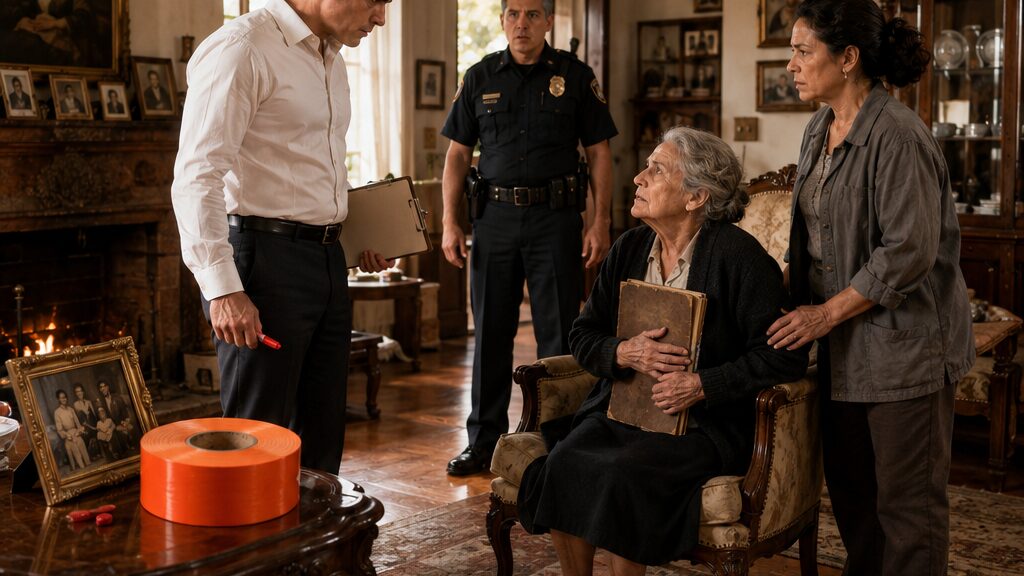
Diego Ruiz put the orange tape on Pilar’s side table as if he were claiming land.
The roll hit the polished wood with a heavy slap that made every photograph on the table tremble in its frame. Pilar, seated in her armchair beside the fireplace, watched the brass-framed picture of her husband rock once and settle crooked.
No one in the room apologized.
Diego glanced around with the quick, assessing boredom of a man pricing grief by square foot. Behind him stood Officer Mario García and another officer near the entryway. Mariana hovered at the edge of the room, having come through the back door ten minutes earlier with the spare key Pilar had once given her for emergencies and then regretted giving.
“This will proceed efficiently if everyone cooperates,” Diego said.
His clipboard was tucked beneath one arm. A thick red marker sat clipped to its top. The neon-orange tape glared on the side table between a porcelain lamp and a row of family photographs.
Pilar looked at the tape. “Remove that from the wood.”
Diego smiled without warmth. “Ma’am, this property is subject to seizure by order of the court.”
“The table is not subject to your manners.”
Officer Mario’s eyes flicked toward Diego, then Pilar. He had the weary stillness of a man who had expected paperwork and found a living room instead.
Diego unfolded the order and held it up. “Pilar Navarro?”
“You know who I am. You are in my house.”
“Then you acknowledge receipt of enforcement.”
“I acknowledge that you have brought bad paper into a clean room.”
Mariana made a small sound behind her.
Diego looked at her. “And you are?”
“Her neighbor.”
“Then unless you are legal counsel, you can observe from outside.”
“She stays,” Pilar said.
“This is not a social visit.”
“No. It is a mistake.”
Diego placed the order on top of the orange tape and pulled a pen from his pocket. “Outstanding debt secured against this property has entered final enforcement. You were notified repeatedly.”
“I was notified falsely.”
“You failed to cure.”
“I owed nothing to cure.”
“Mrs. Navarro,” Officer Mario said, stepping forward gently, “do you have documentation showing the debt was satisfied?”
Pilar’s expression shifted. Not relief. Recognition that someone had asked the right kind of question.
“Yes.”
She reached toward the envelope on her lap, but Diego spoke over the movement.
“Officer, with respect, this is a civil enforcement action already reviewed and approved. Debtors often present partial documents at the door.”
Pilar looked at him. “Do not call me that.”
“Debtor?”
“You know my name.”
Diego checked his watch. “We’re not here to debate language.”
“No. You came with tape.”
He ignored that and nodded to the second officer. “We’ll begin with the main room inventory. Large furniture, framed items, electronics if present, antiques pending valuation.”
“These are not antiques pending valuation,” Pilar said. “They are my husband’s chairs. My mother’s cabinet. My children’s school portraits.”
Diego glanced at the high-backed chair near the bookshelf. “Old furniture is still old furniture.”
Mariana stepped forward. “That cabinet was handmade.”
“Then it may have modest resale value.”
Pilar’s fingers tightened around the envelope. The knuckles rose sharp under her skin.
Officer Mario noticed. “Mr. Ruiz, perhaps we should review her documents before tagging personal effects.”
Diego turned just enough to show irritation without open defiance. “The order authorizes immediate securing of assets. Review can happen during the process.”
“During,” Pilar repeated.
Diego pulled the red marker free. The cap came off with a small pop.
The sound entered Pilar like a door latch clicking shut.
He tore a strip of neon-orange tape and leaned toward the side table. The tape read SEIZED BY BANK in black letters, repeated over and over so the phrase had no beginning and no end.
Pilar stood.
Not quickly. Not easily. But the room changed when she did.
“I paid this house in full in 1988,” she said.
Officer Mario turned to her. “You remember the year exactly?”
“I remember the month. August. The final payment cleared on a Friday because my husband brought home sweet bread from the bakery and said the roof finally belonged only to the rain.”
The officer’s face softened despite himself.
Diego did not look up. “That may refer to an earlier mortgage. The current file concerns a later secured obligation.”
“I never signed one.”
“The file says otherwise.”
“The file lies.”
“The court disagrees.”
Pilar held out the envelope. “Read.”
Officer Mario reached for it.
Diego stepped between them.
It was a small movement, but not an accidental one.
“Copies can be submitted after vacancy,” he said.
“After you remove me from my own chair?”
“If necessary.”
Pilar looked past him to Officer Mario. “Is that your law?”
The officer’s jaw shifted. “Mr. Ruiz, let me see the envelope.”
Diego’s smile thinned. “Officer, I respect your role here, but delay increases liability. The property has already been ordered surrendered.”
He pressed the strip of tape onto the side table.
Mariana gasped.
Pilar’s eyes dropped to the bright adhesive now stuck across polished wood her husband had rubbed with oil every winter. The orange strip crossed the table between the lamp and the photograph like a wound.
Diego smoothed it with two fingers. “There.”
Pilar’s voice was low. “Take it off.”
“No.”
“Take it off.”
Diego leaned closer, lowering his voice as though offering instruction to a difficult child. “Mrs. Navarro, the sooner you accept that this junk no longer belongs to you, the easier your morning will be.”
The word landed harder than the tape.
Junk.
Pilar looked around the room. At the cabinet her mother had saved for in coins. At the chair where her husband had fallen asleep with newspapers on his chest. At the mantel lined with faces no bank computer could name.
“Junk,” she said.
Diego had already moved to the family photographs.
He wrote on a blank tag attached to a second strip of tape. His handwriting was sharp and impatient. The red marker squeaked against the label.
Officer Mario stepped closer. “Mr. Ruiz.”
Diego did not stop. “Framed items. Possible vintage value. To be boxed.”
Pilar moved toward him, but her knee betrayed her with a brief catch. Mariana reached to steady her. Pilar pulled away before the hand could close.
“I can stand.”
“I know,” Mariana whispered.
Diego picked up the brass-framed photograph of Pilar’s husband.
The room seemed to narrow around it.
“Put that down,” Pilar said.
He glanced at the image. “This can be inventoried.”
“It can be put down.”
“It’s a frame, ma’am.”
“It is not yours.”
His face hardened. For the first time, his composure slipped enough to show the strain beneath it: the audit, the manager, the clerk’s questions, the need to finish before anyone found a loose thread.
He set the photograph on the table, not gently, and lifted the red marker.
“Asset identification requires marking.”
Officer Mario said, sharper now, “Hold on.”
But Diego had already leaned over the photograph, red marker uncapped, the tip hovering above the seizure tag beside Pilar’s husband’s face.
Pilar’s hand closed around the old folder against her chest.
The cap clicked against the table.
Diego smiled down at the photograph and said, “You don’t own anything here.”
Then the red tip moved toward the tag.
Chapter 4: The Red Marker Broke First
Diego’s fingers closed around Pilar’s arm before the red marker touched the tag.
His grip was not the accidental pressure of a man steadying someone older. It was the firm, practiced hold of someone moving an obstacle. His thumb pressed into the soft inside of her arm, and pain flashed up through the joint to her shoulder.
“Enough,” he said. “You need to step away from the inventory area.”
Pilar looked down at his hand.
For one second, nobody else moved.
The marker remained uncapped in Diego’s other hand. The red tip hovered above the seizure label beside her husband’s face. The orange tape glared across the side table. The room smelled faintly of furniture wax, old paper, and the sharp chemical ink of the marker.
“Take your hand off me,” Pilar said.
Her voice did not rise. That made it worse.
Officer Mario stepped forward. “Mr. Ruiz, let go of her arm.”
Diego’s jaw tightened. “She is interfering with enforcement.”
“She is standing in her living room.”
“She is obstructing a court order.”
Pilar felt Mariana behind her, felt the younger woman’s panic before Mariana spoke.
“Don’t pull her,” Mariana said. “She has arthritis.”
“I am not pulling her,” Diego snapped.
Then he pulled.
Pilar’s chair scraped backward with a harsh wooden cry as her hip struck its edge. The old folder slipped from where it had been pressed against her side and hit the floor near the fireplace, its cloth sleeve opening just enough to expose a corner of yellowed paper.
Pilar did not look at it.
She looked at Diego.
Not at his hand. Not at his marker. At him.
“You were warned,” she said.
Something flickered in his eyes, not fear exactly, but annoyance at being addressed as if he were the one being evaluated.
“Ma’am, I have been patient.”
“No,” Pilar said. “You have been loud.”
Officer Mario reached them. “Mr. Ruiz, release her now.”
Diego let go, but only after the officer’s hand came within inches of his wrist. He released Pilar as though granting permission, not obeying an order.
The pain remained. Pilar’s arm throbbed where his fingers had pressed. She curled her hand once and felt the stiffness in each knuckle. Her hands had been giving her warnings for years: when turning keys, pinning laundry, lifting pans, polishing the carved legs of the side table. On damp mornings they swelled. On cold evenings they burned.
But those hands had also repaired curtain rods, tightened loose drawer pulls, sewn torn hems, cleaned brass frames, and carried boxes of records no one else had thought worth saving.
Diego turned back toward the photograph, as if the interruption had only sharpened his need to finish. “We are proceeding.”
“No,” Officer Mario said.
Diego ignored him.
The red marker lowered.
Pilar moved first.
She did not remember deciding. Later, she would remember only the sound: the tiny wet squeak of the marker tip beginning its first line on the seizure tag. That was enough. Her hand shot out and closed over Diego’s wrist with a speed that startled even her.
The marker came free.
Diego blinked at his empty fingers.
Pilar held the marker in both hands. Her thumbs pressed against the thick plastic barrel. Her fingers shook, but not from fear. The arthritis flared white through her joints. She drew one breath through her nose.
“Wrong bank,” she said.
The first crack snapped through the room.
Diego took a step toward her. “Give that back.”
Pilar pressed harder. The marker bent. Her mouth tightened, but she did not stop. The plastic split under her thumbs with a second, sharper break.
“Wrong woman.”
The marker snapped cleanly in two.
Red ink burst across her fingers and spattered onto Diego’s expensive white shirt. A thick streak landed just below his collar, then another across his chest, blooming outward like the bank had finally marked him instead.
For a moment there was no sound at all.
The second officer stared. Mariana covered her mouth. Officer Mario’s hand hovered halfway between Pilar and Diego, as though the room had changed faster than his training could name.
Diego looked down at the stain.
His face went pale with disbelief, then dark with fury.
“You assaulted me.”
Pilar tossed the broken halves of the marker onto the orange tape. They struck the roll and rolled apart, leaking red across the printed words SEIZED BY BANK.
“No,” she said. “I stopped you.”
“You destroyed bank property.”
“It was in my house.”
“You threw ink on me.”
“You brought the ink.”
Diego turned toward Officer Mario. “Arrest her.”
The officer did not move.
“Did you hear me?” Diego said. “She grabbed equipment from my hand and vandalized official seizure material during enforcement.”
Officer Mario looked from Diego’s shirt to Pilar’s arm. The marks had begun to rise where Diego’s fingers had been.
“Mrs. Navarro,” he said carefully, “are you injured?”
Diego made a short, incredulous sound. “You’re asking her?”
“I’m asking the person with bruises on her arm.”
Pilar looked down as if the marks belonged to someone else. Four red impressions. One thumb. Precise as a receipt.
“I will live,” she said.
“That is not the question.”
“It is the answer I have.”
Mariana moved toward her. This time Pilar did not pull away when Mariana touched her elbow.
Diego pulled a cloth from his pocket and dabbed at his shirt, only spreading the ink wider. The stain refused to obey him. It crept into the fabric in uneven veins.
“This is exactly why field enforcement requires firm action,” he said, voice shaking with anger. “They escalate. They perform. They create sympathy.”
Pilar looked at him with a tiredness that cut deeper than rage. “You dragged an old woman out of her chair.”
“You refused lawful instruction.”
“I refused to watch you mark my husband’s face.”
“It was a tag.”
“It was a warning to every dead person in this room that the bank had come to rename them.”
Mariana whispered, “Pilar.”
The old woman’s eyes shifted, briefly, to the fallen folder near the fireplace.
That was Diego’s mistake. He followed the glance.
His attention sharpened. He saw the cloth sleeve. The old paper inside. The embossed edge.
“What is that?” he asked.
Pilar stepped toward it, but her knee caught again. Mariana steadied her, and in that half-second Diego moved.
Officer Mario moved faster.
“Leave it,” the officer said.
Diego stopped with his polished shoe inches from the folder. “It may be relevant to the inventory.”
“It is relevant to her dispute.”
“The dispute has already passed review.”
“Not in this room.”
Diego pointed at his stained shirt. “Officer, I am requesting immediate action.”
“And I am taking control of this scene until I understand what happened.”
“You are here to keep peace, not reinterpret civil authority.”
Officer Mario’s face hardened. “Then stop disturbing the peace.”
The words landed with enough force that Diego fell silent.
Pilar bent slowly toward the folder, but Officer Mario raised a hand, not to stop her, only to spare her the pain.
“May I?” he asked.
Pilar’s fingers twitched against Mariana’s sleeve.
For years, that folder had lived in drawers and cabinets, wrapped away from dust and conversation. Her husband had once told her that some papers were not dead just because no one wanted to read them. After he died, she had kept them because throwing them away felt like betrayal and opening them felt like entering a room where his disappointment still sat waiting.
Now it lay on the floor between an orange roll of seizure tape and a man stained by his own red marker.
Pilar gave one small nod.
Officer Mario crouched and lifted the folder with both hands. He handled it carefully, and that almost undid her.
The cloth sleeve slipped back. The first page showed its age at once: thick cream paper, browned edges, a stamped seal pressed deep into the fibers. Officer Mario did not speak immediately. He read the top line, then the next, then looked again at Pilar.
Diego tried to see over his shoulder. “What is it?”
Officer Mario turned the page slightly away from him.
The room held its breath.
There, beneath the formal language and the old ink, was the date: 1950.
Below it, written in careful script beside a block of shareholder records, was Pilar Navarro’s name.
Officer Mario’s thumb stopped under the seal.
He looked up slowly.
“Mrs. Navarro,” he said, “why is your name on the original charter of this bank?”
Chapter 5: The Charter Beneath the Family Photographs
Officer Mario read Pilar’s name aloud, and Diego Ruiz stopped dabbing at the red stain on his shirt.
“Pilar Navarro,” the officer said, his voice careful now, almost unwilling to bruise the paper with sound. “Listed under founding shareholder continuation. Recorded with family interest transferred and held.”
The living room changed again.
Only minutes earlier, Diego’s papers had owned the air. Now the oldest sheet in the room seemed heavier than all of them. It lay open across Officer Mario’s hands, its stamped seal from 1950 catching the light beneath the rows of family photographs.
Diego gave a brittle laugh. “That is ceremonial.”
Officer Mario did not look at him. “You’ve seen it before?”
“No, but banks issue commemorative material all the time.”
Pilar’s eyes remained on the page. “That is not commemorative.”
“Mrs. Navarro,” Officer Mario said, “can you explain what this is?”
She could. That was the trouble.
For a long time she had protected herself by letting the story become smaller. Her husband had worked at the bank. Her family had kept old papers. The house was paid for. Simple sentences. Clean sentences. Sentences that did not mention the meetings, the signatures, the men in new suits who learned to laugh at the old way of doing business.
She looked at the black-and-white photograph on the shelf: men outside the first branch, sleeves rolled, faces serious in the sun. Her father was there. Her husband’s uncle. A younger Pilar partly hidden at the edge, holding a ledger too large for her arms.
“It was a neighborhood bank then,” she said. “Before it became a building that forgot the street outside.”
Diego rolled his eyes. “We’re not here for nostalgia.”
“No,” Pilar said. “You came for furniture.”
Officer Mario lowered the charter onto the side table, carefully avoiding the orange tape and the bleeding marker halves. “Mr. Ruiz, I need you to stop speaking over her.”
Diego looked at the second officer as if searching for backup and found none.
Pilar moved closer to the table. Mariana kept one hand near her elbow but did not touch.
“My father held shares,” Pilar said. “Not many at first. Enough to help open the doors. Later, more. When he died, they passed through my mother. Then through me. My husband managed records for years. He kept telling them the old shareholder ledger mattered.” Her mouth tightened. “They told him everything had been modernized.”
Officer Mario looked down. “This says largest silent shareholder.”
Diego’s head snapped toward the page.
“What?”
The officer pointed to a line beneath the seal. “Here.”
Diego stepped forward.
Officer Mario put a hand flat over the page before Diego could lean too close. “Don’t.”
“This is absurd,” Diego said. “If she were a major shareholder, she would be in the system.”
Pilar looked at him. “I was in the system before men like you taught it to forget.”
“That’s not how ownership works.”
“No. That is how arrogance works.”
Diego’s face tightened. The red stain on his shirt had spread downward, ruining the clean line of his appearance. For the first time, his anger had a seam of fear in it.
He pulled out his phone.
Officer Mario said, “Who are you calling?”
“My manager.”
“Put it on speaker.”
Diego hesitated.
Officer Mario’s eyes did not move.
Diego tapped the screen and held the phone between them. It rang three times.
“Is it completed?” Pablo Vidal asked.
Diego’s jaw flexed. “There’s been an incident.”
“What kind of incident?”
“The occupant became physical.”
Pilar’s hand drifted to the marks on her arm.
Officer Mario stepped closer to the phone. “This is Officer Mario García. I am present at the Navarro property. Enforcement is paused pending review of documents.”
A silence followed. Not confusion. Calculation.
“What documents?” Pablo asked.
“A 1950 bank charter naming Pilar Navarro in shareholder records.”
Diego cut in. “It appears old and likely irrelevant. She used it to obstruct—”
“I did not ask for your summary,” Pablo said.
The room went still at the manager’s tone.
Pilar heard it then: not concern, not surprise, but recognition buried under restraint.
Pablo knew enough to be careful.
Officer Mario heard it too. His posture changed.
“Mr. Vidal,” the officer said, “are you aware of historical ownership flags on this property?”
“I’m not going to discuss internal records over a field officer’s phone.”
“This is my phone,” Diego snapped.
“Then be quiet with it,” Pablo said.
Mariana’s eyes widened.
Pilar looked at Diego and saw humiliation do what cruelty had not: make him small.
Officer Mario said, “The seizure order concerns a debt Mrs. Navarro disputes. Her documents raise questions about ownership, bank interest, and possible misattachment.”
“Possible,” Pablo said. “That word matters.”
“Yes,” Officer Mario said. “So does force used inside a home before documents were reviewed.”
Diego’s grip tightened around the phone.
Pablo’s voice softened into something polished. “Officer, I respect your caution. But you are looking at material from seventy-six years ago. Historical charters, old certificates, founding papers—many survive in private homes. They do not necessarily override current enforcement orders.”
Pilar reached for the charter.
Officer Mario looked at her, then lifted his hand from the page.
Her fingers touched the old paper. The room blurred slightly, not from tears, but from the force of holding what she had refused to hold for years.
“My husband warned them,” she said.
No one interrupted.
“He said a bank that forgets who trusted it first will eventually feed on the people who still trust it. I told him not to fight. I told him to come home. I told him we had our house and our papers and that was enough.”
Her voice thinned on the last word.
Mariana’s face softened with understanding. Pilar had not meant to confess that much. It had slipped out, pulled loose by the charter.
Pablo said, “Mrs. Navarro, I’m sure there is personal history here, but—”
“You do not get to call it personal while using it as collateral.”
The words surprised even Pilar. They came not loudly, but cleanly.
Officer Mario looked at the photographs on the mantel. “Who are these people?”
Pilar followed his gaze.
“My father. My mother. My husband. Men who opened accounts for shopkeepers without making them feel small. Women who brought deposit jars in cloth bags. Children who came for school savings books.” She touched the edge of the charter. “That photograph by the clock was taken the day the first branch opened.”
Diego looked at the photograph as if seeing it for the first time. The black-and-white figures outside the modest bank door. The young woman at the edge with the ledger.
“That’s you?” Mariana asked quietly.
Pilar nodded once.
“You never told me.”
“You never asked about the bank,” Pilar said.
“I asked about your husband.”
“That was asking about the bank.”
The room held that, too.
Then Diego recovered enough of himself to move.
He stepped toward the side table. “This is going nowhere. Mr. Vidal, I recommend securing the documents for bank review and continuing vacancy—”
Officer Mario blocked him. “No one is securing anything except evidence of what happened here.”
“This is not evidence.”
“Then why are you reaching for it?”
Diego’s mouth closed.
Pablo’s voice came through the phone, lower now. “Diego, listen carefully. Do not allow copies of that folder to leave the premises until I verify its status.”
Officer Mario’s eyes sharpened.
Mariana whispered, “Did he just say allow?”
Pilar did not whisper. “This is my house. My folder. My name.”
Pablo exhaled audibly, then returned to his manager’s voice. “Mrs. Navarro, nobody is denying your feelings. But if those documents are bank-related materials, they may need to be reviewed by proper internal channels.”
“Internal channels gave him tape.”
Pablo did not answer.
Diego stared at the folder with renewed purpose. He was no longer thinking about the house. Pilar could see it. The target had changed. Not the furniture. Not the photographs. The paper.
Officer Mario closed the folder gently and held it against his chest.
“No one touches this without her consent,” he said.
Pablo’s voice hardened. “Officer, I strongly advise you not to interfere with bank property.”
Officer Mario looked at the orange tape, the broken red marker, Pilar’s bruised arm, and the family photograph lying crooked beside a seizure tag.
Then Pablo said, clear enough for everyone in the room to hear, “Diego, secure the folder before anyone copies it.”
Chapter 6: The Bank Wanted Its Own History Gone
Diego reached for the folder while everyone was still listening to Pablo Vidal’s order.
It was not a lunge. Diego was too disciplined for that. His hand moved low, almost casually, toward the edge of the side table where Officer Mario had set the folder beside the old charter. But Mariana saw the motion because she had been watching his hands since the moment he grabbed Pilar.
“Officer,” she said sharply.
Mario turned.
Diego stopped with two fingers inches from the cloth sleeve.
Pilar laughed once.
It was a small sound, dry and humorless, but it struck the room harder than shouting.
“You cannot help yourself,” she said.
Diego withdrew his hand. “I was preventing loss of bank material.”
“My name is on it.”
“That doesn’t make it yours.”
Pilar looked at the orange tape still stuck to her table. “You say that about everything you touch.”
Officer Mario took the folder and moved it to the mantel, beneath the photograph of Pilar’s husband. “Mr. Ruiz, step away from the documents.”
Pablo’s voice crackled from the phone. “Officer, I need to speak with you privately.”
“No,” Pilar said.
Everyone looked at her.
She stood straighter, though the bruised arm had begun to stiffen. “Whatever he says about my house can be said in my house.”
Pablo paused. “Mrs. Navarro, we may be able to resolve this without further distress.”
“You had six weeks.”
“I was not personally aware of the situation six weeks ago.”
“Your bank was.”
“That is not the same thing.”
“It is when your bank comes with officers.”
Officer Mario picked up Diego’s enforcement packet from the clipboard. The top page bore Pilar’s address, her name, the court seal, and a loan number that looked final because it had been printed cleanly. Beneath it, the seizure inventory forms waited in blank rows.
“Mr. Vidal,” Mario said, “I need confirmation of the loan identity attached to this property.”
Pablo’s tone cooled. “That information is confidential.”
“You sent a representative to remove a woman from her home using that information.”
“And we have an order authorizing enforcement.”
“You also have a historical title conflict you didn’t mention.”
Pablo did not respond quickly enough.
Diego filled the silence. “Historical flags are common. They don’t stop enforcement.”
Pilar turned to him. “How many homes have you taken while saying that?”
His eyes flashed. “Homes are not taken. Assets are recovered after default.”
Mariana moved to the side table and lifted the brass-framed photograph, checking the glass for cracks. “Listen to yourself.”
Diego ignored her, but his phone buzzed in his hand before he could speak again.
A message preview appeared on the screen. He tilted it away.
Officer Mario saw the movement. “Is that related to this file?”
“No.”
The second officer, who had remained near the entry, shifted closer.
Diego’s phone buzzed again.
Pilar watched his face change. Not much. Just enough.
“Read it,” she said.
Diego gave her a look of open contempt. “You don’t give instructions here.”
Officer Mario held out his hand. “If it relates to the enforcement, I need to see it.”
“It’s internal bank communication.”
“Then you can show it voluntarily, or I can document that you refused during a disputed seizure involving possible misattachment.”
Pablo spoke quickly through the phone. “Diego, forward whatever came in to me first.”
Mariana said, “That sounds calm.”
Diego’s thumb moved over the screen. He opened the message.
A document image filled the display. He looked at it for half a second, then tried to lock the phone.
Officer Mario took one step. “Stop.”
Diego froze.
“Turn it around.”
“This is ridiculous.”
“Turn it around.”
Diego turned the phone.
The image showed a printed page from the bank system. At the top was Pilar Navarro’s property address. Beneath it was a loan number. Beneath that, in smaller type, a borrower profile with business details that did not belong to Pilar: corporate revenue, commercial debtor classification, collateral chain merge.
At the bottom, an automated warning had been highlighted.
POTENTIAL HISTORICAL TITLE CONFLICT. MANUAL REVIEW RECOMMENDED.
Mariana read it aloud, slowly, as if forcing the words to become real in the room.
“Manual review recommended.”
Pilar looked at Diego. “Did you review it?”
He said nothing.
Officer Mario asked, “Who sent this?”
Diego’s mouth worked once before he answered. “A clerk.”
Pablo said, “That page is preliminary.”
“It is a warning,” Mario said.
“It does not invalidate an order by itself.”
“No,” Pilar said. “It only proves the bank knew where to look and chose not to.”
Diego looked at her then, and for a moment she saw the man beneath the title: tired, cornered, furious that one morning had undone the version of himself he had ironed into that white shirt. It did not soften her. It made his next choice clearer.
He could stop.
He did not.
“Manual review was not required for field enforcement,” Diego said. “Recommended is not mandatory.”
Pilar nodded once, almost sadly. “There it is.”
“What?”
“The sentence men use before harm becomes official.”
Pablo’s voice returned, smooth and urgent. “Mrs. Navarro, we can pause enforcement while the records team reviews the attachment. If an error occurred, the bank will correct it.”
“Quietly?” Pilar asked.
“That would be best for everyone.”
“Everyone?”
“For you most of all. No further stress. No public confusion. No unnecessary legal exposure.”
Mariana laughed under her breath. “For her?”
Pablo continued as if Mariana had not spoken. “We can remove the field team, review the documents internally, and send written confirmation once complete. In return, I would ask that all parties refrain from distributing images, copies, or allegations until the bank has had time to assess.”
Pilar looked at Officer Mario. “He means disappear it.”
Pablo said, “I mean handle it properly.”
“No,” Pilar said. “Properly was before the tape touched my table.”
The room settled around that.
Officer Mario placed Diego’s enforcement packet on the coffee table, separate from Pilar’s folder. “Mrs. Navarro, I can document what’s visible here. The seizure tape, the broken marker, the attempted inventory, the bruise on your arm, the documents presented. I can also note the contradictory file information received.”
Pablo’s voice sharpened. “Officer, be careful. You are stepping beyond routine presence.”
Mario looked at the phone. “Routine ended when your representative put hands on her.”
Diego snapped, “I did not assault her.”
Pilar lifted her bruised arm. She did not push up her sleeve dramatically. She simply let the marks be seen.
Diego’s face closed.
The second officer took out a small notepad.
Pablo went silent.
For the first time since the men entered, the house seemed to belong to its own sounds again: the clock, the faint hum of the refrigerator, Mariana’s careful breathing, Pilar’s old floorboards under official shoes.
Pilar reached for the charter folder.
Officer Mario did not stop her.
She opened it fully this time.
Inside were more than the charter. Folded shareholder statements. Old correspondence. A ledger copy with her father’s handwriting. A letter from her husband to the bank’s board, never sent or perhaps never answered, warning that modernization without memory would make the bank dangerous to the people it was built to serve.
Pilar touched that letter and closed her eyes for one beat.
Then she opened them.
“I kept this private because I thought privacy was dignity,” she said.
Mariana’s face changed.
Pilar did not look away from the papers. “Maybe I was wrong.”
Pablo’s voice softened again, now carrying the careful sympathy of a man reaching for a settlement before anyone named it one. “Mrs. Navarro, I understand this is emotional. Let me come personally. We can sit down, review the materials, and make this right without turning your living room into a spectacle.”
Pilar looked around.
At the orange tape.
At the red ink drying on Diego’s shirt.
At her husband’s photograph lying beside a seizure tag.
At Mariana, who had asked to help and been refused until refusal itself became too heavy.
At Officer Mario, who had trusted paper until paper contradicted itself in his hands.
“No,” she said.
Diego’s eyes narrowed. “No what?”
Pilar lifted the charter and placed it beside the modern enforcement order. Old paper beside new. Lived proof beside printed threat.
“No private correction,” she said.
Pablo’s silence became dense.
Pilar turned to Officer Mario.
“Record everything,” she said. “Every mark they put in this room. Every object he tagged. Every paper he brought. Every paper I showed. Start with the tape on the side table.”
Diego stepped back as if the orange strip had become contagious.
Pilar’s voice did not shake.
“And take a photograph of his clipboard before anyone from the bank decides it was never here.”
Chapter 7: The Plaque Above the Fireplace
The orange tape did not come off cleanly.
Mariana peeled it slowly from the side table while Officer Mario photographed the damage, but the adhesive left a pale, sticky outline across the polished wood. A bright ghost of the words remained even after the strip lifted free: SEIZED BY BANK, repeated in residue no longer attached to paper.
Pilar stood beside the fireplace and watched without blinking.
“That will need oil,” she said.
Mariana looked up. “We can fix it.”
Pilar did not correct the we.
Across the room, Diego Ruiz stood with his stained shirt, his jaw locked, and his clipboard held uselessly at his side. He had stopped giving orders once Officer Mario began photographing the room. The second officer had already taken pictures of Pilar’s arm, the broken marker halves, the orange tape on the furniture, the seizure tags Diego had started filling out, and the family photograph lying beside the red-streaked label.
Each camera click seemed to reduce Diego by an inch.
“Turn the clipboard toward me,” Officer Mario said.
Diego stared at him. “It contains bank documents.”
“It contains documents used during a disputed enforcement action inside this home.”
“I am not handing over proprietary material.”
“You’re not being asked to hand it over. You’re being asked to let me document what you brought.”
Diego looked toward the phone on the coffee table, where Pablo Vidal’s call was still active. No one had hung up. No one had forgotten he was there.
Pablo spoke carefully. “Diego, cooperate with the officer for now.”
“For now,” Pilar repeated.
The words settled.
Diego lifted the clipboard.
Officer Mario photographed the top page, then the seizure checklist, then the blank inventory lines waiting for Pilar’s life to be translated into categories. Furniture. Framed items. Miscellaneous personal effects. Pending valuation.
Pilar stepped closer to see.
Her husband’s photograph sat upright again on the side table, but the frame leaned against the lamp because the back stand had cracked when Diego set it down too hard. Mariana had noticed and said nothing yet. Pilar had noticed too. She was waiting to feel angry about that later, when the room was empty.
For now, she felt only clear.
Officer Mario lowered the camera. “Mrs. Navarro, I’ve documented visible marks and materials. I will file this with the incident report and note the record conflict.”
Pablo’s voice came through the phone at once. “Officer, I must stress that the bank is willing to pause enforcement voluntarily pending internal review.”
Pilar looked at the phone. “Voluntarily.”
“Yes,” Pablo said. “There is no need for further escalation. Mrs. Navarro, I would like to come in person this afternoon. We can arrange written correction, apology, restoration costs, and privacy.”
“Privacy,” Mariana said under her breath.
Pilar heard the word as she had heard it in her own mouth for years.
Privacy had kept the folder closed. Privacy had let the letters sit in a drawer. Privacy had made her answer the phone alone while a system prepared to enter her house. Privacy had felt like dignity until men with tape mistook it for weakness.
She looked at the old charter on the mantel beneath her husband’s photograph. The seal held the light differently than the modern papers. It did not glare. It endured.
“What would your written correction say?” Pilar asked.
Pablo paused, likely hearing a door open where he expected a wall. “That the enforcement action has been suspended due to a records discrepancy.”
“Suspended.”
“Pending full review.”
“Not false.”
“I cannot use that word before review is complete.”
“You used seizure before review was complete.”
Diego shifted.
Pablo tried again. “Mrs. Navarro, I understand your frustration.”
“No,” Pilar said. “You understand exposure.”
Silence.
Officer Mario did not interrupt. Mariana stopped peeling the last bit of tape and looked at Pilar with something like recognition, as if she were seeing not a neighbor in trouble, but the person who had been inside the neighbor all along.
Pilar picked up the broken red marker halves from the side table. The ink had stopped bleeding. It had dried on her fingers in thin red lines, sunk into the creases around her knuckles.
“Your man called my furniture junk,” she said. “He put tape on my husband’s table. He tried to mark a photograph. He put his hand on me. And when the paper showed him he was wrong, he reached for that too.”
Diego’s face tightened. “That is not a fair characterization.”
Pilar looked at him. “It is the gentlest one I have.”
Officer Mario’s mouth moved as if suppressing something. Not a smile. Not quite.
Pablo said, “Mrs. Navarro, Diego’s conduct will be reviewed.”
“By the same bank that reviewed the file?”
Another silence. This one was longer.
Mariana finally lifted the last strip of tape from the side table and held it out as if it were something dirty. “Where should I put this?”
Officer Mario took an evidence bag from the second officer. “Here.”
Diego watched the orange strip disappear into plastic.
Something in him broke—not loudly, not nobly. He looked less angry suddenly, and more afraid. The day had turned on him in layers: the marker, the folder, the warning printout, Pablo’s caution, the officer’s camera. He had arrived as the one who labeled things. Now his own actions were being labeled in front of him.
“I followed the order I was given,” he said.
Pilar looked at him for a long moment.
“No,” she said. “You enjoyed the parts that hurt.”
The words did what the ink had not. They went through.
Diego looked down.
Pablo cleared his throat. “Mrs. Navarro, again, I propose we resolve this quietly.”
Pilar took the phone from the coffee table and held it near her mouth.
“I will accept correction,” she said. “I will accept restoration. I will accept the report Officer Mario files. I will accept nothing that requires forgetting.”
“Public claims could create complications.”
“They already did.”
“For the bank, yes. But also for you.”
Pilar looked at the photographs around the room: her mother, her father, the first bank office, her husband by the fireplace, the younger woman at the edge holding the ledger. For so long, she had thought keeping them dusted was enough. Keeping the frames straight. Keeping the paper dry. Keeping memory private and therefore safe.
But memory hidden too long could be mistaken for absence.
“I am eighty years old,” Pilar said. “Do you think complication frightens me more than erasure?”
Pablo did not answer.
Officer Mario closed his notebook. “Mrs. Navarro, do you want emergency medical attention for your arm?”
“No.”
“Do you want to make a formal complaint regarding contact made during enforcement?”
Pilar looked at Diego. His stained shirt, his empty hand, his polished shoes on her floor.
“Yes,” she said.
The word was quiet. It did not need to be anything else.
Diego’s head lifted.
Pablo said, “Diego, leave the premises.”
Diego stared at the phone. “You’re pulling me?”
“I said leave.”
“I was acting under your authorization.”
“And now you are leaving under it.”
For a second, Diego looked as if he might argue. Then Officer Mario picked up the clipboard from the coffee table and removed the top seizure form for documentation. The movement drew Diego’s eyes.
The clipboard’s wooden backing had cracked down one side. It must have happened when he dropped it against the chair during the confusion after the marker snapped. A long split ran from the metal clip to the bottom corner.
Pilar noticed it at the same time Mariana did.
Diego reached for it. “That’s bank property.”
Officer Mario held it out of reach. “It will be photographed first.”
The second officer took the picture.
Mariana touched Pilar’s shoulder. “Do you want to sit?”
Pilar almost said no.
The old answer came to her easily, worn smooth by use. No, I can manage. No, don’t trouble yourself. No, this is mine to handle.
Instead, she looked at the sticky outline on the table and the red ink on her hand.
“Yes,” she said.
Mariana brought the armchair back into place. Pilar sat carefully. Not because Diego had emptied the chair. Because she had decided to occupy it again.
The officers finished their photographs. Diego left without looking at Pilar. The second officer escorted him to the porch, where his white shirt flashed once through the window, stained beyond repair.
Pablo remained on the phone long enough to promise written communication by evening. Pilar placed the receiver down before he finished explaining the bank’s review process.
The living room did not return to normal after the door closed.
It would not. That was the point.
Mariana brought warm water, soft cloths, lemon oil, and an old towel from the kitchen. Together they cleaned the side table. Pilar let Mariana rub gently at the adhesive while she held the cracked photograph frame in her lap. When Mariana reached for the frame, Pilar handed it to her without a word.
“You trusted me with it,” Mariana said.
“I am practicing.”
Mariana smiled, but her eyes shone.
By late afternoon, the officer’s card lay beside the charter folder. The seizure order had been copied. The warning printout had been preserved. The orange tape strip sat in an evidence bag. The broken marker halves remained on a saucer Pilar refused to throw away.
The cracked clipboard backing was different.
Officer Mario had returned it after photographing it, saying the bank could request it later if needed. Pilar held the split wood, ran her thumb along the break, and thought of all the labels that had almost been written.
A week later, after the bank’s formal correction arrived and Pablo Vidal’s apology came printed on expensive paper that said less than his silence had, Mariana stood beside Pilar at the fireplace.
The broken clipboard pieces had been mounted on a small wooden plaque by a local carpenter. Pilar had insisted the split remain visible. Beneath the pieces, no long message was carved. Only a thin brass plate with the date.
Mariana looked at it, then at Pilar. “People will ask what it means.”
Pilar adjusted the plaque until it hung level above the mantel, between the photograph of her husband and the black-and-white picture of the bank’s first branch.
“Good,” she said.
The room was clean again. The side table had been oiled. The photograph frame had been repaired. The old charter rested in a new archival sleeve, no longer hidden in a drawer.
Pilar stepped back, her arthritis-scarred hands folded before her, and looked at the broken clipboard above the fireplace.
It did not make the house safe forever.
It made the warning visible.
The story has ended.