He Threw Trash Into Pablo’s Weathered Mountain-Road Sleeper And Woke The Engine Everyone Misjudged
Chapter 1: The Can Lands Before The Mountain Goes Quiet
The soda can crossed the mountain light like a tossed coin, spinning silver and red, trailing one last ribbon of syrup before it dropped through the open window of Pablo Rivera’s car.
It hit the seat with a hollow crack.
For half a second, nobody on the pull-off moved. The can rolled across the worn cabin floor, knocked against the transmission tunnel, and spilled a sticky brown line into the seam where the old material folded under the seat rail.
Then Carlos Vargas laughed.
“Relax, man,” he said, holding his phone high enough to catch himself, the car, the road, the sky, everything except the hand Pablo had lifted too late. “Your trash can needed trash.”
The laugh came again, not just from Carlos. Tinny voices burst from the phone speaker. Comments flickered up the screen too fast for Pablo to read, though he saw enough little laughing faces to understand the shape of them.
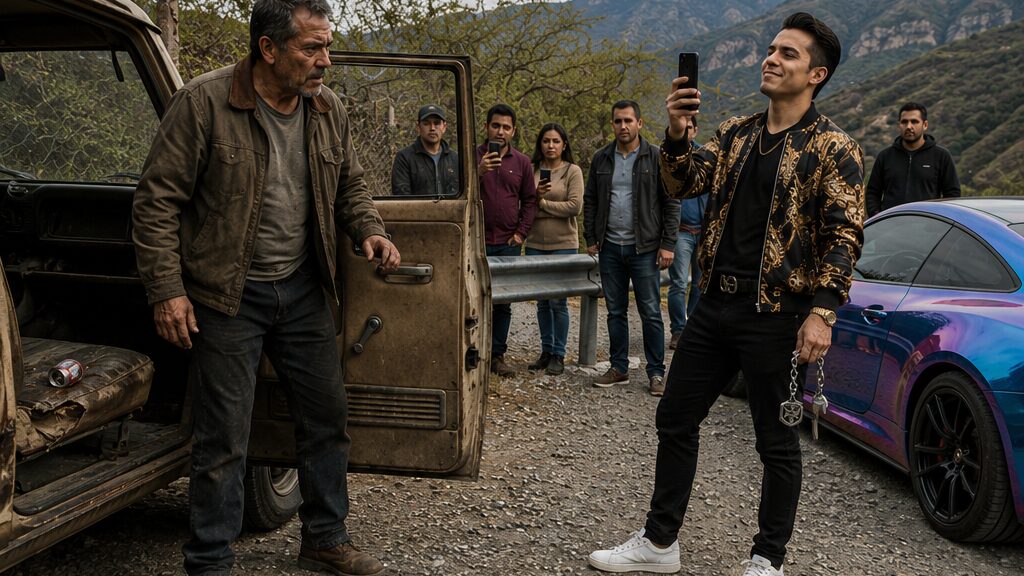
Carlos stood beside a bright blue sports car wrapped in a color so glossy it looked wet. The wrap flashed purple at the edges when the sun hit it. A row of fake carbon pieces hugged its body. The car was angled across the gravel shoulder as if the mountain road itself were a showroom and everyone else had parked wrong.
Pablo’s vehicle sat ten feet away, nose toward the drop, dust settled into every crease of its weathered body. Its paint was not clean, not shiny, not pretty in any way that a passing phone camera would forgive. The hood had sun-faded patches. The door edges carried tiny scars. The cabin looked bare, old, almost forgotten.
Almost.
Pablo opened the door slowly.
Carlos leaned closer to his phone. “Look at this, chat. He’s actually mad.”
Pablo did not look at him. He reached into the cabin and picked up the can with two fingers through a clean cloth he pulled from his back pocket. He did not crush it. He did not toss it back. He held it upright, as if the remaining drops inside might still do more damage if handled carelessly.
That made Carlos laugh harder.
“You keep a towel for the rust bucket?” Carlos said. “Bro, it’s not a museum.”
Pablo’s thumb pressed once against the cloth. The can made a faint sticky sound.
Mountain wind moved through the pull-off, carrying dry grass against the fence posts. Beyond the fence, thorn bushes thickened along the slope, catching old leaves and plastic scraps blown from the road. A few cars slowed as they passed, not because of danger yet, but because Carlos’s voice had the sharp brightness of trouble.
Pablo crouched beside the open door and looked inside.
The soda had reached the seam.
His face changed so little that anyone watching through Carlos’s phone might have missed it. One eyelid tightened. His jaw set. The cloth around the can stopped moving.
Carlos did not miss the silence. He fed on it.
“Chat, you see this? This is what I mean when I talk about fake builds. Guys drag some dead shell up the mountain and act like we’re supposed to respect it.” He turned the phone toward his own car. “Meanwhile, actual taste is sitting right here.”
His free hand swung a heavy metal designer keychain attached to his fob. It flashed in the sun as it circled his finger. Thick links. Polished charm. More weight than function. Each swing made a soft, expensive clack.
Pablo stood.
He set the can on the gravel beside his rear tire, still wrapped in the cloth. Then he took another cloth from the driver’s side pocket, folded it into a narrow square, and reached into the cabin. His movements were deliberate, almost surgical. He dabbed, never rubbed. He held the material away from the seam with one hand and wicked the soda upward with the other.
The live stream voices went shrill.
Carlos tilted the phone, zooming in. “No way. He’s detailing the trash.”
Pablo’s shoulder lifted once with a breath.
“You threw sugar into my cabin,” he said.
It was not loud. The mountain seemed to make room for it anyway.
Carlos blinked, then grinned wider. “I threw garbage into garbage. There’s a difference.”
A woman stepped halfway out of the roadside café kiosk across the pull-off, wiping her hands on a towel. Elena Ortiz watched from under the shade awning, her expression caught between irritation and concern. Pablo knew her by sight. Most locals did. She sold coffee to cyclists, water to hikers, and sandwiches to drivers who underestimated the next thirty miles of road. She had seen Pablo stop here before, always parking at the far edge, always checking the road behind him before opening the cabin.
“Carlos,” someone called from the passing lane, a young man filming from another car. “Make him pop the hood!”
Carlos pointed at him with the phone. “Exactly. Let’s see the monster.” Then to Pablo, “Come on, viejo. Show us the horsepower. Or does it need a hill to roll down?”
Pablo finished blotting the seam. The cloth came away stained.
He looked at it for a long moment.
The old vehicle ticked softly in the wind, cooling metal beneath weathered skin. Under the dashboard, no wires dangled. No trash sat in the footwell. The pedals were worn but clean. The steering wheel carried age the way old tools carried fingerprints: darkened by hands, not neglect. To anyone who cared to notice, everything inside had a place.
Carlos did not care to notice.
He stepped closer, still swinging the keychain. “You know what kills me? Guys like you park these eyesores where people are trying to shoot real content.” The keychain circled faster. “Like, bro, there’s scenic and then there’s sad.”
“Back away,” Pablo said.
Carlos looked at the phone, eyebrows raised. “Hear that? Now he owns the mountain.”
The comments poured in. Pablo saw Carlos glance at them, saw the little flicker of need in his face. Every laugh made him taller. Every reaction made him braver. He turned his body so the wrapped sports car filled the background behind him, its shining side panels swallowing the sun.
“You want respect?” Carlos said. “Wash it. Paint it. Put money into it. Don’t drag a trash can with seats up here and expect people to bow.”
The keychain swung forward.
Its metal charm clipped the air inches from the open door.
Pablo’s eyes went to the arc of it.
Carlos smiled, sensing that he had found the nerve. “Oh, that’s the line? Not the soda. This?”
He swung it again, closer.
Elena took one step from the awning. “That’s enough.”
Carlos ignored her. “What, this thing’s original? Some rare dust package?” He laughed at his own line, then leaned in, phone still up, keychain circling near the cabin. “Tell you what. I’ll buy you an air freshener.”
Pablo moved his hand toward the door.
Carlos shifted with him, blocking the opening for the camera. “No, no, don’t hide it now. Let everyone see the luxury interior.”
The keychain came around again.
This time, it was not just near the door. It swung toward the exposed edge of the cabin, toward the place where Pablo had just lifted the stain with careful pressure.
Pablo’s hand snapped up.
He caught the chain in his fist mid-swing.
The sound was small, just metal links biting into skin, but it cut through the laughter like a blade. Carlos’s smile froze. The phone tilted. The wrapped car behind him slipped out of frame.
For the first time since the can had landed, Pablo looked directly at him.
“Don’t touch it again,” he said.
Chapter 2: The Keychain Disappears Into The Thorns
The keychain left Carlos’s hand with a violent jerk, and his confidence went with it.
Pablo did not yank Carlos forward. He did not strike him. He simply closed his fist around the chain, twisted once, and pulled the fob free from Carlos’s fingers with the same efficient motion he might have used to remove a stripped bolt before it ruined a thread.
Carlos stared at his empty hand.
“Hey,” he said, voice breaking upward. “No. No, give that back.”
The phone still pointed at Pablo. Its lens caught the old man’s hand, the heavy metal charm, the bright car behind Carlos, and the small crowd forming at the edge of the pull-off. Someone near the café muttered. A passing motorcycle slowed, engine burbling, rider’s helmet turned toward the scene.
Pablo stepped past Carlos and toward the fence.
“Don’t,” Carlos said.
Pablo did not look back.
The fence was old mountain-road work, gray posts and wire stretched unevenly along the slope. Beyond it, the thorn patch grew thick and mean, a tangle of dusty green and hooked branches dropping into a shallow ditch. Things went in there and did not come out without blood.
Carlos lunged, but Pablo’s shoulder blocked him once, hard enough to stop him, not hard enough to throw him down.
“Bro, that’s my key,” Carlos snapped. “That’s not some cheap—”
Pablo threw it.
The keychain flashed over the fence. Sun hit the metal charm once, bright as a camera flash, then it disappeared into the thorns with a frantic rattling scrape. Branches shook. Something clicked against a stone. Then there was nothing.
Carlos stood open-mouthed.
For a second, the mountain was quiet except for the distant hiss of tires on the road.
Then Carlos exploded.
“Are you insane?” He shoved the phone toward Pablo’s face. “You all saw that, right? You saw him steal my key?”
Pablo turned back toward his vehicle.
Carlos stepped after him, no longer laughing. “That fob is coded, man. That is a luxury key. Do you know what those cost?”
Pablo picked up the cloth-wrapped soda can from the gravel and set it carefully on the roof of his car, away from any seam, away from any opening. “Less than what you threw that into.”
Carlos’s eyes flickered. Not confusion. Calculation. The kind Pablo had seen in men who had backed a trailer into something expensive and were deciding whether there had been witnesses.
“It’s a can,” Carlos said loudly, for the phone.
“It had sugar in it.”
“Oh my God.” Carlos threw his free hand up. “Sugar. Call the mountain police. Sugar touched the apocalypse wagon.”
A few people laughed, but not as many this time.
Elena Ortiz came fully out from under the café awning. Her gray apron was dusted with flour, and she held her towel like she was still deciding whether it was for drying hands or waving down traffic.
“Pablo,” she said, sharp but low, “he’s recording.”
“I know.”
“Then act like you know.”
Carlos heard that and seized it. “Exactly. Tell him. Tell your friend he can’t just assault people because his junk car got dirty.”
Elena’s eyes moved to the open cabin. She had seen the can land. She had seen Pablo’s cloth. But she also saw phones, strangers, traffic slowing, the bright blue car angled like bait.
“Carlos,” she said, “you threw something in his vehicle. Go look for your key and stop making it worse.”
Carlos swung the phone toward her. “Oh, perfect. Local witness. Say it again, but start with the part where he robbed me.”
“I said stop making it worse.”
His face flushed. Without the keychain, his hand looked strangely empty. He kept flexing his fingers as if the lost metal had been part of his body. The blue sports car behind him gave one soft confirmation chirp from its alarm system, then went silent, locked and smug and useless without the fob.
A small smile moved through the crowd.
Carlos heard it.
“My spare is at home,” he snapped, though no one had asked. “This car is not stranded.”
“Then call someone,” Pablo said.
Carlos turned on him. “I’m calling the police.”
Pablo closed his door halfway, not enough to latch it, just enough to shield the cabin from the road. His hand lingered near the upper edge.
Carlos shoved the phone closer again. “You hear me? I’m calling the police, and I’m sending them this video. You ripped my key out of my hand and threw it into the bushes because you’re embarrassed that your trash got called trash.”
Pablo said nothing.
That silence fed the shape Carlos needed. His voice changed, smoothing into the tone he used for his audience.
“This is exactly the problem,” Carlos said, pacing backward so Pablo and the weathered vehicle fit behind him. “You get these bitter old guys who think because they once touched a wrench, they can threaten people. Meanwhile, they park unsafe junk on public roads and act like everyone else is the problem.”
The phone’s comments flickered. Carlos glanced. His breathing steadied. He had found the story again.
Pablo saw it happen. The scene was no longer a man panicking over a lost key. It was content being repaired in real time.
Elena moved closer to Pablo, not blocking the camera, not joining him either. “You should tell him what it is.”
Pablo looked at her.
“I don’t know the whole story,” she said. “But I know you. You don’t stop here in that unless you have to. You don’t leave the door open unless you’re checking something. Tell him enough.”
Carlos laughed over her. “Yes, please. Tell us. Is it rare? Is it one of one? Did the president drive it? Did your uncle build it in a secret cave?”
Pablo’s face shut.
Elena noticed. Her expression tightened, and for a moment she looked less angry than sorry.
Carlos took that pause as victory.
“Nothing,” he said to the phone. “He’s got nothing. Just attitude.”
Pablo reached back into the cabin and removed another clean cloth from a small folded stack under the seat. He pressed it once along the seam, inspected it, then folded it stain inward.
Carlos’s eyes darted to the careful motion again. Irritation crossed his face, but beneath it was something thinner. Worry, maybe. The kind that came when the joke refused to stay simple.
“My car’s locked,” Carlos said, voice rising again. “My wallet’s in there. My registration. Everything. You understand that? I can’t even open it because this guy had a tantrum over garbage.”
A cyclist at the edge of the crowd said, “You threw the garbage.”
Carlos spun. “Stay out of it.”
Pablo closed the cabin door fully this time. The latch clicked with a precision that did not belong to junk.
That sound landed oddly among the witnesses.
Carlos heard it too. His eyes narrowed.
For the first time, he looked at the vehicle without performing. He noticed the door gap. The clean glass. The way the old tires, though dusty, had deep, purposeful shoulders. The stance, low and still, like an animal pretending to sleep.
Then the phone in his hand buzzed. The live chat jumped. Carlos’s eyes hardened again.
“No,” he said, loud enough for everyone. “No, we’re not doing mysterious old-man energy. We’re doing facts.” He lifted the phone. “Police report. Damaged property. Threatening behavior. And I want him on camera admitting his junk car started this.”
Pablo turned toward him slowly.
Carlos pointed at the weathered vehicle.
“Say it,” he demanded. “Say your trash started this fight.”
Chapter 3: The Engine Answers Louder Than Carlos
“Dead weight,” Carlos said, stabbing a finger toward the old vehicle. “That’s all it is. Dead weight with a temper standing next to it.”
Pablo looked at the finger, then at Carlos’s phone, then at the mountain road beyond them.
A line of cars had slowed near the pull-off. A delivery van idled by the café entrance. The cyclist had stopped pretending to adjust his helmet and was watching openly now. Elena stood near the front of her kiosk, arms folded tight across her apron. Everyone waited for Pablo to finally explain.
He did not.
He walked to the driver’s door.
Carlos barked a laugh. “Where are you going? You gonna run? You gonna push-start it?”
Pablo opened the door and slid into the cabin with care, one hand braced above the sill so his jacket did not drag across the stained seam. From outside, the car swallowed him into its shadow. The worn steering wheel sat high against his chest. Dust streaked the windshield where the wipers had cleared two honest arcs.
Carlos followed, phone up. “Chat, watch this. He’s going to pretend it runs.”
Pablo shut the door.
Inside the cabin, the noise changed. Carlos’s voice became muffled and thin. The mountain wind softened. Pablo sat still for a moment with both hands resting low, not yet on the wheel. The smell of sugar had reached the old material, faint but sharp beneath leather, oil, and warm metal.
His eyes moved to the seam again.
A brown bead remained in the crease.
He took his key from his pocket.
Outside, Carlos tapped on the glass with one knuckle. “Come on, legend. Give us the symphony.”
Pablo turned the key halfway.
A small mechanical sequence answered inside the dash. Not electronic chimes. Not modern alerts. Relays clicked one after another, dry and exact. A fuel pump whispered and stopped. The gauges trembled awake.
Carlos’s grin faltered just enough.
Pablo’s left foot settled. His right hand hovered near the shifter. He closed his eyes for half a breath, not praying, not remembering, only listening.
Then he turned the key.
The engine caught once, low and rough, like something clearing its throat after a long silence.
Carlos raised his eyebrows at the camera. “Wow. It coughs.”
The second turn came deeper.
The car inhaled.
Then the mountain shook.
The engine erupted so hard that several people stepped backward at once. The sound did not rise like a normal rev. It detonated into the air—wide, tuned, violent, a layered mechanical roar that slammed against the cliff wall and came back twice as large. Gravel trembled under Pablo’s tires. The café windows buzzed in their frames. The delivery van’s driver ducked as if something had cracked overhead.
Carlos’s phone microphone clipped into static.
His wrapped sports car began screaming.
Its alarm shrieked in frantic bursts, lights flashing in panic, the bright blue body suddenly ridiculous beside the old machine’s controlled thunder. The alarm chirped and wailed and chirped again, but the sleeper’s idle swallowed it whole, each pulse from the exhaust making the smaller car’s plastic trim quiver.
The crowd no longer laughed.
Carlos stared at Pablo’s car.
The phone dipped.
For the first time all afternoon, the camera was not where Carlos wanted it.
Pablo sat behind the wheel, one hand on the shifter, eyes forward. He did not rev again. He did not smile. He let the engine idle, and that was worse. The sound had discipline. It did not belong to a car barely alive. It belonged to something built beyond what its surface admitted.
The cyclist whispered, “What the hell is in that?”
Elena did not answer.
Carlos swallowed. The alarm behind him kept screaming. He jabbed at his phone, then remembered the fob was gone. His eyes flicked toward the thorn patch.
Someone laughed once, not at Pablo this time.
That laugh hit Carlos like a slap.
He spun toward his car. “It’s sensitive. It’s a security system. That doesn’t mean anything.”
Pablo turned the engine off.
The silence that followed felt physical. Even Carlos’s alarm stopped after a final embarrassed chirp.
Pablo opened the door and stepped out.
Carlos lifted the phone again too quickly. “So what? Loud doesn’t mean valuable. Anybody can make noise. That was reckless. That was threatening. You set off my alarm on purpose.”
Pablo shut the door behind him.
“You stood close,” Pablo said.
Carlos blinked. “What?”
“You stood close to something you did not understand.”
The line was not dramatic enough for the crowd. It had no punch. No performance. But it landed somewhere Carlos did not want touched.
He recovered by pointing the phone at Pablo’s face. “No, no. We’re not doing fortune-cookie mechanic talk. You owe me a key fob. You owe me an apology. And if anything is wrong with my car because of that stunt—”
“Your car is fine.”
“You don’t know that.”
“I know what fine sounds like.”
A murmur moved through the witnesses. Carlos heard it and flushed again.
The live stream buffer wheel spun on his screen. Then the image froze on a distorted frame: Pablo stepping from the car while Carlos’s alarm lights flashed behind him.
Carlos cursed under his breath and tapped the screen. “Signal dropped.”
Elena’s eyes narrowed. She looked not at the phone, but at Carlos’s thumb. The timing had been too clean. He had cut the stream just as the mountain stopped laughing at the wrong man.
Carlos held the phone tight against his palm. “Doesn’t matter. I got enough.”
Pablo looked toward the café, then toward the road. He wanted to leave. Every second here invited another hand, another lens, another wrong version. The cabin needed to be opened under light. The seam needed warm distilled water, then dry air, then inspection. He had already waited too long.
He moved to get back in.
Carlos blocked half a step of the way, not touching him, but placing himself in the camera’s imagined frame. “You leave before the police come, that looks guilty.”
Pablo’s hand stopped on the door handle.
Elena crossed the gravel then, walking straight between them.
“Pablo,” she said quietly.
Carlos groaned. “Great. Here comes the café lawyer.”
Elena ignored him. She kept her voice low enough that the crowd could not easily hear, but Carlos leaned in anyway.
“My outside camera,” she said. “The one above the ice machine.”
Pablo did not move.
“It faces the pull-off,” she continued. “Wide angle.”
Carlos’s expression changed.
Elena looked toward the soda can, still wrapped on the roof. “My camera caught the can.”
Chapter 4: The Clip That Left Out The Can
Pablo saw himself online before the soda had dried.
He stood in his garage with the cabin light angled low over the open door, one hand holding a narrow cotton swab above the stained seam, while the phone on his workbench played a version of the mountain road that had been cut clean of its beginning.
On the screen, he was already holding Carlos’s keychain.
No can. No syrup hitting the cabin. No first warning. No hand swinging too close to old material.
Just Pablo, hard-faced and silent, ripping the fob away.
The caption under the video read: Angry junk-car owner throws my luxury key into the bushes, then revs at me like a maniac.
Pablo stopped the clip with one thumb.
The garage became very quiet.
Under the work light, the vehicle looked worse than it did in daylight and better than any camera had yet understood. Dust softened the panels. Old paint showed every year it had survived. But around it, the garage told a different truth. Labeled trays sat along the wall: original fasteners, cabin clips, switch trim, spare seals. Cloths were folded by use, not by color. A shallow metal pan held distilled water, a soft brush, and the first cloth Pablo had used at the roadside, now sealed in a bag beside the soda can.
He bent over the cabin again.
The sugar had crept farther than he wanted.
“Of course,” he said, barely aloud.
The seam had darkened. Not badly. Not yet. But the liquid had touched the edge of the original material, and once sugar dried there, it could pull dust, stiffen fibers, stain the fold. He worked slowly, lifting, blotting, stopping whenever the cloth came away too wet. Force was how people ruined things they claimed to save.
His phone buzzed again.
He ignored it.
It buzzed a second time, then a third, then lit with a preview from an unknown account: This you, old man? People found the road.
Pablo looked at the message until the screen dimmed.
He should have told them. At the pull-off, before the keychain, before the engine, before Carlos found enough silence to carve into a lie. He had felt Elena’s eyes on him, had heard her say tell him enough, and he had locked his mouth around the truth like it was safer there.
Now strangers were naming the mountain.
He picked up the phone again and opened the clip.
The edit was careful. Carlos had left in the moment Pablo threw the keychain. He had left in Carlos’s panic. He had left in Pablo starting the engine, though the sound had distorted through the phone. He had trimmed the live cutout to make it seem as if Pablo revved at him deliberately, like a threat. The alarm from Carlos’s car remained, but under the caption it looked like damage.
Another notification appeared. A stitched reaction video. Then another.
Pablo set the phone facedown.
Across town, Carlos Vargas sat in the driver’s seat of a borrowed car, parked beneath the buzzing light of a fuel station, watching the numbers climb.
Paula Delgado’s message came in first.
Cleaner without the can.
Carlos stared at it, then looked through the windshield at his blue wrapped sports car across the lot, sitting on a tow bed because he still could not unlock it. The tow driver had not laughed when Carlos explained the key was in a thorn bush. That made it worse.
He typed back: It distracts from him assaulting me.
Paula replied almost at once: It shows why he reacted.
Carlos’s jaw tightened.
He could still feel the thorn scratches across the back of his hand from the ten minutes he had spent searching before giving up. He had tried to make it look like part of the bit, narrating, joking, promising the followers a follow-up. But when he had reached through the fence and thorns hooked his skin, he had stopped filming.
That part did not fit the brand.
His sponsor contact had not answered his last two messages. The payment reminder for the wrap installer sat unopened in his email. The lease app had sent a notification that morning he had swiped away without reading. He needed the clip to work. Not tomorrow. Now.
He typed: Post the shorter one everywhere.
There was a pause.
Then Paula wrote: You sure?
Carlos looked at the frozen thumbnail: his blue car flashing in the background, Pablo framed like an old villain, the weathered vehicle crouched beside him.
He sent: He threw my key. That’s the story.
In Pablo’s garage, the vehicle’s interior light flickered once.
Pablo tapped the housing with two fingers, and it steadied. He had repaired that switch twice over the years, never replacing the visible piece because the old one belonged. Not because it was valuable to anyone else. Because it belonged.
His phone buzzed again.
This time it was Elena.
I’m closing early. People are driving by slow.
He stared at the message, then typed: Don’t involve yourself.
Her reply came fast.
Too late for that.
Pablo closed his eyes.
The garage door was half open. Beyond it, the road in front of his house had gone dark, but twice in the past twenty minutes headlights had slowed near his driveway. Not neighbors. Not anyone who had business there. He had heard one voice call something about junk before the car sped off laughing.
He walked to the garage door and pulled it lower, leaving only a foot of night beneath it.
The vehicle sat behind him in the work light, still weathered, still low, still holding its shape like patience. On the bench, the sealed soda can looked small. Ridiculously small. A cheap can, a few ounces of sugar, a stranger’s laugh.
His phone rang.
The name on the screen stopped him.
Hugo Silva.
Pablo let it ring until voicemail caught it. He set the phone down, then picked it up again when the notification appeared.
He played the message on speaker.
Hugo’s voice came through tight and older than Pablo remembered. “I saw the clip. Not the internet’s version—the bad copy someone sent me because they thought I’d know the car. Pablo, listen to me. If that is the car I think it is, you cannot keep pretending it’s just yours.”
The message ended.
Pablo stood beside the open cabin, cotton swab drying between his fingers.
Then another car slowed outside his garage.
Someone shouted from the street, “Rev the trash can!”
Pablo reached for the light switch and killed the work lamp, leaving the sleeper in darkness before anyone else could see how carefully it was kept.
Chapter 5: The Records Prove Less Than The Promise
Hugo Silva did not touch the stained seam when he arrived the next morning.
He bent near it, hand hovering a few inches above the cabin edge, and that restraint made Pablo trust him for exactly three seconds before Hugo said, “If this crossed into the original weave, you have a real problem.”
Pablo’s face hardened.
“I know.”
“No,” Hugo said, straightening slowly. “You know how to clean it. That is not the same thing as knowing what it means now.”
The garage smelled of old oil, damp cotton, and coffee Pablo had forgotten to drink. The sleeper sat under two work lights, half shadow and half evidence. In daylight, with the garage door closed and no phones pointed at it, the car’s weathered skin seemed less like neglect and more like a language people had stopped learning. Hugo walked around it without stepping too close, eyes moving from door gaps to wheel arches to the small fasteners that had survived where newer hands would have replaced them.
He did not smile.
That told Pablo more than praise would have.
“You kept the old panels,” Hugo said.
Pablo picked up the sealed soda can and moved it farther from the car. “Most of them.”
“The roof line?”
“Untouched.”
“Firewall?”
Pablo looked at him.
Hugo exhaled. “Of course.”
There was history between them, not friendship exactly. Years earlier, Hugo had tried to convince him to document the car properly, to bring it into a controlled shop, to let people with white gloves and market language photograph every angle. Pablo had refused with so little explanation that Hugo had left angry. Not because he wanted to own it. Because he thought Pablo’s secrecy was another kind of neglect.
Now Hugo stood in the garage, older, still irritated, still careful where he placed his hands.
“Do you have the records?” he asked.
Pablo turned toward the metal cabinet by the bench.
“Pablo.”
“I have them.”
“All of them?”
Pablo opened the cabinet and removed a thick folder wrapped in brown paper. He set it on the bench but kept one palm resting on top.
Hugo saw the gesture. “I’m not here to take anything from you.”
“That’s what everyone says before they rename it.”
Hugo’s mouth tightened. “And this is why people are calling it junk online. Because you leave a vacuum and let idiots fill it.”
Pablo opened the folder.
Inside were old service notes, photographs of stripped components, handwritten measurements, receipts from shops that no longer existed, parts labels with fading ink, and dyno sheets with numbers that made Hugo go still.
He lifted one page.
“You actually got it stable at that output?”
“For seven years.”
“On this chassis?”
“For seven years,” Pablo repeated.
Hugo set the sheet down with more respect than before. “This is not a car you hide beside a mountain road with no explanation.”
“It wasn’t hidden. It was being driven.”
“Those are not opposites.”
Pablo said nothing.
Hugo moved to the open cabin again. “The soda damage may be manageable, but if it dries into the seam, no insurer will treat it like a normal upholstery claim. And if you involve insurance without documentation, you will spend months proving the thing in your garage is the thing you say it is.”
“I am not filing a claim over a soda can.”
“You may have to if the stain sets.”
“It will not set.”
Hugo looked at him. “Your confidence is not paperwork.”
The words struck harder than they should have.
Pablo flipped deeper into the folder. A photograph slid partly free from between two records: a younger Pablo standing beside the vehicle when the paint was already weathered but the cabin was open and clean. Another figure was in the frame, cropped by Pablo’s hand before Hugo could see fully.
Pablo removed the photo and placed it facedown beneath a shop towel.
Hugo saw.
For a moment, neither of them spoke.
“That why?” Hugo asked softly.
Pablo closed the folder.
“You didn’t come here for that.”
“No. But that is why you never let anyone call it what it is, isn’t it?”
Pablo’s hand tightened on the folder edge. “People ruin things when they turn them into trophies.”
“People also ruin things when they don’t know what they’re standing next to.”
The garage door rattled.
Both men turned.
A vehicle had stopped outside. Not close enough to be a visitor. Close enough to look. A phone lens appeared briefly in the gap beneath the door, then vanished when Hugo stepped toward it.
“Get out of here,” Hugo barked.
Tires scattered gravel. The car left laughing.
Pablo stood very still.
Hugo lowered his voice. “This is what I mean. The clip is bringing them here.”
Pablo picked up his phone. Notifications stacked across the screen. Carlos had posted again. This time, there was a screenshot of a complaint form, his name covered poorly enough that the intention was obvious.
He opened it.
Carlos had written that Pablo destroyed an expensive key fob, used his vehicle to intimidate him with excessive engine noise, and fled without resolving damages. Under the post, comments argued about whether Pablo should pay, whether the old car was even road legal, whether someone should find it and test how loud it really was.
Hugo read over his shoulder.
“He’s turning this official,” Hugo said.
Pablo locked the phone. “Let him.”
“No. That is your pride talking.”
“It is my property.”
“It is your silence doing damage.”
Pablo turned on him, anger finally showing. “You think I don’t know damage? You think I need you to stand here and tell me what sugar does, what sunlight does, what careless hands do? I have kept this car whole while people with more money than patience tried to strip it into parts. I know damage.”
Hugo did not back away.
“Then stop helping them.”
The words hung between the work lights.
A knock came at the side door, quick and firm.
Pablo opened it before Hugo could speak.
Elena Ortiz stood outside holding a small black drive between two fingers. She looked tired. Her café apron was gone, replaced by a jacket, but she still smelled faintly of coffee and fryer oil.
“I copied it before anyone asked me for it,” she said.
Pablo looked at the drive.
Elena did not hand it over yet. “It shows the can. It shows the keychain. It shows the engine, too.”
Hugo stepped closer but said nothing.
Pablo reached for the drive.
Elena held it back. “Before I give this to anyone, you need to decide what story it tells.”
Chapter 6: The Man Who Mistook Silence For Guilt
Carlos Vargas recorded his next video with thorn scratches across both hands and his leased sports car just out of frame.
He had tried three angles before settling on one that showed the mountain road behind him but not the tow strap mark near the front wheel, not the dust collected on the wrap, not the small humiliation of needing someone else to unlock what he had built his image around.
“Yesterday,” he began, then stopped because his voice sounded too flat.
He rubbed his palms on his pants and winced when the scratches burned.
Paula Delgado stood a few feet away, holding a second phone. “Don’t mention the tow.”
“I know not to mention the tow.”
“And don’t say he stole the car key. Say property.”
“I know.”
She looked at him over the phone. “Carlos.”
He hated that tone. It was the tone people used when they had decided they were smarter than you but still needed your face.
“What?”
“If the full clip comes out, this gets bad.”
He stared at her.
Paula lowered her voice. “The can is obvious. You threw it. He reacts after.”
“He overreacts.”
“Yes. Maybe. But he reacts after.”
Carlos looked toward the road. A truck passed. The driver slowed just long enough to glance at him, then kept going.
He imagined the comments turning. Not all at once. First a few people asking where the beginning was. Then car accounts zooming in. Then someone identifying the car under the dust. Then the jokes about his wrap, his trim level, his payments. He had seen it happen to other creators, watched them become punchlines in a language the internet pretended was justice.
His lease payment was due in nine days.
The wrap shop had started tagging him in polite reminders.
His last sponsor had asked for “authentic engagement,” which meant numbers, not truth.
“Record,” he said.
Paula did.
Carlos lifted his chin. “Yesterday, I was assaulted on a public mountain road by a man driving a worthless rust bucket who lost control because I made a joke.”
Paula’s eyes moved, but she kept filming.
“He destroyed my property,” Carlos continued. “He used his car to threaten me. And now people are acting like I deserved it because his engine was loud. Loud doesn’t make you right.”
At Pablo’s garage, Elena’s security footage sat open on a laptop between three people who did not agree on what truth cost.
The first frame showed the pull-off from above the café’s ice machine. Wide angle. No sound. Cars passing in miniature. Carlos’s blue sports car too bright even in security footage. Pablo’s weathered vehicle near the fence. Then the moment Pablo had already replayed in his mind too many times: Carlos’s arm extending, the can leaving his hand, the small silver spin before it vanished into the cabin.
Elena paused it there.
“No one can argue with that,” Hugo said.
Pablo stood behind them with his arms folded. “Everyone argues with everything.”
“But not equally.”
Elena glanced at him. “He’s already saying you assaulted him.”
“He can say what he wants.”
“He gave people the road,” she said. “Not your exact house, but enough. Two cars came by my place this morning asking if the ‘sleeper guy’ stops there. One bought nothing. Just filmed the fence.”
Pablo looked at the frozen can on the screen.
He could release it. Cut Carlos off at the knees. Let strangers do what strangers did. But then the car would become a destination, a hunt, a prize people tried to identify before he agreed to anything. The old records on the bench, the hidden photograph under the towel, the seam still drying inside the cabin—every private thing would lean toward the light.
Hugo seemed to read his face.
“You do not have to show everything,” he said.
Pablo gave a humorless breath. “You have been telling me to show everything for years.”
“I’ve been telling you to document it. Not feed it to people who want a circus.”
Elena turned the drive in her fingers. “There is another problem.”
Pablo looked at her.
“The café camera caught more than the can. It caught his friend telling him after the live cut that she had enough for an edit. No audio, but you can see her hand signal. If she confirms it, it changes things.”
“She won’t,” Hugo said.
“She might,” Elena said. “If she sees where this is going.”
Across town, Paula stopped recording and lowered the phone.
Carlos grabbed it from her. “Was that good?”
“It was usable.”
“That’s not what I asked.”
She hesitated. “It makes you look angry.”
“I am angry.”
“It also makes you look scared.”
His eyes sharpened. “Don’t psychoanalyze me.”
“I’m trying to keep you from making this worse.”
He laughed once. “Worse? Worse is me paying for a fob because some old man thinks his rust project is holy. Worse is people finding out the car got towed because I couldn’t open it. Worse is losing the sponsor because my numbers dipped last month and now the only clip moving is the one where I look like I got punked by a grandpa.”
Paula said nothing.
Carlos heard himself breathing. He lowered the phone.
“You think I don’t know what you’re thinking?” he said. “That I should just apologize? Admit I threw the can?”
“I think you should stop lying about the beginning.”
“That beginning ruins the point.”
“The beginning is the point.”
His face hardened. “Then don’t mention it.”
Paula looked at him for a long moment. The opportunism in her expression thinned, leaving something uneasy beneath.
Carlos stepped closer. “Paula. Don’t mention the can.”
Back in the garage, Pablo sat alone after Elena and Hugo moved outside to take a call. The laptop was open before him. The full clip waited on the screen.
His finger hovered over delete.
It would be easy. Remove the file. Give Elena back the drive. Tell Hugo to go home. Clean the seam, close the garage, let Carlos shout until another trend replaced him. Pablo had survived worse than public stupidity. So had the car.
Then a new comment appeared under Carlos’s latest post, sent to Pablo by a stranger who thought it was funny.
Somebody should find that junker and toss a whole six-pack in it. Bet he cries.
Pablo read it once.
The garage seemed to narrow around the sleeper.
He thought of the can hitting the seat. The bead of soda in the seam. Carlos’s laugh. His own hand lifting too late. Years of saying nothing because words invited buyers, judges, experts, thieves, admirers, all with hungry hands.
He stood and crossed to the bench.
The old photograph was still under the towel.
He uncovered it.
In the picture, he was younger, but the car was already weathered. The person beside him had one hand on the roof and the other blurred from motion, as if trying to wave off the camera. Pablo looked at the image for a long time, then slid it back into the folder instead of hiding it loose beneath the towel.
When Elena returned, he was holding the drive.
“How much?” she asked.
Pablo looked at the sleeper, then at the frozen frame of the can in mid-air.
“Use the beginning,” he said. “Not just the roar.”
Chapter 7: The Full Clip Finds The Real Fake Car Guy
The first frame that turned the internet against Carlos was not the engine roar.
It was the soda can hanging in the air.
Someone in an online car group froze Elena’s security footage at the exact moment the can left Carlos’s hand. His arm was extended. His phone was up. Pablo stood beside the weathered vehicle, one hand already moving too late toward the open cabin.
The caption beneath it was simple: He cut out the first five seconds.
By noon, the frame had been shared into places Carlos could not charm. Not lifestyle pages. Not short-form fan accounts. Car forums. Restoration groups. Old racing boards with usernames older than Carlos’s driving record. People who noticed door gaps before paint color. People who paused grainy footage and knew what a careful hand meant.
Pablo watched none of it at first.
He sat in the garage while Hugo prepared the documentation Pablo had allowed him to prepare. Not all of it. Enough. The dyno sheet with certain numbers visible. A cropped photograph of the engine bay with the serial markings blurred. A close image of the cabin seam before cleaning, then after. A short note, written by Pablo, then rewritten by Elena until it sounded less like a warning label and more like a human statement.
Hugo wanted to name the model fully.
Pablo refused.
“At least give them the platform,” Hugo said.
“No.”
“They’ll identify it anyway.”
“Then let them work for it.”
Hugo looked up from the laptop. “You are still hiding.”
Pablo’s eyes moved to the vehicle. “I am choosing what is not theirs.”
Hugo did not argue with that. Maybe because, for once, it was not silence. It was a boundary with words around it.
Elena stood near the bench, arms folded, watching the upload spread from her café account and then beyond it. She had posted the clip without music, without a dramatic caption, without the engine boosted. The wide shot showed everything: Carlos mocking, the can flying, Pablo cleaning, the keychain swinging near the cabin, the throw into the thorns, the engine waking, the alarm screaming.
The truth did not need much editing.
That was what made it dangerous.
A comment appeared under the café post: Wait, he threw soda into the car FIRST?
Then another: That is original interior material. You don’t do that.
Then: Pause at 0:34. That is not a junk build.
Hugo turned the laptop toward Pablo. “They see it.”
Pablo looked only long enough to read one thread. Someone had circled the wheel fitment. Someone else had identified the sound not as random loud exhaust but as tuned displacement under serious load control. Another had compared the wrapped blue car to base-model factory specs and then asked, with clinical cruelty, why Carlos had been acting like it was a limited edition.
Pablo closed the laptop halfway.
Elena watched him. “You don’t want to see him get dragged?”
“No.”
“Most people would.”
“I’m not most people.”
“No,” she said. “You are more difficult.”
That almost made Hugo smile.
Across town, Carlos did see it.
He saw all of it.
He sat on the edge of his bed with his phone in one hand and the replacement fob invoice open on the other. His wrapped car was back outside his apartment, unlocked now, though the tow and reprogramming had cost more than he had admitted to anyone. The keychain was still in the thorns. The new fob looked plain without it.
His notifications had become a swarm.
At first, he tried to reply. He called people jealous. He called the car community elitist. He said the can had been empty. Someone clipped that and posted a slow-motion close-up of soda splashing into the cabin. He said Pablo had attacked him first. Someone placed both videos side by side and marked the cut.
Then came the side-by-side of his car.
Base trim. Vinyl wrap. Cosmetic add-ons. Lease plate frame barely visible under one angle. The comments did not attack him for not owning something expensive. That would have been easier to survive. They attacked him for pretending, for mocking an older machine while not understanding his own.
Fake car guy became a phrase under every post.
Then a meme.
Then his face, frozen at the moment Pablo’s engine set off his alarm, became a reaction image.
Paula called him three times before he answered.
“What?” he snapped.
“You need to take the complaint post down.”
“No.”
“Carlos.”
“No. If I take it down, it looks like I lied.”
“You did lie.”
He stood so fast the invoice slid off his knee. “Are you serious right now?”
“I told you not to make the beginning disappear.”
“You said the edit was cleaner.”
“It was. It was also wrong.”
He laughed once, sharp and humorless. “Great. Now you’re honest.”
“I’m trying to keep you from posting another video that makes people hate you more.”
“I don’t need management from someone who held the camera.”
The line sat there.
When Paula answered, her voice had changed. “That is exactly why I’m calling.”
He looked at the phone.
“I’m not taking blame for your throw,” she said. “I edited what you told me to edit, and that was wrong. If people ask, I’m saying the full clip is accurate.”
Carlos’s mouth opened, but nothing came out.
The call ended.
For the first time, the room felt as quiet as the mountain had after the roar.
That afternoon, Carlos posted an apology.
He filmed it in front of the blue car after wiping the dust from the hood and parking so the damaged edge of the wrap did not show. He used a softer voice. He said emotions ran high. He said he respected all builds. He said he never intended damage. He said he had learned a lot about humility and car culture.
He did not say Pablo’s name until the end.
Even then, it sounded like a brand tag.
The comments knew.
At Pablo’s garage, Elena played only the first ten seconds before stopping it. “He’s performing again.”
Hugo leaned against the bench. “Sponsors got to him.”
Pablo took a small glass jar from a shelf and placed two old screws inside, labeling the lid with tape. “That is not my concern.”
Elena looked at him. “He named you.”
“I heard.”
“And?”
Pablo pressed the label flat with his thumb. “He apologized to his audience. Not to me.”
Hugo nodded once, as if the distinction mattered more than any viral count.
By evening, the road near the café had calmed. A few people still drove by slowly, but Elena had put up a handwritten sign that said the pull-off was for customers and emergencies, not filming. Someone online turned that into a joke too, but it had a gentler edge.
The car groups moved on to deeper arguments. Some praised Pablo. Some scolded him for throwing the keychain. Others debated whether the sleeper should be documented, preserved, raced, insured, hidden, shown. Everyone had an opinion on what Pablo owed the world.
Pablo owed the world nothing.
He kept working.
Near dusk, while wiping the final trace of cleaner from the cabin edge, he received a message from Elena.
He’s back.
Pablo stared at the words.
Another message followed.
No camera that I can see. He’s by the fence.
Pablo walked to the garage door and lifted it by hand. The old vehicle waited with its weathered nose toward the street. For a moment, he stood beside it, palm resting above the door but not touching the stain.
Then he took the key from the hook.
The sleeper started without drama this time, settling into a low pulse that filled the garage like an animal waking because its name had been called.
By the time Pablo reached the mountain pull-off, the light had gone thin and blue. Carlos’s bright car was not there. No crowd. No live stream voices. No Paula. Just one figure beside the fence, shoulders hunched, sleeves snagged, searching the thorn patch with a phone flashlight.
Carlos did not turn when Pablo pulled in.
He was on his knees in the gravel, reaching through the wire, still looking for the keychain.
Chapter 8: The Sleeper Leaves Before The Applause Arrives
Carlos was kneeling by the fence at dawn with both hands scratched open when Pablo’s engine rolled up behind him like distant thunder.
He flinched before he turned.
There was no bright blue car beside him now, only a dull borrowed hatchback parked badly near the café entrance. No phone on a tripod. No second camera. No audience hiding behind the guardrail. The mountain road was nearly empty except for the gray edge of morning and Elena’s closed kiosk, its metal shutter pulled halfway down.
Carlos looked smaller without the wrap behind him.
He pulled his hand out of the thorns and hid it against his side. Too late. Pablo had seen the red lines across his knuckles, the torn cuff, the strip of expensive metal chain caught somewhere beyond the wire and refusing to return.
Pablo shut the sleeper off.
The silence between them was not peaceful. It had teeth.
Carlos stood, then seemed to remember the posture he used in videos. His shoulders squared. His chin lifted. “I was going to call you.”
Pablo closed the driver’s door.
Carlos glanced around the pull-off, checking for lenses by habit. “I wanted to say something. About yesterday. About how things got taken out of context.”
Pablo said nothing.
The old phrase died on Carlos’s face.
He tried again, softer. “Look, I posted an apology.”
“To them.”
Carlos swallowed.
The café shutter rattled behind them. Elena appeared in the doorway with a mug in her hand, but she did not come closer. She saw Carlos, saw Pablo, then stayed where she was. Witness, not judge.
Carlos rubbed his scratched thumb against his palm. “I shouldn’t have thrown the can.”
Pablo waited.
“And I shouldn’t have cut the video.”
The words cost him more than the apology had. They came out without polish, without rhythm. He looked almost angry at himself for saying them plainly.
Pablo walked to the passenger side, opened a small compartment behind the seat, and removed a clear evidence bag. Inside was the soda can, dented, sticky residue dried along its rim. He carried it to the fence and placed it on the flat top of a weathered post.
Carlos stared at it.
“That,” Pablo said, “is where it began.”
Carlos’s jaw shifted. “I know.”
“No. You knew yesterday.”
The line landed. Carlos looked away toward the thorn patch.
Pablo stepped closer to the fence and looked down. Several feet in, hooked branches held the metal designer charm hostage. The fob itself had dropped lower into the ditch. It was reachable, maybe, with time and pain.
Carlos followed his gaze.
“I need it back,” he said. “Not for the car. I already had the fob replaced. The chain was…” He stopped.
Pablo looked at him.
Carlos gave a tired laugh that did not become a laugh at all. “It was stupid. I know. But it was the first thing a brand sent me when my page started getting attention. Not even a big brand. Just enough to make me feel like something was happening.”
For a moment, Pablo saw the shape beneath the noise: not innocence, not excuse, but hunger. A young man who had mistaken being watched for being built.
“That is what you protected?” Pablo asked.
Carlos’s face tightened. “You protected a car.”
Pablo turned toward the sleeper.
From this angle, in the washed-out dawn, it looked almost gentle. The weathered paint did not shine. The old panels did not perform. The machine sat low beside the road, holding power inside itself without announcing a number.
“No,” Pablo said. “I protected a promise.”
Carlos looked at him, and for once did not interrupt.
Pablo reached into his jacket and took out the old photograph. Not the records. Not the dyno sheets. Not the proof Hugo had wanted to give the whole world. Just the photograph.
He held it out.
Carlos hesitated before taking it.
In the picture, younger Pablo stood beside the same vehicle, one hand on the roof. Beside him was a person Carlos did not know, face half turned from the camera, palm lifted as if waving away attention. The car’s paint was already worn. The cabin was open, immaculate, sunlight resting across the seat where the soda had landed years later.
Carlos looked at it longer than Pablo expected.
“This who built it with you?” he asked.
Pablo took the photo back. “This is who told me not to let it become a trophy.”
He slid the picture into his jacket again.
Carlos exhaled. “I asked what it was worth online.”
“I saw.”
“So what is it worth?”
Pablo looked at the thorn bush, the soda can, the borrowed hatchback, the empty road waiting beyond them.
“What it sells for?” he said. “Too much for the people who only want to own the story.”
Carlos lowered his eyes.
“What it cost?” Pablo continued. “Years. Friendships. Sleep. Money I should have kept. Parts I had to make because no one had them. Rooms I didn’t enter because I was out here chasing a sound. The last good argument I had with someone who knew me before I became careful.”
Carlos did not speak.
Pablo reached through the fence.
“Don’t,” Carlos said quickly. “The thorns are bad.”
Pablo ignored him. He caught the chain with two fingers, turned it sideways, and freed the charm from the hooked branch without pulling. It took patience, not strength. Carlos watched, breathing shallowly, while Pablo worked the metal loose piece by piece until the fob lifted from the ditch scraped but intact.
Pablo held it out.
Carlos took it with both hands.
For a second, the old exchange from the mountain road reversed itself: metal passing between them, consequence returning to its owner.
Pablo picked up the soda can from the fence post.
“Keep that too?” Carlos asked, uncertain.
“No.”
Pablo placed the can beside Carlos’s recovered keychain on the hood of the borrowed car. The dented aluminum and polished metal sat together in the dawn, ugly little evidence of cause and symbol, throw and return.
“This is the whole story,” Pablo said.
Carlos looked at the two objects, then at him. “Are you going to tell people I came back?”
“No.”
“Why?”
“Because not everything needs an audience.”
Elena’s shutter rattled higher. Somewhere inside the café, a machine began to hiss. The road curved empty toward the ridge, pale light touching the guardrail where yesterday’s crowd had stood with their phones.
Carlos picked up the keychain slowly. He left the can where it was.
Pablo returned to the sleeper and opened the door. Before getting in, he looked once at the cabin seam. Clean. Not untouched, but saved.
Carlos spoke behind him. “I really am sorry.”
Pablo paused.
This time, the words had no camera angle to serve.
Pablo nodded once, not enough to absolve him, enough to acknowledge that he had finally said it to the right person.
Then he got in, turned the key, and let the engine wake gently.
It did not roar this time. It settled into a deep, steady idle, strong enough to tremble the gravel but controlled enough not to startle the morning. The sleeper pulled away from the fence, from the café, from Carlos and the can and the place where strangers had mistaken age for worthlessness.
By the time the first cars of the day began climbing the mountain, Pablo was already gone, driving before the next wave of applause could find him.
The story has ended.