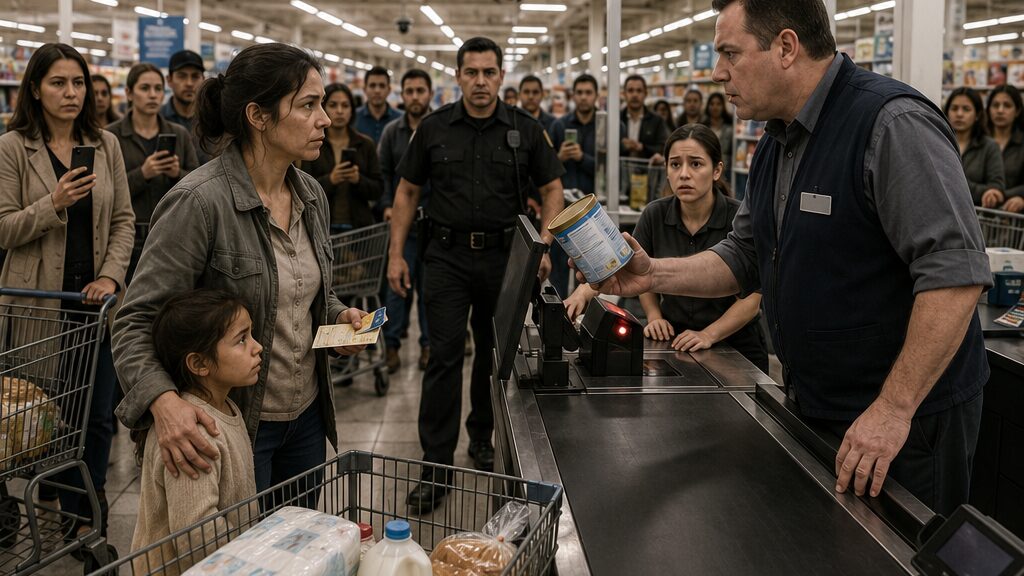
The Store Manager Took Her Baby Formula, Then The Receipt On The Floor Exposed Everything
Chapter 1: The Formula Leaves The Counter First
The register made a sound Laura Martínez had been dreading all week.
Not the normal beep. Not the quick, clean chirp that meant one more item had passed from worry into ownership. This was sharper, longer, almost accusing. The screen above the card reader flashed red, and the checkout line behind her shifted as one body.
A man somewhere behind the cart sighed loud enough for everyone to hear.
Laura kept her hand on the benefits card.
“Maybe it needs the voucher code again,” she said, though her voice came out thinner than she wanted.
Isabel Ortega, the cashier, did not roll her eyes. That was the first mercy of the afternoon. She was young, with dark hair pulled back so tightly it made her face look more serious than tired. She leaned toward the screen and tapped through the options with the careful silence of someone who knew a small mistake could become someone else’s disaster.
Laura’s child stood pressed against her leg, one hand curled into the hem of Laura’s work shirt. The child had been good through the whole store: no grabbing, no whining, no asking for cereal with cartoon animals on the box. Just quiet, heavy-eyed patience while Laura compared prices and counted what she could carry home.
On the conveyor belt sat the whole arithmetic of her week.
A gallon of milk. Store-brand bread. A small bag of rice. Diapers. Apples with one bruise she had hidden on the underside. And the can of baby formula, white and blue, expensive enough that Laura had looked at it three times before placing it in the cart.
She had checked the balance before leaving the apartment.
She had checked it again in the parking lot.
She had saved the assistance voucher on her phone and written the code on a scrap of paper in case the screen cracked, died, froze, or betrayed her in any of the ordinary ways cheap phones betrayed tired people.
“It should cover the formula and diapers,” Laura said. “The milk and bread too. I have cash for the rice and apples.”
Isabel glanced up, not unkindly. “Let me try it one more time.”
Behind Laura, cart wheels knocked together. Someone muttered, “Always this lane.”
Laura felt the words touch the back of her neck.
She wanted to turn around and explain. She wanted to say she had come after finishing the early cleaning shift, before the evening diner shift, because this was the only gap in the day. She wanted to say there was no scam here, no trick, no laziness. Just a mother with sore feet, a sleeping child who would wake hungry, and a system that worked only when it felt like it.
Instead, she swallowed and watched Isabel scan the voucher again.
For one second, the screen changed.
Laura saw it. Isabel saw it too.
Approved.
The word appeared so briefly it felt like a secret. A green flash, a little line of proof. Laura’s shoulders loosened before she could stop them.
Then another message covered it.
TRANSACTION ERROR. MANAGER REQUIRED.
Isabel’s hand froze above the screen.
Laura leaned forward. “It said approved.”
“I saw,” Isabel whispered.
The lane light blinked. Above them, fluorescent bulbs hummed in long white strips. It was Saturday afternoon, the hour when the store seemed to hold half the town under one roof. Checkout lanes were packed. Children tugged at carts. Customers studied candy shelves and receipts. A row of security cameras stared down from black glass domes.
Laura looked at the formula can. It sat upright at the end of the belt, separate from the cheaper food, as if it knew it was the thing everything depended on.
Isabel pressed a button beneath the counter.
A moment later, Diego Vidal arrived.
He came fast, but not rushed. That was what Laura noticed first. He moved like someone already irritated, someone who had been waiting for a reason to prove a point. His dark manager vest was zipped high, his name badge perfectly straight, a store tablet tucked under one arm.
“What’s the issue?” he asked.
Isabel kept her voice low. “Voucher transaction error. It showed approval for a second, then kicked back manager required.”
Diego’s eyes moved from the screen to Laura, then to the cart, then to the child holding Laura’s shirt.
“Benefits?” he asked.
Laura lifted the card slightly. “Yes. And an assistance voucher. It’s valid. I checked before I came.”
He took the card from Isabel’s side of the counter before Laura realized what he was doing. He didn’t pull it from Laura’s hand, but he picked it up from where Isabel had placed it, turning it between two fingers as if it were something damp.
Laura’s face warmed.
“I can show you the voucher,” she said quickly, reaching for her phone. “It has the approval number.”
Diego did not look at the phone. He looked at the line.
“Ma’am, we can’t hold up an entire lane every time someone’s card doesn’t go through.”
“It did go through,” Laura said. “For a second. The screen said approved.”
Isabel’s lips parted. No sound came out.
Diego turned his head just enough to make the silence feel like an instruction.
Laura saw it then: Isabel’s fear. Not confusion. Not annoyance. Fear.
Diego set the benefits card on the counter and picked up his tablet. He tapped the screen twice, sharply.
The customer behind Laura, a woman with a red basket over one arm, lifted her phone and pretended to check a message. The camera lens pointed forward.
Laura hated herself for noticing.
“Please,” she said, softer now. “I’m not trying to cause trouble. I just need the formula.”
Diego’s fingers stopped moving.
Something in his face hardened, not into anger exactly, but into performance. His shoulders squared. He reached past the milk, past the diapers, past the bread, and closed his hand around the can of baby formula.
Laura’s body moved before her thoughts did. One hand went to the cart. The other went down to her child’s shoulder.
Diego lifted the can off the belt.
The beeping from the neighboring lanes seemed to fade, one register at a time.
“If you can’t afford baby formula,” he said, loud enough for three checkout lanes to hear, “maybe you shouldn’t have had a kid.”
The words struck the air and stayed there.
Laura did not move.
Her child pressed closer, confused by the sudden quiet. Isabel stared at the scanner. The man who had sighed behind Laura stopped shifting his cart. The woman with the red basket no longer pretended not to record.
Laura’s first instinct was to apologize.
That was the worst part. Not the insult. Not the staring. The reflex inside her, old and obedient, telling her to make herself smaller so the moment would end.
She opened her mouth.
Nothing came.
Diego held the formula at his side like confiscated evidence.
“I have the voucher,” Laura said at last. “It was approved.”
“Then why didn’t it approve?” Diego asked.
“It did.”
He gave a short laugh, not amused. “That’s not what the receipt is going to say.”
Isabel looked quickly at the printer.
A thin strip of paper began to slide out.
Laura watched it emerge line by line, a small white tongue telling a story she knew was wrong. Failed transaction. Manager required. Balance not completed. It kept printing as if certainty were just ink.
Diego tore it off before Isabel could touch it.
“See?” he said, turning it toward the people behind her. “This is what happens. They come in with a cart full of stuff, card doesn’t work, then suddenly everybody else is supposed to wait while we figure out another excuse.”
Laura felt the line change. Not all at once. Not cruelly from every person. But enough. Eyes lowered to her shoes, her jacket, the diapers, the child. People made calculations. Some looked sympathetic. Some looked bored. Some looked relieved it wasn’t them.
“My card works,” she said. “My voucher works. Check the logs.”
Diego’s eyes sharpened at that.
“What did you say?”
“Check the transaction logs.”
The words surprised her. They were still quiet, but they had edges.
Isabel glanced at Laura, then at the tablet tucked against Diego’s side.
Diego’s hand tightened around the receipt.
“You don’t tell me how to run my front end,” he said.
“I’m not. I’m asking you to check what happened.”
“You’re asking me to waste more time.”
“I’m asking you to give back the formula I paid for.”
“You haven’t paid for anything.”
The child made a small sound then, not quite a cry. Laura bent instinctively, murmured, “It’s okay,” though nothing about the moment was okay. Her hand shook as she smoothed the child’s hair.
When she straightened, Diego was looking past her.
“Santiago,” he called.
A security guard near the front doors turned.
Laura’s stomach dropped.
The guard was broad-shouldered, wearing a black store security shirt with a radio clipped at his chest. He stepped away from the entrance slowly, as if he already disliked where this was going but had been called too plainly to pretend not to hear.
Diego held up Laura’s benefits card between two fingers.
The humiliation became physical then. It stood outside Laura’s body, visible and bright under the checkout lights.
“Security,” Diego said, still looking at Laura, “check her bag before she leaves.”
Chapter 2: The Receipt Hits The Floor
Santiago Medina’s hand moved toward Laura’s shopping bag, and Laura stepped in front of it so quickly the cart bumped the back of her ankle.
The pain flashed sharp, but she did not look down.
“No,” she said.
It came out louder than she meant.
Santiago stopped with his hand still half-raised. His eyes flicked to the child, then to Diego, then to the phone screens that had begun to rise like small black mirrors around the checkout lane.
Diego’s mouth tightened. “If there’s nothing in the bag, you won’t mind.”
“I mind,” Laura said. “You don’t get to search my things because your register failed.”
The line made a sound then, a low ripple. Someone whispered, “Oh.” Someone else said, “Just let them check.” The words were not shouted, but they landed anyway.
Laura’s bag hung from the crook of her elbow. Inside were her phone charger, a folded diner apron, the rent receipt she had not thrown away because she liked having proof she had survived another month, and the paper where she had written the voucher code twice. Nothing stolen. Nothing suspicious.
That did not make the search harmless.
Santiago lowered his hand a few inches. “Ma’am, I’m just doing what I was asked.”
“She tried to leave with unpaid goods,” Diego said.
Laura turned toward him. “I haven’t left.”
“You were about to.”
“I was standing right here.”
“With a cart full of merchandise and a declined card.”
“The voucher was approved.”
Diego laughed under his breath and flicked the failed receipt with two fingers. “This says otherwise.”
He threw it.
The strip of paper did not fly far. It twisted once in the air and slapped against the tile near Laura’s shoes. For a second, no one moved. The receipt lay there faceup, its black print visible in broken lines.
Laura stared at it.
Something about its smallness made the insult worse. Diego had not thrown a can or shouted a new accusation. He had thrown a piece of paper, and everyone understood what he meant: bend down, pick up your failure, and go.
Her child bent slightly, curious.
Laura caught the little shoulder before tiny fingers could reach it. “Don’t.”
The woman with the red basket stepped sideways to get a clearer angle with her phone.
Diego saw the movement and raised his voice.
“The formula stays here until real money shows up.”
The words were captured. Laura knew it before she saw the small red recording dot on the woman’s screen. She heard a man behind the woman mutter, “That’s cold,” but he did not step forward.
Isabel stood behind the register with both hands near the scanner. Her face had gone pale beneath the store lights.
“Diego,” she said quietly.
He turned on her. “Void the transaction.”
Isabel did not move.
“Void it,” he repeated. “Move the line.”
Laura’s eyes went to the receipt again.
Failed transaction. Manager required. There would be a time printed on it. A lane number. A transaction code. She knew receipts. She saved them in envelopes, folded into wallets, stuffed into kitchen drawers. Receipts were not just proof of spending. Sometimes they were proof that you had tried. That you had paid. That you had been where you said you had been. That the world had left a mark you could hold.
If Diego wanted that receipt on the floor, maybe she needed it off the floor.
Laura crouched slowly, keeping one hand on her child.
Her knees ached. Her face burned. The whole line seemed to lean over her as she picked up the paper. For one terrible second, she looked exactly the way Diego wanted her to look: poor woman bent at a manager’s feet.
Then she saw the timestamp.
2:17:43 p.m.
She folded the receipt once, carefully, and stood.
Diego watched with suspicion now.
“Put that down,” he said.
“It’s mine.”
“It’s store property.”
“It has my transaction on it.”
“That transaction failed.”
“Then it proves when it failed.”
The words settled into Laura as she spoke them. Not confidence. Not yet. Something harder than panic.
Diego turned to Isabel. “Cancel it.”
Isabel swallowed. “The register won’t let me fully cancel until the manager prompt clears.”
“Then clear it.”
“I can’t. Not from this side.”
His jaw worked once.
Santiago shifted his weight, still blocking the open space near the end of the lane. He looked like a man stuck in a doorway he had not meant to guard.
Laura held up her phone. “I can show the voucher approval number. I checked it this morning. I checked it in the parking lot.”
Diego pointed toward the service desk. “You can take your declined card and call whoever gave you that voucher. We’re done here.”
“No,” Laura said.
The single word surprised her again. The first no had been instinct. This one was a decision.
Her child looked up at her face.
Laura forced her voice steady. “I’m not leaving without the transaction history being checked.”
A few people in the next lane had stopped unloading their carts. The cashier there was watching openly. Above them, the little lane light blinked as if the store itself were nervous.
Diego stepped closer, still holding the formula can.
“Ma’am, you are creating a disturbance.”
“You created this,” Laura said. “You took the formula and insulted me in front of my child.”
His eyes flashed. For the first time, something beneath the performance showed through. Not guilt. Fear, maybe. Or anger at being named correctly.
Antonia Cruz stood three customers back with a basket of produce and a pack of paper towels. She had not spoken yet. She was watching Diego the way someone watches a signature being forged: calmly, completely, saving each detail.
Diego did not notice her. His attention stayed on Laura because Laura had stopped lowering her eyes.
“Isabel,” he said, “if you want to keep this lane open, void the sale now.”
Isabel’s fingers trembled over the screen.
Laura saw the girl’s fear and hated that she needed something from her. Hated that the truth depended on someone else being brave when Laura herself had spent years avoiding exactly this kind of moment.
“Please,” Laura said, softer, to Isabel. “You saw it approve.”
Isabel’s eyes lifted.
For a breath, the two women looked at each other across the scanner, across the formula, across Diego’s shadow.
Isabel opened her mouth.
Diego snapped, “Don’t.”
The word cracked like a drawer slammed shut.
Isabel flinched.
The child began to cry then, not loud, but enough. A thin frightened sound that cut through the murmuring and made Laura’s chest tighten. She bent, touched the small cheek, whispered that they were all right, that they would go home soon, that she was right there.
But she did not move away from the counter.
Diego mistook the tears for victory.
“Take the child outside,” he said. “Calm down. Come back when you have another way to pay.”
Laura straightened. “I’m calm.”
He looked at Santiago. “Escort her to the side.”
Santiago took one step.
Laura lifted the receipt between them. “If you touch my bag or make me leave, I’m calling the benefits office from this lane and reading them this timestamp.”
The woman with the red basket murmured, “I’m still recording.”
Diego’s face turned toward her.
The woman lowered her phone half an inch, but did not stop.
A long beep came from somewhere to Laura’s right.
Everyone turned.
At register four, a cashier stood frozen beside another customer’s cart. The customer held a benefits card in one hand and a store pickup slip in the other. The card reader flashed red.
The sound repeated.
Same pitch. Same long accusing tone.
Isabel leaned toward Laura, barely moving her lips.
“It happened on register four, too.”
Then her eyes widened.
Diego had heard her.
Chapter 3: Register Four Makes The Same Sound
Register four made the sound again, and this time no one could pretend it belonged only to Laura.
The cashier at that lane pressed a button, waited, then pressed it again. The customer in front of her—a tired-looking woman with two reusable bags open in her cart—stared at the card reader as if patience alone might change the screen.
Red error. Manager required.
The same words.
Laura felt the receipt crinkle in her fist.
Diego turned toward register four with a look so quick and sharp that it told Laura more than his words had. He was not surprised. He was furious that the sound had happened in public.
“Keep your lane moving,” he called to the other cashier.
The cashier at register four looked down. “It won’t clear.”
A murmur passed through the front end. Not sympathy yet. Not outrage. Something more cautious. Recalculation.
Laura looked at Diego. “That isn’t my card.”
Diego swung back toward her. “I didn’t say it was.”
“You said I was making excuses.”
“You are.”
“The same error just happened to her.”
“That doesn’t mean anything.”
“It means you need to check the system.”
Diego’s smile was small and ugly. “It means people talk. It means when one person figures out how to stall a register, others try it too.”
The woman at register four heard that. Her face tightened.
“I’m just picking up groceries,” she said. “The program texted me.”
“I’m not talking to you,” Diego snapped.
But he was. Everyone knew he was. Laura knew the tone. It was the kind that spread wide while pretending to aim narrow.
Santiago took a half step back from Laura’s bag. She noticed, and so did Diego.
“Stay where you are,” Diego told him.
Santiago’s shoulders stiffened. He stayed, but his eyes were no longer on Laura’s purse. They were on the second flashing register.
Antonia Cruz moved out of line.
She did not rush. She set her basket on the floor beside her shoe and stepped into the open space between Laura’s lane and the customer-service counter. She was in her forties, neatly dressed, with reading glasses pushed up into her hair and the kind of calm that did not ask permission from a loud room.
“Excuse me,” Antonia said.
Diego did not answer.
She turned her phone so the screen faced down, still in her hand but not brandished. “What is your full name?”
Diego stared at her. “Who are you?”
“A customer who heard you accuse this woman of theft in front of her child.”
“I did not accuse anyone of theft.”
Laura looked at him.
The woman with the red basket let out a short disbelieving laugh.
Diego pointed toward Laura’s cart. “I said there was an unpaid transaction and asked security to follow procedure.”
“You told security to check her bag before reviewing the transaction,” Antonia said. “Those are different things.”
His eyes narrowed. “Again, who are you?”
“Antonia Cruz.”
The name meant nothing to Laura, but Diego’s face changed slightly at the steadiness of it.
Antonia continued, “What is your store policy for disputed public-benefit transactions?”
“This isn’t a public forum,” Diego said.
“It became one when you raised your voice.”
The phones lifted higher.
Laura’s child had stopped crying but still held tight to her shirt. Laura could feel the small fingers through the fabric, each one a reminder that walking away would end the scene but not the wound. If she left now, the child would remember the formula being taken. The voice. The staring. Maybe not clearly, not in words, but somewhere.
Laura’s mother used to tell her, Don’t make trouble unless trouble can pay rent. Laura had lived by that. She had smiled at supervisors who changed schedules after she had arranged childcare. She had apologized to landlords for asking repairs to be finished. She had let people explain her own hardship back to her as if she had caused it by being careless.
She felt that old rule rise now.
Then register four beeped a third time.
The customer there said, louder, “It says approved first. Then it errors.”
Laura’s head snapped toward her.
Approved first.
Isabel closed her eyes for half a second.
Diego barked, “Nobody touch that register.”
It was the wrong thing to say. Everyone heard it.
Antonia tilted her head. “Why not?”
“Because I said so.”
“That is not a policy.”
Diego stepped closer to Antonia. “You’re interfering with store operations.”
“No. I’m asking you to preserve a record.”
Laura looked at the failed receipt in her hand. The paper was damp now from her palm.
Antonia turned to her, and her voice softened just enough. “Did your voucher show approved before the failure?”
“Yes,” Laura said. “I saw it. Isabel saw it.”
Diego cut in. “The cashier didn’t say that.”
Isabel’s hands moved to the edge of the register. She looked younger than she had a few minutes ago.
Antonia looked at her. “You don’t have to answer him. You can answer what happened.”
Diego’s expression hardened. “She works for me.”
“That is not the same as owning what she saw.”
For the first time, Laura almost smiled. Not because anything was funny, but because someone had named another thing correctly.
Diego seemed to sense the room slipping. He raised his voice, aiming beyond Antonia now.
“Let me be clear. We have been dealing with coordinated abuse of assistance benefits for weeks. People come in with vouchers, cause confusion, walk out with high-value items, and then my inventory report is my problem. I am protecting this store.”
There it was. The reason he wanted everyone to accept.
Laura felt it work on some of them. The word coordinated made people glance at one another. Abuse made her card feel heavy in the air. High-value items made the baby formula in Diego’s hand look less like food and more like evidence.
Her shame surged again, hot and familiar.
She wanted to say, I work. She wanted to say, I am not people. She wanted to say, I paid taxes before I needed help, and I will again, and none of that should matter because my child needs to eat.
Instead, she lifted the voucher higher.
The paper trembled, but it stayed up.
“My name is Laura Martínez,” she said, forcing the words past the tightness in her throat. “This voucher is mine. That card is mine. That cart is mine. I am not coordinating anything. I am asking you to check the logs.”
Diego stared at her as if he hated the steadiness more than he had hated her fear.
“You keep refusing to leave,” he said. “That can get you banned.”
The threat slid through her. A ban from this store would mean two bus rides to the next one. Higher prices. Less choice. More time she did not have.
For a second, the cost of standing there became real enough to make her dizzy.
Antonia spoke before Diego could fill the silence.
“If you ban her after refusing to review a disputed assistance transaction, that becomes part of the complaint.”
Diego looked at her phone. “Are you recording me?”
“Yes.”
“You don’t have my permission.”
“You are speaking in a public checkout area during an incident you created.”
His nostrils flared. “You people always think a phone makes you lawyers.”
Antonia’s eyes cooled.
“I am a lawyer,” she said. “Consumer rights. And you should stop talking long enough to preserve the transaction history.”
That changed the room.
Not because Antonia’s title solved anything. Laura felt no rescue in it. Titles had failed her before. Offices had transferred her. Systems had hung up after forty minutes on hold.
But Diego heard it differently. He looked at Antonia’s shoes, her coat, her phone, and seemed to measure the danger of her in a new category.
Isabel saw it too.
The cashier at register four called over, “Mine still won’t clear.”
Diego did not answer her.
Antonia pointed to the tablet under his arm. “Did you use that before this customer’s transaction failed?”
“No.”
The answer came too quickly.
Laura noticed. Isabel noticed. Even Santiago looked at the tablet.
Diego shifted it behind his hip.
Laura’s heart began to pound in a way that was no longer only fear.
“You did,” she said.
His eyes cut to her. “Careful.”
“I saw you tapping it.”
“I was checking the lane status.”
“Then show it.”
The silence after that was different from the silence after the insult. That first silence had crushed Laura. This one gathered around Diego.
He smiled again, but it did not reach his eyes.
“I don’t have to show confidential store systems to customers.”
Antonia nodded once, as if he had said exactly what she expected.
“No one is asking you to expose confidential information,” she said. “We are asking you to preserve the record of whether her voucher was approved before you touched the tablet.”
Laura held the receipt, the voucher, and her benefits card close to her chest. The formula can remained in Diego’s hand, but it looked less certain there now.
Antonia stepped beside the customer-service counter and raised her phone slightly.
“If that voucher was approved before he touched the tablet,” she said, “you need to preserve the logs now.”
Chapter 4: The Approval That Vanished
Laura’s phone loaded slowly, one bar of service trembling at the top of the screen while Diego’s thumb hovered over the tablet like he could erase the afternoon with a tap.
“Don’t close that,” Antonia said.
Diego looked at her without moving his hand. “This is internal equipment.”
“And that is a disputed transaction,” Antonia said. “You were just asked to preserve the logs.”
Laura’s child leaned against her thigh, quiet now except for the little wet catches that came after crying. Laura kept one palm on the child’s back and the other around her phone. The benefits app spun in a white circle. For three seconds, nothing happened.
Diego noticed.
“See?” he said. “Everybody wants proof until the proof doesn’t load.”
Laura’s grip tightened. She hated that her phone was old. Hated the cracked corner of the case, the delayed screen, the way people like Diego could look at something worn and assume everything attached to it was unreliable.
The circle stopped.
A list of recent voucher activity appeared.
Laura’s breath caught.
Approved — 2:17 p.m.
She touched the screen before it could vanish. “There.”
Antonia stepped closer, but not too close. “May I look?”
Laura nodded.
Antonia read the line without taking the phone from her. “Approved at 2:17 p.m. Do you still have the printed receipt?”
Laura unfolded the strip of paper Diego had thrown. Her hands were steadier now. “It failed at 2:17 too. Forty-three seconds.”
Isabel made a tiny sound behind the register.
Diego heard it. “No one asked you.”
Laura turned toward the cashier. “You saw it.”
Isabel’s eyes flicked to Diego, then to the child, then back to Laura. “I saw something flash.”
“Something?” Diego said.
Isabel swallowed. “An approval prompt. It flashed green. Then the manager-required screen came up.”
The crowd changed again. This time the murmuring had shape. People repeated the word green, the word approval. The customer at register four was still waiting with her pickup slip, and her cashier had stopped pretending to scan anything.
Diego’s face did not break, but the skin around his mouth tightened.
“That can happen during a failed authorization,” he said. “Temporary display. Doesn’t mean completion.”
“Then the record will show that,” Antonia said.
Diego tilted the tablet away from her. “The record is not for public viewing.”
“No one is asking for private customer data. We need the transaction event history for this lane and timestamp.”
“Need?” Diego repeated. “You don’t need anything. You’re a customer.”
“I’m also a witness,” Antonia said.
Laura heard the word witness and felt it land in a place that had been empty. Witness. Not rescuer. Not hero. Someone who saw.
That mattered.
Diego shifted his stance, blocking the tablet with his body. “This conversation is over. Santiago, escort her out. She can call customer care.”
Santiago did not move right away.
Diego turned. “Now.”
Santiago stepped forward, but slower than before. “Ma’am, maybe we can move over there and—”
“No,” Laura said.
The word was not loud, but it stopped him.
She looked at Santiago, not Diego. “Do not touch my bag. Do not touch my cart. Do not touch me. Check the store record.”
Santiago’s ears reddened. “I’m not trying to touch you.”
“Then don’t.”
The child’s fingers tightened in Laura’s shirt again. Laura wanted to scoop the child up and run. She could feel the old instinct, the one that said surviving meant leaving before things got worse. She imagined getting outside, the automatic doors opening, the formula left behind, the receipt crumpled in her pocket like a little white wound.
No.
She set the formula can Diego had put on the customer-service counter within her sight. It stood between the benefits card and the failed receipt. Three objects in a row: need, access, accusation.
“My voucher was approved,” she said. “Your receipt says failed after approval. Your cashier saw it. Another register is doing the same thing. I’m not leaving until the transaction history is checked.”
Diego laughed once, but the sound came too late to feel convincing. “You rehearsed that?”
Laura’s face heated. She almost apologized for sounding prepared. Then she thought of the envelope at home where she kept every bill, every daycare notice, every proof of payment, not because she loved paperwork but because she had learned the world believed paper before it believed her.
“Yes,” she said. “I keep records.”
For the first time, Diego did not have an answer ready.
Antonia’s phone was still angled downward. “You should unlock the tablet and open the event history.”
Diego stared at her. “You should stop giving instructions in my store.”
A tone rang from the customer-service phone. No one answered. The sound went on for four rings before another employee behind the desk grabbed it, listened, and slowly looked toward Diego.
“Manager line,” the employee said. “They’re asking about front-end voucher errors.”
Diego’s eyes flashed. “Tell them I’m handling it.”
The employee repeated the message into the receiver and hung up too quickly.
Laura looked down at her phone again. Approved. The word stayed there, bright and plain. It did not soothe her. It made her angrier. The truth had been in her hand the whole time, and Diego had still managed to make the room doubt her.
Isabel shifted behind the counter. “There was an override prompt.”
Diego’s head turned.
Laura looked at her.
Isabel’s face had gone pale again, but she continued. “After the approval flash. It didn’t print the normal approval slip. It went to manager required.”
Antonia’s voice softened. “Did someone enter the override?”
Isabel gripped the edge of the register. “I didn’t.”
Diego stepped toward her. “Careful, Isabel.”
She stopped.
The unfinished sentence hung there, more revealing than a full answer.
Laura realized then that Isabel was not simply scared of conflict. She was scared of him specifically. Not because he might shout once, but because he controlled her hours, her shifts, maybe whether she could keep rent paid. Laura knew that kind of fear too.
Diego seized the silence. “She doesn’t know what she saw. These front-end systems throw prompts all day.”
“Then open the log,” Laura said.
“Your phone is not store evidence.”
“My receipt is.”
“The failed receipt proves failure.”
“It proves the time.”
Antonia nodded. “And the store tablet will prove what action occurred after approval.”
Diego’s expression flickered.
Just once.
Laura almost missed it. But she had spent years reading small changes in people’s faces: landlords deciding whether to add a fee, supervisors deciding whether to cut hours, daycare staff deciding whether to say something kind or something official. Diego had the look of someone watching a locked door rattle.
He turned away from the counter and tapped the tablet.
Laura stepped sideways, not close enough to grab it, but close enough to see.
A list appeared, rows of lane numbers and transaction codes. Diego’s thumb moved fast. Too fast.
Antonia said, “Please do not alter anything.”
“I’m checking lane status,” Diego snapped.
Laura saw the row before he covered it.
Lane 8. 2:17:39. Voucher approved.
Below it, another line.
Manager override.
Beside it: DVIDAL.
Laura’s pulse slammed so hard she heard it.
“There,” she said. “That’s your name.”
Diego locked the screen.
The tablet went black in his hand.
For a second, no one spoke. Then Antonia’s voice cut through the checkout noise, clear and controlled.
“Why did you override an approved voucher?”
Diego’s face hardened into something colder than anger.
“That is confidential system information,” he said.
Laura looked at the black tablet, the formula can, the benefits card, and the failed receipt laid out like pieces of a story he was trying to scatter.
Now she understood why he had wanted her outside.
Chapter 5: Isabel Says What She Saw
“Remember who signs your schedule,” Diego said to Isabel, and the people recording him went so quiet that the threat seemed to echo off the candy racks.
Isabel’s hands left the register.
She clasped them in front of her apron, fingers twisting together. The gesture made Laura think of her child gripping her shirt. Different ages, same fear: hold on to something before the room takes you apart.
Diego seemed to realize how much he had revealed. He adjusted his vest and looked toward the closest phone. “That was not a threat. I’m reminding my employee that she needs to be accurate.”
Antonia lifted her eyes from her screen. “Then let her be accurate.”
Isabel did not speak.
Laura could not blame her. Bravery looked simple from the outside. It looked like opening your mouth. But Laura knew all the invisible things stacked against it: rent, hours, retaliation, the supervisor who smiled while cutting your schedule to punish you legally.
Diego put the formula can down on the customer-service counter with a heavy click. “This is becoming ridiculous. A voucher failed. The customer became confrontational. We followed procedure.”
“That’s not what happened,” Laura said.
He ignored her. “Isabel, tell them you never saw me override anything.”
Isabel looked at him.
The silence stretched.
“Tell them,” he said.
Her lips parted. “I saw the approval.”
Diego’s face changed. “That is not what I asked.”
“I saw the approval,” she repeated, quieter but clearer. “Then the manager prompt. Then you came over.”
“You called me over.”
“Yes.”
“Because the system required a manager.”
“Yes.”
“So I responded to a system prompt. That’s all.”
Isabel’s eyes dropped.
Laura felt the scene starting to slip again. Diego knew how to leave just enough truth inside a lie to make it hard to pull apart. Yes, Isabel had called him. Yes, the system had required a manager. Yes, the transaction had failed after he arrived. It sounded almost reasonable if you ignored the can in his hand, the insult, the receipt on the floor, the locked tablet.
Laura touched the failed receipt. “What did he do when he came over?”
Isabel’s gaze moved to her.
Laura did not plead this time. She did not say please. She hated that Isabel had been put in the center, but Diego had already put her there.
Isabel looked toward the employee corridor beside customer service, a gray door propped open with a plastic crate. Beyond it was a slice of stockroom shelving and a time clock mounted to the wall.
“I have notes,” she said.
Diego went still.
Antonia noticed before anyone else. “What kind of notes?”
Isabel moved from behind the register. Diego stepped in front of her.
“Back to your lane,” he said.
Santiago shifted, but did not block her. The guard was watching Diego now, not Laura.
Isabel’s voice shook. “I wrote down the times.”
Diego’s smile came back, but it was strained. “Wonderful. My cashier keeps secret notes instead of doing her job.”
“You told me not to write incident slips.”
“Because there weren’t incidents.”
“There were.”
The words came out small, but the effect was not small. The other customer at register four raised her pickup slip.
“Mine is one,” she said.
Diego pointed at her. “Stay out of this.”
Antonia turned her phone slightly. “You should not intimidate witnesses.”
“I am managing a store.”
“No,” Laura said. “You’re managing fear.”
Diego looked at her, startled. Laura was startled too.
Her child leaned into the cart now, tired, thumb near the mouth, eyes moving from adult to adult. Laura touched the child’s hair. The softness steadied her.
Isabel slipped around Diego while his attention was on Laura. She went through the gray door and returned before he could decide whether to follow. In her hand was a folded piece of receipt paper, not from a register roll but torn from something longer and creased many times.
Diego reached for it.
Isabel jerked back.
“Give me that,” he said.
“No.”
It was barely a whisper, but it landed harder than Laura’s first no had.
Isabel unfolded the paper on the counter beside Laura’s failed receipt. Her handwriting filled the back: dates, lane numbers, transaction times, initials, short phrases.
Formula voucher failed. Customer left crying.
Pickup approved then voided.
Manager override after benefit approval.
Laura read the lines in fragments because her eyes kept catching on the same word.
Formula.
Not once. Again and again.
“Why didn’t you report it?” Diego demanded.
Isabel’s face twisted. “I tried.”
“To who?”
“You.”
A few people in the crowd murmured.
Diego snorted. “So your proof is that you complained to the person you’re accusing.”
“I asked if I should file incident slips,” Isabel said. “You told me the women were confused and not to make a paper trail over every failed handout.”
Laura felt the words in her stomach.
Every failed handout.
Diego rubbed one hand over his mouth. For a moment, the polished manager cracked enough to show the tired man under it: cornered, sweating slightly, eyes darting toward the ceiling cameras and the phones and the tablet he had locked too late.
Then he chose anger.
“You think this is how you keep a job?” he said to Isabel. “Making accusations in front of customers?”
Isabel flinched, but she did not fold the paper again.
Antonia leaned toward it, careful not to touch. “May I record this?”
Isabel looked at Laura first, which surprised Laura.
Laura nodded once.
Antonia recorded the handwritten notes.
Diego looked at Santiago. “Remove her from the register.”
Santiago did not move. “Which her?”
Diego stared. “Isabel.”
“For what?”
“For insubordination.”
Santiago’s jaw tightened. “I’m security. I don’t remove employees for talking.”
Diego’s eyes narrowed. “You remove whoever management instructs you to remove.”
“Not unless there’s a safety issue.”
“There is a safety issue. Customers are surrounding my front end because she is spreading false claims.”
Laura heard the trap closing around Isabel now. Diego was turning the whole room into a danger Isabel had created.
“She didn’t start this,” Laura said. “You did when you took the formula.”
Diego slapped his hand on the counter. The formula can jumped.
The child startled. Laura bent immediately, murmuring, “It’s okay, it’s okay,” while anger rose clean and hot through her exhaustion.
When she straightened, Isabel was crying silently. Not sobbing. Just tears slipping down a face trying very hard to remain usable.
“I stayed quiet last time,” Isabel said.
Diego looked away.
Laura heard it. Antonia heard it. Santiago heard it.
“What last time?” Antonia asked.
Isabel wiped her cheek with the heel of her hand. “A mother came in two weeks ago. Same formula. Same voucher program. It approved and then failed. Diego said she tried to confuse the system. She had exact change for everything else. She begged him to just rerun the formula.”
Laura’s throat tightened.
“What happened?” she asked.
Isabel looked at the can on the counter. “He took it back. She left with diapers and no formula.”
The front end went so quiet that the distant freezer hum became audible.
Diego shook his head. “You have no context.”
“I have dates,” Isabel said. “I have times.”
“You have scribbles.”
“I have return numbers too.”
Diego’s face drained.
The change was so sudden Laura almost missed the meaning of it. Diego had fought the voucher notes. He had mocked the approval timestamp. He had dismissed the receipt. But return numbers frightened him.
Antonia’s voice was very soft. “What return numbers?”
Isabel looked at Diego as if waiting for him to stop her, to threaten, to somehow make the last step impossible.
He did nothing.
She unfolded the bottom of the paper.
“There were formula returns after the failed vouchers,” she said. “Same days. Same manager code.”
Diego’s mouth opened, but no words came.
Isabel pointed to the last column with one trembling finger.
“His code is on the fake returns, too.”
And Diego went pale.
Chapter 6: The Manager Code On The Returns
Diego grabbed for Laura’s failed receipt so fast that his fingernails scraped the counter, but Laura caught the other end before he could pull it away.
The paper stretched between them.
For one absurd second, it felt impossible that something so thin could matter. A strip of paper printed badly, already bent, already softened by her palm. Yet Diego wanted it badly enough to forget the phones, the cashier, the attorney, the child, the whole watching line.
“Let go,” he said.
Laura did not.
His eyes were fixed on the receipt, not her face. That told her what she needed to know.
“You threw it at my feet,” she said. “Now you want it back?”
“It’s store documentation.”
“It’s my transaction.”
“It belongs in the system.”
“Then open the system.”
The receipt tore slightly at one corner.
Santiago stepped in, not touching Laura, but placing himself close enough that Diego had to release the paper or make the struggle obvious. Diego let go.
Laura pulled the receipt to her chest.
The crowd exhaled.
Diego straightened his vest with both hands. “This is exactly what I mean. This is chaos. This is why procedures exist.”
Antonia stood beside Isabel’s note without touching it. “Procedures do not include destroying or pocketing disputed receipts.”
“I wasn’t destroying anything.”
“You attempted to remove it from the customer.”
“I was taking it for review.”
Laura laid the receipt back on the counter, but this time she kept two fingers on it. “Review it here.”
Diego looked toward the gray employee corridor. Behind the open door, Laura could see the edge of a small office, a monitor showing security feeds, a metal desk crowded with papers, and a cabinet with a printed sign about high-value inventory controls.
High-value.
Formula had become high-value the moment Diego wanted people to see theft instead of hunger.
Isabel’s handwritten notes sat beside the receipt. Two small pieces of paper, both creased, both easy to dismiss if the right person said so loudly enough.
Antonia glanced at Santiago. “Before Mr. Vidal says anything else, did he instruct you to search Ms. Martínez’s bag before reviewing the transaction?”
Santiago’s face tightened.
Diego snapped, “You don’t answer her.”
Santiago looked at Diego. “You called me over.”
“That’s not what she asked.”
“You told me to check her bag before she left.”
Diego’s eyes went hard. “Because we had a failed transaction and unpaid merchandise.”
“Before you checked the register history,” Santiago said.
The words came slowly, like he was building a bridge he was not sure would hold. His ears were red again. He looked embarrassed, not heroic. That made Laura trust it more.
Antonia nodded. “Thank you.”
Santiago did not look relieved. “I should have asked first.”
The apology was not for Laura yet, not fully. It was an admission made to the room, and it cost him enough to make the air shift.
Diego turned on him. “You want to join her complaint?”
Santiago’s jaw flexed. “I want to know why you told me to search a bag before checking a screen.”
Laura saw it then, the first real crack in Diego’s authority. Not exposure. Not punishment. The loss of automatic obedience.
Diego’s eyes moved from Santiago to Isabel, from Isabel to Antonia, from Antonia to Laura. Each person had become a place where his version of the story could no longer stand alone.
He reached for the tablet again.
Antonia said, “Careful.”
“I am doing my job,” Diego said.
He unlocked it with a passcode Laura could not see. His thumb moved through menus, then stopped. The screen reflected in his eyes.
“Open transaction history,” Laura said.
“I’m opening the incident log.”
“No,” Antonia said. “Open the transaction history for lane eight at 2:17.”
Diego ignored her.
Isabel leaned forward. “That’s not the transaction menu.”
Diego’s head snapped up. “You are suspended pending review.”
Isabel went still.
Laura felt the blow almost physically. Isabel had spoken, and there it was: punishment, immediate and public.
“No,” Laura said. “You don’t get to do that because she told the truth.”
Diego laughed without looking at her. “You don’t get a vote.”
Antonia’s tone sharpened. “Any retaliation against an employee witness during a documented consumer dispute will be relevant.”
Diego’s thumb moved again.
The tablet gave a soft chirp.
Isabel’s eyes widened. “What did you just do?”
“Nothing.”
“That was the delete prompt.”
Diego’s face hardened. “I cleared a duplicate pending transaction.”
“You can’t clear pending history from that menu unless—”
“Enough.”
Another sound came from the tablet.
Not a beep Laura had heard at checkout. Lower. Official. A tone that seemed designed for back offices and people with passwords.
A red banner appeared across the top of the screen.
MANAGER AUDIT ALERT: HIGH-VALUE RETURN DISCREPANCY.
Diego froze.
Antonia leaned in only far enough to read. “Do not close that.”
Laura’s fingers pressed harder on the receipt.
The employee behind the customer-service desk backed away as if the tablet itself had become dangerous.
Isabel whispered, “That’s automatic.”
Diego recovered enough to lock the screen again, but not before the words had been seen.
High-value return discrepancy.
Return.
The word connected to Isabel’s notes, to the formula can, to the earlier mother leaving without it, to Diego’s sudden panic over a receipt he had thrown away.
Laura looked at the can on the counter. It was no longer just the one she needed. It was every can that had been lifted from a conveyor belt, every mother told to leave, every failed receipt made to look like guilt.
Diego tried to speak calmly. “Inventory alerts happen all day. It’s a large store.”
“Then you won’t mind showing the alert,” Antonia said.
“I mind being interrogated by customers.”
Laura looked him in the eye. “You didn’t mind interrogating me.”
The words cut through him. His face flushed dark.
For a moment, Laura saw not a powerful manager but a man cornered by the same public judgment he had used against her. He looked angry, yes, but underneath that was fear. Real fear. The kind that made people reckless.
The customer-service phone rang again.
No one moved toward it.
It rang a second time.
The employee behind the desk picked it up with two fingers, as if distance might protect them. “Front desk.”
They listened. Their eyes widened.
“It’s for you,” they said to Diego.
Diego did not take the phone.
The employee held the receiver out farther. “District office.”
Antonia’s phone remained steady. Isabel’s note lay unfolded. Santiago stood near Laura’s cart, no longer blocking her but facing Diego. The line had stopped pretending to be a line.
Diego took the receiver.
“Yes,” he said, clipped and controlled. “This is Diego.”
The voice on the other end was loud enough only for fragments to escape: formula returns, manager code, front-end alert.
Diego’s face went blank.
Laura watched him listen. She did not feel triumph. Not yet. She felt the strange hollow that comes when the thing you feared begins to show its real shape, and the shape is uglier than you wanted to believe.
Diego said, “I have a disruptive customer creating confusion at the front.”
A pause.
His eyes flicked to Laura.
“No,” he said. “It’s contained.”
Another pause. Longer.
His hand tightened on the receiver.
Finally, he said nothing at all.
The employee behind the counter whispered, “Who is it?”
Diego slowly lowered the phone from his ear.
A woman’s voice came through the receiver before he could hang up, crisp and close enough for the front desk to hear.
“This is Victoria Navarro. I’m already reviewing the formula-return alerts. Do not clear another transaction.”
Chapter 7: The Audit At The Front Counter
Victoria Navarro offered to move the review to the back office, and Laura heard the old part of herself almost say yes.
It would be quieter there. Fewer eyes. No phones. No child pressed against her side while strangers pretended not to stare. No baby formula on the counter like an accusation waiting to be renamed.
Victoria stood just inside the front entrance, still holding her car keys. She was not dressed like the rest of them. No vest, no name badge clipped crooked from a rushed shift. Her dark jacket was plain and neat, her hair pulled back, her expression controlled in a way that made Laura think of offices where people used words like matter and incident instead of shame.
“We can review this privately,” Victoria said. “Ms. Martínez, if you would be more comfortable—”
“No,” Laura said.
The word came faster than fear could stop it.
Diego, who had not stepped away from the customer-service counter, looked at her as if she had made another mistake.
Laura laid one hand on the cart handle and the other on the failed receipt. “He accused me here.”
Victoria looked at the receipt, the formula can, Isabel’s unfolded notes, the tablet locked dark beside Diego’s hand, and then the line of customers gathered at cautious angles around the front end.
“All right,” she said. “Then we review what can be reviewed here.”
Diego let out a short breath. “Victoria, this has been blown out of proportion. We have a disruptive customer, an employee making unsupported claims, and a front-end system that’s been unstable all afternoon.”
Victoria turned to him. “Do not access the tablet again unless I ask you to.”
His jaw tightened.
She held out her hand.
For a second, Diego did not move. The whole store seemed to narrow to that refusal. Laura saw it clearly: a manager with authority only as long as everyone accepted the way he held objects. The formula can. The benefits card. The tablet. The receipt. Power had been in his hands all afternoon.
Victoria’s hand remained open.
Diego placed the tablet in it.
The surrender was small. It changed everything.
Victoria unlocked it with a temporary auditor code the employee behind the desk provided after a trembling call to the district line. Diego watched each step with increasing stiffness. He crossed his arms, then uncrossed them. He looked toward the ceiling cameras, toward the front doors, toward the side aisle that led to the manager’s office, as if every exit had become a question.
Laura’s child tugged gently at her sleeve.
“Soon,” Laura whispered.
The child’s eyes moved to the formula.
“I know,” Laura said.
Victoria opened the transaction history. The tablet screen reflected pale light across her face.
“Lane eight,” Antonia said. “Two seventeen.”
Victoria did not look up. “I have it.”
Diego said, “You should know she refused to leave when asked. Security had to intervene.”
Santiago, standing near the cart but no longer blocking it, shifted.
Victoria kept reading. “I’ll ask for statements in order.”
Diego’s voice sharpened. “And you should also know Isabel has been keeping unauthorized notes on store operations.”
Isabel flinched beside the counter. The folded paper lay under Antonia’s phone camera, its columns of dates and times suddenly looking fragile again.
Victoria looked at Isabel. “Did you alter any store record?”
“No,” Isabel said.
“Did you remove customer information?”
“No. I wrote times and lane numbers after failed assistance transactions because I was worried.”
Diego gave a bitter laugh. “Worried. That’s convenient.”
Victoria looked at him. “You will get a turn.”
He shut his mouth, but Laura could see the effort it cost him.
Victoria tapped the screen. “Transaction event for lane eight. Voucher authorization request submitted at two seventeen and thirty-six seconds. Authorization returned approved at two seventeen and thirty-nine seconds.”
Laura closed her eyes once.
Approved.
Not imagined. Not misunderstood. Not a flicker she had needed so badly that she invented it.
Victoria continued, “Manual manager action entered at two seventeen and forty-one seconds.”
Antonia’s phone tilted closer.
Victoria’s voice stayed even. “Manager action resulted in failed completion and printed error receipt at two seventeen and forty-three seconds.”
Laura unfolded the receipt with careful fingers and placed it flat beside the tablet.
The paper had curled at the edges. She smoothed it once, then again, until the timestamp showed.
2:17:43 p.m.
The failed receipt and the tablet told the same second from opposite sides.
A murmur moved through the checkout lanes.
Diego leaned forward. “Manual action doesn’t mean misconduct. The system prompted me. I cleared a stuck approval. That happens. If I hadn’t cleared it, the lane would have stayed frozen.”
Victoria scrolled. “The action code is not a standard clear.”
Diego’s face tightened.
“What is it?” Antonia asked.
Victoria hesitated only long enough to make Laura’s stomach twist.
“It is an override-to-fail code,” Victoria said.
Isabel put a hand over her mouth.
Laura stared at the phrase. Override-to-fail. It sounded impossible, bureaucratic, cold. A button that could turn approval into humiliation.
Diego spoke quickly. “That code is used when we suspect benefit misuse. High-value items. Formula especially. We’ve been told to be aggressive with loss prevention.”
Victoria looked at him then. “By whom?”
He did not answer.
“By whom, Diego?”
His eyes flicked toward the office. “District has been on me for months about shrink.”
“Shrink is inventory loss,” Victoria said. “It is not permission to manually fail approved assistance vouchers.”
He spread his hands. “You’re not here every Saturday. You don’t see the patterns. People come in with stories. Cards fail. They argue. We lose product. Then the report lands on my desk, and I’m the one explaining missing formula to corporate.”
Laura felt those words trying to put her back in a crowd he could condemn. People. Patterns. Stories. She pressed her fingers to the receipt.
“My story is on your screen,” she said.
Diego looked at her. “Your story is one transaction.”
“No,” Isabel said.
Everyone turned.
Her voice shook, but she did not step back. “It’s not one.”
Diego’s face hardened. “Do not.”
Isabel’s eyes filled again, but this time she kept them on Victoria. “I saw the same approval flash for other women. Not every time, but enough. Formula vouchers mostly. Sometimes diapers. Diego told me they were trying to trick the system. He told me not to file incident slips because it made the store look careless.”
Victoria looked down at the handwritten notes. “May I read these?”
Isabel nodded.
Victoria examined the paper without taking it away from the counter. The silence stretched while she compared dates on the notes with screens on the tablet. A checkout lane tried to resume scanning somewhere behind them, but the normal beep sounded wrong now, too cheerful for the room.
Antonia spoke quietly to Laura. “You’re doing well.”
Laura did not answer. She did not feel well. She felt tired in every part of her body. She felt anger and embarrassment tangled so tightly she could not separate them. She wanted someone to take back the first sentence Diego had said, not just prove it false. She wanted her child not to have heard it. She wanted never to need a voucher again.
But the receipt was under her hand. The formula was still on the counter. She had not left.
Victoria stopped scrolling.
“Return history,” she said.
Diego’s eyes went flat.
Victoria tapped once more. “Same date as Isabel’s first note. Formula item returned forty-six minutes after a failed voucher transaction. Manager code DVIDAL. Item returned to inventory, then adjusted out as damaged.”
“That happens,” Diego said. “Formula seals get damaged.”
Victoria scrolled again. “Second date. Same pattern. Third date. Same pattern.”
His voice rose. “Because people tamper with product. They try to get refunds. They—”
“These returns were processed without customer receipt scans,” Victoria said.
The room tightened.
Diego looked at Isabel. “She had access.”
Isabel recoiled.
“She works the register,” Diego said, words tumbling now. “She could have written anything down after the fact. She’s been nervous for weeks because she knows she mishandled transactions. Maybe she’s trying to cover herself.”
Isabel’s face went white.
Laura saw the attack land. Not just on Isabel’s job, but on her courage. Diego was trying to make her truth look like panic.
Laura looked at the cashier who had been afraid to speak. The girl who had kept notes on scraps because the official forms had been discouraged. The employee who had watched another mother leave crying and carried it until today.
Laura pushed the failed receipt closer to Victoria.
“She didn’t print this,” Laura said. “He threw it.”
Diego snapped, “That proves nothing.”
“It proves you had it,” Laura said. “It proves you knew the timestamp. It proves you wanted it gone when the return alert came up.”
Santiago cleared his throat.
Diego rounded on him. “What now?”
Santiago’s hands were at his sides. He looked uncomfortable, but he did not look away. “You told me to check her bag before you checked the evidence.”
“We’ve covered that.”
“No,” Santiago said. “You told me while you were still holding the formula. Before she moved. Before she refused anything.”
Victoria watched him. “You are stating that security was called before any evidence of concealment or attempted exit?”
Santiago swallowed. “Yes.”
Diego’s voice dropped. “Think carefully.”
“I am.”
The simple answer seemed to strike him harder than argument.
Antonia stepped forward just enough to be heard. “For the record, public accusation, benefit shaming, and attempted search without evidence are all part of the complaint Ms. Martínez may choose to file. The video shows the sequence. The store records now appear to support it.”
Diego laughed, but it broke halfway. “Of course. Everybody gets a complaint now. Everybody gets compensation. Nobody cares about the manager who has to stop theft before he gets fired for inventory loss.”
Victoria’s expression did not change. “You were not stopping theft.”
He stared at her.
She turned the tablet so the screen faced the counter, not the crowd, but close enough for Laura, Antonia, Isabel, and Santiago to see.
“Your code appears on the override. Your code appears on the return adjustments. Your code appears on the damaged inventory approval. Across multiple dates connected to failed formula assistance transactions.”
Diego looked smaller then, but not sorry.
His mouth tightened with a bitterness that had nowhere left to go.
“You think corporate cares why?” he said. “They just care what number is red. They push loss prevention, then act shocked when we use it.”
Victoria’s voice was quiet. “You chose mothers who would be least believed.”
That sentence did what the data had not.
It named the shape.
Laura felt it pass through her, not as relief, but as recognition. She had known, from the moment Diego held up her benefits card, that he expected the room to believe him more than her. He had not chosen her because she was suspicious. He had chosen her because she looked easy to doubt.
Victoria touched the tablet again. A screen appeared requiring administrative confirmation.
“Diego Vidal,” she said, “you are suspended effective immediately pending termination review and fraud investigation.”
He took one step back. “You can’t do that here.”
“I can restrict system access here.”
He looked toward the crowd, finally aware of the full circle of witnesses he had created.
Victoria reached for his name badge.
Diego jerked away. “Don’t touch me.”
She withdrew her hand. “Remove it yourself.”
For a moment, Laura thought he would refuse. Then Diego unclipped the badge with stiff fingers and placed it on the counter, close to the formula can.
Victoria turned it face down.
“You are no longer authorized to access this system,” she said.
Chapter 8: The Formula Goes Home
“What do you need before you leave?” Victoria asked.
The question was gentle enough that it almost undid Laura.
Not because it fixed anything. It didn’t. The checkout lane still smelled faintly of plastic bags and floor cleaner. Her child still leaned against the cart with red-rimmed eyes. The formula can still sat on the counter near Diego’s turned-over badge. People were still watching, though some had lowered their phones now as if shame had finally reached them too.
Laura could have said nothing.
She could have taken the groceries and gone before anyone changed their mind, before paperwork found a way to twist into delay, before dignity became something she had to prove again.
Instead she looked at the spot where Diego had stood when he said the words.
“If you’re going to apologize,” Laura said, “say it where everyone heard him.”
Victoria held her gaze.
Then she nodded.
Diego had been moved a few steps away from the register by Santiago—not dragged, not shoved, just separated from the counter he had controlled. He stood near the customer-service desk with his arms folded and his eyes fixed on the floor. Without the badge, without the tablet, without the formula in his hand, he looked like a man waiting for a door to open under him.
Victoria did not ask him to apologize. Laura was grateful for that. An apology from Diego would have been another performance.
Victoria stepped beside the register.
Her voice carried, not shouted, but clear enough to reach the nearby lanes. “Ms. Martínez’s assistance voucher was valid and approved. The transaction failed because of an improper manager override. She was not stealing. She should not have been accused, searched, or publicly humiliated.”
The words moved through the store differently from Diego’s insult.
His words had made people stare at Laura.
Victoria’s made them look away first, then back with the discomfort of people discovering they had been part of something.
Laura’s hand tightened on the cart.
Victoria turned to her. “On behalf of the store, I apologize for what happened here.”
Laura looked at the formula.
“Not for the error,” she said. “For him taking it.”
Victoria’s mouth pressed into a line. Then she nodded again.
“For him taking the formula,” she said. “For the statement he made about your ability to care for your child. For ordering security before reviewing evidence. For the way this was handled in front of your child and other customers.”
The child looked up at the sound of formula.
Laura bent and murmured, “We’re getting it.”
A small hand reached toward the can.
That simple reach, practical and trusting, pulled Laura back into the reason she had come here before any of this had become an incident. Not a case. Not a complaint. Not a video. Milk. Diapers. Formula. Something to carry home.
Victoria signaled to the employee behind the service desk. “Complete Ms. Martínez’s purchase using the approved voucher. Add the remaining eligible groceries. The store will cover any noneligible items today.”
Laura stiffened. “I have cash for those.”
“I understand,” Victoria said. “This is not charity. It is part of correcting the harm.”
Laura wanted to refuse because refusing felt safer than owing. Owing always came with hooks. But the apples, the rice, the bread, the milk—she saw them all in the cart, ordinary and necessary. She saw her own tired pride trying to throw away help because Diego had poisoned the room with shame.
She took out the folded bills from her pocket anyway. Three ones, two fives, and quarters wrapped in a napkin.
“I can pay what I planned to pay,” she said.
Victoria looked at the money, then at her. “Then we will process your voucher correctly, document the store credit separately, and note that compensation is not a replacement for your payment. You will receive the receipt for both.”
That word again.
Receipt.
Laura nodded.
Isabel moved behind the register. Her face was still pale, but her hands no longer shook when she scanned the formula. The normal beep sounded small but clean.
Formula. Diapers. Milk. Bread. Rice. Apples.
Each item passed over the scanner and landed in a bag. Not stolen. Not begged for. Purchased, covered, corrected.
The new receipt printed.
Isabel tore it carefully, as if paper could bruise.
“I’m sorry,” she whispered to Laura.
Laura took the receipt but did not put it away. “You told the truth.”
“Late.”
“Yes,” Laura said.
Isabel flinched.
Laura softened, but did not erase the edge. “Late still matters when it changes what happens next.”
Tears stood in Isabel’s eyes again. She nodded once, hard.
Victoria spoke to her next. “You are not suspended. Your notes will be included in the review. I will need a full statement, and you will be protected from retaliation while this is investigated.”
Isabel pressed her lips together. “What about my shifts?”
“I’ll handle your schedule directly until the review is complete.”
That was when Isabel finally looked close to collapsing, not from fear this time, but from the sudden removal of it.
Santiago stood near the cart, hands open at his sides. He waited until Laura looked at him.
“I owe you an apology too,” he said.
Laura did not help him through it.
He swallowed. “I reached for your bag without evidence. I shouldn’t have. I listened to his title before I looked at what was happening.”
The words were plain. No excuses. No long explanation about policy.
Laura glanced at her child, then back at him. “Don’t do it to the next mother.”
“I won’t.”
She believed that he wanted to mean it. That was all she could give him.
At the edge of the crowd, the woman with the red basket lowered her phone completely. “I’m sorry,” she said, not loud, not dramatic. “I should have said something sooner.”
Laura looked at her.
The woman’s face flushed. “I kept recording, but I didn’t…”
She trailed off.
Laura knew what she meant. I didn’t step in. I didn’t risk being looked at. I watched.
There were too many apologies now, and none could reach backward. They could only mark the place where people should have chosen sooner.
Laura said, “Then show people the part where she said I wasn’t stealing.”
The woman nodded quickly. “I will.”
Victoria glanced toward Antonia. “Ms. Cruz, if Ms. Martínez chooses to file a complaint, I’ll provide the district contact information and case number.”
Antonia looked to Laura, not speaking for her.
Laura appreciated that.
All afternoon, people had tried to decide what she was: confused, suspicious, disruptive, pitiable, innocent. Antonia waited for Laura to decide what she wanted.
Laura touched the old failed receipt still lying on the counter. The first one. Diego’s receipt. The one he had thrown.
“Put that in the file,” she said.
Victoria reached for an evidence sleeve from the customer-service drawer.
Laura stopped her. “Wait.”
She picked up the receipt herself.
The paper was nearly weightless. It had carried so much.
She placed it beside the new receipt, beside the formula can, beside the turned-over badge Diego had not been allowed to reclaim. For a moment, the counter held the whole story without anyone needing to narrate it.
Then Laura slid the failed receipt into the sleeve.
Victoria accepted it with both hands.
Laura lifted the formula and placed it gently into the top of the grocery bag where it would not crush the bread. Her child reached again, fingertips touching the lid.
“Yes,” Laura whispered. “It’s coming home.”
She pushed the cart forward.
The wheels squeaked over the tile, the same small sound that had followed her into the line. But the sound felt different now. Not graceful. Not triumphant. Just forward.
As she passed Diego, he did not look at her.
Laura stopped anyway.
For one second she saw the version of herself that would have hurried past, afraid that any extra word would make her seem angry, ungrateful, difficult. She had lived inside that version for years. It had kept her alive sometimes. It had also kept her bent.
She did not insult him. She did not ask why. She did not give him the gift of making her rage the final image.
She only said, “You saw a mother and thought no one would believe her.”
Diego’s jaw moved, but nothing came out.
Laura pushed the cart on.
Near the automatic doors, the Saturday light spilled white across the entrance mats. Behind her, checkout lanes slowly resumed. A scanner beeped. A bag rustled. A child somewhere asked for candy and was told no. Ordinary life returned, but not cleanly. Not as if nothing had happened.
Antonia walked beside her only to the door.
“You don’t have to decide about the complaint right now,” she said.
Laura looked at the bags in her cart. “I know.”
“I can help when you’re ready.”
Laura nodded. “Thank you for not speaking over me.”
Antonia’s expression shifted, small and pained. “I waited too long.”
Laura did not deny it. “But you stayed.”
Outside, the air felt too large after the store. Laura paused just beyond the doors, one hand on the cart, one hand smoothing her child’s hair.
The child looked up. “Home?”
Laura breathed in.
The groceries were real. The formula was real. The apology was real, even if incomplete. The harm was real too. She would carry all of it.
But she had not left the receipt on the floor.
She had not let Diego make shame the final word.
“Yes,” Laura said, guiding the cart toward the parking lot. “We’re going home.”
The story has ended.