The Will Took His Name From The Cabin, But Not From Her Final Promise
Chapter 1: The Porch Notice Had His Name Missing
“You don’t have a legal right to sit on that porch anymore.”
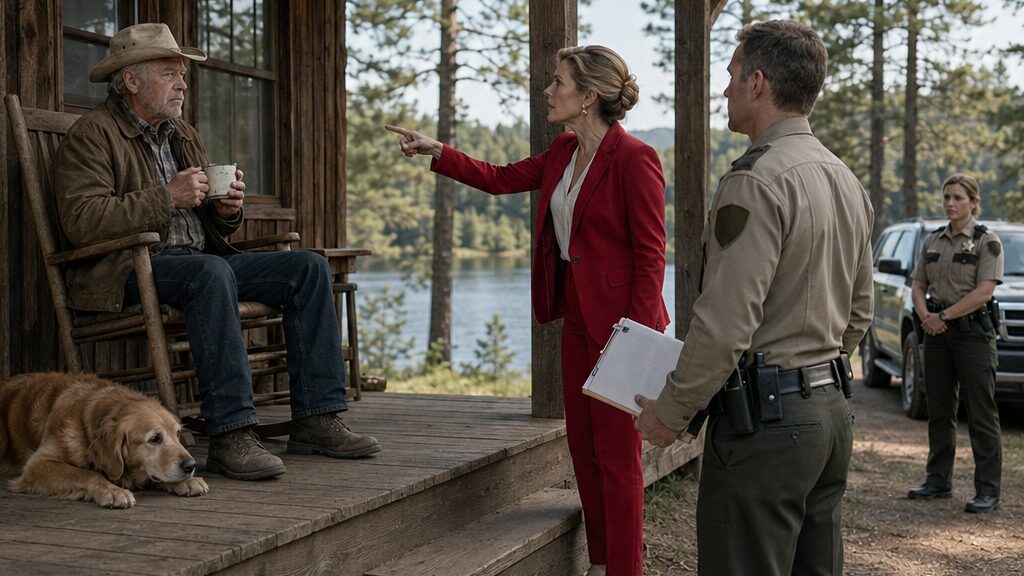
Elizabeth King said it from the bottom step, one gloved hand lifted toward John Harris as if she were pointing out damage on a wall. Her red suit looked too bright against the gray boards, the brown pine needles, the lake shining behind him like nothing in the world had changed.
John did not stand.
The old rocking chair gave one slow creak beneath him. His right hand stayed wrapped around Virginia’s mug, the plain white one with the chip under the handle. The coffee inside had gone lukewarm ten minutes earlier. At his boots, the golden retriever lifted his head, watched Elizabeth, and gave one uncertain thump of his tail before going still again.
Two county officers stood at the edge of the dirt road beside a parked vehicle. One held a folder. The other kept her hands clasped in front of her belt, eyes moving between Elizabeth and John with the practiced caution of someone who had been told this was civil, not criminal.
Elizabeth came up one step.
“John, I’m trying to keep this clean.”
He looked at her shoes first. Black heels, sharp enough to sink into the porch boards if she put all her weight on them. Virginia would have noticed that. Virginia used to say a person’s shoes told you whether they planned to stay, work, or perform.
“Clean,” John said.
His voice came out low, dry, almost unused.
Elizabeth’s jaw tightened. She had Virginia’s mouth when she was angry. That bothered him more than the red suit.
“The estate has been opened. I have the revised document. I have counsel. I have given you time.” She glanced back toward the officers, as if needing them to witness that she had said the reasonable parts aloud. “I didn’t have to come in person.”
“No,” John said. “You didn’t.”
The deputy with the folder stepped closer to the porch but did not climb the stairs. “Mr. Harris?”
John moved his eyes from Elizabeth to him.
The deputy looked uncomfortable, not afraid. There was a difference. “We’re here as a civil standby. Ms. King asked that the estate notice be delivered with no disturbance. We’re not removing anybody today.”
“Today,” John repeated.
Elizabeth’s expression flickered.
The deputy opened the folder. The paper made a thin snapping sound in the lake air. John heard it too clearly. Paper had sounded different in the house since Virginia died. Every envelope seemed to carry somebody else’s decision.
“This is a notice regarding the estate of Virginia Harris,” the deputy read. “Pursuant to the revised last will and testament dated March seventeenth, the real property located at—”
He paused, checking the page.
John looked past him, down the dirt road where Virginia used to walk slowly in the evenings, one hand on the dog’s back, pretending she was only tired.
The deputy read the cabin address.
Elizabeth folded her arms.
“—is devised in full to Elizabeth King, named personal representative and sole beneficiary of said real property. Any current occupant without ownership interest or written lease agreement is requested to vacate within ten days pending further estate administration.”
The dog stood.
John felt the mug handle press into the inside of his fingers. He did not remember gripping it harder. He set his other hand on the dog’s head, and the animal settled against his knee.
The deputy lowered the paper a little. “Mr. Harris, do you understand what I read?”
Elizabeth answered before he could. “He understands. He’s had weeks to understand.”
The deputy did not look at her. “Mr. Harris?”
John looked at the document, not at Elizabeth.
“Read the part with my name,” he said.
The deputy looked down again. His eyes moved over the page. “Your name does not appear in the distribution section I was provided.”
The lake made small sounds against the rocks below the porch. Somewhere in the pines, a branch shifted. John heard the house behind him too: the quiet boards, the refrigerator hum, the wall clock Virginia had insisted was five minutes fast because being early was a kind of respect.
“My wife’s will doesn’t have my name in it,” John said.
Elizabeth exhaled. “It was revised.”
“I heard him.”
“Then don’t act like this is a surprise.”
That almost made him turn his head too fast. He did not. He had learned, in the last year of Virginia’s illness, that sudden movements frightened people who were already trying not to show fear. He had learned to move slowly. To set cups down softly. To say one thing at a time.
The deputy shifted the paper. “The date is March seventeenth.”
John’s thumb stopped rubbing the chipped place on the mug.
March seventeenth.
He had expected a blow. He had not expected a date with a shape.
Elizabeth saw something change in his face and mistook it for surrender. “Mom changed her mind. That was her right.”
John looked at her then.
She had dressed for victory. Red jacket, smooth hair, gold earrings Virginia would have called too loud for morning. But beneath the polish, there was something tight around her eyes. Not grief exactly. Not only anger. A person who had rehearsed a speech all night and now wanted the world to reward her for saying it without shaking.
“Six weeks before she died,” John said.
Elizabeth’s chin lifted. “She knew what she wanted.”
The deputy glanced from one to the other.
John leaned forward just enough that the chair stopped rocking. “Officer, read the date again.”
“March seventeenth.”
“And she died April twenty-ninth.”
“Yes, sir. That appears to be the record attached.”
Elizabeth stepped fully onto the porch. “This is not the place to challenge it.”
“It’s my porch.”
“It was my mother’s porch.”
That landed. Not because it was false, but because it was also true. Virginia’s father had built the first room of the cabin. Virginia had paid for the roof after the storm. Virginia had planted the lavender by the steps. Virginia had also sat in the chair beside him and said, “When I go first, John, you keep this porch warm.”
The problem with promises was that they did not come notarized.
The second officer moved a little closer, maybe because Elizabeth had raised her voice.
John looked down into the mug. A ring of coffee trembled against the ceramic wall. He set it on the small table beside the chair. The dog pressed harder against his leg.
“Is there a copy for me?” John asked.
Elizabeth blinked. “What?”
“The paper that says I’m nobody here. I’d like my copy.”
The deputy removed a set of stapled pages from the folder and held them out. John rose then, slowly. His knees argued. His back pulled where he had slept badly in the bedroom that still smelled faintly of Virginia’s lotion and the cedar chest.
He walked down one step. Elizabeth did not move aside, so he stopped in front of her.
For a second he saw not the woman in red but the girl who had come here at twenty-two with a duffel bag and a hard face, refusing Virginia’s hug until nightfall, when John found both of them crying in the kitchen over burned biscuits. He had not known then how long a person could keep score.
Elizabeth took half a step back.
John accepted the pages from the deputy. The top sheet had Virginia’s name centered in dark print. Under it, formal words arranged with cold confidence. He turned to the distribution page.
He looked for his name even after he knew it would not be there.
Elizabeth’s name appeared twice. Once as beneficiary. Once as personal representative.
John Harris appeared nowhere.
His eyes moved back to the date.
March 17.
The day after he had cut Virginia’s birthday card into two pieces because she had tried to write her name and cried when the V slanted backward.
Elizabeth said, softer but not kinder, “You have ten days. I’ll send someone for the furniture that belongs to the estate.”
John folded the copy once. The crease ran through the date.
“No,” he said.
The deputy’s posture changed. “Mr. Harris—”
“I heard you. You’re not removing anybody today.”
Elizabeth’s lips parted. “John, don’t make this ugly.”
He picked up the mug again, not because he wanted coffee, but because his hand needed something that belonged to Virginia before these pages tried to take every other proof.
“I’m not the one who brought officers to her porch.”
Elizabeth looked wounded then, and for one second he hated himself for noticing. Her mother had died too. Grief did not make people fair. Sometimes it made them efficient.
The deputy cleared his throat. “Sir, if you intend to dispute the document, you’ll need to address that through probate.”
John nodded once.
Elizabeth turned to leave, but paused at the steps. “She signed it, John. Whatever story you’re already making in your head, she signed it.”
The officers walked back toward the road. Elizabeth followed, her red jacket bright between the pines until the vehicle door cut her in half and hid her from view.
John stood on the porch until the engine disappeared down the bend.
Then he sat again.
The dog put his head on John’s boot. John unfolded the paper with a care that felt almost insulting to the thing. March 17 stared up at him, neat and official, as if dates did not have blood in them.
He turned the mug in his hand and saw, for the first time, the faint brown mark near the rim from the morning Virginia had dropped it and apologized to the cup.
“She couldn’t even sign her own birthday card that week,” he whispered.
Chapter 2: The Calendar Kept What Everyone Forgot
The kitchen drawer stuck halfway open, and for one sharp second John thought someone had been inside the house.
He froze with two fingers hooked around the brass pull. The dog, lying near the back door, lifted his head. Nothing moved. The house held its breath the way old houses did, with tiny ticks in the walls and a low groan from the refrigerator.
John pulled again.
The drawer jerked loose, spilling rubber bands, dull pencils, seed packets, a roll of tape, and Virginia’s kitchen calendar onto the floor.
He had not opened that drawer since before the funeral. Virginia had kept it as if it were a second mind. Appointments. Grocery lists. Birthdays circled twice. Notes to herself in careful blue ink. In the final months, when her memory began losing small pieces first, she had still insisted on touching each square every morning.
“Today is today,” she would say, as if it were a joke.
John bent slowly and picked up the calendar.
March came loose in his hand.
The top corner was torn.
Not cleanly. Someone had pulled the page too fast from the wire loop and ripped away the place where Virginia used to write reminders too small for anyone else to read. John stood with it under the kitchen light, his thumb under the torn edge, while the dog came to sniff at the pencils near his boots.
March 17 sat in the third week, square and blank.
He set the revised will summary beside it on the table. The printed date and the empty square looked at each other like strangers pretending not to know.
John turned back one page. February had Virginia’s old handwriting in most boxes. “Feed store.” “Call Heather.” “John dentist 2:30.” Her letters leaned right but held steady.
March was different.
The first week had notes in two hands. Virginia’s blue ink, smaller than before. Then darker black ink. Elizabeth’s, maybe. John had never paid enough attention to Elizabeth’s handwriting. That felt suddenly like a failure.
On March 10: E. visiting.
On March 12: paperwork?
On March 16: E. took V. to town.
John stared at the last line.
He did not breathe until the wall clock clicked to the next minute.
He remembered March 16 as rain. He remembered Virginia asking for tomato soup and then refusing it because she said it tasted yellow. He remembered changing the sheets. He remembered leaving the house for less than an hour to pick up a prescription because Virginia had been asleep and Elizabeth had said, “I can sit with my own mother, John.”
He had been grateful.
That was what burned now. Not only suspicion. Gratitude, turned over and found rotten underneath.
He carried the calendar to the bedroom. Virginia’s side of the bed was still made the way she liked it, with the quilt pulled tight enough to bounce a quarter, though she had not cared about quarters for months before the end. On the dresser sat the wooden box where she kept greeting cards, old stamps, and receipts she swore mattered.
John opened it.
Her last birthday card lay on top.
He had bought it from the grocery store because it had a painted lake on the front and a dock that looked almost like theirs. Inside, he had written, “To my Virginia, who always knew the way home.” He had given her the pen, and she had tried to sign below his words.
V.
A dragging line.
A half-formed shape.
Then tears she tried to hide by asking for a tissue.
He had cut off the bottom of the card later, not from shame, he had told himself, but mercy. She had begged him, “Don’t let Elizabeth see me like this.”
He had obeyed.
Now the missing piece felt like evidence he had destroyed with his own hands.
John sat on the edge of the bed. The calendar rested on his knee. He closed his eyes, and Virginia’s voice came back, not as it had been at the end, but sharp and warm from years before.
“Promises don’t count if nobody writes them down, John.”
He had laughed then. She had not.
By noon he was at the clinic records desk, holding his cap in both hands while a clerk behind a glass partition looked at his driver’s license, then at the copy of Virginia’s death certificate, then at him.
“I’m sorry,” the clerk said. “For full medical records, we need formal authorization or estate authority.”
“I’m her husband.”
“I understand.”
The phrase had the soft surface of kindness and the hard back of refusal.
John leaned closer to the opening in the glass. “I’m asking for one date. Whether she had an assessment around March seventeenth.”
The clerk’s eyes shifted. “I can’t disclose protected records without the proper release.”
“She’s gone.”
“I know.”
“She was my wife.”
The clerk lowered her voice. “Mr. Harris, I’m not trying to make this harder. But if the estate representative is someone else, you may need a lawyer or a court order.”
Estate representative.
Elizabeth’s title, printed cleanly on the paper in John’s truck.
He looked down at his cap. There was a pale stain on the brim from the time Virginia spilled lemonade on him and laughed for five full minutes. He had not heard that laugh in the last year. Not once.
The clerk hesitated. “There was an appointment near that week.”
John looked up.
“I can’t tell you details,” she said quickly. “But if you’re pursuing a legal review, you should request the records properly. Soon.”
“Near that week,” he said.
“I’ve said what I can.”
It was not proof. It was not even close. But it was a doorway with light under it.
On the drive home, John kept one hand on the steering wheel and one on the envelope where he had folded the calendar page. He did not turn on the radio. The road wound through pines and low rock, the lake flashing between trunks. Every bend held some version of Virginia: waving from the dock, trimming lavender, scolding him for leaving tools on the steps.
At the cabin, he spread everything across the kitchen table.
Revised will summary.
March calendar.
Birthday card.
Prescription receipt from March 16.
He wrote the dates on a yellow legal pad in block letters because his hands were too stiff for anything smaller.
March 10: Elizabeth visit.
March 12: paperwork?
March 16: Elizabeth took Virginia to town.
March 17: will signed.
April 29: Virginia died.
The sequence looked impossible and obvious at the same time.
He made himself look at the birthday card again. The cut edge at the bottom seemed to accuse him more than Elizabeth did. He had hidden what Virginia asked him to hide. He had canceled visits when she was having bad days. He had told Elizabeth, “She’s resting,” because Virginia clutched his wrist and shook her head whenever her daughter’s car came up the road.
Had he protected Virginia, or had he built the shadow Elizabeth now stood inside?
The dog nudged his knee. John reached down without looking.
In the evening he walked to the porch with the calendar page and the will copy. The lake had gone silver. The rocking chair waited in its usual place. He sat, placed Virginia’s mug on the porch rail, and studied the line again.
E. took V. to town.
The ink was too dark, too heavy, the tail on the V too sharp. Not Virginia’s. Not his.
John went back inside, found one old Christmas card from Elizabeth in the wooden box, and laid it beside the calendar.
The capital E matched.
He stood over the table until the room dimmed around the papers.
Then he saw the worst part.
The words “to town” were written smaller than the rest, squeezed in as if added after the first line had already been written.
John touched the square with one finger.
“Who took you there?” he asked the empty kitchen.
The calendar gave him no answer, only the dark line in Elizabeth’s hand: E. took V. to town.
Chapter 3: Elizabeth Offered Money For His Silence
The check was already on the table when John walked into the diner.
Elizabeth sat in the back booth beneath a framed photograph of the lake from some brighter decade. Her red suit jacket hung beside her, but she had kept the white blouse, the gold earrings, the smooth posture of someone who wanted witnesses without seeming to need them. The check lay faceup between the salt shaker and an untouched glass of water.
John did not sit.
Elizabeth looked at his hands first, maybe expecting the calendar, maybe expecting a folder thick with accusations. He carried only a folded copy of the revised will summary in his shirt pocket.
“Ten thousand dollars,” she said. “Moving expenses, first months somewhere else, whatever you need to make this dignified.”
The diner was nearly empty. A waitress wiped the counter with slow circles, pretending not to listen. Outside, a logging truck passed, rattling the front window.
John looked at the check. His name was written on the payee line.
That bothered him more than if she had left it blank.
“You spelled Harris right,” he said.
Elizabeth’s face hardened. “Don’t do that.”
“Do what?”
“Act like every practical step is cruelty.”
He sat then, not because she had softened, but because his knees would make him look weaker if he kept standing. The booth vinyl sighed beneath him.
Elizabeth pushed the check an inch closer. “I don’t want a fight.”
“You brought deputies to the porch.”
“I brought witnesses because I knew you would make this emotional.”
John took the revised will copy from his pocket and placed it beside the check. “You mean personal.”
“I mean messy.” Her eyes flicked to the paper. “The document is legal.”
“The document is paper.”
“It was Mom’s decision.”
John watched her say Mom. Not Virginia. Not my mother. Mom. The little-girl word placed carefully in the middle of a legal argument.
“She changed it six weeks before she died,” he said.
“Mom changed her mind. That was her right.”
“Six weeks before she died, she asked me what year it was.”
Elizabeth’s mouth closed.
The waitress stopped wiping for half a second, then continued.
John did not raise his voice. He had not come to perform. “That date matters.”
Elizabeth leaned forward. “You don’t get to decide that now because you don’t like what she signed.”
“I’m asking when she signed it and how.”
“With an attorney present.”
“Daniel Baker?”
“Yes.”
“Did Virginia call him?”
Elizabeth looked toward the window. “I helped her with appointments. You know that.”
“I know you were at the house March sixteenth.”
Her eyes came back to him too fast.
John saw the first crack. Small, but real.
“She wanted to go to town,” Elizabeth said.
“Virginia didn’t want to go past the porch that week.”
“You kept saying things like that.” Her voice sharpened. “Every time I called, she was resting. Every time I drove out, she was confused or tired or asleep. Do you know what that looked like to me?”
John said nothing.
“It looked like you had my mother in that cabin and the rest of us had to ask permission to love her.”
The words hit him in a place he had not guarded.
He had expected greed. He had prepared for entitlement. He had not prepared for the sound of a daughter who believed she had been made a visitor at her mother’s deathbed.
“She asked me not to let people see her on bad days,” he said.
“I was not people.”
The silence between them filled with dishes clinking from the kitchen.
Elizabeth’s eyes were bright now, but no tears fell. She had inherited that from Virginia too: the ability to keep water in the eyes without letting it drop.
John looked down at the check. “So you fixed that by taking my name out of her house.”
“It was her house before it was yours.”
“I never said different.”
“You lived there. You controlled the mail. The medications. The calendar. The visitors. You can dress that up as caregiving all you want, but from the outside, John, it looked like control.”
He could have denied it quickly. A clean denial would have felt good. Instead, he saw himself standing in the doorway, telling Elizabeth that Virginia was sleeping while Virginia sat in the bedroom clutching his wrist, whispering, “Not today. Please not today.”
Protecting someone and controlling access could look the same from the road.
That was the worst part. Elizabeth was wrong, but not from nowhere.
“I should have told you more,” John said.
Elizabeth blinked, thrown by the admission.
“But you knew enough,” he continued. “You saw enough.”
Her fingers moved toward the check, then stopped. “I saw my mother have clear mornings and bad afternoons. I saw you answer questions for her. I saw her look at you before she said anything, like she needed permission.”
“She looked at me when she was scared.”
“She looked at you when Daniel asked what she wanted too.”
John’s chest tightened. “You were in the room?”
Elizabeth looked down.
There it was.
He let the silence hold.
“You just told me the attorney watched her sign,” John said. “You didn’t say you watched him ask.”
“I was there because she asked me to be there.”
“Did she?”
Elizabeth’s face changed again, anger rushing in to cover something else. “Do not make me the villain because you didn’t get the cabin.”
“I’m not doing this over the cabin.”
She laughed once, bitter and quiet. “Then walk away from it.”
He folded his hands on the table because they had begun to shake. “I’m doing this because she told me I could stay on that porch until I couldn’t climb the steps. She said Elizabeth would understand once the grief settled. That was the promise.”
Elizabeth’s eyes flashed. “Convenient promise.”
“No. Inconvenient one. For all of us.”
She pushed the check closer again, harder this time. The edge struck the will copy. “Take it. Leave before this turns into a probate fight you can’t afford. I already spoke with a realtor. If you make me file for removal, I will.”
John looked at her hand. Virginia’s hands had become thin in the final months, skin like paper over blue veins. Elizabeth’s were strong, manicured, sure. The same family bones, different season.
“A realtor,” he said.
“It’s estate property.”
“The dog too?”
Her face flickered. “Don’t be ridiculous.”
“You said furniture that belongs to the estate. I’m asking where the line ends.”
“That dog stays with whoever can care for him.”
“He sleeps beside Virginia’s chair.”
“Virginia is gone.”
The sentence fell clean and cruel. Elizabeth looked as if she regretted its sharpness, but she did not take it back.
John picked up the check. For one second Elizabeth’s shoulders lowered, as if relief had already entered her.
Then he folded it once and slid it back under her water glass.
“I don’t want your money.”
“You want a fight.”
“I want the truth.”
“You want your version of it.”
“I want to know what Daniel Baker saw.”
Elizabeth stood so quickly the red jacket slipped from the hook beside her and fell across the booth seat. She grabbed it, composed herself with visible effort, and leaned close enough that the waitress turned her back fully to them.
“Ask Daniel,” Elizabeth said. “He watched her sign it.”
John held her gaze.
“Then he’s the next person I’ll ask.”
For the first time since she had stepped onto his porch, Elizabeth looked uncertain.
Not frightened. Not defeated.
Uncertain.
She turned and walked toward the door, heels striking the diner floor with hard, measured taps. The bell above the entrance gave a thin ring when she left.
John sat alone with the will copy, the untouched check trapped under the sweating water glass, and a new question pressing harder than all the rest.
If Daniel had watched Virginia sign, what had he watched her understand?
Chapter 4: The Lawyer Remembered The Wrong Day
“The document is valid,” Daniel Baker said before John had taken both feet across the threshold.
John stopped in the doorway of the office with his cap in his hand. The room smelled like toner, old carpet, and the bitter coffee that sat too long in a machine. Behind Daniel, framed certificates hung in a careful row, each one straight enough to suggest a man who trusted paper because paper stayed where he put it.
John looked at the empty chair in front of the desk.
“I didn’t ask yet.”
Daniel’s expression tightened, but not with anger. More like a man recognizing that the wrong sentence had escaped first.
“Mr. Harris,” he said, standing halfway and then sitting again when John did not move. “I understand this is painful.”
“No,” John said. “You understand it’s legal.”
Daniel folded his hands on the desk. A file lay closed near his right elbow. John saw Virginia’s name typed on a white label. The sight of it there, trapped under Daniel’s palm, made the room feel smaller.
“Please,” Daniel said. “Sit.”
John sat.
The chair was too soft. It made him sink lower than he wanted. Daniel remained higher behind the desk, which was probably not an accident. John placed his cap on his knee and kept his hand over it.
Daniel opened the file. “Virginia Harris executed a revised last will and testament on March seventeenth. It was witnessed and notarized. I confirmed identity. I had no reason at the time to believe she lacked capacity.”
“At the time,” John said.
Daniel’s eyes lifted.
John leaned forward. “I’m asking when it was signed, not whether the ink dried.”
A faint color came into Daniel’s cheeks. “Midafternoon. Around two, if I remember correctly.”
“If you remember.”
“I have notes.”
“Then use those.”
Daniel held his gaze for a moment, then turned a few pages. John watched his fingers move over paper that had somehow become stronger than years of marriage.
“Appointment scheduled by family member,” Daniel read. “Client present. Discussion of property transfer, personal representative designation, and real property devise.”
“Family member,” John said.
Daniel’s jaw moved once. “Elizabeth King assisted with details.”
The room went quiet except for a phone ringing somewhere outside the office. No one answered it by the second ring, then someone did on the third.
“Assisted how?”
Daniel looked down again. “She provided background information. Address, parcel description, family structure.”
“Who answered when you asked Virginia what property she meant?”
Daniel’s fingers stopped on the file.
John waited.
“That is not exactly how these meetings work,” Daniel said.
“How did this one work?”
“I spoke directly with Virginia.”
“With Elizabeth in the room?”
Daniel did not answer fast enough.
John looked at the certificates on the wall. He wondered how many times a man could point to a signature and convince himself he had seen the whole person.
“She wanted her daughter present,” Daniel said.
“Did Virginia tell you that?”
“She did not object.”
John let out a breath through his nose. It was not a laugh. He had no room for laughter. “By March, she didn’t object to soup she hated if the spoon was already at her mouth.”
Daniel closed the file halfway. “Mr. Harris, I am not your attorney, and I cannot advise you. If you are alleging incapacity or undue influence, there are proper channels. But suspicion is not proof.”
“I know what suspicion is.” John tapped the cap on his knee once. “I lived with it for months. Suspicion was wondering if she remembered the stove was hot. Suspicion was hiding the car keys and pretending I misplaced them. Suspicion was sitting up at night because she thought there was a little boy crying down by the dock.”
Daniel’s face changed, but only slightly.
John regretted saying it as soon as the words left him. Virginia had begged him not to spread those pieces of her around. They were not public property. They were nights in a house that had already been losing her before death did the final work.
He looked down at the cap.
Daniel’s voice softened. “Was she diagnosed?”
John’s throat closed for a moment. “She was being evaluated.”
“Do you have records?”
“The clinic won’t give them to me because Elizabeth is the estate representative.”
Daniel looked away.
“That’s convenient,” John said.
“It’s procedure.”
“A lot hides behind that word.”
Daniel turned another page. “My notes indicate Virginia understood she was leaving the cabin to Elizabeth.”
“Did she say the cabin?”
“Yes.”
“What did she call it?”
Daniel frowned. “I don’t know what you mean.”
“She called it different things depending on the day. Sometimes ‘the lake place.’ Sometimes ‘Daddy’s house.’ Sometimes, when she was scared, she called it ‘John’s porch.’ What did she call it in this office?”
Daniel looked at the page as if the answer might rise from the margins.
“She referred to the property,” he said.
“Or Elizabeth did.”
“Mr. Harris—”
“Did Virginia say I should leave?”
Daniel shut his mouth.
John felt his pulse in his fingers. He did not want to shout. Shouting would make Daniel cautious. Shouting would turn him into what Elizabeth needed him to be.
“Did she say my name?” John asked.
Daniel’s silence became the answer before his words did.
“I don’t have that in my notes.”
John leaned back. The soft chair accepted him too easily.
Daniel removed his glasses and rubbed the bridge of his nose. “There was no indication she was being forced.”
“Force isn’t always a hand on the back of the neck.”
“No. But legal capacity is not the same as perfect memory. People can have difficult days and still make decisions.”
John nodded slowly. “That’s true.”
Daniel looked relieved too soon.
“So tell me what decision she made,” John said. “Not what the paper says. What did she understand would happen to me after she died?”
Daniel’s eyes moved toward the closed door.
The file lay open between them. John saw a sticky note near the bottom corner of one page: E.K. to provide parcel copy. The initials looked small and harmless.
“I can’t reconstruct every sentence,” Daniel said.
“But you can tell me the document is valid.”
“I can tell you the formalities were followed.”
“Formalities didn’t sit beside her bed when she forgot how to swallow pills.”
Daniel’s face tightened. There it was: the limit of his sympathy. Beyond it lay risk, reputation, insurance, procedure.
“You may challenge the estate,” Daniel said. “But you should understand the practical matter. If Ms. King proceeds with removal, and you do not have a stay or legal basis to remain, you could lose possession of the property before a full review.”
John looked at Virginia’s name on the file label. “So I can be put out before anyone decides whether she understood putting me out.”
Daniel did not correct him.
That was the second useful thing he had done.
John stood, taking his cap. “I want a copy of any note that says Elizabeth assisted with details.”
Daniel shook his head. “I can’t release the file to you.”
“Because I’m not in the will.”
“Because I represented Virginia.”
John looked at him. “Did you?”
Daniel flinched, not much, but enough.
The door opened as John stepped into the hallway. An assistant stood there with a stack of folders pressed against her chest. She looked past John toward Daniel, then back at John, and lowered her voice.
“I shouldn’t say anything.”
Daniel stood behind his desk. “Please don’t.”
The assistant’s eyes stayed on John. “Mrs. Harris asked something twice when she was leaving.”
John’s hand tightened around his cap.
Daniel said her title sharply, but the assistant continued anyway, quieter.
“She asked whether John still had the porch. I remember because Ms. King said, ‘We talked about that already,’ and Mrs. Harris looked embarrassed.”
John stood so still the hallway seemed to move around him.
Daniel said, “That is not a legal conclusion.”
“No,” John said, his voice almost gone. “It’s a question.”
He walked out with nothing in his hands except his cap and more doubt than he had carried in.
At the truck, he sat behind the wheel but did not start the engine. The office windows reflected the afternoon sky. Somewhere behind one of them sat a file that said Virginia had removed him from the only place she kept asking whether he still had.
Chapter 5: The Cabin Sign Brought The Fight Home
The sign at the road had gone up before breakfast.
John saw it through the kitchen window while rinsing Virginia’s mug. At first his mind refused to make sense of the white rectangle nailed to two fresh wooden stakes near the dirt turnoff. Then he saw the printed words facing the lake road.
ESTATE PROPERTY.
AVAILABLE SOON.
A phone number sat beneath, bold and black.
The mug slipped in his wet hand and struck the sink hard enough to crack the silence. It did not break. John held it with both hands for a moment, breathing through the hot flash of anger that climbed into his throat.
The dog barked once from the porch.
John dried his hands carefully. Too carefully. Then he walked outside.
Mist still lay low over the water. The cabin looked the way it always had in early morning: worn, patient, half-hidden by pine shadow. But the sign changed the whole yard. It made the place look vacant while he stood in it. It made the porch, the steps, the lavender, the dog’s bowl, and Virginia’s chair appear temporary.
John walked down the dirt track.
A neighbor’s pickup slowed as it passed. The driver lifted two fingers, then seemed to think better of it and kept going.
By the time John reached the sign, his chest hurt.
He read the words again.
Estate property.
Not Virginia’s cabin. Not John’s home. Not the place where he had replaced the south windows with his own hands because Virginia said winter wind had a personal grudge against her ankles.
Estate property.
The stakes were fresh pine. Elizabeth had not driven them in herself; the angle was too clean. Someone had done it for money and gone home.
John gripped one stake and pulled.
It did not move.
He pulled harder. Soil cracked around the base. The dog barked again from the porch, anxious now. John heard Virginia’s voice in memory, not soft but practical: Don’t let anger make you clumsy.
He let go.
A truck rolled to a stop behind him. The neighbor near the lake road leaned out the window, one arm hanging from the frame.
“John.”
John did not turn right away.
The neighbor cleared his throat. “Heard there was some estate business.”
“Looks like you heard right.”
“I don’t want to step in anything.” The man’s eyes moved to the sign, then to the cabin. “Just thought maybe, if this is what Virginia wanted, dragging it out won’t help anybody.”
John turned then.
The neighbor looked uncomfortable enough to be sincere, which made it worse.
“What Virginia wanted,” John said.
“That’s all I mean.”
John’s hand closed around the top of the sign. “You talk to her about it?”
“No.”
“You see the will?”
“No, but folks talk.”
“Folks,” John said, “weren’t there when she couldn’t find the bathroom in her own house.”
The neighbor looked down at his steering wheel. “I’m sorry. I didn’t know.”
“No,” John said. “You didn’t.”
The truck eased forward and continued down the road, leaving a slow curl of dust behind it.
John stood beside the sign after the sound faded. Shame followed anger into him, quiet and mean. He had said too much to the wrong man, and still not enough to the right people. The cabin was already becoming a story told by others: John refusing to leave after Virginia chose her daughter. John making trouble. John after the property.
The revised will had not only removed his name from paper. It was removing him from memory.
He walked back to the porch, found the claw hammer from the tool shelf, and returned to the road.
The first stake came loose after three strikes and one hard pull. The second splintered. John did not care. He threw the sign facedown into the grass and stood over it, breathing hard.
The dog had followed halfway down the drive and now watched him with worried eyes.
“I know,” John said. “I know.”
The sound of another vehicle came before he reached the porch.
Elizabeth’s car turned in from the lake road, followed by the same county vehicle from the first notice. John stopped with the hammer still in his hand.
That was how they found him.
Elizabeth got out first. She wore dark slacks this time, but the red jacket was back, bright as a warning flag. Her eyes went to the sign lying in the grass, then to the hammer.
For a second, triumph crossed her face so quickly she probably thought he had missed it.
“Put the hammer down, John.”
He looked at the hammer as if someone else had placed it there. Then he set it on the ground beside his boot.
The county deputy stepped out of the vehicle. The second officer remained near the passenger side, watching the dog and the road.
“Mr. Harris,” the deputy said, voice measured. “We got a call about removal of estate signage.”
John laughed once under his breath. It came out rough. “Estate signage.”
Elizabeth walked to the fallen sign and lifted it with two fingers, as if it were evidence. “You don’t get to destroy property because you’re angry.”
“It’s my yard.”
“It is estate property pending administration.”
The words sounded rehearsed. Maybe by Daniel. Maybe by someone else. Maybe Elizabeth had been practicing all the way from town.
The deputy looked at John. “Sir, I’m not here to arrest anyone. But I need you to understand this kind of thing can work against you.”
John looked down at the hammer.
He saw it then, with a coldness that sobered him. Elizabeth did not need to prove he was wrong about March seventeenth if she could prove he was unstable now. Angry widower. Hammer in hand. Destroying estate property. Refusing lawful notice.
He had almost helped her.
The dog came to his side, pressing against his leg.
John bent slowly, picked up the hammer by the head instead of the handle, and held it out to the deputy. “Take it while we talk.”
The deputy hesitated, then accepted it.
Elizabeth’s expression shifted. The little victory she had expected did not land.
“I want that noted,” John said.
“What?” she snapped.
“That I put it down. That I handed it over. That no one here was threatened.”
The deputy looked at him for a long moment, then nodded. “I can note that.”
Elizabeth folded her arms. “This doesn’t change the fact that he removed posted estate property.”
“No,” John said. “It changes whether you get to say I waved a hammer at you.”
Color rose in her cheeks.
The deputy cleared his throat. “There’s more. Ms. King has requested a civil removal order. It’s not executed today, but if the paperwork moves through and there’s no stay or probate objection affecting possession, we may be back.”
John looked past him to the porch.
Virginia’s mug sat on the rail where he had left it, white against the weathered wood. From the road, it looked small enough for anyone to miss. But it was still there. The chair was still there. The cabin still held its breath behind the screen door.
“How long?” John asked.
The deputy’s mouth tightened. “Could be days.”
Elizabeth said nothing.
That silence was worse than any answer.
John walked to the fallen sign, lifted it from the grass, and turned it over so the words faced him again. Estate property. Available soon.
He carried it to Elizabeth and held it out.
“You can take this with you,” he said. “Or you can put it back after there’s an order that says I’m gone.”
She stared at the sign but did not take it.
The deputy finally reached for it. “I’ll place it in the vehicle for now.”
Elizabeth turned on him. “That’s not—”
“For now,” he repeated.
John saw then that restraint was not weakness. It was a record. It was witness. It was the only tool he had that Elizabeth could not twist as easily.
But when the vehicles left, and the road fell quiet again, the porch no longer felt protected by stillness. It felt watched.
Near sunset, the deputy returned alone.
John met him at the steps with the dog beside him and the mug in his hand.
The deputy did not come onto the porch. He held a folded paper but did not offer it yet.
“Mr. Harris,” he said, “Ms. King has formally requested the civil removal order. I thought you should know before it lands on your door.”
John looked at the paper.
For the first time since Elizabeth had arrived in red, he felt the cabin slipping in a way his hands could not hold.
Chapter 6: The Medical Note Made The Date Speak
“You may not like what this proves,” the clinic records clerk said.
John looked through the glass partition at the sealed envelope in her hand. It was thinner than he expected. After all the waiting, the forms, the phone calls, the stamped request he had filed with shaking patience, he had imagined something heavier. A box. A file thick enough to justify the fear of opening it.
Instead, the truth came in a white envelope with Virginia Harris typed across the front.
The clerk slid it through the slot.
John did not pick it up right away.
The clerk’s voice lowered. “It’s not a complete record. Only the portion approved for release under the limited request. The assessment note. The date you asked about.”
“March sixteenth?”
She nodded once.
The day before the will.
John took the envelope.
In the truck, he sat with both hands on the steering wheel and the sealed flap untouched. The clinic parking lot was busy with people carrying prescriptions, children, paper cups of coffee, ordinary errands. He had the strange thought that the world should have been required to pause when a dead woman’s mind was about to be measured on paper.
He opened it with his pocketknife.
The note was two pages. Typed sections. Check marks. Phrases that tried to make Virginia small enough for a form.
Intermittent confusion.
Unable to state current year.
Requires assistance with medication management.
Decision-making capacity should be reassessed before major legal or financial changes.
John read the last sentence three times.
The paper blurred.
He pressed the heel of his hand against his eye until it hurt. Not because the note surprised him. Because it did not. It took what he had known in the kitchen, in the bedroom, on the porch at three in the morning, and made it official enough for strangers.
Virginia had feared that most of all.
Don’t let them remember me like this.
He folded the note and placed it on the passenger seat beside the revised will copy. The dates sat together now. March sixteenth. March seventeenth.
One day.
Not proof of everything. Not proof of pressure. Not proof that Elizabeth had understood what she was doing.
But enough to make the date speak.
John drove to Heather Sanchez’s apartment next, though he almost turned around twice.
Heather lived above a closed bait shop near the old marina. When she opened the door, she looked past him toward the stairs before looking at his face. She had always been careful that way. In Virginia’s final months, she had moved through the cabin quietly, doing hard things without making them dramatic.
“I wondered when you’d come,” she said.
John held up the envelope. “I need to ask about March.”
Heather’s fingers tightened on the door.
“I don’t want to pull you into anything you can’t afford,” he said.
“That’s already why I didn’t call you.”
She let him sit on the small porch outside her apartment, where two plastic chairs faced a view of boat trailers and a strip of water beyond them. Heather did not invite him inside. That, too, was careful.
John handed her a copy of the medical note. She read it with her lips pressed together.
“I was there the next morning,” she said.
“March seventeenth?”
“Yes. Elizabeth was already gone when I arrived.”
John looked at her. “Gone from where?”
Heather glanced toward the stairs again. “The cabin.”
John waited.
“She had come early. Before my shift. I saw her car leaving when I pulled in.”
“Virginia say anything?”
Heather looked down at the paper. “She was upset.”
“About what?”
“She kept asking whether you were mad.”
John’s chest tightened. “Why would I be mad?”
“I don’t know. She couldn’t explain it.” Heather swallowed. “She asked three times if John still had the porch.”
The same words the assistant had remembered.
The boat trailers below them became indistinct in John’s vision.
Heather folded the paper carefully along its existing crease. “I told her, ‘Of course he does.’ She calmed down after that. Then ten minutes later she asked again.”
John gripped the arms of the plastic chair. They bent under his hands.
“I should have written it down,” Heather said.
“You remember.”
“That isn’t the same.”
“No,” he said. “It isn’t. But it’s not nothing.”
Heather’s face changed at that. Some old burden shifted behind her eyes.
“Elizabeth wasn’t always cruel to her,” she said.
John looked up.
“I know you two are fighting. I know what she’s doing now. But I saw her brush Virginia’s hair one afternoon when Virginia wouldn’t let me touch it. Elizabeth cried in the bathroom after. She thought you didn’t see how bad it was. Or maybe she thought you saw and were keeping it for yourself.”
“Keeping what?”
“Being needed.”
The words were gentle. That made them harder.
John looked away toward the strip of water. “Virginia asked me not to let Elizabeth see her on bad days.”
“I know.”
“You think I was wrong?”
Heather was quiet a long time. “I think you were trying to obey a frightened woman. I think Elizabeth was trying to find her mother through a locked door. Both can be true.”
John hated the fairness of it.
Fairness did not repair what Elizabeth had done. But it made the wound less clean. He could not keep Elizabeth in the simple shape he had made for her after the porch. She had chosen harm. She had also been grieving. Those truths did not cancel. They rubbed against each other until nothing felt easy to hold.
“Will you tell the mediator?” he asked.
Heather looked down at the marina lot. “If I’m asked properly.”
“That’s not yes.”
“It’s not no.” She handed back the note. “John, if I speak, Elizabeth will say I’m protecting you because you were always kind to me. She’ll say I’m making Virginia look worse than she was. She’ll say I should have reported concerns sooner.”
“Did you have concerns?”
Heather’s eyes shone. “Every day. But concerns don’t always become reports. Sometimes they become extra notes on the fridge and hiding the stove knobs.”
John closed his eyes.
He had hidden the stove knobs in a coffee can under the sink.
Heather remembered.
At the probate mediator’s office two days later, Elizabeth arrived without the red jacket. She wore gray, and for reasons John did not want to examine, that unsettled him more. Daniel Baker sat on her side of the table, not quite with her, not quite apart. The probate mediator placed a yellow pad in front of herself and told everyone that nothing said in the room should be mistaken for a final ruling.
Elizabeth did not look at John until he placed three papers on the table.
The revised will copy.
The March calendar page.
The medical note.
Daniel saw the clinic letterhead first. His face stilled.
Elizabeth looked at the will, then the calendar, then the note. Her eyes moved to the date.
March 16.
For the first time, she did not speak quickly.
The mediator adjusted her glasses. “Mr. Harris, what are you asking for today?”
John had prepared an answer about stays, review, estate possession, and disputed capacity. The words were on a sheet in his folder.
He did not read them.
“I’m asking,” he said, “that nobody remove me from my wife’s home using a document signed one day after a clinician wrote she should be reassessed before major financial changes.”
Elizabeth’s lips parted.
Daniel lowered his eyes to the table.
The mediator picked up the note. She read the final sentence, then read it again.
Elizabeth’s hand moved toward the paper but stopped short of touching it. “I didn’t see that.”
John looked at her.
Her voice was smaller when she said it again. “I didn’t see that note.”
“No,” John said. “You saw her.”
The words landed too hard. He knew it as soon as he said them.
Elizabeth’s face tightened, not with denial first, but pain. “You don’t get to tell me what I saw when you spent a year deciding when I was allowed to be her daughter.”
Daniel said, “Elizabeth.”
“No.” She kept her eyes on John. “You want to make this all about one day. Fine. Let’s talk about the year before that. Let’s talk about every time I called and you said she was sleeping.”
John felt the old instinct rise: protect Virginia, protect the room, protect the version of her that could still stand in memory without trembling.
But the medical note lay between them now.
He could not fight a document while hiding the truth that explained it.
“She asked me to,” he said.
Elizabeth blinked.
“She asked me not to let you see her when she was lost. She was ashamed. She was your mother and she didn’t want to become a thing you managed.”
Elizabeth looked away.
John’s voice roughened, but he kept it low. “I thought I was protecting her. Maybe I protected too much. Maybe I made you think I was keeping her from you. But that doesn’t make March seventeenth clean.”
The room held still.
The mediator placed the medical note beside the will, aligning the dates with one finger.
“Given this,” she said carefully, “there may be grounds to delay any removal action while capacity and circumstances of execution are reviewed.”
“Delay,” Elizabeth said.
“Not overturn,” the mediator said. “Delay.”
John nodded once. He had learned not to grab more than the truth offered.
Elizabeth stared at the medical note. The color had drained from her face. Her hand hovered over the date as if touching it might change where it fell.
Then she looked at John, and for one unguarded second the polished anger was gone.
What remained was not confession.
It was recognition, and fear.
The mediator asked whether Elizabeth wished to proceed with the removal request unchanged.
Elizabeth did not answer.
Her eyes stayed fixed on the sentence dated one day before the will, and the silence around her became the first thing she could not explain.
Chapter 7: He Chose Truth Over The Cabin
“I won’t admit fraud,” Elizabeth said, before the mediator had finished closing the door. “If that’s what he wants, we’re done.”
John sat across from her with the medical note in his folder and Virginia’s mug wrapped in a dish towel beside his chair. He had brought it without knowing why. Maybe because the removal deadline had made every object in the cabin feel like it might be touched by strangers before sundown. Maybe because he needed one thing in the room that had known Virginia before paperwork reduced her to dates.
Daniel Baker sat near Elizabeth, his hands folded over a blank legal pad. He looked as if he had slept badly. The probate mediator placed a fresh yellow sheet in front of herself and looked at John.
“Mr. Harris?”
John kept his eyes on Elizabeth. “I didn’t ask you to say fraud.”
Elizabeth’s shoulders lowered a fraction, then tightened again.
“I asked you not to call March seventeenth clean.”
The room held still.
Elizabeth glanced at Daniel. He did not rescue her. He looked down at his pen.
The mediator said, “We are here to discuss whether the removal request should proceed today and whether the parties can reach a temporary or partial agreement pending further review.”
“Temporary means he stays forever,” Elizabeth said.
“No,” John said. “Forever is what death feels like. This is a house.”
Her face twitched at that, but she looked away before grief could become visible.
The mediator opened a folder. “There is also reference, provided by Mr. Harris, to an earlier estate planning draft.”
Daniel cleared his throat. “I located an unsigned copy in my archived intake materials from several years ago. It was not executed as a final instrument.”
“But it says what she was trying to do then,” John said.
Daniel’s mouth pressed thin. “It indicates an intention at that time to leave the cabin property ultimately to Elizabeth King, subject to a life estate for John Harris.”
Elizabeth looked at him sharply. “You didn’t tell me that.”
“I found it yesterday.”
“You found it yesterday?”
“It was in an old planning packet. Your mother did not complete that version with my office.”
John watched Elizabeth absorb that. Not a confession. Not a court order. Not enough to erase the revised will. But enough to show Virginia had once drawn a line between ownership and protection.
The mediator turned the copy toward Elizabeth.
Elizabeth read it with her jaw clenched. John could see her stop at the phrase life estate. Her eyes did not soften. They narrowed, as if the words had betrayed her by being reasonable.
“So she changed her mind,” Elizabeth said.
“Maybe,” John said.
“She had a right to.”
“Maybe.”
Elizabeth slapped one hand lightly on the table, not loud enough to be called an outburst, but sharp enough to make the mediator look up. “Stop saying maybe like you’re the only one who loved her carefully.”
John looked at the mug wrapped beside his chair.
He could have answered with the nights. The medicine charts. The sink baths. The mornings Virginia woke afraid of the lake because she thought it had moved closer to the house. He could have made a ledger out of love and dared Elizabeth to total it.
Instead he said, “I should have called you more.”
Elizabeth went very still.
“I should have told you when she had bad days,” he said. “Not every detail. She asked me not to. But enough. I made you guess from the road.”
For the first time that morning, Elizabeth looked directly at him without the armor of legal language.
John reached into the folder and took out the medical note. “But you guessed wrong if you thought that meant she was strong enough to sign this alone.”
Elizabeth’s eyes went back to the date.
March 16.
Daniel spoke carefully. “The concern, Elizabeth, is not that the will is automatically invalid. It is that the circumstances create risk. If challenged formally, there may be discovery. Testimony. Medical review. My file notes would be examined.”
“Your file notes,” she said.
He did not answer.
The mediator leaned in. “A removal today, under these facts, could increase litigation exposure for the estate. A temporary stay is likely if Mr. Harris files immediately.”
Elizabeth gave a brittle laugh. “So he wins.”
“No,” John said.
She turned on him. “You get the cabin.”
“I don’t want to take the cabin from you.”
Her mouth closed.
He unwrapped the mug. The white ceramic looked plain and almost foolish on the polished table. A chipped cup in a room of folders.
“This is what she used every morning,” John said. “Even when she forgot where the sugar was. Even when she called the dog by your name once and then cried because she knew she’d done it.”
Elizabeth looked down.
“I’m not asking to own what her father built. I’m asking to live where she told me I could live. That’s the difference she understood before everything got tangled.”
The mediator’s pen moved once. “Mr. Harris, what specific term are you proposing?”
John had the answer written. He had rewritten it three times in the dark.
“A recorded life-estate agreement. I stay at the cabin for my lifetime or until I voluntarily leave for care. I pay utilities, ordinary maintenance, taxes if the estate can’t. I don’t sell it. I don’t mortgage it. When I’m gone, it goes to Elizabeth.”
Elizabeth stared at him.
“And the removal request?” the mediator asked.
“Withdrawn.”
“Personal property?”
John touched the mug with one finger. “I keep the dog. My tools. My clothes. Virginia’s mug. Her porch chair stays where it is. The rest can be inventoried properly.”
Elizabeth laughed under her breath, but there was no humor in it. “You came here ready.”
“I came here tired.”
Daniel looked at Elizabeth. “It is not an unreasonable settlement.”
She turned on him. “Of course you’d say that now.”
He accepted it without defending himself.
The mediator gave Elizabeth time. Silence settled over the table. Outside the office, a copier started, stopped, started again. Ordinary machinery doing ordinary work while the shape of a home changed.
Elizabeth looked at the old draft again. “She wanted me to have it.”
“Yes,” John said.
“You admit that?”
“I never denied it.”
“You made it sound like I stole everything.”
John’s hand closed around the mug. “You tried to remove me with a will signed one day after a note said she shouldn’t be making major decisions without reassessment.”
Elizabeth’s eyes shone, but she still did not cry. “I thought if I didn’t move fast, you’d make it impossible. You knew everyone out there. The neighbor, the clinic, Heather. You had the house. You had her things. You had the dog. You had all the proof that you were there.”
John let that hurt because it was partly true.
“And I had the part of her that was disappearing,” he said. “That wasn’t winning.”
The sentence changed the room.
Elizabeth looked at the mug then, not as an object of inheritance but as something that had sat beside a bed, a sink, a chair, a woman becoming less able to hide from the people who loved her.
The mediator slid a blank term sheet between them.
“No admission of fraud,” Elizabeth said.
John nodded once. “No statement that March seventeenth was clean.”
Daniel wrote that down in careful language: disputed circumstances of execution.
Elizabeth watched the words appear.
“And you don’t tell people I manipulated her,” she said.
“I won’t say more than I can prove.”
“That’s not the same as no.”
“No,” John said. “It isn’t.”
Her face hardened again, but more from pain now than strategy. “Then I want it written that final ownership remains with me.”
John nodded. “It should.”
The mediator began shaping the agreement line by line. Withdrawal of immediate removal request. Recorded occupancy right. Maintenance obligations. Preservation of estate property. No admission of fraud or invalidity. Acknowledgment of disputed capacity concerns related to the March seventeenth execution. Personal items excluded from estate claim by mutual agreement: one ceramic mug, one dog, ordinary clothing, tools, and effects.
One dog.
John almost smiled at that, but it would have broken something in him, so he did not.
By early afternoon, the county deputy stood once more at the edge of John’s porch, paper in hand.
Elizabeth had come too. She stood near the steps, not in red now but in the gray jacket from mediation. Without the bright color, she looked less like a verdict and more like a daughter who had brought herself too late to the wrong door.
The dog lay beside John’s chair, chin on paws.
John sat with Virginia’s mug in his hand.
The deputy looked at him, then at Elizabeth, then read from the paper.
“Pursuant to mediated interim agreement between Elizabeth King, personal representative of the estate of Virginia Harris, and John Harris, any pending civil removal request concerning the cabin property is withdrawn. John Harris shall retain occupancy pursuant to recorded life-estate terms pending final probate administration. No removal action shall proceed under the prior notice.”
The words moved across the porch differently this time.
They did not heal the boards. They did not bring Virginia to the doorway. They did not turn Elizabeth into the girl who had once cried over burned biscuits in the kitchen. They did not make March seventeenth harmless.
But they stopped the house from becoming empty by sundown.
The deputy folded the paper. “That’s the order as provided.”
Elizabeth looked at John. “She did want me to have it someday.”
“I know.”
“She told me that too.”
“I believe you.”
That seemed to wound her more than argument would have.
John looked out past her to the lake. The water held the afternoon light in broken pieces. Virginia used to say no one owned a lake view. You only got to borrow it while your eyes were open.
Elizabeth stepped down from the porch.
At the bottom, she paused. “I don’t know how to forgive you for shutting me out.”
John did not rush to defend himself.
“I don’t know how to forgive you for using that paper before asking what happened to her,” he said.
She nodded once, a small, unhappy movement. Then she walked to her car.
The deputy followed a minute later. Dust lifted behind both vehicles and slowly settled along the road where the sign had stood.
John remained in the rocking chair.
The dog sighed in sleep.
After a while, John raised Virginia’s mug toward the empty chair beside him. It was not a toast. Not quite. More like an answer to a promise that had almost been buried under the wrong date.
“You still have the porch,” he said.
The chair beside him stayed empty, but the cabin did not.
The story has ended.