She Called His Silent Server a Weapon Until Her Own Attack Became the Real Hazard
Chapter 1: The Woman Filming the Quiet Window
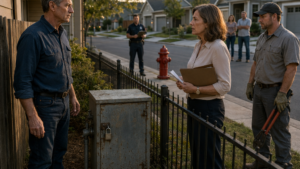
The phone was wedged between two cedar fence slats, its camera pointed straight through Daniel Mitchell’s reinforced workshop window.
On its screen, Janet Walker’s face floated above a column of rapidly rising comments.
“There,” she whispered to whoever was watching. “That’s the mind-control machine.”
Daniel stopped halfway across the side patio, one hand still resting on the insulated latch of the solar battery enclosure. Behind the glass, three server towers stood in a clean black row. Their cooling fans produced the low, even hum he listened for every morning before checking temperature, voltage, and load.
The sound meant balance.
Janet flinched as though it had touched her.
“You’re filming inside my property,” Daniel said.
Her phone jerked but remained between the slats. “I’m documenting a hazard.”
“You’re documenting a locked workshop through a fence.”
“You admit it’s locked.”
Daniel looked at her through the narrow gap. Janet wore a pale windbreaker despite the warm morning, its pockets swollen with folded papers. She had once brought him a broken lamp and waited beside his workbench while he replaced the cord. Back then, she had called him the only person on the street who knew how things worked.
Now she angled the phone toward the battery bank.
“People are waking up with headaches,” she said. “Children can’t concentrate. Dogs are acting wrong.”
“Which people?”
“You don’t get to interrogate me.”
“You’re making a claim.”
“I’m raising an alarm.”
Daniel lifted his hand from the enclosure. “The server is offline. It has no transmitter. The battery bank supplies my property. Both systems passed inspection.”
Janet moved the phone closer to the gap. “Then why is that window reinforced?”
“To protect the cooling system.”
“From what?”
“Impact.”
Her expression sharpened, as if he had confessed to expecting violence.
Daniel saw comments flickering beneath her image. Most were too small to read, but one appeared in block capitals.
MAKE HIM TURN IT OFF.
He walked toward the fence. Janet pulled the phone back, though not far enough to stop recording.
“Delete the footage from inside my yard.”
“No.”
“Janet.”
“People deserve to know what’s next to their homes.”
“What they deserve is accurate information.”
She gave a tight laugh. “That is exactly what someone hiding dangerous equipment would say.”
Daniel could have ended the exchange by going inside. He knew that. Instead, irritation held him at the fence.
He opened the monitoring application on his tablet and turned the screen toward her. A diagram showed the server rack isolated from every external network. The only active lines ran to local storage and the workshop’s internal control panel.
“No wireless connection,” he said. “No cable leaving the property. No broadcast hardware.”
Janet stared at the diagram longer than he expected. For a moment, uncertainty softened her face.
Then she lifted her chin.
“So it’s designed to operate without government oversight.”
Daniel lowered the tablet.
“That is not what offline means.”
“It means nobody can see what you’re doing.”
“It means nothing is leaving the room.”
“According to you.”
The hum continued behind him, steady and ordinary. Janet’s shoulders tightened each time the fans increased by a fraction as the morning temperature rose.
She reached into her windbreaker and brought out her own phone again. “Listen to this.”
A recording played through its speaker.
The sound was enormous—an amplified metallic drone pulsing beneath a wash of static. It bore only a distant resemblance to the quiet airflow behind Daniel’s window.
Janet raised the volume.
Across the street, a man retrieving a trash bin stopped to listen. Another neighbor came out onto a porch. The distorted hum filled the narrow space between houses.
“That came from your workshop at two in the morning,” Janet said.
“It came from your phone after you increased the gain.”
“I did not alter it.”
“The clipping is obvious.”
“To you, maybe.”
The man across the street looked from Janet’s phone to the black server towers. His expression changed—not to belief, exactly, but to unease.
Daniel felt the first shift in the morning. Until then, Janet had been one frightened neighbor with a camera. Now the sound had given everyone else something concrete to fear, even if the concrete thing was false.
He reached through the gate and pressed the exterior intercom button. The workshop’s actual sound transmitted through a small speaker: a soft breath of fans, barely louder than a refrigerator.
Janet talked over it.
“He can lower it when he knows we’re listening.”
Daniel released the button.
“You asked for evidence,” he said.
“I asked for the truth.”
“No. You asked for an answer that agreed with you.”
A few comments on her screen surged faster.
Janet smiled without warmth. “There it is. That attitude.”
Daniel stepped back. The impulse to explain left him all at once.
On the patio table sat a folder containing inspection certificates, electrical diagrams, fire ratings, and manufacturer specifications. He had prepared it after Janet’s first complaint. He considered handing it over.
Instead, he closed the folder.
“Stop filming through my fence,” he said. “If you have a formal concern, file it.”
“I already have.”
He looked at her.
Janet slipped the phone into her pocket. “Maybe somebody official will make you answer.”
She walked away along the fence line, leaving the faint smell of her perfume behind. Across the street, the man with the trash bin avoided Daniel’s eyes.
Daniel returned to the battery enclosure. He checked the seals twice, then ran the network isolation test again even though he had performed it twenty minutes earlier.
Everything was normal.
At nine seventeen, his phone vibrated.
The municipal safety portal had opened a complaint against the property. Daniel expected Janet’s language about frequencies, headaches, and hidden transmissions.
What stopped him was the attached photograph.
It showed the rear junction housing in close detail, close enough to capture the serial number stamped under the weather shield. The angle could not have come from the street or through the fence.
The camera had been less than three feet from the enclosure.
Daniel looked toward the side gate.
It was closed. The lock was intact.
But the photograph had been taken from inside his yard.
Chapter 2: The Inspection Papers Prove Too Little
The city inspector arrived two mornings later while white vapor drifted from the workshop vent.
Janet was waiting for him on the sidewalk.
“That’s what I reported,” she said, pointing. “It’s smoking again.”
The inspector stared at the thin plume dissolving in the morning air, then at the tablet in his hand.
“That’s condensation.”
“You haven’t even examined it.”
“I know what condensation looks like.”
Daniel opened the side gate before Janet could follow the inspector through it. He stepped into the opening and kept one hand on the gate.
“Authorized personnel only.”
Janet held up her phone. “I’m the complainant.”
“You can remain outside the property.”
The inspector glanced between them. He was younger than Daniel expected, with a municipal badge clipped to his belt and the tired expression of someone already regretting the assignment.
“I’ll need access to the equipment named in the complaint,” he said.
“You’ll have it.”
“And I’ll need both of you to let me work.”
Janet folded her arms. “I want it noted that he’s excluding witnesses.”
Daniel said nothing. Silence was safer than the answer pressing against his teeth.
Inside the patio, the inspector examined the charging pedestal, the solar battery enclosure, the weather seals, and the reinforced workshop window. Daniel provided binders in the order requested. Fire inspection. Electrical permit. Structural approval. Manufacturer test reports.
The hum from behind the glass remained constant.
Janet stood beyond the gate, filming each page as Daniel passed it over.
“Can you turn that off while we’re here?” she asked.
“No.”
“Why not?”
“A time-sensitive render is running.”
“What kind of render?”
“Not relevant to the inspection.”
Janet looked at the inspector. “You hear that?”
The inspector continued reading. “I hear a cooling system.”
Daniel almost smiled.
Then the inspector reached the registration sheet for the PHEV charging station.
His eyes paused at the asset reference printed beneath the address.
“What does this designation cover?” he asked.
“The charger and associated continuity infrastructure,” Daniel said.
Janet pushed closer to the gate. “Continuity for what?”
Daniel did not answer.
The inspector looked up. “Is there a state registration attached to this property?”
“Yes.”
“What state use?”
“Protected residential continuity.”
Janet’s phone moved immediately toward the page.
Daniel closed the binder.
“You’ve recorded enough.”
“What are you hiding?”
“Nothing that concerns your property.”
“That is not an answer.”
“It is the answer you’re entitled to.”
The inspector stepped between the open binder and the gate. “The designation doesn’t change the safety question.”
“Then ask him to explain it,” Janet said.
“I’m asking whether the installation complies with code.”
“And?”
“So far, it does.”
Her face tightened. “You haven’t tested the frequency.”
“There is no municipal frequency test for cooling fans.”
“That’s convenient.”
The inspector crouched beside the battery enclosure and checked the lower vents. He ran a sensor along the seams, then stood.
“No thermal anomaly. No gas release. No visible damage.”
Janet pointed toward the white vapor. “And the smoke?”
“Condensation.”
“What if the batteries ignite?”
“They have isolation barriers and suppression controls.”
“What if someone sprays them before they ignite?”
The inspector’s attention sharpened.
“Do not spray water on this enclosure.”
Janet blinked.
He continued, more firmly. “High-pressure water could force contamination past a damaged seal or reach external connections. If you believe there’s a fire, call emergency services and leave the area.”
For the first time since arriving, Janet lowered her phone.
Daniel saw the warning reach her. He saw her understand it.
Then she looked at him, and embarrassment hardened into anger.
“So now I’m the danger?”
“Nobody said that,” the inspector replied.
Daniel should have left it there.
Instead, he said, “People become dangerous when they confuse internet videos with expertise.”
Janet’s phone rose so quickly he knew she had been waiting for something usable.
“Say that again.”
Daniel felt the inspector’s glance.
He closed the binder. “The inspection is over when he says it is.”
Janet turned the camera toward herself. “You heard him. He thinks ordinary residents are too stupid to understand what he put beside our homes.”
“That is not what I said.”
“It is exactly what you meant.”
The inspector handed Daniel the preliminary clearance. “No immediate violation. I’ll file the full report after reviewing the permits.”
Janet stepped closer. “And if we keep reporting symptoms?”
The inspector exhaled. “Repeated complaints can trigger a formal review or neighborhood hearing, but complaints need evidence.”
“I have recordings.”
“You have audio from a phone.”
“I have people.”
Daniel looked toward the sidewalk. Three neighbors stood at varying distances, pretending not to gather. One woman rubbed her temple while listening.
The inspector followed his gaze.
“If this becomes a continuing access dispute,” he said quietly to Daniel, “a hearing may be required even if the equipment is compliant. That won’t mean the complaint is valid. It means the city will want the record settled.”
“The record is settled.”
“Technically, maybe.”
The word irritated Daniel more than it should have.
The inspector left through the gate. Janet followed him to the curb, asking whether he would sign a statement confirming the state designation. He declined twice before reaching his vehicle.
Daniel carried the binders back into the workshop.
Behind the reinforced glass, white indicator lights moved in sequence across the server rack. The hum deepened briefly as the cooling load adjusted, then returned to its familiar level.
Jessica called while he was replacing the registration sheet.
“How bad?” she asked.
“Cleared.”
“That wasn’t my question.”
He looked through the glass toward Janet’s house. “She recorded everything.”
“You gave her something to use.”
“She called condensation smoke.”
“And you told her she was ignorant.”
“I said she confused videos with expertise.”
Jessica was silent for a beat. “That distinction will look excellent in a fifteen-second clip.”
Daniel pressed his thumb against the binder’s edge. “The equipment is safe.”
“I know.”
“The city knows.”
“The neighborhood doesn’t know what they’re looking at, and you keep acting as if that makes them beneath explanation.”
“I gave them documents.”
“You gave them a wall of paper.”
Before Daniel could answer, a notification appeared on his tablet.
Janet had posted a new video.
The clip began with Daniel’s sentence: People become dangerous when they confuse internet videos with expertise.
It cut immediately to a frozen image of the charging-station registration sheet. Janet had enlarged the restricted asset reference and circled it in red.
Her caption filled the screen.
HE FINALLY ADMITTED THE MACHINE IS GOVERNMENT CONNECTED.
Daniel watched the clip once.
Then he saw the view count climbing.
Chapter 3: A Safety Meeting Built on Silence
Janet placed a glass jar of dead insects in the center of the folding table.
“They were found directly beneath his frequency window,” she said.
The neighborhood association room went still.
Daniel looked at the jar. It contained three beetles, a moth, and what appeared to be part of a dried leaf.
Across from him, Jessica lowered her eyes for half a second. It was the only sign that she had nearly reacted.
Janet kept one hand beside the jar as if presenting evidence in court. “No pesticide. No storm. They simply dropped.”
“Those are ordinary dead insects,” Daniel said.
“They were alive before they died.”
A few people shifted in their chairs.
The ceiling ventilation unit clicked on. A low mechanical hum spread through the room, close enough in pitch to Daniel’s workshop fans that he saw several heads tilt.
Janet did not appear to notice.
Daniel did.
He could have pointed it out immediately. Instead, he waited, watching the room absorb the sound without fear because no one had told them to fear it.
Jessica touched his sleeve beneath the table.
Not yet.
At the front of the room, the association coordinator cleared her throat. “This is not a formal hearing. We are here to discuss concerns and possible next steps.”
“The next step is shutdown,” Janet said.
“The system has passed every inspection,” Daniel replied.
“And no one has been allowed inside.”
“Inspectors have.”
“Your inspectors.”
“City inspectors.”
“Who saw a state asset number and stopped asking questions.”
The coordinator raised a hand. “Janet, let him finish.”
Daniel opened the same binder he had shown the inspector. He had replaced the photographed registration page with a redacted copy.
“The server is not connected to the internet. The battery bank meets fire and electrical code. The charging system is registered and inspected. No signal is being broadcast.”
Janet pointed toward the binder. “Then tell everyone what the server does.”
“I’m not required to.”
A murmur moved through the room.
Jessica’s hand left his sleeve.
Janet’s expression changed—not triumph exactly, but relief. Daniel had given her the gap she wanted.
“So you admit there is a secret.”
“I admit there is private work on private property.”
“Government work.”
Daniel closed the binder.
The ceiling vent continued humming.
A neighbor near the wall raised his hand. “Can I say something?”
The coordinator nodded.
He looked uncomfortable. “Janet asked me last week whether I’d been sleeping badly. I said no. Then she asked if I’d noticed headaches since the machine went in. I hadn’t noticed the sound before she mentioned it.”
Janet turned toward him. “I was checking on you.”
“I know. I’m just saying I didn’t report a symptom.”
“You said you were tired.”
“I work nights.”
A few people looked away from Janet. It was a small shift, but Daniel felt it.
He opened his laptop and connected a call to the projector.
Dennis Anderson appeared on the screen from a plain office, his left forearm resting stiffly beside the keyboard.
“I’ve reviewed the installation remotely,” Dennis said. “I’m willing to conduct an independent walkthrough and answer technical questions.”
Janet leaned forward. “Independent through whom?”
“I’m no longer employed by the state.”
“Have you worked with Daniel?”
Dennis glanced toward Daniel’s camera. “Yes.”
“How long?”
“Eleven years.”
Janet sat back. “Then you are not independent.”
“I said I’m no longer employed by the state.”
“You’re his friend.”
Dennis’s mouth tightened. “That doesn’t make the battery chemistry different.”
“It changes what you’ll admit.”
Daniel saw the offer collapse before Dennis could explain further. Janet had wanted an independent review until independence produced an answer she might not like.
Jessica spoke for the first time.
“The charging station is registered to this residence because of my office.”
Everyone turned toward her.
Janet’s phone was already recording.
Jessica continued carefully. “During extended outages, the property can operate independently. That continuity matters for communications and transportation.”
“And the server?” Janet asked.
Jessica looked at Daniel.
This was the opening she had warned him they would need. A controlled disclosure. Enough truth to remove the mystery without exposing details.
Daniel could feel Dennis waiting on the screen.
“The server performs local modeling,” Jessica said. “It does not collect neighborhood data.”
“What kind of modeling?”
Daniel answered before she could.
“That is not information for a neighborhood meeting.”
Jessica looked at him.
The silence between them was brief, but everyone in the room saw it.
Janet did too.
“So even your wife isn’t allowed to explain?”
“That is not what happened.”
“It looked exactly like what happened.”
The ceiling vent rattled, then settled into the same low hum again.
Daniel finally pointed upward. “That ventilation unit is producing almost the same frequency as my workshop.”
Several people listened.
Janet said, “We are not sleeping beside this building.”
“No. Which is why the sound doesn’t frighten you.”
Her face reddened. “You think this is psychological.”
“I think you decided what the sound meant before you measured it.”
“And I think you decided no one else had the right to ask.”
The words landed harder than Daniel expected because part of them was true.
Jessica gathered the redacted documents. “The local system supports emergency-planning simulations during grid interruptions. It is isolated. It does not monitor residents. We can arrange a controlled technical review with an independent professional.”
Daniel looked at her.
She met his eyes. “That is the reasonable next step.”
Janet stared at the phone in her hand. For a moment, she seemed unsure whether to keep fighting.
Then Daniel said, “We have already provided more access than the complaint justifies.”
Jessica’s expression closed.
The coordinator announced that the association would request a formal city review and ended the meeting before the argument could restart.
Outside, neighbors formed small groups beneath the parking-lot lights. Daniel carried the binders toward the car while Jessica walked several steps ahead of him.
“You had a way out,” she said without turning.
“I had a demand for unrestricted access.”
“You had a room ready to hear a limited truth.”
“They were not entitled to operational details.”
“This is not only about entitlement.”
“It should be.”
Jessica stopped beside the car. “That is your problem.”
Across the lot, Janet stood beneath a streetlamp with her phone held at arm’s length.
Daniel could hear her clearly.
“We now have confirmation,” she told the livestream. “Secret state artificial-intelligence exercises are being run inside a residential neighborhood.”
Jessica looked toward her, then back at Daniel.
“Correct it,” she said.
Daniel watched Janet’s comments race across the screen.
He could step over, speak into the same camera, and state exactly what the system did not do. He could accept the independent review. He could give the neighborhood enough truth to weaken the lie.
Instead, he unlocked the car.
Janet lifted her voice behind him.
“They finally admitted the machine is part of a state program.”
Daniel got in without answering.
By the time Jessica closed the passenger door, the lie was already moving faster than they were.
Chapter 4: The Fire Daniel Never Explained
“Stop there,” Dennis said through the workshop speakers. “Zoom in on the lower seal.”
Daniel enlarged the diagnostic image until the weatherproof junction housing filled the monitor. Three pale scratches crossed the black composite rim. One ended in a small crescent where the outer gasket had lifted.
“That wasn’t there during the last inspection,” Daniel said.
“No.”
“It could be tool contact from maintenance.”
“You did the maintenance.”
Daniel leaned closer. The scoring was narrow, uneven, and too high for accidental contact from a mower or garden tool.
Dennis shifted in his chair on the video feed. His left forearm remained planted beside the keyboard, fingers curled slightly inward. “Looks like somebody tested the edge with metal.”
Daniel glanced through the reinforced window toward the side gate.
The server had been powered down for the seal inspection. Without the cooling fans, the workshop felt wrong. Small sounds separated themselves from the missing hum: the click of a wall relay, the faint buzz of an overhead light, his own breath moving through his nose.
Silence had preceded the old alarm too.
He forced his attention back to the screen.
“I have exterior footage.”
“Then pull it.”
Daniel opened the security archive and moved backward through the previous night. Shadows crossed the patio. Tree branches shifted. At 11:43, a figure appeared outside the gate.
Janet wore a long coat over her nightclothes. In one hand she carried a galvanized steel pipe.
She did not enter the camera’s full field. She stood close to the gatepost, partly hidden by the cedar fence, and raised the pipe toward something beyond the frame. A faint metallic scrape came through the recording.
Then she stepped back and looked directly at the camera.
The footage ended twelve seconds later.
“Why did it cut?” Dennis asked.
“Motion boundary.”
“She knew where it was.”
Daniel replayed the clip. Janet’s eyes found the lens too quickly for chance.
“I showed her the camera coverage when I fixed her gate last year,” he said.
Dennis gave him a flat look. “That was generous.”
“She was having package theft.”
“And now she knows where not to stand.”
Daniel opened the second camera feed. It showed only a slice of Janet’s coat and the lower end of the pipe. No entry. No clear contact with the junction housing. Nothing that would establish more than suspicious behavior.
Dennis rubbed his thumb against the stiff fingers of his left hand.
“You need to report it.”
“I need evidence.”
“You have a damaged seal and a neighbor walking around with a pipe.”
“I have a scratch and a video that proves she stood outside her own property line.”
“That sentence is why Jessica keeps telling you people aren’t circuit diagrams.”
Daniel closed the footage window harder than necessary. “The system remained secure.”
“That is not the point.”
“It is exactly the point.”
“No.” Dennis leaned toward his camera. “The point is she’s moved from talking about the equipment to touching the perimeter. You’re still waiting for a clean failure condition before you act.”
Daniel looked at Dennis’s forearm.
Dennis noticed.
“Don’t do that,” he said.
“Do what?”
“Look at my hand like it’s a warning label.”
Daniel turned back to the seal.
Years earlier, in a state testing facility, a battery array had begun cycling two degrees above its predicted temperature. Daniel had seen the variation. The checklist permitted continuation within four degrees.
Dennis had asked whether they should stop.
Daniel had pointed to the tolerance range.
Five minutes later, one cooling channel failed. The battery room went silent when the fans lost power. Then the pressure alarm sounded.
Daniel remembered heat forcing him to the floor. He remembered Dennis reaching across a burning control cabinet to release the manual door lock. He remembered seeing skin come away beneath a melted glove.
The official review had blamed a defective component and an inadequate procedure. Daniel had never told Dennis that he had noticed the temperature drift before the test began.
Dennis already knew.
That was worse.
“I built this system so there is no single point of failure,” Daniel said.
“You built it because you think enough redundancy can reverse time.”
Daniel’s jaw tightened.
Dennis continued before he could end the call. “The installation is excellent. The isolation is excellent. Your battery barriers are better than the state standard. That doesn’t mean you’re allowed to ignore a person standing outside with a steel pipe.”
Daniel removed the junction cover. The inner gasket was intact, but the outer lip had been weakened. He ran a probe along the channel.
“High-pressure water could get past the first seal,” Dennis said.
“The inner barrier would stop it.”
“Unless the impact shifts the housing.”
“It won’t.”
“You said the old cooling system wouldn’t fail either.”
The workshop seemed to narrow.
Daniel set the probe down.
For several seconds, neither man spoke.
Then Dennis said, more quietly, “I survived that room. You don’t have to keep surviving it for me.”
Daniel looked at the old burn shine along Dennis’s wrist. “I should have stopped the test.”
“Yes.”
The directness struck harder than comfort would have.
Dennis flexed his hand with effort. “And I should have refused to proceed. But neither of us gets to turn me into your permanent punishment.”
Daniel faced the control monitor. “I’ll replace the seal.”
“And restore full camera coverage.”
“It is full.”
Dennis pointed toward the status column. “Your evidence mirror is gray.”
Daniel followed his finger.
The local cameras were recording, but the automatic off-site mirror showed inactive. He opened the settings and found the date: three weeks earlier, during a privacy update. Daniel had disabled automatic duplication while testing new encryption keys.
He had never completed the reauthorization.
“You postponed it,” Dennis said.
“I know what I did.”
“Your perfect system.”
Daniel did not answer.
The local archive could preserve footage unless the recorder was damaged or power was lost. The off-site mirror existed for exactly those conditions. He had designed it after the old fire, insisting that evidence of every failure survive the failure itself.
Now it was unavailable because he had decided to finish the update later.
He began restoring the encryption credentials. The system requested a hardware token locked in the house safe.
His phone rang.
Jessica stood in the kitchen doorway, already wearing her coat when he answered. “There’s been an overnight security issue at the capitol complex. I have to go.”
“For how long?”
“At least until tomorrow.”
Daniel looked at Janet’s frozen image on the monitor, pipe in hand.
“Take the protective detail through the rear drive,” he said.
Jessica studied his face. “What happened?”
“Someone damaged an exterior seal.”
“Someone?”
He hesitated too long.
“Janet?”
“There isn’t enough footage.”
Jessica came into the workshop and saw the image. “Call Michael.”
“I’m replacing the seal and restoring the mirror.”
“That isn’t what I said.”
“I heard you.”
Her gaze moved to the silent server towers. “Daniel, this is the part where you stop treating preparation as action.”
The words stayed with him after she left.
He retrieved the token, replaced the outer gasket, and started reauthorizing the mirror. The progress indicator reached thirty-eight percent before the process stalled on a certificate error.
Then, beyond the fence, a small gasoline engine coughed to life.
Daniel went still.
The engine stopped, sputtered, and started again with a harsh mechanical roar.
It came from Janet’s yard.
Chapter 5: Water Crossing the Side Gate
The brass nozzle punched through the gate latch before Daniel reached the patio.
Wood splintered inward. The latch tore free, struck the paving stones, and spun beneath the charging cable.
The gate flew open.
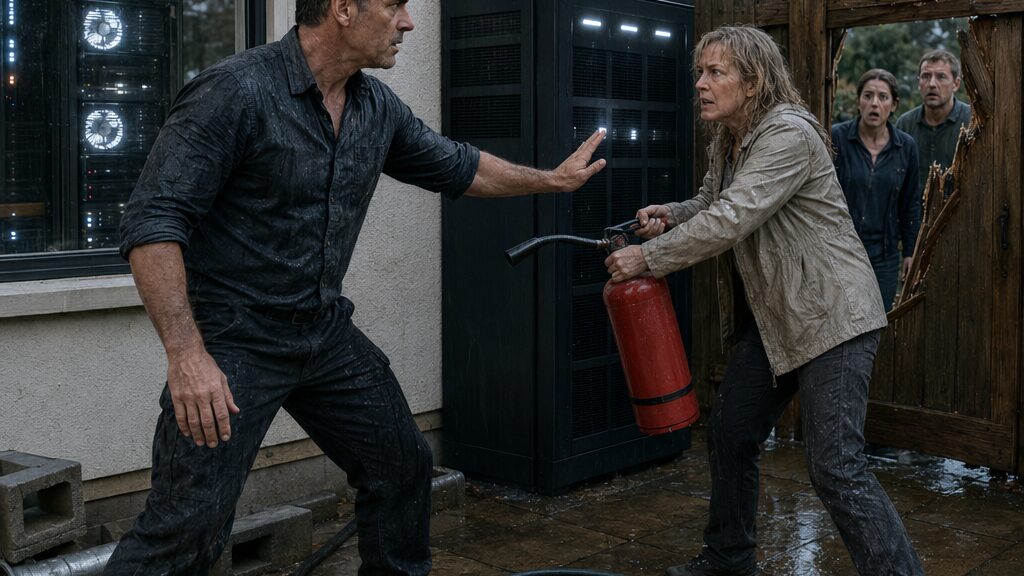
Janet entered behind a snaking black hose, wearing a yellow safety vest over her clothes. A steel pipe was tucked beneath one arm. In her other hand, she held a phone mounted on a short grip, its camera aimed at Daniel.
“This is an emergency intervention,” she shouted over the gas engine. “Stay back.”
Daniel saw the logo on the safety vest and recognized it from the facilities company where she worked. Her employee badge hung at her chest.
“Shut the hose off,” he said.
“I have notified the public.”
“You have forced entry onto protected property.”
“You threatened to ignite this entire street.”
“I never said that.”
“You said the system could fail if ordinary people interfered.”
The hose jerked as pressure built. Janet gripped the heavy nozzle with both hands and swept it toward the solar battery enclosure.
Daniel moved.
The first stream struck the paving stones where he had been standing. It hit with enough force to scatter gravel against the workshop glass.
“Janet, stop!”
She redirected the stream.
Water hammered the enclosure.
The sound swallowed the server hum. Warning lights flashed amber along the outer control strip as water drove into the lower vents and sheeted across the junction housing Dennis had identified.
Daniel lunged for the emergency panel beside the workshop door.
He slapped the exterior isolation switch.
Relays snapped beneath the enclosure. The charging pedestal went dark. The patio outlets disconnected. Inside the workshop, the server fans changed pitch as the system transferred to internal reserve.
Janet turned her camera toward the lights.
“You see that?” she shouted. “It’s going critical.”
“It is shutting down because you are flooding it.”
She aimed the stream at him.
Daniel ducked behind the concrete equipment barrier. Water struck its edge and burst into cold spray across his face. He reached around, seized the hose behind the nozzle, and forced it toward the ground.
Janet held on.
“You’re interfering with a safety officer.”
“You are not a safety officer.”
“I have workplace certification.”
“Not for this property. Not for electrical response.”
Her phone remained pointed at them. Comments and reaction symbols climbed across the screen.
Daniel twisted the hose downward. The nozzle dug a trench through the wet soil beside the patio. Janet released one hand and shoved him in the shoulder.
He let go rather than wrestle her near the battery housing.
“Turn off the pump,” he said. “Last warning.”
“You don’t give the warnings anymore.”
She swung the stream back toward the enclosure.
Daniel reached the manual shutdown sequence on his tablet. The interface showed contradictory readings: the exterior circuit reported isolated, but the damaged junction sensor still registered intermittent contact.
Emergency shutdown paused.
VERIFY EXTERNAL CONDITION.
He tried the override.
ACCESS DELAY—SENSOR CONFLICT.
The water had forced itself beneath the lifted outer seal. Not far enough to breach the inner barrier, but enough to confuse the monitoring circuit.
His redundancies had prevented immediate current exposure. They had also trapped the system between states.
The server fans surged, then faltered.
The sound pulled him backward through time—the old battery room, Dennis asking whether the drift was worth stopping, Daniel reading a checklist while the machines tried to tell him something else.
This time he did not wait for the approved threshold.
He grabbed the insulated hook mounted beside the door and pulled the manual isolation lever down.
A heavy contactor slammed open inside the wall.
The charging station died completely. The battery bank entered containment mode. The server transferred to its final local reserve, its hum thinning into a high, strained breath.
Janet stared at the flashing lights. “It’s failing.”
“You are causing the failure.”
“I’m exposing it.”
She dropped the hose. The nozzle bucked across the paving stones, spraying wildly beneath the patio table.
Janet pulled the galvanized pipe from under her arm.
Daniel stepped between her and the workshop window.
“Put it down.”
She raised the phone toward his face. “He’s blocking an emergency inspection.”
“You are trespassing.”
“The public can see what you’re doing.”
“The public can see you holding a pipe.”
For the first time, she glanced at her own screen as if noticing the image she had created.
Her expression flickered.
Daniel lowered his voice. “The city cleared the installation. You heard the inspector tell you water would make it dangerous. Shut off the pump and leave.”
Janet’s grip tightened around the pipe.
Behind her, water spread around the base of the battery enclosure. The containment lights remained amber, not red. The inner seals were holding.
She could still stop.
Then someone spoke through her phone’s tiny speaker, the words indistinct but urgent.
Janet looked toward the server rack.
“You’re erasing it,” she said.
“Erasing what?”
“The evidence.”
“The system is isolated.”
“Because you know we found you.”
She swung.
The pipe struck the reinforced glass with a sharp metallic crack. The window held, but a white mark appeared at the impact point.
Daniel caught the pipe on the second swing.
The force drove the steel against his palm. He stepped inside her reach, trapped the pipe against his forearm, and twisted it free.
Janet stumbled forward.
Daniel threw the pipe across the patio, away from both of them.
It struck a stack of loose cinderblocks beside the workshop wall and clattered to the ground.
“Leave,” he said.
His voice sounded unfamiliar—flat, stripped of negotiation.
Janet backed toward the open gate. Her eyes moved from Daniel to the enclosure and then to the phone.
For one second, he thought she had finally understood.
Then she saw the red fire extinguisher mounted near the charging station.
She tore it from its bracket.
“That is for electrical fire response,” Daniel said. “Do not discharge it into the vents.”
“You don’t get to tell me what fire equipment is for.”
“There is no fire.”
“There will be if I don’t stop it.”
She pulled the hose free from its retaining clip.
Daniel heard the sentence beneath the sentence: If she left now, nothing would happen. The neighborhood would see only a broken gate, a flooded patio, and a woman who had ignored every warning. She needed smoke. Sparks. A visible disaster strong enough to justify everything she had said.
The realization ended his last hope of talking her down.
Janet wrapped one hand around the extinguisher handle and aimed the nozzle directly at the battery ventilation gap.
Daniel moved toward her.
She yanked the safety pin free and charged.
Chapter 6: The White Blast at Her Feet
Janet pulled the extinguisher lever as Daniel’s hand closed around the cylinder.
A burst of white chemical powder struck the workshop wall.
Daniel drove the nozzle upward before she could sweep it into the battery vent. The discharge hissed past his shoulder and filled the air above them with a choking cloud.
“Let go!” Janet screamed.
“You aimed at energized infrastructure.”
“You said it was isolated.”
“Containment is still active.”
“So you lied about shutting it down.”
She dragged the cylinder toward the ventilation gap. Her shoes slipped in the water, but she kept both hands on the extinguisher.
Daniel locked his forearm beneath the handle and turned his body between Janet and the enclosure.
The cylinder was heavier than it looked. Pressurized. Slick with water. Dangerous if its valve fractured unpredictably.
The old training returned in pieces: control the direction, clear the hazard, do not fight force with force when leverage will do.
Janet kicked his shin.
“You knew,” Daniel said through clenched teeth. “You knew the city cleared it.”
“They cleared what you showed them.”
“You heard the inspector warn you about water.”
“Nobody was listening to me.”
“That does not make this an emergency.”
“It had to look like one.”
The words escaped her before she could stop them.
Daniel stared at her.
Janet’s face changed. Not remorse. Recognition that she had said the quiet part aloud.
She shoved harder.
“People needed to see what could happen.”
“You decided to make it happen.”
“They would have ignored me until someone got hurt.”
The extinguisher nozzle swung toward the battery vent again.
Daniel trapped it beneath his elbow. With his free hand, he reached for the manual isolation lever behind him.
His fingers touched the rubber grip.
Janet lunged forward.
Daniel pulled the lever through its final mechanical stop.
Inside the wall, the last contactor released.
The thin server hum died.
Silence landed over the patio beneath the extinguisher’s hiss and the distant gas engine. For Daniel, it was the old battery room again—the dead fans, the pause before heat and alarms, Dennis reaching for a door that should have opened automatically.
His grip almost failed.
Then he saw the battery enclosure in front of him, intact. Amber containment lights. No smoke. No flame. Janet’s hand forcing a pressurized cylinder toward the only vulnerable gap.
This was not the old room.
He was not waiting for a checklist.
Daniel ripped the extinguisher sideways and tore it from her grip.
Janet reached for it again.
He planted the sole of his heavy work boot against the valve assembly, angled the cylinder away from both the battery bank and her body, and drove his leg down.
Metal cracked.
The valve tore loose.
The extinguisher erupted.
A violent white blast struck the paving stones and recoiled across Janet’s legs and torso. The pressure knocked her backward into the wet grass. She landed on one hip, arms flung wide, her phone skidding from her hand.
The cylinder bucked in Daniel’s grip.
He released it toward the open center of the patio. It spun in a widening arc, blasting powder until it struck the concrete barrier and emptied itself in a diminishing roar.
White dust rolled across the ground like smoke.
Daniel coughed and pulled his shirt over his nose. Through the cloud, he found the battery enclosure. Powder coated the outer wall but had not entered the vent. The containment indicators remained steady.
He crossed to the manual panel and checked the isolation blade.
Open.
Physical separation confirmed.
The system was safe.
For one breath, that was enough.
Then Janet pushed herself upright.
Her hair and safety vest were covered in white powder. A thin scrape marked one elbow. She looked stunned, smaller than she had moments before.
Daniel stepped toward her slowly.
“Stay down. Troopers are coming.”
“You attacked me.”
“You forced the gate and tried to damage the system.”
“You kicked an extinguisher at me.”
“I directed it away from the equipment.”
Her phone lay faceup in the grass. The livestream still ran. The image showed only white haze and the lower half of the broken gate.
Janet saw it.
Something hardened in her again.
“The whole neighborhood saw you,” she said.
“They saw you admit what you were doing.”
Her eyes shifted past him.
The galvanized steel pipe lay beside the cinderblocks.
Daniel followed her gaze.
“Don’t.”
Janet moved.
She scrambled across the wet grass, one hand reaching toward the pipe.
Daniel reached it first.
He seized the steel near its center and stepped back.
Janet stopped three feet away.
“Put it down,” she said, as if she had become the one giving lawful orders.
“Go to the sidewalk.”
“You broke my arm.”
“You are using both arms.”
“You could have killed me.”
“Back away.”
She took one step toward him.
Daniel saw the broken gate hanging open, the flooded battery housing, the cracked white mark on the workshop glass. He saw Dennis’s rigid hand on a video screen. He heard Janet saying it had to look like an emergency.
Anger rose cleanly, almost calmly.
He wanted her to understand what she had brought into his yard.
Beside his boot sat a loose cinderblock from the unfinished equipment barrier.
Daniel raised the pipe.
Janet froze.
He brought the steel down.
The pipe struck the cinderblock inches from her shoes.
The block burst apart with a deafening crack. Gray fragments jumped across the wet paving stones. Dust and extinguisher powder rose together around Janet’s legs.
She screamed and staggered backward.
Daniel held the pipe low.
“That was your only warning.”
The words came out before he could weigh them.
For a second, the result felt like control. Janet stood motionless. The danger had stopped. She finally looked afraid enough to obey.
Then Daniel saw the truth of the moment.
She had been unarmed.
She had stopped advancing before the strike landed.
The cinderblock had not protected the battery bank. It had frightened her because he wanted her frightened.
Necessary action had ended when he took the pipe.
Everything after that belonged to his anger.
A siren cut through the street.
Janet snatched up her phone and ran through the broken gate, shouting before she reached the sidewalk.
“He tried to kill me! He has a weapon!”
Daniel lowered the pipe.
Blue lights flashed across the workshop glass. Vehicles stopped hard beyond the fence. Doors opened.
“Drop it!”
The command came from the gate.
Daniel recognized Michael Clark’s voice, but the drawn weapons behind it erased any familiarity.
Daniel placed the pipe on the ground.
“Step away from it,” Michael ordered. “Hands where I can see them.”
Daniel raised his hands and moved backward.
Janet stood behind two troopers, covered in white powder, pointing at him.
“He attacked me after I came to stop a fire.”
“There was no fire,” Daniel said.
Michael’s gaze cut to him. “Do not speak to her.”
“The battery is isolated, but the patio is wet. Keep everyone away from the enclosure.”
“Turn around.”
Daniel obeyed.
A trooper pulled his wrists behind him while another guided Janet toward the sidewalk. Her voice grew louder as neighbors emerged from their homes.
Michael looked at the shattered cinderblock, the broken extinguisher, and the steel pipe lying at Daniel’s feet.
Then his eyes moved to the cameras above the workshop.
“Those recording?” he asked.
“Locally.”
“Mirrored?”
Daniel thought of the stalled authorization process.
“Not fully.”
Michael’s face revealed nothing.
He pointed toward the house. “Secure every device. Nobody touches the footage.”
Janet shouted from beyond the gate, “He smashed that block right in front of me. He wanted me to think I was next.”
Daniel looked at the fragments scattered across the patio.
Michael followed his gaze.
“Did you?” he asked.
Daniel could have answered that she was advancing. That the pipe had been hers. That the warning ended the threat.
Instead, he said nothing.
Michael stepped closer.
“Protected registration doesn’t change what happens now,” he said. “Turn away from the cameras.”
Chapter 7: Evidence Without a Hero’s Edit
“Protected registration does not protect you from an excessive-force inquiry,” Michael said.
Daniel sat across from him in a small interview room at the state police office, his damp clothes replaced by a gray sweatshirt Jessica had brought from home. Fine white extinguisher powder still clung beneath his fingernails.
Michael placed three photographs on the table.
The broken gate.
The discharged extinguisher.
The cinderblock reduced to fragments beside Janet’s shoes.
“I understand,” Daniel said.
“Do you?”
“Yes.”
Michael sat down but did not open his notebook. “Janet forced entry. We have the damaged latch. We have the hose, pipe, and extinguisher. We have the city inspector confirming she was warned not to spray the enclosure.”
Daniel waited.
Michael tapped the third photograph. “We also have this.”
“She moved toward the pipe.”
“Was the pipe in her hand?”
“No.”
“Was she touching it?”
“No.”
“Was she advancing when you struck the block?”
Daniel saw the moment again with painful clarity: Janet stopping, the steel raised in his hands, the clean satisfaction of making fear appear on her face.
“She had stopped.”
Michael leaned back.
Outside the interview room, a door opened and closed. Daniel could hear low voices from another office but not the workshop hum that had measured so many hours of his life. Its absence made every question sound sharper.
“The cameras caught most of it,” Michael said. “One angle is incomplete. Your off-site mirror was inactive.”
“The local recorder survived.”
“We are imaging it now.”
Daniel nodded.
Michael studied him. “Jessica’s office has offered a statement confirming that the charger and continuity system are registered to the lieutenant governor’s residence.”
“That should not be the basis of the decision.”
“It isn’t.”
“I don’t want it presented that way.”
Michael’s expression tightened. “You do not control how this looks.”
“I know.”
“Do you? Because Janet’s version is already circulating. Her video cuts from the extinguisher blast to you raising the pipe. It makes the missing seconds look very bad.”
Daniel looked at the photographs.
“I have a local diagnostic recording,” he said. “The system logs audio with relay events.”
“Does it capture the patio?”
“Yes.”
“Everything?”
Daniel thought of his remark to Janet during the inspection. His refusal at the meeting. The cinderblock strike.
“Probably.”
Michael opened his notebook. “Then we need the complete file.”
Jessica was waiting in the kitchen when Daniel returned home that evening. The patio remained sealed behind temporary barriers, and the workshop had no power except for an evidence-preservation circuit installed by investigators.
Without the server fans, the house seemed unnaturally still.
Jessica had placed a tablet on the kitchen table. A draft statement filled the screen.
Daniel read the first sentence.
An unlawful attack was carried out against protected energy infrastructure registered to the official residence of Lieutenant Governor Jessica Mitchell—
“No,” he said.
“It is accurate.”
“It leads with your title.”
“Because the registration matters.”
“It matters to the charge. It should not decide who people believe.”
Jessica folded her arms. “Janet told thousands of viewers that you attacked her while she tried to stop a fire.”
“There was no fire.”
“Then we should say that.”
“We should release the sequence.”
Her eyes moved toward him. “All of it?”
“Yes.”
“Including the block?”
“Yes.”
Jessica sat opposite him. “Your attorney may advise against that.”
“My attorney wasn’t holding the pipe.”
The local recorder had captured more than the cameras. Its diagnostic microphone recorded Janet acknowledging the city clearance. It preserved Daniel’s repeated commands to leave, her statement that the danger had to look real, the isolation relays, and the instant when the hum ceased.
It also preserved Daniel saying, That was your only warning, after striking the cinderblock.
Jessica listened without interrupting.
When the recording ended, the kitchen refrigerator clicked on. A small mechanical hum filled the silence.
“You frightened her on purpose,” Jessica said.
“Yes.”
“After you had the pipe.”
“Yes.”
“Why?”
Daniel looked down at his hands. “Because I wanted her to feel what she had brought into the yard.”
Jessica’s voice softened, which made the question harder.
“Did it protect anything?”
“No.”
The following morning, Daniel submitted every file.
He included the full inspection exchange, not only Janet’s edited version. He included the association meeting, the stalled security update, the exterior footage that failed to prove Janet had damaged the seal, and the complete attack recording.
Michael called two days later.
“The pipe removal was justified,” he said. “So was redirecting the extinguisher. The technical review confirms contamination at the vents could have created a serious hazard.”
“And the cinderblock?”
“Still under review.”
Daniel closed his eyes.
Michael continued. “There is something else. Janet used her employer-issued phone to run the livestream. She wore company safety equipment and repeatedly identified herself as an authorized responder.”
“She has workplace safety training.”
“She does not have authority to conduct residential inspections. Her employer says the vest and credentials were not approved for personal use.”
That afternoon, an employer representative contacted Jessica’s counsel. The company believed the complaint might be politically motivated and requested the unedited footage before taking any action.
Daniel authorized its release.
The representative called him directly after reviewing it.
“Did Mrs. Walker tell you she was acting on behalf of our company?”
“She said she was a safety officer.”
“Did she display her badge?”
“Yes.”
“Did you know the device filming the incident belonged to us?”
“No.”
There was a pause.
“We found messages sent through her work account,” the representative said. “She described the action as an inspection and invited coworkers to share the stream as a public-safety demonstration.”
Daniel looked through the kitchen window toward Janet’s dark house. Curtains covered every front window.
“What happens now?” he asked.
“That will be handled internally.”
“I’m not asking for a particular outcome.”
“No,” the representative said. “But the evidence requires one.”
Later that week, Michael returned to the Mitchell house. He stood inside the repaired temporary gate while investigators removed the final evidence markers.
“Janet is being charged with unlawful entry, property damage, and assault-related offenses,” he said. “The protected infrastructure designation increases scrutiny, but the case does not depend on Jessica’s office.”
Daniel nodded.
“And me?”
“No criminal charge is being recommended. The report will state that the cinderblock strike was avoidable and escalatory after the immediate weapon threat had ended.”
“That is accurate.”
Michael watched him for a moment. “Most people argue with that part.”
“Most people weren’t there.”
“You were. That can make people argue harder.”
Across the street, a delivery vehicle stopped in front of a neighbor’s house. Two workers unloaded long metal rails marked for rooftop solar installation.
Daniel noticed Michael looking at them too.
Before leaving, Michael handed Daniel a printed notice from Janet’s employer. Her access credentials had been revoked pending final termination, and the company had confirmed that her public claims of authorized inspection were false.
The document felt lighter than Daniel expected.
Janet’s collapse did not restore the broken gate. It did not restart the server. It did not remove the image of her face when the pipe struck concrete.
Jessica found him still holding the notice after Michael had gone.
“You were right about her,” she said.
Daniel folded the paper once.
“That doesn’t make me right about everything I did.”
Chapter 8: When the Quiet Hum Returned
The first machine Daniel heard six weeks later was not his server.
It was a drill biting into the roof across the street.
He stood beside the repaired side gate while installers secured solar rails to the neighbor’s shingles. Two houses farther down, a charging pedestal had appeared beside a driveway. Another family had scheduled a smart-energy consultation after attending the city’s final safety review.
No one called it solidarity.
No one needed to.
The neighborhood had simply stopped treating unfamiliar equipment as proof of hidden danger.
Daniel’s new gate used the same cedar boards as the old one. Jessica had suggested steel reinforcement and an electronic access lock. He had installed a stronger latch but refused to turn the entrance into a barricade.
Today, the gate stood open.
A city electrical inspector, an independent fire-safety engineer, and six neighbors waited on the patio for the controlled walkthrough Daniel had once refused to offer.
Jessica remained near the back, dressed without any visible sign of office. She had insisted the event not become a press opportunity. No cameras beyond the city’s documentation device. No statement from her staff. No mention of rank unless registration procedures required it.
Daniel appreciated the restraint because he knew it had cost her political team an easy victory.
Janet’s house stood closed and empty next door. She had moved in with a relative while the criminal case proceeded. Her employer had terminated her for credential misuse, false claims of authority, and use of company systems to organize the attack.
The force inquiry involving Daniel had ended without charges. Its final report cleared his actions during the hose, pipe, and extinguisher assault, then described his cinderblock strike in a sentence he had read many times:
The action was not necessary to prevent immediate harm and increased the perceived threat after the aggressor’s advance had paused.
He had framed no portion of that report as vindication.
Inside the workshop, replacement fans waited in silence. The reinforced window had been repaired. New seals surrounded the battery junction housing, and the evidence mirror now showed green on two independent displays.
Dennis stood near the workbench, turning a shortened section of galvanized pipe in his good hand.
Daniel had cut away the bent end and polished the remaining metal. A brass plaque lay beside it.
HAZARD AVERTED.
Dennis read the words, then looked up.
“Reminder or trophy?”
“Reminder.”
“That answer was fast.”
“I’ve had six weeks.”
Dennis set the pipe down. The stiffness in his left hand was worse in cold rooms, though he rarely mentioned it.
“What exactly are you reminding yourself of?”
“That she brought a weapon into the yard.”
“That part will be easy to remember.”
Daniel looked at the plaque.
Dennis waited.
“And that I wanted to scare her after I had already stopped her.”
“Less decorative.”
“I can remove it.”
“I didn’t say that.”
Daniel picked up a copy of the final incident report and slid it into a clear sleeve beneath the mounting brackets.
Dennis’s mouth shifted slightly. “Better.”
They joined the others beside the server controls.
A neighbor near the front kept glancing toward the open gate. Daniel recognized him from the association meeting—the man who had admitted Janet asked about headaches before he had noticed the sound.
“I signed her petition,” the man said suddenly.
The group went quiet.
Daniel rested one hand on the server’s startup panel.
“I know.”
“I thought you might read the names today.”
“Why?”
“To show who helped her.”
Jessica watched Daniel from the back of the room.
Six weeks earlier, he might have answered that signatures were part of the public record. He might have believed accuracy was enough.
Instead, he said, “You signed a request for review. She chose to break the gate.”
The neighbor’s shoulders lowered slightly.
“You still think we were ignorant.”
“I think I made it easy for uncertainty to become suspicion.”
“That isn’t the same as saying we were right.”
“No.”
The answer held without cruelty.
Daniel turned to the battery enclosure diagram. He showed the group the isolation barriers, external disconnect, ventilation path, and automatic containment sequence. He explained that the server had no external network connection and performed local simulations used for emergency continuity planning. He showed them the blank wireless inventory and let the independent engineer confirm it.
No one needed access to the stored files.
No one demanded it.
At last, Daniel placed his hand on the startup switch.
“This is the sound that caused the first complaint,” he said.
He pressed it.
Relays clicked in order. Indicator lights moved from amber to white. The cooling fans began at low speed, producing a soft breath through the racks.
The hum returned.
Several neighbors leaned closer.
“That’s it?” someone asked.
“That’s it.”
The fire-safety engineer held up a sound meter. The reading was lower than the ventilation unit in the association room.
A few people exchanged embarrassed looks, but Daniel did not point them out.
The server load rose. The hum deepened slightly, ordinary and stable. For the first time, Daniel heard it without treating it as proof that he had controlled every danger.
It meant only that the machine was running.
The rest required people.
After the walkthrough, Dennis helped him mount the shortened pipe above the workbench. Daniel fixed the brass plaque beneath it, then added a narrow handwritten strip under the polished words.
Including the hazard in me.
Dennis read it.
“That may be too honest for a workshop wall.”
“Then it belongs there.”
Outside, the drill across the street started again. Sunlight caught the first row of newly mounted panels. Beyond them, another roof already held dark glass rectangles angled toward the sky.
Jessica came to stand in the workshop doorway.
“The gate is still open,” she said.
“The inspection isn’t over until the city device finishes uploading.”
“You could close it anyway.”
Daniel listened to the restored hum moving through the reinforced room. Once, he had trusted locked doors, perfect documentation, and redundant systems to keep every failure outside.
Now the complete incident report hung beneath the broken tool, visible to anyone invited inside.
He looked past Jessica to the patio, the repaired latch, and the neighbors leaving with questions answered but not every disagreement erased.
“Leave it open,” he said.
The fans settled into their steady rhythm.
This time, no one mistook the sound for a weapon.
The story has ended.