The Police Chief Surrounded His Home Until the Property Line Became Evidence
Chapter 1: The Street Filled Before the Warrant Arrived
The first cruiser stopped across Thomas Carter’s driveway at 7:14 in the morning.
The second blocked the intersection.
By the time Thomas reached the laboratory surveillance room, blue lights had swallowed every house on the street.
Six camera windows glowed above his workbench. Uniformed officers stepped onto lawns, pulled reflective vests over body armor, and waved an approaching delivery van into a hurried turn. A seventh cruiser rolled past Carolyn Wilson’s porch and stopped beside the empty lot adjoining Thomas’s property.
Then a voice cracked through an amplified speaker.
“Thomas Carter, come to the front gate and open it.”
Thomas looked at the clock beside the monitors. He wrote the time on a yellow evidence tag, placed it beneath the keyboard, and switched the surveillance system to mirrored local storage.
The voice came again.
“This is Chief Patrick Moore. We are conducting an emergency safety inspection.”
Thomas glanced through the interior window separating the control room from the laboratory. Stainless-steel counters stood beneath white lights. Sealed sample jars occupied numbered racks. The ventilation indicators showed steady green bars.
No smoke. No spill. No alarm.
He took his phone, his keys, and the slim folder containing his licenses.
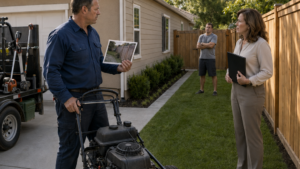
The front driveway was barely visible beyond the bulk of his overland vehicle. The old machine sat sideways behind the gate, its wide tires planted on reinforced concrete. Faded sand-colored paint covered a steel body scarred by years of field work. Its rear corner stood inches from the sample-transfer door, where a direct vehicle strike would otherwise reach the laboratory wall.
Thomas had parked it that way every night for four years.
Patrick would call it obstruction.
Thomas called it staying able to sleep.
He walked around the vehicle with the folder beneath one arm. Before approaching the gate, he stopped beside the narrow white survey mark painted across the concrete. It aligned with a brass pin set into the base of the fence.
Still intact.
Still on his side.
Patrick stood ten feet beyond it, broad beneath a dark uniform jacket, one hand resting near his belt. Lieutenant Larry Perez stood to his right with a tablet. Officers occupied the street behind them. Several had their hands clasped in front of their vests, neither relaxed nor ready.
“You brought enough people,” Thomas said.
Patrick lowered the loudspeaker. “Open the gate.”
“Show me the warrant.”
“This is a safety check.”
“That is not a warrant.”
Patrick’s jaw tightened. “We received multiple reports of hazardous chemical activity, suspicious deliveries, toxic odors, and equipment associated with illegal drug production.”
Thomas raised the folder. “I operate a licensed environmental testing laboratory.”
“Then you should have no problem letting us verify that.”
“I have a problem with anyone entering without lawful authority.”
Across the street, curtains shifted. A man two houses down held his phone above a hedge. Carolyn stood on her porch in a pale sweater, filming with both hands.
Patrick glanced toward the growing audience before returning his attention to Thomas.
“You are making this harder than it needs to be.”
“No. I am asking you for the document that makes it legal.”
Larry stepped nearer the fence. “Mr. Carter, can you show us the license?”
Thomas removed the state laboratory certificate and held it flat against the wire mesh. Larry leaned forward, reading the issue date and registration number.
“It appears current,” Larry said.
Patrick caught his sleeve and drew him back before he reached the second page.
“A certificate does not tell us what is inside today.”
“It tells you this is not an unregistered narcotics lab,” Thomas said.
Patrick looked past him toward the overland vehicle. “Why is that truck blocking the driveway?”
“It is parked on my property.”
“It prevents emergency access.”
“There is no emergency.”
“You do not get to decide that.”
Thomas looked at the fixed camera mounted above the gate. A red indicator showed active recording.
“Do you have a warrant?” he asked again.
Patrick’s eyes followed his toward the camera.
“We have an immediate public-safety concern.”
“That was not my question.”
The silence lasted long enough for two nearby officers to look at each other.
Patrick lifted his chin. “No. We do not currently have a warrant.”
Thomas kept his face still, though something inside him loosened. The admission mattered. Not enough, but it mattered.
“Then remain outside the gate.”
Patrick stepped closer until the toes of his polished boots nearly touched the shadow cast by the fence.
“Your neighbors report drums being carried in after dark. They report respirators, chemical containers, and strange odors. One of them saw you unloading sealed barrels at midnight.”
“They were soil cores delivered after a highway closure delayed the courier.”
“You expect me to accept that through a locked fence?”
“I expect you to obtain legal authority before entering.”
Patrick turned half away, addressing the officers and the street as much as Thomas.
“Establish a perimeter. No one enters or leaves this property. Close the road at both ends.”
Larry hesitated. “Chief, we have not confirmed an airborne hazard.”
“We have an uncooperative subject operating a chemical facility in a residential neighborhood.”
Thomas’s fingers tightened around the folder. “Subject?”
Patrick ignored him.
Officers began stretching yellow tape between two cruisers. Another moved toward the side fence with a camera. A patrol vehicle blocked the delivery entrance at the rear alley.
The machinery of official certainty had started moving. Once in motion, it did not need proof. It needed only tasks.
Thomas returned the papers to the folder.
“You have exterior air data available through the county portal,” he said. “My monitors report automatically.”
Patrick gave a thin smile. “Then you will have nothing to worry about.”
Thomas had heard that sentence years earlier, spoken by an inspector stepping over contamination tape with mud on his boots.
Nothing to worry about.
By sunset, three weeks of samples had been unusable.
By winter, the families waiting on those results had lost their case.
Thomas pushed the memory down and looked at Larry. “You read the license.”
Larry’s gaze moved toward Patrick before returning. “I saw it.”
“Record that.”
Patrick answered for him. “We will record what is relevant.”
That was when irritation gave way to something colder.
This was not an inspection delayed by procedure. Patrick did not want clarification. He wanted compliance, preferably in front of witnesses.
A delivery truck appeared at the far barricade. The driver spoke to an officer, pointed toward Thomas’s compound, then was turned away.
Thomas watched it leave.
“That shipment contains temperature-controlled reference material.”
Patrick shrugged. “You chose to obstruct the inspection.”
“You closed the road before applying for a warrant.”
“I closed the road because your operation may endanger the public.”
“What evidence do you have of an active release?”
Patrick pointed across the street.
“Your own neighbors called us.”
Thomas followed the gesture.
Carolyn lowered her phone by several inches.
Patrick continued, louder now. “Mrs. Wilson reported chemical odors, protective masks, drums, and suspicious nighttime activity.”
Carolyn’s lips parted, but no words came.
Thomas looked at the porch, then at the line of cruisers, then down at the white mark beneath the gate.
He had refused Carolyn entry to his workshop two months earlier when she came asking what he stored behind the fence. He had told her the permits were public record and closed the door.
Now she raised her phone again, and the red recording light faced him from across the street.
Chapter 2: The Neighbors Watched the Lie Grow
The livestream called Thomas an armed chemist before the first air monitor had been removed from its case.
He saw the title on a neighbor’s phone through the gate camera: POLICE SURROUND POSSIBLE DRUG LAB IN QUIET SUBURB.
More than eight hundred people were watching.
Thomas stood in the sample intake room, listening to Patrick’s voice carry through the fence.
“We have credible reports of a possible narcotics operation involving toxic materials.”
The word credible landed harder than it should have.
Thomas looked toward Carolyn’s porch through the narrow reinforced window. She remained beside the railing, her phone held chest-high now rather than above her face. Patrick stood below her steps, speaking with the assurance of someone confirming facts rather than assembling them.
Carolyn said something Thomas could not hear.
Patrick answered loudly enough for the street.
“You were right to report it. A toxic narcotics lab in a residential area cannot be ignored.”
Carolyn went still.
Thomas turned away from the window.
On the steel table lay a sealed crate marked with three hazard classifications. Inside were soil samples from an abandoned manufacturing site, each jar double-contained and logged. None could poison the neighborhood through walls and closed lids. But mishandled, opened outside containment, or mixed by someone who did not understand the stabilizing agents, they could become dangerous.
Patrick’s lie had attached itself to a fragment of truth.
There were hazardous chemicals inside.
There were respirators.
There were drums.
That did not make the laboratory illegal. It made forced entry reckless.
Thomas opened the environmental monitoring panel. Exterior sensors showed ordinary air composition, no volatile organic spike, no particulate event, no ventilation failure. He selected the public display function and routed it to the weatherproof screen beside the gate.
Numbers appeared outside in green.
AIR QUALITY: NORMAL
VOC: BASELINE
PARTICULATES: NORMAL
EXTERNAL RELEASE: NONE
Patrick saw the screen change.
Thomas activated the intercom. “Those readings are independently timestamped and mirrored to the county system.”
Larry approached the display, studying the values.
Patrick remained where he was. “A clean exterior reading does not tell us what is happening inside.”
“It tells you there is no airborne emergency.”
“It tells us your equipment says there is no emergency.”
“My calibration records are filed with the state.”
“Then open the gate and let us inspect them.”
“You may inspect them after obtaining a warrant specifying what you are authorized to inspect.”
Several phones tilted toward Patrick.
For the first time, his expression shifted—not uncertainty, but awareness of the audience’s attention turning.
He stepped nearer the fence.
“Mr. Carter, people do not normally build walls, install industrial ventilation, block their driveway with a military-style vehicle, and refuse police access unless they have something to hide.”
“The vehicle is civilian. The laboratory is licensed. The wall was permitted.”
“You have an answer for everything.”
“That is usually what records are for.”
A few yards away, Larry lowered his eyes, hiding what might have been discomfort.
Patrick turned and signaled to an officer at the command vehicle. “Contact utilities. We may need power isolated if there is a chemical process running inside.”
Thomas’s hand tightened around the intercom switch.
“Do not cut power.”
Patrick looked back. “Concerned now?”
“The sample refrigerators require stable temperature. The ventilation controls require power.”
“So there is a hazard.”
“There are controlled materials. Your interference could make them uncontrolled.”
“That sounds like an argument for immediate entry.”
“No. It is an argument for leaving functioning systems alone.”
Patrick walked toward the command vehicle, already speaking into his radio.
Thomas stood motionless until the intercom clicked off. Then he crossed to the refrigerated storage room.
Three cabinets held current samples. Backup batteries could maintain them for ninety minutes. The natural-gas generator could extend that, provided police did not disable the fuel connection or interpret startup as escalation.
He checked every seal.
At cabinet three, he paused over a jar containing dark, clotted soil. A warning label named lead, chlorinated solvents, and petroleum byproducts. The sample had come from the empty tract beyond his eastern fence—the land developers had described as clean enough for town houses and a daycare center.
A reflected shape appeared in the glass door.
Carolyn stood outside the intake window, separated from him by the side fence and twenty feet of concrete. She had crossed from her porch while officers were occupied.
Thomas opened the exterior speaker but not the window.
“What did you tell them?”
Her eyes moved toward the nearest officer. “I said I smelled something twice last month. Sweet and metallic. I saw people wearing masks. There were blue drums.”
“Did you say narcotics?”
“No.”
“Did you say toxic fumes were escaping?”
“I said I was worried about chemicals.”
“Did you tell Patrick I threatened anyone?”
Carolyn’s mouth tightened. “No.”
“Then correct him.”
She stared through the glass at the racks behind Thomas. “Are those dangerous?”
“They are secured samples.”
“That was not my question.”
“Yes. Some contain hazardous residues. That is why trained people handle them under controlled conditions.”
Her fear sharpened rather than eased. “And you keep them beside our homes.”
“I keep them inside a licensed laboratory with monitored ventilation, secondary containment, fire suppression, and state inspections.”
“You could have told me that when I asked.”
“You asked to see inside my workshop.”
“I asked what you were doing.”
“You demanded access because you did not like delivery trucks arriving after dark.”
“My husband died after years of working around chemicals nobody warned him about.”
The words stopped Thomas.
He had known her husband had been ill. He had not known why.
Carolyn looked past him at the sealed cabinets. “Everyone kept saying the exposure levels were within limits. Then he got sick, and suddenly no one remembered who had measured what.”
Thomas thought of the families whose samples had been ruined by muddy boots. Fear could make people careless. It could also make them easy to use.
“You should not have had to guess,” he said.
Her expression changed slightly, but before she could answer, Patrick called from the street.
“Mrs. Wilson, please return behind the perimeter.”
She stepped back.
“Tell him what you actually reported,” Thomas said.
Carolyn looked toward Patrick, then toward the people filming from lawns.
“What if you are wrong?” she asked.
“What if he is?”
She did not answer. She returned to her porch.
Thomas shut off the speaker.
Minutes later, a utility truck stopped at the roadblock. Patrick met the driver beside the command vehicle. Larry joined them, gesturing toward the public air readings. The discussion grew tense, but the driver did not approach the service box.
A temporary reprieve.
Thomas returned to the sample table and opened the digital manifest. If Patrick did obtain entry, Thomas needed to know which materials could be moved into the inner containment vault without breaking chain of custody.
He scrolled past refinery waste, agricultural runoff, roadside sediment.
Then the redevelopment case appeared.
EAST PARCEL—PROPOSED RESIDENTIAL TRACT.
The file included six core samples from the empty lot and three from land held by a company represented by two of Patrick’s closest friends in the neighborhood association.
Thomas opened the preliminary results.
The contaminant levels were not yet legally conclusive. Confirmation testing remained incomplete.
But they were high enough to stop construction.
Outside, Patrick glanced toward the empty lot as he spoke into his phone.
For the first time that morning, Thomas wondered whether the police chief had come for something more specific than obedience.
Chapter 3: The Samples Beneath the Empty Lot
At noon, the police command post requested Thomas’s inventory by case number.
Not categories. Not hazard classes.
Case numbers.
The demand appeared in an electronic message sent through the county emergency portal: Provide immediate disclosure of all materials associated with files EP-17 through EP-24.
Thomas read it twice.
Those were the redevelopment samples.
Carolyn could not have known the numbers. The officers at the gate could not have seen them. Even the state licensing database listed only the broad field of analysis.
Someone had told Patrick exactly what to ask for.
Thomas printed the message and placed it beneath the yellow evidence tag beside his keyboard. Through the surveillance feed, Patrick stood under a folding canopy near the command vehicle, one hand pressed to his ear as he spoke on the phone. Beyond him, the empty lot lay behind temporary fencing and a faded sign promising future homes.
The sign had gone up eight months earlier.
The first purchase offer for Thomas’s property had arrived two weeks later.
He opened the archive cabinet with a key worn smooth at the edges. Inside were paper contracts, field logs, photographic records, and encrypted storage drives. The eastern parcel file occupied a red folder on the second shelf.
The preliminary report documented solvent residues beneath imported fill. The distribution pattern suggested the contamination extended under both the proposed development and the neighboring tract. Confirmation cores were scheduled for the following week.
If those results matched, excavation would be expensive. Construction could be delayed for years.
Thomas had told no one outside the client’s legal team.
He looked through the laboratory window toward the overland vehicle. Its broad flank blocked the driveway and shielded the sample-transfer entrance. To Patrick, it looked like a barricade. Thomas remembered welding reinforcement beneath the rear frame after a demolition contractor had once backed into a mobile lab during a field investigation.
Preparedness always looked excessive before the thing it prevented.
His computer chimed.
A notification appeared from a secure federal evidence portal he had not opened in eleven days.
ACCESS REQUEST ACTIVE
CASE CONTACT: JOSEPH GREEN
UPLOAD WINDOW AVAILABLE
Thomas stared at the name.
Joseph had contacted him twice during the previous month. The questions had concerned code inspections, nuisance citations, pressured property sales, and municipal officials who appeared repeatedly around favored redevelopment projects.
Thomas had answered narrowly.
When Joseph requested copies of the eastern parcel correspondence, Thomas refused without a court order or client authorization. Joseph had replied with a single sentence: Your caution is understandable, but incomplete evidence protects more than your clients.
Thomas had closed the message.
Now the portal waited again.
He inserted an encrypted drive and opened the upload interface. The folder contained laboratory results, purchase offers, photographs of officials meeting with development representatives, and notices issued against other landowners who had refused to sell.
Sending it would expose confidential environmental findings before confirmation. It could damage the client’s case. It would place Thomas’s records in hands he could not supervise.
His finger rested above the authorization key.
On another monitor, Patrick pointed toward the eastern fence while an officer photographed the empty lot.
Thomas withdrew his hand.
Not yet.
He copied the police request into a separate evidence directory and closed the federal portal.
A memory surfaced before he could stop it: orange contamination tape snapping in wind, officials stepping across it after he told them to wait, one boot sinking into wet soil beside an open evidence tray.
He had shouted then.
It had not mattered.
The inspector later claimed no boundary had been clearly marked. The agency called the breach regrettable but inconclusive. The opposing company called the samples compromised.
Families who had waited months for proof received letters saying the findings could no longer support attribution.
Thomas had installed redundant cameras after that. Then the wall. Then the gate sensors. Then local backups isolated from the internet. Each addition made sense alone.
Together, they had made his home resemble the place Patrick wanted everyone to believe it was.
The intercom flashed.
Larry stood at the front gate without Patrick.
“Mr. Carter, I need clarification about the inventory request.”
Thomas activated the speaker. “Who supplied those case numbers?”
“I do not know.”
“You signed the message.”
“It was transmitted under my credentials.”
“That was not my question.”
Larry looked over his shoulder toward the command post. “The chief received information from a cooperating party.”
“What party?”
“I am not authorized to disclose that.”
“Then I am not disclosing client files.”
Larry exhaled. “If those samples present an immediate risk—”
“They do not. Your exterior readings confirm that.”
“Could they become dangerous if the power is interrupted?”
“Yes.”
“So help me prevent that.”
“Tell Patrick not to interrupt the power.”
“I have.”
Thomas studied him through the camera. Larry’s posture had changed since morning. His shoulders were lower, his words more careful.
“You read my license,” Thomas said.
“Yes.”
“And yet the command log still describes this as an unverified facility.”
Larry glanced toward the command post again. “I am trying to keep this controlled.”
“By letting someone else decide which facts count?”
The lieutenant’s expression hardened, not with anger but with recognition.
“I have officers on this street who believe there may be a drug laboratory behind that gate,” he said. “I also have a chief who believes refusal itself is escalation. Give me something I can use.”
Thomas nearly opened a limited camera feed. He could show the intake room, the sealed cabinets, the active permits mounted beside the decontamination station.
Then he imagined the images clipped, enlarged, stripped of labels, presented as proof of hidden chemical production.
“No,” he said.
Larry’s disappointment was immediate.
Thomas felt the consequence before the lieutenant stepped away. He had asked for judgment from Larry while offering none of his own trust in return.
Still, he did not call him back.
Inside the archive room, Thomas removed the eastern parcel folder and placed it in the fire-rated cabinet beneath the workbench. He checked the bolts securing the transfer door. The overland vehicle’s rear quarter stood directly beyond it, too heavy to shift without specialized equipment.
A loud mechanical rumble came from the street.
Thomas returned to the monitors.
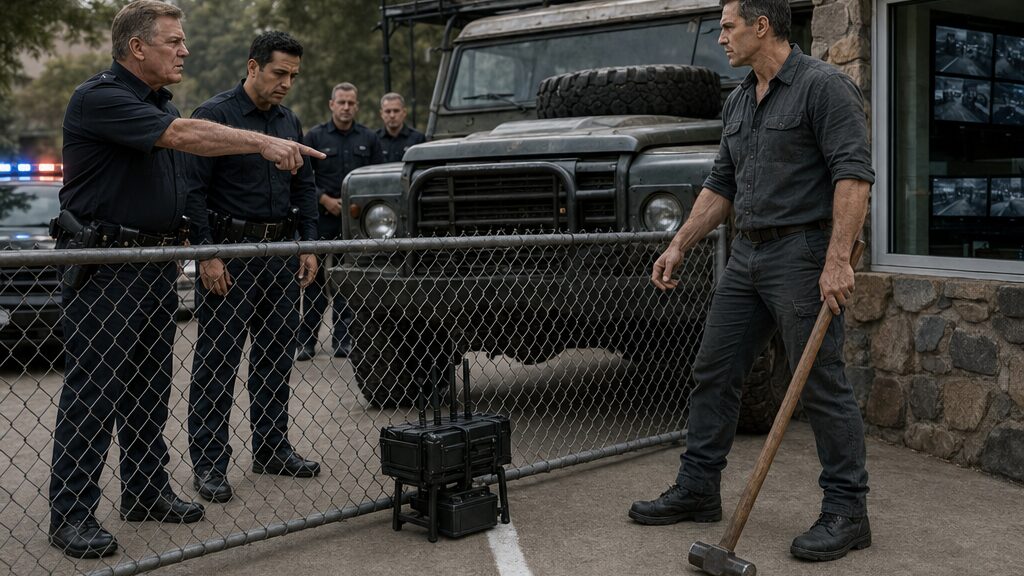
An officer unloaded a compact black case from a police support vehicle. Another carried a squat electronic unit with two folding antennas and a reinforced battery pack.
Larry approached Patrick quickly. Their conversation had no audio, but Larry pointed toward the device, then toward the houses.
Patrick responded with a dismissive motion.
Thomas enlarged the image.
A manufacturer’s warning label was visible on the case. LOCALIZED COMMUNICATION SUPPRESSION SYSTEM.
The federal portal chimed again behind him.
UPLOAD WINDOW AVAILABLE.
Thomas looked from Joseph’s waiting request to Patrick directing officers toward the nearest cruiser.
The electronic unit was placed on the hood, antennas rising above it like narrow black horns.
Patrick lifted his radio.
“For officer safety,” his amplified voice said, “we are now restricting unauthorized communications from the property.”
Thomas watched an officer reach for the power switch.
Chapter 4: When the Cameras Lost Their Signal
Every surveillance screen froze at the same instant.
The gate camera stopped with Patrick’s hand suspended above his radio. The side-yard feed became a gray block. The image of Carolyn’s porch fractured into colored squares, then vanished.
A second later, alarms sounded inside the laboratory.
Thomas turned from the monitors as the temperature display over cabinet three flashed amber. The ventilation controller lost its remote connection, recovered for half a second, then dropped again.
He crossed the control room in three strides.
The laboratory network was built in layers: wired internal sensors, isolated local storage, two cellular routes, a fixed wireless link, and an emergency satellite channel. Each system had survived outages before. None had been designed to function beside a concentrated transmitter flooding every usable frequency from forty feet away.
The wired monitors still measured conditions. The problem was control.
Cabinet three climbed two-tenths of a degree.
Thomas silenced the room alarm and opened the mechanical override panel. He switched the sample refrigerators from network management to local thermostatic control, then engaged the backup ventilation sequence by hand.
Outside, Patrick’s amplified voice cut through the walls.
“Electronic activity from the property has been restricted for officer safety.”
Thomas pulled the maintenance cover from the air-handling unit. The auxiliary fan had not started. Its controller was waiting for a network confirmation that could no longer arrive.
He bypassed the signal relay.
The fan shuddered to life.
Air moved through the ceiling ducts with a low, steady pressure. Green lights returned above two sample cabinets. Cabinet three remained amber.
Thomas opened its exterior service panel, careful not to break the containment seal. The refrigeration compressor was running, but the automated defrost system had locked in the wrong cycle when communication failed.
He reset it manually.
The temperature stopped rising.
Through the reinforced window, he could see the jammer on the hood of the cruiser. Its antennas stood upright. A blue indicator pulsed between them.
Patrick had created the first genuine laboratory hazard of the day and was announcing it as proof that Thomas had been dangerous all along.
Thomas reached for his phone. No signal.
The landline produced only static. The secure portal on his workstation showed an error. Even the satellite terminal failed to establish a clean uplink through the interference.
His cameras still recorded to local drives, but he could not see the exterior feeds or transmit them.
He could protect the samples.
He could document the police.
He could communicate with Joseph.
For the moment, he could do only two of those things, and one depended on equipment Patrick had just blinded.
Thomas returned to the intake room and checked each hazardous sample by hand. The glass jars remained sealed within secondary containers. He moved the most volatile set into a passive insulated cabinet that required no network connection.
A dull pounding sounded from the front gate.
“Mr. Carter,” Larry called. “Come where we can see you.”
Thomas opened the small armored viewing panel beside the sample-transfer entrance. Larry stood beyond the overland vehicle near the gate, one hand raised to show he held nothing.
Thomas did not open the door.
“You disabled my monitoring systems,” he said through the hardwired exterior speaker.
“The device is intended to limit remote communication.”
“It is interfering with safety controls.”
Larry looked toward the cruiser. “Can you maintain the laboratory manually?”
“That is not the legal standard.”
“I asked whether you can.”
“For now.”
The answer gave Larry no comfort.
“Are any materials unstable?”
“No. Because I intervened.”
Patrick appeared behind him. “So your facility requires constant remote intervention to remain safe?”
Thomas looked directly at him through the viewing slit. “Your jammer interrupted an automated defrost cycle and a ventilation relay.”
Patrick turned toward an officer holding a camera. “Record that the subject admits his chemical systems began failing when electronic communication was restricted.”
“That is not what I said.”
“You said your systems failed.”
“I said your interference disrupted them.”
Patrick’s expression barely changed. “Then perhaps you should have cooperated before we were forced to take precautions.”
Thomas felt an old anger pressing against the discipline he had spent years building. He saw again the wet field site, the open tray, the inspector’s boot beyond the orange tape.
He forced his hands open.
“Deactivate the jammer,” he said.
“Open the gate.”
“No.”
“Then maintain your equipment and remain visible.”
Patrick walked away.
Larry stayed.
“Chief,” he called, “we should document the laboratory license and the exterior readings in the operational notes.”
Patrick stopped without turning. “The notes reflect the current threat assessment.”
“The permit is relevant to that assessment.”
“What is relevant is that a man behind a fortified fence admits his chemical systems can become unstable.”
“The systems became unstable after we activated the device.”
Patrick faced him then. Officers close enough to hear became interested in their boots, their radios, the road.
“The device is approved equipment,” Patrick said.
“For what authorization?”
“For this operation.”
Larry glanced at the black unit. “I did not see it listed in the plan.”
“There was no time for a full plan. That is what emergency command discretion is for.”
“And the clean air readings?”
“Self-reported.”
“They mirror the county portal.”
Patrick stepped close enough that his voice no longer carried to Thomas, but the hardwired microphone beside the gate caught pieces.
“Lieutenant, you are here to contain a possible hazardous operation. Not to litigate every decision in the street.”
Larry’s jaw shifted.
“Yes, Chief.”
It was obedience, but not agreement.
Patrick returned to the command post. Larry remained by the fence for another moment, looking down at the white survey mark.
Thomas closed the viewing panel.
Inside, cabinet three returned to its proper range. The laboratory was stable again, but every necessary task now required his presence. He checked the local recording rack. Fixed cameras were still writing data, including two aimed directly at the gate and property marker. Their images would not be visible until he could restore the network, but the drives were active.
That mattered.
He entered the mechanical room and opened the emergency communications cabinet. A spool of shielded cable connected to a buried conduit running toward the rear alley. If he exposed the line and attached a portable terminal, he might create a narrow wired path beyond the jammer’s strongest range.
It would take twenty minutes.
Leaving the laboratory controls unattended for twenty minutes was now unsafe.
Thomas closed the cabinet.
The jammer’s signal strength rose.
He knew because the interference meter on the wall moved from amber into red.
Through the side window, officers were lifting the device from the cruiser hood.
Larry walked beside them, speaking sharply. One officer stopped near the curb, where the jammer had already achieved full disruption.
Patrick pointed toward the fence.
The officer shook his head.
Patrick pointed again.
Larry stepped between the device and the property. Even without audio, Thomas could read the argument in the lieutenant’s rigid shoulders. The unit had no reason to move closer if communication was already disabled.
Unless disabling communication was no longer the only purpose.
Patrick said something. Larry looked toward Thomas’s gate camera, perhaps remembering it might still be recording locally.
The device advanced another six feet.
Thomas left the window and went to the equipment rack beside the utility door. A sledgehammer hung there beneath insulated bolt cutters and a fire ax. Its wooden handle was dark from years of use in the field.
He took it down.
Not yet.
He carried it to the front driveway and stopped beside the overland vehicle. The jammer had been placed on a portable stand just outside the fence. Its antennas threw thin shadows through the wire.
Thomas walked to the painted survey mark and set the sledgehammer head on the concrete beside his boot.
Patrick’s voice came through the loudspeaker.
“Move the unit closer.”
Larry answered without amplification. “It is already inside the effective range.”
“Closer.”
The officer nudged the stand forward.
The antenna shadow crossed the white line first.
Then the edge of the battery housing moved toward it.
Chapter 5: The Sledgehammer Fell on Thomas’s Side
The jammer’s battery pack scraped across the painted survey mark with a dry plastic rasp.
Patrick stood behind it, watching Thomas rather than the equipment.
“Touch police property,” he said, “and you will end this day in custody.”
Thomas kept the sledgehammer head resting on the concrete. The gate separated them, but the jammer’s reinforced battery housing now protruded beneath the lower gap by less than an inch.
Not enough.
Thomas looked up at the fixed cameras mounted on the gateposts. Their external indicators were dark because the network was jammed. Their local recorders were not.
He raised his voice.
“Your device is crossing the surveyed property boundary. Move it back.”
Patrick glanced toward Larry. “Record that he is threatening to destroy public equipment.”
“He did not threaten that,” Larry said.
Patrick ignored him. “Move it forward.”
The officer holding the portable stand hesitated. “Chief, it is already—”
“Forward.”
Larry stepped nearer. “The housing is across the marker.”
“The fence line is the boundary.”
“The survey pin is inside the fence base. The painted line aligns with it.”
Patrick’s eyes moved to the small brass pin embedded in the concrete. For a moment, Thomas saw calculation replace anger.
Then Patrick made his choice.
“The device needs to be closer to suppress remote triggering systems,” he said. “Advance it.”
The officer pushed.
The battery housing slid three inches over the line.
Thomas waited.
Patrick’s mouth tightened. He had expected immediate action, something quick enough to look reckless from a distance.
Thomas planted the sledgehammer upright and pointed to the white mark.
“This is your final warning. Remove the equipment from my property.”
“We are operating under emergency authority.”
“You have not declared a specific electronic threat.”
“We do not have to disclose tactical assessments to you.”
“You are interfering with licensed safety systems.”
“You admitted those systems are unstable.”
“You made them unstable.”
The officer’s grip shifted on the stand.
Larry looked from the jammer to Thomas. “Chief, withdraw it to the curb. We have full suppression from there.”
Patrick’s face had gone pale around the mouth. Neighbors were still filming. His officers had heard Larry contradict him twice. The gate had become a stage, and Thomas understood that Patrick no longer wanted entry merely because someone had asked him to secure it.
He wanted Thomas to submit where everyone could see.
“Another six inches,” Patrick said.
The stand moved.
Nearly half the battery pack crossed the line.
Thomas bent, slipped one hand beneath the lower fence gap, and seized the exposed housing.
The officer jerked backward.
Thomas pulled harder.
The stand struck the fence, tipped, and separated from the jammer unit. The black box slid fully beneath the gate onto Thomas’s driveway.
Several officers shouted at once.
Thomas grabbed the unit by an antenna mount and flung it away from the fence. It struck the concrete, split at one corner, and rolled onto its side.
Patrick lunged toward the gate.
“Do not touch it!”
Thomas brought the sledgehammer up.
He struck the casing once.
The blow tore the upper shell open and exposed bundled wiring, metal shielding, and the rectangular battery pack locked beneath a protective bracket.
“Drop the hammer!” Patrick shouted.
Thomas stepped around the device, placing his body between it and the gate.
The interference meter inside the workshop remained red. The transmitter was still active.
He hooked the hammer beneath the broken bracket and tore the battery pack free.
Larry called through the fence. “Thomas, stop. The device is disabled.”
“No,” Thomas said. “It is still transmitting.”
The unit emitted a high electronic whine. A blue indicator continued pulsing behind the cracked housing.
Thomas placed the battery pack flat on the driveway.
Patrick reached through the mesh as if he could recover it with his bare hand. “That is city property.”
“It is on my property.”
“You dragged it there.”
“After you pushed it across the line on camera.”
Patrick turned. “Breach the gate.”
No one moved.
Thomas raised the sledgehammer above his shoulder and brought it down squarely onto the battery pack.
The impact echoed between the houses.
The reinforced casing collapsed. Internal cells split beneath the hammer head. The blue light on the jammer died.
For one suspended second, nothing happened.
Then the gate camera’s red indicator came on.
A ventilation alarm cleared inside the laboratory. The exterior display restarted. Thomas’s phone vibrated repeatedly in his pocket as delayed messages and connection notices flooded in.
Across the street, several phones chimed almost together.
The network had returned so suddenly that the cause could not be disguised.
Thomas left the shattered equipment where it lay and pulled out his phone. The signal-strength meter showed full service. He opened the laboratory dashboard.
Cabinet temperatures stable.
Ventilation normal.
Exterior air normal.
All surveillance feeds active.
He turned the screen toward the fence.
“Your device caused the disruption.”
Patrick’s face had changed. Whatever justification he had rehearsed depended on uncertainty. The restored systems had converted Thomas’s claim into a visible demonstration.
Patrick recovered quickly.
“You have destroyed police equipment and interfered with an emergency operation.”
“You placed an unauthorized jammer across my boundary.”
“You forcibly seized it from an officer.”
“The cameras recorded the location.”
“We will seize the cameras.”
The words came too fast.
Larry looked at him. “Chief?”
Patrick raised his radio. “Subject has destroyed municipal tactical equipment with a sledgehammer. He is armed, noncompliant, and obstructing a hazardous-material investigation. Prepare for forced entry and arrest.”
Thomas looked toward the officers.
Some tightened their formations. Others remained where they were. A breaching case was unloaded from the support vehicle. Farther down the street, a tow truck waiting behind the barricade started its engine.
Thomas could retreat into the laboratory and lock every interior door.
That would protect him for minutes and make Patrick’s story easier to tell.
Instead, he set the sledgehammer on the concrete, stepped away from it, and raised both empty hands where every camera could see.
“I am not threatening anyone,” he said. “The hammer is down.”
Larry repeated into his radio, “Hammer is down. Subject’s hands are visible.”
Patrick lowered his own radio. “He just committed a felony in front of us.”
Larry’s eyes remained on Thomas. “Then we preserve the scene and obtain the appropriate authority.”
“We have exigency.”
“What active threat?”
Patrick stared at him.
Thomas used the moment to cross toward the overland vehicle. Officers reacted, hands moving toward holsters and long weapons.
“I am retrieving a computer,” Thomas called. “My hands remain visible.”
“Stop moving,” Patrick ordered.
Thomas stopped beside the vehicle’s hood.
The restored gate camera faced him. The side camera captured Patrick. Every word now left the property twice—once to local storage and once to an external mirror.
Thomas placed his phone on the hood. From a locked compartment beneath the dashboard, he removed a rugged laptop and connected it to the vehicle’s independent power system.
Patrick pointed toward him. “That may be a triggering device.”
“It is a computer.”
“Step away from it.”
Thomas opened the federal portal.
Joseph’s access request still waited.
Alongside it were three unread messages, the newest sent less than a minute earlier.
TRANSMIT ORIGINAL FILES. DO NOT EDIT. INCLUDE LIVE INCIDENT RECORD.
Thomas looked at the red folder visible through the laboratory window.
The archive contained more than Patrick’s wrongdoing. It held preliminary results that could alter land values, damage clients, and expose people who had trusted him to control access. Once sent, it would exist beyond his walls.
His first instinct was to prepare a narrow package—to redact names, separate the live video, hold back the soil data until confirmation.
That instinct had delayed him all morning.
Patrick was already rewriting the day.
Thomas selected the complete siege archive, the police inventory demand, the redevelopment correspondence, the purchase offers, and the eastern parcel data. He added a warning that the laboratory results remained preliminary and confidential.
The upload estimate appeared.
Nine minutes.
Behind the fence, Patrick ordered officers to retrieve shields. A hydraulic cutting tool was placed near the gate.
Thomas clicked AUTHORIZE.
The progress bar began to move.
Patrick strode closer. “Whatever you are transmitting, stop now.”
“No.”
“That equipment may contain evidence.”
“It does.”
“Then you are tampering with it.”
“I am preserving it.”
Patrick looked toward the tow truck. “Bring it forward.”
Larry stepped into his path. “We do not have a warrant to enter the property or seize records.”
“We have destruction of police property committed in our presence.”
“The equipment crossed the survey line.”
“You are accepting his version over mine.”
“I watched it cross.”
The words reached every microphone.
Patrick lowered his voice. “Careful, Lieutenant.”
Larry did not move. “I am being careful.”
The upload reached thirty-two percent.
Officers unfolded ballistic shields near the command vehicle. One checked the hydraulic cutter. Another photographed the shattered jammer from outside the gate.
Thomas opened the restored camera archive and confirmed that the boundary footage existed. The angle was clear: the brass survey pin, the painted line, the battery housing moving over it, Patrick pointing forward.
He attached the clip to the transmission.
Fifty-eight percent.
Patrick called someone on his phone and turned away, speaking with controlled urgency. Thomas caught fragments: active destruction, suspected narcotics, emergency judicial review.
A warrant request.
The upload reached seventy-four percent.
Thomas looked through the gate at Carolyn. She was no longer filming him. Her camera faced Patrick.
Eighty-nine percent.
The tow truck rolled toward the driveway, stopping behind the cruisers. Its heavy boom rose slowly above the street.
Patrick ended his call and looked at Thomas with new confidence.
“A judge is reviewing the application now.”
Thomas watched the progress bar.
Ninety-six.
Ninety-eight.
The gate camera captured Patrick turning toward the officers.
“As soon as authorization comes through, move the vehicle and breach.”
The upload completed.
A confirmation code appeared beneath Joseph Green’s name.
Thomas closed the laptop but kept one hand on its lid.
For years he had built walls to ensure no one could take his evidence from him.
Now he had sent it beyond the wall by choice.
Chapter 6: The Warrant Built from Missing Facts
Carolyn heard Patrick turn her fear into sworn certainty.
He stood beneath the command canopy with a phone on speaker and read from the warrant application while an officer entered revisions into a tablet.
“Multiple residents reported persistent toxic odors consistent with chemical drug production,” Patrick said. “Witnesses observed suspicious barrels, masked personnel, and late-night movements of unknown substances.”
Carolyn gripped her porch railing.
She had reported two odors, weeks apart. She had said one reminded her of paint thinner and the other of something sweet. She had never claimed they were persistent. She had never said drugs.
Patrick continued.
“The property owner refused reasonable safety inspection, obstructed emergency personnel, and used a sledgehammer to destroy police communications equipment during an active hazardous-material response.”
Nothing about the painted line.
Nothing about the laboratory license Larry had read.
Nothing about the clean exterior readings glowing green beside the gate.
Carolyn crossed the yard before she decided what she would say.
“Patrick.”
He covered the phone microphone. “Go back to your house.”
“That is not what I told you.”
“This is an active operation.”
“I did not report drug production.”
“You reported facts consistent with it.”
“I reported drums and masks.”
“And odors.”
“Twice.”
Patrick glanced toward the phone. “Carolyn, this is not the time to become uncertain.”
The phrase stung because certainty was what he had offered from the beginning. When she called him days earlier, he had told her not to worry. He said he would send someone for a quiet compliance visit, the sort of thing neighbors did for one another before a problem became dangerous.
Now there were shields in the street and a tow truck facing Thomas’s gate.
“You said it would be a simple check.”
“It would have been if he had cooperated.”
“He showed you a license.”
“A license does not legalize everything occurring inside.”
Carolyn looked at the shattered jammer lying on Thomas’s driveway. “Did that need to cross his line?”
Patrick’s expression flattened.
“Return to your porch.”
She did, but she carried her phone with her.
Inside, she opened the messages she had sent Patrick over the previous week.
I saw workers in respirators again. Do you know whether his permits cover that?
There was a chemical smell near the east fence tonight. Could it be from the construction lot?
Blue drums delivered after midnight. Probably delayed truck, but I’m uneasy.
Patrick’s responses were still there.
I’ll handle it quietly.
You did the right thing.
No need to involve anyone else yet.
Carolyn read them once, then took screenshots. She exported the conversation with timestamps and attached the call log from the morning Patrick had asked her to repeat what she had observed.
The federal portal link was visible on the livestream comments. Someone had posted it after Thomas’s network returned, asking witnesses to preserve original files.
Carolyn hesitated over the upload button.
Sending the messages would not make her innocent. She had watched Patrick ignore Thomas’s license and had said nothing. She had let fear fill the silence because speaking might leave her responsible if Thomas truly was dangerous.
She uploaded everything.
Across the street, Larry stood beside the command vehicle while the officer read back the warrant summary.
“Add that officers observed no narcotics materials directly,” Larry said.
Patrick looked up sharply. “That is unnecessary.”
“It is accurate.”
“We observed conduct consistent with concealment and destruction of evidence.”
“We observed destruction of a jammer after it crossed the property marker.”
Patrick turned to the officer. “Do not include speculation about the boundary.”
Larry’s voice hardened. “Then log my objection separately.”
The officer froze between them.
Patrick stepped closer. “Are you refusing a command?”
“I am refusing to certify that officers witnessed narcotics activity. We did not.”
For several seconds, only the idling tow truck could be heard.
Then Patrick said, “Log whatever you need to log. We are not leaving a hazardous site unsecured because you are worried about phrasing.”
The application went forward.
Thomas watched from behind the gate, unable to hear the remote judicial questions but able to follow the changes in posture. Patrick spoke into the phone. The officer searched files. Larry remained apart, writing on his own tablet.
The progress display on Thomas’s laptop showed his federal transmission had been received. No response followed.
He could not know whether Joseph considered the evidence sufficient, whether anyone had reviewed it, or whether the archive had arrived too late to matter.
Patrick’s phone call lasted eleven minutes.
When it ended, he smiled for the first time since the jammer broke.
A printer inside the command vehicle began feeding paper.
The thin sound carried across the street.
Patrick took the pages while they were still warm. He signed one section, handed another to Larry, and walked toward the gate.
“We have judicial authorization,” he announced.
Thomas remained beside the overland vehicle. “Read the scope.”
Patrick held the first page against the fence. “Search of the laboratory and immediate attached structures for hazardous controlled substances, equipment associated with unlawful chemical production, records relevant to that production, and evidence related to destruction of municipal property.”
“Based on facts you omitted.”
“That argument can be made later.”
Larry read the copy in his hand. “The warrant is limited. It does not authorize indiscriminate removal of records.”
Patrick did not look at him. “We will seize what is relevant.”
“Chain-of-custody and contamination controls still apply.”
“We are not asking the subject to dictate execution.”
Thomas looked at the officers preparing equipment. Some avoided his eyes. Others had settled into the relief of having paper where uncertainty had been.
A warrant changed the legal problem.
It did not change what had happened before it.
Patrick pointed toward the overland vehicle.
“Move it.”
“No.”
“We are authorized to enter.”
“You are not authorized to destroy controlled samples or breach without contamination precautions.”
“You no longer set the conditions.”
Thomas’s gaze shifted to the hydraulic cutter, then to the tow truck’s cable hook.
Patrick lifted his radio.
“Attach to the vehicle. If he does not provide the keys, move it by force.”
The tow truck rolled forward until its front bumper reached the gate.
Behind Thomas, the laboratory alarms remained green.
Above the fence, the restored cameras recorded everything.
He had preserved the evidence and sent it away.
Now he had to decide how to keep Patrick’s lawful-looking paper from becoming the excuse for an unlawful rush through the gate.
Chapter 7: The Arrest Warrant Was Not for Thomas
The tow operator had just lowered the steel hook toward Thomas’s gate when armored vehicles entered from both ends of the street.
They came without sirens.
Dark trucks rolled past the barricades and stopped at angles that blocked every exit. Doors opened almost together. Men and women in marked tactical vests stepped into the dusk, weapons held low but ready, their movements quiet enough to make the local police formation look suddenly improvised.
The tow operator froze beside his cable.
Patrick lifted his radio. “Hold the breach.”
Thomas stood behind the overland vehicle with both hands visible. He could not read the lettering on the nearest vest until the first team passed beneath a streetlamp.
U.S. MARSHAL.
Relief tried to rise in him. He stopped it.
The local warrant remained in Patrick’s hand. The gate remained locked. Officers carrying shields remained ten yards from the property line. Federal arrival did not erase any of those facts.
A tall man stepped from the lead vehicle and scanned the street before moving forward. He wore no helmet. His gray-streaked hair and controlled pace distinguished him from the armed team spreading around the command post.
Thomas recognized him from the secure portal photograph.
Joseph Green.
Patrick strode to meet him.
“Marshal, good timing. We have an armed, barricaded subject operating a suspected narcotics laboratory. Judicial search authorization was issued minutes ago.”
Joseph did not stop.
Patrick moved alongside him. “My officers are preparing entry. I need your people to secure the rear and prevent destruction of evidence.”
Joseph’s eyes went first to the shattered jammer on Thomas’s driveway, then to the white survey mark beneath the gate. He glanced toward the fixed cameras and finally toward Thomas.
“Mr. Carter,” he said.
Thomas gave one nod.
Patrick stepped ahead of him. “The subject destroyed police equipment with a sledgehammer. He has refused every lawful order we issued.”
Joseph stopped within a yard of the chief.
“Patrick Moore?”
The chief’s expression shifted. “Yes.”
Joseph removed a folded document from inside his vest.
“You are under arrest pursuant to a federal warrant for corruption, obstruction of justice, falsification of official records, and deprivation of rights under color of law.”
For a moment Patrick did not move.
The officers nearest him did not either.
Then he gave a short, disbelieving laugh. “You have misunderstood the situation.”
Joseph held the warrant where Patrick could see the seal. “Turn around and place your hands behind your back.”
Patrick looked from the document to the Marshal teams now surrounding his command vehicle.
“This operation is active. I am the commanding officer.”
“Not anymore.”
Patrick’s hand moved toward his radio.
Two Marshals stepped closer.
Larry raised his own hand toward the local officers. “Nobody moves.”
Patrick stared at him. “Lieutenant, execute the warrant. That gate is authorized for breach.”
Larry looked down at the pages he still carried.
“The search warrant requires controlled execution,” he said. “It does not authorize an immediate armed rush, and the scope is disputed.”
“You take orders from me.”
“I did.”
The past tense landed quietly.
Patrick’s face reddened. “This man attacked police equipment in front of witnesses.”
Joseph glanced toward the driveway. “We have the video.”
“You have his edited version.”
“We have simultaneous recordings from three fixed cameras, local system logs, the network interruption data, your operational audio, and the original upload checksum.”
Patrick’s eyes moved toward Thomas.
Thomas kept his hands at his sides. The files he had guarded for years now stood between them in someone else’s custody.
Joseph continued. “We also have Lieutenant Perez’s contemporaneous objection and a witness’s original messages documenting what was—and was not—reported before you described this as a narcotics operation.”
Across the street, Carolyn lowered her phone.
Patrick saw her.
Something in his expression emptied.
“You called me,” he said.
Carolyn’s voice barely crossed the street. “I did not say what you claimed I said.”
Patrick turned back to Joseph. “A frightened neighbor reported chemical hazards. I acted to protect the public.”
“You were warned the facility was licensed.”
“A license does not prevent crime.”
“You omitted the license from the warrant application.”
“I exercised command judgment.”
“You omitted the clean air readings, the location of the jammer, and the fact that your own lieutenant contested the narcotics description.”
Patrick looked toward the local officers as though their uniforms could restore the hierarchy by themselves.
“The property owner refused inspection. His resistance created the escalation.”
“No,” Thomas said from behind the gate. “My refusal exposed it.”
Patrick lunged one step toward the fence.
The Marshals caught his arms before the movement became anything more.
Joseph turned him, drew his wrists behind his back, and secured the cuffs. The click was smaller than the hammer strike had been, yet every person on the street heard it.
Patrick struggled once.
“You are destroying a public-safety case based on a hostile witness and preliminary soil records.”
Joseph’s attention sharpened. “You knew which records were inside.”
Patrick stopped resisting.
That silence answered more than denial would have.
Joseph read the formal arrest notice while another Marshal removed Patrick’s radio and weapon. The chief’s officers stepped away one by one, leaving an open ring around him.
Thomas watched without satisfaction. The arrest did not return the hours lost, undo the accusation, or make the warrant disappear.
Joseph seemed to read that in his face.
When Patrick had been placed inside a federal vehicle, Joseph approached the gate alone.
“The arrest warrant was approved before today,” he said. “Your upload established the siege as an overt act and showed an immediate risk of evidence destruction and retaliatory entry. Carolyn’s messages corroborated the false statements. We accelerated execution.”
“You waited.”
“We were building a broader case.”
“You waited until he put armed officers at my gate.”
Joseph accepted the accusation without looking away. “Yes.”
The answer was not comforting, but it was honest.
Thomas nodded toward Patrick’s search warrant, still in Larry’s hand. “That remains active.”
“It does.”
“So his arrest changes nothing about entry.”
“It changes who controls the scene. It does not cancel a judge’s order.”
Larry joined them, stopping outside the painted line. “The warrant can be executed without force if the facility is secured and Mr. Carter cooperates.”
Thomas looked at him. “You helped bring the jammer forward.”
“I stopped at the curb.”
“You still carried it.”
Larry’s face tightened. “Yes.”
No excuse followed.
Joseph unfolded a separate document. “I can request that the local warrant be stayed pending review of omissions. That may take time. Meanwhile, allegations involving controlled materials are now part of the record.”
“You want inside.”
“I want a neutral environmental inspection conducted by qualified personnel, under recorded contamination controls, limited to the warrant’s lawful scope. No member of Patrick’s command team enters.”
Thomas felt the old field site return in fragments: orange tape, wet soil, a careless boot, an official promising procedure after the damage had already been done.
“No.”
Joseph did not argue.
Behind him, a federal evidence team photographed the command vehicle. Another Marshal sealed the jammer’s portable stand. The tow operator retracted his cable and backed away from the gate.
Joseph placed the paper on the pavement outside the line.
“Read the proposed protocol. Revise it if necessary. The inspectors are waiting at the end of the street.”
“You brought them before asking.”
“I expected the laboratory would need independent verification whether Patrick was arrested or not.”
“That sounds like you already decided.”
“I decided verification would be necessary. I have not decided you must surrender control of how it occurs.”
Thomas looked at the paper but did not move.
Joseph stepped back from it.
“You sent the archive,” he said. “That required trusting us with information you could no longer contain. This is the same decision in physical form.”
“No. Data can be copied. Samples can be ruined.”
“Then define the conditions that prevent it.”
The street had grown quiet. No amplified commands. No jammer hum. No hydraulic cutter being positioned against steel.
Only a folded protocol lay outside Thomas’s boundary.
Joseph moved several paces away from the gate and waited with empty hands visible.
Thomas looked toward the laboratory, then at the key control clipped to his belt.
For the first time that day, the person asking him to open the gate was not touching it.
Chapter 8: The Taller Wall Had One Door
Thomas held the gate control for nearly a minute before pressing the button.
The motor engaged with a low mechanical pull. Steel slid back along its track, exposing the white survey mark one foot at a time.
Joseph remained outside.
So did Larry.
The neutral inspection team waited behind them in plain protective clothing, carrying sealed equipment cases rather than breaching tools. Each case bore a calibration tag. Each inspector wore clean disposable covers over their boots.
Thomas stopped the gate when the opening was only wide enough for one person.
“Your protocol is incomplete,” he said.
Joseph nodded. “What needs changing?”
Thomas held up the pages he had retrieved from the pavement. He had marked them in black ink.
“No local officers. Continuous video from my system and yours. Entry limited to the intake room, containment area, and storage cabinets named in the warrant. No sample opened without written necessity. New gloves between every cabinet. All equipment sterilized before crossing the line. Any item removed receives two seals, one controlled by me.”
One inspector looked toward Joseph. “That is workable.”
Thomas continued. “The redevelopment records remain confidential unless separately authorized. Preliminary results are not probable cause for broader seizure.”
Joseph read the changes through the opening. “Agreed, subject to judicial review if disputed.”
“Not verbal agreement.”
Joseph signed the revised protocol and passed it to the lead inspector, who signed beneath him. One by one, the team added names, times, equipment numbers, and purpose of entry.
Larry stood apart.
Thomas looked at him. “You are not entering.”
“I understand.”
The words carried neither resentment nor relief.
Thomas opened the gate another three feet.
The inspectors crossed only after he pointed to the decontamination mat and watched each pair of covered boots settle inside its edges. Joseph entered last, stopping just beyond the painted line until Thomas gave a single nod.
The overland vehicle still blocked the main driveway. Thomas guided them through the narrow route beside it, where its scarred body forced everyone into a single file.
Inside the laboratory, he moved from station to station without surrendering the lead.
He showed the permits mounted beside the intake room. He demonstrated the ventilation logs and the manual override he had used when the jammer disrupted the network. He opened the monitoring history, where the system failures began within seconds of Patrick activating the device and ended at the moment its battery was crushed.
The lead inspector studied the graph.
“This was external interference,” she said.
“Yes.”
“And the materials remained contained?”
“Because I switched to manual control.”
She checked the cabinets, secondary seals, and temperature records. No sample was opened.
When she reached the eastern parcel rack, Thomas placed himself between the inspector and the red folder.
“Physical samples only,” he said. “The underlying client records are outside the agreed scope.”
Joseph looked at the signed protocol.
“He is correct.”
The inspector recorded the container numbers and moved on.
The inspection took two hours.
At its end, no narcotics materials had been found, no unlawful process identified, and no active release detected. The most significant safety event in the report was the communication suppression caused by police equipment.
Thomas signed only the section confirming what rooms had been entered.
When the team left, Joseph paused at the gate.
“You were right about the contamination controls,” he said.
Thomas looked toward the federal vehicle where Patrick sat behind dark glass. “Being right later is expensive.”
“Yes.”
Joseph did not ask for forgiveness or pretend the system had worked cleanly.
That mattered more than Thomas expected.
Carolyn approached after the last inspector crossed the street. She carried her phone in both hands, though it was no longer recording.
“I sent the messages,” she said.
“I know.”
“And the original video. Before I trimmed anything.”
Thomas waited.
She looked toward the laboratory windows. “When Patrick sounded certain, it made me feel less foolish for being afraid. Then every time the facts changed, I let him sound more certain.”
“You could have corrected him earlier.”
“Yes.”
Her answer was quiet and complete.
She held out the phone. “This has the first conversation from the porch. The version with the timestamp and his statement about the narcotics report. The federal team has it, but I thought you should too.”
Thomas did not take the device.
“Send the file through the evidence portal.”
Carolyn lowered her hand. “All right.”
She turned to leave.
“Your husband,” Thomas said.
She stopped.
“If you still have his workplace records, I can tell you what kind of environmental testing would have been relevant. I cannot promise it will prove anything.”
Carolyn looked back at him. “I am not asking you to.”
“I know.”
It was not friendship. It was a door opened only far enough for one careful exchange.
Months passed before the city agreed to settle.
The amount—four million eight hundred thousand dollars—appeared in headlines beside photographs of the gate, the overland vehicle, and the broken jammer. Thomas declined every interview.
Patrick’s criminal case expanded beyond the siege. Investigators uncovered inspection pressure, altered nuisance files, selective enforcement, and communications with people connected to the redevelopment company. The eastern parcel testing was repeated under independent observation. The contamination was confirmed.
Construction stopped.
The proposed town houses and daycare disappeared from the sign beside the empty lot.
Thomas bought the land before another developer could.
His first design for the expanded perimeter contained no entrance on the eastern side. Twelve feet of reinforced wall. No windows. No access except through the original gate.
He reviewed the plans at the laboratory workbench, where the crushed jammer’s battery sat sealed in a clear evidence container. Beside it lay the survey map showing the old boundary in red and the new property line in blue.
The wall would make the compound wider.
It would also make the silence wider.
Thomas took a pencil and drew a narrow rectangle into the eastern section.
The contractor studied it. “Service door?”
“Controlled sample transfer.”
“Public access?”
“Verified access.”
He specified an exterior intercom, document scanner, decontamination threshold, independent camera, and inner lock that could not open until the outer door closed. Inspectors and couriers could enter one controlled chamber without crossing into the residence or main laboratory.
A boundary with a procedure built into it.
On the final construction day, the taller wall extended across the purchased lot in clean gray sections. The restored overland vehicle remained behind the original gate, its faded body visible when the steel panels moved.
Thomas stood in the new transfer chamber while a technician tested the interlocks.
The outer door opened.
The inner door stayed sealed.
A green indicator appeared only after the scanner verified the delivery code.
Thomas watched the sequence twice, then signed the acceptance form.
Back at his workbench, he placed the sealed remains of the jammer beside the survey map. Its battery casing still carried the square indentation from the sledgehammer. The old property line ran beneath it like a measured accusation.
Outside, the construction equipment withdrew from the adjoining lot. The new wall held its shadow across land that Patrick’s friends had expected Thomas to lose.
Thomas did not smile.
He switched on the transfer-door camera, confirmed the image, and watched the green boundary indicator become steady.
The wall was taller.
The property was wider.
And this time, the line had a door whose terms belonged to him.
The story has ended.