The HOA Sent a Forklift, but the Ground Beneath It Belonged to Raymond
Chapter 1: The Forklift Outside the Painted Door
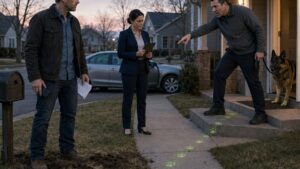
The forklift’s headlights swept across Raymond Davis’s front door before sunrise, turning the wet paint into a hard blue glare.
Raymond froze with the lid still in his hand.
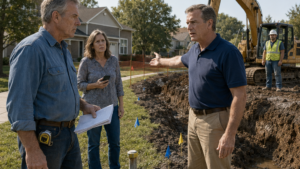
The machine rolled off the main road on a flatbed trailer, its forks raised like blunt metal teeth. A white contractor truck followed it through the neighborhood entrance, then stopped sideways across Raymond’s driveway. Three workers climbed out. The last man to emerge was Jack Wilson.
Raymond set the paint lid on the porch step and looked at the door.
The color was called Harbor Slate. His wife had chosen it from two nearly identical swatches eighteen months before she died. The approved HOA shade was Coastal Slate. Under most light, no one could tell the difference.
Jack apparently could.
He crossed the road carrying a clipboard beneath one arm. His boots landed beside the line of fresh white marking paint Raymond had sprayed along the edge of his parcel the previous evening.
“You received notice,” Jack said.
“I received a hearing date.”
“You failed to attend.”
“The hearing is next Tuesday.”
Jack smiled without warmth. “That was the appeal hearing. Corrective authority has already been granted.”
Raymond glanced toward the trailer. The forklift operator was releasing chains.
“For a door?”
“For repeated noncompliance.” Jack flipped the top page toward him. “Unapproved exterior color. Unregistered landscaping. Obstruction of corrective access.”
Raymond read the words without taking the document.
Behind Jack, a worker approached the hydrangeas lining the front walk. Their heavy blossoms bent under the last of the night’s moisture, blue and violet against the dark soil.
“What does corrective access have to do with a forklift?” Raymond asked.
Jack looked up at the solar panels mounted over the side-yard structure. Raymond had built the supports himself from galvanized steel, keeping the array low enough that it could not be seen from most of the street.
“You installed equipment without final aesthetic certification.”
“The county approved it.”
“The county doesn’t manage neighborhood presentation.”
“The HOA doesn’t manage my parcel.”
That made Jack’s smile sharpen.
He stepped closer. “You’ve been saying that for six weeks, but you still haven’t produced a complete exemption.”
Raymond looked down at the boundary line between them. The white paint was bright near the driveway and faded where it curved toward the hydrangeas. Beneath it lay the survey his grandfather had walked with county officials before most of the neighborhood existed.
“No one from your crew crosses this line,” Raymond said.
Jack lowered his eyes to the paint, then deliberately placed the toe of one boot across it.
“This line?”
Raymond did not move.
Across the street, a front door opened. Kimberly Roberts came out in a robe with a phone in her hand. She had lived there nearly twelve years. Once, she had brought cuttings to Raymond’s wife and spent entire afternoons discussing soil acidity on the porch.
Since the funeral, she had mostly waved from a distance.
“Jack,” she called, “what are you doing with that machine?”
“Scheduled corrective work.”
“At six in the morning?”
“We start early to reduce disruption.”
The metal ramps dropped from the trailer with two enormous bangs. Porch lights blinked on along the street.
Kimberly crossed halfway, stopping at the curb. “You told the board you were only inspecting.”
Jack turned. “This does not concern you.”
“You made it concern everyone yesterday.”
His face tightened.
Raymond looked at her. “What did he say?”
Kimberly hesitated, then raised her phone as if the device gave her permission to finish.
“He said your house was going to be the last exception anyone asked for.”
The forklift engine started. Its diesel rumble rolled through the ground and into Raymond’s shoes.
Jack turned back to him. “You see the problem? Every resident thinks their circumstance is special. A childhood tree. A sentimental mailbox. A paint color picked by a dead relative. Standards stop meaning anything if personal stories replace them.”
Raymond heard the words, but his attention had shifted to the worker beside the hydrangeas.
The man had put on gloves.
“Step away from those plants,” Raymond said.
The worker looked at Jack.
“They aren’t on the elite flora registry,” Jack said. “They’ll be removed by the roots.”
Raymond walked down from the porch.
He was not a large man, though age had not taken the width from his shoulders. Decades maintaining municipal pumps had left his hands thick and scarred. He stopped at the painted line, positioning himself between the crew and the first hydrangea.
“My wife planted these.”
Jack exhaled. “There it is.”
“There what is?”
“The story that makes the rules disappear.”
Raymond looked at him for a long moment. “No. The reason you don’t touch them.”
One of the workers shifted uneasily. The forklift backed down the trailer ramps, its warning alarm cutting through the engine noise. The machine settled onto the road and turned toward Raymond’s driveway.
Raymond kept his eyes on Jack.
“You have inspection access by appointment,” he said. “Nothing more.”
Jack removed a folded packet from his clipboard and opened it to the final page. Sandra King’s signature appeared above the HOA seal.
“Corrective-work authorization,” he said. “Signed yesterday afternoon.”
Raymond read the heading. The smaller print disappeared beneath Jack’s thumb.
“I want a copy.”
“You were mailed one.”
“I want the one you’re using.”
“You can request it from the board.”
Raymond looked past him. The forklift was turning now, its forks leveling toward the property. One worker carried a shovel. Another pulled heavy straps from the truck.
Something cold and precise settled inside Raymond.
For weeks, he had treated the notices as paper noise. He had sent one copied deed page to the board and refused every follow-up call. He had assumed the words permanent exemption would be enough once someone bothered to look.
He had not expected machinery.
Kimberly moved closer to the curb. “Raymond, I’m recording.”
Jack laughed once. “Record all of it. Record a contractor carrying out a lawful order while a resident obstructs access.”
The worker with the shovel reached toward the nearest hydrangea.
Raymond stepped over the line onto his own grass and placed one hand around the wooden handle.
The worker released it immediately.
“Mr. Davis,” Jack said, “do not interfere with my crew.”
“Your crew is standing outside my property.”
“Not for long.”
Raymond turned toward the side yard. Beyond the solar supports, the equipment shed sat beneath a low roof. Inside it were old valves, pressure gauges, buried-line maps, and a red emergency control he had not touched in years.
He looked back at Jack.
“You cross that line,” Raymond said, “and you own what happens next.”
Jack made a small circling gesture with two fingers.
The operator lowered the forklift’s steel forks until they pointed directly toward the solar supports.
“Unload it,” Jack ordered. “Then bring it in.”
Chapter 2: The Rule That Needed an Example
The worker’s gloved hand closed around the trunk of the first hydrangea.
Raymond caught his wrist before he could pull.
“That plant went into the ground twenty-two years ago,” Raymond said. “Take your hand off it.”
The worker looked from Raymond to Jack, then slowly released the branch. A cluster of blue petals trembled between them.
Jack strode across the road. “You touch one of my employees again, and I’ll call the police.”
“He was on my property.”
“He was executing an authorized removal.”
“You keep using that word as though it changes the boundary.”
Jack stepped across the white line again, this time with both feet. He spread his arms toward the houses where curtains had begun to move.
“This is exactly why enforcement has to be visible,” he said. “One resident refuses a hearing, ignores notices, paints whatever color he likes, plants whatever he likes, then declares himself outside the system. Ten others watch and decide rules are optional.”
Kimberly lifted her phone higher.
Jack saw it and stepped backward across the line.
The movement was small, almost instinctive, but Raymond noticed.
“So you know where it is,” Raymond said.
Jack ignored him. “Show me the exemption.”
“I sent it.”
“You sent half a copied page without the operative clause.”
“It identifies the parcel.”
“It identifies an old transfer.”
“It identifies the land my family donated.”
“Donation does not mean exemption.”
Raymond felt irritation press against the restraint he had been using as armor. The complete papers existed somewhere. He knew that. His wife had handled the last requests from the county after the HOA began questioning the parcel. After her death, he had found one deed copy in the hall cabinet and mailed the page that seemed sufficient.
He had not opened the labeled files beneath it.
Jack mistook his silence for defeat.
“Exactly,” he said. “You don’t have it.”
The forklift idled in the street. Its operator kept one hand on the wheel and stared toward the house. The other two workers stood beside the hydrangeas without moving.
Jack pointed at the man holding the shovel.
“Start with the first three plants.”
The worker shook his head.
“What?”
“I want the order clarified.”
“You heard the order.”
“I heard him say the property’s exempt.”
“And I told you it isn’t.”
The worker glanced at Kimberly’s phone. “Then you pull them.”
Jack’s jaw tightened. “I’m paying you to do a job.”
“You’re paying me to install and remove landscaping. Not settle a deed fight.”
For the first time that morning, Raymond saw uncertainty enter the crew. It was not loyalty to him. It was self-protection. That was enough.
A sedan came through the neighborhood entrance faster than the posted limit and stopped behind Jack’s truck. Sandra King climbed out carrying a leather binder against her chest.
She wore office clothes and flat shoes unsuited to the damp roadside. When she saw the forklift pointed toward the driveway, she stopped.
“Why is that off the trailer?” she asked.
Jack met her beside the truck. “Corrective access.”
“I authorized inspection and removal of noncompliant plantings.”
“The panels obstruct equipment movement.”
Sandra looked at the solar structure. “You said the crew could work by hand.”
“The resident is interfering.”
“I am standing on my land,” Raymond said.
Sandra turned toward him. “Mr. Davis, you were given several opportunities to resolve this.”
“You were given several opportunities to verify the deed.”
“The page you submitted did not contain an exemption.”
“Then you should have waited for the county.”
“You should have attended the hearing.”
The words struck because they were true.
Raymond had received three notices. He had opened each, read the first lines, and laid it facedown beneath a ceramic bowl his wife used to keep by the door. He had told himself he would not sit in a room while strangers debated whether her flowers were acceptable.
His absence had left the room to them.
Kimberly lowered her phone slightly. “Sandra, does that authorization say they can damage his solar system?”
Sandra’s grip tightened on the binder.
“No,” she said. “It does not.”
Jack turned on her. “No one said damage.”
“You aimed a forklift at it.”
“I aimed the forklift at the access route.”
“There is no access route through a support frame.”
Jack leaned close enough that only those nearest could hear, but the street had grown quiet.
“My renewal review is Friday,” he said. “The board asked why compliance numbers dropped. This is why. Every time someone resists, you make me wait for another letter, another meeting, another excuse.”
Sandra’s expression changed. Not sympathy, exactly. Recognition.
“This is not your renewal demonstration,” she said.
“It became one when he ignored the order.”
Raymond watched the exchange. The machine, the early hour, the speed of the escalation—suddenly they fit together. Jack had not come merely to correct a door or pull flowers. He had chosen the house at the entrance because everyone would see it.
Raymond was not the problem.
He was the example.
Jack stepped away from Sandra and addressed the crew. “The plants come out. The support section comes down only as required for access.”
Sandra caught his arm. “That is not authorized.”
He pulled free. “Then amend the paperwork.”
“I’m telling you to pause.”
“And I’m telling you the equipment is here, the crew is clocked in, and he has already obstructed us.”
Raymond took out his phone.
Jack noticed. “Calling your lawyer?”
“The county.”
He found the number Dennis Anderson had left in a voicemail two days earlier. Raymond had not returned it. At the time, the message had sounded procedural: conflicting records, archive review, allow several business days.
Now the forklift engine shook the windows.
Dennis answered on the fourth ring.
“Property records.”
“This is Raymond Davis. Parcel at the old east entrance.”
There was a pause, followed by keyboard clicks.
“Mr. Davis. I was waiting for your return call.”
“The HOA has a forklift outside my property.”
Another pause, shorter this time.
“What kind of work?”
“They intend to remove landscaping and strike a solar support if it blocks them.”
“Do not permit alteration while the record is under review.”
“I’m not permitting it.”
Raymond turned on speaker.
Dennis’s voice became audible over the idling engine. “No party should alter the disputed parcel until jurisdiction is confirmed.”
Jack folded his arms. “The county does not govern private association enforcement.”
Dennis heard him. “Who is speaking?”
“Jack Wilson, authorized HOA contractor.”
“Mr. Wilson, I am advising that the archive review is incomplete.”
“Advising isn’t ordering.”
“No,” Dennis said carefully. “But proceeding may expose whoever authorizes the work.”
Jack looked at Sandra.
She said nothing.
Raymond asked, “You said the records conflict. How?”
Dennis hesitated.
“The county archive contains two versions of the founding deed,” he said. “One matches the page you submitted. The other includes additional attachments.”
“What attachments?”
“That is what I am trying to determine. The index is incomplete.”
Raymond looked toward his front door.
Behind it, in the hall cabinet, sat the files he had refused to open.
Dennis continued. “Mr. Davis, where did you obtain your copy?”
“My wife kept it.”
“Was it a complete recorded set?”
Raymond could not answer.
Jack’s smile returned, quieter now. “You don’t know.”
Raymond ended the call only after Dennis repeated that no one should alter the site.
He slipped the phone into his pocket.
Jack pointed toward the house. “Find your paperwork. You have twenty minutes.”
Raymond looked at the forklift, then at the incomplete boundary line beneath its shadow.
Two versions of the deed existed.
And he had sent the one that proved less.
Chapter 3: The File He Would Not Open
“You have nineteen minutes,” Jack called as Raymond reached the porch.
The forklift engine revved behind him.
Raymond entered the house and shut the Harbor Slate door hard enough to rattle the frame. The fresh paint smell filled the narrow hall. Beneath it lingered the faint mineral scent of damp soil from the boots he had left on the mat.
Kimberly slipped inside before the latch caught.
“I’m not leaving you alone in here while he counts down.”
“I didn’t invite you.”
“I know.”
The answer stopped him more effectively than an apology would have.
Raymond crossed to the hall cabinet. On top sat the ceramic bowl his wife had used for keys. Three HOA notices lay beneath it, their corners aligned. He moved the bowl aside and opened the lower door.
Folders filled the shelf.
Utility records. Solar permits. Irrigation maps. County correspondence.
At the back stood a gray file box with his wife’s handwriting across the lid.
HOUSE — FINAL RECORDS.
Raymond stared at it.
Kimberly remained near the door. Outside, Jack’s voice carried through the wood as he directed the crew to clear the trailer chains from the road.
“You knew she kept something?” Kimberly asked.
“I knew she kept everything.”
“That isn’t what I asked.”
Raymond crouched and pulled the box forward. Dust marked the place where it had rested untouched for nearly two years.
His wife had assembled the file during the months when illness had reduced her world from the yard to the porch, then from the porch to the front room. She had still noticed every bloom. Still corrected Raymond when he overwatered the western bed. Still compared paint swatches against the morning light.
He had promised to deal with the records after she was gone.
Instead, he had closed the cabinet.
A horn sounded outside.
“Seventeen minutes,” Jack shouted.
Raymond lifted the lid.
The first folder contained tax bills. The second held photographs of repairs. Under them lay an envelope with a county seal, still unopened.
Across the front, his wife had written:
FOR THE BOUNDARY, WHEN THEY PUSH.
Kimberly inhaled sharply.
“She expected this,” she said.
“She expected paperwork.”
“She wrote when, not if.”
Raymond slid one finger beneath the seal but stopped.
The envelope felt heavier than paper should.
Kimberly came closer. “Raymond.”
“You used to sit with her out there.”
“Yes.”
“Then you stopped coming.”
Kimberly looked toward the window. “After the funeral, every time I crossed the street, you found something to repair.”
“There was plenty to repair.”
“You made sure of it.”
The accusation was soft, and because it was soft, it landed.
Raymond tore open the envelope.
Inside were three pages of correspondence with the county recorder, a photocopied index sheet, and a handwritten reference number. No certified deed. No exemption clause.
His disappointment came as anger.
“This proves nothing.”
Kimberly took the index page. “It proves she requested something.”
“It proves the county sent another incomplete response.”
A photograph slipped from between the papers and landed faceup on the floor.
Raymond bent to retrieve it.
His wife knelt beside a newly planted hydrangea, younger by more than twenty years, her hair tied back with a blue cloth. One hand rested on the small wooden survey stake at the edge of the bed. Behind her, the front door wore its original plain white paint.
On the back she had written a date and three words:
Start at the line.
Kimberly looked over his shoulder. “That was the first one?”
Raymond nodded.
“She planted it beside the survey marker on purpose?”
“She said people respected flowers more than stakes.”
Outside, metal scraped against pavement.
“Fifteen minutes,” Jack called.
Raymond opened another folder. Paint cards slid out. One had Harbor Slate circled in blue ink. Beside it, his wife had written:
Enough gray to belong. Enough blue to be ours.
Raymond sat back on his heels.
The color had not been chosen in her final weeks, as he had told himself. The date showed she had selected it months earlier, while still planning repairs she knew she might not live to see.
Kimberly touched the edge of the card. “She showed me this.”
Raymond looked up.
“She said the board kept making the neighborhood flatter. Same doors. Same shrubs. Same mailboxes.” Kimberly swallowed. “She said a place could be orderly without erasing everyone who lived there.”
“She never told me that.”
“She probably tried.”
Raymond’s first impulse was to reject it. Then he remembered evenings when she had begun talking about board records, historical covenants, neighbors who had paid fines without appealing. He had changed the subject to medication schedules or pump pressure or dinner.
Practical things.
Things he could fix.
A fist struck the front door.
“Ten minutes,” Jack shouted. “Then corrective access begins.”
Raymond stood so quickly the file box shifted.
Kimberly stepped between him and the door. “Why didn’t you go to the hearing?”
“Because they had no authority.”
“That isn’t why.”
He looked at the blue-gray paint visible around the doorframe.
“No,” he said. “It isn’t.”
The admission seemed to alter the room.
“I wasn’t going to sit there while they called her choices violations,” he said. “I wasn’t going to explain what every plant meant to people who had already decided it meant nothing.”
“So you let them hear only Jack.”
Raymond’s jaw tightened.
Kimberly did not retreat. “You thought silence protected this house. It gave him the empty chair.”
Outside, the forklift horn sounded again.
Raymond returned to the box.
Beneath the paint cards lay a thin maintenance notebook. Most pages contained his own old handwriting—valve numbers, pipe depths, seasonal pressure readings. Near the back, his wife had added several notes in blue ink.
He turned one page, then another.
A folded sheet fell into his palm.
EMERGENCY SYSTEM — WEST LINE.
Below it, she had copied the same county reference number from the envelope. A hand-drawn arrow pointed toward the equipment shed.
Raymond read the final line twice.
Kimberly watched his face. “What is it?”
He handed her the page.
At the bottom, beneath a list of valves and inspection dates, his wife had written:
The records are not all in the house. Check the emergency-system cabinet.
Then, on the next line:
Do not let them decide where our home ends.
Chapter 4: Water Beneath the Property Line
The red control was still behind the emergency cabinet door.
Raymond found it beneath a yellowed maintenance sheet fastened with two strips of clear tape. His wife’s handwriting filled the margins—dates, pressure readings, reminders to inspect the western nozzles before fire season. At the bottom, beside a small blue check mark, she had written: Tested after county letter. Full line holds.
Outside the equipment shed, the forklift engine rose and fell.
Kimberly stood in the doorway with her phone aimed toward the road. “Jack’s moving it closer.”
Raymond folded the handwritten note into his shirt pocket. The cabinet smelled of steel, dust, and old pipe lubricant. Behind the red lever sat a row of zone switches he had installed when the neighborhood’s eastern field had burned fifteen years earlier.
The system had never been intended to stop machinery.
Its buried main followed the property boundary because that was the clearest route from the municipal connection to the storage tank behind the house. Six high-capacity sprinkler heads covered the roof, solar supports, hydrangeas, and western grass strip. At full pressure, they could soak the ground faster than ordinary lawn irrigation.
Raymond opened the lower panel.
The gauge needle rested at zero.
“Of course,” he muttered.
“What?”
“The reserve line was drained.”
“Can you restore it?”
He looked at the manifold. “If the seals held.”
A metallic knock sounded from the driveway. Jack’s voice followed.
“Five minutes, Raymond.”
Kimberly stepped outside. “He’s retrieving records.”
“He had six weeks.”
“He has a county reference number you didn’t bother to request.”
Raymond heard Jack answer, but not the words. He was already kneeling before the manifold.
He opened the storage-tank valve by a quarter turn. The line groaned. Somewhere beneath the yard, trapped air moved through pipes like stones rolling inside a wall.
The gauge climbed to ten pounds, shivered, then stopped.
Raymond closed the valve.
A leak would turn the shed into a useless flood and leave the outer zones dry. He ran his fingers along the brass fittings until he found moisture beneath the third coupling.
Kimberly returned. “Sandra is telling him to wait.”
“Is he listening?”
“No.”
Raymond took a wrench from the cabinet and tightened the coupling one careful fraction. The old gasket compressed. He opened the valve again.
Ten pounds.
Twenty.
Thirty-five.
The pipe beneath his palm trembled but held.
Through the shed window, he saw the forklift turning until its front wheels faced his driveway. Its forks had been lowered to the height of the lowest solar brace.
Jack stood beside Sandra near the contractor truck. Their voices carried between bursts of diesel noise.
“You’re done,” Sandra said. “I am withdrawing authorization for anything involving the solar array.”
Jack leaned close to her. “You don’t get to send me here with a crew and machine, then act surprised when I use them.”
“I authorized plant removal after inspection.”
“He blocked inspection.”
“Then document it and leave.”
“My renewal is in four days.”
“That has nothing to do with this parcel.”
“It has everything to do with it.” Jack pointed toward the watching houses. “My compliance numbers are down because every time someone objects, the board delays until they get tired of arguing. The company financed that machine because you promised steady work.”
“I promised a contract review.”
“If I lose this account, I lose the crew. Maybe the company.”
For one brief moment, Jack did not sound powerful. He sounded cornered.
Sandra lowered her voice. “Then do not make it worse.”
Jack looked toward Raymond’s house. “He is making it worse.”
“No,” Sandra said. “He is refusing you.”
The distinction seemed to anger him more than an accusation.
Raymond turned back to the gauge. Fifty pounds.
Enough to test one head.
He selected the rear roof zone, where no one stood, and pressed the switch.
A pipe hammered beneath the ground. Then a sprinkler rose behind the solar structure and fired a hard white fan into the air.
Several neighbors cried out. Jack spun toward the shed.
Raymond released the switch after two seconds.
Water glittered across the solar panels and fell in a brief silver curtain. The pump settled into a steady hum.
Kimberly stared. “You built that?”
“For fire.”
“It covers the whole yard?”
“Almost.”
Her eyes moved to the western strip where the white boundary paint ran beside the driveway.
Raymond saw the same possibility forming in her mind and shook his head.
“Don’t.”
“I didn’t say anything.”
“You didn’t have to.”
He checked the zone map taped inside the cabinet. The western line had three heads. One faced the hydrangeas. One covered the side structure. The third was angled low across the grass strip nearest the entrance.
At full flow, the clay-heavy soil there would soften quickly. Perhaps too quickly.
He had spent his working life understanding what pressurized water could do when directed into earth. It could save a hillside. It could lift pavement, break a retaining wall, hollow the ground beneath a truck.
A forklift moving across saturated soil could slide sideways. An operator could be thrown. A worker could be crushed between the machine and the support frame.
This was not a lever to pull in anger.
Raymond reset the test zone and increased tank pressure gradually.
Outside, Sandra raised her voice. “Jack, I am formally telling you that the HOA does not authorize contact with the solar equipment.”
Jack removed his phone and tapped the screen. “And I’m documenting that the association changed instructions after mobilization.”
“Document whatever you like. The machine stays off his property.”
Jack turned toward the forklift operator. “Bring it to the line.”
The machine moved.
Its front tires rolled from the street onto the edge of Raymond’s driveway, stopping just before the white paint. The operator’s shoulders were rigid behind the safety frame.
Raymond left the shed.
Kimberly followed, still recording.
The sprinkler test had left droplets across the panels and darkened one patch of soil. Jack watched Raymond approach with the red control unit in his hand.
“What is that?” Jack asked.
“Fire system.”
“You planning to wash us away?”
“I’m giving you a last chance to leave.”
Jack glanced at the wet roof, then at the buried sprinkler heads. “You think a lawn system scares me?”
Raymond looked past him to the operator. “If he crosses that line, the ground may not carry the machine.”
The operator leaned out. “Jack?”
Jack did not turn.
Raymond continued, “The county told you not to alter the parcel. Sandra withdrew authorization. You know the boundary. Take your people home.”
For a second, Jack’s face showed the fear Raymond had heard behind the shed: payroll, debt, a machine bought against promised work, a contract slipping away while neighbors watched.
Raymond understood it.
Then Jack chose what to do with it.
“You had every chance to comply,” he said. “I have obligations too.”
“Your obligations stop at that line.”
Jack climbed onto the forklift’s side step and gripped the overhead frame.
Sandra moved after him. “Jack, do not do this.”
He pointed over the operator’s shoulder toward the lowest steel brace.
“Cross the line,” he ordered. “Take the support first.”
Chapter 5: When the Ground Refused Them
The forklift’s steel forks lowered toward the solar support as Raymond closed his hand around the red control.
The operator looked over his shoulder. “He said the ground won’t hold.”
Jack remained on the side step, one arm locked around the frame. “He is bluffing. Move.”
The machine edged forward.
Its front tires touched the white property line and flattened the grass beneath it. The forks extended like a pair of dull spears, level with the horizontal brace Raymond had welded fifteen years earlier.
Kimberly stood near the curb, phone raised.
Sandra had backed toward the contractor truck. “This is no longer authorized,” she called. “Everyone can hear me. Stop the machine.”
Jack slapped the forklift frame. “Forward.”
Raymond lifted the control.
He could activate all three western heads at once. Full pressure would soak the strip in less than a minute, but the first blast might knock a nearby worker off balance. Two crew members still stood beside the hydrangeas, and a third had moved between the driveway and the solar structure.
“Clear the yard,” Raymond shouted.
The worker with the shovel retreated immediately. The second followed.
The third bent to drag a loose strap from the machine’s path.
Raymond’s thumb hovered above the zone switch.
The front tires crossed the paint.
White marking powder smeared beneath the tread and vanished into black rubber grooves. The forklift tilted slightly where the driveway edge met the soil.
The worker holding the strap stepped backward, caught his heel in a shallow irrigation depression, and fell near the western sprinkler head.
Raymond pulled his thumb away.
“Stop!” he shouted.
The operator braked.
Jack looked down at the fallen worker, then toward Raymond. “You wanted it stopped. It’s stopped. Now get out of the way.”
The worker pushed himself onto one knee, directly inside the spray path.
Raymond pointed. “Get him clear.”
“You don’t direct my crew.”
“I do when you put them in danger.”
The worker rose, rubbing his ankle. Kimberly hurried forward but stopped at the boundary.
“Can you walk?” she asked.
He nodded and limped toward the street.
Jack watched him go with visible impatience. “You’re fine. Stand by the truck.”
That was when Raymond understood there would be no moment when Jack became reasonable. Pressure had not made him cautious. It had narrowed his view until the machine, the contract, and the watching street were the only things he could see.
Raymond selected the hydrangea zone.
One sprinkler head snapped upright beside the walkway and released a narrow, forceful burst. Water struck the ground in front of the remaining crew and swept across their boots.
They jumped back.
Raymond released the switch before the stream reached the forklift.
The flowers shook beneath the spray, petals flashing blue and violet. Water ran around the old survey stake hidden below their leaves.
Jack laughed from the machine. “That’s your defense?”
“It was a warning.”
“To whom?”
“To everyone still standing where they shouldn’t.”
The workers moved fully into the road.
Only Jack and the operator remained on the forklift.
Raymond shifted the control to the western line but did not activate it.
Jack leaned close to the operator. Raymond could not hear the first words. Then Jack spoke louder, perhaps because he wanted Sandra and the neighbors to hear his explanation before the damage occurred.
“Hit the lower frame first. Once it bends, we classify the section as an access obstruction. Then we remove what’s unsafe.”
Sandra stared at him. “You just admitted you intend to create the hazard.”
Jack’s head snapped toward her.
Kimberly’s phone remained pointed at him.
For the first time, the operator took his hands off the controls. “I’m not hitting a structure with him standing there.”
Raymond stood ten feet from the brace.
Jack climbed down from the side step and opened the cab gate.
“Move over.”
“You aren’t certified on this model.”
“I own it.”
“That isn’t the same thing.”
Jack reached inside and pointed toward the road. “Get out.”
The operator hesitated, then climbed down.
Jack took the seat.
The transfer changed the scene. Until then, responsibility had been spread across documents, board signatures, crew instructions, and claims of procedure. Now Jack’s hands settled directly on the steering wheel.
Raymond held up the control where he could see it.
“My family donated this land,” he said.
Jack started forward.
“The deed carries a permanent exemption from HOA control.”
The forklift rolled another foot.
“My wife found the full record before she died.”
Another foot.
“She marked this boundary because she knew someone like you would decide uncertainty belonged to whoever brought the largest machine.”
Neighbors had come onto porches and sidewalks. Raymond could feel their attention, but for once he did not resent it.
Jack shouted over the engine, “Then you should have brought the deed to the hearing.”
“Yes.”
The admission checked him more than denial would have.
Raymond continued, louder. “I should have opened the file. I should have answered the county. I should have shown the board before you arrived.”
Kimberly lowered the phone a fraction, watching him rather than the machine.
“My silence was a mistake,” Raymond said. “It was not permission.”
Jack pressed the accelerator.
The forklift surged.
Raymond activated the first western head.
A concentrated jet struck the soil behind the workers, driving them farther into the road. He released it, counted the distance, and switched to the low boundary nozzle.
Water burst horizontally across the grass.
The stream hit the front tires and exploded into mist. Jack flinched but kept moving. The tire treads churned the wet surface, folding white paint into dark soil.
Raymond watched the machine’s weight transfer.
The western strip had a buried drainage trench beneath it, backfilled decades earlier with looser soil than the surrounding clay. His wife’s note had led him to the cabinet because the emergency line followed that trench. Once saturated, it would reveal the true weakness beneath the visible boundary.
But only if he held pressure long enough.
The forklift advanced within six feet of the brace.
A steel fork scraped the bottom edge, producing a shriek that sent birds out of the trees.
Sandra shouted for Jack to stop.
He did not.
Raymond looked once at the road. The workers were clear. Kimberly stood behind the curb. The operator had moved beside the truck. No one remained in the collapse zone.
He pushed the master control down.
All three western sprinklers erupted.
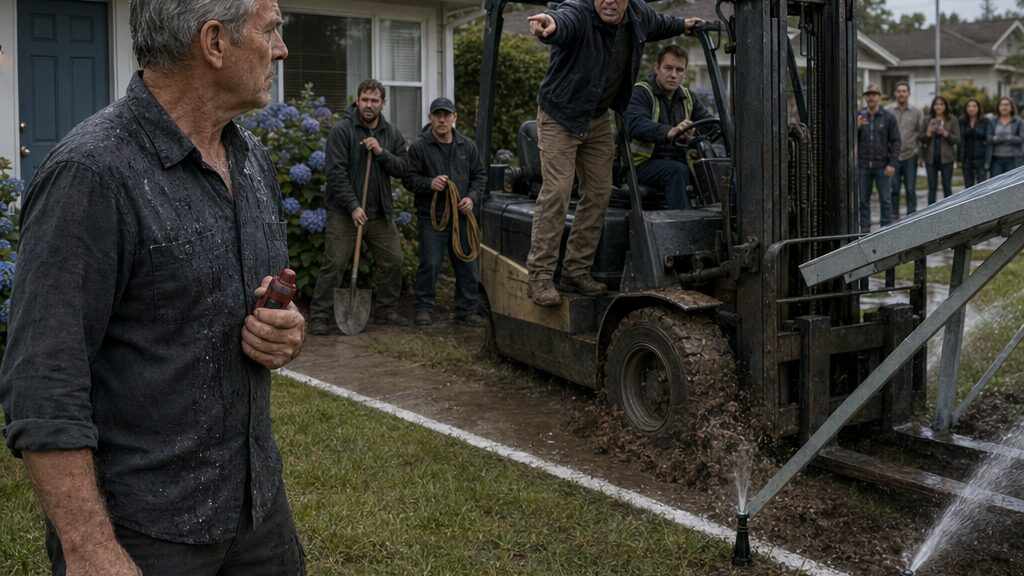
Water struck the forklift from both sides, hammered the solar panels, and swept through the hydrangeas. The engine roared beneath the impact. Jack hunched over the wheel and accelerated.
The tires spun.
At first they threw only water. Then the tread began lifting strips of grass. Brown slurry sprayed across the side panels.
The machine moved forward another six inches.
Raymond held the control.
The ground beneath the left front tire sagged.
Jack twisted the wheel. The tire dropped to its rim, then climbed halfway out before the loosened soil folded beneath it. The opposite tire spun faster, smearing the boundary line into a broad pale scar.
The buried trench filled.
Mud rose around the axle.
Jack pushed the accelerator until the engine screamed. The rear wheels dug in, throwing heavy clumps against the contractor truck and Sandra’s trousers.
The forklift lurched toward the brace.
Raymond did not release the control.
For one suspended second, the nearest fork stopped less than a hand’s width from the galvanized steel.
Then the front end sank.
The axle settled deep into the mud. Both front wheels spun helplessly, carving pits that filled instantly with water. The machine listed toward the driveway but could go no farther.
Jack released the accelerator.
The sudden absence of engine strain left only the sprinklers, hard and rhythmic, beating water across metal, flowers, and earth.
Raymond shut down the outer heads one by one.
The hydrangea blossoms lifted slowly as the pressure eased. Mud streamed from the forklift’s tires. Beneath the churned soil, the top of the old wooden survey stake appeared beside the erased white line.
Jack sat motionless behind the wheel.
Raymond stepped between the trapped machine and the solar support.
Water ran from his sleeves and down his hands.
He looked at the fork stopped inches from the steel.
Then at Jack.
“You crossed it,” Raymond said.
Chapter 6: The Deed Proved Less Than Expected
Jack photographed the trapped forklift before he climbed out of it.
He took pictures of the buried wheels, the muddy driveway, the sprinkler heads, and Raymond holding the red control. Then he turned the phone toward Raymond.
“You destroyed a commercial machine,” he said. “You’re paying for the extraction, repairs, lost time—everything.”
Raymond slipped the control into his pocket. “You drove it onto wet ground after you were warned.”
“You deliberately flooded the soil.”
“To stop you from striking my property.”
“That is sabotage.”
Jack called the police while standing ankle-deep in the mud he had made the forklift enter. He described an attack on contracted equipment, an unstable homeowner, and a dangerous improvised trap.
Kimberly kept recording.
Sandra moved onto Raymond’s porch to protect her binder from the remaining spray. Mud marked one side of her trousers. She looked at the forklift, then at the signed authorization inside her hands.
“Jack,” she said, “do not represent this as HOA-approved demolition.”
He turned away from the phone. “You signed the order.”
“I signed an inspection and plant-removal authorization.”
“You knew equipment was coming.”
“I did not authorize forced entry or contact with the array.”
“You’re changing your story because it went wrong.”
Sandra’s face tightened. “No. I am reading what I signed.”
A county vehicle arrived before the police.
Dennis Anderson stepped out carrying a document case and wearing the expression of a man who had expected a property dispute, not a forklift buried to its axle in a front yard.
He stopped at the curb.
“No one touches anything,” he said.
Jack pointed at Raymond. “He already touched everything.”
Dennis looked from the sprinklers to the exposed survey stake. “Who operated the machine?”
Jack did not answer immediately.
Kimberly did. “He did.”
Dennis took out a camera and began photographing the yard.
Raymond led him to the porch, where the papers from the gray file box had been placed beneath a dry towel. Dennis compared the handwritten county reference number to the documents in his case.
“I found the second deed image,” he said. “And the attachment index.”
Raymond waited.
Dennis removed a certified copy and laid it on the porch table. The pages were old enough that the scanned type feathered at the edges. Near the end, beneath a legal description of the donated acreage, an attached covenant identified Raymond’s retained parcel.
Dennis placed one finger under the relevant sentence.
“The parcel is permanently exempt from covenants, assessments, design controls, and enforcement powers exercised by any successor homeowners’ association.”
Sandra sat down slowly.
Jack gave a dismissive shake of his head. “That does not excuse damaging my machine.”
“No,” Dennis said. “It establishes that the HOA had no enforcement jurisdiction over this parcel.”
A neighbor near the curb murmured, “Then all the fines are invalid.”
Dennis looked up. “Only for this parcel.”
The street quieted.
He continued, “This exemption does not dissolve the association, cancel other owners’ covenants, or automatically reverse prior enforcement elsewhere.”
Kimberly lowered her phone. “So Raymond is protected, but everyone else is still trapped?”
“I did not say trapped. I said this clause applies to his retained property.”
The victory narrowed before it had time to become celebration.
Raymond looked at the certified page. His wife had been right. The words existed. They protected the house, the door, the solar supports, and every hydrangea.
They did not protect the woman two houses down who had removed a wheelchair ramp after a fine. They did not return money paid by residents too tired to appeal. They did not erase the fear Jack had used as part of his business.
Dennis walked into the yard, testing the ground with each step. Near the forklift, water had washed away enough mud to reveal the old survey stake.
He crouched and compared its position to the county map.
“The front axle is approximately three feet inside the retained parcel,” he said.
Jack folded his arms. “Because he lured the machine in.”
Raymond’s temper flashed. “I stood in front of you and told you not to cross.”
“You activated a system designed to sink equipment.”
“It was designed for wildfire protection.”
“You knew what it would do.”
Dennis stood. “That question matters.”
Raymond looked at him.
“If you knowingly created an uncontrolled hazard,” Dennis continued, “the exemption does not remove potential liability.”
Jack smiled for the first time since climbing from the machine.
Kimberly stepped off the curb. “Then watch the recording.”
She brought her phone to Dennis and played the final minutes.
Jack’s voice came first: Hit the lower frame. Once it bends, we classify the section as an access obstruction.
Then Raymond’s warning.
Then the worker falling, Raymond delaying, and the narrow burst that drove the crew backward. The video showed the operator leaving the machine and Jack taking the seat. It showed Sandra withdrawing authorization. It showed Raymond waiting until every worker stood beyond the danger area.
Dennis watched twice.
When the clip ended, he handed the phone back.
“You preserved the full file?” he asked.
“It’s uploading to three places.”
Jack stared at her. “My company will pursue you for distributing edited material.”
“It isn’t edited.”
“You recorded employees without consent.”
“In the street?”
His threat sounded weaker than the engine had, but Kimberly’s face still paled. She gripped the phone with both hands.
Raymond saw the fear she had carried across the road. She had not lost it. She had acted while afraid.
Sandra opened her binder.
“There’s something else,” she said.
Jack turned. “Don’t.”
She removed the signed authorization and a copy of his service contract.
“The contract allows exterior inspection from common areas and corrective landscaping work after written access is obtained. Forced entry requires separate board approval.”
“You gave verbal approval.”
“No.”
“You told me to resolve the parcel before Friday.”
“I told you to document noncompliance before Friday.”
Jack stepped toward her.
Raymond moved between them.
Jack stopped, not because Raymond touched him, but because every phone on the street had risen.
Sandra’s voice shook once, then steadied. “I should not have signed the plant-removal order before jurisdiction was confirmed. That was my failure. But I did not authorize you to cross the boundary or damage the structure.”
Dennis took copies of both documents.
A police vehicle arrived and parked behind the county car. The officer approached slowly, surveying the mud and gathered residents.
Before anyone could begin another account, Sandra leaned toward Raymond.
“The board can settle this,” she said quietly. “Extraction, yard restoration, written withdrawal of every notice. We keep it contained, and no one spends months paying attorneys.”
Raymond looked at her binder.
“Contained where?”
“Between the affected parties.”
“So the next resident still believes Jack can bring a machine if they miss a hearing?”
“That is not what I mean.”
“It is what secrecy would do.”
Sandra glanced toward the neighbors. “Public accusations will damage the entire association.”
Raymond placed the certified deed beneath his palm.
“My silence already did enough damage.”
Dennis had returned to his vehicle to retrieve the final archive attachment. He opened it on a portable screen, scrolling through faint recorded pages.
Then he stopped.
“This is not another parcel exemption,” he said.
“What is it?” Kimberly asked.
Dennis enlarged a paragraph and read it twice before answering.
“A continuing covenant attached to the original land donation. It requires any successor association to preserve the founding records and provide residents reasonable access to them.”
Sandra’s gaze dropped to her binder.
Raymond looked at the houses lining the street.
The exemption belonged only to him.
The records did not.
Chapter 7: What His Wife Meant to Leave
Inside the final folder, Raymond found a list of neighbors his wife believed had been pressured into silence.
The names were written in blue ink beneath a heading that read: Ask what happened, not whether they complied.
Beside each entry she had added a few words.
Ramp removed after warning.
Garden cut before appeal.
Fence approved, then fined.
Paid because afraid of lien.
Raymond stood at the porch table while the mud dried in streaks across his trousers. Beyond the steps, the forklift remained buried at the property line. The crew had left. The police had taken statements without making an arrest. Jack had gone to his truck to speak with an insurer, his voice low and urgent behind the closed windows.
Kimberly read over Raymond’s shoulder.
“She talked to all these people?”
“Some of them.”
“My name is here.”
Raymond followed her finger.
Kimberly Roberts — frightened of resale damage; knows more than she says.
Kimberly gave a quiet, embarrassed laugh. “She was right.”
“She usually was after everyone else ran out of excuses.”
At the bottom of the page, his wife had written one final note:
The exemption protects our parcel. The records may protect their right to question.
Raymond looked toward the street. Residents had remained outside even after the immediate danger passed. They stood in pairs near driveways, speaking more openly than he had heard them speak in years.
The neighborhood common room opened at five for an emergency board meeting.
Before Raymond could gather the files, Sandra approached the porch alone.
She held her binder against her chest, but the authority it had carried that morning was gone.
“I can get you access to the board archive tonight,” she said.
“You were required to provide it already.”
“I know that now.”
“You knew records existed.”
“I knew there were old boxes. I did not know the donation covenant required resident access.”
Raymond closed the folder.
Sandra looked toward Kimberly, then back at him. “Some records will expose mistakes made by people who are still on the board.”
“Your mistakes?”
“Yes.”
The answer was immediate.
Raymond waited.
Sandra lowered her voice. “I signed the plant-removal authorization because Jack told us delays were encouraging wider noncompliance. I did not verify the parcel first. I told myself the hearing would correct anything improper later.”
“After the flowers were gone.”
She flinched.
“I can help open the files,” she said. “But if this becomes a public accusation against individual board members, they will lock everything behind attorneys. Give me one day. Do not name my role in authorizing today’s work.”
Kimberly stepped closer. “You want protection in exchange for records residents already have a right to see?”
“I want a chance to keep the board from becoming defensive.”
Raymond studied Sandra’s face. She was frightened, but not only for herself. Years of bad procedure could become lawsuits, special assessments, declining sales—the same fears the HOA had used to justify control.
Still, fear did not erase choice.
“I skipped the hearing,” Raymond said. “I ignored calls. I sent incomplete evidence because I did not want strangers discussing my wife’s home.”
Sandra said nothing.
“My silence helped create the space Jack used this morning. I’ll say that in the meeting.”
Kimberly turned toward him, surprised.
Raymond continued, “You will say what you signed and why. Not because you carry all the blame. Not because you carry none.”
Sandra’s shoulders lowered.
“And the records?” she asked.
“They open tonight.”
A vibration sounded from Kimberly’s phone.
She checked the screen, then showed them an email sent to several residents. Jack’s company logo appeared above a notice warning that unauthorized recordings, online distribution, and interference with contracted equipment could result in litigation and property liens.
Sandra read it twice. “He cannot place liens merely because someone recorded him.”
“Most people won’t know that,” Kimberly said.
“That is the point,” Raymond answered.
At five, the common room filled beyond its chairs. Residents stood along the walls and in the doorway. No one applauded when Raymond entered carrying the gray file box. They moved aside for him, watching the box as if it held both permission and danger.
Sandra placed the board archive cartons on a folding table.
Raymond began with the deed.
He did not dramatize it. He showed the retained parcel, the permanent exemption, and the covenant requiring access to founding records. Then he held up the incomplete page he had mailed weeks earlier.
“This is what I sent,” he said. “It did not prove what I claimed.”
A man near the back asked, “Why not send the rest?”
“Because I had not opened it.”
Raymond looked down at his wife’s handwriting on the folder.
“I thought refusing to explain was the same as refusing to surrender. It wasn’t.”
The room remained still.
He told them about the unopened file, the county correspondence, and the warning beside the emergency controls. He did not describe his wife’s final illness. He showed the paint card instead.
Enough gray to belong. Enough blue to be ours.
Then he unfolded her list.
Kimberly stood beside him as residents recognized their own disputes. One woman described removing a ramp rather than risk a daily fine. Another admitted paying for an approved fence twice because she feared a lien would delay her home sale.
Sandra opened the board records.
She read the authorization she had signed and confirmed that Jack had been told to pause before crossing the boundary. Her voice weakened on the first sentence, then steadied.
By the time she finished, several residents had received the same threat from Jack’s company.
“We preserve every message,” Kimberly said. “No one deletes anything.”
“What happens tomorrow?” someone asked.
Raymond looked at the chalk he had brought from his shed. Earlier, he had redrawn the part of his property line the forklift erased. Now the remaining stick lay on the table beside the files.
“The rules do not disappear tomorrow,” he said. “My exemption does not belong to anyone else. But neither does their right to frighten you out of asking questions.”
Kimberly picked up the Harbor Slate paint card.
She faced the room.
“Anyone willing to be visible,” she said, “put a paint can or a hydrangea beside your front door before sunrise.”
A few residents exchanged uncertain looks.
No hands rose. No promises were spoken.
But when the meeting ended, the paint card was passed from one person to the next until it disappeared into the crowd.
Chapter 8: Twenty Doors Beyond the Line
Raymond opened his front door at sunrise and saw Harbor Slate across the street.
Kimberly’s door had been white the night before. Now it carried the same blue-gray shade his wife had circled years earlier. A small hydrangea sat beside the threshold in a black nursery pot, damp soil clinging to its base.
Farther down the street, another door matched it.
Then another.
Raymond stepped onto the porch.
Twenty houses displayed either the forbidden color, a hydrangea, or both. Some paint jobs were clean. Others showed hurried brush marks around locks and hinges. One resident had painted only a narrow vertical strip down the center of the door, enough to make the choice unmistakable.
No crowd waited for Raymond. No one cheered.
People stood in their own yards, holding coffee, brushes, or watering cans. Separate parcels. Separate lines.
The same refusal.
Kimberly crossed the street carrying the blue paint card.
“I think three stores sold out of this shade last night.”
Raymond took the card. His wife’s handwriting had been smudged slightly at one corner.
“You organized this quickly.”
“I sent one message.”
“Twenty houses is more than one message.”
“People were already ready. They just didn’t want to be first.”
A heavy tow truck entered the neighborhood.
Conversation stopped as it approached Raymond’s house. Behind it came Jack’s contractor truck, moving slowly. Jack parked at the curb and remained inside while the tow crew inspected the sunken forklift.
A board notice had arrived before dawn. His exclusive contract was suspended pending investigation. Previous enforcement actions would be reviewed, though the notice emphasized that existing HOA rules remained in effect unless formally amended.
Jack finally climbed out.
His clothes were clean, but mud still coated the lower half of the forklift. He carried an insurance form and did not look toward the painted doors.
The tow operator pointed at the extraction route. “Owner signs responsibility for ground recovery and any additional property damage.”
Jack signed.
Raymond stood beside the exposed survey stake.
“You knew Sandra withdrew authority,” he said.
Jack kept his eyes on the form. “I heard her.”
“That wasn’t the question.”
Jack capped the pen.
“My contract was ending,” he said. “The board wanted numbers. My crew wanted hours. The machine payments don’t stop because residents argue over paperwork.”
“So you crossed.”
“Yes.”
The word came without apology.
Jack looked at the trapped forklift. “I thought if I finished the job, the board would support the result instead of admitting they lost control.”
“They lost control when they gave it to fear.”
Jack handed the form back to the operator. “You had the one deed that could beat them.”
“And I nearly let it stay in a cabinet.”
For the first time, Jack looked directly at him.
There was no forgiveness between them. Only recognition of two different choices made under pressure.
Jack walked away as the tow crew secured cables to the forklift frame.
Dennis arrived while the first winch line tightened. He carried copies of the founding covenant and a schedule for the emergency review.
He paused when he saw the doors.
“This does not create exemptions,” he said.
Kimberly smiled faintly. “We know.”
“Painting in coordinated protest may still result in notices under the current covenants.”
“We know that too.”
Dennis looked toward Raymond. “The county can verify records and boundaries. It cannot run your association. Reform will require hearings, votes, document requests, and probably legal review.”
Raymond watched the tow cable pull taut.
Yesterday, those words would have sounded like reasons to retreat. Today, they sounded like work.
“I’ll present the donation history,” he said.
Dennis nodded. “The full history?”
Raymond looked at the gray file box visible through his open door.
“The full history.”
The winch began to turn.
Mud released the forklift reluctantly. Its front axle rose inch by inch, water draining from the pits the tires had carved. The nearest fork cleared the solar support without touching it.
After the machine was hauled onto solid pavement, Raymond carried a shovel to the damaged strip. Kimberly brought a bag of topsoil. Other residents arrived with boards, rakes, and work gloves.
No one crossed onto his property until he waved them over.
Together they filled the deepest ruts, leaving the old survey stake visible. Raymond repainted the boundary around it in a clean white line.
Then he went to the hydrangeas.
Several blossoms had been bruised by the water. One branch had split near the base. He trimmed it carefully and pressed fresh soil around the roots.
Kimberly set the nursery hydrangea beside him.
“For the empty space near the line,” she said.
Raymond considered the spot.
His wife had planted the first flower beside the boundary because people respected flowers more than stakes. For years, he had understood that as a way to defend what was theirs.
Now the matching blooms extended from house to house beyond it.
He planted the new hydrangea just inside his property.
When he opened the valve, the ordinary garden sprinklers rose with soft clicks. Water arced over the flowers, not as a weapon now, but as maintenance—measured, steady, shared across roots that would need time.
Raymond stood beside the restored line and looked down the street at twenty doors carrying enough gray to belong and enough blue to remain their own.
The review would not erase every fine. The board would resist. Jack’s insurer would argue. Records would have to be read page by page.
But Raymond would be in the room.
And this time, his chair would not be empty.
The story has ended.