The Neighbor Who Livestreamed His Attack on the Quiet Machine Behind Frank’s Gate
Chapter 1: The Man Filming Beyond the Side Gate
The phone camera appeared between two cedar boards before Frank heard Raymond’s voice.
Its black lens slid through the narrow gap in the side gate and tilted toward the silver fiber junction mounted beside the latch. A red livestream icon glowed on the screen. Beneath it, comments climbed too quickly to read.
“There,” Raymond said from the sidewalk. “That’s the neighborhood surveillance site.”
Frank stopped halfway across the patio with a torque driver in one hand.
Behind him, the off-grid battery bank filled the shaded wall beneath the solar awning. Its cooling system made a low, even hum, barely louder than a refrigerator behind a closed door. Two insulated lines ran from the bank to the workshop, where a liquid-cooled workstation processed its evening load. Everything was fenced, grounded, inspected, and paid for.
The camera pushed farther through the gate.
“Remove the phone,” Frank said.
Raymond’s face appeared in the gap, one eye enlarged by the lens. “Why? Afraid people might see what you installed?”
“I’m afraid you’ll damage the gate.”
A burst of electronic pings came from Raymond’s phone. He turned the screen toward himself, feeding on the comments.
“Listen to that,” he told his viewers. “He won’t deny it.”
Frank set the torque driver on his workbench. “I denied it twice yesterday.”
“You called it infrastructure.”
“It is infrastructure.”
“That’s a word people use when they don’t want to say surveillance.”
Frank crossed the patio and stopped several feet from the gate. The evening light had caught the small amber indicator on the fiber junction. It pulsed once, then went dark.
Raymond pointed through the boards. “There. Did everyone see that? It just targeted something.”
“It confirmed a connection.”
“To what?”
Frank held Raymond’s stare through the gap. “A network you are not authorized to access.”
Raymond smiled as if Frank had handed him a weapon. “You hear that? Not authorized. On a residential street.”
The comment pings accelerated.
Frank could have shown him the municipal permit clipped inside the workshop. He could have explained the optical isolation, the shielded conduit, the independent battery feed. He could have pointed out that fiber carried light inside glass and did not broadcast radiation across lawns.
He had explained enough already.
“Step away from my property,” he said.
Raymond pulled the phone back but kept filming over the top of the gate. “People have a right to know what’s humming beside their bedrooms.”
“It’s twenty-seven decibels at the property line.”
“Cancer doesn’t care about decibels.”
Frank almost laughed. The sound died before it reached his throat.
Across the street, two curtains moved. A neighbor stood behind a screen door pretending to check the mail. Raymond noticed and raised his voice.
“This man built a private power plant and connected it to a commercial data line without asking anyone.”
Frank walked to the battery cabinet and opened the exterior disconnect panel. He knew better than to perform demonstrations for a man who treated every fact as camouflage, but the watching windows bothered him more than Raymond did.
He flipped the grid-isolation switch to test position.
The meter beside it dropped to zero.
“This bank draws from the roof array,” Frank said. “It does not pull from the neighborhood circuit. It cannot back-feed into it. The inspection seal is here.”
He tapped the unbroken municipal tag.
Raymond zoomed in, then shifted the camera away before the seal could remain visible.
“Look at all those cables,” he said. “Why would one person need that much power?”
“For work.”
“What kind of work?”
“The kind covered by permits and contracts.”
Again, the smile.
Frank closed the panel harder than necessary. The latch struck metal with a sharp click that startled a bird from the fence.
Raymond lowered the phone for half a second. Without the screen between them, he looked older and less certain. His gaze moved from the battery bank to the dark workshop window.
“I heard it last night,” he said. “The frequency changed around two in the morning.”
“The cooling load increased.”
“My television flickered.”
“Your television is not connected to my equipment.”
“You don’t know that.”
“I know exactly that.”
Raymond’s jaw tightened. The phone rose again.
Then he said something that made Frank’s hand settle on the battery cabinet.
“This commercial fiber junction wasn’t in your original permit.”
He pronounced the equipment type correctly.
Three days earlier, Raymond had called it a laser transmitter. That morning, he had claimed it was a power amplifier. Frank had never named it within his hearing.
“Who told you what it was?” Frank asked.
Raymond glanced at the livestream comments. “People recognize things.”
“What people?”
“People who aren’t afraid to look.”
The phone screen reflected rows of messages. One contained Frank’s street number. Another displayed a cropped image of the property from an online map. A third urged viewers to file complaints with the city, the utility, the fire department, and anyone else who could force entry.
Frank took one step toward the gate.
Raymond stepped back.
“End the stream,” Frank said.
“You don’t control what happens outside your fence.”
“No. But you’re directing strangers to my home.”
“I’m asking for accountability.”
“You’re giving them an address.”
Raymond’s expression flickered. For a moment, he seemed to understand the difference. Then another cascade of pings sounded, and the performance returned.
“If everything is safe, an investigation will clear you.”
“You already have the inspection number.”
“From the same city that approved this?”
Frank stared at him.
Raymond slowly turned the phone so the workshop filled the frame. “Tomorrow, we start asking why officials are protecting a private surveillance site.”
He walked away without ending the stream.
Frank remained beside the gate until Raymond reached his own driveway. The hum behind him stayed steady, indifferent to accusation. It had always comforted him—the sound of balanced temperatures, clean power, controlled processes.
Now it seemed loud enough to carry through every wall on the street.
Inside the workshop, his monitoring console showed normal loads. The server rack held its temperature within half a degree. The exterior cameras had recorded the entire exchange.
Frank opened the complaint portal.
Seven reports had arrived in eleven minutes.
Illegal antenna. Radiation source. Unlicensed commercial machinery. Fire hazard. Suspected data collection.
The language repeated in identical blocks, copied from Raymond’s livestream.
Frank began attaching the same documents to each response: electrical permit, fire inspection, acoustic reading, battery certification. Facts in orderly files. Facts that required no persuasion.
A secure message appeared in the corner of the screen.
It was from Timothy Baker.
Frank opened it.
Do not discuss the relay’s purpose, designation, operating schedule, or protected connection with neighbors, media, municipal staff, or responding agencies without prior authorization. Public explanation may constitute a contractual disclosure.
Frank read it twice.
Beyond the workshop wall, the cooling system hummed with perfect regularity.
For the first time, he understood that silence was no longer keeping anything contained.
Chapter 2: The Inspection That Proved Too Little
Anna Moore ran one gloved finger across the scrape on the fiber junction and looked at Frank.
“This wasn’t here when I signed the installation check.”
“No.”
“Tool mark?”
“Possibly.”
On the sidewalk outside the open gate, Raymond lifted his phone higher.
“The inspector has discovered physical damage,” he announced to his livestream. “That means even the city admits the system is unsafe.”
Anna turned. “That is not what I said.”
Raymond smiled at the screen. “She’s refusing to say what caused it.”
“I have not examined it yet.”
“Why wasn’t it found during the original inspection?”
“Because it wasn’t there.”
Frank watched Anna’s expression flatten. She was careful with people, not patient. There was a difference.
She crouched beside the junction and angled a flashlight across the casing. The scrape was shallow, no deeper than the coating, but it ran in a curved line toward the service latch. Someone had tried to find purchase with a metal edge.
Frank had reviewed his camera recordings before dawn. The angle beside the gate remained partly obscured by the cedar post. All he had was a pale hand entering the frame and withdrawing six seconds later.
Anna stood. “The enclosure is intact. I’ll note attempted external interference.”
Raymond stepped toward the gate.
Frank blocked the opening with one arm.
“This is an official inspection,” Raymond said.
“You were not invited.”
“I filed the complaint.”
“That doesn’t grant access.”
Anna lifted her clipboard. “I can conduct the inspection without either of you narrating it.”
Raymond stayed on the sidewalk, but his phone remained raised.
Anna began at the solar disconnect, followed the conduit to the battery bank, checked the grounding path, then opened the fire-suppression cabinet. Frank answered her technical questions in exact phrases. Ratings. Clearances. Temperatures. Load limits.
The hum continued beneath their voices, low and unchanged.
Anna placed a sound meter at the property line.
“Twenty-six point eight,” she said.
Raymond leaned closer. “At what frequency?”
“Decibels measure sound pressure.”
“You’re avoiding the question.”
“No. You are combining two unrelated questions.”
“What about electromagnetic frequency?”
Anna lowered the meter. “This equipment does not emit ionizing radiation. There is no laser directed at neighboring homes.”
Raymond’s livestream pings slowed.
Frank allowed himself one measured breath.
Anna pointed toward the smart-home hub fixed beneath the patio roof. “That is a residential controller. It manages lights, temperature sensors, and security contacts. It is not a surveillance laser.”
Raymond stared at her for a second, then turned the phone toward the workshop.
“And the server?”
“Outside the scope of my electrical safety inspection.”
“Why?”
“Because I inspect whether it is installed safely, not what calculations it performs.”
“So you don’t know what it does.”
“I know it does not violate the code sections I enforce.”
Raymond’s pings began again.
Frank saw the turn before Anna did. She had given Raymond a boundary, and he would present it as a confession.
Anna inspected the cooling lines, emergency cutoff, drainage trench, and battery isolation. Every reading fell within specification. She tested the fire suppression alarm. A soft tone sounded inside the workshop, followed by a green status light.
Raymond moved along the sidewalk, searching for an angle past Frank.
Then he held up a folded sheet of paper.
“I have the procurement language,” he said.
Frank recognized the formatting before he saw the words.
The header had been removed. So had the issuing department, project number, and restriction markings. Only one phrase remained enlarged in the center:
PROTECTED COMMUNICATIONS NODE.
Anna looked at Frank. “Is that authentic?”
“It’s incomplete.”
“That isn’t an answer,” Raymond said.
“It’s a phrase removed from context.”
“So it is authentic.”
Frank felt heat gather behind his ribs. “Where did you obtain it?”
“Public research.”
“That document was not public.”
Raymond’s hand tightened around the paper, but he kept his face turned toward the stream. “He just admitted it.”
“I admitted you possess part of a document you should not have.”
Anna stepped between their lines of sight. “Frank, does the equipment include a communications component beyond ordinary residential service?”
His contract language came back with Timothy’s exact severity.
Do not discuss purpose, designation, operating schedule, or protected connection.
“It includes equipment covered by a commercial installation permit,” Frank said.
Raymond laughed. “Listen to him.”
Anna did not laugh. “That is still not an answer.”
“It is the answer I’m authorized to provide.”
For the first time that morning, uncertainty moved across her face.
Frank hated it—not because she doubted the installation, but because he had helped create the doubt.
Anna finished the inspection in silence. At the gate, she read her findings aloud for the camera.
“The battery installation, solar isolation, cooling system, grounding, fire suppression, and exterior fiber enclosure are compliant with applicable municipal safety codes. I found no illegal radiation source, no directed laser device, and no immediate fire hazard.”
Raymond waited.
Anna continued. “The operational function of the protected communications equipment was not evaluated because it falls outside municipal electrical jurisdiction.”
There it was.
Raymond repeated only the final phrase.
“Function not evaluated.”
Anna snapped her clipboard shut. “Do not misrepresent my report.”
“I’m reading your words.”
“You are removing the finding that the system is safe.”
“You said you don’t know its function.”
“I said function is not my jurisdiction.”
Raymond turned to his viewers. “The city inspected the wires but refused to inspect what the machine is doing.”
Frank stepped closer to him. “You have your safety finding. Stop.”
Raymond lowered the phone enough that only Frank could see the triumph in his eyes.
“You should have explained it when people asked.”
“You were given what you had a right to know.”
“That’s what officials always say before something burns.”
The sentence landed differently from the others. Not theatrical. Not borrowed.
Before Frank could answer, Raymond raised the phone again and walked backward toward his property.
Anna remained beside the gate.
“You make this harder than it needs to be,” she said quietly.
“I complied with everything.”
“That isn’t the same as communicating.”
“My work is restricted.”
“Then say what you can say in language that doesn’t sound like a locked door.”
“The report says it is safe.”
Anna looked toward Raymond’s house. “Reports don’t speak louder just because they’re correct.”
By noon, a cropped image of her document had spread across local discussion pages. The lines confirming compliance were removed. Only FUNCTION NOT EVALUATED remained beneath a photograph of Frank’s gate.
He sent the full report to the same pages. Most did not respond.
At 4:17, Raymond began another livestream.
This time he stood in front of his garage beside a black screen displaying a digital countdown.
Twenty-eight hours.
“At sunset tomorrow,” Raymond said, “if the city still refuses to shut the system down, citizens will act.”
Frank watched from his workshop console.
Behind Raymond, partly hidden by the garage door, stood a long rusted crowbar.
Chapter 3: What Frank Refused to Explain
The red paint on the fiber conduit was still wet.
Frank touched the edge of the mark with a folded cloth. A bright smear came away on the fabric, shaped like the point of an arrow. It aimed directly at the junction latch.
Below it, fresh scratches crossed the gate’s metal catch.
Someone had tested how it opened.
The cooling system changed pitch behind him—a faint flutter, then a return to its normal hum.
Frank turned at once.
He opened the exterior fan housing and found the upper screw backed out three turns. It had not loosened through vibration. The locking compound on the threads was broken.
He tightened it, photographed the damage, and added both incidents to the security log.
Then he called Timothy.
“You need to authorize a limited disclosure,” Frank said when Timothy appeared on the workshop screen.
“No.”
“There are markings on the conduit and interference with the cooling housing.”
“Send the records to security review.”
“The man across the street has announced a countdown.”
“Local police can address threats.”
“They asked whether he made a specific statement of violence.”
“Did he?”
“He said citizens would act.”
Timothy’s face remained controlled. “That is ambiguous.”
“So is telling people there’s a secret communications node beside their children.”
“We did not tell them that.”
“They have part of the procurement language.”
That produced a pause.
“How?”
“I was hoping you could tell me.”
Timothy looked away, likely reading from another monitor. “Do not circulate the fragment. Do not validate it.”
“Raymond already circulated it.”
“Then validation is exactly what we avoid.”
Frank leaned closer to the screen. “I can explain that the relay is passive except during scheduled continuity tests. I can explain that it does not collect neighborhood data.”
“You cannot confirm a relay exists.”
“They can see the indicator.”
“They can see a light.”
“And because I refuse to name it, Raymond gets to name it for me.”
Timothy’s voice hardened. “Your previous incident should have taught you the cost of informal explanation.”
Frank went still.
On the workshop’s far wall, an old metal file cabinet held the surviving paper records from that incident. He had not opened its bottom drawer in years.
A subcontractor had once asked what Frank’s team was building. Frank had trusted him with a partial answer, enough to explain an unusual access restriction. The man had repeated it to someone else. A photograph followed. Then a leak, a suspension, a canceled project, and thirty-two people sent home while officials argued over responsibility.
No criminal betrayal. No grand conspiracy. Just one answer given too freely.
“I remember the cost,” Frank said.
“Then protect the boundary.”
The call ended.
Frank strengthened the gate.
He fitted a steel reinforcement plate behind the cedar boards, replaced the latch screws with longer bolts, and installed a secondary drop bar low enough that it could not be reached through the gap. Each strike of the drill carried across the street.
Raymond filmed from his driveway.
By the time Frank finished, a new post had appeared online: SECRET SERVER OWNER FORTIFIES COMPOUND BEFORE CITIZEN INSPECTION.
Frank read the title once and closed it.
A knock sounded at the front door.
The woman waiting outside had Raymond’s narrow mouth but none of his performance. She held her car keys in both hands.
“I’m Ruth Jones,” she said. “Raymond is my brother.”
Frank did not invite her inside until she said, “He bought industrial bleach, a crowbar, and a tripod.”
In the kitchen, Ruth refused coffee. Her eyes kept moving toward the side window, where the top of Raymond’s house was visible beyond the fence.
“He says the bleach is for mold,” she said. “There is no mold.”
“What kind?”
“Commercial concentrate. The label said corrosive.”
Frank wrote it down.
“And the crowbar?”
“He borrowed it from an old storage unit. He’s been practicing with it.”
“Practicing what?”
Ruth pressed her lips together. “Breaking things on camera.”
Frank looked toward the workshop.
“Have you contacted the police?”
“They spoke to him. He showed them the inspector’s cropped report and said he was organizing a lawful protest.”
“Did you tell them about the chemicals?”
“I didn’t know then.”
“Tell them now.”
“I will. But I thought you should talk to him first.”
Frank stared at her.
“He thinks you’re hiding something,” Ruth continued. “Every time you refuse to answer, it gets worse.”
“My refusal does not make his theory true.”
“No. But he doesn’t need it to be true anymore. He needs to be the person who noticed first.”
She finally looked directly at Frank. “He had a repair shop. Years ago. There was an electrical fault in the back room. He smelled insulation heating for days and kept telling himself it was an old compressor. Then the place burned.”
Frank’s pen stopped.
“Was anyone hurt?”
“No. But he lost the shop. Afterward, he told everyone the utility ignored his warnings. That wasn’t what happened.”
Ruth rubbed her thumb against the edge of a key. “Now every transformer is a cover-up. Every antenna is making someone sick. He thinks if he exposes one real danger, it will change what happened before.”
For the first time, Frank saw the fear beneath Raymond’s certainty. Not concern for the neighborhood. Not entirely. A man standing outside a burned building, rewriting the moment when he had chosen not to act.
“He still has choices,” Frank said.
“Yes.”
“And he has been given the safety report.”
“Yes.”
“Then his history does not grant him access to my property.”
“I didn’t say it did.”
“You asked me to talk to him.”
“I asked because he may listen before he crosses the line.”
“He crossed it when he damaged the enclosure.”
Ruth’s face tightened. “Can you prove that was him?”
Frank did not answer.
She stood. “You’re both very good at making a boundary sound like a principle.”
The words followed him back to the patio after she left.
He added another camera over the gate. He moved the chemical containment kit beside the battery bank. He tested the emergency cutoff and verified that the drainage seam led to the gravel trench, not the workshop threshold.
Practical measures. Reliable measures.
At dusk, Raymond stood across the street and spoke to his livestream while Frank worked.
“Look at the fortress now,” he said. “Ask yourself why an innocent machine needs armor.”
Frank could have walked across the street. He could have said the system was inspected, isolated, and incapable of what Raymond feared. He could have acknowledged the repair-shop fire without using it as leverage.
Instead, he shut the gate.
Later, inside the workshop, he reviewed the new camera angles. Raymond’s driveway appeared in the upper-right frame.
At 9:43, Raymond emerged carrying a length of steel pipe.
He set his phone on a tripod, adjusted the frame, and stepped backward until his entire body was visible. Then he raised the pipe over one shoulder and swung it through the air.
He checked the recording.
Moved the tripod.
Swung again.
On the third attempt, he shortened the arc so the pipe remained inside the camera frame from beginning to end.
Frank watched the silent footage twice.
Then he reached for the phone, uncertain whether he meant to call the police, Timothy, or Raymond himself.
Chapter 4: The Fragment of Truth Inside the Lie
The amber indicator on the fiber junction flashed at the exact moment Raymond pointed at it.
“There,” he said to the phone mounted on his tripod. “It’s scanning the street right now.”
Frank watched the livestream on a muted monitor inside the workshop while the relay completed its scheduled handshake. The indicator pulsed twice more, then held steady for three seconds.
Outside, Raymond turned slowly, as though tracking an invisible beam across the houses.
Comments flooded the side of the screen.
Frank reached for the relay controls, then stopped. The test had been authorized. Interrupting it would create a fault report, corrupt the continuity record, and give Raymond the sudden darkness he wanted.
The cooling hum rose as the workstation entered its afternoon processing cycle.
Raymond lifted his free hand. “You hear that? It knows we’re watching.”
Frank shut the livestream window and called Timothy.
This time he did not begin with a request.
“I’m telling the neighbors what the indicator means.”
Timothy’s face appeared against a blank office wall. “You are not.”
“He is broadcasting a scheduled test as proof of surveillance.”
“Then allow the test to finish.”
“The explanation will outlive the light.”
“Any confirmation of relay behavior narrows its purpose.”
“I can say it carries no neighborhood data.”
“That confirms it carries other data.”
Frank looked through the workshop window. Raymond had moved closer to the property line, narrating the change in the hum. Behind him, a digital countdown on his tablet showed four hours remaining.
“He has procurement language,” Frank said. “He has identified the junction. He has marked the conduit and interfered with the fan housing.”
“None of that authorizes disclosure.”
“What does authorize it?”
“A breach.”
“So I wait until he comes through the gate?”
“You contact local authorities.”
“I did.”
“And?”
“They logged a threat report. No arrestable act.”
Timothy’s expression tightened, but not with surprise. “Then maintain the perimeter and follow protocol.”
“Protocol assumes the public does not know where the node is.”
“The public does not know.”
“Raymond knows enough to put a crowbar on the right box.”
Timothy glanced away from the screen. “The current workload cannot be discussed under any circumstances.”
Frank heard the change in his voice.
“What current workload?”
“You have the package identifiers.”
“I have coded identifiers.”
“That is sufficient.”
“It was sufficient until someone started labeling my equipment for strangers.”
Timothy remained silent.
Frank opened the secure processing dashboard and selected the active job. Most of the fields were masked, but the newly granted threat-status view exposed a category line he had not seen before.
STRUCTURAL CONTINUITY MODELS—RESTRICTED CIVIC FACILITIES.
Below it sat a warning: UNAUTHORIZED EXPOSURE MAY CREATE PHYSICAL SECURITY RISK.
Frank read the line again.
“These are building plans.”
“They are derivative models.”
“For what kind of buildings?”
“That distinction is not relevant to your operational role.”
“It becomes relevant when someone is standing outside with demolition tools.”
Timothy exhaled through his nose. “The servers are processing proprietary structural architecture for continuity planning. Hospitals, transport control sites, emergency coordination facilities. You do not possess complete plans, but the geometry and access relationships remain sensitive.”
Frank looked toward the server rack. The black cabinets stood behind the glass partition, status lights blinking in ordered rows. He had treated the workload as protected data because the contract said it was protected. Now he imagined those relationships extracted, copied, or simply destroyed during a live broadcast.
Raymond’s theory was absurd. The danger was not.
“What happens if I shut down now?” Frank asked.
“The current run becomes unreliable. It restarts from the last validated checkpoint.”
“How much loss?”
“Thirty-six processing hours, contractual penalties, and a reportable interruption.”
“And if the perimeter is breached?”
“You now have authorization to initiate emergency isolation.”
“Now?”
“The threat review was updated this morning.”
Frank’s fingers tightened around the edge of the console. “You gave me permission after Ruth warned me about the chemicals?”
“After documentation established a credible physical risk.”
“You mean after I provided enough paperwork for someone else to believe me.”
Timothy did not answer.
Frank opened the emergency menu. A red isolation control appeared beneath three confirmation fields. The system could seal the files, sever the external relay, and begin a controlled thermal shutdown. It would take ninety seconds.
Ninety seconds was a long time with an open gate.
Outside, Raymond’s voice rose through the wall.
“The machine just changed pitch again.”
Frank unmuted the feed.
Raymond stood in front of the side gate, close enough that his shoulder nearly touched it. “That is modulation,” he told his viewers. “They test whether people notice. Most people don’t.”
Frank activated the exterior speaker.
“Raymond.”
Raymond flinched, then smiled toward the camera. “He’s listening.”
“The indicator shows a scheduled network integrity check. It does not scan the street. It does not record homes. It does not emit harmful energy.”
The words left Frank’s mouth before he could measure them against Timothy’s restrictions.
Raymond turned toward the speaker. “Network integrity for what network?”
“A protected commercial connection.”
“Protected from whom?”
“Unauthorized access.”
“Meaning us.”
“Meaning anyone without lawful permission.”
Raymond stepped closer. “Why would a private house need an emergency communication relay?”
Frank went still.
He had not used the word emergency.
The comments on the stream surged.
One viewer posted a diagram. Another wrote that the amber pattern matched a continuity node handshake. A third urged Raymond to check for a manual cutoff near the cooling manifold.
Frank’s pulse slowed rather than quickened. It was the response he had trained into himself when a system began failing: reduce noise, identify pathways, remove assumptions.
“You are receiving technical guidance,” he said.
“I’m receiving help from citizens.”
“From people trying to identify protected equipment.”
“Protected from accountability.”
Frank’s eyes moved to the camera above the gate. Raymond’s countdown had disappeared from his tablet. In its place was a map of Frank’s patio, crude but recognizable. Someone had marked the battery bank, junction, workshop door, and cooling enclosure.
This was no longer one frightened man guessing at a machine.
Frank spoke into the exterior system. “Do not enter this property. Do not touch any equipment. Your inspection complaint has been answered.”
Raymond’s face hardened. “You finally admitted there is a relay.”
“I explained enough to correct a false claim.”
“You explained enough to prove I was right.”
“No. You found one fact inside a lie and decided the lie became true.”
For a moment Raymond looked stripped of his audience. His eyes went to the amber light, then to the upper workshop window.
“You should have told people,” he said.
Frank almost answered, Because it was not yours to know.
Instead, he saw Ruth at his kitchen table, turning her keys between both hands. He heard Anna saying that reports did not speak louder because they were correct.
“I should have said sooner that the equipment was independently inspected and that the light was not aimed at anyone,” Frank said. “I am saying it now.”
Raymond stared at the speaker.
The moment could have ended there. Frank felt it—an opening no wider than the gap where the phone camera had first appeared.
Then a comment notification sounded from Raymond’s tripod.
He looked at the screen.
Whatever he read restored him.
“That’s what they do,” he told the viewers. “They admit the smallest piece when they know exposure is coming.”
He stepped away from the gate. “Tonight, we shut it down.”
Frank opened a direct line to Timothy. “I’m initiating isolation if the perimeter alarm triggers.”
“You have authorization.”
“I also want an outside statement prepared.”
“Frank—”
“A truthful one. Safety findings, no collection of residential data, no harmful emissions. Nothing operational.”
“That will require review.”
“Then review it quickly.”
He ended the call.
The processing dashboard showed seventy-three minutes remaining in the active stage. Shutting down now would preserve the files but damage the run. Continuing might place everything behind ninety seconds of emergency response.
Frank watched the temperature curves. Stable. The hum held its higher working pitch.
He left the job running.
It was a calculated decision, but not a clean one. Part of him still refused to let Raymond dictate when legitimate work stopped. Part of him could not bear another project collapsing because someone outside the room misunderstood what was inside it.
At 6:12, the countdown reached zero.
Nothing happened.
At 6:18, Raymond ended his livestream.
At 6:24, Frank saw movement on the exterior camera near the side gate.
The image broke into gray blocks.
Then it went black.
A second later, the gate alarm sounded.
Chapter 5: The Livestream Through the Broken Gate
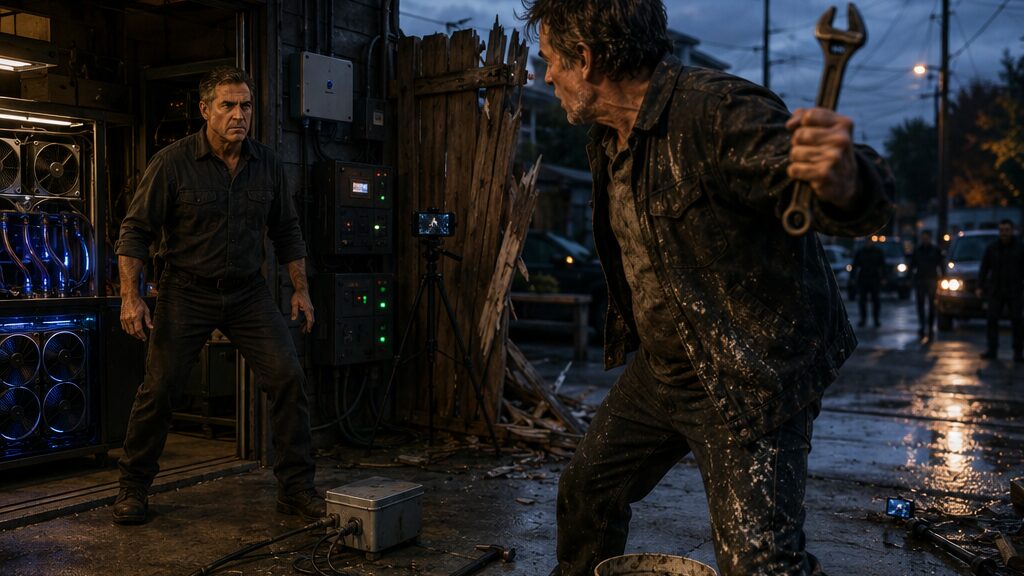
The cedar boards burst inward beneath the hooked end of the crowbar.
Raymond shouldered through the opening before the broken gate stopped moving. A large cleaning bucket swung from one hand. A rusted concrete crowbar dragged in the other. Behind him, a smartphone stood on a tripod in the street, its camera aimed through the breach.
“I’m shutting down the matrix!” he shouted.
The words reached Frank twice—once through the workshop wall and again through the livestream still open on his console.
The viewer count had passed eight thousand.
Frank struck the emergency isolation control.
Ninety seconds appeared on the screen.
Raymond jammed the crowbar beneath the fiber junction’s service lip.
“Step away from the box,” Frank said through the exterior speaker.
Raymond heaved. Metal shrieked against metal.
“This is the uplink,” he told the phone. “This is how it talks to every device in the neighborhood.”
“It is a sealed fiber enclosure. Leave now.”
The crowbar slipped and gouged the casing. Raymond staggered, recovered, then kicked the lower conduit.
Frank entered the first confirmation code.
Eighty-one seconds.
The server rack began sealing active files into isolated storage. The cooling system deepened its hum as the processors compressed the current state.
Raymond glanced toward the sound.
“There,” he said. “It knows I’m cutting the signal.”
He released the crowbar and lifted the bucket. Its label faced away from the camera, but the sharp chemical odor reached Frank when he opened the workshop door.
Industrial bleach concentrate.
Not acid, but corrosive enough to ruin fan bearings, wiring insulation, exposed connectors—and dangerous if it mixed with the wrong cleaning residue or entered the battery enclosure.
Frank remained on the threshold.
“Put the bucket down.”
Raymond’s face glistened with sweat. “You don’t get to give orders anymore.”
“You are trespassing. The system is isolating. Nothing you do now will expose what you think is here.”
“So you admit you’re wiping it.”
“I am protecting it from you.”
Raymond set the bucket beside the cooling housing and pointed at the workshop window.
A printed diagram was taped to the outside of his sleeve. Four handwritten labels marked equipment positions.
“You see this code?” he called to the livestream. He read the identifier printed along the upper edge of the interior job board. “R-C-M seven-four. People online traced it. Restricted continuity model. That’s not home computing.”
Frank felt the remaining uncertainty leave him.
The viewers had not merely encouraged Raymond. They had helped him identify restricted project language from fragments visible through glass.
The isolation clock showed sixty-four seconds.
“Raymond,” Frank said, “you are reading identifiers connected to proprietary information. Stop broadcasting and leave.”
Raymond looked at the phone. “He’s threatening me with secret laws now.”
“I am warning you that your stream is documenting every choice you make.”
“Good.”
He seized the crowbar again and swung it at the exterior cooling fans.
The first impact dented the protective grille.
The hum stuttered.
Frank moved off the threshold.
“Do not strike it again.”
Raymond raised the bar. “This frequency ends tonight.”
The second blow tore one corner of the grille free. A fan blade clipped warped metal with a rapid ticking sound.
The smooth mechanical note behind Frank fractured into an uneven pulse.
Fifty-one seconds.
Raymond dropped the crowbar and reached into the bucket. He pulled out a heavy wrench wet with chemical solution, as though he had deliberately soaked it.
He advanced toward the liquid-cooling manifold visible just inside the workshop.
Frank stepped between him and the door.
The livestream phone chimed continuously from the street.
“Move,” Raymond said.
“No.”
“You built this beside families.”
“I built it inside code, behind a legal boundary, after independent inspection.”
“Officials said they didn’t evaluate what it does.”
“They evaluated whether it could hurt you.”
Raymond’s gaze flicked toward the camera. “Hear that? Not whether it spies. Not whether it controls anything.”
Frank saw the calculation: every sentence had to serve the audience. Even now, inside another man’s broken gate with a chemical-wet wrench in his hand, Raymond was framing the next clip.
“Put it down,” Frank said. “That is your final warning.”
Raymond swung at the workstation.
Frank caught his forearm with both hands before the wrench completed its arc. Momentum drove them against the doorframe. The wrench head struck wood hard enough to split the trim.
Raymond smelled of sweat and bleach.
“You don’t understand what they’re doing,” he grunted.
“I understand what you’re doing.”
Frank turned the wrist outward. The wrench fell onto the threshold.
Thirty-eight seconds.
Raymond shoved him away and kicked the emergency control pedestal. The metal stand lurched sideways. The screen cracked against the wall, and the countdown vanished.
Frank looked once at the broken display.
The isolation process might still be running. Or the impact might have interrupted the command.
Raymond followed his glance and smiled.
“That’s the kill switch.”
He bent for the bucket.
Frank kicked it backward before Raymond could lift it. The liquid sloshed over the rim but remained mostly contained.
Raymond lunged past him, grabbed the loose fan grille, and pulled. Metal tore away. The damaged blade struck the housing with a harsh, repeating knock.
The hum became a staggered vibration.
Frank shoved Raymond clear of the enclosure and reached for the manual cooling bypass. Raymond caught his shirt and dragged him backward.
They hit the patio wall.
For one second, Raymond’s face was inches from his. The rage had thinned enough for fear to show through.
“You smelled it too,” Raymond said. “You heard the frequency change.”
“That is a damaged fan.”
“It changed before I touched it.”
“Because the processors took load.”
“Exactly.”
Raymond believed that one word settled everything.
Frank broke his grip and pushed him toward the gate. “Go home.”
Raymond stumbled near the bucket. The camera in the street continued recording, its lens centered on him.
He looked at it.
Then he looked at Frank.
Retreat would live forever on the same stream that had promised a shutdown.
Raymond grabbed a length of steel pipe lying behind the broken gate.
Frank recognized it from the rehearsal footage.
Raymond shifted his feet until his full body faced the phone. He lifted the pipe over his shoulder with the shortened arc he had practiced.
“People are watching,” Frank said.
“I know.”
“They are not protecting you.”
“They’re witnessing.”
“No. They’re keeping you here.”
Raymond’s hands tightened.
He swung.
Frank stepped inside the arc. The pipe passed behind his shoulder and struck the workshop frame. Before Raymond could pull it back, Frank trapped his wrist, drove his forearm upward, and twisted the pipe free.
He could have struck Raymond.
The opening was there. Raymond stood off balance, unarmed, his chest exposed.
Frank saw the broken gate, the damaged cooling enclosure, the chemical bucket, the red arrows Raymond had painted like target markers. Anger narrowed the patio to a single line between the pipe in his hands and Raymond’s body.
Then the fan blade clipped metal again.
The servers needed him precise.
Frank turned away from Raymond and drove the pipe downward into the tripod-mounted phone.
Glass burst across the pavement.
The livestream image spun, flashed white, and went black.
For the first time since Raymond entered, the patio seemed to fall silent.
Then a small camera clipped to Raymond’s shirt blinked red.
He smiled through heavy breathing.
“You didn’t stop it.”
The stream was still running.
Behind Frank, an alarm began pulsing inside the workshop. Cooling efficiency had fallen below the safe threshold.
Raymond seized the bucket with both hands.
Frank lunged, but Raymond did not throw it at him. He overturned it toward the patio seam leading past the battery bank.
The pale liquid spread in a shining sheet.
It found the slope.
And began running toward the battery enclosure.
Chapter 6: When the Quiet Hum Stopped
The corrosive liquid reached the first groove in the patio before Frank moved.
He dropped the steel pipe, seized the yellow containment wedge from beside the battery cabinet, and drove it into the drainage seam. The liquid divided around it, one branch curling toward the gravel trench, the other continuing along the concrete toward the enclosure.
Raymond ran for the red emergency hose.
“Don’t touch that,” Frank shouted.
Raymond tore the line from its wall bracket.
The hose was designed to cool the battery casing from a protected distance during thermal failure. Its high-pressure brass nozzle could throw water across the entire patio.
Raymond twisted the valve.
The line stiffened in his hands.
“I’ll wash it out,” he said. “Every signal. Every chemical.”
“Water will drive the bleach into energized equipment.”
“You said it was isolated.”
“The process is not complete.”
Raymond aimed the nozzle at the workshop door.
Frank turned toward the control pedestal. Its broken screen hung by one cable. A green status light behind the panel blinked twice, then changed to amber.
Isolation still running.
The cooling alarm accelerated.
Frank grabbed a bag of absorbent granules and ripped it open across the moving spill. White grains darkened as they drank in the liquid. He kicked the saturated mass toward the trench, then laid a second barrier along the battery base.
A sharp chemical smell burned his nose.
Raymond opened the nozzle.
The first blast struck the patio wall and exploded back in a cloud of spray.
Frank ducked behind the battery cabinet. Water swept across the concrete, struck the containment wedge, and pushed the diluted chemical toward the gravel trench.
For one moment, Raymond’s mistake helped.
Then he swung the nozzle toward the workshop.
Frank crossed the distance before the stream reached the open door.
He caught the hose behind the brass fitting and forced it upward. Water shot over the roofline.
Raymond held on with both hands. “Let go!”
“No.”
“You’re protecting the machine instead of the neighborhood!”
“You are the hazard.”
Raymond’s shirt camera blinked between them. Comments were likely still racing beneath the image, though the shattered phone lay in pieces outside the gate.
“Tell them,” Raymond gasped toward the camera. “Tell them I was right to come in.”
Frank stared at him.
The demand was not for evidence. It was for absolution.
“You were warned,” Frank said. “By me. By the inspector. By your sister. You came anyway.”
Raymond’s face changed at Ruth’s mention.
“She called you?”
“She tried to stop this.”
“She never believed me.”
“She believed you were frightened.”
“I wasn’t frightened.”
“You brought an audience because you were.”
Raymond jerked the nozzle sideways. The stream clipped the workshop threshold and splashed across the lower door.
Frank wrenched the hose back.
The brass fitting was too thick to close by hand against the pressure. The shutoff valve sat behind Raymond, beyond reach. The line bucked between them like a rigid cable.
Frank saw three options.
Release it and let Raymond flood the workstation.
Drive him to the ground and risk the nozzle striking the battery bank.
Sacrifice the hose.
He twisted his grip, braced the nozzle against the steel corner of the gate reinforcement, and folded the line sharply back on itself.
The brass groaned.
Raymond’s eyes widened. “What are you doing?”
Frank leaned his weight into the bend.
The nozzle crimped.
Pressure surged backward through the trapped line. The hose expanded near the coupling, its black outer layer swelling into a smooth blister.
Frank shoved Raymond away and released the assembly.
The coupling burst.
A concussive crack struck the patio.
Water erupted sideways in a white sheet. The hose whipped through the broken gate and into the street, spraying wildly across the pavement. Raymond lost his footing and fell hard on one knee, drenched from chest to shoes.
The shirt camera tore free and spun beneath the spray.
Frank ran to the workshop.
The internal alarm had changed from pulsing to a continuous tone. The server rack’s status lights were shifting from green to amber in descending rows.
He reached the manual isolation panel inside the glass partition and entered the physical override.
FILE SEAL: COMPLETE.
RELAY DISCONNECT: COMPLETE.
THERMAL SHUTDOWN: IN PROGRESS.
He exhaled once.
Then the damaged exterior fan gave a final metallic strike.
The quiet hum stopped.
The absence of it filled the workshop more completely than any alarm.
Frank placed his palm against the server cabinet. Warm, but not critical. The internal coolant pumps continued on reserve power, nearly silent.
Behind him, Raymond staggered through the doorway.
Water ran from his sleeves. He had recovered the rusted crowbar.
“You shut it off,” he said.
Frank turned.
Raymond looked past him at the darkening rack. His expression held something close to relief.
“I stopped it.”
“No,” Frank said. “You damaged the cooling system. I protected the data from you.”
“Then show everyone what it was doing.”
“It was processing restricted structural models.”
Raymond blinked.
The words had escaped before Frank could recall them.
“Structures where?”
“That is not yours to know.”
Raymond’s relief sharpened into triumph. “Restricted. You hear that?”
The shirt camera lay outside, but a second device flashed red from the broken gatepost. A compact action camera had been taped beneath the upper hinge, aimed inward.
Raymond had planned for the main phone to fail.
Frank followed his gaze to it.
“You disabled the stream delay,” he said.
Raymond smiled. “Nobody can edit the truth.”
The irony was so complete that Frank felt no satisfaction in it.
Every warning, every strike, every attempt to reach the equipment was being archived beyond either man’s control.
Sirens sounded in the distance, mixed with a lower engine note.
Raymond heard them and lifted the crowbar.
“They’re coming because they saw it too.”
“They’re coming because the security relay reported a breach.”
The statement stopped him.
Not because it frightened him, but because it confirmed the last piece of his theory.
“So it calls them automatically.”
“It reported sabotage of protected equipment.”
Raymond looked toward the street. “Then I’ll explain.”
“You already did.”
Frank stepped between him and the server rack.
Raymond raised the crowbar, but the movement lacked the certainty of his rehearsed pipe swing. His arms shook from the hose struggle. Water ran down the rusted shaft and dripped from its hooked end.
“Put it down,” Frank said.
“You attacked me.”
“I disarmed you.”
“You broke my phone.”
“After you entered with chemicals and struck the cooling system.”
“You admitted the plans are restricted.”
“Yes.”
The plain answer unsettled Raymond more than denial had.
Frank continued. “Restricted does not mean aimed at you. Protected does not mean dangerous to you. You decided every boundary was evidence because you needed one of your warnings to be right.”
Raymond’s jaw worked.
“My shop burned because no one listened.”
“Your sister said you ignored the fault.”
For the first time, Raymond looked genuinely struck.
“She wasn’t there.”
“She knew enough to fear what you would do tonight.”
The vehicles reached the block.
Two dark, unmarked vans turned in behind a marked patrol car. Doors opened before the engines stopped. People in plain jackets moved toward the property while an officer ordered both men to show their hands.
Raymond looked from them to the crowbar.
The livestream camera beneath the hinge continued blinking.
Frank stepped backward and raised his empty hands.
Raymond did not.
“They’re protecting him,” he shouted toward the street. “The relay called them. I exposed it.”
“Drop the tool,” the officer commanded.
Raymond’s grip loosened.
The crowbar struck the wet concrete.
He sank to both knees, not in surrender so much as collapse. Water continued spraying across the road behind him, the ruptured hose twisting under its own pressure until someone reached the exterior valve and shut it down.
The street became suddenly quieter.
Agents moved past Raymond toward the junction and workshop. One stopped beside Frank, displayed identification too quickly to read, and asked whether the data seal had completed.
“Yes,” Frank said. “The rack entered thermal shutdown after file isolation.”
“External transmission?”
“Disconnected before the cooling failure.”
The agent looked at the broken enclosure, the chemical residue, and the camera taped beneath the gate hinge.
“Was that his?”
“Yes.”
Another agent lifted the device without covering its lens.
“It’s still streaming,” they said.
Raymond made a sound from the ground. It might have been a laugh or a sob.
Heavy steel cuffs closed around his wrists.
Frank turned toward the workshop.
The rack stood dark behind the glass. No ordered hum came through the wall. No fan vibration traveled into the floor.
Only the amber emergency light remained, blinking over a machine that had gone silent before Frank could know what, exactly, had survived.
Chapter 7: The Evidence Raymond Made Himself
The investigator froze the video on a frame recorded twelve minutes before Raymond broke the gate.
The image showed Raymond standing in his garage, speaking calmly into his phone. Behind his left leg sat the cleaning bucket, its commercial hazard label turned toward the camera. The crowbar leaned against the wall beside it.
“He claimed he brought the chemical after discovering an emergency,” the investigator said.
Frank studied the frame. “The bucket was already prepared.”
“So were the diagrams taped to his sleeve.”
They sat in a temporary interview room inside a municipal building. Frank’s clothes still carried the faint chemical smell of the patio. A shallow cut crossed one knuckle where the steel pipe had scraped him. He had declined treatment beyond cleaning it.
On the table lay printed photographs of the damaged junction, broken cooling grille, ruptured hose, and red arrows painted on the conduit.
The investigator advanced the recording.
Raymond appeared outside Frank’s gate, telling viewers he would first “disable the communications spine,” then “break the frequency source,” and finally “flush whatever remained.”
His own words supplied an order of attack.
“He disabled the platform delay,” the investigator said. “The stream was mirrored by viewers before the primary phone was destroyed. The secondary camera continued recording until officers secured it.”
Frank looked at the still image of the bucket.
“Did the files survive?” he asked.
“That is what your liaison is waiting to discuss.”
Timothy sat in the next room with two technical examiners. When Frank entered, Timothy stood but did not offer his hand.
“The automatic seal completed,” he said. “No protected files were transmitted or opened.”
Frank let the words settle.
“The processing run?”
“Unreliable after the thermal event. It will restart from the last checkpoint.”
“How much did we lose?”
“Thirty-one hours. The damaged cooling assembly, junction enclosure, emergency line, and environmental cleanup will be included in the claim.”
One examiner turned a laptop toward Frank. The server logs showed the sequence in narrow rows: perimeter breach, file seal, relay disconnect, thermal shutdown.
The final protected-data entry was timestamped four seconds before the fan stopped.
Frank touched the table with two fingers.
Four seconds.
Timothy mistook his silence for concern about responsibility. “Your response remained within emergency authority.”
“I left the job running after the threat became credible.”
“You had no requirement to stop it earlier.”
“I had discretion.”
“You made an operational judgment.”
Frank looked at him. “I also did not want Raymond deciding when my work stopped.”
Timothy said nothing.
That refusal had once felt like discipline. Sitting beneath fluorescent lights with photographs of a broken gate spread between them, Frank could see pride inside it.
The examiner opened another folder. Screenshots from Raymond’s private discussion group filled the display. Users had helped identify the project code, locate the cooling manifold, and speculate about the relay. Raymond had asked whether destroying the fiber enclosure would force the servers to “spill their stored routing maps.”
“He was not simply destroying equipment,” the investigator said from the doorway. “He was soliciting restricted technical information and attempting to force disclosure during a public broadcast.”
“Industrial espionage?” Frank asked.
“That theory will be evaluated with the attempted sabotage and unlawful access evidence. Civil exposure is already substantial.”
Timothy leaned toward Frank once the others stepped away.
“We should keep the public account narrow,” he said. “An unstable individual misidentified lawful equipment and caused damage.”
“That makes it sound accidental.”
“It avoids amplifying his claims.”
“He received an inspection result. He had written warnings. He planned the order of attack.”
“No one is disputing that.”
“Then the record should say it.”
Timothy lowered his voice. “If prosecutors emphasize his technical questions, reporters may ask what he nearly accessed.”
“They can be told the material was proprietary and protected.”
“That invites more questions.”
Frank glanced at the closed evidence folder. Years earlier, he had watched one careless explanation move from person to person until a project collapsed beneath it. Since then, he had treated silence as the only secure container.
But silence could also erase the difference between confusion and choice.
“I will authorize a limited statement,” Frank said. “The relay’s protected status, the absence of neighborhood surveillance, the independent safety findings, and the proprietary nature of the workload. Nothing about the facilities or models.”
Timothy’s expression tightened. “That creates review obligations.”
“Review it.”
“And if the client refuses?”
“Then I provide the evidence required under subpoena and explain why a man who planned an attack should not be reduced to a harmless irrational neighbor.”
Timothy studied him for several seconds.
Finally, he closed the folder. “I’ll prepare the release language.”
Ruth arrived before Frank left the building.
She looked smaller than she had in his kitchen. She carried no keys in her hands this time.
“They asked about the shop fire,” she said.
Frank waited.
“I told them the truth.”
They stood near a vending machine that hummed more loudly than his battery bank ever had.
“Raymond said the utility ignored him,” Frank said.
Ruth shook her head. “An electrician told him to shut down the back circuit. Raymond refused because he had customer work running. He said stopping would prove the wiring was bad and scare people away.”
Frank looked at her.
“He smelled the insulation for three days,” Ruth continued. “After the fire, he needed someone else to have failed first.”
That was the truth no technical document could have supplied. Raymond had not become vigilant because no one listened. He had become obsessed with warnings because he had once ignored one.
“I should have told you sooner,” Ruth said.
“It might not have changed him.”
“It might have changed what you expected.”
Frank nodded. He did not absolve her, but he did not make her ask again.
A week later, the side patio was clean.
The fiber junction wore a new casing. The cooling fans had been replaced behind a stronger grille. The ruptured emergency hose was gone, and the drainage trench held fresh gravel where the corrosive liquid had been contained.
The gate had been rebuilt with a steel inner frame and new cedar boards.
Anna arrived to inspect the repairs. She checked each seal, tested the isolation switch, and stood beside Frank while the solar battery bank came back online.
The first fan began turning.
A low hum entered the patio.
Frank listened for imbalance. There was none.
Anna handed him the signed report. “I added a plain-language summary.”
He read it.
Independent electrical and fire-safety inspection completed. No directed laser, neighborhood data collection system, harmful radiation source, or grid back-feed present. Questions may be directed to the municipal inspection office.
A month earlier, he would have rejected the final sentence.
Now he folded the report once and placed it inside the weatherproof display panel mounted beside the gate.
“You’re comfortable with that?” Anna asked.
“People can ask you about what you inspected.”
“And what I didn’t?”
“They can be told it is lawful protected infrastructure. No more.”
Anna nodded. “That is more than a locked door.”
Inside the workshop, Frank mounted the broken end of Raymond’s crowbar above the repaired workstation. He had cut away the bent shaft, leaving the rusted hooked section that had scarred the junction box.
Beneath it, he fixed a polished brass plaque.
HAZARD AVERTED.
The words did not name Raymond. They did not celebrate his arrest or the civil claim already climbing into millions. They marked the danger without pretending it had come only from across the street.
Frank stepped outside and closed the rebuilt gate.
The safety panel remained visible from the sidewalk.
Behind him, the liquid-cooled workstation entered its restored processing cycle. The fans deepened together, smooth and measured. The sound moved through the workshop wall and settled into the evening air.
The quiet hum had returned.
This time, Frank did not need it to prove that nothing could reach him.
The story has ended.