He Smashed Her Breaker Box to Stop a Fire That Never Existed
Chapter 1: The Hammer Fell Before Any Alarm Sounded
The second hammer blow split the breaker cover while Raymond Baker told his phone that Angela Wright had abandoned a burning building.
“She won’t come out,” he said, leaning toward the livestream mounted on a black tripod. “That tells you everything.”
Angela was already outside.
She stood barefoot on the back step, one hand gripping the doorframe, listening for the alarms that should have been screaming if any part of Raymond’s story were true.
None sounded.
Beyond him, the detached workshop remained sealed. Blue status lights traced the edges of the reinforced window. Inside, six dark server cabinets stood in two disciplined rows, their cooling fans producing the low, continuous hum Angela knew better than the sound of her own refrigerator. On the patio, the off-grid battery bank gave off the softer vibration of its circulation pumps. Her PHEV waited beneath the solar canopy, its charging indicator steady green.
Everything was running.
Raymond raised the hammer again.
“Put it down,” Angela said.
He turned, but only enough to include her in the phone’s view.
“There she is.” His voice changed for the audience, flattening into the practiced gravity of someone delivering bad news. “The owner. Finally.”
The hammer came down.
Metal folded inward with a bright crack.
Angela crossed the patio but stopped six feet from him. The damaged housing was weatherproof and locked, with the live components recessed behind a second shield, but each impact risked driving metal where it did not belong.
“Leave my property.”
“There’s smoke coming from that building.”
“There is no smoke.”
“You can’t see chemical smoke.”
A stream of tiny comments moved up the phone screen. Angela could not read all of them, but she caught fragments.
CALL THE FIRE DEPARTMENT.
SHE LOOKS GUILTY.
THOSE BATTERIES EXPLODE.
Raymond pointed the hammer toward the workshop window. “You’ve got industrial equipment running in a residential yard. Servers. Batteries. High-voltage charging. And these things.”
He jabbed a finger at one of the smart-home sensors fixed beneath the roofline.
“They are motion and heat sensors.”
“They’re lasers.”
“They are not lasers.”
“They shine straight into my bedroom.”
The sensor had no visible emitter. Angela had explained that once, weeks earlier, after finding Raymond standing beside her fence with binoculars. She had shown him the manufacturer’s specification sheet through the locked gate. He had called it propaganda.
Now he had brought an audience.
Margaret Wilson stood across the street in a robe and slippers, arms folded tightly beneath her chest. Two other neighbors had emerged onto their lawns. One held a coffee mug; the other had a phone raised.
Angela looked back at Raymond’s tripod.
He had positioned it before approaching the breaker box. The camera faced the workshop, the battery bank, and the place where he now stood with the hammer. A rescue scene arranged before there had been anything to rescue.
Then Angela saw the rest.
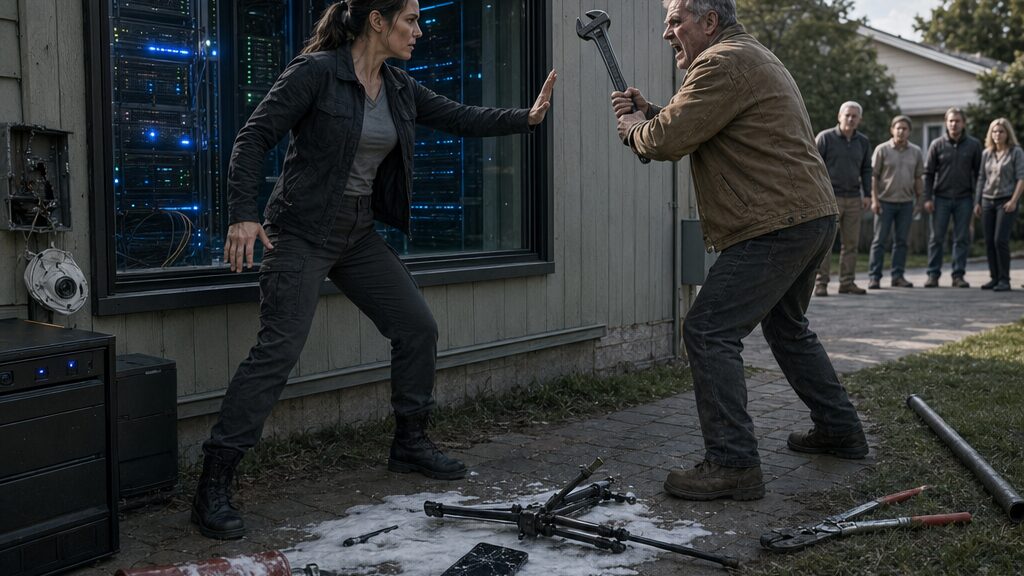
A red industrial fire extinguisher lay beside the tripod, its hose already uncoiled. A massive pair of rubber-handled cable loppers rested against the fence. A heavy wooden bat and a length of steel pipe had been placed on the paving stones within easy reach.
Not emergency equipment.
Options.
The fear in Angela’s chest became colder.
She took out her phone and opened the control interface. The breaker housing Raymond was striking served exterior utility circuits, not the protected server bus, but she would not trust damaged metal.
Raymond noticed the screen. “She’s trying to override it remotely.”
“I’m isolating the circuit you damaged.”
“You hear that?” he said to the livestream. “She admits there’s a dangerous circuit.”
Angela touched the confirmation panel.
A contactor thudded inside the workshop. The charging cable beside the PHEV went dark, along with the patio lighting and exterior maintenance outlets. Behind the reinforced glass, the server racks remained lit. The battery bank shifted its load without interruption.
The hum continued.
Raymond stopped swinging.
For one second, Angela thought the unchanged sound had confused him.
Then he smiled at the phone.
“She cut the visible power,” he said. “But that building’s still running.”
“Because you damaged an exterior circuit that does not supply the servers.”
“Hidden feed,” he said. “Exactly what I warned everyone about.”
Margaret stepped closer to the curb. “Angela, is there any chance something overheated?”
“No.”
“You had people working out there late at night.”
Angela’s attention moved to her.
Margaret looked uneasy, but not hostile. That made the question worse.
“The system is safe,” Angela said.
It was true.
It was not the whole truth, and Raymond seemed to hear the missing part.
He turned back to the livestream. “Notice she didn’t answer.”
“I did answer.”
“No, you made a statement.”
A comment flashed across his screen, and he read it aloud.
“‘Ask her why the windows are reinforced.’ Good question.”
“The contract requires physical security.”
“What contract?”
Angela said nothing.
She could not identify the client. She could not describe the files. She could not explain why an offline system in a detached suburban workshop needed tamper logging, reinforced glass, and redundant cooling without revealing more than her agreement allowed.
Raymond spread his free hand toward the phone.
“There. Silence.”
Angela looked at the smart sensor above the workshop door. Its indicator remained green. The yard cameras were recording locally, with redundant angles stored inside the secured control cabinet. Raymond could smash the tripod, the breaker housing, even one exterior sensor, and the incident would remain preserved.
She had built the system so evidence did not depend on anyone’s willingness to believe her.
“Last warning,” she said. “Leave now.”
Raymond’s face tightened.
He had spent the past month speaking to her through the fence, through neighborhood messages, through printed notices he taped to her gate. Each time she refused the argument, he grew more certain that refusal meant fear.
“You don’t get to issue warnings while you’re exposing this street to radiation and fire.”
“There is no radiation hazard.”
“Those sensors are blinding lasers.”
“They detect motion.”
“They hit my windows every night.”
“They do not project anything.”
He dropped the hammer.
For a breath, the movement looked like surrender.
Then he reached down and picked up the bat.
Margaret called from across the street. “Raymond, don’t.”
He held the bat near the handle, the barrel pointing at the row of roofline sensors.
“You shut these down,” he told Angela, “or I will.”
Angela stepped sideways, putting herself between him and the workshop door.
The phone continued streaming. Comments climbed faster now, too quick to distinguish.
Raymond’s eyes were not on the sensors.
They were on the screen.
“Your viewers cannot authorize you to be here,” Angela said.
“They’re witnesses.”
“To trespassing.”
“To intervention.”
He lifted the bat.
Angela saw the movement start in his shoulder. No hesitation, no flinch, no glance toward an alarm or smoke or any sign of actual danger.
He had come to strike something.
The bat slammed into the first sensor.
Plastic burst against the siding. The small green indicator vanished, and on Angela’s phone one camera tile went black—the angle covering the server-room entrance.
Raymond looked at the dead sensor, breathing hard.
Then he turned toward the remaining equipment.
Chapter 2: The Safety Expert Who Brought Demolition Tools
Raymond pulled a worn identification card from his wallet and held it toward the neighbors before Angela could reach the broken sensor.
“Certified property inspection,” he announced. “Commercial and residential safety.”
The card was old enough for the plastic edges to have yellowed. The photograph showed Raymond with darker hair and a heavier face. A company logo remained visible above his name, but the expiration date was partly obscured by his thumb.
Angela stayed between him and the workshop.
“You are not conducting an inspection.”
“I am responding to an imminent hazard.”
“Your employer did not send you.”
“You don’t know what my employer authorized.”
“You said on the stream that you were acting alone.”
His eyes flicked toward the tripod.
The livestream was still moving. The broken sensor had disabled one of Angela’s visible cameras, and Raymond seemed to believe that meant he now controlled what could be proved.
He lifted the identification card higher.
“I’ve spent thirty-two years inspecting electrical work,” he said. “I know what unsafe equipment sounds like.”
From his jacket pocket he produced a second phone.
He tapped the screen. A low mechanical vibration played through its speaker.
At first Angela did not recognize it. The recording was distorted, flattened by distance and night air. Then she heard the soft cyclic rise beneath the static.
The battery cooling fan.
Raymond held the phone toward Margaret and the others.
“That,” he said, “is pre-ignition vibration.”
Angela almost laughed, but the phrase had been chosen too carefully. It sounded technical enough to frighten someone who did not know it meant nothing.
“That is a cooling fan,” she said.
“It surges.”
“It changes speed with temperature.”
“Which means it overheats.”
“Which means the cooling system is working.”
Raymond smiled without warmth. “That’s what people say right before thermal runaway.”
Margaret crossed the street but stopped at the edge of Angela’s driveway.
“I heard that sound too,” she said. “Three nights in a row.”
“It is designed to run.”
“And the workers?”
Angela looked at her.
Raymond answered first. “Midnight service call. Unmarked van. Two men carrying coolant equipment.”
He swiped across the second phone and held up a photograph. It showed the side patio under work lights. A repair technician knelt beside the battery bank while another carried a sealed container from the van.
Angela knew exactly when Raymond had taken it.
He had entered the narrow strip between their fences after midnight. She had seen his shadow on the side camera, watched him retreat when the technician opened the gate, and decided not to make an issue of it. The repair was complete. The system was stable. Raymond had not touched anything.
A report would have required disclosing the service call.
So she had saved the clip and said nothing.
“You came onto my property to take that picture,” Angela said.
“I documented a hazard.”
“You trespassed.”
“You concealed emergency repairs.”
“It was scheduled maintenance.”
The lie was small enough to sound natural and large enough to sit heavily in her mouth.
The battery bank had suffered a temporary cooling fault. Not a fire risk—the cells had remained below shutdown temperature—but the secondary pump had failed during a critical processing run. Angela had called the approved contractor, replaced the pump, tested the system, and continued work without opening a formal incident.
Raymond did not know those details.
But he had found the shape of them.
A ringtone cut through his speech.
The livestream phone displayed a caller name large enough for Angela to see from several feet away.
David Hall.
Raymond looked at it and rejected the call.
A murmur went through the neighbors.
“Your manager?” Angela asked.
Raymond’s jaw shifted. “They’ve been told not to support me publicly.”
The phone began ringing again.
He silenced it.
“Why would your company stop its own inspector during an emergency?” Angela asked.
“Liability,” Raymond said immediately. “Corporate cowardice. They don’t want to admit they ignored my reports.”
“Did you file a report?”
“I raised concerns.”
“With whom?”
“That is internal business.”
He turned the livestream toward himself. “This is what happens when experienced professionals try to prevent disaster. The company lawyers start panicking before the smoke even clears.”
There was still no smoke.
Angela pulled up the municipal permit registry on her phone. She entered the property code and opened the public record.
“Permit number R-E-S-441-92,” she said. “Solar storage, detached electrical structure, vehicle charging equipment. Final inspection approved. You can verify it yourself.”
Margaret leaned over Angela’s screen.
Raymond did not.
His gaze remained on the workshop.
“That covers installation,” he said. “It doesn’t cover concealed malfunction.”
The shift was smooth. Illegal equipment had become faulty equipment in a single sentence.
Angela lowered the phone.
“You came here claiming the entire installation was unpermitted.”
“I came here because the installation is dangerous.”
“It passed inspection.”
“Before the repair trucks came.”
Margaret’s eyes moved between them. “Angela, they were here after midnight.”
“The system is safe.”
“That isn’t what she asked,” Raymond said.
Angela heard the echo of her own earlier evasion. She had permitted the equipment correctly, maintained it correctly, repaired it correctly—and concealed the one event that now made Raymond sound less irrational than he was.
A notification appeared on Raymond’s livestream. He read it with satisfaction.
“Someone says the reinforced windows prove it’s industrial.”
“They prove it is secure,” Angela replied.
“From what?”
She did not answer.
Raymond pointed toward the server racks glowing behind the glass. “What is in there that you can’t tell the people living twenty feet away?”
“Private work.”
“Dangerous work.”
“Confidential.”
“Same thing, apparently.”
Angela’s phone vibrated.
KATHLEEN GREEN.
She accepted the call and turned slightly away, keeping Raymond in sight.
Kathleen did not greet her.
“Your exterior security feed shows a blind sector,” she said. Her voice was level, stripped of everything but function. “What happened?”
“Raymond destroyed one sensor and damaged the external breaker enclosure.”
“Police?”
“Not here yet.”
“You called?”
Angela had triggered the silent emergency request through the security interface. She did not know when anyone would arrive.
“Yes.”
A pause.
“Angela, the client tamper system has registered contact near a restricted cable route.”
Angela looked toward the workshop wall.
The protected conduit ran beneath the exterior cladding behind the battery bank. Raymond was standing within reach of it.
“What kind of contact?” she asked.
“External vibration followed by signal loss on one perimeter node.”
“The sensor he broke.”
“No.” Kathleen’s voice sharpened. “Different location.”
Angela saw the cable loppers leaning against the fence.
Raymond followed her gaze.
Then he smiled.
Chapter 3: The Fault Angela Never Put on Record
“What did Raymond see the night the coolant alarm tripped?”
Kathleen’s question came through Angela’s phone clearly enough that Raymond, only a few feet away, lifted his head.
Angela stepped backward into the workshop control vestibule and pulled the door toward her, but Raymond moved closer.
“Coolant alarm?” he said loudly.
His livestream comments surged.
Angela shut the door before he could hear more, leaving herself inside the narrow glass-walled entry between the yard and the sealed server room. Raymond’s face remained visible beyond the reinforced outer panel. He looked energized now, as if Kathleen had handed him the missing word he needed.
Angela kept her voice low.
“The secondary pump dropped below minimum flow.”
“When?”
“Eleven days ago.”
“I have no incident report.”
“The cell temperatures remained inside tolerance.”
“That was not my question.”
Angela looked through the inner glass at the server cabinets. Indicator lights moved in orderly patterns. The active architecture models were running locally across the isolated cluster, generating structural variations from data that had never touched an outside network.
“The pump was replaced that night,” Angela said. “The system passed a full thermal load test before processing resumed.”
“And you did not report it.”
“I documented it in the local maintenance log.”
“Local is not contractual reporting.”
Outside, Raymond raised his second phone and replayed the battery-fan recording for the growing group near the curb.
“That sound,” he declared, “was the cooling system failing.”
Angela turned away from him.
“Kathleen, there was no data loss, no temperature breach, and no interruption beyond six minutes of reduced load.”
“There was an alarm.”
“A low-flow advisory.”
“You just called it a coolant alarm when you thought the distinction helped.”
Angela closed her eyes for half a second.
Kathleen continued. “Why did you withhold it?”
Because the contract required an automatic review after any cooling anomaly. Because the project was forty-eight hours from an internal deadline. Because Angela had already watched one employer turn a team failure into her individual fault after she had reported the risk early and repeatedly. Because logs were supposed to protect facts, but facts had once been edited around her until warning looked like confession.
“The repair was complete,” she said.
“That is not an answer.”
“It would have suspended processing.”
“Yes.”
“For a fault that never threatened the cells.”
“The review determines that.”
“I determined it.”
Silence came through the line.
When Kathleen spoke again, her voice was colder.
“That is the problem.”
A hard tap struck the vestibule glass.
Raymond stood outside holding his livestream phone toward Angela.
“She admitted it!” he shouted to the neighbors. “Cooling failure. Midnight repair. No report.”
Angela opened the door only wide enough to speak.
“You are listening to a confidential call on private property.”
“You said coolant alarm.”
“The system is stable.”
“You concealed it.”
“I repaired it.”
“Because it was dangerous.”
“Because machines require maintenance.”
He turned the phone toward Margaret. “Hear how she minimizes it?”
Margaret did not answer. Her concern had settled into something more cautious, but she had not moved away.
Kathleen spoke in Angela’s ear. “Can he access the protected conduit?”
“Not without removing the exterior shield.”
Angela glanced through the opening.
Raymond had retrieved the hammer.
He struck the siding beside the battery bank.
The blow rang through the vestibule.
“What is he doing?” Kathleen asked.
“Testing the cladding, apparently.”
Raymond hit it again.
“Do not narrate. Stop him.”
“I have ordered him off the property.”
“Then secure the system.”
Angela looked at the control panel. A full secure shutdown would seal the active data volumes and transfer volatile work states into encrypted local storage. It was designed for controlled emergencies, not someone attacking exterior infrastructure while the process ran.
“How long?” she asked.
“Current workload?”
“Four active model groups.”
“Seven minutes, possibly nine.”
Too long.
Another strike sounded. The battery cooling system changed pitch, shifting into secondary operation after the isolated exterior circuit altered its power-balancing route. The hum rose half a tone.
Raymond froze.
His expression changed.
Not triumph this time.
Fear.
“There,” he said. “It’s climbing.”
Angela knew the sound. A fan curve response. Nothing more.
But Raymond stepped back as if heat had touched his face.
Kathleen heard it through the phone. “What changed?”
“Secondary cooling mode.”
“Temperature?”
“Normal.”
“Begin secure shutdown.”
Angela placed her thumb on the authorization field.
A warning filled the panel.
ACTIVE MODEL INTERRUPTION MAY CORRUPT CURRENT ITERATIONS.
Below it, another message appeared.
LOCAL INCIDENT PACKAGE WILL INCLUDE ALL UNREPORTED MAINTENANCE EVENTS.
Angela stared at the line.
Kathleen said, “Authorize.”
If she did, the system would package everything: the damaged sensor, breaker impact, perimeter alerts, current thermal readings—and the pump fault she had never sent.
There would be no separating Raymond’s wrongdoing from her omission.
Outside, the neighbors were repeating the phrase coolant alarm among themselves.
Angela pressed her thumb down.
The authorization field turned amber.
“Shutdown initiated,” the system announced softly.
Raymond heard it through the open door.
He lifted his livestream phone. “She’s shutting it down now. After telling us there was no problem.”
“Because you are attacking it,” Angela said.
“That’s not what the system said.”
“It said secure shutdown.”
“Same thing.”
“No.”
He set the hammer down.
For a moment, Angela felt relief.
Then he walked to the fence and picked up the industrial cable loppers.
The handles were thick, red-black rubber, long enough to generate more force than any exterior residential conduit was meant to withstand.
Margaret moved into the driveway. “Raymond, you proved your point. Let the fire department handle it.”
“There is no fire department,” he said.
“You called them?”
“I called emergency services.”
“When?”
He did not answer.
Angela checked the shutdown timer.
Six minutes, forty-two seconds.
Raymond approached the battery bank.
“Do not touch that conduit,” Angela said.
He opened the lopper jaws.
Kathleen’s voice came through the phone. “Angela, maintain distance.”
“If he cuts the data link before the active volumes seal—”
“We know.”
“No, you know the policy. I know the routing.”
She stepped out of the vestibule.
Raymond shifted the loppers toward the exterior shield. “This is the feed keeping that building alive.”
“It is not a power cable.”
“Then you won’t mind losing it.”
“It is tamper monitored.”
“So it is connected to whatever you’re hiding.”
Angela stopped three feet from him. The workshop hummed behind her, quieter now as workloads began closing in sequence.
“Put them down.”
His hands tightened around the handles.
For the first time since she had come outside, Raymond was no longer looking at the livestream.
He was looking at her.
And in his face Angela saw that the argument had moved beyond fire, permits, batteries, or any danger he could name.
He needed her to retreat.
The shutdown timer reached six minutes.
Raymond opened the lopper jaws around the protected conduit.
Chapter 4: What Raymond Remembered About the Fire
“You didn’t predict that fire, Raymond,” Margaret said. “You helped cause it.”
The lopper jaws stopped around the conduit.
Even the livestream seemed to hesitate. Comments still climbed the phone screen, but Raymond no longer glanced at them. He stared across the driveway at Margaret as though she had spoken from a place years away.
“You don’t know what happened,” he said.
“I know what you told everyone afterward.”
“You heard rumors.”
“I heard you blame the electrician who warned you.”
Angela watched his grip tighten. The shutdown timer on her phone showed five minutes, forty-one seconds. Beneath the clipped exchange, the system emitted a soft repeating tone. It was not a fire alarm. It marked each stage of the secure shutdown as active models closed and encrypted volumes sealed.
At the first chime, Raymond’s face lost color.
Angela had seen fear in him when the cooling fans changed pitch. This was different. His eyes fixed on nothing. His shoulders drew upward. For an instant the loppers were no longer in Angela’s yard but somewhere else, in another workshop, beside another panel.
“Turn that off,” he said.
“It is a shutdown indicator.”
“Turn it off.”
“It stops when the process finishes.”
The tone sounded again.
Raymond flinched.
Margaret took one step onto the driveway. “That was the alarm, wasn’t it?”
“Stay out of this.”
“The one at the renovation site.”
Raymond twisted toward her, dragging the loppers free of the conduit without cutting it. “You weren’t there.”
“No. But you came to my house after the hearing. You sat at my kitchen table and told me nobody had listened when you warned them.”
“That is what happened.”
“You said the temporary panel was overloaded.”
“It was.”
“You signed off on it.”
His expression hardened. “Because the schedule was already behind. Because the electrician said it would hold.”
Margaret shook her head. “You told me he was the one who wanted it shut down.”
The server system chimed again.
Raymond looked toward the workshop as if the sound accused him personally.
Angela remembered fragments from neighborhood conversations she had avoided. Raymond’s contracting company had collapsed after a serious job-site fire. One worker had survived with permanent damage to one arm. Raymond always told the story as a warning about careless electrical work and managers who ignored experienced men.
Now Margaret had changed one detail.
One signature.
“That panel was supposed to run temporary lighting,” Raymond said. “They added equipment after inspection.”
“And when the electrician found it?”
“He made a scene.”
“He warned you.”
“He panicked.”
The word landed harder than his shouting.
Angela saw what he had built around it. Not a lie invented all at once, but a structure assembled over years: the alarm he had ignored became the alarm nobody else respected; the warning he had dismissed became his own warning; the injury caused under his authority became proof that he had understood the danger before everyone else.
He had not forgotten the fire.
He had moved himself to the other side of it.
The shutdown timer reached four minutes, fifty seconds.
Angela stepped to the control vestibule and angled her phone outward.
“Raymond.”
He looked at her.
“The isolation display shows every battery temperature, every active circuit, and every shutdown stage. You can see it from the property line. You do not have to enter the workshop.”
His breathing slowed slightly.
“You expect me to trust a screen you control?”
“No. I expect you to read certified sensor values. The permit record identifies the inspection standard. Margaret can watch with you.”
Margaret nodded. “Do that.”
Angela moved the display to a public diagnostic page. Green status bars filled the screen. Cell temperatures sat well below warning thresholds. The exterior circuit Raymond had damaged showed isolated. No smoke detector, thermal detector, or fire sensor had triggered.
She placed the phone on the low stone wall near the driveway entrance and stepped away.
“There is your proof,” she said.
Raymond lowered the loppers.
The shift was small, but real. The heavy jaws tilted toward the paving stones. His attention moved from Angela to the display. The shutdown tone sounded again, and this time he did not flinch as sharply.
Margaret walked closer to the phone. “Temperatures are normal.”
Raymond took half a step.
For one moment, the entire confrontation balanced on that movement.
Angela did not speak. She knew that pressing him could turn retreat into humiliation. She left him the space to cross the driveway, read the figures, and let the emergency end without surrendering in front of his viewers.
Then his livestream phone chimed with a new comment.
Raymond glanced down.
His face tightened.
“What does it say?” Margaret asked.
He angled the screen away.
Another comment appeared. Angela caught only the final words before his thumb covered them.
STAGED THE WHOLE THING.
Raymond’s jaw moved as he read silently.
A second message followed.
COWARD. CUT THE POWER OR GO HOME.
The loppers rose again.
“Raymond,” Margaret said, “don’t let strangers decide this.”
“They can see what’s happening.”
“They can see what you show them.”
His gaze snapped toward her. “You think I staged this?”
“I think you brought tools before there was an emergency.”
He looked at the hammer, bat, extinguisher, and steel pipe arranged beside the tripod. For the first time, the preparation seemed visible to him as evidence rather than equipment.
He could still leave.
Angela held his eyes. “The values are there. No fire. No thermal event. Put the loppers down and step off the property.”
Raymond’s attention shifted to the reinforced window. Behind it, the server lights continued their measured sequence.
“You think a green screen erases what you hid?”
“No.”
The answer surprised him.
Angela continued. “I should have reported the cooling fault. I did not. That does not make your claims true, and it does not give you the right to destroy anything.”
His mouth parted slightly.
He had expected denial. Her admission removed the argument he had been pushing against and left only his choice.
The timer showed three minutes, twelve seconds.
Raymond looked once more at the comments.
Then he turned away from the public diagnostic display.
“You’re shutting it down because I was right.”
“I’m shutting it down because you are standing beside protected equipment with cable cutters.”
He opened the lopper jaws.
Angela stepped forward. “That conduit carries no dangerous voltage.”
“Then cutting it cannot start a fire.”
“It will trigger a security incident.”
“Good.”
The word was quiet.
No panic. No concern. No claim of rescue.
Good.
Raymond fitted the jaws around the outer sheath and drove the handles together.
The reinforced polymer split with a dense snap. A narrow strip curled away, exposing the metallic shielding beneath. He had not reached the internal line, but the conduit’s tamper filament broke instantly.
Inside the workshop, the shutdown tone changed.
Angela’s phone flashed red.
RESTRICTED LINK INTEGRITY BREACH.
Raymond stared at the warning.
He knew now that he had not cut power.
Still, he repositioned the loppers for a deeper bite.
Chapter 5: The Livestream Broke Before His Story Did
Raymond dropped the loppers and pulled the pin from the red fire extinguisher.
The metal ring bounced once on the paving stones.
Angela saw the hose swing toward the workshop’s lower ventilation intake. Thick chemical foam forced into that channel would not extinguish anything. It would coat filters, damage cooling components, and contaminate the controlled interior before the secure shutdown could complete.
“Set it down,” she said.
Raymond wrapped one hand around the cylinder handle and gripped the nozzle with the other.
“You cut the conduit,” Angela said. “You know it was not a power line.”
“It was connected to the system.”
“A tamper-monitored data link.”
“So the equipment is still active.”
“The shutdown is processing.”
“You keep changing the language.”
The remaining exterior camera recorded from beneath the solar canopy. The workshop’s internal cameras covered the vestibule and server room. Angela did not know whether the damaged conduit had interrupted the redundant yard feed, but evidence had become secondary.
The extinguisher nozzle was less than four feet from the intake.
Kathleen’s voice came through the phone. “The conduit breach initiated an encrypted incident transfer. The protected volumes remain sealed from external access.”
Angela kept her eyes on Raymond. “How long?”
“Two minutes, fourteen seconds.”
Raymond heard her.
He raised the nozzle.
Margaret moved behind him but stopped when he glanced over his shoulder. “That foam will go into the building.”
“That is the point.”
“You said there was a fire.”
“There will be if she keeps it running.”
Angela took one measured step closer. “The intake is drawing air. If you discharge foam, you will damage the cooling system you claim to be protecting.”
“Then shut the fans off.”
“They are shutting down in sequence.”
“Not fast enough.”
His index finger tightened around the lever.
Angela moved.
She seized the hose below the nozzle and drove it toward the paving stones. Raymond squeezed. A white blast struck the ground between them, spreading in a violent fan across the bricks. The chemical smell rose sharp and bitter.
Raymond pulled back. Angela followed the force instead of fighting it, turning the nozzle away from the intake while her other hand clamped over the extinguisher’s handle assembly.
For several seconds they struggled without either speaking.
Then Angela twisted the cylinder against his wrist.
Raymond released it.
She dragged the extinguisher out of his reach and rolled it beneath the parked PHEV, where the chassis blocked immediate access. Foam continued hissing weakly from the hose until the pressure dropped.
The livestream comments pinged faster.
Somebody had posted the clip of Raymond cutting the conduit. New messages filled the screen faster than his earlier supporters could defend him.
HE SAID IT WAS POWER.
THAT WOMAN SHOWED HIM THE READINGS.
CALL THE POLICE.
Raymond read them.
His chest heaved. White foam clung to his shoes and the cuffs of his trousers. The image he had arranged—the experienced professional intervening while a secretive neighbor obstructed him—was coming apart in real time.
He snatched up the steel pipe.
Margaret backed away.
Angela stood between him and the reinforced window.
“Raymond,” she said, “the system has recorded your contact with restricted infrastructure. Stop now.”
“Restricted,” he repeated. “You finally admit it.”
“I never denied that the work is confidential.”
“You hid industrial operations in a neighborhood.”
“I built a permitted secure facility.”
“For what?”
“I cannot tell you.”
He laughed once, without humor. “And everyone is supposed to accept that.”
“Yes,” Angela said. “You are supposed to accept that something can be lawful without belonging to you.”
The pipe came up.
Angela saw the attack in the way his rear foot shifted. He was not aiming at her head. His gaze fixed beyond her, on the reinforced window.
He swung.
Angela caught the pipe with both hands near its center. The impact jarred through her forearms. Rather than stop it dead, she pulled with its momentum and stepped aside.
Raymond stumbled forward.
The far end of the pipe struck the tripod-mounted phone.
Glass burst across the paving stones. The tripod folded beneath the blow, and the phone spun into the white foam, screen flickering once before going black.
The sound cut off.
No comments.
No notification chimes.
No tinny reproduction of Raymond’s own voice arriving a fraction of a second late.
Only the quieter machinery behind the glass.
Raymond stared down at the broken phone.
Angela tore the pipe from his loosened grip and threw it across the patio. It struck the grass and rolled against the fence.
“Do not move,” she said.
His face had gone still.
For the first time that morning, he seemed smaller than the tools around him.
Then the second phone in his pocket buzzed.
He pulled it out. The older device still displayed the battery-fan recording, but a banner notification covered the screen.
COMPANY ARCHIVE: LIVE EVENT MIRRORED.
Raymond read it twice.
Angela’s phone remained connected to Kathleen.
“The livestream did not terminate at the source,” Kathleen said. “He tagged his employer’s verified account and identified himself as an acting inspector. Their platform mirrored the feed automatically.”
Raymond heard every word.
“No,” he said.
Margaret looked at the broken phone. “They have the whole recording?”
Kathleen answered through Angela’s speaker. “From before the breaker impact.”
Raymond turned toward Angela. “You arranged that.”
“I did not know your company was receiving it.”
“You contacted them.”
“Your manager called you. You rejected him.”
“He wanted to stop me from exposing this.”
“Or he wanted you to stop using his company’s name.”
The secure shutdown timer reached forty-eight seconds.
Inside, one server cabinet dimmed. Then another. The hum softened in layers, not dying but changing shape as active processing ended and encrypted storage remained protected.
Raymond looked through the reinforced glass.
“What are those machines doing?”
“Closing the project safely.”
“What project?”
Angela said nothing.
He took a step toward the window.
She matched it.
“Move.”
“No.”
“You destroyed my phone.”
“You swung the pipe.”
“At the glass.”
“That is not a defense.”
His second phone began ringing.
DAVID HALL.
Raymond rejected the call again, but the name had already appeared.
A new message followed.
STOP ALL ACTIVITY. LEAVE THE PROPERTY. DO NOT REPRESENT THE COMPANY.
Margaret read it over his shoulder.
“Raymond,” she said softly, “they are telling you to leave.”
His hand closed around the phone until his knuckles paled.
The last active cabinet shifted into standby. Kathleen confirmed that the project volumes were sealed.
“The classified architecture set is intact,” she said. “The conduit breach did not expose data.”
Margaret looked toward the workshop. “Classified?”
“Proprietary high-security architecture,” Angela said. “Not a public hazard. Protected client work.”
Raymond’s eyes moved to the cut conduit.
He understood enough now.
Not power. Not fire. Not lasers.
Evidence of deliberate contact with restricted commercial infrastructure.
A siren sounded somewhere beyond the neighborhood, still distant.
Raymond searched the patio.
The extinguisher was under the PHEV. The loppers lay near the cut conduit. The bat remained beside the ruined sensor. The pipe was out of reach.
Angela saw his gaze settle on the exterior maintenance cart.
A heavy steel wrench rested on its lower shelf.
“Raymond,” Margaret warned.
He lunged for it.
Angela moved toward him, but he reached the cart first. His fingers closed around the wrench, and he swung around with the tool already raised.
Chapter 6: The Wrench Buried Deep in the Fence
The wrench came down before Angela could retreat.
She caught Raymond’s wrist with one hand and the steel handle with the other. The weight drove her backward until her shoulder struck the reinforced window.
Behind the glass, the servers hummed in protected standby.
Raymond leaned into the wrench with both hands.
“You don’t get to ruin me,” he said.
Angela’s arms trembled under the force. “You came here.”
“You lied.”
“I concealed a maintenance fault. I did not invent a fire.”
His face was inches from hers. There was no performance left in it now. No grave concern for invisible fumes, no professional patience for an audience.
Only the terror of consequence.
The wrench slipped lower.
Angela turned her head before its metal edge could strike her cheek. The handle scraped the reinforced glass with a sharp squeal.
Margaret shouted for him to stop.
The approaching siren grew louder.
Angela shifted her right foot behind Raymond’s. She loosened her resistance for half a second, letting his weight move forward. When he compensated, she drove upward on his wrist and rotated his shoulder away from the window.
He stumbled sideways.
She stayed with him, keeping both hands on the weapon. He tried to wrench free, but his balance had broken. Angela pulled his arm across his body, turned him by the shoulder, and forced the tool away from herself and the glass.
Raymond’s fingers opened.
Angela took the wrench.
She could have dropped it.
Instead, she saw his eyes move toward the loppers.
She pivoted and hurled the wrench past him.
It crossed the narrow space between workshop and fence with a low, brutal spin. The steel head struck a wooden post and buried itself deep enough to split the grain. The handle vibrated once, jutting out beside the line dividing their properties.
The impact silenced everyone.
No livestream pings. No hammer. No steel against glass.
Only the quiet fans behind Angela.
Raymond stared at the wrench.
Angela’s breathing came hard, but her voice did not rise.
“That was your last warning.”
He looked at her as though he had never seen her before.
The siren reached the street. A vehicle stopped beyond the driveway, doors opening out of Angela’s view. Voices called for everyone to stay where they were.
Raymond lifted his empty hands, but not in surrender.
“She attacked me,” he shouted. “She threw a weapon at me.”
Margaret stood near the driveway entrance, pale and rigid.
“She threw it away from you,” she said.
Raymond turned on her. “You saw her grab me.”
“I saw you swing first.”
“You’re protecting her because you’re afraid of those machines.”
Margaret looked toward the broken breaker housing, the shattered sensor, the severed conduit, and the foam spreading beneath Angela’s car.
“No,” she said. “I’m afraid of what you did after she showed you they were safe.”
The words struck him more deeply than accusation.
Angela’s phone sounded with Kathleen’s incoming authorization request.
INCIDENT PACKAGE READY FOR RELEASE.
Below it were two selectable files.
EXTERNAL ASSAULT AND INFRASTRUCTURE BREACH.
UNREPORTED COOLING EVENT AND DELAYED DISCLOSURE.
The system offered three choices: release both, release external incident only pending internal review, or cancel transmission.
Kathleen spoke through the line. “Angela, the client’s legal team requires authorization now. The first package establishes deliberate interference with protected infrastructure. The second documents your failure to report the cooling fault within the contract window.”
Raymond heard enough to seize on it.
“She hid a failure,” he called toward the arriving responders. “Ask her. She admitted it.”
Angela looked at the options.
The cleanest version of the morning sat beneath her thumb.
External assault only.
Raymond’s hammer blows, his false identification claim, the staged tools, the cut conduit, extinguisher discharge, pipe swing, and wrench attack would stand without the cooling fault that had given his accusation its fragment of truth.
She could release that package now and let Kathleen handle the rest later.
Facts had once been used against Angela because someone else controlled which ones appeared together. Warnings removed from dates. Messages separated from replies. Her caution presented as indecision and someone else’s decisions attached to her name.
She had responded by building systems that preserved everything.
Then, when preservation threatened her own work, she had hidden behind a local log.
“Angela,” Kathleen said. “Choose.”
Raymond pointed at her phone. “She’s deleting it.”
Angela selected both files.
AUTHORIZE COMPLETE INCIDENT RECORD?
Her thumb hovered.
The server-room window reflected her face over the dark cabinets. Between reflections, she could see the wrench embedded in the fence and Raymond standing beneath the broken sensor.
She pressed authorize.
The screen confirmed transmission.
“Complete package released,” she said.
Kathleen exhaled quietly. “Received.”
Raymond stopped shouting.
The admission he wanted was now part of the same record that showed what he had done after receiving proof there was no fire.
Angela turned to the responders entering the driveway. She placed her phone on the stone wall, stepped away from every tool, and raised her empty hands where they could be seen.
“The system is shut down,” she said. “The damaged exterior circuit is isolated. The extinguisher discharged onto the patio only. There is no active fire.”
Raymond began speaking over her.
“She operates classified industrial machines in a residential—”
Margaret’s phone rang.
She glanced at the screen. “It says David Hall.”
Raymond moved toward her. “Don’t answer.”
Margaret stepped back and accepted the call.
“Hello?”
A man’s voice came through sharply enough to carry across the driveway.
“Is Raymond Baker with you?”
Margaret looked at him. “Yes.”
“Put me on speaker.”
She did.
“Raymond,” David said, “do not claim you are acting for the company. You were never assigned to that address, and you have no authority to conduct emergency interventions.”
Raymond’s mouth tightened. “You’re protecting yourself.”
“I am preserving the record. We have the mirrored livestream from the moment you activated it under our company tag.”
“You ignored my reports.”
“You sent photographs of a permitted installation and demanded we condemn it without inspection.”
“There was a cooling failure.”
“That did not authorize trespass.”
Raymond looked at Angela, then at the responders, searching for someone who might interrupt before the next sentence.
No one did.
David continued.
“We also reviewed the complaints we previously closed without action and the message instructing you not to contact Ms. Wright under the company name. Your employment is terminated effective immediately.”
Raymond’s face emptied.
“You can’t do that over a video.”
“The video shows you displaying expired company identification, striking private equipment, rejecting my calls, and attempting to destroy infrastructure after being told there was no emergency.”
“I was preventing a fire.”
“No,” David said. “You were representing yourself.”
The call ended.
Margaret lowered her phone.
Raymond stood in the wreckage of the scene he had built for everyone else to see.
Behind Angela, the last active fan shifted to its secure idle speed.
The hum remained.
Chapter 7: The Truth Did Not Leave Anyone Untouched
Kathleen placed two reports on the table and turned them so Angela could read both titles.
The first recommended civil action against Raymond Baker for trespass, property destruction, interference with protected infrastructure, and attempted access to restricted commercial systems.
The second documented Angela Wright’s failure to report the cooling fault within the required contract window.
Angela looked at the reports without touching either one.
The workshop conference area had been cleared of equipment during the investigation. Beyond the reinforced window, the server cabinets stood dark. Their cooling fans had been silent for six days, leaving the detached building unnaturally hollow. Angela could hear the faint buzz of the overhead lights and the click of Kathleen’s pen against the tabletop.
“Both are accurate,” Kathleen said.
Angela nodded.
“The client’s legal team believes the full incident record supports a substantial claim against Raymond. His actions were deliberate, recorded, and continued after he was shown there was no active hazard.”
“And my report?”
“Also deliberate.”
Angela met her eyes.
Kathleen did not soften the wording. “You knew the contract required disclosure. You decided the fault was too minor to justify suspension.”
“It was minor.”
“That is not disputed.”
Angela waited.
“The problem,” Kathleen continued, “is that you made the decision alone.”
The same sentence had followed her through every interview. It had become more difficult to resist because nobody was using it to erase Raymond’s responsibility. His attack remained his. Her omission remained hers.
“What happens to the contract?” Angela asked.
“Temporary suspension. Formal reprimand. Independent review of the cooling system and reporting controls.”
“And after that?”
“If the review confirms the equipment is compliant, processing resumes.”
Angela looked through the glass at the dark server racks.
“So I keep the work.”
“You keep the work because you released the complete record when withholding part of it would have protected you.”
Kathleen closed the second report.
“Do not mistake that for absolution.”
“I don’t.”
Kathleen studied her for a moment, then nodded once.
Across the street, Raymond was telling anyone who would listen that the two reports proved he had been right.
He had posted copies of Angela’s maintenance violation on neighborhood message boards. He had called it confirmation of an undisclosed electrical emergency. He left out the thermal readings, the completed repair, the valid permits, and the fact that he had cut a monitored data conduit after viewing the safe operating values.
His explanation required fewer details each time he repeated it.
The civil settlement offered to him during the second week required reimbursement for the damaged sensor, breaker housing, conduit, contamination cleanup, and security review. It also required a written admission that he had entered Angela’s property without authority and continued after being ordered to leave.
He refused.
The legal letter arrived at his house two days later.
Angela did not see the amount, but she saw the way Raymond stood on his front step reading it. His shoulders remained rigid until he reached the final page. Then one hand dropped to the railing.
His homeowner’s insurer denied coverage for intentional property damage. His former employer refused to defend actions performed outside any assignment. The client’s attorneys added the cost of forensic review and project interruption to the claim.
Raymond responded by giving an interview from his driveway.
He stood beside the fence where the wrench had been removed, leaving a dark split in the post. He called himself a whistleblower. He said Angela’s reprimand proved a conspiracy to hide dangerous technology.
Margaret watched from her porch.
When a reporter asked whether she supported Raymond’s account, she crossed the street carrying a folded statement.
She did not praise Angela. She did not apologize for believing the first warnings.
She simply listed what she had seen.
Raymond had placed the tripod before striking the breaker box. He had brought the hammer, bat, extinguisher, pipe, wrench, and cable loppers before claiming there was an emergency. Angela had displayed certified readings. Raymond had lowered the loppers when shown the system was safe, then raised them again after reading comments on his livestream. He had cut the conduit after saying “Good” when told it would trigger a security incident.
Margaret handed the statement to the reporter and went home.
That evening, Raymond knocked on her door.
Angela could not hear the conversation, but she saw Margaret shake her head. Raymond pointed toward Angela’s workshop. Margaret closed the door.
The sale sign appeared in Raymond’s yard three months later.
By then, Angela’s suspension had ended.
The independent review required additional external indicators: a public-facing safety panel near the gate, verified emergency contact information registered with local responders, and visible markings distinguishing the battery equipment from the protected data conduit.
Angela added more than the report required.
She held a brief neighborhood meeting beside the driveway. She did not identify the client or display the restricted work. She explained the battery shutdown system, the fire isolation equipment, and the difference between a cooling fan changing speed and an alarm.
Only six people attended.
Margaret stood at the back and asked two difficult questions.
Angela answered both.
The workshop resumed processing the following morning.
One cabinet awakened, then another. Cooling pumps engaged beneath the patio. The familiar hum returned gradually, filling the space Raymond’s hammer blows had once dominated.
His house sold below the original asking price.
The buyer was a small AI infrastructure company seeking a permitted suburban testing site near distributed solar capacity. Technicians arrived in plain vans and carried server cabinets through Raymond’s former garage. New cooling units appeared behind an approved acoustic barrier. Solar panels covered the rear roof.
Every installation permit was posted beside the front door.
Raymond returned on the final day to collect a box left in the shed. He stood on the sidewalk while technicians tested the new ventilation system. The low fan noise spread across the two properties until it was impossible to tell which machines belonged to Angela and which belonged to the house he no longer owned.
Angela crossed her driveway carrying the charging connector.
Her PHEV showed a full battery.
She unplugged it, closed the port, and placed the cable neatly against the wall. Raymond watched from beside the sale agent’s car. There was no anger left in his posture, only the stunned resistance of someone waiting for the world to admit it had gone too far.
Angela did not speak to him.
She entered the vehicle and started it. No engine answered. The car rolled backward with only the soft sound of tires over concrete.
As she reached the street, technicians switched on the last server bank inside Raymond’s former home.
The new fans rose into a steady, lawful hum.
Angela drove away without looking back.
The story has ended.