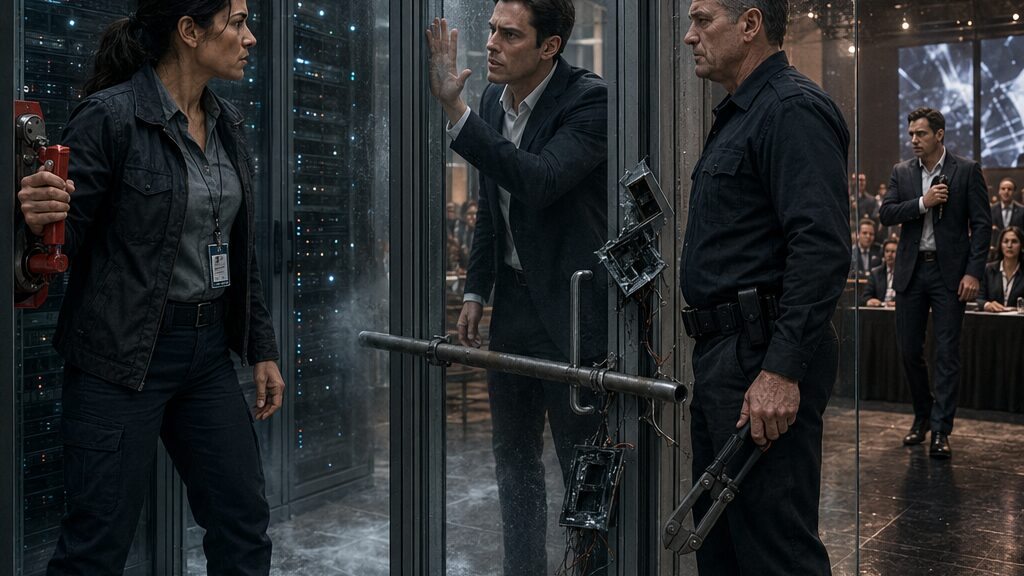
They Auctioned Her Stolen Energy Grid Until She Froze Every Server Solid
Chapter 1: The Woman Beneath the Forty-Million-Dollar Screen
Amanda Flores stopped beneath the main auction screen because the sentence glowing under Brandon Mitchell’s portrait belonged to her.
WHEN THE GRID CANNOT TRUST ITS OWNER, IT MUST PROTECT THE PEOPLE FIRST.
She had written those words at three in the morning on the back of a cooling-system schematic, then entered them into the earliest design notes for the smart-grid architecture. No one had been in the laboratory except Ryan Miller, asleep at the next workstation with his head beside a cold cup of coffee.
Now the sentence stretched twenty feet across the glass-and-steel auction hall.
“Forty million,” the auctioneer announced. “We have forty million dollars for exclusive international operating rights.”
A ripple moved through the seated buyers. Government energy representatives leaned toward their advisers. Utility executives watched the demonstration platform from behind polished bidding consoles. Reporters raised their phones toward the stage.
At its center stood the Control Console.
The glass touchscreen rose from a black pedestal like a clear slab of ice. A simulated city glowed beneath its surface—hospitals, transit lines, residential towers, solar fields—all breathing in coordinated pulses. Amanda knew every color, every pause, every hidden gesture. She had spent ten years teaching that machine how to distribute power without treating human lives as numbers on a demand chart.
Above it, Brandon smiled beneath the title VISIONARY ARCHITECT.
Amanda forced herself to move.
Her old maintenance credential hung against her charcoal jacket. The magnetic strip was scratched, and the expiration date had passed six weeks earlier, but the service entrance reader flashed amber instead of red. The door had opened because part of her original access profile remained buried beneath the company’s newer permissions.
She had taken that as a sign that records could not be erased completely.
Now she was less certain.
A security employee glanced at the faded credential as she crossed the rear aisle. His attention returned to the stage before he could question her. Everyone was watching Brandon spread his hands over the city display as if he were blessing it.
“The platform does more than balance energy,” he said. “It anticipates human need.”
Amanda heard one of her own presentation lines come from his mouth.
She reached the compliance enclosure at the edge of the bidder floor. A woman in a navy suit stood behind the transparent partition, reviewing transfer documents on a tablet.
“Catherine Baker?” Amanda asked.
The woman looked up. Her expression was alert but not welcoming. “Who are you?”
“Amanda Flores. I submitted an authorship dispute at nine this morning.”
Catherine’s gaze dropped to the maintenance badge. “That dispute was marked unsupported.”
“Because the files were screened by Brandon’s legal department before they reached you.”
“This auction has independent compliance review.”
“Then review them independently.”
Amanda placed a small encrypted drive on the counter. Catherine did not touch it.
Onstage, Brandon guided the city through a manufactured surge. Power flowed away from office towers and toward a hospital district. The buyers murmured approval.
Amanda looked at the console. The transition was too smooth.
“They’ve disabled the load governor,” she said.
Catherine’s eyes narrowed. “What?”
“That demonstration is running without the safety governor. Ask them to produce the validation sequence.”
“You’re making a serious allegation.”
“I’m telling you what the console is doing.”
Catherine glanced toward the stage, then finally picked up the drive. “Come inside.”
The compliance enclosure sealed behind Amanda with a soft click. Catherine inserted the drive into an isolated terminal. Folders appeared: early architecture maps, handwritten calculations, version histories, cooling diagrams, and photographs of crude prototype boards spread across Amanda’s kitchen table.
Catherine opened the oldest file and checked its metadata.
Her mouth tightened.
“What?” Amanda asked.
“The creation date is fourteen months after the corporation’s registered development record.”
“That’s impossible.”
“It’s what the file says.”
“Check the embedded hash chain.”
“I have.”
Amanda leaned toward the screen. The visible date was wrong. Not corrupted. Rewritten cleanly, with the kind of consistency that required access to the company’s archival signing keys.
Ryan had once managed those keys.
Catherine opened the corporation’s filings. Amanda’s diagrams appeared there too, stamped earlier and attributed to an executive research group chaired by Brandon.
“You were employed by the company during this period,” Catherine said.
“I built the system during that period.”
“Your title was maintenance systems analyst.”
“They kept the title low to deny me equity.”
“That may be an employment dispute. It does not establish ownership of the auctioned asset.”
Amanda felt the old instinct rise in her: wait, gather more, return with proof no one could question. It was the instinct that had kept her quiet after the grid failure. The instinct that had allowed Brandon to turn silence into a corporate record.
She looked through the enclosure wall.
The city beneath the Control Console brightened. Brandon lifted one hand for the cameras.
At the lower-right corner of the glass, a white six-pointed symbol flickered once.
Amanda stepped closer to the partition.
“There,” she said.
Catherine followed her gaze. “What am I looking at?”
“It resembles frost. Six narrow branches around a hollow center.”
“I can barely see it.”
“You aren’t supposed to. It appears when thermal forecasting and load forecasting disagree by more than eight percent.”
Catherine looked back at her. “How would a maintenance analyst know about an unlisted interface symbol?”
“Because I drew it.”
Onstage, Brandon continued speaking, unaware that the symbol had appeared beneath his wrist.
Catherine’s certainty shifted—not enough to become belief, but enough to become caution.
She reached for her communication panel.
Across the floor, Ryan turned from the technical booth.
His face changed when he saw Amanda.
For a moment they simply looked at each other over the heads of bidders and camera crews. Ryan had lost weight since she had last seen him. His suit hung too cleanly from his shoulders, and the nervous habit of rubbing his thumb against his first finger had returned.
Then he looked at her badge.
Amanda felt the credential vibrate against her chest.
The compliance door clicked open behind her.
Catherine checked her panel. “Your access has just been revoked.”
Two security employees began moving from the rear aisle.
Ryan leaned toward a terminal and spoke into his headset.
Catherine’s tablet chimed. She read the new message, and whatever uncertainty Amanda had created hardened again.
“The company identifies you as a terminated technician involved in a prior grid emergency.”
“I wasn’t terminated. I was placed on leave after refusing to sign the patent transfer.”
“You signed an incident statement accepting operational responsibility.”
Amanda said nothing.
That half-second was enough.
Catherine stepped away from the drive. “You need to leave the bidder floor while this is reviewed.”
“There won’t be anything left to review after the sale.”
“The transfer cannot erase regulated records.”
“You’re trusting the people who changed my timestamps.”
The security supervisor arrived first. He was broad-shouldered, gray at the temples, and wore no expression of personal hostility.
“David Campbell,” he said. “Ma’am, step away from the terminal.”
Amanda took the drive before he could reach it.
“I’m not threatening anyone.”
“Then cooperate.”
The auctioneer called forty-one million.
Applause moved across the floor.
Amanda turned toward the console. She could reach it in twelve steps. Perhaps nine if the aisle remained clear. The glass would still recognize old diagnostic gestures even if her credential had been revoked.
She moved before she had fully decided to.
David caught her arm beside the stage barrier.
The console woke beneath her approaching hand.
For one breath, the city vanished and a thin diagnostic line traced the exact rhythm of her fingers through the air.
Then the display flashed red.
AUTHORITY OVERRIDDEN: B. MITCHELL.
David pulled her back. One of the cameras turned toward them.
Amanda looked past Brandon to the technical booth.
Ryan had opened a directory on his monitor. She could see the date even from the floor because she had lived every hour of it.
The date of the grid failure.
Ryan selected the entire directory.
Then he pressed Delete.
Chapter 2: Sue Me Before the Hammer Falls
Brandon stopped the auction with one raised hand.
“Since we have an unexpected guest,” he said into the microphone, “perhaps the room would like to hear from the technician who nearly shut down three hospitals.”
The buyers turned as one.
David still held Amanda’s right arm. Another guard stood close enough to block her left side. Camera lenses found her between them: dark jacket, expired maintenance credential, hair pulled back without care, one hand clenched around an old encrypted drive.
On the giant screen, Brandon’s portrait disappeared.
Amanda’s face replaced it.
The magnification showed the strain at the corners of her eyes and the red mark where David’s fingers pressed through her sleeve.
Brandon stepped down from the platform, wearing the patient expression of a man indulging an unreasonable interruption.
“Amanda Flores worked in a technical support capacity during early testing,” he told the room. “After a serious operational incident, she became convinced that routine maintenance contributions entitled her to ownership of the entire platform.”
Amanda looked at Catherine. “Ask him for the load-governor validation.”
Brandon smiled. “This is what I mean.”
“The hospital district is drawing against a simulated industrial spike with no thermal buffer.”
Several buyers glanced toward the console.
Brandon turned slightly, just enough to keep his face open to the cameras. “The platform is performing exactly as designed.”
“No. It’s performing exactly as staged.”
A low sound passed through the floor—not disbelief, not yet, but interest.
Amanda pointed toward the lower corner of the glass. “The frost indicator is active. Your demand model and cooling model disagree.”
Brandon looked at the console.
His smile held, but his eyes searched the surface.
He could not find the symbol.
Ryan’s voice came through Brandon’s earpiece. Amanda could not hear the words, but she saw Brandon’s shoulders relax.
“The icon she is describing,” he said, “is a legacy maintenance alert. It has no bearing on system safety.”
“It isn’t an alert. It’s a forecast contradiction.”
Brandon placed his palm against the glass for the photographers.
The console reflected Amanda’s face beneath his hand.
“Would you like to explain the contradiction?” Catherine called from the compliance enclosure.
Brandon’s smile thinned.
He looked toward Ryan. “Our chief systems specialist can address any technical detail.”
Ryan came out of the booth carrying a tablet. He kept his eyes away from Amanda.
“The cooling model is temporarily conservative because the demonstration uses an accelerated simulation,” he said. “The discrepancy will resolve after the next balancing cycle.”
“No, it won’t,” Amanda said.
The auctioneer shifted uneasily near the podium.
Amanda watched the city pulses. Ryan had reduced the displayed interval, but he had not changed the system’s internal clock. She counted beneath her breath.
Six.
Seven.
Eight.
“The northeast transit sector will dim,” she said.
Ryan’s thumb froze over the tablet.
Nine.
The simulated rail lines on the console flickered.
Then an entire quadrant darkened.
A few bidders lowered their paddles.
The frost symbol brightened.
Catherine left the compliance enclosure and approached the stage. “Mr. Mitchell, should the auction pause while this is assessed?”
“No.” Brandon’s answer came too quickly. He softened it. “The demonstration has multiple safety layers. A cosmetic fluctuation does not affect the asset.”
A representative in the front row raised a hand. “Who designed the thermal forecasting layer?”
Brandon looked at Ryan.
Ryan said, “It was developed collaboratively.”
Amanda almost laughed, but the sound would not come.
Brandon moved closer to her. He lowered the microphone, though not far enough.
“You should have stayed outside,” he said.
“You should have left the governor connected.”
“We are selling software rights, not activating a national grid.”
“You’re proving you’ll remove any safeguard that interferes with a presentation.”
His jaw tightened. “You never understood what it took to make this viable.”
“I understood what it took to make it safe.”
“And while you protected every theoretical risk, I found the money, the regulators, the buyers, the political support. Without me, your diagrams would still be taped above a kitchen table.”
There it was: the part of his belief that was not entirely false.
Amanda had never known how to make powerful people wait. Brandon did. He had turned prototypes into rooms like this one. He had paid teams, opened doors, forced officials to look at a system they would otherwise have ignored.
Then he had decided that bringing the work into the light made the work his.
Catherine held out her tablet. “Mr. Mitchell, the corporation has submitted an incident statement bearing Ms. Flores’s signature.”
Brandon’s confidence returned.
The giant screen changed again.
Amanda’s signature appeared beneath a block of legal text.
I ACCEPT OPERATIONAL RESPONSIBILITY FOR THE UNAUTHORIZED LOAD EVENT AND THE RESULTING RISK TO CONNECTED MEDICAL FACILITIES.
The room became very quiet.
David’s grip loosened slightly, perhaps because Amanda had stopped resisting.
Brandon raised the microphone.
“This was not obtained in secret,” he said. “Ms. Flores signed it in the presence of counsel.”
Amanda stared at the sentence. She remembered the room where she had signed it: no windows, a clock that ticked too loudly, a live hospital map glowing on a laptop while administrators waited to know whether the system would be shut down.
Catherine looked at her. “Is that your signature?”
“Yes.”
The answer moved through the crowd faster than any denial could have.
Brandon let the silence settle.
Then he faced Amanda fully.
“You want justice?” he said. “Fine, sue me. Let’s see if you have the money to fight this corporation!”
A few people shifted in their seats. Someone near the back laughed once, then stopped. Most did nothing. The auction screens still displayed forty-one million dollars.
Amanda felt the humiliation as heat beneath her skin, but it was not Brandon’s insult that held her still.
It was the sight of Ryan.
He had returned to the booth. On his monitor, the failure directory was disappearing file by file. Progress bars closed. Archive markers vanished. He was not merely cleaning a presentation machine. He was erasing the internal chain that connected the bypass, the hospital load, and Brandon’s order to continue.
Amanda pulled once against David’s hand.
“Ryan,” she called.
He did not look up.
“Check his terminal.”
Brandon stepped between her and the booth. “Remove her.”
Catherine lifted a hand. “Not yet.”
The auctioneer leaned toward her. “We have active bids.”
“Then hold them.”
Brandon’s expression hardened. “You have no basis.”
“I have a live system discrepancy and a disputed authorship claim.”
“You have a former employee staging a breakdown.”
Amanda watched Ryan’s deletion counter.
Twelve percent remained.
She understood then why he was working so quickly. The auction’s final authorization would not simply transfer license keys. It would generate a clean commercial archive and purge unregistered development logs from the demonstration environment. Ryan only needed to remove the protected directory before that process began.
Then every surviving official record would support Brandon.
The auctioneer received instructions through his earpiece. He looked from Catherine to Brandon, then toward the buyers.
“Bidding will remain open,” he announced, “for a final verification interval of five minutes.”
A countdown appeared above them.
04:59.
Ryan looked up at the clock.
Amanda looked at the deletion counter.
Nine percent.
The sale and the purge were now racing each other, and both would finish before anyone in the room decided whether she deserved to be heard.
Chapter 3: The Failure She Agreed to Carry
David guided Amanda into the service corridor and said, “That signed statement is enough to have you arrested.”
“It was never a confession.”
“It says you accepted responsibility.”
“It doesn’t say I caused the failure.”
The door shut behind them, muting the auction floor to a bass vibration. Through the narrow glass panel, Amanda could still see the countdown burning above the stage.
03:48.
Catherine followed, carrying Amanda’s encrypted drive and her tablet. Brandon remained inside, speaking urgently to auction officials while Ryan worked at the booth.
David positioned himself between Amanda and the corridor leading backstage.
“You have one minute,” Catherine said. “Tell me why you signed.”
Amanda looked at the incident statement on Catherine’s screen.
For months she had told herself that the wording mattered. Operational responsibility was not technical fault. Risk was not damage. Connected facilities were not affected facilities.
The distinctions had protected her conscience while Brandon used the signature as a weapon.
“The system was connected to a hospital network during a validation exercise,” Amanda said.
Catherine’s expression sharpened. “The corporate report says it was an isolated simulation.”
“It was supposed to be.”
The memory returned with the clarity of an alarm.
A control room washed in blue monitor light. Ryan beside her, younger and sweating through his shirt. Brandon behind the glass, surrounded by investors he had invited without telling the engineering team. A demand surge climbing faster than the cooling forecast could absorb.
On Amanda’s screen, the frost symbol had opened like a white crack.
She had reached for the load governor.
The control was already disabled.
“Ryan bypassed the governor,” she said.
David glanced through the door toward the booth.
“Why?” Catherine asked.
“Brandon wanted the system to show it could absorb an industrial surge without slowing the demonstration. The governor would have reduced the transfer rate.”
“You can prove that?”
“The proof was in the directory Ryan is deleting.”
Catherine held up the statement. “And instead of reporting the bypass, you signed this.”
“The network operator was preparing an emergency isolation. If they isolated us at full load, three hospitals would have switched to local backup at the same time.”
“That is what emergency backup is for.”
“One generator was under maintenance. Another had failed a morning test.”
Catherine said nothing.
Amanda remembered the hospital icons pulsing red. She had held the grid together manually for eleven minutes while Brandon ordered the demonstration to continue and Ryan tried to restore the governor without revealing that he had removed it.
If Amanda had exposed the bypass at that moment, the operator would have disconnected the platform. The hospitals might have lost stable power during the transfer. Junior control staff who had followed Brandon’s approved demonstration plan would have been blamed.
So she had accepted operational responsibility. In exchange, the company had agreed to stop the live test, protect the operators, and correct the system before another deployment.
She had believed the agreement bought time.
It had bought Brandon silence.
“I thought I could repair the architecture first,” Amanda said. “Then I would prove what happened without risking the network.”
“And did you?”
“I repaired it. They locked me out before I could finish the evidence package.”
Catherine looked toward the auction floor. “Technical knowledge still does not establish legal ownership.”
“No. But it establishes that the people selling this system removed a safety control they didn’t understand.”
The service door opened briefly as an event employee rushed through. In the gap, Amanda saw beneath Ryan’s booth.
A compact black storage unit was fixed to the underside of the terminal with two magnetic clamps. A narrow cable ran from it into the archive port.
She stopped breathing.
The device was not company equipment. Its status light blinked in a three-beat pattern: copy, verify, conceal.
Ryan was not only deleting the directory.
He was taking something.
Amanda moved toward the glass. David blocked her.
“Look under his terminal,” she said.
“I see a box.”
“It’s an encrypted storage unit.”
Catherine checked the auction equipment list on her tablet. “No external archive device is registered to that booth.”
David’s posture changed by a degree. “Could it be part of the demonstration?”
“No,” Amanda said. “Deletion doesn’t require external storage.”
The countdown showed 02:31.
Inside, Ryan leaned close to his monitor. His left hand rubbed thumb against forefinger. He used to do that when a test was almost complete and he feared someone would ask whether he had followed the procedure exactly.
Amanda watched the hidden device.
A green bar reached eighty-seven percent.
“He’s copying the core,” she said.
Catherine looked at her. “Why would he steal a system the corporation is about to sell?”
“Because after the sale, Brandon won’t need him.”
The answer arrived with a painful simplicity.
Ryan had never believed Amanda alone deserved authorship. He had spent years translating her rough logic into cleaner modules, documenting interfaces she neglected, catching errors she refused to admit until he proved them twice. He had wanted his name beside hers.
Brandon had offered him something easier: a title, money, and the chance to help erase her.
But Brandon’s stage still displayed only one visionary.
Ryan had finally understood what happened to useful people when Brandon no longer needed them.
“He stripped the safety governor from the copy,” Amanda said.
“How can you know that?” David asked.
“The full architecture won’t fit on that unit before the transfer closes. He’s taking the commercial core and leaving the verification layers behind.”
Catherine’s face tightened. “Would it operate?”
“Yes. Until it encountered a load condition it couldn’t judge. Then it would keep distributing power because nothing would tell it to stop.”
The green bar reached ninety-four percent.
Amanda stepped close to David. “If he leaves with that device, this auction won’t be the only sale.”
David looked through the glass.
Ryan glanced up.
Their eyes met.
For the first time, fear crossed his face without disguise.
He reached beneath the booth and tore the cable free. The storage unit disappeared inside his jacket.
“Stop him,” Amanda said.
David’s hand moved toward the service door.
Then Brandon’s voice cracked through his radio.
“Campbell, detain Flores immediately. She has attempted unauthorized access to critical infrastructure.”
David hesitated.
Inside the auction hall, Ryan began walking toward the private exit.
The countdown above him reached two minutes.
Chapter 4: The Console Was Never the Heart
Ryan was six steps from the private exit when Brandon ordered David to arrest Amanda instead of stopping him.
“Campbell, secure Flores now,” Brandon said through the radio. “She is the threat.”
David watched Ryan’s hand press against the bulge inside his jacket.
Amanda felt the hesitation travel through David’s grip.
It was small, no more than a loosening of two fingers, but it was the first decision anyone in authority had made that Brandon had not already chosen for them.
Ryan reached the exit reader.
“His credential will still work,” Amanda said. “Mine was the one he revoked.”
David moved toward the service door.
Brandon’s voice sharpened in his earpiece. “That is a direct order.”
The auction countdown showed 01:43.
Catherine stepped between David and Amanda. “Mr. Campbell, the unregistered device is now a compliance concern.”
That gave him a rule he could obey.
David opened the door.
Ryan looked back and saw them coming.
He abandoned the private exit and cut across the rear of the bidder floor, using the confusion around the stage as cover. Brandon turned from the auction officials and followed the movement with his eyes. For one exposed second, his expression held no confidence at all.
Then he pointed at Amanda.
“She is trying to disrupt the transfer. Protect the console.”
Security employees converged around the glowing glass slab.
Amanda stared at them.
Of course.
Brandon believed the console was the system because it was the part the cameras could see. He had built the auction around it, placed his name above it, laid his hand on it as though touching the surface meant understanding what lived beneath.
The console was only a window.
The heart sat behind two fire-rated doors, forty meters of service corridor, and a rack of processors tied to the building’s environmental controls.
The countdown reached 01:28.
David pushed through the bidder floor toward Ryan. Catherine followed him, calling for the exit locks to be engaged. Ryan slipped between two rows of seated buyers and disappeared behind the technical curtains.
Amanda turned the other way.
The guard beside her caught her sleeve.
She twisted, not away from him but toward him, driving her shoulder under his arm. His balance shifted. Amanda pulled free and ran behind the stage.
Someone shouted.
Her old credential slapped against her chest as she entered the lighting lane. Black cables crossed the floor beneath taped covers. The roar of the auction became muffled behind curtains and equipment walls.
A maintenance terminal glowed beside a support column.
Amanda pressed two fingers to its corner, dragged them diagonally, and tapped the blank space where no visible control appeared.
The terminal hesitated.
Then the Control Console onstage changed.
The simulated city vanished. Thin white lines swept across the glass in a diagnostic loop, one after another, forming the old calibration pattern Amanda had used before the interface possessed icons or color.
A sound rose from the crowd.
She had not stopped the sale. She had not proved authorship.
But the system had answered her.
The terminal displayed a hidden service map. Most of her permissions were gone, yet the maintenance route remained outlined in pale blue. At the far end, the server room pulsed behind a red lock symbol.
TRANSFER AUTHORIZATION: 00:57.
Amanda ran.
Behind her, Brandon’s voice filled the auction hall.
“Shut down that diagnostic display. Now.”
No one answered quickly enough.
The backstage lane narrowed between temporary walls. Amanda passed cooling ducts, power-distribution boxes, and emergency equipment cabinets. A warning tone began pulsing overhead as the system registered simultaneous access conflicts.
At the junction ahead, a steel fire door slammed shut.
Brandon had found the corridor controls.
Amanda reached the reader and pressed her expired badge against it.
ACCESS DENIED.
Through the small reinforced window, she could see the final corridor and the gray server-room door beyond it.
00:43.
She checked the wall cabinets. Fire hose. Electrical isolation tools. A maintenance rack held clamps, insulated cutters, and a length of steel pipe used to turn manual ventilation valves.
Amanda lifted the pipe.
The fire door was magnetically locked, but its lower emergency hinge housing had been mounted on a temporary frame for the event. She drove the pipe between the housing and the wall.
Metal scraped.
A security employee rounded the corner behind her.
“Put it down.”
Amanda pulled harder. The temporary frame groaned.
“Amanda,” David called from farther back.
She could not tell whether he meant stop or go.
The hinge housing tore loose from the wall.
The door dropped half an inch, twisting against its upper mount. Amanda shoved her shoulder into the gap. The edge crushed against her ribs, then shifted far enough for her to force herself through.
The guard caught the back of her jacket.
The fabric tightened across her throat.
Amanda drove the steel pipe backward. It struck the doorframe, not the guard, but the impact startled him enough that his grip opened. She fell into the corridor and dragged the pipe after her.
00:29.
The server-room reader showed a solid red light.
She swiped her badge anyway.
DENIED.
The walls vibrated with the low, steady force of the cooling system. Behind the door, the processors were preparing the commercial archive that would validate the rights transfer and clean away everything the corporation had marked obsolete.
Amanda inserted the pipe beneath the reader housing and levered it outward.
The plastic face cracked. Wires pulled free.
The lock remained engaged.
She opened the emergency tool recess beside the door. During installation, she had insisted that every electronic barrier possess a physical override accessible to maintenance crews during a power fault.
Brandon had called it old-fashioned.
Amanda turned the recessed latch.
The door released.
She stepped into the cold white light of the server room and pulled the door shut behind her.
Rows of black racks stood beneath silver suppression pipes. Status lights moved in disciplined sequences. At the center, the operational core occupied three cabinets surrounded by transparent safety panels.
The main control terminal displayed the countdown.
00:14.
Amanda entered the normal shutdown command.
A red banner appeared.
SHUTDOWN PATH DISABLED BY ADMINISTRATOR R. MILLER.
She tried the load-isolation sequence.
DISABLED.
Ryan had not merely copied the core. He had cut off every clean way to stop it.
The transfer timer reached seven seconds.
Amanda looked toward the wall beside the door.
Behind a clear protective cover sat the mechanical emergency control for the CO2 suppression system.
No software permission governed it. No administrator could erase it. Pulling it would flood the room, crash the hardware through thermal shock, and turn ten years of her work into frozen metal.
The timer reached three.
Amanda lifted the cover.
Chapter 5: A Safeguard Built for the Unthinkable
Brandon reached the server-room glass before Amanda touched the CO2 release.
He struck the window with the flat of his hand.
“Don’t.”
The word came through the emergency intercom, stripped of stage polish.
Amanda stood between the server racks and the mechanical lever. Behind Brandon, security crowded the corridor. David was among them, one hand on his radio, his gaze moving between Amanda and the auction floor beyond.
The transfer timer had reached zero, but the system had not completed authorization. Amanda’s forced entry and the disabled shutdown commands had pushed it into a verification hold.
On the wall terminal, a new countdown appeared.
EXTERNAL RIGHTS HANDSHAKE PENDING: 02:00.
Brandon saw it through the glass.
His face changed.
“Amanda, listen to me,” he said. “Step away from the control and we can correct this.”
She looked at the racks.
“Correct what?”
“Your title. Your compensation. The public record.”
The condensation from her breath faded against the cold air.
“You can stand beside me when we reopen the auction,” he continued. “Shared credit. Executive authority. Equity. Whatever you should have had from the beginning.”
The offer landed where he intended.
For years Amanda had imagined some version of it. Not money first, though money would have changed her life. She had imagined entering a room without a maintenance badge. Hearing her name attached to the system before someone else’s. Being asked instead of overruled.
Brandon watched her face and believed he had found the right number.
“You built something extraordinary,” he said. “But extraordinary work needs power behind it. I have that power. You don’t have to destroy this because you’re angry.”
Amanda stepped toward the glass.
“I’m not angry enough to destroy it.”
Relief moved into his shoulders.
“I’m afraid enough.”
She pointed to the handshake warning. “Who is authenticating outside the sale?”
Brandon looked toward the corridor.
“Ryan,” Amanda said. “He copied the commercial core.”
“That’s impossible.”
“You gave him archive authority.”
“I gave him authority to protect the platform from you.”
“And he protected himself from you.”
Brandon turned toward David. “Find Miller.”
David spoke into his radio. No answer came back immediately.
The external handshake dropped to 01:34.
Amanda returned to the terminal. She opened the environmental diagnostics and entered a command sequence hidden beneath the cooling controls.
The system asked for an architect signature.
Her biometric access had been removed from the public console, but this layer predated Brandon’s permissions. Amanda placed her palm against the small service plate.
A pulse of light passed beneath her skin.
ARCHITECT SIGNATURE RECOGNIZED: A. FLORES.
Outside the glass, Brandon stared at the words.
Amanda initiated the first stage of emergency containment.
Across the auction hall, every screen changed at once.
The city simulation disappeared. Brandon’s portrait vanished. A white frost-shaped icon expanded over a black field, its six branches turning slowly around an empty center.
The same symbol appeared on the server-room terminal.
EXTERNAL AUTHENTICATION BLOCKED.
Somewhere beyond the corridor, the auctioneer’s voice broke through the growing noise.
Brandon leaned close to the glass. “What did you do?”
“I stopped Ryan’s copy from completing the handshake.”
“Then restore the transfer.”
“No.”
“You just proved you still control corporate property.”
“I proved you tried to sell a system without knowing where its authority lived.”
His mouth tightened. “You think that distinction will matter after they charge you?”
Amanda looked at the mechanical lever.
“It matters to me.”
A metallic whine began outside the door.
One of the security employees had brought a rotary cutting tool. Sparks sprayed from the damaged access housing as the blade touched the frame.
David spoke through the intercom. “Amanda, step away from the suppression control.”
“Did you find Ryan?”
“Teams are covering the exits.”
“That isn’t an answer.”
“You are inside a sealed room with a fixed-fire system. Pulling that control could injure you.”
“The discharge delay is eight seconds.”
“And after that?”
“I stay below the release nozzles and reach the emergency mask.”
David glanced at the mask cabinet mounted several feet from her. “You may not reach it.”
“I designed the layout.”
“You also signed a statement once because you thought you could control every consequence.”
The words struck harder than Brandon’s insult had.
David had understood more than she wanted him to.
Amanda looked at the racks, at the small lights passing data through the architecture she had once believed would outlive every compromise around it.
She had built the hidden protocol after the hospital incident.
Not to establish ownership.
Not to punish Brandon.
She had built it because a grid responsible for millions of lives could not depend on the courage of one employee in one locked room. If an authorized owner disabled safety controls, coerced the architect, and forced a catastrophic shutdown, the system would preserve the chain of responsibility beyond the owner’s reach.
The protocol did not activate through accusation.
It required physical proof of abuse: disabled safety paths, disputed authority, external duplication, and a catastrophic environmental event.
She had hoped no one would ever create those conditions.
She had also concealed the safeguard from formal review. If Brandon had known, he would have ordered Ryan to remove it. Amanda had told herself secrecy was necessary.
It was still secrecy.
The cutting blade bit deeper into the frame.
On the terminal, a new line appeared beneath the blocked handshake.
ANTI-COERCION ARCHIVE: ARMED.
Brandon saw it.
“What is that?”
Amanda did not answer.
His voice rose. “What did you put in my system?”
“Your orders.”
“You recorded internal meetings?”
“The system recorded changes to its own safety controls.”
“You had no authority.”
“Neither did Ryan when he removed them.”
Brandon struck the glass again. “This sale funds deployment across six countries. It puts hospitals, transit networks, and communities onto a cleaner grid. You want to destroy that because your name isn’t on a screen?”
Amanda looked past him toward the distant auction floor. Buyers stood in clusters now. Catherine was speaking with officials beneath the giant frost icon. Reporters were filming the locked corridor.
Brandon was wrong, but not about everything.
The system could help millions.
It could also harm them if sold to people who believed safeguards were optional and workers replaceable.
Amanda had spent years treating the machine’s survival as equal to its purpose.
That was the lie she had told herself.
“I should have spoken after the hospital test,” she said.
Brandon went still.
“I should have shown the bypass, the orders, all of it. I stayed quiet because I thought keeping the project alive would protect the people it was built for.”
“You did protect them.”
“No. I protected this.”
She placed her hand against the nearest rack.
The metal vibrated softly beneath her palm.
“And you learned that I would always choose the machine over myself.”
The cutting tool stopped.
For a moment there was only the server fans.
Then the external handshake warning flashed again.
A second attempt had begun.
Ryan had found another connection.
Amanda entered the final containment command. The terminal requested confirmation that catastrophic loss could follow.
She confirmed.
The frost icon brightened across every screen.
The server-room door shuddered as security forced the cutting tool back into the frame.
David called through the intercom. “Amanda, we are coming in.”
Brandon turned on him. “Get her away from the lever. Preserve the racks at all costs.”
David’s eyes met Amanda’s through the glass.
She saw the rule-bound calculation in his face. The auction, the property, the people in the building, the unregistered storage device, the disabled shutdown. He still did not trust her.
But he no longer trusted Brandon either.
Amanda lifted the steel pipe from the floor.
She drove it through the paired door handles and wedged it against the frame. Then she swung the pipe into the damaged access-control panel.
The plastic housing shattered.
The electronic lock sparked and died, trapping the mechanical bolts halfway between open and closed.
The cutting tool screamed against steel.
Amanda dropped the pipe.
She crossed to the suppression control, broke the final seal, and wrapped her fingers around the red mechanical handle.
Above the racks, the CO2 pipes trembled as the system pressurized.
Chapter 6: When the White Vapor Took Everything
Amanda pulled the handle.
The first CO2 blast struck with the force of a collision.
Ceiling panels jumped in their frames. White vapor punched from the nozzles and rolled across the room in thick, violent sheets. The alarm became a continuous metallic howl.
Eight seconds.
Amanda turned toward the emergency mask cabinet.
Her shoes slipped on the whitening floor.
Behind the glass, Brandon disappeared inside the vapor’s reflection. Security figures became shadows beyond the door. The cutting tool stopped as the corridor alarms ordered evacuation from the suppression zone.
Seven.
Amanda reached the cabinet and tore it open.
The mask strap caught beneath the latch.
Six.
She ripped it free, pressed the seal over her mouth and nose, and crouched below the nearest nozzle.
The cold arrived next.
It moved through the room with astonishing speed, racing over metal rails and transparent safety panels. Moisture crystallized across the rack doors. Cooling fans whined as their bearings contracted.
Five.
The operational core tried to compensate. Status lights shifted from green to amber, then red. Internal protections fought the temperature drop while the disabled shutdown path refused to let them power down cleanly.
Four.
Amanda looked at the central rack.
Ten years lived behind that glass.
The first crude load-balancing model she had built in her apartment. Ryan’s elegant interface work from before resentment hollowed him out. Months of hospital simulations. Nights spent correcting failures no one else had seen. Every argument she had lost, every precaution Brandon had mocked, every promise she had made to herself that the work would matter more than the way she was treated.
Three.
Frost closed over the glass.
Two.
The server fans stopped.
One.
The room went dark.
Beyond the server-room wall, the auction screens died with it.
A stunned silence replaced the bidding floor’s noise. Even the alarms seemed distant through Amanda’s mask.
Brandon’s shape emerged beyond the frosted glass.
He turned toward the dead screens, then back to Amanda.
“She destroyed it,” he shouted. His voice reached her faintly through the emergency intercom. “She destroyed all of it.”
The words spread because people needed an explanation, and his was the first.
On the auction floor, buyers looked at one another. Reporters lowered and raised their phones, uncertain where to point them. Catherine stood beneath the blank main display with her tablet pressed to her chest.
Brandon pushed into the corridor microphone.
“She has erased the platform and the records supporting her own claim. This is sabotage by a former employee who admitted responsibility for a previous failure.”
Amanda closed her eyes.
For one terrible moment, nothing happened.
The racks remained black.
The evidence protocol required an external route beyond the corporate network. She had tested it in isolation years earlier, but Ryan had altered the archive architecture since then. He might have found it. He might have broken the delivery chain without knowing what it was.
The server room had become a frozen tomb containing every answer.
Brandon saw the delay and grew stronger.
“Detain her the second that door opens,” he told David. “No one accesses the room without corporate counsel.”
David stood several feet away, one arm shielding his face from cold vapor seeping around the damaged frame.
Catherine approached. “The auction remains under compliance hold.”
“You no longer have an asset to hold,” Brandon said. “She destroyed a forty-million-dollar system in front of witnesses.”
The main screen flickered.
One white line appeared across the black surface.
Then another.
A delivery interface opened.
AUTHENTICATED EVIDENCE RELEASE INITIATED.
Brandon stopped speaking.
The screen populated faster than anyone could read.
Source-control histories. Safety-governor changes. Administrator overrides. Internal audio indexes. Transfer logs. Cryptographic signatures. A list of recipients scrolled down the right side: international auction regulators, infrastructure safety authorities, independent technical auditors, and major news organizations.
DELIVERY CONFIRMED.
DELIVERY CONFIRMED.
DELIVERY CONFIRMED.
Phones began ringing throughout the hall.
A reporter near the stage looked down at a new message, opened an attachment, and raised her head sharply toward Brandon.
The auction screens divided into panels.
One displayed the original architecture chain. At its beginning appeared Amanda’s early development signature, preserved through thousands of linked revisions.
ARCHITECT AUTHORITY: AMANDA FLORES.
It was not a title. It was not a portrait or a ceremonial credit.
It was the technical origin from which every validated version descended.
Another panel opened an audio file.
Brandon’s recorded voice filled the hall.
“Remove the governor for the demonstration. We need full transfer speed.”
Ryan answered from the recording. “Amanda won’t authorize it.”
“Then use my administrator credential.”
A third voice—Amanda’s—came through moments later.
“The hospital load is unstable. Stop the test.”
The recording continued.
Brandon’s voice: “The investors are watching. Keep it running.”
No one applauded.
The room simply changed around him.
People stepped away.
Catherine looked down at her tablet as documents arrived through the independent compliance channel. David listened without moving, his face unreadable.
Another file opened.
Ryan’s altered access logs appeared beside the originals. The screen highlighted the differences line by line. Then came a transfer record created less than an hour earlier: an unauthorized copy of the commercial core, stripped of the safety governor, prepared for an external buyer.
A security employee shouted from the rear of the hall.
Ryan was running.
He had abandoned the private exit and cut toward a freight corridor, one hand holding his jacket closed over the storage unit.
Brandon saw him.
“Campbell!” he shouted. “Get into that server room. Stop Flores before she does anything else.”
David looked from Amanda behind the glass to Ryan crossing the floor.
The command exposed Brandon more completely than the recordings had.
The duplicate was escaping. The evidence had been released. Yet Brandon still wanted control of the frozen racks more than he wanted the thief stopped.
David turned away from the server room.
He intercepted Ryan beside the final row of bidders.
Ryan tried to change direction. David caught his shoulder and drove him to the floor. The storage unit skidded from inside his jacket, struck the polished surface, and spun beneath an empty chair.
Two security employees seized Ryan’s arms.
“I was protecting the company,” Ryan said.
David retrieved the device.
“From whom?”
Ryan looked toward Brandon.
That glance answered for him.
Catherine took the auctioneer’s microphone.
“The sale is suspended,” she said. “All bids, transfer authorizations, and associated licensing actions are frozen pending regulatory and criminal review. No representative of the selling corporation is authorized to access the system or evidence chain.”
Brandon crossed the floor toward her.
“You cannot suspend an executed commercial transfer.”
“The transfer did not authenticate.”
“The system was sabotaged.”
“The evidence archive authenticated through channels outside your corporation.”
“She built an illegal trap into company property.”
Catherine’s grip tightened on the microphone. “That question will be investigated. So will every file it released.”
White vapor continued leaking beneath the server-room door.
Inside, Amanda sat against the wall with the mask over her face. Her hands had begun shaking from cold. The racks were silent. Frost had covered the safety panels so completely that she could no longer see the lights beneath.
The system was gone.
The evidence was not.
That difference did not feel like victory. It felt like standing after a building collapsed and realizing the one person you saved was the truth.
Security finally disengaged the corridor alarm and began working on the barricaded door from outside.
Brandon returned to the glass.
He struck it with both hands.
“Reboot it.”
Amanda lifted her head.
“You hear me?” he shouted. “Restore the core. The architecture belongs to the corporation. You are still obligated to preserve it.”
The public Control Console had restarted in emergency mode beyond him. Its glass surface displayed a biometric authorization request.
Brandon ran to it.
He pressed his palm against the scanner.
The console pulsed red.
AUTHORITY NOT RECOGNIZED.
He tried again.
Red.
Around him, cameras recorded every attempt.
Brandon looked through the frost-covered wall at Amanda.
“You built it under my roof,” he said. “With my money. My staff. My access. It is mine.”
Amanda pulled the mask aside just far enough to speak into the intercom.
“Then save it.”
He struck the console with his palm.
The glass remained dark beneath his hand.
Chapter 7: What Remained After Ownership Went Dark
David removed Amanda’s restraints and immediately told her she was still under investigation.
“The evidence release changes what happened out there,” he said, “but it does not erase what you did in that room.”
They stood in a temporary compliance area built from movable glass walls at the edge of the auction floor. The restraints had left pale bands around Amanda’s wrists. Her jacket was damp from the thawing vapor, and every breath carried a faint metallic taste from the emergency mask.
Beyond the partition, the auction no longer resembled an auction.
Buyers had been separated from corporate representatives. Regulators occupied the technical booth. Security guarded Ryan near a service exit while investigators photographed the storage unit recovered from his jacket. Brandon sat with two attorneys beneath the dead main screen, speaking in short, furious bursts no microphone could amplify.
The Control Console remained where it had stood all afternoon.
Its glass was black.
Emergency lights moved across its surface in red reflections, as if something damaged were still pulsing beneath it.
Catherine entered carrying Amanda’s encrypted drive and a tablet sealed inside a clear evidence sleeve.
“The rights transfer has been suspended,” she said. “The authentication never completed.”
Amanda lowered herself into a chair. Her legs had begun trembling after the cold left them.
“Suspended isn’t canceled.”
“No. That determination will require review across several jurisdictions.”
“And the servers?”
“Preliminary assessment says the operational core is unrecoverable. Some peripheral storage may be readable after controlled thawing.”
Amanda looked through the glass toward the server corridor. The door she had barricaded stood open now. White vapor drifted close to the floor while technicians in protective equipment moved around the frozen racks.
For ten years, she had measured danger by whether the system survived it.
Now survival was the one outcome no longer available.
Catherine placed the tablet on the table.
“The released archive appears to contain independently verifiable source histories and safety records. Enough to support your authorship claim. Enough to justify criminal and regulatory inquiries.”
“Enough to rebuild?”
“Not safely. Not soon.”
The answer hurt less than Amanda expected and more deeply.
Catherine sat opposite her. “The commercial architecture was optimized around the operational core. The archive proves how it developed, but it is not a deployable replacement. Reconstructing the system could take years.”
“Good.”
Catherine studied her.
Amanda looked at her own hands. “That shouldn’t have been my first thought.”
“No,” Catherine said. “But I understand it.”
Outside, David escorted Ryan past the compliance partition. Ryan’s tie was gone, and one sleeve had torn at the shoulder. He did not look at Brandon. He looked through the glass at Amanda.
There was accusation in his face, but something else too—the old resentment of a man who still believed being close to the work had entitled him to possess it.
Amanda met his eyes until security moved him on.
Catherine opened a document on the tablet.
“I need a recorded statement before external investigators take control. There is a way to keep it narrow.”
Amanda read the first lines.
Ryan Miller acted independently to remove safety systems, falsify development records, and duplicate protected corporate material. Amanda Flores responded to an immediate unauthorized transfer threat.
The wording was precise. Clean. It placed Brandon’s coercion in the evidence archive and Amanda’s destruction inside the logic of emergency response.
It left out the hidden protocol.
It left out the months of silence.
It left out the fact that Amanda had built an undisclosed mechanism capable of releasing corporate records through channels no executive could stop.
“This protects the suspension,” Catherine said. “It also reduces the chance that your own actions overshadow the evidence against them.”
Amanda scrolled farther.
The statement described her as unaware that catastrophic suppression would activate the archive.
She placed the tablet down.
“That isn’t true.”
“It is defensible.”
“It’s false.”
“It is limited.”
Amanda looked toward the Control Console.
Earlier that day, Brandon had stood beside it and reduced ten years of her work to a corporate asset. Ryan had reduced their collaboration to copied code. Amanda had reduced her own silence to sacrifice because sacrifice sounded cleaner than fear.
Now Catherine was offering her another useful reduction.
Blame Ryan. Let the released files speak for Brandon. Preserve the strongest claim. Protect the larger case.
It was the same kind of bargain Amanda had accepted after the hospital incident.
A partial truth in exchange for stability.
“What happens if I sign this?” she asked.
“The auction remains frozen. Your attorneys challenge the ownership filings. Regulators investigate the safety violations.”
“And the next company?”
Catherine did not answer.
“They rebuild it under different management,” Amanda said. “They call the archive Ryan’s sabotage. They say the hidden trigger was an accident. Then someone removes the next safeguard because the record says no architect ever put it there.”
“The complete truth may expose you to prosecution.”
“I know.”
“It could weaken your civil claim.”
“I know.”
“You may lose control of how people see you.”
Amanda almost smiled.
“I never had control of that.”
Catherine leaned back. For the first time since the service entrance, she looked tired rather than official.
“My responsibility is to preserve admissible facts,” she said.
“Then preserve all of them.”
Amanda pulled the tablet closer and deleted the prepared statement.
She began again.
She described Ryan’s bypass during the hospital demonstration. Brandon’s order to keep the test running. Her decision to accept operational responsibility rather than trigger an immediate isolation while medical facilities remained vulnerable.
Then she described what came after.
She had embedded the anti-coercion archive without formal approval. She had concealed it from management. She had designed it to activate when authorized owners disabled safety paths, disputed the architect’s authority, attempted external duplication, and forced catastrophic shutdown conditions.
Finally, she described pulling the CO2 handle.
No softened language.
No claim that she had acted without understanding the damage.
Catherine read in silence.
“This account gives investigators grounds to examine you as more than a victim,” she said.
“I was more than a victim.”
Amanda added one final sentence.
I delayed telling the whole truth because I believed preserving the system was more important than exposing the people controlling it, and that delay helped make today necessary.
She signed.
Catherine sealed the statement into the evidence system.
Across the floor, Brandon rose when he saw them finish. One of his attorneys stopped him from approaching. His face held none of the certainty he had worn onstage, but Amanda did not mistake his collapse for her restoration.
There would be hearings. Claims. Possible charges. Years of people arguing over which part of the truth mattered most.
Catherine stood and gestured toward the Control Console.
“We need it preserved for examination. Your original diagnostic access may help us stabilize the remaining interface.”
Amanda approached the dark glass.
Her reflection appeared faintly beneath the emergency lights. No title hovered above her. No city waited beneath her fingers. The console no longer recognized anyone.
She lifted her hand.
Then she let it fall without touching the surface.
“You have the source chain,” she said. “Start there.”
Amanda removed the expired maintenance credential from her jacket and placed it on the compliance table.
She walked past the black console, past the silent auction hammer, and toward the exit while the screens behind her continued delivering records no corporation could call back.
The story has ended.