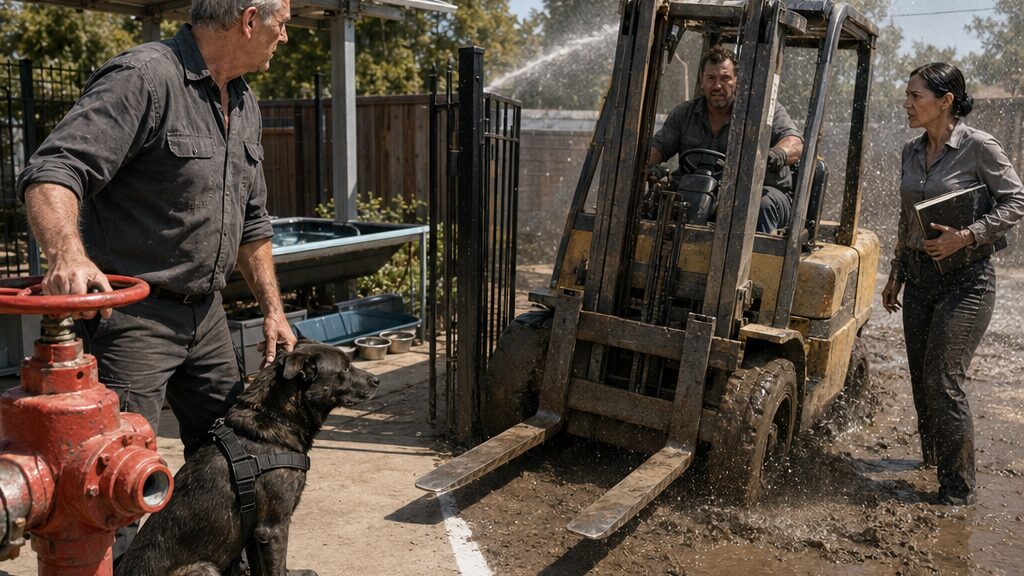
The HOA Sent a Forklift for His Solar Panels, but the Property Line Fought Back
Chapter 1: The Forklift Arrived Before the Morning Heat
The dog stopped drinking before Jacob heard the engine.
One second, she was lapping from the stainless-steel bowl beneath the patio shade. The next, her head lifted, water dripping from her muzzle, her body rigid and angled toward the dirt lane beyond the gate.
Jacob followed her stare.
A horn barked twice.
Then the top of a forklift mast rose above the cedar fence.
“Easy,” Jacob said.
The dog moved to his left leg instead of relaxing. Her shoulder pressed lightly against his knee, the practiced contact firm enough to be noticed but not enough to unbalance him.
Jacob set down the white paintbrush in his hand.
He had been kneeling at the patio entrance, refreshing the narrow property line that crossed the packed dirt between his fence post and the drainage marker. The old stripe had faded under tires, dust, and two summers of sun. Half of it now shone bright against the earth. The other half remained a chalky ghost.
The forklift horn sounded again.
Behind Jacob, four dark solar panels stood on steel supports above the western edge of the patio. They were tilted high enough to shade the dog’s resting platform, the water circulation pump, and the compact cooling unit mounted against the house. A green light blinked on the medical monitor beside the patio door. The fan beneath the shade canopy turned with a low, steady hum.
Everything was working.
That mattered more than the truck outside his gate.
Jacob rose carefully. His right hand rested on the fence until the brief pressure behind his eyes passed. The dog watched him without moving.
“I’m all right.”
She did not believe him yet.
The gate latch rattled.
A woman’s voice came through the slats. “Mr. Robinson, open the gate.”
Jacob recognized the flat precision before he recognized the speaker. Angela Garcia had delivered three certified notices over the past month, each in the same uninflected tone, as though annoyance, urgency, and courtesy were equally inefficient.
He opened the smaller pedestrian gate but kept his body in the space.
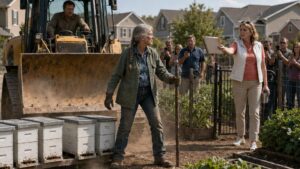
Angela stood outside in a pale gray blouse, dark slacks, and spotless low-heeled shoes unsuited to the dirt lane. A thick HOA rulebook rested beneath one arm. In her other hand she carried a blue contractor packet stamped with the association seal.
Behind her, a flatbed truck idled beside the curb. Two workers were releasing chains from a compact yellow forklift. A broad-shouldered man in a faded work shirt stood on the flatbed, directing them with short hand signals.
“What is this?” Jacob asked.
Angela looked past him toward the solar array.
“Enforcement.”
The forklift’s metal ramps struck the ground with twin crashes. The dog flinched against Jacob’s leg.
Angela opened the rulebook to a tabbed page. “The exterior energy installation has remained in violation beyond the corrective period.”
“You sent an inspection notice.”
“We sent several notices.”
“And I answered them.”
“You failed to cure the violation.”
The broad-shouldered man climbed down from the flatbed. He glanced at Jacob, then at the panels.
“Daniel Clark,” he said. “Crew foreman.”
Jacob did not offer his hand. “What were you hired to do?”
Daniel’s gaze shifted to Angela.
She answered for him. “Remove the offending structure.”
“With a forklift?”
“The supports are anchored.”
Jacob looked from the lowered forks to the solar panels above the dog’s shaded station. The machine was small enough to fit through the vehicle gate, but large enough to buckle every support if Daniel drove it in low and lifted.
“Nothing enters my property,” Jacob said.
Angela turned a page. “Clause fourteen authorizes corrective action when an exterior condition causes continuing interference with neighboring property.”
“What interference?”
“Solar glare.”
“At what hour?”
“That is immaterial.”
“It is very material if you intend to destroy the system.”
Angela’s expression did not change. “The reflected light has been documented. The board approved forced removal after your failure to comply.”
One worker started the forklift. The engine rose from a diesel clatter into a heavy mechanical growl.
The dog moved in front of Jacob.
He touched two fingers to the side of her harness. “Behind.”
She obeyed reluctantly, stepping back while maintaining contact with his calf.
Daniel climbed into the operator’s seat and tested the lift. The forks rose, stopped, then lowered until their tips hovered inches above the dirt.
Angela checked her watch. “The installation will be removed before noon.”
Jacob studied the lane.
No police cruiser. No county inspector. No utility representative. No fire officer. No court official. Just Angela, three workers, and a machine built to make resistance seem unreasonable.
“You scheduled demolition without an inspector present?”
“This is not demolition.”
“What do you call steel forks tearing anchored panels out of concrete?”
“Correction.”
The word chilled him more than anger would have.
Jacob stepped through the gate and pointed to the line he had been repainting.
“That stripe runs from the survey pin beneath the fence post to the drainage marker. My parcel begins there. The forklift is outside it.”
Daniel leaned sideways in the seat to see.
“Looks like it,” he said.
Angela turned toward him. “The association has access authority.”
“I didn’t ask about your association,” Jacob said. “I asked the operator where his machine is.”
Daniel kept one boot near the brake. “Outside the line.”
“Good. Keep it there.”
For the first time, Angela’s mouth tightened.
She held out the blue packet. “Mr. Clark has the authorization required to complete the work. Your appeal period has expired.”
Jacob took the packet but did not move away from the gate. The association seal filled the upper corner. His address appeared beneath a bold heading: FINAL CORRECTIVE ENFORCEMENT.
He scanned the first page.
A board vote was listed. So were three notice dates and a reference to clause fourteen. The work description said removal of noncompliant reflective equipment and supporting structures.
No warrant.
No court seal.
No case number.
His dog nudged the back of his knee.
Jacob closed the packet.
“Who told you this document permits entry?”
Angela’s eyes flicked toward Daniel. “The board’s legal authority is explained in the attached materials.”
“That wasn’t my question.”
“It is the relevant answer.”
Daniel shut off the forklift. The sudden quiet exposed the cooling fan beneath the patio and the soft ticking of the water pump.
Jacob heard his own breath. He also heard the reason he had installed the red emergency valve beside the gate, waist-high on the steel supply pipe. The system had been designed to protect the battery cabinet and patio supports from brush fire. Three separate zones. Two pressure settings. Manual override.
Angela looked at the half-painted line, then at Jacob.
“You have had ample opportunity to cooperate.”
“I offered a correction.”
“You offered an unapproved modification.”
“You never inspected it.”
“The hearing concluded the matter.”
Jacob held up the packet. “This does not say a court authorized you to enter.”
“It says removal is authorized.”
“By the people who hired you.”
Angela turned to Daniel. “Lower the forks and position the machine at the gate.”
Daniel restarted the engine.
The forks sank toward the ground.
Jacob stepped back onto his side of the bright white stripe. His fingers brushed the cool metal wheel of the red valve, then moved away.
On the first page of Angela’s packet, beneath every stamped phrase and official-looking box, the blank space where a court case number should have appeared seemed larger than anything printed there.
Chapter 2: Clause Fourteen Did Not Say Demolition
“Clause fourteen ends there,” Jacob said. “It does not say you can destroy anything.”
The forklift engine idled behind Angela, its warning beeper sounding every few seconds. Jacob stood just inside the gate with the open rulebook balanced against one forearm. Angela had surrendered it only after he demanded to read the language she kept quoting.
He traced the paragraph with his finger.
“Written notice. Opportunity to cure. Hearing before the board. Assessment of reasonable costs.” He looked up. “Where is forced entry?”
Angela held out her hand for the book. “The association’s enforcement powers are not limited to a single paragraph.”
“Then show me the paragraph that allows this.”
“You are not qualified to interpret the governing documents.”
“I maintained municipal pump stations for thirty-two years. I can read an instruction manual.”
“This is not an instruction manual.”
“No. Manuals usually tell you what you’re allowed to do before you break something.”
One of the workers looked down to hide a reaction. Daniel did not. He sat in the forklift with both hands loose on the controls, watching Angela.
She took the rulebook from Jacob.
“Your objections were due at the compliance hearing.”
“I sent written objections.”
“You failed to appear.”
“I was told the board had my documents.”
“You were told you could present them.”
The distinction landed harder than Jacob expected.
Angela opened the contractor packet and removed a glossy photograph. It showed a row of folding chairs in the HOA meeting room. One chair near the front had a printed card taped to its back.
ROBINSON.
Empty.
“The board waited eleven minutes,” Angela said. “Your absence was entered into the record as a waiver of personal presentation.”
Jacob stared at the photograph.
He remembered that night. His jacket hanging over the kitchen chair. The dog’s harness on the counter. His truck keys in his palm.
He had driven halfway to the clubhouse before turning around.
There had been thirty people at the last meeting he attended, all facing him after his knees weakened near the coffee station. Someone had called an ambulance even after he said not to. Someone else had recorded it. For weeks afterward, neighbors had lowered their voices when they saw him, as though speaking too loudly might make him collapse again.
He had not returned.
“That doesn’t create demolition authority,” he said.
“No,” Angela replied. “The board’s decision does.”
She stepped across the painted line.
It was only one pace. The toe of her clean shoe landed on Jacob’s side, beside the unfinished paint can.
Jacob looked down.
Angela followed his gaze. “The HOA retains access rights for enforcement.”
“Step back.”
“This boundary does not nullify the covenants.”
“It does not disappear because you carry a binder.”
She remained where she was.
The dog shifted between them. Her posture was not aggressive, but her eyes stayed fixed on Angela.
Angela glanced at the harness. “Control your animal.”
“She is controlled.”
“She is obstructing an authorized representative.”
“She is standing on her own patio.”
Daniel turned off the forklift again.
“Let’s settle the access question before we move equipment,” he said.
Angela did not look at him. “The access question has been settled.”
“Not for my insurance.”
Jacob stepped away from the gate, keeping Angela in view, and entered the small utility room beside the patio door. The air inside smelled of metal shelving and pipe sealant. He opened a flat drawer beneath the workbench.
The deed survey lay inside a clear sleeve. Beneath it was a copy of the letter he had sent to the HOA after the first threat of removal. The letter identified the separate patio parcel, denied consent to entry, and demanded judicial authorization before any contractor crossed the surveyed boundary.
He had written it carefully.
He had omitted three words just as carefully: medical support system.
At the time, that omission had felt like protection.
Now it looked like an open gate.
When Jacob returned, Angela had moved another step onto the property. Daniel stood beside the forklift, reading the work order.
Jacob placed the survey against the fence.
“Survey pin here. Drainage marker there. The patio parcel was added to the deed before the HOA was formed. Your own records acknowledge it.”
Angela barely glanced at the page.
He held up the letter. “And this was delivered twelve days ago.”
“It was received.”
“You knew I denied access.”
“You cannot deny lawful enforcement.”
“Then show the law.”
The dog touched Jacob’s wrist with her nose.
He ignored her.
She touched him again, harder, then moved across his knees and leaned her weight against him.
Daniel looked up. “Is she alerting?”
Jacob felt a thin tremor begin in his right hand.
“She’s working.”
Angela exhaled through her nose. “This is precisely the sort of delay the board anticipated.”
Jacob’s eyes lifted to hers. “What did you say?”
“I said the enforcement will not be suspended by performance.”
Daniel’s face changed.
Jacob gripped the fence rail until the tremor eased. The dog stayed braced against him.
“She alerts before I lose balance,” he said. Each word cost more than it should have. “That is not a performance.”
Angela’s gaze moved briefly to the cooling platform, the pump, and the monitor inside the patio door. “Her medical role was not included in your architectural application.”
Because he had refused to include it.
Because the application asked for the nature of the accommodation, supporting diagnosis, treating provider, and expected duration. Because the idea of handing those details to a volunteer board had felt worse than a fine.
“The equipment meets code,” Jacob said.
“That is not the issue under review.”
“It should have been.”
“You chose not to make it one.”
The truth in that sentence made him angrier than her contempt.
Daniel walked to the gate with his copy of the packet.
“Mr. Robinson,” he said, “does your survey match the county filing?”
“Yes.”
“And the association knew entry was disputed?”
“You’re holding their answer.”
Daniel looked at Angela. “Do we have a court order?”
“The board’s authorization is in your packet.”
“I’ve read the board authorization.”
“Then you understand your assignment.”
“I asked about a court order.”
Angela tucked the rulebook beneath her arm. “The association’s counsel reviewed the enforcement process.”
“That’s not a yes.”
Her eyes hardened, but her voice remained level. “Your company accepted the contract based on the documents provided. Delay provisions began when you arrived.”
Daniel glanced toward his crew. One worker stood near the flatbed, checking his phone. The other had already removed the protective straps from the forklift attachment. They were being paid to work, not to referee a property dispute.
Jacob understood the pressure in Daniel’s silence.
Angela did too.
She stepped back over the painted line, not in concession but because she no longer needed to prove she could cross it.
“Position the forklift,” she said.
Daniel did not move.
Angela tapped the contractor packet with one finger. “The board’s authorization is in your packet.”
She had answered him twice without ever answering him at all.
Chapter 3: The Complaint Jacob Never Truly Received
A blade of white light flashed across the lane and struck Brenda Allen’s upstairs window.
Everyone saw it.
The reflection lasted less than two seconds, but it filled the glass so sharply that Brenda recoiled behind her desk. A moment later, her front door opened and she hurried down the side path toward Jacob’s fence.
Angela closed the rulebook with quiet satisfaction.
“There,” she said. “The continuing interference.”
Jacob looked up at the panels.
The morning angle had shifted exactly as his calculations predicted. The upper western panel caught a narrow band of sun and threw it across the space where the old shade tree had once stood.
The light vanished.
Daniel folded his arms. “That’s the glare?”
“That is one occurrence,” Angela said. “It repeats daily.”
Brenda reached the lane wearing house shoes and a work headset around her neck. She stopped when she saw the forklift.
“What are they doing?”
“Executing the corrective order,” Angela said.
Brenda stared at her. “With that?”
“You filed the complaint.”
“I asked for the reflection to stop.”
“And the board determined removal was necessary.”
“No one told me you were tearing down his whole system.”
Jacob felt something inside him loosen and tighten at the same time.
“You said it hit your office all morning,” he said.
Brenda turned to him. “I said it hit my screen during my eight-thirty calls.”
“The notice said continuous glare.”
“I didn’t write the notice.”
Angela opened the rulebook again. “The duration does not determine whether a nuisance exists.”
Jacob looked at Brenda. “Why didn’t you come to me?”
Her cheeks colored. “I did. Twice.”
“You left two cards from the management office.”
“Because when I knocked, you opened the door three inches and told me to submit everything in writing.”
He remembered. He had been unsteady that week and unwilling to let anyone see the medical equipment stacked in the hall.
“I thought you were collecting signatures,” he said.
“I thought you didn’t care.”
The dog moved from Jacob to the shade station and lay down near the water pump, though her eyes remained on him.
Angela pointed toward the panels. “The resident was given multiple opportunities to address the condition.”
Jacob went to the utility shelf and pulled out a narrow cardboard tube. He removed a rolled drawing and spread it across the top of the paint can.
It showed a hinged aluminum shield mounted along the upper edge of the western panel. The angle could be adjusted seasonally to block the brief reflection without reducing meaningful output.
“I submitted this three weeks ago.”
Brenda crouched beside the drawing. “I’ve never seen it.”
Angela remained standing. “The proposal was not approved.”
“Was it sent to her?” Jacob asked.
“That was not required.”
Brenda looked up. “You told me he refused every corrective option.”
“He refused removal.”
“That is not the same thing.”
Angela’s expression barely shifted, but the pause before her answer was visible.
“The board determined that an owner-designed attachment could introduce additional visual and structural concerns.”
Jacob tapped the engineer’s stamp in the bottom corner. “It wasn’t just owner-designed.”
Daniel leaned closer. “Adjustable glare screen?”
“Yes.”
“Could install it without removing the panel?”
“In two hours.”
Brenda stood. “That is all I wanted.”
Angela turned to her. “The association cannot base enforcement on informal preferences after a violation has been adjudicated.”
“My complaint is not an informal preference.”
“Your complaint initiated a process. It does not control the board’s final remedy.”
The words left Brenda still.
For the first time, Jacob saw why she had relied on Angela. Brenda disliked confrontation so much that she had handed the problem to a system designed to sound certain. Angela had converted that trust into authority.
But Jacob had handed her something too.
His silence.
His refusal to open the door. His empty chair at the hearing. His application stripped of every detail that might have explained why the installation mattered.
He had made it easy to describe him as stubborn because stubbornness was the only part he had allowed anyone to see.
Daniel studied the solar frame. “Why did the glare start now if the panels have been up for two years?”
Brenda pointed toward the bare strip between their properties.
“There was a tree.”
Jacob looked at the stump near the drainage swale. The HOA landscaping crew had removed the mature shade tree six weeks earlier after roots cracked a section of common walkway.
“The tree blocked the angle,” he said.
Brenda nodded. “I didn’t have any reflection before they cut it down.”
Angela’s fingers tightened around the rulebook.
“The association removed a hazardous tree. That does not transfer responsibility for a private installation.”
“It changes the cause,” Daniel said.
“It changes nothing about current compliance.”
Jacob rolled the drawing halfway closed, then stopped.
“I’ll install the shield today.”
Angela shook her head.
“You can inspect it before sunset.”
“The removal contract has been executed.”
“That is your reason?”
“The board issued a final decision.”
“The crew is already paid,” Daniel said quietly.
Angela looked at him. “Mobilization and removal have been authorized. Failure to complete the assignment may trigger delay penalties.”
Brenda took out her phone. “I want to see the complaint record.”
Angela’s tone sharpened by a degree. “You may submit a records request.”
“I have the emails.”
She scrolled, opening one message after another. Jacob watched her expression change from irritation to confusion.
“Here,” she said. “This says, ‘Owner has refused all corrective options and insists no modification will be made.’”
She held the phone toward Jacob.
The message had come from Angela’s HOA address.
Below it was Brenda’s reply: If he will not adjust it, then the board needs to do something.
Jacob unrolled his drawing completely and pointed to the submission stamp. The date was two days before Angela’s email.
Daniel saw it too.
Brenda swiped at the screen. “There are attachments.”
Angela stepped toward her. “Those communications may include privileged board material.”
“They were sent to me.”
One attachment opened slowly.
A scanned cover page appeared first, bearing Jacob’s address and the title PROPOSED REFLECTIVE MITIGATION SHIELD. Beneath it, in the received box, was Angela Garcia’s electronic signature.
Brenda enlarged the timestamp.
Three weeks earlier.
Before the final hearing.
Before the removal vote.
Before Angela told Brenda that Jacob had refused every option.
The forklift idled behind them, its engine vibrating through the dirt. Angela stood between the machine and the marked property line with the rulebook pressed against her side.
Brenda turned the phone so Daniel could see.
“You had his solution,” she said. “Why did you tell us he never offered one?”
Chapter 4: The Order Hidden Inside the Work Packet
Daniel took Brenda’s phone, compared its timestamp to the paper in his hand, and shut off the forklift.
The engine coughed into silence. Dust settled around the tires.
“Everybody hold,” he called to his crew.
Angela’s head turned sharply. “You are not authorized to suspend the work.”
“I’m authorized to keep my people out of a bad job.”
“There is no bad job. There is a noncompliant structure and a valid removal order.”
Daniel laid Brenda’s phone on the forklift hood, then opened the blue contractor packet. Jacob placed his survey and mitigation drawing beside it. The papers met directly above the painted stripe, Angela’s documents on the lane side and Jacob’s on the patio side.
Daniel flipped to a page marked SITE CONDITION.
His brow tightened.
“What does yours say?” Jacob asked.
Daniel read aloud. “‘Abandoned hazardous energy structure. Owner has refused access for safety remediation. Court-authorized removal status confirmed by contracting authority.’”
Brenda stared at Angela. “Abandoned?”
Jacob looked behind him.
The cooling fan turned beneath the solar canopy. Water moved through the dog’s bowl in a steady filtered stream. The monitor beside the patio door blinked green. A clean cloth hung from the support harness rack where he had placed it that morning.
Nothing on the patio looked abandoned because nothing was.
Daniel tapped the page. “What court?”
Angela folded her arms. “The association’s counsel reviewed the matter.”
“That isn’t what this says.”
“The terminology reflects legal review.”
“It says court-authorized.”
“The board acted within its authority.”
Daniel turned the page over, searching for a docket number or seal. “Who wrote this description?”
“The contractor packet was compiled by management.”
“You are management.”
“I am the administrative officer assigned to enforcement.”
Daniel drew a slow breath. “So you wrote it.”
Angela did not answer.
One of the workers came closer, wiping his hands on his trousers. “We were told the power had been disconnected.”
“It hasn’t,” Jacob said.
The worker looked toward the cables running beneath the panels. “Then those forks go into the frame and catch a live conduit, we’ve got more than property damage.”
“The system has automatic isolation,” Jacob said. “But you were not given permission to test it with a forklift.”
Daniel’s jaw hardened. “Packet says utilities secured by owner.”
Jacob pointed to himself. “Do I look like I secured anything for you?”
Angela stepped between the men. “The owner has been notified repeatedly. His refusal to cooperate does not invalidate the work order.”
“It invalidates the line saying he did cooperate,” Daniel said.
For the first time, strain showed beneath her calm. A faint pulse moved at the side of her neck.
“The board expects visible resolution today,” she said. “There have been unresolved violations in this section for months. Residents complain that rules are enforced selectively. When exceptions accumulate, the covenants become meaningless.”
Brenda crossed her arms. “Fixing the glare is not an exception.”
“You are not the only resident affected by enforcement standards.”
“No. I’m the resident whose complaint you used.”
Angela faced Daniel again. “Your company agreed to a completion deadline. Delay penalties began at nine-thirty.”
Daniel checked his watch. Nearly an hour had passed since the forklift came off the truck.
“How much?” Jacob asked.
Daniel did not respond, but the look he gave the two workers answered enough. This was not a large company with attorneys waiting in an office. The flatbed was worn. One ramp had been reinforced by hand. A week’s payroll could disappear inside a contract penalty drafted by people who never touched the machinery.
Angela understood that too.
She drew Daniel a few paces toward the truck and lowered her voice. Jacob could not hear every word over the cooling fan, but he heard enough.
“Change order.”
Daniel glanced back.
Angela continued. “Access obstruction was not disclosed. I can approve additional labor, standby time, and equipment recovery if necessary.”
“After legal review?” Daniel asked.
“After completion.”
“That isn’t an answer.”
“It is a guarantee that your company will not bear the cost of his resistance.”
Daniel looked toward Jacob’s dog, now standing beside the shaded platform. “And if your paperwork is wrong?”
“It is not.”
“You said counsel reviewed it. You did not say a judge signed it.”
Angela’s voice dropped further. “Move the machine into the access position. Nothing has to be removed until I resolve the document concern.”
Jacob heard that clearly.
“Access position is across my line.”
“It is at the gate,” Angela said, turning back.
“The gate is inside the parcel.”
“You are manufacturing distinctions to obstruct enforcement.”
“No. I painted the distinction this morning.”
Daniel rubbed one hand over his face. “I won’t put the forks into the panels while he or the dog is in the work zone.”
Angela’s gaze sharpened. “No one instructed you to strike a person or animal.”
“You instructed me to charge an occupied structure.”
“I instructed you to secure access.”
The word changed each time she used it. Removal had become remediation, then positioning, then access. The machine remained the same.
Jacob gathered his survey before the forklift hood’s vibration could slide it to the dirt. His fingers passed over the red mitigation drawing. The shield would have been simple: two brackets, one pivot rail, twenty minutes of adjustment after the first installation.
An answer small enough to hold in both hands.
Angela had buried it because a corrected panel would not look like enforcement.
Daniel returned to the forklift. He did not climb in immediately.
“If I move it,” he told Jacob, “it’s straight ahead, low speed, and only enough to clear the truck lane.”
“You cross that paint, you are on my land.”
“I understand.”
“Then don’t.”
Daniel glanced at Angela. “I have two men who need their checks Friday.”
Jacob saw no threat in the statement. That made it worse. Daniel was telling him the truth Angela had placed between them: one man’s property against another man’s payroll.
Jacob went to the patio wall and checked the support dog’s tether point. He did not attach it yet. The dog worked best free to position herself, and restraints could become dangerous if the machine came through the gate.
Beside the wall, the red valve waited on the main sprinkler pipe.
Three zones branched from it. The first covered the panel supports. The second protected the battery cabinet. The third ran beneath the dirt lane through six high-flow heads installed after a brush fire jumped the drainage swale two summers earlier.
Jacob had tested every head in spring.
Daniel climbed into the forklift.
Angela stood close to the machine and raised the blue packet as though it were a signal flag.
“Move forward six feet.”
Daniel started the engine. “That crosses the line.”
“The association’s access right has already been established.”
“By whom?”
“By the board.”
Brenda lifted her phone and began recording.
Angela saw her. Something in her expression closed.
She placed one foot on the forklift’s running board and gripped the frame beside Daniel’s seat.
“You have a contracted instruction,” she said. “Execute it.”
Daniel kept his foot on the brake.
Angela leaned closer. “If this job is not completed, the full delay assessment will be applied. No change order. No standby allowance. No recovery reimbursement.”
One of the workers swore softly behind the truck.
Daniel looked at Jacob.
“I’m not touching the panels.”
“The line,” Jacob said.
“I know.”
“Do you?”
The engine vibrated through the ground. The dog pressed against Jacob’s leg. Beneath his palm, the red valve wheel was warm from the sun.
Angela struck the side of the forklift with the flat of her hand.
“Proceed.”
Chapter 5: What the Solar Panels Were Keeping Alive
The dog shoved her nose beneath Jacob’s wrist before Daniel released the brake.
His hand trembled against the red valve.
Not much. Two quick movements through the fingers, nearly invisible beneath the machine’s vibration. The dog caught them anyway. She stepped across him, blocking his knees, then leaned hard against his thighs.
“Not now,” Jacob whispered.
She held her position.
The sun had climbed past the canopy edge. Heat pressed onto the patio tiles and gathered beneath the steel roof supports. The cooling fan was still running, but the air it pushed no longer felt cool. The battery cabinet’s display showed the load climbing as the water circulation system, fan, and medical monitor worked together.
Daniel waited in the forklift seat.
Angela remained on the running board, one hand gripping the frame. “Move.”
“Give him a second,” Daniel said.
“He has had a month.”
Jacob’s vision narrowed at the edges. He bent his knees slightly and let the dog take more of his weight.
Angela looked toward Brenda’s phone. “Record the obstruction clearly.”
Brenda lowered it just enough to stare at her. “She’s alerting him.”
“I can see the animal.”
“No,” Brenda said. “I don’t think you can.”
Jacob reached for the gatepost and steadied himself. A memory came without invitation: fluorescent lights in the clubhouse, a paper cup rolling away from his hand, thirty faces turning as his legs folded beneath him. Someone kneeling too close. Someone saying his name as if he had already stopped hearing it. The red pulse of an ambulance washing over the windows.
Afterward came the careful voices.
Do you need someone to drive you?
Should you still be living alone?
Maybe the board should have an emergency contact.
He had answered every question by withdrawing from the people asking it.
The dog nudged his palm.
Jacob looked down at her harness, then across the patio.
“The panels power her cooling station,” he said.
No one spoke.
He forced the rest out before pride could close his throat again.
“They run the circulation pump, the fan, and the backup monitor inside. During an outage, the battery keeps the patio below the recovery limit and keeps my medical alert system alive.”
Angela’s eyes moved toward the equipment.
“That information was not submitted with your application.”
“I know.”
“You represented this as a residential energy improvement.”
“It is one.”
“You withheld a claimed accommodation.”
“I withheld my medical records from a board that put complaint photographs in public meeting packets.”
Angela stepped down from the forklift. “Then the board ruled on the facts you provided.”
The sentence struck cleanly because it was true.
Jacob had expected her to understand what he refused to disclose. He had demanded protection for a purpose he had hidden, then treated every misunderstanding as proof that hiding was necessary.
Brenda looked at the monitor by the door. “Is that why you never let anyone inside?”
Jacob did not answer.
The dog eased her weight as his hand steadied.
He placed one boot on the painted line and the other inside his property. For a moment he stood divided between the lane and the patio, between the argument he had made and the truth beneath it.
Then he stepped fully back onto his side.
“My condition causes sudden pressure loss and loss of balance,” he said, looking at Daniel rather than Angela. “She alerts before it becomes dangerous. The solar system keeps the equipment running when the grid drops in high heat. You tear those panels out, you are not removing decoration.”
Daniel shut the forklift down again.
Angela took out her phone. “Unverified medical claims do not stay enforcement.”
“No,” Jacob said. “Evidence does.”
He pulled his own phone from his pocket and opened Michael Moore’s number.
Michael answered on the third ring.
“Tell me you are not calling from in front of a moving machine.”
“I am calling from behind my property line.”
“That was not what I asked.”
Jacob turned on speakerphone. “The contractor is here. They have a packet claiming court-authorized removal. There is no case number.”
A pause followed.
“Who issued the order?” Michael asked.
“The HOA board.”
“That is not a court.”
Angela spoke loudly enough for the phone. “Judge Moore, this is an administrative covenant matter. Your personal relationship with the owner is inappropriate.”
Michael’s voice cooled. “Who is speaking?”
“Angela Garcia, association enforcement administrator.”
“Ms. Garcia, I am not presiding over anything on this telephone call. Mr. Robinson called a friend. A friend cannot issue an injunction.”
Angela looked at Jacob with the first hint of triumph he had seen all morning.
“There,” she said. “Even your judge friend refuses to interfere.”
Michael continued. “Jacob, listen carefully. If you want lawful emergency relief, you need a record. Not my opinion. Not a fishing story. A record.”
Jacob closed his eyes for half a second.
He had wanted Michael’s title to do what he accused Angela’s rulebook of doing—end the argument by sounding powerful.
“What do you need?” he asked.
“The deed and current survey. Every notice. The contractor packet. Evidence that entry is imminent. Evidence of the system’s medical function if that is part of the claimed harm. And someone other than you who can verify what is happening.”
Brenda raised her phone. “I can.”
Daniel looked toward the crew, then nodded once. “So can I.”
Angela stepped away from the forklift. “Employees under contract are not neutral witnesses.”
“They do not have to be neutral,” Michael said. “They have to tell the truth.”
Jacob went to the utility room.
This time he did not stop at the survey drawer.
A locked metal file box sat beneath the workbench. He had not opened it since renewing the dog’s certification. Inside were the physician’s letter, the medical equipment schedule, the veterinary heat-safety plan, and the battery backup specifications.
His hand rested on the lid.
Then he carried the entire box outside.
He spread the documents on the patio table. Brenda photographed the altered packet and forwarded her email chain. Daniel photographed his work instructions. Jacob scanned the deed, the survey, and his prior no-entry notice.
The medical letter remained last.
For years, he had treated the paper as if anyone reading it would acquire ownership of the weakness described there.
He placed it beneath the phone camera.
“Send it,” Michael said.
Jacob did.
Michael gave him an emergency filing address and told him how to title the submission. He spoke with the precision of someone protecting the process from the appearance of personal favor.
“I am routing this to the duty court,” he said. “I may be able to confirm status, but I will not decide it. Do you understand?”
“Yes.”
“And Jacob?”
“Yes.”
“Stop asking people to protect what you refuse to let them see.”
The line went quiet while Michael checked the submission.
Angela turned toward Daniel. “The judge has made clear he is not intervening. Resume access positioning.”
“He said a duty court is reviewing it,” Brenda said.
“He said he is not issuing an order.”
Jacob propped his phone against the gatepost with the camera aimed at the painted line. The screen captured the stripe, the forklift’s front wheels, Angela, and the lower edge of the solar supports.
Michael returned to the call.
“The emergency request has been received. Keep the live feed running.”
“How long?” Jacob asked.
“I cannot promise you a time.”
Angela climbed back onto the running board.
Michael’s voice sharpened. “Jacob, do not touch that valve unless the machine crosses the line. Not approaches. Not threatens. Crosses.”
Jacob looked at the red wheel beneath his hand.
The forklift engine started again.
“I understand.”
Chapter 6: When the Steel Forks Crossed the Line
Angela struck the forklift’s side panel.
“Proceed.”
Daniel’s foot came off the brake.
The machine lunged half a yard before he caught it, the sudden motion pitching Angela against the frame. The steel forks jumped over a rut and settled low, aimed through the open gate.
Jacob did not move toward the valve.
His phone remained propped against the gatepost, its camera fixed on the painted stripe. Brenda stood behind it with her own phone recording. The two crewmen had moved clear of the machine. The dog pressed against Jacob’s left leg, her harness warm beneath his fingers.
“Slow,” Daniel called over the engine.
Angela gripped the frame. “Continue.”
The forklift rolled forward.
Its tires compressed the loose dirt until the tread marks stopped inches from the white paint.
Daniel braked.
The mast swayed.
“Your six feet ends there,” he said.
“The access position is inside the gate.”
“That is his line.”
“The line has no effect on the association’s easement.”
Jacob raised his voice above the engine. “Daniel, you have been told entry is disputed. You have seen the survey. Do not cross.”
Daniel stared ahead through the mast.
Angela leaned toward him. “Your refusal is now a contractor default.”
“I said I would position it. I did not agree to trespass.”
“You agreed to perform the work described in your packet.”
“The packet you won’t explain?”
Angela looked at the camera on Jacob’s gatepost. Her face became still.
“Move forward.”
Daniel’s hands tightened on the controls.
Jacob reached beside the main valve and opened the smaller brass control marked ZONE THREE—TEST.
A sharp hiss ran beneath the dirt.
Two sprinkler heads snapped up on either side of the gate and released crossing fans of water. The streams struck the forklift’s forks with a metallic roar, drenching the steel and spraying mist across the lane.
Daniel flinched but kept the machine stopped.
Angela recoiled. Water darkened one sleeve of her blouse.
“You have activated a hazard against contracted personnel.”
“It is a warning zone,” Jacob said. “The main system is still closed.”
“Turn it off.”
“Back the machine away.”
The water continued for ten seconds, then Jacob closed the test control. Droplets fell from the forks. The dirt around the boundary darkened, but the ground remained firm.
Daniel wiped water from his face. “That was your warning.”
“Yes.”
Angela climbed down.
For one hopeful second, Jacob thought she had decided to stop.
Instead, she walked to the front of the forklift and pointed through the gate.
“The water system confirms the owner is intentionally interfering with lawful enforcement. Proceed past the obstruction.”
Daniel stared at her. “You want me to drive through after he warned us on camera?”
“I want you to fulfill the contract.”
“What if the injunction comes through?”
“There is no injunction.”
“Yet,” Brenda said.
Angela turned toward her. “There is no legal basis for one. The owner created this urgency by refusing every earlier opportunity.”
Brenda lifted the email showing Jacob’s suppressed proposal.
“You know that isn’t true.”
A sound came from Angela then—not anger, but exhaustion compressed into one breath.
“I have forty-seven open compliance files,” she said. “Every owner claims a special fact. Every owner says their case is different. The board asks why nothing closes. Residents ask why their neighbor gets an exception. Counsel tells us to follow procedure. The procedure was followed.”
“You changed the contractor’s packet,” Daniel said.
“I summarized the board’s authority.”
“You wrote ‘court-authorized.’”
“The enforcement was legally reviewed.”
“That is not the same.”
Angela looked at him as though he had betrayed a shared understanding. “You accepted the job.”
Daniel glanced toward his workers. One of them shook his head. The other looked at the flatbed, perhaps calculating how much money had already been lost.
Angela stepped beside the front tire.
“Move it far enough to secure the entrance. I will assume responsibility.”
That was the choice.
Not the rulebook. Not the board. Not counsel.
Hers.
Daniel started forward.
Jacob moved the dog behind the reinforced patio barrier and gave the stay signal. She resisted for one second, then obeyed, body tense behind the steel rail.
He returned to the valve.
The forklift crept toward the line.
Daniel turned the wheel slightly, angling away from Jacob. It was a small act, almost hidden by the size of the machine. He was obeying Angela, but he would not point the forks at a man or dog.
The turn brought the right front tire over the section dampened by the warning spray.
The tire touched the white stripe.
Paint transferred onto the rubber tread.
Jacob watched one block of white disappear beneath the wheel, then reappear behind it as a smeared gray scar.
The machine had crossed.
“Stop!” Brenda shouted.
Daniel braked, but Angela slapped the hood. “Continue. Clear the gate.”
The forklift moved another foot.
Its rear wheel rolled onto the softened patch. Because Daniel had turned to avoid Jacob, the heavy side of the machine now tracked over the lowest part of the lane. One fork angled toward the nearest solar support.
Jacob looked at his phone.
The live feed still ran. Michael had not called.
Angela pointed toward the panels. “Advance.”
Jacob opened the first sectional lever.
The lane sprinklers erupted.
Six heads punched through the dirt in a staggered line and released thick arcs beneath the forklift. Water hammered the undercarriage, flooded the tire tracks, and spread across the access lane in seconds.
Daniel stopped.
“Back out,” he called.
Angela seized the side rail. “Forward. Get onto the patio.”
“The rear tires are slipping.”
“Then keep momentum.”
Daniel shifted into reverse. The wheels spun once and threw wet dirt behind them.
The dog barked from the barrier.
Jacob saw the right fork sway toward the solar support as the rear of the machine slid sideways.
He could still close the sectional lever. The lane was wet but not yet lost. Daniel might reverse out. Angela might claim the entire event was confusion rather than trespass.
Then she climbed onto the running board again and reached toward the directional control.
“Get off the machine,” Daniel snapped.
“You are refusing a direct instruction.”
“You touch that lever, you can drive it yourself.”
Her hand remained inches from the control.
The forklift’s rear tire spun again. Mud formed beneath it, thin at first, then dark and glossy.
The nearest fork shifted another inch toward the support.
Jacob understood what restraint required.
Not another warning.
Action.
He wrapped both hands around the red emergency wheel and pulled.
The main valve opened with a deep internal thud.
Pressure surged through the pipe.
Water exploded from every lane head at once, harder than the test flow, striking the ground with enough force to break the packed surface into slurry. The dry dirt collapsed beneath the forklift’s weight. Its rear tires dropped first, sinking to the rims. The front end tilted. Daniel lowered the forks instantly, using them as braces before they could strike the panel frame.
The engine roared.
The tires spun, flinging mud against the gate, the fence, and Angela’s dark slacks. She jumped down and landed ankle-deep.
“Shut it off!” she shouted.
Jacob kept the valve open until the machine settled axle-deep and motionless.
Then he closed it.
The sudden silence was broken by water draining through ruts and the forklift engine straining uselessly against mud.
Daniel killed the ignition.
No one moved.
The solar supports stood untouched.
The painted line was almost gone beneath brown water, but the video had captured the tire crossing it.
Jacob’s phone began to ring against the gatepost.
Michael Moore’s name filled the screen.
Chapter 7: The Rulebook Dripping in the Mud
Jacob answered the call and pressed the speaker icon with a wet thumb.
Michael’s voice came through over the ticking engine and the hiss of water draining into the ruts.
“An emergency injunction is now in force. Nobody takes another step.”
Angela stood ankle-deep beside the forklift. Mud streaked her trousers to the knee, and the rulebook hung from one hand with its pages darkening beneath the spray.
“This equipment was sabotaged,” she said. “The owner attacked a lawful work crew.”
“The duty court reviewed the live recording, the deed survey, the disputed work packet, and the notice denying entry,” Michael replied. “The order prohibits removal, entry, or interference with the solar installation until a hearing can be held.”
Angela lifted her phone. “I am calling the police.”
“You may,” Michael said. “Provide them with the injunction when they arrive. Anyone who violates it after receiving notice may be held in contempt.”
The two crewmen stepped farther from the property line.
Daniel climbed down from the forklift carefully. His first boot sank almost to the ankle. He caught the handrail, lowered himself onto firmer mud, and stared at the buried wheels.
“You could have rolled it,” Angela told him. “You stopped in the soft ground.”
Daniel wiped mud from his forearm. “You ordered me across a disputed boundary after you were asked for a court order.”
“You accepted responsibility for operating the machine.”
“Based on the packet you gave me.”
Angela raised the dripping rulebook as if it could still settle the matter. “The board approved the work.”
Daniel walked to the truck and retrieved the blue folder. He spread the pages across the flatbed’s raised tailgate, pinning each corner with tools.
Jacob remained beside the red valve.
His dog waited behind the barrier, watching him. He gave the release signal, and she came straight to his side, pressing her shoulder against his leg before sniffing the water running beneath the gate.
“The order is temporary,” Michael said through the phone. “Jacob, do not mistake it for a final ruling.”
“I won’t.”
“The glare complaint remains active. The court will also examine the sprinkler activation and any equipment damage.”
Angela looked at Jacob. “You flooded a commercial machine.”
“After it crossed the line.”
“That does not erase liability.”
“No,” Jacob said. “It does not.”
Brenda lowered her phone.
The answer surprised her. It appeared to surprise Angela too.
Jacob looked at the muddy trench where the white stripe had been. “The glare is real. I’ll correct it. And I’ll account for every valve I opened.”
He did not apologize for opening them.
Daniel called from the flatbed. “Angela, come here.”
She stayed where she was.
He held up a printed email taken from the rear of his packet. “This one says legal review pending.”
Angela’s face emptied.
Daniel read the date aloud. It had been sent four days before the work order, from Angela’s address to the HOA board.
One sentence beneath the subject line was underlined:
Counsel has not confirmed authority for physical entry onto the separately deeded patio parcel.
Daniel pulled out his phone and photographed the page.
“You knew,” he said.
“I documented an unresolved question.”
“Then you sent us a sheet saying court-authorized removal was confirmed.”
“The board voted to proceed.”
“The board is not a court.”
Angela looked toward the workers, but neither man met her eyes.
Daniel began collecting the documents into a dry plastic sleeve. “Save every message from this job,” he told his crew. “Dispatch texts, instructions, photos, all of it. Nobody deletes anything.”
One worker nodded and took out his phone.
Angela’s voice lost its administrative flatness. “Your company is still bound by confidentiality provisions.”
“Not for false statements that put my crew into a trespass case.”
“You have no basis for that accusation.”
“I have your email.”
Daniel pointed toward the half-sunken forklift.
“And I have a machine that now needs recovery because you told me the legal question was settled.”
He took a breath, looking not triumphant but tired.
“Triple the contracted fee,” he said. “Equipment recovery, delay, and reputational damage. Put it in writing today, or I give Jacob every record and testify at the hearing.”
“You cannot extort the association.”
“Then call it a claim. Your lawyers can choose the word.”
Michael’s voice came quietly through Jacob’s phone. “Preserve the documents. Do not negotiate the civil dispute on this call.”
Daniel nodded toward the phone, though Michael could not see him. “Understood.”
The force had gone out of the morning.
Without the engine, there was only the cooling fan, the water pump, and mud sliding from the forklift’s tires in heavy clumps. Angela looked down at the rulebook in her hand. Several pages had swollen away from the binding. Brown water ran from its lower corner.
She stepped toward the gate.
The dog moved closer to Jacob.
Angela stopped before the ruined line.
“May I cross to retrieve the contractor packet?” she asked.
It was the first time she had asked.
“No,” Jacob said. “Daniel has it.”
Her jaw tightened, but she remained on the lane side.
The next morning, the forklift was gone.
Recovery crews had winched it backward after laying broad timber mats across the mud. Deep ruts remained, along with a gray smear where its tire had erased Jacob’s fresh paint.
Brenda arrived carrying a small roller and a can of white marking paint.
“I thought you might need help,” she said.
Jacob almost told her he could manage.
The words reached the back of his teeth and stopped there.
He handed her the roller.
They worked from opposite ends, repainting the boundary from the fence post to the drainage marker. The line came together between them, brighter and straighter than before.
Afterward, Jacob mounted the aluminum glare shield along the western panel. Brenda stood at her office window while he adjusted the angle. She raised one hand when the reflection disappeared.
The dog rested beneath the canopy, cooled by the same fan that had turned throughout the confrontation.
On the patio table, Jacob arranged the papers for the coming hearing: deed, survey, mitigation drawing, Angela’s altered work packet, Daniel’s statement, and the sprinkler system diagram.
The medical-purpose file sat apart from them in its metal box.
He looked at it for a long time.
Then he opened the lid.
He removed the physician’s letter, the support-dog certification, and the equipment schedule. He placed them on top of the hearing file where they could be read without apology or permission.
Outside, the new property line dried in the sun.
Jacob rested one hand on the dog’s harness and left the file open.
The story has ended.