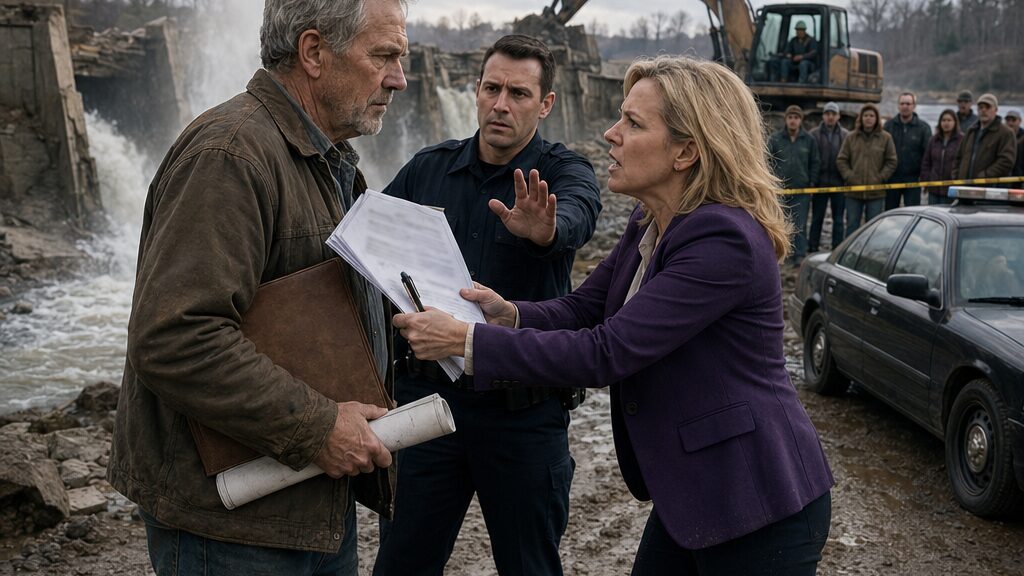
She Demanded Eighty-Six Thousand Dollars After The Dam Came Down In Front Of Everyone
Chapter 1: The Morning The Water Broke Through The Concrete
George Martin saw the water punch through the concrete before he heard the sirens.
It came out in a gray-white burst from the base of the old dam, too low and too violent to be overflow. For one second it looked like steam, a hard bloom of spray shoving itself through a crack that had been there for years and that everyone around Lake Thomas had pretended was only a stain. Then the sound reached his porch—a deep, tearing crack, followed by the roar of water finding a way out.
George stood with one hand on the porch rail and the other still holding his coffee cup.
The cup was warm. His fingers were cold.
Across the road, past the bare trees and the sloping yards, the lake had turned restless. The dam sat half-hidden beyond the bend where the gravel service road dipped behind Karen Roberts’s property. In summer, people called it charming. In winter, with the leaves gone and the concrete showing through the brush, it looked like what it was: old, patched, and tired.
A second crack rolled across the lake.
George set the cup down without drinking. It rattled once against the small metal table. Inside the house, the phone on his kitchen counter began ringing, stopped, and started again.
He already knew what the calls would say.
They would not say the dam had been unsafe.
They would not say the county had walked the spillway months earlier.
They would not say George had sent three letters, two emails, and one certified complaint after the water rose high enough to lap under his back steps.
They would say he had complained.
They would say he had started it.
A yellow excavator arm rose behind the trees and swung into view like a warning. It was not working yet. It hovered above the concrete face, waiting. Beyond it, faint but unmistakable, red and blue lights moved against the muddy road.
George went inside.
The kitchen smelled of cold toast and old paper. On the table by the back window sat the brown lake folder, its corners softened from years of being opened and closed without ever being shown to the people it was meant to answer. He had tied it with a faded blue cord because the clasp had given out. Rolled inside it were county maps, drainage notices, photographs, copies of complaints, and the old survey page he had once promised himself he would bring to a lake association meeting.
He had not brought it.
Not when Karen had laughed and said the lake had always run high in spring. Not when the association members had shifted in their folding chairs and looked at George as if he were asking them to drain their view. Not when someone behind him had muttered, “He bought lakefront and now he doesn’t like water.”
He had folded the map again, put it back in the folder, and gone home.
The phone rang a third time.
George picked it up.
“George?” a neighbor said, breathless. “You seeing this?”
“I’m seeing it.”
“They’ve got county trucks down there. Police too. Karen’s not home yet, but someone called her.”
George looked through the kitchen window. The excavator arm lowered, then stopped again. A worker in a hard hat stepped through the mist, waving another worker back.
The neighbor’s voice dropped. “She’s saying you did it.”
George closed his eyes for one beat.
“She’s on her way back from town,” the neighbor continued. “She knows who started this. That’s what she told the association thread.”
George’s hand tightened around the phone. “I didn’t touch that dam.”
“I know that,” the neighbor said too quickly, in the tone people used when they were already stepping backward from trouble. “I’m just telling you what’s out there.”
Out there.
George looked at the brown folder. The blue cord had slipped loose at one corner. A photograph showed halfway from the stack: the spillway last October, water foaming around a hairline fracture, a strip of green survey ribbon tied to a stake near the concrete seam. He had taken the picture on a cloudy afternoon after seeing tire tracks in the mud below Karen’s dock.
He remembered raising his phone, taking the picture, and then lowering it when Karen appeared on the opposite bank.
She had waved as if nothing were wrong.
He had waved back.
That was his mistake, maybe. One of them.
He hung up and lifted the folder. The documents had weight. Not much, but enough to pull at his wrist in the familiar place where arthritis lived. He slid the old survey map out and unrolled it across the table, holding down one corner with the coffee cup he had carried inside without remembering.
The map showed the dam in thin black lines, not as a possession, but as a structure crossing several marked areas: private parcels, county easement, drainage reserve. A small note near the spillway read: access subject to inspection.
George touched the line with one finger.
He had shown this to no one.
Not because it was useless. Because using it would mean standing in a room full of people who wanted lake views and telling them the thing they liked was also a thing that could fail.
Outside, a horn blasted twice.
George rolled the map with care, slid it back into the folder, and tucked the bundle under his arm. He changed from house slippers into worn boots by the door. His hands took longer than they used to with the laces. He hated that. He hated that people noticed.
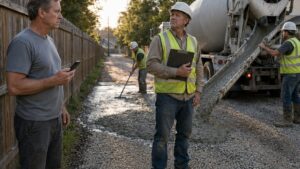
By the time he stepped off the porch, the road had begun to fill. A white county truck blocked the gravel lane. A police cruiser sat at an angle beside it, lights flashing against the wet mud. Two neighbors stood near the ditch, both pretending not to stare at George until he walked close enough for them to look away.
The roar from the dam grew louder with every step.
At the service road, a demolition crew foreman raised a palm. “Sir, you can’t come through.”
“I live there.” George pointed past the trees toward his property. “And I have records for the county inspector.”
The foreman’s eyes moved to the folder under George’s arm. Something in his expression shifted—not belief, not suspicion exactly. Recognition that papers made people complicated.
“Stay behind the cruiser,” the foreman said. “No closer.”
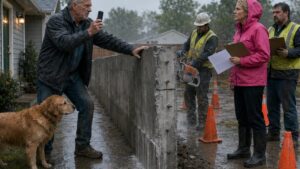
George stopped at the muddy edge where the gravel broke into tire ruts. From there he could see the dam clearly. Water had forced a jagged opening near the base, and the excavator now bit into the upper wall in slow, deliberate strikes. Each impact sent a shiver through the concrete and a slap of spray into the air.
He had wanted repair.
He had wanted inspection.
He had not wanted this.
A police officer stood near the cruiser, watching the crowd more than the dam. George saw the officer glance at him, then at the folder, then away.
Behind him, one of the neighbors whispered, “That’s him.”
George kept his eyes on the water.
Another car came too fast around the bend.
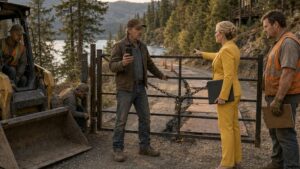
It was dark, clean, and wrong for the mud. It fishtailed once before stopping behind the county truck. The driver’s door flew open, and Karen Roberts stepped out in a purple blazer, one heel sinking at once into the wet shoulder. She did not seem to feel it. In one hand she held a white packet of papers. In the other, a phone.
Her face found George before she was fully out of the car.
The papers in her hand were clipped at the top, the first page already damp at the edges.
She came toward him fast, across the mud and flashing lights, holding the packet like a verdict.
Chapter 2: The Estimate She Slapped Against His Plans
“You demolished my dam?”
Karen’s voice cut through the machinery so sharply that even the excavator operator looked down.
George did not answer at first. He could feel half the road turning toward him, every face hungry for the missing piece. The dam cracked again behind Karen, and water hit broken concrete with a force that made the ground tremble lightly under his boots.
Karen stopped less than two feet from him. Her purple blazer was splattered with mud at the hem. Her hair had come loose on one side. She looked less like a woman surprised by damage than like someone trying to force surprise into anger before anyone else could speak.
“You stood at meetings for months complaining about my water level,” she said. “You sent letters. You brought county people out here. And now this?”
George shifted the folder under his arm. “I didn’t demolish anything.”
“You caused it.” She slapped the packet against the rolled plans hard enough to bend the top page. “And you’re going to cover it.”
The impact ran through the old cardboard tube and into George’s ribs.
The top sheet was a repair estimate. He saw the number before he could stop himself.
$86,400.
Below it were itemized lines: concrete removal, emergency stabilization, temporary shoreline barrier, spillway replacement, labor, equipment, administrative claim fee. The contractor’s letterhead was not Brandon Smith’s, but a larger company from the next county. Karen had not come with questions. She had come with a bill.
“I’m not signing that,” George said.
“You haven’t even read it.”
“I read the number.”
A few neighbors murmured. Karen heard them and lifted the papers higher, performing for the road as much as for him.
“You think because you’re quiet and you carry your little folder around, nobody notices what you’ve been doing?” she said. “You wanted the dam gone. You said it was affecting your property. You filed the complaint that triggered the county order.”
“I filed a drainage complaint,” George said. “Because water was under my steps.”
“And because of that, the county came after my dam.”
Behind her, the excavator teeth bit into the upper lip of concrete. A chunk fell inward with a dull, final thud. Spray lifted over the broken wall.
Karen pointed toward it without looking. “That dam maintained this lake for thirty years.”
“That dam crossed an easement.”
“It was on my side.”
“Not all of it.”
Her eyes narrowed. “Don’t do that. Don’t stand here and act like this is some map trick.”
George felt heat move up his neck. He had spent years not doing this, not correcting people in public, not unfolding maps over folding tables, not forcing neighbors to look at thin black lines when they wanted simple ownership. Now the words were in his mouth and every one of them sounded like an excuse.
A police officer stepped between them when Karen moved closer. His hand came up, palm out, not touching either of them.
“Ma’am, sir, keep some distance.”
Karen leaned around him. “Officer, I want it noted that he has been harassing the association about this dam for months.”
“I haven’t harassed anyone,” George said.
“You wrote complaints.”
“I wrote records.”
“That’s the same thing when people lose property because of you.”
The officer looked uncomfortable. “This is a civil matter unless there’s a threat. Please keep your voices down.”
Civil. The word landed wrong. It made $86,400 sound like a disagreement over a fence line.
Karen took advantage of the pause. She pulled a pen from inside the packet and pressed it against the estimate. “You can start with acknowledgement. I’m not even asking you for the full amount today. I’m asking you to accept responsibility so insurance can proceed.”
George looked at the pen.
There were moments when a person’s whole life narrowed to one small object. A pen. A blank line. A damp piece of paper held against your own records while people waited to see if age had made you agreeable.
He took one step back.
“No.”
Karen’s mouth tightened. “No?”
“No.”
“You understand what happens if you don’t cooperate?”
“I understand I didn’t cause that.”
“You filed the complaint.”
“The spillway was marked before my last complaint.”
That made her blink.
Only once.
The officer looked at George. “Marked by who?”
“The county.” George kept his voice even. “There was a green survey ribbon at the seam. I have a photo from before the emergency notice.”
Karen recovered quickly. “A ribbon? That’s your defense? A ribbon?”
“It means somebody was already looking at it.”
“It means nothing without context.”
“I agree.”
For the first time, her anger shifted into something tighter. She lowered the packet just enough that George could see another page behind the estimate. It was a printed email chain. A highlighted sentence caught his eye.
Resident complaint received from George Martin regarding dam-related drainage concerns.
Karen saw him notice it.
“I have the documentation too,” she said. “And I have a contractor who can explain exactly how your complaint started this chain. Brandon told me the county wouldn’t have touched the dam if you hadn’t kept pushing.”
George did not let himself react to Brandon’s name, though it moved through him like a pulled wire.
Brandon Smith had worked near the spillway the previous fall. Temporary boards. Sandbags. A pump running after dusk. George had seen the truck. He had seen Karen standing by the dock with her arms crossed while Brandon pointed at the waterline.
He had almost walked over.
He had not.
Karen slid the packet back under his rolled plans and trapped both together with her hand. “Friday,” she said. “You have until Friday to acknowledge responsibility before this goes to the insurer with your refusal attached.”
“I won’t acknowledge something false.”
“You may not get to decide what’s false.”
The words were not loud, but they carried.
A neighbor behind George whispered, “He did complain, though.”
George heard it clearly. So did Karen. She lifted her chin, strengthened by the little sound of doubt moving through the crowd.
The officer gestured again. “Everyone needs to clear the road. Demolition crew needs access.”
Karen did not move. She stared at George as if she could make him old enough to fold.
“People like you think paperwork makes you harmless,” she said. “But paperwork is exactly how you did this.”
George pulled the rolled plans free from beneath her packet. He did it slowly, because his fingers had stiffened, and because he refused to give her the satisfaction of seeing him snatch.
The estimate slid in the mud between them.
For a moment neither of them bent to pick it up.
Then Karen did, pinching the corner as if the mud had proved her point.
George held the folder against his side and looked past her at the broken concrete, the churning water, the green-gray mist rising from a wound everyone could see and almost no one understood.
“I told the county water was coming under my steps,” he said. “I did not tell anyone to demolish your dam.”
Karen leaned closer despite the officer’s hand.
“Then prove it before Friday,” she said. “Because after that, George, this follows your homeowner’s insurance, not mine.”
Chapter 3: The Complaint That Made Him Look Guilty
“Dad, this looks like they can make it stick.”
Mary Taylor stood at George’s kitchen table with Karen’s damp estimate held in both hands, careful not to let the mud touch her sweater. She had driven over as soon as he called, but he could tell from her face that she had already heard another version of the story before she arrived.
Everyone had.
George took off his glasses and rubbed the bridge of his nose. “It looks like paper.”
“It looks like a timeline.” Mary tapped the highlighted email. “Your name is right here.”
“My name is on a complaint about drainage.”
“And the dam came down after that complaint.”
“After a county inspection.”
“Can you prove the inspection wasn’t because of you?”
He did not answer quickly enough.
Mary’s expression changed in the small way that hurt most. Not disbelief. Fear wearing the shape of doubt.
The lake folder lay open between them. George had spread the contents across the kitchen table in careful rows, the same way he used to organize tax receipts when Mary was a child and she thought his patience with paper was magic. Now the papers looked smaller than the accusation. Photos. Copies. Notes. A county map with creases worn white. Receipts for gravel he had placed near his own steps. Printouts of emails he had written with too many polite phrases and not enough force.
Mary set the estimate down. “Eighty-six thousand dollars is not a neighbor argument.”
“I know what it is.”
“Do you?” She lowered her voice. “Because if insurance gets involved and decides you’re liable—”
“I’m not liable.”
“I’m not saying you are. I’m saying they may not care at first.”
George looked through the window toward the lake. From here he could not see the dam, only the pale sky above the bend and the faint mist still drifting where the crew worked. The noise had settled into a distant mechanical rhythm. Bite, reverse, grind, crash.
Mary moved one photograph aside. “Why didn’t you show these to the association months ago?”
He picked up the county map and tried to flatten one corner. “They didn’t want maps.”
“That’s not an answer.”
“They wanted me to stop bringing it up.”
“And you did.”
His hand stilled.
Mary saw it and softened. “Dad.”
He did not look at her.
“I wasn’t trying to win anything,” he said. “I just wanted the water handled.”
“But you kept all of this.”
“I thought if it got bad, I’d have it.”
“It got bad in public.”
Yes, he thought. It had. That was exactly the part he had not planned for. He had imagined a clerk reading his letter, an inspector walking the site, maybe a repair order sent quietly to the association. He had not imagined Karen crossing mud in heels and shouting over the sound of concrete breaking.
Mary picked up one of the photographs. “When was this?”
“October.”
The picture showed the spillway from the side, water dark and high against the concrete. Near the seam, a wooden stake stood at an angle with a strip of green survey ribbon tied to the top. The ribbon had twisted in the wind when George took the photo, bright against the gray.
Mary held it closer. “This was before your last complaint?”
“Three weeks before.”
“Can you prove the date?”
“It’s in the phone file. Printed copy has the date on the back.”
Mary turned it over. He had written it there in black ink: October 14.
Her shoulders dropped a little. “Why didn’t you start with this?”
“At the dam?”
“Yes.”
“With Karen shouting and the police standing there?”
“Yes.”
George gave a tired half-smile that disappeared almost at once. “Because waving one photograph in a mud road doesn’t prove the whole truth. It just gives people something else to argue about.”
Mary studied him. “Or because you hate making people look wrong.”
That found its mark.
He began gathering the loose photos, though they were not out of order. “I don’t hate it.”
“You do. You always have. You’d rather keep a folder for ten years than tell someone they’re lying to your face.”
“She may not think she’s lying.”
Mary looked at the estimate. “She thinks you owe her eighty-six thousand dollars.”
“She thinks I caused the county to act.”
“Did you?”
He met her eyes then.
“No.”
The answer came out quiet, but it stayed in the room.
Mary sat across from him. For a moment she looked younger, like the girl who used to come home from school furious at unfair teachers and expect him to know how to fix the world by dinner. “There may be a settlement,” she said. “Something reduced. Something that doesn’t drain you.”
“I’m not paying for damage I didn’t cause.”
“I know that’s how it should be.”
“It’s how it is.”
“You have your house. Your insurance. Your credit. Your health.” She pressed her palms together on the table. “I’m not saying sign anything today. I’m saying don’t let pride make the decision before you know the cost of fighting.”
George looked down at his hands. The knuckles were swollen from years of repairs done himself because hiring out felt wasteful. Pride, maybe. Or habit. It was hard to tell the difference after a while.
“I should have gone to the meeting with the map,” he said.
Mary was quiet.
“I should have said the easement mattered. I should have asked who put boards near the spillway. I should have asked Karen why Brandon’s truck was there after dark.” He touched the October photo. “I saw things. I wrote them down. Then I waited for the records to speak for me.”
“And now?”
“Now I may have to speak first.”
The phone rang before Mary could answer.
Not the house phone. George’s cell, lying faceup beside the folder. The screen showed an unfamiliar number. He let it ring twice, then answered and put it on speaker when Mary gestured.
“Mr. Martin?” a woman’s voice said. “This is Jennifer Garcia calling regarding a property damage claim associated with the Lake Thomas dam demolition.”
Mary’s eyes closed briefly.
George sat straighter. “Yes.”
“I’m contacting you because you have been identified as a potentially responsible party in the preliminary statement we received. At this stage, we’re gathering information, but I do need to advise you that refusal to cooperate may affect how the claim is reviewed.”
George looked at the papers spread before him, at the old photograph with the green ribbon, at his name highlighted in Karen’s packet as if one complaint could become a weapon simply by being underlined.
Jennifer continued, professional and calm. “We’ll be sending formal notice by email and mail. You may submit any documentation you believe is relevant.”
Mary mouthed, Say yes.
George did.
After the call ended, the kitchen seemed smaller. The distant machine noise from the dam had stopped, leaving a silence that made every paper edge feel sharp.
Mary reached for the October photograph and placed it on top of the estimate.
“Then we start with this,” she said.
George looked at the green ribbon beside the crack, bright and small and almost ridiculous against eighty-six thousand dollars.
Before he could answer, his phone buzzed again.
This time it was an email notification from Jennifer Garcia.
Subject: Claim Opened — Responsible Party Review: George Martin.
Chapter 4: The County Map Did Not Say What Karen Said
The county clerk looked at George’s request form, then at the brown folder under his arm, and said, “Why do you want a map that was flagged for emergency review six months ago?”
George’s pen stopped above the signature line.
Mary, standing beside him at the counter, turned her head slowly. She had insisted on driving him after seeing the email from Jennifer Garcia, and now her hand tightened around her purse strap as if the clerk had just handed them something fragile.
George kept his voice level. “I didn’t know it was flagged six months ago.”
The clerk frowned, not unkindly. “That’s what the system note says. Dam structure, Lake Thomas drainage reserve, preliminary field review. Are you requesting the parcel map, the easement map, or inspection correspondence?”
“All of it,” George said.
The clerk’s eyebrows lifted. “Some of that may require a formal records request.”
“I’ll file one.”
Mary leaned closer to the counter. “Can you at least tell us whether the dam was listed as private property?”
The clerk glanced past them toward the hallway, where people moved between offices carrying folders, coffees, and small county problems. “I can print the publicly available parcel overlay. I can’t interpret it for you.”
“That’s fine,” George said.
It was not fine. Not entirely. But it was more than he’d had when he walked in.
The clerk disappeared behind a partition. A printer started somewhere nearby, slow and uneven, like it was arguing with each page before releasing it. George stood still, aware of the hard fluorescent lights and the way Mary kept looking at him instead of the hallway.
“You didn’t know about six months?” she asked quietly.
“No.”
“But your photo was October.”
“Yes.”
“And six months before now is before that.”
George nodded.
Mary exhaled through her nose. “So someone had eyes on it before your last complaint.”
“Maybe.”
“Dad.”
“Maybe,” he repeated. “We don’t know what was flagged. We don’t know why. We don’t know who asked for it.”
He heard the caution in his own voice and disliked it. Even now, with the first small crack appearing in Karen’s version, he was reaching for restraint like a handrail. It had kept him from looking foolish many times. It had also kept him quiet when quiet was mistaken for guilt.
The clerk returned with three pages and slid them across the counter. “This is the public parcel overlay. The heavy line is the private property boundary. The shaded strip is the drainage reserve. The dam structure crosses both.”
Mary reached for the pages first, but George saw enough from where he stood.
The dam was not a neat little block inside Karen Roberts’s lot. It was a line across water, land, and a marked county easement that cut like a pale band through the corner of her parcel and the adjoining reserve. The spillway sat close to the shaded area, not tucked safely inside the boundary Karen had claimed with such certainty.
George touched the paper once, near the place where his old map had always said the same thing.
The clerk said, “If you need inspection notes, you’ll want to speak with dam safety. Daniel Perez is the inspector listed in the public note. He may be in today.”
Mary looked up. “Can we see him?”
“If he’s available.”
George almost said they could come back. The words formed out of habit, polite escape ready before the door opened. But then he saw Karen at the dam site again, pressing the estimate against his folder while people watched him become responsible in their minds.
“We’ll wait,” he said.
Daniel Perez met them twenty minutes later in a small conference room with a table too large for the three chairs around it. He was younger than George expected, with rolled sleeves, tired eyes, and a manner that suggested he had explained the same regulation to angry property owners too many times.
He looked at the folder, the printed parcel map, and then at George. “You’re the homeowner named in the claim email?”
George’s face warmed. “Apparently.”
Daniel did not smile. “I heard about the dispute. I can’t speak to insurance liability.”
“I’m not asking you to.”
“What are you asking?”
George removed the October photograph and set it on the table. “Was the spillway marked before my last drainage complaint?”
Daniel picked up the photo. His eyes paused on the green ribbon.
Mary leaned forward but said nothing.
Daniel tapped the edge of the picture. “That ribbon is county survey marking.”
“When was it placed?”
“I’d need the field note to confirm.”
“Can you confirm generally?”
Daniel sat back. “The dam had been on a monitoring list. Low-priority at first. After a field visit, the spillway seam was marked for follow-up. That does not mean the dam was ordered demolished then.”
George accepted the answer because it was careful, and careful was not the same as useless.
“But it was being reviewed before my complaint?”
Daniel looked at him for a long moment. “Before your most recent complaint, yes.”
Mary closed her eyes briefly, then opened them again.
George kept both hands flat on the table. He wanted to let the relief show. He did not trust it yet.
“Can I get that in writing?” he asked.
“You can request the inspection notes. Some internal comments may be redacted. The emergency demolition order, once finalized, should be available.”
“How long?”
Daniel’s mouth tightened. “Formal records request can take several business days.”
“I have until Friday before an insurance claim moves forward.”
“I understand, but I can’t bypass the process.”
Mary leaned in. “Mr. Perez, my father is being accused of causing an eighty-six-thousand-dollar demolition. A woman handed him a bill in front of half the neighborhood. If there’s a county record that shows the dam was already under review, he needs it.”
Daniel looked at her, then at George, and something in his expression changed—not enough to become warmth, but enough to become human. “I can provide the public map today. I can also provide the reference number for the field review. That may help your insurer understand that there was a county process predating the claim statement.”
“That would help,” George said.
“It won’t prove causation.”
“I know.”
Daniel studied him. “Most people come in wanting me to say one sentence that ends the fight.”
George gave a dry, tired sound. “I’m old enough to know sentences don’t do that.”
Daniel almost smiled. He wrote a reference number on a sticky note and slid it across the table. “File the formal request at the counter. Ask specifically for spillway field review, Lake Thomas drainage reserve, and any records tied to emergency demolition assessment.”
George copied the words carefully onto his own notepad.
Before leaving, he and Mary drove to the public overlook near the dam. The demolition crew had cleared part of the upper wall. Water now ran through a controlled opening, brown with disturbed silt. A few neighbors stood along the barrier tape, talking in low voices. No one came over.
George unrolled the county map against the hood of Mary’s car. The wind tried to lift one corner. Mary held it down with her phone.
“There,” she said, pointing from the printed overlay to the exposed spillway below. “That shaded part. That’s not just Karen’s.”
“No.”
“Then she was wrong.”
“Wrong about the boundary,” George said. “That doesn’t prove she was wrong about why the county acted.”
Mary looked at him. “You’re still protecting her from certainty.”
“I’m protecting myself from being careless.”
A white work truck passed slowly behind them. George did not notice it until Mary did. The truck had a faded decal on the door: Smith Shoreline Repair.
George watched it turn out of the overlook lot and head toward the far side of the lake.
The name stirred something he had seen the day before and not followed. Back at the county office, Daniel’s packet had included an old work permit request attached to the dam reserve file. It had not been completed. It had not been approved. At the bottom, under applicant contractor, was the same name.
Brandon Smith.
George pulled the page from his folder and read it again in the wind.
Temporary waterline stabilization near private spillway.
No final inspection recorded.
Mary saw his face. “What is it?”
George folded the page once, not because it needed folding, but because his hands needed something to do.
“Brandon did work there,” he said. “And the county never signed off on it.”
Chapter 5: The Contractor Remembered The Wrong Part First
“I already told Karen I’m not getting in the middle of this.”
Brandon Smith said it before George had both feet inside the office.
The place smelled of sawdust, damp rope, and burnt coffee. A wall calendar showed dock projects, shoreline repairs, and lake cleanups marked in thick black pen. On the desk, a metal clipboard held invoices beneath a cracked calculator. Brandon stood behind it with both hands on his hips, broad-shouldered and sunburned, the kind of man who looked more comfortable beside equipment than behind paperwork.
George stopped just inside the doorway. Mary had stayed in the car at his request, though he could see her through the window, watching.
“I’m not asking you to get in the middle,” George said.
Brandon snorted. “That’s what people say when they’re standing dead center.”
George took the old permit request from his folder and set it on the desk. “Your name is on this.”
Brandon did not touch it. His eyes dropped only long enough to recognize the page. “That was routine shoreline work.”
“Near the spillway.”
“Near a lot of things. It’s a lake.”
“Was it inspected?”
Brandon’s jaw shifted. “You need to ask the county.”
“I did.”
That made him look up.
George kept his voice calm. It cost him something. He wanted to press the page flat, point to the line, demand the missing truth the way Karen had demanded money. But he had spent years hating the way people used volume to stand in for proof. He would not borrow the habit now.
“The county has no final inspection,” George said. “I’m asking what work you did.”
Brandon glanced toward the window. “Karen sent you?”
“Karen sent me a bill.”
Something like irritation crossed Brandon’s face, followed quickly by caution. “That’s between you two.”
“It became between more than two when she told insurance I caused the dam to come down.”
Brandon looked away.
George saw it. Not guilt, exactly. Recognition. The kind a person shows when a sentence lands near something they have been stepping around.
“I’m not accusing you,” George said.
“That’s good.”
“I’m asking what happened before the county marked the spillway.”
Brandon laughed once, without humor. “You people and that ribbon.”
“You people?”
“Residents. Association. County. Everybody sees a ribbon and suddenly it’s proof of whatever they already thought.”
George held his ground. “What did Karen ask you to fix?”
Brandon’s eyes hardened. “Water level.”
The words came out too quickly. He caught himself, but not before George heard the difference between an answer and an admission.
“Low water?” George asked.
Brandon rubbed a hand over his face. “Last fall, she said her dock was sitting wrong. Boats scraping. Mud showing near the stones. She wanted the lake held a little higher on that side until spring.”
“By adjusting the spillway?”
“By slowing wash-through at the edge. Temporary boards. Sandbags. Nothing structural.”
“Was there a permit?”
“The request was filed.”
“Was it approved?”
Brandon leaned over the desk. “You ever deal with county permits for a two-hour temporary fix? Half the lake would rot waiting for a stamp.”
George said nothing.
Brandon’s anger thinned under the silence. He picked up the permit request and looked at it as if it had aged while lying there. “It wasn’t supposed to stay.”
“But it did.”
“For a few weeks.”
George removed the October photograph and placed it beside the permit page. The green ribbon showed near the spillway. Water pushed high against the seam. In the lower corner, faint but visible, was a stack of pale boards wedged near the outflow.
Brandon stared at the picture.
“You took this?” he asked.
“Yes.”
“What were you doing taking pictures?”
“Watching water come under my steps.”
Brandon’s face changed then, not into apology, but into the discomfort of a man forced to see the same scene from someone else’s yard.
“That date right?” he asked.
George turned the photograph over. October 14.
Brandon reached for the clipboard on his desk, hesitated, then pulled open a drawer instead. He removed an old invoice booklet bound with a rubber band. It was the paper kind, duplicate sheets still stained at the edges.
“I didn’t remember the date,” he said.
“Do you remember it now?”
Brandon flipped through the pages. “I remember Karen calling me twice that week. She was worried people would say the dam was failing. She kept saying it was cosmetic, that the crack had been there forever.”
He stopped on an invoice, then flattened it with his palm.
George saw the date before Brandon pointed to it.
October 12.
Temporary waterline boards. Spillway edge reinforcement. Client request: preserve lake level pending association review.
George let the words settle before touching the page. “May I have a copy?”
Brandon’s hand stayed on it. “That invoice doesn’t say I caused anything.”
“No.”
“It doesn’t say the dam failed because of me.”
“No.”
“It says I did what I was asked to do.”
“It says work happened near the spillway before my complaint.”
Brandon looked toward the window, where Mary sat in the car pretending not to watch as closely as she was. “Karen told me not to talk about the water-level adjustment.”
George’s chest tightened. “When?”
“Yesterday.”
The office seemed to shrink around the desk.
“What did she say?”
Brandon took his hand off the invoice. “She said people would twist it. Said the issue was your complaint, not a couple boards. Said if insurance started chasing contractors, nobody would get paid and the whole association would turn ugly.”
“She asked you to leave it out?”
“She asked me to remember the right part first.”
George looked at him.
Brandon’s mouth twisted. “Her words.”
For a moment neither man spoke. Through the thin office wall came the sound of a truck backing up in the yard, the beep-beep-beep small and steady.
George wanted to dislike Brandon cleanly. It would have been easier. But the man in front of him looked less like a villain than a contractor who had done a favor for an influential client and then watched that favor become part of something too expensive to admit.
“Will you send the invoice to the adjuster?” George asked.
Brandon’s eyes snapped back. “I’m not volunteering to put myself in the barrel.”
“I didn’t ask you to volunteer. I asked if you’ll send a truthful invoice.”
Brandon tapped the desk once. “You think truth is free?”
“No.”
The answer seemed to catch him.
George gathered the photograph and permit request but left the copy paper on the desk. “I spent a long time acting like if I kept good records, people would behave better when the time came. They don’t. They behave better when the record reaches the right place.”
Brandon stared at the invoice booklet.
George turned to leave.
“Martin.”
He stopped.
Brandon tore the duplicate invoice from the booklet, folded it once, and held it out. “This is not me saying I caused the dam failure.”
George took it. “I know.”
“And it’s not me saying Karen lied about everything.”
“I know that too.”
Brandon looked tired then. “She believed that dam was hers. She believed that lake stayed pretty because she kept everyone from meddling with it.”
“She handed me a bill.”
“Yeah,” Brandon said quietly. “That part’s hers.”
Outside, Mary got out of the car before George reached it. She saw the folded invoice in his hand and lifted her eyebrows.
“Is that enough?”
“No,” George said.
But for the first time since the dam cracked open, the folder under his arm felt less like something he was carrying alone.
His phone buzzed as he opened the passenger door. A text from Karen lit the screen.
George, I am willing to reduce the demand if you sign by Friday morning: no dispute of cause, no admission of amount beyond settlement, insurance cooperation required.
A second message arrived before he could breathe.
This offer expires at 9:00 a.m.
Chapter 6: The Offer That Would Have Made The Lie Permanent
“The amount can come down,” Karen said, sliding the settlement form across the lake association table, “if George signs before the adjuster escalates the file.”
The form stopped in front of him with the signature line facing his chair.
George looked at the blank space, then at the phrase above it.
No dispute of cause.
Not admission of guilt. Not full responsibility. The wording had been softened until it almost sounded harmless, the kind of language a tired person might accept because it promised an end without using the word surrender.
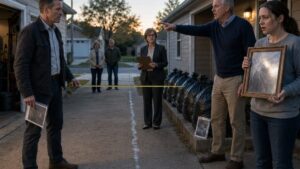
Karen sat across from him in a cream jacket this time, composed and pale around the mouth. Jennifer Garcia sat at the end of the table with a laptop open, a claims folder beside it, and the professional stillness of someone trying not to become part of a neighborhood fight. Mary sat to George’s right, her hands folded tightly. On the wall behind Karen, a framed photograph showed the lake in summer before the dam came down, smooth and bright and misleading.
“What is the reduced amount?” Mary asked.
Karen glanced at Jennifer, then back to George. “Twenty-seven thousand as a settlement contribution. Paid in installments or through insurer coordination.”
Mary inhaled softly.
George did not move.
Karen leaned forward. “It protects everyone from a drawn-out process.”
“Everyone?” George asked.
“It protects you from a larger claim.”
Jennifer clicked once on her laptop. “To be clear, Mr. Martin, the current preliminary file includes Ms. Roberts’s timeline, the county demolition notice, and your documented drainage complaints. We are still reviewing any additional material you provide.”
George heard the shape of it. Karen’s story was organized. His truth was scattered across photographs, maps, invoices, county reference numbers, and memories he had waited too long to say aloud.
Karen placed a pen beside the form. “Nobody is calling you malicious, George.”
He almost smiled. “That’s generous.”
“I mean it.” Her voice tightened. “I think you pushed the county without understanding the consequences.”
Mary shifted beside him. “Karen, the county was already reviewing the spillway.”
Karen’s eyes flicked toward her. “Your father’s complaints accelerated it. You know that matters.”
“It doesn’t make him responsible for the dam.”
“It makes him part of the chain.”
George looked at Mary. Her face was tense in a way he had seen when she was a girl standing between two adults who expected her to choose which version of a story hurt less. She leaned closer to him, lowering her voice.
“Dad, if there’s a way to protect your insurance and keep this from growing…”
He turned toward her.
She did not say sign it. She did not have to. Fear said enough.
George looked back at the form.
Twenty-seven thousand dollars was not eighty-six thousand. That was the trap. It made the false thing feel practical. It invited him to weigh truth against cost and then call the cheaper lie reasonable.
Jennifer spoke gently. “Signing this would not necessarily mean you agree to the full demanded amount. It simply allows the claim parties to move forward without disputing the causal chain at this stage.”
“At this stage,” George said.
“Yes.”
“And later?”
Jennifer paused. “It may limit certain arguments, depending on how the file develops.”
Karen’s hand moved slightly toward the pen, then stopped. “George, nobody wants to drag this through every office in the county.”
“No,” he said. “You wanted me to sign in the mud.”
Her cheeks colored.
The room went quiet.
George took the folded invoice from Brandon Smith and placed it on the table. Then he placed the October photograph beside it, green ribbon bright against gray concrete. Then the parcel overlay. Then Daniel Perez’s reference number, written on the sticky note now attached to the map.
Jennifer leaned forward but did not touch anything yet.
Karen’s eyes went first to the photograph, then to the invoice. He watched recognition move across her face and vanish almost as quickly.
“That invoice doesn’t prove what you think it proves,” she said.
“I don’t know everything it proves.”
“Then why bring it?”
“Because it belongs in the file.”
Jennifer reached for the invoice. “May I?”
George nodded.
She read the date. Her expression remained trained, but her pen moved to her notepad.
Karen’s voice sharpened. “Temporary waterline work is not dam damage.”
“I didn’t say it was,” George said.
“You’re implying it.”
“I’m refusing to let my complaint be the only dated event anyone sees.”
That sentence changed the room more than he expected. Mary looked at him. Jennifer stopped writing for a second. Karen sat back.
For years, George had kept his records like proof waiting politely for permission. Now, hearing himself say what the folder was for, he felt something inside him loosen and hurt at the same time.
Karen looked at Jennifer. “This is exactly why I wanted this resolved. He is going to turn a straightforward claim into a fight about everything that ever happened around that dam.”
“A claim for eighty-six thousand dollars should include everything that happened around that dam,” George said.
Mary touched his sleeve under the table. Not to stop him. This time, he thought, to steady him.
Jennifer closed the claims folder. “Given the new documents, I can’t advise either party to treat this settlement as complete without further review. If Mr. Martin disputes the causal statement, we’ll need a formal review meeting.”
Karen’s composure cracked. “With the association?”
“If the association is part of the property maintenance history, yes.”
“That will turn into a circus.”
George looked at the summer photograph on the wall. The lake in it was too smooth. No cracks, no ribbon, no muddy estimate, no old man standing at the wrong end of a story.
“Maybe it already did,” he said.
Karen pushed her chair back. “Fine. Bring your folder. Bring every picture you took from behind your curtains. But do not pretend you cared about the lake while you were building a case against it.”
George felt that one land because part of it was close enough to truth to sting.
He had cared about his steps, his crawlspace, the rot beginning at the lower boards of his porch. He had cared about not being mocked at association meetings. He had cared about not becoming the man who made everyone’s lake smaller. He had cared, but not loudly enough to be understood.
“I didn’t build a case against the lake,” he said. “I kept track of what people ignored.”
Karen gathered her papers with a hard, uneven motion.
Jennifer typed for several seconds. “Mr. Martin, please submit your documents through the claims portal today. I’ll note that you dispute cause and that additional county records are pending.”
George took the settlement form and slid it back across the table without signing.
Karen looked at the blank line. “You’re making a mistake.”
“No,” George said. “I made it earlier.”
She frowned.
He stood, picking up the lake folder. “I thought staying quiet would keep peace.”
Mary rose beside him, slower.
At the county office an hour later, George filled out the formal records request himself. He wrote the words Daniel had given him: spillway field review, Lake Thomas drainage reserve, emergency demolition assessment. His hand ached by the end, but he did not ask Mary to finish it.
When the clerk stamped the form received, George asked for one more thing.
“If Daniel Perez can provide inspection notes in writing when they’re releasable,” he said, “please tell him George Martin is requesting them for an active claim review.”
The clerk nodded and slid him a copy of the stamped request.
George placed it in the folder on top of the unsigned settlement.
For the first time, the empty signature line did not look like a threat.
It looked like a place where he had chosen not to disappear.
Chapter 7: The Green Ribbon In The Old Photograph
“He started this,” Karen said before George had even sat down.
The association meeting room went quiet in the quick, eager way rooms do when people are grateful someone else has said the harsh thing first.
George stood near the end of the long folding table with the lake folder under his arm. Mary was beside him, close enough that he could hear her breathing. Jennifer Garcia sat with her laptop open and a claims folder to her left. Several association members lined the walls in metal chairs. Karen sat at the center of the table, her papers stacked cleanly in front of her, her hands folded over them as if tidiness could become truth.
Behind her, through the room’s narrow window, the lake looked lower than it had in years.
George pulled out a chair.
Karen did not stop. “He filed repeated complaints. He involved the county. He stood at the demolition site with plans in his hand like he’d been waiting for it. And now he wants everyone to believe he had nothing to do with what happened.”
Mary started to speak, but George touched her wrist once.
He sat down.
Jennifer looked from Karen to George. “We’re here to review the claim timeline, not assign blame by volume.”
Karen’s lips pressed together.
George placed the brown folder on the table. The room watched it as if he had brought in something dangerous. He could feel the old shame rise again, that familiar warning that people did not like men who kept paper on their neighbors. People liked easy stories. Complaints were easy. Old men with folders were easy too.
He untied the faded blue cord.
Karen’s eyes dropped to his hands. “I hope those are originals,” she said.
“They’re copies,” George replied. “The originals stay home.”
A few people shifted.
Jennifer’s pen paused briefly, then moved again.
George took out the county parcel overlay first. He had marked nothing on it. No arrows. No angry circles. Just the printed map exactly as the county clerk had handed it to him.
“This is the public parcel overlay,” he said. “The shaded strip is the Lake Thomas drainage reserve.”
Karen leaned back. “We all know there’s a reserve.”
“The spillway crosses it.”
“That doesn’t make the dam yours.”
“I didn’t say it did.”
He slid the map toward Jennifer, not Karen. That choice mattered. He had learned, finally, not every sentence needed to be addressed to the loudest person in the room.
Jennifer examined the map, then typed something into her laptop.
Karen looked toward the association members. “This is what he does. He makes simple things sound complicated.”
George almost stopped there. That line would have worked on him a year ago. Maybe even a week ago. It had always been easier to retreat than to make people sit with details they found inconvenient.
Instead, he took out the October photograph.
The green ribbon showed near the cracked seam. The waterline sat high against the spillway. At the edge of the frame, pale temporary boards leaned near the outflow.
George placed the photo in front of Jennifer.
“This was taken October fourteenth,” he said. “Three weeks before my last drainage complaint.”
Jennifer picked it up. “Is the date embedded?”
“Yes. I submitted the original file through the portal.”
Karen’s face hardened. “A photograph of a ribbon does not prove the dam was failing.”
“No,” George said. “It proves the spillway had been marked before the date you gave insurance.”
Jennifer looked at Karen. “Your initial statement lists Mr. Martin’s November complaint as the first event that brought county attention to the spillway.”
Karen’s posture changed by less than an inch, but George saw it. So did Mary.
“I wrote what I understood at the time,” Karen said.
Jennifer turned to her laptop and pulled up the digital file. “The county reference number Mr. Martin provided connects to a field review opened before November.”
“That does not mean his complaint didn’t escalate it.”
“It may not,” Jennifer said. “But it means the timeline in your statement is incomplete.”
The word incomplete moved through the room more quietly than accusation, but with more weight.
Karen reached for her own folder. “There were cosmetic concerns. That’s not the same as emergency demolition.”
George took out Brandon Smith’s invoice and laid it flat.
“October twelfth,” he said. “Temporary waterline boards. Spillway edge reinforcement. Client request: preserve lake level pending association review.”
One of the association members murmured, “Preserve lake level?”
Karen turned sharply. “Temporary work. Maintenance. Everyone wanted the lake held through the season.”
“Everyone didn’t request it,” George said.
Her eyes snapped back to him. “Are you saying I damaged my own dam?”
“I’m saying work happened at the spillway before my complaint, and it was not in the statement sent to insurance.”
Karen’s face flushed. “Because it had nothing to do with your complaint.”
“Then it should not hurt to include it.”
The room stilled.
George felt Mary look at him, and this time he did not shrink from it. He was not shouting. He was not accusing beyond what the paper could bear. But he was no longer leaving space for someone else to use his silence.
Jennifer picked up the invoice. “Did Brandon Smith provide this directly?”
“He gave me the duplicate copy.”
“Has he submitted it?”
“I don’t know.”
Karen gave a short laugh. “So now we’re relying on a contractor who doesn’t want responsibility either.”
George turned toward her. “Did you ask him not to mention the water-level adjustment?”
Her mouth opened. Closed.
That was the first real silence Karen Roberts had given him since the dam broke.
Jennifer looked up.
Karen’s fingers tightened on her papers. “I told him people would twist routine maintenance into something it wasn’t.”
“That is not what I asked.”
“I told him to be careful.”
George waited.
Karen looked toward the window, then back at the table. When she spoke again, her voice was lower. “I believed the dam was mine to maintain. I believed your complaints were an attempt to force county action against my property. I still believe you pushed this farther than it needed to go.”
“That may be what you believe,” George said. “It is not the whole record.”
An older association member near the wall cleared his throat. “Karen, did the board know about the boards at the spillway?”
Karen turned. “It was minor.”
“That’s not an answer,” Mary said quietly.
The same phrase she had used on George in the kitchen came back into the room, and for a moment he felt the strange fairness of it. He had not answered when he should have. Now Karen was standing in the same narrow place.
Jennifer looked between the documents. “Ms. Roberts, for the claim to proceed under the original causal statement, the timeline needs to be accurate. If county review predates Mr. Martin’s November complaint, and if work occurred at or near the spillway before that complaint, the current claim theory is not adequately supported.”
Karen’s face changed—not into defeat, but into calculation collapsing under the weight of too many witnesses.
“Are you denying the claim?” she asked.
“I am saying it cannot proceed as currently stated.”
George let out a breath he had not known he was holding.
It was not victory. Not yet. It was only a door that had not closed on him.
Karen stared at Jennifer. “So because he kept pictures, I’m supposed to absorb the loss?”
George began gathering the papers, then stopped. He left the October photo on the table.
“No,” he said.
Karen looked at him.
“You’re supposed to correct the statement.”
The room seemed to wait for her answer. George did not. He looked at the photograph instead, at the green ribbon twisting beside the crack before anyone wanted to admit the crack mattered.
Jennifer closed the claims folder halfway.
“Until the statement is corrected,” she said, “the claim cannot continue against Mr. Martin under the information currently provided.”
Chapter 8: The Claim Was Withdrawn, But The Lake Remembered
The letter arrived in a plain white envelope that did not look strong enough to carry the sentence inside it.
George stood on his porch with one thumb under the flap and the lake spread quiet beyond the rail. The demolition crew had left two days earlier. The broken place where the dam had been was fenced and marked with orange barriers, and the water had settled into a lower, narrower shape that made every dock look a little stranded.
Mary stood beside him, waiting without asking to read over his shoulder.
George unfolded the letter.
After review of additional documentation, including county records, dated photographs, and contractor invoices, you are not considered responsible for the Lake Thomas dam demolition costs under the current claim.
He read it once.
Then he read it again, because the first time his eyes had gone too quickly toward relief and not slowly enough through the words.
Not considered responsible.
Not an apology. Not a declaration that Karen had been wrong in every possible way. Not a public undoing of the mud road, the estimate slapped against his plans, or the neighbors whispering behind him.
But the claim had moved off his name.
Mary touched his arm. “Dad?”
He handed her the letter.
She read it, pressed her lips together, and looked toward the lake. “It’s over?”
“The claim against me is.”
“That’s not the same thing.”
“No.”
Across the road, a truck slowed near Karen’s driveway, then continued on. People had been doing that all week—slowing, looking toward the broken dam, looking toward George’s porch, then pretending they had not. The lake had become quieter, but not kinder.
Mary gave the letter back. “Jennifer sent this?”
“Her office.”
“And Karen?”
George nodded toward the small envelope tucked beneath the larger one. He had opened that first by mistake, before seeing the insurer’s return address.
Mary’s expression changed. “She wrote to you?”
“Not much.”
He handed her the note.
It was on heavy cream paper. Karen’s handwriting was neat and controlled.
George,
I have amended the insurance statement to include the county review date and prior spillway maintenance. I am withdrawing the direct demand for settlement from you pending further determination. I still disagree with how this situation began, but the claim should not have named you as sole cause.
Karen
Mary read it twice, just as he had read the letter twice.
“That’s not an apology,” she said.
“No.”
“It’s something, though.”
“It is.”
Mary folded the note carefully along its original crease. “Do you wish she had said more?”
George watched a pair of birds pick at the wet shoreline where the lake had pulled back from the stones. There were things he had wished for at different points in the week. An apology. A correction on the association thread. Karen standing in the same muddy road and telling the same people she had been wrong to hand him that bill. Brandon sending his invoice without hesitation. Jennifer treating his documents as seriously on the first day as she had on the last.
Wanting all of it did not make it possible.
“I wish she had asked before accusing me,” he said.
Mary looked down.
The answer had room inside it for both of them.
She leaned against the porch rail. “I was scared.”
“I know.”
“I kept thinking about your insurance, your house, what it would cost if they pushed harder. I thought maybe paying part of it would be safer.”
“So did I.”
That surprised her. “You did?”
George gave a small nod. “Twenty-seven thousand is less than eighty-six. That’s how they make a wrong thing sound sensible.”
Mary’s eyes dampened, though she smiled a little. “I should not have asked you to think about signing.”
“You were trying to protect me.”
“I was trying to make the fear stop.”
“So was Karen.”
Mary turned toward him.
George took back the note and letter. “That doesn’t excuse what she did.”
“No.”
“But fear makes people reach for the nearest person to blame. She reached for me. You reached for the quickest exit. I reached for silence for years and called it peace.”
Mary was quiet for a while.
From the far side of the lake came the faint sound of equipment, not demolition now, just cleanup. The county had left temporary barriers where the old spillway had been. The lake association would have to decide what came next, and George knew those meetings would not be gentle. Some people would resent Karen for the maintenance. Some would resent George for the records. Some would resent the county because a lower lake was easier to blame on a department than on a community that had liked the dam better when it looked harmless.
Mary picked up the brown lake folder from the porch table. “What are you going to do with all this?”
“File it.”
“That’s it?”
“What else should I do?”
“I don’t know. Frame the letter?” She tried to smile. “Wave it at the next meeting?”
George shook his head. “No.”
The folder had changed during the week. Or maybe he had. Before, it had felt like a private defense, a thing he kept because he did not trust himself to speak in time. Then it had become suspicious in other people’s eyes, the old man’s bundle of complaints. At the association meeting, opened flat beneath the fluorescent lights, it had become something else: not a weapon, not a shield exactly, but a record of what he had seen and failed to say loudly enough.
He took it from Mary and went inside.
The kitchen table was clear except for the old county map, the October photograph, Brandon’s invoice copy, Jennifer’s letter, and Karen’s note. George laid them in order.
Mary stood in the doorway.
He untied the folder cord and placed the insurer’s letter on top of the stack. Not hidden at the back. Not loose in a drawer. On top.
Then he smoothed Karen’s note and placed it beneath the letter.
Mary stepped closer. “You’re keeping that too?”
“Yes.”
“Why?”
“Because it’s part of what happened.”
He slid the October photograph behind both. The green ribbon caught his eye one last time, bright against concrete that no longer existed.
Mary watched him close the folder. “Are you going to be okay living here after this?”
George looked through the window toward the road, the lake, the place where Karen’s car had thrown mud when she arrived with the estimate. The house felt the same around him, but the neighborhood did not. Maybe it never had been the way he wanted to believe. Maybe peace built on swallowed words was only quiet waiting for pressure.
“I’ll be okay,” he said. “But I’ll answer sooner next time.”
Mary nodded.
He tied the faded blue cord. His fingers still ached. The knot took longer than it should have. He did not rush it.
When he was finished, he set the folder on the shelf beside the back door, where he could reach it without digging, and where anyone who came into the kitchen could see it was not hidden.
Outside, the lowered lake moved softly against the stones.
George stood there for another moment, looking not at the water but at the shelf, at the folder he had once treated like proof he hoped never to need.
It was still proof.
But now it was also a promise he had made to himself, in ink, paper, and restraint: he would never again sign away the truth just because someone else had brought a bill.
The story has ended.