When The HOA Filled His Drainage Channel With Concrete, They Forgot Why He Built It
Chapter 1: The Concrete Was Already Pouring Into The Creek Bed
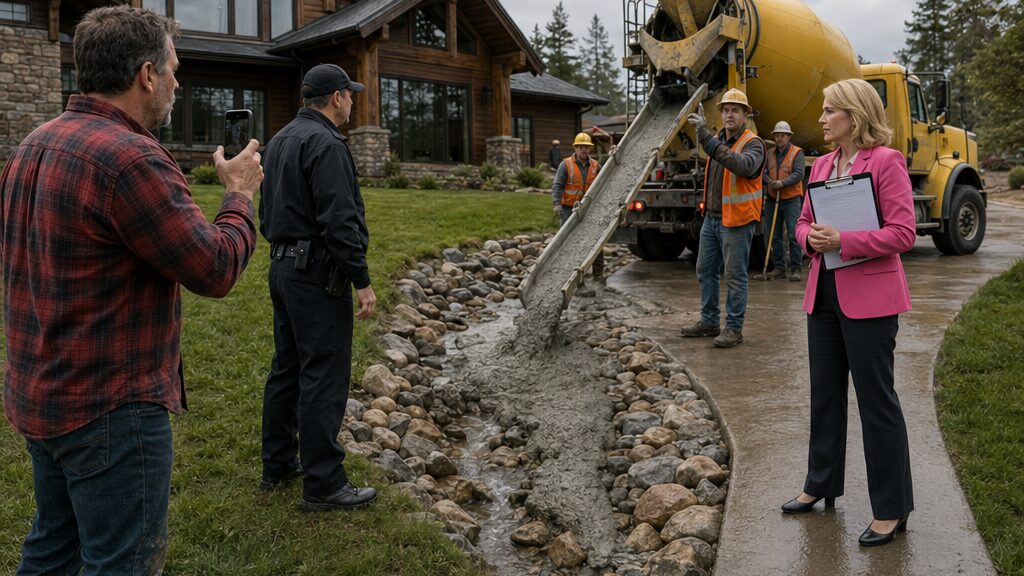
The chute of the yellow cement truck was already lowered over William Green’s drainage channel when he came around the side of the cabin with one boot untied and his phone clutched in his hand.
Wet concrete slid from the metal trough in a gray, heavy ribbon. It struck the creek stones he had set by hand two weeks earlier and swallowed them with a thick slap. The workers in orange vests did not look up at first. One stood near the truck with a gloved hand raised to the driver. Another guided the flow with a shovel, spreading the wet mix into the rock-lined bed as if filling a backyard hole.
William stopped so hard his shoulder hit the corner post of the porch.
“No,” he said.
The word came out too small against the truck engine.
Then he saw Kathleen Thompson standing near the driveway in a bright pink blazer, one hand holding a clipboard against her ribs, the other resting on her hip. Beside her stood a uniformed security officer from the community patrol, his arms folded, his face arranged into the blank patience of someone already told which side was official.
William stepped off the porch and crossed the wet grass.
“Stop the truck.”
One of the workers turned. The crew supervisor glanced toward Kathleen instead of answering.
William raised his voice. “Stop the truck now.”
The chute kept pouring.
Kathleen looked at him over the top of her clipboard. “Mr. Green, do not interfere with the crew.”
“That’s my drainage channel.”
“It is an unauthorized alteration to a common-view exterior drainage area.”
“It is not common-view anything. It’s on my lot.”
“It affects stormwater movement across the association-controlled easement.”
William had to breathe through his nose because if he opened his mouth too fast, he knew the first thing out would not help him. He looked down at the concrete as it spread over the river rock, pushing into the gaps where water had run clear three days ago. The channel curved along the lawn below the driveway, then dropped toward the lower entry. That lower entry was the only doorway Linda could manage on bad mornings, the only one without the steep porch steps.
He lifted his phone and began recording.
Kathleen’s expression tightened. “You may document from a safe distance.”
“I’m documenting you pouring concrete into a drainage channel before I’ve seen any order.” He kept the phone steady even though his hand wanted to shake. “Who authorized this?”
“The board authorized emergency abatement.”
“When?”
“The notice was delivered this morning.”
“This morning?” William looked toward the truck, then back at her. “The truck was here before I was.”
“It was left on your front door.”
“I came out the front door ten minutes ago.”
Kathleen tapped a paper on the clipboard. “Service was completed at 8:05.”
William checked the time on his phone screen. 8:17.
Behind him the second worker scraped concrete farther down the channel. The shovel made a dull, gritty sound against stone. William took one step closer.
“Tell him to stop spreading it.”
The security officer moved slightly, enough to put his body between William and the chute. “Sir, you need to stay clear of the work area.”
William looked at him. “Are you law enforcement?”
“Community security.”
“Then you can stand there and watch me record.”
The officer’s jaw tightened, but he did not touch him.
Kathleen came forward, heels sinking slightly in the damp lawn. “Mr. Green, your channel was not approved. It changes the appearance and grade of the drainage area. Multiple residents raised concern that you were diverting runoff.”
“It was built to keep runoff away from my lower door.”
“You were instructed to wait for architectural review.”
“I submitted the request four weeks ago.”
“You submitted an incomplete request.”
The statement hit him harder than he wanted it to. Not because he believed her, but because part of him knew there had been pages, copies, calls, a conversation with Jerry Johnson in the grocery store parking lot, and a sentence William had chosen to hear as permission because the rain was coming and Linda had nearly fallen at the upper stairs.
He forced his eyes back to the channel.
“Where is the abatement order?”
Kathleen’s mouth thinned. “I have the notice.”
“I asked for the order.”
“The board has authority under the emergency nuisance provision.”
“Then show me the written order that says you can bring a cement truck onto my property and fill a working drainage path.”
The crew supervisor shifted his weight. “Ma’am?”
Kathleen did not look at him. “Continue with the first section.”
William moved.
He did not run. He did not shove anyone. He walked down the slope and planted himself beside the channel where the concrete had not yet reached the lower curve. The chute still hung over the upper stones, but the worker with the shovel paused.
“Sir,” the security officer warned.
William held the phone higher. “I’m not touching your crew. I’m standing beside the part you haven’t destroyed yet.”
Kathleen’s voice turned low. “You are creating liability.”
“No,” William said. “You are.”
The truck engine rumbled. The concrete slowed, then stopped in the chute with a wet cough. For the first time since he had stepped outside, the workers waited without looking at Kathleen. They looked at the man standing beside the open part of the channel, a bearded homeowner in a red plaid shirt, muddy boots planted in his own lawn, phone aimed at the people who had come with paperwork and a truck.
Kathleen lifted her clipboard. “This modification was installed without final approval.”
“This channel was cut because water was reaching the lower entry.”
“That does not give you permission to alter exterior drainage.”
“My wife uses that lower entry.”
Kathleen paused only long enough to prove she had heard him. “Then you should have included that in the formal accommodation process.”
William almost said he had. The answer rose hot and certain.
But he remembered the red folder on the kitchen table, the unstamped copy, the envelope he had meant to bring to the office himself and then mailed because Linda’s nurse had called. He remembered Jerry saying, I don’t see why anyone would stop you, and how good it had felt to stop asking.
So he said the one thing he could prove in that moment.
“Give me your order in writing before another yard of concrete goes into this channel.”
Kathleen looked toward the supervisor. “Pause the pour.”
The supervisor gave a hand signal. The truck driver leaned out of the cab, irritated but silent.
William lowered his phone only enough to check that it was still recording. The gray concrete already filled the upper bed from bank to bank. The stones he had chosen for water flow were gone under a smooth, dead surface.
Kathleen walked to her car and returned with a white envelope. She held it out not with apology, but with the practiced firmness of someone passing a bill across a counter.
William did not take it at first.
“What is that?”
“Notice of abatement charges,” she said. “For removal of the unauthorized installation and restoration of the approved drainage appearance.”
“You’re charging me for this?”
“The association will seek reimbursement.”
A grinding sound came from the truck.
William looked past her. The mixer had begun turning faster again, thick with the second load.
Kathleen pushed the envelope closer.
“Mr. Green,” she said, “if you continue to obstruct the crew, there will be additional costs.”
Chapter 2: The Folder Proved Less Than William Needed
The first thing William saw when he opened the red folder was the empty corner where an HOA date stamp should have been.
He stood at the kitchen table with the abatement envelope unopened beside his elbow and spread the papers in careful rows, as if neatness could repair what had already hardened outside. Photos of the old washout. A sketch of the proposed rock bed. Jason Smith’s estimate. A copy of the architectural change request. A printout of the community drainage guideline. Two pages with his own blocky handwriting at the top.
Those two pages had no stamp.
William stared at them until the ink blurred.
From the lower hallway came the soft scrape of Linda’s walker, then the pause she took before the turn into the kitchen. He gathered the medical note too quickly and slid it beneath Jason’s estimate.
Linda noticed anyway.
“What did they leave?” she asked.
“Paperwork.”
“That’s not an answer.”
He looked at her then. She wore a blue cardigan over her morning shirt, her hair pinned imperfectly on one side. The stroke had changed the timing of her movements more than the shape of her face. She still looked directly at things people tried to soften for her.
William picked up the envelope. “They’re calling it abatement.”
“Abatement,” she repeated, as if testing whether the word deserved to be in their kitchen.
“They say the channel wasn’t approved.”
“The channel that kept the water from the lower door?”
“That channel.”
Linda moved closer, one careful step at a time. Her eyes shifted to the red folder. “Did they stop after you talked to them?”
He did not answer quickly enough.
“William.”
“They filled the upper half. I stopped them before the lower curve.”
She closed her eyes.
“I should have been outside sooner,” he said.
“You were making breakfast.”
“I heard the truck and thought it was Raymond’s driveway work.”
“Is it still open enough for the next storm?”
That was the question he had been avoiding since the truck left. He had walked the channel twice. The concrete sat thick in the upper section where the water was supposed to slow, split, and follow the stones away from the lower entry. The lower curve remained clear, but without the upper path, a hard rain would hit the concrete and choose its own direction.
“I don’t know,” he said.
Linda pulled out the chair but did not sit until he moved it for her. She hated when he did that automatically, and he saw the flicker cross her face. He stopped with one hand on the chair back.
“I can do it,” she said.
“I know.”
But he did not let go.
After a second, she sat. The sound of the chair legs against the floor seemed too loud.
William opened the folder again because papers were easier than her face. “I gave them the photos. I gave them the sketch. Jason’s estimate. Drainage note. Everything.”
“Did you give them the letter from the nurse?”
His hand stopped over the stack.
“I mailed a copy.”
“That wasn’t my question.”
He found the page under the estimate and pulled it out. The nurse’s letter did not say much. It did not need to. It stated that Linda Green had mobility limitations, that consistent access through the lower entry reduced fall risk, and that standing water or ice at that entry would create an unsafe condition. It was written on plain clinic letterhead, not dramatic, not pleading.
There was no stamp on it.
Linda saw that too.
“You said they had it.”
“I thought they did.”
“You thought.”
He swallowed. “I sent it with the second packet.”
“You said Jerry told you it would be fine.”
“Jerry said he didn’t see why anyone would stop it.”
“That is not the same thing.”
The sentence landed with the quiet force of truth. William looked toward the window above the sink. Through it, the lawn sloped down to the channel. The fresh concrete shone dull and wet beneath the morning light. A faint track from the workers’ boots marked the grass.
He wanted to be angry at Kathleen. He was angry at Kathleen. But beneath that anger sat the harder thing: the memory of himself standing outside the grocery store with Jerry Johnson, describing the washout and the lower door and the rain coming Friday. Jerry had been loading bags into his car, no longer architecture chair but still the man everyone asked when they did not want to wait for a meeting.
Submit the paperwork, Jerry had said. I don’t see why anyone would stop you.
William had heard permission. Maybe because he needed it to be permission.
His phone buzzed. A message from Jason Smith appeared.
Saw the concrete. Call me before you touch anything. If HOA did that, they just made a mess.
William showed Linda the message.
She read it and looked toward the lower hallway. “They’ll say you started it.”
“I did start it.”
“You fixed a problem.”
“I started before final approval.”
“Because I nearly slipped.”
“Because I didn’t want you reading a board packet about your own body.”
Her expression changed, not softening, exactly, but tightening around a place he had meant to protect.
“That wasn’t your choice to make alone,” she said.
William did not have an answer for that. He had wanted to keep her out of it. Not out of the decisions, he told himself, but out of the staring, the forms, the meetings where strangers said “mobility limitation” as if they were discussing a mailbox color. He had promised her after the hospital that the house would not become a place where she had to ask permission to move.
Then he had tried to keep that promise by keeping her name small on the page.
He opened the abatement envelope. Inside was a two-page notice, a copy of the emergency nuisance provision, and an invoice estimate for crew mobilization, concrete delivery, labor, and administrative review.
The number at the bottom made him laugh once, without humor.
Linda reached for it. He hesitated, then handed it to her.
Her mouth went still. “They want us to pay for them to pour concrete into our yard?”
“Association reimbursement.”
“They broke it and billed us.”
“They’ll say they restored it.”
“To what?”
He looked again at the nurse’s letter, the unstamped corner, the smooth concrete outside.
“To something that looks better from the road,” he said.
Linda folded the invoice carefully and placed it on the table. “Call Jason.”
“I will.”
“And call the HOA office.”
“I will.”
“Not just Kathleen.”
He looked at her.
Linda tapped the unstamped page. “Ask where this went.”
William nodded, but his eyes had moved to his laptop on the counter. A thought had cut through the room so sharply that he crossed to it before saying anything else.
He opened his email and searched Jerry Johnson.
The first results were newsletters, a notice about landscaping, an old architectural committee thread. Then he found it: a short reply from six days after his first submission.
William clicked it.
Jerry’s message sat beneath William’s photos of the washout, the channel, and the lower entry.
Looks like a sensible fix to me. I don’t see why anyone would stop you.
William read it twice. Linda read it over his shoulder.
Below Jerry’s name there was no title, no approval language, no committee vote, no attachment, no authority.
Only a sentence that had felt like a door opening until William saw how little it would hold.
Chapter 3: Kathleen Called The Channel A Community Risk
Kathleen Thompson began the HOA meeting by putting William’s property on the screen before she said his name.
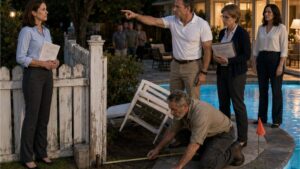
The photo filled the wall behind the board table: his cabin-style home, the sloped lawn, the pale strip of fresh concrete poured across the drainage channel like a scar. From that angle, the channel looked less like protection and more like an open wound in the manicured green space. The picture had been taken from the road, high enough to include the driveway and low enough to make the stone bed seem larger than it was.
William sat in the second row with the red folder on his knees and felt every chair in the room turn toward him.
Kathleen adjusted the microphone. She wore a cream jacket tonight instead of pink, but the same controlled expression. “The emergency session concerns an unauthorized drainage alteration at Lot 38, owned by William and Linda Green.”
William stood. “Before you frame it that way, I’d like to—”
“You will have time to speak after the report.”
He remained standing for one more beat. Then he sat because starting with a fight would give them what they expected.
Beside Kathleen, Emma Lewis sorted a packet with a pen tucked between her fingers. She did not look at William at first. Raymond Davis sat near the aisle, arms crossed, his jaw set in the expression of a man who had practiced being reasonable while angry.
Kathleen clicked to the next slide. Another photo appeared, this one showing the channel before the concrete. William recognized the shot. It had been taken after his first weekend of work, when the river rock was still uneven and the banks were raw.
“This modification was installed without final architectural approval,” Kathleen said. “It changes grade, material appearance, and stormwater behavior along a shared drainage easement. The board received complaints from neighboring properties regarding possible runoff redirection.”
Raymond cleared his throat loudly enough to be heard.
William opened the red folder. The stamped pages were on top. The unstamped ones waited beneath them like a trap.
Kathleen continued. “Under emergency nuisance provisions, the board authorized temporary abatement to prevent further alteration before weather events expected later this week.”
“Temporary?” William said.
Kathleen looked at him. “Mr. Green, please wait.”
“You poured concrete into it.”
The room shifted. A board member whispered to another.
Kathleen’s eyes sharpened. “The crew stabilized the unauthorized channel.”
“They blocked it.”
“You will have a chance to present your view.”
“My view is water runs downhill whether the board approves it or not.”
The security officer from the morning stood near the back wall tonight. He did not move, but William saw him.
Kathleen looked down at her papers. “Mr. Davis, since your property is adjacent to the runoff path, you may summarize your concern.”
Raymond stood with the stiff energy of a man already offended. “I have no problem with anyone fixing their own property. But when a neighbor digs a channel that points water toward my side yard, that becomes my problem. We all bought into this community because there are standards. You let one person do whatever he wants and the rest of us pay for it.”
“It doesn’t point at your yard,” William said.
Raymond turned. “I watched the water move after the last rain.”
“You watched water move because the old washout had already failed.”
“I watched you dig a ditch.”
William’s hand tightened around the folder rings. “It is a lined drainage channel.”
“Call it whatever you want.”
Kathleen tapped the microphone. “This is exactly why review exists. Individual owners cannot make stormwater decisions based on personal judgment.”
Personal judgment.
William thought of Linda gripping the lower doorframe after the old path flooded, her left foot searching for dry ground that was not there. He thought of himself telling her he would handle it. He thought of all the ways “personal” became a word people used when they did not want to say “necessary.”
He stood again.
“I submitted a request four weeks ago.”
Kathleen nodded. “An incomplete request.”
William held up the stamped architectural form. “This was received.”
“That form did not include all required supporting documentation.”
He held up Jason’s estimate. “This was received.”
“Yes.”
He held up the drainage sketch. “This was received.”
Kathleen glanced down. “A sketch was included.”
“And photos.”
“Yes.”
“And notice that the lower entry was being affected.”
Kathleen paused. “The board packet references water concerns at the lower entry.”
Emma Lewis looked up at that. Her pen stopped moving.
William slid out the nurse’s letter but kept it low, not yet ready to hold Linda’s name in front of the room. “Where is the accommodation note?”
Kathleen’s face did not change, but Emma began turning pages.
“The packet includes the owner’s drainage statement,” Kathleen said.
“That’s not what I asked.”
Emma lifted a binder tab. Then another. Her brow tightened.
Kathleen noticed. “Emma?”
Emma kept her voice careful. “I’m checking the attachments.”
William watched her fingers move through the packet. Stamped form. Photos. Estimate. Sketch. Complaint summary. Abatement recommendation. No nurse’s letter.
Kathleen said, “The emergency decision was based on the documents available to the board at the time.”
William felt the room narrow around that phrase.
“At the time,” he repeated.
Kathleen straightened. “Mr. Green, even if additional materials exist, you were not authorized to begin work before final approval.”
“Did the board review the full request before sending a truck?”
“We reviewed the file provided.”
“That’s not an answer.”
“It is the answer.”
“No. The answer is yes or no.”
The board chair beside Kathleen leaned toward the microphone, but Kathleen raised one hand slightly and stopped him.
“No,” she said. “The board did not review documents that were not in the file.”
A murmur moved through the room.
There it was. Not victory. Not even close. But a small opening in the wall.
William set the nurse’s letter on top of the folder without lifting it high enough for the room to read. “Then you destroyed part of the repair before you knew why it was there.”
Raymond spoke from the aisle. “You still didn’t have approval.”
William turned to him. “And if the lower door floods this week because concrete is blocking the water?”
Raymond’s jaw worked. “That’s not my doing.”
“No,” William said. “It’s everyone’s if you vote to keep pretending this is landscaping.”
Kathleen’s voice cooled. “The board is not pretending. The board is managing risk. Your alteration created concern. Your incomplete submission delayed review. Your decision to proceed forced enforcement.”
There was enough truth in it to sting.
William felt it and hated that he felt it. He had wanted the room to be simple. He had wanted Kathleen wrong in every direction and himself clean in every direction. But the unstamped page in his folder sat like a weight against his leg.
Emma finally spoke. “For the record, I would like the office to confirm whether any additional pages were received but not scanned into the board packet.”
Kathleen’s eyes moved to her. “That can be done after tonight.”
“Before any further enforcement?” Emma asked.
The room went quiet.
Kathleen turned back to the microphone. “Further enforcement will depend on compliance status. The abatement invoice remains pending. Fines for unauthorized exterior alteration will begin Friday if the property is not restored or brought under approved corrective action.”
William stared at her. “You filled the corrective action with concrete.”
“The board has scheduled a final compliance inspection for Friday at 9 a.m.”
Friday. The storm was forecast for Thursday night.
William closed the red folder slowly.
Kathleen clicked off the projector. The photo of his concrete-filled channel vanished from the wall, but the pale shape of it remained behind William’s eyes.
“Mr. Green,” she said, “I suggest you use the next forty-eight hours carefully.”
Chapter 4: The First Rain Found The Concrete Wall
William heard the water hit the lower door before he saw it.
It was not the clean rush he knew from storms, not the steady run through stone toward the culvert. It was a slap. Then another. Then a spreading hiss beneath the threshold, as if the rain had found a handhold and was trying to pry its way into the house.
He was in the garage when the sound came, kneeling beside a stack of towels he had pulled down just in case. For one second he stayed still, listening, hoping he had mistaken the noise.
Then the lower hallway light clicked on behind him.
“William?” Linda called.
“Stay there.”
He hated the fear in his own voice. He grabbed the towels and crossed the garage, boots slipping slightly on the concrete floor. At the lower entry, water had already gathered outside the glass panel in a shallow black sheet. Rain struck the walkway, bounced against the fresh concrete wall in the drainage bed, then turned where it should not have turned.
Toward the door.
William shoved towels against the inside threshold and raised his phone to record. The screen showed the shape of the mistake clearly: the hardened concrete across the upper channel, water bunching against it, the overflow crawling sideways across the lawn and down the low spot near the accessible entry.
Linda appeared at the hallway corner with one hand on the wall.
“I told you to stay back.”
“You always do.”
“This isn’t dry.”
“I can see that.”
He wanted to tell her it would be fine, but the water struck the door again, harder this time. Linda’s eyes moved from the towels to the thin line of water beginning to darken the inside edge of the threshold.
“That is the wrong side,” she said.
William nodded once. “Yes.”
He stepped outside through the garage instead of opening the lower door. Rain hit his face in cold bursts. The storm had not become severe yet, but it was steady enough to test every claim made in the boardroom. He walked the slope with his phone light on, filming the upper bed where the concrete shone pale under the water. The channel he had built was gone there. Not damaged. Gone. Filled smooth, like a curb across the natural flow.
The water found the side of it, curled around, and dropped toward Linda’s path.
“Come on,” he muttered, not to the water, not to the concrete, but to himself two weeks earlier, who had thought he could beat weather with common sense and a folder.
He called Jason Smith from under the garage overhang.
Jason answered on the third ring. “Tell me you didn’t touch it.”
“I didn’t touch it.”
“Good. Send me video.”
“I’m looking at water against the lower door.”
There was a pause, then the sound of Jason moving, maybe sitting up, maybe reaching for paper. “Because they filled the upper run?”
“Yes.”
“Film from the driveway down. Slow. Show where the original bed turns. Show the concrete, then the door.”
“I already did.”
“Do it again. Wider.”
William almost snapped at him. Instead he turned and filmed again. He made himself move slowly, even though rain ran down the back of his collar. He captured the driveway, the rock edging that disappeared under concrete, the water pooling at the obstruction, the side flow, the lower path, the door.
When he came back inside, Linda had moved two more towels from the laundry basket and set them on the floor. Her left hand trembled with the effort.
“I said stay back,” William said, too sharply.
She looked at him. “And I decided not to.”
He took the towels from her, ashamed before she could answer. “I’m sorry.”
She leaned against the wall. “Call it what it is.”
“What?”
“You’re not angry because I carried towels.”
He pressed one against the door seam. “No.”
“You’re angry because they were right about one thing.”
He stopped.
Linda’s voice stayed quiet. “You started before they gave final approval.”
Rain rattled the garage door. William kept his palm on the towel as if pressure alone could hold back the water.
“I started because the old washout was getting worse.”
“I know.”
“Because you couldn’t use the upper steps when your leg locked.”
“I know.”
“Because the next storm was going to come whether Kathleen stamped a paper or not.”
“I know that too.”
But she waited, and the silence made him finish the part he had not wanted to say.
“And because I thought if I made it look practical enough, no one would make us explain you.”
Linda looked away first. That was worse than anger.
His phone buzzed with Jason’s reply. William opened the message.
That concrete made a dam. Don’t let anyone say otherwise. But we need to talk permit. Emergency work still needed city signoff if it touched the easement.
William read it once, then again. He passed the phone to Linda.
She gave it back without comment.
The word easement sat in his chest like a second problem. He had known the drainage strip was in the HOA rules. He had known there were city stormwater maps somewhere. He had even asked Jason about it, and Jason had said they could stabilize with stone first and formalize later if the washout became a safety issue. William had heard the part he wanted: stabilize first.
Now the towels were darkening beneath his hand.
He called Jason again. “Can you come out tonight?”
“In this rain?”
“Tomorrow morning, then.”
“I can come at first light. But listen to me, William. Don’t dig out the concrete yourself.”
“If it floods the door—”
“Document. Sandbags if you have them. Towels inside. But if you start breaking concrete, they’ll say you caused whatever happens next.”
“They caused whatever happens next.”
“And they’ll say you caused it better on paper.”
That stopped him.
Jason’s voice softened, not much, but enough to show the warning was not just business. “I know why you built it. But you’re in a paperwork fight now. The water is evidence. Don’t destroy your evidence.”
William looked at the door. Another thin line of water had made it beneath the threshold. Linda had noticed but said nothing.
“Fine,” he said.
After he hung up, he found two old sandbags in the shed and dragged them through the garage. By the time he wedged them outside the lower door, rain had soaked through his shirt. Linda stayed near the hallway, watching not as a patient, but as a wife who understood exactly what the house was doing to them.
The sandbags slowed the water. They did not solve it.
Near midnight the rain eased. William went outside with a flashlight and filmed the channel again. The concrete had collected leaves and muddy foam along its upper edge. Down near the curve that remained open, a small stream still ran correctly, but most of the water had found a new path through the lawn.
A path the board could not see from a meeting photo.
At dawn, Jason arrived with a measuring rod, a shovel he did not use, and the guarded face of a contractor who knew the wrong sentence could cost him. He walked the channel in silence, crouched near the hardened concrete, then brushed mud from the lower edge with his gloved fingers.
“Hold the light here,” he said.
William knelt beside him. “What?”
Jason wiped again.
Under the thin wash of mud at the edge of the concrete was a small round metal marker set low near the stones, half buried before, now exposed by the runoff.
Jason pulled out his phone and took a photo.
“What is that?” William asked.
Jason looked up at the house, then down toward the lower entry, then back at the marker.
“That,” he said, “looks like a culvert marker.”
William stared at the fresh concrete poured right over the line of the old drainage path.
Jason took another photo, closer this time.
“If I’m right,” he said, “they didn’t just fill your channel. They may have filled part of a registered stormwater route.”
Chapter 5: The Inspector Stopped Both Sides
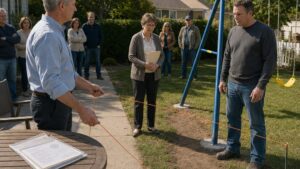
The city stormwater inspector pushed a measuring wheel across the hardened concrete and stopped exactly where Jason had found the buried marker.
No one spoke at first.
The wheel clicked once as it settled. The inspector looked down at the marker, then at the pale concrete covering the upper run of the drainage bed, then at William’s lower entry where towels still lay in a damp heap inside the glass.
Kathleen stood on the driveway with her clipboard held close to her body. Raymond Davis had come too, though no one had invited him onto William’s lawn. Emma Lewis stood a few feet behind Kathleen, a folder tucked under one arm, her eyes moving from the marker to the concrete truck tracks still pressed into the grass.
The inspector crouched. “Who authorized the fill?”
Kathleen answered before William could. “The association authorized temporary abatement of an unauthorized owner alteration.”
The inspector looked at her. “That was not my question.”
William felt the smallest shift in the morning air.
Kathleen’s fingers tightened around the clipboard. “The board authorized the crew.”
“Was there a city permit to fill this section?”
Kathleen hesitated. “This was not a construction improvement. It was restoration.”
The inspector stood. “Concrete is not restoration if it changes flow.”
Raymond stepped forward. “Excuse me, but the original issue was his ditch redirecting water toward my property.”
The inspector turned to him. “And you are?”
“Adjacent owner. Raymond Davis.”
“Did you file with the city or the HOA?”
“The HOA. That’s what they’re for.”
The inspector made a note without replying.
William kept quiet because Jason had told him to. Jason stood beside him with both hands in his jacket pockets, the posture of a man trying not to become the center of the fight.
The inspector walked the channel slowly, wheel clicking over grass, mud, and the edge of the remaining stone bed. William followed, but not too close. He had learned that morning that restraint could be louder than interruption if the right person was finally looking at the ground.
At the lower curve, the inspector stopped again. “This section you installed?”
“Yes,” William said.
“Before final HOA approval?”
William felt Kathleen turn toward him before he saw it.
“Yes,” he said.
Kathleen took the opening. “That is the core issue. Mr. Green proceeded without approval, altered grade, and created concern across the easement.”
The inspector did not look up. “Mr. Green, did you apply for a city drainage permit?”
“No.”
Kathleen’s pen scratched once against her paper.
William forced himself to keep his hands at his sides. “I submitted to the HOA. I believed the work was temporary stabilization because the lower entry was flooding.”
“Believed based on what?”
William could feel Linda’s letter in the red folder under his arm. He had brought it. He had not yet opened it.
“Based on the washout,” he said. “Based on the water reaching the lower door. Based on a contractor’s recommendation to stabilize before the next storm.”
Jason shifted. “I recommended stone stabilization, not concrete, and not a permanent change without permit.”
Kathleen looked satisfied for half a second.
Jason added, “But what the HOA poured is more obstructive than what he installed.”
The satisfaction disappeared.
The inspector walked back to the marker. “This channel appears to overlap a mapped stormwater conveyance path. I’ll verify against city records, but the marker is consistent.”
Kathleen said, “If that is the case, Mr. Green’s unapproved work is even more serious.”
“Yes,” the inspector said. “And so is filling it.”
William looked down before anyone could read his face.
The inspector continued, “Until this is reviewed, no one is to add material, remove material, excavate, break concrete, or alter flow without written authorization from the city.”
William looked up. “The lower door took water last night.”
“I saw the towels.”
“My wife uses that entry.”
“I understand.”
“With respect, I don’t think anyone does.”
The inspector held his gaze. “I understand enough to say I don’t want more unauthorized work making this worse.”
Kathleen said, “So the owner is ordered to restore the property?”
“No.” The inspector closed the notebook. “Both sides are ordered to stop.”
Raymond made a frustrated sound. “Both sides? My yard is the one at risk.”
The inspector turned to him. “Right now, every yard downhill is at risk if people keep guessing with stormwater.”
That silenced him.
William should have felt relieved. Part of him did. The HOA could not pour more concrete that morning. Kathleen could not send another truck while the city reviewed the route. But the same order that stopped Kathleen also stopped him. The hardened concrete remained where it was. The rain forecast remained where it was. Linda’s lower entry remained the low point toward which water had already started moving.
“Can I place sandbags?” William asked.
“Temporary surface protection at the door, yes. No digging. No concrete removal. No regrading.”
“Can Jason open a notch in the concrete if water rises?”
“No.”
“Even if it reaches the threshold?”
The inspector’s expression did not change. “Call emergency services if the structure is threatened.”
William almost laughed. The house did not need sirens. It needed the thing he had built before the truck came.
Kathleen stepped closer to the inspector. “Will the city issue a violation to Mr. Green?”
“The city will issue a review notice to the property owner and the association.”
“That does not answer my question.”
“It is the answer today.”
William recognized the phrase and looked at Kathleen. She recognized it too. Her jaw set.
The inspector wrote two copies of the stop-work notice on the hood of his vehicle. One went to William. One went to Kathleen. The paper felt heavier than it should have when William took it.
Kathleen read hers quickly. “This does not withdraw the HOA violation.”
“No,” the inspector said. “It does not.”
She turned to William. “Then the association’s fines remain pending.”
Emma’s head lifted. “Kathleen, we should wait until the city verifies the easement.”
“The owner’s lack of approval is not changed by the city review.”
William said, “Neither is your concrete.”
Kathleen met his eyes. For a moment the procedural mask slipped just enough for him to see something harder and more frightened beneath it. Not fear of him. Fear of losing control of the room, the file, the precedent.
Then it was gone.
“Mr. Green,” she said, “you are still responsible for work you began without authorization.”
He looked at the stop-work notice in his hand. “I know what I started.”
“Good.”
“And I know what you filled without reading.”
Emma looked sharply at him.
Kathleen said, “If you have new documentation, submit it properly.”
“I already submitted it.”
“Then submit it again.”
William nearly answered, but his phone rang. Unknown number. He almost declined it. Then he saw Emma lower her folder, step away from Kathleen, and pull her own phone from her pocket as if she had just sent something.
He answered.
Emma’s voice came through, low and controlled, though she stood only twenty feet away.
“Mr. Green, don’t react. I checked the packet scan against the office upload log.”
William kept his face still.
“The medical note was never attached to the board packet,” she said. “It isn’t in the file they voted from.”
His fingers tightened around the stop-work notice.
Emma looked toward Kathleen, then away.
“I don’t know yet whether it was missed, misrouted, or removed,” she said. “But the page that explains your wife’s access issue was not there.”
Chapter 6: The Missing Page Made Everyone Choose
Emma turned the computer monitor toward William, and the scanned file ended one page before the truth.
They were in the HOA records office, a narrow room behind the community clubhouse kitchen, with boxes of old landscaping approvals stacked beneath a folding table. The air smelled faintly of toner and coffee. Emma had asked him to come through the side entrance after lunch, not secretly, she had said, but quietly. There was a difference in her mind. William was not sure there was one in Kathleen’s.
On the screen, his submission appeared as a single PDF.
Page one: architectural request form, stamped received.
Page two: photos of the washout.
Page three: Jason’s estimate.
Page four: rough drainage sketch.
Page five: William’s handwritten note about water reaching the lower entry.
Then nothing.
Emma clicked the final page again, as if the nurse’s letter might appear through force of embarrassment.
“It isn’t there,” William said.
“No.”
“I mailed it.”
“I’m not saying you didn’t.”
“Then where did it go?”
Emma looked toward the closed office door. “That’s what I’m trying to find out.”
William placed his red folder on the edge of the desk. He opened it and took out his copy of the nurse’s letter. Its corner remained clean and unstamped, a small blank square that had become an accusation against everyone, including him.
Emma did not reach for it right away.
“I need to be clear,” she said. “This doesn’t automatically approve what you built.”
“I know.”
“And it doesn’t erase the fact that you began before final approval.”
“I know that too.”
She finally took the page. “But it changes what the board should have reviewed before ordering abatement.”
The word abatement sounded smaller in this room than it had beside the cement truck. Smaller, but not less ugly.
Emma scanned the letter and saved it under a new filename. William watched her type: Green_Accessibility_Attachment_Resubmitted.
“Resubmitted,” he said.
She paused. “I can’t label it original until I confirm receipt.”
“I sent it with the second packet.”
“How?”
“Mail.”
“Certified?”
He looked away.
Emma did not need to say anything. Her silence did the work.
“I was trying to get it done before the rain,” he said.
“I believe you.”
“That doesn’t help much.”
“No,” Emma said. “It doesn’t.”
A knock came at the records office door. Before Emma could answer, it opened.
Kathleen stood outside with her purse strap over one shoulder and her expression perfectly still. Behind her, through the narrow gap, William could see a slice of the clubhouse hallway and the framed community standards poster on the wall.
“Emma,” Kathleen said, “why is Mr. Green in the records office?”
Emma closed no windows. She hid nothing. William respected her for that even as he felt the room tighten.
“He asked to verify his submission packet.”
“He should make records requests through the office.”
“I’m the treasurer. The abatement invoice involves association funds. I’m verifying the file.”
Kathleen’s eyes moved to William’s red folder. “This is becoming inappropriate.”
William said, “What’s inappropriate is voting without the page that explained why the repair was needed.”
Kathleen stepped into the room. “Mr. Green, you keep using the word needed as if it exempts you from process.”
“No. I’m using it because you keep using process as if it exempts you from looking.”
Her face colored slightly, but her voice stayed even. “The board cannot manage architectural changes through emotional exceptions.”
“Then manage them through complete files.”
Emma said, “Kathleen, the medical/access letter was not in the packet.”
“I heard you.”
“Did you know that before the vote?”
Kathleen looked at Emma then, not William.
“No,” she said.
The answer came too quickly to feel rehearsed. It did not absolve her. It did make the room less simple.
“Then we need to reopen review,” Emma said.
“We can review additional documentation while maintaining the violation.”
William laughed once under his breath. Kathleen turned back to him.
“You find that amusing?”
“No. I find it familiar. You admit you voted without the page, but the fine stays.”
“The violation is for unauthorized work.”
“The concrete is for not reading.”
Kathleen’s mouth tightened. “The concrete was to prevent further damage to the community drainage system.”
“The inspector said you may not have had authority to fill it.”
“The inspector has not issued a final determination.”
“And neither had you.”
For a moment, no one moved. Then Kathleen reached into her purse and removed a folded document.
“The association is willing to suspend additional daily fines,” she said, “if you sign an acknowledgment accepting responsibility for unauthorized alteration and agree to fund restoration according to an approved plan.”
Emma’s head turned sharply. “Kathleen.”
William looked at the document but did not take it.
“Restoration meaning what?”
“Removal of improper work and replacement with an association-approved drainage appearance.”
“Concrete?”
“That will be determined.”
“No.”
“Mr. Green—”
“No.”
Kathleen’s eyes hardened. “Then fines continue.”
Emma said, “We have a city stop-work order.”
“Fines are not work.”
William closed the red folder. He had come looking for a missing page. He had found it, and still the door did not open. The process could bend without breaking. It could admit a page was missing and still ask him to sign away the reason it mattered.
He left the clubhouse without signing.
On the porch that evening, Jerry Johnson stood with both hands in the pockets of his windbreaker and looked older than William remembered.
“I shouldn’t have answered your email the way I did,” Jerry said.
William stood inside the open door, not inviting him in. “You said you didn’t see why anyone would stop me.”
“I wasn’t chair anymore.”
“You didn’t say that.”
“You knew I wasn’t chair.”
“I knew everyone still asked you about approvals.”
Jerry winced. “That doesn’t make it approval.”
“No. It made it convenient.”
The word hit both of them.
Jerry looked past him into the house, not searching, just avoiding William’s face. “I thought you were doing stone cleanup. I didn’t understand the medical part.”
“I didn’t tell you the medical part.”
“No.”
There it was again. William’s share of the damage, plain as the concrete outside.
Jerry took a folded printout from his pocket. “I’ll tell the board what I told you. But I won’t say I approved it. I can’t.”
William took the page. It was a copy of Jerry’s email, printed and signed at the bottom with a short note: Informal opinion only. No committee approval granted.
It helped and hurt in the same sentence.
After Jerry left, William found Linda in the kitchen with the nurse’s letter in front of her. She had written something beneath it in careful, uneven handwriting. Her left hand rested on the table, tired from the effort.
“What is that?” he asked.
“My letter.”
He came closer.
It was not long. It did not beg. It stated that she was Linda Green, that the lower entry was her safest access point, that standing water there increased her risk of falling, and that the drainage repair was connected to her ability to remain safely in her home.
At the bottom, she had signed her name.
William sat down slowly. “You don’t have to let them read that.”
“I know.”
“I was trying to keep you out of the board’s mouth.”
“I know that too.”
He looked at her signature. It was shakier than it had been before the stroke. It was also unmistakably hers.
Linda slid the paper toward him.
“You built the channel because of me,” she said. “But you don’t get to hide me and then wonder why they can’t see me.”
William could not speak.
She tapped the page once.
“Use it,” she said. “Even if the whole boa
Chapter 7: William Refused To Move Without A Written Order
The second crew arrived while the first drops of rain were still darkening the driveway.
This time there was no cement truck, but there were cones, pry bars, a gas-powered saw, and a small loader idling at the curb with its bucket lowered like a jaw. The crew supervisor stepped out of his truck and looked toward Kathleen before he looked at William. Behind him, two workers began setting orange cones along the grass beside the hardened concrete.
William stood at the lower edge of the channel with the red folder under one arm and Linda’s signed letter inside it.
“Stop right there,” he said.
The supervisor paused. “We’re here under HOA direction.”
“Then I want that direction in writing before a tool touches anything.”
Kathleen came up the driveway in a dark raincoat, phone in one hand, clipboard in the other. Emma Lewis was with her, and so was the city stormwater inspector. Raymond Davis stood near the road, keeping to the pavement this time, his arms folded against the damp air.
Kathleen’s eyes went first to William, then to the folder. “Mr. Green, the crew is here to secure the area pending permanent correction.”
“With a saw?”
“The concrete may need to be edged to prevent further hazard.”
“No one cuts anything until the inspector says it in writing.”
The loader engine rumbled. Linda was inside, visible through the lower door glass, seated just beyond the hallway with her walker beside her. William had asked her to stay in the kitchen. She had moved to where she could see the channel.
Kathleen noticed her and looked away too quickly.
The inspector stepped between the crew and the concrete. “No cutting yet.”
The supervisor lifted both hands and backed away.
William kept recording.
Kathleen’s voice lowered. “Mr. Green, you are escalating this unnecessarily.”
“No. Last time I came outside, the concrete was already pouring. Today we start before the damage.”
“This is not the same action.”
“It is the same pattern.”
The rain thickened slightly, ticking against the leaves and the truck hoods. Water began to gather along the upper side of the concrete, not much yet, but enough for everyone to see where it wanted to go.
Emma opened her folder. “We need to address the accommodation request before any further enforcement.”
Kathleen did not look at her. “We are addressing immediate safety.”
“Whose safety?” William asked.
Kathleen’s mouth tightened. “The community’s.”
William opened the red folder. His hands were steady now, which surprised him. The anger had not left; it had changed shape.
“I started the stone work too early,” he said.
Kathleen blinked.
William turned enough for the inspector, Emma, Raymond, and the crew to hear him. “I submitted the request. I believed I had informal clearance. I did not have final written approval. That part is on me.”
For a moment, only the loader engine answered.
Raymond muttered, “Well, finally.”
William looked at him, then back at Kathleen. “Now answer your part. Why did the board order concrete into a drainage path before reading the accommodation page?”
Kathleen’s face went still.
Emma said, “The page was routed to the wrong committee inbox. It was not included in the vote packet.”
The inspector looked at Kathleen. “Is that accurate?”
Kathleen’s eyes flashed toward Emma, but Emma did not lower hers.
“It appears an attachment was not included,” Kathleen said carefully.
William took out Linda’s signed letter and held it in a plastic sleeve so the rain would not touch the ink. He did not wave it. He did not thrust it at Kathleen. He held it like something that belonged to Linda, not to the argument.
“My wife signed this because I kept trying to protect her privacy by making the problem sound like drainage only. That was my mistake too. But the lower entry is her safest access. The old washout put water there. The stone channel moved water away. Your concrete pushed it back.”
The inspector took the sleeve when William offered it. He read quickly, then more slowly.
Kathleen said, “A personal hardship does not automatically authorize exterior alteration.”
“No,” William said. “But it does require review before enforcement. Not after.”
The inspector handed the letter to Emma, then crouched at the concrete edge. Rainwater had begun to sheet against the obstruction. He pointed to the upper side. “This is already backing up.”
Kathleen stepped closer. “Can the crew edge a temporary relief path?”
“Not with that saw and not under the current notice,” the inspector said. “But emergency stabilization can be authorized on site if documented.”
William let the sentence sit before asking, “What does that mean?”
“It means sandbagging, temporary channeling with removable material, and opening surface flow without excavation into the easement, if all parties sign the emergency authorization.”
Kathleen looked sharply at him. “All parties?”
“The property owner, the association representative, and the city.”
The rain found the first low place in the grass and began sliding toward the lower walkway.
Kathleen’s phone buzzed. She checked it, and for a moment William saw the pressure behind her face: board messages, liability, Raymond watching, Emma challenging the file, the inspector’s notebook, the crew billing by the hour. She was not powerless. But she was no longer the only person naming the rules.
Raymond stepped off the curb. “If you open flow toward my lot—”
The inspector cut him off. “The temporary measure will follow the mapped path, not Mr. Green’s guess and not the HOA’s concrete. Your lot is protected by getting water back into the correct conveyance.”
Raymond looked at the marker near the channel, then at the pooling water. Some of his certainty thinned.
Kathleen still had not moved.
William lowered his phone. “You can sign a temporary authorization now, or I can keep recording you refusing safe access during a storm warning after you admitted the board voted from an incomplete packet.”
“That sounds like a threat.”
“It’s documentation.”
Emma said quietly, “Kathleen, sign the temporary. We can still vote on the permanent plan.”
Kathleen looked toward the lower door again. Linda had stood. She was behind the glass now, one hand on the walker, not hiding, not pleading.
William turned and met her eyes through the rain.
For weeks he had treated her privacy like a curtain he alone could hold. Now she had pulled it open herself.
Kathleen followed his gaze. Something shifted in her face, not apology, not surrender, but the first visible understanding that this was not a landscape dispute with a sympathetic footnote. A person lived at the end of the water path.
The inspector opened his clipboard case and produced a temporary authorization form. He wrote in the rain under the shelter of the crew supervisor’s truck hatch. William signed first. His signature cut hard into the damp paper.
The inspector signed next.
Kathleen hesitated with the pen in her hand.
“The association is not accepting full responsibility for the owner’s unauthorized work,” she said.
William almost answered. Emma did first.
“No one asked you to solve the whole case in one sentence. Sign the emergency measure.”
Kathleen signed.
The crew’s tools changed purpose. The saw stayed in the truck. The loader shut off. Under the inspector’s direction, Jason arrived with temporary stone, sandbags, and flexible barriers he had kept in his trailer after William’s call. Workers who had come to enforce now carried sandbags. Water that had been pressing toward the lower walkway began to slide back along the temporary line.
Not fixed. Not forgiven. But moving away from the door.
Kathleen handed William a copy of the temporary authorization. Rain had speckled the ink.
“This does not approve the permanent modification,” she said. “The board still has to vote.”
William took the paper and folded it into the red folder beside Linda’s letter.
“Then this time,” he said, “the board can read the whole file before it decides.”
Kathleen closed her clipboard. “Friday evening. Emergency session.”
The rain kept falling, and the temporary channel held for now.
Chapter 8: The Channel Was Cleared Before The Next Storm
The workers returned two weeks later to remove the same concrete the HOA had paid to pour.
William stood at the edge of the driveway with Linda beside him, her walker planted firmly on the dry walkway, and watched the crew cut the hardened slab into sections small enough to lift. The saw screamed through the morning air, but this time every cut had a permit number on the work order and the city inspector’s initials in the corner.
Kathleen stood near the curb with Emma, both of them in plain coats, neither holding a clipboard high enough to look like command.
Jason supervised from the channel bed, pointing where the concrete ended and the old marked route began. “Slow there,” he called to the worker. “That edge stays.”
The first chunk came loose with a dull crack. Beneath it, the river stones William had set were stained gray but still visible in places, pressed into the earth like something buried before it was dead.
Linda looked down at them. “Those are the ones from the north side of the yard.”
William nodded. “You said they looked less decorative.”
“I said they looked less fake.”
“That too.”
She smiled without looking away from the channel.
The emergency board session had not been easy. Kathleen had presented the matter in sections: unauthorized owner work, missing attachment, city stormwater path, accommodation request, contractor plan, neighbor runoff concern, cost exposure. She still spoke like someone trying to keep every word from becoming a lawsuit. But this time Emma had required the full packet on the table before discussion began, and Linda’s letter sat in front of every board member.
William had spoken only after Linda did.
She had stood with one hand on the back of the chair and said, “I am not asking the association to admire the channel. I am asking you not to make my safest door unsafe because the first packet was incomplete.”
No one applauded. William was grateful for that. Applause would have made it feel like a performance. The room had simply gone quiet enough for the words to remain there.
Now, on the lawn, Raymond Davis approached with his hands in the pockets of his jacket. He stopped a few feet from William, eyes on the exposed channel.
“I looked at the city map,” Raymond said.
William waited.
“The water path doesn’t point at my side yard the way I thought.”
“No.”
Raymond rubbed the back of his neck. “After they poured the concrete, I got pooling near my fence.”
“I know.”
“Worse than before.”
William looked at him then. Raymond seemed smaller without the boardroom aisle and the certainty of complaint around him.
“I filed because I thought you were sending water at me,” Raymond said.
“And Kathleen acted because you filed.”
“I didn’t tell her to bring a cement truck.”
“No,” William said. “You didn’t.”
That was as much absolution as he could honestly give.
Raymond nodded once, accepting the limit. “The revised plan shows a stone check edge near my side.”
“It does.”
“That should help both lots.”
“That’s what Jason says.”
Raymond looked toward Linda. “I didn’t know about the lower entry.”
Linda’s grip tightened on the walker, but her voice stayed even. “Most people didn’t.”
Raymond looked back to the channel. “I’m sorry for my part.”
William did not answer immediately. The saw stopped. A worker lifted another concrete section into the loader bucket. It landed with a flat, final sound.
“Then make sure the next complaint asks a question before it asks for enforcement,” William said.
Raymond nodded. “Fair.”
Across the driveway, Kathleen approached with two papers in her hand. Emma walked beside her but did not speak for her.
Kathleen stopped in front of William and Linda. “The board has voted to withdraw the exterior alteration violation.”
She handed William the first paper.
He read the sentence twice. Violation withdrawn. Daily fines removed. Abatement reimbursement invoice canceled.
Canceled, not forgiven. The word mattered. It meant the charge should not have stood.
Kathleen handed him the second paper. “The revised drainage plan is approved under conditions.”
William scanned it. Stone edging visible from the road. No additional grade change without city review. Annual inspection before storm season. Contractor completion certification. Maintenance responsibility shared according to the easement language.
He looked up. “Annual inspection.”
Kathleen’s chin lifted slightly. “For every lot touching the mapped drainage path. Not just yours.”
Emma added, “That policy change passed with the approval.”
William looked back at the channel. Jason was setting new stone along the upper curve, larger pieces than before, placed to slow water without blocking it. The design was cleaner than William’s emergency version. It also carried more conditions, more eyes, more paperwork. He did not love that. But he could live with it.
“Who pays for removing the concrete?” he asked.
“The association,” Kathleen said.
“And the temporary work?”
“The association will cover emergency stabilization caused by the abatement. You remain responsible for the original unapproved work until the approved contract begins.”
There it was: not clean, not total, not the simple sentence anger wanted. But it was close enough to truth to stand on.
William looked at Linda. “What do you think?”
Kathleen seemed surprised that he asked her there, in front of everyone.
Linda read the approval page slowly. Her finger moved under each condition. When she finished, she looked at the open channel, the lower walkway, the workers lifting out the last concrete pieces.
“I think,” she said, “I can get through my own door.”
William folded the papers and put them in the red folder.
Kathleen exhaled, almost invisibly. “The board will also revise emergency abatement procedures. No physical enforcement on owner property without confirmation of complete file review, city status when applicable, and notice before crew dispatch except in immediate danger.”
Emma looked at William as if to say that part had not come easily.
William nodded once.
Kathleen’s eyes moved to Linda. “Mrs. Green, I should have asked what the lower entry meant before treating this as only a drainage issue.”
Linda held her gaze. “Yes.”
No one rescued Kathleen from the smallness of the word. To her credit, she did not try to escape it.
“Yes,” Kathleen said. “I should have.”
The final concrete chunk came out before noon. By late afternoon, the channel had been cleared, reshaped, and lined with stone that looked less like decoration than direction. A low, stable crossing near the lower path gave Linda room to turn with her walker. The culvert marker was visible now, set cleanly at the edge instead of buried beneath gray fill.
When the next rain came that evening, it was ordinary and steady.
William and Linda stood inside the lower door, watching through the glass. Water ran down from the driveway, reached the upper curve, slowed against the new stones, and followed the channel away from the walkway. It slipped past the marker, under the small crossing, and toward the culvert exactly as it should.
Linda opened the door.
William started to say her name, then stopped.
She stepped onto the dry threshold, both hands steady on the walker. Rain sounded in the leaves. The channel carried the water away without asking anyone’s permission.
William stood beside her, the red folder tucked under his arm, thinner now that the right pages were on top.
The water kept moving in the dark, not toward the house, not toward the door, but through the path that had finally been allowed to do its job.
The story has ended.