The Birdhouse That Fell Before Sunrise and the Neighbor Who Could Have Knocked First
Chapter 1: The Birdhouse Was Taller Than Barbara Thought It Should Be
Barbara Campbell stood directly beneath the birdhouse, tilted her chin toward the top platform, and said, “That is a violation.”
John Thompson still had a cordless drill in his hand. A silver screw clung to the magnetic tip. Behind Barbara’s shoulder, the late Saturday sun caught the new cedar shingles he had cut one by one, making the little rooflines glow warm and clean above the fence.
“It’s a birdhouse,” John said.
“It is a structure,” Barbara replied.
She said the word the way other people said infestation.
John looked up at what he had built. It was taller than he had meant it to be. He could admit that much. The main post rose from a fresh concrete footing beside the back corner of the yard, and above it sat three stacked compartments with narrow ledges, tiny arched openings, and a slanted roof he had sanded until the edges no longer caught his fingers. It looked less like a birdhouse than a small, hopeful apartment building for sparrows.
Rebecca had laughed when he carried the first frame out from the garage.
“You built a condo,” she had said.
“Mixed-use development,” John had answered, and for the first time in months, she had laughed like she did before the house got so quiet.
Now Barbara stood in his grass with her arms folded over a pale blouse, eyes moving over every board as if measuring its threat to the neighborhood.
“You can’t have something that tall over the fence line,” she said.
John glanced at the fence. The birdhouse rose maybe two feet above it, three if someone counted the little copper-colored cap he had made from scrap flashing. From Barbara’s kitchen window, it probably showed against the sky.
“I didn’t know birdhouses had a height limit.”
“They do when they affect sightlines.”
“Sightlines to what?”
Barbara’s mouth tightened. “John, please don’t make this difficult.”
The sentence landed harder than it should have. He had not raised his voice. He had not stepped toward her. He had asked one question, and already he was the one making it difficult.
From the patio, Rebecca set down two glasses of iced tea she had brought out and looked between them. She wore her old denim jacket even though the afternoon was warm, sleeves pushed up, hair pulled back in a clip that had been losing teeth for years.
“Barbara,” she said, “did someone complain?”
“I’m speaking as compliance chair.”
“That’s not what I asked.”
John shifted the drill from one hand to the other. “Rebecca.”
She looked at him, not angry yet, but close. That was the look she used when he tried to smooth over a dent instead of fixing what caused it.
Barbara took one careful step away from the post, as though distance would make her more official. “The association has standards. Decorative exterior additions require review when they’re visible from neighboring property.”
“It’s in my backyard,” John said.
“It’s visible from mine.”
A mower droned two lots over. Somewhere in the maple tree by Dennis Harris’s fence, a bird chipped three quick notes and went silent. John heard the sound and looked up again.
That was what the birdhouse had been for, though he did not want to explain it with Barbara standing there. He had spent two weekends in the garage measuring, cutting, recutting, sanding, fitting, and starting over when one wall leaned. He had done it because the house had felt dead after winter. Because Rebecca had started leaving the radio on in rooms she wasn’t using. Because he had found himself standing at the kitchen sink too many mornings with nothing moving in the yard but trash bags waiting for pickup.
He had wanted noise. Wings. Small ordinary life returning without anyone having to make a speech about it.
Barbara saw only height.
“I can submit it for review,” he said. “If that’s what needs to happen.”
“You should have submitted before installing.”
“I didn’t think—”
“That’s the problem.”
Rebecca’s eyes sharpened. John felt heat crawl up his neck.
Barbara seemed to notice it, because her tone softened by half an inch. “Look, I understand you put effort into it. It’s very… detailed. But the board has been clear that homeowners can’t just build things and ask permission later.”
“It’s not a shed.”
“It’s mounted. It’s permanent.”
“The post can come out.”
“Then take it out.”
John looked at her. For a second he imagined saying the first thing that rose in him, quick and clean: No.
Instead he looked down at the drill and pressed his thumb against the battery release though he had no reason to remove it.
A young man in a tucked polo came around the side gate before anyone had invited him in. Tyler Anderson, from the management company, carried a tablet against his chest. John knew him from two brief encounters: once about trash bins left out after noon, once when he put the wrong color mulch around the mailbox. Tyler always looked as though someone older had sent him to say something he did not fully understand.
“Mrs. Campbell?” Tyler said.
Barbara turned. “Here.”
Tyler stopped when he saw John and Rebecca, then gave a professional nod that did not quite reach his eyes. “Mr. Thompson. Mrs. Thompson.”
Rebecca crossed her arms now, matching Barbara without meaning to. “Did you call management over a birdhouse?”
Barbara did not answer her. “Tyler, can you confirm what we discussed?”
Tyler tapped the tablet awake. “There may be a compliance issue regarding an unapproved exterior structure visible over the rear fence line.”
“May be,” John repeated.
Tyler swallowed. “Until reviewed.”
Barbara’s lips pressed together.
John set the drill on the patio table because if he kept holding it, he would keep feeling like he was being judged for having tools in his own yard.
“What review?” Rebecca asked. “Who reviews it?”
“The architectural committee,” Tyler said. “Or the board, depending on whether it’s classified as yard decor or an exterior improvement.”
“So nobody actually knows what it is,” Rebecca said.
Tyler’s face colored. “I didn’t say that.”
John almost smiled, not because anything was funny, but because the whole thing had become too precise and too absurd at once: three adults and a management assistant standing under a cedar birdhouse as though it were a zoning crisis.
Barbara took control again. “John, I’m asking you as a neighbor. Remove it before Monday, submit the proper request, and this doesn’t need to become formal.”
Before Monday.
The words put a clock on the yard.
John looked at the post. He had set it deep because spring storms came hard through the back of the subdivision. He had mixed concrete in a wheelbarrow until his shoulder ached. He had stood there with one hand on the level and one foot braced against the post, waiting for it to hold steady. It had felt good to make something that stood straight.
“I’ll look at the rules,” he said.
Barbara exhaled as if he had disappointed her. “That isn’t the same as removing it.”
“It’s the answer I have right now.”
Rebecca turned toward him, surprised. Barbara noticed that too.
Tyler shifted his weight. “If it remains unresolved, a notice can be issued.”
John nodded once. “Then issue whatever you think you need to issue.”
It sounded braver than he felt. The silence after it was large enough for the mower two lots over to fill.
Barbara looked up at the birdhouse again. The small ledges threw neat shadows against the walls. John had drilled the entrance holes cleanly and brushed sawdust from inside each chamber. He had imagined birds finding it slowly, one at a time, as if trust could be built in the yard the same way.
Barbara reached into the pocket of her cardigan and pulled out her phone.
Rebecca stepped forward. “What are you doing?”
“Documenting the condition as of today.”
“It’s a birdhouse, Barbara.”
“It’s evidence of noncompliance.”
John did not move as Barbara lifted the phone and framed the shot. He felt suddenly foolish standing there in his worn work shirt, with cedar dust still caught in the bend of one elbow, watching a neighbor make a case file out of something he had built with hope and a miter saw.
Barbara took one photo, then another from a different angle.
Tyler looked down at his tablet, pretending not to watch.
When Barbara lowered her phone, she gave John a small, tight smile that had no neighborliness in it.
“Monday,” she said.
Then she walked back through the side gate, leaving it open behind her.
Chapter 2: Before Sunrise, the Post Was Empty
The post was empty when John looked out the kitchen window.
For a moment his mind refused to place the shape correctly. The yard was still gray with early Sunday light, the grass damp, the fence pale and flat beyond it. The post stood at the back corner where he had set it, but the birdhouse was gone from the top. Only the metal mounting bracket remained, bent upward on one side like a finger pulled too far back.
John did not move. The coffee maker clicked behind him, finishing its cycle with a tired hiss.
Rebecca came in barefoot, tying the belt of her robe. “You’re blocking the mugs.”
He kept looking out.
“What?” she asked.
He opened the back door before answering.
The morning air was cool enough to raise the hair on his arms. He crossed the patio, then the grass, each step slower as the rest of the scene came into view. The birdhouse lay on its side near the fence, partly hidden behind the raised herb bed. One little roof had cracked along the seam. A porch rail he had made from thin dowels had snapped clean off and lay several feet away.
Rebecca stopped behind him. “John.”
He crouched beside it but did not touch it at first. The cedar smelled wet. A smear of dark soil marked one wall. The bracket under the base had been twisted, not sheared. Two screws were still in place, bent sideways, their heads bright where the metal had strained.
“It didn’t fall,” he said.
Rebecca stepped around him and looked at the post. “Maybe wind?”
“There wasn’t any wind.”
“You sure?”
He looked at her.
She stopped. “Right.”
A delivery truck rumbled along the street beyond the houses, too early for anyone to be outside pretending not to watch. A gate latch clicked somewhere. John felt suddenly exposed in his own yard, crouched beside the thing Barbara had photographed less than twelve hours earlier.
He lifted the birdhouse carefully. It was heavier than it looked, awkward with its stacked levels and broken ledge. When he turned it, a small rain of splinters fell into the grass. He set it upright, but the bent bracket made it lean.
Rebecca’s mouth tightened. “Who would do this?”
“I don’t know.”
“You know who threatened it yesterday.”
“I know who wanted it down.”
“John.”
He heard the warning in her voice. Not anger at Barbara, not exactly. Anger at him for already stepping away from the obvious.
“I’m not accusing somebody without proof,” he said.
Rebecca stared at the grass around the post. “Then look for proof.”
She moved toward the fence, scanning the ground. John almost told her to leave it alone, that they should take pictures first, call management, send an email that sounded calm enough not to be used against them. Then she stopped near the side yard.
“Come here.”
The two words cut through him.
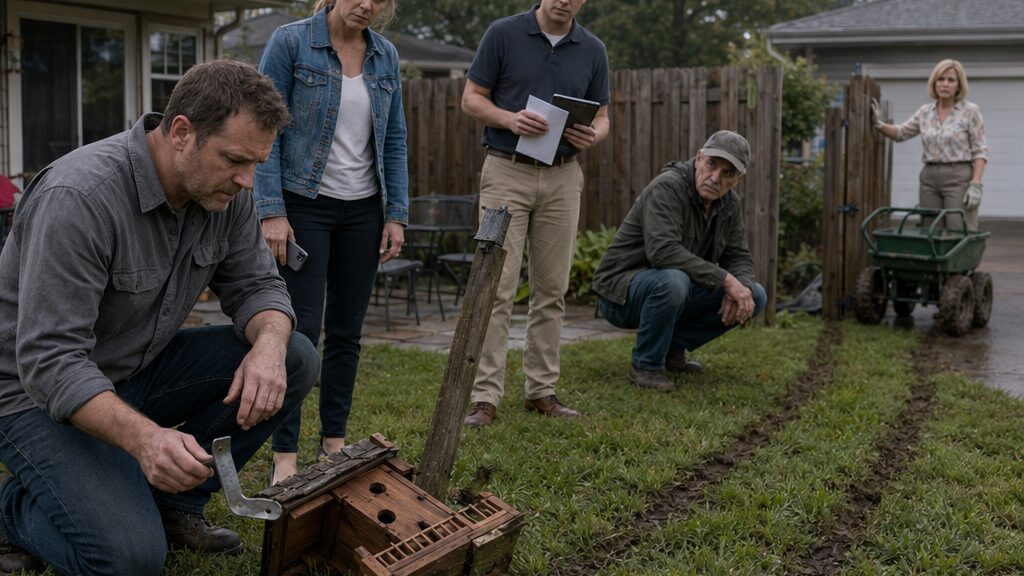
He walked over. In the damp grass, running from the narrow gate area toward the back corner, were two parallel tracks. Not footprints. Not mower lines. The grass had been pressed down in shallow ruts, with small repeating dents along the edges.
Rebecca pointed. “Those weren’t here yesterday.”
John followed the tracks with his eyes. They ran from the direction of the shared strip between their house and Barbara’s, curved toward the birdhouse post, then returned in a messier line toward the same side gate. At one place, a deeper gouge showed where something heavy had turned.
He crouched again, this time by the tracks.
“Wheelbarrow?” Rebecca asked.
“Or a garden cart.”
“Like the one Barbara keeps by her garage.”
John said nothing.
“Don’t do that,” she said.
“What?”
“That face. The one where you decide a thing is true and then pretend it isn’t because saying it out loud would be inconvenient.”
He rubbed a hand over his jaw. “I’m trying not to turn this into something worse.”
“It already became worse when somebody came into our yard.”
The side gate creaked before John could answer.
Tyler Anderson stepped through with a white envelope in one hand and his phone in the other. He froze when he saw the birdhouse lying near the herb bed, then looked at the empty post.
“Oh,” he said.
Rebecca laughed once, sharply. “Good morning to you too.”
Tyler glanced back toward the street as if he regretted not waiting in his car. “I knocked at the front. No one answered.”
“It’s six-forty,” John said.
“I was asked to deliver this before close of business Monday, but Mrs. Campbell said the matter was time-sensitive.”
Rebecca walked toward him. “Barbara sent you over before seven on a Sunday?”
Tyler held out the envelope to John, not Rebecca. “It’s a courtesy notice. Not a fine.”
John took it. His name and address were printed in a management-company format, neat and impersonal. He opened the flap with his thumb.
The notice said an unapproved structure visible from neighboring property had been installed without prior architectural review. It requested removal or submission of a variance application within forty-eight hours. Near the bottom, in smaller type, it cited Section 8.3: Exterior Improvements, Sightlines, and Permanent Yard Structures.
John read it twice. The words blurred less from confusion than from the effort not to let Tyler see his hands tighten.
“This was drafted yesterday?” John asked.
“After the site observation.”
“Barbara’s photos.”
Tyler hesitated. “Documentation was provided.”
Rebecca pointed toward the grass. “Did her documentation include this?”
Tyler looked where she pointed. His expression shifted. He stepped closer, then stopped before his shoe touched the track.
“What is that?”
“That’s what we’re asking,” Rebecca said.
John folded the notice and put it back into the envelope. “Tyler, did anyone from the association authorize someone to remove it?”
“No. Absolutely not.”
“Did Barbara?”
“I can’t speak for—”
“Then speak for the association.”
Tyler’s throat moved. “No removal was authorized.”
Rebecca took out her phone and began photographing the tracks, the post, the bent bracket, the birdhouse lying on its side. She moved quickly, almost angrily, but her photos were careful. John watched her frame the ruts in the grass with the side fence in the background.
Tyler said, “It’s possible it was unstable.”
John looked at him.
“I’m not saying it was,” Tyler added. “Just that if it wasn’t properly approved or installed—”
“I set that post in concrete,” John said. His voice stayed level, but something under it had changed enough that Tyler stopped talking. “Whoever moved it had to loosen the bracket and lift the base. Or they pulled it until the bracket twisted.”
Tyler looked at the birdhouse again, then down at the notice in John’s hand. “I should report that it was already down when I arrived.”
Rebecca lowered her phone. “Already down. That’s convenient.”
“I didn’t mean—”
“What did you mean?”
John stepped between them before Tyler could answer. Not directly, not dramatically. Just enough that Rebecca’s eyes flicked to him.
“Tyler,” John said, “I want the notice paused until this is reviewed.”
“I don’t have authority to pause a notice.”
“Then tell whoever does.”
Tyler’s face reddened again. “I can pass that along.”
A voice came from the other side of the fence. “What in the world happened back here?”
Dennis Harris stood at the corner where his yard met theirs, wearing a faded ball cap and holding a coffee mug. He was in his late sixties, narrow-shouldered but sturdy, with the permanently sun-browned face of a man who had spent too many years taking care of other people’s grass.
John exhaled. “Birdhouse came down.”
Dennis’s eyes moved from the empty post to the bent bracket, then to the tracks. He did not ask the first obvious question. He stepped through the open side path and crouched in the grass.
“Nobody dragged that by hand,” Dennis said.
Rebecca folded her arms. “That’s what we thought.”
Dennis leaned closer to the ruts. He did not touch them. He followed one line with his eyes all the way toward the shared strip between the houses, and his mouth pulled slightly to one side.
“What?” John asked.
Dennis stayed crouched.
“Dennis?”
The older man looked toward Barbara Campbell’s closed gate, then back at the marks in the grass.
“I’ve seen that tread before,” he said. “And I don’t think you’re going to like where it goes.”
Chapter 3: The Tracks Crossed the Wrong Lawn
Dennis Harris measured the tread mark with two fingers, then wiped the damp grass from his knuckles and looked toward Barbara Campbell’s driveway.
Nobody moved for a second.
The morning had started to wake around them. Garage doors hummed somewhere down the block. A dog barked once and was called inside. In John’s yard, the birdhouse sat crooked on the grass, and the tracks made a quiet accusation none of them had yet said out loud.
Rebecca was the first to break the silence. “Show us.”
Dennis stood slowly. “I’m not looking to start a war.”
“It started before sunrise,” she said.
John looked at her. “Rebecca.”
“No. Someone came through our gate and moved something John built. We’re allowed to follow the marks they left.”
Tyler Anderson shifted beside the empty post. “I should probably remain neutral.”
Rebecca stared at him. “That would be a first.”
Tyler looked down.
Dennis sighed and walked along the tracks toward the side strip between the houses. John followed a few steps behind, careful not to step on the ruts. The path ran beside the fence, through the narrow strip where both properties came close and nobody lingered unless mowing. At the gate, the tracks deepened where wheels had pushed over the small lip of soil. On the other side, in the shared strip visible from the sidewalk, the pattern continued faintly through the dew.
Then it angled toward Barbara’s driveway.
John stopped at the property line.
The green garden cart stood beside Barbara’s garage, half tucked behind a row of clipped boxwoods. Its metal tray was empty except for a pair of pruning shears and a folded canvas kneeling pad. Mud clung to both tires. Along the raised rubber tread, little diagonal notches matched the dents in John’s lawn.
Rebecca took one picture. Then another.
Dennis looked miserable. “I sharpened that axle for her last spring. Told her those tires would leave a pattern if she rolled it on wet turf.”
John stared at the cart. He had seen Barbara use it dozens of times—hauling mulch, potted plants, paper lawn bags folded with obsessive neatness. He had never thought about the tires. He had never thought about her rolling it through his yard in the dark or early morning, stopping under the birdhouse, putting her hands on the thing he had built.
Tyler came up behind them and saw the cart. “That doesn’t prove—”
The side door of Barbara’s garage opened.
Barbara stepped out wearing pale gardening gloves and a floral blouse tucked into khaki pants. Her hair was smooth, her face composed, but she stopped when she saw all four of them standing near the driveway.
Her eyes went first to Rebecca’s phone, then to Dennis, then to John.
“What is this?” Barbara asked.
Rebecca lowered the phone. “That’s what we came to ask you.”
Barbara’s expression hardened in stages. “You are standing on my driveway.”
“Barely,” Rebecca said.
John raised a hand slightly. “Rebecca.”
Barbara turned to him. “John, I hope you understand how inappropriate this looks.”
He almost laughed. The sound came up in his chest and died there.
“Inappropriate,” he said.
Tyler stepped forward with the caution of a man approaching a loose dog. “Mrs. Campbell, the birdhouse appears to have been moved or damaged sometime overnight.”
Barbara looked toward John’s backyard, though the fence blocked the view. “I’m aware it was unstable.”
John felt Rebecca go still beside him.
“How are you aware?” he asked.
Barbara’s gaze returned to him. “Because I told you yesterday it was a problem.”
“That’s not what I asked.”
Her lips pressed together.
Dennis removed his cap and turned it in his hands. “Barbara, those tracks run from John’s post to this cart.”
“You don’t know that.”
“I know tread.”
“That’s not evidence.”
Rebecca lifted her phone. “It’s a pretty good start.”
Barbara’s face flushed. Not much, but enough. “I did not damage anything.”
John heard the narrowness in the sentence.
“Did you move it?” he asked.
Barbara opened her mouth, then looked at Tyler. The management assistant suddenly seemed fascinated by his tablet.
“Barbara,” John said.
She removed one glove finger by finger. “It was leaning.”
“It was not leaning.”
“It was too tall and improperly installed. I was concerned it might fall.”
“So you came into my yard?”
“I stepped through the gate because I saw a hazard.”
“At what time?”
“That isn’t the point.”
“It is exactly the point.”
Rebecca took a breath like she was about to say something sharp enough to leave a mark, but John spoke before she could.
“Did you use the cart?”
Barbara glanced toward the green cart. The pause was small. It was enough.
“I tried to shift it away from the fence line,” she said. “A little.”
Dennis closed his eyes.
Rebecca said, “You tried to shift a five-foot cedar birdhouse mounted to a post a little?”
“It should never have been there.”
John looked at the cart, then at the mud on its tires, then at Barbara’s gloved hands. His anger did not come hot. It came heavy. He thought of her under the birdhouse yesterday, saying structure, sightlines, Monday. He thought of himself nodding, swallowing, making room for her tone because it was easier than making a scene.
“You could have knocked first,” he said.
Barbara blinked.
The words were not loud. That made them worse. They sat there in the driveway with the cart and the wet tracks and Tyler’s white notice in John’s hand.
“You could have knocked on my door,” John said. “You could have called. You could have waited for the board to decide whatever it was going to decide. You could have done almost anything except come into my yard and put your hands on it.”
Barbara’s shoulders lifted. “I was trying to prevent a safety issue.”
“No,” Rebecca said. “You were trying to win before anyone told you no.”
Barbara’s eyes flashed. “You don’t know what I’m trying to do.”
Dennis put his cap back on. “Barbara, I think everybody needs to stop talking for a minute.”
But Barbara had already turned toward John with the controlled brightness she used in meetings. “You were given a courtesy opportunity to correct the violation. Instead you and your wife are taking photographs on my property and accusing me in front of neighbors.”
“Because you moved it,” Rebecca said.
“I moved a hazard.”
“You broke it.”
“I did not break it. If it broke, that only proves it was poorly installed.”
John looked down at the envelope in his hand. The compliance notice seemed thinner now, less official and somehow more dangerous. Paper made everything cleaner than it was.
Tyler finally spoke. “Mrs. Campbell, I think we should document all of this for the board.”
Barbara turned on him. “Exactly. We should.”
Tyler flinched at her agreement more than her anger.
Barbara looked back at John. “The board will hear about this. All of it. The unapproved structure, the confrontation, the way you handled this.”
“The way I handled finding my property in the grass?”
“The way you handled a compliance matter.”
John wanted to say more. He wanted to ask how she had gotten into the gate, how long she had been there, whether she had heard the bracket bend and kept pulling anyway. Instead he looked at the green cart, at the twin tires that had written the truth across his lawn because Barbara had not thought wet grass would remember.
Rebecca touched his arm, not to stop him this time, but to steady him.
John folded the notice once, then again, making the crease sharp.
“Then I’ll be at the meeting,” he said.
Barbara’s face changed just slightly, as if that was not the answer she expected from him.
John turned back toward his yard. Behind him, Dennis followed. Rebecca waited one more second, took a final photo of the cart tires, and then came too.
At the gate, John looked back.
Barbara was standing beside the green cart, one glove still in her hand, watching them leave as though she had been the one cornered.
Chapter 4: The Rule Everyone Quoted but Nobody Had Read
John’s birdhouse filled the clubhouse wall like evidence from a crime scene.
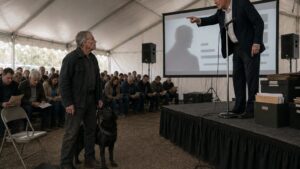
Barbara’s photo had been enlarged on the pull-down screen behind the folding table where the HOA board sat with paper cups, binders, and the exhausted expressions of people who had expected a Monday night meeting about pool tags and late dues. The birdhouse looked taller in the projection than it had in the yard. Its cedar walls were bright, its rooflines neat, its post straight and plain beneath it.
At the bottom of the image, someone had circled the part that rose over the fence in red.
Rebecca leaned close to John. “She marked it up.”
John kept his hands folded around the bent mounting bracket in his lap. He had brought it in a grocery bag, then taken it out because hiding it made him feel like he was asking permission to be believed.
Barbara sat three chairs down from the board table, a folder on her knees. She had not looked at him since he and Rebecca entered. Tyler Anderson stood near the wall with his tablet, trying to be invisible and failing.
One board member adjusted her glasses. Another shuffled through printed pages. Dennis Harris sat in the second row, cap in his hands.
“Mr. Thompson,” the board member with glasses said, “we understand there are two concerns tonight. The first is the unapproved backyard structure. The second is the alleged damage or movement of that structure.”
“Alleged?” Rebecca said under her breath.
John touched her knee once. Not to silence her. To tell her he heard it too.
Barbara stood. “If I may clarify, the structure was not approved. That part is not alleged.”
John looked at the screen again. The red circle seemed childish and official at the same time.
The board member said, “Mrs. Campbell, you’ll have time to speak.”
“I only want the record to be accurate.”
“Noted.”
John waited. The old version of him would have let the meeting find its own direction. He would have watched the people in charge decide what tone was acceptable, what facts mattered, when to move on. He could already feel that habit reaching for him like a familiar coat.
He set the bent bracket on his knee instead.
When his turn came, he stood with the bracket in his hand.
“I built the birdhouse,” he said. “I didn’t submit a form because I didn’t know a birdhouse required one. When Mrs. Campbell told me it did, I said I would look at the rules. The next morning, it was off the post and in the grass.”
Barbara’s chair creaked.
John did not look at her. “I’m asking for two things. First, I’d like to know the exact rule I broke. Second, I’d like the board to address the fact that someone entered my yard and moved my property before any decision was made.”
The room was quiet enough for him to hear the fluorescent lights.
The board member with glasses turned to Tyler. “Mr. Anderson, would you read the cited section?”
Tyler tapped the tablet. “Section 8.3. Exterior Improvements, Sightlines, and Permanent Yard Structures.”
He stopped.
Rebecca leaned back in her chair. “That’s the title.”
Tyler glanced at the board. “Right. The section states: ‘No owner shall erect, alter, or install any shed, antenna, deck extension, fence addition, exterior storage unit, or permanent improvement visible from neighboring lots without prior written approval of the architectural committee.’”
He stopped again.
John waited.
The board member said, “Continue.”
Tyler scrolled. “That’s the relevant sentence.”
“Does it say birdhouse?” John asked.
“No.”
“Does it define decorative yard items?”
Tyler’s thumb moved across the screen. “Not in this subsection.”
Barbara stood again. “It says permanent improvement. It’s mounted in concrete.”
John turned then. “Was mounted.”
Barbara looked at the bracket in his hand and then away.
The second board member, a man with a tired voice and a pen he kept clicking, said, “Mr. Thompson, would the birdhouse be removable?”
“Yes.”
“But the post was set in concrete?”
“A small footing. It can be dug out.”
“So it is not exactly like a planter hook.”
“No,” John said. “But it’s not a shed either.”
A few people in the room shifted. Someone gave a short cough that sounded like a swallowed laugh.
Barbara opened her folder. “The purpose of the rule is to prevent visual intrusion and unauthorized exterior modifications. If we start making exceptions because something is charming or handmade, we lose consistency.”
John heard the word handmade and felt the edge under it.
Rebecca raised her hand halfway. “Can we also be consistent about not going into other people’s yards?”
The board member with glasses said, “Mrs. Thompson, we will address that.”
“When?”
“After we determine whether the structure was permitted.”
John felt Rebecca stiffen. He understood why. The order of things mattered. The room was treating the birdhouse as the first offense and the damage as a second issue, optional and messier.
He lifted the bracket. “This was bent before any review. That seems important.”
Tyler looked at the metal and then at Barbara. “For the record, management did not authorize removal.”
Barbara’s face stayed composed. “No one removed it. I shifted it away from a potential fall line.”
Dennis made a sound from the second row, not quite a word.
The board member with the pen looked up. “Mr. Harris?”
Dennis seemed to regret being noticed, but he stood anyway. “I worked grounds maintenance for thirty-one years. That post didn’t fail by itself. Somebody put lateral force on it. The cart tracks show that.”
Barbara’s voice sharpened. “Mr. Harris is not an engineer.”
“No,” Dennis said. “Just old enough to know what wheels do in wet grass.”
A few heads turned toward Barbara.
For the first time all night, John saw uncertainty touch her face. It was brief, but it was there. She had come prepared to speak about rules. Dennis had brought the yard into the room.
The board member with glasses tapped the paper packet. “Here is what we can do tonight. We are not prepared to make a final determination on whether the birdhouse qualifies as a permanent improvement under 8.3. We can table that pending review of the architectural guidelines.”
Rebecca’s mouth opened.
John put his hand over hers before she spoke.
The board member continued. “As for the alleged movement or damage, we will request written statements from all involved parties.”
Barbara closed her folder with a soft snap. “Before that, I need to add a safety concern.”
John felt the room tilt again.
Barbara pulled out a second page. “This kind of oversized bird structure can attract nuisance wildlife. Not just songbirds. Wasps, rodents, possibly raccoons. If it is visible over the fence and drawing animals near property lines, that becomes a health and safety issue, not merely an aesthetic one.”
John stared at her.
Rebecca whispered, “You have got to be kidding.”
Tyler looked down at his tablet again, but this time his face did not hide his discomfort.
The board member with the pen stopped clicking. “Do we have any documentation on that?”
“I can obtain it,” Barbara said.
John looked at the projected photograph of the birdhouse, at the red circle around the roofline, at the cedar compartments he had smoothed by hand. Yesterday it had been too tall. This morning it had been unstable. Now it was unsafe wildlife.
He stood before anyone had called on him again.
“I’ll provide a drawing, measurements, and whatever information you need,” he said. His voice sounded calmer than he felt. “But I want the same standard applied to the person who touched it.”
Barbara looked at him then, and for a second the authority in her face cracked into something else. Not guilt. Not yet. Fear, maybe.
The board member nodded. “We’ll reconvene Wednesday evening.”
John picked up the bracket and the grocery bag. Rebecca stood beside him. Dennis rose too.
As they reached the door, Barbara’s voice followed them from inside the meeting room.
“I’ll also bring documentation about the wildlife risk.”
John paused with his hand on the metal push bar. Behind the glass, the parking lot lights buzzed over the empty spaces. He had thought the meeting would answer whether Barbara had power over the birdhouse.
Instead, she had found a new way to make the birdhouse sound dangerous.
Chapter 5: Barbara Had Already Lost One Vote
“It isn’t only about birds,” a neighbor said at the mailboxes on Tuesday afternoon.
John had just slid three envelopes from his slot and was turning away when the woman beside him lowered her voice. She did not look at him when she spoke. She looked down the sidewalk toward Barbara Campbell’s house, where the green garden cart was no longer beside the garage.
John stopped with the mail in his hand. “What do you mean?”
The neighbor pressed a catalog against her chest. “I probably shouldn’t get involved.”
“That seems to be everyone’s favorite way of getting involved.”
She gave him a quick, guilty smile. “Barbara lost a vote last month. Over the Sanchez patio lights. She pushed for fines, the board told her she’d overstepped, and people started asking whether compliance had become too personal.”
John glanced toward Barbara’s house. The front porch was swept clean, the hanging fern trimmed into a perfect round shape.
“What does that have to do with me?”
The neighbor finally looked at him. “Your birdhouse went up where everyone could see it. If she let it slide after the patio light thing, it would look like nobody listens to her anymore.”
John felt the mail bend in his grip.
The neighbor walked away before he could ask anything else, leaving him with a power bill, a grocery flyer, and a fact he had not wanted because it made everything less simple.
By the time he reached his own driveway, Rebecca was standing near the empty post in the backyard, arms folded, staring at the gap above it. The birdhouse itself rested on a tarp under the patio cover. John had patched the cracked roof seam but left the broken porch rail untouched, as if fixing all of it too soon would erase what had happened.
Rebecca turned when he came through the gate. “Barbara moved the cart.”
“I noticed.”
“She thinks hiding it changes something.”
John leaned the mail against the patio table. “A neighbor said Barbara got overruled last month.”
Rebecca’s expression did not soften. “Good.”
“Maybe that’s why she pushed so hard.”
“Still not good.”
“I didn’t say it was.”
Rebecca looked back at the post. Without the birdhouse, it seemed oddly accusing, a plain four-by-four stuck in the ground with nothing to hold.
John crossed the yard. “I’m going to talk to her.”
Rebecca turned fast. “Alone?”
“I’m not going to fight.”
“That is exactly what worries me.”
He almost said, I know what I’m doing. He did not, because they both knew it would not be true. Instead he said, “I want to hear what she says when there isn’t a board table between us.”
Rebecca studied him for a moment. “And if she twists that too?”
“Then at least I’ll know I tried before Wednesday.”
Barbara opened her front door before he reached the porch, as if she had watched him coming through the narrow glass beside it.
“John.”
“Barbara.”
Neither said hello.
Her porch smelled faintly of potting soil and lemon cleaner. A stack of flattened cardboard sat by the wall, tied with twine. Through the half-open garage door, John could see shelves labeled with plastic bins, every tool in its place. The green cart was not visible.
“I’d like to talk,” he said.
“I have nothing to say until the meeting.”
“That’s not true.”
Her eyes narrowed. “Excuse me?”
He kept his voice low. “You had plenty to say about safety last night.”
Barbara glanced down the street. “This is not the place.”
“It’s your porch.”
“That’s exactly why.”
He almost walked away. The old habit rose again: let her have the last word, avoid the scene, save the rest for when people with titles were listening. Then he saw the corner of the green cart behind a tarp inside the garage.
“You moved the cart,” he said.
Barbara’s face changed.
“Why?” he asked.
She opened the door wider but did not invite him in. “Because people were taking pictures of my property.”
“After it was used on mine.”
“I told you what happened.”
“You told me three versions of what happened.”
She looked down. For the first time since Saturday, her posture loosened. Not collapsed, but loosened, as if the strings holding her official shape had slipped.
“You don’t understand what it’s like,” she said.
“To have a birdhouse in your view?”
“To be the person everyone calls when something bothers them, and then the person everyone blames when you act on it.”
John waited.
Barbara’s mouth tightened, but now it looked less like contempt than effort. “Last month I followed the guidelines on a complaint. Patio lights. They were bright, they were up all night, they shone into a bedroom. I pushed for enforcement. The board decided it was neighbor-to-neighbor and made me look ridiculous in front of half the association.”
“So you needed to win this one.”
“That is not what I said.”
“It’s what it sounds like.”
Her eyes flashed, but the anger did not fully arrive. “Do you think rules enforce themselves? Everyone says they want standards until the standard applies to something they like. Then suddenly I’m petty. I’m controlling. I’m the problem.”
John looked past her into the garage. “You came into my yard.”
“I saw it leaning.”
“No, you didn’t.”
“You don’t know what I saw.”
“I know how I built it.”
“That doesn’t make it safe.”
“It makes it mine.”
For a moment neither of them spoke. A car rolled slowly down the street, the driver pretending not to look.
Barbara wrapped her arms around herself. “If that thing fell and damaged my fence, or hurt someone, everyone would ask why compliance saw it and did nothing.”
“There was no one under it at five in the morning.”
Her face flickered again.
John caught it. “Was it five?”
She did not answer.
He felt a small coldness move through him. He had guessed. She had confirmed it by not denying.
“You were in my yard before sunrise.”
“I was checking the property line.”
“With a cart.”
“I made a poor judgment call,” she said, each word stiff. “But that does not erase your violation.”
John nodded slowly. “There it is.”
“What?”
“You can say poor judgment call. You can say safety. You can say structure. But you can’t say you’re sorry.”
Barbara’s cheeks colored. “An apology would be treated as an admission.”
“It is an admission.”
“Then you see my position.”
He did see it. That was the problem. He saw the woman who had built her life around being correct, who had mistaken correction for respect, who had been embarrassed once and decided never to be visibly weak again. He saw that she believed rules were the only language the neighborhood still listened to.
He also saw the broken rail on the tarp in his backyard.
“I’m not withdrawing my complaint,” he said.
Barbara’s face closed again. “Then I won’t be able to support any compromise on the birdhouse.”
John laughed once, quietly. He did not mean to. It came from surprise, not humor.
“So that’s the trade?”
“That’s not what I said.”
“It’s exactly what you said.”
She lifted her chin. “If you continue framing this as misconduct, I will continue treating the structure as a formal violation.”
John stepped back from the porch.
The old version of him would have taken the offer hidden inside the threat. Let it go, keep part of the birdhouse, avoid more meetings, avoid more neighbors whispering by mailboxes. He could almost feel the relief of surrender.
Instead he looked at Barbara’s spotless porch, the trimmed fern, the garage where the cart had been tucked away.
“I’ll see you Wednesday,” he said.
When he returned through the side gate, Rebecca was waiting by the post.
“She apologized?” she asked.
John shook his head.
Rebecca’s jaw set. “Then we ask the board to remove her.”
The words landed harder than Barbara’s threat.
John looked at the empty post, at the square top where the bracket should have held, at the place where he had wanted birds and gotten a hearing instead.
“I don’t know if that’s what I want,” he said.
Rebecca stared at him as if he had stepped backward.
Behind them, the post stood bare in the late light, and for the first time John understood that keeping the birdhouse might not be the same thing as fixing what had been broken.
Chapter 6: The Empty Yard Made Rebecca Say the Quiet Part
“Are you protecting peace,” Rebecca asked, “or are you protecting fear?”
John stood at the kitchen sink with a plate in his hands and no memory of picking it up. Outside the dark window, the empty post cut a black vertical line against the porch light. The birdhouse sat under the patio cover, patched but not whole, its little broken rail still resting beside it like a bone too small to matter and too visible to ignore.
He set the plate down. “That’s not fair.”
“No,” Rebecca said from the table. “What happened wasn’t fair. Me asking you to name it is just uncomfortable.”
Her voice was not loud. That was what made it harder to step around.
John dried his hands on a towel though they were not wet. “I talked to her.”
“And she threatened you.”
“She explained herself.”
Rebecca pushed back from the table. “John.”
“I’m not defending her.”
“It sounds like you are practicing.”
He turned from the sink. Rebecca sat with Barbara’s notice, the photos, and John’s hand-drawn birdhouse plans spread across the table. She had organized them into piles: damage, rules, correspondence. It looked like a case. He hated that their kitchen had become a place for evidence.
“She’s wrong,” he said. “I know she’s wrong.”
“Then why do you keep looking for a way to make her less wrong before you decide what you’re allowed to feel?”
He looked out at the post again.
Because anger made him feel careless. Because once, years ago, he had watched his father turn every slight into a match and every room into a place people had to survive. Because John had promised himself early that he would be the kind of man who did not make others brace when he walked in.
But promises could grow crooked if nobody checked the level.
“I almost took it down,” he said.
Rebecca went still.
He had not planned to say it. Once it left his mouth, the room seemed to hear it before she did.
“When?” she asked.
“Saturday night.”
She looked toward the patio. “After everything?”
“After you went to bed. I came out here with a socket wrench. I thought if I took the top down, submitted the form, maybe trimmed it lower…” He stopped. “Maybe it would all go away.”
Rebecca’s face changed, anger giving way to something more hurtful. “You didn’t tell me.”
“I didn’t do it.”
“But you were going to.”
“I thought I was being practical.”
“You thought disappearing your own work would be easier than letting someone be upset with you.”
The words hit exactly where they were aimed.
John pulled out the chair across from her and sat. Between them lay the first sketch he had made on scrap paper from the garage. The lines were rougher than the final build: three stacked compartments, a wide roof, a note in the margin that said face east if possible. He had written that after reading birds preferred morning sun and afternoon shade.
Rebecca touched the sketch. “You made this before you bought the cedar.”
“Yeah.”
“Why?”
He could have said because he liked woodworking. Because the yard needed something. Because it was cheaper than buying one already made. All of those were true enough to be lies.
He looked toward the dark window. “Last winter, I’d come downstairs and the house would feel… stopped.”
Rebecca’s eyes lowered.
He regretted it immediately, not because it was untrue, but because it touched the loneliness they had both stepped around carefully for months. The quiet dinners. The unused guest room they had painted and then closed. The doctor bills paid and filed. The way hope, when it left, did not always slam a door; sometimes it just stopped making noise.
“I wanted something alive back there,” he said. “Something that came and went because it wanted to. Not because we planned it or paid for it or filled out a form.”
Rebecca’s hand covered the edge of the sketch. She did not cry. That would have been easier to meet. She looked at him with a sadness that had been in the room long before Barbara ever stepped into the yard.
“And you were going to take it down alone,” she said.
His throat tightened. “I was going to avoid a fight.”
“With Barbara.”
“With everybody.”
“With me too?”
He did not answer fast enough.
Rebecca leaned back as if the silence had touched her. “That’s what I mean. You call it peace, but sometimes it feels like you leave me standing in the argument by myself.”
John looked at the photos. One showed the tracks in wet grass, two parallel lines crossing the yard. They looked less like evidence now than a message written by someone who believed her urgency mattered more than his door.
“I don’t want to become cruel,” he said.
“I’m not asking you to be cruel.”
“I don’t want to be the person who walks into a meeting and tries to ruin someone.”
“Then don’t.” Her voice softened. “Walk in and tell the truth. There’s a difference.”
The refrigerator hummed. Outside, a moth tapped once against the window, bounced off the glass, and vanished into the porch light.
John reached for the sketch. The paper had a faint ring from an old coffee mug and a crease where he had folded it into his pocket at the hardware store. He remembered standing in the lumber aisle, choosing boards that were not warped. He remembered sanding the entrances smooth because he had read rough edges could scrape feathers. He remembered thinking that care no one noticed was still care.
He stood suddenly and went to the drawer by the stove.
“What are you doing?” Rebecca asked.
“Looking for the pencil.”
“In the junk drawer.”
“I know.”
“You never know.”
He found it under a pack of batteries and a tape measure with a cracked case. Then he took the sketch to the back door, flipped on the patio light, and stepped outside.
Rebecca followed.
The night air smelled like damp soil and cut grass. John walked to the empty post, then past it, toward the back corner nearer Dennis’s fence and farther from Barbara’s direct sightline. He crouched with the sketch on one knee and drew a rough rectangle for the yard, the fence, the herb bed, the maple shadow, the angle of morning sun.
Rebecca stood over him, arms wrapped around herself. “You’re moving it?”
“I’m proposing a new spot.”
“That’s compromise.”
“Yes.”
“After what she did?”
He looked up. “Compromise isn’t the same as surrender if I say what happened first.”
Rebecca held his gaze. The porch light caught the tiredness in her face.
He marked an X near the back corner, then wrote beside it: new post, lower bracket, same house.
The words steadied him.
“I’m going to bring the bracket,” he said. “The photos. The rule. The sketch. I’m going to ask them to clarify the policy. I’m going to ask Barbara to acknowledge she came into the yard before any vote.”
Rebecca’s expression was careful, hopeful but guarded. “And if she refuses?”
“Then she refuses in front of everyone.”
“And you?”
John looked at the empty post. For two days it had looked like a failure. Now, in the hard porch light, it looked like a question he finally understood.
“I don’t have to yell to stop backing down,” he said.
Rebecca stepped closer and took the pencil from him. On the sketch, under his X, she wrote two words: knock first.
John looked at them for a long moment.
Then he folded the paper carefully, not to hide it, but to carry it.
Chapter 7: You Could Have Knocked First
John placed the bent mounting bracket on the board table, and the sound it made was smaller than he expected.
A dull tap. Metal against fake wood. Nothing dramatic enough for the room to understand what it had cost him to bring it there.
Barbara Campbell looked at the bracket and then at the folder in front of her. Tyler Anderson, standing near the projector cart, stopped scrolling on his tablet. The two board members glanced at each other. Behind John, chairs creaked as neighbors shifted, waiting to see whether this would be another argument about a birdhouse or something less comfortable.
Rebecca sat in the front row with John’s folded yard sketch on her lap. Dennis Harris sat beside her, one ankle crossed over his knee, cap in his hands, his thumb worrying the brim.
John kept his hand near the bracket for a second before letting go.
“This is from the base,” he said. “It was straight Saturday night.”
The board member with glasses looked at it carefully. “Mr. Thompson, we’ll give you time.”
Barbara sat upright. “Before we begin, I would like it noted that I submitted supplemental information on potential wildlife concerns.”
The board member with the pen lifted a packet. “We received it.”
Rebecca’s fingers tightened on the sketch.
John did not look back at her. If he did, he might borrow her anger, and he had come to the meeting with something harder to carry.
The board member with glasses nodded to him. “Go ahead.”
John unfolded a sheet of paper and set it beside the bracket. He had written notes, then crossed most of them out. Every version that tried to sound official became something he did not trust. What remained fit on half a page.
“I’m not here to argue that every homeowner should build whatever they want,” he began. “I understand why neighborhoods have rules. I bought into this association knowing there would be rules.”
Barbara’s shoulders eased almost imperceptibly, as if she believed the sentence was a concession.
John touched the bracket. “But rules can’t become permission to skip basic respect.”
The room stilled.
He heard Rebecca take a breath behind him.
John continued before he could stop himself. “Saturday, Mrs. Campbell told me the birdhouse was a violation. I asked what rule. I was told to take it down by Monday. Sunday before sunrise, the birdhouse was off the post and lying in the grass. Tracks ran from the post to the side strip and toward Mrs. Campbell’s driveway. Mrs. Campbell later said she tried to shift it for safety.”
Barbara leaned forward. “Because it was leaning.”
John looked at her. “It was not leaning until someone pulled on it.”
“You cannot know that.”
“I built it.”
“That doesn’t make you an inspector.”
“No,” John said. “But it does make me the person you should have spoken to before touching it.”
Barbara looked away first.
The board member with the pen cleared his throat. “Mr. Anderson, management sent a courtesy notice Sunday morning. Correct?”
Tyler nodded. “Yes.”
“Before any board review.”
“Yes.”
“Was that standard?”
Tyler’s face went red from his collar upward. “A courtesy notice can be sent when a potential violation is observed.”
“Potential,” John said.
Tyler swallowed. “Yes.”
The board member with glasses looked over her copy of the covenants. “We reviewed Section 8.3 and the architectural guidelines. The language is not as specific as it should be. It covers sheds, antennas, deck extensions, fence additions, exterior storage units, and permanent improvements. It does not mention decorative birdhouses, wildlife structures, or mounted yard decor.”
Barbara opened her folder. “But it says permanent improvement.”
“It says that,” the board member agreed. “The question is whether this object is reasonably classified under that term without clearer guidance.”
“It was set in concrete.”
“A removable footing,” John said.
“Not easily removable.”
“It came off pretty easily when you pulled it.”
The room went quiet enough that the pen stopped clicking.
John regretted the sharpness as soon as it left him, not because it was untrue, but because it felt like stepping onto the road he had promised himself not to take. He saw Rebecca shift, saw Dennis glance down, saw Barbara’s face flush with anger and something like injury.
He drew a breath. “That was unfairly said. I’m angry, but I’m not here to trade insults.”
Barbara blinked, caught between responding to the insult and the apology.
The board member with glasses looked relieved to have a path back. “Mrs. Campbell, did you enter Mr. Thompson’s backyard before the courtesy notice was delivered?”
Barbara’s mouth tightened. “I entered the side gate area because I believed there was an immediate safety issue.”
“That is not exactly the question.”
Barbara looked at the board member then, and John saw the moment she understood the room was no longer arranged the way she had expected. Her role had shifted. Compliance chair was not enough to hold the floor.
“Yes,” she said. “I stepped into the yard.”
“With permission?”
“No.”
“Had the board authorized any action?”
“No.”
“Had management?”
Tyler answered before Barbara could. “No.”
The word hung there, clean and damaging.
Barbara’s hand closed around a pen. “I want the record to show that I acted out of concern. The structure exceeded the fence line, it was newly installed, and if it had fallen toward the adjoining fence—”
“Was anyone under it?” the board member with the pen asked.
“That is not the only standard for safety.”
“No. But urgency matters.”
Barbara’s eyes flashed. “Everyone here enjoys second-guessing compliance until something goes wrong.”
That was the first time her voice cracked.
Not broke. Cracked. It let something through.
She looked around the room at the neighbors watching her. “Last month I was told I overreached because I enforced a lighting complaint. The month before that, I was told I didn’t act quickly enough on a trailer left in a driveway. People email at midnight about trash cans and weeds and noise, and when I try to apply standards, suddenly I’m unreasonable.”
John looked at her hands. The pen trembled faintly between her fingers.
“I saw that birdhouse over the fence,” she said, “and I knew exactly how it would go. If I did nothing, someone would say compliance had become useless. If I acted, someone would say I was targeting him.”
Rebecca’s face had gone still. Dennis looked down at his cap again.
Barbara lifted her chin, trying to rebuild herself around the explanation. “So yes, I acted. And perhaps I acted too quickly. But this association cannot function if every owner decides their personal project is exempt because it has sentimental value.”
The last words touched John more sharply than he expected.
He had not told Barbara about the winter. He had not told the room about the quiet house or the way the birdhouse plans had given his hands somewhere to put hope. Yet she had aimed at the place anyway, not knowing what she hit.
John picked up the folded sketch from Rebecca’s lap when she handed it to him. He opened it on the board table. The original birdhouse drawing showed his rough lines and small notes. Beside it, in pencil from Tuesday night, was the yard rectangle with the X in the back corner and Rebecca’s words beneath it: knock first.
“I’m not saying my personal project is exempt,” John said. “I’m saying the process matters. If the board decides it needs to be lower, I’ll make it lower. If it needs a different location, I drew one. I even called the county extension office this morning about the wildlife concern.”
Barbara looked up sharply.
John took a small printed email from the folder. “A volunteer sent basic guidance. Cleanable compartments, no food placed inside, distance from rooflines, secure mounting. The birdhouse can be adjusted to meet those recommendations.”
The board member with glasses accepted the email. “Thank you.”
Barbara’s wildlife packet suddenly seemed heavier on the table.
John turned slightly toward her. Not fully. Enough.
“What I am not agreeing to,” he said, “is the idea that because you felt pressure, you had the right to come into my yard before dawn and handle it yourself.”
Barbara’s face tightened again, but she did not interrupt.
“I should have asked for the rule on Saturday,” John said. “I didn’t. I should have made it clear then that I expected any concern to go through a process. I didn’t. That’s on me. I thought being calm meant letting things slide until they settled. They didn’t settle. They got dragged across my lawn.”
No one laughed. That made the sentence land the way he meant it to.
Tyler looked at the bracket, then at his tablet. “For what it’s worth, the notice was premature.”
Barbara turned toward him. “Tyler.”
He looked miserable but continued. “It should have been a request for review, not a compliance notice. The rule isn’t clear enough for removal language before the committee looks at it.”
The board member with the pen wrote something down.
John saw Barbara’s face go pale under the clubhouse lights. Not because Tyler had destroyed her, but because someone inside the machinery she trusted had finally said the machinery had moved too fast.
The board member with glasses folded her hands. “Here is the board’s position. Mr. Thompson will submit the birdhouse as decorative yard construction with measurements and the revised location. The board will treat it under temporary guidance until clearer language is drafted. Management will withdraw the compliance notice and replace it with a review request.”
Rebecca’s shoulders dropped, but only a little.
The board member turned to Barbara. “As for entry onto the property, the board finds that no authorization existed for any homeowner, officer, or committee member to move or adjust the birdhouse.”
Barbara stared at the table.
The board member continued more gently. “Mrs. Campbell, your concern about safety could have been brought to management, the board, or Mr. Thompson directly. It was not appropriate to enter the yard.”
Barbara stood so abruptly her chair legs scraped the floor.
“I have volunteered hundreds of hours for this association,” she said.
No one answered. Maybe because it was true. Maybe because it was not the point.
Her eyes moved to John. “I will not sit here and be treated as if I vandalized something.”
John stood too. The room braced.
He could have pushed. He could have said the word damage. He could have asked for her removal, as Rebecca wanted. He could have made Barbara choose between denial and public humiliation.
Instead he looked at the bent bracket, then at the sketch with the X in the new corner.
“I’m not asking them to treat you like a vandal,” he said. “I’m asking you to treat me like a neighbor.”
Barbara’s mouth opened slightly.
John’s voice stayed low. “You didn’t have to like it. You didn’t have to approve it. You didn’t even have to be wrong about the height. But you could have knocked first.”
The sentence moved through the room without needing help.
Barbara looked toward the exit. For a second John thought she would walk out. Her hand went to the back of the chair. She pushed it in halfway, stopped, and looked down at the bracket.
When she spoke, it was barely above the hum of the lights.
“I thought if I waited, nothing would happen.”
John did not answer.
“I thought,” she said, then stopped again. The rest of the sentence seemed too heavy to lift in public.
The board member with glasses softened her voice. “Mrs. Campbell.”
Barbara closed her folder slowly. Her face was red now, but not with the same anger as before.
“I should not have entered your yard,” she said.
John watched her fight each word.
“And I should have knocked first.”
Rebecca’s hand covered her mouth for a second, not in triumph. Dennis let out a quiet breath.
John felt no victory rush. What he felt was stranger: the return of something that had been taken but not fully restored.
He nodded once. “Thank you.”
The board member with the pen clicked his pen one final time. “Then let’s put the repair plan in writing.”
By the time the meeting ended, the notice had been withdrawn, the review request had been drafted, and the board had agreed to clarify the rule before enforcing similar complaints. Barbara left quickly, her folder held against her chest. Tyler lingered near the door long enough to tell John, “I’ll fix the language tomorrow.”
John believed he meant it.
Outside, the clubhouse parking lot was half empty. Barbara stood near her car under the buzzing light, keys in hand, not leaving. When John and Rebecca passed, she did not look at Rebecca.
She looked at John.
“I can bring the bracket back,” she said.
He frowned. “What?”
“The replacement. I know the type.” Her grip tightened around her keys. “If you’re reinstalling it.”
John felt Rebecca look at him.
“Saturday,” John said. “If the weather holds.”
Barbara nodded. “I’ll see.”
It was not an offer exactly. Not yet. But it was not a threat.
On the drive home, Rebecca was quiet until they turned into their street.
“You didn’t ask them to remove her.”
“No.”
“You wanted to?”
John looked at the dark shapes of the houses passing by. “For about ten minutes.”
“And then?”
“And then it started to feel like another way of pulling on the post.”
Rebecca said nothing for a while.
When they pulled into the driveway, the backyard was dark except for the patio light shining on the empty post. John sat in the car, keys still in the ignition, looking through the side gate at the upright shadow.
The birdhouse was not back where it belonged.
But for the first time since Sunday morning, the empty post did not look like surrender.
Chapter 8: The Post Stood Straighter in the New Corner
Dennis Harris arrived with a level before John had finished carrying the post-hole digger out of the garage.
He came through the side gate without ceremony, cap low, tool in one hand, coffee in the other. “If you set it crooked, I’m pretending I don’t know you.”
John looked at the level. “Good morning to you too.”
Rebecca came out behind him carrying the repaired birdhouse top with both hands. The cracked roof seam had been glued and clamped. The broken little rail had been replaced, though the new dowel was a shade lighter than the others. John had thought about staining it darker, then decided to let the repair show if someone looked closely enough.
The new corner of the yard had been marked with a wooden stake and a loop of twine. It sat farther from Barbara’s fence, angled toward the maple tree and the morning sun. It was still visible. Just not looming over anyone’s kitchen window like a challenge.
Two neighbors drifted over after Dennis, one with work gloves, another with a bag of quick-setting concrete. No one made a speech about community. They just stood around the hole and argued mildly about depth until Dennis settled it by taking the digger himself.
John was tamping the bottom of the hole when the side gate clicked.
Barbara Campbell stepped into the yard holding a small cardboard box.
The talking stopped too quickly.
She noticed. Her face tightened, but she stayed where she was.
“I brought the bracket,” she said.
John stood. Dirt clung to his gloves. “Thank you.”
Barbara crossed the grass and held out the box. Inside was a new galvanized mounting bracket, the same size as the bent one, along with screws still sealed in a plastic sleeve.
“I wasn’t sure if you had already bought one.”
“I hadn’t.”
Rebecca stood near the patio with her arms folded, watching but not blocking.
Barbara looked at her, then back at John. “The board approved the revised location this morning by email. Temporary approval, pending the new decorative-structure language.”
“That was fast,” Dennis said.
Barbara accepted the small jab without answering it. “Tyler sent a draft. It says complaints require notice to the owner before any action unless there’s an immediate emergency verified by management.”
John looked down at the bracket. Clearer language. Less room for someone’s fear to become someone else’s damage.
“That’s good,” he said.
Barbara nodded. “It should have said that before.”
No one rushed to fill the silence.
Then Dennis tapped the post with his level. “Well, if we’re done revising government, can somebody hold this straight?”
The neighbors moved again, grateful for a task. John set the post in the new hole while Dennis checked two sides. Rebecca steadied it with both hands. One neighbor poured dry concrete mix around the base, and another added water from a garden can. John adjusted the post once, twice, until Dennis grunted approval.
Barbara stood a few feet away with the empty box in her hands.
“You can hold it,” Rebecca said suddenly.
Barbara looked startled.
“The post,” Rebecca added. “It needs a few minutes.”
John looked at his wife. Rebecca did not smile.
Barbara set down the box and stepped forward. She placed both hands on the post, careful at first, then firmer when Dennis said, “Don’t pet it. Hold it.”
The corner of Rebecca’s mouth moved despite herself.
Together they stood around the post while the concrete thickened. John watched Barbara’s hands on the wood. The last time she had touched his birdhouse, she had done it alone, before sunrise, trying to force the yard into obedience. Now she stood in daylight with everyone watching, holding the post still because she had been asked.
It did not erase anything.
It changed the shape of what remained.
When the base was ready, John and Dennis lifted the birdhouse top into place. It was awkward, heavier than anyone remembered, and for one breathless second it tilted toward Rebecca before John caught the side and Dennis barked, “Easy, easy.”
Barbara reached up without thinking and steadied the lower ledge.
John looked at her hand, then at her face. She pulled back slightly, as if unsure whether help was allowed.
“Hold there,” he said.
She did.
They fixed the bracket, tightened the screws, and stepped away.
The birdhouse stood in its new corner, a little lower than before, its lighter replacement rail catching the sun. The post was straight. Dennis checked it twice, then turned the level around as if the tool itself might be lying.
“It’ll do,” he said.
From Dennis, that was almost applause.
The neighbors began to drift away. Someone gathered the empty concrete bag. Someone else rinsed the garden can. Rebecca took the cardboard box from Barbara and broke it down for recycling without making a point of it.
Barbara lingered near the patio. “John.”
He turned.
“I meant what I said at the meeting.”
“I know.”
Her eyes moved to the birdhouse. “I’m still going to notice things. That won’t change.”
A few days earlier, the sentence would have sounded like a warning.
John took off his gloves. “Then knock when you do.”
Barbara nodded once. “I will.”
Rebecca came to stand beside him, shoulder close enough to touch.
They did not invite Barbara to stay for coffee. She did not ask. Partial things had their own honesty.
After everyone left, John carried the old bent bracket to the garage. He almost threw it away, then set it on the shelf above his workbench. Not as evidence anymore. As a reminder of what happened when pressure replaced conversation, and what it took to straighten something without pretending it had never bent.
When he returned to the yard, Rebecca was standing by the back door, looking toward the new corner.
“Do you think birds will actually use it?” she asked.
“Probably not now that half the neighborhood has handled it.”
She laughed softly. This time the sound stayed.
They went inside and left the door open.
Late in the afternoon, after the tools were put away and the yard had emptied of voices, John looked out the kitchen window. The birdhouse stood quiet in the angled sun, repaired rail pale against cedar, post straight in the new ground.
A small brown bird landed on the fence first.
It hopped once, twice, then dropped to the lower ledge of the birdhouse and cocked its head toward the opening.
John did not call Rebecca right away. He stood still, one hand on the counter, afraid the smallest sound would send it off.
The bird peered inside, fluttered its wings, and stayed.
The story has ended.