The HOA Called His Rain Barrels Ugly Until the Whole Street Needed Every Drop
Chapter 1: Four Green Barrels Beside the Garage
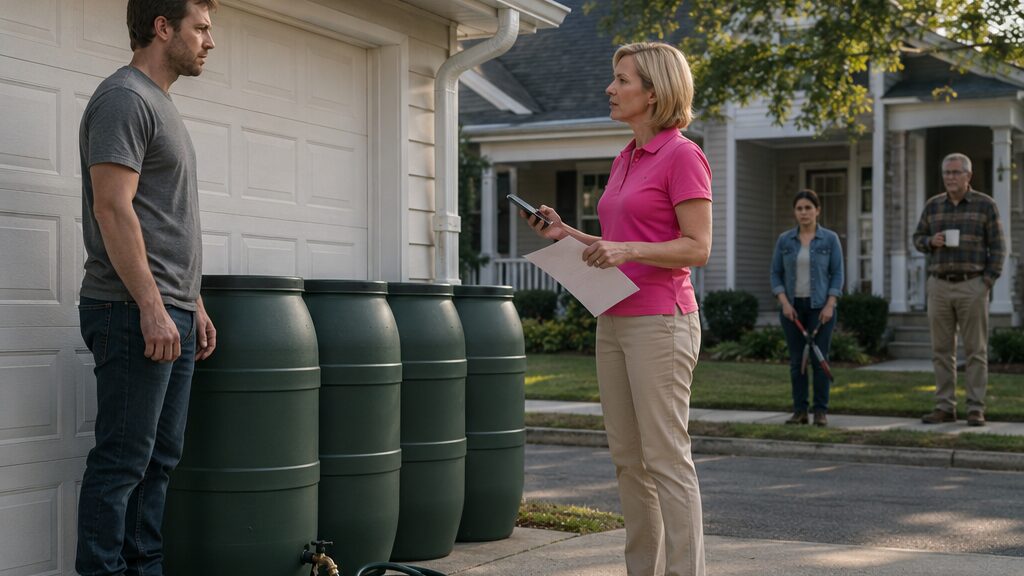
Linda Clark was taking pictures of David Walker’s garage before she even rang the doorbell.
David saw her through the narrow kitchen window above the sink, her phone held upright, her pink polo bright against the gray Monday morning. She stepped sideways, framed the shot again, and pointed the camera at the four green rain barrels lined up beneath the gutter like evidence at a trial.
He turned off the faucet.
The house went quiet except for the refrigerator hum and the faint ticking of the wall clock. Outside, Linda leaned closer to the nearest barrel, careful not to touch it, as if it might stain her. Behind her, a delivery driver slowed his dolly at the curb. Across the street, Rebecca Martinez paused with pruning shears in one hand and a half-trimmed hanging basket in the other.
David dried his hands on a towel and walked to the front door.
Linda rang the bell just as he opened it.
“Oh,” she said, lowering her phone an inch. “Good. You’re home.”
“Morning, Linda.”
She gave him the kind of smile that belonged on a clipboard. “David, I wish this were just a neighborly visit.”
“It’s not?”
She glanced past him toward the garage side of the house. “We received several concerns about the items you’ve installed.”
David stepped onto the porch and pulled the door shut behind him. “Several?”
Linda’s smile tightened. “Enough.”
The barrels stood in a clean row along the garage wall: four matte green cylinders, each on a low cinder-block base, connected by short dark hoses. He had cut and sanded the overflow line himself. The downspout fed the first barrel, then the water moved through the others. He had spent most of Saturday leveling the ground so nothing leaned.
They were not pretty. He knew that.
But they were square, stable, sealed, and useful.
Linda walked toward them with the authority of someone giving a tour of damage. “This is exactly the sort of thing the exterior standards are meant to prevent.”
“They’re rain barrels.”
“They are four oversized plastic containers in full view of the street.”
“They’re screened.”
“That is not the point.” She tapped her phone awake and held up a photo. In it, the barrels looked bigger than they were, the angle low and accusatory. “The point is curb appeal. This neighborhood has worked very hard to maintain a consistent appearance.”
David looked across the street. Rebecca had not gone back to pruning. Two houses down, Ronald Thompson stood on his porch with a coffee mug, watching but pretending not to.
Linda lowered her voice, though not enough. “People are worried you’re turning the side of your house into a utility yard.”
David almost laughed, but there was nothing funny in the way she said people. People never meant people. It meant no one wanted their name attached.
“I checked the guidelines,” he said.
“You checked the wrong section.”
“It says temporary conservation equipment is allowed if it doesn’t obstruct drainage or create a hazard.”
Linda blinked once. “Temporary. Conservation. Equipment.” She repeated the words as if each one had arrived wearing muddy shoes. “David, these are visible from the sidewalk.”
“They’re also connected to the gutter.”
“Please don’t be difficult.”
That brought the delivery driver’s head up. Rebecca shifted on her porch. Ronald lifted his mug, then lowered it without drinking.
David felt the old pressure rise in his chest, the one that made his jaw lock before his mouth could make anything better. He had learned silence young. Silence kept arguments from spreading. Silence let people reveal themselves. Silence was cleaner than pleading.
But silence also left empty space for other people to fill.
Linda filled it immediately.
“I’m sure this made sense to you when you installed it,” she said. “But from the street, it looks careless. It looks like storage. It affects every homeowner here, not just you.”
David looked at the barrels. A few faint scuffs marked the lids from where he had dragged them out of his truck. He had planned to paint the bases dark brown next weekend. Maybe put a trellis screen in front once he had the cash. Maybe explain that to someone if anyone had asked before photographing them.
No one had.
“They’re not hurting anyone,” he said.
“They’re hurting the standard.”
A small sound came from Rebecca’s porch, not quite a cough. David did not look at her.
Linda reached into a slim folder tucked under her arm and pulled out a printed notice. The paper was crisp, folded exactly in thirds, the HOA logo centered at the top.
“I’m giving you an informal chance to correct this before the board has to act.”
“You brought a formal notice for an informal chance?”
Her eyes sharpened. “The barrels must be removed by Friday at five. If they remain visible after that, the association may assess daily fines and pursue removal at owner expense.”
The delivery driver stopped pretending to organize packages. Ronald set his mug on the porch rail. A car rolled past slowly enough for the driver to look.
David took the notice from Linda. His name was on it. His address. The phrase unsightly exterior storage had been bolded.
Something in him went still.
Not angry. Not yet.
Just still.
Linda seemed encouraged by his silence. “I know you’re new compared with many of us. People sometimes don’t understand how these communities function.”
“I’ve lived here two years.”
“Yes. Exactly.”
The words landed softly and cut anyway.
David looked at the date on the notice, then at the barrels, then at the sky. The morning was clear, almost painfully bright. No one looking at it would believe the forecast buried under city maintenance language and emergency repair schedules. No one would care until caring was the only thing left.
He folded the notice once, slowly.
Linda’s expression flickered. “David, I hope you’re not taking this personally.”
“You posted a violation on my house in front of my neighbors.”
“I haven’t posted it yet.”
“Then what are we doing?”
Linda looked toward the street and seemed to remember the audience. She took the notice back from him with a brisk motion. “We are documenting noncompliance.”
She walked to the garage door, peeled a strip from the back of a clear plastic sleeve, and pressed the notice against the white paint at eye level.
David heard the adhesive catch.
A flush rose under his collar. The notice looked obscene there, not because of what it said, but because it turned his home into something the street was invited to judge.
Rebecca looked down at her shears. Ronald’s mouth tightened.
Linda stepped back to inspect her placement. “Friday at five.”
David walked over, peeled the sleeve off the garage door, and held it by one corner. The adhesive stretched, then snapped free.
Linda gasped. “That is association documentation.”
“It’s my garage door.”
“You can’t just remove—”
“Give it one week,” David said.
Linda stopped.
He had not raised his voice. That made the words carry farther. Rebecca looked up. The delivery driver froze beside his truck. Ronald’s eyes narrowed as if he had heard something under the sentence that no one else had.
Linda recovered first. “Excuse me?”
David kept the notice in his hand. “Give it one week.”
“For what?”
He folded the notice again and slid it into his back pocket. “Then decide whether they’re ugly.”
Linda stared at him with open disbelief, but David had already turned toward the barrels. He checked the first lid, tightened it half an inch, and adjusted the hose at the base with two fingers. His hands were steady. That annoyed him more than if they had shaken.
Linda said, “You understand this refusal will be recorded?”
“Record it.”
“This isn’t a joke.”
“No.”
“And when fines begin?”
David looked back at her. “They begin.”
For the first time, Linda seemed unsure what kind of person she was dealing with. Not frightened. Not sympathetic. Just off-balance. She glanced at the neighbors, then at her phone, then at the barrels again.
“You’re making this harder than it needs to be,” she said.
David did not answer.
Linda walked away with quick, clipped steps. The delivery driver suddenly remembered his schedule. Rebecca turned back to her basket, cutting at one stem three times before it gave way. Ronald stayed where he was.
David stood beside the four barrels until the street resumed pretending it had not watched him be marked.
Then Linda’s phone buzzed in her hand as she reached the sidewalk.
She looked down only long enough to silence it.
On the screen, before it went dark, the sender line read: City Water Department.
Chapter 2: The Notice Nobody Wanted to Read
Ashley Ramirez found two different dates for David Walker’s violation before she found the coffee filters.
One notice said Friday at five.
The draft attached to the HOA drive said Monday at noon.
She stood alone in the community room kitchenette with the cabinet door open, a box of stale sugar packets in one hand and her laptop balanced on the counter. The Monday draft had Linda Clark’s initials in the corner. The Friday version had gone out that morning, scanned and uploaded under Exterior Compliance—Urgent.
Ashley clicked back and forth between them, frowning.
The rain-barrel complaint should have been ordinary. Most exterior issues were ordinary. A basketball hoop left too close to the curb. A trash bin visible after pickup day. Someone painting shutters a blue that looked harmless until three board members called it “coastal.” Ashley recorded the minutes, filed the notices, and tried not to become part of anyone’s feud.
But two dates meant someone had changed the timeline.
The community room smelled faintly of floor cleaner and old paper. Folding chairs lined one wall beneath framed photos from past neighborhood picnics. On the long table, Linda had left a stack of printed violation forms, each aligned with the edge like order itself could calm people down.
Ashley carried her laptop to the table and opened the board email.
At the top was a message from the city water department sent at 8:14 that morning.
Subject: Preliminary Notice Regarding Outdoor Water Use Advisory.
Ashley opened it.
The language was careful, bureaucratic, and somehow more worrying because of that. Scheduled maintenance at the south pump station. Possible pressure fluctuations. Residents asked to monitor usage. A formal outdoor watering restriction might be issued if repairs were delayed or heavy rainfall affected access roads.
Ashley read the last line twice.
Please advise residents to prepare for temporary outdoor water limitations beginning later this week if conditions require.
She sat down slowly.
Linda entered with a binder under one arm and a travel mug in the other. “You’re early.”
“I was updating the compliance log.”
“Good. I want David Walker’s file clean.”
Ashley turned the laptop a few inches. “Did you see this city notice?”
Linda set her mug down. “I saw it.”
“It mentions possible outdoor water limitations.”
“It mentions possible limitations if conditions require.”
“Right, but if they do—”
“Then the city will notify residents.” Linda opened her binder. “Our job is not to rewrite our exterior standards every time the city sends a maybe.”
Ashley hesitated. She was twenty-eight, younger than most of the board by at least fifteen years, and still treated like the person who knew how to attach PDFs rather than someone who could read them. “Rain barrels might fall under conservation equipment.”
Linda’s hand paused on the binder rings. “Not those rain barrels.”
“The guideline has an exception.”
“The guideline has a temporary exception for approved equipment.”
“Does approved mean preapproved by the board or legally compliant?”
Linda looked at her.
Ashley felt the old reflex to retreat. It was easier to say never mind. Easier to type the minutes in passive voice and leave hard words out. But she had seen David’s face that morning from her own upstairs window when Linda pressed the notice to his garage. He had looked less angry than exposed.
“I’m just asking because the city notice might matter,” she said.
Linda sat at the head of the table. “What matters is that he installed four industrial-looking barrels without submitting an architectural request. If we let that stand, by next month someone else will have a chicken coop, a compost pile, or a tarp over a car and call it sustainability.”
“That’s a big jump.”
“It’s how decline happens.” Linda’s voice lost its polish for one second. “Slowly. One exception at a time.”
Ashley studied her. Linda’s yard was always edged, always mulched, always seasonal. In spring, tulips in exact rows. In summer, white hydrangeas under the front windows. Every holiday decoration removed before it became embarrassing. People joked that Linda could spot a weed from inside a moving car.
But there was a tightness in her now that was not about barrels.
“Did someone complain besides you?” Ashley asked.
Linda closed the binder. “I received concerns.”
“From who?”
“Residents have a right to privacy.”
Ashley looked back at the two dates. “Why did the first draft say Monday?”
“That was a placeholder.”
“It says removal deadline.”
“Ashley.”
The single word was enough to make the room smaller.
Linda leaned back, softening her tone with visible effort. “You’re good at details. That’s why the board appreciates you. But don’t confuse details with judgment. David Walker may think he’s being clever, but he doesn’t get to make the side of his house look like a farm supply store because he read one sentence in the guidelines.”
Ashley lowered her eyes to the laptop. There it was: the line between order and embarrassment, between community and control.
“What if the city issues the restriction before Friday?” she asked.
“Then we handle that when it happens.”
“And the violation?”
“Stays.”
A board member arrived, then another, carrying paper cups and complaints from the parking lot. The rain barrels became a topic before the meeting officially began. Someone had seen them from the sidewalk. Someone else said their cousin’s neighborhood had let standards slide and property values had never recovered. One board member asked if the barrels attracted mosquitoes. Linda said sealed lids did not matter if the appearance was unacceptable.
Ashley typed, deleted, and typed again.
When discussion turned to the water notice, Linda summarized it in one sentence: “The city has sent a preliminary maintenance advisory, but nothing currently changes association standards.”
Ashley’s fingers hovered over the keys.
Preliminary maintenance advisory.
Nothing currently changes.
She typed the words because they had been said, but they felt thinner on the screen than they had in the room.
After the meeting, Ashley carried a folder of signed forms back toward the small office. Through the community room window, she saw David’s street in the distance, neat roofs and trimmed lawns under a sky that had started to lose its blue. Neighbors walked dogs. Sprinklers ticked over front grass in glittering arcs, wasting water in the ordinary way no one noticed.
Her phone buzzed.
A city alert appeared across the top of the screen.
Updated Advisory: South Pump Station Repairs May Affect Outdoor Water Use if Severe Weather Delays Crews.
Ashley opened the message before it disappeared. The new notice was longer, more direct. Heavy storms were expected Wednesday night. If access roads flooded, repairs could be delayed. Residents were encouraged to store non-potable water for landscape protection where legally permitted.
Where legally permitted.
Ashley went back to the file and opened David’s violation again.
The Friday deadline stared up from the page.
Down the hall, Linda was laughing politely with a board member, her voice light and controlled.
Ashley printed the city alert, folded it into David Walker’s file, and left it there like a question no one had agreed to ask.
Chapter 3: When the Storm Filled What They Mocked
Thunder hit hard enough to shake the garage wall, and the first barrel began to overflow before David could get his jacket zipped.
He stepped into the side yard with a flashlight clenched between his teeth and rain striking the back of his neck like thrown gravel. Water roared through the downspout, slapped into the screened intake, and disappeared into the dark mouth of the first green barrel. The second one was already heavy. The third gave a low plastic creak as it took the transfer.
“Easy,” David muttered, though there was no one to hear him.
The storm had arrived faster than the forecast said. By seven, the air had turned yellow-gray. By eight, branches bent over the street. By nine, water ran along the curbs in shallow brown streams, carrying leaves, mulch, and someone’s loose newspaper.
Now the whole neighborhood flashed white every few seconds.
David crouched at the base of the first barrel and checked the overflow diverter. The hose trembled under the pressure but held. Water spilled exactly where he wanted it, away from the foundation and into the gravel channel he had dug behind the shrubs.
Not careless, he thought.
Not storage.
Not junk.
A porch light snapped on across the street. Ronald Thompson stood beneath his awning in a faded raincoat, looking directly at the barrels. Even through the storm, David saw the older man’s attention move from the downspout to the bases to the drainage trench.
Ronald lifted one hand, not a wave exactly. More like a mechanic acknowledging a clean repair.
David nodded once and went back to work.
A gust shoved rain sideways under the eaves. He tightened a connector between the second and third barrels. Cold water ran down his wrist. In the garage behind him, a small workbench light glowed over a neat row of tools, a coil of spare hose, and a red watering can with a chipped handle.
His mother’s watering can.
David had almost thrown it away after he sold her house. It had sat beside her back steps for years, sun-faded but stubborn. During the last drought before she got sick, she had tried to keep her small garden alive with kitchen rinse water and whatever the city still allowed. Tomatoes, basil, marigolds, two rosebushes she insisted were tougher than they looked.
David had been busy then. Working double shifts. Telling her he would come by Saturday. Then next Saturday. Then after the heat broke.
By the time he showed up with a hose repair kit and a bag of mulch, the basil had crisped black at the edges. The roses were bare sticks. His mother had laughed it off, because that was how she spared people guilt.
“Well,” she had said, touching one dead stem, “we learn before next time.”
But there had not been a next time for her.
Lightning cracked close enough to pull him back into the present.
The fourth barrel thudded as water surged through the line. David stood and aimed the flashlight at the lids. All sealed. All screened. All filling.
From the sidewalk came a shout. “That thing holding?”
David turned.
Ronald had crossed to the edge of his driveway, rain running off the bill of his cap. He was not coming closer, just watching with a plumber’s suspicion.
“It’s holding,” David called.
“You got a relief line?”
David pointed with the flashlight. “Runs to the gravel bed.”
Ronald leaned to see. Another flash lit the yard, showing the trench, the splash block, the small stones dark with water.
“Huh,” Ronald said.
In Ronald language, it sounded almost like praise.
A car eased past, tires hissing. Two houses down, a neighbor dragged patio cushions under cover. Across the street, Rebecca struggled with a hanging basket that swung wildly from a porch hook. David saw flowers slap against the siding. She glanced toward him, then quickly away.
The alert had hit everyone’s phone that afternoon, but most people had treated it like the city always treated weather: cautious, official, easy to ignore. Sprinklers had still run at dinner. Lawn-service flags still marked fertilized grass. Linda Clark’s hydrangeas had been watered at dusk, their white heads glowing under landscape lights before the storm swallowed them.
Now all that water fell at once, too much and too late.
David checked the barrels again. The first was full. The second nearly. The third rising. The fourth taking water steadily. He should have felt satisfaction. Instead, as he looked down the street, he saw what the storm was doing badly.
Water pooled at the end of Rebecca’s walkway where the drain always clogged with maple seeds. A gutter at the corner house poured straight onto a flower bed, digging a hole in the mulch. A child’s plastic scooter floated against the curb. Ronald’s yard, graded better than most, shed water in a clean sheet, but the newer houses near the bend took it at their foundations.
They had all been so worried about how his barrels looked.
Half of them had no idea where their own water went.
Another phone alert buzzed in David’s pocket. He pulled it out under the shelter of the eave.
City Water Department: South Pump Station access delayed due to storm flooding. Crews assessing. Residents should expect temporary outdoor water restrictions if pressure issues continue.
David read it once, then again.
The rain hammered the barrels. The sound was deep now, no longer hollow. Stored water had a different note. A full sound. A kept sound.
Ronald’s phone lit his face across the yard. He read the same alert, then looked at David’s barrels.
This time he did wave.
David almost smiled.
Then, from the far end of the street, something popped. Not loud like a transformer, but low and heavy, followed by a brief dimming of porch lights. A few neighbors stepped outside despite the rain. Someone called, “Was that the pump station?” though the pump station was miles away and no one really knew what they meant.
The storm did not answer. It kept coming.
By ten-thirty, the fourth barrel was full and the overflow line was doing its job, sending excess water away in a controlled stream. David stood soaked beside the garage, one hand on the nearest lid, feeling the vibration of water still arriving with nowhere left to be stored.
For a moment, he imagined Linda seeing them now. Not as four ugly containers, but as four chances no one had wanted to look at closely.
His phone buzzed again.
This time it was not the city.
It was the neighborhood group chat, where someone had copied the official alert in all capital letters.
TEMPORARY OUTDOOR WATER RESTRICTION EXPECTED BY MORNING. NO LAWN OR GARDEN WATERING UNTIL FURTHER NOTICE.
Messages began stacking beneath it.
Is this real?
What about new plantings?
We just had all this rain.
Can we use collected rainwater?
Does anyone know?
David stood in the dark beside the full green barrels while the same street that had watched him be warned now searched for water in the palms of their hands.
Chapter 4: The Flowers Started Dying First
Rebecca Martinez knew the restriction was real when the petals fell before she touched them.
She reached up for the hanging basket beside her porch steps, meaning only to turn it away from the hard morning sun, and a drift of dry purple blooms broke loose and scattered over her shoes. The soil had pulled away from the plastic rim in a dark, cracked ring. One stem bent with a sound too small to be heard, but she felt it in her fingers.
“Oh, come on,” she whispered.
Her phone lay on the porch rail, still showing the city alert from dawn.
Temporary Outdoor Water Restriction Now in Effect. No lawn or garden watering with municipal supply until further notice. Hand watering from legally collected non-potable sources permitted where allowed by local and association rules.
Rebecca had read the last line six times.
Where allowed.
That was the kind of phrase that made neighbors look at one another instead of the sky.
Across the street, David Walker’s four green barrels stood under the garage gutter, full and dark from the storm. They looked different now. Not prettier. Not less oversized. But heavier with meaning. Yesterday morning, Rebecca had looked at them and thought, Why four? This morning, she found herself counting them like chances.
Her porch garden was small, but it was hers. Two hanging baskets, three tomato pots, basil in a long planter, marigolds along the steps. Nothing grand. Nothing that raised property values. Just color, scent, and the daily habit of keeping something alive.
She should have taken the baskets down before the storm. She should have set buckets out. She should have said something when Linda put that notice on David’s garage.
Instead she had stood with pruning shears in her hand and watched.
The front door two houses down opened. Linda Clark stepped onto her porch in white capri pants and a pale cardigan, holding her phone like a badge. Her yard looked neat even after the storm. The hydrangeas drooped, but the mulch remained smooth, the edging sharp.
A neighbor called from the sidewalk, “Linda, do you know if collected rainwater is allowed?”
Linda came down the steps. “The city notice does not override association rules.”
Rebecca froze with the dead basket in both hands.
Another neighbor said, “But it says legally collected non-potable sources.”
“City language is broad,” Linda replied. “Our covenants are specific. No unapproved exterior storage containers. No visible utility equipment without architectural review.”
“What about David’s barrels?”
Linda glanced across the street as if the barrels had spoken out of turn. “David’s barrels remain in violation.”
Rebecca felt heat climb her neck. “Even if people need water?”
Linda turned toward her. “Rebecca, no one is saying plants don’t matter.”
“My tomatoes are already wilting.”
“I understand. Everyone is inconvenienced.”
Inconvenienced.
Rebecca looked at the crisp petals on her shoes. “The city says we can use collected rainwater.”
“The city does not manage our exterior standards.” Linda’s voice stayed calm, but it had the hard center Rebecca had heard at meetings. “If residents start lining driveways with barrels and buckets, we’ll have a bigger problem than a few stressed plants.”
A few stressed plants.
From his driveway, Ronald Thompson had been clearing leaves from the curb drain with an old rake. He leaned on the handle and said, “Those barrels of David’s are sealed.”
Linda smiled without warmth. “That is not the only issue.”
“They’re not drawing mosquitoes.”
“I said that is not the only issue.”
Rebecca set the basket down before she dropped it. She could see David’s house from where she stood. His blinds were open in the kitchen. A shadow moved inside, then disappeared. He was watching. Or maybe just passing through. Either way, he was not coming out.
She could not blame him.
The neighborhood group chat had been ugly since sunrise. Not openly cruel, not enough for anyone to feel guilty, but full of little comments with teeth.
Can the HOA clarify whether the barrel situation is legal?
Some of us follow rules even when it’s inconvenient.
Preparedness is good, but four barrels seems excessive.
Maybe this is why approvals exist.
Rebecca had typed and erased three replies. She had wanted to say, He told us to wait a week. She had wanted to ask why no one had listened. But the memory of Monday kept stopping her: Linda at the garage, David standing still, Rebecca trimming the same stem over and over so she would not have to meet his eyes.
A lawn-service truck rolled slowly down the street, then stopped at the corner. The worker got out, checked a phone, shook his head, and started packing up equipment without unloading a hose. That small action did what the official alert had not. It made the restriction feel physical. No water. No workaround. No usual pretending.
Linda raised her voice enough for the nearest porches. “Until the board meets, I strongly advise residents not to encourage or participate in any use of unapproved containers. If David distributes water from a violation, that may create additional penalties.”
Rebecca looked at her. “Additional penalties for sharing rain?”
“For ignoring process.”
Ronald gave a humorless huff. “Rain didn’t file the right form.”
A few neighbors smiled, but only for a second.
Linda’s face flushed. “This is exactly why we have standards. People treat one exception like permission to do anything.”
Rebecca heard something else beneath the words. Not just irritation. Fear. Linda was not looking at the barrels now; she was looking at the gathered neighbors, measuring how quickly order could slip out of her hands.
Still, fear did not water flowers.
Rebecca picked up the hanging basket and carried it to the shade. The leaves were limp against her wrist. She thought of David tightening the barrel lids in the storm, alone in the rain while everyone else waited for instructions. She remembered his voice: Give it one week.
He had not sounded smug.
That made it worse.
By late morning, the sun had burned away the last cloud cover. Steam lifted faintly from driveways. The storm had left everything wet except what needed steady water. Gutters dripped. Lawns shone. But potted plants, shallow-rooted and battered, sagged fast in the heat.
Rebecca filled a glass at her kitchen sink, stood over the basil planter, and stopped. Municipal water. The alert had said no garden watering. Would one glass matter? Probably not. But the whole street was built on probably not. Probably no restriction. Probably no one would need stored water. Probably easier not to speak.
She drank half the glass herself and poured the rest down the drain.
At noon, the group chat lit up again.
Board will review emergency guidance Friday evening.
Until then, please do not use or request water from noncompliant exterior installations.
Linda had sent it.
Rebecca stared at the message until the words blurred. Then she looked out her kitchen window toward David’s garage.
The barrels sat silent and full.
A red watering can hung just inside his open garage, visible on a hook near the workbench. Old, chipped, ordinary. For some reason, that made her throat tighten.
She waited until the street had gone quiet, until Linda’s front door closed and the lawn-service truck had left the corner. Then she took her own empty green watering can from beside the back steps. It felt ridiculous in her hand, too light to be useful.
Halfway across her yard, she stopped.
David had every reason to say no.
He had every reason not even to open the door.
Rebecca crossed the sidewalk anyway. Each step felt louder than it was. Ronald saw her from his porch but said nothing. She appreciated that more than encouragement.
At David’s door, she lifted her hand, lowered it, then forced herself to knock.
The empty watering can bumped softly against her leg while she waited.
Chapter 5: Every Drop Had a Reason
David opened the door and looked first at Rebecca’s face, then at the empty watering can in her hand.
Neither of them spoke.
The silence was not the same as Monday’s. Monday’s silence had been full of witnesses and judgment. This one was smaller, more uncomfortable, and harder to hide inside. Rebecca stood on his porch with her shoulders slightly hunched, a few dry petals caught in the cuff of her jeans.
David kept one hand on the door.
“I’m sorry,” she said.
It was not what he had expected, and because of that, he did not answer quickly enough.
Rebecca swallowed. “Not just because I need something.”
The watering can shifted in her grip. Green plastic, scuffed at the bottom, the kind sold in every garden center every spring. David had seen it on her porch before, usually full, usually swinging from her hand while she moved between tomatoes and flowers before work.
Now it looked like a question.
“You watched,” he said.
Her eyes dropped. “I did.”
“You didn’t say anything.”
“No.”
He waited for the excuse. Linda was intimidating. It happened fast. I didn’t know what to say. None of those would have been untrue, but he knew how excuses could make the person giving them feel cleaner while leaving the mess where it was.
Rebecca did not offer one.
“I should have,” she said. “I’m sorry.”
Behind David, the house was cool and dim. The city alert still sat open on his kitchen table beside a stack of mail and the folded HOA notice. He had read the group chat. He had seen Linda’s warning. He had watched neighbors suddenly discover words like legal and permitted after treating preparation like bad manners.
“You need water,” he said.
“My flowers do.” She looked up, then winced. “That sounded stupid.”
“It didn’t.”
“They’re just plants.”
“Nothing is just plants to the person keeping them alive.”
Rebecca’s expression changed at that, softening in a way that made David regret saying it. Not because it was false. Because it was too true, and he had not meant to let truth out so easily.
He stepped onto the porch and closed the door behind him. “Linda told people not to ask.”
“She did.”
“And you came anyway.”
“I figured if I was going to be a coward on Monday, I shouldn’t be one twice in the same week.”
David almost smiled. It did not quite make it.
He walked toward the side yard. Rebecca followed, careful to stay a step behind, as if the distance could show she was not demanding anything. The sun was high enough now to flatten every shadow. The barrels looked plain and blunt against the garage wall. The violation notice was no longer stuck to the door, but David could still see the faint rectangle where the adhesive had touched paint.
At the first barrel, he crouched and checked the gauge strip he had taped along the side. Full. The second and third too. The fourth just below the top.
Rebecca stopped a few feet away. “You really saved that rain?”
David reached for the spigot at the base of the first barrel. His fingers rested on the small metal handle.
For one second, he was back in his mother’s yard, standing over soil that had gone hard as fired clay. The red watering can had been empty then too, but not because there had been no water in the world. Because he had not arrived in time with what he knew how to fix.
His mother had not blamed him. That had been the worst part.
She had sat on the back step in a straw hat too big for her, one hand around a glass of iced tea, looking at the brown stems where her roses had been.
“We learn before next time,” she had said.
David had nodded like learning was the same as doing.
Now Rebecca stood beside him with her dry porch flowers and her apology too late but still offered.
He turned the valve.
Water rushed out clear and sudden, striking the inside of Rebecca’s can with a hollow drumbeat that became a rising, solid sound. Rebecca flinched, then laughed once under her breath, not from amusement but relief.
David watched the water climb.
“Every drop,” he said.
Rebecca looked at him.
He closed the valve when the can was almost full, leaving enough room not to spill over her shoes. She gripped the handle with both hands now.
“How did you know?” she asked.
“The city posted the maintenance schedule last month.”
“I didn’t see it.”
“Most people didn’t.”
“You did.”
“I do landscaping work on weekends. Restrictions matter when people expect you to keep things alive.”
She nodded slowly. “So you installed all this because of work?”
David wiped a splash from the spigot with his thumb. “Partly.”
The word hung there.
Rebecca waited. It would have been easy to say nothing more. He was good at that. Built for it, some days. He could let the barrels explain themselves. He could let neighbors wonder and feel foolish. He could keep the real reason sealed tighter than the lids.
Instead his eyes went to the red watering can hanging inside the garage.
“My mother had a garden,” he said.
Rebecca turned slightly but did not look into the garage until he did. “Had?”
“She passed last year.”
“I’m sorry.”
David nodded once. “There was a drought before she got sick. Not a big dramatic one. Just enough restrictions, enough heat, enough missed weekends.” He pushed his hand through his hair, annoyed at himself for continuing and unable to stop. “She kept saying she needed help setting up a better way to collect rain. I kept saying I’d come by. I was working. Busy. Tired. All the usual reasons.”
Rebecca’s hands tightened on the can.
“When I finally showed up, most of it was dead.” He looked at the barrels, not at her. “She acted like it didn’t matter. She was good at that.”
The street was quiet except for a distant mower that should not have been running and stopped after a few seconds, probably when someone remembered the restriction.
“So when I bought this place,” David said, “I told myself I wouldn’t be the guy who knew better and still waited.”
Rebecca did not rush to comfort him. That was good. Comfort too quickly could feel like someone trying to close a drawer.
She said, “And we all made it about how it looked.”
“Linda made it about how it looked.”
“I helped by being quiet.”
David looked at her then.
That was the first thing anyone had said all week that did not feel polished.
A movement across the street caught his eye. A neighbor stood near the curb holding up a phone. Not hiding it. Not exactly. But the lens pointed toward David’s side yard, toward the stream of water still dripping from the spigot into the gravel.
Rebecca saw his face change and turned.
The neighbor lowered the phone too late.
David’s jaw tightened.
Rebecca set the watering can down. “I’ll tell them not to post it.”
“They already will.”
“I didn’t ask them to film.”
“No one ever asks before they decide what a thing means.”
She flinched, and he regretted the sharpness. Not because she did not deserve some of it, but because the words had come from the part of him that wanted to punish the whole street through whoever stood closest.
Rebecca picked up the can again. “I can pay you for the water.”
“No.”
“I don’t want to just take it.”
“You apologized. That’s more than most people have paid.”
Her eyes filled a little, though she did not cry. “David—”
“I’m not saying that to be noble.” He stepped back from the barrel. “I’m tired of being treated like a problem until I’m useful.”
She nodded. “That’s fair.”
“No, it isn’t.” The honesty surprised him. “It’s just true.”
A car door shut down the street. Two children on scooters slowed near the curb to stare. The neighborhood had that strange charged feeling after any public scene, when curtains did not move but everyone saw everything.
Rebecca lifted the full can. “Can I come back if this isn’t enough?”
David looked at the four barrels. Then at the violation notice folded on the workbench. Then at the phone in the neighbor’s hand, already rising again.
“Once,” he said. “For now.”
She accepted that without arguing. “Thank you.”
She carried the can carefully across the street, water rocking just below the rim. David stayed by the barrels until she reached her porch and poured the first stream into the hanging basket. The soil took it greedily, darkening in seconds.
His phone buzzed on the workbench.
Then buzzed again.
Then again.
He walked inside the garage and picked it up.
The neighborhood group chat had a new video.
In the frozen preview, David crouched beside the green barrel, one hand on the valve, Rebecca’s watering can filling beneath it. The caption beneath the clip had already been typed by someone else.
So now the violation is a neighborhood water station?
David watched the typing bubbles multiply.
Chapter 6: The Board Meeting Turned on a Valve
The board played the video without sound, which made it worse.
On the screen at the front of the community room, David crouched beside the rain barrel like a man caught stealing from himself. Water flashed silver in the sunlight. Rebecca’s watering can filled. The neighbor who had recorded it had zoomed in just enough to make the spigot look suspicious, as if the act of opening a valve required investigation.
Ashley Ramirez sat at the end of the table with her laptop open and her hands folded tightly beside it.
No one had asked who recorded the clip.
No one had asked Rebecca why she was there.
Linda stood beside the screen with a remote in one hand. “This is what happens when enforcement pauses or becomes unclear.”
“It didn’t pause,” Ronald Thompson said from the second row. “You told everyone not to ask him.”
“And yet,” Linda replied, clicking the remote so the clip restarted, “here we are.”
David stood near the back wall, arms at his sides. He had not taken one of the folding chairs. Rebecca sat two rows ahead of him, her face pale but steady. A few neighbors had come because their plants were suffering. A few had come because conflict had become the evening’s entertainment. The rest were board regulars, people who believed procedure was a kind of weather: always present, often complained about, rarely challenged.
Ashley typed the meeting start time. Her fingers felt stiff.
Linda turned off the screen. “The issue before us is not whether the city restriction is inconvenient. It is whether an owner can install unapproved exterior containers, refuse correction, and then invite others to participate in that violation.”
“I didn’t invite anyone,” David said.
Every head turned.
His voice was calm, but Ashley heard the strain under it. He had not spoken at the beginning when Linda summarized the complaint. He had not interrupted when a board member called the barrels “industrial.” He had stood there absorbing each sentence like he was stacking bricks inside himself.
Linda faced him. “You distributed water.”
“I gave a neighbor one can.”
“From a noncompliant installation.”
“From rain.”
A murmur moved through the room. Linda waited it out.
“Rainwater does not exempt homeowners from standards,” she said.
Ronald stood slowly, one hand on the chair in front of him. “Can I ask something practical before this gets buried under words?”
Linda’s smile returned, tight and official. “Briefly.”
“I looked at the setup Wednesday night. Lids are sealed. Intakes are screened. Overflow runs away from the foundation into gravel. Bases are level.” He glanced at David. “I was a plumber forty years. I’ve seen legal work done worse.”
A few neighbors laughed softly.
Linda did not. “The board appreciates your opinion, Ronald, but safe drainage is only one consideration.”
“It’s the one people kept pretending was the problem.”
Ashley looked down quickly, but not before Linda saw.
“Ashley,” Linda said. “Would you please read the relevant exterior section?”
Ashley opened the document. Her mouth had gone dry. She had read this section three times before the meeting, along with the emergency exception and the city notices she had printed and placed in the file. She knew which sentence Linda wanted. She also knew which sentence Linda was hoping she would skip.
She read the first part. “Exterior storage containers, utility equipment, and visible non-decorative fixtures require prior architectural approval and must be screened from street view unless otherwise permitted.”
Linda nodded.
Ashley continued before she could lose courage. “Temporary conservation equipment may be permitted during municipal advisories or restrictions, provided it does not create a safety, drainage, pest, or access concern.”
The room shifted.
Linda’s head turned slightly. “That section refers to approved temporary equipment.”
Ashley kept her eyes on the screen. “The word approved is not in that sentence.”
A board member leaned forward. “It isn’t?”
“No.”
Linda’s hand tightened around the remote.
Ashley clicked to the next file. “The city issued a preliminary advisory Monday morning. An updated advisory Monday afternoon. A restriction this morning.”
“We all know that,” Linda said.
“The violation notice was prepared after the preliminary advisory.”
The room became quieter than before.
David looked at Ashley for the first time.
Linda set down the remote. “Prepared, yes. Issued because of an existing unapproved installation.”
Ashley’s pulse beat in her ears. “The first draft gave him until Monday. The final version gave him until Friday.”
“That is normal administrative revision.”
“Except Friday was before the board’s emergency review.”
A board member frowned. “Why would we set the deadline before reviewing the city restriction?”
Linda’s face held, but the color under her makeup rose. “Because the violation existed before the restriction.”
Rebecca stood. “My flowers existed before the restriction too. That didn’t make them survive it.”
No one laughed this time.
Linda looked at her. “Rebecca, I sympathize with your situation, but individual landscaping choices cannot dictate association policy.”
Rebecca’s voice trembled once, then steadied. “I’m not asking my flowers to dictate policy. I’m asking why we shamed the one person who prepared.”
The words landed harder because she did not dress them up.
David looked away.
Ashley saw it then: he did not enjoy this. The room turning did not make him taller. It made him look more tired.
Linda must have seen something too, because her voice changed. It lost the sharp top edge and dropped into something more personal. “You all don’t remember what this neighborhood looked like ten years ago.”
Ronald sat back slowly.
Linda looked around the room. “Half the rentals had trash bins out all week. Someone had a broken hot tub in a driveway for six months. We had buyers walk away after one showing. Everyone complained. Everyone wanted someone to fix it. Then when standards are enforced, suddenly enforcement is cruel.”
The room did not soften, but it listened.
“I am not against conservation,” Linda said. “I am against turning every crisis into permission for people to do whatever they want.”
David spoke from the back. “You knew the advisory was coming.”
Linda met his eyes.
“You had the same email I did,” he said.
“I had a preliminary notice.”
“You had enough to wait.”
“And you had enough to submit a request.”
That stopped him for half a second because it was true.
Ashley saw the opening and saw Linda see it too.
David could have submitted a request. He could have printed the city schedule, attached photos, explained the setup, asked Ronald to check drainage, and forced the board to answer on paper. Instead, he had installed the barrels and trusted silence to make him look steadier than everyone else.
He seemed to feel it. His shoulders shifted.
“You’re right,” he said.
Linda blinked.
“I should have submitted something,” David continued. “I didn’t because I figured no one would read it until it was too late. Maybe that was unfair. Maybe it wasn’t.”
A murmur started. He lifted one hand, not for drama, just enough to finish.
“But you didn’t ask either. You didn’t knock and ask why. You photographed my house, posted a notice on my garage, and told people I was lowering the standard.” His eyes moved from Linda to the board. “If the standard is that nobody prepares unless the paperwork looks nice first, then the standard failed this week.”
Ashley stopped typing for a moment. Then she forced herself to record the sentence.
Linda’s mouth pressed into a thin line. For a moment, Ashley thought she would apologize. Not fully, maybe not well, but enough to change the air.
Instead Linda picked up the remote and faced the board.
“I move that the association uphold the violation and assess fines beginning immediately, pending removal or full screening of the barrels.”
Rebecca turned sharply. Ronald swore under his breath.
David stepped away from the wall. “I’m not finished.”
Linda did not look at him. “There is a motion on the floor.”
Ashley’s cursor blinked on the minutes, waiting for words that would decide whether the truth had mattered at all.
Chapter 7: The Rule Changed After the Rain
David stepped forward before anyone could second Linda’s motion.
“Don’t remove the barrels,” he said. “Regulate them.”
The room held its breath in that small, suburban way, with folding chairs creaking and people pretending they were not waiting for a fight. Linda stood at the front with the remote still in her hand, her motion hanging in the air like a door half closed. Ashley’s fingers froze above the keyboard.
David looked at the board, not at Linda.
“You want standards,” he said. “Fine. Make standards that work.”
A board member frowned. “Mr. Walker, there’s already a motion.”
“Then hear this before you vote.”
Linda’s voice cut in. “Procedure matters.”
“So does timing,” David said. “And you were ready to fine me before the board even reviewed the city’s notice.”
Ashley watched Linda’s face tighten, but David did not press the advantage the way he could have. He did not mention the group chat. He did not point out the neighbor filming him. He did not ask Rebecca to stand and show everyone the flowers she had saved. That restraint changed the room more than anger would have.
Ronald leaned back in his chair, arms folded, watching David with new interest.
David reached into his back pocket and pulled out a folded sheet of paper. Not the violation notice. Something else. He unfolded it once, then again.
“I made notes this afternoon,” he said. “Screened intake. Sealed lids. Overflow routed away from foundations. No standing water. Neutral colors or screened from street view within thirty days. Maximum size based on lot line clearance. Emergency use permitted during city restrictions.”
Linda stared at the paper as if it had betrayed her.
“You wrote a policy?” one board member asked.
“I wrote what I should have submitted Monday,” David said.
The admission landed quietly. Ashley saw it register across the table: he was not pretending he had done everything right. That made it harder to dismiss him.
Linda recovered. “This is exactly backwards. Residents don’t violate first and draft rules after.”
“No,” David said. “And boards shouldn’t shame first and understand after.”
Rebecca made a small sound behind him. David did not turn, but he knew where she sat. He had noticed the basket she carried in when she arrived, the one with the wilted purple flowers still drooping over the rim. She had placed it beside her chair like evidence she hated needing.
Linda saw it too.
Her eyes moved from David’s paper to the basket. For a fraction of a second, something flickered in her expression, a private crack in the official surface. The flowers were not dramatic. They were not dead enough to be tragic, not alive enough to be fine. They simply looked like what happened when everyone waited for permission.
A board member cleared his throat. “Maybe we should separate the fine issue from the emergency guidance.”
Linda looked sharply at him. “If we separate everything, nothing holds.”
Ronald stood again. “Or maybe the thing holding shouldn’t be the part that failed.”
No one laughed this time.
David turned the paper in his hands, pressing one crease flat with his thumb. “I’m not asking you to let everyone stack junk in their yards. I’m not asking for no rules. I’m asking for rules that know the difference between junk and preparation.”
Linda’s voice dropped. “And who decides that?”
“The board,” David said. “With people who know drainage. With the city restriction in front of you. With enough humility to admit a barrel can be ugly and useful at the same time.”
Ashley felt the sentence move through the room. It was not polished, not clever enough for a campaign flyer, but it sounded like something a tired person had paid for.
Linda set the remote on the table. “You think this is only about your barrels.”
“No,” David said. “I think my barrels became the easiest place for everyone to put their fear.”
For the first time that evening, Linda looked away.
A board member asked Ashley to read the emergency exception again. She did. This time nobody interrupted. Then Ronald, with the patience of a man explaining a pipe fitting to someone determined not to understand it, described the difference between a sealed rain barrel and an open container. He explained overflow, mosquito screens, base stability, and why the storm had made municipal water restrictions worse instead of unnecessary.
Rebecca finally stood when a neighbor muttered that potted flowers were not an emergency.
“They weren’t an emergency to you,” she said. “They were to me.”
Her voice shook, but she did not sit down.
“I watched Linda put that notice on David’s garage,” Rebecca continued. “I watched him stand there and take it. I didn’t say anything because I didn’t want to be the next person everyone talked about. That’s on me. But I’m not going to sit here now and pretend this is about standards only.”
She bent, picked up the hanging basket, and set it gently on the front table.
Dry petals fell onto the polished surface.
Linda’s mouth parted, then closed.
Ashley looked at the petals lying beside the printed bylaws. For days, water had been an abstract thing in emails, alerts, and rules. Now the lack of it had color. Purple, brown-edged, fragile.
The board did not vote on Linda’s motion.
Not then.
Instead, after twenty more minutes of tight voices and careful amendments, they voted to pause fines on David’s barrels until the city restriction lifted, provided he added temporary screening from the street within thirty days. They also agreed to draft a conservation exception for sealed, screened rain barrels during official advisories, with safety requirements reviewed by the board.
It was not a sweeping victory. No one clapped. Linda did not apologize. One board member insisted the decision was “not a precedent,” even while creating a precedent in the minutes.
David accepted that. Practical justice, he was learning, often arrived wearing ugly shoes.
As people began folding chairs and collecting bags, a neighbor approached him near the back wall.
“So,” the neighbor said, not meeting his eyes, “could I maybe fill a bucket tomorrow?”
David looked at him. Then at the room, where two other neighbors were clearly listening.
“No,” David said.
The neighbor blinked. “No?”
“Not like that.”
“I thought you wanted to help.”
“I did help. I’ll help again if we set up a shared plan. But I’m not becoming the neighborhood’s private water department because everyone ignored the city and then ignored me.”
The neighbor’s face flushed. “I didn’t mean—”
“I know.”
That was the problem. Most people had not meant anything all week. They had not meant to shame him. Had not meant to be silent. Had not meant to film. Had not meant to need what they had mocked.
David folded his paper and tucked it away.
Outside, the air smelled like wet asphalt and cut leaves. The storm had washed the street clean, but under porch lights the lawns already looked tired. Rebecca carried her basket carefully. Ronald walked beside her, one hand ready in case the plastic hook snapped.
Linda remained inside the community room, talking quietly with Ashley. David could not hear the words. He did not need to. Ashley’s face was serious. Linda’s shoulders looked lower than they had all week.
By Saturday morning, David had bought a roll of dark reed screening from the hardware store and tied it loosely in front of the barrels. It did not hide them completely. Nothing would. But it softened the view from the sidewalk, making the row look intentional instead of defiant.
He was tightening the last tie when a car slowed in front of his house.
Linda stepped out.
No binder. No phone raised. No clipboard pressed against her ribs.
She crossed the street carrying only the old violation notice, folded in half, and stopped at the edge of David’s driveway.
Chapter 8: What the Street Remembered at Sunset
Linda set the old violation notice on top of the nearest rain barrel as if she still did not trust herself to hand it to him.
David looked at the paper, then at her.
The morning sun caught the plastic lid, showing scratches from the storm and a few specks of dried mud. Behind the barrels, the new reed screen shifted slightly in the breeze. It did not make the setup beautiful. It made it considered. There was a difference.
Linda wore no cardigan today, only a plain blue blouse and dark pants. Without the clipboard, she looked less like the neighborhood had sent her and more like she had been forced to arrive as herself.
“I thought you’d want this back,” she said.
“I already have one.”
“I know.”
Neither of them moved.
Across the street, Rebecca was on her porch turning the damaged basket toward the shade. Ronald stood at his curb with a broom, sweeping storm grit away from the drain. Both noticed Linda. Both pretended not to.
David wiped his hands on his jeans. “Are you here as the board or as Linda?”
The question landed harder than he intended, but he did not take it back.
Linda looked toward the barrels. “I’m not sure I’ve separated those very well lately.”
It was not an apology. Not yet. But it was the first honest thing she had said to him all week.
David waited.
Linda touched the folded notice with two fingers. “Ten years ago, when the neighborhood was worse, everyone wanted someone to enforce things. They wanted clean curbs, clean yards, clean rules. Then after it got better, they forgot how ugly it was before.”
“So you made sure no one forgot.”
“I made sure no one blamed me again.”
There it was.
The truth did not excuse the harm, but it gave it shape. David understood that more than he wanted to. A person could build a whole life around not failing the same way twice. Sometimes that life looked like rain barrels. Sometimes it looked like violation notices.
Linda looked up. “I should have asked why.”
“Yes.”
“I should have waited for the board to review the city notice.”
“Yes.”
Her mouth tightened, but she stayed. “I should not have posted the notice on your garage in front of people.”
David crossed his arms, not to close her out, but because his hands needed somewhere to be. “No. You shouldn’t have.”
Linda nodded once. The apology, partial and stiff as it was, seemed to cost her more than the whole meeting had. “The board is circulating the revised emergency language this afternoon. Ashley cleaned it up. Ronald added safety notes.”
“Good.”
“The barrels can stay if the screening is completed and the overflow remains as inspected.”
“They were always going to stay through the restriction.”
“I know.” Linda looked at the old notice. “That’s what I’m trying to say.”
David almost let it rest there. It would have been easy to accept the implied apology, let both of them keep some pride, and move on with the familiar American mercy of not saying the uncomfortable part aloud.
But that was the habit that had gotten him here.
He picked up the notice and unfolded it. The paper had softened at the creases. His name still sat beneath the HOA logo. Unsightly exterior storage. Removal required. Daily fines.
“Read the new rule,” he said.
Linda’s eyes narrowed slightly. “What?”
“Not for them.” He nodded toward the street, though he knew the porches were listening. “For me.”
She looked offended for a second, then uncertain.
David held her gaze. “You read the violation out loud enough for half the block to understand it. Read the correction.”
A curtain moved in a front window. Ronald stopped sweeping. Rebecca lowered her basket slowly.
Linda inhaled through her nose. David could see the argument form and die behind her eyes. Then she took a folded page from her pocket. Not the old notice. A clean printout.
Her voice was quiet at first.
“During official municipal water advisories or restrictions, residents may use sealed, screened rainwater collection barrels for non-potable outdoor plant preservation, subject to drainage safety, pest prevention, lot clearance, and reasonable visual screening standards.”
She paused.
David said nothing.
Linda continued, louder. “Emergency conservation equipment shall not be treated as prohibited exterior storage solely due to visibility when compliant safety measures are present and timely review is pending.”
Ronald gave one short nod from across the street.
Rebecca looked down at her flowers.
Linda folded the page again. Her face had gone pink, but she did not run from it. “That’s the language.”
“That’s better.”
“It isn’t perfect.”
“No rule is.”
For a moment, they stood in the narrow space between resentment and repair. David did not feel triumphant. He had imagined, more than once, what it would be like for Linda Clark to admit she was wrong. He had expected satisfaction. Instead he felt the tiredness after lifting something heavy and realizing it still had to be carried somewhere.
Rebecca crossed the street then, holding the wounded basket with both hands.
“I don’t want to interrupt,” she said, already interrupting.
Linda stiffened, but Rebecca was looking at David.
“The city update says restriction stays through Monday,” Rebecca said. “I can wait if today isn’t a good day.”
David glanced at the basket. Half the plant was gone. The other half had perked slightly from yesterday’s water, leaves still limp but no longer collapsed.
He went into the garage and took down the red watering can.
The chipped handle fit his palm the way memory did, familiar and not always gentle. He filled it from the first barrel, listening to the water strike metal instead of plastic. The sound pulled him backward for one breath: his mother on the step, the dead roses, the promise made too late.
Then Rebecca was there, holding the basket steady.
David handed her the can. “Slow around the edges first. Let the soil take it.”
She nodded, concentrating like he had given her something more serious than garden advice. Water darkened the soil in a widening ring. A few drops ran through and fell onto the driveway.
Linda watched without speaking.
After a minute, David said, “This can’t be just me.”
Rebecca looked up. “I know.”
“No, I mean it. If the restriction goes longer, people need to set out clean containers where allowed. Share what they collect. Check on the older neighbors. Use gray buckets for trees if the city permits it. Whatever the rule says, it has to be shared responsibility.”
Ronald crossed over at that, broom still in hand. “I can look at downspouts. Make sure folks aren’t sending water toward foundations.”
Rebecca said, “I can organize a sign-up.”
Linda’s lips parted.
David looked at her. “The HOA can send the message.”
She absorbed that. Not an order. Not forgiveness. A boundary with a use attached.
“I can do that,” she said.
“And not make me the example.”
Linda looked at the old notice on the barrel. “No.”
The day stretched hot and bright. By late afternoon, three neighbors had set out clean containers behind fences or beside screened patios. Ronald moved from house to house with the slow authority of a man who had fixed enough leaks to mistrust enthusiasm. Rebecca taped a handwritten note near the mailboxes explaining the city rule and the HOA’s temporary guidance in plain language. Ashley posted the official version online, with no bold threats and no hidden dates.
Not everyone became kind. One neighbor still complained that the barrels looked “a bit much.” Another asked David whether he planned to paint them. Someone in the group chat wrote that rules mattered too, as if anyone had said they did not.
But the street had shifted.
Near sunset, Rebecca brought her basket back to her porch and hung it from the hook. The flowers were still ragged, but a few purple blooms held their faces up. David crossed over with the red watering can and gave the planter one last careful drink.
Linda stood on the sidewalk, hands empty.
“I’m sorry,” she said again, softer this time.
David tipped the can, watching the last water thread into the soil. “I know.”
It was not the same as saying it was fine.
It was not fine.
But it was enough to keep the conversation alive.
When he walked back to his driveway, the four green barrels caught the low orange light along their curved sides. The reed screen threw thin shadows across them. They still looked practical, a little awkward, impossible to mistake for decoration.
David hung the red watering can inside the garage, where he could reach it.
Then he stood for a moment beside the stored water, listening to the quiet street remember what it had almost thrown away.
The story has ended.