The Will Was Changed Before She Died, Then They Came For Carter Farm With Deputies
Chapter 1: The Name Missing Beneath The Barn Sign
“Your name isn’t in it anymore, Daniel.”
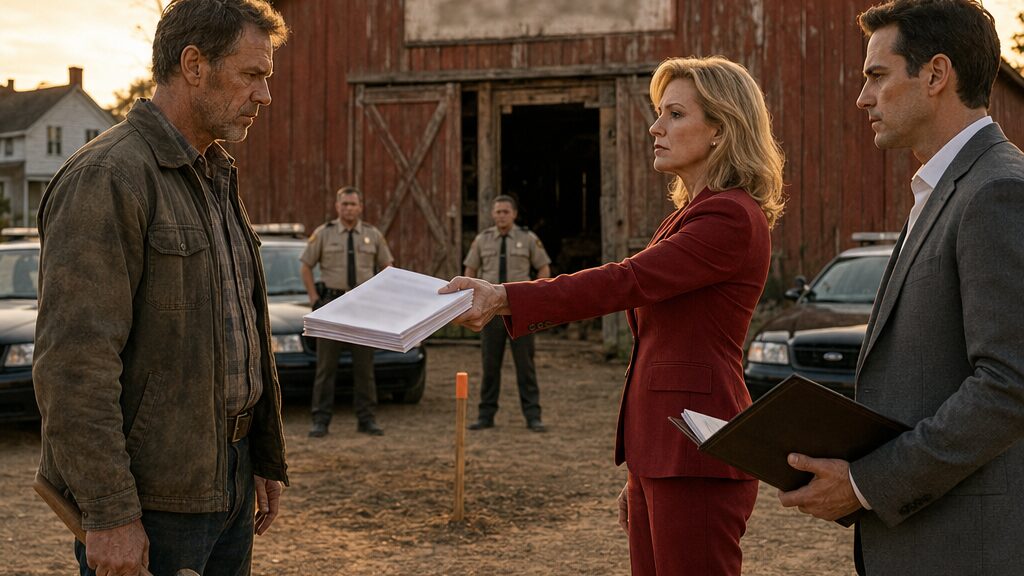
Nancy Green said it with the paper held out in front of her, as if the white pages were a locked gate and she had brought the key.
Daniel Carter stood ten feet from his sister in the dirt yard below the red barn, one hand wrapped around the handle of the sledgehammer he had been using to drive repair braces beside the sagging cattle rail. Above her shoulder, the old painted board over the barn doors still read CARTER FARM 1947, the numbers faded at the edges but not gone. Their grandfather had painted them. Their father had repainted them. Daniel had touched up the white letters the summer before Ruth Carter stopped climbing the porch steps without help.
Now Nancy stood beneath that sign in a red suit bright enough to look wrong against the dust, with two sheriff’s deputies beside their cruisers and a man in a gray jacket holding a leather folder against his ribs.
Daniel looked at the paper, then at Nancy.
“What did you say?”
Nancy’s mouth tightened, not with grief. With preparation.
“I said your name isn’t in the transfer. The farm is under estate control now. I’m the named beneficiary and acting trustee. Jason can explain the language if you need him to.”
The man in gray shifted forward. “Jason Rodriguez,” he said, though Daniel already knew his name from the letter that had arrived three days after Ruth’s funeral. “Mr. Carter, I understand this is difficult. But these documents are validly executed.”
Daniel did not take the packet. He stared at Nancy’s hand until it trembled once and she pulled it back.
The deputies remained quiet, but their quiet had weight. Their boots faced Daniel. Their cruiser doors were closed. Nothing about them said they expected trouble, but everything about them said they had been sent in case trouble found them.
Nancy lifted the top page again. “Mom made changes before she passed. She wanted the farm handled cleanly.”
“Cleanly,” Daniel repeated.
He had mud on his jeans, grease under one thumbnail, and hay dust stuck to the sweat at his neck. Nancy’s shoes had not collected a single burr from the driveway. She had parked on the gravel strip near the mailbox, where the weeds did not touch her ankles.
Jason opened his folder. “The restated trust and related transfer documents place the real property into a managed estate structure. Your sister is authorized to make decisions regarding occupancy, maintenance, sale, or distribution.”
“Occupancy,” Daniel said.
One of the deputies glanced toward the small white farmhouse beyond the barn. Ruth’s curtains still hung in the front window. Daniel had not taken them down. He had not been able to make himself move the jar of peppermint candies beside her chair either.
Nancy looked toward the house and then back at him. “You can’t stay here indefinitely and pretend nothing changed.”
“I stayed here while she was dying.”
Her face flickered.
Only for a second.
Then the paper came up again like a shield. “That doesn’t make you the owner.”
The sledgehammer handle creaked under Daniel’s grip. He felt each groove in the wood, each smooth place worn by years of his hand and his father’s before him. There was a new survey stake near the west edge of the barnyard, a thin orange-topped thing driven into Carter dirt that morning by someone who had not asked permission.
He turned his head toward it.
The younger deputy moved one step.
“Mr. Carter,” the deputy said, “we’re here to keep the peace.”
Daniel almost laughed. It would have come out wrong.
He walked to the survey stake instead.
Nancy’s voice sharpened. “Daniel.”
He raised the sledgehammer. The deputy’s hand moved near his belt, not to draw, just to remind.
Daniel brought the hammer down on the stake.
The wood split with a dry crack. The orange top vanished into the dirt. Dust jumped around his boots.
He did not raise it again. He left the hammer head resting on the broken stake and turned back to Jason.
“What date?”
Jason blinked. “Excuse me?”
“What date did she sign it?”
Nancy exhaled through her nose. “This isn’t going to become one of your scenes.”
Daniel kept his eyes on Jason. “You said validly executed. You said she made changes. What date?”
Jason looked down into the folder. He did not need to. He knew. Daniel saw that he knew because the man’s thumb had already found the page.
“Six weeks before her passing,” Jason said.
Daniel heard a cow low in the far pasture. He heard the wind move loose tin on the equipment shed. He heard his own pulse once, hard, behind his ears.
“Say the date.”
Jason gave it.
The yard seemed to tilt.
Nancy stepped forward. “Mom had good days. You know she had good days.”
Daniel looked at her then, and whatever she saw made her stop.
“That week,” he said, “she asked me where Dad was.”
Nancy’s jaw worked. “She was grieving.”
“Dad’s been dead twelve years.”
“She got confused sometimes. That doesn’t mean she couldn’t make decisions.”
Jason cleared his throat. “Capacity is not determined by isolated moments of confusion. Mrs. Carter understood the nature of the transaction at the time of signing.”
“Were you here?”
Jason hesitated. “The signing took place at my office.”
“Who drove her?”
Nancy said, “I did.”
“Who sat with her?”
Nancy’s voice lowered. “I did. She wanted me there.”
Daniel nodded once, not because he accepted it but because something had changed shape. Until that moment, he had thought this was a fight over land after Ruth’s death. Now he understood it had started while Ruth was still alive, in some room he had not been invited into, with Nancy’s hand on her elbow and a lawyer sliding paper across a desk.
The older deputy approached with a folded notice. “Mr. Carter, we’re not here to remove you today. But you are being served notice of disputed occupancy. If you interfere with estate access or destroy marked property again, this can become a civil enforcement issue.”
Daniel took the notice because refusing it would give Nancy what she wanted: angry Daniel, stubborn Daniel, Daniel who did not understand papers.
The top page had Ruth’s name typed neatly.
RUTH E. CARTER.
Below it, in cold black print, were words Daniel had never heard her say.
Nancy watched him read. “I didn’t want it to happen like this.”
He looked up. “Then why bring deputies?”
For the first time, she had no polished answer ready. Jason touched her elbow, a small professional warning.
Nancy’s face hardened again. “Because you don’t listen unless someone makes you.”
The words landed harder than the legal notice.
Daniel folded the packet once. Then again. His hand shook only after the fold hid Ruth’s name.
He turned toward the barn, toward the sign. CARTER FARM 1947. The year Ruth used to point to whenever someone suggested selling a back acre. “That number,” she would say, “is not paint. It’s a promise.”
Six weeks before she died.
Daniel unfolded the packet again, found the date, and stared at it until the digits blurred.
It was the same afternoon he had called Ruth from the feed store to sing her a late birthday song, and she had not known what day it was.
Chapter 2: The Calendar Ruth Kept Beside The Phone
The blue calendar was not in Ruth’s drawer where Daniel expected it. It was under a stack of unpaid utility notices beside the old wall phone, pressed flat like someone had tried to bury a year without throwing it away.
Daniel found it because the power bill slid off the counter and scattered across the kitchen floor.
He stood there in his work socks, the house still cold from dawn, looking down at Ruth’s careful handwriting on the calendar cover. She had written CARTER FARM in block letters across the top, then underlined it twice. Not “appointments.” Not “bills.” Not “medicine.”
Farm.
Outside the kitchen window, the red barn sat in pale morning light. CARTER FARM 1947 stared back at him through the glass, high above the doors. The broken survey stake lay where he had left it, half-buried in dust.
Daniel picked up the calendar with both hands.
The first pages smelled faintly of coffee and the lavender hand lotion Ruth kept beside her chair. She had always written in pencil, even birthdays, because she said ink was for people who believed life didn’t change its mind.
He flipped to the month before she died.
Nancy’s name appeared every Thursday.
Not “Nancy.” Just N.G., written sharply enough that Daniel knew Ruth had been copying from something or someone. Ruth never wrote her daughter’s married initials unless she was marking formal things: tax papers, insurance calls, church envelopes.
Beside the first Thursday: N.G. — bank forms?
The second: N.G. — don’t upset him.
Daniel stared at that line until the kitchen went quiet in a way that made the refrigerator hum sound rude.
Don’t upset him.
Him meant Daniel. It had to. There had been no other man in Ruth’s daily life by then except James Davis coming by to check fence posts and the delivery driver who left feed at the shed. Ruth had never worried about upsetting James. She had bossed James around from her porch for thirty years.
Daniel sat at the table.
The chair across from him was still turned slightly sideways from the last morning Ruth used it. She had wanted oatmeal, then refused it, then apologized for refusing it as if he were a waiter and not her son. He had laughed and told her he had eaten worse reviews from cows.
He had not written that down.
He had written down feed totals, diesel costs, vet visits, fence boards.
Not the promises.
Not the confusion.
Not Nancy’s visits.
He flipped forward.
On the week Jason said Ruth had signed the revised documents, the Thursday square had two marks. N.G. at ten. Jason R. at one.
Daniel’s thumb stopped over the name.
Jason R.
Not office at one. Not lawyer. Not documents. Just his name, squeezed between a medication note and a reminder to soak beans.
Daniel stood so fast the chair scraped the floor. He opened Ruth’s junk drawer, then the drawer beneath it, then the small side cabinet where she kept rubber bands, stamps, and old keys that opened nothing anymore. Bank envelopes. Insurance notices. Prescription receipts. Christmas cards she had saved from people who were dead now.
In the bottom drawer, under a yellowed manual for the old freezer, he found three envelopes from the bank. All unopened. All addressed to Ruth Carter care of Nancy Green.
Daniel read the address twice.
Nancy’s address.
The bank had been mailing Ruth’s notices to Nancy’s house.
He pressed the envelopes flat against the counter and tried to remember when the paper statements had stopped coming. He could see himself bringing in mail, sorting seed catalogs from bills, tossing junk into a basket. He could remember asking Ruth once if she had changed to electronic statements and her waving him off.
“Nancy’s helping with the office things,” Ruth had said.
He had been relieved.
That was the part that made shame rise hot in his throat. He had been relieved because paperwork made him impatient, because he trusted his mother’s voice, because Nancy had always been the one with clean folders and correct forms. He had let the mail vanish from the kitchen because cows still needed feeding and Ruth still needed bathing and the roof still leaked above the mudroom.
He opened one bank envelope with a butter knife.
It was not a statement. It was a notice confirming a mailing address change.
Requested by authorized agent.
Daniel set it down.
Authorized agent.
The words seemed harmless until they were not.
He went to Ruth’s bedroom. The room still smelled like powder and old wood. Her quilts were stacked in the cedar chest. Her shoes were lined up beneath the bed as if she might still complain that Daniel never put his boots in pairs. On the dresser sat a framed photograph of Ruth and Nancy beside the barn, taken years ago, Nancy in college, Ruth squinting into sun. Daniel was not in the picture because he had been fixing the tractor that day.
He opened the small writing desk by the window.
Inside were greeting cards, a broken pair of reading glasses, and a church bulletin with Ruth’s notes in the margin. Nothing official. No old will. No deed copy. No grand proof waiting for him because the world was not kind enough to leave truth where grief could find it.
Then, tucked behind the drawer, he felt paper.
He worked it loose carefully.
It was only a scrap torn from a feed receipt. Ruth’s writing crossed it in uneven pencil.
Ask D about west fence loan. Don’t let N worry.
Daniel closed his eyes.
He had taken that loan without telling Nancy. Not a big one, not compared to land value, but enough to repair the west fence after the storm and keep the cattle contained. Ruth had known. She had told him not to mention it at Thanksgiving because Nancy would make it sound like failure instead of survival.
Don’t let N worry.
Don’t upset him.
Two children protected in opposite directions until protection had become secrecy.
A knock struck the front door.
Daniel folded the scrap into his shirt pocket before he answered.
The same older deputy from the day before stood on the porch, hat in hand this time. His expression was not unkind, which made the envelope he carried worse.
“Mr. Carter,” the deputy said, “I’m delivering the formal timeline notice. Estate representative requested it be documented.”
Daniel took the envelope.
“How long?”
The deputy glanced toward the barn as if he wished the answer were written there instead. “Ten days before they can request removal from the residence. Could be delayed if there’s a filing, but without one…”
He did not finish.
Daniel looked past him to the barn sign, then down at the blue calendar still open on the kitchen table behind him.
Ten days.
For the first time since Nancy had said his name was missing, Daniel understood that remembering was not enough. He would have to prove the shape of weeks everyone else had already turned into paper.
Chapter 3: She Said The Paperwork Was Legal
“The documents are legal,” Jason Rodriguez said before Daniel had fully sat down. “Your sister is the named beneficiary.”
Daniel kept his hands on his knees so he would not reach across the desk and straighten the man’s perfect stack of papers into something less smug.
Jason’s office sat on the second floor of a brick building off the town square, above a tax service and a closed dress shop. The room had framed certificates, gray carpet, and a window that looked down on parking meters. Nothing in it smelled like hay, medicine, or rain coming through an old roof. Ruth would have hated it. She would have whispered that any room with that many pens in one cup was trying too hard.
Nancy had not come. Jason said she was not required to attend. Daniel knew that meant she had decided the paper could do the talking for her.
“I’m not here to ask whether my sister’s name is typed in the right place,” Daniel said. “I’m asking how it got there.”
Jason folded his hands. “Mrs. Carter requested changes to her estate structure. She expressed concern about continuity of farm management and financial exposure.”
Daniel heard Nancy’s voice inside those words. Financial exposure. Continuity. Cleanly.
“My mother said that?”
“In substance.”
“In substance means no.”
Jason’s eyes lifted. “Mr. Carter, grief can make these matters feel personal—”
“It is personal.”
“Of course. But legally, the question is whether your mother had capacity at the time of signing and whether the documents were executed properly.”
Daniel pulled the blue calendar from the inside of his jacket and laid it on the desk. He did not open it yet.
Jason glanced down despite himself.
Daniel noticed.
“Who scheduled the appointment?” Daniel asked.
Jason moved one page from one side of the folder to the other. “Your sister contacted my office on your mother’s behalf.”
“Did my mother call you?”
“She participated in the appointment.”
“That’s not what I asked.”
Jason’s jaw tightened. It was small, but Daniel had spent his life reading small changes in animals before they kicked. He saw the man measure patience, choose professional calm, and wrap himself in it.
“Initial contact came through Nancy,” Jason said.
Daniel opened the calendar to the week of the signing and turned it toward him. “That’s what this says too.”
Jason looked at the square. N.G. at ten. Jason R. at one.
For the first time, he did not answer immediately.
Daniel leaned back. “Was Mom alone with you when she signed?”
Jason removed his glasses and cleaned them with a cloth that looked too expensive to have ever cleaned anything dirty. “Your mother was accompanied by your sister because of mobility concerns.”
“That’s not what I asked either.”
“She was present for portions of the meeting.”
“Was Mom ever alone with you?”
Jason put his glasses back on. “I don’t recall the exact sequence minute by minute.”
Daniel nodded slowly. “You remember enough to say she understood everything. But not enough to say whether my sister was in the room.”
“That’s not a fair characterization.”
“Neither is calling me a tenant on land I kept running while my mother forgot how to use the stove.”
Jason’s face changed then. Not sympathy. Wariness.
Daniel hated that he had said it. Not because it was untrue, but because anger had entered the room and Jason had been waiting for it. Nancy had probably told him Daniel would come in hot, dirty, loud, unreasonable. A man who broke survey stakes instead of reading documents. A man who thought promises beat signatures because he could not understand the difference.
Daniel made himself breathe.
When he spoke again, his voice was lower. “I’m asking for the date, the circumstances, and who was present. I’m asking because that week my mother could not remember her own birthday call.”
Jason looked at the calendar again. “Capacity can fluctuate. A person may be confused in one context and lucid in another.”
“I know.”
The answer surprised Jason. It surprised Daniel too.
He did know. Ruth had hours when she was Ruth again so sharply it hurt. She would correct Daniel on feed ratios, remind him which pasture gate stuck in the cold, tell him exactly where his father had hidden a spare tractor key. Then, by evening, she would ask whether the school bus had come for children who had grown old enough to have grandchildren.
“I’m not saying she never had good hours,” Daniel said. “I’m saying I want to know whether my sister picked one, shaped it, and called it Mom’s final wish.”
Jason closed the folder halfway. “If you intend to contest the trust or related transfers, you should retain counsel.”
“With what money?”
The question came out before Daniel could stop it.
Jason heard too much in it. His expression softened just enough to make Daniel dislike him more.
“These disputes are expensive,” Jason said. “And emotionally damaging. Your sister has authority under the documents. She may be willing to discuss a practical resolution if you approach this constructively.”
“A practical resolution.”
“Occupancy terms. Personal property. Perhaps some compensation for your work on the farm.”
Daniel stared at him.
His work on the farm.
As if the years had been labor hours Nancy might reimburse at a rate she found reasonable. As if bathing Ruth, lifting her from the bathroom floor, learning which pills made her dizzy, sleeping in a chair by the hallway because she wandered at night, were services rendered against a balance sheet.
He closed the calendar.
“I don’t want compensation for being her son.”
Jason said nothing.
Daniel stood, then stopped with his hand on the calendar. “Was there a doctor’s statement?”
“A formal capacity letter was not required.”
“Medical notes?”
Jason’s gaze flicked once toward the folder.
There it was.
Daniel waited.
Jason seemed to realize he had moved too soon. He reached for a pen, then set it down. “There were care records generally available. Nothing that prevented execution.”
“Care records from who?”
“That is not something I can disclose casually.”
“But you know.”
Jason’s silence filled the room like locked filing cabinets.
Daniel picked up the calendar and stepped toward the door.
Behind him, Jason said, “Mr. Carter.”
Daniel turned.
The attorney looked irritated with himself before he even spoke. “If you are going to make inquiries, do not harass medical staff. Emily Lopez was a care coordinator, not a decision-maker.”
Emily Lopez.
Jason stopped there, realizing too late that he had given Daniel the first name in the whole process that Nancy had not controlled.
Daniel looked at the folder in Jason’s hand, then at the man holding it.
“What did Emily write down?” he asked.
Jason’s mouth closed.
Daniel left before anger could give the attorney another reason not to answer.
Chapter 4: The Nurse Would Not Say It First
“I can’t tell you your mother didn’t know,” Emily Lopez said through the half-open window of her parked car. “I can tell you that morning was bad.”
Daniel stood beside the white line in the clinic parking lot with both hands empty on purpose. He had left the blue calendar on the passenger seat of his truck because carrying it up to her window had felt too much like pushing paper at someone the way Nancy had pushed paper at him.
Emily had not agreed to meet him inside. She had called him back from an unknown number and said she had five minutes before her next home visit. Now she sat with one hand still on the steering wheel, her badge clipped to her scrub top, her face cautious in the shadow of the visor.
“What does bad mean?” Daniel asked.
Emily looked toward the clinic doors. “It means she was disoriented when I saw her.”
“Disoriented enough not to sign legal papers?”
Her mouth tightened. “Daniel.”
He heard the warning and swallowed the next words before they came out rougher. Jason had already made him into the angry son in his own office. Daniel could not afford to become that here too.
“I’m sorry,” he said. “I’m asking wrong.”
Emily softened by half an inch. Not enough to open the door. Enough to stay.
“She knew me that morning,” Emily said. “Then ten minutes later she asked if I was from the school.”
Daniel looked down at the asphalt. A dark oil stain spread between his boots like a map of a place nobody wanted.
“She did that sometimes,” he said.
“I know.”
“She had good hours.”
“I know that too.”
The gentleness in her voice bothered him more than if she had been cold. It made him feel seen, and he did not want to be seen standing in a parking lot begging for scraps of his mother’s last weeks.
Emily turned the engine off. The sudden silence put the conversation somewhere more serious.
“I cannot declare capacity,” she said. “I wasn’t the attorney. I wasn’t a doctor making a legal determination. My notes can show what I observed during visits, not what she understood in a different room at a different hour.”
“Jason said there were care records.”
Emily looked away. That told him she knew exactly how her name had entered the room.
“What did you write that week?” Daniel asked.
She breathed in slowly. “I wrote that Ruth had fluctuating orientation. I wrote that she recognized familiar people inconsistently. I wrote that stress made her confusion worse.”
Daniel’s fingers curled against his palms.
Stress.
Nancy would have known that. They all knew that. Loud rooms, too many questions, new places—Ruth would smile, nod, and vanish behind her own eyes.
“Did Nancy know?”
Emily’s gaze returned to him. “Nancy was present for some of those conversations.”
“Some.”
“Daniel.”
He waited.
Emily rubbed her thumb along the edge of the steering wheel. “Your sister asked me not to call you that day.”
The words did not strike like the survey stake breaking. They slid under his ribs and stayed there.
“What day?”
“You know what day.”
He looked toward his truck, toward the calendar he could not see through the windshield glare.
“The signing day,” he said.
Emily did not nod, but she did not deny it.
“She said Ruth needed calm,” Emily continued. “She said when you were around, Ruth got emotional and tried to talk about the farm instead of focusing on what had to be done.”
Daniel almost answered too fast. Then he remembered Ruth crying once because Daniel had brought in a broken hinge and asked whether she wanted the old gate repaired or replaced. She had clutched the hinge like a relic and said his father never liked replacing what could still hold.
Maybe he did make her emotional.
Maybe Nancy had built a lie out of a true piece of him.
“What did you do?” he asked.
“I told Nancy family decisions weren’t mine to manage.”
“But you didn’t call me.”
Emily’s face closed with pain she had no right to show and every right to feel. “No. I didn’t.”
Daniel nodded. He had wanted a clean answer. Instead, he had found another person who had stood near the door and not opened it.
“Can I get those notes?”
“Not from me standing in a parking lot. There’s a process.”
“Everything has a process.”
“It does when people are dead and everyone left is angry.”
That stopped him.
Emily looked sorry the moment it came out, but Daniel was glad she had said it. It was the first honest sentence anyone connected to the paperwork had given him.
“I’m not doing this because I want Nancy’s money,” he said.
“I didn’t say you were.”
“She will.”
“I know.”
Daniel turned toward his truck. Through the clinic lot, past the road, past the roofs of town, he could almost feel the farm waiting with its deadline pinned to the porch.
Emily opened her door before he reached the truck.
“One more thing,” she said.
He stopped.
“Ruth asked for you two days before that appointment.”
Daniel did not move.
“She was upset. She said she needed to talk to you about the west fence and Nancy. I told her I’d mention it during my next coordination call. By the next call, Nancy said it had been handled.”
“What had been handled?”
Emily shook her head. “I don’t know. That was the phrase.”
Handled.
It sounded like Jason’s office. Like Nancy’s folders. Like Ruth’s life had become something to manage around Daniel instead of with him.
On the drive back, he kept seeing his mother in rooms he had not entered. Ruth in Nancy’s car. Ruth in Jason’s office. Ruth looking for him while other people decided calm was better than truth.
At the farm, the afternoon sun had shifted behind the barn, turning the red boards dark. Daniel parked near the house and sat for a moment with Emily’s words still moving through him.
The signing day followed a bad morning.
Nancy asked that he not be called.
Ruth had asked for him.
None of it overturned anything. Jason would say that. A court would say that. The world loved paper more than patterns.
Daniel took the blue calendar from the seat and walked toward the barn. He needed to put the dates beside the bank notice, the utility envelopes, the service deadline, anything that could make a shape. Halfway across the yard, he saw James Davis standing just inside the open barn door.
James was broad and gray-bearded, wearing the same kind of plaid shirt he had worn since Daniel was a teenager. His cap sat low, and one hand rested on the edge of the sliding door as if he had been holding the barn upright by himself.
Daniel stopped.
James looked at the calendar in Daniel’s hand, then up at the sign over the door.
“I heard Nancy brought the deputies,” James said.
Daniel waited, too tired to make it easy for him.
James stepped out of the shadow.
“Your mother made me promise not to talk,” he said.
Chapter 5: The Man Who Stayed Silent Too Long
“Your mother made me promise not to turn you two against each other,” James Davis said.
Daniel stood in the barn doorway with Ruth’s blue calendar under his arm and the smell of old hay, dust, and machine oil between them. For a moment, he could not tell whether he wanted to hear the rest or make James carry it alone forever.
“You knew,” Daniel said.
James took off his cap and held it in both hands. His gray hair lay flat where the brim had pressed it. “I knew pieces.”
“You knew enough to come here after Nancy brought deputies.”
“I should’ve come sooner.”
“That’s not an answer.”
“No,” James said. “It ain’t.”
The barn swallowed the sound after that. Above them, light cut through gaps in the boards and striped the packed dirt floor. The old tractor sat under a tarp near the back wall, its front tire low, Ruth’s favorite feed scoop hanging from a nail beside it. Daniel had spent half his life in this barn with James nearby, learning how to fix what could be fixed and live with what could not.
He had never imagined James as someone keeping a door closed.
Daniel walked past him and set the calendar on the workbench. “Say the pieces.”
James followed slowly. “That week Nancy drove Ruth into town. Day before that, Ruth was worked up. Kept asking if you’d been told about something.”
“What something?”
James looked at the calendar but did not touch it. “The farm.”
Daniel let out a hard breath. “Everything was the farm.”
“No. Not like that.” James swallowed. “She said, ‘Both my children have to be safe.’ She said it twice.”
Daniel’s anger stumbled. Not disappeared. Stumbled.
Both my children.
Not Daniel only. Not Nancy only.
“What did Nancy say?”
“She told Ruth not to worry. Said she had a way to keep things from getting messy.”
Daniel pressed his palm against the workbench. The wood was rough and familiar. “And you didn’t ask what that meant?”
“I did.”
“And?”
James looked toward the barn doors, toward the yard where the deputies had stood. “Nancy said if the land stayed tangled up with you, your debts would eat it alive.”
Daniel’s mouth went dry.
The west fence loan. The equipment note. The late feed account after two bad seasons and Ruth’s medication costs. None of it was secret in the way shame pretended things were secret. The bank knew. The feed store knew. Ruth knew.
Nancy knew enough.
Daniel turned away.
James’s voice lowered. “She said Ruth had spent her whole life holding the place together and you were going to mortgage the bones out from under it.”
Daniel faced him again. “You believed her?”
“I believed you were stretched thin.”
“That’s not what I asked.”
James put his cap back on, then took it off again as if he did not deserve the comfort of it. “I believed Nancy was scared. I also believed she liked being the one with the answers.”
That sounded too true to dismiss.
Daniel opened the calendar to the signing week. “Emily says Mom asked for me.”
James closed his eyes.
“You knew that too?”
“I was on the porch when Ruth asked. Nancy told her you were in the north pasture and didn’t need to be bothered.”
“I wasn’t in the north pasture. I was at the feed store.”
“I know that now.”
“You knew then if you’d walked ten steps to the phone.”
James flinched.
Good, Daniel thought, then hated himself for needing it.
James looked older than he had yesterday. Or maybe Daniel was finally making room for other people’s age. “Ruth got confused when folks argued around her. Nancy kept saying one more upset would send her back to the hospital. I thought keeping quiet was kindness.”
“To who?”
James had no answer.
Daniel picked up a rusted tractor key from the workbench. Ruth had tied a strip of blue cloth to it years ago so she could find it in the drawer. He rolled it between his fingers, feeling the cloth stiff with age.
“My mother asked for me,” he said. “And everyone decided I was the problem.”
James’s face folded around the words. “I’m sorry.”
Daniel wanted to throw the apology into the rafters. Instead, he set the key down carefully because throwing anything would prove Nancy right again.
“What else?”
James hesitated.
Daniel laughed once, without humor. “There’s more.”
“I heard Ruth tell Nancy she didn’t want the barn sold.”
Daniel stared at him.
“When?”
“After the appointment. Maybe two days after. Ruth was sitting in the truck while Nancy came in here looking for the old deed map. Window was down. Ruth said, ‘Not the barn, Nancy. Promise me not the barn.’”
Daniel looked toward the doors. From inside, the painted sign was backward through the slats, the white shapes broken by shadow.
“And Nancy?”
“Said she promised.”
The words hung there like a rope neither man wanted to touch.
Daniel leaned back against the bench. Nancy could still say she was protecting the farm. She could still say Ruth had good hours. She could say Daniel’s debts scared everyone. She could say James had misunderstood an old woman’s rambling.
But she could not say Ruth wanted Daniel erased.
Not if James stood by what he had heard.
“Will you put that in writing?”
James looked at him then. “Yes.”
Daniel had expected another excuse. The answer hit him harder than he let show.
“Why now?”
James glanced toward the farmhouse. “Because I saw the deputy notice on your porch. Keeping peace is one thing. Letting them put you out under that sign is another.”
Daniel nodded once.
It was not forgiveness. It was use.
They spent the next hour at the workbench. Daniel wrote dates in a lined notebook. James spoke slowly, backing up whenever memory blurred. Ruth asking for Daniel. Nancy saying Daniel would get her upset. Ruth saying both children had to be safe. The barn promise. The old deed map.
Halfway through, James stopped and pointed to the blue calendar.
“That mark there,” he said.
Daniel looked. Beside one Thursday, Ruth had drawn a small square with a line through it.
“What is it?”
“Old habit. Means she was waiting on a phone call.”
“From who?”
James shook his head. “You’d know better.”
Daniel did not. That was the trouble. He knew the farm’s pumps, gates, medicine times. He did not know who his mother had been waiting to hear from in the week her will changed.
Near dusk, an engine came up the driveway too cleanly to be a truck from the feed store. Daniel and James stepped outside.
Nancy’s car stopped near the broken survey stake. She did not get out immediately. When she did, she was not wearing the red suit. She wore dark pants and a cream coat, softer colors that made her look less like an enemy and more like someone who had once sat across from Daniel at this same kitchen table eating corn bread with butter on her fingers.
That made him more careful.
She held an envelope.
James stood beside the barn door.
Nancy noticed him and faltered. “James.”
He gave her a nod that offered nothing.
She turned to Daniel. “We need to talk without deputies.”
“You brought them first.”
“I know.” She looked toward the farmhouse and then back at him. “I’m trying to avoid worse.”
Daniel waited.
Nancy walked close enough to hand him the envelope. “There’s a settlement offer inside. Cash payment. The old tractor. Personal property from the house you can list. If you leave before morning and agree not to contest the trust, I’ll make sure you’re not walking away with nothing.”
Daniel looked at the envelope in her hand, then at the barn sign above her.
Before morning.
The offer was not kindness. It was a door closing.
Chapter 6: The Offer That Was Supposed To Quiet Him
“Take the money, Daniel. Don’t make Mom’s last decision ugly.”
Nancy stood beneath the barn sign with the settlement envelope between them, and for one brief, dangerous second, Daniel wanted to take it just so he could tear it in half in front of her.
Instead, he opened it.
James stayed near the barn door, silent as a fence post. Nancy glanced at him once, irritated by the witness, then fixed her eyes on Daniel as he unfolded the papers.
The number was not small.
That was the first thing that unsettled him.
It was enough to clear the west fence loan. Enough to quiet the feed account. Enough to rent a place outside town for a while and pretend leaving Carter Farm had been a decision instead of a removal. She had included the old tractor too, as if Ruth’s machine were a consolation prize at a fair.
Daniel read the clause near the bottom twice.
Agreement not to contest estate documents, trust administration, real property transfer, or beneficiary designation.
“You had Jason write this?” he asked.
“He reviewed it.”
“That wasn’t my question.”
Nancy’s face sharpened. “Yes.”
Daniel held the papers against the barn wall, pinning them under his palm below CARTER FARM 1947. “You want me gone by morning.”
“I want this stopped before it destroys what’s left.”
“What’s left of what?”
“Our family.”
He looked at her then. “You brought deputies to my door.”
“You broke a survey stake with a sledgehammer.”
“I broke wood.”
“You scared people.”
“You wanted people scared. That’s why the cruisers were here.”
Nancy’s mouth opened, then closed.
The first real crack.
Daniel set the settlement papers on the workbench just inside the barn. He went to his truck and brought out Ruth’s blue calendar, the bank address notice, and the notes he had written from James’s statement. He did not bring Emily’s name into it yet. Not fully. He had learned something from Jason’s office: do not give away the only door before knowing who might slam it.
He laid the calendar open on the hood of his truck.
Nancy crossed her arms. “What is this?”
“The week Mom signed.”
“I know the week.”
“I’m sure you do.” He tapped the square. “You’re here at ten. Jason’s name is here at one. Same week Emily says Mom had a severe confusion episode.”
Nancy looked at James. “You’re involving him now?”
“He was involved before I knew I was out.”
James said nothing, but his silence had changed sides.
Nancy stepped closer to the calendar. Her eyes moved over Ruth’s handwriting, and Daniel saw something pass across her face before she covered it. Not guilt exactly. Recognition.
“You went through Mom’s things,” she said.
“I live in Mom’s house.”
“You live in a house that now belongs to the estate.”
“There it is.”
Her cheeks colored. “Facts don’t become cruel because you dislike them.”
“No. People do.”
Nancy flinched, and for a moment Daniel felt the old rhythm between them: push, bruise, regret, hide. They had been like this since childhood, Nancy building rules around feelings, Daniel breaking rules and pretending feelings were beside the point.
He looked down at the calendar so he would not soften too soon.
“Why was Mom never alone with Jason?” he asked.
Nancy went still.
Behind her, James lifted his head.
“She needed help,” Nancy said.
“She needed help walking. Not answering.”
“You don’t know what she needed in that room.”
“Neither did Jason, apparently, if you never left it.”
Nancy’s eyes shone, but her voice stayed hard. “You think this was easy for me?”
“I think it paid you.”
She slapped him.
Not hard enough to hurt for long. Hard enough to silence the yard.
James took one step forward. Daniel raised a hand without looking at him.
Nancy stared at her own fingers as if they belonged to someone else.
Daniel’s cheek burned. He did not touch it.
“That,” he said quietly, “is the version of me you needed. The one who makes you feel justified.”
Nancy’s breath shook. “You don’t get to act like you were the only one who lost her.”
“I don’t.”
“You were here. Every day, you were here. You got the house, the routines, the neighbors bringing casseroles, everyone saying how good you were. I got phone calls about bills and your loans and Mom crying because she didn’t know if the farm would survive you.”
Daniel looked down.
Nancy saw it and pressed. “Yes. I knew about the loan. I knew about the feed account. I knew you were behind on equipment payments. You think Mom didn’t worry? You think she didn’t ask me how to keep you from drowning and taking the land with you?”
The worst part was not that she was lying.
The worst part was that she was using truth as a handle.
“I should’ve told you,” Daniel said.
That answer threw her off.
He looked back up. “I should’ve told you how bad the west fence got. I should’ve told you the feed costs. I should’ve told you Mom was paying some things late because the medication changed. I didn’t because I knew you’d make it sound like I was failing her.”
Nancy’s face twisted. “Maybe you were.”
The words landed between them and did not move.
James looked away.
Daniel folded the settlement papers and handed them back to her. “No.”
Nancy did not take them. “Think carefully.”
“I am.”
“If you contest this, the estate can move forward with removal and auction preparation. I don’t need your permission to protect the assets.”
“The assets.”
“The farm,” she snapped. “Fine. The farm. The thing you love so much you’d rather bury it under debt than admit you need help.”
Daniel put the papers on the hood of her car.
“Mom asked James not to let you sell the barn.”
Nancy’s eyes cut to James.
James held her stare.
“That’s not what she meant,” Nancy said.
Daniel almost asked what she meant, but he saw the answer already building behind Nancy’s face, another managed phrase, another clean explanation.
So he picked up the calendar instead.
“I’m going to the county clerk.”
“For what?”
“The old deed packet.”
Nancy laughed once, sharp and scared. “A deed packet won’t undo a trust.”
“No,” Daniel said. “But maybe it tells me what Mom thought she was protecting before you told everyone you were the only one protecting it.”
Nancy reached for the settlement papers on her hood. “The offer expires tonight.”
“Then let it.”
He drove into town with his cheek still warm and the calendar on the passenger seat. The county clerk’s office was ten minutes from closing, and the clerk behind the counter looked at his dirty boots, then at the folder in his hand, and said records requests might take time.
“I don’t have time,” Daniel said, and heard himself sounding too much like the man Nancy described.
He stepped back. Lowered his voice.
“Please. Carter Farm. Ruth Carter. I need the prior deed packet, anything filed before the recent transfer.”
The clerk studied him, then disappeared into the back.
Daniel stood under fluorescent lights that made everyone look guilty. He watched the clock move. He thought of Nancy’s offer expiring, Jason’s folder closing, Emily’s caution, James’s silence, Ruth’s handwriting pressed into small calendar squares.
The clerk returned with a scanned packet printed on warm paper.
“Older filings,” the clerk said. “Some attachments are handwritten. We copied what was legible.”
Daniel paid with cash he should have saved for feed.
He did not open the packet until he reached the truck. Under the dome light, the first pages were deeds, parcel maps, transfer references. Then came a photocopy clipped behind a prior filing, Ruth’s handwriting slanting across the bottom of a distribution note dated months before Nancy’s Thursday visits began.
Daniel read the line once.
Then again.
Homestead and barn parcel to remain for Daniel’s use, with Nancy protected from sale proceeds if outer acreage is ever divided.
Ruth had not written him everything.
She had written both of them in.
And someone had turned that into only one name.
Chapter 7: What The Paper Could Not Erase
Daniel placed the calendar, the care note request form, and the prior deed packet on Jason Rodriguez’s conference table without raising his voice.
Nancy sat across from him with both hands folded around a paper cup she had not drunk from. Jason stood at the head of the table, not sitting, as if remaining on his feet kept him outside the fight. James Davis stood near the wall with his cap in his hands. Through the conference room window, the town square looked ordinary enough to insult them: parked cars, a courthouse clock, people walking past with coffee while Carter Farm waited under a removal notice.
Daniel slid the old photocopied page forward.
“This was filed before the trust was changed,” he said.
Jason looked down. His expression did not break, but his eyes slowed.
Nancy saw that and leaned forward. “What is it?”
“Mom’s distribution note,” Daniel said. “Homestead and barn parcel for my use. Outer acreage protected so you wouldn’t be cut out if it was ever divided.”
Nancy reached for the page. Daniel let her take it.
Her face changed when she recognized Ruth’s handwriting.
For once, she did not speak first.
Jason adjusted his glasses. “A handwritten note attached to an earlier deed packet is not necessarily controlling.”
“I know,” Daniel said.
Nancy looked up sharply, as if she had expected him to argue with the wrong point.
Daniel set the blue calendar beside the old note. “I’m not saying this one page fixes it. I’m saying it makes your story harder.”
“My story?” Nancy asked.
“The one where Mom simply changed her mind and erased me.”
Nancy’s mouth tightened. “She didn’t erase you.”
“You served me papers that said I had no right to live in the house where I carried her to bed.”
Jason said, “Let’s keep this productive.”
Daniel looked at him. “Were you ever alone with my mother?”
The question dropped cleanly.
Jason’s professional stillness returned, but this time it looked thinner. “I met with Mrs. Carter and Nancy to discuss revisions.”
“That’s not what I asked.”
Nancy set the handwritten note down. “Daniel, don’t twist this.”
He kept his eyes on Jason. “Was she ever privately questioned away from the person who benefited?”
Jason did not answer quickly enough.
James shifted by the wall.
Nancy saw the pause too. “Jason?”
The attorney closed the folder in front of him. “Nancy was present for the substantive portions of the meeting.”
Daniel felt no triumph. Only a dull click inside him, like a gate latch falling into place.
“So no,” he said.
Jason’s jaw moved. “Given Mrs. Carter’s mobility and health limitations, Nancy’s presence was not unusual.”
“Not unusual isn’t the same as safe.”
Nancy stood halfway. “I was helping her.”
Daniel turned to her. “Then why didn’t you call me when she asked for me?”
Color moved up Nancy’s neck.
Jason looked at her then, not as her lawyer exactly, but as a man who had just heard a room change.
Nancy sat back down. “She was upset. Emily said stress made her worse.”
Daniel took the paper from his folder, not Emily’s full record—he did not have that yet—but the written request acknowledgment and the dates Emily had confirmed he could document. He placed it beside the calendar.
“She also said Mom had a severe confusion episode that morning.”
“She said good and bad hours,” Nancy snapped. “You know that. You know Mom could be clear. Don’t stand there and make her sound gone just because it helps you.”
That struck close enough that Daniel had to look away.
For a second, Ruth was there not as a legal question but as herself: Ruth correcting the seed order, Ruth asking for a dead husband, Ruth humming while Daniel tied her shoes because she could not bend without pain. Good hours and bad hours. Both true. Neither simple.
“You’re right,” he said.
Nancy blinked.
Daniel looked back at her. “She wasn’t gone. That’s why what happened matters.”
Nancy’s grip tightened around the cup. The lid buckled.
“I was trying to save the farm from you,” she said.
The sentence came out low, not proud.
James lifted his eyes.
Daniel waited.
Nancy laughed once, broken at the edge. “There. Is that what you wanted? You want me to say I didn’t trust you? Fine. I didn’t. You had loans you didn’t tell me about. Equipment payments late. Feed store credit stretched out. Mom would call me scared because she didn’t understand the bills anymore, and you’d tell her everything was handled.”
Daniel said nothing.
“You got to be the good son because you were there,” Nancy continued. “I was the one who had to hear the panic after you left the room. I was the one she called when she found a bank notice and didn’t know whether she was losing the farm. You think I wanted deputies out there? You think I wanted to stand under that sign with paper in my hand?”
“You still did.”
“Yes,” she said. “Because I thought if the land stayed tied to you, there wouldn’t be any Carter Farm left to argue over.”
The room went quiet.
It was not an excuse. Daniel knew that. But it was the first time Nancy had spoken without sounding like Jason’s folder.
He picked up the old deed note and turned it so she could see Ruth’s writing again.
“She was trying to protect both of us,” he said.
Nancy looked at the line. Homestead and barn parcel. Outer acreage. Both children, divided without selling the heart.
“She changed it later,” Nancy said, but the certainty had gone out of her voice.
“After you drove her. After you sat in the room. After you told people not to call me.”
Nancy looked at James then. “You don’t know what he would’ve done if he’d been there.”
James stepped forward from the wall. “I know what Ruth said.”
Jason’s attention sharpened.
Nancy turned fully toward him. “James.”
He held his cap against his stomach. “She said both my children have to be safe. That was before the appointment. After it, she told you not to sell the barn.”
Nancy’s eyes filled, but she shook her head. “She was confused.”
“Maybe,” James said. “But she knew the barn.”
The words opened something in Daniel he had been holding shut since the deputies came. Ruth had forgotten days. Names sometimes. Whether she had eaten. But she had known the barn. Even on bad mornings, she knew the red boards from her bedroom window. She knew the number over the doors. She knew that the land could be divided on a map and still remain whole in only one place.
Jason took off his glasses and set them on the table.
“If these statements are accurate,” he said carefully, “there may be enough to justify a formal review of circumstances surrounding execution. I am not saying the document is invalid.”
“No one in this room expected you to,” Daniel said.
Jason accepted that without argument.
Nancy sat back slowly. “A review means what?”
“It means delay,” Jason said. “Potential challenge. Questions regarding undue influence. Capacity. Process.”
“Process,” Daniel said.
This time, the word did not sound useless. It sounded like a gate he had finally learned to open.
Nancy stared at the papers. “If this goes that way, the estate costs come out of everything.”
“I know.”
“You could still lose.”
“I know.”
“The farm could still suffer.”
Daniel leaned forward. “The farm is already suffering. You tried to protect it by removing the person who knew where the roof leaks, which heifers breach the south fence, which boards in the barn floor won’t hold weight. You didn’t save it from me. You tried to save it without me because you were angry I mattered there.”
Nancy’s face crumpled for half a second before she caught it.
“I mattered too,” she whispered.
Daniel felt the old childhood wound beneath the grown-up fight. Nancy leaving for college. Daniel staying. Ruth praising the child who was present and worrying over the one who was gone. Years of small exclusions, none of them enough to justify the paper, all of them real enough to poison the room.
“Yes,” he said. “You did.”
Nancy looked at him then, and for the first time since Ruth’s funeral, she seemed less armed than tired.
Daniel gathered the pages into a neat stack. Not because the matter was finished, but because throwing them across the room would have been easier and less useful.
“I won’t sign away a challenge,” he said. “I won’t take the settlement. I’m filing for review.”
Jason nodded once, as if he had expected it by now.
Daniel looked at Nancy. “But I’m not asking for everything. I’m asking for the homestead and barn parcel to be paused out of removal and restored to shared control while the review happens. You want to protect the farm? Start with not putting me out of the part Mom specifically wrote down.”
Nancy looked at the handwritten note again.
Jason spoke before she could. “That may be a reasonable temporary stipulation.”
Nancy turned on him. “Reasonable?”
“Under the circumstances,” he said, and his voice carried the first hint of discomfort Daniel had heard from him, “it may prevent a more aggressive filing.”
Nancy’s eyes moved from Jason to James to Daniel.
No one rescued her from the choice.
At last, she pushed the paper cup away. “No auction preparation on the homestead or barn parcel,” she said. “No removal from the house while the review is pending.”
Daniel let the words settle before he trusted them.
“And the deputies?” he asked.
“I’ll withdraw the immediate request.”
“Today.”
Nancy closed her eyes. “Today.”
Jason began writing notes. The scratch of his pen sounded too small for what had just shifted, but Daniel had learned that small marks could change lives.
When the meeting ended, no one shook hands.
James walked with Daniel down the stairs and out to the street. He did not speak until they reached the truck.
“You did better than I would’ve,” James said.
Daniel looked at him. “I almost didn’t.”
“I know.”
That was all James offered, and all Daniel could take.
By late afternoon, Daniel was back at Carter Farm with copies of the temporary stipulation on the passenger seat. Nancy had not followed him. Jason had sent confirmation that the removal request would be paused. The legal review would take time. Money. More rooms with carpet and pens and people deciding how much truth paper could hold.
But the sheriff’s cruiser was gone from the driveway.
Daniel carried the folder across the yard. The broken survey stake still lay near the barn, split and dirty. He picked it up, not to save it, not to display it, but to remove it from the place where anger had first spoken for him.
Above the barn doors, CARTER FARM 1947 caught the last light.
He stood beneath the sign with Ruth’s calendar, the old deed note, and the paper that did not fix everything but stopped the immediate erasure. The farm was not fully his. The fight was not over. Nancy was still his sister, and that fact felt less like comfort than a scar with a name.
Daniel pressed his palm against the red barn door.
“I found it,” he said, though Ruth was not there to answer.
Not all of it. Not enough to make the last months clean. Not enough to turn the law into memory or memory into law.
But enough that no one could say Ruth Carter had simply erased him.
Enough that the barn remained standing with his name still tied to its shadow.
The story has ended.