They Sent Officials To Her Brick House With A Bill She Wouldn’t Sign
Chapter 1: The Estimate Arrived Before She Unlocked The Chain
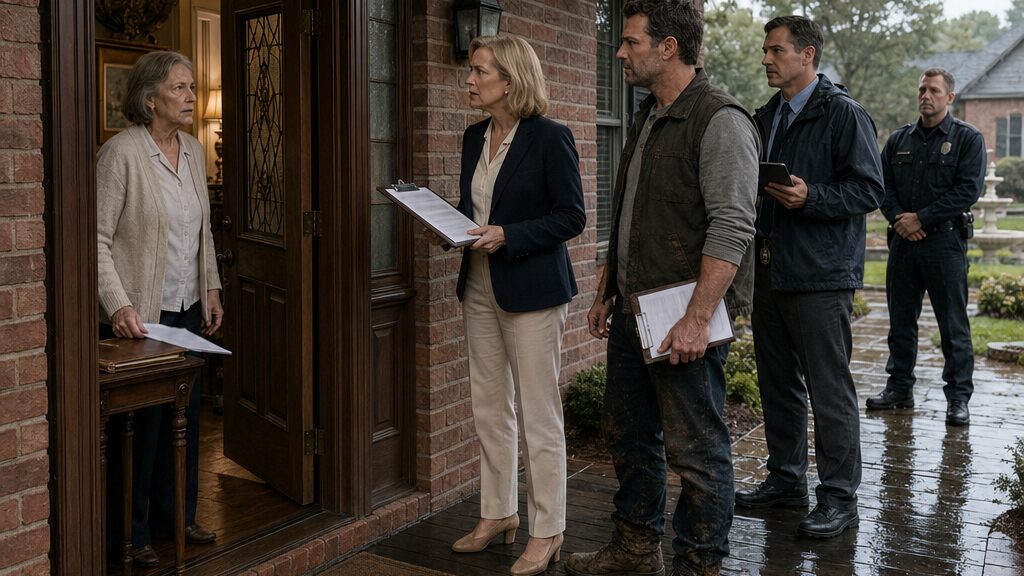
The man from the city was already halfway up Susan Carter’s front walk before she had the door chain unlatched.
He came fast, his dark rain jacket flapping open over a city badge clipped to his belt, one hand raised as if the whole brick house might try to run from him. Behind him, a uniformed civil standby officer kept pace without expression. Nancy Anderson followed two steps back in cream slacks and a navy blazer, holding a clipboard against her chest like it was a court order.
Susan stood with one hand on the brass chain and the other on the doorknob.
She had not even finished her first cup of tea.
The storm had ended before dawn. Water still shone in shallow silver lines along the curb, and a broken twig had lodged under the porch step. Susan’s front walk was clean except for the muddy crescents Nancy’s heels left behind.
“Susan Carter?” the city man called.
She opened the door as far as the chain allowed. “Yes.”
“I’m Gregory Williams with city code compliance.” He held up his identification quickly, then lowered it before Susan could read more than his name. “We received an urgent complaint regarding drainage runoff and possible property damage.”
Nancy stepped forward. “Possible?” Her voice cut through the gap in the door. “My basement wall is wet, Gregory. My baseboards are buckling.”
The civil standby officer looked past Susan into the dark foyer, then back to the street.
Susan tightened her robe at the collar. “I’m sorry about your basement.”
Nancy’s mouth hardened at the word sorry, as though Susan had offered too little and too late. She shifted the clipboard, pulling the top page free with a snap.
“You need to review this,” Nancy said.
Gregory gave Susan a practiced look. “Ms. Carter, this is a preliminary notice. Nobody is making findings at the door.”
“That isn’t what you told me when I called,” Nancy said.
Patrick Lee came up from the side yard then, boots wet to the ankles, contractor vest zipped over a gray shirt. Susan had seen his truck next door twice the week before, parked with its hazard lights blinking while men carried lengths of black corrugated pipe around Nancy’s garage.
He stopped beside Nancy and pulled a folded estimate from under the clipboard clip.
“You’ve got runoff from this side,” Patrick said, nodding toward Susan’s narrow side yard. “It’s pushing straight against her foundation. I documented it.”
Susan looked at the paper he had thrust toward the gap.
At the top, in clean black print, was Patrick Lee’s company letterhead. Beneath it was a photograph of Nancy’s basement wall, the concrete darkened in a ragged vertical stain. A second photograph showed mud along the exterior foundation. A third, cropped close, showed water in a trench near a strip of grass.
Then the total.
$18,740.
Susan read the number once, then again.
Nancy watched her face. “That’s before mold remediation.”
Susan did not reach for the paper.
Patrick slid it closer. “You’ll need to sign the acknowledgment. It doesn’t mean you’re paying today. It just confirms your side is the source.”
“My side,” Susan repeated.
“Your gutter line and side slope,” Patrick said. “It’s all coming down that way.”
Susan looked beyond him to the strip between the houses. The ground there had always been difficult, a narrow place where both houses seemed to lean water toward the same argument. Years ago, after a different heavy rain, her late husband had stood in that same strip with a yellow legal pad in his hand, saying nothing while Nancy’s landscaper moved soil with a flat shovel.
Susan had not thought of that morning in months.
She had made sure not to.
Gregory cleared his throat. “Ms. Carter, the complaint says there’s active runoff from your property contributing to structural damage next door. If there’s a voluntary acknowledgment, it helps everyone avoid further enforcement.”
“Voluntary,” Susan said.
Nancy’s eyes flashed. “No one is trying to be difficult.”
Patrick gave a short laugh, not quite friendly. “We’re just trying to stop the damage before it gets expensive.”
Susan looked again at the estimate. “It already looks expensive.”
“That’s why we’re here now,” Nancy said.
The civil standby officer shifted his weight. A car slowed on the street, then kept going. Across the way, Barbara Campbell’s curtain moved and fell still.
Susan noticed that too.
Nancy raised the clipboard so it filled the gap in the door. “I also submitted this to the HOA, because if water from your property damages mine, it affects community standards. I don’t want this to become ugly.”
It was already ugly. It had walked up her front path wearing official shoes.
Gregory’s tone softened, but only by habit. “If you have contrary evidence, you can provide it. But right now, the contractor’s report is what we have.”
“The contractor she hired,” Susan said.
Patrick’s face tightened. “Water doesn’t care who hired me.”
“No,” Susan said. “But paper sometimes does.”
Nancy inhaled sharply. “Susan.”
Susan reached through the gap and took the estimate at last. The paper was damp at one corner from Patrick’s glove. She held it near the light from the sidelined window.
The basement photo told her nothing. The foundation photo showed mud and a piece of white downspout elbow cut off by the crop. The third photo made her pause.
There, just at the edge of the muddy trench, almost clipped out of the frame, was a green survey flag bent at the wire.
Susan knew that flag.
Or rather, she knew where it had been put.
It had not marked her gutter.
It had marked the trench Patrick’s men had opened beside Nancy’s side yard before the storm.
Patrick saw her looking too long. “That’s the runoff channel.”
Susan lifted her eyes. “No. That’s the trench.”
Nancy spoke over her. “It’s where the water ended up because it came from your property.”
Susan slipped the estimate back through the opening. “I’m not signing a bill for water that was already running before your trench was filled.”
For half a second, no one moved.
Gregory’s eyebrows drew together. “What trench?”
Nancy turned toward Patrick. Patrick’s mouth pressed into a straight line before he answered.
“There was minor drainage work,” he said. “Unrelated.”
Susan looked at him. “Then why is its survey flag in your proof?”
Nancy’s grip tightened on the clipboard. “This is exactly why I asked for a standby officer. You always do this. You make things complicated, and meanwhile my walls are wet.”
Susan felt heat rise in her face. Always. Nancy liked words that made a person feel as if yesterday, last year, and twenty years ago had all voted against them.
“I have not been contacted for an inspection,” Susan said.
Gregory checked his tablet. “A certified notice was sent last week.”
“I didn’t receive it.”
“It shows delivery attempted.”
That made Susan look away.
There had been a peach-colored slip in the mailbox. She had set it under the grocery coupons because she had known, somehow, before reading it, that it would belong to something she did not want reopened.
Nancy saw the flicker. “So you ignored it.”
“I said I didn’t receive the notice.”
“You ignored it,” Nancy said again, turning slightly so Gregory could hear the word as if it had legal weight. “And now we’re all standing here in the wet because you won’t take responsibility.”
Susan unhooked the chain.
The movement made Gregory straighten. The officer’s attention sharpened. Nancy took a step back, but Susan only opened the door wider and stood on the threshold in her house slippers, small and still in the frame of the brick house she had paid taxes on for thirty-two years.
“I will not sign that acknowledgment,” Susan said.
Patrick gave Gregory a look. “Then note refusal.”
Gregory tapped something into his tablet. “Ms. Carter, if you don’t submit a written response by five p.m., the city can open a formal code complaint. The HOA may proceed separately. I’m advising you to gather whatever documentation you believe is relevant.”
Nancy’s smile had no pleasure in it. “And I’m advising you not to drag this out. Insurance companies don’t like delays.”
Susan looked at the estimate one more time, at the green flag almost erased by the crop.
“I understand deadlines,” she said.
Nancy slid the top page back under the clipboard clip. “Good. Because the board meets tonight.”
Susan’s eyes moved from Nancy’s face to Patrick’s boots, then to Gregory’s tablet, where her name already existed in a file she had not opened.
Nancy stepped off the porch.
“Then we’ll let the board read your name tonight.”
Chapter 2: The Folder Hidden Beneath The Pantry Towels
The peach-colored certified notice was not under the grocery coupons anymore.
Susan found it folded behind the ceramic flour jar, where she had tucked it four days earlier with the clean, unreasonable hope that paper hidden in a kitchen would stop being real. The slip had softened at the crease. Her own thumbprint marked the corner in a faint crescent of tea.
She stood in the pantry doorway with the notice in her hand and heard Nancy’s last words as clearly as if the woman were still on the porch.
We’ll let the board read your name tonight.
The kitchen clock said 11:14.
Five p.m. was no longer a time. It was a wall.
Susan set the slip on the table beside the copy of Patrick’s estimate Gregory had left behind. She had not asked for it, but he had placed it on the porch rail before leaving, as if the paper itself needed somewhere official to stand.
The number waited at the bottom.
$18,740.
She moved her tea mug away from it. Even the ring of moisture near the edge of the page felt like a mistake she might be asked to pay for.
The pantry smelled faintly of cedar shelf liner and laundry starch. On the second shelf, behind folded dish towels and a stack of cloth napkins she never used, was a flat brown folder tied with cotton string. She had put it there after Raymond died, not because it belonged with pantry things, but because she opened closets more often than file cabinets and was less likely to cry among towels.
Susan pulled it free.
Dust lifted from the flap.
For a moment she did not untie it. Her fingers rested on the knot Raymond had made, an unnecessarily careful bow. Raymond had believed in knots, dates, margins, labels. Every screwdriver in his garage had a strip of blue tape on the handle. Every receipt he kept had a note about why it mattered.
She had loved that about him until it became the reason neighbors called him difficult.
The doorbell rang.
Susan flinched so hard the folder edge struck the table.
It was not Nancy this time. Through the glass beside the door, Susan saw John Baker standing on the porch with his phone in his hand and worry already arranged across his face.
“You didn’t answer,” he said when she opened the door.
“I was in the pantry.”
“That doesn’t make me less worried.”
He stepped inside without waiting, a habit from childhood he had never outgrown. He was in work clothes, sleeves rolled, hair damp from rain or a rushed shower. His eyes went to the table first, then to the estimate.
“Oh, Mom.”
“I didn’t call you.”
“Nancy did.”
That stopped her.
John looked guilty before she asked anything. “She said code enforcement was here. She said there was a possible claim. She said you were refusing to cooperate.”
Susan closed the door behind him. “That was fast.”
“She’s on the HOA finance committee. Fast is what she does.” He picked up the estimate, saw the number, and exhaled. “Eighteen thousand.”
“Seven hundred forty,” Susan said.
“Mom.”
“I’m not rounding their accusation for them.”
He looked at her then, really looked, and softened. “I’m not saying you caused it.”
“You’re thinking maybe I should pay something.”
“I’m thinking there are insurance companies, liens, board complaints, code letters. I’m thinking you live alone and you don’t need Nancy turning the whole block against you over drainage.”
Susan untied Raymond’s folder.
The cotton string loosened with a small dry whisper.
Inside were photographs in paper envelopes, photocopied maps, handwritten notes, old city printouts, and a few yellowed receipts clipped together. Raymond’s handwriting covered the tabs: north side grade, Anderson downspout, storm 4/18, flag line, board call.
John saw the handwriting and looked away.
“I thought you got rid of all that.”
“I almost did.”
“Mom.”
“You keep saying that like it changes what happened this morning.”
He rubbed his forehead. “What happened this morning is exactly why I’m saying it. I remember what it was like when Dad was fighting with everyone about runoff. Every dinner turned into water and slope and permits. He couldn’t let it go.”
Susan touched one envelope. “Because it kept coming back.”
“Or because he kept chasing it.”
The words landed harder because John did not say them cruelly. He sounded tired from a fight that had outlived the person who started it.
Susan opened the envelope marked storm 4/18.
The first photo showed her side yard after a rain, the grass shiny but not flooded. The date stamp glowed orange in the corner. The second showed Nancy’s back corner with water pooling near the basement window well. The third showed a temporary green survey flag beside a shallow cut in the soil.
Susan placed that photo beside Patrick’s cropped estimate image.
John leaned closer.
The same green flag stood in both.
Only Patrick’s photo had been cut tight enough to make the water look as if it flowed from Susan’s side.
“What am I looking at?” John asked.
“That flag marked Nancy’s drainage work.”
“From when?”
Susan turned the photo over. Raymond had written a date, a time, and a note in his small square hand.
Before fill-in. Anderson side.
John’s face changed. “This is old.”
“Older than today’s accusation.”
“Old enough?”
Susan looked through the folder for the clearest photo, the one she remembered Raymond taking from the upstairs window because the whole side strip could be seen at once. It had shown Nancy’s downspout extension, the trench, the slope, everything.
She found the envelope, but when she pulled the picture out, her breath stopped.
A water stain had bled through the center. The ink date along the bottom was half blurred. The left side remained sharp, but the crucial corner where the trench met the downspout had faded into a gray smear.
John took it gently. “Can this still help?”
“I don’t know.”
He set it down with unusual care. “Maybe you don’t need to prove everything yourself. Maybe you just send what you have and ask them to pause.”
“And if they don’t?”
“Then we see.”
Susan laughed once, quietly. It was not amusement. “That’s what people say when they are not the ones whose name is on the complaint.”
John flinched. “I’m trying to protect you.”
“I know.”
“Do you?” His voice lowered. “Because from here it looks like you’re about to walk back into Dad’s old fight because Nancy knows how to pull the right string.”
Susan folded her hands around the edge of the folder. She could still see Raymond at the kitchen table, bending over maps until midnight. She remembered asking him, near the end, if being right was worth what it was doing to him. He had not answered. Three weeks later he was gone, and the folder became a thing she could not open without feeling she had failed both of them: failed to stop him, failed to help him, failed to understand which one he had needed.
“I’m not doing this for him,” she said.
John’s expression said he did not believe her.
She was not sure she believed herself.
The phone rang, making them both turn.
The caller ID showed the HOA office. Susan let it ring until it stopped. A moment later, her phone chimed with a voicemail, then an email notification.
John picked up the phone and read the preview. “They attached tonight’s agenda.”
Susan already knew before he turned the screen.
Drainage Liability Review: Carter Property.
Her name looked smaller there than it had sounded in Nancy’s mouth.
Susan went back into the folder, not for the damaged photograph now, but for anything Raymond might have kept from the city. Receipts. Notes. A complaint form. A letter. She found a folded sheet tucked behind a photocopied drainage map, its edge softened from being opened often.
It was not addressed to the city.
It was Raymond’s handwriting again, darker than the rest, as if the pen had pressed harder into the page.
Do not let them rewrite the drain.
Susan sat down slowly.
John moved closer. “Who’s ‘them’?”
She looked at the old note, then at the estimate on the table, then at the green flag appearing in two different versions of the same lie.
“I think,” she said, “your father tried to tell me before he stopped talking about it.”
Chapter 3: The Contractor Measured From The Wrong Side
Patrick Lee stopped the measuring tape with the toe of his boot before it crossed the green survey flag.
“That’s far enough,” he said.
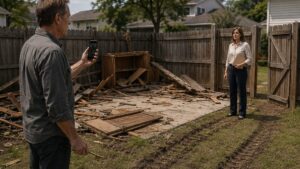
Susan stood on her side of the narrow strip between the houses with Raymond’s folder tucked under one arm and the morning’s damp still clinging to the cuffs of her jeans. The grass made a sucking sound beneath her shoes when she shifted her weight. On Nancy’s side, a shallow muddy depression ran from the downspout area toward the back corner, half-filled and poorly smoothed.
The green flag leaned over it like a warning no one wanted to read.
Gregory Williams crouched near the property line, tablet balanced on one knee. “Mr. Lee, I need the measurement from the foundation wall to the low point.”
“I gave you that in the estimate.”
“I need to verify it.”
Patrick’s jaw worked. “Then verify from the accessible side.”
Susan looked at him. “The accessible side meaning mine.”
“The side causing the issue,” Patrick said.
Nancy stood near her basement window well in a quilted vest, arms folded tightly. She looked less polished than she had that morning. A strand of hair had escaped near her cheek. For the first time, Susan saw the fear beneath the anger, the exhausted way Nancy kept glancing at the damp block wall as though the house itself might betray her again.
That did not make the bill true.
Gregory extended the tape. “Ms. Carter has requested a second opinion and a complete site note.”
“She can request whatever she wants,” Patrick said. “Water follows grade. Her grade pushes this way.”
Susan looked down the strip. “Then let the tape cross the flag.”
Patrick turned to her. “You’re not an engineer.”
“No. I’m the person you billed.”
Nancy stepped in. “Nobody billed you. We asked you to acknowledge responsibility.”
“For an estimate with my name beside the cause.”
“Because we can’t file properly without identifying the source.”
“Then identify it properly.”
The words came out sharper than Susan intended. John was not there to wince at them, but she heard him anyway: don’t make enemies.
Patrick pulled the tape back with a metallic snap. “I’m noting refusal to cooperate.”
“I’m standing right here,” Susan said.
“You’re refusing to accept the finding.”
“The finding you wrote before measuring from the trench.”
Patrick’s eyes flicked toward the flag.
There it was again. A fraction of a second. Not guilt exactly. Calculation.
Gregory saw it too, or perhaps Susan only hoped he did.
The civil standby officer from the morning waited near the sidewalk, arms relaxed but attention steady. Two neighbors had slowed their dog walk at the corner. Across the street, Barbara Campbell stood behind her storm door, one hand on the inside latch.
Susan caught Barbara’s eye.
Barbara looked down.
Nancy noticed the glance and turned. Barbara stepped back into the shadow of her entryway and let the storm door close.
Susan felt the old loneliness of neighborhood disputes settle around her shoulders. People saw things. People always saw things. But seeing was not the same as standing close enough to be named.
Gregory rose. “Ms. Anderson, did any drainage work occur here before last night’s storm?”
Nancy hesitated.
Patrick answered for her. “Routine maintenance.”
Gregory looked at him. “Date?”
“I’d have to check.”
Susan opened Raymond’s folder and pulled out the older photo with the clear green flag. The date stamp on this one was intact. She did not hand it over yet. She held it against the folder, face down, and felt the paper soften under her thumb.
Nancy’s gaze dropped to it. “What is that?”
“A photograph.”
“Of what?”
“Of a flag.”
Patrick gave a short impatient breath. “We all see the flag.”
“No,” Susan said. “You showed everyone a piece of the flag.”
She turned the photo over.
Gregory leaned in. Nancy did not move. Patrick’s expression flattened.
The photo showed the same green flag beside an open trench, but this image was wider. Nancy’s downspout elbow was visible, extended toward the depression. A pile of loose dirt sat beside it. There was no water flowing from Susan’s yard in the frame.
Gregory took the photo carefully. “What’s the date?”
“Three years ago,” Susan said. “But the flag location hasn’t changed.”
Patrick’s laugh was too quick. “Three-year-old photo doesn’t explain last night’s storm.”
“No,” Susan said. “But it explains why you cropped the flag.”
Nancy’s face colored. “That is an accusation.”
“So is an eighteen-thousand-dollar estimate.”
The words hung there, plain and unadorned.
Gregory handed the photo back. “I’m going to need copies of anything you submit. For now, I’ll note that additional documentation may exist.”
Patrick already had his clipboard up. “Homeowner provided irrelevant historical photo. Refused access to confirm current runoff source.”
Susan stared at him. “I did not refuse access.”
“You refused the finding.”
“That is not the same thing.”
Patrick wrote anyway.
Something inside Susan tightened. She had spent years thinking calm would protect her from being called difficult. Yet Patrick could write a sentence in twelve seconds that made her look uncooperative while she stood in wet grass trying to answer him.
Nancy moved closer to Gregory. “This is exactly what I mean. She turns every simple issue into an archive. Meanwhile I have water damage now.”
Gregory’s face remained neutral, but his thumb moved over the tablet. “The formal process can accept documents from both parties.”
“Documents do not dry out walls,” Nancy said.
“No,” Susan said. “But they can stop you from billing the wrong person for them.”
For a moment Nancy looked not angry, but cornered. Her eyes moved toward Patrick, and Susan saw the private exchange between them: not conspiracy, not exactly, but reliance. Nancy needed Patrick’s certainty to be real because she had built too much on top of it already.
Patrick bent and pressed the tape’s metal end into the mud near Susan’s side. “The slope is visible. The source is visible.”
Susan stepped closer and pointed at the green flag. “Then measure from there.”
“I said that area is not relevant.”
Gregory looked up. “Why not?”
Patrick’s answer came half a beat late. “Because that trench was corrected.”
Susan looked at the muddy depression, the slumped fill, the water shining in the low crease.
“Corrected when?”
Patrick clipped the tape shut. “I’d have to check my records.”
“Please do,” Susan said.
Nancy made a sound under her breath. “You always have to win.”
Susan turned toward her. “No. I have to not pay for what I didn’t do.”
The dog walkers moved on. The civil standby officer looked away, giving them the small privacy that public embarrassment sometimes pretends to offer.
Gregory closed his tablet. “I’ll file that a response is pending by five p.m. and that Ms. Carter disputes the source. Ms. Carter, if you want a second opinion, submit it quickly. The HOA is separate from the city process.”
Nancy’s mouth tightened again. “The board won’t wait forever.”
“You’ve given me until tonight,” Susan said.
“I didn’t give you anything. You ignored the first notice.”
Susan could have said she had been afraid. She could have said the certified slip had felt like Raymond’s ghost knocking from inside the mailbox. She could have said that keeping peace had become a habit so strong it looked, from the outside, like guilt.
She said none of it.
Instead, she closed Raymond’s folder and walked back toward her porch.
By the time she reached the front steps, Barbara’s storm door opened across the street. Not wide. Just enough for a hand to slip out and place something inside Susan’s mailbox after the others had turned toward Nancy’s basement window.
Susan waited until the side yard emptied.
Then she crossed to the mailbox.
Inside was a small folded note torn from lined stationery. The handwriting was careful, old-fashioned, and unsigned.
The trench was open before the storm.
Chapter 4: The Board Read Her Name Like A Verdict
Susan reached the HOA meeting room door in time to hear her own name spoken through the wall.
“The Carter runoff issue,” Nancy said, crisp and clear, “has already moved past neighborly discussion.”
Susan stopped with her hand on the knob.
Inside, chairs scraped. Someone coughed. Paper shifted in that official, restless way paper had when people were waiting to decide what it meant before the person named on it entered the room.
John stood beside her in the hallway, jaw set, one hand hovering near her elbow without touching. “We can still leave.”
Susan looked at the frosted glass panel. Her reflection was a pale shape over the HOA logo. The folder was tucked under her arm, the note from Barbara folded inside the front flap beside the old photo with the green flag.
“No,” she said.
She opened the door.
The room quieted too quickly.
Nancy stood near the head of the conference table with Patrick’s estimate clipped to a board packet. Three HOA board members sat in a row, their faces arranged into neutrality. Gregory Williams stood near the wall with his tablet under one arm, not part of the board but present enough to make the matter feel larger than neighborhood irritation.
Patrick sat near Nancy with his contractor clipboard on his knees.
A projector screen glowed behind them.
At the top of the slide were the words Drainage Liability Review: Carter Property.
Below them was Patrick’s cropped photograph of the muddy trench.
Susan felt John shift beside her. “They put it on a slide?”
Nancy turned. “Susan, I’m glad you came.”
The words were polite. The room around them was not.
Susan moved to the only empty chair at the far end of the table. It was not beside anyone. John stood behind her for a moment, then pulled out the chair next to her and sat down.
The board chair cleared his throat. “We were just summarizing the complaint.”
“I heard,” Susan said.
Nancy clicked to the next slide. There was the estimate again, enlarged enough that the number at the bottom seemed to lean out toward the room.
$18,740.
A murmur went through the chairs behind Susan. More neighbors than she expected had come. Some avoided her eyes. Some looked at her the way people looked at a fallen branch after a storm, wondering whether it had damaged anything of theirs.
Nancy gestured toward the screen. “The contractor’s assessment identifies water intrusion consistent with exterior runoff from the Carter side yard. Because the damage affects a neighboring structure and possibly shared drainage expectations under our covenants, the finance committee recommends immediate documentation before the insurance claim window narrows.”
“The contractor’s assessment,” Susan said, “was written by the contractor you hired.”
Patrick leaned forward. “My measurements are independent.”
“You refused to measure across the green flag.”
The board chair glanced at Nancy. “Green flag?”
Nancy’s smile tightened. “Susan has an old photograph she believes is relevant.”
“It is relevant,” Susan said.
John leaned close, whispering, “Careful.”
The whisper stung because he meant protect yourself, but in the room it sounded almost like sit down. Susan kept her eyes on the board.
Nancy clicked back to the cropped trench photo. “This is current damage. We cannot keep moving backward into old disputes every time action is required.”
Susan opened the folder but did not take anything out. “You are asking the board to move forward based on a cropped picture.”
“I’m asking the board to protect a homeowner from ongoing damage,” Nancy said. For a second, her composure cracked, and Susan saw her glance toward the printed estimate as if it were the only solid thing on the table. “My basement is wet. My wall is cracking. I have lived next to this property for years, and every time there is a drainage issue, I am told to wait while someone finds another map.”
That quieted the room more effectively than anger would have.
Susan felt it. Nancy’s fear was real enough to make the accusation sound reasonable.
Then Patrick tapped his clipboard. “Water doesn’t invent slope. The grade speaks for itself.”
“The grade did not hire you,” Susan said.
John’s hand moved under the table and touched her wrist. Not warning this time. A plea.
Nancy saw it. “Even your son understands this should not become personal.”
Susan’s face warmed.
The board chair adjusted his glasses. “Ms. Carter, do you have documentation tonight?”
“I have some,” Susan said. “Not all. I received the full demand this morning at my door.”
Nancy immediately said, “Notice was attempted last week.”
Susan looked at her. “And tonight, before I had a formal inspection, you put my name on a slide.”
The room shifted again. Someone behind Susan drew in a breath.
Gregory stepped forward slightly. “For clarity, the city has not issued a finding. The city has opened a preliminary inquiry based on the complaint and the contractor report.”
Nancy turned toward him. “But you did advise that written response is required.”
“I did.”
“When?”
“By five p.m. for the initial code file.”
“It’s now after six,” Patrick said.
Gregory checked his tablet. “Ms. Carter verbally disputed the source before the deadline.”
Nancy’s eyes narrowed. “Verbally.”
Susan slid Barbara’s note deeper into the folder with her thumb. She had not asked Barbara’s permission to use it. A note with no signature could make a frightened woman feel exposed without helping enough.
Instead, Susan pulled out the old photo of the green flag and placed it on the table.
Patrick’s cropped photo glowed on the screen. Susan’s wider photo lay below it.
The same green flag leaned in both.
The board chair leaned forward.
Susan said, “That flag was not on my gutter line.”
Patrick said, “Historical condition.”
“You wrote current source.”
Nancy’s hand tightened around the clicker. “Again, she is using old papers to avoid present responsibility.”
Susan looked up at the screen. There was her alleged guilt, enlarged and lit. The corner of the photo excluded the downspout. It excluded the trench line. It excluded almost everything except mud.
“May I have a copy of the full estimate packet?” she asked.
Nancy blinked. “You have the estimate.”
“The full packet. All photos. Notes. Measurements. Dates.”
Patrick closed his clipboard. “That’s proprietary work product.”
The board chair frowned. “If it’s being used as the basis for HOA action, she should have the packet.”
Nancy’s jaw flexed. “Fine.”
Patrick looked at her sharply, but she had already opened the board packet binder and removed several pages. She slid them down the table. They stopped halfway. John reached out and brought them to Susan.
There were four additional photos. Two were of Nancy’s basement. One showed the exterior foundation from a wider angle. The last showed a white downspout elbow at the edge of the frame, cut almost out but not fully.
Susan felt her pulse change.
The white elbow did not point toward her property. It turned toward the muddy depression near the green flag.
She did not smile. She did not look at Nancy. She placed the packet in her folder.
The board chair folded his hands. “Here is what we can do tonight. We will not assign financial responsibility through this board. But given the complaint and potential common drainage implications, we can vote to forward the matter for formal documentation unless Ms. Carter provides written proof within forty-eight hours.”
Nancy said, “Forty-eight hours is generous.”
Susan almost laughed at the word.
John whispered, “That gives us time.”
Us.
The small word reached her before she could stop it.
The vote passed with no drama. Three hands. One abstention. Nancy did not vote, though everyone knew which way her silence leaned.
Afterward, chairs scraped back. Neighbors avoided lingering near Susan. Patrick spoke quietly to Nancy, his body angled so Susan could not see his clipboard. John gathered the extra estimate pages and slipped them into the folder.
Gregory approached while Susan was still seated.
“I checked the preliminary city archive after this afternoon,” he said. “There is an older drainage complaint connected to this address.”
Susan looked up. “My address?”
“Connected to the side-yard drainage between both properties.” He hesitated. “It was filed under your husband’s name.”
The room emptied around them, but Susan stayed still.
John’s fingers tightened on the folder.
Gregory lowered his voice. “It was withdrawn before inspection.”
Susan looked down at the old photo, the green flag, the cropped estimate, the folder she had hidden under pantry towels.
“Withdrawn by whom?” she asked.
Gregory’s answer was careful.
“That is what you may want to find out.”
Chapter 5: The Cropped Photograph Left Out The Gutter
The records clerk slid the file across the counter with two fingers, as if the folder might object to being opened again.
“Withdrawn at owner request,” the clerk said.
Susan stared at the stamped line on the top page.
Beside her, John leaned close enough that his sleeve brushed hers. The municipal records office smelled of toner, old cardboard, and someone’s microwaved lunch. Behind the counter, drawers opened and closed with dull metallic claps. Ordinary sounds, Susan thought, for a place that kept buried arguments alive in beige folders.
“Owner request,” John said. “That means Dad withdrew it?”
The clerk adjusted her glasses. “That is what the form indicates. I can make copies of anything public in the file, but some handwritten notes may be internal.”
Susan touched the signature line.
Her husband’s name was there. His handwriting. The familiar slant of the first letter, the careful crossing of the final t.
For one weak second, she wanted to close the folder and let Nancy have the room, the street, the memory. She was tired of paper making demands on the living.
John saw her hand pause. “Mom?”
Susan opened the file.
The first page was a complaint form about redirected stormwater discharge from the Anderson property. The second was a rough drainage sketch. The third was a printed photo from years earlier, clearer than the one in her pantry folder.
Nancy’s downspout was visible in full.
It had been extended along the side of her house, angled toward the trench near the green survey flag.
Susan stopped breathing for a moment.
Patrick’s estimate photo had shown mud, water, and just enough of the flag to imply a source. The municipal photo showed what the crop had left out: the white gutter elbow, the trench line, and the way the water had been guided away from Nancy’s roof and toward the lowest shared strip.
John put Patrick’s full packet beside the municipal copy. “Same corner.”
“Yes.”
“But Patrick’s picture cuts off the gutter.”
“Yes.”
John looked at her. “That’s not a mistake.”
Susan did not answer too quickly. She had learned, painfully, that calling something intentional before proving it let the other person dismiss the whole truth as bitterness.
“Maybe not,” she said.
The clerk returned with a second file. “There’s also a permit inquiry attached to the parcel. No approved permit, but there was a denial note.”
“Whose parcel?” Susan asked.
“Anderson.”
The clerk turned the file around.
Patrick Lee’s company name appeared in the contractor field.
John’s mouth parted. “He worked on it then?”
Susan read the date. It was two years after the original complaint and before the storm photo in her folder. The permit request had been denied because the proposed drainage modification directed runoff toward the side setback without approved mitigation.
The denial language was dry. It had no outrage in it. That made it worse.
“What happened after the denial?” Susan asked.
The clerk looked through the file. “No approved revision here.”
John gave a short, humorless laugh. “So they just did something anyway.”
The clerk’s expression did not change. “I can’t say what work was performed. I can only provide records.”
Records. Always careful. Always less than what people needed until someone put them beside something else.
Susan requested copies. While the machine warmed, she stood near a bulletin board of city notices and looked down at her husband’s withdrawal form.
He had signed it after filing. No explanation. No attached note.
John’s voice was low beside her. “Why didn’t you know?”
“I knew there was an argument.”
“That’s not what I asked.”
Susan folded her hands around the edge of the folder. “Because I stopped asking.”
John looked at her then, and the disappointment in his face was not sharp. It was worse. It was adult, tired, and sad.
“He was drowning in this stuff,” she said. “Every rain, every board meeting, every note from Nancy. I thought if I refused to give it more air, it would end.”
“Did it?”
She looked at the copy machine flashing its green light.
“No.”
The clerk brought the copies back in a manila envelope. Susan paid the small fee in cash because using a card felt too much like leaving another trace in a dispute already made of traces.
Outside, John opened the passenger door for her, then did not start the car. He took out his phone and scrolled through old saved messages.
“What are you looking for?” Susan asked.
“Something I forgot I had.”
“You saved messages from then?”
“Dad sent me things sometimes. Mostly pictures of mud.” He grimaced faintly. “I didn’t always answer.”
Susan looked away. “He never said.”
“He wouldn’t.”
John tapped, listened, then frowned. “This isn’t from him.”
He put the phone on speaker.
Nancy’s voice came out thinner than it sounded in person, sharpened by age and recording quality.
“Raymond, if he files that, everyone pays. You know how the board gets. You know what it does to property values. I am asking you not to turn a manageable problem into a public record.”
Susan closed her eyes.
The message continued.
“I will handle my side. But if you push this through the city, I promise you, no one on this street will thank you.”
Then silence.
John stopped the recording.
Neither of them spoke.
A truck passed in the street, rattling the parked car slightly. Susan watched its reflection slide across the windshield and disappear.
“She didn’t say she caused it,” John said finally.
“No.”
“But she knew the record mattered.”
“Yes.”
He looked at the envelope in Susan’s lap. “Why would Dad withdraw it?”
Susan thought of the last summer before her husband’s heart failed. How he had sat at the kitchen table with his pen uncapped, listening to the phone ring and ring. How neighbors became polite at the mailbox but stopped asking him to neighborhood cookouts. How Susan had said, once, tired and frightened, Can you let one thing go before it takes the rest of you?
And he had.
For her.
The knowledge settled cold in her chest.
“I asked him to stop fighting,” Susan said.
John’s face changed. “Mom.”
“I didn’t ask him to sign that form. I didn’t even know there was a form. But I asked him to stop. And after he stopped, I put the folder away and told myself peace was the same as done.”
John looked down at the phone in his hand. “Nancy used that.”
“Maybe.”
“She’s using it now.”
Susan took the municipal photo from the envelope. The white gutter elbow was clear, almost bright against the mud. Beside it, the green survey flag marked the same spot Patrick had tried to crop into Susan’s guilt.
The old folder no longer felt like a box of grief.
It felt like something that had been waiting, not for revenge, but for the first person willing to place the pages in the right order.
Susan picked up Nancy’s recorded message again and listened only to the last line.
No one on this street will thank you.
John’s phone buzzed before she could hand it back. A new voicemail notification appeared under an unknown insurance number. Then another text from Nancy arrived on Susan’s phone.
Private settlement may still be possible before this becomes formal.
John read it over her shoulder.
Susan slipped the municipal copies into the folder, on top of Patrick’s cropped estimate.
“Before what becomes formal?” he asked.
Susan looked at the old voicemail on his screen, Nancy’s warning hanging between them.
“What she prevented before,” Susan said, “is exactly what she’s trying to prevent now.”
Chapter 6: The Same Crack Appeared In Two Different Years
The insurance adjuster did not ask whether Susan was angry.
He asked why Patrick Lee’s photograph of a “new structural crack” had an old inspection sticker visible in the corner of the basement frame.
Susan stood in Nancy Anderson’s basement with the municipal envelope under one arm, and for the first time since the officials had hurried up her front walk, the room tilted away from accusation and toward something closer to fact.
Nancy stood near the bottom step, arms folded across her sweater. Patrick was beside the damp wall, one hand resting on his clipboard, his face carefully blank.
The adjuster held two photos side by side on a tablet.
“This one was submitted with the current estimate,” he said. “This one appears in the prior inspection file Ms. Carter provided. Same wall, same lower corner, same crack line.”
Patrick leaned in. “Cracks can reopen.”
“They can,” the adjuster said. “But the current estimate describes initial crack formation after last night’s water intrusion.”
“That was based on visible conditions.”
Susan looked at the wall.
It was damaged. There was no pretending otherwise. The baseboard had bowed outward. A dark fan of moisture stained the block. The room smelled of wet drywall and the sour edge of panic. For a moment, despite everything, Susan understood Nancy’s desperation. A house could turn against you quietly, one seam at a time, and money could vanish before anyone admitted where the water began.
Nancy saw Susan looking and mistook it for doubt. “You see it. You can see what happened.”
“I see the damage,” Susan said.
“Then stop acting like I invented it.”
“I never said you invented the damage.”
Patrick’s pen paused over the clipboard.
Susan turned toward Nancy. “I said you blamed the wrong property.”
Nancy’s face tightened. “Because that’s what I was told.”
“By the man whose company appears on your denied drainage permit?”
The basement went still.
The adjuster lifted his eyes from the tablet. Gregory Williams, who had come at Susan’s request after receiving the municipal copies, stood near the utility sink with his tablet in hand. He did not speak, but his attention shifted to Patrick.
Patrick straightened. “Permit inquiry. Not permit.”
“Denied permit inquiry,” Susan said. “For a drainage modification directing runoff toward the side setback.”
Nancy looked at Patrick. “You said that old paperwork didn’t apply.”
“It doesn’t apply to this loss,” Patrick said quickly. “The issue today is active water pressure from her side.”
“Then why,” Gregory said, “did you not disclose prior drainage work in your estimate narrative?”
Patrick’s mouth opened, then closed.
Nancy stepped in before he could answer. “Because I asked him for a repair estimate, not a history lesson.”
Her voice cracked on the last word.
Susan looked at her then and saw how close Nancy was to unraveling. Not from guilt alone. From fear. From payments and deadlines and the terrifying arithmetic of a wet basement. The sharp blazer, the clipboard, the boardroom voice—those were braces around something shaking.
The adjuster lowered the tablet. “Ms. Anderson, I need a full timeline of any exterior drainage work completed in the last five years.”
Nancy looked at the floor.
Patrick said, “I can provide invoices.”
“Complete invoices,” Gregory said.
Patrick’s eyes narrowed. “City code isn’t party to the insurance claim.”
“No,” Gregory said. “But city code is party to the complaint you supported with this estimate.”
Susan heard the change in his tone. Not apology. Not yet. But procedure had shifted direction.
Nancy walked to the damp wall and pressed two fingers against the bowed baseboard. “Do you know what happens if this doesn’t close before my refinance review?”
No one answered.
She turned back, eyes bright but dry. “The bank sees an open claim. The rate changes. The repair sits. The HOA asks why I didn’t act. Everyone says document, document, document until the moment a person actually does, and then suddenly she’s aggressive.”
Susan said nothing.
Nancy looked at her. “I had to protect my house.”
“So did I.”
“You had folders. Photos. Notes.” Nancy’s voice sharpened again, defensive because softness had exposed too much. “You could have come to me years ago instead of letting your husband file complaints behind my back.”
Susan absorbed the hit. Her first instinct was to answer with the voicemail, to play Nancy’s old warning aloud in her own basement and watch her deny it in front of everyone.
Instead, Susan held the phone in her coat pocket and did not touch it.
“My husband withdrew that complaint,” she said. “I think he did it because I asked him to stop fighting.”
Nancy’s face flickered.
Susan continued, quieter. “That was my mistake. Not the drainage. Not your bill. My mistake was thinking silence would stay empty.”
The adjuster glanced between them, then returned to his tablet, giving the moment just enough room to pass.
A knock sounded from upstairs.
Nancy wiped her palms down her sweater. “Who is that?”
Gregory went up first. Susan heard the front door open, a low exchange, then slow footsteps overhead.
When Gregory returned, Barbara Campbell came down behind him, one hand gripping the rail. She wore a gray cardigan buttoned wrong at the bottom. Her eyes went to Nancy first, then to Susan, then to the green flag visible through the small basement window outside.
“I can’t stay,” Barbara said.
Nancy’s expression hardened. “Barbara, this is not a neighborhood meeting.”
“No,” Barbara said. “That’s why I came.”
Susan felt her heart begin to beat harder.
Barbara looked at the adjuster. “The trench was open before the storm. I saw Patrick’s men working there Monday afternoon. They had pipe out. The fill wasn’t finished when I brought my trash bins back in.”
Patrick said, “That’s not accurate.”
Barbara flinched but did not leave.
“I saw it,” she said, softer. “I didn’t want to get involved. Nancy helped block that rental application across the street last year, and I didn’t want problems with the board.” Her mouth tightened with shame. “But I saw it.”
Nancy stared at her. “You left a note.”
Barbara’s face reddened.
Susan did not look at Nancy. She looked at Barbara and nodded once. Not forgiveness. Not pressure. Just acknowledgment.
The adjuster made a note. “Ms. Campbell, would you be willing to provide a written statement?”
Barbara swallowed. “If it only says what I saw.”
“That is all it should say,” Susan said.
Patrick snapped his clipboard shut. “This is turning into speculation.”
“No,” the adjuster said. “This is turning into a timeline.”
He turned to Susan. “Ms. Carter, the documents you provided are enough to pause any subrogation toward your policy for now. To redirect the claim fully, I need a signed statement from you with copies of the municipal record, prior photos, and your account of the inspection refusal.”
Susan felt John’s absence then. He had wanted to be there, but she had told him no, not because she did not need him, but because she had needed to stand in the room without his fear speaking for her.
Gregory added, “A signed statement will also reopen the city archive. The old complaint will become part of the current file.”
Nancy looked up sharply. “That is unnecessary.”
Patrick said, “It’s prejudicial.”
The adjuster waited.
Susan understood the cost now. Once she signed, the old fight would no longer be folded under pantry towels. Her husband’s withdrawn complaint would be visible. Her own silence would be visible. Nancy’s pressure would be visible. So would Barbara’s fear, Patrick’s evasions, Gregory’s rushed first file, John’s worry, all of it laid out where neighbors could misread it forever.
But the alternative was signing their version of peace.
Susan took the municipal photo from her folder. The white gutter elbow, the green flag, the muddy trench. Then she took Patrick’s cropped estimate photo and placed it beside the older image on Nancy’s basement workbench.
The same crack marked the wall in two different years.
The same flag marked the ground before and after the accusation.
Susan did not feel triumphant. She felt tired, and steadier than tired.
“I’ll sign a statement,” she said.
Nancy turned away.
Later, in Susan’s kitchen, John stood over the table as she arranged copies into careful stacks. He had listened while she told him about Barbara, the adjuster, the crack, Nancy’s refinance, and the old complaint that would have to be reopened.
He did not tell her to stop.
He only said, “Once you sign, they can’t pretend this was a misunderstanding.”
Susan uncapped a pen.
“No,” she said, setting the first page in front of her. “I’m signing the truth, not their peace.”
Chapter 7: The Bill She Refused Became The Record
Nancy Anderson was waiting beside Susan’s mailbox before the next HOA meeting, holding a white envelope that had not been mailed.
Susan saw her from the front window and did not move at first. The brick walkway between them still carried faint muddy marks from the morning Gregory Williams had arrived with a complaint already forming on his tablet. The same walkway looked narrower now, less like an entrance and more like a line people crossed when they wanted something from her.
John stood behind her in the foyer. “Do you want me to answer?”
Susan shook her head. “No.”
She opened the door before Nancy could ring.
Nancy looked different without a clipboard. Her blazer was still pressed, her hair still neat, but there was a drawn tightness under her eyes that made her look less like a woman prepared for a meeting and more like someone who had spent two nights counting expenses against a clock.
“I thought we could resolve this privately,” Nancy said.
Susan looked at the envelope.
“It’s a no-fault contribution,” Nancy said quickly. “Not an admission. Just enough to show cooperation. I can withdraw the board item as a neighbor dispute, and you don’t have to put Raymond’s old complaint into the public packet.”
John stepped closer inside the doorway. “How much?”
Nancy’s eyes flicked toward him. “Five thousand.”
Susan did not take the envelope.
Nancy pressed on. “Less than your deductible would become if insurance starts naming parties. Less than a lawyer. Less than dragging this through every file in the city.”
“I’m not naming myself as partly responsible for damage I didn’t cause.”
“It says no fault.”
“It says contribution.”
Nancy’s mouth tightened. “Susan, I am trying to save both of us embarrassment.”
“No,” Susan said. “You are trying to save the version where the blame is shared.”
For a moment Nancy’s face hardened into the one Susan knew: boardroom Nancy, porch Nancy, the woman who could turn a meeting agenda into a verdict. Then it broke, just slightly.
“My house is damaged,” she said. “I did what people tell you to do. I called a contractor. I called insurance. I documented. I protected myself.”
“You protected yourself by putting my name where the cause should have been.”
Nancy looked past Susan into the foyer, where Raymond’s folder sat on the hall table in a new blue binder John had bought the night before. Copies tabbed in yellow and green stuck from the edges. The old brown folder lay inside the binder like an organ transplanted into something that could survive public handling.
“If you submit all of that,” Nancy said, “they will come after Patrick. They will look at my permits. They will make it look like I hid something.”
Susan held her gaze. “Did you?”
Nancy drew back as if slapped, though Susan’s voice had not risen.
“I trusted the person I hired,” Nancy said.
“And then you used his estimate against me before anyone checked it.”
The envelope trembled once in Nancy’s hand. She lowered it.
From the curb, Gregory Williams’s city vehicle slowed, then parked behind Nancy’s car. He stepped out carrying a slim folder. He did not hurry this time. He walked like a man arriving to correct something he wished he had read more carefully the first time.
Nancy saw him and folded the envelope in half.
Susan picked up the blue binder from the hall table.
At the meeting room that evening, the projector was already on, but the slide no longer said Drainage Liability Review: Carter Property. It said Drainage File Correction. The change was small and enormous.
Patrick Lee sat at the far side of the table, his clipboard closed. He did not look at Susan when she entered. Nancy took her usual place near the front but did not stand.
The board chair cleared his throat. “We have received supplementary documentation from Ms. Carter, the city, and the insurance adjuster. We will not be proceeding with any HOA referral assigning responsibility to the Carter property.”
No one applauded. No one gasped. The neighbors who had come sat very still, as if stillness could excuse how eagerly they had listened the first time.
Gregory stepped forward. “The city’s preliminary complaint is being corrected. Based on the submitted records, including prior drainage filings, photographs, and current inspection notes, responsibility for the reported water intrusion is unsubstantiated as to the Carter property.”
He placed a stamped copy on the table.
Withdrawn / responsibility unsubstantiated.
Susan looked at the stamp, then at the old estimate beneath it. The same paper that had arrived like a weapon now looked strangely ordinary, flattened by copies, dates, and the dull blue bite of official ink.
Patrick’s voice broke the silence. “That doesn’t determine contractor liability.”
Gregory turned toward him. “No. It determines that the city complaint should not have identified Ms. Carter’s property as the source based on the materials provided.”
The insurance adjuster, present by phone on a small speaker, added, “The claim is being redirected for further review of exterior drainage work performed on the Anderson property. No subrogation will proceed against Ms. Carter’s homeowner policy at this time.”
John exhaled beside Susan. She had not realized he had been holding his breath until he let it go.
The board chair looked at Nancy. “The prior agenda item will be closed.”
Nancy’s hands were folded on the table. The skin over her knuckles was pale.
She did not look at Susan when she said, “I still have a damaged basement.”
Susan’s chest tightened. The words were true, and because they were true, they were not easy to hate.
“Yes,” Susan said.
Nancy finally turned. “I had to protect my house.”
The room waited, hungry for either apology or fight.
Susan gave them neither.
“So did I,” she said.
Nancy’s eyes shone, but she blinked it away. “You could have come to me before making it official.”
Susan touched the blue binder. “I did come to you. At my own door, when you handed me a bill and asked me to sign a cause you had not proved.”
Nancy looked down.
Patrick stood abruptly. “I’ll wait for the formal carrier review.”
He left without another word, taking his closed clipboard with him. The door clicked behind him softer than Susan expected. A man could walk out quietly and still leave behind damage.
Gregory slid the corrected complaint copy toward Susan. “Ms. Carter, this is yours.”
She took it.
The paper felt no different from the estimate. That surprised her. She had expected vindication to have weight, warmth, some physical quality she could recognize. Instead, it was just another sheet she would have to keep.
John touched her shoulder. “You okay?”
Susan looked around the room. Barbara Campbell sat in the last row, her cardigan buttoned correctly this time, her eyes lowered to her hands. When she noticed Susan looking, she gave the smallest nod.
Susan nodded back.
“I am,” Susan said, and found it was almost true.
Later, after the meeting emptied in uncomfortable fragments, Gregory stopped beside her near the door.
“I should have asked for the full packet before I came to your house,” he said.
Susan looked at him. “Yes.”
He accepted it with a small nod. “I corrected the file.”
“Good.”
It was not forgiveness, but it was enough for a public hallway.
John carried the binder to the car, but Susan asked him to wait while she walked home alone. He resisted, then saw something in her face and handed her the corrected copy instead.
The brick house was dark except for the porch light. The walkway was dry now. No officials. No clipboard. No one waiting with a bill.
Susan unlocked the door and set the stamped estimate on the hall table. For a while, she stood there with one hand resting on the blue binder and the other on the old brown folder inside it.
Raymond had kept records because he feared the truth would be rewritten.
Susan had hidden them because she feared what fighting would cost.
Both fears had been right. Neither had been enough.
The doorbell rang.
She opened it slowly.
No one stood on the porch. At first she saw only the empty walk, the quiet street, Nancy’s house with one basement light still on.
Then she looked down.
A folded note lay on the mat, weighted by a small clean stone.
Susan picked it up and opened it under the porch light.
Barbara’s handwriting was neater than before.
I should have said it sooner.
Susan read it twice.
Across the street, Barbara’s curtain shifted. Susan did not wave. She only held the note a moment longer, then placed it inside the blue binder with the estimate, the photographs, the municipal record, and the corrected complaint.
After that, she closed the door, not against the neighborhood, but against the lie that peace meant leaving the truth outside.
The story has ended.