The HOA Said His Old Blue Car Had to Go Before They Heard It Run
Chapter 1: The Notice on the Windshield Before the Engine Could Speak
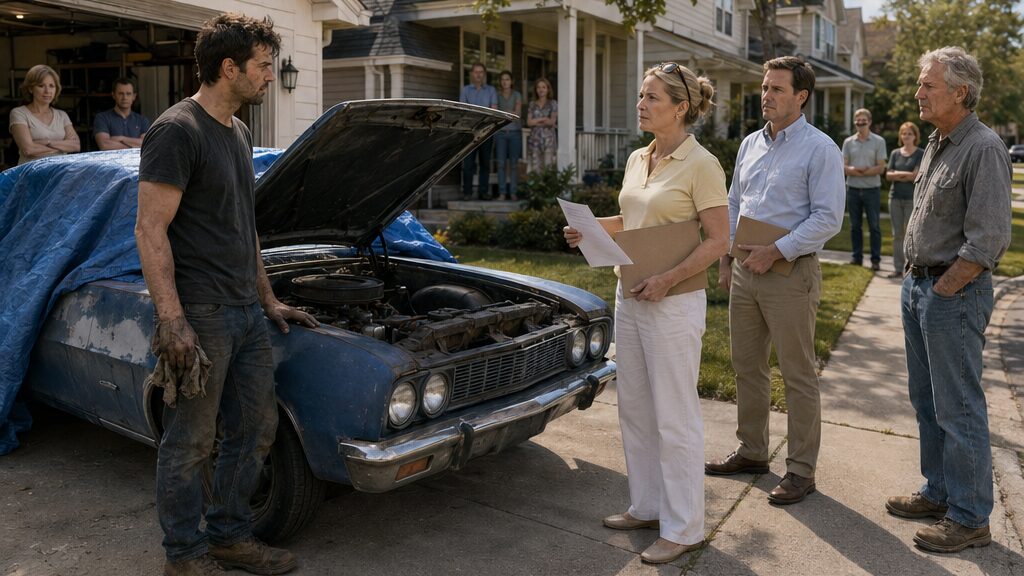
Carol Johnson pressed the orange violation notice flat against the old blue windshield before Ryan Miller could get out from under the hood.
The tape made a sharp ripping sound in the quiet Monday morning street. Ryan heard it over the faint click of cooling metal, over the small clatter of the wrench he had left balanced against the fender. He looked up from the engine bay with grease across his knuckles and saw Carol smoothing the paper as if she were posting a public warning on a condemned building.
“Morning, Ryan,” she said, though nothing in her voice made it sound like a greeting.
He wiped one hand on the side of his jeans. “You could’ve knocked.”
“I did.” Carol stepped back and adjusted the sunglasses pushed up on her head. She wore a pale yellow polo tucked into white pants, clean enough to make the driveway look worse around her. “You didn’t answer.”
“I was in the garage.”
“Yes. With this.” She tapped the notice with one manicured nail. “Again.”
The old car sat nose-out in the driveway, its paint faded into a tired blue that still showed deeper color where the trim had protected it. The hood was raised. A blue tarp was folded over the roof and rear window, pulled back because Ryan had been working since six. To anyone passing too fast, it probably did look like a stalled project. Maybe even junk.
Ryan knew that. He hated that he knew that.
“It’s not abandoned,” he said.
Carol glanced into the open hood, then at the cardboard oil box near the front tire, then at the socket set laid open on the concrete. “It has been in visible disrepair for weeks.”
“Because I’m repairing it.”
“The association rules are clear. Vehicles in driveways must be operable, registered, and presentable. This one fails at least two of those.”
“It’s registered.”
“Operable?” Carol asked.
Ryan looked down into the engine bay. The silence under the hood seemed to grow teeth.
“I’m almost done,” he said.
Carol gave him the kind of patient smile people used when they had already decided patience was wasted. “Almost done is not a compliance category.”
Across the street, a neighbor paused at the end of his driveway with a trash bin. Two doors down, a child with a backpack slowed beside his mother. Ryan felt the street noticing them, one porch and window at a time. He kept his hand on the fender because he needed somewhere to put the anger.
Carol turned the notice toward him. “You have until Friday to remove it from public view or restore it to compliance.”
“It’s my driveway.”
“It is a driveway within an association-governed property.”
“It’s my father’s car,” Ryan said before he meant to.
Carol’s expression shifted, but only slightly. Not softened. Recalculated. “I understand sentimental attachment. That doesn’t override neighborhood standards.”
The word sentimental landed wrong. Too small. Too neat. Ryan felt his hand tighten around the fender lip. The metal was warm from the sun, and a flake of old blue paint came away under his thumb.
“It’s not junk,” he said.
Carol glanced at the engine again. “Then start it.”
The street went too quiet.
Ryan’s throat closed around the first answer that came up. Not yet. Not with the timing still off. Not with the battery acting weak. Not with half the neighborhood watching like the car had been dragged out for inspection. He could have explained the fuel line, the wiring, the part that had arrived late, the two nights he had spent tracing a bad ground. He could have shown receipts, photos, the rebuilt carburetor, the new plugs.
Instead he said, “I told you. I’m almost done.”
Carol crossed her arms. “Done what?”
The question hung between them, simple and sharp. Ryan stared at her, then past her, toward the clean lawns and matching mailboxes and the houses that all seemed to face his driveway at once.
“Restoring it,” he said.
Carol let out a quiet breath through her nose. Not quite a laugh, but near enough. “Ryan, restoration does not mean leaving a covered vehicle in a driveway indefinitely while everyone else follows the rules.”
“It hasn’t been indefinite.”
“It has been six weeks since the first complaint.”
“Six weeks isn’t—”
“It is long enough,” she cut in, her voice still calm, which somehow made it worse. “And I’m not the only person hearing about it.”
The neighbor with the trash bin suddenly found a reason to wheel it up the driveway slower than necessary. Ryan saw him watching from the corner of his eye.
Carol lowered her voice a notch. “You’re not being singled out. The association has had multiple complaints about visible repairs, parts boxes, staining, and the tarp. We let it go because people said you were dealing with family matters. But at some point, Ryan, consideration becomes unfair to everyone else.”
Family matters. That was what people called death when they did not want to touch it directly.
Ryan shut the hood halfway, then stopped himself. Closing it felt like admitting something. Leaving it open felt like being exposed.
“I’ll move the parts boxes,” he said.
“The car has to go.”
“No.”
Carol’s eyebrows lifted.
Ryan heard how the word sounded: flat, too hard, too final. He had spent months avoiding conversations, using short answers like walls. It had worked with neighbors who only waved from a distance. It did not work with a woman holding a clipboard and a deadline.
Carol slipped a second sheet from the folder under her arm. “This is the formal notice. The fine begins Wednesday. If there is no correction by Friday morning, the board can authorize removal.”
“Removal.”
“A tow company.”
Ryan looked at the old blue car. His father used to slap the roof twice before opening the driver’s door. Habit, superstition, affection—Ryan never knew. He had caught himself doing it last week and had stood in the driveway with his palm on the roof until the porch light clicked off.
“You can’t tow a car off my driveway because you don’t like looking at it,” he said.
Carol’s face tightened. “I don’t enjoy this.”
“You look pretty comfortable.”
The words came out before he could sand them down. Carol’s mouth pressed thin. For the first time, something personal flashed behind her eyes.
“I am comfortable enforcing rules people agreed to when they moved here,” she said. “Including your father.”
Ryan said nothing.
That name, even unnamed, changed the air. Carol must have sensed it because she straightened the edge of the paper one last time and stepped back from the windshield.
“I suggest you take the next few days seriously.”
He looked at the notice taped to the glass. The paper covered the spot where his father had once stuck a faded parking pass from an auto show. Ryan had peeled it off after the funeral because the adhesive had gone brown and brittle. He regretted that now.
Carol turned toward the sidewalk. The neighbor with the trash bin looked away too late. A woman across the street pulled her curtains back into place. The street resumed itself in small guilty motions.
Ryan waited until Carol reached the end of the driveway.
“It’ll run,” he said.
She paused without turning fully around. “Then make it run somewhere it isn’t violating the bylaws.”
He wanted to tell her the carburetor was rebuilt. That the fuel pump was new. That the red paint underneath the primer was going to shine again when he was finished. That the car had not been left to rot; it had been held together by every hour he had not known what else to do with.
Instead he watched her walk away.
A minute later, he peeled one corner of the notice off the windshield, but the tape held. The paper tore slightly and left a white scar across the glass. Ryan stopped pulling. His reflection stared back at him through the notice: tired eyes, dark hair flattened with sweat, jaw set like stubbornness could solve timing and grief.
He leaned into the car and turned the key.
The starter clicked once.
Nothing else answered.
Ryan closed his eyes, waited, then tried again. Another click. No rumble. No cough. No sign of life strong enough to throw back at Carol Johnson or anyone else on the street.
His phone buzzed on the workbench inside the garage. He ignored it until it buzzed again, then again. When he checked, the message was from the HOA portal.
Formal violation logged. Corrective deadline: Friday, 8:00 a.m.
Under it, a second message appeared before the screen dimmed.
Carol Johnson had added a note: Tow company available Friday morning if noncompliance remains.
Ryan stood in the garage doorway with the phone in his hand and the silent car behind him, realizing the deadline was no longer just a threat spoken in the driveway.
It had a time now.
Chapter 2: The Blue Tarp Everyone Treated Like Proof of Neglect
Maria Flores found the fine notice under a magnet shaped like a tiny red pickup, and Ryan knew from her silence that she had read the amount twice.
He was at the kitchen sink scrubbing grease from under his nails with dish soap when she lifted the paper from the refrigerator. The late sun came through the blinds in thin bars, striping the counter, the unpaid utility bill, and the cardboard box of house-sale documents she had brought over three Sundays in a row.
“Ryan,” she said.
He kept scrubbing. “I was going to tell you.”
“No, you weren’t.”
The water ran gray over his fingers.
Maria turned the notice toward him as if he had never seen it. “A daily fine starting Wednesday? And a tow review Friday morning?”
“It’s handled.”
She laughed once, without humor. “That’s what you said about the gutters. That’s what you said about the estate paperwork. That’s what you said about the realtor.”
He turned off the faucet. The quiet after the water felt too full.
“It’s a car,” he said.
“It’s not just a car. That’s the problem.” Maria set the notice on the counter and pressed her palm over it. She was still in work clothes, blouse sleeves rolled to her elbows, hair clipped back in a way that meant she had come directly from somewhere else and had already decided not to stay long. “You have fines starting in two days, a board that wants proof, and a house we still haven’t listed because you keep saying you need one more weekend.”
Ryan dried his hands slowly. “I do need one more weekend.”
“You’ve needed one more weekend since April.”
He looked toward the garage door. Through the small kitchen window he could see the blue tarp draped over the rear half of the car. From inside, it looked protective. From the street, he knew, it looked like surrender.
Maria followed his gaze.
“When Dad bought that thing, Mom said it would outlive all of us out of spite,” she said, softer now.
Ryan almost smiled. Almost.
“He said it just needed someone who listened.”
“He said that about everything with a motor.”
“Because he was usually right.”
Maria’s face shifted at the edge of memory, then closed again. “And now he’s not here, Ryan.”
He folded the towel over the sink divider. “I know that.”
“Do you?”
The question hit harder because she did not raise her voice.
Ryan walked into the garage before he answered. Maria followed him, the paper still in her hand. The garage smelled like fuel, old cardboard, metal filings, and the faint damp scent of the tarp. Tools lined the workbench in careful rows. New parts sat beside labeled bags of old bolts. Nothing about it was careless. Nothing about it looked abandoned to anyone who understood work in progress.
Maria stood beside the front fender and looked at the car. “It still looks bad from the street.”
“It won’t when it’s done.”
“That’s not the point.”
“It’s exactly the point.”
“No, the point is you’re risking more money we don’t have because you won’t move it into storage.”
“I can’t work on it in storage.”
“You barely sleep working on it here.”
Ryan reached into the open passenger window and pulled a folded rag from the seat. Under the rag was an old photo, curled at the edges: his father leaning against the car when it still wore glossy red paint, one hand on the roof, grinning at someone outside the frame. Ryan moved quickly, too quickly, and slid the photo under a service manual before Maria could see.
She saw anyway.
“What was that?”
“Nothing.”
“Ryan.”
“It’s just an old picture.”
“Then why hide it?”
He tossed the rag onto the bench. “Because you look at everything like evidence.”
Maria flinched.
The regret came instantly, hot and useless. He wanted to take it back, but apology had never been easy in their family. Their father apologized by fixing things. Maria apologized by bringing food. Ryan apologized by showing up the next day and pretending the worst sentence had not been said.
Maria folded the notice once, then again. “I look at things because somebody has to. Dad left a house, a car, bills, boxes, and you standing in the middle of all of it saying you’re almost done.”
He looked down at the engine bay. “Carol asked me the same thing.”
“What?”
“Done what.”
Maria’s eyes softened for half a second. “And what did you say?”
“That I’m restoring it.”
“Is that all you’re doing?”
Ryan reached for a wrench he did not need. “What else would I be doing?”
“Keeping him here.”
The garage seemed to lose air.
Outside, a car rolled slowly down the street. Tires hissed against pavement. Ryan waited until it passed.
Maria stepped closer to the open hood. “You know I loved him too, right?”
He kept his eyes on the engine. “I didn’t say you didn’t.”
“You act like selling the house means I’m throwing him away.”
“You keep talking about buyers.”
“Because bills do not stop for grief.” She looked around the garage, at the labeled bags, the parts boxes, the tarp folded with more care than some people gave blankets. “And because this place is eating you.”
Ryan’s hand tightened around the wrench.
Maria saw it. Her voice dropped. “I’m not your enemy.”
“No. You just sound like the HOA now.”
The words landed worse than the first ones. Maria stared at him for a moment, then nodded as if some private calculation had finished.
“Fine,” she said. “Then I’ll be practical.”
“Maria—”
“If the car is worth something, we can sell it to someone who’ll finish it. There are buyers for classics even in rough shape. I know a local mechanic who can look at it, or I can call around.”
“No.”
“You don’t get to just say no forever.”
“It’s not yours to sell.”
Her face went still. “Half the estate is mine.”
Ryan knew it. The sentence had been sitting between them for months, avoided because neither of them wanted to see what it made them. He looked at the car, then at his sister, and felt the old defensive wall rising even though part of him knew she was tired too.
“I’ll have it running by Friday,” he said.
“That’s not a plan. That’s a wish with grease on it.”
He turned away and lifted the battery tester from the bench. “Then let me work.”
Maria stood there long enough that he thought she might argue again. Instead she set the folded notice on the workbench beside the hidden photo.
“When it costs more than the car, don’t tell me nobody warned you.”
She left through the kitchen. The front door closed a minute later with controlled softness, which was worse than a slam.
Ryan waited until the house settled. Then he pulled the photo from under the manual and set it on the fender. His father’s grin stared up at him from a year when the car had still been red and Ryan had still been young enough to believe time could be postponed if you kept promising later.
He slid into the driver’s seat. The vinyl was cracked but familiar. He turned the key.
The starter gave one weak click.
Ryan frowned, leaned forward, and tried again. The dash lights dimmed almost to nothing. He got out, connected the tester, and watched the needle drop into the red.
The battery would not hold a charge.
For the first time since Carol taped the notice to the windshield, Ryan felt the deadline move from outside the car to inside his chest.
Chapter 3: The Saturday Walkthrough When the Street Went Quiet
By the time Ryan lifted the garage door Saturday morning, three neighbors were already pretending not to wait.
One stood by a mailbox with a coffee mug. Another bent over a flower bed that had not needed that much attention in years. Two children sat on the curb with their bikes tipped beside them, whispering until their mother called them back toward the porch. Across the street, Thomas Brown watched from the shade of his open garage, arms folded, expression unreadable.
Ryan had slept four hours since Thursday.
The new battery held. The fuel line was tight. The timing was close enough that he could feel possibility in the key before he touched it. He had worked under a shop light until moths circled the hood and his eyes burned. He had not called Maria. He had not answered the HOA portal. He had not removed the notice from the windshield either. The torn corner still lifted in the morning breeze.
The garage door rattled fully open.
The blue car sat half-covered, the tarp pulled back from the hood and windshield like something waking under protest. It did not look beautiful. Not yet. Primer marked one quarter panel. Chrome trim lay on a blanket along the garage wall. But the engine bay was clean. The hoses were new. The carburetor sat rebuilt and bright against everything older around it.
Carol Johnson arrived at nine exactly.
She was not alone.
Michael Davis walked beside her with a folder under one arm and the tense look of a man who had agreed to something procedural and now regretted its shape. Two HOA board members followed at a careful distance. Carol carried a printed packet clipped neatly at the corner.
“Good morning, Ryan,” Michael said.
Ryan nodded once. “Michael.”
Carol’s gaze moved from the car to the parts boxes Ryan had stacked inside the garage, then to the tarp. “You were advised to remove the vehicle from public view.”
“I was advised to restore it to compliance,” Ryan said.
Carol opened the packet. “That would require the vehicle to be operable and presentable.”
“It’s operable.”
The neighbor with the coffee mug stopped pretending to drink.
Carol looked at him over the paper. “Then this should be simple.”
Ryan felt every window on the street. He had wanted this moment when he was angry. Wanted Carol standing there while the engine caught, wanted the sound to shut down every assumption she had carried onto his driveway. But wanting an audience and standing in front of one were different things.
Michael cleared his throat. “We’re not here to embarrass anyone. This is a compliance walkthrough. If you can demonstrate meaningful progress, the board can consider an extension.”
Carol turned a page. “The reported violation includes visible disrepair, driveway mechanical work, fluid staining, exposed parts, and an inoperable vehicle. Additional complaints mention noise before seven a.m., odor, and decline in curb appeal.”
Ryan’s jaw tightened. “Noise before seven?”
Carol did not look up. “A resident reported repeated tool use.”
“I used a hand wrench.”
“Repeatedly.”
A small laugh came from somewhere near the sidewalk, quickly swallowed.
Ryan looked toward Thomas. The older man had stepped closer now, stopping at the edge of his own driveway. He did not speak, but his eyes were on the engine, not the tarp. That mattered more than Ryan wanted it to.
Carol continued, her voice carrying farther than necessary. “As compliance chair, I am documenting that the vehicle remains under repair in open view after notice. Unless corrected, emergency removal remains available to the board.”
Ryan took the rag from his back pocket and wiped his hands, though they were already clean enough. “You done reading?”
Michael said quietly, “Ryan.”
“No, it’s fine.” Ryan stepped to the driver’s side. “Everybody came to see if it’s junk.”
Carol’s mouth tightened. “No one used that word in the formal notice.”
“You used it Monday.”
“I said it appeared neglected.”
“You said junk.”
The street held still around them.
For a moment Carol looked less certain, not guilty exactly, but aware that too many people were listening for her to fully deny it. Then she straightened. “Start the vehicle, Ryan.”
His pulse moved into his fingertips.
He slid into the driver’s seat. The old interior smelled like vinyl, dust, and the faint gasoline trace that had lived in the car longer than he had owned the house. The notice on the windshield blocked part of his view. He reached up and tore it free. Tape squealed. A strip of paper remained stuck to the glass.
He set the notice on the passenger seat.
His father’s seat.
Ryan paused.
From outside, Carol said, “Is there a problem?”
He closed his hand around the key.
Not now, he told the car. Not in front of her. Not in front of everyone.
He turned it.
The starter cranked.
Once. Twice.
The engine coughed, rough and low, then died.
Someone on the sidewalk shifted. One of the children whispered, “It made noise.”
Ryan waited three seconds, adjusted the choke, and tried again.
The engine caught.
The sound rolled out of the garage like something heavy clearing its throat after years of silence. It was not smooth. It shook the hood, rattled a loose bracket, and sent a tremor through the steering wheel into Ryan’s palms. But it was alive. Deep, uneven, unmistakably alive.
For two seconds, no one spoke.
Ryan looked through the windshield and saw Carol’s expression change before she controlled it. Saw Michael lift his head. Saw Thomas Brown take one step forward, eyes narrowing with professional interest.
The engine rumbled again, stronger.
A smile almost broke across Ryan’s face.
Then it stumbled.
He felt it before the others heard it: a skip in the rhythm, a sag, a hungry drop where the sound should have held. He reached for the throttle, feathered it carefully, but the engine knocked once and went dead.
The silence after it was brutal.
Ryan kept his hand on the key. His chest felt hollow, as if the car had taken something from him when it stopped.
Carol closed her packet.
Michael spoke first. “That’s significant progress.”
Carol gave him a sideways look. “It stalled.”
“It started,” Michael said.
“It stalled.”
Ryan got out slowly. “The timing needs adjustment.”
Carol’s composure had returned. “So the vehicle is not reliably operable.”
“It ran.”
“For a few seconds.”
Thomas crossed the street then, not fast, not dramatic. He stopped near the front fender and looked into the engine bay. “That’s not a dead car.”
Carol turned to him. “Thomas, this is an official walkthrough.”
“I owned a body shop for thirty-two years. I know dead when I see it.” He pointed toward the engine without touching anything. “He’s close.”
The words should have helped. They did help, somewhere under the humiliation. But Ryan could not pull his eyes from the dash, from the key still hanging where his hand had left it, from the passenger seat where the torn notice lay like an accusation.
Carol lowered her voice, but not enough. “Close does not mean compliant.”
Thomas looked at Ryan. “You want a hand with timing later?”
Ryan almost said no. The old reflex came up hard. My car. My problem. My promise.
But the engine’s failed rumble still seemed to hang in the driveway, proof and failure mixed together.
“I’ll let you know,” Ryan said.
Thomas nodded, accepting the half-answer with more grace than it deserved.
Michael closed his folder. “I’ll note that the vehicle started during inspection. The board can discuss whether—”
Carol interrupted. “The emergency removal clause still applies if the vehicle remains visibly inoperable or creates ongoing complaints. I’ll file the supplemental report today.”
Ryan looked at her. “You saw it start.”
“I saw it fail to remain running.”
Something in him went quiet then. Not calm. Not beaten. Just contained in a way that frightened him a little.
“You were never here to see it run,” he said. “You were here to watch it fail.”
Carol’s face flushed. “I’m here to enforce the rules.”
“No,” Ryan said. “You’re here to be right.”
Michael stepped between the words before they sharpened further. “Enough. We’ll review it.”
The neighbors began to scatter, not wanting to be caught openly witnessing the aftermath. The children pushed their bikes away. Thomas lingered a moment, then returned to his side of the street.
Carol and the board members walked off together. Michael stayed behind long enough to meet Ryan’s eyes.
“Send me receipts,” he said quietly. “Photos. Anything that shows active restoration.”
Ryan looked toward the torn notice on the passenger seat.
“I shouldn’t have to prove grief comes with paperwork,” he said.
Michael’s expression changed, but Ryan had already turned away.
By noon, the HOA portal sent another notification.
Supplemental violation report filed. Emergency tow review requested.
Ryan read it twice while standing beside the silent car, the smell of brief combustion still fading from the garage.
Carol had heard the engine.
She had filed anyway.
Chapter 4: The Hearing Where Almost Done Was Not Enough
Ryan saw the words “abandoned property” before he found his own name.
They were printed in bold on the agenda taped to the clubhouse door Tuesday night, tucked between Pool Gate Repair and Landscaping Bid Review as if his father’s car were a broken latch or a dead shrub. He stood on the concrete step while people moved past him into the room, carrying water bottles, folders, and the small confidence of neighbors arriving to discuss someone else’s problem.
Abandoned property.
Ryan read it again until the letters lost shape.
Inside, the clubhouse smelled like carpet cleaner and burnt coffee. Folding chairs faced a long table where Michael Davis sat in the center with a binder open in front of him. Carol Johnson sat two chairs down, her packet arranged neatly, a pen lined parallel to the edge of the table. She did not look surprised to see Ryan. She looked prepared.
Thomas Brown sat near the back wall, arms crossed, work boots planted apart. Ryan noticed him only after taking the last chair in the front row. The older man gave him a small nod.
Ryan almost nodded back. His neck would not move.
Michael tapped the microphone, winced at the squeal, and leaned away. “We’ll keep this brief. Item four, compliance review for Lot 38, visible vehicle violation.”
Carol lifted her packet before Michael finished.
Ryan’s phone was heavy in his pocket. On it, he had a seven-second recording of the engine catching Saturday morning. He had watched the clip too many times, listening for proof inside failure. The rumble was there. Rough, brief, but there. The car had breathed.
Carol began with photographs.
The first showed the blue car under the tarp, taken from the sidewalk. The tarp looked worse in the picture than it did in real life, wrinkled and sagging over the rear window. The second showed a cardboard box of parts by the garage. The third showed a dark spot on the driveway from before Ryan had replaced the oil pan gasket.
“These were taken over a period of six weeks,” Carol said. “The issue is not one bad morning. It is ongoing visible disrepair.”
Ryan leaned forward. “Half those parts are installed now.”
Michael glanced at him. “You’ll have a chance to respond.”
Carol moved to another sheet. “We also received written complaints from residents. I’ll read only the relevant portions.”
Ryan looked down at his hands.
“‘The vehicle has created a neglected appearance at the entrance side of the cul-de-sac.’” Carol paused. “‘The owner works on it at unreasonable hours.’ Another says, ‘This sets a poor precedent if everyone can keep non-running vehicles in view and call it a project.’”
A board member murmured something to Michael. Michael wrote it down.
Carol turned the page. “And after Saturday’s inspection, the vehicle started briefly but failed to remain running. In my opinion, that confirms noncompliance.”
“That confirms it’s being repaired,” Ryan said.
Michael raised a hand. “Ryan.”
“No, she watched it start and wrote it up like it didn’t.”
Carol kept her eyes on Michael, not Ryan. “It is not the board’s role to evaluate mechanical potential. We evaluate present compliance.”
Mechanical potential. Ryan almost laughed. The phrase was so clean it erased every torn knuckle, every late-night search for parts, every second spent listening for what the engine wanted.
Michael folded his hands. “Ryan, do you have documentation of active repair? Receipts, registration, insurance, photographs?”
“I have registration.”
“Current?”
“Yes.”
“Insurance?”
Ryan hesitated. “Storage coverage.”
Carol’s pen moved.
Michael noticed. “That doesn’t automatically disqualify it, but the operating status matters.”
Ryan pulled out his phone. His thumb hovered over the recording. He could play it. Let the room hear the engine. Let them sit in that rough little miracle and decide whether abandoned things made sounds like that.
Instead he opened his photos and showed the rebuilt carburetor, the new fuel line, the labeled wiring, the receipts from the parts counter. Michael took the phone, scrolled carefully, and passed it to the board member beside him.
“This is more substantial than I understood,” Michael said.
Carol’s face did not change, but her fingers tightened around the pen. “Substantial effort is not the same as compliance.”
Thomas’s chair scraped softly at the back.
Michael looked up. “Mr. Brown?”
Thomas stood, as if he disliked being formal but knew the room required it. “I’m not here to get in the middle of HOA business.”
Carol’s expression suggested he had already failed.
“But I ran a body shop for thirty-two years,” Thomas continued. “That car isn’t sitting dead. He’s replaced half the ignition and fuel system, from what I could see. It caught Saturday. Not clean, but it caught. If he says he’s close, I believe him.”
Ryan stared at the table.
Michael nodded. “Thank you.”
Carol leaned toward her microphone. “With respect, Thomas, the rule does not create an exception for skill level. If a resident can avoid enforcement by saying he is close, we lose the ability to enforce anything consistently.”
There it was, Ryan thought. The real engine driving her.
Not the car. The precedent.
A board member asked, “Has Ryan requested an extension in writing?”
Michael checked the file. “No.”
The answer struck harder than Ryan expected because it was true. He had ignored the portal reminders. Ignored Michael’s quiet advice after the walkthrough. Ignored every chance to put his work into the language the HOA could read because part of him refused to translate his father into receipts.
Michael turned to him. “Ryan, why didn’t you submit the documentation earlier?”
Because you shouldn’t have needed it.
Because Carol looked at my driveway and decided what kind of man I was.
Because if I tell you what this car is, then all of you get to touch something that isn’t yours.
Because the last time my father sat in that passenger seat, he made me promise.
Ryan felt the room waiting. Even Thomas was watching now, not impatiently, but with concern.
He said, “I didn’t think I had to prove I wasn’t dumping trash in my own driveway.”
Carol drew a controlled breath. Michael closed his eyes for half a second.
“That’s not enough,” Michael said quietly.
Ryan’s anger rose because he knew it was not enough and still could not make himself give more. He unlocked his phone again, found the engine recording, and turned the screen face down on his knee without playing it.
Carol slid one more document across the table. “Emergency removal is allowed when a violation remains uncorrected after notice and affects common neighborhood standards.”
“It started,” Ryan said.
“It stalled,” Carol replied.
Thomas shifted near the wall. “A lot of good cars stall before they’re right.”
Carol looked at him then. “And a lot of neighborhoods fall apart one exception at a time.”
For the first time that night, Ryan saw something behind her polished certainty that was not aimed only at him. Fear, maybe. Or memory. The board members exchanged glances, and one of them looked away. Michael’s mouth tightened.
“Carol,” Michael said, “we are not relitigating last year.”
Ryan looked up.
Carol’s face closed so quickly he almost thought he imagined the crack. “I’m speaking to the current violation.”
Michael sat back. Whatever last year was, nobody else at the table wanted it opened.
Ryan should have used the shift. He should have asked what Michael meant, should have pressed on the skipped steps, should have played the recording. Instead he sat with his phone dark in his palm and the old habit of silence hardening around him.
Michael gathered the papers into a stack. “Here’s what we’ll do. The board grants forty-eight hours. Ryan, you have until Thursday evening to provide proof of operability or bring the vehicle into full compliance. Carol, no tow action before that deadline without board sign-off.”
Carol turned sharply. “Michael—”
“That’s the decision for tonight.”
Ryan stood. “Forty-eight hours.”
“It’s more than the current notice requires,” Michael said. His voice was not unkind. That made it harder to hear. “Use it.”
The meeting moved on after him. Landscaping bids. Pool gate repair. The clubhouse returned to ordinary concerns before Ryan had reached the door.
Outside, Thomas caught up with him under the buzzing porch light.
“You should’ve played the recording,” Thomas said.
Ryan stopped at the edge of the parking lot. “Would it have changed anything?”
“It might’ve changed you sitting there like you had something to hide.”
Ryan turned. “You don’t know what I have.”
Thomas took the words without stepping back. “No. I don’t. But I know when a man is letting pride do the talking.”
Ryan’s phone buzzed before he could answer.
The HOA portal notification lit the screen.
Board determination: forty-eight-hour corrective window granted. Failure to demonstrate compliance by Thursday 6:00 p.m. may result in vehicle removal Friday morning.
Ryan read it once, then again.
Forty-eight hours had sounded like a chance inside the clubhouse.
On the screen, it looked like a countdown.
Chapter 5: The Promise Hidden Under the Passenger Seat
The wrench slipped from Ryan’s hand and disappeared beneath the passenger seat with a metallic clank that sounded too final for such a small mistake.
He swore under his breath and crouched beside the open door. The garage was hot Wednesday afternoon, the kind of stale heat that collected under rafters and made every old smell stronger. Fuel. Dust. Vinyl. Cardboard. The faint ghost of his father’s aftershave still lived somewhere in the car, or maybe Ryan invented it whenever he leaned too far inside.
He reached under the seat, fingers dragging across grit, a loose washer, the edge of an old receipt. No wrench.
He pushed the seat back as far as it would go. Something resisted with a dry scrape.
Ryan bent lower and saw the corner of a manila envelope wedged against the rail.
For a moment he did not touch it.
The envelope was yellowed at the edges, creased down the middle, sealed with tape that had gone cloudy. His father’s blocky handwriting sat across the front.
Passenger side — don’t lose this one, kid.
Ryan sat back on his heels.
The garage went quiet around him. Not silent exactly. A house always made small sounds if you listened: the refrigerator through the kitchen wall, a pipe settling, a neighbor’s mower starting somewhere down the street. But the car seemed to pull all of it far away.
He slid the envelope free.
A small key fell out first, landing on the floor mat. Not the ignition key. Smaller. Older. Attached to a cracked plastic tag from a parts store that no longer existed. Ryan picked it up and closed his fist around it.
Inside the envelope was a folded sheet of paper and a photograph.
The photograph showed Ryan at maybe sixteen, shoulders narrow, face still soft, standing beside the car in primer while his father leaned over the engine bay pointing at something. Ryan remembered that day only in pieces: heat rising from the driveway, his father laughing because Ryan had installed a bracket backward, the radio playing a baseball game neither of them was following.
He unfolded the paper.
Kid,
If you’re reading this, either I hid it too well or you finally got curious enough to clean under the passenger seat.
Ryan stopped there. His eyes burned so suddenly he had to look away.
A knock came at the garage frame.
He turned too fast, paper clenched in one hand. Maria stood just outside, holding a takeout bag and the guarded expression of someone who had decided to be helpful against her better judgment.
“I knocked inside,” she said. “You didn’t hear.”
He folded the paper reflexively.
Maria saw the envelope. “What is that?”
“Nothing.”
The word came out tired this time, not sharp.
She stepped into the garage slowly. “Ryan.”
He looked at the car, then at the paper, then at his sister. Forty-eight hours. A tow order. A dead father’s handwriting in his hand. There was nowhere left to put the wall.
“It was under the seat,” he said.
Maria set the takeout bag on the workbench. The smell of fried rice and soy sauce drifted into the garage, ordinary and absurd. “From Dad?”
Ryan handed her the first page before he could change his mind.
Maria read the opening line. Her face changed. She stopped standing like a person ready to argue and became, all at once, someone younger.
She lowered herself onto the metal stool near the workbench.
“Read it,” Ryan said, because he could not.
Maria swallowed and continued aloud.
“If this is the red one, not the house keys, then good. That means you’re still messing with the car. I know your sister thinks I should sell it before it becomes another thing in the garage. Don’t tell her I wrote that.”
Maria let out a sound that was almost a laugh and almost not.
Ryan leaned against the fender.
She kept reading.
“I wanted to hear it run with you again. Not because the car matters more than anything else. It doesn’t. It’s metal and noise and money we probably should’ve spent on the roof. But some things teach you how to stay when staying is hard. You stayed with me under that hood more than you ever stayed in a conversation.”
Ryan shut his eyes.
Maria’s voice thinned, but she did not stop.
“If I don’t get the chance, don’t make this into a chain around your ankle. Finish it if finishing helps. Sell it if selling helps. Drive it if driving helps. Just don’t leave it half-done because you think that keeps me nearby. I’m already there, kid. In every tool I yelled at you for misplacing.”
The paper trembled in Maria’s hands.
Ryan stared at the engine. He saw his father’s hands there, broad and scarred, tapping a wrench against the intake while thinking. He saw the hospital room too, though he tried not to: his father thinner than seemed possible, voice low, asking whether Ryan had checked the timing marks. As if timing marks mattered when machines in the room were doing the breathing.
Ryan had said, “We’ll get it running when you’re home.”
His father had smiled like he knew a promise when he heard one.
Maria lowered the page. “There’s more.”
“I can’t.”
“Yes, you can.”
He shook his head. “I’ve been fixing the wrong thing.”
Maria looked at him.
Ryan picked up the small key and rolled it between his fingers. “Every time I got close, something else needed adjusting. Timing. Fuel. Wiring. Paint. Trim. There was always another reason not to be done.”
Maria did not speak.
He gave a short, hollow laugh. “Maybe Carol’s been right about one thing. Maybe it has been sitting there because I wouldn’t finish it.”
“She wasn’t right about what it was.”
“No. But maybe she saw the part I didn’t want anyone to see.”
Maria folded the letter carefully along the old crease. “That you’re stuck?”
Ryan looked at the windshield, at the place where the notice had been. A strip of tape still clung there, dusty at the edges.
“That if it runs,” he said, “then he never hears it.”
Maria’s face broke in a small, controlled way. She pressed the heel of her hand under one eye and looked toward the open garage door.
For a while neither of them moved.
Then Ryan opened his fist and showed her the key. “Do you know what this goes to?”
Maria wiped her cheek and took it. “Dad’s old tool chest?”
Ryan looked toward the back wall, where a dented red metal chest sat beneath a stack of moving boxes. He had avoided it for months because it was too obviously his father’s: stickers half-peeled, drawer handles worn, one corner bent from a move in 2008.
Maria crossed to it and tried the key.
The lock clicked.
Inside the top drawer, under a layer of shop towels, lay a small timing light, a handwritten notebook, and a plastic bag with two parts receipts clipped together. Ryan lifted the notebook. His father’s notes filled the pages: compression numbers, paint codes, wiring colors, reminders written like jokes.
One note near the back was circled twice.
If it stalls warm, check vacuum leak before blaming timing. Ryan always blames timing.
Maria looked over his shoulder. “He knew you.”
Ryan huffed a laugh that hurt. “Yeah.”
His phone rang on the workbench, startling both of them. The screen showed a local number he did not recognize.
Ryan answered on speaker.
“This is the tow company calling to confirm access for Friday morning pickup at Lot 38,” a man said. “We have authorization pending final HOA release. Vehicle is a blue classic, non-running, driveway accessible?”
Ryan stared at the open tool chest.
Maria’s eyes widened.
“No,” Ryan said.
There was a pause. “Sir?”
“It’s not non-running.”
“I’m just confirming the order details we received.”
“Who sent them?”
“HOA compliance request. Pickup window Friday morning after eight, unless canceled.”
Ryan looked at his father’s note, at the circled line, at Maria holding the old key.
“Don’t come before eight,” he said.
The tow company driver sounded confused. “That’s the scheduled window.”
“Good.”
Ryan ended the call.
Maria stared at him. “That’s it? Good?”
Ryan picked up the timing light from the drawer. For the first time all week, his hands felt steady for a reason that was not anger.
“If they’re coming Friday,” he said, “then it has to run before they get here.”
Chapter 6: The Night the Engine Answered Back
Thomas Brown arrived Thursday evening carrying an old timing light in one hand and a folding chair in the other.
Ryan was standing in the garage with his father’s notebook open on the fender, trying not to read the same circled line for the tenth time. Maria sat on the front steps with a paper cup of coffee, still wearing her office slacks but now with one of Ryan’s old flannel shirts over her blouse. The tow company had called again at noon. The HOA portal had not changed. Friday, 8:00 a.m., still sat over everything like a shadow with paperwork.
Thomas stopped at the driveway edge. “You going to tell me to go home?”
Ryan looked at the timing light. “Depends what you charge.”
“Coffee and the right to say I told you so once.”
Maria lifted her cup. “Coffee we have.”
Ryan opened the garage wider.
Thomas stepped in and went straight to the car without touching it. He leaned over the engine bay, eyes moving from hose to clamp to distributor cap. “You find something?”
“Maybe vacuum leak,” Ryan said. “My dad’s note.”
Thomas nodded, not asking to see the note, which Ryan appreciated. “Fathers are annoying that way. Dead and still right.”
Maria made a small sound from the steps.
Thomas glanced at her. “Sorry.”
“No,” she said. “He would’ve liked that.”
They worked under the hum of the garage light while the street settled into evening. Ryan loosened what Thomas told him to loosen, tightened what the notebook said not to overtighten, replaced a cracked line he had missed because it hid behind a bracket. Thomas never took over. He pointed, watched, corrected, and occasionally muttered things Ryan’s father might have said with different words.
At one point Carol Johnson walked past on the opposite sidewalk.
She slowed.
Ryan saw her through the windshield but kept his head down. Thomas saw her too. Maria stood from the steps.
Carol did not cross the street. She carried a folder against her side, her posture straight, her face turned toward the garage just long enough for Ryan to know she had seen all three of them working.
Maria stepped toward the driveway. “Do you want me to say something?”
“No,” Ryan said.
Carol continued walking.
Thomas waited until she was gone. “She filed that tow order after the walkthrough?”
“Same day.”
“She saw it start.”
“Yeah.”
Thomas tightened his jaw. “That’s not about the car anymore.”
Ryan clipped the timing light to the battery. “Maybe it never was.”
The words surprised him because they carried less anger than they would have two days earlier. Carol was still wrong. She had still pushed too hard, made him a spectacle, and ignored what did not fit her report. But Ryan could feel another truth taking shape beside that one: Carol had not made him hide the letter. She had not made him ignore Michael’s request. She had not made him answer every honest question with a wall.
Maria came back into the garage holding the folded letter. She had read the rest inside while Ryan worked. He knew because her eyes were red again but clear.
“There’s a part you should hear,” she said.
Ryan reached for a screwdriver. “Now?”
“Yes. Now.”
Thomas quietly busied himself with the chair, turning his back enough to give them the shape of privacy without leaving.
Maria unfolded the paper. “He wrote, ‘Ryan will try to finish it alone because he thinks help means he failed. Don’t let him. Also, he will pretend he isn’t crying by looking for a ten-millimeter socket.’”
Thomas coughed into his hand.
Ryan stared into the engine bay. “I am holding a screwdriver.”
“Close enough,” Maria said.
He looked at her then, and for the first time since the funeral, they both laughed in the garage without guilt cutting it short.
The laugh faded. Ryan leaned against the fender.
“I told him we’d hear it run when he got home,” he said.
Maria folded the letter slowly.
“I said it in the hospital,” he continued. “He was asking about the car because he didn’t want to talk about anything else. I told him we’d do it when he got home, and he looked at me like…” Ryan stopped. The words scraped on the way out. “Like he knew I was lying but loved me for trying.”
Maria stepped closer. “You were trying to give him something.”
“I was trying not to know.”
Thomas remained turned away, one hand on the back of the folding chair.
Ryan looked at the old blue car, at the primer, the unfinished trim, the engine that had almost spoken and then quit in front of the whole street. “I think I kept it almost done because then I could keep promising.”
Maria reached across the fender and put her hand over his wrist. Not a dramatic embrace. Just contact, warm and steady.
“Then finish it,” she said. “Not for Carol. Not for the board. Finish it because he asked you not to leave it half-done.”
Ryan nodded once.
The next hour narrowed to work. Thomas found the leak with a hiss of carb cleaner and a change in idle that existed only in theory because the engine was still off. Ryan replaced the line, reset the distributor by the marks in the notebook, and cleaned a connection he had cleaned twice already. Maria handed tools without knowing every name but learning fast: socket, pliers, rag, light.
At 10:17 p.m., Ryan sat behind the wheel.
Thomas stood by the open hood. Maria stood just outside the passenger door, one hand on the roof. The blue tarp lay folded on the garage floor, no longer hiding anything.
Ryan turned the key.
The starter cranked.
The engine caught, stumbled, and held.
Not perfectly. Not showroom smooth. But steady enough that the sound filled the garage and stayed there, low and alive, vibrating through the floor, through the steering wheel, through Ryan’s ribs. The timing light flashed in Thomas’s hand like a small controlled lightning storm. Maria covered her mouth.
Ryan did not cheer.
He sat very still and listened.
The engine settled into a rough idle that grew cleaner as Thomas adjusted and Ryan feathered the throttle. The rumble changed from argument to answer.
Maria leaned into the open window. “He would’ve heard that.”
Ryan kept his eyes forward. “Yeah.”
His phone buzzed against the seat.
For a second, nobody moved. Then Ryan picked it up, still holding the engine at idle.
A message from Michael Davis.
Carol says final tow release remains active unless board verifies compliance before 8:00. Can you bring proof to clubhouse lot Friday morning?
Ryan read it aloud over the engine.
Maria’s face hardened. “She still won’t cancel it?”
Thomas lowered the timing light. “Proof is sitting right here shaking the garage.”
Ryan looked past the windshield toward the dark street. Carol had seen the failed start and ignored it. Tomorrow she would see the finished one only if he let the car speak somewhere she could not reduce it to a note in a file.
He shut off the engine.
The sudden quiet pressed against them, but it was different now. Not dead. Waiting.
Ryan typed back with his thumb.
I’ll bring the car.
Michael’s reply came almost immediately.
It has to arrive under its own power.
Ryan looked at Maria, then at Thomas, then at the old blue car that had finally answered after months of silence.
“Then I’ll drive it there,” he said.
Chapter 7: The Morning Carol Heard What She Had Tried to Remove
The tow truck turned the corner at 7:56, its amber light bar flashing silently in the early sun, just as Ryan slid behind the wheel and reached for the key.
For one second, he did not move.
The truck slowed at the entrance to the cul-de-sac, white cab, flatbed tilted low enough to show its purpose before it reached his driveway. The driver looked down at a clipboard on the passenger seat, then up at house numbers. Carol Johnson stood two doors away near the sidewalk, phone in one hand, folder in the other. She had not come close enough to be accused of interfering. She had come close enough to watch.
Maria stood on the passenger side of the old blue car with both hands on the roof. Thomas waited near the open hood, though there was nothing left for him to adjust. Michael Davis had texted ten minutes earlier: I’m at the clubhouse lot. If it arrives running, I’ll document it.
If it arrives.
Ryan’s hand closed around the key.
The garage behind him looked strangely empty without the tarp covering the car. Tools had been cleared from the floor. Parts boxes were stacked against the wall. The blue tarp lay folded on the workbench, no longer an accusation, no longer a shield. The car itself still wore its faded paint and primer patches, but under the hood it was awake in every place that mattered.
Maria leaned into the open window. “You don’t have to prove anything to her.”
Ryan looked past her at the tow truck rolling closer.
“I know,” he said.
But he did have to prove something. Not to Carol, not exactly. To the board, yes. To the rule written in language that could not hear grief. To the version of himself that had hidden behind almost done because almost done could not fail completely.
The tow truck stopped at the curb in front of his house.
The driver stepped out, looking from the car to the open garage to Ryan. “Ryan Miller?”
Ryan turned the key.
The starter cranked once.
The engine hesitated.
For a terrible moment, there was only that dry mechanical turn, the sound of hope catching on its own edge. Ryan felt Maria’s hand tighten on the roof. Thomas leaned forward. Across the street, a neighbor’s garage door stopped halfway open. Carol lowered her phone slightly, watching.
Ryan did not pump the pedal. He did not curse. He held steady, hearing his father’s voice from nowhere and everywhere.
Listen first.
The engine caught.
It stumbled once, low and rough, then found itself. The rumble settled through the frame and into Ryan’s hands, deeper than it had sounded in the garage. Outside, in open air, it seemed to move across the cul-de-sac like a physical thing. A few birds lifted from the oak near the corner. The tow truck driver paused with one hand still on his clipboard.
Thomas let out a breath that was almost a laugh. “There it is.”
Maria closed her eyes.
Ryan sat still long enough to feel the idle hold. Five seconds. Ten. Fifteen. The engine did not die.
Carol walked toward the driveway.
The driver looked at his paperwork. “I was told this was non-running.”
Ryan shifted into gear.
“It was,” he said.
The car rolled backward out of the driveway under its own power.
The tow truck blocked part of the street, so Ryan eased the wheel carefully, the old steering heavier than he remembered. The brakes grabbed slightly, then smoothed. The engine stayed with him, rumbling, imperfect but strong. He passed the front of the tow truck so close the driver stepped back.
Neighbors emerged in small, cautious movements. A man with a coffee mug. A woman in gardening gloves. The two children with bikes. No one clapped. No one made a show of it. They simply watched the old blue car move, and their watching changed.
Carol stepped into the street just enough to make Ryan slow.
He lowered the window fully.
“This doesn’t resolve the appearance issue,” she said.
The engine rumbled between them.
Ryan kept his foot on the brake. “It resolves non-running.”
“It remains under restoration in visible view, and this morning’s disturbance—”
“Carol,” Michael called from a silver sedan that had pulled up behind the tow truck.
Ryan turned. Michael stepped out, tie slightly crooked, folder already open. He must have driven from the clubhouse when the tow truck arrived.
Carol’s posture stiffened. “Michael, the vehicle has not been inspected at the clubhouse.”
“I can see it’s running.”
“The rule also says presentable.”
“The emergency tow order was based on abandoned and inoperable status,” Michael said. “A running, registered vehicle cannot be removed under that clause without a separate board vote.”
Carol’s face flushed. “We cannot let residents stage last-minute performances and call it compliance.”
Ryan felt the old anger rise, but it did not take over. He looked at her through the open window, through the sound she had tried to reduce to failure.
“It’s not a performance,” he said. “It’s transportation.”
Michael glanced at him, and something like approval crossed his face before he turned back to Carol. “The tow is canceled.”
The driver lifted both hands slightly. “I just need someone to sign the cancellation.”
Michael walked to him. Carol followed, speaking in a low, tight voice Ryan could not make out over the engine.
Maria opened the passenger door and slid in.
Ryan looked at her. “You sure?”
“You’re driving it to the clubhouse, right?”
“That was the plan.”
“Then I’m not watching from the curb.”
She buckled the seat belt carefully, as if the old car deserved formal manners. On the seat between them lay their father’s folded letter and the small old key from the tool chest, attached now to the same ring as the ignition key.
Ryan pulled away slowly.
The cul-de-sac stretched ahead, ordinary and transformed. He had driven the street thousands of times in his truck, in rental cars, in silence after hospital visits, but never like this. The car moved with weight and memory, every vibration carrying something that had been locked in the garage too long.
At the stop sign, the engine dipped.
Ryan’s hand tightened on the wheel.
Maria went still.
The idle wavered, then steadied.
Ryan let out a breath and turned right.
“Dad would’ve said you flooded it,” Maria said.
“Dad would’ve been wrong.”
“He would’ve said that too.”
Ryan smiled without looking away from the road.
The clubhouse lot sat at the edge of the development beside the pool and mail kiosk, a place Ryan had mostly avoided except to pick up packages too large for delivery lockers. Michael was already there when they arrived, standing beside the tow driver and two board members who looked as if they had not expected the morning to become work.
Carol stood apart from them, arms crossed, folder held against her ribs.
Ryan pulled into a visitor space. The engine kept running. He left it idling and stepped out.
The old blue paint looked rougher in the full light of the clubhouse lot. The primer patch showed. The chrome was incomplete. But the exhaust note stayed even, warm, alive. A practical truth the board could not file around.
Michael held up his phone and recorded the engine, the plate, the dashboard, the car moving forward and back when Ryan put it briefly in gear.
“For the record,” Michael said, “the vehicle arrived under its own power.”
Carol’s voice cut in. “It still creates a visual nuisance.”
Ryan looked at her. “Say it plainly.”
She blinked. “Excuse me?”
“Say what you’ve been saying since Monday. That it looks like junk.”
Michael said, “Ryan—”
“No. I’m done pretending this is just a form.” Ryan kept his voice level, though his pulse beat hard in his throat. “You saw boxes and a tarp and decided I didn’t care. You saw it start Saturday and wrote down that it failed. You looked at something unfinished and treated it like proof I was neglecting the neighborhood.”
Carol’s jaw tightened. “Residents complained.”
“And you wanted to show them you were in control.”
That landed. The board members exchanged a glance.
Carol’s face changed in a way Ryan had not seen before: not defeat, not apology, but a flash of old humiliation answering new accusation. “Last year,” she said, each word clipped, “the board let three violations slide because everyone wanted to be nice. One owner parked a leaking RV for five months. Another left construction debris until rats got into a neighbor’s shed. I got blamed for not acting sooner. So yes, I care about enforcement.”
Michael looked down.
Ryan understood then what had been hiding under her certainty. Not kindness. Not excuse. But pressure with a history.
“That doesn’t make my car an RV with rats,” he said.
“No,” Carol said.
The single word surprised him.
She looked at the running car. For a moment, her expression lost its polished edge. “But you didn’t give us anything. No extension request. No repair timeline. No documents until the hearing. You expected everyone to know the difference because you knew it.”
Ryan opened his mouth, then closed it.
The engine filled the space where his answer should have gone.
She was wrong about the tow. Wrong about the public shaming. Wrong to ignore what she had seen. But not wrong about that. He had demanded understanding while refusing explanation, then called every question an insult.
Maria stepped out of the passenger side and stood beside him.
Ryan looked at Michael. “I should have submitted the receipts earlier.”
Carol’s eyebrows lifted slightly.
“But you should have stopped the tow after Saturday,” he added.
Michael nodded once. “Both can be true.”
One board member cleared his throat. “What’s the proposed action?”
Michael looked at the car, then at the tow driver waiting with his clipboard. “Cancel emergency removal. Reclassify as active restoration with a thirty-day appearance plan. No driveway mechanical work before seven a.m. Parts stored inside. Tarp secured neatly or vehicle garaged when possible. Review in thirty days.”
Carol turned toward him. “That should have a board vote.”
“It will,” Michael said. “But the tow is canceled now.”
The tow driver finally got his signature and returned to the truck. The flatbed pulled out of the lot empty.
Ryan watched it go.
He expected triumph to arrive then, clean and bright. Instead he felt tired. Relieved. A little ashamed. The car idled behind him, not roaring, not showing off, just running because people had finally let running be enough.
Michael handed him a copy of the temporary compliance note. “You’ll still need to clean up the driveway.”
“I will.”
“And send the repair plan.”
“I will.”
Carol slipped her folder under one arm. “Thirty days is not indefinite.”
Ryan looked at her. “Almost done isn’t indefinite either.”
For the first time, she had no immediate answer.
Ryan turned toward the passenger side and opened the door for Maria. She paused before getting in, one hand on the roof where their father used to tap twice.
“You okay?” she asked.
Ryan looked at the running car, then at the clubhouse, then at Carol standing with the board while the empty tow truck disappeared down the road.
“No,” he said. “But I think I’m done proving the wrong thing.”
Maria sat in the passenger seat.
Ryan closed her door, walked around the front of the car, and placed his palm briefly on the hood. Warm metal. Living vibration. Not finished. Not lost.
Then he got behind the wheel and drove away from the clubhouse with the passenger seat no longer empty.
Chapter 8: The Drive That Was No Longer About Proving Anyone Wrong
Carol’s corrected notice arrived at 1:12 that afternoon with no apology attached.
Ryan read it on his phone while standing in the driveway beside the old blue car, the engine off now, ticking softly as it cooled. The subject line said Compliance Status Updated. The message said the emergency removal order had been canceled, the vehicle had been reclassified as active restoration, and the board would review new language restricting emergency tow approvals without full documentation.
No admission. No regret. Just a clean record replacing a dirty one.
Maria read over his shoulder. “That’s the most HOA apology I’ve ever seen.”
Ryan gave the phone to her and looked at the car. “It’ll do.”
Across the street, Thomas lifted a hand from his garage. Ryan lifted one back. A few neighbors had walked past since they returned, slower than usual, looking without pretending quite as hard. Nobody said much. One man nodded at the car like it had earned residency. The children on bikes circled once at the end of the cul-de-sac, whispering about the sound it had made.
Ryan expected to enjoy that more than he did.
Instead he went into the garage and picked up the blue tarp from the workbench. It was stiff at the folds, stained at one corner, the same tarp everyone had treated like proof of neglect. He carried it toward the car, then stopped.
Maria stood by the passenger door, holding something in her hand.
“What’s that?” he asked.
She opened her palm.
Their father’s old keychain lay there, a scratched metal rectangle with a faded parts-store logo and a small split ring worn thin from years of use. Ryan had seen it a thousand times hanging from the ignition when his father drove, swinging lightly every time he turned a corner. After the funeral, it had vanished into one of the boxes Maria took home.
“I kept it,” she said. “I thought you’d be mad.”
“I might’ve been.”
“I know.”
Ryan took it carefully. The metal was warm from her hand.
Maria looked toward the house. “I didn’t keep it because I wanted to take something from you. I just needed one thing that wasn’t paperwork or hospital stuff.”
Ryan closed his fingers around the keychain. “I get that now.”
She gave him a faint smile. “Only took an HOA violation.”
He almost laughed. Instead he opened the driver’s door and attached the keychain to the ring. It hung there beside the ignition key and the little tool chest key from under the passenger seat. Three pieces of metal, none of them enough to hold a person, all of them holding something anyway.
Maria touched the roof twice before opening the passenger door.
Ryan noticed.
She noticed him noticing. “Don’t make it weird.”
“He did that.”
“I know.”
The street was quiet when they pulled out again. This time no tow truck waited, no folder, no clipboard, no phone raised from a sidewalk. Ryan drove slowly because the car still needed care, and because he wanted to hear every shift in the engine. The rumble was softer now inside the afternoon, less like proof and more like company.
At the exit of the neighborhood, Carol Johnson stood near the mail kiosk speaking with Michael Davis. She looked over when the car passed. Ryan did not slow for her, and he did not speed up. Maria watched from the corner of her eye.
“Do you think she’ll ever say she was wrong?” Maria asked.
“No.”
“Does that bother you?”
Ryan considered it as the car rolled onto the wider road beyond the subdivision. The engine held steady. The steering pulled slightly left. Something in the dash rattled when he hit a seam in the pavement.
“Less than I thought it would.”
Maria leaned back against the seat. “That sounds healthy. Suspicious, but healthy.”
Ryan smiled.
They drove past the grocery store, the gas station where their father used to complain about prices even when they were low, the auto parts place that had changed names twice. Ryan did not tell Maria where they were going. He did not need to. When he turned onto the cemetery road, she looked out the side window and went quiet.
The cemetery sat behind a low stone wall, shaded by old maples. Ryan parked near the section where their parents were buried and left the engine running for a moment. Not loud. Not rude. Just present.
He looked at the empty space beyond the windshield.
“I thought if I finished it,” he said, “that would be the last thing.”
Maria did not answer right away. “Maybe it’s the first thing after.”
The engine idled between them, warm and uneven and real.
Ryan shut it off.
The silence that followed did not feel like failure. It felt like a place to stand.
They stayed only a few minutes. Maria left the old folded letter tucked safely in her purse. Ryan did not make a speech at the grave. He set his hand on the keychain once, then on the roof of the car, and let that be enough.
On the drive back, they talked about ordinary things: the house, the realtor, which boxes were definitely his and which Maria had unfairly labeled his because she did not want them. They agreed not to sell the car. They agreed not to let it sit half-covered for another season. Ryan would finish the paint when he could afford it. Maria would stop calling it “that thing” unless he became impossible again. The house could be listed after the garage was cleared, not because their father was gone from it, but because they were allowed to leave.
When they turned into the neighborhood, Ryan saw Carol’s corrected notice in his email again as a banner on his phone. He ignored it.
At his driveway, the blue tarp waited on the workbench where he had left it.
Ryan pulled in, parked, and sat with his hand on the wheel after shutting off the engine. The garage was open. The driveway was visible from the street. The car, faded paint and all, sat in plain view.
Maria looked at the tarp, then at him. “You covering it?”
Ryan got out and walked to the workbench. He picked up the tarp, folded it once more, tighter this time, and set it on the shelf beside the tool chest.
“No,” he said.
The next time he started the car, it would not be for Carol, or the board, or the neighbors who had mistaken silence for neglect.
It would be because engines were made to run, and some promises were kept best by moving forward.
Ryan closed the garage door halfway, then stopped. He changed his mind and opened it again.
The old blue car caught the late afternoon light through the open door, uncovered.
Ryan backed out of the driveway, Maria beside him, and drove past his own house without hiding what still needed work.
The story has ended.