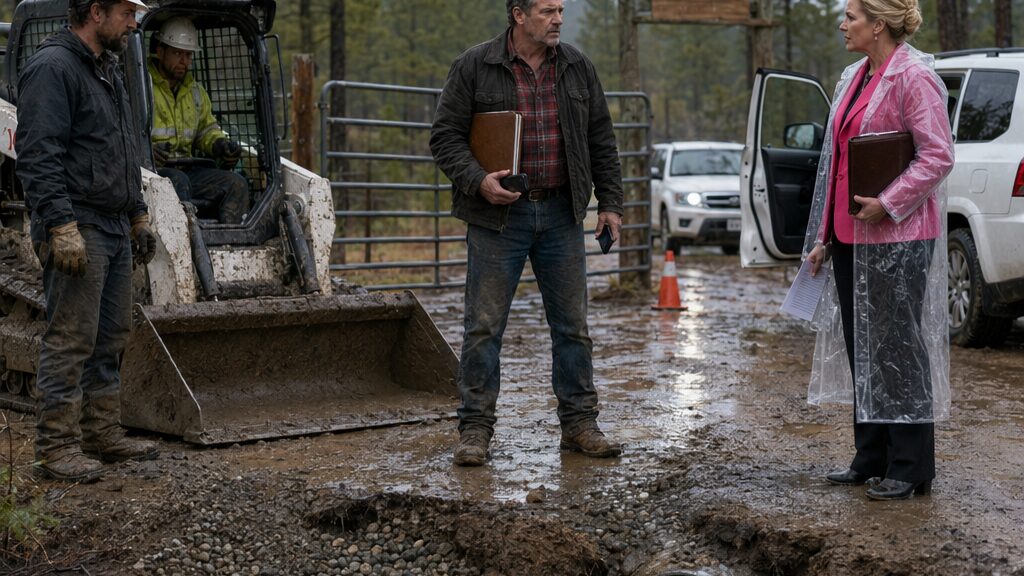
When the HOA Sent a Crew to Tear Out the Road That Kept His Wife Home
Chapter 1: The Machine Was Already at the Gate
Patrick Clark heard the engine before he saw the lights.
It came through the trees in a low, grinding pulse, too heavy for a pickup, too steady for a neighbor passing the lower road. At first, half-awake, he thought the sound had folded itself into the rain that had beaten on the metal roof all night. Then came the sharp scrape of a bucket dragging gravel.
He was out of bed before the second scrape.
Sarah stirred behind him. “Patrick?”
“Stay inside,” he said, already pulling on jeans over his thermals.
Her breathing machine hummed beside the bed, soft and constant. He did not look back because if he did, she would read his face. She always did. He shoved his feet into boots still stiff with dried mud, grabbed his phone from the dresser, and took the brown survey folder from the top of the gun safe where he kept it because he did not trust filing cabinets with things that mattered.
By the time he reached the porch, the engine had climbed into a harsher growl.
Down the timber road, past the bend where the pines leaned close enough to knit their branches together, orange work lights flashed against the wet trunks. The front gate was a quarter mile from the house, but sound traveled hard in the hollow after rain. Patrick climbed into his old truck and drove without turning on the radio. The folder slid across the passenger seat at every rut.
The road had been passable yesterday.
Not pretty. Not perfect. But passable.
Three loads of crushed gravel, one replacement culvert pipe, two pressure-treated posts, and twelve hours of work had kept the washout from eating the only vehicle path to the house. He had the contractor’s invoice clipped inside the folder, along with photos from before and after. He had the county survey showing five hundred acres of timberland that had belonged to Sarah’s father before it belonged to them. He had the HOA guidelines printed from their own website, with the clause about “entrance-area visual harmony” circled in pencil.
He had everything except patience.
When he came around the last bend, his headlights hit the metal gate, the wooden sign, and the machine.
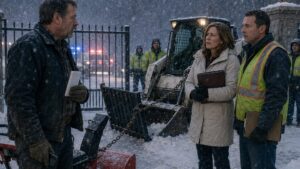
A skid steer sat inside the open gate with its bucket down in the fresh gravel. One strip of the new surface had already been peeled back, exposing black mud beneath. The replacement culvert showed like a bone at the edge of the ditch. Two workers in reflective jackets stood near the fence line. A white SUV was parked sideways beyond the gate, its driver’s door open.
Patrick stopped the truck in the middle of the road.
The sign on the gate was still there, crooked from last week’s storm but readable.
PRIVATE TIMBERLAND
NO TRESPASSING
The skid steer’s bucket dropped again.
Patrick slammed his truck door so hard one worker turned.
“Shut it off,” Patrick called.
The operator looked toward the white SUV instead of him.
Patrick walked straight to the machine, gravel shifting under his boots. “Shut it off.”
The bucket lifted halfway. The engine kept running.
A man with a clipboard stepped from behind the SUV. Dark work jacket, hard hat, trimmed beard, eyes tired in a way that said he had done jobs he did not want to remember.
“You Patrick Clark?” the man asked.
“You’re on my road.”
“I’m Eric Miller. Crew supervisor.”
“Then supervise him shutting that off.”
Eric glanced at the operator. After a second, he raised two fingers. The engine dropped to an idle but did not die.
Patrick looked at the peeled gravel. Yesterday the edges had been clean, tamped down with the back of his shovel. Now the ditch was starting to slump again where the bucket had bitten too deep.
“Who authorized this?”
Eric held out a paper sealed in a plastic sleeve. “We were contracted by the Pine Hollow Association for removal of unauthorized exterior alteration.”
Patrick did not take it. “This is private timberland.”
“The entrance is under association control.”
“The entrance gate is mine.”
“The work order says the road surface modification and culvert reinforcement are non-compliant.”
Patrick looked past him at the gate, at the post he had reset after the rainwater loosened it, at the chain looped through the latch. “Non-compliant with what?”
Eric’s face tightened. “I just have the order.”
“Then stop work until you have the right one.”
The second white SUV came fast enough that mud fanned out from its tires when it stopped. A third followed behind it. Their white doors opened in a staggered line, clean against the wet brown road. Patrick knew before she stepped out.
Linda Roberts emerged in a bright pink blazer under a clear raincoat, holding a leather portfolio tight to her ribs. She looked wrong against the trees, like someone had pasted a boardroom into the woods. Her hair was pinned smooth, her boots too clean for the road.
“Mr. Clark,” she said. “You need to move your vehicle.”
Patrick turned his phone camera on and held it low against his thigh. “You sent a crew through my gate before sunrise.”
“We left notice.”
“When?”
Linda’s mouth compressed. “The notice was placed according to association procedure.”
“When?”
“This morning.”
Patrick looked at the skid steer. “This morning when the machine was already inside?”
Eric shifted but said nothing.
Linda stepped closer, stopping just outside the mud. “You performed unapproved work in a controlled entrance zone after written warning.”
“I repaired a washed-out culvert on my road.”
“You altered the appearance and drainage of an entrance area maintained under the Pine Hollow easement.”
Patrick opened the brown folder. The top page was the county map, creased along the section lines. He held it up enough for her to see the stamped corner.
“Five hundred acres,” he said. “Private timberland. The subdivision ends at that fence.”
Linda pointed toward the gate sign as if it had offended her personally. “That sign does not override recorded community restrictions.”
“It’s not a community road.”
“It is a controlled visual access corridor.”
“It is the road to my house.”
Her eyes flicked toward the folder, then away. “And you were told not to change it.”
The skid steer engine idled behind Patrick, vibrating through the ground. The operator had one hand on the controls. A worker had already begun lifting a loose post from the gravel shoulder.
Patrick saw it then: they had not only scraped the surface. They had pulled two of the posts he had set to keep drivers from sliding into the ditch. The ditch was open again, raw and dark. A medical van could not clear it. An ambulance would slow, maybe stop. A stretcher would have to be carried down from the gate if the road gave way.
He stepped in front of the skid steer bucket.
Eric raised his hand sharply. “Sir, don’t stand there.”
“Then shut it down.”
Linda’s voice hardened. “Mr. Clark, you are interfering with authorized enforcement.”
Patrick lifted his phone higher, not close to her face, not dramatic. Just enough that the red record dot was visible.
“I want your name, your supervisor’s name, and I want the written order that gives you the right to bring machinery through my gate and tear out a culvert on my land.”
Linda smiled without warmth. “You know my name.”
“I want it on the order.”
“You have an enforcement notice.”
“An HOA notice isn’t a court order.”
“It is sufficient under the governing documents.”
“Not for my road.”
“For this entrance, we control this land.”
The sentence hung in the wet air.
Even Eric looked at her then.
Patrick lowered the survey folder slowly until it rested against his leg. His hand had begun to shake, so he closed it around the folder spine until the cardboard bent.
“No,” he said. “You control a meeting room. You control fines. You control letters taped to doors. You do not control the road my wife’s medical van uses to reach our house.”
Linda’s expression changed, not into concern, but into calculation. She glanced toward the workers, then the gate, then Patrick’s phone.
“This is the first time you have raised a medical claim.”
“It isn’t a claim.”
“It is not in your application.”
“I submitted repair photos, the contractor’s invoice, and the washout report.”
“You did not submit medical accommodation paperwork.”
Patrick said nothing.
There it was. The gap he had hoped would not matter. The paper he had left in the kitchen drawer because Sarah hated seeing her condition reduced to forms, because he hated asking permission to keep his own road usable, because he had believed ownership would be enough.
Linda saw the silence and stepped into it.
“Work will pause for the moment,” she said, turning so Eric could hear her. “Not because Mr. Clark is correct, but because we will document his refusal to comply.”
Eric signaled the operator. The skid steer engine finally cut off, leaving the woods suddenly too quiet. Water dripped from pine needles. Gravel rolled softly into the exposed ditch.
Patrick did not move from in front of the bucket.
Linda opened her portfolio and pulled out another sheet. “Emergency board review is scheduled for tonight. Continued obstruction, unauthorized alteration, and refusal to restore the entrance may result in daily fines beginning immediately.”
She held the page toward him.
Patrick looked at the paper but did not take it.
Linda placed it on the wet hood of his truck, under one windshield wiper, like she was pinning a notice to a door.
“Seven o’clock,” she said. “If you want to argue that the rules do not apply to you, do it where everyone can hear.”
Chapter 2: The Road Was Never Just a Road
The home-health driver called before Patrick reached the porch.
He saw the number on his phone and stopped with one muddy boot on the bottom step. Behind him, through the trees, the gate road sat wounded and half-open, its fresh gravel scraped into piles and its ditch showing black under the gray morning light.
He answered without saying hello.
“Mr. Clark, I’m sorry,” the driver said. “They told me there’s equipment blocking the entrance.”
“It’s moved.”
“But the road’s torn up?”
Patrick looked down at his boots. Fine gravel dust had turned to paste around the soles. “Part of it.”
There was a pause on the line. Not impatience. Calculation. The driver knew rural roads, soft shoulders, liability forms.
“I can’t take the van across if the culvert’s exposed,” the driver said. “Not with Mrs. Clark inside. If we bottom out there, we’re stuck.”
“She has therapy at eleven.”
“I know.”
“She missed last week because of the storm.”
“I know that too.”
Patrick turned toward the house. Sarah was visible through the kitchen window, one hand on the counter, the other on the back of the chair she used when she did not want him to see her using the walker. Her hair was pulled loose over one shoulder. From that distance, she could have been any woman waiting for coffee to finish.
The driver’s voice softened. “If you can get it certified passable, I’ll come. But I can’t guess. Not with the company policy and not with her breathing like it was last time.”
Patrick shut his eyes.
Last time, the van had lurched at the washed-out bend, tires slipping toward the ditch while Sarah sat silent in the back. She had not made a sound. That was what had scared him. Not panic. Not anger. Silence. Her hand had tightened around the strap until the knuckles whitened, and afterward, when they made it home, she had said only, “We need to fix that before winter.”
So he had.
“I’ll call you back,” Patrick said.
Inside, Sarah had already heard enough.
She stood at the table with the coffee pot beside her and the folded medical letter under one palm. The oxygen tubing ran lightly along her cheek. She hated when it caught the light; she turned her head away from windows because of it.
“They’re not coming?” she asked.
“Not yet.”
“Because of the road.”
“Because Linda Roberts thinks gravel is an architectural statement.”
Sarah did not smile.
Patrick set the brown folder on the table and began pulling pages out, laying them in rows: survey, invoice, dated photos, HOA warning, new violation notice. He worked fast because work kept his hands from doing anything else.
Sarah watched him for a moment. Then she reached into the side pocket of the folder and removed the letter he had not touched.
It was still unsigned.
“You didn’t give them this,” she said.
Patrick kept sorting. “I gave them what they needed.”
“No. You gave them what you wanted them to need.”
He looked up.
Her voice was not sharp. That made it worse.
“They don’t need your diagnosis,” he said.
“It isn’t a diagnosis. It’s an accommodation request.”
“It has your doctor’s letterhead on it.”
“Yes.”
“And your limitations.”
“Yes.”
“And every board member in that room will know your business before they finish their coffee.”
Sarah eased herself into the chair. She moved carefully, as if each bend in her body had to be negotiated. “They already know enough to tear out the road.”
Patrick picked up the violation notice from the table. The paper had wrinkled under his windshield wiper. Linda’s name was printed cleanly at the bottom.
“Unauthorized exterior modification to entrance-area access surface,” he read. “Failure to restore original condition. Obstruction of enforcement activity.” He dropped the page. “They make it sound like I built a fountain.”
“You built the road back.”
“I replaced what the storm took.”
“For me.”
“For us.”
“For me,” Sarah said again, quieter.
Patrick looked toward the hallway where the walker stood folded against the wall. She kept it there when guests came, as if guests ever came far enough down the timber road to see it. Beside it was the portable ramp he had built for the back steps, stained the same color as the porch so she would not feel like the house had become equipment.
He had learned to make help look ordinary.
He had thought that was kindness.
Sarah touched the unsigned letter. “I asked you not to make me the subject of neighborhood talk.”
“And I listened.”
“You also decided that meant pretending my needs were optional.”
“That’s not what I did.”
“Patrick.”
He stopped.
Outside, water slipped from the porch roof in uneven drops. From the kitchen window, he could see the road disappearing into the pines. It looked peaceful from there. It always had. That was why they had stayed after her father died, after the subdivision grew up near the lower entrance, after the HOA started sending newsletters to people who mistook proximity for ownership.
Sarah drew the letter closer. “I don’t want Linda Roberts saying my name like she owns that too.”
“She doesn’t get to.”
“She already is. By leaving me out.”
Patrick braced both hands on the back of the empty chair across from her. “If I hand this over tonight, they’ll stop talking about culverts and start talking about you.”
“They’re already using my silence against you.”
He wanted to argue, but the words had nowhere to stand.
His phone buzzed.
A new email notification from Pine Hollow Association filled the screen.
OFFICIAL NOTICE OF REQUIRED RESTORATION
He opened it with his thumb.
The email was short and clean. All unauthorized materials, including gravel fill, culvert reinforcement, roadside posts, and gate-adjacent modifications, were to be removed within twenty-four hours pending board review. Failure to comply would trigger daily fines and recovery costs. The association reserved the right to complete removal and bill the owner.
Patrick read the last line twice.
Sarah did not ask what it said. She watched his face.
“They want everything gone,” he said.
“The culvert too?”
“The reinforcement. Posts. Gravel.”
“The part that keeps the van from tipping.”
He folded the phone into his palm and looked at the kitchen table. The papers he had arranged like proof now looked incomplete, almost childish. Land records. Repair invoices. Photos of mud. All of it true. None of it enough.
Sarah reached for a pen. Her fingers hesitated over it.
“Don’t sign it because they scared us,” Patrick said.
“I’m not.”
“Sarah.”
She looked at him then, and he saw the exhaustion under her steadiness. “I am scared. But not of them knowing. I’m scared of being stuck in this house because we were too proud to say the road was keeping me here.”
The pen rolled under her fingers but she did not sign.
Not yet.
Patrick’s phone buzzed again. This time it was a calendar alert from the HOA notice, automatically added from the email.
EMERGENCY REVIEW — 7:00 PM
PINE HOLLOW CLUBHOUSE
Below it, in smaller text, was the subject line from the violation.
RESTORATION DEADLINE BEGINS NOW.
Chapter 3: The Survey Proved Less Than He Needed
“This proves ownership,” Mark Allen said. “It does not prove accommodation.”
Patrick stood at the county records counter with the brown folder open between his hands, the paper edges softened from being handled too much in too little time. Behind the glass, rows of old plat books sat in metal shelving. A printer coughed somewhere in the back room. The clerk had already stamped two copies of the timberland survey, and the blue ink was still drying.
Patrick stared at him. “It proves the road is mine.”
“It proves the parcel is yours,” Mark said carefully. “It proves the access road crosses your parcel after the gate. It proves the subdivision boundary stops here.” He tapped the map with a clean fingernail. “But the entrance easement is older than the HOA, and that language is why you’re standing here.”
Patrick leaned over the counter. “Read it back.”
Mark adjusted his glasses and turned the page. “Recorded entrance easement permits visual maintenance and reasonable access coordination for the shared lower gate approach serving Pine Hollow lots and Clark timber parcel.”
“Visual maintenance,” Patrick said.
“Yes.”
“Not demolition.”
“No.”
“Not road control.”
“Not exactly.”
Patrick’s jaw tightened. “That means no.”
Mark looked at him for a long second. “It means a lawyer will argue about ‘reasonable access coordination’ until everyone in the room is tired and poorer.”
Patrick pulled the violation notice from the folder and slid it across the counter. “They brought a skid steer through my gate.”
Mark read silently. The county clerk’s office had no music, no television, nothing to fill the silence except the buzz of old fluorescent lights. Patrick watched Mark’s eyes move over the lines Linda had printed as if they were law.
“This is an association enforcement notice,” Mark said.
“That’s what I told them.”
“It is not a county removal order.”
“That’s what I told them too.”
Mark looked back at the survey. “But if you changed drainage near an entrance easement without final approval, they’ll claim procedural authority.”
“It washed out.”
“I’m not saying they’re right.”
“Then say what you’re saying.”
Mark exhaled through his nose and reached for a different drawer. “I’m saying ownership and necessity are two separate arguments. You came in with ownership.”
Patrick said nothing.
Mark found an old scanned document and printed it. “There was an amendment in 1998, before Pine Hollow incorporated the HOA. Most people forget it because it was attached to a timber-access dispute, not the subdivision covenants.”
Patrick took the page.
The copy was grainy, the type faded in places, but one paragraph had been highlighted by the printer’s preview marks.
No association, successor entity, or lot owner shall obstruct emergency, agricultural, timber, medical, utility, or necessary residential access to the Clark timber parcel beyond the designated entrance approach.
Patrick read it once. Then again.
“Medical,” he said.
Mark nodded. “It helps.”
“It helps?”
“It helps if you make a medical-access argument.”
Patrick folded the page halfway, then stopped before he creased it. “What if I don’t want to drag my wife into it?”
Mark’s expression changed, not much, but enough. “Then you are asking the map to do all the work.”
Patrick looked down at the survey. For years, it had been the paper he trusted most. It had settled fence questions, timber bids, tax assessments, a neighbor who wanted to hunt the west ridge, and one developer who thought an old logging trail could become a shortcut to future lots. Patrick had carried that folder like a quiet answer.
Now Mark was telling him it answered the wrong question.
“The association says they control the entrance,” Patrick said.
“They control some appearance and coordination rights near the approach. The roadbed beyond the approach is different.”
“They didn’t stop at the approach.”
“I understand.”
“They tore into the culvert.”
“I understand.”
“Do you?”
Mark did not flinch. “My sister uses a chair. So yes, I understand more than you think. But I also understand that if you go to that meeting tonight and only say ‘five hundred acres’ while they say ‘unapproved alteration,’ you’ll both be talking past the thing that matters.”
Patrick slid the survey back into the folder.
“What matters is they came onto land that wasn’t theirs.”
“What matters is why stopping you creates harm they were required to consider.”
Patrick hated the word harm in Mark’s mouth. Not because it was wrong. Because it was accurate.
Mark made three certified copies: the original survey, the 1998 amendment, and the recorded entrance easement. He paper-clipped them separately and wrote the document numbers on a yellow sticky note.
“This is not legal advice,” he said.
“I didn’t ask for legal advice.”
“You asked for records. Records won’t stand up and speak.”
Patrick closed the folder. “They will tonight.”
Mark’s face showed exactly what he thought of that answer, but he only handed him the copies. “Then make sure you know which one you’re asking to speak first.”
Patrick left the building with the folder pressed against his side.
In the truck, he sat without starting the engine. The county parking lot was filling with people renewing registrations, paying taxes, arguing about permits. Ordinary paperwork. Ordinary lives held up at counters by stamps and clauses. He had always believed those things were annoying but manageable, provided a man kept his receipts.
His phone showed three missed calls from numbers he did not recognize and one voicemail from Brenda Jones.
Patrick almost deleted it.
Then he saw the time. Twelve minutes after Linda had sent the restoration notice.
He played it through the truck speaker.
“Mr. Clark, this is Brenda Jones, Pine Hollow treasurer.” Her voice was low, hurried. “I’m calling because tonight’s agenda changed. Linda is presenting the road work as a refusal-to-comply matter, not an access issue. I can’t discuss board deliberations outside the meeting, but I will say this plainly: do not come to the board meeting with only the survey.”
There was a pause, and in the background Patrick heard a door close.
Brenda came back quieter.
“Ask her which map she used. And ask why the medical-access language was left out of the packet.”
The voicemail ended.
Patrick sat very still.
On the seat beside him, the brown folder looked thicker than before, but less certain. The page marked “medical” waited inside it like a question he had not yet earned the right to answer.
His phone buzzed once more.
A text from Sarah.
Did the survey fix it?
Patrick looked at the courthouse doors, then at the folder, then at the road leading back toward Pine Hollow.
He typed three words, erased them, and typed three different ones.
Not by itself.
Chapter 4: The Board Called Safety an Exterior Change
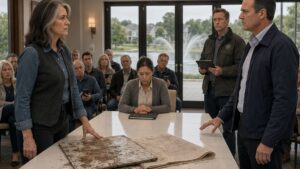
Patrick walked into the Pine Hollow clubhouse and saw his gate projected on the wall with the words NON-COMPLIANT STRUCTURE typed in red beneath it.
For a second, he did not move.
The photo had been taken from inside his property line. The metal gate filled the center of the screen. The wooden PRIVATE TIMBERLAND sign hung in the lower left, cropped so the words looked like a challenge instead of a warning. Beside it, the repaired culvert showed as a strip of pale gravel and two new posts. Someone had circled the posts in yellow.
A neighbor near the coffee urn turned to look at him, then quickly looked away.
Linda Roberts stood at the front table in the same pink blazer, now without the raincoat. A stack of printed packets sat beside her laptop. Brenda Jones sat two chairs down, eyes on the agenda sheet in front of her. She did not lift her head when Patrick entered, but her fingers tightened around her pen.
Patrick carried the brown folder under one arm. The certified documents from Mark Allen were clipped inside, the 1998 amendment behind the survey, the HOA easement behind that. Sarah’s unsigned medical letter was not there. It was still on the kitchen table where she had left it under the pen.
That absence felt heavier than the folder.
Linda tapped the microphone. “Mr. Clark, since this matter concerns your property, you may sit in the front row.”
There were twelve folding chairs set out for residents. Most were full. A man in a fleece vest whispered something to the woman beside him. Another neighbor held a phone low, not pointed exactly at Patrick, but close enough.
Patrick took the aisle seat in front and set the folder across his knees.
Linda began as if reading weather warnings.
“Emergency review regarding unauthorized entrance-area alteration at the Clark timber access gate. The board is considering continued enforcement, restoration costs, and immediate fine assessment based on refusal to restore the area after notice.”
“Refusal?” Patrick said.
Linda looked over the top of her glasses. “You were asked to allow restoration.”
“I asked for written authority before a machine touched the culvert again.”
“Your statement is noted.”
She clicked to the next slide.
The screen changed to a close-up of the scraped gravel, the ditch, and the exposed culvert. Patrick recognized the angle. It had been taken after the crew tore the surface open, not before. The photo made the road look raw, careless, dangerous.
“That picture was taken after your crew damaged it,” Patrick said.
Linda did not look at him. “The condition shown is the result of unapproved work undertaken by the owner.”
Eric Miller, seated near the back in a work jacket, shifted in his chair. He had come because Linda had asked him to be available for questions. Patrick had not expected him to show.
Linda continued. “Pine Hollow’s entrance corridor has been governed for decades under a recorded easement requiring coordination of appearance, drainage, and access standards. Mr. Clark performed exterior work in that corridor after being told approval was pending.”
Patrick opened the folder. “Pending because nobody answered.”
“Pending means not approved.”
“The road washed out.”
“And emergency repairs may be requested through the proper process.”
“I sent photos.”
“You did not submit the complete form.”
Patrick looked at Brenda. Her face remained still.
Linda clicked again. A page from Patrick’s email appeared on the wall. His words were enlarged enough for every person in the room to read.
Storm washout at culvert. Repair needed before access worsens. Attached: photos, contractor estimate, survey page.
Linda pointed at the screen. “No medical accommodation request. No drainage engineering note. No material approval. No board authorization.”
The word medical passed through the room like a sound people pretended not to hear.
Patrick kept his hands on the folder. “I submitted a repair notice.”
“You submitted an incomplete request and proceeded anyway.”
A neighbor raised a hand. Linda nodded.
“If he owns the land,” the neighbor said, “why is the HOA involved?”
Linda’s answer was ready. “Because the entrance corridor affects the entire community’s legal and insurance position. If one owner alters drainage and someone is injured or trapped, the liability question may not stop at that owner’s fence.”
That was the first thing she had said that sounded almost reasonable.
Patrick saw a few heads nod. He understood then how she had carried them this far. Not by saying she hated his road. By saying the road could cost everyone.
Brenda finally looked up. “For the record, the easement does say visual maintenance and reasonable access coordination. It does not clearly grant the association authority over the culvert beyond the lower approach.”
Linda’s eyes cut toward her. “That interpretation is not settled.”
“No,” Brenda said. “It isn’t. Which is why I asked that the 1998 amendment be included in the packet.”
Patrick’s spine straightened.
Linda’s hand rested on the laptop. “The packet includes the governing documents relevant to the violation.”
Brenda turned a page in front of her. “The amendment mentions necessary residential, utility, and medical access to the Clark timber parcel.”
Silence widened across the room.
Patrick heard the fluorescent lights. He heard someone’s phone buzz and stop. He heard the quiet creak of Eric leaning forward in his chair.
Linda’s face did not change, but the skin along her jaw tightened. “Again, no medical accommodation request has been submitted by Mr. Clark.”
There it was. The door she had found and kept open.
Patrick drew out the certified amendment. “I have the amendment here.”
Linda looked at the paper as if it were an interruption, not a record. “You may submit it to the secretary after public comment.”
“I’m submitting it now because your slide leaves it out.”
“This is not a courtroom, Mr. Clark.”
“No. In a courtroom, you couldn’t crop my sign out of context and call your crew’s damage my work.”
A murmur moved through the chairs.
Linda tapped the microphone once. “Please keep comments civil.”
Patrick forced himself to breathe through his nose. His anger wanted more room than the building had.
He opened the folder to the survey and placed it on the front table, careful not to shove it. Then the easement. Then the amendment.
“Five hundred acres,” he said. “Private timberland. The subdivision ends at the fence. The easement does not give you the right to tear out a culvert on my road.”
Linda folded her hands. “And yet you still have not explained why this work could not wait for final approval.”
Patrick’s answer rose in him, immediate and true.
Because my wife could not wait.
He saw Sarah at the kitchen table, pen under her fingers, refusing to be used and refusing to be hidden, both at once. He saw the van tilting near the ditch. He saw the oxygen tube catching the window light.
He did not say her name.
“The repair was necessary for safe access to the house,” he said.
Linda looked almost relieved. “That is your opinion.”
Brenda’s pen stopped moving.
Patrick knew then he had lost that round. Not because the truth was weak. Because he had brought it wrapped in privacy and expected strangers to treat it as enough.
Linda clicked to the final slide.
PROPOSED ACTION:
Continue violation status.
Assess daily fines pending inspection.
Require no further repair before county review.
“The county inspector is available tomorrow morning,” she said. “Until then, the area must remain as-is. No new gravel. No replacement posts. No adjustment to the culvert.”
Patrick stood. “As-is means unsafe.”
“As-is means documented.”
“For who?”
“For everyone,” Linda said. “Not just you.”
The board voted in pieces. Brenda hesitated before raising her hand for inspection and against immediate full restoration. The others voted with Linda on fines pending review. Patrick watched each hand go up and felt the room become smaller.
Afterward, while residents scraped chairs and avoided his eyes, Brenda stepped near him.
“I told you not to bring only the survey,” she said quietly.
“I brought the amendment.”
“You didn’t bring the reason.”
Patrick slid the documents back into the folder. “You don’t know what the reason costs.”
“No,” Brenda said. “But Linda knows what the missing form gives her.”
At the front of the room, Linda gathered her packets into a neat stack.
“The inspector will arrive at nine,” she announced, loud enough for Patrick to hear. “The road remains unrepaired until then. If it changes overnight, we will treat it as a second violation.”
Patrick looked down at his folder, then at the projected image still frozen on the wall: his gate, his sign, his road, renamed in red by people who could not reach his house if the culvert failed.
Chapter 5: Sarah Refused to Be Hidden
Sarah placed the unsigned medical letter on the kitchen table and said, “You keep protecting me out of the room I live in.”
Patrick had not taken off his jacket yet.
The board packet lay under his arm, damp at one corner where he had carried it through the mist from the truck. His boots had left two dark marks on the kitchen mat. On the stove, the kettle had gone cold without being poured.
Sarah sat at the table with the pen beside her hand. She had changed into the blue sweater she wore when she was trying to look stronger than she felt. The oxygen tube crossed her cheek. This time she had not turned away from the window.
Patrick set the folder down slowly. “I didn’t want them talking about you.”
“They already did. They just did it without saying my name.”
He pulled out a chair but did not sit. “Linda used the missing form like a weapon.”
“Yes.”
“I should have brought it.”
Sarah looked at the letter. “You should have asked me again before deciding not to.”
That landed harder than Linda’s vote.
Patrick gripped the chair back. “I thought I was doing what you wanted.”
“You were doing what made you feel like you could still hold the line alone.”
The house gave a small settling creak. Beyond the kitchen window, the road was a strip of darkness between the trees. The gate was too far to see, but Patrick could picture the exposed culvert as clearly as if it sat in the yard.
“I promised you we would stay here,” he said.
“I know.”
“I promised I wouldn’t let this place turn into a waiting room.”
Sarah’s expression softened, but not enough to let him escape. “Then don’t make it a fortress either.”
His phone buzzed on the table.
Unknown number.
He almost ignored it. Then a text came through.
This is Eric Miller. You need to see this.
A photo loaded beneath the message.
Patrick enlarged it with two fingers.
The picture showed the gate under work lights. Orange cones had been set around the remaining culvert supports. A worker’s boot stood near one of the posts. Behind him, the skid steer sat with its bucket raised, not touching the ground, but positioned close enough to do the rest in minutes.
Another text followed.
I was told to stage for morning “documentation.” Not touching it tonight. But there’s an order to remove loose material before inspection if directed.
Patrick read it twice.
Sarah watched his face. “What is it?”
He turned the phone toward her.
She looked for only a few seconds, then closed her eyes. “If they take the rest before the inspector comes, there won’t be anything left to inspect.”
“They’re not supposed to touch it.”
“Were they supposed to start before you got notice?”
Patrick put the phone down.
The pen remained between them.
Sarah reached for it, then stopped. Her fingers rested on the barrel. “I don’t want them to read every detail.”
“They don’t need every detail.”
“What do they need?”
“That the road is necessary for medical transport and safe access.”
“And my name?”
He hesitated.
Sarah noticed.
“I’m tired of being the secret that makes you look unreasonable,” she said.
“You are not a secret.”
“Then why did a room full of people think you tore up a road because you didn’t like asking permission?”
Patrick sat finally. The chair gave under him. “Because I let them.”
Sarah nodded once. Not victory. Confirmation.
He opened the folder and pulled out the medical letter. The doctor’s signature was at the bottom. Most of it was plain: mobility limitation, respiratory limitation, unsafe transfer risk, need for reliable vehicle access to residence, recommended accommodation for maintained passable road surface and emergency access.
Words clean enough for strangers.
Words cruel enough for a woman who remembered hiking the ridge trails before breakfast.
Sarah took the pen.
Patrick covered her hand lightly. “You don’t have to.”
“I know.”
“If we file it, they can’t unsee it.”
“Good,” she said.
He let go.
She signed slowly, not because her hand shook, but because she insisted on making the letters clear. Sarah Clark. Full name. No apology in it. When she finished, she turned the page toward him.
“There,” she said. “Now stop protecting Linda from the truth.”
He almost laughed, but it broke before it became sound.
Patrick scanned the signed letter with his phone, attached it to an email addressed to the association board, the county inspector’s office, and the general Pine Hollow compliance account. His thumb hovered over send.
Sarah saw him pause. “Patrick.”
“I’m checking the attachments.”
“You’re stalling.”
He sent it.
The whoosh of the email leaving sounded too small for what it changed.
Neither of them spoke for a while.
Then the landline rang.
Patrick answered on the second ring. The home-health driver’s voice came through, careful and apologetic.
“I checked with dispatch. We can’t come tomorrow unless the road is cleared or certified safe. If the inspector blocks it, we need written confirmation before rescheduling.”
“Understood,” Patrick said.
“I’m sorry. I know she needs the visit.”
Patrick looked at Sarah. She was watching the signed letter as if it had become a door.
“We’ll handle it,” he said.
After he hung up, Sarah pushed herself carefully to standing.
“Don’t help,” she said before he moved.
He froze halfway out of his chair.
She took the walker from the hallway and set it in front of her herself. The sound of its feet on the floor was small, rubber against wood, but it made Patrick feel the distance from the kitchen to the bedroom in a way he never had when he walked it without thinking.
At the hallway, she stopped.
“I wasn’t ashamed of needing the road,” she said without turning around. “I was ashamed of needing people who would argue about whether I deserved it.”
Patrick stayed seated until she disappeared into the bedroom.
Before dawn, he slept in pieces. Twice he checked his email. No reply from Linda. No acknowledgment from the board. At 6:14, a read receipt appeared from Brenda Jones. At 6:22, another text came from Eric.
Crew told to arrive by 8:30. Linda wants site “unchanged except unsecured materials.”
Patrick was at the gate by 7:15.
Mist lay low along the ditch. The white gravel was scattered like broken teeth across the mud. The gate hung open on one side, its chain looped but not locked because the crew had left it that way. The PRIVATE TIMBERLAND sign was streaked with rain and clay.
Then he saw the cones.
Fresh orange cones circled the remaining culvert supports. Not where the hazard was. Around the parts still holding the road together.
Patrick stepped closer and saw red marking paint on one post.
REMOVE.
Chapter 6: The Order Was Not the Same as the Right
The county inspector arrived at nine and stopped his truck fifty feet short of the gate because the road Linda’s crew had “documented” could no longer carry a county vehicle.
Patrick watched the inspector step out, look at the exposed culvert, then look at the skid steer idling behind the cones. The man did not say anything at first. He only pulled a clipboard from under his arm and walked to the edge of the washout.
Linda Roberts stood beside her white SUV with her portfolio pressed flat against her stomach. Brenda Jones had come in a separate car and remained near the fence, arms crossed against the cold. Eric Miller stood by the machine, hard hat in one hand, eyes on the ground.
Patrick had laid the brown folder open across the hood of his truck.
Survey. Easement. 1998 amendment. Signed medical letter. Photos before the crew arrived. Photos after. Screenshot of Eric’s text. HOA notice. Email sent with time stamp.
For once, he did not hide the page that mattered most.
The inspector crouched near the culvert. “Who removed the gravel surface?”
Linda stepped forward. “The association began restoration of an unauthorized modification.”
“Before or after the owner was notified?”
Linda’s pause was brief, but everyone heard it.
“Notice was placed according to procedure.”
The inspector looked toward Patrick.
Patrick picked up the first photo from the folder. “At 6:18 yesterday, I heard machinery. At 6:31, I arrived. The skid steer was already inside the gate. At 6:44, Ms. Roberts gave me the notice. I was recording by then.”
Linda’s face sharpened. “Selective recording does not change the violation.”
“No,” Patrick said. “But timing changes authority.”
Eric rubbed one hand over his jaw.
The inspector stood. “Mr. Miller, when did your crew enter the property?”
Eric looked at Linda.
She said, “Eric, answer only what is relevant to your work order.”
Eric’s mouth tightened. “We arrived at 6:05. Gate was open when we started work.”
Patrick turned. “The gate was locked when I went to bed.”
Eric’s eyes flicked to him, then away. “I was told association access had been arranged.”
“By who?” the inspector asked.
Eric nodded toward Linda without speaking.
Linda lifted her chin. “The association has entrance coordination rights.”
Patrick took the easement copy from the truck hood and held it out to the inspector. “Visual maintenance and reasonable access coordination. That’s the language she keeps calling control.”
The inspector read the highlighted section. “This doesn’t mention removal authority.”
“It mentions not obstructing medical access,” Patrick said, handing him the amendment next.
Linda opened her portfolio. “Medical access was not part of the original repair application.”
“It is now,” Patrick said.
“After enforcement began.”
“After you tore out the road.”
Brenda stepped closer. “For the record, the accommodation letter was emailed to the board and copied to the county office last night.”
Linda gave her a look. “This is not a board hearing.”
“No,” Brenda said. “That is why I said for the record.”
The inspector read the medical letter. Patrick did not watch his face. He looked at the road instead, at the exposed pipe, at the post marked REMOVE in red paint. He thought of Sarah signing her name. He thought of her saying he had protected her out of the room.
The inspector lowered the page. “This letter states reliable vehicle access is medically necessary.”
Linda’s voice cooled. “No one is disputing Mrs. Clark’s condition. The issue is that Mr. Clark altered a controlled area without complete approval.”
Patrick felt his anger rise, but he kept his hands flat on the truck hood. “The storm altered it first.”
“You could have waited.”
“For the road to fail?”
“For proper review.”
“For Sarah to miss treatment?”
Linda’s expression flickered at Sarah’s name, not with cruelty, but discomfort. Patrick saw it and understood she had preferred the wife remain abstract. A missing form. A claim. An inconvenience.
He lifted the photo taken the day before the repair. Brown water had cut around the old culvert, narrowing the road to one slick lane.
“This was the road before I fixed it.”
Then the after photo: clean gravel, posts, a safe turn.
“This was the road before your crew touched it.”
Then the morning photo: exposed ditch, cones, red paint.
“This is what your enforcement made.”
The inspector took all three.
Eric stepped forward, voice low. “We were instructed to remove the gravel surface and any non-approved supports. We were told the owner had been notified and refused access.”
Linda turned. “Eric.”
He kept going. “When Mr. Clark arrived, he asked for the order. I had a work order from Pine Hollow. Not a county order. Not a court order.”
Patrick looked at him. Eric did not look proud. He looked like a man trying to step off a board that had begun to crack under him.
Linda closed her portfolio. “The association will pursue legal action if Mr. Clark performs additional repairs before board approval.”
The inspector glanced at the gap in the road. “If this remains open, emergency access is compromised.”
“It remained open because Mr. Clark created an unauthorized condition,” Linda said.
“No,” Patrick said.
The word came out quieter than he expected.
Everyone looked at him.
He picked up the medical letter and clipped it to the survey with a black binder clip from the folder. The two pages looked strange together: land and body, acres and breath, boundary and need. He placed them on the hood where anyone could see them.
“I own the parcel,” he said. “The easement doesn’t give you demolition rights beyond the entrance approach. The amendment says medical access cannot be obstructed. My wife’s doctor says this road has to be passable. I repaired storm damage. You sent a crew to remove the repair before notifying me. I am not asking you to like the gravel. I am telling you the machine stops here.”
Linda’s eyes flashed. “You do not get to dictate enforcement.”
“I get to refuse unlawful removal on my land.”
“You are exposing yourself to fines.”
“You already fined me.”
“To legal costs.”
“You already damaged the road.”
“To community consequences.”
Patrick looked past her to the line of white SUVs, the open gate, the timber beyond. “This is not community property because you parked white cars in front of it.”
The inspector raised a hand before Linda could answer. “No further removal today.”
Linda turned toward him. “On what authority?”
“On the authority of not worsening a documented access hazard while jurisdiction is unclear.”
“That is not a final determination.”
“No. It is a stop. The county will issue a written note that the site should be stabilized, not further disturbed, until documentation is reviewed.”
Patrick felt something in his chest loosen, but only slightly. Stabilized was not repaired. Reviewed was not approved.
Linda knew it too. “The HOA maintains its violation.”
“Then maintain it without the skid steer,” the inspector said.
Eric immediately signaled the operator. The machine shut down.
The silence that followed had weight.
Brenda walked to Linda’s side, but not close enough to seem allied. She held her phone in one hand, screen lit.
“Linda,” she said, “before we leave, I need you to answer something for the meeting record.”
Linda’s head turned slowly. “This is not a meeting.”
“It concerns board action. I’m recording my own notes.”
Linda’s smile was thin. “Careful.”
Brenda did not move. “When I asked last week whether the Clark culvert was beyond the entrance approach, you said counsel would rather enforce first and clarify later.”
Linda’s eyes hardened.
Brenda continued, voice steadier now. “When I asked whether the old amendment included medical-access language, you said it was not relevant because no accommodation had been filed.”
Patrick watched Linda’s hand tighten on the portfolio.
The inspector looked from Brenda to Linda. Eric stared at the ground.
Brenda lifted her phone slightly, not like a threat, more like a witness she wished she did not need.
“Now that the accommodation has been filed,” she said, “why was the board not told about it before today’s site action?”
Chapter 7: The Gate Stayed, but the Rule Changed
Patrick saw the board packet before Linda saw him.
It sat on the front table in the Pine Hollow clubhouse, clipped neatly in sets, with the top page facing the room.
CLARK ACCESS VIOLATION WITHDRAWAL
EMERGENCY ROAD ACCESS POLICY REVISION
For a moment, he stood just inside the doorway with his hand still on the knob. The words looked official enough to trust and polished enough to suspect. A week earlier, the same room had shown his gate on the wall under red letters. Now his name was printed in black, smaller, cooler, as if the board could shrink the damage by changing the font.
Sarah stood beside him, one hand on the handle of her walker.
“You don’t have to stay,” Patrick murmured.
She looked at the packet. “Yes, I do.”
He did not argue.
The room was fuller than last time. Some neighbors watched Sarah with quick, embarrassed glances, then looked at the floor. Brenda Jones sat at the board table with a stack of documents already open. Linda Roberts sat at the center, but not quite as centered as before. Her pink blazer had been replaced with a navy one, and her portfolio lay closed in front of her.
Patrick and Sarah took the front row.
Linda tapped the microphone. “This special meeting will address the Clark access matter and proposed revisions to emergency repair procedures.”
No one moved.
Brenda leaned toward her own microphone. “And withdrawal of the current violation.”
Linda’s eyes flicked sideways. “That item is included.”
Patrick felt Sarah’s hand settle briefly on his sleeve. Not gripping. Just there.
The county inspector’s written note had arrived two days after the site visit. It did not declare Patrick victorious. It did not accuse Linda of anything. It said the road should be stabilized immediately, that no further removal should occur while property and easement documentation were reviewed, and that medical access concerns required accommodation review before enforcement continued.
Bureaucratic words. Carefully limited. Enough to stop a machine.
Then Mark Allen’s certified records had gone to the HOA attorney. Eric Miller had sent Patrick an invoice copy showing the removal started before the notice time. Brenda had forwarded the board packet that left out the medical-access amendment, along with her own memo asking why.
None of it solved everything alone.
Together, it made denial harder than correction.
Brenda began reading from the proposed action. “The association withdraws the current violation related to the Clark culvert and access-road repair. The association acknowledges that the work occurred on the Clark timber parcel beyond the maintained entrance approach, with medical-access documentation now submitted and reviewed. The association will not assess daily fines for the emergency repair.”
Linda stared at the table.
A neighbor raised a hand. “Does this mean anyone can do road work without approval now?”
Linda reached for the microphone, but Brenda answered first.
“No. It means emergency access repairs have to be reported in writing and inspected afterward if prior approval would create a safety risk. It does not allow cosmetic work. It does not remove drainage review. It does require the board to consider medical, utility, emergency, and necessary residential access before enforcement.”
The neighbor nodded slowly, not pleased, but less certain.
Patrick watched Linda. He had expected resistance, some last procedural turn. Instead, she sat very still, which made him more alert.
Then she opened her portfolio.
“The association also proposes a mutual non-disparagement and confidentiality clause regarding this matter,” Linda said. “Given the sensitive medical information involved and the potential reputational harm to Pine Hollow, all parties would agree not to discuss details publicly.”
Sarah’s hand tightened on the walker.
Patrick stood before he had decided to.
“No.”
Every face turned.
Linda’s mouth flattened. “Mr. Clark, this clause protects your wife’s privacy as much as the association.”
Patrick looked at Sarah. She looked back, steady and tired and fully in the room.
“No,” he said again. “Her medical details stay private. The fact that a necessary access repair was treated like a violation does not.”
Linda’s eyes hardened with the old confidence. “The association has an interest in limiting mischaracterizations.”
“Then correct the record.”
“We are correcting it now.”
“In a packet nobody outside this room will read.”
Brenda looked down, but Patrick saw the corner of her mouth tense, as if she had been waiting for him to say it.
Linda folded her hands. “Mr. Clark, public accusations help no one.”
“I’m not asking for a public fight.”
“Then what are you asking for?”
Patrick lifted the folder from the chair beside him. The brown cardboard was scuffed at the corners now. He had stopped trying to smooth it.
“I want the violation withdrawn in writing. I want the restoration cost covered by the association because your crew removed work before proper notice. I want the revised rule adopted without a confidentiality clause. And I want the board minutes to say the road was a medical-access repair, not an exterior decoration.”
The room stayed quiet.
Linda looked toward Sarah. “Mrs. Clark, surely you understand—”
Sarah’s voice cut through gently, which made it impossible to dismiss. “Do not use my privacy to hide your mistake.”
Linda stopped.
Sarah did not stand. She did not need to.
“I did not want my health discussed here,” she said. “I still don’t. But that road is how I leave my home and how help reaches me. If your rules can’t tell the difference between a decoration and access, then the rule is the problem.”
Patrick looked at the floor for a second because pride and guilt rose together in him, and he did not want either to show as triumph.
Brenda turned a page. “I move to strike the confidentiality clause.”
The motion had to be seconded. For a long, thin moment, nobody did.
Then the neighbor who had asked about road work lifted his hand. “Second.”
Linda’s face changed only slightly, but Patrick saw it: the moment control moved without asking her permission.
The vote was not unanimous. Linda voted no. Another board member hesitated and voted no with her. Brenda voted yes. Two others followed. The clause was removed.
Then came the withdrawal.
Linda read it because she was still president and procedure still belonged to her voice.
“The Pine Hollow Association withdraws the violation notice issued to Patrick Clark regarding the emergency culvert and access-road repair at the Clark timber parcel. No fines will be assessed. The association will reimburse reasonable restoration costs for removal activity conducted prior to confirmed notice. Future emergency access repairs shall follow the revised notification and review process adopted tonight.”
She finished without looking up.
It was not an apology. Not really.
But it was paper, and paper had done enough damage that Patrick knew better than to dismiss it when it finally did some good.
After the vote, while chairs scraped and neighbors drifted toward the door, Linda came to the aisle. She stood in front of Patrick and Sarah, portfolio tucked against her ribs like a shield.
“Mrs. Clark,” she said, “I regret that the process did not account for your circumstances sooner.”
Sarah’s face remained calm. “The process was told where to look. It chose not to.”
Linda absorbed that with a small nod. Then she turned to Patrick. “You also proceeded before approval.”
“I did.”
The admission surprised her.
Patrick held her gaze. “I should have filed the medical letter with the first repair notice. I didn’t. That gave you room to pretend the road was just gravel.”
Linda looked away first.
“I’ll be stepping back from enforcement review until the policy revision is completed,” she said.
Brenda, standing behind her, heard it. So did Patrick.
That was as close as Linda Roberts would come to saying she had gone too far.
Patrick did not offer her more.
Three days later, Eric Miller’s crew returned without the skid steer bucket lowered like a threat. This time, the machine carried gravel in, not out. The operator worked slowly under the county note, the revised approval, and Patrick’s watch. Eric kept the work order clipped to a board and handed Patrick a copy before anyone crossed the gate.
“Figured you’d ask,” Eric said.
Patrick took it. “Figured you’d bring it.”
They rebuilt the culvert shoulders, reset the posts, packed the gravel, and graded the turn so water would move into the ditch instead of over the road. Patrick worked beside them until Eric told him he was making the crew nervous.
By late afternoon, the orange cones were gone.
The gate stood open.
Sarah’s medical van arrived at four-twenty. Patrick stood near the sign, one hand on the latch, while the van eased over the repaired culvert. The tires held. The body did not sway. The driver gave him a small thumbs-up through the windshield.
Sarah sat by the window, oxygen tube visible in the sunlight, looking not at the road but at the trees beyond it.
Patrick had expected relief to feel larger.
Instead, it felt practical. Four tires crossing gravel. A gate wide enough. A road doing what a road was supposed to do.
When the van returned an hour later, Sarah was tired but smiling faintly.
“You watched the wheels the whole time,” she said as Patrick helped her down.
“I watched the road.”
“You watched both.”
He could not deny it.
After the van left, he walked to the gate with the wooden sign under one arm. He had cleaned it in the shed that morning, brushing mud from the carved letters, sanding one splintered edge where the crew had knocked it loose. Beneath the old PRIVATE TIMBERLAND sign, he fixed a smaller approved marker required by the new agreement.
EMERGENCY ACCESS ROUTE
MAINTAIN CLEAR
The two signs looked strange together at first. One guarded the land. The other admitted what the land had to allow.
Sarah stood on the road behind him, leaning on the walker.
Patrick tightened the final screw. “Too much?”
“No,” she said. “Both are true.”
He stepped back.
The metal gate, the timber road, the new gravel, the clean sign, the smaller marker beneath it. Five hundred acres beyond. One house at the end. Not hidden. Not surrendered.
Patrick closed the gate halfway, then stopped and left it open wide enough for the next van.
The story has ended.