The Neighbor Brought a Repair Bill to His Welcome-Home Barbecue, But She Hadn’t Seen His Old Folder
Chapter 1: The Welcome-Home Banner Was Still Crooked
The “WELCOME HOME” banner had come loose on one side, and every time the wind caught it, the last two letters snapped against the barn like somebody knocking from inside.
Michael Anderson stood beneath it with a tray of ribs in both hands, watching the crooked corner slap the weathered boards. Brandon had tied it too high. The boy had always tied everything too high, even after turning thirty-seven and growing a beard of his own. He said it made things visible from the road.
Michael would have preferred it lower.
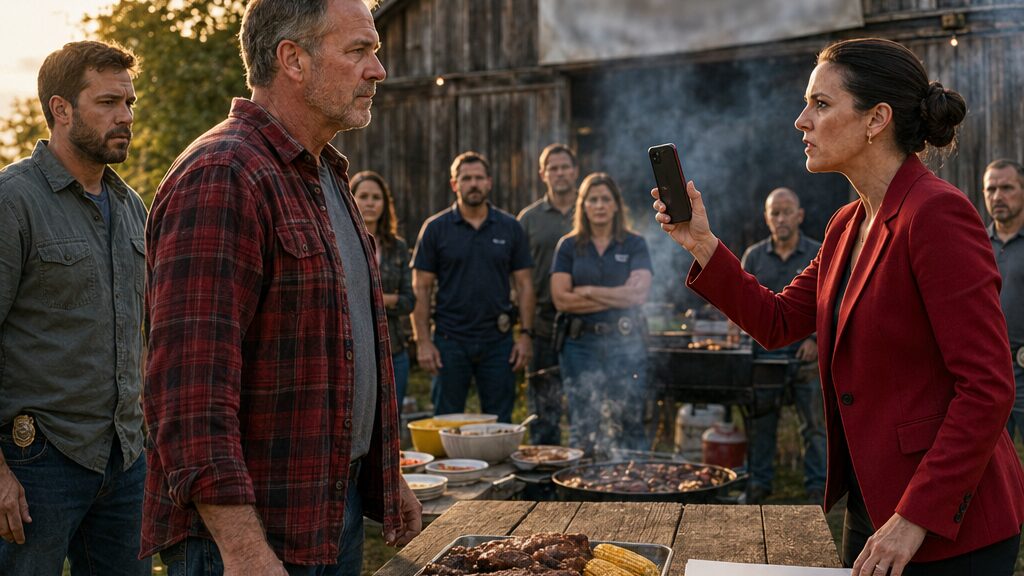
Behind him, smoke rolled up from the grill in blue-gray waves. Two off-duty officers from the county department stood beside the folding table, arguing over whether the corn needed more butter. One of them had his badge clipped to his belt and a paper plate in his hand. Another leaned against the fence rail laughing at something one of the grill volunteers had said.
They were not there in uniform exactly, not the way people meant it when they said uniform. A few wore department polos. One still had his duty pants on from a shift that had run long. A couple had come straight from the station because Brandon had called everyone Michael had once helped after a storm, a wreck, a missing dog, a flooded road.
Michael had told him that was too much.
Brandon had said, “You fell off your own porch and spent three weeks pretending you didn’t need anybody. Let people bring you potato salad.”
So they came.
They came with foil pans and folding chairs, with iced tea and paper napkins, with stories Michael did not want repeated about the time he’d dragged a fallen cedar off County Road 11 before the ambulance arrived. They came because Brandon had made calls and because Michael’s barn had always been the place people pointed to when they needed a generator, a shovel, a jump start, or somebody old enough to know where the shutoff valve was.
Michael shifted the tray against his hip and glanced toward the long picnic table. There was an old brown folder lying on the end of it, half under a stack of paper plates.
He frowned.
The folder had been on his kitchen counter that morning. He had brought it outside only because he meant to sort the barn receipts before everyone arrived, then Brandon had shown up with decorations and the kind of cheerful force a man could not politely refuse. Now the folder sat in the middle of a party, its bent corners showing beneath the plates as if it belonged there.
Michael set the tray down on a cooler, wiped one hand on his jeans, and slid the folder free.
“Uncle Michael,” Brandon called from near the grill, “don’t start cleaning at your own party.”
“I’m moving paper away from barbecue sauce,” Michael said.
“Same thing.”
A few people laughed. Michael managed a small smile and tucked the folder under the far end of the bench, away from the food. It was not a secret folder. It held property tax receipts, old drainage sketches from when the county regraded the road, a few repair invoices, and photographs he had printed because phones broke and clouds lost things. He had learned that the hard way after his wife’s illness, when every wrong bill had required proof that somebody else had already been paid.
He did not like keeping records.
He liked needing them even less.
Brandon came over with tongs in one hand and concern tucked behind his smile. “You okay?”
“I’m standing in my yard being fed by half the county,” Michael said. “That’s not usually a complaint.”
“You look like you’re waiting for bad news.”
Michael looked past him, toward the wire fence that divided his back field from Jennifer Moore’s property.
Jennifer stood near the gravel edge of her driveway in a red blazer bright enough to make the afternoon look dull. She had her phone pressed to one ear and a folder tucked against her side. Not a purse. Not a plate. A folder.
Her detached garage sat behind her, white siding too new for the old trees around it. The lower panels on the far side had been stripped away after the storm two weeks earlier. Michael could see the raw patch even from where he stood. He had noticed the repair crew’s truck there once, then the dumpster, then Gregory Hall’s sign propped near the driveway for three days.
Jennifer had not looked toward him all afternoon until now.
Brandon followed his gaze. His smile thinned. “She came?”
“She lives next door.”
“She knew this was today.”
Michael picked up the tray again. “Everybody knew. You put a banner large enough for low aircraft.”
“That doesn’t mean she needed to stand there like she’s waiting to serve papers.”
Michael gave him a look.
Brandon lifted both hands, tongs and all. “Fine. I’ll behave.”
Michael did not answer. He carried the tray toward the picnic table, where paper plates waited in two leaning stacks and a bowl of coleslaw sat sweating in the shade. People shifted to make room. Someone said the ribs looked perfect. Someone else asked whether the corn was from the roadside stand near the church. Michael answered with nods when he could and short words when he had to.
He had never been good at being welcomed.
Coming home should have been simple. Three weeks in a rehab center after slipping on the porch steps. A cracked wrist, bruised ribs, too many forms, too many people asking whether he had considered selling the place before it became too much for him. He had come back determined to walk the fence line, oil the hinges, and prove nothing had changed.
Then the storm had come.
Rain hard enough to flatten weeds. Water running brown across both properties. Jennifer’s garage taking damage on the low side. Her new driveway edge holding a pale line of fresh gravel where there used to be an open swale.
Michael had seen it. He had said nothing.
Not because he thought it did not matter.
Because people heard an old man mention drainage and decided he was complaining before he finished the sentence.
He was setting the tray down when Mary Campbell touched his sleeve. She had a small plate balanced in one hand and worry folded into every line of her face.
“Michael,” she said quietly, “maybe you ought to talk to her before she comes over.”
“Jennifer?”
Mary looked toward the fence. “She’s been upset.”
“She had storm damage. I don’t blame her.”
Mary’s mouth pressed shut. Her eyes moved to the folder under the bench, then away. “That’s not what I meant.”
Before Michael could ask what she did mean, Jennifer stepped through the open gate between the properties as if it had been placed there for her entrance.
Conversations loosened and dropped. Not stopped entirely, not at first. Just softened, the way a room changes when a glass tips near the edge of a table.
Jennifer walked across the grass with her phone still to her ear. Her red blazer was crisp despite the heat. Her hair was pulled back tight. The folder against her side was white, with a contractor’s logo clipped to the front and a yellow sticky note showing a number written in thick black marker.
Michael saw the number before he saw her face.
18,740.
Brandon moved half a step toward him. “Uncle Michael.”
Jennifer lowered the phone but did not end the call. Her eyes swept over the tables, the grill, the officers, the banner, and finally Michael. The look on her face was not embarrassment. It was the hard relief of someone who had found an audience.
“I’m glad everyone’s here,” she said.
Michael felt the tray’s heat through the towel under his palm. “Jennifer, if this is about the storm, we can talk at the fence after folks eat.”
“No,” she said, voice carrying clean across the yard. “We’re done doing this quietly.”
One of the officers near the grill straightened, but Michael shook his head once. Not to them. To himself. To the old instinct that wanted trouble smoothed flat before anyone saw the wrinkle.
Jennifer walked to the picnic table and stopped beside the corn.
“Before everyone eats,” she said, lifting the folder, “he needs to answer for what he did to my garage.”
Chapter 2: The Estimate Landed Beside the Corn
Jennifer slid the repair estimate across the picnic table while Michael was still holding the tray, and the corner of the paper stopped against an ear of grilled corn.
For a second, nobody moved.
The estimate had been printed on thick white paper, too clean for the outdoor table. Gregory Hall’s company name sat at the top in blue letters. Under it were lines for water intrusion remediation, siding removal, lower framing replacement, driveway wall crack repair, drainage correction, labor, disposal, and contingency.
At the bottom, circled twice in black marker, was the total.
$18,740.
Michael set the tray down carefully. Not because he was calm, but because the ribs were heavy and his left wrist still complained when he moved too fast.
Jennifer watched his hand. “That’s what your neglect cost me.”
A grill volunteer muttered something under his breath. Brandon stepped forward, but Michael lifted two fingers. It was not enough to stop Brandon entirely. It was only enough to keep him from speaking first.
“My neglect,” Michael said.
“Yes.”
“Of what?”
Jennifer made a short sound, almost a laugh. “Don’t do that. Not in front of everybody.”
The party had pulled into a circle without meaning to. People stood with paper plates half-filled, cups lowering, napkins held unused. The officers by the grill were quiet now. One of them looked at Michael, waiting for permission that Michael would not give.
Jennifer tapped the estimate with one red-painted fingernail. “The drainage swale on your barn side. You let it clog. The stormwater backed up, came across my driveway, and flooded the west side of my garage. Gregory inspected it. He says the water came from your side.”
Michael looked down at the paper, then beyond it to the strip of land between their properties.
He could see it in his mind better than he could from the table: the shallow cut along the barn side, the grass flattened after rain, the place near the fence where Jennifer’s driveway extension had narrowed the natural run. Before the storm, before her gravel work, he had taken photographs while checking the loose banner hooks Brandon had left in the barn. Not for Jennifer. Not for a claim. Just because he had meant to remember where the water had pooled after the county cleaned the ditch.
That memory rose in him, then stopped behind his teeth.
He hated the feeling of reaching for proof too quickly. Hated the look people got when he opened a folder and began explaining dates. Like he had been waiting to win an argument nobody else knew they were having.
Jennifer took his silence as room.
“My insurance needs an answer. I need an answer. I cannot have this sitting unresolved while repairs are underway.”
Brandon said, “You brought this here?”
Jennifer turned on him. “I brought it because your uncle stopped answering like a responsible neighbor.”
Michael looked at her then. “You didn’t ask me a question.”
“I came by Thursday.”
“You left a note that said call Gregory.”
“And did you?”
“No.”
“There you go.”
Michael heard the shift around him, the tiny intake of people who had just been handed a simpler version. Jennifer had come by. Michael had not called. Therefore Michael had avoided responsibility. That was how these things worked when one person arrived with paper and the other arrived with barbecue.
He wiped his fingers on the towel. Sauce stained the cloth orange.
“Jennifer,” he said, “I’m sorry your garage was damaged.”
Her face sharpened. “Don’t start with that.”
“I am sorry it happened. But I didn’t cause it.”
“You don’t know that.”
“I know I’m not signing that.”
The quiet after his words was different. Not stunned. Braced.
Jennifer’s phone, still in her hand, flashed as the call timer continued. She lifted it slightly, making sure he saw. “Then I’ll call this in properly. Right now. I’m not going to be bullied on my own property because you have a cookout and a few friends here.”
A few friends.
Michael let his eyes move, not dramatically, not in challenge, just enough to take in the men and women near the grill. The officer with the paper plate. The one leaning against the fence. The county deputy who had brought peach cobbler because his wife had insisted. People who had come out of kindness, not authority.
Jennifer followed his glance and mistook it. “Don’t look at them. If I need law enforcement here, I’ll ask for it myself.”
Michael looked back at her. “They’re already here.”
A nervous laugh broke from someone near the cooler and died quickly.
Jennifer’s cheeks colored. “That is not what I meant.”
“I know what you meant.”
“I mean officially.”
“They’re not here officially.”
“Then stop using them like a shield.”
Michael felt the old embarrassment rise hot in his neck. That was the trick of it. She had walked into his yard, laid a bill beside his food, accused him in front of his guests, lifted her phone like a warning, and now somehow he was the one using pressure.
He reached for the estimate, but did not pick it up. He turned it so the total faced him.
“Who wrote this?”
“Gregory Hall. You can read.”
“I can.”
“Then read the part where it says water intrusion from adjacent property drainage.”
“It says possible.”
Jennifer’s mouth tightened.
Michael tapped the word once. Possible. It was small, almost hidden in the line of description, but it was there.
“That’s contractor language,” she said.
“It’s an important word.”
“It’s an expensive word. And if you force this through insurance, it may become more expensive for you.”
Brandon stepped close enough that Michael could feel him at his shoulder. “Maybe we should take this inside.”
“No,” Jennifer said. “No more side conversations. I have been patient.”
Michael looked toward Mary. She stood near the far bench with her plate untouched. Her face had gone pale. For one moment, her eyes met his, and he thought she might say something. Instead, she looked down at the grass.
He could have reached under the bench then. He could have taken out the old folder, spread his own papers beside Jennifer’s estimate, forced the party to become a hearing. He could have shown every person there that he had records, dates, photographs, proof that his property had not been sitting neglected.
But the banner was still snapping against the barn. The corn was going cold. People had come to welcome him home, not watch two neighbors turn a picnic table into a courtroom.
So he did what he had always done too long.
He kept the folder where it was.
“I won’t sign anything today,” he said.
Jennifer stared at him. “Today?”
“I won’t sign anything false.”
Her eyes narrowed. “Careful.”
The word landed harder than the bill.
Michael folded the estimate once, not creasing it, only closing the top page over the amount. “Leave me a copy. I’ll review it.”
“You’ll review it,” she repeated, with a bitter little smile. “That’s what this is to you?”
“That’s what paperwork is for.”
“No. Paperwork is for people who accept responsibility before they make everyone else chase them.”
One of the officers near the grill shifted. Michael saw it from the corner of his eye and shook his head again, smaller this time. The officer stayed back. That mattered. It had to matter. If the story became about them, Jennifer would use that too.
Jennifer snatched the top copy from the folder and left the duplicate on the table. “You have until Monday to respond. After that, I submit everything through insurance and let them decide what kind of neighbor you are.”
She turned before he answered.
The red blazer cut through the party, bright and hard against the smoke. She walked back through the gate, phone already at her ear again. The moment she crossed onto her side, voices began returning in fragments, not conversation yet, only people trying to remember what they had been doing before the accusation.
Michael stood with one hand on the table.
The estimate lay beside the corn, the corner spotted with sauce.
Brandon reached for it first. Michael let him.
His nephew scanned the page, and the practical color drained from his face. He leaned closer, lowering his voice until only Michael could hear.
“Uncle Michael,” he whispered, “that could touch your insurance.”
Chapter 3: The Claim Sounded Official by Monday
“Mr. Anderson, before we proceed, I need to know whether you are willing to accept preliminary responsibility for the drainage-related damage.”
Michael stood in his kitchen Monday morning with the phone pressed to his ear and the old folder open on the table.
The woman’s voice was polite. That made it worse.
Not rude. Not accusing. Not loud like Jennifer in the yard. Polite enough to sound as if a decision had already been placed in a proper file and she was only calling to ask whether he wanted to make it easier for everyone.
He looked at the estimate lying beside his coffee cup.
“Who am I speaking with?” he asked.
“Amy Johnson. I’m the adjuster assigned to the Moore property claim. I sent an introductory email a few minutes ago.”
“I haven’t checked.”
“That’s all right. I can summarize.”
Michael glanced through the window over the sink. Across the boundary, Jennifer’s garage sat with its stripped siding exposed like an accusation. A contractor’s tarp hung over the west wall. No one was working there that morning.
Amy continued, “Mrs. Moore submitted a damage statement indicating that stormwater overflow from your barn-side drainage swale crossed onto her property during the storm on the sixth and caused water intrusion into the lower wall of her detached garage.”
“The storm was on the eighth,” Michael said.
A pause.
Paper moved faintly on the other end of the line. “I have the sixth listed as the initial water event.”
“The hard storm was the eighth.”
“There may have been earlier accumulation.”
“There was rain before. Not that kind.”
“I understand. Weather verification is part of review. At this stage, I’m documenting each party’s position.”
Michael almost smiled at that. Each party’s position. It sounded clean enough to eat off.
“My position,” he said, “is that I didn’t cause her damage.”
“All right. Are you disputing the direction of runoff or the condition of your drainage swale?”
“Yes.”
“To which?”
“Both.”
Another pause.
Michael heard his own answer and knew it sounded difficult. One-word answers made people write things down in narrow ways. Difficult. Defensive. Uncooperative. He could hear clerks from years before asking whether he had proof his wife’s bill had already been paid, whether he had the statement number, whether he understood the form. He had understood every form. That had not stopped them from making him feel like understanding was an offense.
Amy’s voice softened slightly. “Mr. Anderson, I’m not asking you to agree to payment today. But if your property contributed to the loss, your homeowner’s carrier may need to be notified. Delaying that can create complications.”
“My property did not contribute.”
“What documentation do you have to support that?”
His eyes moved to the folder.
It had grown heavier since Saturday, even though he had not added a page. Jennifer’s estimate lay on top now, folded where he had folded it beside the corn. Under it were old county ditch notices, tax receipts, one hand-drawn sketch from when the barn downspout had been redirected years ago, and a sleeve of printed photographs.
“I have records,” he said.
“Good. Please send anything relevant.”
“Relevant to who?”
“I’m sorry?”
“To her claim, or to what actually happened?”
This time the silence was not procedural. It was human.
“To what actually happened,” Amy said.
After the call ended, Michael did not move right away. The kitchen hummed around him: refrigerator, wall clock, the small click of the old stove settling. His coffee had gone cold.
He opened the photograph sleeve.
The first few prints were nothing much. Fence line. Barn gutter. The shallow swale after a light rain. He had taken them the week before the big storm, when Brandon had come by to help with party setup and left the ladder leaning against the barn. Michael had photographed the banner hooks because one was pulling loose from the old wood. In the background of one picture, the edge of Jennifer’s driveway showed pale and fresh.
He slid that photo aside.
In the next one, Gregory Hall’s truck sat near Jennifer’s garage.
Michael leaned over the table.
The truck was not the focus. It was half in the frame behind the sagging banner corner, white door open, company lettering visible only because the sun hit it. Beside it, a strip of gravel ran along the swale where grass should have been. Not finished work. Not old neglect. New stone, too bright, too clean.
The date printed at the bottom of the photo was four days before the hard storm.
Michael touched the corner with one finger.
He remembered now. Gregory had been there that afternoon, walking the boundary with Jennifer, pointing toward the low edge between the properties. Michael had been on his side of the fence, carrying a ladder, not wanting to get drawn into a conversation about somebody else’s contractor. Jennifer had waved without smiling. Gregory had looked at the swale, then at the garage, then made a note on a clipboard.
Michael had thought, not my business.
That phrase had cost people more than money.
A knock came at the back door. Brandon opened it before Michael answered, holding two paper bags and wearing the expression of a man who had slept badly on someone else’s problem.
“I brought breakfast,” he said.
“It’s ten-thirty.”
“Then I brought anxious lunch.”
Michael set the photograph down. Brandon noticed it before he noticed the coffee.
“Is that Gregory’s truck?”
“Yes.”
“When?”
“Before the storm.”
Brandon put the bags on the counter and came closer. “That’s good, right?”
“It’s something.”
“It’s more than something.”
“It proves he was there.”
“And the gravel?”
“It shows there was gravel.”
Brandon rubbed both hands over his face. “Uncle Michael, you don’t have to build the whole courthouse yourself. If there’s a chance this touches your policy, we should maybe offer something. Not the whole thing. Just enough to show good faith.”
Michael looked at him.
Brandon heard himself and looked away. “I know. I know how that sounds.”
“It sounds like paying a bill I don’t owe.”
“It sounds like keeping this from turning into a claim that follows you. Premiums, inspections, letters, all of it. You just got home.”
Michael gathered the photo and estimate together, aligning their corners. “That’s why she brought it Saturday.”
“What?”
“She knew people would say that. That I just got home. That I should make it easy.”
“I’m not saying easy. I’m saying safe.”
Michael almost answered sharply. He felt the words rise, hot and old: Safe is what people call surrender when they are tired of watching you fight. But Brandon had organized the barbecue. Brandon had changed the porch bulb, stocked the fridge, tied the crooked banner, called the people Michael would never have called for himself. Fear could look like pressure when it came from someone who loved you.
So Michael only said, “Print that email for me.”
Brandon held his gaze for a moment, then nodded.
The email from Amy arrived with attachments: Jennifer’s statement, Gregory’s estimate, photographs of water staining along the garage wall, and a timeline Jennifer had submitted in neat bullet points. Brandon printed each page from the small office printer that jammed twice before giving up the stack.
Michael read standing at first. Then he sat.
Jennifer’s timeline said she noticed water intrusion on the morning of the seventh. It said she had warned Michael about a clogged swale “several days before the storm event.” It said Gregory Hall had inspected on the ninth and confirmed runoff from Michael’s side.
Michael read the line again.
Several days before the storm event.
He flipped back to his photo. Gregory’s truck. Fresh gravel. The date printed clear at the bottom.
Then he checked the timeline again and saw the impossible part hiding in plain sight.
Jennifer had written that Michael ignored her warning on the fifth.
On the fifth, Michael had not been home. He had still been at the rehab center, signing discharge papers with Brandon beside him, waiting for a nurse to return his cane.
Brandon saw his face change.
“What is it?”
Michael turned the page around so Brandon could read it.
His nephew leaned over the table. His mouth opened, then closed.
Outside, the loose corner of the welcome-home banner knocked once against the barn, still not taken down.
Michael picked up a pen and circled the date Jennifer had given Amy Johnson.
“She says I ignored her warning,” he said, “on a day I wasn’t here.”
Chapter 4: The Swale Had Been Filled Before the Rain
Michael stood at the property line with Jennifer’s impossible date circled in his folder and saw fresh gravel where grass used to carry water away from both houses.
The swale had always been shallow, nothing dramatic enough for a man in a red blazer’s office or a contractor’s glossy estimate. Just a low green run between Michael’s barn and Jennifer Moore’s driveway, cut years ago when the county regraded the road and told every property owner along that side to keep the runoff path open. Michael had mowed around it, cursed it when the weeds took hold, and cleared leaves from the low mouth after every big rain.
Now the mouth was half-filled with pale stone.
He bent slowly, one hand on his knee, and picked up a piece. It was clean gravel, sharp-edged, the kind that had not lived in dirt long enough to dull. It matched the border along Jennifer’s new driveway extension.
Behind him, Brandon shifted on the grass. “That wasn’t like that before?”
“No.”
“You’re sure?”
Michael looked at him.
Brandon winced. “I’m not doubting you. I’m asking how sure.”
Michael dropped the stone into his palm. “Sure enough to be careful.”
Across the fence, Jennifer’s garage wall had been opened to studs along the bottom. A strip of plastic flapped where siding should have been. Water staining reached higher than Michael had expected, dark brown at the base and fading upward. He understood why she was scared. Anyone would be, looking at a wall peeled open with a sale sign already planted near the road.
Fear did not make him responsible.
He opened the folder on the hood of his truck. The old photograph lay on top now, the one showing Gregory Hall’s truck and the fresh gravel before the hard storm. He held it up, matching the angle against the present boundary.
The same pale strip. The same narrow throat where the swale used to widen. In the photo, Jennifer’s driveway edge looked newly squared, tidy, expensive, and wrong.
Brandon leaned in. “That’s pretty clear.”
“It’s clear to me.”
“Then send it to Amy.”
“I will.”
“But?”
Michael lowered the photograph. “One photo shows what was there. It doesn’t say who put it there or why.”
“Gregory’s truck does some talking.”
“Not enough.”
A voice came from behind the hedge near the side path. “He was here two days before that storm.”
Mary Campbell stood with a reusable grocery bag hooked over one wrist, as if she had been caught on her way somewhere else. She had not come through the open gate. She stood on the narrow strip beside Jennifer’s hedge, half on the path, half hidden by the overgrown privet. Her eyes moved from Michael to the gravel, then to Brandon, then to the garage.
Michael closed the folder partway. “Morning, Mary.”
She nodded quickly. “I wasn’t spying.”
“I didn’t say you were.”
“I just walk this way sometimes. It’s flatter than the road.”
Brandon said gently, “You saw Gregory here?”
Mary’s fingers tightened around the bag handle. “I saw his truck. I saw him and Jennifer talking about the edge there.” She pointed with two fingers, a small motion toward the swale. “He had one of those measuring sticks. Orange handle.”
Michael did not move. “Did you see them put the gravel in?”
Mary opened her mouth.
A car door shut on Jennifer’s side of the property.
Mary’s face changed so quickly Michael felt sorry for noticing. Her shoulders drew in. She looked toward the driveway, where Jennifer was stepping out of her car in the red blazer again, phone in one hand, sunglasses pushed up in her hair.
Jennifer saw them at the boundary and stopped.
“What are you doing?” she called.
Mary took one step back. “I should go.”
“Mary,” Michael said, still quiet.
She shook her head, not looking at him. “I have frozen things in the bag.”
There was nothing frozen in the shape of that bag. Bread, maybe. A prescription bottle making a small rattle against something boxed. But Michael did not press her. He had seen that look before, the look of a person calculating what truth might cost them in rides, favors, borrowed ladders, checked mail, someone to call when the power went out.
Jennifer crossed her driveway with her phone lifted as if already documenting him. “Michael, you need to step away from my garage.”
“I’m on my side.”
“You’re photographing my property.”
“I’m photographing the boundary.”
“You are harassing me after refusing to cooperate with an active insurance matter.”
Brandon’s jaw tightened. “He’s standing in his own grass.”
Jennifer flicked her eyes at him. “And you’re helping him intimidate me?”
“No one is intimidating you,” Michael said.
She held the phone higher. “Then you won’t mind me recording.”
Michael looked down at the photograph in his hand, then at the gravel, then at Mary hurrying away along the hedge with her head lowered.
“No,” he said. “I don’t mind.”
Jennifer seemed dissatisfied by that. She wanted heat. He could feel it. Heat would make a cleaner story. Angry neighbor, unstable after a fall, trespassing, raising his voice, gathering people against her. Instead, he opened his folder and slid the photograph inside.
“You told the adjuster I ignored a warning on the fifth,” he said.
Jennifer’s lips parted, then pressed together.
“I was not home on the fifth.”
“I may have had the date wrong.”
“You may have.”
“I was dealing with water damage, Michael. I had contractors, insurance, a buyer’s inspection coming, and a garage wall falling apart. I didn’t have the luxury of keeping a diary.”
The words found a soft place to land. Buyer’s inspection. There it was, not hidden exactly, but newly visible. A reason the bill had needed to become his quickly.
Michael glanced toward the road. The small sale sign near Jennifer’s mailbox had a “pending” rider clipped beneath it.
Brandon saw him see it.
Jennifer followed his gaze and stepped into the gap. “Don’t make this about my sale.”
“I didn’t.”
“You’re implying things.”
“I’m reading dates.”
“You’re trying to make me look dishonest because you don’t want your insurance involved.”
Michael slipped the folder under his arm. “I want the right cause identified.”
“The cause is your side.”
“No. That’s your claim.”
Her face flushed. For a moment, the fear behind her confidence showed itself—not guilt, not yet, but pressure. The kind that made people grip whatever story had a handle.
“I’m filing a neighbor complaint,” she said. “If you keep coming over here, if you keep bothering people, if you keep involving Mary—”
“I didn’t involve Mary.”
“She’s elderly. She doesn’t need this.”
Michael looked toward the hedge where Mary had disappeared. “No. She doesn’t.”
Jennifer’s phone lowered a fraction, and her voice became quieter, more dangerous for being less public. “You had a chance to handle this like a decent neighbor. Don’t be surprised when people stop treating you like one.”
She turned and walked back toward her garage.
Brandon let out a breath. “That was a threat.”
“It was a sentence with a threat inside it.”
“You’re making jokes?”
“No.”
“You should be angrier.”
“I am.”
But anger, Michael had learned, was like runoff. If a man did not cut a channel for it, it found the lowest place and did damage there.
That afternoon, he drove to the county records office with the folder on the passenger seat and the photograph tucked inside a plastic sleeve. The clerk at the counter was younger than the filing cabinets behind her and patient in the way people became when they had to explain forms all day.
“I need rainfall records for the eighth,” Michael said, “and any drainage notes attached to driveway work at this address.”
The clerk entered the parcel number, clicked through screens, and printed the rainfall summary first. The county gauge had recorded the heaviest storm cell late on the eighth, not the sixth. Michael added the page to the folder.
Then she frowned at the computer.
“There’s an attachment on the driveway permit,” she said. “It’s older than the final approval.”
“What kind of attachment?”
“Contractor note, looks like. Drainage observation.”
Michael kept both hands flat on the counter.
The clerk clicked once, then again. “It references Gregory Hall.”
She turned the monitor slightly away to read, lips moving silently over the line.
Michael waited.
Finally, she looked up. “I can print this, but it may take a minute. The scan is sideways.”
“That’s all right.”
The printer behind her coughed, pulled one page crooked, stopped, then started again. Michael heard every mechanical sound as if the machine were deciding whether truth deserved paper.
When the page came out, the clerk picked it up and read the first line before handing it over.
Her eyebrows lifted.
Michael took the permit note and saw Gregory Hall’s typed name, Jennifer’s address, the driveway extension description, and one sentence circled by the county reviewer in faded blue ink:
Existing swale must remain open or be extended to prevent redirected stormwater toward detached garage.
Michael slid the page into his folder without folding it.
Chapter 5: The Contractor’s Note Was Not Meant for Him
“That note was between me and Mrs. Moore,” Gregory Hall said, and he held the workshop door only half open, as if Michael were a salesman or a stray dog.
Michael stood on the concrete apron outside Gregory’s metal building with his folder tucked beneath one arm. Behind Gregory, sawdust hung in the air and a radio played low near a stack of trim boards. The place smelled of cut wood, motor oil, and old rain drying off tires. A white company truck sat inside the open bay, the same logo as the one in Michael’s photograph.
“I got it from the county,” Michael said.
Gregory’s eyes flicked to the folder. “Then why are you here?”
“To ask what you meant by it.”
“I meant what it says.”
“That the swale needed to remain open or be extended.”
Gregory looked past Michael toward the road, then back. He was younger than Michael had expected from his voice on the estimate, maybe mid-forties, broad through the shoulders, with a pencil behind one ear and a tape measure clipped to his belt. He had the guarded impatience of a man who charged by the hour even when he was not on the clock.
“Drainage notes are standard,” he said.
“That one sounds specific.”
“Everything’s specific when lawyers and insurance people start reading it.”
“I’m not a lawyer.”
“No, but you’re here with a folder.”
The words landed close enough to sting.
Michael almost tucked the folder behind him, then stopped. He had not driven across town to apologize for carrying paper.
“You wrote an estimate saying water came from my side.”
Gregory’s jaw moved once. “Possible water source from adjacent drainage.”
“Jennifer is using it as definite.”
“I don’t control how a homeowner reads an estimate.”
“You control what you write.”
Gregory opened the door wider, but not in welcome. “Mr. Anderson, I looked at a damaged garage after a storm. Water came from somewhere. Her garage sits lower than your barn side. Your swale runs along that line. That’s what I saw.”
“And the gravel?”
A small pause.
“What gravel?”
Michael opened the folder and took out the photo. He did not hand it over. He held it where Gregory could see his own truck half-framed beneath the crooked banner hook.
Gregory’s expression did not collapse. It tightened.
“That doesn’t show anything useful.”
“It shows your truck there before the storm.”
“I was hired to clean up the driveway edge.”
“And fill the swale?”
“I didn’t say that.”
“No.”
Gregory exhaled through his nose. “Mrs. Moore wanted the edge stabilized before the inspection. The buyer didn’t like the washout along the drive. I told her if we cleaned and packed that edge, drainage extension would be smart. She didn’t want extra work. That doesn’t mean I caused her garage damage.”
“I didn’t say you did.”
“You’re standing at my shop with a county note and a photo of my truck.”
“I’m trying to find out why I’m being sent an eighteen-thousand-dollar bill.”
For the first time, Gregory looked directly at him, not at the folder or the road. Something like discomfort moved across his face, then was gone.
“I wrote possible,” he said.
“I saw that.”
“Then you know I didn’t put your name on the bill.”
“Jennifer did.”
“I’m not in the middle of neighbor disputes.”
“You’re already in it.”
Gregory’s mouth went flat. “You want advice? Let insurance handle it.”
“That’s what people say when they think the paperwork will land somewhere else.”
“That’s not fair.”
“No,” Michael said. “It isn’t.”
Gregory looked away first.
The phone in Michael’s pocket buzzed. He almost ignored it, then saw Brandon’s name and answered.
“Uncle Michael,” Brandon said without greeting, “Jennifer called me.”
Michael closed his eyes briefly. “Why?”
“She said she couldn’t get anywhere with you and didn’t want this to hurt you worse than necessary.”
Gregory shifted, listening despite pretending not to.
Brandon continued, voice tight with worry. “She said if you pay half by Friday, she’ll tell insurance you cooperated and keep it from becoming a full liability dispute.”
“Half.”
“About ninety-three hundred.”
Michael looked at the workshop floor, where a thin stream of sawdust had gathered near the threshold like silt after rain.
Brandon lowered his voice. “I know you didn’t do it. I’m saying maybe we need to think about risk.”
“Risk of what?”
“Premiums. A claim. A lien if this gets ugly. I don’t know. That’s the point—I don’t know. And I don’t like you standing alone in this.”
Michael heard the care in it. He also heard the surrender.
“I’m not paying half of a false bill,” he said.
Gregory’s eyes came back to him.
Brandon was quiet for a second. “Then please tell me you’ve got more than one photo.”
“I’m working on it.”
When Michael ended the call, Gregory rubbed the back of his neck.
“She offered half?” Gregory asked.
Michael put the phone away. “You heard.”
“She’s under pressure.”
“So am I.”
“I know.”
“Do you?”
Gregory stepped outside and pulled the shop door nearly closed behind him. The sound cut the radio to a muffled murmur.
“She’s got a buyer waiting on inspection repairs,” he said. “Her closing got pushed once already. If that garage wall stays unresolved, the buyer may walk.”
“That explains urgency.”
“It explains why she’s wound tight.”
“It doesn’t explain why she named me.”
Gregory looked across the road, toward a ditch choked with weeds. “People name the nearest thing they can see when water moves.”
“And contractors?”
“We describe conditions.”
Michael let that sit between them.
Gregory finally said, “I’m not giving you my copy of her job file.”
“I already have the county attachment.”
“You don’t have my notes.”
“Do they say something different?”
“They say I recommended extending the swale.”
“To Jennifer.”
“To the property owner, yes.”
“Before the storm.”
Gregory’s shoulders rose, then fell. “Before the storm.”
Michael nodded once. “Thank you.”
“That’s not a statement.”
“No.”
“I mean it. Don’t quote me like I’m on your side.”
“I won’t.”
Gregory gave a short, humorless laugh. “You’re careful.”
“I’m learning late.”
He turned to leave before he said more. Gregory stopped him with a quieter voice.
“Mr. Anderson.”
Michael looked back.
“I didn’t think she’d use my estimate like that.”
It was not enough. It was not even close. But it was the first thing Gregory had said that did not sound like a board laid over a hole.
Michael nodded. “Then you might want to be careful what your estimate lets her say.”
He drove back to the county records office instead of home.
The same clerk was not there. Another clerk helped him file a request for the driveway permit attachment and drainage note, stamped the copy, and handed him a printed page with the county seal in the corner. It was not Gregory’s private file. It was not a confession. It was a record that existed before Jennifer’s claim and outside Michael’s word.
He placed it in the folder behind the rainfall report.
By the time he pulled into his driveway, the sun was sliding behind the barn. The welcome-home banner still hung crooked, though one corner had finally torn loose and dangled over the side like a tired arm.
Something white sat in his mailbox.
Not an envelope. A folded sheet of notebook paper, pushed far enough back that it might have been missed if the mailbox had held anything else.
Michael opened it standing by the road.
The handwriting was small, uneven, and familiar from Christmas cards left on porches.
I saw the gravel go in before the storm.
No signature.
It did not need one.
Across the road, Mary Campbell’s front curtains moved and fell still.
Chapter 6: Half the Bill Was Still a Lie
Brandon laid Jennifer’s half-settlement offer beside Michael’s folder as if he were placing a bandage next to an open wound.
The offer was not on official letterhead. That made it feel worse, somehow. A clean email printed on plain paper, forwarded from Jennifer with a note at the top saying she wanted to resolve things “neighbor to neighbor before this became unnecessarily adversarial.” The amount was written in the middle of the page.
$9,370.
Due within forty-eight hours.
Michael stood at the kitchen sink, washing a mug that was already clean. The water ran over his fingers until Brandon reached across and turned off the tap.
“Please sit down,” Brandon said.
Michael dried his hands slowly. “I don’t need to sit for a number.”
“No, but I need you to sit so I don’t feel like I’m arguing with your back.”
That got him to turn.
Brandon looked tired. There were dark half-circles beneath his eyes, and his work shirt was wrinkled at the collar. He had come straight from somewhere, probably after missing dinner, probably after spending half the day reading insurance articles he did not fully understand.
Michael sat.
The folder waited between them. It no longer looked like clutter. It looked like something alive enough to change the air in the room. Jennifer’s estimate, Amy’s email, the dated photograph, the rainfall report, the permit note, Mary’s folded page. Each piece answered something and asked something else.
Brandon tapped the settlement offer. “I hate this.”
“Then we agree.”
“I hate that I’m about to say it more.”
Michael leaned back. His left wrist ached from gripping the steering wheel too tightly on the drive back from the county office.
Brandon took a breath. “Nine thousand dollars is a lot. But it’s not eighteen. If this turns into a full liability claim, and if your insurance gets dragged in, and if they decide even partly against you—”
“They’d be wrong.”
“Wrong still costs money sometimes.”
Michael looked toward the window. The barn was dark, the crooked banner barely visible in the porch light. Past it, Jennifer’s garage showed one square of work light glowing through plastic.
Brandon softened his voice. “You just got home. You’re still healing. I don’t want this eating months of your life.”
“It already has teeth.”
“That’s why I’m saying maybe we pull your hand back before it bites harder.”
Michael turned back to him. “You think I should pay.”
“I think you should consider whether proving you’re right is worth the risk.”
The words hit the table and stayed there.
Michael opened the folder, took out Mary’s note, and placed it beside the settlement offer. The two papers looked like they belonged to different worlds. One typed, polished, strategic. One folded crooked, written by a shaking hand.
“Half the bill is still a lie,” Michael said.
Brandon rubbed his forehead. “I know.”
“Do you?”
“Yes.”
“Because it doesn’t sound like you know.”
Brandon’s face tightened. “That’s not fair.”
Michael heard Gregory saying the same thing outside the workshop. Not fair. Maybe everyone got to say it once.
He looked down at his own hands. They had liver spots now, and a faint tremor when he was tired. Sauce had stained one thumbnail from Saturday, or maybe dirt from the boundary. He wondered when people had started seeing those hands and calculating what he would tolerate.
“I’m sorry,” he said.
Brandon’s anger loosened, but his fear did not. “I’m not trying to make you small.”
“I know.”
“I’m trying to keep you from getting buried.”
Michael reached for the settlement offer. “That’s what they said when your aunt was sick.”
Brandon went still.
Michael had not meant to say it. Not tonight. Not with the folder open and the house already full of paper.
He folded the offer once along the line where Jennifer had written “without admission of wrongdoing.” He could still see the phrase through the back of the page.
“Every time a bill came wrong,” he said, “someone told me to let it go. Pay it and move on. It’s only this much. It’s only that much. It’s not worth the stress. Your aunt would be lying in bed apologizing for costing trouble, and I’d be at this table with a stack of statements proving the same charge had been submitted twice.”
Brandon lowered his eyes.
“I got good at paper because people got careless with pain,” Michael said. “Then after she died, I told myself I wouldn’t be that man anymore. The man with folders. The man who keeps copies of copies. The man who remembers every date because somebody might try to make him prove his own life happened the way it did.”
He stopped. The kitchen clock clicked too loudly.
Brandon said, “Uncle Michael.”
Michael shook his head once. “No. I’m all right.”
But he was not all right in the way people meant when they said it to end a conversation. He was all right in the older way, the way a fence post was all right if it still held even after leaning.
He pulled a blank sheet of paper from the drawer and began drafting a response to Jennifer.
The first version came out sharp.
Mrs. Moore, I will not pay you one dollar for damage caused by your own contractor’s work.
He stared at it, then crossed out the line so hard the pen tore the paper.
Brandon watched without speaking.
The second version was worse because it was calmer.
Your attempt to shift responsibility is false and documented.
Michael crossed that out too.
He sat for a long moment, then wrote a third version.
Jennifer,
I do not agree to pay any portion of the repair estimate because I did not cause the damage claimed. I am willing to participate in a site review with the adjuster and provide the documents I have collected, including dated photographs, rainfall records, and county permit notes. Please direct further claim-related requests through the adjuster.
Michael Anderson
He read it twice. It said enough. It did not swing.
Brandon leaned over. “That’s good.”
“It’s dry.”
“Dry is good. Dry doesn’t get used against you.”
Michael almost smiled.
He scanned the letter and emailed it to Jennifer and Amy Johnson before he could change his mind. Then he attached the dated photograph, the rainfall record, the county note, and a short list of the dates. Not Mary’s handwritten note. Not yet. He would not put her in the middle until she chose to stand there.
The reply from Amy came twenty minutes later.
Thank you, Mr. Anderson. Based on the conflicting timelines and documentation, I am scheduling a joint site review with all relevant parties present. Please make yourself available Thursday at 10:00 a.m. Mrs. Moore and Mr. Hall will be notified.
Brandon read it over Michael’s shoulder.
“Well,” he said quietly, “that’s something.”
“It’s a room without walls,” Michael said.
“What?”
“A site review. Everybody standing where the water went, each one saying it went somewhere else.”
“But you’ll have your folder.”
Michael looked at the brown folder on the table. Its corners were soft from years of being moved aside, buried, reopened, resented, needed. For the first time since Saturday, he did not push it away.
The phone buzzed.
Jennifer’s name appeared on the screen because years ago, back when they still traded holiday cookies and fence repair notices, he had saved her number.
He did not answer.
A text appeared instead.
Bring whatever little folder makes you feel better.
Brandon read it and swore under his breath.
Michael turned the phone face down beside the folder. The message had done what Jennifer intended; it had found the part of him that still wanted to leave the folder closed, to not be the man with documents, to not arrive at a property line carrying proof as if proof were a weapon.
Then he opened the folder again and placed Amy’s site review email on top.
On Thursday morning, he would bring it anyway.
Chapter 7: The Folder Opened at the Property Line
Jennifer arrived at the site review with another copy of the estimate already marked in red: OWNER RESPONSIBLE.
She held it against a clipboard as she crossed her driveway, the red letters facing outward like a sign meant for everyone to read before anyone spoke. Behind her, Gregory Hall stepped out of his truck and shut the door with more care than necessary. Amy Johnson parked near the road, carrying a tablet, a measuring wheel, and the expression of a woman trying not to inherit other people’s anger.
Michael stood on his side of the property line with the brown folder tucked under his left arm.
Brandon had offered to stand beside him. Michael had told him no. Not because he did not want him there, but because he needed one person in this argument to understand he had chosen his own feet.
“You don’t have to prove anything by standing alone,” Brandon had said that morning.
“I’m not alone,” Michael had answered.
Now, as Jennifer’s red letters flashed in the morning light, he wondered if that had sounded braver in the kitchen than it felt in the grass.
Amy greeted everyone by name and set her measuring wheel upright. “I appreciate you all making time. I’m here to observe the site conditions, review the timelines, and determine whether the submitted claim needs correction before further processing.”
Jennifer held out her marked estimate. “This is the contractor’s assessment.”
Amy did not take it immediately. “I have the estimate in the file.”
“This copy has the responsibility clarified.”
Gregory looked down.
Michael noticed.
Amy did too.
“Clarified by whom?” Amy asked.
Jennifer’s chin lifted. “By the circumstances.”
“That isn’t an answer I can document.”
Jennifer’s mouth tightened, but she pulled the clipboard back. “Fine. Then let’s look at the obvious. My garage is lower. His swale was neglected. Water ran from there to here.”
Michael said nothing.
Not yet.
Amy walked the boundary first. She let the measuring wheel click along the grass, then paused at the pale gravel throat where the swale narrowed. She crouched, touched the stone, and looked toward Jennifer’s garage wall.
“When was this gravel placed?” she asked.
Gregory cleared his throat. “Before the larger storm.”
Jennifer’s eyes snapped toward him.
Amy looked up. “How far before?”
Gregory rubbed his thumb along the edge of his tape measure. “Couple days. Maybe three.”
Michael opened the folder, but he did not remove anything yet. He wanted Gregory’s words to settle into the air without being chased by paper.
Jennifer stepped forward. “The gravel was maintenance. The swale was already compromised.”
“By what?” Amy asked.
“By years of poor upkeep.”
Michael felt the sentence press on him, familiar and practiced. Years of poor upkeep. Old barn. Old man. Old place. Easy story.
He pulled out the dated photograph and handed it to Amy.
“This was taken before the storm,” he said. “The date is printed at the bottom. It shows the swale open before the driveway-edge work was finished. It also shows Mr. Hall’s truck.”
Jennifer made a sharp sound. “That picture was not taken for drainage.”
“No,” Michael said. “It was taken because the banner hook was loose.”
Amy studied the print. The crooked welcome-home banner showed in the foreground, half tied to the barn, the swale and Jennifer’s driveway edge in the background. Gregory’s truck sat angled behind the fence line, white and unmistakable.
Amy enlarged something on her tablet, comparing it with the digital copy Michael had sent. “This matches the file attachment.”
Jennifer crossed her arms. “A background detail in a party picture does not prove causation.”
“No,” Michael said. “It proves timing.”
Amy glanced at him, then back at the photo. “That distinction matters.”
Gregory shifted again. His boot scraped gravel.
Jennifer heard it. “Gregory, you inspected the damage. You said the water came from his side.”
“I said water appeared to have moved along the adjacent drainage line.”
“That is his side.”
Gregory’s face hardened. “Jennifer.”
It was the first time anyone had used her first name with warning in it.
Amy looked between them. “Mr. Hall, did you provide a drainage recommendation before the storm?”
Gregory took too long to answer.
Jennifer filled the gap. “There were general suggestions. Nothing urgent.”
Michael opened the folder and removed the county permit attachment. He held it out to Amy, not to Jennifer.
“This was attached to the driveway extension permit.”
Amy read it once standing. Then again, slower.
Jennifer’s voice sharpened. “I already know what that says.”
Michael looked at her then.
The words had left her too fast.
Amy’s eyes lifted from the paper. “Mrs. Moore, this note states that the existing swale must remain open or be extended to prevent redirected stormwater toward the detached garage.”
Jennifer looked toward the garage as if the damaged wall had betrayed her. “It was not that simple.”
“No,” Gregory said quietly. “It wasn’t.”
She turned on him. “Don’t.”
Gregory’s jaw worked. He looked like a man standing at the edge of a hole he had helped dig and only now realizing how deep it was.
“I recommended an extension,” he said.
Amy’s stylus paused above the tablet. “Before the storm?”
“Yes.”
“Was that recommendation accepted?”
Gregory looked at Jennifer. “No.”
Jennifer’s face went pale beneath the makeup. “Because you said it could wait.”
“I said the edge would hold for normal rain. I said if a heavy storm came before the extension, water could push toward the garage.”
“You did not say it like that.”
“I wrote it.”
Amy looked down at the permit note again. “It appears the county reviewer also flagged it.”
Jennifer’s fingers tightened around the clipboard until the paper bent.
Michael felt no triumph. Only a tired recognition that truth, once it began moving, did not always move gently. He looked past Jennifer toward the road, where Mary Campbell had stopped beside her mailbox.
She stood with one hand on the post, watching.
Jennifer saw Michael’s eyes shift and turned.
Mary froze.
For a moment, everything seemed to hold: Amy with the paper, Gregory beside his truck, Jennifer in the grass with red letters on her estimate, Michael with the open folder, and Mary at the road, small and exposed in the bright morning.
Jennifer called, “Mary, you don’t need to be part of this.”
Mary’s hand tightened on the mailbox post.
Michael said, “She doesn’t have to be.”
Jennifer turned back. “Then don’t drag her into it.”
Michael closed his hand over the edge of Mary’s folded note inside the folder. He had not planned to use it. Not unless Mary chose to speak. A handwritten note without a signature might help, but it could also make her life harder. He thought of the grocery bag, the prescription rattle, the way she had said she walked that path because it was flatter than the road.
Amy followed their attention. “Mrs. Campbell, do you have information relevant to the timing of the gravel placement?”
Mary did not answer.
Jennifer’s voice softened in a way that sounded kind and controlling at the same time. “Mary, go on inside. I’ll call you later about your appointment.”
There it was.
Not a threat. A reminder.
Michael looked at Mary and shook his head once, very slightly. She did not owe him this. He would not collect truth from someone who had to pay for it in rides to a clinic.
Mary stepped away from the mailbox.
Then she stopped.
“No,” she said.
It was not loud. A truck passing on the road might have swallowed it. But no truck passed.
Jennifer’s mouth opened. “Mary—”
“No,” Mary said again, and this time she looked at Amy, not Jennifer. “I saw the gravel go in before the storm. I saw Mr. Hall’s truck and two men working along that edge. I saw them pack it down. I didn’t know it mattered until after the water came.”
Amy’s stylus moved. “Do you recall the day?”
Mary nodded. “It was the same day Michael’s nephew was trying to hang that banner. It kept falling on one side.”
Michael looked at the barn. The torn banner still hung there, now folded over itself.
Jennifer whispered, “You don’t know what you saw.”
Mary’s face trembled, but she did not retreat. “I know you took me to my appointment that morning, and when you brought me back, the gravel was there.”
The silence after that was not empty. It was full of things people would not be able to unsay.
Gregory wiped both hands on his work pants. “The extension should’ve been done before the storm.”
Jennifer turned on him. “You told me we could close without it.”
“I told you the buyer might not notice the swale if the edge looked cleaner.”
Amy’s head lifted. “Buyer?”
Jennifer shut her eyes briefly.
Michael slid the permit note back into the folder. Layer by layer, the story had become less about water and more about time. Jennifer had needed the property to look ready. Gregory had made the edge look clean. The storm had found what clean had covered. Then Jennifer had needed someone else’s name on the damage before the buyer walked.
Amy’s voice changed, not unkindly, but firmly. “Mrs. Moore, did you submit the claim naming Mr. Anderson’s property before the drainage recommendation and driveway work sequence were reviewed?”
Jennifer stared at the marked estimate.
“I submitted based on the information I had.”
“That isn’t what I asked.”
Jennifer looked at Michael then, and for the first time since Saturday, her confidence did not look like confidence. It looked like fear wearing good clothes.
“My inspection deadline is Monday,” she said. “If that garage remains unresolved, the sale may fall through. I cannot carry two properties another month.”
Michael did not answer. He had suspected it. Hearing it aloud made it sadder and worse.
Amy made a note. “Financial urgency does not establish liability.”
Jennifer flinched.
Gregory looked at Michael. “I should have pushed harder on the extension.”
“You should have written the estimate harder too,” Michael said.
Gregory accepted that without defending himself.
Amy gathered the photo, the rainfall record, the permit note, and her tablet into one working stack. “Based on what I’ve seen today, the claim cannot proceed as filed. Mrs. Moore, unless you amend your statement to reflect the driveway work and prior drainage recommendation, I cannot support adjacent-owner liability against Mr. Anderson.”
Jennifer’s eyes flashed. “So that’s it? He just walks away?”
Michael closed the folder. The sound of the cover meeting the papers was soft, but everyone heard it.
“No,” he said. “I stand here.”
Jennifer looked at him as if she wanted to hate him and needed him to deserve it more.
Amy turned to her. “You’ll need to submit an amended statement by tomorrow afternoon.”
“And if I don’t?”
“Then the file reflects unsupported liability as presented.”
Jennifer looked toward the garage, then toward Mary, then Gregory, then the folder under Michael’s arm. Her marked estimate bent in her hand until the red letters creased across the middle.
Amy capped her pen.
“The claim cannot proceed as filed,” she said, “unless you correct it.”
Chapter 8: The Banner Came Down Without Applause
The insurance letter arrived one week later with CLAIM AMENDED printed above Michael’s name, and for a moment he could not make himself open it.
He stood by the mailbox with the envelope in his hand, thumb pressed under the flap, listening to a delivery truck fade down the road. Across the way, Jennifer’s sale sign still stood, but the “pending” rider had been removed. Her garage wall was covered in new wrap, clean and white, waiting for siding. No one moved in her driveway.
Michael carried the letter inside and placed it on the kitchen table beside the brown folder.
He did not sit right away.
The folder had been opened so many times that week it no longer closed flat. Corners of printed photographs stuck out beside official pages. Mary’s note remained tucked in the inner pocket, still unsigned, still hers. The repair estimate lay beneath everything now, no longer on top.
Finally, Michael opened the envelope.
Dear Mr. Anderson,
Following review of the provided documentation, site conditions, contractor permit attachments, and amended claimant statement, the matter has been corrected to remove adjacent-owner liability from the filed claim. No payment is being sought from you or your carrier at this time.
He read the paragraph twice. Not because it was difficult, but because some sentences needed more than one pass before the body believed them.
No payment.
No liability.
No claim against his carrier at this time.
He lowered the paper and looked toward the empty chair across from him. For years, he had imagined his wife in that chair whenever paperwork mattered. Not as a ghost, not in any dramatic way. Just the habit of a shared life. She had been the one who could read a bill and find the wrong line faster than he could find his glasses. She would have tapped the letter with one finger and said, “File it before you misplace it.”
So he did.
He slid the letter into a clean sleeve and placed it at the back of the folder, not the front. The front still belonged to the first estimate. He wanted to remember what it had felt like when the accusation arrived beside the corn. Not to stay angry. To stay awake.
A soft knock came at the back door.
Brandon stepped in holding two bags of groceries and wearing the cautious look of a man who did not know whether good news had landed safely.
“Well?” he asked.
Michael handed him the letter.
Brandon read it standing beside the counter. His shoulders dropped before he finished.
“Thank God.”
Michael took the groceries from him. “Amy Johnson, county records, Mary Campbell, and a badly hung banner helped too.”
Brandon laughed once, then pressed the heel of his hand against one eye. When he lowered it, he looked younger than he was.
“I was wrong,” he said.
Michael put a loaf of bread on the counter. “You were scared.”
“I was still wrong.”
“Yes.”
Brandon nodded, accepting the distinction and the sentence both. “I wanted you to pay because I couldn’t stand the thought of them coming after you harder.”
“I know.”
“That doesn’t make it right.”
“No.”
Brandon folded the letter carefully and gave it back. “You shouldn’t have had to prove that hard that you didn’t do something.”
Michael looked at the folder. “People shouldn’t have to do a lot of things.”
A car slowed outside.
Both men turned toward the window.
Jennifer’s sedan had stopped near Michael’s mailbox. She did not get out at first. Her hands rested on the steering wheel. Then she opened the door, walked to the box, and slid something inside. She did not look toward the house before getting back in the car.
Brandon’s mouth tightened. “Want me to get it?”
“No.”
Michael walked out alone.
The envelope in the mailbox had his name written in Jennifer’s precise block letters. No stamp. No return address. Inside was one sheet of paper.
Michael,
I have amended the statement regarding the drainage sequence. I misunderstood the timing of the driveway work in relation to the storm and should not have brought the estimate to your gathering.
Jennifer Moore
There was no apology after that. No “I’m sorry I accused you.” No “I was wrong.” No “I knew more than I said.” But the sentence was there, stiff and unwilling, like a door opened only wide enough to pass a document through.
Brandon read it over Michael’s shoulder when he returned.
“That’s it?”
“That’s it.”
“She misunderstood the drainage sequence?”
Michael set the note beside the insurance letter. “Some people build fences with words.”
“She humiliated you in front of half the neighborhood.”
“She tried.”
“And you’re not angry?”
Michael looked at him.
Brandon gave a rueful nod. “Right. Bad question.”
Michael was angry. The anger had not vanished when the claim amended itself. It lived in small places: the picnic table where people had gone quiet, the sauce stain on the estimate, Mary standing by her mailbox with fear on her face, Brandon trying to turn surrender into safety because Jennifer had made the risk feel so large.
But anger was not a bill he needed to keep paying.
That afternoon, Brandon came back with a toolbox, a coil of rope, and two grill volunteers who had promised to repair the loose banner hook before Michael climbed anything again. One of the off-duty officers stopped by in work clothes, not to ask questions, just to return a serving tray his wife had taken home by mistake and to help carry a folding table back into the barn.
No one mentioned Jennifer at first.
That was its own kind of mentioning.
Michael brought the brown folder outside and placed it on the picnic table. The welcome-home banner had finally been taken down and folded into a loose white bundle beside it. The bright letters no longer shouted across the yard. HOME disappeared into folds. WELCOME bent around itself.
Brandon saw the folder and frowned. “You want that out here?”
“For a minute.”
Michael opened it one last time in the open air. The first repair estimate. The impossible date. The photograph with Gregory’s truck in the background and the crooked banner in front. The rainfall record. The county note. Mary’s page. Amy’s final letter. Jennifer’s stiff correction.
A whole storm, reduced to paper.
He took Mary’s note out and slipped it into a small envelope. Later, he would return it to her and tell her it had been enough. He would not keep more of her courage than he needed.
Across the property line, Jennifer stepped out onto her porch. For a second, she and Michael looked at each other over the distance between their houses.
She did not wave.
Neither did he.
That was honest enough.
Brandon tightened the new hook into the barn while the others folded chairs. Someone asked whether Michael still had charcoal. Someone else said it would be a shame to waste the afternoon. The grill was rolled out again, smaller this time, no banner, no crowd, no great welcome. Just the people who had come to fix what was loose and stayed because the day had room in it.
Michael carried the tray from the kitchen himself.
Corn, sausages, a few ribs left from the freezer, nothing special. The tray felt steadier in his hands than it had the week before.
Brandon watched him set it down. “You sure you don’t want me carrying that?”
“No.”
His nephew smiled faintly. “Had to ask.”
Michael placed the folder beside the folded banner, then thought better of it. He picked it up, carried it into the barn, and set it on the high shelf above the workbench where he kept the things he did not want to need often but refused to lose.
When he came back outside, the grill smoke had started to rise.
The people who stayed were gathered near the table, talking quietly, leaving a space for him without making a show of it. Michael picked up the tray again and walked toward them, not welcomed home this time, not defended, not rescued.
Just standing on his own grass, carrying food to the people who had remained.
The story has ended.