The Woman Who Reported a Puzzle in the Driveway Accidentally Finished the Neighborhood
Chapter 1: The Puzzle Table Nancy Clark Called a Violation
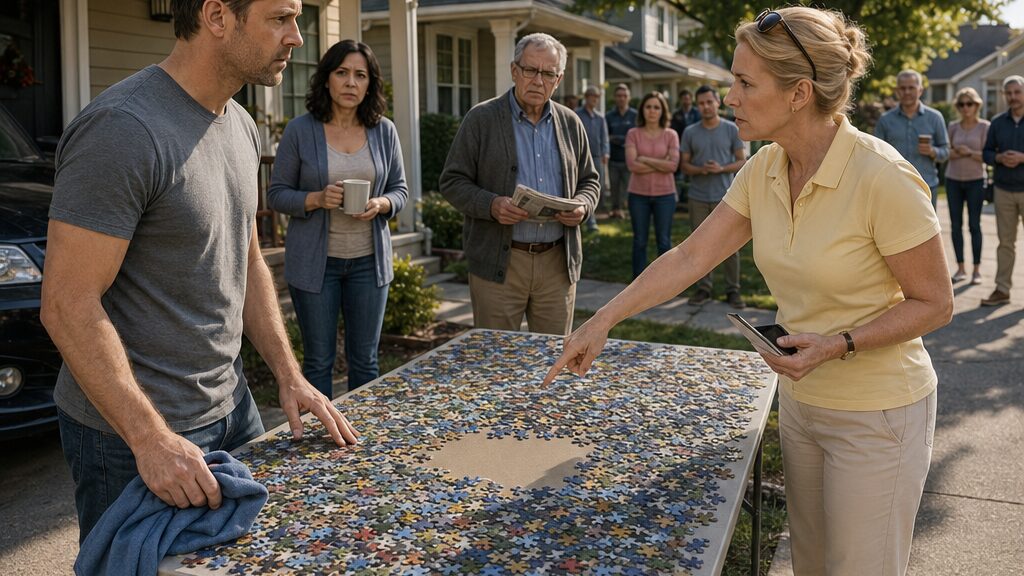
Nancy Clark pointed at the puzzle as if Gregory Hall had dragged a broken refrigerator onto the driveway and left it to rot.
“What is this supposed to be?” she asked.
Her sunglasses sat on top of her blond hair, and one hand rested on her hip while the other hovered over the folding table. The gesture was careful, almost theatrical, making sure she did not touch anything. Gregory stood on the other side of the table with a cardboard puzzle box tucked under his arm, watching her shadow fall across the unfinished center.
“It’s a puzzle,” he said.
“I can see that it’s a puzzle.”
Her tone turned the word into something worse. Across the street, a garage door paused halfway up. Two houses down, someone’s sprinkler ticked in a neat green arc over a lawn that had never given the HOA a reason to comment. Gregory could feel the neighborhood noticing. It happened in small ways: a curtain shifted, a dog stopped barking, a car slowed a little too much at the corner.
Nancy looked down at the hundreds of interlocked pieces spread across the table. The image was not complete yet, only bright fragments of porches, maple trees, little painted windows, and a white shape in the center where the last section had not been built. Around the edge, loose pieces sat in shallow paper plates, sorted by color the way Maria used to do when she still had the patience to sit outside for hours.
Gregory moved one plate away from Nancy’s sleeve.
“It’ll be gone soon,” he said.
“That’s not the point.” Nancy straightened. “Outdoor driveways are not recreation rooms. You can’t just set up a game table in full view of the street.”
“It isn’t a game table.”
“It has a game on it.”
He closed his mouth.
That was his mistake. He knew it even as he made it. Silence had become a habit in the eight months since Maria died, and habits were hard to break in front of women like Nancy Clark, who carried a clipboard as if the whole street might collapse without it.
Nancy glanced toward the open garage, then at the table legs, then at the folded blue cloth draped across one chair. Her eyes moved the way they did during compliance walks, calculating whether something could become a paragraph in an email.
“You know the guidelines,” she said. “No temporary structures in driveways. No unsightly items visible from the street. No personal displays without approval.”
Gregory gave a small, humorless breath. “It’s a puzzle.”
“It’s clutter.”
“It’s not clutter.”
“Gregory.” She made his name sound like a warning. “This neighborhood has rules for a reason.”
Behind her, the front door of the Rivera house opened a crack. Melissa Rivera stepped onto her porch holding a coffee mug, then stopped as soon as she saw Nancy. Gregory noticed her noticing the puzzle. She had passed it twice that morning and had politely pretended not to stare.
Nancy noticed her too.
That made her voice firmer.
“I’m going to ask you to take it inside.”
“I can’t.”
The answer came out too fast.
Nancy’s face shifted. Not much, only a slight tightening at the corners of her mouth, but Gregory saw it. To her, “I can’t” meant defiance. To Gregory, it meant the puzzle was too wide, too fragile, too full of pieces Maria had touched before her hands began to tremble.
“You can,” Nancy said. “And you will.”
Gregory looked down at the empty space near the center. It was shaped like nothing yet, just a gap where several pieces still needed to come together. Maria had called that part the heart. He had laughed when she said it because it sounded like something painted on a craft-store sign. Now he could not look at it without feeling the air leave him.
“It was supposed to be finished before Saturday,” he said.
Nancy blinked. “What happens Saturday?”
Gregory looked toward the street instead of answering.
A delivery truck rolled by slowly, its driver glancing once at Nancy, once at Gregory, and then at the bright mess on the table. Gregory imagined the story already moving faster than the truck: Gregory Hall lost it, Gregory Hall built a puzzle shrine in his driveway, Gregory Hall is fighting with the HOA over a board game.
Nancy drew her phone from the back pocket of her pale pants.
“Don’t,” Gregory said.
“I’m documenting,” she said.
“For what?”
“For the file.”
“There’s a file now?”
“There will be if this continues.”
She stepped back far enough to get the table, the garage, and Gregory in the frame. The little camera click was soft, but Gregory felt it like a door shutting. He did not move. He did not raise his hand to block the picture. He did not explain that the table was Maria’s old craft table from the spare room, or that the puzzle box still had her handwriting on the side, or that Saturday would have been her birthday.
Nancy took another photo from an angle that made the table look larger, more intrusive. The puzzle pieces caught the morning light. One blue piece near the edge flashed like glass.
From the porch, Melissa shifted her weight. Gregory saw concern on her face, but she did not come down the steps. Joseph Anderson had appeared at the end of his driveway, one hand in the pocket of his cardigan, the other holding his morning paper. He did not speak either.
No one did. That was how the neighborhood worked. Noise traveled fast, but help moved carefully.
Nancy lowered the phone. “I don’t want this to become unpleasant.”
“It already is.”
Her jaw set. “Then let’s not make it worse.”
Gregory set the puzzle box on the chair beside him and picked up the blue cloth. It was the old one Maria used when she had to stop midway through a puzzle. She had always lowered it slowly, smoothing it over the pieces as if putting a child to bed. Gregory had done the same every night that week. This time his hands were clumsy.
Nancy watched him cover the puzzle.
“Thank you,” she said, too quickly.
He kept one hand pressed on the cloth where the empty center would be. “I’m covering it. I’m not moving it.”
“That’s not sufficient.”
“It’s what I’m doing.”
“You don’t get to decide that.”
Gregory looked up then. For the first time since she had walked onto his driveway, he let her see that she had reached something harder than embarrassment.
Nancy’s expression flickered, not with fear, but with offense. She was used to people complaining after they obeyed. She was less used to quiet refusal.
“Gregory, I’m trying to handle this informally.”
“No,” he said. “You’re trying to make it small enough to throw away.”
The words surprised him. They seemed to surprise Nancy too.
She looked past him into the garage, where the empty wall hooks still held Maria’s gardening gloves and sun hat. He shifted slightly without meaning to, blocking her view.
Nancy put her phone away.
“I’ll notify the board,” she said. “You’ll receive a formal notice by noon. If the table is still visible after the deadline, fines may apply.”
Melissa’s porch door opened wider. Joseph lowered his paper.
Gregory nodded once. “Do what you need to do.”
Nancy turned to leave, then stopped beside the table. For a second, her gaze rested on the covered shape, and Gregory thought she might ask the question she should have asked at the beginning.
Instead, she said, “This is exactly how standards slip.”
She walked down the driveway with the brisk steps of someone who believed being watched meant she had won. Gregory stood behind the covered puzzle until her car door closed and the engine started. Only then did he let his fingers curl into the cloth.
The blue fabric shifted, and a single loose puzzle piece slid from the edge of the table onto the driveway.
It landed faceup near his shoe.
A painted chair. Empty.
Gregory bent to pick it up, but before he could, Nancy’s window rolled down at the curb.
“By noon, Gregory,” she called. “The board will issue the notice by noon.”
Chapter 2: The Notice Taped Beside the Missing Piece
The notice was taped to the porch column beside Maria’s flowerpot, so close to the dead lavender stems that Gregory almost tore them both away together.
He stood on the top step with the envelope in his hand while the tape fluttered against the white paint. It was 12:17 p.m. Nancy had either printed it before the confrontation or moved faster than grief allowed decent people to move. The HOA logo sat at the top, clean and blue, above the words Courtesy Compliance Notice.
Courtesy. He almost laughed.
The folding table remained in the driveway, covered in Maria’s blue cloth. From the porch, it looked less like clutter and more like a body someone had not yet carried inside.
Gregory opened the envelope.
Temporary recreational setup visible from street. Possible unsightly display. Please remove from driveway or relocate to approved enclosed area by 9:00 a.m. Saturday to avoid further action.
Further action.
He read the words twice, then folded the notice into a smaller and smaller square until the paper resisted. The lavender pot sat at his elbow, dry soil cracked away from the ceramic sides. Maria had planted it the first spring after they moved in. She said lavender was stubborn if you stopped fussing over it. He had stopped fussing over everything.
“Gregory?”
Melissa Rivera stood at the bottom of his porch steps, one hand wrapped around a travel mug, the other tucked into the pocket of her cardigan. She looked at the notice in his hand and then at the table.
“Bad time?” she asked.
He almost said yes. That had become the easiest word after Maria died. Yes, bad time. Yes, maybe later. Yes, I’m fine, but not today. Instead he slid the notice into his back pocket.
“It’s fine.”
Melissa climbed one step and stopped, careful not to come too close. She worked part-time at the town library and had the habit of lowering her voice around other people’s private pain, as if grief were a reading room.
“I saw Nancy this morning,” she said.
“Everyone saw Nancy this morning.”
A small flush crossed her face. “I should have come over.”
“You didn’t have to.”
“I know. That’s usually what people say when they wish someone had.”
Gregory looked away first.
Melissa’s gaze moved to the covered table. “Is that Maria’s?”
His hand tightened around the porch rail.
“She had a lot of puzzles.”
“I remember.” Melissa gave a faint smile. “She used to bring them to the library swap. Always took the ones with too many trees because she said people gave up on trees too quickly.”
Gregory could hear Maria saying it. Not clearly, not as a ghost or a memory with perfect edges, but in the blurred way that hurt more because it almost came back whole.
He stepped off the porch. “This one was different.”
Melissa followed him down the walkway but stopped at the driveway’s edge, as though the concrete had become a boundary. Gregory lifted one corner of the blue cloth. The unfinished puzzle waited underneath, half-neighborhood, half-chaos. The empty space near the center looked larger than it had that morning.
Melissa leaned in.
“Oh,” she said softly.
“What?”
“I’ve seen this.”
Gregory stilled. “Where?”
“Not finished. Just—pieces of it. Maria showed me a sketch once at the library.” Melissa pointed without touching. “That’s the clubhouse roof, isn’t it? And there’s the mail kiosk. That’s Joseph’s porch swing.”
Gregory uncovered more of the table despite himself. “She painted the picture first. Sent it off to one of those custom puzzle companies.”
“She made the neighborhood into a puzzle?”
“Her version of it.”
Melissa looked at the tiny painted houses, the paths, the flowerbeds brighter than they were in real life. “She made it kinder.”
Gregory almost covered it again.
Instead, he reached into his shirt pocket and took out the small brown envelope he had carried since morning. He opened it with his thumb. Inside lay the piece that had fallen by his shoe after Nancy left: the painted empty chair. Maria had written one word on the back in fine black pen.
Start.
Melissa saw it before he could close his hand.
“She wrote on them?”
“Some.”
“How many?”
“I don’t know.”
That was not entirely true. He knew there were more. He knew because, after the funeral, he had found the puzzle box in the hall closet with a rubber band around a stack of envelopes and a note on top that read Saturday, if I don’t get bossy and do it myself first. He had put the envelopes in the kitchen drawer beneath the takeout menus. He had told himself he would look at them when he was ready.
He had not been ready for eight months.
Melissa studied his face. “Gregory, why was it supposed to be finished before Saturday?”
He slid the piece back into the envelope. “It just was.”
“Saturday is Maria’s birthday, isn’t it?”
The question was gentle, which made it harder to dodge.
He nodded once.
Melissa pressed her lips together. “She mentioned something last winter. A puzzle night, maybe. I thought she was just being Maria.”
“Meaning what?”
“Meaning she had plans even when she was tired. Especially then.”
Gregory covered the puzzle again, more sharply than he meant to. A few loose pieces jumped under the cloth.
Melissa did not flinch, but she stepped back. “I’m sorry.”
“No. I’m sorry.” He rubbed both hands over his face. “Nancy’s right about one thing. It probably shouldn’t be in the driveway.”
“Nancy is right about rules the way a smoke alarm is right about toast.”
Despite himself, Gregory almost smiled.
Melissa looked toward the HOA notice peeking from his pocket. “The community room is empty tomorrow morning until two. I can ask the volunteer coordinator.”
“No.”
“You don’t even know what I’m suggesting.”
“I know.”
“Then let me suggest it anyway.”
He turned toward the garage. “It was Maria’s thing.”
“Maybe that’s why you shouldn’t be the only one carrying it.”
The words hit too close. Gregory walked into the garage and busied himself with nothing, lifting a box, setting it down, moving a coil of extension cord from one shelf to another. Melissa stayed where she was.
After a moment, she said, “Did she invite anyone?”
Gregory stopped.
The garage smelled of cardboard, grass clippings, and the faint dry scent of potting soil. Against the far wall, Maria’s old craft shelves still held jars of buttons, fabric scraps, glue sticks hardened at the caps. The kitchen door stood open beyond them.
Melissa’s voice came softer. “Gregory?”
He went inside without answering.
The kitchen had not changed enough. That was the problem. Her mug still hung from the second hook because he could not stand seeing it in a cabinet. Her handwriting still labeled a jar of tea she had not lived long enough to finish. The drawer beside the stove stuck halfway when he pulled it, the same way it always had.
Under the takeout menus, under a roll of tape, under a stack of unused thank-you cards from the funeral, he found the rubber-banded bundle.
Cream envelopes. Ten of them. Maybe twelve.
Maria’s handwriting across the top one:
For the neighbors who forgot they were neighbors.
Gregory stood with the drawer open and the envelopes in his hand as Melissa’s shadow reached the kitchen doorway behind him.
Chapter 3: The Neighbors Who Were Never Invited
Joseph Anderson arrived at sunset holding a puzzle piece in his palm like he had found a tooth.
“I don’t know if this is yours,” he said, standing at the edge of Gregory’s driveway, “but it was under my welcome mat.”
Gregory had just finished retaping the blue cloth against the evening breeze. He had told himself he was protecting the puzzle from dust, not hiding it from the street. The difference had stopped mattering around the time a second car slowed in front of the house and the driver pretended to check an address.
Joseph extended his hand.
The piece was mostly green, with a stripe of brown and a corner of painted white. Gregory did not need to turn it over to know Maria had written something on the back. His fingers hesitated before taking it.
“Was it in an envelope?” he asked.
Joseph nodded. “Cream envelope. My name on it. Her handwriting.”
Melissa, who had come back with a plastic container of soup Gregory had not asked for, stood beside the porch steps. She looked from Joseph to Gregory with the careful expression of someone watching a door begin to open.
Gregory turned the piece over.
Sit a while.
Two words. Maria’s script. No explanation.
Joseph gave a dry little laugh. “That sounds like her.”
Gregory swallowed. “When did she give this to you?”
“She didn’t. That’s the thing.” Joseph looked back across the street toward his porch. “I found it this afternoon after Melissa called to ask if Maria ever mentioned a puzzle night. I went to look for an old note from her and saw the envelope tucked under the mat. Must’ve been there a long time.”
“That’s impossible.”
“Probably not. I don’t use the front door much.”
Gregory stared at the piece until the green blurred. The picture on it was Joseph’s lawn, he realized, and the brown stripe was the edge of his porch swing. Maria had painted him into the puzzle. Not just his house. Him, in a way: the place he sat alone every evening after his wife went into assisted living.
“She told me once,” Joseph said, “that neighborhoods had too many closed doors for places with so many windows.”
Melissa’s eyes shone, but she busied herself with the soup container.
Gregory walked to the table and lifted the cloth. “It goes somewhere near the left side.”
Joseph stepped closer, then stopped. “You sure?”
No. He was not sure.
Maria had been particular about puzzles. She sorted edges first, then colors, then what she called “obvious lies”—pieces that looked like sky but belonged in water, pieces that looked like leaves but were actually shadows. She would have hated people forcing pieces into the wrong place.
But Joseph was watching him with an old man’s restrained hope, and Melissa was pretending not to hold her breath.
Gregory moved one paper plate aside. “Try.”
Joseph placed the piece near the left side of the puzzle, turned it once, then again. It clicked into a gap beside the painted porch swing.
No one spoke for a moment.
The click had been tiny. Plastic against cardboard. A sound almost too small for the weight it carried.
Melissa let out the breath she had been holding. “Maria planned this.”
Gregory covered his mouth with his hand.
“She planned this,” Melissa repeated, not as a question this time.
From the sidewalk came a child’s voice. “Is that the puzzle Mrs. Hall made?”
Gregory looked up.
Two children had stopped with their bikes at the curb, helmets crooked, curiosity unfiltered. Behind them, a neighbor stood with a reusable grocery bag against her hip. A man from the next block lingered near the mailboxes, pretending to sort through envelopes.
Gregory felt the driveway shrinking around him.
“Go on home,” the grocery-bag neighbor told the children, but she did not move either.
One of the children dug into the pouch of his hoodie. “My mom said not to bother you, but we got one too.”
Gregory’s chest tightened.
The child pulled out a cream envelope, bent at one corner. No name on the outside, only a small drawing of a bicycle in Maria’s hand.
Melissa took one step toward him. “Gregory.”
He wanted to say no. He wanted to fold the table, carry it into the garage, shut the door, and keep Maria’s strange, generous plan from becoming another thing people discussed while watering lawns. He wanted to be angry with her for this. For giving away pieces. For knowing him well enough to know he would hide the invitations and still finding a way around him.
The child held out the envelope.
Gregory took it.
Inside was a piece of painted sidewalk and a few words on the back.
Keep going.
He looked toward the kitchen window, where the drawer still hung open inside.
More neighbors came in the next half hour, not as a crowd at first but in embarrassed little arrivals. Someone had found an envelope taped to the underside of a mailbox shelf. Someone else had one tucked inside a Christmas cookie tin Maria had returned with fudge. A delivery driver stopped at the curb and handed Gregory a piece Maria had once asked him to “deliver back to the neighborhood” if she forgot.
“She gave it to me months ago,” he said, rubbing the back of his neck. “I thought it was just one of those things people do when they’re sick and trying to stay cheerful.”
Gregory did not know where to put his hands. Every new piece felt like evidence against him and mercy at the same time.
Melissa helped sort the arrivals by color. Joseph sat in a folding chair and read the backs aloud only when Gregory nodded. Some were simple.
Bring cookies.
Wave first.
Ask twice.
One made Melissa press her fingers to her mouth.
Don’t let Gregory say he’s fine too quickly.
Joseph looked at him when he read that one, and Gregory had to turn away.
By dusk, the puzzle had grown visibly. The left side of the neighborhood had filled in. Porches connected to sidewalks. Trees connected to driveways. The empty center remained, but it no longer looked like a wound. It looked like a place waiting for something.
Then Gregory saw Nancy Clark standing across the street.
She had not approached. She stood beside her car with her phone in one hand, watching the neighbors gathered around his driveway. Her face was unreadable from that distance, but her posture was not. Straight back. Chin lifted. Shoulders squared against embarrassment.
Melissa saw her too. “Maybe I should talk to her.”
“No,” Gregory said.
“You don’t have to do this alone.”
“That’s what everyone keeps saying.”
“And you keep hearing it like an accusation.”
Gregory looked at her then. Melissa did not soften the words by smiling.
Before he could answer, Nancy raised her phone. Not to take a picture this time, he thought. Her thumbs moved quickly over the screen.
A moment later, Melissa’s own phone buzzed. She glanced down and went still.
“What?” Gregory asked.
She turned the screen toward him.
An email from the HOA board notification list had already gone out.
Unauthorized gathering in visible driveway. Possible violation escalation pending emergency review.
Gregory looked across the street.
Nancy lowered her phone, got into her car, and drove away before anyone could ask what she had just started.
Chapter 4: The Board Meeting Where Order Sounded Like Fear
Nancy projected the photograph of Gregory’s puzzle onto the clubhouse wall so large that the unfinished center looked like a hole punched through the room.
The board members sat around the long folding table beneath it, coffee cups lined up beside printed agendas. Someone had dimmed the lights for the screen, which made everyone’s face look flatter, more official, less like neighbors who waved from driveways and more like people deciding whether a person belonged.
Gregory stood near the back with his hands in his jacket pockets.
He had not planned to come. The email had said emergency review, which sounded both ridiculous and serious enough to pull him out of his kitchen before he could talk himself into staying home. Melissa sat two rows ahead, her shoulders tense. Joseph had come too, though he had taken a chair near the aisle as if giving himself an easy escape.
Nancy stood beside the screen with her clipboard held against her ribs.
“As you can see,” she said, “the resident was advised verbally this morning. A courtesy notice was issued. The item remained visible, and by evening, the situation escalated into a gathering.”
A board member cleared his throat. “A gathering around the puzzle?”
Nancy’s mouth tightened. “Around an unapproved driveway setup.”
Gregory looked at the photograph. He was in it, half-turned away, one hand on the blue cloth. The picture had caught him at the worst possible second, face drawn, shoulders hunched, looking less like a homeowner than a man refusing a reasonable request.
Nancy clicked to the next slide.
Another photograph appeared. This one showed neighbors near the table at sunset. Joseph was seated. Melissa leaned over a paper plate of pieces. A child’s bike lay on its side at the curb. The image looked warm if you knew what you were seeing. It looked like an accusation if you wanted it to.
“There are liability concerns,” Nancy said. “Sidewalk obstruction concerns. Precedent concerns. We’ve had several complaints this year about inconsistent enforcement. If we ignore this, the next resident will ask why their inflatable arch, yard sale table, or political display is different.”
“It’s a puzzle,” Joseph said from the aisle.
Nancy turned toward him. “Mr. Anderson, I understand that people may feel attached to certain items. That doesn’t change the covenants.”
Gregory felt Melissa look back at him. He kept his eyes on the screen.
The HOA president, a tired-looking man with reading glasses low on his nose, turned a page. “Gregory, do you want to respond?”
Every head shifted.
Gregory stepped forward because remaining near the wall suddenly felt worse. “It’ll be gone from the driveway by morning.”
Nancy’s expression eased, almost triumphantly.
“But I’d like to use the community room tomorrow,” he added.
Nancy’s head turned sharply. “That wasn’t submitted through the proper request process.”
Melissa stood before Gregory could answer. “Maria submitted one.”
The room changed.
Not loudly. No one gasped. No one made a speech. But chairs creaked. Pens stopped moving. Nancy’s eyes cut to Melissa, then away.
The HOA president frowned. “Maria Hall?”
“Maria Sanchez,” Melissa said. “Gregory’s wife. She asked me about the community room last winter when I was helping with the library book exchange. She said she wanted to host a neighborhood puzzle afternoon on her birthday.”
Gregory stared at the carpet. He had not known Melissa knew the date. He had not known Maria had spoken to her about the room. He had not known there were more ways to fail someone after they were gone.
Nancy set her clipboard on the table. “I don’t recall an approved reservation.”
“I didn’t say it was approved,” Melissa said.
The words landed carefully, but they landed.
One board member flipped through a folder. “Was there a request?”
Nancy reached for the folder before he could pass it down. “There were many informal suggestions last year. Not all of them were actionable.”
Gregory looked up.
Nancy was not looking at him. She was looking at the folder, at the table, at anything that did not have Maria’s name attached to it.
“What does that mean?” he asked.
The HOA president adjusted his glasses. “Let’s keep this orderly.”
Orderly. The word made Gregory’s pulse rise.
Melissa turned halfway toward him, her face apologetic, but she continued. “Maria wanted to reserve the room because she was worried about the driveway being too small. She told me she had asked Nancy about whether it needed approval.”
Nancy’s voice sharpened. “She asked in passing. At the mail kiosk. That is not a request.”
“She was sick,” Melissa said.
“And I did not know the details of her health.” Nancy’s hand pressed flat against the folder. “I told her the room required forms, deposit, supervision, and board review, the same as everyone else. That was not unkind. That was the procedure.”
For the first time that night, Gregory saw something under Nancy’s clipped certainty. Not guilt exactly. More like fear of being assigned guilt by people who had already decided she deserved it.
He hated that he noticed. It would have been easier if she were only cruel.
“You could have told her how to file it,” Joseph said.
Nancy turned on him. “I tell everyone how to file things. People hear what they want to hear.”
Gregory stepped closer to the table. “Did she ask you?”
Nancy’s mouth opened, then closed.
The HOA president looked between them. “Nancy?”
“She mentioned an idea,” Nancy said. “A neighborhood puzzle event. I told her outdoor displays weren’t appropriate and that the clubhouse calendar was full until reviewed. I also told her we could revisit it once she had a date and a volunteer sponsor.”
“She had a date,” Gregory said.
Nancy finally looked at him.
He did not say birthday. He would not put that word on the table for them to sort and weigh and vote on. Not yet.
The board member with the folder found a paper and slid it free. “There’s a note here. Community room inquiry. Puzzle social. Sponsor pending.”
Melissa sat down slowly.
Nancy’s face stayed still, but her neck flushed.
The HOA president sighed. “This is getting more personal than compliance.”
“It was personal before you printed it,” Gregory said.
The room went quiet enough for the projector fan to become loud.
He regretted the words at once. Not because they were false, but because they had escaped without discipline. He had come intending to protect Maria’s name from becoming a weapon. Now he had made the board look at Nancy as if she had done exactly that.
Nancy recovered first. “We still have to address the visible violation.”
A board member nodded reluctantly. “Maybe there’s a compromise. The driveway table comes down by morning. The puzzle can be completed in the community room tomorrow during open hours. No advertising. No obstruction. No food service unless already approved.”
Melissa looked back at Gregory, asking without words.
He imagined lifting the puzzle from the table, sliding cardboard beneath it, trusting other hands to carry what he had not trusted anyone even to see. He imagined the empty driveway Saturday morning. Maria’s birthday with no table in the sun.
Then he imagined Nancy’s photographs becoming the only record of it.
“Fine,” he said. “I’ll move it.”
Nancy gathered her papers too quickly. “And the notice remains pending until the driveway is clear.”
The president hesitated, then nodded. “Pending. Not escalated.”
Gregory turned to leave before his face gave away too much. At the door, he stopped.
“Nancy.”
She looked up from her clipboard.
He should have walked out. He should have let the compromise hold. Instead, the question that had been pressing against his teeth since Melissa spoke finally came out.
“Do you remember telling Maria no?”
Nancy’s fingers tightened around the papers.
Behind Gregory, no one moved.
Nancy looked at him across the dim clubhouse, her face pale in the projector light, and for one second he saw that she remembered more than she wanted the room to know.
Chapter 5: The Covered Table That Drew Everyone Closer
Gregory uncovered the puzzle Saturday morning and found strangers holding pieces of Maria in their hands.
They stood inside the community center room under fluorescent lights, not quite talking, not quite silent. The folding table had survived the move from the driveway, though one leg wobbled unless Joseph wedged a folded napkin beneath it. Melissa had found extra chairs from the storage closet. Someone had brought a cardboard sign that said Puzzle Table, but Gregory had turned it facedown before anyone could tape it to the door.
He had slept badly, then woken before dawn to slide poster board under the puzzle in sections. Joseph helped without asking too many questions. Melissa carried the paper plates of sorted pieces in her car as if transporting evidence.
Now, at 9:08 a.m., the table was no longer his.
A neighbor he knew only by sight placed an envelope beside the blue pieces. A child dropped two pieces into a paper cup and whispered that Maria had told him they were “for later.” A community center volunteer stood near the kitchenette, watching with an expression that moved between confusion and tenderness.
Gregory kept one hand on the edge of the table.
Melissa noticed. “You can let go for a second.”
“I’m not holding it.”
“You are.”
He looked down. His knuckles were white against the wood.
He released the table.
Across from him, Joseph sorted through a small pile of green and brown pieces. “Maria was more organized than all of us put together,” he said.
Gregory tried to answer, but a woman stepped forward with an envelope before he could.
“She gave this to me after the holiday decoration meeting,” the neighbor said. “I thought it was a thank-you note. I put it in a drawer and forgot. I’m sorry.”
Gregory took the envelope. “You don’t have to apologize.”
The neighbor glanced at the puzzle. “Maybe I do.”
That was how the morning went. People arrived with embarrassment tucked under ordinary words. I found this in my glove compartment. She left this with the cookies. My daughter had one in her bike basket. I thought it was just Maria being sweet. I meant to come by after she passed. I didn’t know what to say.
Each piece entered the puzzle like a quiet confession.
Gregory wanted to resent them for waiting until now. He also knew he had waited longer.
Melissa placed a corner of sidewalk near the painted mail kiosk. “This one says ‘Ask twice.’”
Joseph looked at Gregory. “She knew you.”
“She knew everyone,” Gregory said.
“No,” Joseph said gently. “She paid attention. That’s different.”
Gregory had no defense against that.
By ten, the puzzle had taken on a shape that was impossible to dismiss. The neighborhood appeared from the chaos in bright, softened detail: porches without peeling paint, lawns without property lines, windows lit gold though the scene was daytime. Maria had painted people into the edges but never with faces clear enough to accuse anyone of being left out. A child on a bike. A man with a newspaper. A woman bending over flowers. A delivery truck at the curb. The community center itself near the center, with a long table visible through its painted windows.
Gregory stared at that window.
“She put this room in the puzzle,” he said.
Melissa leaned beside him. “She meant to finish it here.”
The small payoff hurt more than he expected. All week he had believed he was protecting her plan by keeping it on the driveway table. But Maria had drawn the community room at the heart of the picture. The driveway had been his substitute, not hers.
Joseph slid another piece into place. “She came by my porch in February,” he said. “Cold day. Had that red scarf on. She said if she asked you whether you were lonely, you’d fix a gutter or clean the garage until she stopped asking.”
Gregory looked at him sharply.
Joseph did not look away. “She said, ‘When the time comes, don’t let Gregory say he’s fine too quickly.’”
Melissa stilled.
Gregory’s first instinct was anger. It rose fast, hot and protective. Maria had no right to discuss him like that. Joseph had no right to carry that sentence into a public room. Everyone had no right to stand around a table made from his private wreckage.
Then he saw the puzzle piece in Joseph’s hand. The words on the back were not visible, but he knew Maria had written something there. She had distributed not just cardboard, but instructions for the parts of him she knew would go missing.
Gregory stepped away from the table.
Melissa followed him only as far as the side wall. “Too much?”
“Yes.”
“Do you want everyone to leave?”
He looked at the room. People were careful with the pieces. They spoke quietly. No one laughed too loudly or stared too long. A child held up a piece and waited for permission before placing it. Joseph sat with both hands folded over his cane, pretending he was not watching Gregory decide.
“No,” Gregory said. The word came out rough. “I just don’t know how to be in the room with it.”
Melissa nodded as if that made perfect sense. “Then just be in the room.”
The community center door opened hard enough to bump the wall.
Nancy Clark entered in a beige trench coat, her clipboard hugged against her side and her phone already in her hand. Her eyes went first to Gregory, then to the table, then to the number of people gathered around it.
“This,” she said, “is not what the board approved.”
No one answered.
The room had the stunned stillness of a classroom after a dropped tray. Nancy seemed to draw strength from it. She walked toward the table, heels clicking on the linoleum.
“The agreement was open hours, no event, no gathering, no food service.” She looked at a plate of store-bought cookies near the kitchenette. “And now there are refreshments.”
A child quietly moved the cookies behind a napkin holder.
Melissa stepped forward. “Nancy, people are returning pieces Maria gave them. That’s all.”
“This is exactly how people exploit exceptions.”
Gregory felt the table edge under his hand again though he did not remember reaching for it.
Nancy’s eyes dropped to the puzzle. For a moment, the complaint seemed ready to continue. Then she saw the cream envelopes lined along the side.
Each had a name. Some written in Maria’s hand, some added by neighbors who had found pieces without envelopes. Joseph. Melissa. The delivery driver. The child with the bicycle. Others.
Nancy’s face changed when she saw one near the center of the table.
It was unopened. Cream paper, softened at the corners, the flap still sealed.
Across the front, in Maria’s careful handwriting, was one name.
Nancy.
The clipboard lowered an inch.
Melissa looked from the envelope to Nancy. “She left one for you too.”
Nancy did not move.
Gregory picked up the envelope before he could think better of it. For eight months he had hidden the bundle. For one morning he had allowed other people to open what Maria had left them. But this one felt different. He held it out across the table.
Nancy stared at her name as if Maria had written it from the other side of an accusation.
Chapter 6: The Card Maria Wrote for the Woman Who Said No
Nancy read Maria’s card without sitting down, and by the second line her hand had stopped looking like it belonged to someone in charge.
Gregory stood across from her, close enough to see the small tremor in the paper. The room had pretended to return to the puzzle, but no one was fooled. Pieces hovered above plates. Conversations thinned. Even the children seemed to understand that the woman who had entered ready to shut everything down had opened something she could not cite or correct.
Nancy turned the card slightly away from the room.
Gregory did not ask to read it. He had forfeited that right when he hid the envelopes in the kitchen drawer. Still, he saw the first line because Maria had written in large, steady letters.
Nancy, I know you like things in their place.
Nancy’s mouth pressed tight.
She read on.
The silence stretched until the community center’s old refrigerator clicked on in the kitchenette. The sound made several people blink. Nancy folded the card once, then unfolded it immediately, as if closing it had burned her.
“This is private,” she said.
Gregory’s first response was cruel and immediate in his own mind. So was the notice taped to my porch. So were the photographs. So was Maria’s birthday until you put it in a board packet.
He did not say any of it.
“Then we can step into the side room,” he said.
Nancy looked surprised by the offer. Suspicious too. But she nodded once.
Melissa shifted as if to follow. Gregory gave her a small shake of his head. He needed no audience for this part. That was not mercy for Nancy. Not exactly. It was the last piece of restraint he could still claim.
The side room smelled of dry erase markers and stored chairs. A stack of folded tables leaned against one wall. Through the half-open blinds, Gregory could see the main room in broken stripes: Melissa helping a child, Joseph sitting very still, the puzzle waiting.
Nancy stood near the whiteboard with the card in her hand.
“She shouldn’t have written to me,” she said.
“Why?”
“Because I barely knew her.”
Gregory watched her avoid his eyes. “She knew you enough to write your name.”
Nancy let out a small breath. “You want me to say I was awful to her.”
“I want you to say what happened.”
“I told her the process.” Nancy’s voice sharpened, then faltered. “That’s what happened.”
“Was she alone?”
Nancy looked down.
That answered more than he wanted it to.
“She caught me after a board meeting,” Nancy said. “I had three people angry about holiday lights, one threatening to sue over a fence, and an email from a realtor saying buyers were asking whether the neighborhood had ‘lost consistency.’ That was the phrase. Lost consistency.”
Gregory said nothing.
“She had a folder,” Nancy continued. “Drawings, I think. A list of names. She said she wanted to do something simple in the community room. A puzzle afternoon. Coffee. Chairs. People could come and go.”
Nancy rubbed her thumb along the card’s edge.
“I told her simple things become complicated when no one manages them.”
The sentence sat between them.
Gregory could picture Maria standing near the clubhouse door, folder pressed to her chest, red scarf tucked under her chin. He could picture her smiling to make refusal easier for the other person. That was what hurt: Maria would have protected Nancy from the discomfort of rejecting her.
“She was sick,” Gregory said.
“I didn’t know how sick.”
“But you knew she was asking for help.”
Nancy’s eyes lifted then, and for once they were not hard. “I knew she was asking for an exception.”
There it was. The narrow little bridge Nancy had chosen to stand on.
Gregory leaned against the table behind him. “Why did Maria invite you?”
Nancy looked at the card. “She said…” Her voice thinned. She cleared it. “She said people think rules mean you don’t need anyone. She said that must get lonely.”
Gregory turned toward the window.
Nancy gave a short, wounded laugh with no humor in it. “Can you imagine? Your wife, dying, apparently, and still deciding the neighborhood compliance chair needed sympathy.”
“That sounds like her.”
“It felt insulting when I read it.”
“When you read it just now?”
Nancy’s silence sharpened.
Gregory looked back. “You’d seen it before?”
“No.” Too fast.
He waited.
Nancy’s hand moved to her purse, then stopped. “I didn’t open this envelope before today.”
“But?”
She closed her eyes briefly. “But she gave me something. Months ago. At the mail kiosk. A little envelope. I thought it was follow-up paperwork. I was late for an appointment. I put it in my purse and forgot.”
Gregory felt the room tilt slightly, not from shock but from the strange precision of Maria’s planning. “A puzzle piece?”
“I don’t know.”
“You don’t know?”
“I forgot it was there.”
Anger flared again, but it no longer had a clean target. Nancy had forgotten a piece. Gregory had hidden a dozen envelopes. The difference mattered, but not enough to let him stand above her.
He looked through the blinds at the puzzle. “I hid the cards.”
Nancy stared at him.
“The ones Maria left for everyone. I found them after the funeral. I told myself I’d give them out when I could do it properly.” He swallowed. “Then I told myself people had moved on. Then I told myself she wouldn’t want me making a scene.”
Nancy’s face shifted, some of its defensiveness giving way to recognition.
“The truth is,” Gregory said, “I wanted one thing of hers that didn’t belong to anybody else.”
The admission left him tired.
Nancy sank into one of the stacked chairs without seeming to notice she had done it. The card rested in her lap.
“She wrote that I should come even if I thought it was a bad idea,” Nancy said. “She said I could stand by the door and judge the folding chairs if I needed to.”
Despite everything, Gregory almost smiled.
“She also wrote,” Nancy said, and her voice caught with irritation at herself more than grief, “that someone would save me a corner piece because people like me need corners.”
“That also sounds like her.”
Nancy looked toward the main room. “I did say no.”
Gregory did not soften it. “Yes.”
“I thought I was keeping things from getting messy.”
“They got messy anyway.”
She nodded, barely.
From the main room came a murmur, then Melissa’s voice. “Gregory?”
He opened the side-room door.
Melissa stood beside the puzzle, holding both hands slightly apart as if afraid to touch anything. “We have a problem.”
Joseph sat behind her with the sorted plates spread before him. The puzzle was nearly complete now. Streets connected. Porches lined up. The community center window glowed at the center. Only one space remained open, a small irregular shape in the middle of the painted table inside the painted room.
“The last piece is missing,” Melissa said.
Gregory felt Nancy move behind him.
Joseph looked over at her purse.
Nancy followed his gaze slowly. Her hand went to the clasp as if acting on an instruction written long before any of them entered the room. She opened the purse, searched through receipts, keys, lipstick, folded papers, and finally drew out a small cream envelope, worn soft from months of being carried and ignored.
Her name was not on this one.
On the outside, Maria had written only one word.
Center.
Nancy held it out, but no one took it.
Her fingers shook as she opened the flap herself and tipped the final puzzle piece into her palm.
Chapter 7: The Last Piece Did Not Belong to Gregory Alone
The room waited while Gregory stared at the empty space in the center of Maria’s puzzle, and the final piece sat in Nancy Clark’s palm like something too small to cause this much silence.
No one reached for it.
Nancy held it between her thumb and forefinger, face pale, shoulders no longer squared in that boardroom way of hers. The piece showed a curved sliver of painted wood and a bit of blue shadow. Gregory knew where it belonged. Everyone knew. The center gap waited inside the painted community room, on the painted table Maria had placed at the heart of the neighborhood.
Joseph shifted in his chair. The sound of his cane tapping the floor made Nancy flinch.
Gregory looked at her hand. “You kept it.”
“I didn’t know I had it.”
“That’s not the same as not keeping it.”
Nancy absorbed that without answering.
Melissa stood near the end of the table, arms folded loosely, watching Gregory more than Nancy. He understood the look. She was afraid he would snatch the piece, finish the puzzle himself, and call that justice. Part of him wanted to. A mean, clean part. The part that had found the envelopes after the funeral and decided Maria’s last plan belonged in a drawer until he could bear it.
Nancy took one step toward him. “I’ll withdraw the violation.”
A murmur moved through the room.
Gregory lifted his eyes from the piece to her face.
Nancy swallowed. “The notice. The pending escalation. I’ll send the email before I leave. I’ll tell the board the matter has been resolved.”
The offer should have felt like victory. Yesterday morning, Gregory would have wanted nothing more than for Nancy Clark to back off and take her official language with her. But now the sentence sounded too small. Resolved. As if the issue had been the table. As if a withdrawn notice could untangle Maria’s handwriting from all the hands in the room.
“That’s not enough,” he said.
Nancy stiffened, but only for a second. “What do you want?”
The room leaned toward the question without moving.
Gregory looked around the table. The neighbors who had come with envelopes now stood close together, no longer strangers pretending not to be involved. The child with the bike helmet had both hands on the back of a chair. The delivery driver lingered near the doorway, cap in hand, shift forgotten or risked. Joseph watched with the tired patience of a man who had spent a lifetime waiting for people to say the true thing instead of the safe thing.
Gregory placed both hands on the table.
“I need to say why she made it.”
No one spoke.
He had imagined this moment badly, if he had imagined it at all. In his fear, speaking about Maria in public had always meant losing her to other people’s versions of her—neighborly Maria, brave Maria, cheerful Maria, poor Maria. He had guarded the fuller truth by refusing all of it.
But the puzzle on the table had already made his privacy dishonest.
“She started painting it last winter,” he said. “Before the custom company made it into pieces. She told me she wanted a picture of the neighborhood as it ought to be.”
Melissa lowered her eyes.
Gregory touched the edge of the puzzle. “Not perfect. She hated perfect. She said perfect was just lonely with better landscaping.”
A few people gave soft, surprised laughs. The sound loosened something in him.
“She put everyone in it without making anyone obvious. Joseph’s porch swing. Melissa’s library tote on the clubhouse chair. The delivery truck at the curb. The kids’ bikes. The mailboxes. The room we’re standing in.” He pointed to the center. “She wanted people to come here on her birthday and help finish it. Not because she needed a party. Because she knew I wouldn’t ask anyone for help after she was gone.”
His voice thinned at the last word.
He stopped, jaw tight, until the room steadied.
“I found the invitations after the funeral,” he said. “I hid them.”
Melissa’s face changed, but she did not interrupt.
“I told myself I was waiting for the right time. Then I told myself it would hurt people. Then I told myself no one would come.” His hand moved toward the cream envelopes stacked at the corner of the table. “The truth is uglier than that. I didn’t want to share the last thing she left unfinished. I wanted to be the only one with a claim to it.”
Joseph’s eyes shone behind his glasses.
Gregory looked at Nancy then. “You were wrong yesterday. You were wrong today. But I was wrong first.”
Nancy’s hand closed around the puzzle piece.
“No,” she said quietly. “That doesn’t erase what I did.”
“It doesn’t.”
“I made it a violation because that was easier than wondering why it mattered.”
Gregory nodded once.
Nancy turned toward the room. Her posture tried to straighten by old instinct, then failed. She set her clipboard on an empty chair as if putting down a shield.
“I owe all of you an apology,” she said.
The words were formal at first, but the room did not let her hide inside them. No one nodded too quickly. No one rescued her.
Nancy looked at Melissa. “I treated Maria’s request like a nuisance before I understood it. And after I did understand some of it, I still treated Gregory’s table like a problem to solve instead of a question to ask.”
Her gaze moved to Joseph, then to the children, then to the neighbors by the wall.
“I told myself I was protecting standards. Some of that was true. This neighborhood does need rules. But I also didn’t want another event I would have to manage, another exception someone would blame me for, another chance to be told I was doing the job wrong.” She drew a breath that shook. “That was my fear. Not Maria’s fault. Not Gregory’s. Not yours.”
The room remained quiet, but the silence had changed. It no longer pressed. It held.
Nancy turned to Gregory last.
“I’m sorry I photographed your grief and called it clutter.”
Gregory looked away.
That sentence got under the skin more cleanly than all the others. He pressed his thumb against the puzzle’s edge, feeling the raised line where two pieces joined.
Maria would have hated this part and loved it. She would have thought everyone was being too stiff. She would have told Nancy to put the piece down before they all turned into a committee.
Gregory almost heard her: For heaven’s sake, Greg, let the woman have her corner. Even if it isn’t a corner.
He looked at Nancy’s hand. “You can place it.”
Nancy’s eyes widened.
“But not because the notice is withdrawn,” he said. “And not because it makes everything fine.”
“I know.”
“Place it because she gave it to you.”
Nancy nodded.
She stepped to the center of the table. People shifted back to make room, but Gregory stayed beside her. He did not help. He did not touch her wrist or guide the piece into place. This was not forgiveness made easy for an audience. It was a task Maria had assigned badly, perfectly, impossibly.
Nancy bent over the puzzle.
The piece did not fit on the first try. She turned it once, cheeks flushing as several people held their breath. The child with the bike helmet whispered, “Other way,” and then clapped a hand over his own mouth.
Nancy gave a tiny laugh, broken and embarrassed. She turned it again.
The piece slid into the center with a clean, soft click.
For one second, no one reacted.
Then the completed picture seemed to appear all at once. Not a subdivision. Not a map. A table.
Maria had painted the whole neighborhood as if every street, porch, sidewalk, yard, and driveway were connected to one long table running through the community center and out into the open air. Chairs appeared everywhere: under trees, beside mailboxes, near garages, at kitchen windows. Some chairs were occupied. Some were empty. At the very center, where Nancy’s piece had gone, was a blue chair pulled slightly back from the painted table, waiting.
Gregory recognized it.
The chair from his driveway. The empty one from the piece that had fallen by his shoe.
A sound moved through the room—not applause yet, but breath returning. Melissa covered her mouth. Joseph bowed his head. The child leaned so far over the table that his mother caught his shirt.
Then people began to clap.
It was not loud at first. It built awkwardly, neighbor by neighbor, until the room filled with hands striking hands, relief and grief and embarrassment all mixed together. Nancy stood beside the table, crying silently in a way that looked like it irritated her. Gregory did not clap. He could not. He looked at the blue chair Maria had hidden in the center and understood the last part of her plan.
She had not made the empty chair for herself.
She had made it for whoever needed room.
Melissa came to stand beside him. “Gregory.”
“I see it,” he said.
Nancy wiped her cheek with the heel of her hand. “I’ll send the email now.”
Gregory looked at the completed puzzle, then at the people around it. “Send it later.”
Nancy hesitated.
“Stay,” he said.
She did not deserve the kindness entirely. He did not give it entirely. But Maria had left a chair in the middle, and he was tired of arguing with her after she was gone.
Nancy sat down near the edge of the room, not at the table yet, but not by the door either.
The applause faded. People began leaning over the finished image, pointing out places they recognized. The child found his bicycle. The delivery driver laughed when someone spotted the painted truck. Joseph touched the porch swing with one finger and then pulled his hand back quickly.
Gregory stood at the center of it, no longer guarding the puzzle, no longer owning it.
At the heart of Maria’s painted neighborhood, the blue chair waited with its back turned slightly toward the next person who might need to sit.
Chapter 8: The Driveway Stayed Empty, But the Table Stayed Open
Gregory folded the empty driveway table one week later and nearly carried it into the garage for good.
The metal legs snapped shut with a sound that made the quiet Saturday morning feel decided. No puzzle lay across the surface. No paper plates. No blue cloth. The driveway looked the way Nancy Clark had wanted it to look: clear, clean, unremarkable from the street.
Gregory stood with one hand on the folded table and one hand on the garage door frame.
Inside, the wall hooks still held Maria’s gardening gloves and sun hat. The completed puzzle was not there. It had been mounted under glass and hung in the community center lobby two days earlier, after three volunteers, Joseph, Melissa, and the delivery driver argued gently over whether the frame was level. Beneath it, someone had placed a small card: Made by Maria Sanchez Hall and completed by her neighbors.
Gregory had stared at the card for a long time, surprised by the way his wife’s two names sat together. Maria Sanchez Hall. The woman before him, the woman with him, the woman beyond him. All of her in one line.
Now the driveway was empty, and he did not know whether that meant he had healed or surrendered.
He lifted the table.
“Planning to hide that before I can object?”
Gregory turned.
Nancy stood at the curb without a clipboard.
The absence of it was so noticeable that he looked at both her hands before looking at her face. She wore jeans and a navy sweater, not compliance-walk clothes. Her sunglasses were pushed up into her hair, but her posture was less sharp, as if she had arrived without armor and was still learning how to stand.
Gregory set the table down. “I thought Saturday mornings were for violations.”
“They are. I’m violating my own routine.”
He did not smile, but the corner of his mouth moved. “That must be serious.”
“It is.”
Nancy walked up the driveway, stopping at the place where she had stood a week earlier pointing at Maria’s puzzle. She looked toward the porch column, then the flowerpot. The dead lavender was gone. Melissa had brought a new plant on Monday and left it without a note. Gregory had planted it because not planting it would have required explaining too much.
Nancy noticed. “Looks better.”
“Don’t make that official.”
“I won’t.”
An awkward silence passed between them, but it did not have the old shape. It was not accusation. It was simply two people who had not yet learned the new distance.
Nancy took a folded paper from her back pocket.
Gregory’s shoulders tightened before he could stop them.
She saw it. “Not a notice.”
“What is it?”
“A draft.”
That was not as comforting as she seemed to think.
She handed it to him. The HOA logo sat at the top, but beneath it the language was different from the old warning. Community Use Clarification. Temporary tables may be permitted in driveways or common rooms for neighbor gatherings, memorial activities, educational activities, or community projects, provided access remains clear and the setup is removed by agreed time.
Gregory read it twice.
“It’s not approved yet,” Nancy said. “The board still has to vote. Someone will complain that it’s vague. Someone will say it invites garage sales every weekend. Someone will ask who decides what counts as community.”
“Who does?”
Nancy looked at the folded table. “Maybe that’s the part we have to stop pretending rules can answer by themselves.”
Gregory handed the paper back. “That sounds dangerous coming from you.”
“I know. I may need supervision.”
This time he did smile, barely.
Nancy folded the draft along its old crease. “I also wanted to ask where the next puzzle should go.”
“The next puzzle?”
“At the community center, probably. Unless the driveway is approved.” She looked almost annoyed with herself. “People have been asking.”
“People?”
“Melissa. Joseph. The children. The delivery driver, actually. He said he can’t come every week, but he wants to know if there will be cookies again.”
Gregory looked toward the street. The neighborhood sat in ordinary Saturday pieces: garage doors up, a mower starting, someone rinsing a car, a child’s bike abandoned on a lawn. It looked the same as it had before Maria’s puzzle. It did not feel the same.
“I don’t have another one,” he said.
Nancy reached into the canvas tote hanging from her shoulder and pulled out a blank puzzle board, still wrapped in plastic. Not a printed puzzle. Just a plain board of interlocking white pieces waiting for an image.
“I found this online,” she said. “It’s probably the wrong kind.”
Gregory stared at it.
“For people to draw on,” Nancy added, suddenly too brisk. “Or write on. Or not. It was just an idea. A badly formed one. I’m told those can be revisited with proper sponsorship.”
He took the board carefully.
The white surface caught the morning light. Empty pieces. No picture yet. No instructions on the back. No handwriting telling anyone where to stand or what to forgive.
That frightened him more than Maria’s puzzle had.
“With Maria’s,” he said, “I knew what it was supposed to become.”
Nancy nodded. “This one would have to become something without her telling us.”
He wished she had not understood. It made refusing harder.
Across the street, Joseph lifted one hand from his porch swing. Melissa appeared at her mailbox, saw Nancy in Gregory’s driveway, and paused with a stack of envelopes against her chest. Neither of them came over. Both of them watched with the careful patience the neighborhood had started practicing.
Gregory unfolded the table again.
The legs locked with a metallic click.
Nancy stepped back, letting him decide where to place it. He set it not in the center of the driveway, where Maria’s puzzle had been, but closer to the porch, leaving room for a car, a stroller, a person walking past without feeling forced to participate.
Nancy noticed the placement and said nothing.
Gregory laid the blank puzzle board on top.
For a moment, the white pieces looked wrong against the worn table. Too clean. Too hopeful. He went into the garage and found Maria’s blue cloth on the shelf where he had folded it after the community center event. He brought it out, not to cover the board, but to spread beneath it like a quiet foundation.
Nancy watched his hands smooth the cloth.
“I sent the withdrawal,” she said. “The same day. I also added that the original complaint failed to account for relevant context.”
“That sounds like an apology translated into board language.”
“It was.” She looked at him. “I sent a plain one too.”
“I know.”
Her email had arrived Saturday evening. No attachment. No logo. No copied board. Just three paragraphs that did not try to defend what she had done. Gregory had read it once, then again the next morning. He had not replied yet.
“I didn’t know what to say back,” he said.
“You didn’t owe me a response.”
“No.” He adjusted the puzzle board by a fraction of an inch. “But I might owe you one eventually.”
Nancy accepted that with a small nod.
Melissa crossed the street at last, carrying a grocery bag. “I’m not interrupting, am I?”
“Probably,” Gregory said.
“Good.” She reached the driveway and peered at the blank puzzle. “Oh.”
Nancy’s mouth tightened. “Too much?”
Melissa set the grocery bag on the porch step. “No. Just new.”
Joseph came more slowly, paper tucked under his arm, cane tapping the sidewalk. “If this is a committee, I’m leaving.”
“It’s not a committee,” Gregory said.
Nancy glanced at him. “Yet.”
The child with the bicycle rolled up next, helmet crooked as usual. “Are we making another one?”
Gregory looked at the blank board. “I don’t know what we’re making.”
The child considered that, then pulled a washable marker from his pocket with the confidence of someone who had expected adults to be unprepared. “Can I start?”
Gregory almost said wait.
The word rose from the old place—protect it, control it, don’t let anyone touch what you can’t replace. But Maria was not in the blank board. Not the way she had been in the first puzzle. This one could not be preserved by being guarded.
He pulled out a chair.
Not Maria’s chair from the garage. Not yet. A plain folding chair from beside the wall.
“Sit,” he said.
The child climbed into the chair and drew a small crooked bike on one white piece near the edge. Melissa laughed softly. Joseph complained that the wheels were uneven. Nancy stood with her hands clasped, fighting the urge to organize the markers by color.
Gregory went into the garage one more time.
Maria’s old chair leaned against the workbench, the blue paint scuffed at the arms. He had avoided bringing it out all morning because it still felt like asking the air to be a person. He carried it carefully to the table and set it beside his own.
No one sat in it.
No one tried.
That was the kindness.
As neighbors gathered in ones and twos, Gregory picked up a marker. He did not know what to draw. For a long moment, he held the marker above a blank piece near the center.
Then he wrote one word on the back, where only the person who later turned it over would see.
Stay.
He placed the piece back into the board and left it for someone else to find.
The driveway was no longer empty. It was not cluttered either. It was simply occupied: by a table, a blank puzzle, a living lavender plant, a woman trying to do better without being congratulated too quickly, a few neighbors learning how to arrive before being invited, and one blue chair left open beside Gregory Hall.
The story has ended.