The Man Who Wouldn’t Take Down the Garage Map Everyone Thought Was Ridiculous
Chapter 1: The Map Nicole Martin Wanted Gone Before Dinner
“Why,” Nicole Martin said from the edge of Daniel Wright’s driveway, “is there a giant map on your garage wall?”
Daniel looked up from the cardboard box at his feet. He had been sorting blue pushpins by shade, because the cheap ones from the hardware store were darker than the ones he had started with, and somehow that mattered. For a moment, he thought Nicole might be talking about a lost package or a loose trash bin. Then he saw her standing there with one hand on her hip, sunglasses pushed up into her hair, staring past him into the garage.
The garage door was fully open. That had been his mistake.
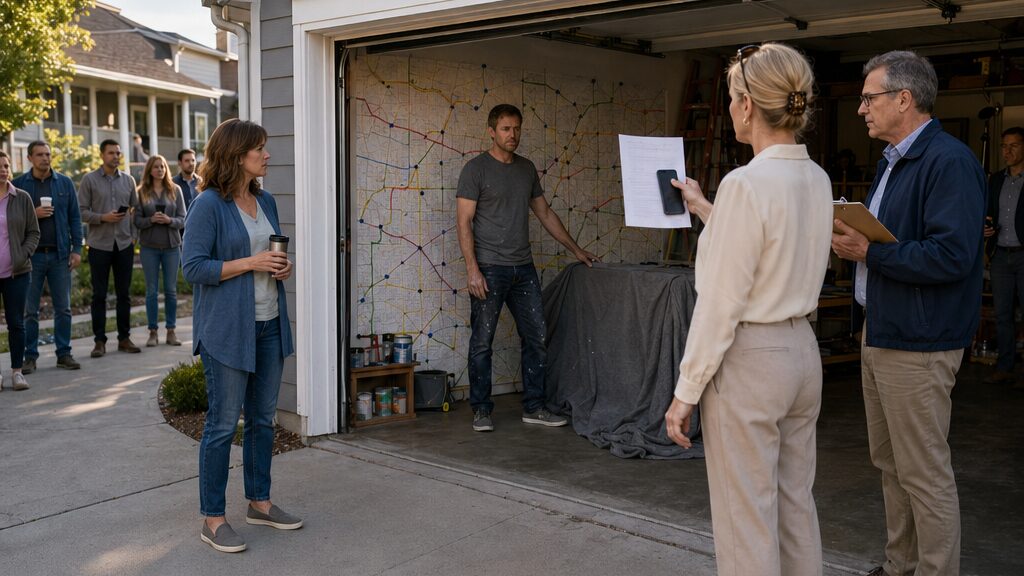
Behind him, the map filled nearly the whole back wall.
It was not a normal map. It was six sheets of plywood, sanded and joined, painted in soft layers of gray, green, and white. Streets were marked in thin black lines. Trails wound in blue and yellow. Sidewalk gaps were drawn in red. Tiny rectangles marked benches. Small circles marked streetlights. Blue pushpins clustered at crossings, trailheads, and places where an old walking path cut between houses before disappearing into brush.
To anyone driving by, it probably did look strange.
Daniel wiped his hands on his jeans. “It’s a map.”
“I can see that.” Nicole stepped one foot onto the driveway without asking. “I’m asking why it’s on display.”
“It’s in my garage.”
“Your garage is open.”
Daniel glanced past her. A delivery driver was slowing at the curb. Across the street, a dog walker tugged gently on a leash while pretending not to look. Two teen runners moved past, their eyes flicking toward the wall before they broke into quiet laughter.
Nicole heard it. Her lips tightened.
“It’s visible from the street,” she said. “That makes it a neighborhood concern.”
Daniel closed the cardboard box. The pushpins clicked together softly inside.
Nicole had lived three houses down for nine years, but Daniel mostly knew her by posture. Upright at mailbox clusters. Upright at HOA meetings. Upright on the sidewalk when someone’s mulch crossed an invisible line. Since being elected compliance chair in January, she had developed the careful expression of a person listening for violations before anyone said anything.
“It’s temporary,” Daniel said.
“That wall has looked like a county planning office for months.”
“It’s still temporary.”
“How long is temporary?”
Daniel looked back at the wall. There was an unfinished section in the lower right corner, where the old creek path should have joined the school route. He had left it blank. Not because he lacked information. Because every time he started it, his hand stopped.
“Long enough,” he said.
Nicole gave a short laugh with no humor in it. “That’s not an answer.”
“It’s the one I have.”
She took another step closer, and now she was close enough to see the labels written by hand. Hickory Bend. North Drainage Path. Bus Stop Without Sidewalk. The old names Charles Lewis still used, even when the subdivision signs had renamed everything with softer words.
Nicole’s eyes moved across the wall, faster now, judging. “Daniel, this looks ridiculous.”
The word landed harder than it should have.
Daniel kept his face still.
“It’s not a mural,” she said. “It’s not approved exterior art. It’s not even framed. It looks like you’re running some kind of command center in your garage.”
“It’s not exterior.”
“When the door is open, it is visible. That’s the issue.”
“The issue,” Daniel said quietly, “is that you walked onto my driveway to tell me what my wall is allowed to look like.”
A car slowed behind Nicole. Samantha Young’s silver SUV rolled past, school backpack visible on the passenger seat, her child in the back looking out. Samantha lifted two fingers from the steering wheel in an uncertain greeting, then looked away when Nicole turned.
Nicole saw that too. Her jaw shifted.
“I’m not trying to embarrass you,” she said, though her voice carried well enough for the dog walker to hear. “I’m trying to keep this neighborhood from turning into a free-for-all. First it’s giant wall maps. Then it’s political banners, business signs, garage sales every weekend, who knows what else.”
Daniel almost said, It’s not a sign.
He almost said, You don’t know what you’re looking at.
Instead he reached for a blue pushpin, rolled it between his fingers, and said, “It’s staying.”
Nicole blinked, as if refusal were a language she understood but had not expected from him. “Excuse me?”
“It’s staying.”
“For now?”
“Until I’m done.”
“Done with what?”
The question opened a door inside him. Behind it was a folded route note, a phone call, a hospital hallway, a crossing with no marked shoulder and headlights coming too fast around a curve. Behind it was the reason he had spent evenings measuring distances in his truck and mornings walking trails with a notebook in his pocket.
He closed the door.
“With the map,” he said.
Nicole folded her arms. “Do you hear yourself?”
Daniel bent, picked up the box, and set it on the workbench beneath the wall. “I hear you fine.”
“I don’t think you do. Because I’m telling you, as the person now responsible for compliance, this is exactly the sort of thing people complain about after property values start slipping.”
“It’s plywood and paint.”
“It’s visible clutter.”
“It’s information.”
“For whom?”
Daniel did not answer quickly enough.
Nicole’s expression sharpened. “That’s what I thought.”
Across the street, the dog walker had stopped beside a mailbox. The delivery driver had parked two houses down but was taking his time with the package. Daniel felt the neighborhood narrowing around the open garage, every window and lowered phone becoming part of the room.
He moved toward the garage door button.
Nicole lifted her hand. “Closing it now doesn’t change the fact that it’s been visible.”
“No,” Daniel said. “But it ends this conversation.”
“That’s not how this works.”
The garage door rattled when he pressed the button, metal panels beginning their slow descent. For two seconds, the map seemed to slide upward behind the closing door, the blue pushpins catching light like small, stubborn sparks.
Nicole stepped back just enough to avoid the sensor beam. “Daniel, I’m giving you a chance to handle this neighbor to neighbor.”
“You came over to call it ridiculous.”
“I came over before someone else filed something formal.”
“Someone else?”
She looked away, which told him enough.
The garage door stopped halfway. Daniel had taken his thumb off the button.
Nicole seized on it. “There have been comments.”
“From who?”
“I’m not going to name residents.”
“Then don’t use them.”
“That’s not fair.”
Daniel laughed once, quietly. He did not mean to. Nicole colored.
“You think this is funny?”
“No.”
“Then take it down.”
“No.”
The word was not loud. It did not need to be. It sat between them with more weight than all the explaining he refused to do.
Nicole opened the thin folder tucked under her arm. Daniel had not noticed it before. Inside were printed pages, highlighted sections, sticky notes, the kind of paperwork people carried when they wanted a conversation to have an audience even without one.
“Our governing documents are clear about nuisance displays visible from common areas,” she said.
“Is my driveway a common area now?”
“Don’t be clever.”
“I’m asking.”
She took out her phone.
Daniel’s hand tightened around the garage remote. “Nicole.”
“I need a record.”
“For what?”
“For the file, if you won’t cooperate.”
The delivery driver finally dropped the package and got back in his van. The dog walker moved on. But Nicole held up her phone, angling it past Daniel, past the half-lowered garage door, toward the exposed bottom of the map.
Daniel stepped sideways.
Nicole lowered the phone an inch. “Are you blocking documentation?”
“I’m standing in my driveway.”
“Then move.”
“No.”
For the first time, uncertainty crossed her face. Not fear. Not guilt. Something smaller and more practical: awareness that the scene was no longer neat. She had wanted him embarrassed, apologetic, ready to comply. Instead he was calm in a way that made her look louder than she wanted to be.
The garage door hummed above them, stalled.
Nicole looked at the visible part of the map. The lower right blank space showed beneath the door, pale and unfinished. Beside it, a cluster of blue pushpins marked routes that went almost to the empty area but not through it, as if the whole map were holding its breath.
“What is that section?” she asked.
Daniel’s answer came too fast. “Nothing.”
Nicole heard the speed. Her eyes narrowed.
“Doesn’t look like nothing.”
“It isn’t finished.”
“Then take it down until it is.”
He pressed the remote again. The door lowered another foot.
Nicole stepped back, lifted her phone higher, and took the picture before the metal panels swallowed the wall completely.
The camera sound was small, artificial, and final.
Daniel stood still as the garage door reached the ground.
Nicole slid the phone into her folder. “You’ll hear from the board.”
Daniel looked at the closed door, seeing the map through it anyway, every trail and gap and blue pin burned into his mind.
“Then I’ll hear from the board,” he said.
Nicole turned toward the sidewalk, but before she left, she glanced once at the garage as if the map were still staring back at her.
Daniel waited until she reached the curb. Then he opened the garage just enough to slip inside, leaving the driveway empty behind him.
In the dimmer light, the map seemed larger than before. The unfinished section waited in the lower right corner, pale and accusing.
Daniel reached for a blue pushpin, then stopped.
Outside, Nicole’s heels clicked once on the sidewalk. Her phone rose again, pointed back at the closed garage door, and she took one more photograph for the HOA file.
Chapter 2: A Violation Notice Under the Blue Pushpins
The notice was taped directly over the lowest corner of the map, covering the place Daniel had avoided for three months.
He found it Monday evening after work, a white sheet folded in thirds and sealed inside a clear plastic sleeve. Someone had slipped it under the garage door, but the tape at the top showed it had been pressed against the wall after the door opened. Daniel stood with his keys still in his hand, reading the bold line through the plastic.
NOTICE OF POTENTIAL COVENANT VIOLATION.
Nicole’s name was not on the first page. Of course it wasn’t. The letter came from the HOA board, formal and bland, full of phrases like visible nuisance, unapproved display, and thirty-day remedy period. At the bottom, in smaller print, was a warning about escalating fines.
Daniel peeled the sleeve off carefully. The tape pulled a sliver of paint from the plywood.
He stared at the damaged spot longer than he stared at the fine amount.
Then he set the notice on the workbench, picked up a pencil, and went back to the map.
The evening had the hot, stale smell of a garage that had been shut all day. His truck ticked as it cooled in the driveway. On the workbench were index cards, trail notes, old municipal printouts, and a jar of blue pushpins sorted by shade. Daniel had once thought the sorting was fussy. Now it felt like the only part of the project that obeyed him.
He pinned a note beside a trail entrance behind Juniper Court: narrow shoulder, no curb cut.
Then another beside the drainage path near the retention pond: muddy after rain, passable if dry.
The map was not beautiful. He knew that. It had too many lines, too many corrections, too many scraps of handwriting. But it was accurate in a way the subdivision brochure never had been. The brochure showed green space. Daniel’s map showed where the green space became a ditch, where a sidewalk ended without warning, where a person pushing a stroller would have to step into the street.
His laptop chimed.
The HOA email had arrived twelve minutes earlier.
Daniel opened it and saw the same notice as an attachment. Below it, a short message from Ronald White, the treasurer.
Daniel,
Please see attached regarding the garage wall display visible from street view. The board has received a compliance concern and asks that you remedy or respond within the stated timeframe.
Regards,
Ronald White
No warmth. No accusation. The email equivalent of someone placing a chair in a doorway.
Daniel read the attached covenant section. Nicole had highlighted it before forwarding, or someone had copied her highlight into the file. The rule referred to commercial signage, banners, exterior decorations, and displays “mounted or placed in a manner visible from common areas.”
Daniel leaned back.
“Commercial signage,” he said aloud.
The map did not sell anything. It did not advertise. It was not even on the outside of the house.
But the words visible from common areas sat there, elastic enough for someone determined.
A knock sounded on the side of the garage frame.
Charles Lewis stood in the open doorway, holding a paper grocery bag in one hand and his old canvas walking hat in the other. He was in his late sixties, maybe older, though he moved with the careful efficiency of a man who had spent decades fixing things before other people noticed they were broken.
“I saw the notice,” Charles said.
Daniel looked toward the driveway. “Everyone saw the notice?”
“Only the people Nicole told.”
Daniel rubbed his forehead. “That’s comforting.”
Charles came in without waiting for an invitation, the way he had after the first month, when Daniel found him staring at the map from the sidewalk and asked if he knew where the old maintenance trail behind Hickory Bend used to come out.
Charles had known. He had known every unofficial path, every bench installed by a resident instead of the town, every section of sidewalk poured two feet short because one developer had argued with another developer twenty years ago.
He set the grocery bag on the workbench. “Brought the old plat copy I told you about.”
Daniel reached for it too quickly.
Charles noticed, but only said, “Careful. It’s older than half the board.”
Inside was a folded survey map, yellowed at the creases. Daniel opened it beside his own notes. Some street names had changed. A drainage easement was marked where three houses now backed up to a fence. At the lower right, near the section he had left blank, a dotted line marked an access path that no current neighborhood map acknowledged.
Daniel’s hand went still.
Charles looked at the wall. “You still haven’t marked the crossing.”
“I’m working around it.”
“That’s not how maps work.”
Daniel picked up a pencil. “I need confirmation.”
“You have confirmation.”
“I need current confirmation.”
“You need nerve.”
Daniel set the pencil down.
Charles had never pushed him there before. He had circled the subject, let Daniel choose distances and colors and labels, pretended the blank space was a technical delay rather than a wound. Now his eyes were on the pale section beneath the notice’s torn tape mark.
“That crossing matters,” Charles said.
“It matters too much.”
“That’s why it can’t stay blank.”
Daniel turned away and opened the HOA email again. “They’re giving me thirty days.”
“Nicole won’t wait thirty.”
“She can wait as long as the bylaws say.”
Charles snorted. “You think people like that use rules because they love patience?”
Daniel said nothing.
A breeze moved through the garage, lifting the corner of the violation notice. Charles reached out and caught it before it slid off the bench. He put on his glasses and read, lips tightening.
“Visible nuisance,” he said. “That’s what they call it?”
“That’s what the form calls it.”
“This map has more useful information than anything at the clubhouse.”
“It’s not finished.”
“Because of that crossing.”
Daniel looked at him.
Charles lowered the paper. “You think I don’t remember?”
The words tightened the air between them.
Daniel turned to the wall and pressed one blue pushpin into the spot where Maple Run met the road without a marked shoulder. His thumb held it there a second too long. “I’m not talking about that tonight.”
“You don’t have to talk. Just don’t leave it blank.”
The laptop chimed again.
This time it was not Ronald. It was an automated HOA message confirming that Daniel’s case had been entered into the compliance portal. There was a case number now. A dropdown menu. A response deadline. A button marked Upload Supporting Documents.
Daniel almost laughed again, the same dry sound Nicole had hated.
“What?” Charles asked.
“It wants supporting documents.”
Charles looked at the map. “Good. You’ve got a wall full.”
Daniel’s gaze moved from the laptop to the plywood, from the blue pushpins to the red sidewalk gaps, from the old plat map to the blank space near the crossing.
For the first time since Nicole’s visit, irritation sharpened into something useful.
He opened the covenant PDF and searched for the word garage. Nothing. He searched for interior. Nothing. He searched for map, and the search box blinked back empty.
Commercial signage. Exterior decorations. Displays mounted or placed visible from common areas.
The map was mounted inside his garage. The garage door had been open because he had been working.
Nicole had not asked what it was. She had asked why she had to see it.
Daniel printed the rule section, then printed the town’s old plat map. He clipped them together and wrote the case number at the top. His handwriting came out harder than necessary.
Charles picked up his walking hat. “You going to respond?”
“Yes.”
“With words?”
Daniel hesitated.
Charles smiled sadly. “That’s the hard part, isn’t it?”
Daniel closed the laptop halfway. “I’ll respond enough.”
“Enough for who?”
He did not answer.
After Charles left, the garage settled into quiet. Daniel worked until the light changed, adding labels, correcting trail angles, marking benches where older walkers rested before the hill. He moved around the blank crossing without looking at it directly.
Near nine, he reached for a screwdriver in the bottom drawer of the toolbox and felt paper against his knuckles.
It was folded twice, soft at the edges from being opened and closed too many times. He knew what it was before he unfolded it.
The note was written in blue ink on the back of a grocery receipt.
If sidewalk ends, cut through by the creek path. Should come out near school lot. Don’t worry. I know the way.
Daniel stood in the garage with the toolbox drawer open and the note in his hand.
On the wall, the blank section waited beneath the torn place where the violation notice had been taped.
Chapter 3: The Driveway Inspection Everyone Pretended Was Casual
Nicole Martin arrived Saturday morning holding the printed violation notice like a ticket she expected Daniel to pay on sight.
Ronald White came with her, though he stayed half a step behind, a clipboard pressed against his stomach. Behind them, not officially part of anything, were three neighbors walking too slowly, a dog walker with no dog in sight, and Samantha Young standing near her mailbox with a travel mug she had not raised to her mouth once.
Daniel had opened the garage before they arrived.
He had also covered the lower right section of the map with a gray drop cloth.
Nicole saw it immediately. Her eyes went to the cloth, then to Daniel. “So you do understand there’s a problem.”
Daniel stood beside the workbench, hands loose at his sides. “I understand there’s a complaint.”
“That’s a start.”
Ronald cleared his throat. “We’re here for a preliminary visual inspection. Nothing final today.”
Nicole shot him a look.
Ronald adjusted his clipboard. “Per procedure.”
Daniel nodded once. “Then inspect.”
That seemed to bother Nicole more than resistance would have. She stepped closer to the garage, careful not to cross too far inside. The map spread above her in all its unruly detail. In daylight, the colored lines looked brighter. Blue pushpins marked crossings and trailheads. Red dashes broke sidewalks into absences. Yellow threads traced informal paths behind fences, along drainage easements, past the old pond.
“It’s larger than it looked in the photo,” Ronald said.
Nicole gave him another look. “That’s not helping.”
“I’m making an observation.”
“It takes up an entire wall.”
Daniel said, “Most walls do.”
A neighbor coughed behind a hand. Samantha looked down into her mug.
Nicole turned. The faint amusement died immediately.
“This isn’t a joke,” she said. “The HOA has received concerns about visible clutter and unapproved displays. We can’t have residents turning garages into public exhibits.”
“It isn’t public,” Daniel said.
“The public can see it.”
“When the garage is open.”
“Which it has been. Repeatedly.”
Daniel looked past her at the gathered neighbors. “People have garage doors open all the time.”
“Most people don’t install giant maps.”
“No,” he said. “They install refrigerators, flags, tool racks, sports banners, plastic skeletons in October.”
Nicole’s face tightened. “Those are customary residential items.”
“So the rule is taste.”
“The rule is community standards.”
Ronald shifted his weight. “The section cited does refer mostly to signage and exterior displays.”
Nicole turned sharply. “It says visible from common areas.”
“It does,” Ronald said. “I’m just noting the context.”
Daniel watched him. Ronald looked like a man trying to step around a puddle in dress shoes: cautious, annoyed that the puddle existed, and not eager to be blamed for either side.
Nicole faced the map again. “What is it even supposed to be?”
The question was close enough to the right one that Daniel almost answered.
He looked at the covered section.
Not yet.
“A walking map,” he said.
Samantha’s head lifted.
Nicole frowned. “A walking map of what?”
“The neighborhood. Trails. Shortcuts. Sidewalk gaps. Crossings.”
“Why?”
“Because the official maps are wrong.”
A small silence followed.
One of the teen runners from the previous week had stopped at the sidewalk with another teen. Both were pretending to stretch.
Ronald stepped closer and studied the wall. “These are actual distances?”
“Yes.”
“You measured them?”
“Yes.”
“All of them?”
“Most. Charles Lewis verified the older paths.”
At the mention of Charles, one of the older neighbors near the curb nodded as if that meant something. Nicole noticed and spoke faster.
“Whether it’s accurate is not the concern.”
“It should be,” Daniel said.
“No. The concern is whether this is appropriate to display.”
“It’s on the inside of my garage.”
Nicole pointed at the street without looking away from him. “And visible from there.”
Samantha suddenly moved closer.
Daniel saw her before Nicole did. She stepped off her curb, crossed the street in a straight line, and stopped just outside the driveway. She wore jeans, a faded cardigan, and the wary expression of someone who had promised herself not to get involved and already regretted breaking it.
“Is that Cedar Lane?” she asked.
Daniel followed her gaze to a thin black street near the upper left quadrant. “Yes.”
“And this yellow line behind it—does that cut to the school?”
Nicole’s mouth opened. “Samantha, this is an inspection—”
“I’m just asking.” Samantha’s voice stayed polite, but she did not look at Nicole.
Daniel nodded. “It does. But only if the ground is dry. The lower part floods after rain.”
Samantha stepped closer, squinting. “My son walks that way with two other kids. They told me it was faster.”
“It is faster.”
“Is it safe?”
Daniel hesitated. Several faces turned toward him.
“Not after rain,” he said. “And not after dark. There’s no light near the bend.”
Samantha stared at the yellow line. Her travel mug lowered to her side. “The school route flyer doesn’t show that.”
“The flyer uses the main sidewalks.”
“There’s no sidewalk on Maple for half a block.”
“I know.”
She looked at him then, really looked, and the amusement she had tried to hide days ago was gone.
Nicole’s voice sharpened. “This is exactly why private residents should not create unofficial public guides. People might rely on incorrect information.”
Daniel’s jaw tightened.
Ronald wrote something on his clipboard.
Samantha turned to Nicole. “But if the school flyer is missing things too, shouldn’t someone mark them?”
“That’s not what we’re here to decide.”
“Maybe it should be.”
The words were quiet, but they changed the driveway.
Daniel felt it happen. The neighbors were no longer watching him as an eccentric man with too much plywood. Their eyes moved between the map and the actual streets around them, measuring their own habits against the colored lines.
Nicole felt it too.
She took one step forward and pointed toward the gray drop cloth. “Then what’s under that?”
Daniel did not move.
Ronald looked up from his clipboard.
Samantha’s eyes went to the covered corner.
Daniel said, “An unfinished section.”
“Convenient,” Nicole said.
“It’s not ready.”
“Or it’s something you know shouldn’t be there.”
The accusation hit the old place. Daniel’s hand closed around the edge of the workbench.
Nicole saw it and softened her voice in a way that was somehow worse. “Daniel, if there’s something inappropriate or misleading on that section, you need to remove it before this gets worse.”
“Inappropriate,” he repeated.
“Wrong. Unverified. Potentially unsafe. Pick your word.”
He thought of the folded note in the kitchen drawer. He thought of the creek path, the school lot, the place where the sidewalk ended and the road curved.
“I already picked my words,” he said. “It’s not ready.”
Nicole turned to Ronald. “Document refusal to disclose.”
Ronald’s pen hovered. “That’s not exactly—”
“Document it.”
Daniel looked at Ronald. “You can document that I declined to show an unfinished part of something mounted inside my garage.”
Ronald gave a small, strained nod and wrote slowly.
The dogless dog walker drifted nearer. One of the teen runners whispered, “That’s actually kind of useful,” and the other elbowed him quiet.
Nicole snapped the folder shut. “Since you’re unwilling to remedy the issue voluntarily, I’m requesting a formal hearing.”
A murmur moved through the small gathering.
Ronald looked uncomfortable. “Nicole, the response period hasn’t expired.”
“The board can schedule a hearing before fines begin. He can make his case there.”
“My case,” Daniel said.
“Yes,” she said. “Your case for why the rules should not apply to you.”
For a moment Daniel wanted to pull down the cloth. He wanted to show them every unfinished line, every note, every reason. He wanted to make Nicole stand there while he explained what happened when people assumed a neighborhood was safe because the lawns were trimmed and the street signs were clean.
Instead he reached up and pressed his palm flat against the cloth, holding it in place.
Nicole watched the gesture.
So did Samantha.
Daniel lowered his hand. “Schedule the hearing.”
Nicole’s surprise lasted less than a second before she turned it into victory. “Good.”
Ronald closed his clipboard. “You’ll receive notice of date and time.”
“I’m sure I will.”
The neighbors began to separate slowly, disappointed and unsettled in equal measure. Samantha remained at the edge of the driveway.
“My son,” she said quietly, “does that yellow route really flood?”
“Yes.”
“Could you maybe—” She stopped, glancing at Nicole, who was still within earshot. “Never mind.”
Daniel looked at her, then at the map. “Tell him not to use it after rain.”
She nodded. “Thank you.”
Nicole walked past her toward the sidewalk, folder tight under her arm. Before leaving, she looked back at the covered section.
“The hearing will decide whether it stays,” she said.
Daniel stood in the mouth of the garage until they were gone.
Then he turned back to the map.
The cloth hung over the unfinished corner, still and gray, hiding the part everyone now wanted to see.
Chapter 4: The Shortcut the HOA Never Put on Paper
Charles Lewis stopped at the edge of the old drainage path and would not take another step.
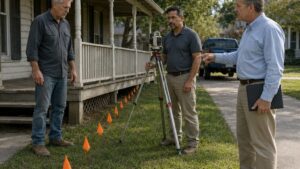
Daniel was already two paces ahead before he noticed. The path began behind a row of privacy fences, where the mowed subdivision grass gave up and turned into hard-packed dirt. A narrow break in the brush led toward the creek, the kind of opening people used for years without anyone officially admitting it existed.
Charles stood with one hand on the split rail fence, looking down at the dirt like it might answer for itself.
“What?” Daniel asked.
Charles shook his head. “I hate this part.”
“You said you maintained it.”
“I said I knew it.” Charles’s mouth pressed flat. “Not the same thing.”
Daniel looked past him. The creek path was shaded and uneven. Roots crossed the dirt like knuckles. On his map it was still a dotted yellow line, unverified at both ends. According to Charles, it connected the back of Hickory Bend to the school parking lot, cutting almost twelve minutes off the official walking route. According to the HOA’s current neighborhood guide, it did not exist.
Daniel lifted the small measuring wheel from the back of his truck. “If we don’t check it, I can’t mark it.”
Charles gave him a look. “Now you sound like me twenty years ago.”
The words had a weight Daniel did not like.
He clicked the measuring wheel down and started walking. After a moment, Charles followed.
The path narrowed where vines had grown over the old gravel base. Every few yards, Daniel paused to write notes on an index card clipped to a small board. Steep dip. Slippery leaves. No lighting. Fence nail exposed near bend. Charles pointed with the tip of his walking stick, correcting distances before Daniel measured them.
“This used to be wider,” Charles said. “Maintenance cart could get through.”
“HOA maintained it?”
“Developer did first. Then the town was supposed to take over. Then nobody wanted it on their insurance.”
“So everyone pretended it wasn’t here.”
Charles stepped over a root. “That’s one way to put it.”
The path opened briefly near the creek. Daniel could see tire tracks under the weeds, old and shallow. A faded metal post stood at an angle, sign missing, bolts still attached.
He photographed it.
Charles watched him. “Don’t make the mistake of thinking a picture will make them care.”
“It might make them stop saying it’s made up.”
“That’s different.”
They kept going until the path climbed toward a chain-link gate behind the school parking lot. The gate was locked now, but a worn track around the side showed where kids and parents had been slipping through for years. Daniel looked at the official sidewalk beyond it, bright and clean and useless from this side of the fence.
“How many people use this?” he asked.
“Enough to make it real.”
“Not enough to make it official.”
Charles leaned on his walking stick. “Official is what people call something after they decide who gets blamed.”
Daniel wrote that down without thinking.
Charles saw him do it and made a tired sound. “That’s not map information.”
“It is to me.”
They left the path from the school side and drove to the town records desk before it closed. The clerk behind the counter wore a cardigan and the expression of someone who had spent the day explaining why old paper was not the same as current policy. Daniel spread Charles’s folded plat copy on the counter and pointed to the dotted access line.
“We’re trying to confirm whether this route was ever part of the planned pedestrian access.”
The clerk glanced at Charles. “That’s old.”
“That’s why we’re here,” Charles said.
She disappeared into a back room and returned with a scanned subdivision plan on a tablet. The screen showed the same dotted line, cleaner and official, marked as pedestrian easement pending acceptance.
Daniel felt his pulse shift.
“Pending acceptance by who?” he asked.
The clerk pinched the screen larger. “Looks like town acceptance was contingent on final developer improvements. Lighting, surface, drainage, gate access. There should be correspondence.”
“Can we see it?”
She hesitated. “You can request copies. Some of it may be archived.”
Charles said, “Try complaints.”
The clerk looked at him.
“Resident complaints,” Charles said. “Sidewalk gaps, school access, that sort of thing. They’d have kept those closer.”
The clerk typed. A list appeared. Daniel could not read the entries upside down, but he saw dates, street names, short descriptions. Maple Run shoulder. Creek path lighting. School access gate. Missing sidewalk segment.
The same problems, reported years apart, by different residents.
Daniel’s hands went cold.
The clerk turned the screen slightly. “There are several. Some forwarded to the HOA management company, some to the town.”
Charles looked at Daniel but did not speak.
“Can I get copies?” Daniel asked.
“You can request them. I can print the public ones now. The forwarded correspondence might take a formal request.”
“Print what you can.”
The printer behind her began its slow mechanical breathing. Page by page, the old complaints came out. A parent worried about children walking along Maple where the sidewalk disappeared. An older resident asking why there was no bench between the pond and the clubhouse. Someone reporting that the creek path flooded and forced walkers into the street. Each one had a date stamp. Each one had been answered with the same soft language: under review, outside current scope, pending maintenance clarification.
Charles touched one page but did not pick it up.
Daniel saw the date near the top. It was four years old.
Too close.
The clerk handed Daniel the copies. “These don’t prove current responsibility.”
“No,” Daniel said. “They prove people asked.”
On the drive back, Charles was quiet until they turned into the subdivision.
“You see why I stopped going to meetings?” he said.
Daniel kept both hands on the wheel. “Because they ignored it.”
“Because they listened just enough to write it down.”
They passed the clubhouse, where the lawn was edged cleanly and the flower beds were thick with fresh mulch. On the bulletin board by the door, laminated notices advertised pool hours, trash pickup reminders, and a friendly walking club route that stayed entirely on the broadest sidewalks. Daniel pulled into the empty lot without planning to.
Charles looked at him. “What are you doing?”
Daniel took the printed complaints and walked to the bulletin board. For one irrational second, he wanted to pin them there under the cheerful walking club flyer. He wanted every neighbor to see that the neighborhood had known its own gaps and painted around them.
But the board was locked behind glass.
Daniel stood with the papers in his hand, reflected faintly in the glass beside the smiling route map.
Charles came up behind him. “Not today.”
Daniel did not move.
“Daniel.”
He folded the complaints once and put them under his arm.
Back at the garage, the giant map waited. Daniel pinned copies of the public complaints to the workbench, not the wall. He added a blue pushpin beside the creek path entrance, then another beside the missing sidewalk on Maple. The color that had once meant useful route now felt insufficient. Too gentle. Too small.
Charles stood near the covered section.
“There’s one more,” he said.
Daniel did not look up. “One more what?”
“One crossing you still haven’t marked.”
“I know.”
“No,” Charles said. “You don’t. Not the way you need to.”
Daniel slowly set down the pencil.
Charles’s voice was rough but steady. “It wasn’t just the creek path. She came out by the school lot, same as the old plat said. Then she tried to follow Maple because the sidewalk was supposed to pick up again after the curve.”
Daniel’s throat closed around the answer he did not give.
Charles looked at the gray cloth covering the map’s lower corner.
“That’s where you stopped,” he said. “Maple Run crossing. Where the sidewalk ends and everyone pretends the road is still safe.”
Daniel turned to the blank cloth as if it had spoken his name.
Chapter 5: What Daniel Would Not Say in Front of the Board
Daniel placed the folded route note beside the covered blank space and waited for his hand to stop shaking.
It did not.
The note looked smaller on the workbench than it had in the toolbox drawer, almost harmless. Blue ink on the back of a grocery receipt. A little hurried, a little crooked. If sidewalk ends, cut through by the creek path. Should come out near school lot. Don’t worry. I know the way.
He had read it so many times that he no longer needed to open it, but he opened it anyway.
The garage was closed. Outside, evening traffic moved through the subdivision in soft waves, tires over clean pavement, garage doors humming, sprinklers ticking. Inside, Daniel had the map lights on. The gray drop cloth hung over the lower right corner like a held breath.
Tomorrow evening, he would sit in the clubhouse while Nicole called his wall display a nuisance. Ronald would read from the rules. The board would ask questions in careful voices. Someone would probably say they understood his intentions before explaining why intentions did not matter.
Daniel had prepared documents. Old plats. Public complaints. Photos of missing sidewalks. Distance measurements. He had printed smaller copies of the map and highlighted the safe school routes in yellow.
He had not prepared the truth.
A knock sounded at the side door.
Daniel folded the note fast, too fast, and slipped it under the old plat map before opening the door.
Samantha Young stood there with a manila envelope pressed to her chest. Her hair was pulled back messily, and she looked like she had argued with herself before walking over.
“I’m sorry,” she said. “I know it’s late.”
“It’s not.”
“My son told two other parents about your map.”
Daniel waited.
“And then those parents told three more.” She lifted the envelope. “People started texting me things. Routes their kids take. Places they avoid. One mom sent a picture of where the sidewalk just stops behind the pool. Another said her dad won’t walk to the clubhouse anymore because there’s nowhere to sit halfway.”
Daniel looked at the envelope.
Samantha gave a small embarrassed shrug. “I didn’t know what to do with it.”
He stepped aside. “Come in.”
She entered the garage and stopped, as most people did, beneath the size of the wall. But this time her face did not carry amusement or judgment. She looked at it as if searching for someone.
Daniel cleared a space on the workbench.
Samantha laid out the pages. Printed texts. Hand-drawn corrections. A photo of a muddy patch near Cedar Lane. A child’s pencil drawing of a shortcut past the pond with the words scary dark spot written in uneven letters.
“That one’s from my son,” she said. “He told me not to show anyone, then put it in the envelope.”
Daniel picked up the drawing carefully.
A small yellow line curved behind stick-figure houses. Near the bend, the child had drawn a black circle and colored it hard enough to tear the paper.
Daniel set it down.
Samantha watched him. “Is that useful?”
“Yes.”
The answer came out rough.
She glanced toward the covered section. “Is that where the bad crossing is?”
Daniel’s hand moved toward the folded note under the plat, then stopped. “One of them.”
“One of them,” she repeated quietly.
He took a blue pushpin from the jar and pressed it into a spot near Cedar Lane. “This dark spot. He’s right. The streetlight is blocked by trees.”
Samantha came closer. “You knew that?”
“I walked it last month.”
“At night?”
“Yes.”
“Why?”
He felt the question try to open the same door Nicole had kicked at. From Samantha, it did not feel like accusation. It felt worse. It felt like permission.
Daniel picked up the child’s drawing. “Because kids use routes adults don’t admit they use.”
Samantha nodded slowly. “I used to think HOA drama was just people arguing over paint colors.”
“Sometimes it is.”
“This isn’t.”
“No.”
She looked at him again. “Are you going to tell them tomorrow?”
He set the drawing down. “I’m going to tell them the map is inside my garage and the rule they cited doesn’t apply.”
“That’s not what I mean.”
“I know.”
The garage seemed to shrink around the wall. Daniel reached under the plat map and touched the folded note with two fingers.
Samantha noticed but did not ask.
He should have thanked her, walked her out, gone back to safe facts. Instead he heard himself say, “She was my sister.”
Samantha went still.
Daniel looked at the map, not at her. “Virginia.”
The name was still allowed in his house but rarely invited into conversation.
“She moved in with me for a few months after her divorce,” he said. “Worked over at the urgent care near the shopping center. Didn’t like asking for rides. Said walking cleared her head.”
Samantha’s voice was careful. “She got hurt?”
Daniel nodded once. “It was late. Her phone was low. She texted me that she knew the way. I was in the middle of fixing a leak under the sink and didn’t answer for twenty minutes.”
He could hear the drip from that night even now. Slow, metallic, petty. A thing that had seemed urgent until the phone rang.
“She cut through the creek path,” he said. “Came out by the school lot. Tried to follow Maple back because the sidewalk was supposed to connect. At the curve, there’s no shoulder. A car came around too wide.”
Samantha put one hand over her mouth.
“She lived,” Daniel said quickly, because people always needed that part first. “But she never walked the same after. And she left six months later because every street here made her angry.”
He almost said, made us angry. But that was not true. She had been angry. He had been useful. He had installed grab bars, measured medication, driven her to appointments, and never once admitted that twenty unanswered minutes had become a room inside him.
Samantha’s eyes had filled, but she did not perform sadness at him. She only said, “That’s why you started the map.”
“Not right away. First I complained.”
“To the HOA?”
“To anyone whose email I could find.”
“What happened?”
Daniel touched the stack of printed old complaints. “They said it was under review.”
Samantha looked back at the wall. “So you made your own.”
“I started making notes. Then Charles helped. Then it got bigger.”
“Daniel.”
He hated the softness in her voice, and he hated himself for needing it.
“I don’t want them using her,” he said.
“Using her how?”
“As a reason to look sympathetic for five minutes before they still do nothing.”
Samantha folded her arms, not defensively, but as if holding herself in place. “Maybe you don’t have to give them all of her.”
He looked at her.
“Tell them enough,” she said. “Not for pity. For context.”
The same phrase Charles had used in a different shape. Enough.
After Samantha left, Daniel stood alone with the envelope of neighbor corrections. The map had changed while he was not looking. It was no longer only his measurements and Charles’s memory. It had a child’s fear of a dark bend, a parent’s warning about mud, an older walker’s need for a bench.
He reached for the gray cloth.
Then stopped.
His laptop was open on the workbench. The hearing notice glowed on the screen. Below it was the blank response box for supporting comments.
Daniel placed his fingers on the keyboard.
He typed: The map is a private project mounted inside my garage.
He stopped.
Deleted private.
Typed: The map is a neighborhood walking-safety project mounted inside my garage.
His hands hovered.
Then he closed the laptop without sending it.
For a sharp, cowardly moment, he considered taking the map down. He could photograph it, store it, finish it later in pieces. He could avoid the room, the questions, Nicole’s controlled smile. He could keep Virginia’s note in the toolbox and let the HOA win a fight they did not understand.
He turned off one work light.
The map dimmed. The covered section became a shadow.
Then his eyes fell on Samantha’s envelope, open on the bench, the child’s drawing on top. Scary dark spot.
Daniel switched the light back on.
He pulled the cloth down.
The blank section appeared, pale and raw beneath the finished streets. Daniel took out the old route note and taped it beside the lower corner, not on the wall where others could read it, but close enough for him to see while he worked.
With a pencil, he drew the creek path through to the school lot. He marked the locked gate. He traced Maple Run’s broken sidewalk. At the curve, where the shoulder vanished, his hand stopped.
He picked up a blue pushpin.
For a long moment he could not press it in.
Then he did.
The pin entered the wood with a small, final sound.
Chapter 6: The Hearing Where the Rule Stopped Sounding Simple
Nicole’s evidence photo made the map look uglier than it was.
Daniel sat in the second row of the clubhouse meeting room and watched the image appear on the pull-down screen at the front. The fluorescent lights washed out the colors. The angle was tilted. The half-lowered garage door cut across the wall like a metal frown. In the photo, the map looked chaotic, oversized, and almost aggressive.
Nicole stood beside the screen with a folder tucked against her ribs.
“This,” she said, “is what residents are seeing from the street.”
A few board members leaned forward. One whispered to another. Ronald White sat at the folding table with the covenant binder open, his pen laid neatly across the page.
Daniel had brought printed mini-maps in a stack on his lap. His hands rested on top of them so they would not curl.
Behind him, chairs scraped as neighbors settled in. More people had come than he expected. Samantha sat near the aisle with the manila envelope at her feet. Charles sat against the back wall, arms folded, walking stick between his knees.
Nicole clicked to the next slide. A cropped image of the blue pushpins appeared.
“Mr. Wright has been asked to remedy the issue voluntarily,” she continued. “He declined. He has also declined to disclose the full content of the display during inspection.”
Daniel kept his eyes on the screen.
The HOA president, seated at the center of the table, looked over reading glasses. “Mr. Wright will have a chance to respond.”
Nicole nodded. “Of course.”
Her voice was calm, professional, and faintly strained. Daniel wondered how many times she had practiced it. He also wondered whether she had slept badly. There was a shadow beneath one eye that her makeup did not hide.
Ronald read the cited covenant section aloud. Commercial signage, banners, exterior decorations, nuisance displays visible from common areas. The language sounded both official and thinner than it had in the email.
When it was Daniel’s turn, he stood with the mini-maps.
The room quieted in a way that made his throat tighten.
He placed the stack on the table. “I made copies so people don’t have to rely on that photo.”
Nicole’s fingers tightened around her folder.
Daniel handed one copy to Ronald, one to the HOA president, then passed the rest down the first row. Samantha rose without being asked and helped distribute them. Daniel did not thank her aloud. He only nodded.
The mini-map looked cleaner than the wall version. He had stripped out some working notes and left the key: yellow for walkable paths, red for sidewalk gaps, blue dots for crossings or rest points, black circles for poor lighting.
“This is not a sign,” Daniel said. “It’s not commercial. It’s not exterior. It’s a working map of neighborhood walking routes.”
Nicole stepped forward. “A map visible from the street.”
“When my garage is open.”
“Which it often is.”
“Because I was working on it.”
The HOA president looked at Ronald. “Does the cited section apply to items inside a garage?”
Ronald adjusted his glasses. “The language is not specific. Historically, we’ve applied it to items mounted outside the home or placed in yards, windows, or driveways. Garages are… less clear.”
Nicole’s chin lifted. “The impact is clear.”
“The impact,” Daniel said, “is the part I’d like to discuss.”
He heard the risk as soon as he said it. Nicole had framed impact as appearance. He was about to frame it as safety. The room could follow either.
He pointed to the printed mini-map. “The official neighborhood walking flyer shows three routes. All on main sidewalks. It does not show where those sidewalks end. It does not show where the creek path floods. It does not show the locked gate behind the school lot or the missing streetlight at Cedar Lane.”
A board member frowned at his copy.
Daniel continued before he could lose the room. “This isn’t about telling people to use unsafe routes. It’s about showing them where the unsafe parts are before they find out alone.”
Nicole opened her folder. “That sounds like exactly the liability concern.”
Ronald looked up.
Nicole turned to the board. “If residents begin using an unofficial map created in someone’s garage, and someone is injured, who is responsible? The HOA? Mr. Wright? The neighborhood? We have approved materials for a reason.”
A murmur moved through the room.
Daniel felt the shift. It was clever. Nicole had moved the question from whether she had overreached to whether he was creating risk. Fear was easier to vote for than fairness.
He looked down at his mini-map. His thumb covered Maple Run crossing.
Samantha stood.
The HOA president said, “Please state—”
“I’m not making a formal statement,” Samantha said, then looked embarrassed by her own interruption. “I just want to say my son already uses one of those routes. Kids already do. That’s the point.”
Nicole turned toward her. “And would you rather they rely on unofficial information?”
“I’d rather know what they’re doing than pretend they only walk where the flyer says.”
Charles’s voice came from the back. “Same for older folks.”
The president sighed. “Let’s avoid cross-discussion.”
Daniel could have let the neighbors carry it. He could have stayed behind procedure and let Nicole look unreasonable. For one tempting moment, that seemed enough.
Then he saw Charles watching him.
Tell them enough.
Daniel put both hands on the table. “The map started because someone I love was injured on a route that looked connected on paper and failed in real life.”
The room went very still.
Nicole’s face changed, just slightly. Not regret. Not yet. But the clean line of her certainty bent.
Daniel did not look at her. “I’m not asking the HOA to endorse every path. I’m asking that you stop treating the map like clutter before you understand what it shows.”
He opened the folder he had brought and placed three public complaint copies on the table. “Residents reported these gaps before. Maple Run. Creek path lighting. School access. Some of those complaints were forwarded to management.”
Ronald reached for the copies. “May I?”
Daniel handed them over.
Nicole moved closer. “Those are old complaints. They don’t establish current responsibility.”
“No,” Daniel said. “They establish current memory.”
That landed harder than he expected. Even the president looked down.
Ronald flipped through the pages, then returned to the covenant binder. “For tonight’s issue, I’m not comfortable recommending fines under the commercial signage section. Not without counsel or a clearer rule.”
Nicole stared at him. “Ronald.”
He did not look up. “I’m saying the procedure is weak.”
“The display is still inappropriate.”
“Maybe,” he said. “But weak procedure makes bad enforcement.”
Daniel felt no victory. Only a small loosening around the ribs.
Nicole took a breath and changed course again. “Then table the fine. But require removal until the board determines whether the map creates liability.”
A few board members murmured agreement.
There it was: not a fine, but a pause. A polite way to make the wall blank again.
Daniel looked at the mini-maps in people’s hands. He thought of the child’s drawing, the scary dark spot, Virginia’s note taped beside the wall where only he could see it. He thought of the blank space that was no longer blank.
“If you vote tonight based on a bad photo,” he said, “you’ll miss the point.”
Nicole’s eyes narrowed. “And what do you suggest?”
“Come see it finished.”
The words surprised him as much as the room.
Ronald’s pen stopped.
Nicole gave a short, disbelieving laugh. “Finished?”
“Yes.”
“I thought it was unfinished.”
“It was.”
“And now?”
Daniel gathered the remaining copies. “Give me one week. No fines. No removal order. No endorsement. Just come look at the completed version before you vote on whether it has to come down.”
The president looked at Ronald. Ronald looked at the complaint copies, then at Nicole.
Nicole’s face had gone tight again, but not triumphant. The room was no longer cleanly hers.
“A week,” Ronald said quietly, “would not prejudice enforcement.”
The president nodded. “One week. Site review before final board action.”
Nicole closed her folder.
Daniel sat down before his knees could show anything.
Behind him, Samantha exhaled. Charles tapped his walking stick once against the floor, not applause, just acknowledgment.
As the meeting broke, Nicole passed close enough that only Daniel could hear her.
“I hope,” she said, “that whatever you’re hiding under that cloth is worth this.”
Daniel looked at the complaint copies in Ronald’s hand, then at the neighbors folding the mini-maps into purses and back pockets.
“It isn’t hidden anymore,” he said.
Nicole paused, but Daniel had already turned away, because one week from that night, the garage door would open again.
Chapter 7: Actually, It’s Finished
Nicole arrived one week later with the expression of someone expecting an apology and a cleared wall.
Daniel saw her through the garage window before she reached the driveway. She had dressed for authority again: pale blouse, neat slacks, folder under one arm, sunglasses pushed up into her hair though the morning was overcast. Ronald walked beside her, slower than before, with the HOA president and two board members trailing behind. Samantha came from across the street with her child’s backpack still over one shoulder. Charles stood near the curb, leaning on his walking stick as if he had been waiting there longer than he would admit.
More neighbors gathered without pretending this time.
Nicole stopped at the edge of the driveway and looked at the closed garage door.
“I hope,” she said, loud enough for the first row of watchers to hear, “that thing is gone.”
Daniel stood beside the garage keypad. For a moment, the old habit rose in him: answer with as little as possible, keep the soft places covered, let everyone believe what they wanted if it meant they would leave.
He pressed the button.
The garage door began to rise.
“It is,” he said.
Nicole’s shoulders eased.
The metal panels rattled upward, revealing the concrete floor first, then the workbench, then the lower edge of the plywood wall. The gray drop cloth was gone. The blank section was gone. In its place, Maple Run curved through the lower right corner in a firm black line, broken sidewalk marked in red, creek path traced in yellow, school lot access marked with a locked-gate symbol. Blue pushpins formed a careful chain through the difficult places.
Daniel watched Nicole’s face change as more of the wall appeared.
He said, “Actually, it’s finished.”
By the time the garage door reached the top, nobody was speaking.
The map filled the wall brighter and cleaner than before. Daniel had redrawn the legend in block letters. He had added small printed labels where handwriting had become crowded. There were QR codes mounted in clear sleeves at the bottom, one labeled Walking Routes, one Sidewalk Gaps, one Report a Change. Rest stops were marked in blue. Poor lighting in black. Flood-prone trails in gray. Routes safe for strollers or wheelchairs were marked with a thin green line.
At the lower right, Maple Run crossing had three blue pushpins instead of one.
Nicole stared at them.
Ronald stepped forward before she did. “You digitized it.”
Daniel nodded. “A basic version. It’s not fancy.”
A teen runner near the sidewalk lifted his phone. “The QR thing works?”
“Try it,” Daniel said.
The teen scanned. His eyebrows rose. “It opens.”
A ripple moved through the neighbors. Phones came out, not hidden this time. Samantha moved closer and scanned the school-route code. Her child leaned against her side, eyes fixed on the wall.
“This shows the flooded part,” Samantha said.
“Yes.”
“And the dark spot?”
“Black circle near Cedar.”
Her child pointed. “That’s it.”
The simple certainty in the child’s voice did what Daniel’s documents could not. People looked from the map to the child, then back again, and the wall stopped being an argument.
Nicole recovered first. “This doesn’t change the fact that the board has not approved it.”
“No,” Daniel said. “It changes what you’re being asked to approve or remove.”
The HOA president stepped into the garage mouth, careful but curious. “May I?”
Daniel moved aside.
She examined the lower legend. “Unresolved hazard markers,” she read.
“Places that need review,” Daniel said. “Not instructions. Warnings.”
Ronald pointed to a red gap on Maple. “This is the complaint from the old file?”
“One of them.”
“And these blue pins?”
“Safe crossings, rest points, or places people identified as needing attention. Some are verified. Some are community-submitted and marked pending.”
Nicole looked sharply at him. “Community-submitted?”
Samantha raised the manila envelope slightly. “Parents sent corrections.”
A dog walker near the curb said, “I sent the bench by the pond.”
Someone else said, “The broken curb cut by the pool is mine.”
Nicole turned as if the driveway had betrayed her. These were not the faceless concerned residents she had invoked. They had become specific, practical, inconvenient.
Daniel saw something move under her expression then: not humiliation yet, but fear. She had thought the map made the neighborhood look disorderly. Now the neighborhood was stepping forward to say the disorder had been there all along.
The HOA president scanned one of the QR codes with her own phone. “Who maintains this file?”
“I do for now,” Daniel said. “But I’ll share it. Anyone can suggest corrections.”
Nicole folded her arms. “And if someone follows one of these paths and gets hurt?”
Daniel pointed to the legend. “Then they’ll at least know where the risk is before they reach it. The current walking flyer doesn’t show that.”
“The current flyer is board-approved.”
“The current flyer is incomplete.”
The sentence landed without heat. That was why it held.
Charles tapped his walking stick once. “It was incomplete when I was still fixing drainage out here.”
The HOA president turned. “You worked these paths?”
“Some of them.”
“Officially?”
Charles smiled without humor. “Depends which year and which budget line you want to believe.”
Ronald coughed into his hand.
Nicole stepped closer to the lower right section. Her eyes had returned to the three blue pushpins at Maple Run. “Why three pins there?”
Daniel felt the driveway quiet around him.
He could have answered with the safe version. One for missing sidewalk. One for poor sightline. One for crossing risk. Accurate. Adequate. Empty.
He looked at Samantha’s child, then at Charles. Charles’s gaze did not push him this time. It simply stayed.
Daniel said, “One for the missing sidewalk. One for the blind curve. One because someone was hurt there after following an unofficial route that should have been marked years ago.”
Nicole’s face lost a little color.
The HOA president lowered her phone.
“Who?” Nicole asked, but softly now.
Daniel held the edge of the workbench. “My sister.”
No one moved.
He did not tell the whole story. He did not give them Virginia’s note. He did not describe the hospital or the sink leak or the twenty unanswered minutes. He had thought saying anything would crack him open in front of them. Instead the words stood on their own, plain and survivable.
“She lived,” he added. “But she should not have had to learn the neighborhood was unsafe by getting hurt in it.”
Samantha looked down.
Nicole’s folder had lowered to her side.
Daniel took one printed mini-map from the stack on the workbench and held it out to the HOA president. “I’m not asking to embarrass anyone. I’m asking you not to make appearance the only standard.”
The president accepted the paper.
Ronald moved to the wall and traced a route with one finger without touching it. “This crossing has had multiple complaints?”
“Yes.”
He looked at Nicole. “We need to review that before any vote on removal.”
Nicole’s mouth tightened. “The complaint was about the display.”
“The display shows a safety issue the board has notice of,” Ronald said. “That changes our exposure more than leaving a garage map visible.”
The word exposure made several board members shift. It was not noble, but it was effective.
A neighbor near the back lifted a phone and took a picture of the map. Then another did. The teen runner scanned the second QR code and called out, “It even shows water fountains.”
“Only the working ones,” Daniel said.
That drew a small laugh, not mocking, but relieved.
The garage became crowded at the edges. People pointed out their streets, their shortcuts, their complaints. A parent asked whether stroller-friendly routes could be printed. An older neighbor wanted to know if the bench locations were updated. The dog walker argued that the pond path should be marked muddy after sprinklers, not just rain.
The map absorbed them all.
Nicole stood apart, folder pressed flat against her thigh. Daniel saw her watching the board president listen to residents, watching Ronald take notes, watching the thing she had called ridiculous become the center of a conversation she no longer controlled.
He did not enjoy it as much as he expected.
Maybe because her embarrassment was not the repair. It was only a door opening.
Samantha came to stand beside him. “That’s the crossing?”
Daniel nodded.
“My son almost used that way last winter,” she said. “After basketball. It was dark.”
Daniel did not have an answer that would not sound like an apology for something larger than himself.
Samantha looked toward the board members. Her voice rose, steady and clear.
“Why didn’t the HOA mark it?”
The talking stopped.
Nicole turned.
Samantha did not back away. “If there were complaints, and if kids use that route, why wasn’t it on the walking flyer? Why did Daniel have to build a wall map in his garage for us to find out?”
The question hung in the open garage, bigger than the map, bigger than the complaint, and this time Daniel did not try to answer for anyone.
Nicole looked at the three blue pins at Maple Run, then at the folder in her hand.
Chapter 8: The Blue Pins Stayed, But the Fine Did Not
The new sign at the clubhouse was smaller than Daniel expected.
It had appeared two weeks after the site review, mounted beside the bulletin board where the old walking club flyer still hung behind glass. The sign was simple, laminated, and almost cautious.
Neighborhood Walking Route Map Available
Scan for routes, sidewalk gaps, rest points, and safety notes.
Below the words was a QR code linked to Daniel’s digital map.
Nobody had asked him what font he preferred. Somehow, that made him trust it more.
He stood in front of it early Saturday morning with a travel mug in one hand and the original violation notice folded in his back pocket. The board had voted three days earlier to withdraw the complaint without fine. Not dismiss. Not apologize in the minutes. Withdraw pending clarification of display standards and pedestrian safety review.
It was HOA language, padded and careful.
But the fine was gone.
The clubhouse door opened behind him.
Nicole Martin stepped out carrying a folder.
Daniel almost smiled at the symmetry of it, then did not.
She saw him and stopped. For one second, her old public face came up: composed, alert, ready to manage the scene. Then it lowered. She walked over without the crispness he had come to expect.
“I didn’t know you’d be here,” she said.
“I was checking the code.”
“Does it work?”
“Yes.”
“Good.”
They stood side by side, looking at the sign instead of each other. A car passed slowly. Somewhere beyond the pool fence, a maintenance worker dragged a trash bin across concrete.
Nicole opened the folder and took out a paper sleeve.
“I brought this back,” she said.
Inside was the original violation notice, the one from the compliance file. Daniel recognized the fold, the case number, the official language that had sounded so final when it first arrived. Across the top, in blue ink, someone had written Withdrawn.
He accepted it.
“Ronald said copies stay in the file,” she said. “This was yours.”
Daniel looked at the notice, then at her. “You didn’t have to return it.”
“I know.”
Her hands clasped around the empty folder.
For a moment, neither spoke.
Then Nicole said, “I thought if I let one thing go, everything would start sliding.”
Daniel waited.
“When I became compliance chair, half the emails were about things nobody wanted to say directly. Trash cans. Cars. A basketball hoop. Someone’s brother living in an RV for two weeks. Everyone wanted me to handle it, but nobody wanted to be the person complaining.” She gave a small, tired laugh. “So I decided I would be precise. Fair. Consistent.”
“And the map?”
“The map was visible.” She looked toward the sign. “And strange. And people were talking.”
“That was enough?”
“At the time, I told myself it was.”
Daniel folded the notice once more along its old crease. “You could have asked.”
“I should have.”
The words were plain. Not dramatic. Not enough to undo anything by themselves. But they were the first ones she had offered without hiding behind a rule.
Nicole looked toward Maple Run beyond the clubhouse lawn. “The board is forming a safety review group. Sidewalk gaps, lighting, school access, benches. Ronald insisted we put dates on it.”
“That sounds like Ronald.”
“You’ll be asked to join.”
Daniel looked at her then. “By you?”
“By the board.”
“That wasn’t my question.”
Her mouth tightened, but not with anger. “Yes. By me too.”
A dog walker approached the clubhouse sign and scanned the code, not noticing them until the phone opened the map. “Oh,” the neighbor said, embarrassed. “Morning.”
“Morning,” Daniel said.
The neighbor looked at Nicole, then at Daniel, then at the sign. “The pond bench is still there, right?”
“Still there,” Daniel said. “But loose. I marked it.”
“Good to know.” The neighbor walked on, studying the phone.
Nicole watched them go. “It’s useful.”
Daniel slid the withdrawn notice into his back pocket. “That was the idea.”
“I know that now.”
He could have said something sharp. Two weeks earlier, he would have wanted to. Instead he thought of the map wall, now covered in small slips of paper people had left under his garage door: curb cut broken, branch over path, light out again, good bench, steep hill, safe with stroller.
The map was no longer only proof that he had cared. It was proof that other people did too, once given a place to put that care.
At home, the garage door was already open.
Samantha stood at the workbench with her child, sorting community notes into three piles because Daniel had never made a system for them beyond “don’t lose these.” Charles sat in a folding chair near the map, arguing with a teen runner about whether the pond loop was eight-tenths of a mile or closer to nine.
“It’s not nine,” Charles said. “Your watch is flattering you.”
The teen runner grinned. “My watch has satellites.”
“I had knees when that path was poured.”
Daniel paused at the driveway.
The wall looked different in daylight now. Not less strange. Maybe stranger. More pins had appeared. Blue for rest points and crossings. Yellow slips for route suggestions. Red tabs for hazards needing review. A green sticky note in a child’s handwriting said, This way is good after school.
Nicole stopped beside him at the curb.
“Do you keep it open like this every Saturday?” she asked.
“I haven’t decided.”
Inside, Samantha looked up and waved him in. Charles pointed his walking stick at the map and accused the teen’s watch of being dramatic. Someone had left a small plate of muffins on the workbench, half-covered with a napkin.
Daniel felt the old impulse to close the door. Not because he was ashamed. Because openness was work. People brought corrections, opinions, needs. They touched the edges of what he had built for Virginia and made it less his.
That was the part he had not expected to hurt.
Samantha’s child came to the garage entrance holding a blue pushpin between two careful fingers. “Mr. Wright? Where does this one go?”
Daniel stepped into the garage and looked at the map. The child pointed to a route behind the pool, a place where the sidewalk bent around a patch of grass and continued toward the clubhouse.
“What’s it for?” Daniel asked.
“Mrs. Martin said there should be a pin where the new safety review starts.”
Nicole looked down, caught.
Charles made a sound that might have been a laugh and might have been a cough.
Daniel took the blue pushpin from the child and handed it back. “Then you place it.”
The child pressed it into the map with both thumbs, slightly crooked but firm.
Nicole stood at the edge of the garage, not quite inside, not quite outside. Daniel picked up a blank index card and wrote Safety review begins here. He pinned it beside the new blue point.
Later, when the morning crowd thinned and the muffins were gone, Daniel remained in front of the wall. The original blank section was filled now, but at the far edge of the map he had left a small open space, bordered but unmarked. No route lines. No pins. No warnings.
Charles noticed. “You missed a corner.”
“No,” Daniel said. “I left it.”
“For what?”
Daniel looked at the blue pins, the handwritten notes, the routes that had stopped being his alone.
“For what we haven’t found yet.”
He opened the garage door wider, though it was already all the way up.
The story has ended.