The Neighbor Who Tried to Shut Down the Food Truck Before She Read the Sign
Chapter 1: The Pink Polo at the Curb
“You need to move that food truck.”
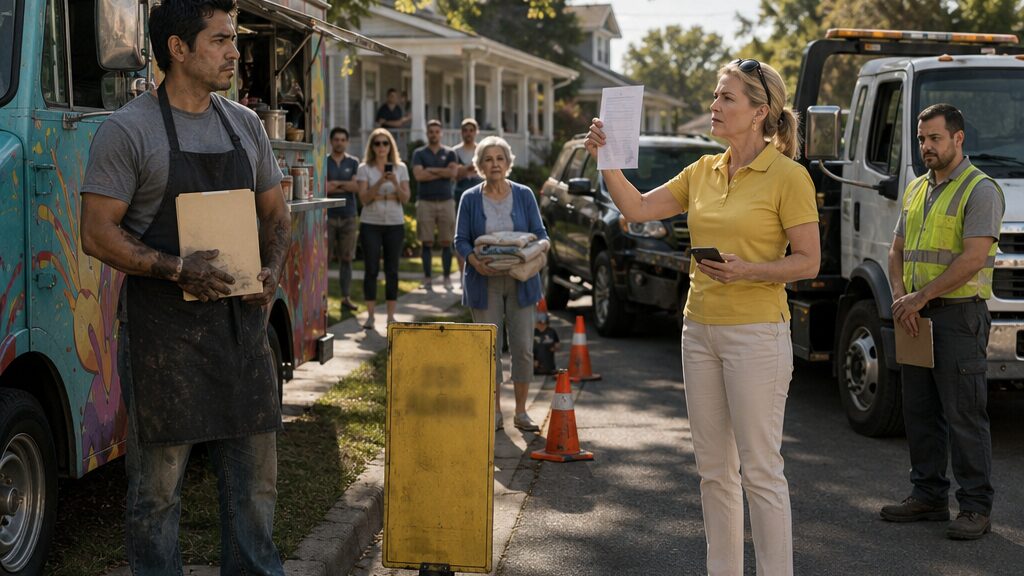
James Ramirez had one hand inside the service window, tightening the loose latch with a flathead screwdriver, when the voice cut across his driveway sharp enough to make him stop. He looked over the top of the truck door and saw Nicole Martin standing at the curb in a pink polo, pale slacks, white sneakers, and sunglasses pushed up on her head like she had come prepared to inspect sunlight itself.
She was pointing at the truck.
Not gesturing. Pointing.
Behind her, across Oak Hollow Lane, two garage doors were open, and three neighbors who had been pretending to sort recycling or water flowers had gone still.
James lowered the screwdriver.
“Afternoon, Nicole.”
“Don’t ‘afternoon’ me.” She stepped one foot off the curb, then seemed to think better of touching his driveway. “That vehicle cannot stay here.”
The truck sat where it had sat for nine days: backed neatly beside his garage, tires inside the concrete edge, power line disconnected, propane locked, service window closed. The paint was fresh enough that the afternoon sun still caught the red and cream stripes. On the side, in simple block letters, it said Ramirez Street Kitchen.
James glanced at the letters and then back at her.
“It’s on my property.”
“It’s a commercial vehicle.”
“It’s registered.”
“It’s an eyesore.”
That word passed over his face without landing where she wanted it to. He had heard worse in restaurant kitchens, worse in hospital hallways, worse from his own head at three in the morning when the house felt too clean and too silent.
He set the screwdriver on the step inside the truck. “The HOA rules allow vehicles in driveways if they’re licensed, operational, and not blocking sidewalk access.”
Nicole gave a short laugh, the kind meant for the people watching more than for him. “I am very familiar with the rules.”
“I figured.”
Her eyes narrowed.
Across the street, someone’s phone lifted at chest level. James saw it from the corner of his eye: black rectangle, careful angle, held by a neighbor who probably told himself he was only checking messages. A child rolled past on a scooter and slowed until his mother called him back.
Nicole folded her arms. “We’ve received complaints.”
“About what?”
“Noise. Traffic. Odor. Possible food service out of a residential lot.”
“There hasn’t been food service here.”
“Not yet,” she said quickly. “That’s exactly the concern.”
James wiped his right hand on the thigh of his jeans. Grease left a faint dark line near his pocket. “Then the concern is about something that hasn’t happened.”
“The concern is about what this neighborhood is becoming.”
He looked down the lane. Identical mailboxes. Trimmed lawns. Fresh mulch shaped in obedient half-moons around builder-grade shrubs. A flag lifted from one porch. A basketball hoop stood at the end of a driveway with its net torn on one side. It was not a rich neighborhood, but it worked hard at looking settled.
“What is it becoming?” he asked.
Nicole’s mouth tightened, as though he had tried to trap her. “That is not the issue.”
“It sounds like the issue.”
“The issue is compliance.” She raised a folder he had not noticed before, a pale manila one held against her side. “You cannot run a business out of your driveway.”
“I’m not running it out of my driveway.”
“Then why is it here?”
Because the commissary lot flooded last week. Because the county inspection is signed off. Because the city approved Saturday. Because Mary used to sit at the kitchen table and draw little squares on notebook paper, saying, One truck here, one table there, make sure the kids have shade.
Because if I park it anywhere else tonight, I’m afraid I won’t bring it back.
James said none of that.
He picked up the screwdriver again, not to work, only to give his hand something to hold.
“It’s here because it’s mine.”
Nicole’s eyes flicked to the screwdriver. “Is this how you plan to respond to every reasonable request?”
“I’m responding.”
“You’re refusing.”
“Yes.”
The word was quiet, but it reached the curb.
One of the garage doors across the street began to lower, then stopped halfway, as if even the motor wanted to listen.
Nicole looked toward the watching houses. That glance changed her face. It added polish, board-meeting polish. Her shoulders lifted; her chin settled into a practiced angle.
“James, nobody is trying to be unkind.”
He almost smiled at that, but it would have come out wrong.
“This is a residential community,” she continued. “People bought here with expectations. Quiet streets. Clean sight lines. No commercial operations parked beside breakfast nooks and children’s bedrooms.”
He thought of the children who had eaten free tacos from Mary’s church table after the storm three years ago. He thought of Nicole passing out bottled water that same day, efficient and annoyed and useful. People were rarely only one thing. That made them harder to answer.
“I’ll make sure it’s clean,” he said.
“That isn’t enough.”
“It’s not blocking anything.”
“That isn’t enough either.”
A neighbor’s dog started barking behind a fence. The sound bounced between the houses.
Nicole took a step closer to the driveway line. “Move it to a storage facility. A commercial lot. Somewhere appropriate.”
“I can’t.”
“Can’t or won’t?”
He looked at the food truck’s rear bumper. He had replaced the left taillight himself after backing too close to the garage. Mary would have laughed at the crooked first attempt. She would have put one hand over her mouth, failed to hide it, and said, Baby, it’s leaning like it’s tired.
“Both,” he said.
Nicole exhaled through her nose. “Then you leave me no choice.”
That made him look at her fully.
There it was. Not anger. Satisfaction, small but visible. Not enough for anyone else to call it cruelty. Enough for James to feel the ground under the conversation change.
“What choice is that?”
She tapped the folder with two fingers. “The board has remedies.”
“The board hasn’t met.”
“The compliance chair can initiate review.”
“For a truck in my driveway.”
“For a continuing violation.”
“It’s been nine days.”
“Nine days too many.”
He heard the front door of Linda Baker’s house open two doors down. Linda stepped onto her porch in a loose blue cardigan, one hand on the railing, her gray hair pinned badly on one side. She did not come down the walk. She only watched.
James looked away first.
Near his garage sat a folded yellow metal sign, leaned face-in against a cardboard box of extension cords. He had meant to take it to the curb before noon but had spent too long checking generator seals. Only the back of the sign showed, dull and scratched. Nicole’s gaze slid over it without interest.
“Saturday morning,” she said.
“What about it?”
“If that truck is still visible from the street, I will file the complaint formally and request enforcement. Fines, towing referral if applicable, suspension of any community-use approval attached to your address.”
A heat moved through James’s chest, not loud, not dramatic, just a hard pressure behind the ribs.
“You don’t know what approval is attached to my address.”
“I know what I need to know.”
He nodded once.
That seemed to irritate her more than an argument would have. “That’s it? No explanation?”
“I gave you one.”
“No, you gave me an attitude.”
This time the phone across the street rose higher. James turned his head slightly, and the neighbor holding it pretended to film the dogwood tree.
Nicole saw the phone too. Her voice softened immediately, becoming careful enough to be quoted. “I’m asking you as a neighbor to respect the standards everyone agreed to.”
James wanted to say that everyone had also agreed to bring side dishes when Mary organized storm meals, to check on old Mr. Henley before his daughter found out he had been alone for two days, to wave even when tired, to remember that houses were not display cases.
Instead he placed the screwdriver on the truck step again and closed the service window with a firm metallic click.
“I’ll respect the rules,” he said.
Nicole held his gaze. “Not for long.”
The sentence landed strangely. Not as a correction. As a promise.
She pulled her phone from her pocket, raised it, and photographed the food truck from three angles: side panel, driveway, license plate. Then she took one more picture, wider, catching James beside it with his hands at his sides.
He did not move.
When she finished, she smiled with only half her mouth, the way people smile when they believe the record has already chosen their side.
“Enjoy your afternoon,” she said.
James watched her walk back down the curb, folder tucked under her arm, phone still in hand.
Only after she turned the corner did the garage door across the street finish closing. Linda remained on her porch a moment longer. James could feel her looking at him, waiting for him to look back, waiting maybe for him to ask for help or offer the explanation she already partly knew.
He didn’t.
He bent, lifted the folded yellow sign, and turned it around.
NO PARKING
VIOLATORS WILL BE TOWED
The black letters were bold, official, and ugly. Necessary, the city clerk had said. Temporary signs must be placed twenty-four hours before street closure.
James carried it to the bed of his pickup and laid it flat beside the sandbags.
Then his phone buzzed.
A message from the HOA notification address sat on his lock screen.
Subject: Compliance Concern Received — Commercial Vehicle.
James stared at it until the screen went dark in his hand.
Chapter 2: The Notice That Arrived Before Dinner
The violation notice arrived before the oven finished preheating.
James had just slid a sheet pan of chopped peppers onto the counter when his laptop chimed from the kitchen table. The sound was ordinary. Thin. Digital. But it cut through the house like someone had opened a door without knocking.
He wiped his hands and looked.
Official Notice of Possible Covenant Violation.
Below that: commercial vehicle visible from street; suspected business activity from residential lot; possible nuisance impact; immediate correction requested.
He stood over the table without sitting. The peppers smelled green and sharp behind him. The kitchen light made the laptop screen too bright, every line too clean.
Attached were Nicole’s photographs.
The food truck from the curb. The food truck beside his garage. His license plate. James himself, caught mid-breath, mouth closed, eyes lowered, looking exactly like a man with something to hide.
For a moment he considered laughing. Not because it was funny. Because the alternative was throwing the laptop into the sink.
The message was copied to the HOA board.
Nicole Martin. John Young. Two unnamed board members. Management portal. Compliance archive.
At the bottom, a line in bold: Failure to correct may result in daily fines and referral for further enforcement.
Daily fines.
James pulled out a chair but did not sit. He read the notice again, slower, searching for the part where someone had asked a question before reaching a conclusion.
There was no question.
On the counter near the stove lay his permit folder, weighted by a coffee mug. City temporary food-service approval. County health inspection. Fire extinguisher tag. Insurance certificate. Street closure authorization for Saturday from eight in the morning to four in the afternoon. He had paid fees he could barely afford and answered emails from three departments that never seemed to read one another’s attachments.
He opened the folder and touched the top page.
Approved.
The word should have been enough.
Mary used to say paperwork was just a nervous person’s way of asking to be trusted. She had been better at it than he was. She put sticky notes on everything. Call clerk. Confirm cones. Ask Linda about folding tables. Remember vegetarian option. Don’t forget shade for kids.
He moved the permit aside.
Under it lay a sheet of notebook paper, creased at the corners, written in Mary’s rounded handwriting.
Oak Hollow Food Day — rough plan, don’t overthink it.
He closed the folder quickly, as if someone had walked in and seen too much.
The oven beeped.
James turned it off.
For several minutes he stood in the kitchen listening to the refrigerator hum. The house had been too quiet since Mary died, but it was not empty. It held her systems. Her blue tape on the inside of cabinet doors. Her old grocery lists in a drawer he could not make himself clear. Her handwriting tucked into recipes, addresses, phone numbers, plans.
Plans had been her way of arguing with loneliness.
His phone buzzed.
Linda Baker.
He let it ring until it stopped.
Then it buzzed again with a text.
Saw what happened. You all right?
He typed, Fine.
He stared at the word, deleted it, typed, It’s handled.
He deleted that too.
Finally he put the phone face down.
Across the kitchen table, the HOA notice waited with its clean margins.
He opened a reply window.
Nicole, the truck is on my property and there is no food service occurring from my driveway. I have permits for—
He stopped.
If he attached the permits, Nicole might back off. If he explained the festival, she might stop treating him like a nuisance.
If he explained Mary, the whole neighborhood would know why.
He pictured it too clearly: the softened voices, the tilted heads, people saying they had no idea, asking what kind of cancer even though nobody needed the answer, remembering Mary in public as if grief became safer when distributed. Someone would post about community spirit. Someone would cry at the serving window. Someone would say, “She would have loved this,” and James would have to stand there and not break.
He deleted the sentence.
Then he wrote:
The vehicle is legally parked. Please cite the exact provision being violated.
He sent it before he could soften it.
The response from Nicole came sixteen minutes later.
James,
Thank you for your reply. The Board takes these concerns seriously. Section 8.4 prohibits commercial activity that creates visual nuisance, traffic risk, or disruption to residential character. Please remove the vehicle from public view pending review.
Regards,
Nicole Martin
Compliance Chair
He read “public view” three times.
Public view was not a rule. It was a feeling dressed as one.
He opened the covenants file saved on his desktop. Mary had downloaded it years ago after a neighbor got a warning for leaving a basketball hoop too close to the sidewalk. She had highlighted the oddest lines just to make him laugh. Trash bins may not be visible before 6:00 p.m. on collection eve. Holiday inflatables shall not exceed reasonable seasonal expression. Temporary community events require written notice to the Association and applicable municipal approval.
He found Section 8.4.
Nicole had quoted around the rest.
Commercial activity was prohibited if conducted as a regular business from a residential lot, except home offices without visible customer traffic and temporary events approved by municipal authority and not otherwise prohibited by the Association.
Temporary events.
Approved by municipal authority.
Not otherwise prohibited.
James leaned back.
There it was. Not victory, exactly. A hinge.
His phone buzzed again, this time with an email alert from the city events clerk.
Reminder: Temporary No Parking signs must be placed by 8:00 a.m. tomorrow for Saturday closure. Cones may be set no earlier than 6:30 a.m. day of event. Please keep permit copy on site.
He rubbed both hands over his face.
Tomorrow. Saturday.
The day Mary had circled on the calendar before the appointment that changed the calendar into a thing neither of them trusted anymore.
He went outside at dusk with the yellow signs and the sandbags. The neighborhood had entered that hour when everyone pretended not to watch from behind blinds. Porch lights came on one by one. A sprinkler ticked in a yard three houses down. Someone’s television glowed blue behind a front window.
James placed the first sign near the corner, facing traffic.
NO PARKING
SATURDAY 8 A.M.–4 P.M.
VIOLATORS WILL BE TOWED
The official city placard was clipped beneath it in a plastic sleeve. He checked the zip ties twice.
When he turned, Linda was at the end of her walkway.
“You should call me back when I call,” she said.
James picked up the empty sign frame. “I was busy.”
“You were stubborn.”
“That too.”
She came closer, slowly. Linda moved like someone who had earned the right not to hurry. “Nicole came by after she left you.”
“I figured.”
“She asked if I’d sign a statement that the truck was affecting neighborhood enjoyment.”
He kept his eyes on the sign frame. “Did you?”
“No.”
“Thank you.”
“I didn’t defend you either.”
He looked at her then.
Linda’s face carried the kind of guilt that did not ask to be comforted. “I told her I didn’t know enough.”
“That’s true.”
“It isn’t.”
A car rolled by too slowly. Both of them stopped talking until it passed.
Linda lowered her voice. “Mary would have had three copies of every permit in color-coded folders and a smile sharp enough to cut glass.”
The mention of Mary’s name made the air change. James looked toward his driveway.
“Mary isn’t here.”
“No,” Linda said. “But you are.”
He gave a short nod that ended the conversation before it could become what she wanted.
Linda did not push. She only looked at the yellow sign. “That’s for Saturday?”
“City requirement.”
“So it’s really happening.”
“If Nicole doesn’t find a way to stop it.”
Linda’s mouth tightened. “She hates being surprised.”
“So do I.”
“That’s not the same thing.”
James lifted the sign frame. “Good night, Linda.”
He regretted it before her face changed, but it did change. Not hurt exactly. Tired.
“Good night, James.”
He finished placing the signs under porch lights and the eyes of curtains. By the time he came back inside, the peppers had gone soft on the counter. He covered them, washed the knife, wiped the cutting board, then opened the HOA portal one more time.
There were new comments under the compliance thread.
I wondered if that truck was allowed.
Is he selling food from home now?
This should have been handled before the weekend.
Nicole, thank you for staying on top of this.
James scrolled without breathing much.
Then he saw the forwarded attachment: Nicole’s original complaint, sent not only to the board but to a neighborhood distribution list someone had built for lost pets, yard sales, and storm updates.
At the top, Nicole had written:
Several residents have expressed concern that Mr. Ramirez may be attempting to use our street for an unauthorized commercial event.
James closed the laptop slowly.
Outside, the yellow sign at the curb reflected his porch light back at the house.
Chapter 3: The Saturday Sign Everyone Missed
The tow truck was already idling behind Nicole’s SUV when James opened his garage at 6:41 Saturday morning.
For a second he stood still with his hand on the wall switch, watching exhaust drift pale in the cool air. The street was supposed to be empty. That was the point of the signs. Empty for cones, tables, vendor setup, and children wandering with paper boats of food later in the day.
Instead, Nicole Martin stood beside the tow contractor with a clipboard in one hand and her phone in the other, dressed now in a yellow polo bright enough to match the signs she had apparently not read.
James stepped out of the garage.
“Morning,” he said.
Nicole turned. “Do not start unloading.”
Behind him, inside the garage, boxes of paper trays, napkins, and bottled water sat stacked beside two folding tables. In the food truck, the refrigerator was already running. Beans warmed low in a covered pan. The smell of cumin and onions had begun to fill the narrow stainless-steel space.
James pulled the garage door down to half-height, buying himself one second away from her eyes.
“It’s six forty-three,” he said. “The permit allows setup at six thirty.”
“The HOA has not authorized this.”
“The city has.”
“The HOA governs this community.”
“The city governs the street closure.”
Nicole gave him a look of exhausted patience, as if he were a child explaining traffic law with a crayon. “James, we can argue jurisdiction later. Right now, this vehicle needs to be removed before residents wake up to whatever you think this is.”
The tow contractor, a man with a reflective vest and a paper cup of gas-station coffee, studied the truck with professional unease. “Ma’am, if it’s on private property—”
“It’s part of an enforcement matter,” Nicole said without looking at him.
James walked to the curb.
The yellow sign stood between Nicole’s SUV and the first orange cone he had set out before dawn.
NO PARKING
SATURDAY 8 A.M.–4 P.M.
VIOLATORS WILL BE TOWED
Beneath it, in the plastic sleeve, was the city notice stamped and dated. The corner of the paper fluttered in the morning breeze.
Nicole followed his glance and then looked away too quickly.
“You put those up after the complaint,” she said.
“I put them up when the city told me to.”
“You understand how this looks.”
“Yes.”
“No, I don’t think you do.” She stepped closer, lowering her voice in the way people did when they wanted nearby listeners to hear the seriousness but not the words. “You cannot embarrass this association with a food truck parade because you found a loophole.”
James turned his head.
There it was again: embarrass.
Not safety. Not access. Not even rules.
Embarrassment.
A garage opened across the street. A neighbor in running shorts stepped out, saw the tow truck, and stopped with one foot still inside the garage. Farther down, Linda Baker’s porch light came on.
Nicole noticed the attention gathering and straightened.
“The board has a duty to preserve residential character,” she said, louder now. “We had complaints. We have a violation notice. We have not approved any commercial activity.”
James felt the morning narrow around him.
He could pull out the folder now. Show the permit. Show the county approval. Show the email chain where the city clerk had copied the HOA management address two weeks ago. He could ask Nicole why she had not opened the attachment. He could say Mary’s name and end the whole performance.
He did not.
He looked at the tow contractor. “You can’t tow from my driveway.”
The contractor shifted. “I’m not hooking anything without paperwork from the property owner or police authorization.”
Nicole’s cheeks colored. “This is not about the driveway anymore. He is setting up an event on association frontage.”
“It’s a city street,” James said.
“It is our neighborhood entrance.”
“It’s Oak Hollow Lane.”
“Do you always hide behind technicalities?”
The question had teeth. A phone appeared in the runner’s hand across the street. Another curtain moved. The neighborhood was waking faster than it did for trash pickup.
James took a breath.
“Nicole,” he said, “did you read the sign?”
She blinked. “Excuse me?”
“The sign.”
“I can read.”
“Then read it.”
The tow truck’s engine rattled through the pause.
Nicole turned, annoyed, toward the yellow metal frame she had been standing beside for several minutes. Her eyes moved over the bold letters first with impatience, then with calculation. She leaned slightly toward the plastic sleeve beneath it.
James watched the moment reach her.
Not all at once. First the city seal. Then the date. Then the permitted closure hours. Then the address block. Then the line that said: Applicant: James Ramirez. Event: Oak Hollow Food Day.
Behind her, a minivan turned onto the lane, slowed at the first sign, and stopped. A woman leaned out the driver’s window. “Are vendors supposed to use the other entrance?”
James lifted a hand. “Yes, ma’am. Around by Maple Court. I’ll move the cone in two minutes.”
Nicole turned back to him. Her expression had changed, but not softened. If anything, it had hardened around the embarrassment she had named.
“You applied for a street event,” she said.
“I did.”
“You did not notify the HOA.”
“I did.”
“No, you did not.”
“I sent notice to the management email listed on the association website.”
“That is not board approval.”
“It was not a request for board approval. It was notice with municipal approval attached.”
Her eyes flicked to the neighbors now gathering in driveways. Too many ears. Too many phones. She lowered her voice again, but the edge stayed. “You should have come to me directly.”
“You told me to move the truck before you asked why it was here.”
A white pickup entered from the far end of the block, towing a small trailer painted with lemons and blue waves. Behind it came a sedan with a folding canopy strapped to the roof. Two children on bikes coasted to the corner and stared at the tow truck like it was part of the entertainment.
The street, which Nicole had expected to control while empty, began filling around her.
A vendor got out of the lemon trailer and called, “Ramirez? Where do you want us?”
James turned. “Past the second cone, driver’s side to the curb. Leave ten feet for fire access.”
The words came automatically. Calm. Precise. Work words. Kitchen words. Event words. The kind of words that moved people without needing to push them.
Nicole heard it too. Her eyes narrowed as he walked to the cone and shifted it aside.
Within five minutes, the block had become a thing in motion. Canopies unfolded with metallic snaps. Coolers rolled over asphalt. A father carried a stack of folding chairs. Someone laughed near the lemonade trailer. The smell of coffee drifted from a cart setting up near the mailboxes.
The tow contractor came over to James, keeping his voice low. “I’m going to clear out.”
James nodded. “Appreciate you waiting.”
The contractor glanced toward Nicole. “She told dispatch it was unauthorized parking. That sign says different.”
“I know.”
“You want me to say anything?”
“No.”
The man gave him a brief look, maybe respect, maybe relief, then climbed into the cab. The tow truck pulled away slowly, its amber light off.
That was the first small victory, and James hated how exposed it made him feel.
Nicole stood near her SUV, phone pressed to her ear now. “John, you need to get here,” she said. “No, not later. Now. He has vendors.”
James opened the food truck service window. The latch held. He placed the menu board on the counter: three items, two prices, one line at the bottom.
Community plates available. Just ask.
He had argued with himself over that line for three nights.
A little girl in a purple backpack ran up with her mother and pointed at the truck. “Is this the taco one?”
James swallowed.
“It is,” he said.
Her mother smiled apologetically. “She’s been talking about it since the flyer.”
Nicole’s head snapped toward them. “Flyer?”
The mother looked uncertain. “The one in the mailbox? For Oak Hollow Food Day?”
More cars came around Maple Court now. Not traffic jam cars. Neighborhood cars. People carrying lawn chairs, foil-covered pans, grocery bags. A man from three streets over waved at James with the awkward cheer of someone who had criticized him online and now wanted breakfast.
Linda Baker walked toward the truck holding two bundles of plastic tablecloths. She did not look at Nicole at first. She looked at James.
“You forgot these,” she said.
“I didn’t ask you to bring them.”
“No,” Linda said. “You didn’t.”
She handed them through the window. Her fingers brushed the edge of the clipboard clipped just inside, and her face changed.
James saw her see it.
Mary’s old checklist, copied and laminated, was clipped behind the service counter where only he could read it.
Linda’s mouth opened slightly, then closed.
Not now, her face said.
Please not now, his said back.
Nicole approached the truck slowly, as if the asphalt had shifted under her. “You organized this?”
James wiped his hands on a towel. The neighborhood moved behind her: vendors setting up, families forming the first uncertain line, children trying to read chalk arrows on the pavement, the yellow no-parking sign standing at the curb like a witness nobody had wanted.
“For the whole neighborhood,” he said.
Nicole stared at him.
The festival banner unfurled across the street behind her, tied between two temporary poles by a pair of volunteers.
OAK HOLLOW FOOD DAY
For one brief second, nobody spoke.
Then Nicole looked from the banner to the crowd, from the crowd to the sign, and finally back to James as if the question had become larger than the answer he had given.
“Why?” she asked.
Chapter 4: The Festival With One Empty Chair
The line stretched past Nicole Martin’s driveway before James had finished serving the first pan of rice.
He saw it when he looked up from the steam: parents with folded lawn chairs under their arms, kids balancing lemonade cups, two older men arguing gently over which vendor had the best pulled pork, a teenager taking pictures of the banner like proof that something interesting had finally happened on Oak Hollow Lane. The festival had not exploded into chaos. It had become what Mary had drawn in blue pen—people moving slowly, talking in clusters, filling the street without owning it.
And Nicole stood at the edge of it all with her phone in her hand, not eating, not leaving.
“Two chicken plates,” a father said at the window. “And one community plate, if that’s okay.”
James nodded. “It’s okay.”
The father’s ears reddened, as if asking had cost him something. “My sister’s kids are with us this weekend. Didn’t plan for three extra lunches.”
“No problem.”
James packed the third tray fuller than the first two and slid it across without making the man say anything else. That had been Mary’s rule from the beginning. If people had to explain hunger, you had already made it too expensive.
Behind him, clipped to the inside wall beside the prep list, Mary’s laminated checklist tapped faintly every time the breeze pushed through the service window.
Oak Hollow Food Day — rough plan, don’t overthink it.
He had tried not to look at it all morning.
“James.”
Linda Baker’s voice came from the side of the truck. She had tied one of the plastic tablecloths over a folding table near the curb, but now she stood close to the service window, holding an empty tray she clearly did not need.
“You’re low on forks,” she said.
He pointed with his elbow toward a box under the counter. “Second case is by the cooler.”
Linda did not move. Her eyes were not on the forks. They were on the checklist.
James reached up and unclipped it before she could say anything. He turned it facedown beside the register.
Linda’s mouth tightened.
“Don’t,” he said softly.
“I didn’t say a word.”
“You were about to.”
She looked toward the line. A little boy was showing another child how to fold a napkin into a hat. Two women who had not spoken since a fence dispute last spring were sharing shade under one canopy. Nicole paced near the fire lane with her phone pressed to her ear.
Linda lowered her voice. “It looks like what she wanted.”
James kept packing trays. “It looks like lunch.”
“It looks like people remembering how to stand near each other.”
His hand paused over the rice.
A woman at the window smiled uncertainly, and he forced himself back into motion. “Chicken or bean?”
“Bean, please.”
Nicole crossed into his view as James handed over the tray. Her smile appeared only when someone looked at her. Between smiles, her expression returned to a hard, searching focus. She stopped at the yellow sign, photographed it again, then photographed the city placard beneath it.
James watched her thumb move across her screen.
A minute later, John Young arrived in a golf cart that belonged to the HOA clubhouse, even though the clubhouse was only three blocks away. He parked badly near the corner, climbed out with his reading glasses already in one hand, and looked around at the full street with the expression of a man who had opened a bill he thought he had already paid.
Nicole went straight to him.
James could not hear all of it over the generator hum and the sizzle from the lemonade trailer’s griddle, but he caught pieces.
“—not properly logged.”
“—management email, not board approval.”
“—liability exposure.”
“—commercial use.”
John looked from Nicole to the sign, then toward the banner. He did not look angry. That worried James more. John looked like he was counting consequences.
The county health inspector appeared at eleven fifteen, checked temperatures, asked for the permit binder, and signed the inspection sheet on the hood of his car. James handed him a taco plate as he left, and the inspector accepted it with the solemnity of a man who had seen enough church suppers to know which ones were safe.
That should have settled something.
It did not.
At noon, when the crowd had settled into a steady rhythm and the street sounded less like an argument than a block party, Nicole came to the truck window.
“I need a copy of your permit.”
James slid the binder toward her. “City permit is in the front sleeve. County approval is behind it.”
She did not take it. “Send it electronically.”
“It was already sent.”
“To the wrong place.”
“To the management email listed on the HOA website.”
“That is for general correspondence.”
“That’s where the website says to send community event notices.”
“The website is outdated.”
James looked at John, who had come up beside her but stayed half a step back. “Is it?”
John shifted his glasses from one hand to the other. “The management company changed intake categories last quarter. We’ve been meaning to update the page.”
“You’ve been meaning to,” James repeated.
Nicole’s eyes flashed. “That does not change the fact that the board did not formally review this.”
“The city did.”
“We are not the city.”
“No,” James said. “You’re not.”
A few people in line went quiet. James felt the silence forming and regretted the sharpness as soon as it left him. Nicole’s face closed, not wounded, exactly, but locked.
John cleared his throat. “James, for now, let’s keep the event safe and documented. We can sort notice procedures Monday.”
Nicole turned on him. “Monday? After it’s already happened?”
“The street is closed legally,” John said, low but firm. “The inspector signed off. The safest option right now is not escalating in the middle of it.”
The words hung between them. Not escalating. In the middle of it.
Nicole looked around and seemed to notice, maybe for the first time, that the whole neighborhood could see her having to accept less control than she wanted.
She stepped back. “Fine. But this is not over.”
James turned to the next order before he answered something he could not take back.
The lunch rush peaked at one. He lost track of faces and kept track of hands: cash, cards, children’s fingers pointing, a neighbor’s wedding ring tapping the counter, Linda sliding extra napkins into place, John buying two plates and pretending he had not come to investigate.
Then Linda froze beside the prep shelf.
James followed her gaze.
The checklist had shifted facedown when he grabbed the binder. Now it lay at an angle, showing the lower corner. Mary’s handwriting curved along the edge.
Ask Linda about folding tables.
Linda touched the counter as if steadying herself.
“You kept it,” she said.
James reached for the page. “Linda.”
“She wrote that at my kitchen table.”
A customer stepped up, saw their faces, and hesitated. James forced his hand away from the checklist.
“Give me one second,” he told the customer.
He turned to Linda. “Not here.”
“Where, then?”
The question was too quiet for anyone else, but it hit harder than Nicole’s pointing.
James’s throat tightened. “Please.”
Linda looked at him for a long moment. Then she nodded, but there was no agreement in it. Only delay.
By three thirty, the street looked sun-tired and happy. Trash bags were tied. Children had chalk on their knees. The lemonade trailer had sold out. Someone had hung a handwritten thank-you note on the yellow sign, the paper fluttering beneath the tow warning.
Nicole saw it and removed it.
James watched from the truck window as she folded the note once and tucked it into her folder, not throwing it away, not keeping it kindly either. Evidence, maybe. Or something she did not know what to do with.
When the last vendor pulled out and the city closure ended, James took down the banner himself. The fabric sagged into his arms.
Linda came over with the final stack of tablecloths. “You fed half the neighborhood.”
“Not half.”
“Enough.”
He folded the banner smaller than it needed to be. “Thank you for helping.”
“That’s not what I want from you.”
“I know.”
“Then stop making me ask.”
James looked toward the truck. The checklist was no longer clipped inside. It was in the binder, under the permits, where no one could accidentally recognize it again.
Linda’s voice softened, but it did not become gentle. “Mary would hate that you’re letting them erase her.”
James held the folded banner against his chest.
Across the street, Nicole stood beside John, pointing at something on her phone.
James did not answer Linda, because if he opened his mouth, the first thing out might have been Mary’s name, and he was not ready for the street to hear it.
Chapter 5: The Meeting Where Politeness Turned Sharp
James walked into the HOA clubhouse Monday evening and saw a printed photo of his food truck already taped to the whiteboard.
The room smelled like burnt coffee and carpet cleaner. Metal folding chairs had been arranged in three rows, more than the board usually needed, and almost all of them were filled. Neighbors who had eaten from his truck two days earlier now sat with their hands folded in their laps, wearing the careful faces people wore when they wanted truth but did not want involvement.
On the whiteboard, above the photo, someone had written: SPECIAL AGENDA ITEM — COMMERCIAL USE / EVENT AUTHORIZATION.
Nicole Martin sat at the front table with a folder stacked thick beside her. John Young sat two seats away, calculator and bylaws binder in front of him. The two other board members avoided James’s eyes.
James took a seat in the second row, not the front.
Linda Baker sat at the end of the same row. She did not look at him until he sat. Then she placed her purse on the chair between them and removed it again, leaving the space open.
He kept the permit binder on his lap.
Nicole tapped her pen once. “We’ll call this special meeting to order.”
Her voice was smooth, almost pleasant. That made the photo on the whiteboard feel worse.
“As everyone knows,” she continued, “there was an incident this weekend involving an unauthorized commercial food event on Oak Hollow Lane.”
James felt Linda turn her head toward him. He did not move.
John leaned toward his microphone, though the room was small enough not to need one. “For accuracy, we should say disputed authorization.”
Nicole looked at him. “The authorization is what we’re here to discuss.”
“Then it’s disputed.”
A small movement passed through the room. Not quite approval. Interest.
Nicole’s smile held. “Fine. A disputed commercial food event occurred Saturday, creating questions about notice, traffic control, liability, and covenant compliance.”
A neighbor in the front row raised a hand halfway. “But it was nice.”
Nicole did not look at her. “The quality of the tacos is not before the board.”
A few people gave uneasy laughs. James did not.
Nicole opened her folder. “Mr. Ramirez was issued a notice of possible violation before the event. He proceeded anyway.”
James’s hand tightened on the binder rings.
John flipped a page in his bylaws binder. “He also had a city street closure permit, temporary food-service approval, county inspection, and insurance certificate naming the event location.”
Nicole’s pen stopped.
John looked uncomfortable but kept going. “Those documents were provided Saturday. I reviewed them Sunday.”
“Provided after the fact,” Nicole said.
James stood before he had decided to.
Every head turned.
“They were emailed two weeks before the event,” he said.
Nicole looked up at him. “To a general inbox.”
“To the address listed for community event notice.”
“The board did not see them.”
“That’s not the same as me not sending them.”
The room went still in a sharper way.
Nicole’s cheeks colored, but she kept her posture. “Mr. Ramirez, nobody is accusing you of failing to send an email.”
“You sent a complaint to the neighborhood saying I was attempting an unauthorized commercial event.”
“I said there were concerns.”
“You used my name.”
“You put a food truck on the street.”
“After the city approved it.”
She leaned back slightly. “And before the board could evaluate the effect on this community.”
James almost opened the binder then. The front sleeve held the permit. Behind it, the notice email. Behind that, Mary’s checklist, still folded, because he had taken it out and put it back five times before leaving the house.
He could feel the paper there like heat.
John cleared his throat. “Nicole, can we walk through the timeline?”
“I have the timeline.”
“I’d like to walk through it anyway.”
Another small shift in the room. Nicole noticed it. James could see her measuring not the facts, but the room’s movement away from her.
John read from a printed email. “City events office sent approval to Mr. Ramirez and copied the HOA management address on the first of the month. The management portal did not assign it because the intake category was retired. That is an administrative issue.”
Nicole’s jaw tightened. “An administrative issue that left the board unaware.”
“Agreed,” John said. “But not necessarily a homeowner violation.”
Nicole turned a page too quickly. “The vehicle itself was still visible from the street for more than a week.”
James said, “The covenants allow licensed vehicles in driveways.”
“Not when they are commercial.”
“They prohibit regular commercial activity from the lot. Not ownership of a registered vehicle.”
Nicole looked to the front row, where two neighbors nodded faintly. Her fingers pressed flat against her folder.
“This is exactly the problem,” she said. “We are being dragged into technical arguments after the neighborhood has already been used.”
Used.
The word changed the temperature in James’s chest.
Linda spoke from beside him. “Used for what, Nicole? People ate lunch and talked.”
Nicole turned toward her. “Linda, with respect, you helped him set up. You’re not neutral.”
Linda’s face went pale, but she did not look away. “No. I’m not.”
James looked at her then. It was the first open thing she had said.
Nicole’s eyes sharpened, as if she had found the crack she wanted. “That raises another issue. There appears to have been private coordination presented as a community event.”
James felt the room tilt slightly.
“What does that mean?” he asked.
“It means,” Nicole said carefully, “that if this was a personal project, promoted using community language, we need to know that.”
“It was open to everyone.”
“Open to everyone does not mean created for everyone.”
James heard his own breath.
John said, “Nicole.”
But she was looking directly at James now. Not at the room. Not at the rules. At him.
“I was told,” she said, “that your late wife may have been connected to this event idea.”
The room tightened around Mary’s absence.
James stopped breathing for one beat.
Linda whispered, “Don’t.”
Nicole heard and misunderstood. “I am sorry for your loss. Truly. But grief does not exempt a homeowner from rules, and using a deceased spouse’s name to create sympathy around a commercial event would be deeply inappropriate.”
For a second, there was no clubhouse. No whiteboard. No rows of neighbors. Only Mary’s name handled like a tool on a table.
James stood so still that his anger had nowhere to go.
Nicole’s expression flickered. Not regret. Alarm, perhaps, at how far her own words had traveled once released.
John said sharply, “That was unnecessary.”
A neighbor in the back murmured, “Come on.”
James opened the permit binder. The rings clicked loudly. He turned past the city permit. Past the county inspection. Past the insurance certificate.
His fingers reached Mary’s checklist.
He could pull it out. Put it on the table. Let them see her handwriting. Let Linda confirm. Let the room soften and Nicole shrink under the weight of what she had touched.
Instead, he closed the binder.
The sound was soft. Final.
Nicole looked confused.
James picked it up and held it against his side. “I’m not doing this with you.”
“Mr. Ramirez, this is a board proceeding.”
“No,” he said. “This is something else.”
He turned to leave.
Linda rose halfway. “James.”
He kept walking.
At the door, John called after him, “We still need to resolve the notice.”
James stopped with his hand on the metal bar.
“Then resolve it,” he said without turning around.
He stepped into the parking lot. The evening air was cooler than the room, but he could not get enough of it into his lungs.
Through the clubhouse window, he saw Nicole still seated at the table, her folder open, her face no longer smooth. Linda was standing now. John had one hand over his mouth, staring down at the bylaws.
James looked at the binder under his arm.
Inside it, Mary’s checklist remained unseen.
He unlocked his truck, sat behind the wheel, and did not start the engine until the clubhouse door opened behind him.
Chapter 6: Mary’s Checklist in the Glove Box
James sat in the dark truck with Mary’s checklist under the dome light and read the same line until the words stopped behaving like words.
Ask Linda about folding tables.
The clubhouse parking lot had emptied thirty minutes ago. The board members had left in separate cars. Nicole had walked out last, phone against her ear, speaking quickly and quietly, and had not looked toward his truck. Linda had come to the curb once, seen him sitting there, and gone home without knocking on the window.
Now the binder lay open across the passenger seat.
James unfolded the checklist all the way.
Mary had written it before the tremor in her hand got bad. Blue pen. Looped letters. Little boxes drawn beside each task, some checked, most not.
Confirm street closure.
Call county health office.
Ask Linda about folding tables.
Kids’ shade.
Community plates — no questions.
James does tacos, even if he complains.
Music? Not too loud. Nicole will panic.
That last line had made him smile once. Tonight it made his throat close.
He touched the edge of the paper with one finger.
Mary had not disliked Nicole. That was the part nobody would believe if he said it now. Mary had found her exhausting, but useful. “Every neighborhood needs someone who reads the dull emails,” she used to say. “The trouble starts when they think reading the email means they understand the people.”
James folded the checklist once, then opened it again.
He had promised Mary he would do it. Not in a dramatic hospital scene. Not with music or tears. She had been at home by then, propped against pillows in the living room, frustrated that her voice tired faster than her mind. He had been pretending to watch a cooking show while she revised the festival map on a clipboard.
“If I don’t make it to spring,” she had said.
“Don’t.”
“If I don’t,” she repeated, “don’t let this become another folder in the drawer.”
He had stared at the television.
“James.”
“I heard you.”
“No, you got quiet. That isn’t the same.”
He had taken the clipboard from her lap and said he would handle it, just to stop the conversation from becoming real.
Then spring came without her.
For months, the folder stayed in the drawer.
When he finally took it out, he told himself it was because the truck was ready, because the permits were possible, because Oak Hollow had gone strange and cold after the pandemic years and the storm and Mr. Henley dying in his recliner before anyone realized his daughter had been calling the wrong number.
But the truth sat heavier.
He was afraid that if he did not make Mary’s plan real, the last unfinished thing she had asked of him would remain unfinished because he had been too tired to love her properly after she was gone.
A knock hit the passenger window.
James jerked back.
Linda stood outside in a cardigan thrown over her nightgown, hair loose around her face. She held up both hands like she was approaching a skittish animal.
He lowered the window.
“You planning to sleep in there?” she asked.
“No.”
“Good. Your driveway’s more comfortable.”
He almost laughed, but it caught.
Linda looked at the checklist on the passenger seat. “You brought it to the meeting.”
“Yes.”
“You didn’t show it.”
“No.”
“Because of what she said?”
James looked through the windshield at the dark clubhouse. “Because if I showed it after what she said, it would have felt like I was putting Mary on the table to win.”
Linda’s face changed, and for a moment she looked older than he had ever seen her. “Mary asked me to help.”
He turned.
Linda folded her arms against the cold. “Before she got too sick. She called me over and made tea she didn’t drink. Told me if you backed out, I was supposed to annoy you.”
A breath moved out of James without permission.
“She said that?”
“She said, ‘Linda, he’ll confuse privacy with disappearing. Don’t let him.’”
James looked down.
Linda’s voice gentled, but only slightly. “I didn’t do it.”
“You helped Saturday.”
“I waited until you had already done the hard part. That’s not the same.”
He picked up the checklist. The paper shook once in his hand, so small he hoped she had not seen it.
Linda saw it.
“Mary started this because of Mr. Henley,” she said.
James nodded.
“He died twenty houses from people who would have brought soup if they’d known he was alone.”
“He didn’t answer the door much.”
“Neither do you.”
That struck harder than he expected.
Linda let it sit.
Then James’s phone lit up in the cup holder. An HOA email notification spread across the screen.
Special Motion Submitted: Amendment Regarding Commercial Vehicles and Temporary Food Service Activity.
He picked it up.
Nicole had filed it at 10:38 p.m.
The proposed rule would prohibit commercial vehicles larger than a standard passenger van from being parked in visible areas, ban food-service activity on association-adjacent streets without prior board approval, and require written board review for any temporary neighborhood event involving outside vendors.
Emergency vote requested Thursday.
James read it twice.
Linda was still at the window. “What is it?”
He handed her the phone.
She read silently, then swore under her breath in a way Mary would have found impressive.
“She’s trying to make sure it can’t happen again,” Linda said.
“She’s trying to make sure I can’t happen again.”
“No.” Linda gave the phone back. “She’s trying to make sure she’s never surprised again.”
James looked at the checklist, then at the closed clubhouse doors.
He had wanted to keep Mary out of their mouths. Nicole had already put her there.
He had wanted silence to protect what was private. Silence had left enough room for other people to write the story badly.
Linda tapped the window frame. “Come to my porch in the morning.”
“I have prep.”
“You have a vote Thursday.”
“I know.”
“You have the rules?”
“Yes.”
“You have the city permit?”
“Yes.”
“You have Mary’s plan?”
James looked at the paper.
Linda’s voice lowered. “Then stop acting like using the truth is the same thing as using her.”
By Tuesday morning, James had slept three hours and burned the first batch of onions. The smell filled the kitchen bitter and smoky. He opened the back door, set the pan in the sink, and stood under the vent fan until his phone buzzed again.
A text from Linda.
I found my copy.
Attached was a photograph of a page James had never seen: Mary’s event map, folded at the corners, with Linda’s handwriting in the margin.
Ask James if he knows how many people miss being invited.
James sat at the kitchen table.
For the first time since the meeting, he opened a blank email to John Young. He attached the city permit, the HOA notice, the email showing the management address, the covenant section, and Nicole’s proposed amendment.
He did not attach Mary’s checklist.
Not yet.
Instead he wrote:
I will attend Thursday’s meeting. I want public comment before any vote. Linda Baker will come with me.
He stared at the last sentence.
Then he added:
This event was not a loophole.
He sent it.
A minute later, Linda called.
This time, James answered.
“I’ll come Thursday,” he said before she could speak. “But if Mary’s name comes up, it comes from me.”
There was a long pause on the line.
Then Linda said, “That’s all she would have wanted.”
Chapter 7: The Rule Nicole Could Not Rewrite
Nicole called for the vote before the last neighbor had finished speaking.
James was still standing beside the back row with Linda Baker at his left, the permit binder under his arm, when Nicole tapped her pen against the table and said, “The board has heard sufficient comment.”
A woman near the window turned in her chair. “I haven’t said anything yet.”
“We’re already over time,” Nicole replied.
John Young looked up from the bylaws binder. “We are not over time. The agenda says public comment before board action.”
Nicole did not look at him. “The chair can manage discussion.”
“The chair can manage it,” John said, “not end it to avoid it.”
The clubhouse went quiet in a way it had not gone quiet Monday. That meeting had been full of discomfort and gossip. This one had a charge in it. More people had come than there were chairs. Some stood against the walls, arms crossed, faces expectant. The photo of James’s truck was no longer taped to the whiteboard, but everyone seemed to remember it there.
On the table in front of Nicole lay her proposed amendment.
No commercial vehicles larger than a standard passenger van may be visible from any street, driveway, or common area. No temporary food-service activity may occur within association boundaries without prior written board approval. No outside vendor activity may occur in connection with community gatherings unless reviewed and approved by the board no fewer than thirty days in advance.
James had read the language so many times that afternoon the words had begun to blur.
Commercial vehicles.
Food-service activity.
Outside vendor.
There was nothing in it about people.
Nicole folded her hands. “This amendment protects us from confusion going forward.”
Linda made a sound beside him, soft but sharp.
James kept his eyes on the table.
John adjusted his glasses. “It also contradicts the temporary community event provision already in the covenants.”
“That provision is vague,” Nicole said.
“Then we clarify it. We don’t erase it.”
“We are not erasing anything. We are requiring oversight.”
A neighbor near the front said, “Oversight or permission?”
Nicole’s smile tightened. “Those are not opposites.”
James felt the binder under his arm, its hard edge pressing into his ribs. Inside were the printed emails, the city permit, the covenant pages, the photo of the yellow sign, and Mary’s checklist. He had placed the checklist in the back sleeve, not hidden but not first. Linda had seen him do it and said nothing.
John looked at James. “Mr. Ramirez requested public comment. He should be allowed to speak before any vote.”
Nicole’s pen clicked once.
Every face turned.
James walked to the front slowly because walking fast would have looked like anger and walking too slowly would have looked like fear. The room smelled of coffee again, but this time someone had brought cookies, untouched on a paper plate near the door.
He set the binder on the table.
Nicole looked at it as if it might open by itself.
James took out the photo first. The yellow sign stood in the center of the page, black letters clear, city placard clipped beneath.
He placed it flat.
“This sign was posted because the city required it,” he said. “Not because I wanted to threaten anyone’s car. Not because I wanted a scene. It was part of the permit.”
He placed the city approval beside it.
“This was sent to the HOA management email two weeks before the event.”
John leaned forward. “I can confirm the email reached the management system. It was not assigned properly because our website and intake categories were out of date.”
Nicole’s jaw moved.
James placed the covenant page down next. He had highlighted the line in yellow.
Temporary community events require written notice to the Association and applicable municipal approval.
“The rules already allow temporary community events,” he said. “Not every weekend. Not without permits. Not without safety. But they allow them.”
Nicole leaned toward her microphone. “That is your interpretation.”
“It’s the sentence.”
A few people shifted. Someone near the back let out a breath that was almost a laugh.
Nicole looked at the room and then back at James. “The issue is not only Saturday. It is whether one homeowner can impose a commercial event on everyone else and then claim community benefit afterward.”
James felt the anger rise. He could feel how easy it would be to answer her with the sharpness she deserved. He could make her look cruel. He could open the back sleeve, hold up Mary’s handwriting, and let the room punish Nicole for him.
Linda’s voice came back from the night in the truck.
Stop acting like using the truth is the same thing as using her.
James opened the binder again.
His fingers found the checklist.
He did not lift it yet.
“I didn’t tell people why I organized it,” he said.
Nicole sat back slightly, wary now.
James looked at the neighbors instead of at her. “That was my mistake.”
The words cost more than he had expected. They made the room less like a court and more like a place where people could hear him breathe.
“My wife, Mary, started planning Oak Hollow Food Day before she got sick.”
A few faces changed. Linda lowered her eyes.
James kept going before pity could fill the room too quickly.
“She wasn’t trying to start a tradition with a banner and matching shirts. She was upset because Mr. Henley died on this street and most of us found out after the ambulance left. She said a neighborhood where people only talk through complaint emails isn’t a neighborhood. It’s just houses close together.”
Nicole’s eyes moved down to the papers.
James slid the checklist from the sleeve and placed it beside the sign photo. The blue handwriting looked small under the fluorescent lights.
“I didn’t want to bring this,” he said. “I didn’t want Mary’s name used to win an argument. I still don’t.”
Nobody spoke.
“But I also let my silence leave room for another story. That I was sneaking in a business. That I wanted attention. That the festival was a loophole.” He looked at Nicole then, not with triumph, but directly. “It wasn’t.”
Nicole’s face had lost its boardroom polish. For the first time, she looked tired.
James tapped the photo of the sign once. “You read the sign Saturday after you called a tow truck. You read the rule after you issued a notice. You read my grief before you read my permit.”
The words landed hard enough that John looked down.
Nicole did not answer immediately.
When she did, her voice was lower. “You could have come to the board.”
“I sent what the rule required.”
“You could have come to me.”
“You came to my curb with a complaint before you asked one honest question.”
Her eyes flashed, but it faded quickly. Something in the room would not let her turn that into authority.
A neighbor near the window raised a hand. “I ate at the festival. My kids did too. I didn’t feel imposed on.”
Another said, “The street was cleaner after than it is after Halloween.”
A man by the wall added, “If the rule says temporary events are allowed, then why are we banning them because the website email was wrong?”
John turned a page in the bylaws binder and pushed it toward the center of the table. “We also have a problem with the violation notice.”
Nicole looked at him. “John.”
“No,” he said, and the word seemed to surprise him too. “I should have said this Monday. I didn’t because I didn’t want to make the board look divided. But I will not certify fines or enforcement based on a notice issued before review, under a section that does not clearly apply, when the homeowner had municipal approval.”
The room moved again, not loud, but decisive.
Nicole stared at him. “So you’re refusing?”
“I’m doing my job.”
James watched Nicole absorb that. Not just John’s refusal, but the public shape of it. The room she had tried to control now had rules she could not bend without everyone seeing.
One of the other board members whispered to her. Nicole shook her head once, then stopped. Her hand rested on the proposed amendment.
For several seconds, she looked at the paper as if it had betrayed her.
“I was compliance chair during the last block party,” she said suddenly.
No one spoke.
Her voice stayed even, but the words came less polished. “Two summers ago. Before most of you moved in. Someone parked in front of a hydrant. Someone’s child got sick from food left outside. The board got blamed for everything. I got blamed for everything.” She looked at James, and there was anger still, but something underneath it now. “When I saw your truck, I saw that happening again.”
“That doesn’t make what you did right,” Linda said.
Nicole looked at her. “No. It doesn’t.”
The room held its breath.
Nicole picked up the proposed amendment, then set it down.
“I withdraw the motion pending proper review of the existing temporary event provision,” she said.
John nodded. “And the violation notice?”
Her mouth tightened. For a moment James thought she would fight that part to the end.
Then she looked at the checklist again.
“The notice is withdrawn,” she said. “No fines will be assessed.”
No one applauded. James was grateful for that.
Applause would have made it smaller.
He gathered the papers carefully. The sign photo first. The permit. The covenant page. Mary’s checklist last. His hands were steadier than they had been when he entered.
As people began to stand, Nicole remained seated. She did not apologize. She did not look ready to. But when James reached the end of the table, she said his name.
He stopped.
“James.”
The room quieted around them again, though people pretended it had not.
Nicole looked at the folded amendment in front of her. “I should have read more before I acted.”
It was not enough.
It was also not nothing.
James nodded once. “Yes.”
He walked out with Linda beside him.
In the parking lot, the night air felt clean and ordinary. Linda touched his sleeve before he reached his truck.
“You did it without handing her your grief,” she said.
James looked at the binder in his hand. Through the plastic cover, the edge of Mary’s checklist showed pale blue.
“No,” he said. “I finally stopped hiding behind it.”
Across the parking lot, the clubhouse door opened. Nicole stepped out alone, holding the withdrawn motion in one hand, but she did not come after him.
She stood under the light, unable to apologize and unable to pretend nothing had happened.
Chapter 8: The Second Saturday Without the Threat
James found Nicole setting orange cones before he arrived.
For a moment he sat in his pickup at the corner of Oak Hollow Lane with the engine running, unsure whether the early morning light was playing some strange trick on him. But no—there she was, in jeans and a navy jacket instead of a polo, carrying a cone from the back of her SUV and placing it carefully along the curb where the city map said the vendor lane began.
The yellow No Parking sign stood ten feet away, already sandbagged.
James turned off the engine.
A month had passed since the vote. The violation had been withdrawn. The HOA website had been updated. John had sent a long email explaining the temporary event procedure in language so plain it nearly sounded like an apology from the whole board. Nicole’s name had appeared at the bottom, but she had not written to James directly.
He had told himself that was fine.
He climbed out.
Nicole saw him and straightened. Her hands went briefly to her jacket pockets, then came out again. She looked like a person trying not to appear as though she had been caught doing something decent.
“You’re early,” James said.
“So are you.”
“I have the truck.”
“I have the cones.”
The words nearly became humor, but neither of them trusted it enough.
James walked to the sign. The city placard was clipped beneath it, laminated this time against dew. Nicole had placed it exactly where the clerk’s map required. Not too close to the hydrant. Not blocking the mailbox cluster. Correct.
He looked back at her. “John send you?”
“No.”
“Board assignment?”
“No.”
She lifted another cone, then set it down again without moving it. “I read the checklist.”
James went still.
Nicole’s face changed quickly. “Not Mary’s. The permit checklist. The new one. The one John drafted. I noticed the cone placement section was vague, so I came out.”
He let his breath move again.
“Okay.”
Nicole looked toward the empty street. “I read the rule this time.”
James bent to open the tailgate of his pickup. “That helps.”
“I didn’t read the person last time.”
The sentence stopped him.
It sat between them without polish. Without board language. Without the protective stiffness she usually wore like a pressed collar.
James did not know what answer would be fair.
Nicole seemed not to expect one. She carried the last cone to the corner and set it down. “I’m not asking you to make me feel better about it.”
“Good.”
A small, surprised laugh escaped her. She looked down. “Fair.”
He unloaded the folded tables. A month ago, he would have refused to let her touch them. This morning, when she reached for one end, he hesitated only a second before letting her help.
They carried it together to the curb.
The street slowly woke around them. Linda arrived next, wearing the same blue cardigan and carrying a stack of tablecloths like a flag of stubborn victory. She stopped when she saw Nicole.
“Well,” Linda said.
Nicole braced.
Linda handed her half the stack. “If you’re standing there, be useful.”
Nicole took them.
James turned away before either woman could see his mouth soften.
By seven thirty, vendors began arriving through Maple Court. The lemonade trailer parked without drama. A coffee cart set up near the mailboxes. Two neighbors James barely knew brought a folding chalkboard that read Oak Hollow Food Day — Second Saturday. Someone had drawn a little taco in the corner.
The phrase had not been his idea.
It had appeared in John’s updated email, almost casually: Residents interested in continuing a Second Saturday food gathering may submit dates quarterly.
Continuing.
The word had followed James around the house for three days.
At eight, he opened the service window of Ramirez Street Kitchen. The latch held. Steam rose. He clipped the menu in place.
Then he took out a single folding chair.
It was white metal, scraped on one leg, with a small cushion Linda had brought from home. James carried it to the narrow patch of shade near the yellow sign and set it facing the street, not hidden behind the truck, not centered under the banner either.
Linda saw it first.
Her eyes filled, but she did not speak.
Nicole came over holding a roll of blue painter’s tape. “Do you need that chair moved for access?”
James looked at the space around it. The fire lane was clear. The sign was visible. The sidewalk open.
“No,” he said. “It’s where it belongs.”
Nicole looked at the chair longer than necessary. “For Mary?”
He nodded.
A child ran past chasing another child with a napkin folded into a triangle. Their laughter cut through the moment and saved it from becoming too fragile.
Nicole handed him the tape. “Then we should make sure nobody stacks bags on it.”
“We?”
She looked uncomfortable again. “The event committee.”
“There’s an event committee?”
“Linda said there is if she says there is.”
From under the canopy, Linda called, “I heard that.”
James shook his head once, almost smiling.
The line formed earlier than expected. Some people paid. Some asked quietly for community plates. James served them the same way each time, without pause, without question. When a father tried to explain about a missed paycheck, James slid the tray across and said, “You’re good,” before the man could finish.
At midmorning, Nicole came to the service window. Not with a folder. Not with a complaint. She held a five-dollar bill.
“One bean plate,” she said.
James looked at the bill.
“You don’t have to buy something to stand here.”
“I know.”
He made the plate. She accepted it with both hands.
Before she stepped away, she said, “I am sorry for calling the tow truck.”
James wiped the counter though it was already clean.
“And for what I said at the meeting,” she added. “About Mary.”
Behind him, the beans simmered. Outside, the yellow sign reflected sunlight, its warning suddenly ordinary among chairs, chalk, and children.
James looked at Nicole. He did not try to decide whether she deserved ease.
“Thank you for saying that.”
She nodded, eyes lowered, and stepped out of the line.
It did not fix everything. It did not make him forget the photo on the whiteboard or the way Mary’s name had sounded in Nicole’s mouth that night. But repair, James was learning, did not always arrive as a clean replacement for damage. Sometimes it arrived as a cone set in the right place before sunrise.
Near noon, Linda came to the window with Mary’s checklist in a clear sleeve. James had given it to her that morning with one instruction: not on display, not hidden either.
Linda clipped it to the side of the table where volunteers checked supplies. People could see there was handwriting. They could see a name at the top if they looked closely. But no one crowded it. No one turned it into a shrine.
Nicole stood near the permit table, explaining to a neighbor how the quarterly date request worked. John arrived with coffee and a sheepish look, then spent twenty minutes moving trash bins exactly where Linda told him to.
James watched all of it through the service window.
A month ago, the yellow sign had felt like a weapon. Then it became a shield. Now it was just a sign, doing what it was meant to do: telling people where not to park so there would be room for something better.
At one o’clock, James took a covered pan from the back warmer.
Linda saw it and pressed one hand to her chest.
“Is that—”
“Mary’s,” he said.
The recipe was simple. Too simple for how much people had loved it. Rice, beans, roasted peppers, lime, the seasoning blend she refused to write down properly because she said James should be able to taste his way home. He had made it three times that week before getting it close.
He filled the first plate slowly.
Not for a customer. Not for pity. Not for performance.
He carried it out of the truck himself.
The street noise softened around him, or maybe he only stopped listening to the edges of it. He walked to the white chair near the yellow sign and set the plate on the small folding table beside it. Linda stood a few feet away. Nicole remained near the permit table, still.
James rested his hand on the back of the chair.
For the first time, Mary’s place in the neighborhood was visible without being explained.
A child came up to the truck window and called, “Mister, are you still serving tacos?”
James looked once at the empty chair, then back at the line.
“Yeah,” he said, his voice steady. “I’m still serving.”
He returned to the truck, washed his hands, and made the next plate from Mary’s recipe.
The story has ended.