The HOA President Padlocked His Garden Gate, Then Learned the Street Belonged to Him
Chapter 1: The Padlock on the Garden Gate
The steel chain punched through the wooden slats before Samuel King reached the gate.
One link scraped across the old black hinge, leaving a bright silver wound in the paint. Then came the heavy click of a padlock opening.
Samuel set the pruning shears on the stone border beside him and listened.
Outside the side yard, someone dragged metal across concrete. A tripod leg struck the driveway with a hollow ring. Another followed. Voices murmured near the curb, too many for a private conversation and too deliberate for a neighborly visit.
Samuel wiped his hands on his work trousers and crossed the garden.
The gate had been built from cedar twenty-one years earlier. Its boards had weathered to a soft gray, but the hinges still held square and true. They were not glossy black. They had never been glossy black. Their finish had faded unevenly beneath years of heat, rain, and his wife’s habit of pushing the gate open with her shoulder while carrying baskets of tomatoes.
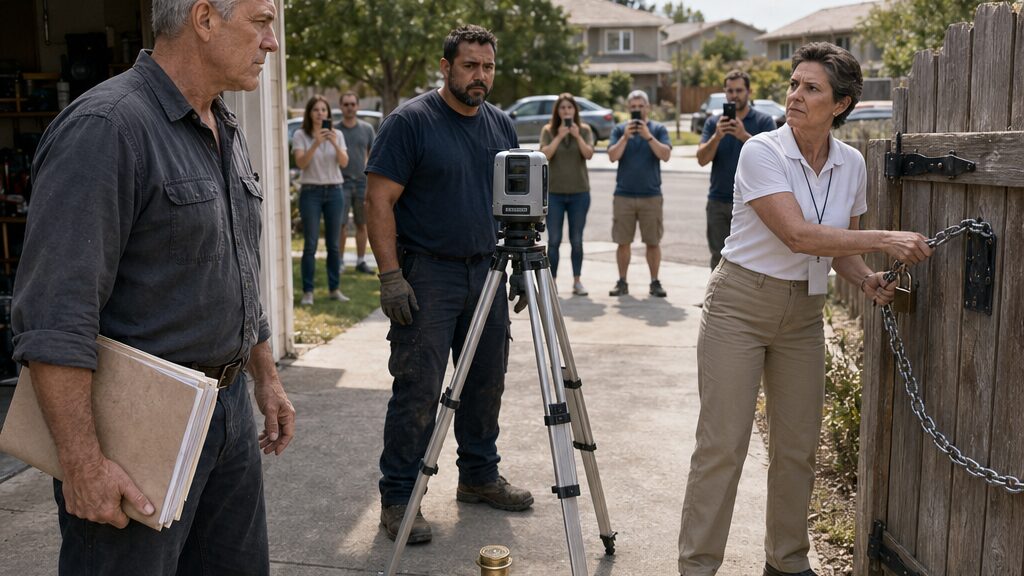
Through the narrow gap between the slats, Samuel saw Betty Robinson feeding the chain through the latch.
She wore a white HOA polo with the new board emblem stitched over her heart. A laminated identification badge swung from her neck. Behind her, David Torres stood beside two workers and a wheeled tool case. Near the center of Samuel’s driveway, an aluminum tripod supported a rectangular digital meter with twin sensors pointed toward the house.
Heather Lee held a clipboard near the sidewalk.
Across the street, two garage doors stood open.
Betty had chosen her time carefully.
Samuel pulled the gate inward before she could close the padlock.
The chain snapped taut between them.
Betty staggered half a step, then recovered. “You need to remain inside until the enforcement action is complete.”
Samuel looked at the chain, then at her hand. “Take it out.”
“This gate has been cited.”
“For what?”
Betty drew a folded notice from beneath her clipboard. She opened it with a small flourish and held it where the neighbors could see the yellow header.
“Noncompliant exterior hardware,” she said. “Specifically, reflective black metal inconsistent with the approved matte-black finish standards.”
Samuel looked at the hinges.
A thin edge of rust showed near one screw head. The paint had not reflected anything in years.
Betty continued. “You failed to correct the violation within the stated period, so access is being restricted until compliance is verified.”
“I received no hearing notice.”
“This was classified as an emergency nuisance.”
David shifted his weight.
Samuel noticed the cordless drill in his hand.
“What emergency?” Samuel asked.
Betty pointed to the hinges as though presenting evidence in court. “Inconsistent finishes damage the visual continuity of the neighborhood. Once residents begin deciding which rules matter, every standard becomes optional.”
The digital meter emitted a short electronic chirp behind her.
Samuel looked past Betty to the tripod. One leg rested directly over a round brass survey pin sunk near the edge of the driveway. The pin was almost invisible beneath dust and old grass clippings, but Samuel knew its exact location. He had set enough property corners during thirty-three years with the municipal survey office to recognize one without bending down.
The tripod stood two feet inside his line.
“David,” Samuel said, “move your equipment.”
David glanced at Betty.
“It belongs to the association,” Betty said. “It is monitoring noise and reflected light during enforcement.”
“On my driveway.”
“The driveway frontage is subject to HOA control.”
Samuel opened the gate wider and stepped outside.
Betty did not retreat. She lifted the chain and tried to pass it behind the gatepost.
Samuel placed one hand flat against the wood.
“Do not touch the gate again.”
The workers stopped unloading the tool case.
Heather cleared her throat. “Samuel, we can resolve this through the appeal process.”
“Then stop the work until there is an appeal.”
“The order is already active,” Betty said.
Samuel looked at Heather. “Where is the hearing date?”
Heather glanced down at the notice. Her eyes moved across the page, then returned to the top.
Betty answered before she could. “Emergency actions do not require advance hearings.”
“That is not what the bylaws say.”
“You are not on the board.”
“No,” Samuel said. “I only read what the board sends me.”
A neighbor across the street raised a phone.
Betty saw it and straightened.
“This is exactly the problem,” she said, projecting her voice. “Certain homeowners believe rules apply only when convenient. The board was elected to restore consistency.”
Samuel watched her face as she spoke. The satisfaction in it had little to do with paint.
He remembered the candidate meeting three months earlier, when Betty had stood beneath a projected neighborhood map and claimed the association controlled every curbside strip for enforcement access. Samuel had corrected her from the back row. He had not raised his voice. He had only named the parcel numbers and pointed out that three lots retained private frontage beyond the curb.
Betty had smiled then, too.
Not kindly.
David lowered the drill. “I need a signed access authorization before I put anything into the post.”
Betty turned. “The work order is signed.”
“By the property owner?”
“By the association.”
“That isn’t the same thing.”
A brief silence spread across the driveway.
Samuel bent and brushed the dust from the brass survey pin with the side of his shoe. The metal circle appeared beneath the tripod leg.
“This marks my eastern boundary,” he said. “Your meter is inside it. Your workers are inside it. You are inside it.”
Betty looked down, then gave a sharp laugh.
“That old marker does not control HOA maintenance access.”
“It controls where my land begins.”
Heather stepped closer to the tripod. “Betty, maybe we should move it until this is reviewed.”
“No.” Betty took the padlock from the chain and held it up. “Moving equipment now suggests the resident can halt enforcement by making unsupported claims.”
Samuel’s gaze settled on the meter. It was expensive, probably more expensive than anything needed to inspect a gate hinge. A green indicator blinked beside its lens.
Recording.
He looked at the open garages, the raised phones, and the chain hanging across the gate his wife had once painted by hand.
Then he looked at Betty.
“I am withdrawing permission for every person and every object connected to this action,” he said. “Leave my property.”
Betty’s mouth tightened.
David stepped back toward the sidewalk. One worker followed him.
Heather remained still.
Betty moved the tripod herself.
She lifted it by the center column, carried it several steps farther up the driveway, and planted its feet beyond the survey pin, closer to Samuel’s garage.
The meter chirped again.
Betty adjusted its angle until the sensors faced the gate and Samuel together.
“Make sure everyone sees,” she said, “where his property ends.”
Chapter 2: The Five Feet Nobody Questioned
“Samuel King’s refusal is precisely why this board needs stronger enforcement authority.”
Betty’s voice carried across the driveway before Samuel could answer. She stood beside the relocated tripod, one hand resting on its aluminum column as if it were a flag planted on conquered ground.
Three more neighbors had emerged from their homes. Rachel Perez stood near her mailbox with her phone held vertically, recording. A delivery van slowed, then continued down the street.
Samuel closed the garden gate behind him without latching it.
“The board’s authority does not begin wherever you place equipment,” he said.
Betty turned toward the small audience. “You see? He rejects every standard, every process, every attempt at cooperation.”
“Show them the hearing date.”
Heather looked down at the violation notice again.
Betty did not.
Instead, she pointed toward the hinges. “The finish requirement has been in the exterior standards for years.”
“Matte black,” Samuel said.
“Correct.”
“These were matte black when installed.”
“They are now inconsistent.”
“They are old.”
“Age is not an exemption.”
Samuel walked to the garage wall and opened a narrow storage cabinet. From a hook inside, he removed an old steel measuring tape with a scratched yellow case. He returned to the gatepost and fixed the tape’s end against a small notch near the base.
Betty watched him with visible impatience.
“What are you doing?”
“Showing you the part you keep pretending not to understand.”
He extended the tape across the driveway. The metal blade clicked over the concrete, passing the brass pin and continuing toward the curb.
Five feet beyond the curb line, he stopped.
The tape ended in the street.
A few neighbors lowered their phones to look.
Samuel held the blade taut. “My parcel does not stop at the curb.”
Betty folded her arms. “The association maintains that frontage.”
“Maintenance is not ownership.”
“It grants access.”
“For maintenance. Not padlocking my gate.”
Heather turned a page on her clipboard. “The notice says environmental consistency inspection.”
Samuel looked at her. “Read the authorization code.”
Heather traced the line with one finger. Her expression changed slightly.
“B-Seventeen,” she said.
“That code is handwritten,” Samuel said.
Betty reached for the paper. Heather moved it away before she could take it.
“There is no hearing date,” Heather said. “There should be one even if the inspection was expedited.”
“This is not the time for internal administrative discussion,” Betty said.
“It is exactly the time,” Samuel replied.
David had set the drill on top of the tool case. He stood near the curb now, no longer pretending he was ready to work.
Betty turned on him. “Why has the gatepost not been secured?”
“Because he revoked access.”
“You have a board work order.”
“I asked for property-owner authorization.”
“You are being paid to perform a service.”
“I am being paid to install a lock, not defend a trespass claim.”
The word trespass changed the mood.
One of the workers quietly carried the chain back toward the truck, but Betty stopped him with a raised hand.
“Nobody leaves.”
Samuel reeled the tape in three feet at a time, the blade snapping against the case with hard metallic slaps.
Betty’s face reddened. “You have spent years resisting every neighborhood improvement.”
“I objected when the board placed temporary signs inside my frontage.”
“You left them there.”
“I sent written objections.”
“You sent letters about everything.”
“I sent three.”
“Exactly.”
A faint laugh came from across the street. Betty’s head turned toward it.
Samuel saw the old injury beneath her anger. Not fear of disorder. Fear of being laughed at.
At the candidate meeting, she had presented herself as the person who would make the neighborhood respected again. She had promised cleaner facades, stricter landscaping, uniform lighting, and “decisive control of all shared boundaries.” When Samuel corrected the map, several residents had asked questions she could not answer.
She had lost the room for four minutes.
Apparently, she had carried those minutes for months.
“You wrote this notice yourself,” Samuel said.
Betty’s eyes returned to him. “The board authorized enforcement.”
“Did the board authorize the hinge language?”
“The language reflects the violation.”
“Did the board vote to padlock the gate?”
She said nothing.
Heather closed the clipboard.
“Betty.”
Betty’s voice sharpened. “Do not undermine an active action in front of residents.”
“I am asking what was approved.”
“The board approved stronger compliance.”
“That is not the same as this.”
Rachel moved closer, still recording.
Betty saw her and pointed toward Samuel. “He stood in a public meeting and deliberately humiliated a candidate over a technicality. Now he is using another technicality to obstruct an elected board.”
Samuel let the measuring tape retract the final foot.
“There it is,” he said.
“What?”
“The reason.”
Betty lifted her chin. “The reason is uniformity.”
“No. The reason is that I corrected your map.”
“You challenged authority without understanding the consequences.”
“I challenged a line drawn in the wrong place.”
“And now you will learn that the board decides where enforcement applies.”
David looked toward Samuel.
The statement hung between them, too clear to take back.
Rachel’s phone remained raised.
Heather stared at Betty as if seeing a document she had not wanted to read.
Samuel walked into the garage and returned with a flat brown survey folder. The corners were softened from years of handling. He opened it across the hood of his old pickup and removed a stamped plat showing his lot, the gate, the driveway, and the five-foot strip extending beyond the curb.
The red boundary line was clean and unmistakable.
He placed one finger on the surveyor’s seal.
“This was recorded with the county when the property was subdivided.”
Betty barely looked at it. “That map is outdated.”
“Property lines do not become outdated because you dislike them.”
Heather stepped closer.
She studied the parcel number, the recording stamp, and the dimensions. Then she pulled out her tablet and opened the HOA’s digital mapping system.
For the first time that morning, Betty looked uncertain.
Heather turned the screen toward Samuel.
A pale blue maintenance overlay covered the curbside strip. Beneath it, a newer digital parcel line appeared to stop at the curb.
“This is the map the board has been using,” Heather said.
Samuel stared at the screen.
The red line on his paper continued five feet farther.
The blue line on the tablet did not.
Betty recovered quickly.
“There,” she said. “Association-controlled frontage.”
Samuel did not answer.
He knew the old survey was recorded. He knew the pin still existed. He knew the dimensions by memory.
But the digital map carried a later date.
And beside the overlay, in small gray letters, was a notation he had never seen before:
Maintenance access subject to subsequent agreement.
Heather looked from the tablet to the survey.
“Samuel,” she said carefully, “do you have the later agreement?”
Chapter 3: The Survey That Proved Too Little
The county parcel portal displayed Samuel’s land as though someone had shaved five feet from its edge.
He sat at the workbench inside his garage, staring at the screen while the afternoon light moved across the concrete floor. The stamped survey lay open beside the keyboard. Its red boundary line crossed the curb with perfect confidence.
On the monitor, the same line stopped short.
A translucent blue maintenance strip covered the missing frontage.
Samuel enlarged the map until the pixels blurred.
The notation remained.
Maintenance access subject to subsequent agreement.
He clicked the document index.
No agreement appeared.
Only a reference number, a date from eleven years earlier, and a link that returned an error message.
Behind him, the faded chalk line on the garage floor ran from the wall to the open door. Samuel had drawn it years ago while checking the angle between the original monument and the eastern survey pin. He had meant to clean it away.
Now it looked like a boundary the house itself had forgotten.
His phone vibrated.
A message from the HOA announced an emergency board review at six that evening.
Subject: Chronic Noncompliance and Threatened Interference with Authorized Equipment.
Samuel read it twice.
He had threatened no one.
He had touched nothing.
Yet.
Another vibration followed.
A video attachment from Rachel Perez.
He almost ignored it. Then he saw the thumbnail: Betty standing beside the tripod, her mouth open mid-sentence.
Samuel pressed play.
The frame shook as Rachel shifted position. Betty’s voice came through clearly.
“He stood in a public meeting and deliberately humiliated a candidate over a technicality.”
Then Samuel’s own voice: “The reason is that I corrected your map.”
Betty again, sharper now.
“You challenged authority without understanding the consequences.”
The recording continued through the next exchange.
“And now you will learn that the board decides where enforcement applies.”
Samuel stopped the video.
It proved motive. Retaliation, perhaps. Abuse of process, certainly.
It did not prove where his property ended.
Rachel appeared at the open garage door before he could reply.
She did not step inside.
“I sent the full file,” she said. “No edits.”
Samuel nodded.
“You should show it tonight.”
“I may.”
“That means no.”
“It means I have not decided.”
Rachel glanced at the survey. “She fined me last month because my flower bed curves six inches past the approved line.”
Samuel remembered the bed. White stones around two young lavender plants.
“You removed it.”
“I thought I had to.” Rachel lowered her phone. “Then she posted the violation photo in the community group before I even received the letter.”
Samuel returned his attention to the monitor.
Rachel waited.
“We could get people together before the meeting,” she said. “There are others.”
“This is a property dispute.”
“It stopped being only your property dispute when she brought an audience.”
“I do not need an audience of my own.”
“No,” Rachel said. “You need witnesses who do more than film after something happens.”
The words landed harder than her tone.
Samuel closed the parcel window. “I have records.”
“Records did not stop her this morning.”
“They will if used properly.”
“By you alone?”
He looked at her.
Rachel’s expression changed. She had expected anger, perhaps. What she found was enough to make her step back.
“I’m trying to help,” she said.
“I know.”
“Then let me.”
“This is mine to handle.”
She pressed her lips together, nodded once, and left.
Samuel listened to her footsteps cross the driveway.
The garage seemed larger after she was gone.
He opened the county index again and searched the reference number by year. The result led to a scanned maintenance resolution adopted after a severe winter storm. It authorized the association to clear snow, repair drainage, and maintain curb access along several lots.
It did not transfer ownership.
But a handwritten note in the margin referred to “owner consent on file.”
Samuel searched his cabinets.
The top drawer contained tax records. The second held warranty papers, utility easements, and photographs of drainage repairs. The third was packed with HOA correspondence arranged by year.
He found copies of his objections to temporary signs and contractor storage. He found two certified-mail receipts. He found a photograph of a snow pile pushed across his survey pin.
But he found no consent agreement.
He also found no response from the board.
Samuel sat back.
For years, he had treated silence as evidence of their weakness. He had sent letters, filed copies, and watched every unauthorized use from behind his windows. He had believed restraint made him different from people who turned every disagreement into war.
Yet the board’s map now showed their assumption as fact.
His silence had not preserved the line.
It had allowed someone else to redraw it.
At five fourteen, Heather sent him a scanned page from the board archive. The message contained only one sentence.
This is the document attached to the digital overlay.
Samuel opened it.
The page was not an agreement. It was a maintenance summary listing affected parcels. Beside his lot number, someone had typed:
Owner did not object to continuing access.
Samuel read the sentence until the words lost shape.
He had objected.
He had receipts.
He stood and crossed to the tallest cabinet near the rear wall. On its top shelf sat a dented metal file box he had not opened since his wife died.
Most of her papers had been sorted years earlier. Medical bills. Garden plans. Recipes written on index cards. He had kept the box because throwing it away had felt too final.
Samuel lifted it down.
Dust marked the workbench when he set it beside the survey.
Inside were seed catalogs, old photographs, and envelopes tied with a faded green ribbon. Beneath them lay a certified-mail envelope with the postal strip still attached.
His name was written across the front in his wife’s hand.
Samuel did not remember seeing it before.
The envelope had never been opened.
On the back, beneath the sealed flap, she had written one line in dark blue ink.
Keep this if they ever cross the line again.
Chapter 4: What His Wife Kept Filed
The first photograph inside the envelope showed Betty Robinson standing beside an HOA sign planted three feet inside Samuel’s frontage.
She was younger in the picture, her hair darker, her expression almost cheerful. One hand rested on the temporary sign as if she had helped place it. Behind her, the brass survey pin was visible near the driveway edge.
Samuel turned the photograph over.
His wife had written a date and four words on the back.
They know where it is.
He lowered himself onto the stool beside the workbench.
The envelope contained more than photographs. There were copies of his certified letters, postal receipts, handwritten notes from board meetings, and two contractor invoices his wife must have obtained from a records request. One invoice listed temporary holiday signage. Another listed drainage equipment storage.
Both named Samuel’s parcel.
Both described the curbside strip as “HOA frontage.”
Samuel read each page slowly.
Eleven years earlier, he had objected when the association began using the strip for snow storage after a severe winter. He had written that temporary access for emergency clearing did not constitute permanent permission. The letter had been delivered and signed for.
The receipt was stapled to the copy.
The signature belonged to Heather Lee.
Samuel looked at the date again.
Heather had not merely failed to find his objection. Her office had accepted it.
Near the bottom of the envelope lay a folded sheet of lined paper.
He recognized his wife’s handwriting before he opened it.
Samuel,
You are right about the line. I know you are right because I watched you measure it three times when one would have been enough.
He stopped reading.
From the garden came the faint tap of a branch against the wooden gate. The chain Betty had tried to install still lay coiled beside the fence where David’s worker had dropped it.
Samuel returned to the note.
But being right can become another kind of fence if you stand behind it too long.
Do not let them take what belongs to us. Do not let them turn you into someone who spends every morning waiting for the next fight either.
Use the records if they cross the line again.
Not because you hate them.
Because a line that is never defended becomes an invitation.
Samuel pressed his thumb against the paper.
For years, he had remembered only the last argument they had about the HOA. She had been tired from treatment, sitting at the kitchen table while he sorted certified-mail receipts into plastic sleeves. She had told him she did not want their remaining time measured in violations, meetings, and property disputes.
He had heard a command to stop.
He had never considered that she meant stop living for the fight, not stop defending the land.
Outside, a truck door closed.
Samuel folded the note and slipped it back into the envelope.
David stood at the open garage door.
He kept both hands visible, perhaps because the morning had taught him that Samuel noticed where people put things.
“I didn’t come onto the driveway,” David said.
Samuel looked at his boots. They remained on the sidewalk.
“What do you want?”
“To explain.”
“You had all morning.”
“Betty was holding the contract.”
“That did not move your feet.”
David looked toward the gate. “No.”
Samuel waited.
David rubbed one hand across his jaw. “My company has done work for the association for six years. Snow barriers. Signs. Drainage inspection. Temporary storage when the clubhouse lot was full.”
“On my strip.”
“Sometimes.”
“How many times?”
“I’d have to look.”
“You already know.”
David’s eyes shifted toward the workbench and the papers spread across it.
“I knew there were markers,” he said. “I did not know the board had no access agreement.”
“You never asked.”
“I was given work orders.”
“So was the crew today.”
“That is why I stopped.”
“You stopped before drilling. You still unloaded the chain.”
David accepted that without protest.
Samuel held up one of the invoices. “Is this yours?”
David leaned forward but did not cross the threshold.
“Yes.”
“It lists my parcel.”
“Yes.”
“It calls the land HOA frontage.”
“That language comes from their system.”
“You billed against it.”
“I did.”
Samuel set the invoice down.
David’s voice lowered. “If this becomes a formal dispute, I will provide whatever I am required to provide.”
“Required.”
“I have employees. Insurance. Contracts. I cannot hand over files because a neighbor asks.”
“You were willing to install a padlock because a board member asked.”
David’s mouth tightened.
“That was a mistake.”
“No. A mistake is using the wrong drill bit. You chose not to verify where you were standing.”
David looked past Samuel to the faded chalk line on the garage floor.
“I assumed you tolerated it,” he said.
“Because I did not drag your equipment into the street?”
“Because you never stopped a job.”
Samuel’s first answer rose hot and immediate. He swallowed it.
David had given him the truth without kindness.
Samuel had written letters. He had documented. He had watched.
He had never made the cost visible.
“That assumption ends now,” Samuel said.
David nodded once. “Then send me something formal.”
He turned to leave.
“David.”
David stopped.
“How many work orders?”
A pause.
“More than five,” he said. “Less than twenty.”
“And after my objection?”
David looked back at the papers on the workbench.
“I do not know.”
That answer sounded careful enough to mean he feared he did.
When the truck drove away, Samuel carried the envelope into the garden.
He stood beside the gate and touched the upper hinge. The paint was rough under his fingers. His wife had held the gate square while he drove the screws during her final summer. She had laughed when the first hinge squeaked and told him no one would inspect it closely enough to care.
Betty had found the one thing she could call defective and the one thing Samuel would never replace merely to satisfy her.
His phone buzzed.
An official HOA notice filled the screen.
EMERGENCY ENFORCEMENT RESCHEDULED.
The message stated that the board would convene at seven-thirty the next morning. At eight, a contractor would return to complete the gate restriction. Police presence had been requested “to prevent anticipated interference.”
The final sentence was bolded.
The gate will be permanently sealed pending compliance.
Samuel read it beside the hinges his wife had helped install.
Then he opened a new folder on his computer and began scanning every page in the envelope.
Chapter 5: The Board Meeting Built on Silence
A photograph of Samuel’s gate filled the clubhouse wall beneath two words in red capital letters.
CHRONIC DEFIANCE.
Samuel stopped just inside the meeting room.
The picture had been taken from his driveway that morning. The chain hung through the slats, the black hinges centered in the frame. Whoever had prepared the slide had darkened the edges so the gate looked less like part of a home and more like evidence.
Betty stood at the front table arranging papers.
“You are early,” she said.
“I am on time.”
“The meeting has not been called.”
“Then you should not have started the presentation.”
Several residents sat in folding chairs. Rachel occupied a seat near the aisle, phone in her lap. Heather sat behind the secretary’s table with two binders open in front of her. David remained near the back wall, holding a single white envelope.
Samuel chose a chair in the first row.
Betty called the meeting at seven-thirty exactly.
She began without reading the full complaint.
“This board is not here to debate whether uniform standards matter,” she said. “They do. We are here because one resident has escalated routine enforcement into threats against association property and personnel.”
Samuel looked at the photograph behind her.
“What threat?”
Betty tapped a printed statement. “You warned that nothing connected to the HOA would remain on your land.”
“I withdrew permission.”
“You used aggressive language.”
“I used accurate language.”
A few residents shifted.
Betty clicked to the next slide. An enlarged map appeared. The pale blue maintenance overlay covered Samuel’s frontage, and the original parcel line beneath it had been reduced to a faint gray trace.
“Association maintenance authority is clearly established,” she said.
Samuel studied the projection.
The line had not been removed. It had been buried.
Heather raised her hand slightly. “Before we continue, there is a procedural issue.”
Betty did not look at her. “We can address clerical matters after the enforcement vote.”
“This is not clerical.”
Heather lifted the notice from the previous day. “The required hearing period was not provided. The action code was handwritten, and it does not match the gate-hardware section.”
Betty turned toward her. “We discussed the need for immediate action.”
“We discussed stronger compliance generally. There was no vote authorizing a padlock.”
“The environmental meter confirmed the need for further inspection.”
Samuel spoke. “The meter was purchased for noise and light complaints.”
Heather’s eyes moved to him.
He continued. “It has no function in judging paint finish.”
“That equipment allows the board to document site conditions,” Betty said.
“Then why was it pointed at me?”
Betty clicked the remote, but the next slide did not appear.
Rachel stood.
“I have the answer.”
Betty’s expression hardened. “Public comments come later.”
“This happened in public.”
Rachel raised her phone and pressed play.
Betty’s recorded voice filled the clubhouse.
He stood in a public meeting and deliberately humiliated a candidate over a technicality.
Then came Samuel’s question about the map.
Then Betty’s reply.
You challenged authority without understanding the consequences.
The room grew still.
Rachel let the video continue.
And now you will learn that the board decides where enforcement applies.
When the recording ended, no one spoke for several seconds.
Betty placed both hands on the table. “That clip lacks context.”
“It has four minutes before and six minutes after,” Rachel said. “I brought the full file.”
“This meeting is about property compliance, not personal interpretations.”
A resident near the window asked, “Did the board approve locking his gate?”
Another said, “Why would anybody lock a private gate over paint?”
Betty raised her voice. “Because selective resistance spreads. First it is hardware. Then landscaping. Then exterior lighting. The community elected this board to prevent decline.”
Samuel looked around the room.
Several residents were angry now, but not all at Betty. One man muttered that rules existed for a reason. A woman near the back said Samuel could have repainted the hinges and avoided the entire dispute.
Betty heard them and regained some confidence.
“This resident has repeatedly refused cooperation,” she said. “He has sent hostile correspondence for years.”
“Produce one hostile sentence,” Samuel said.
Betty ignored him.
Samuel stood.
He did not bring his wife’s note to the meeting. He had brought copies of the letters, the delivery receipts, the photographs, and the recorded survey. The note remained in his shirt pocket, folded close to his chest.
“I am not asking whether you like my hinges,” he said. “I am asking who authorized the board to enter my parcel after receiving written objections.”
Betty pointed at the map. “The association has maintenance access.”
“For drainage and emergency clearing.”
“Access is access.”
“No. A right to clear snow is not a right to chain a gate.”
Heather opened one of her binders.
“I found the archived intake log,” she said.
Betty’s head turned sharply.
Heather placed a finger on a dated entry. “Samuel’s certified objection was received eleven years ago. It was scanned under general correspondence instead of property records.”
“So it was misfiled,” Betty said.
“It was received.”
“That does not invalidate the maintenance resolution.”
“It invalidates the notation that the owner did not object.”
A murmur moved through the room.
Samuel felt no satisfaction. Only the cold recognition of how long one careless sentence had been allowed to stand.
Betty stepped away from the table. “This is exactly why enforcement cannot be abandoned whenever someone produces an old letter. The neighborhood depends on consistent action.”
“The action is suspended,” one resident said.
“We do not have enough voting members present to suspend it,” Heather replied.
Betty seized the opening.
“Then the existing order remains active. Police have been asked to witness enforcement at eight. Mr. King has already threatened association equipment, and any interference will be documented.”
Samuel looked at the clock.
Seven fifty-three.
Betty began gathering her papers.
“You came here expecting me to defend my temperament,” Samuel said.
She paused.
“I will not. Account for the land.”
Betty’s fingers tightened around the map printout.
“Every sign,” Samuel continued. “Every snow pile. Every contractor load. Every inspection device. Account for where it stood and what authority put it there.”
David left the back wall.
He walked to the front carrying the white envelope.
Betty frowned. “This is not your matter.”
“It is if my company did the work.”
David opened the envelope and removed a single invoice.
“I checked the archive before coming,” he said. “This is from eight years ago.”
He placed the invoice on the table.
Heather turned it toward herself.
The description listed drainage equipment staging on Samuel’s parcel. The date was six months after his certified objection had been received.
At the bottom was an HOA approval code.
Betty’s initials appeared beside it.
David looked at Samuel, then at Betty.
“This is only one,” he said. “The rest are in my truck.”
Chapter 6: Nothing Crosses This Line Again
Betty stepped across the fresh orange line while telling the officer it had no legal meaning.
Samuel had sprayed it from the garden gate, across the driveway, over the curb, and five feet into the street. The paint followed the dimensions on his recorded survey. It was not a legal monument, and he knew that better than anyone.
But it made the dispute visible.
The officer stood near the sidewalk reading the enforcement packet. David’s truck was parked behind the HOA vehicle. His two workers remained inside it.
Heather had followed from the clubhouse but stayed near the curb.
Rachel stood across the street with her phone raised.
Betty carried the steel chain in one hand.
“You cannot manufacture a boundary with spray paint,” she said.
“No,” Samuel replied. “The survey and monuments establish it. The paint shows you where not to step.”
She looked down at the orange stripe beneath her shoes and deliberately moved farther onto the driveway.
The digital meter stood behind her on its aluminum tripod. Its green indicator blinked.
Recording again.
David approached with a thick stack of work orders under one arm.
“I am not installing the lock,” he said.
Betty turned. “You are under contract.”
“Not for disputed entry.”
“You accepted payment.”
“I will return it.”
“You will lose every association job you have.”
David’s face tightened, but he did not move.
“Then I lose them.”
The words cost him. Samuel could see it.
Betty could too.
She shifted her attention to the officer. “This contractor is abandoning an authorized safety action because the homeowner intimidated him.”
The officer looked up from the packet. “I have not heard a threat.”
“He destroyed nothing yet because we arrived in time.”
“Yet?” Samuel said.
Betty pointed at him. “That tone.”
The officer closed the folder. “This is a civil boundary dispute. I am here to keep the peace. I am not validating the HOA’s ownership claim, and I am not ordering him to permit entry.”
“The order is already active.”
“The notice has no hearing date, and the property line is contested.”
Betty’s face changed.
For the first time, official presence had failed to enlarge her authority.
Samuel walked to the center of the driveway.
He held his survey folder in one hand and his phone in the other. The recording application was open.
He spoke clearly.
“This is my final notice. Betty Robinson, Heather Lee, David Torres, and all association contractors are informed that I do not consent to entry beyond the marked line.”
Heather stepped backward over the orange stripe.
David did the same.
Betty remained.
Samuel pointed to each item.
“The tripod, digital meter, chain, padlock, and all tools must be removed from my property. No object may be attached to the gate. No person has permission to cross this line for enforcement.”
The officer watched without interrupting.
The meter chirped.
Betty raised the chain. “The association rejects your claim.”
“The association can reject it from the sidewalk.”
“This gate is under restriction.”
“It is not.”
“It will be.”
She walked toward the wooden gate.
Samuel did not block her.
Not yet.
Betty fed the chain through the slats. Metal scraped across the black hinge, brightening the wound left that morning. She pulled the ends together and snapped the padlock closed.
The sound carried down the street.
Samuel looked at the lock.
Then at Betty.
“Remove it.”
“No.”
The officer stepped forward. “Ma’am, do not escalate this.”
“The enforcement order requires completion.”
“You have completed nothing except entry onto disputed property.”
Betty turned toward the officer, angry now at anyone who would not mirror her certainty. “He cannot erase board authority with an antique drawing and a can of paint.”
She kicked at the brass survey pin.
Her shoe struck the metal cap and tore loose the small protective ring of soil around it. The pin did not move, but the gesture broke something in the stillness.
Samuel placed the survey folder on the hood of his truck.
He removed his reading glasses and set them on top.
Then he walked to the tripod.
Betty saw where he was going.
“Do not touch association property.”
Samuel wrapped both hands around the aluminum legs.
“I gave notice.”
“You will be charged.”
“I heard you.”
He lifted the tripod.
The meter swung at the top, its sensors flashing toward the sky. Samuel folded one leg inward, braced the frame against his knee, and pulled.
The aluminum snapped with a sharp metallic crack.
Someone across the street gasped.
Betty froze.
Samuel broke the second leg. Then the third.
Each sound was clean and deliberate.
He lowered the ruined frame to the driveway, removed the meter from its mount, and struck it once against the broken tripod joint. The casing split. The screen went dark, then flickered back to life with a fractured green line.
Betty raised her phone.
“Keep recording,” Samuel said.
He kicked the twisted legs and shattered electronics across the orange boundary. They skidded over the curb and stopped in the street.
Nothing touched Betty.
Nothing touched the officer.
Samuel returned to his truck and opened the survey folder.
Inside lay the stamped plat, certified objections, delivery receipts, dated photographs, maintenance invoices, and his wife’s preserved records. David added the stack from his truck beside them.
Pages covered the hood.
Betty spoke into her phone. “I am reporting intentional destruction of HOA equipment.”
The officer looked at the broken meter in the street, then at the locked gate.
“You should also report where it was standing,” he said.
Betty stopped speaking.
Samuel placed one finger on the recorded boundary.
“I own five feet beyond the curb,” he said. “Your board received notice. Your work orders prove continued entry after that notice. Your photographs prove today’s entry. Your meter recorded itself on my parcel.”
Betty lowered the phone slightly.
Samuel pointed toward the ruined device.
“That did not cross a public sidewalk,” he said. “It crossed my line.”
Behind her, the garage door began to descend.
Samuel had pressed the remote in his pocket.
The panels lowered slowly, cutting the open garage into a narrowing strip of darkness.
Betty stood on the orange-marked driveway with the locked gate behind her, the broken equipment in the street, and neighbors recording from both sides.
As the door reached his shoulders, Samuel met her eyes.
“Nothing crosses this line again.”
The garage closed between them with a final hard slam.
Chapter 7: The Evidence Betty Created Herself
Betty’s criminal complaint began with the serial number of the meter Samuel had broken.
That number led the county investigator to a cloud account Betty did not know existed.
By noon, the device manufacturer had confirmed that the meter automatically stored time, date, orientation, and GPS location whenever its recording mode was activated. The final location entry placed it twenty-eight inches inside the parcel line shown on Samuel’s recorded survey.
The earlier entries were worse.
They showed the meter being moved deeper onto the driveway after Samuel withdrew permission.
Samuel learned this at the county review office while sitting across from a property examiner and an association attorney. His survey folder rested on the table between them, swollen now with photographs, letters, receipts, work orders, and Rachel’s unedited video.
Betty sat at the opposite end.
She had brought a printed photograph of the shattered meter. Its cracked screen and twisted legs filled the page.
“He admitted destroying it,” she said. “There is no dispute about that.”
“No,” Samuel said. “There is not.”
The association attorney looked at him. “You understand that acknowledgment may expose you to the replacement cost.”
“I understood that when I broke it.”
Betty leaned forward. “Then why are we discussing property maps instead of charges?”
The examiner rotated a monitor toward her.
A satellite image displayed Samuel’s lot. A red dot marked the meter’s final recorded position. The dot sat inside the older parcel boundary and beyond the orange line Samuel had painted.
“Because the location of the equipment is relevant,” the examiner said. “So is the notice given before it was damaged.”
Betty looked toward the association attorney.
He did not rescue her.
Samuel placed his stamped survey beside the screen. “The brass monuments remain in place. The recorded dimensions match them.”
“The digital overlay does not,” the attorney said.
“The overlay is not a transfer.”
“We agree it is not a deed.”
It was the first sentence Samuel had heard from anyone connected to the association that did not pretend otherwise.
The examiner opened the maintenance resolution. “This grants limited access for drainage and emergency clearing. It contains no authority to restrict a private gate.”
Betty crossed her arms. “The gate violated community standards.”
“Then the association was required to follow its hearing procedure.”
“We were preventing continued noncompliance.”
Heather’s voice came from behind Samuel.
“You were preventing a hearing.”
Everyone turned.
Heather stood near the door holding two archive binders. She looked as though she had not slept.
The attorney gestured toward the empty chair beside him. “Ms. Lee, please sit.”
She did, but she did not place the binders on the association’s side of the table. She set them in the middle.
“I received Samuel’s certified objection eleven years ago,” she said. “My signature is on the receipt.”
Betty stared at her. “You said it was misfiled.”
“It was.”
“Then this is administrative error, not misconduct.”
Heather opened the first binder. “The error was never corrected because the board continued using the strip. Moving the signs, storage, and snow staging would have required new contracts and different access routes.”
The attorney’s pen stopped.
Heather continued. “When Samuel sent later objections, they were added to general correspondence. No one reviewed the earlier parcel file.”
“Because they were repetitive,” Betty said.
“Because we did not want the answer.”
The words settled heavily across the table.
Samuel looked at Heather.
She did not look away.
“I told myself the maintenance overlay made it acceptable,” she said. “I told myself he would file a formal claim if it mattered enough.”
Samuel felt the old anger rise, but beneath it came something less comfortable.
He had told himself almost the same thing from the other side. If the board intended real harm, he would act. If his records were strong enough, silence cost nothing.
Both assumptions had used time as permission.
The door opened again.
David entered carrying a document box.
“I brought every work order involving that frontage,” he said.
The box held fourteen files.
Seven were dated after Samuel’s first certified objection. Three listed Betty’s initials as site contact, including one from before she joined the board. Two showed temporary signs positioned according to a diagram that clearly marked the brass pin.
Betty examined the diagram.
“You knew where the monument was,” Samuel said.
“I knew where you claimed it was.”
“The contractor drew it.”
“The association map controlled.”
“The map you defended after seeing the marker.”
Her face tightened. “Someone had to keep standards from collapsing. Every time a resident resists, everyone else watches. If the board backs down once, the rules become suggestions.”
Samuel heard the fear beneath her certainty. It was real.
So was the harm she had chosen to cause with it.
“You did not protect a rule,” he said. “You chose a person.”
Betty looked toward the window.
The examiner closed the last work order. “The county will order an independent re-staking of the parcel. Until that is complete, the association is prohibited from entering the disputed strip except for an immediate safety emergency.”
The association attorney slid a separate folder toward Samuel.
“There may be a faster resolution,” he said.
Inside was a settlement offer.
The association would pay for the gate repair, survey review, and a portion of Samuel’s legal expenses. It would also waive any claim for the meter.
In exchange, Samuel would withdraw his broader complaint and keep the terms confidential.
He read the page once.
Betty watched him with an expression that was not quite hope and not quite contempt.
The offer would end the fight.
It would protect the gate.
It would restore the money.
It would also leave every misfiled letter, altered assumption, and unauthorized work order inside a sealed folder.
Samuel thought of his wife’s note.
A line that is never defended becomes an invitation.
He pushed the settlement back.
“No confidentiality.”
The attorney frowned. “The financial terms are contingent on it.”
“Then change the terms.”
“Mr. King, public proceedings could prolong this.”
“I prolonged it already.”
The room went quiet.
Samuel placed his hand on the document box David had brought.
“I kept proof and expected proof to defend itself. It did not. I will not hide the record now that it can protect someone besides me.”
The review lasted four more days.
The independent survey crew confirmed the original monuments and re-staked the five-foot frontage. The HOA was ordered to fund the correction of every affected map, review restitution for unauthorized use, and suspend enforcement on disputed access areas.
Heather resigned as secretary after giving a complete statement.
David accepted responsibility for performing work without confirming the right of entry.
Betty was suspended pending a removal hearing.
When Samuel returned home after the final session, temporary white stakes stood along the corrected line. Bright ribbon fluttered from each one.
Betty waited near his driveway.
She had no badge, no clipboard, and no crew.
Behind her, the road looked unchanged.
At her feet, the new stake proved it was not.
She stood on the five-foot strip she had once called association-controlled land, staring down at the marker as if it had appeared there only to contradict her.
Samuel pressed the garage remote.
The door began to rise.
Betty looked toward him, but he did not stop beside her.
For the first time, she had nothing in her hands that could force him to.
Chapter 8: The Garage Door Closed Without Surrender
The permanent boundary marker appeared five feet into the street on a Tuesday morning.
It was a small brass disk set flush with the pavement, plain enough that most drivers would pass over it without noticing. Samuel noticed from the garage before the survey crew finished packing its tools.
He walked to the marker and stood with one boot on either side.
The line no longer depended on memory, faded chalk, or a folder only he could see.
At the side yard, the old gate leaned against the fence.
The chain had scarred two slats. The latch was bent, but the frame remained square. Samuel had removed the hinges, cleaned away the rust, and laid them on his workbench.
Their black finish was still uneven.
He left it that way.
Rachel arrived carrying a tray of coffee. David came ten minutes later with new cedar boards and a replacement latch in the bed of his truck.
Neither entered the driveway until Samuel waved them across the marker.
David set the lumber down. “My insurer will cover the meter.”
“No.”
David looked at him. “It was association equipment.”
“I broke it.”
“It was on your land.”
“I still broke it.”
David rested both hands on the truck bed. “You warned them.”
“That explains it. It does not erase it.”
Samuel had already sent payment for the damaged device, minus the tripod mount the association could not prove had any remaining value. The check had been accompanied by a single sentence: Payment is not consent to entry.
David gave a reluctant nod.
“That is an expensive distinction.”
“Most useful ones are.”
Rachel handed Samuel a coffee.
“My landscaping fine was withdrawn,” she said. “They are reviewing twelve more.”
Samuel took the cup. “Good.”
“Heather sent a copy of the new access policy.”
The board had adopted a rule requiring written owner permission, parcel verification, and independent review before any contractor crossed disputed property. It was the kind of procedure that should never have required a broken meter to exist.
Rachel looked toward the gate. “Are you replacing it?”
“Repairing it.”
“With the same hinges?”
Samuel picked one up from the workbench.
A narrow scrape exposed silver beneath the faded black where Betty’s chain had struck it.
“The same hinges,” he said.
They worked without ceremony.
David replaced the damaged slats. Rachel held the gate upright while Samuel aligned the upper hinge. For a moment, the weight shifted against her shoulder in the same awkward way it had against his wife’s all those years ago.
Samuel’s hand stopped on the screwdriver.
Rachel noticed but said nothing.
He drove the screw.
The hinge settled into the old holes.
By late afternoon, the gate swung freely. It still gave a faint squeak near the end of its arc.
Samuel did not oil it.
A shadow crossed the driveway.
Betty stood on the opposite side of the street.
She wore ordinary clothes now. No association polo. No identification badge.
Rachel stiffened.
David set down the drill.
Betty approached until she reached the new brass marker. She stopped before stepping over it.
For several seconds, nobody spoke.
“I lost the removal vote,” she said.
Samuel rested one hand on the gate.
“I heard.”
“They made it sound as if I acted alone.”
“You signed the orders.”
“The board benefited from every one of those practices.”
“Yes.”
Her eyes moved to David, then Rachel, searching perhaps for an argument she could survive.
“The neighborhood did need stronger standards,” she said. “You know what happens when nobody enforces anything.”
Samuel looked at the repaired gate, the uneven hinges, and the line of fresh survey stakes.
“Standards are not ownership.”
“I was trying to keep control.”
“That was the problem.”
Betty’s mouth trembled, not with grief but with the effort of holding herself together in front of witnesses.
“You humiliated me.”
Samuel considered the accusation.
Months earlier, he would have answered with dates, documents, and exact quotations. He would have proved the sentence wrong piece by piece.
Instead, he said, “You stood where you were told not to stand.”
Her eyes hardened.
For a moment, the old Betty returned—the one who needed the last word to become an order.
Samuel did not give her a place to put it.
He pressed the garage remote.
The door began to descend.
Betty remained outside the marked boundary as the panels lowered between them. Samuel watched until only her shoes were visible beneath the narrowing gap.
Then the door touched concrete.
The sound was firm, but it was not the ending.
Samuel turned toward the side yard.
Rachel had gathered the tools. David stood beside the gate, uncertain whether the invitation to help had expired with the work.
Samuel opened it.
Beyond the cedar frame, the garden path curved between tomato vines and late-season herbs. The repaired hinges held the gate without sagging.
Rachel looked through. “You never let anyone back there.”
Samuel stepped aside.
“I did not say never.”
David wiped his hands on his trousers. “You sure?”
Samuel glanced once toward the closed garage door.
A boundary could keep harm out.
It could also become a wall if no one ever opened the gate.
He held it wider.
“Come through the side,” he said.
Rachel entered first. David followed, carrying the coffee tray.
The old hinge squeaked behind them, imperfect and unmistakable, as Samuel closed the gate without locking it.
The story has ended.