The Engineer Behind the Ivy Fence Recorded Every Order They Tried to Deny
Chapter 1: The Hook That Came Over the Ivy
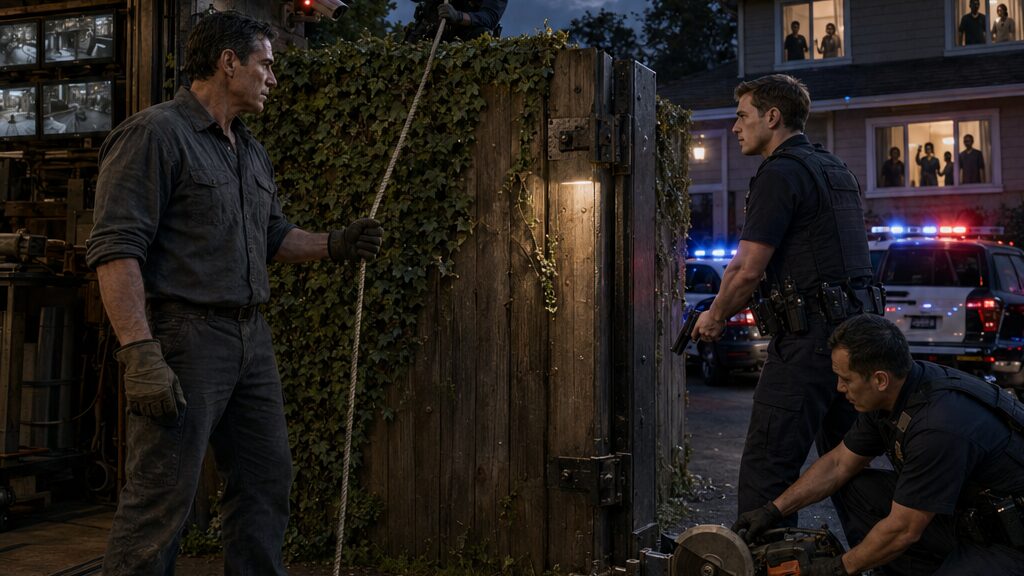
The grappling hook struck the top of Raymond Hernandez’s fence with a sound like a hammer hitting a coffin lid.
It tore through the ivy, scraped over the wooden cap, and dropped six inches into his property before the rope snapped tight.
Raymond was already moving.
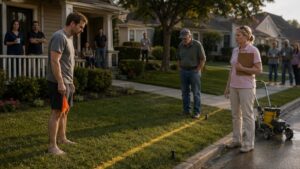
He crossed the narrow strip of concrete between the equipment shed and the gate, caught the rope in one gloved hand, and stopped three feet behind the yellow boundary line painted across the paving stones. Beyond the slats, red and blue light pulsed over parked cars, trimmed hedges, and the pale faces of neighbors watching from windows.
“Take it back,” Raymond said.
A young officer appeared through the viewing gap beside the gate. Tyler Walker had one hand resting near his holster and the other wrapped around the radio clipped to his vest.
“Open the gate.”
“You came for a welfare check. You saw me. You spoke to me. The check is complete.”
“Then come outside.”
“No.”
Tyler’s jaw tightened. “That’s not how this works.”
“It is when you don’t have a warrant.”
The rope twitched in Raymond’s fist. Someone outside had begun pulling.
Raymond held it without strain. At fifty-three, he was thick through the shoulders from years of lifting batteries, steel housings, and cable drums before he had learned to let machinery do most of the work. His gray work gloves were scarred across the palms. The rope did not move.
A deeper voice came from the street.
“Who threw that?”
The pulling stopped.
Raymond saw another officer approach the gap. Patrick Allen was older than Tyler, broad-faced and heavy around the eyes, with a supervisor’s insignia fixed to his uniform. He looked first at Raymond, then at the rope extending over the fence.
“Remove it,” Patrick ordered.
An officer outside dragged the hook backward. It snagged in the ivy, ripping free a long green strand before vanishing over the top.
For a moment, the pressure eased.
Raymond released the rope and looked down at the painted line. He had laid it himself with industrial floor enamel, measured exactly from the property survey pins. Visitors sometimes laughed at it. Delivery drivers assumed it marked where to leave packages.
It was not decoration.
Patrick stepped closer to the viewing gap. “Mr. Hernandez, your neighbor called because she hadn’t seen you in several days. Packages were left outside. Your generator ran all night.”
“I explained that.”
“I’m confirming.”
Raymond pointed toward the small camera mounted above the gate. “At four forty-one, Officer Walker asked whether I was injured. I said no. At four forty-two, I held my identification to that lens. At four forty-three, I answered his questions about the generator.”
Tyler leaned into view. “You didn’t explain what the generator powers.”
“I’m not required to.”
“You’ve got industrial ventilation behind a residential fence.”
“I have permitted equipment.”
“Open the gate and show us.”
Raymond’s eyes shifted to Patrick. “Do you have a signed warrant?”
“No,” Patrick said. “At this point, we are trying to establish that there is no ongoing danger.”
“You established that I’m alive. You established that I’m coherent. The neighbor requested a welfare check, not an infrastructure inspection.”
A curtain moved in the house across the street. Barbara White stood behind the glass with one hand pressed to her mouth. Raymond had lived opposite her for eight years. They had exchanged fewer than twenty sentences.
Most had been about packages.
Tyler said, “People don’t build walls like this around nothing.”
Raymond turned toward a weatherproof panel beside the gate. He touched the screen, opened the local recording, and selected the first exchange.
Tyler’s voice came through the speaker, thinner and sharper than it sounded outside.
“Can you confirm you are Raymond Hernandez?”
“Yes.”
“Are you injured?”
“No.”
“Are you alone?”
“Yes.”
“Do you require medical assistance?”
“No.”
Then Tyler’s recorded voice said, “He appears alert and responsive.”
Raymond stopped the playback.
Silence held on both sides of the gate.
Patrick looked at Tyler.
Tyler’s expression changed only slightly, but Raymond recognized the movement: a man feeling the shape of a lost argument and searching for another one.
“The welfare concern may be resolved,” Tyler said, “but that doesn’t address a possible hazard.”
“What hazard?” Patrick asked.
Tyler pointed through the viewing gap toward two low ventilation housings rising behind Raymond’s workshop. Their metal covers were plain and unmarked.
“That equipment. We can hear the generator. The neighbor reported electrical fluctuations. He refuses to identify what’s operating inside.”
Barbara’s front door opened.
“I didn’t report electrical fluctuations,” she called.
Every officer on the sidewalk looked toward her.
Barbara stayed on her porch. She wore house slippers and held her phone in both hands. “I said his generator was running. It was louder than usual.”
Tyler turned partly toward her. “Ma’am, please remain inside.”
“I called because the boxes were still there.”
Raymond looked through the slats at the two damp cardboard parcels beside his outer mailbox. Replacement air filters. Nothing urgent. He had left them because the street had been crowded with utility crews the day before, and he disliked opening the pedestrian hatch when strangers were standing nearby.
That choice now sat in public like evidence.
Patrick lowered his voice. “Mr. Hernandez, is there any active fault in your system?”
“No.”
“Any fire?”
“No.”
“Chemical storage?”
“No.”
“Anyone else inside?”
“No.”
Tyler gave a short, humorless breath. “And we’re supposed to take his word for all of it.”
Raymond felt irritation harden into something colder. Tyler was no longer investigating a report. He was assembling a version of events in which every answer became proof of concealment.
“You took my word when you reported me alert and responsive,” Raymond said.
“That was before you refused lawful instructions.”
“Name the law.”
Tyler stepped toward the gap. His hand settled fully on his holster now.
Patrick noticed. “Walker.”
“I’m not drawing.”
“I can see that.”
The street had filled while they spoke. Two cruisers blocked one lane. A third sat angled near Barbara’s driveway. Neighbors held phones behind curtains and porch rails. Radio chatter clicked between officers. Raymond could hear the repeated words secured structure, unknown equipment, noncompliant occupant.
Occupant.
Not homeowner.
Not engineer.
Not the man who had answered every question asked of him.
Patrick walked several feet away with Tyler. Their voices dropped, but one of Raymond’s directional microphones caught fragments.
“Permits…”
“Could be obsolete…”
“No visible smoke…”
“Liability if we leave…”
Raymond looked toward the camera above the gate. Its status light remained dark. Local recording was active, as it always was, but the exterior indicators were disabled. He had designed the system so people would not perform for the cameras.
Behind him, inside the compound, cooling fans moved air through the isolated routing cabinets. The generator had run overnight because a scheduled load-transfer test had failed on the first cycle. Raymond had corrected the relay by dawn.
He could have said that.
He could have printed the maintenance record and pushed it through the document slot.
Instead, he remained behind the yellow line.
Patrick returned.
“I’m asking for a visual inspection of the immediate entry area,” he said. “Nothing more.”
“No.”
“It may resolve this.”
“It already resolved. Then your officer changed the question.”
Tyler stared through the gap. “You’re barricading yourself behind a reinforced gate.”
“I am standing in my yard.”
“Open it.”
“Bring a warrant.”
A new engine approached from the far end of the street.
It was not another patrol cruiser. A utility vehicle rolled past the watching houses and stopped behind Patrick’s command car. An officer opened its rear compartment.
Inside, strapped beside a pry bar and bolt cutters, was a gas-powered angle grinder.
Raymond watched Patrick’s face.
The supervisor had not expected it.
Tyler had.
Chapter 2: The Officer Who Needed an Emergency
“Dispatch, subject remains barricaded inside a fortified structure.”
Tyler spoke clearly into his shoulder radio while Raymond stood in full view behind the gate.
Patrick turned on him. “He is not barricaded.”
Tyler released the radio button. “The gate is locked.”
“It was locked when we arrived.”
“And he refuses to exit.”
“That does not make it a barricade.”
The correction carried across the sidewalk, but not over the radio. Raymond noted the distinction. Tyler’s statement had entered the official channel. Patrick’s objection had not.
Raymond touched the intercom control. “For the record, I am standing approximately six feet from the gate. I have made no threat. I have displayed no weapon. I have requested a warrant.”
Tyler looked up at the camera.
“You recording us?”
“Yes.”
That answer was true, though incomplete.
The utility vehicle’s rear doors remained open. An officer stood beside the angle grinder without touching it, as if proximity alone could be explained later as coincidence.
Patrick moved to the document slot in the gate. “Show me the permits.”
“I’ll show you confirmation of their existence.”
“That is what I asked.”
“No. You asked for the permits.”
Raymond entered a code on the weatherproof panel. A printer inside the guard cabinet produced a single sheet. He fed it through the slot.
Patrick took it.
The page listed municipal permit numbers, inspection dates, equipment classifications, and a verification number. It did not identify the routing node’s clients, physical topology, redundancy design, or external connection schedule.
Tyler read over Patrick’s shoulder.
“This says communications equipment.”
“That is what it is,” Raymond said.
“What kind of communications?”
“The lawful kind.”
Tyler gave a tight smile. “That answer is why we’re still here.”
“No,” Raymond said. “You are still here because leaving would require you to admit the call ended ten minutes ago.”
Patrick glanced up from the page.
Raymond saw that the words had landed. Not because Patrick agreed, but because they named the pressure he was under in front of subordinates, neighbors, and cameras.
The supervisor handed the document to another officer. “Verify these.”
Tyler stepped closer. “Even valid permits don’t tell us whether something is malfunctioning right now.”
“There is no malfunction.”
“Then open the gate.”
“No.”
The exchange had become circular, but the scene around it kept changing. One officer photographed the iron hinges. Another crouched near the lower corner of the gate and studied the gap between wood and concrete. A third marked positions on a notepad.
Their attention had shifted from Raymond to the barrier.
The yellow line lay just inside it, bright beneath the security lights that had begun switching on with dusk.
Barbara crossed halfway down her front walk before Patrick raised a hand.
“Ma’am, please stay back.”
“I want to correct something.”
Tyler muttered, “You’ve already spoken with her.”
Patrick looked at him, then at Barbara. “Go ahead.”
She clutched her phone against her chest. “I didn’t say he threatened anyone. I didn’t say there were weapons. I didn’t hear screaming or breaking glass.”
Tyler said, “No one claimed you did.”
“You asked me whether I’d ever seen strange vehicles at night.”
“That was part of assessing the property.”
“You asked if he watched the street.”
Raymond looked at Barbara through the slats. Her face was pale, but she kept speaking.
“I told you he has cameras. Everyone knows he has cameras. That isn’t the same as saying he’s dangerous.”
Tyler’s neck reddened. “Ma’am, you called because you believed something was wrong.”
“I called because two boxes got wet.”
“And because the generator ran all night,” Patrick said, not unkindly.
Barbara nodded. “Yes.”
“That concern was reasonable.”
Relief crossed her face, followed quickly by guilt.
Raymond understood the sequence. Patrick had offered her a way to remain decent while the situation built from her decision.
Tyler offered no such exit.
“He hasn’t let anyone verify the equipment,” Tyler said. “If we leave and that system causes a fire, an outage, or contamination, everyone will ask why we ignored the warning signs.”
Patrick folded his arms. “What contamination?”
“I don’t know. That’s the point.”
Raymond almost laughed, but the sound would have been used against him.
The permit verification came back over the radio. The numbers were active. Inspections were current. The visible ventilation system was approved for enclosed telecommunications equipment.
Patrick listened, then said, “No forced entry.”
Tyler stared at him. “Supervisor—”
“No. We do not have probable cause for a criminal search, and nothing currently establishes an emergency exception.”
For the first time since the hook had crossed the fence, Raymond felt the scene begin to contract. The officer beside the grinder stepped away from the utility vehicle. Another lowered his camera.
Patrick faced the gate. “Mr. Hernandez, I strongly recommend that you arrange a voluntary inspection with the appropriate city department.”
“I’ll consider a written request.”
Tyler walked several paces away. His shoulders were rigid beneath his vest.
Then the generator changed pitch.
Inside the compound, a transfer relay engaged with a heavy mechanical clack. The cooling fans dipped. Security lights along the workshop wall dimmed for less than a second.
Across the street, two porch lamps flickered.
The generator recovered immediately.
Tyler turned.
“There.”
Raymond checked the status panel. Input stable. Output stable. The brief dip had come from the automatic return to utility power. Routine. Harmless.
But Patrick was looking at the neighbors’ houses.
“Did your system cause that?” he asked.
“No. The transfer cycle coincided with a grid fluctuation.”
“You know that already?”
“I monitor both feeds.”
Tyler came back toward the gate. “So you admit your system is tied into the neighborhood grid.”
“Every house is tied into the grid.”
“Not with industrial backup power.”
Patrick looked again at the darkened ventilation housings. His earlier certainty had thinned.
Raymond could see the thought forming behind his eyes: if they left and something happened, the video would show that they had noticed the flicker.
Tyler saw it too.
“We need to verify there’s no backfeed,” Tyler said. “At minimum.”
“That requires an electrical inspector,” Raymond replied. “Not an armed entry.”
“An electrical fault doesn’t wait for office hours.”
“My isolation switch is inspected and compliant.”
“According to you.”
“According to the permit you just verified.”
Patrick rubbed one hand across his mouth. “Can you display live load data?”
Raymond hesitated.
The exterior summary screen could show voltage, frequency, and isolation status without revealing system architecture. He had built that function for emergency contractors.
He had never enabled it for police.
Tyler mistook the pause for weakness. “He can’t.”
“I can,” Raymond said.
“Then do it.”
“No.”
Patrick’s expression hardened. “Why not?”
“Because each time I answer one question, Officer Walker invents another. You came to determine whether I needed help. You are now demanding operational data from private, permitted equipment because a light flickered across the street.”
“You’re making this harder than it has to be,” Patrick said.
Raymond looked at the officers near the hinges.
“No. I am preventing easy actions from becoming lawful merely because they are easy.”
Patrick stepped away to call a superior. Tyler followed, speaking low and fast. Raymond could not hear every word over the radios and idling engines, but he heard liability, critical infrastructure, visible anomaly, refusal.
The story was changing again.
An officer began measuring the gate.
Another photographed the painted line through the lower gap.
Raymond returned to the control panel and expanded his camera grid. Twelve exterior feeds appeared: gate, northeast corner, workshop roof, rear access lane, utility pole, driveway, neighboring sidewalks.
One image caught Tyler walking behind the nearest cruiser.
He looked toward Patrick, who was still on the phone.
Then Tyler reached through the open driver’s window, gripped the dashboard camera mount, and turned it away from Raymond’s gate.
Chapter 3: The Red Light Raymond Had Not Used
The cruiser camera rotated until its lens faced an empty stretch of pavement.
On Raymond’s monitor, Tyler’s hand withdrew from the window. He glanced once toward the gate, then signaled to the officer standing near the utility vehicle.
Two fingers toward the hinges.
A flattened palm.
Wait.
Raymond enlarged the image and froze it.
For years, his cameras had recorded quietly into three local arrays. No cloud service could lock him out. No remote administrator could erase a file. Every stream was timestamped against two independent clocks, hashed at capture, and copied through buried fiber to a hardened cabinet beneath the workshop.
But the small red indicators mounted beneath the exterior lenses remained dark.
So did the public broadcast relay.
He had installed that system after Gary Roberts’s investigation, tested it twice, and never used it.
Raymond looked through the gate camera at Tyler’s pistol, Patrick’s command vehicle, the angle grinder waiting in the open utility compartment, and Barbara standing across the street with her phone.
Then he opened an encrypted contact window.
Nancy Lee answered on the fourth tone.
Her face appeared in a narrow panel beside the camera grid. She wore reading glasses and had a stack of papers behind her, but her voice became alert as soon as she saw him.
“Raymond?”
“I have police at the gate.”
“Why?”
“Welfare check. It was resolved. They’re preparing forced-entry tools.”
Nancy removed her glasses. “Are you detained?”
“No.”
“Has anyone stated that you are free to end contact?”
“No.”
“Any warrant?”
“No.”
“Any emergency?”
“They are attempting to create one.”
He sent her the frozen image of Tyler moving the dashboard camera.
Nancy studied it. “How much have you recorded?”
“Everything.”
“Locally?”
“Yes.”
“Good. Keep it local.”
Raymond’s finger rested above the broadcast control.
“They’re positioning at the hinges.”
“Call their watch commander.”
“They have a supervisor here.”
“Then call above him.”
“That gives them time to coordinate a version.”
Nancy’s eyes narrowed. “What are you planning?”
“Public relay.”
“No.”
The answer came so quickly that Raymond looked at her instead of the gate feeds.
“You told me years ago that redundancy mattered.”
“Evidence redundancy. Not an uncontrolled livestream of a secure communications site.”
“The masks are available.”
“Have you tested them under live motion?”
“Yes.”
“When?”
“Four months ago.”
“That is not the same as tonight. You could expose routing hardware, access points, neighboring homes, officers’ private information—”
“They are preparing to cross.”
“And if you broadcast, you expose yourself too.”
“That is the purpose.”
“No, Raymond. Your purpose is to stop them. Those are not always the same thing.”
Outside, Tyler approached Patrick and pointed toward the ventilation housings. The officer near the grinder lifted it from the compartment but did not start the engine.
Raymond activated the privacy filter.
Gray masking fields covered the workshop doors, antenna alignments, equipment labels, neighboring windows, and all areas below the officers’ shoulders where personal devices might be visible. The gate, hinges, sidewalk, weapons, and painted boundary remained clear.
Nancy watched the preview update.
“You built this before tonight,” she said.
“Yes.”
“For exactly this.”
“For any attempt to alter an official account.”
Her expression changed. Not surprise. Recognition.
“Gary,” she said.
Raymond ignored the name. “I’m sending you the local archive key.”
“Raymond.”
“You will receive the full unmasked copy. The public relay gets the filtered feed.”
“That means you trust me with the site.”
“It means the key expires in six hours.”
“That is not trust.”
“It is sufficient.”
A movement flashed on camera seven. Tyler had noticed the lens above the northeast corner turning to maintain coverage.
He pointed at it.
“Supervisor, that device just tracked me.”
Patrick looked up.
“It’s a security camera,” Raymond said through the intercom.
Tyler drew his pistol halfway before Patrick caught his arm.
“Do not.”
“It moved when I moved.”
“That is what tracking cameras do,” Raymond said.
“We don’t know what’s housed in it.”
“A lens.”
Tyler raised his voice for the officers and neighbors. “Unknown automated device is targeting personnel.”
Raymond heard Nancy swear under her breath.
Patrick pushed Tyler’s weapon hand down. “Holster it.”
Tyler obeyed, but slowly.
Raymond watched the scene divide into two realities. In one, a camera had followed a moving subject. In the other, an unknown device had targeted police. Tyler needed only enough fear in the gap between those versions.
Nancy leaned toward her screen. “Send me the archive. Do not go public yet.”
“He turned their camera.”
“I saw it.”
“He is describing mine as a weapon.”
“I heard him.”
“They brought a grinder.”
“And the moment you livestream, strangers will clip ten seconds, remove context, publish your address, and decide who deserves to die before breakfast.”
Raymond’s hand remained above the control.
Nancy continued, quieter now. “Evidence is not safer because more people possess it.”
Outside, Patrick ordered every officer to hold position. He moved behind his command car and began speaking into his phone.
Tyler waited until Patrick’s back was turned.
Then he approached the officer holding the grinder.
The gate microphone caught his voice beneath the idling engines.
“Get it fueled. Don’t start until we have a visible condition.”
The officer hesitated. “He said no entry.”
“He said no forced entry without an emergency.”
“There isn’t one.”
“Not yet.”
Raymond saw Nancy hear it. Her face went still.
He pressed the archive transfer.
Progress bars opened across his lower monitor: Nancy’s office, an independent evidence custodian, two civil-rights organizations whose intake systems he had configured months earlier without ever contacting them.
“You had those destinations ready,” Nancy said.
“Yes.”
“How long?”
“Six years.”
“Since Gary?”
Raymond did not answer.
The officer set the grinder on the pavement near the hinge. Tyler walked toward the cruiser whose camera he had turned. He reached inside again, checking the lens position.
Raymond touched the final control.
Across the compound, red lights awakened beneath every exterior camera.
One by one, they glowed through the ivy like watchful embers.
The public relay counter appeared at zero.
Then twelve.
Seventy-nine.
Four hundred.
The filtered feed branched through mirrored servers. Viewers multiplied as automated alerts reached legal observers, local reporters, civil-rights networks, and subscribers to public accountability channels.
Nancy closed her eyes for half a second.
“You have made it impossible to contain,” she said.
“That is the point.”
“No. The point is to make it impossible to erase.”
Raymond looked at her.
The difference settled between them.
On the street, officers began noticing the red indicators. One pointed upward. Another checked his phone. Patrick turned from his call and stared at the camera above the gate.
Tyler stepped into the viewing gap.
“You are broadcasting police positions.”
“I am broadcasting my property entrance.”
“Shut it down.”
“No.”
“This is an active tactical scene.”
“You called it a welfare check.”
Tyler’s face tightened. “That was before your conduct created a threat.”
Raymond enlarged the viewer count. Twelve thousand.
Nancy’s voice came through his headset. “I have the unmasked archive. Hashes verify. Do not alter anything from this point forward.”
“I won’t.”
“That includes anything you do.”
“I understand.”
“Do you?”
Raymond looked toward the utility knife secured beside the gate control, then toward the yellow line.
Outside, Patrick confronted Tyler beside the command vehicle. Their words overlapped with radio traffic. An officer’s phone chimed repeatedly as the livestream spread.
The open scene channel carried Tyler’s voice clearly.
“We don’t have a warrant,” he said. “We don’t need one if there’s an active emergency.”
Patrick answered, “There is no confirmed emergency.”
Tyler looked toward the ventilation housings, the generator cabinet, and the officer beside the grinder.
His next words entered every microphone Raymond owned.
“Then we make the emergency visible.”
Chapter 4: What Silence Had Cost Gary
“Raymond, why is there a file named Gary Roberts in the evidence packet?”
Nancy’s question came through his headset as Patrick crossed the street with Raymond’s permit sheet in one hand and his phone pressed to his ear.
Raymond looked at the transfer window.
Among the folders sent to Nancy was a directory he had not selected: ARCHIVE_ORIGIN. The automated disclosure system had included it because the file contained the first configuration records for the camera network.
Gary’s name sat at the top.
“Do not open it,” Raymond said.
“You gave me access.”
“To tonight’s archive.”
“The system included this.”
“Close it.”
Outside, Tyler had moved the grinder beside the gate. Its circular blade remained still, but the fuel cap was open. An officer poured from a red container while another held a flashlight over the engine.
Nancy said, “This document is six years old.”
Raymond muted her and switched on the gate intercom.
“Supervisor Allen, your officer is fueling forced-entry equipment after you denied forced entry.”
Patrick stopped in the middle of the street. He looked toward Tyler.
“I authorized staging,” he called. “Nothing else.”
“Staging where?”
“Near the access point.”
“The access point is my gate.”
Tyler screwed the grinder’s fuel cap shut. “It’s a safety precaution.”
Raymond watched the red camera lights reflected in the wet leaves of the ivy.
“No,” he said. “A fire extinguisher is a safety precaution. A cutting tool placed against private hinges is preparation.”
Patrick lowered his phone. “The city confirmed the permits are active.”
“Then leave.”
“They also said they cannot verify present operating conditions remotely.”
“Because your officer asked a city clerk to certify a live electrical system.”
Patrick’s mouth tightened. “I am trying to give everyone a safe way out of this.”
“You had one when you verified I was alive.”
Raymond unmuted Nancy.
She was silent for several seconds.
Then she said, “Gary’s legal notice is inside the system design file.”
Raymond closed his eyes briefly.
The original diagram lay on his archive screen: fence line, camera overlap, buried conduit, blind-zone elimination. He had sketched the first version on the back of a rejected appeal notice Gary had left on his desk.
One side described a system that would never lose sight of an event.
The other described a man no institution had agreed to hear.
“Raymond,” Nancy said, “what happened to him?”
“You know the public version.”
“I know he was accused of bypassing network controls and creating unauthorized access.”
“He did bypass two maintenance approval steps.”
“That is not the same allegation.”
“No.”
“What did the logs show?”
Raymond looked toward the workshop door. Behind it, Gary’s original diagnostic drives sat sealed in a cabinet that required two separate keys.
“The logs showed no external access,” he said.
Nancy did not respond immediately.
Outside, Patrick’s phone rang again. He turned away from Tyler and listened.
Raymond could hear only the supervisor’s side.
“Yes, the permits are valid.”
“No visible smoke.”
“No, we have not detected heat.”
“Yes, he refuses entry.”
Patrick glanced toward the glowing cameras.
“Yes, he is broadcasting.”
Tyler stepped close enough to speak into Patrick’s free ear. Patrick waved him back, but Tyler persisted.
“Permits don’t cover an active fault,” he said loudly. “Tell them about the power dip.”
Patrick covered the phone. “I did.”
“And the unknown load.”
“We do not know that the load is dangerous.”
“We don’t know it isn’t.”
Patrick turned away again.
Nancy’s voice remained steady. “Gary asked you to release the logs, didn’t he?”
Raymond’s hand tightened around the edge of the console.
“He asked me to release everything.”
“And you didn’t.”
“The records also showed the bypasses.”
“Minor violations.”
“Enough to end his certification.”
“What happened instead?”
Raymond said nothing.
Nancy answered for him.
“They accused him of compromising the network.”
The viewer count climbed beyond two hundred thousand. Messages rolled beneath the public feed, most hidden from Raymond’s main display. He had disabled comments inside the control room, but the counter remained visible.
Numbers were clean. People were not.
Gary had understood that before Raymond did.
The memory came without warning: Gary standing in the old laboratory doorway, holding a storage drive between two fingers.
Not asking Raymond to lie.
Asking him to let the whole truth exist.
There were shortcuts in those files. Improper maintenance windows. A borrowed credential used after an authorization server failed. Enough to embarrass them both.
But there was also proof that no data had left the protected system.
Raymond had believed releasing everything would widen the investigation.
He had believed silence would limit the damage.
Within a month, Gary’s access had been revoked. Within three, the accusation had become the only version anyone remembered. His marriage ended the following year. He stopped answering Raymond’s calls before the first camera pole went up behind the ivy.
“I thought I was protecting him,” Raymond said.
Nancy’s face softened, though her voice did not. “Did he think that?”
“No.”
A notification appeared on Raymond’s permit interface. The city had sent a verification response directly to the exterior display system.
ELECTRICAL ISOLATION INSPECTION: CURRENT.
BACKUP GENERATION PERMIT: CURRENT.
NO OUTSTANDING SAFETY ORDERS.
Raymond pushed the summary to the gate screen.
Patrick read it from the street.
“There,” Raymond said. “Your concern has now been answered twice.”
Tyler moved beside Patrick. “Inspection current doesn’t mean no emergency tonight.”
“No,” Patrick said. “But we have no independent sign of one.”
Tyler pointed upward. “He has automated cameras tracking officers, a private data system we cannot identify, and a generator that affected the block.”
“The grid fluctuation affected the block,” Raymond said.
“You expect us to accept your diagnosis because you built the thing we’re investigating.”
Patrick looked toward the workshop roof, then toward the growing cluster of phones held behind windows.
Raymond could see him balancing two dangers. One was physical and unproven. The other was visible and accelerating.
Nancy said, “Release the permit packet to the watch commander.”
“No.”
“Raymond.”
“They already have verification.”
“They have a summary. Give them enough detail to remove the excuse.”
“Operational diagrams are not required.”
“I did not ask for operational diagrams.”
“You are asking me to trust their limits.”
“I am asking you to choose the information that protects the site without feeding their claim that you conceal everything.”
Raymond stared at the red status indicators.
His entire system was built on the belief that disclosure could be controlled by architecture. The correct camera. The correct mask. The correct access key. The correct line.
Gary had stood before him with no architecture at all, only an ugly complete truth.
Raymond opened a sanitized safety folder.
“Sending isolation certificates, fire-suppression inspection, and live voltage summary,” he told Nancy.
“To me?”
“To Patrick’s official address. Copy to you.”
“Good.”
“But nothing identifying clients or routing paths.”
“That is a boundary, not concealment.”
The distinction irritated him because it sounded true.
He sent the packet.
Patrick’s phone chimed. He stepped behind the command vehicle and opened the files. For the next minute, no one moved near the gate.
Then Patrick faced Tyler.
“Stand the equipment down.”
Tyler’s expression hardened. “On the basis of documents he generated?”
“On the basis of municipal certifications and live readings copied to dispatch.”
“He could falsify those.”
Patrick lowered his voice, but the gate microphones caught it.
“We cannot treat every fact against your theory as proof of the theory.”
Tyler looked toward the cruiser camera he had turned away.
His face changed.
Not much. Only enough for Raymond to see that retreat had become more frightening to him than the possibility of being wrong.
Nancy said, “Raymond, listen carefully. If they cross, do not give me only the angle that favors you.”
“I have twelve.”
“I mean it. Whatever you do next, preserve all of it.”
“They are the ones escalating.”
“That will not make every response lawful.”
“I know where the line is.”
“Do you?”
Raymond looked down at the yellow stripe beneath his boots.
Gary had known the line too. Raymond had simply refused to let anyone see both sides of it.
Outside, Tyler reached for the grinder’s starter cord.
Patrick said, “Walker, do not activate that tool.”
Tyler did not look at him.
“We need a visible check of the hinge temperature,” he said.
“With a grinder?”
“The blade can expose the plate.”
“That is cutting.”
Tyler pulled the starter.
The engine coughed once.
Patrick stepped toward him. “I did not authorize breach.”
Tyler pulled again.
The motor roared to life.
The officer holding the tool flinched as Tyler shoved it into his hands and pointed at the lower hinge.
“Inspect the plate.”
The blade spun faster, rising into a metallic scream.
Raymond took the utility knife from its bracket beside the gate.
Nancy saw him.
“Whatever happens,” she said, “do not become the editor.”
The grinder touched iron.
A burst of orange sparks struck the ivy and scattered across the yellow line.
Chapter 5: The Rope Tightened Across the Line
The grinder blade bit into the hinge as a grappling hook sailed over the fence.
Raymond saw both crossings at once.
Sparks sprayed through the lower gap. Above him, the hook tore across ivy and caught behind a steel reinforcement rail. The rope dropped inside the property, swinging toward the painted line.
An officer outside put his weight on it.
“Stop cutting,” Raymond said.
The grinder screamed louder.
Patrick seized Tyler by the shoulder. “I did not authorize this.”
Tyler pointed toward the gate. “He drew a knife.”
Raymond held the utility knife low at his thigh, blade folded.
“It is closed,” Patrick said.
“He’s positioning.”
Raymond stepped backward, keeping both boots behind the yellow line. The rope dragged across the concrete and began to tighten.
A shadow rose beyond the fence.
Someone was climbing.
“Any officer crossing this boundary will be entering without consent or warrant,” Raymond said through the intercom. “You are being recorded from twelve angles.”
Tyler drew his pistol.
Patrick shoved the muzzle downward. “Holster it.”
“He has a blade.”
“He is inside his property.”
“He’s threatening officers.”
Raymond heard every word through the open channel and through Nancy’s connection.
“Raymond,” she said, “do not approach the gate.”
“The rope is already inside.”
“Back away.”
“If he reaches the top, he drops beside the equipment corridor.”
“Then document it.”
The climbing officer’s boot struck the outer boards. The rope jerked. The hook ground against steel.
Raymond looked toward the workshop.
Twenty feet behind him, an exposed service path led to the cooling intake and emergency cutoff cabinets. An officer dropping inside would not understand which housings could be touched, which could not, or why a careless impact against the battery isolation panel could shut down emergency routing across three counties.
He had designed the fence to delay entry.
He had not designed the equipment to survive armed strangers.
The grinder chewed deeper.
Patrick shouted, “Kill the tool!”
The officer operating it eased away, but Tyler grabbed the rear handle and pushed it forward again.
“We have an attempted assault in progress,” Tyler said.
“No, we don’t.”
“He’s waiting with a knife.”
Raymond opened the blade.
Nancy inhaled sharply in his headset.
He crouched and caught the rope in his left hand.
The officer’s weight pulled it hard enough to vibrate.
“Raymond,” Nancy said, “release it.”
“He is crossing.”
“Do not pull.”
The climber’s fingers appeared over the top of the fence.
Tyler saw Raymond take the rope.
“Drop it!” he shouted. “Drop the rope and the knife!”
The absurdity struck Raymond with almost physical force. Police equipment had been thrown into his property, and Tyler was commanding him to surrender it.
The climbing officer shifted higher.
Raymond did not think about Gary then.
He thought about leverage.
The rope angle. The fence height. The officer’s center of gravity. The difference between pulling a man over the wall and breaking his climb.
Raymond wrapped the line once around his gloved palm.
Then he yanked downward and sideways.
The officer vanished from the top.
A heavy impact struck the outer boards. The fence shuddered. The rope went slack for half a second, then snapped taut again as the officer fell against the sidewalk side.
Shouts erupted outside.
Raymond released immediately.
He heard the climber groan.
“He pulled me,” the officer said.
“Officer down!” Tyler raised his pistol toward the viewing gap. “He attacked an officer. Breach it now!”
Patrick moved between Tyler and the gate.
“Lower your weapon!”
“He dragged him off the wall.”
“He was climbing without authorization.”
“He assaulted him!”
The grinder had fallen silent. Its blade spun down beside the scarred hinge.
Raymond looked at the rope. A length of it lay across the yellow stripe, its fibers trembling.
He stepped closer without crossing.
The utility knife felt heavier now.
Nancy’s voice was sharp. “Is the officer conscious?”
“Yes.”
“Can you see an injury?”
“No.”
“Do not touch the rope again.”
Outside, another officer checked the climber.
“He’s conscious,” the officer called. “Shoulder impact. No head strike.”
The climber sat against the fence, breathing hard.
Tyler kept his pistol raised.
Raymond knew exactly how the scene looked through the gap: a man behind a fortified gate, gripping a knife after pulling an officer from a wall.
He also knew what the other cameras showed.
The hook crossing first.
The grinder cutting first.
Patrick refusing authorization.
Tyler pushing past him.
None of it erased Raymond’s choice.
He had pulled.
He had calculated force and applied it to a human body.
The rope tightened again as someone outside tried to retrieve the hook.
Raymond lowered the knife to the concrete and placed the blade against the fibers where they lay two inches inside the yellow line.
“Do not cut police equipment!” Tyler shouted.
Raymond looked through the gap.
“Remove it from my property.”
“It is evidence now.”
“Then obtain it lawfully.”
He drew the knife once.
The rope resisted.
He pulled again, harder.
The fibers parted with a dry snap.
The section inside the compound dropped at his boots. Outside, the remaining line whipped backward, and someone cursed.
Raymond folded the knife and set it on the ground.
“My hands are visible,” he said.
Tyler moved toward the gate.
“You just destroyed evidence.”
“You ordered equipment across a property boundary after admitting you had no warrant.”
“Put your hands on your head.”
“No.”
Patrick turned. “Raymond, step away from the gate.”
Raymond obeyed that instruction. He moved back three paces, never crossing the line, and raised his empty hands to shoulder height.
Tyler’s pistol followed him through the gap.
Behind Tyler, phone screens glowed in nearly every visible window.
The public viewer counter passed six hundred thousand.
Tyler could not see that number, but he could see the red indicators.
His face had lost its earlier certainty. What remained was more dangerous: the desperation of a man who believed the next command might repair the last one.
“He assaulted an officer,” Tyler said to Patrick. “You have grounds now.”
Patrick looked at the climber, who was standing with help.
“Medical?”
The officer rolled his shoulder carefully. “I’m okay.”
“You need evaluation.”
“I said I’m okay.”
Patrick turned toward the grinder. “Who ordered contact with the hinge?”
Tyler answered at once. “You authorized inspection.”
“I authorized positioning and visual inspection.”
“You said determine whether the plate was compromised.”
“I did not authorize cutting.”
“You knew why the tool was here.”
Patrick stared at him.
That was the accusation Tyler had been building toward: if the action failed, responsibility belonged upward. If it succeeded, decisiveness belonged to him.
Raymond understood then that Tyler was not only afraid of appearing weak. He was afraid of being alone in his choice.
The realization did not soften Raymond’s anger. It made the scene clearer.
Patrick touched his radio.
“All units hold. No entry. No discharge unless there is an immediate threat.”
Tyler looked at Raymond’s knife on the ground. “The threat is immediate.”
“The knife is down.”
“He can retrieve it.”
“So can anyone standing near a kitchen drawer. That is not an immediate threat.”
Tyler’s pistol remained raised.
Patrick stepped closer to him. “Lower it now.”
For several seconds, Tyler did not move.
Then he lowered the weapon by inches.
Raymond’s first impulse was to retreat to the monitoring room, lock the secondary steel door, and let the system speak for him. Every instinct he had built over six years urged him inward.
Machines did not panic.
Files did not change loyalties.
Cameras did not ask why he had pulled harder than necessary.
Nancy’s image remained open on the monitor by the gate.
“Raymond,” she said, “confirm whether the public feed includes the close angle.”
He knew which one she meant.
Camera four sat low beneath the ivy, almost level with his left hand. It had captured the wrap of rope around his glove, the set of his shoulders, and the force of the pull.
“Yes.”
“Do not disable it.”
“I won’t.”
“Say it so they hear you.”
Raymond looked through the gap at Tyler, Patrick, the scarred hinge, and the officer rubbing his shoulder.
“The complete unedited archive has been transmitted to independent custodians,” he said. “It includes every camera angle, every audio channel, and my own actions. I cannot recall or alter those copies.”
Tyler’s eyes flicked toward Patrick.
“Public threats,” he said. “He’s trying to intimidate the department.”
“No,” Raymond said. “I am removing everyone’s ability to rewrite what happened.”
Patrick’s command phone rang.
He answered without taking his eyes off Tyler.
A woman’s voice came through the speaker, clear enough for the officers near him and Raymond’s gate microphones to capture.
“This is Nancy Lee, counsel for Raymond Hernandez. At eighteen forty-seven and twelve seconds, Officer Walker stated on your open scene channel, ‘We don’t have a warrant.’ At eighteen forty-seven and twenty seconds, he said, ‘We make the emergency visible.’ I have preserved both statements, along with video of the cruiser camera being manually redirected.”
Patrick’s face went still.
Nancy continued.
“Supervisor Allen, your next instruction is also being preserved.”
Chapter 6: A Million Witnesses Were Not a Verdict
The viewer counter crossed one million as a voice from Patrick’s radio ordered every weapon lowered.
“Scene command, stand down all forced-entry activity. Repeat, stand down. No approach to the gate.”
Tyler looked at the radio as though it had betrayed him.
Patrick repeated the order in person.
“Holster.”
Tyler did not move.
“Walker. Holster your weapon.”
This time Tyler obeyed.
The pistol disappeared into its holster with a hard plastic click. Around him, officers stepped away from the gate. The grinder lay on the pavement near the scarred hinge, its engine ticking as it cooled.
Inside the compound, the red camera lights continued glowing.
Raymond lowered his hands but did not approach the severed rope. The cut section rested across the yellow line, half in shadow, half beneath the gate lamp.
On the public monitor, the number kept rising.
One million witnesses.
Nancy’s earlier correction returned to him.
The point was not to make the truth impossible to contain.
It was to make it impossible to erase.
Those were not the same victory.
Patrick moved behind his command vehicle with the phone held to his ear. His superior’s voice came in fragments through the microphone.
“Separate statements…”
“Preserve equipment…”
“No arrest pending review…”
“Medical evaluation…”
Tyler stood alone near the curb. Other officers had shifted away from him without being told.
He looked toward the houses, and for the first time Raymond saw the street as Tyler must have seen it: curtains parted, phones raised, red lights above the ivy, every posture acquiring meaning before anyone had spoken under oath.
Tyler touched his radio.
“The subject used force against an officer,” he said. “That must be addressed.”
The reply came immediately.
“It will be.”
Tyler’s gaze lifted.
Raymond felt no relief in the answer.
Nancy appeared again on the monitor. “I need your decision now.”
“About what?”
“The low camera.”
“It stays.”
“The angle shows you bracing before the pull.”
“I know.”
“It also shows the officer’s hands reaching the top. It is the most complete view, but it is not flattering.”
“Preserve it.”
“I already have it. I am asking whether you authorize inclusion in the formal packet.”
“All angles.”
Nancy watched him carefully. “There will be people who say you intended to injure him.”
“I intended to stop him crossing.”
“That is not the same as proving the amount of force was necessary.”
“I know.”
The words were harder to say than he expected.
Gary had once asked for the same thing without legal language: Do not cut the part that makes us look bad.
Raymond had cut nothing. He had simply kept everything hidden.
The result had been the same.
“Include it,” he said.
Nancy nodded once.
Outside, two officers photographed the grinder where it lay. Another bagged the severed exterior rope. The climber sat in an ambulance doorway while a medic examined his shoulder. He looked embarrassed more than injured.
Tyler approached Patrick.
“The dash camera malfunctioned,” he said.
Patrick slowly turned toward him.
“It rotated.”
“The mount was loose.”
“You put your hand through the window.”
“I adjusted it because the glare—”
“I saw you move it.”
Tyler stopped.
Patrick’s voice remained quiet, which made every word carry farther.
“I saw you look at me before you did it. I was on the phone. I chose not to address it because I thought I could still control the scene.”
Tyler’s mouth opened.
Patrick continued. “That choice is mine. Moving the camera was yours.”
The division fell between them as precisely as Raymond’s painted line.
For several seconds, Tyler looked younger than he had all evening.
Not innocent.
Only exposed.
“You were going to cancel everything,” he said.
Patrick stared at him.
“You kept backing away,” Tyler continued. “Every time he refused, you gave him another chance. If there was a fault inside and we left, it would be our names on the report.”
“So you created a reason to stay?”
“I made sure we could see what he was hiding.”
“You cut a permitted gate after I told you not to.”
“You brought the tool.”
Patrick’s face tightened.
“Yes,” he said. “I allowed it to be brought forward. That was wrong.”
Tyler looked away first.
The public feed had no clean hero in that exchange. Raymond knew clips would reduce it anyway. Some would show Patrick confessing responsibility. Others would isolate Tyler’s accusation. Some would begin with Raymond’s rope pull and end before the hook appeared.
The comments Nancy had warned him about began reaching the administrative display despite his filters.
DEFEND YOUR HOME.
ARREST HIM.
POLICE STATE.
FORTRESS PSYCHO.
A million witnesses, each with a fragment.
Raymond turned the comment feed off completely.
Nancy said, “The copies are now secured with three independent recipients. None can alter the others.”
“Good.”
“The public stream is still active.”
“They have not left.”
“Correct. Keep the exterior feed running. No commentary.”
“I wasn’t planning any.”
“I know what you planned six years ago too.”
Raymond looked at her.
She did not soften the statement. “Silence can be a form of editing.”
Before he could answer, Patrick approached the gate alone. He stopped outside the viewing gap, hands visible.
“We have orders to withdraw from the property perimeter,” he said.
Raymond did not respond.
“The attempted entry will be reviewed. So will your use of force.”
“I expected that.”
“The gate will remain secured as evidence until photographed.”
“You have already photographed it.”
“We need measurements of the cut.”
“From outside.”
Patrick nodded. “From outside.”
He seemed to be waiting for something else.
An apology, perhaps.
Raymond would not offer one to make the retreat easier.
Patrick looked at the yellow line through the lower gap.
“I should have ended the call after the permit verification,” he said.
“That was not the first point when you should have ended it.”
“No.”
Patrick glanced toward Tyler. “It was not.”
Then he walked away.
The withdrawal happened without ceremony. The utility officer loaded the grinder into an evidence container instead of returning it to the vehicle rack. Cruisers reversed one at a time from the street. The ambulance left with the climbing officer for evaluation.
Tyler remained until last, standing beside the command car while another officer collected his radio.
He looked toward the gate but did not speak.
Raymond watched him through all twelve cameras.
When the final instructions came, Tyler entered the passenger side rather than the driver’s seat.
The command car began to move.
Barbara hurried from her porch.
“Wait,” she called.
Patrick lowered his window.
Barbara held up her phone. “I recorded something.”
Patrick stopped the vehicle.
Nancy’s voice came through Raymond’s headset. “Can you hear her?”
“Yes.”
Barbara crossed only to the edge of her lawn, unwilling to approach the officers any farther.
“Before the grinder started,” she said, “Officer Walker spoke to the man holding it.”
Tyler turned in the passenger seat.
Barbara’s hands shook, but she unlocked her phone and raised the volume.
Tyler’s recorded voice came from the small speaker.
“If he reaches for anything, say you believed he was preparing an attack. Keep your report simple.”
The street went silent.
Patrick closed his eyes briefly.
Tyler stared straight ahead.
Barbara looked toward Raymond’s fence, though she could not see him behind the ivy.
“I didn’t know what it meant then,” she said. “I do now.”
Nancy spoke quietly into Raymond’s ear.
“Do not post that recording.”
Raymond looked at the viewer counter, the red lights, and Tyler’s rigid silhouette inside the command car.
He could send Barbara’s clip to a million people with one command.
Instead, he opened a new evidence channel.
“Barbara,” he called through the gate, “send the original file to counsel. Do not edit it.”
She looked at the camera above him.
“To whom?”
Raymond placed Nancy’s secure address on the exterior screen.
Barbara nodded and began the transfer.
The last cruiser waited at the curb while the progress indicator filled.
Chapter 7: The Gate Stayed Locked but Not Silent
The media producer’s offer arrived with a title already attached.
THE FORTRESS ENGINEER WHO HUMILIATED AN ARMED POLICE UNIT.
Raymond read it once, then closed the message.
Three weeks had passed since the cruisers left his street. The grinder scar remained on the lower hinge, a bright crescent cut through black paint. Raymond had sealed the exposed steel against rust but refused to replace the hinge until the civil review completed its measurements.
The severed rope hung from a hook inside the monitoring room.
Beside it, beneath clear glass, was the first boundary diagram he had drawn on the back of Gary Roberts’s rejected appeal notice.
Nancy appeared on the secure video screen.
“You saw the producer’s proposal?”
“Yes.”
“They want exclusive access to the edited public feed.”
“They want a story with no uncertainty.”
“They specifically offered to remove the close-angle footage of your pull.”
Raymond opened the attached treatment. It described Tyler as a reckless officer, Patrick as a cowardly commander, and Raymond as a flawless citizen who had anticipated every act and defeated the entire department without error.
Gary’s name did not appear.
Neither did the officer who had struck the fence.
Neither did the moment Raymond had wrapped the rope around his hand and calculated exactly how hard to pull.
“They also want the Gary material excluded,” Nancy said.
“It complicates the narrative.”
“That is their wording?”
“Mine.”
Nancy leaned back. “The review panel begins in twenty minutes. They still need your authorization to enter the complete archive.”
“They already have the police evidence.”
“They have the evidence from that night. They do not have Gary’s files.”
Raymond looked at the diagram behind glass.
The reverse side of the paper carried the legal language he had avoided for six years. Alleged unauthorized access. Procedural bypass. Failure to comply with internal controls.
The allegations had been broad.
The truth had been narrower and less comfortable.
Gary had broken maintenance rules. He had used a borrowed credential when the authorization server failed. He had delayed reporting it because he feared losing access to the project.
He had not stolen data.
He had not created an external route.
He had not compromised the system.
Raymond had possessed proof of all three facts.
“What happens if I release it?” he asked.
“Gary’s procedural violations become public again.”
“And if I don’t?”
“The old accusation remains the only complete story anyone can find.”
Raymond looked at the producer’s offer.
A selective victory had been prepared for him. Clean, profitable, easy to share.
He deleted it.
Then he opened the archive authorization page and selected every file.
Nancy watched the confirmation window appear on her screen.
“You understand this includes your correspondence with Gary.”
“Yes.”
“His final message to you.”
“Yes.”
The message had six words.
The truth does not need protecting.
Raymond pressed authorize.
The files transferred to the civil review system.
A remote hearing window opened beside Nancy’s image. The panel members appeared in separate boxes. Patrick sat at a plain table in uniform. Tyler appeared from another room wearing a dark suit instead of a badge.
He looked older.
The review began without ceremony.
A panel attorney moved through the timeline: welfare call, confirmation of Raymond’s condition, permit verification, equipment staging, camera obstruction, grinder contact, attempted climb, rope pull, withdrawal.
The footage played from multiple angles.
No music.
No captions.
No viewer counter.
Only actions.
When camera four showed Raymond bracing and pulling the rope, Tyler’s attorney paused the video.
“That was a deliberate application of force,” he said.
“Yes,” Raymond answered.
“You understood an officer could be injured.”
“Yes.”
“And you pulled anyway.”
“Yes.”
Nancy did not interrupt.
Raymond continued. “He was crossing the fence above a secured equipment corridor. I chose to stop the climb. I released the rope immediately after he fell back.”
“You could have retreated.”
“I could have.”
“You could have allowed officers to enter and challenged the entry later.”
“I could have.”
The attorney waited, perhaps expecting justification.
Raymond gave none beyond the truth already preserved.
The hearing moved on.
Patrick admitted that he had allowed the grinder to be brought to the gate because he feared being blamed if the equipment later proved dangerous. He admitted that Tyler’s theory had become less credible as each verification arrived. He admitted he had seen Tyler rotate the cruiser camera and had failed to correct him immediately.
“I believed I still controlled the scene,” Patrick said.
“Did you?”
“No.”
Tyler’s testimony came last.
At first, he spoke carefully. He had perceived risk. Raymond’s refusal had limited verification. The generator fluctuation had suggested an electrical hazard. The fortified property had complicated normal procedure.
Then Barbara’s recording played.
“If he reaches for anything, say you believed he was preparing an attack. Keep your report simple.”
Tyler’s face changed as his own voice filled the hearing.
The panel attorney asked, “Why did you say that?”
Tyler looked down at the table.
“My supervisor was going to terminate the response.”
“That does not answer the question.”
“I thought he was backing away because of the cameras.”
“So you directed another officer toward a predetermined account?”
“I told him to be clear.”
“You told him what to believe before anything happened.”
Tyler remained silent.
The attorney asked about the dashboard camera.
Tyler repeated that the mount had been loose.
Patrick turned slightly in his chair.
Tyler saw him.
Something in his posture gave way.
“I moved it,” he said.
The words were almost too quiet for the microphone.
“Why?”
“Because I thought Allen would watch the feed and cancel the approach.”
Patrick did not react.
Tyler swallowed. “I had hesitated on another call months earlier. Nothing happened, but the report said I failed to take control. I was not going to stand there again while everyone waited for something to go wrong.”
“So you manufactured urgency?”
“I thought the danger was real.”
“Did you know it was real?”
“No.”
“Did you have a warrant?”
“No.”
“Did Mr. Hernandez appear injured or incoherent?”
“No.”
The hearing ended with no dramatic declaration. Findings would be issued in writing.
Two days later, they arrived.
The department confirmed there had been no legal basis for forced entry. Tyler was suspended pending disciplinary action for unauthorized escalation, obstruction of recording, and attempting to influence another officer’s account. Patrick received formal criticism for allowing equipment to be staged and for failing to intervene when the camera was moved.
Raymond’s rope pull was referred for separate review but not charged. The report called it a serious use of defensive force under contested circumstances.
He considered the wording accurate.
The statement about Gary took longer.
Raymond wrote seventeen drafts before reducing it to four paragraphs. It acknowledged the maintenance violations. It described the complete diagnostic logs. It stated plainly that no external access or data compromise had occurred.
The final paragraph contained no accusation.
Only his own failure.
I possessed records that could have corrected the central false claim. I withheld them because I feared the consequences of releasing the full truth. That silence caused harm.
Nancy read it once.
“Publish it,” she said.
He did.
The response was smaller than the police stream. No million-view counter appeared. No channels carried it live. A technical journal requested the records. A former colleague sent a one-line reply.
Gary should have had this years ago.
Raymond printed that message and placed it beneath the boundary diagram.
Late that afternoon, Barbara approached the gate.
Raymond saw her on camera before she reached the sidewalk. She carried no phone. Her hands were empty.
She stopped outside the viewing gap.
“I came to apologize.”
Raymond remained in the monitoring room.
The intercom button waited beneath his hand.
Barbara looked up at the dark camera light. The public broadcast had been shut down after the withdrawal. Local recording continued, silent and invisible.
“I should have knocked before I called,” she said. “Or written a note. Something.”
Raymond pressed the intercom.
“You believed something might be wrong.”
“I also believed too many things I never asked you about.”
He had no answer prepared for that.
Barbara glanced toward the repaired section of ivy. “I don’t expect you to let me in.”
The words tightened something in him.
He looked at the gate controls. For years, access had been binary: authorized or denied. Verified or unknown. Inside or outside.
Nancy’s car turned onto the street.
She parked near Barbara’s house and walked toward the gate carrying a slim document case.
Barbara stepped aside.
Raymond left the monitoring room.
The severed rope remained hanging behind him. Gary’s notice remained under glass. The red indicators stayed dark.
He crossed the courtyard and stopped at the yellow line.
Nancy stood beyond the gate.
“You asked me to bring the final archive receipt,” she said.
“I did.”
She waited.
Raymond had always passed documents through the slot.
Instead, he entered the release code.
The heavy lock withdrew with a metallic clunk.
Barbara looked at him through the opening seam.
Raymond pulled the gate inward only far enough for one person.
Nancy crossed the threshold.
Her eyes dropped to the painted boundary line.
“Limited access?” she asked.
“Monitoring room only.”
“Six-hour key?”
“Two.”
A faint smile touched her face, but she did not comment.
Raymond turned to Barbara. From his shirt pocket, he removed a small card.
It held one number.
No system details. No private address. No invitation.
An emergency contact line that would ring inside the compound.
He handed it through the opening.
“If the generator runs overnight again,” he said, “call this first.”
Barbara took the card carefully.
“I will.”
Raymond looked across the street at the windows where neighbors had once held phones behind curtains. Most were closed now. Life had resumed without submission, without applause, without anyone becoming harmless simply because the truth had been recorded.
He stepped back.
Nancy remained inside the gate by his choice.
Barbara remained outside it without insult.
Raymond closed the gate and turned the lock.
The heavy click sounded through the ivy.
This time, it did not sound like the end of a conversation.
The story has ended.