She Brought A Deputy To The Cabin Before He Learned His Name Was Missing From The Will
Chapter 1: The Deputy Came Before The Will Was Explained
“Get out of my house, John.”
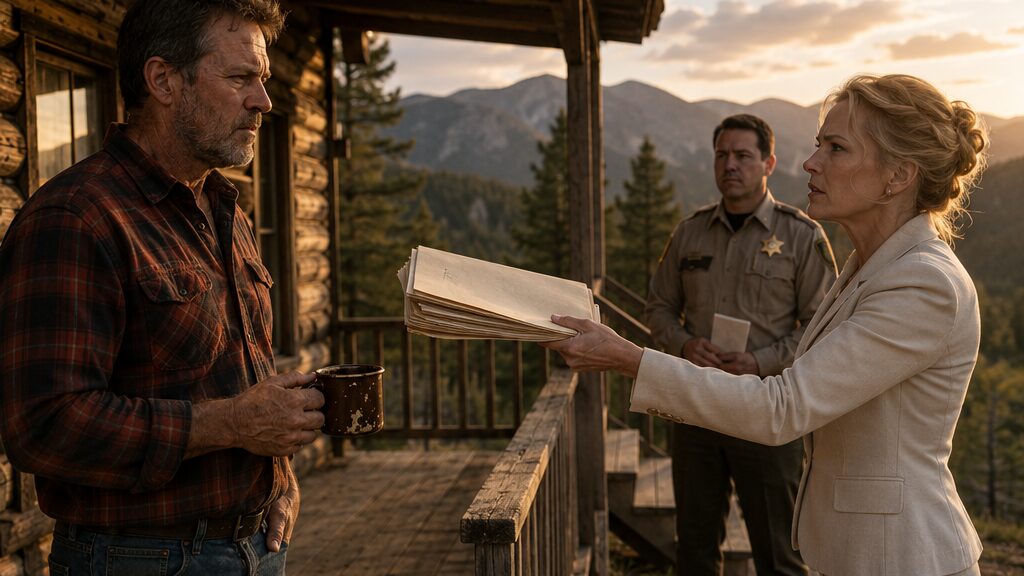
Angela Wright’s finger was already pointed at his chest when John Miller opened the screen door.
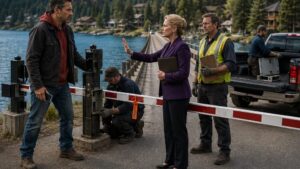
For one second, all he noticed was the wrongness of her standing there in pale slacks and clean shoes on his father’s muddy porch, as if the mountain had agreed to let her pass without touching her. Behind her, near the steps, a county deputy stood with one hand near his belt and the other holding a folded paper. His truck idled at the gravel turnoff below, its blue-and-white paint flashing between the pines whenever the branches moved.
John still had Samuel’s mug in his right hand.
It was the brown one with the chipped rim, the one his father had used every morning for twenty-two years, the one John had filled without thinking because the cabin still seemed to require it. Steam curled above the coffee and disappeared in the cold air between him and Angela.
“You heard me,” Angela said. “This cabin is mine now.”
John looked from her face to the deputy. “Is there a reason law enforcement is on my father’s porch?”
Angela gave a small laugh, too sharp to be mistaken for amusement. “Your father’s porch? That is exactly the problem.”
The deputy shifted his weight. He looked younger than John expected, not by much, but enough that his careful neutrality felt practiced rather than natural. “Mr. Miller, I’m here to keep the peace while Mrs. Wright serves notice.”
“Notice of what?”
Angela held up a packet of papers with a blue clip at the top. “Of the fact that you can’t squat in a house you don’t own.”
The word squat landed harder than it should have. John had replaced the lower porch boards with his own hands after Samuel’s walker caught in a rotten seam. He had patched the kitchen pipe during a January freeze while Angela was in town arguing with the pharmacy over insurance. He had slept in the narrow room beside Samuel’s because the oxygen machine made a soft alarm when the hose kinked. He had missed work, missed holidays, missed Margaret’s birthday dinner, missed his own life in increments small enough that no one noticed until they added up.
He kept his voice level. “This is my father’s cabin.”
“Your father left instructions,” Angela said. “And those instructions do not include you living here.”
The deputy unfolded the paper halfway, watching John’s hands more than his face. “Do you have any paperwork showing you have a legal right to occupy the property?”
John’s fingers tightened around the mug. The handle was warm. The air was not.
“My father told me I could stay.”
Angela’s mouth hardened, but something flickered behind her eyes before she covered it. “That’s not paperwork.”
“No,” John said. “It was a promise.”
The deputy glanced down, uncomfortable now. “Verbal promises can be complicated.”
Angela stepped closer, the porch boards creaking beneath her heel. “There’s nothing complicated. Samuel signed a will. The cabin goes to me. Everything connected to the cabin goes to me. John is not named.”
For a moment the mountain went silent around him.
John heard the old refrigerator inside kick on. He heard the deputy’s radio crackle and settle. He heard the coffee shift in the mug as his hand lowered without his permission.
Not named.
He had known there would be paperwork. He had known Angela would make sure the funeral bills, bank accounts, insurance notices, and tax forms all passed through her first. Samuel had married her seven years after John’s mother died, and John had never expected that grief would stay simple. But Samuel had been clear about the cabin. Not loud. Not dramatic. Clear.
“This place is yours to keep standing,” Samuel had said one late fall afternoon, after John fixed the west railing and set two mugs on the porch rail. “Angela won’t want the work. Margaret won’t want the drive. You’ll know what to do with it.”
John had believed him because Samuel had never used many words when fewer would hold.
Angela pushed the packet toward him. “Read it.”
John did not take it.
The deputy did. Maybe he felt the need to make the moment official, or maybe he saw that Angela’s hand was shaking. He cleared his throat and scanned the first page.
“Last will and testament of Samuel Lee Miller,” he read, then stopped.
“Read the part that matters,” Angela said.
The deputy hesitated. “Mrs. Wright—”
“Read it.”
The deputy looked at John. “It states that the real property known as the Miller cabin property, including structures and associated contents, is devised to Angela Ruth Wright.”
John stared at the paper. Angela’s middle name sat there like a key turned in a lock.
“And John?” he asked.
The deputy looked down again.
Angela answered for him. “Your name isn’t in it.”
The mug touched the porch rail with a soft ceramic click. John placed it there carefully because if he kept holding it, he might crush the handle.
“When,” he said.
Angela frowned. “What?”
“When did he sign it?”
She folded her arms, relieved, perhaps, to be back in the world of facts. “Six weeks before he died.”
John looked past her to the pines below the porch. Six weeks before Samuel died, the care calendar had been full of red dots. Red for confusion. Blue for medication changes. Black for days when Samuel slept more than he spoke. Six weeks before Samuel died, Samuel had called John by his brother’s name, then cried because he knew he had done it.
The deputy must have seen something change in John’s face. “Mr. Miller?”
John turned back. “Six weeks.”
Angela’s chin lifted. “He knew what he wanted.”
“Did he?”
“Don’t start that.”
“Who was there?”
“The attorney handled it.”
“At the office?”
Angela’s lips pressed together.
The deputy looked at her then, quickly, but not quickly enough.
John saw it.
Angela snatched the paper back from the deputy. “You have until Monday to remove your belongings. I am not dragging this out because you can’t accept your father’s decision.”
“My father couldn’t remember what month it was six weeks before he died.”
“That is not true.”
“He asked me where his truck was while he was sitting in it.”
“He had good days.”
“He had bad weeks.”
Angela’s face flushed. “And you weren’t there for all of them, were you?”
That struck with more accuracy than she deserved.
John did not answer. He looked at the coffee mug instead. Steam no longer rose from it. The brown ceramic sat between them, his father’s daily object turned into a witness that could not speak.
The deputy folded the document and tucked it under his arm. “This is a civil matter. I can’t remove anyone today without a court order. But Mr. Miller, you should speak with an attorney.”
Angela swung toward him. “I told you he was refusing to leave.”
“I heard what you told me,” the deputy said. His tone remained careful. “Today I’m keeping the peace.”
John picked up the mug again, not to drink from it, only to keep his hands occupied.
Angela looked at him with a fury that seemed larger than the cabin, larger than the will, larger than grief. “You always thought this place made you more his family than me.”
John felt the first heat rise in him, but he pushed it down. “No. I thought taking care of him counted for something.”
“It did,” she said. “Just not for this.”
The deputy took one step down from the porch, signaling the visit was over, but Angela stayed where she was.
John said, “Who drove him to sign it?”
Angela blinked.
The deputy stopped on the top step.
John waited.
For once, Angela had no immediate sentence ready. She looked at the will packet, then at the mug, then at the road where the deputy’s truck waited below the trees.
She turned and walked down the steps without answering.
Chapter 2: Six Weeks Before The Funeral Changed Everything
The care calendar was still hanging beside the refrigerator, and the square dated six weeks before Samuel’s death had a red circle around it.
John stood in the cabin kitchen with Angela’s deadline folded on the table and the mug cooling beside it. The calendar had been a cheap drugstore one, all trout streams and mountain sunsets, the kind Samuel used to say made bad weather look like a sales pitch. John had turned it into a map of decline because memory had become unreliable before grief did.
Red dot meant confusion.
Blue line meant medication change.
A checkmark meant Samuel had eaten more than half a meal.
A black slash meant John had called the nurse.
The circled date had all four.
John touched the paper with two fingers, as if pressure could bring the day back whole. He remembered Samuel sitting in the kitchen chair wearing one boot and one slipper, insisting he needed to go down to the county office because his father was waiting there. Samuel’s father had been dead for thirty-one years. Angela had stood by the sink, arms folded, saying, “He’s tired, John. Stop correcting him.”
That was the week the new will had been signed.
John pulled the calendar from the wall. The nail stayed behind, bright against the faded square of paint.
He did not call a lawyer first. That would have been the smart thing. Instead, he drove to the bank because the old automatic payments for the cabin utilities came from the account Samuel had used for everything tied to the property. John knew it was a mistake as soon as he stepped inside. The clerk behind the counter wore the expression of someone trained to be kind only up to the edge of policy.
“I’m sorry,” the clerk said after checking the screen. “I can’t disclose account details unless you’re listed or have estate authority.”
“I paid the electric from this account for two years.”
“I understand.”
“I brought him here when his signature started shaking. You have copies of the forms.”
“I understand,” the clerk said again, and this time she sounded like she did. “But Mrs. Wright is the executor listed in the paperwork we received.”
John looked through the glass wall toward the parking lot. Angela’s name had reached the bank before he had.
“Executor,” he repeated.
“Yes.”
“When did you receive the paperwork?”
The clerk hesitated. “I can’t give you account details.”
“Not the account. The mail. When did the estate address change?”
Her eyes flicked to the screen before she stopped herself. That glance was small, but John had spent years watching for small signs: the way Samuel’s hand trembled before he dropped a spoon, the way his eyes searched for the name of a room he was standing in.
The clerk lowered her voice. “Mr. Miller, you should speak with counsel.”
“Was it before he died?”
She did not answer directly.
That was answer enough.
Back at the cabin, John laid out everything on the table: Angela’s notice, the deputy’s card, the care calendar, Samuel’s old pill sheet, three utility bills with John’s handwriting on the payment notes, and a photograph of the porch from the summer before. Samuel sat in the picture with the brown mug in one hand, laughing at something John could no longer remember saying.
The phone rang while John was staring at the photograph.
“This is the office of the estate attorney returning your call,” a woman said. “How may I help you?”
John stood straighter though no one could see him. “I’m John Miller. Samuel Miller’s son.”
A pause.
“Yes, Mr. Miller.”
“I need to know who witnessed my father’s will.”
“I’m afraid we can’t discuss the estate file in detail with you.”
“My name was removed.”
“I understand this is difficult.”
“When was the document signed?”
Another pause, shorter this time. “You were provided a copy?”
“Angela showed up with a deputy and waved it on my porch.”
“I’m sorry. That sounds upsetting.”
“It was six weeks before he died. Was the attorney aware of his medical condition?”
“I can’t answer that.”
“Was it signed at the office?”
The woman breathed in softly, as if she had almost stepped over a line. “Mr. Miller, you would need your own legal representative to request records formally.”
John looked at the calendar. “Was there a notary?”
“There is always a notary for execution.”
“At the office?”
“I can’t—”
“Did my father come to you, or did you go to him?”
Silence.
Then papers moved on the other end of the call.
“I can’t discuss details,” she said, and now her voice had tightened. “But any home visit would have been arranged through the client’s representative.”
“The client was my father.”
“Yes.”
“Who arranged the home visit?”
“I’m not able to—”
“Was it Angela?”
The woman did not speak.
John closed his eyes.
After a few seconds, she said, “You should request the full file through counsel. That is all I can suggest.”
He almost thanked her. Habit nearly did it for him. Instead he said, “I will.”
Before he hung up, she added, so quietly he almost missed it, “The home visit was arranged by Mrs. Wright.”
The line clicked dead.
John remained beside the table, the receiver still against his ear, long after the call ended. The cabin seemed to hold its breath around him. From the kitchen window, the porch rail was visible, the exact spot where he had set down Samuel’s mug while Angela told him the house was hers.
He drove to Margaret’s house that evening because anger had begun arranging facts into shapes he did not trust. Margaret had always been better at separating what happened from what someone wanted to believe happened. She lived forty minutes down the mountain in a ranch house with a flat yard and no view, by choice. She said views were another kind of maintenance.
She answered on the third knock and did not look surprised to see him.
“Angela called you,” John said.
Margaret stepped back to let him in. “She emailed me.”
On her kitchen counter lay a copy of the will summary and a letter from Angela’s attorney. John saw his own name nowhere, not even in the formal language of exclusion.
Margaret rubbed her forehead. “John, I know this feels wrong.”
“It is wrong.”
“I said feels because what we know and what we can prove are not always the same.”
“He signed it during the red-circle week.”
Her eyes moved toward the folded calendar under his arm. “You brought that?”
“Yes.”
“Of course you did.”
“What does that mean?”
“It means you’re already building a case in your head.”
“Someone should.”
Margaret leaned against the counter, exhausted before the argument began. “Legal documents beat memories most of the time.”
“Our father was not a memory.”
“No,” she said, softer. “But he’s gone.”
The sentence hit the room and stayed there.
John set the calendar on her counter, opening it to the circled date. “Angela arranged a home visit. The bank changed the estate mailing before he died. The attorney’s office won’t tell me who witnessed it. You think I should just walk out because the paper says so?”
“I think you should be careful about what this will cost.”
“The cabin?”
“You,” Margaret said. “Me. Whatever is left.”
John looked down at Samuel’s handwriting in the calendar margins. Some notes were his own, some Samuel’s from earlier months when his hand was still firm. On one clear day in spring, Samuel had written: porch rail fixed, John stubborn.
He almost smiled. He could not.
Margaret touched the edge of the calendar. “There’s something else you need to remember before you decide Angela is the only reason this happened.”
John looked up.
Margaret’s face had changed. Not against him, exactly. Worse than that. Pitying him.
“You weren’t there every day, John,” she said. “Don’t pretend you were.”
Chapter 3: The Sister Who Wanted The Fight To End
Margaret opened her front door two days later with Angela’s settlement offer already in her hand.
John had not told her he was coming. He had driven down because the cabin had become too loud in its silence, every floorboard answering him with the same question: where were you when he signed it? Margaret stood in the doorway wearing house slippers and a sweater too heavy for the mild afternoon, her hair pulled back like she had been ready for a headache before he knocked.
“She sent it to me too,” Margaret said.
John looked at the envelope. “Of course she did.”
“She wants me to talk sense into you.”
“Are you going to?”
“I haven’t decided what sense is yet.”
He followed her inside. Her living room still had the framed photograph from Samuel’s seventieth birthday on the mantel. John had tried to avoid looking at it the last time. Now he looked straight at it. Samuel stood between them in a dark jacket, one arm around Margaret, one around John. Angela stood at the edge of the frame, smiling as if she had been added after the picture was taken.
Margaret saw where his eyes went. “Don’t start hating a photograph. It can’t defend itself.”
John took the papers from her. The offer was short. Angela would give him fifteen thousand dollars for moving expenses and “personal sentimental items to be mutually agreed upon,” if he vacated the cabin, released all claims, and stopped contacting institutions connected to the estate.
“Fifteen thousand,” John said.
“It’s insulting.”
“Then why are you holding it like it might be practical?”
“Because insulting and practical have spent a lot of time together in this family.”
He folded the paper. “She wants me quiet by Friday.”
“She wants the cabin settled before tax bills, insurance, probate notices, all of it becomes a mess.” Margaret sat on the edge of the couch. “And before you make accusations you may not be able to prove.”
“I’m asking when Dad signed a document that erased me.”
“You’re also implying Angela pushed him into it.”
“She arranged the signing.”
“Maybe because she was his wife.”
John laughed once, without humor. “Now you’re defending her.”
“No. I’m trying not to pretend the story is simple just because she’s acting like it is.” Margaret clasped her hands together. “You need to hear something you don’t want to hear.”
“I’ve heard plenty.”
“You were gone.”
The words were quieter than before, but they did not soften.
John looked toward the mantel again. “Ten days.”
“Almost eleven.”
“He told me to leave.”
“He was sick.”
“He knew exactly where to aim.”
Margaret’s face tightened because she remembered, or because he had told her enough to make remembering unnecessary.
It had been the first week of the red circles. Samuel had refused his evening pills, then accused John of hiding the truck keys to keep him prisoner. John had tried patience, then explanation, then firmness. Samuel had knocked the pill cup to the floor. Tiny white tablets scattered under the table like spilled teeth.
“You always did want me weak,” Samuel had said.
John could still feel the pill cup in his hand. He could still feel the child in him flinch under the old man’s voice.
He had said, “Call Angela if you think she’ll do better.”
Samuel had said, “Maybe I will.”
So John left.
Not forever. Not even close. He drove down the mountain, spent the first night in his truck outside a motel because he was too angry to check in, then stayed with a friend from work for several days. He called Margaret. He did not call Samuel. He told himself it was because Samuel needed to see what Angela actually managed when John was gone. He told himself it was respite, a word the nurse had used more than once.
On the tenth day, Angela called and said Samuel had fallen. John came back before dark. Samuel was in bed, bruised on one shoulder, embarrassed and sleepy. He did not mention the argument. John did not either.
Now Margaret watched him remember all of it.
“I came back,” John said.
“I know.”
“I never left again.”
“I know that too.”
“Then why are you saying it like I abandoned him?”
“Because Angela is going to say it like that. And because some part of you thinks it first.”
John turned away.
Margaret let the silence sit for a moment, then stood. “Let’s get coffee. I can’t do this in a room full of Dad’s pictures.”
They drove separately to a roadside diner halfway between her house and the mountain road. It was the kind of place Samuel had liked because the coffee came fast and nobody asked whether he wanted oat milk. John sat across from Margaret in a booth with cracked red vinyl, Angela’s offer between them like a third sibling.
Margaret stirred creamer into her cup until the coffee went pale. “Dad told me once that you were tired.”
John looked at her. “When?”
“Months before he died.”
“What exactly did he say?”
“That you looked at the cabin like it was a sentence.”
John’s mouth went dry.
Margaret continued because stopping would have been worse. “I told him caregiving does that. He said, ‘John won’t say it. He’ll just get quieter until something breaks.’”
John stared at the table. He had not known Samuel saw that much. He had thought silence protected both of them.
“I was tired,” he said.
“I know.”
“I was angry.”
“I know.”
“I still did the work.”
“I know, John.” Her voice trembled now. “But don’t build your case on the idea that everyone saw you as pure and Angela as poison. That’s not true. Dad worried about her too.”
John lifted his eyes. “Worried how?”
“She asked me once what would happen to her if the cabin went to you and the accounts got eaten by medical bills. She said she had been a wife, not a visitor.”
“That doesn’t give her the right to take everything.”
“No. It explains why she could tell herself she had the right.”
The waitress came by with a pot of coffee. Neither of them spoke until she left.
Margaret pushed the settlement offer back toward him. “I’m not telling you to take it. I’m telling you that if you fight, fight the real thing. Not the cleaner version where Dad promised, you served, Angela stole, and nothing else happened.”
John folded the offer along its original crease. “The real thing is he asked about me.”
Margaret went still.
He noticed. “What?”
She looked down at her cup.
“Margaret.”
“I didn’t know what it meant then.”
“What?”
Margaret closed her eyes for a moment. “Angela called me the day the will was signed.”
John felt the diner noise flatten around him.
“She said Dad was having a decent morning. She said some paperwork people were coming and she wanted me to be available in case he got agitated.”
“Why didn’t you call me?”
“Because you were still gone.”
His hand tightened around the paper.
Margaret said quickly, “And because Angela told me not to make it harder. She said Dad got upset when your name came up.”
“That was a lie.”
“I don’t know what it was.”
“What did Dad say?”
Margaret’s eyes filled, but she did not let the tears fall. “I heard him in the background. Just once. He asked, ‘Is John back from the woodpile?’”
John stopped breathing for a second.
The woodpile sat thirty yards beyond the cabin, near the shed. Samuel used to send him there when they needed a break from each other. It had become a joke after arguments. Go stack wood, come back human. Samuel would leave the brown mug on the porch rail when he was ready to stop being stubborn.
John looked toward the diner window, but all he saw was the porch.
Margaret’s voice dropped. “Angela told him you were busy.”
John turned back.
“She didn’t tell him you were gone,” Margaret said. “She didn’t tell him you had left after the fight. She said you were busy.”
John held the settlement offer until the crease cut into his thumb.
“On the day the will was signed,” he said.
Margaret nodded.
John stood so quickly the booth shook.
“John—”
He looked down at his sister, at her fear, her guilt, her practical hands wrapped around a cooling cup of coffee.
“Dad asked for me,” he said.
And for the first time since Angela had stepped onto the porch, the question was no longer whether John had been erased.
It was why nobody had let Samuel know he was asking.
Chapter 4: The Hospice Aide Remembered The Wrong Silence
“I wondered when someone would ask about that week,” Ruth Carter said before John could finish saying his father’s name.
She stood beside a grocery cart in the parking lot, one hand gripping the handle, the other holding a paper bag against her hip. The bag had celery leaves sticking from the top and a carton of eggs pressed dangerously against the side. John had found her by accident only because Margaret had remembered Ruth worked mornings at the pharmacy counter after leaving hospice care.
John had rehearsed a careful beginning on the drive down.
Ruth gave him no room for it.
“That week,” he repeated.
Her eyes moved past him to the mountain road, then to the grocery store windows. “Not here.”
“I’m not trying to put you in the middle of anything.”
“That’s usually what people say right before they do.”
John stepped back from the cart. “Then I’ll leave.”
Ruth studied him. She looked older than he remembered from Samuel’s last months, though perhaps she had always looked tired and John had been too busy counting pills to notice. She wore her hair pinned low, and her coat had one missing button. Nothing about her suggested a person eager to become useful evidence.
“You look like him when he was trying not to ask for help,” she said.
John did not know what to do with that, so he said nothing.
Ruth sighed and nodded toward an older apartment building across the side street. “Ten minutes. You can carry the eggs.”
Her apartment smelled faintly of tea and laundry detergent. She cleared a stack of mail from a small kitchen table and placed the grocery bag on the counter. John kept standing until she pointed at a chair.
“You’re not here about the will because of money,” Ruth said.
“I’m here because he asked for me when they signed it.”
Her hand paused on the kettle.
“Margaret told you.”
“She heard him in the background.”
Ruth put the kettle down without turning it on. “I was there that morning.”
John felt the chair under him become too small.
Ruth sat opposite him and folded her hands, not like a witness, but like someone about to choose how much of herself she could afford to spend. “I wasn’t there for the signing. I need that clear. By the time the notary came in, Mrs. Wright told me I could take my lunch early.”
“Angela sent you away.”
“She said Samuel would feel crowded.”
“Was he having a good day?”
Ruth looked at him for a long moment. “He had pieces of good days.”
That answer hurt more than a simple no.
“He knew people sometimes,” she said. “He knew the cabin almost always. He knew the mug.” She glanced toward John’s hands as if the object might appear there. “Every morning he wanted that brown mug set on the porch rail. Even when he couldn’t drink coffee anymore, he wanted it there. He said you’d complain if the rim faced the wrong way.”
John swallowed once. “I did complain.”
“I know.”
He almost smiled, but Ruth’s face stopped him.
“That week,” she said, “he was mixing up time. He asked me twice if his mother had fed the chickens. He asked Mrs. Wright if the lake had frozen, and it was September. He called me Margaret once. Then he apologized because he knew it was wrong but not why.”
John looked down at the table. “Did Angela know?”
“She was there.”
“That’s not an answer.”
Ruth’s eyes hardened, not with anger at him, but warning. “Be careful who you turn into the only villain. Care breaks people in different ways.”
“I’m not trying to break her.”
“She may think you are.”
“She brought a deputy to the cabin.”
“And maybe she thought if she didn’t move fast, you’d lock her out of the only security she believed she had left.”
John leaned back. “Did she say that?”
“Not in those words.” Ruth rose and finally turned on the kettle. “She said once, ‘When Samuel goes, they’ll remember I wasn’t blood.’”
The words shifted something without softening anything. John could picture Angela at the sink, looking out at the woodpile, hearing Samuel ask for his son and choosing what to do with that.
Ruth set two mugs on the table. Neither was brown.
“What happened before the notary came?” John asked.
Ruth’s mouth tightened. “Mrs. Wright cleaned him up. Fresh shirt. Shaved him a little. She kept saying, ‘You’re clear today, Samuel. You know what you want.’ Not cruelly. Like she needed it to be true.”
“And was it?”
“He answered simple questions.”
“What about complicated ones?”
Ruth looked at the kettle. “He asked if John had finished the porch place.”
John gripped the edge of the table.
“That exact phrase?”
“As close as I remember. ‘Did John finish the porch place?’ Mrs. Wright said you were busy and that paperwork had to get done.”
“Did he ask where I was?”
“He said you were out chopping wood.”
John closed his eyes.
Ruth continued carefully. “It sounded like he thought you were nearby. Not gone. Not refusing him. Nearby.”
The kettle clicked off. Neither of them moved toward it.
“Can you say that formally?” John asked.
Ruth shook her head before he finished. “I can say what I observed. I can’t diagnose capacity. I can’t swear he didn’t understand every page. I didn’t hear the signing questions. I was out of the room.”
“But you saw enough to know something was wrong.”
“I saw enough to know there should have been more caution.”
The sentence was small, but John felt the weight of it.
Ruth poured the tea. Her hand shook once, and she steadied the mug with both palms. “You also need to know something else. He had good instincts even on bad days. He got anxious when Mrs. Wright spoke for him too quickly.”
“Corrected him?”
“Prepared him,” Ruth said. “That was the word she used. She said she was preparing him so he wouldn’t get embarrassed.”
John thought of Samuel, proud even when his hands failed him, letting Angela button his shirt before strangers came to put his wishes on paper.
“I want to ask you for a written statement,” John said.
“I know.”
“I won’t make it say more than you saw.”
Ruth gave him a tired look. “That’s the first useful thing you’ve said.”
She wrote slowly, crossing out words when they sounded too certain. Samuel confused dates. Samuel believed John was outside or nearby. Angela arranged the room. Ruth was asked to leave before the notary arrived. She would not state Samuel lacked capacity. She would state she believed additional assessment would have been appropriate.
When she finished, John did not reach for the page right away.
“Why didn’t you tell anyone?” he asked.
Ruth’s face closed, then opened just enough to show the shame underneath. “Because nobody asked. Because he died. Because families turn every sentence into a weapon. Because I needed work.”
John nodded. He had no right to judge silence as if he had not practiced it himself.
At the cabin that evening, he sat in the driveway with Ruth’s statement on the passenger seat and the care calendar beside it. The porch above him was dark. Through the windshield he could see the rail where Samuel’s mug usually sat.
His phone buzzed with a message from Margaret.
Did Ruth talk?
John typed yes, then deleted it. Typed more than I expected, then deleted that too.
Before he could answer, another message came in from an unknown number. It was a photograph of an envelope addressed to him, left between the screen door and the frame.
He climbed out of the truck and went up the steps.
The envelope contained a formal notice from Angela’s attorney: he had until Friday to respond to the settlement offer or vacate voluntarily before further action. Behind it, tucked where the paper had been folded, was a copy of a single handwritten line from the notary journal.
Time of arrival: 9:40 a.m.
John stood with the paper in his hand, remembering Angela telling the deputy the signing had happened after lunch, when Samuel was always clearer.
Then he looked toward the woodpile beyond the cabin, black against the trees, and heard Ruth’s voice again.
He thought you were out chopping wood, though John had not been there in days.
Chapter 5: The Lawyer Had A Document, But Not The Whole Day
“The documents are legal,” Angela said. “Your feelings are not evidence.”
She sat across the estate attorney’s conference table with her purse in her lap and both hands folded over it, as if she had brought herself there under control and intended to remain that way. Her pale jacket looked expensive but worn at the cuffs. John noticed because he had been trying not to notice the yellow legal pad placed near the attorney’s elbow.
The estate attorney had not introduced himself by first name. He had shaken John’s hand, nodded to Angela, and opened a folder thick enough to make grief look procedural.
John placed Ruth’s statement on the table. “I’m not asking anyone to accept my feelings.”
Angela’s mouth tightened. “You’re asking everyone to ignore Samuel’s signature.”
“I’m asking when he understood what he was signing.”
The attorney lifted one palm. “Capacity is a legal threshold, Mr. Miller. Confusion alone does not invalidate a testamentary document.”
“I know.”
That made the attorney pause. Perhaps he had expected anger to do the work for him.
John continued. “I’m asking for the signing circumstances. Who requested the appointment. Who was in the room. What questions were asked. Why the home visit happened the morning his calendar shows medication changes, confusion, and a hospice call.”
Angela looked at the calendar he had brought and set beside the statement. “That thing is not a medical record.”
“No,” John said. “It’s what we used to survive the days you now want to pretend were clear.”
The attorney turned slightly toward him. “Mr. Miller.”
John stopped. Not because he regretted saying it, but because he heard the edge in his own voice and knew Angela could use it.
The attorney opened the folder. “The will was executed with proper formalities. It was witnessed and notarized. Your father affirmed that he understood the nature of his estate and the objects of his bounty.”
“The objects of his bounty,” John repeated.
“It is standard language.”
“It sounds like a way to avoid saying people.”
Angela leaned forward. “He knew who I was.”
“I’m not saying he didn’t.”
“You keep implying he was helpless.”
“I’m saying he was ill.”
“He had good mornings.”
“Then why did you tell the deputy it was signed after lunch?”
Angela’s eyes flicked to the attorney.
There it was again: the small glance.
The attorney looked from one to the other. “What is this about?”
John took the copied notary line from his folder and placed it beside the legal pad. “The notary arrived at 9:40 a.m. Angela told the deputy the signing happened after lunch, when Dad was clearer. Ruth Carter says she was sent away before the notary came. Margaret heard Dad ask for me on the phone that same morning.”
Angela exhaled sharply. “He asked if you were there because you had been gone for over a week.”
The attorney’s pen stopped moving.
John felt the blow, but this time he did not look away from it. “That’s true.”
Angela blinked. She had expected denial.
“I left after an argument,” John said. “I came back. I should have called him. I didn’t. That was my failure. But it doesn’t answer why you let him think I was outside chopping wood when you knew I wasn’t there.”
Angela’s face shifted, not into guilt, not fully. Into the defensive panic of someone whose story had depended on only one part being spoken.
“He was calmer when he thought you were nearby,” she said.
The room went quiet.
The attorney wrote something on the yellow pad.
John looked at him. “What did Samuel ask during the appointment?”
The attorney closed the folder slightly. “Notes from testamentary meetings are privileged and sensitive.”
“I’m not asking for your conclusion. I’m asking because you already have a note that mattered enough to write down.”
Angela turned toward him. “You don’t know that.”
John looked at the yellow pad. “No. But you do.”
The attorney’s expression changed by almost nothing. But his hand moved to the older file beneath the top folder.
“Counsel would normally be present for this discussion,” he said.
“I don’t have counsel yet.”
“Then this is not advisable.”
“For me or for the estate?”
The attorney did not answer immediately. He removed one sheet from the folder, a photocopied page of handwritten notes from an earlier yellow legal pad. The writing was cramped and slanted. John could not read it from where he sat, but he saw the date at the top.
The signing date.
Angela’s voice sharpened. “I don’t think you should be sharing internal notes.”
The attorney looked at her. “Mrs. Wright, if there is a potential dispute, transparency now may avoid a more serious challenge later.”
“Transparency?” she said. “He is trying to make Samuel look incompetent.”
John did not rise to it. “Read the note.”
The attorney glanced at the page. “There is an entry during the discussion of the cabin property.”
John waited.
The attorney cleared his throat. “‘Client asks whether John still gets porch place. A.W. clarifies intent to leave residence to spouse to prevent instability. Client nods after explanation.’”
For a moment the words meant nothing because they meant too much.
John still gets porch place.
Not cabin. Not real property. Porch place. The phrase Samuel used when he wanted to talk about the cabin without making it sound like an estate asset. The porch place was where he drank coffee, where John fixed railings, where arguments cooled, where Samuel left the brown mug facing west.
Angela’s eyes had gone bright. “He nodded.”
“He asked about John first,” John said.
“He nodded after I explained.”
“After you clarified his intent for him.”
“That is not what happened.”
The attorney held up the page, but not high enough for John to take. “The note does not prove undue influence. It does suggest there was a question.”
Angela stood abruptly. “A question from a dying man does not erase a signed will.”
“No,” John said. “But it means the will erased a question.”
The attorney put the page down. “There is also the matter of timing.”
Angela sat slowly.
John turned to him.
“The notary journal lists arrival at 9:40,” the attorney said. “Execution was completed at 10:18. The file memo indicates Mrs. Wright had requested a morning appointment because Mr. Miller fatigued in the afternoon.”
John looked at Angela. “You told the deputy after lunch.”
“I was upset,” she said.
“You brought a deputy.”
“I was upset before I brought him.”
The attorney closed the file. “Mrs. Wright has offered a private resolution. Mr. Miller, if you accept, the estate can avoid delay. If not, you may retain counsel and pursue formal review.”
Angela slid another envelope across the table. “Fifteen thousand was generous. I’ll make it twenty-five if you sign by Friday.”
John did not touch the envelope.
“Moving expenses,” she said. “And sentimental items. The mug, if that’s what this is really about.”
The attorney looked down.
John felt something in him go cold. “You think the mug is sentimental clutter?”
“I think you are turning objects into proof because you don’t like the proof that counts.”
He looked at the yellow legal pad. The attorney had written another line while Angela spoke. John could not read all of it, only two words near the edge.
notary time
He pointed to the pad. “You already know the times don’t match.”
The attorney covered the note with his hand, not fast enough.
Angela’s voice lowered. “John, take the offer. You were tired. Samuel knew you were tired. Maybe he did what he thought was best for everyone.”
The sentence sounded almost kind. That made it worse.
“Did he know I wasn’t outside?” John asked.
Angela did not answer.
“Did he know I had not been told?”
The attorney closed the folder. “I think this meeting should end.”
John stood. He gathered Ruth’s statement, the calendar copy, the notary page, and left Angela’s envelope on the table.
At the door, the attorney spoke again.
“Mr. Miller.”
John turned.
The attorney’s face had lost some of its professional distance. Not enough to become an ally. Enough to become a man who understood a file had begun to move under his hands.
“The notary’s journal has a different time than the time Mrs. Wright gave the deputy,” he said. “If you pursue this, request the complete journal entry. Not just the arrival line.”
Angela’s chair scraped behind him.
John looked at her, then at the attorney, then at the yellow pad where Samuel’s question had been copied into legal handwriting and nearly buried there.
“What else is in it?” John asked.
The attorney did not answer.
Angela did.
“Enough,” she said, and the fear in her voice was the first honest thing she had given him all morning.
Chapter 6: The Offer To Leave Quietly Proved Too Much
“This is your last chance to be reasonable,” Angela said.
She had come to the cabin without the deputy this time. No official truck waited below. No folded notice sat in a uniformed hand. She stood on the porch with a white envelope and a face that looked less polished than it had on the day she told him to leave. Her hair was pulled back, but wind had loosened strands around her temples. For the first time, John noticed how tired she was.
That did not make him open the door wider.
“It’s Friday,” she said.
“I know what day it is.”
“You have until five.”
John stepped onto the porch and closed the screen behind him. Samuel’s mug sat on the rail between them, filled with coffee John had not meant to pour. Habit had done it. Or grief. Or the part of him still waiting for someone inside the cabin to ask why the rim faced east.
Angela looked at the mug and away again. “Twenty-five thousand. You choose what personal items you want, within reason. You stop calling banks, former aides, and legal offices. You vacate by the end of the month.”
“You rehearsed that.”
“I’ve had to rehearse a lot of things since your father died.”
“So have I.”
She held the envelope out. “Take it.”
John did not.
Angela’s arm stayed extended until it began to tremble. She lowered it first, angry at herself for showing the weakness.
“You think I planned some grand theft,” she said. “You think I sat beside his bed counting what I could take.”
“I think you let him sign something when he was confused.”
“I think you left.”
There it was, spoken cleanly on the porch.
John looked toward the woodpile. The chopped rounds were still stacked badly from the week before Samuel died. He had always meant to restack them. He had meant to do many things.
“I did,” he said.
Angela’s expression changed. “You never admit that.”
“I’m admitting it now.”
“You left me with him.”
“I left him with his wife.”
“And what did you think that meant?” Her voice cracked, then hardened around the crack. “You came and went like the cabin was yours and caregiving made you noble. But when he shouted, when he forgot, when he got mean because he was scared, you could get in your truck. I was still his wife when the door closed.”
John absorbed it because some of it was true.
Angela took a step closer. “He worried you would resent him. He worried you already did.”
“I did resent him sometimes.”
The admission seemed to strike her more than any accusation had.
John continued before silence could turn cowardly. “I resented the pills. The calls. The way he would thank you for a glass of water and snap at me for fixing the thing he broke. I resented that he made promises instead of paperwork because he thought we would all behave better than this.”
Angela looked at the mug.
“But I came back,” John said. “And he asked for me.”
“He asked for you because he was confused.”
“He thought I was outside chopping wood.”
“He was calmer that way.”
“So you let him believe it.”
Angela’s mouth opened, closed.
John picked up the mug and set it on the small table beside the porch chair, exactly between them. “When you explained the will, did you tell him the cabin going to you meant I would have no right to stay?”
“He knew I needed protection.”
“That isn’t what I asked.”
“He knew I had nowhere else like this.”
“That still isn’t what I asked.”
Angela’s eyes filled suddenly, and she turned her face toward the trees as if anger could hide the tears. “Your father told me once that every board in this place had your hands on it. Do you know what that feels like? To be married to a man and still feel like the house is having a conversation with someone else?”
John said nothing.
“He promised me I wouldn’t be left begging his children for permission to live,” she said. “He promised that too.”
The porch boards creaked under John’s shift of weight. Samuel had promised too many things in different rooms.
“Then why take all of it?” he asked.
Angela looked back. “Because partial promises do not pay tax bills.”
“Neither does erasing me.”
“I didn’t erase you. The will—”
“Angela.”
She stopped.
The envelope bent in her hand.
“I am going to mediation,” John said. “I am requesting the complete notary journal. I am requesting the attorney notes through counsel. Ruth gave a statement. Margaret will be asked what she heard.”
Angela’s face tightened at Margaret’s name. “She told you?”
“She told me Dad asked for me.”
“She doesn’t understand what that morning was like.”
“Then explain it there.”
Her laugh came out broken. “In a room where everyone looks at me like I tricked a dying man?”
“In a room where you answer the question.”
“What question?”
John touched the mug’s handle, then let go. “Whether he meant to protect you or meant to erase me.”
Angela stared at him.
For a moment the porch returned to the day of the deputy: her pointed finger, the paper, the legal confidence. But now there was no deputy to steady the scene into roles. There was only a woman who had been afraid of being left with nothing and a man who had been afraid to admit he once wanted to leave.
At the mediator’s office that afternoon, the room had no windows and too many chairs. The probate mediator asked each of them to state what they wanted. Angela said she wanted the estate honored. John said he wanted the timeline examined. The mediator asked if he was contesting out of financial loss.
John looked at Angela before answering.
“I’m contesting because my father asked whether I still got the porch place, and nobody answered him honestly.”
Angela’s jaw tightened.
The mediator turned to John’s documents. “You also acknowledge you were absent during part of the period in question.”
John felt Margaret’s eyes on him from the chair near the wall. She had come reluctantly, carrying no folder, only her purse and the look of someone who feared every truth would charge a fee.
“Yes,” John said. “I was gone ten days.”
Angela looked down.
The mediator waited.
John continued. “I left after an argument. I was tired and angry. I didn’t call him. I should have. If Angela says that made him afraid, I believe it might have.”
Margaret’s hand moved to her mouth.
Angela looked at him then, not with forgiveness, not even softness, but surprise. She had expected him to protect himself by cleaning the story. He had not.
“But my absence does not explain why he was allowed to believe I was nearby when the will was signed,” John said. “It does not explain why the final document ignored his question. And it does not explain why Angela told different times to different people.”
The mediator made notes. “Mrs. Wright?”
Angela’s answer was quiet. “He was afraid John would leave again.”
The sentence did not clear her. It did something more complicated. It admitted she had known which fear to use.
John felt anger rise, but grief reached it first.
Before anyone could speak, the conference room door opened. Margaret stood halfway in, breathless, one hand gripping Samuel’s old care calendar.
“I’m sorry,” she said to the mediator, though she was looking at John. “I went back through the pages.”
John stood. “Margaret?”
She came into the room and placed the calendar on the table with both hands, open to the week before the signing. Her finger touched a small entry in Samuel’s own uneven handwriting, squeezed into the margin beside a medication note.
“There’s one entry none of us noticed,” she said.
Chapter 7: The Cabin Was Never Supposed To Choose For Him
The probate mediator turned the calendar toward Angela and tapped the small line in Samuel’s uneven handwriting.
“Mrs. Wright,” the mediator said, “if Samuel intended to leave everything to you without qualification, why does this note divide the cabin from the bills?”
Angela stared at the page as if the ink had waited until that room to betray her.
John stood beside Margaret’s chair, not trusting himself to sit yet. The calendar lay open under the fluorescent light, its trout-stream photograph bent backward, its boxes crowded with medication marks, meal notes, and the private shorthand of a man trying to keep control of days that were slipping out of order.
In the margin beside the week before the signing, Samuel had written four words.
John porch / Angela bills.
Not a will. Not a legal command. Not enough, by itself, to undo the document in the folder.
But it was Samuel’s hand.
The mediator waited. The estate attorney sat very still, his yellow pad open but untouched. Angela had both hands flat on the table, fingers spread, as if she could hold the room in place.
“That could mean anything,” she said.
Margaret closed her eyes.
John said nothing. He had learned, finally, that silence and restraint were not the same thing. Silence hid. Restraint chose when to speak.
The mediator looked at the attorney. “Was this calendar reviewed before the revised will was drafted?”
The attorney adjusted his glasses. “Not to my knowledge.”
“Were prior estate plans reviewed?”
“There was reference to an earlier intention,” the attorney said carefully, “but no executed prior will was produced at the home visit.”
Angela’s head turned toward him. “You told me the signed document controlled.”
“It does control unless challenged,” he said. “That is not the same as saying there are no questions.”
The word questions seemed to tire her. She leaned back, and for the first time since the porch confrontation, John saw the older woman beneath the sharp one: Samuel’s wife, yes; the person who had learned which pharmacy answered fastest, which bill could wait, which nurse would call back. A woman who had been afraid the family would remember her only when something needed blaming.
The mediator slid Ruth Carter’s statement beside the calendar. “The hospice aide states Samuel believed John was nearby during the signing morning.”
“She wasn’t in the room,” Angela said.
“No,” the mediator agreed. “She was asked to leave.”
Angela swallowed.
The attorney turned one page in his file. “The meeting note also records Samuel asking whether John still got the porch place.”
John felt the phrase pass through him without cutting this time. It still hurt, but it no longer belonged only to pain.
The mediator said, “Mrs. Wright, the issue is not whether Samuel wanted you protected. There appears to be evidence he did. The issue is whether the final document accurately reflected his divided intention.”
Angela’s eyes lifted. “Divided.”
“Between your security and John’s connection to the cabin.”
Her mouth moved once before words came. “You all say that like security is some little thing.”
“No one said that,” John said.
She looked at him then, wary.
He stepped closer to the table, but not too close. “Dad worried about you. I believe that.”
Margaret looked up.
Angela did not blink.
John continued, “He worried you’d be left with bills. He worried we’d treat you like you were temporary. I don’t think he wanted that.”
Angela’s face tightened around something almost like relief, but suspicion stopped it from becoming visible.
“Then stop this,” she said. “If you believe that, stop.”
“I also believe he wanted me to keep the cabin.”
“You have your own life.”
“I had pieces of one.”
“That’s not my fault.”
“No,” John said. “It isn’t.”
The room quieted around that admission.
He looked down at the calendar. Samuel’s handwriting slanted downward in the margin, as if even the line had been tired. John remembered his father at the table, one boot and one slipper, insisting he had to meet a man dead for three decades. He remembered leaving. He remembered not calling. Those things did not disappear because Angela had done wrong.
“I left him for ten days,” John said. “I won’t pretend I didn’t. If he was afraid I’d leave again, I helped create that fear.”
Angela’s eyes filled, but she stayed rigid.
“But you used it,” he said. “You let him think I was outside. You explained his question away. You let a document erase what he was still trying to separate.”
The mediator gave the words room to settle.
Angela looked at the calendar again. “He said you would know what to do with the place.”
John’s breath caught.
She seemed angry at herself for saying it. Once spoken, though, the sentence would not go back.
“He said it more than once,” she continued, quieter. “Usually when something broke. The pump. The rail. The stove pipe. He’d say, ‘John will know.’ Do you know how that felt?”
John shook his head once.
“Like I was his wife until the cabin needed a future.”
Margaret whispered, “Angela.”
“No.” Angela wiped under one eye with the heel of her hand, hard and impatient. “You want the truth? I was scared. The medical bills were still coming. The taxes were coming. Every account had some rule I didn’t understand. And every time Samuel talked about after, the cabin had your name in it even when he didn’t say your name.”
“So you made sure he didn’t,” John said.
She flinched.
The attorney’s pen moved again. Not quickly. Not triumphantly. Just enough to make the moment part of the record.
Angela looked at John. “I told myself I was clarifying. I told myself he had already promised to protect me. I told myself you had walked away when it got hard.”
“I did walk away when it got hard.”
“For ten days,” she said.
“For ten days,” he agreed. “Not forever.”
Her hands folded inward on the table. “By the time you came back, the appointment was already set.”
The sentence did not contain a full confession. It did not need one. It drew the shape of what had happened: fear first, paperwork second, justification afterward.
The mediator leaned forward. “There are paths from here. A formal challenge could delay the estate and expose the signing circumstances to review. There is also room for a settlement that reflects what everyone now appears to understand Samuel was trying, however imperfectly, to do.”
Angela gave a bitter laugh. “Everyone understands Samuel now?”
“No,” John said. “But we understand the will doesn’t tell the whole story.”
He touched the edge of the calendar. “You keep the accounts designated for bills and support. The life insurance, if it named you, stays yours. I won’t fight that.”
Angela watched him carefully.
“The cabin transfers to me,” John said. “Not because you lose. Because Dad never meant for it to choose between us.”
The estate attorney looked at Angela. “That proposal may reduce litigation risk.”
Angela’s laugh was smaller this time. “Of course that’s how you’d say it.”
The mediator said nothing.
Angela looked at Margaret. “And you?”
Margaret’s face was pale. “I think Dad made a mess because he hated hard conversations. I think John made it worse by leaving and pretending silence was noble. I think you made it worse by turning fear into paperwork.” She looked down at Samuel’s note. “And I think that line is the closest thing we have to what he was trying to say before everyone started speaking for him.”
Angela sat back.
The room did not change all at once. No one shook hands. No one apologized in a way that healed anything. The attorney drafted conditions. The mediator asked questions about maintenance, taxes, contents, deadlines. Angela objected to phrases. John gave ground where he could and refused where the cabin itself was concerned.
Samuel’s mug was listed as a personal item to remain with the cabin.
Angela read that line twice.
“That mug has a crack,” she said.
“I know.”
“He wouldn’t let me throw it away.”
“I know that too.”
She signed near the bottom first.
John signed after her.
A month later, the first frost silvered the porch rail before sunrise.
John stood outside the cabin wearing Samuel’s old flannel over his own shirt, the sleeves too short at the wrist. The legal transfer was not finished in every county system, and the settlement still had steps left, signatures left, fees left. Nothing about the ending was clean. Margaret had not come up the mountain yet. Angela had mailed one box of documents and kept her message to a single sentence: These were in his desk.
Inside the box were receipts, insurance notices, and a photograph of Samuel and Angela at the lake, both of them squinting into hard sun, both of them smiling.
John had placed it on the mantel, not beside his mother’s picture, not hidden either.
He poured coffee into the brown mug and set it on the porch rail with the chipped rim facing west.
For years, he had thought the cabin was proof of what he had done. Then Angela had turned it into proof of what she feared. Then the will had turned it into language neither of them recognized.
Now it was just morning.
The woodpile waited beyond the steps, still badly stacked. John walked down, lifted two split logs, and set them right. It was not enough to fix the pile. It was only enough to begin.
When he returned to the porch, the coffee had cooled to the temperature Samuel used to tolerate while pretending he liked it that way.
John picked up the mug and sat in the chair closest to the rail.
“You didn’t erase me,” he said quietly.
The mountains gave nothing back. That was all right. For the first time, he was not asking them to.
He drank from Samuel’s mug, not because the law had given him everything, and not because the family had been made whole, but because the truth finally had a place to sit.
The story has ended.