They Told Him The Cabin Was Hers Until He Asked When His Mother Signed
Chapter 1: The Morning She Called Him A Trespasser
“Get off my porch,” Catherine shouted from the dirt path below. “You have no right to be here.”
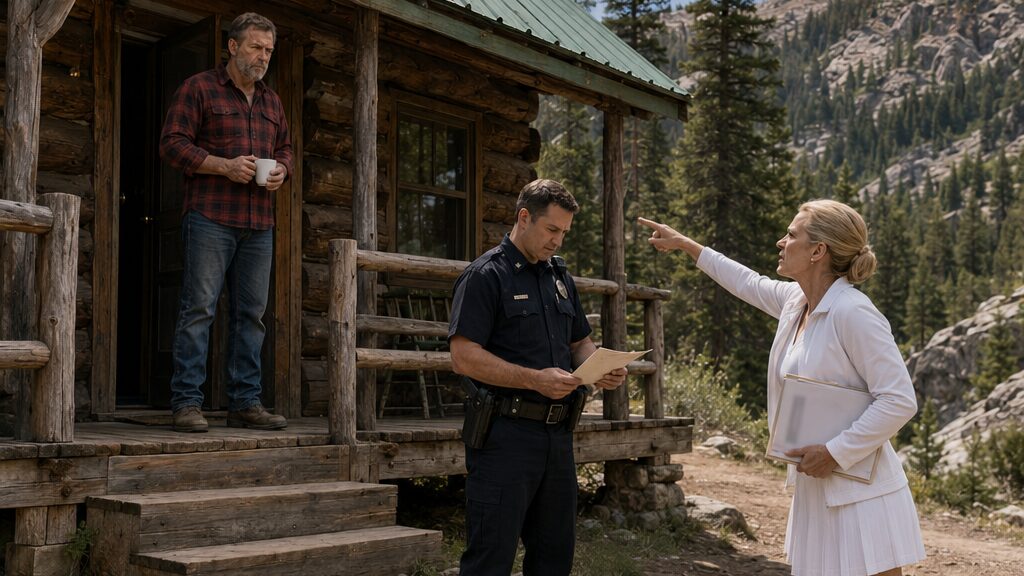
Larry Carter stood with one hand around his mother’s plain white coffee mug and the other resting against the cabin doorframe where the paint had worn thin from forty years of shoulders, bags, firewood, and winter gloves. Behind him, the old green roof caught the late morning sun. In front of him, his sister stood beside a police officer, pointing at him as if she had found a stranger breaking into a rental.
The officer looked uncomfortable before he said a word.
Catherine did not. She wore white from her visor down to her shoes, the kind of outfit she used to wear when she wanted a hard day to look easy. Her face was flushed. The folder in her hand snapped each time she shook it.
“This is my property now,” she said. “He was told not to come up here.”
Larry looked past her, down the slope where the dirt road bent between the pines. His truck was parked where it had always been parked, beside the flat stone his mother used to call the step for people too proud to admit they needed one. The woodpile was still stacked under the tarp he had tied down before the funeral. A half-split round of pine sat on the chopping block because he had left it there the morning Donna Carter had gone into the hospital and not come home.
The officer cleared his throat. “Sir, are you Larry Carter?”
Larry nodded.
“You live here?”
“No,” Catherine cut in. “He does not live here. He stayed sometimes because Mom let him. That’s over.”
Larry lifted the mug without drinking. There had been no coffee in it for twenty minutes. He had poured some out of habit, before the cruiser came up the road, before Catherine stepped out like she was arriving at a closing.
“I’m here to pick up a few things and check the pipes,” Larry said.
“My pipes,” Catherine said.
The officer glanced at the cabin, then at Larry’s boots, then at the mug in his hand. “Do you have paperwork showing you’re allowed to be on the property?”
Larry almost answered too quickly. He almost said, My mother asked me to keep the pipes from freezing. My mother told me this cabin was mine to care for. My mother sat in that chair every morning and drank from this mug while she told me not to let Catherine sell it to someone who would paint the logs gray.
But none of that was paperwork.
Catherine opened the folder and pulled out a stapled packet with a bright tab on one corner. “I have the estate summary. I’m executor. The cabin passes to me under the revised will.”
The word revised landed harder than the word will.
Larry looked at the paper without moving from the doorway. “Revised when?”
Catherine’s mouth tightened.
The officer held out his hand. “Ma’am, may I see that?”
She gave it to him, but she kept talking to Larry. “Mom changed her mind. That was her right.”
Larry stared at the mug. There was a hairline crack near the handle shaped almost like a hook. He had noticed it last winter after Donna dropped it against the stove and insisted it was fine. She had laughed then, embarrassed by her own hand. He had not laughed. He had picked it up and checked her fingers.
The officer read silently, lips moving once over some formal phrase.
Larry stepped down one porch board. Catherine stepped back as if he had threatened her.
“I asked when,” Larry said.
The officer looked up. “It says it was signed on March nineteenth.”
For a moment, nothing moved except the pine shadows across the porch.
March nineteenth.
Larry saw his mother that week, not as a memory but as a series of small alarms. Donna standing in the kitchen with the stove clicking because she had turned the knob but not lit the burner. Donna asking twice in one afternoon whether the hospital had called about her appointment, though the appointment had been the day before. Donna looking at him with sudden fury because he had taken the car keys from the hook, then crying five minutes later because she could not remember where the bathroom light was.
On March nineteenth, she had not been revising her life. She had been asking him why snow melted from the roof when it was not snowing.
Catherine watched his face and seemed to mistake the silence for defeat. “You need to leave.”
Larry set the white mug on the porch rail. The sound was small, ceramic on weathered wood, but both Catherine and the officer looked at it.
“March nineteenth,” Larry said.
“Yes,” Catherine replied. “It’s legal.”
He looked at the officer. “Two days before that, she tried to put a dish towel in the freezer because she said it was smoking.”
Catherine rolled her eyes. “Don’t do this.”
“I was here,” Larry said.
“You were always here when it made you look good.”
That was the first sentence that found him under the ribs. Not because it was true, not exactly, but because it carried enough old poison to feel prepared.
The officer shifted the folder in his hand. “This sounds like a civil matter.”
“It became a trespassing matter when he refused to leave,” Catherine said.
“I didn’t refuse,” Larry said. “I asked a question.”
“You always ask questions after everything is done,” she said. “That was your problem with Mom too. You waited. You let me handle the hard parts, and now you want to act like I stole something.”
Larry looked at her then, really looked. Under the anger, she was scared. Not frightened of him. Frightened of delay, cost, exposure, anything that might stop the clean line she thought the document had drawn.
The officer handed the papers back to Catherine. “Mr. Carter, without documentation showing you have a current right to enter, I can’t tell her she has to let you stay. I’m not making a legal determination, but for today, it would be better if you left and contacted the estate attorney.”
Catherine smiled before she could stop herself.
Larry picked up the mug again. His mother’s mug. Not his. Not Catherine’s. Not evidence. Not yet. Just a thing warm hands had made familiar.
“I’ll leave today,” he said.
Catherine exhaled sharply, victorious and offended that it had taken this long. “Good.”
“I want a copy of the full will.”
“You can ask the lawyer.”
“I’m asking you.”
“I don’t owe you anything.”
Larry stepped down from the porch, locking the door behind him with the key Donna had taped under the flour tin when he was seventeen and too proud to carry one. Catherine’s eyes followed the key. He saw her notice it. He saw her file it away as if even that small history were an offense.
He walked toward his truck. The officer stayed near the cruiser, waiting to make sure the scene did not turn.
Catherine called after him, “You need to understand something, Larry. This isn’t like when Mom was alive and you could just show up and act like the cabin belonged to you.”
Larry stopped beside the flat stone.
The mountains were quiet around them. Too quiet for what she had just said.
“She told me to keep it standing,” he said.
Catherine lifted the folder. “And then she put it in writing that it was mine.”
“Then give me the full will.”
Catherine’s smile disappeared.
She held the folder against her chest, not like a document anymore, but like a shield. “Why? You are not named in it.”
Chapter 2: The Signature Date No One Wanted To Explain
“The document is valid,” John Moore said. “Your mother changed her mind.”
Larry sat across from him in a leather chair that made a soft complaining sound each time he shifted. The office smelled like paper, floor polish, and coffee from a machine that had burned the pot dry. On the wall behind the attorney hung framed certificates and a photograph of a lake Larry did not recognize.
John Moore did not look cruel. That almost made it worse. He looked practiced. Calm. Sympathetic in the way professionals were when they knew sympathy cost nothing.
Larry had not slept much after leaving the cabin. He had driven down the mountain with Donna’s white mug belted into the passenger seat because he could not bear to put it on the floor. He had parked outside John’s office before it opened and waited in the truck while the glass door reflected his own face back at him: tired, gray at the beard, eyes too dry.
Now a copy of the will lay between them.
Not the whole file. Not notes. Not drafts. Just the document John said Catherine had authorized him to release as a courtesy.
“My mother did not mention changing the cabin,” Larry said.
John folded his hands. “People often keep estate decisions private.”
“She kept grocery lists on the refrigerator so I wouldn’t forget bread.”
“That is different from a testamentary decision.”
Larry looked down at the page. Donna Carter’s name appeared in bold in the opening paragraph, formal and strange, as if it belonged to someone who had never worn slippers to take ashes out of the woodstove. He turned to the marked section.
The mountain cabin located at…
He did not read the address. He knew every bend in the road, every loose porch board, every drawer that stuck in the kitchen.
…shall pass solely to my daughter, Catherine Williams.
Solely.
The word had a clean edge.
“Where am I?” Larry asked.
John’s face changed by almost nothing. “There are some personal effects distributed at the executor’s discretion.”
“At Catherine’s discretion.”
“Yes.”
“My name isn’t in the cabin clause.”
“No.”
“In the property section?”
“No.”
“In any section?”
John hesitated. That was answer enough.
Larry touched the bottom of the page, not the signature yet, just the margin where his mother’s hand had not been. “When did your office first meet with her about this?”
“I cannot disclose all privileged communications without authorization from the executor.”
Larry looked up. “Catherine.”
“Yes.”
“She arranged it.”
John’s pause was shorter this time. “She contacted our office regarding updates to existing estate documents.”
“What did she say needed updating?”
“Mr. Carter—”
“Larry.”
John removed his glasses, cleaned them with a cloth, and put them back on. “Larry. I understand this is painful. But the will was witnessed, notarized, and executed according to state requirements.”
“On March nineteenth.”
“Yes.”
Larry pressed his thumb against the paper until the edge bent. “On March seventeenth, my mother called me at six in the morning because she thought somebody had moved the kitchen wall. On March eighteenth, she asked Catherine if Dad was coming for supper. Our father had been dead eleven years.”
John did not write that down.
That was the first thing Larry noticed. Not the silence. Not the careful face. The pen lying untouched beside the yellow pad.
“You’re not noting any of this,” Larry said.
“At this stage, you are making allegations.”
“I’m telling you what happened.”
“Those are not always the same thing legally.”
Larry almost stood. He felt it in his knees, the old reflex to end a conversation before it made him say more than he meant. He had done that with Donna the week before the signing. She had accused him of treating her like a child because he took the stove knobs off. He had said, “Then stop making me choose between your pride and your safety,” and walked out to split wood until his hands blistered. He had missed two calls that afternoon because he did not want another fight.
Silence had felt clean then.
Now it looked like an empty space someone else had filled.
“I want the witness page,” Larry said.
John’s eyes narrowed slightly. “For what purpose?”
“To know who says she understood.”
The attorney leaned back. “I can provide a copy of the execution page. I cannot provide internal notes without proper request or executor authorization.”
“Then give me what you can.”
John studied him for a long moment, then stood and left the room. Through the glass wall, Larry could see him speak to a clerk. The clerk glanced toward Larry, then toward a copier.
Larry looked again at Donna’s signature.
It was hers, but thinner. The D started strong and then seemed to lose the path. The Carter slanted downward, letters crowding each other near the end. He remembered signing her hospital discharge papers because she could not keep the pen steady enough to finish her middle initial. He remembered her laughing it off. “My hand’s just tired,” she had said.
John returned with three pages. “This includes the witness and notary information. I am providing it because you are an interested family member, not because I am agreeing with your characterization.”
Larry took the pages.
Two witness lines. One name belonged to the notary assistant from John’s office. The other was a role-only witness, an office employee whose signature looked quick and practiced. Larry did not recognize either.
“Was Catherine in the room?” he asked.
John closed the folder. “I’m not answering that today.”
“Was I mentioned?”
“Larry.”
“Was I mentioned?”
John’s expression hardened, not with anger but with professional caution. “If you intend to challenge the will, you should retain counsel.”
Larry almost laughed. Not because it was funny. Because Catherine had papers, John had rules, and all he had was a week of his mother’s confusion and a mug in his truck.
When he stepped outside, Catherine was waiting beside his pickup.
She should not have known he was there unless John had called her or she had guessed. She wore sunglasses now, though the morning had clouded over. In her hand was a small cardboard box.
“You move fast when there’s money involved,” she said.
Larry unlocked his truck. “I’m not doing this in the parking lot.”
“You did it at the cabin with a cop standing there.”
“You brought the cop.”
“Because you wouldn’t listen.”
He opened the driver’s door. Catherine stepped closer and held out the box. Inside were a few of Donna’s things: a scarf, a cracked wooden recipe box, two framed photographs wrapped in tissue. On top sat the white mug.
Larry looked toward his passenger seat.
His mug—the mug—was already there.
Catherine followed his gaze and saw it. Something flickered across her face.
“I found another one,” she said too quickly. “She had several.”
“No,” Larry said. “She didn’t.”
Catherine’s jaw worked once. Then she shifted the box so the mug handle faced him. “Take it. Take this and three thousand dollars from the estate account. I’ll call it an advance on personal effects. Then stop harassing John.”
Larry looked at the mug in the box. It was white, but newer. No hooked crack by the handle. Catherine had either forgotten the difference or hoped he had.
“You think this is about a mug?”
“I think this is about you not being able to stand that Mom made a choice.”
Larry set the witness page on the truck seat and covered it with his hand so the wind would not take it.
“Who arranged the March nineteenth meeting?” he asked.
Catherine lowered the box. “The documents are legal.”
“That isn’t what I asked.”
“You never ask what you mean. You just circle around until someone feels guilty.”
“Who arranged it?”
Her sunglasses hid her eyes, but not the tightness at her mouth. “Mom wanted her affairs in order.”
“Who called John?”
Catherine stepped back. “You’re embarrassing yourself.”
She turned toward her car, still holding the box. Larry did not follow. He sat in the truck and closed the door, but he did not start the engine.
On the witness page, beneath Donna’s unsteady signature, the notary assistant’s name was printed clearly, along with the office address and date.
Larry stared at the name until the letters stopped being letters and became a doorway.
He had never seen it before.
Chapter 3: The Calendar Still Hanging By The Stove
“Take your clothes,” Catherine said from the kitchen doorway. “Not my mother’s things.”
Larry stood in the middle of the cabin with an empty canvas duffel in one hand and Donna’s key in the other. Catherine had allowed him one hour. She had said it in a text that morning as if granting access to a storage unit.
One hour. Personal belongings only. I will be present.
She had arrived before him and opened all the curtains, making the rooms look inspected rather than lived in. Two cardboard boxes sat by the table. One was labeled DONATE. The other was labeled MISC. The word made his throat tighten more than it should have. His mother had not owned miscellaneous things. She had owned the blue sweater with the burn mark from Christmas chili. She had owned the chipped sugar bowl she refused to replace because Larry’s father had glued it badly and she liked seeing the seam. She had owned the white mug, the real one, which now sat beside the stove where Larry had left it two days ago.
Catherine had not packed it.
He noticed that before he noticed anything else.
“It’ll be easier if you point out what’s yours,” Catherine said.
Larry looked at his boots near the mat, the plaid jacket over the chair, the old toolbox under the sink. “You know what’s mine.”
“I know what you used.”
He swallowed the answer that rose first. He had come for more than clothes, but if Catherine knew that, she would lock the door and call the officer again.
He started with the bedroom alcove off the hall, folding shirts he had left there during the months when Donna could not be alone overnight. The room still smelled faintly of cedar blocks and the ointment she rubbed into her knuckles. On the dresser sat a photograph of Donna between Larry and Catherine at the cabin when they were teenagers. Catherine had braces. Larry had hair to his shoulders. Donna’s arms were around them both, holding them so tightly they looked annoyed to be loved that much.
He picked it up.
Catherine appeared behind him. “That stays with the estate.”
“It’s a copy.”
“It stays.”
He set it down. Not because he agreed. Because fighting over the photograph would cost him the hour.
In the kitchen, he opened the cupboard where Donna kept batteries, string, tape, warranties, and every instruction manual for appliances she no longer owned. Catherine watched from the table, arms crossed.
“What are you looking for?” she asked.
“Pipe tape.”
“In the memory box?”
Larry looked down. He had opened the wrong cupboard.
Catherine gave a short laugh. “You always did that. Act like you knew this place better than anyone, then forget where things were.”
He shut the cupboard carefully. “You moved the pipe tape last winter.”
“I did not.”
“You put it in the coffee can because Mom kept confusing it with medical tape.”
For a moment, Catherine’s face changed. She remembered. Then she looked away first.
Larry found the coffee can under the sink. Inside were pipe tape, two hose washers, a key with no tag, and a stubby pencil sharpened with a knife. He took the tape and left the rest.
On the wall beside the stove, Donna’s calendar still hung from a nail shaped like a rooster. Catherine had not taken it down, maybe because calendars looked harmless. The month showing was March.
Larry did not stare at it immediately. He moved to the sink, opened the cabinet, checked the pipes, tightened a fitting that did not need tightening. He could feel Catherine’s impatience behind him like heat.
“Are you done?” she asked.
“Almost.”
He stood and let his eyes drift as if by accident.
The calendar squares were crowded in Donna’s uneven handwriting and, later, in Catherine’s sharper one. Doctor. Groceries. Amy 10-2. Larry stove. Call pharm. Some notes were crossed out twice. Some had question marks. On every Thursday for six weeks, Catherine’s name appeared in blue ink.
Cath.
Cath.
Cath.
On March nineteenth, the square held four words: papers for cabin 11.
Not will.
Not lawyer.
Papers for cabin.
Larry’s pulse moved into his ears.
He stepped closer.
Catherine’s chair scraped. “What?”
“Nothing.”
“That didn’t look like nothing.”
He took his phone from his pocket and angled it toward the calendar. Catherine was across the room before the camera clicked.
“What are you doing?” She snatched at his wrist.
Larry pulled back but did not raise his voice. “Taking a picture of Mom’s calendar.”
“You don’t get to document my property.”
“It’s a calendar.”
“It’s estate property.”
“It’s on the wall.”
“You’re trying to build a case out of nothing because you can’t accept that she chose me.”
Larry looked at the square again. March nineteenth. Papers for cabin. The handwriting was not Donna’s. It was too narrow, too slanted, too controlled.
“Who wrote that?” he asked.
Catherine stared at the calendar as if seeing it for the first time. “I don’t know.”
“You don’t know?”
“Maybe Mom.”
“No.”
“You’re a handwriting expert now?”
“I know her handwriting.”
“You knew the parts of her that made you feel needed.”
Larry felt the sentence hit, and this time he did not look away. “Who wrote it?”
Catherine folded her arms. “This is exactly why she changed it. You made everything an interrogation.”
“She thought she was signing papers for the cabin.”
“She was signing papers for the cabin.”
“A will is not maintenance paperwork.”
“She knew what a will was.”
“On March nineteenth?”
Catherine’s face flushed. “Get your things.”
Larry held her gaze a second longer, then lowered his phone. The picture had taken. He could see the small thumbnail in the corner of the screen.
Catherine saw it too.
“If you use that,” she said, “I’ll tell John you removed estate records without permission.”
“I didn’t remove it.”
“You photographed it.”
“Then tell him why it bothers you.”
Her hand rose as if she might point at him the way she had on the porch. Instead she grabbed the DONATE box and shoved a stack of dish towels into it.
Larry returned to the sink, pretending to check the shutoff valve. His hands were steady now, and that surprised him. The anger had gone cold enough to be useful.
When Catherine stepped outside to take a call, he moved fast.
Not to the calendar. She expected that now.
He went to the narrow drawer beside the stove where Donna kept stamps, coupons, and the spiral notebook marked CARE in black marker. He had seen it a hundred times and ignored it almost as often. Amy used to write medication times in it. Larry had scribbled grocery notes in the back. Catherine had once complained it made the kitchen look like a nursing station.
He opened to March.
The pages were full of practical things. Took morning pills. Ate half toast. Confused after nap. Asked for Larry. Catherine here. Amy 10-2.
On March nineteenth, beside the date, the entry was short.
Amy Nelson 9:45. Cath taking D. to sign cabin papers. D. asked where Larry was.
The porch boards creaked outside.
Larry closed the notebook but kept one finger inside the page. Catherine came back into the kitchen, phone still in hand, eyes immediately dropping to the drawer.
“What are you holding?”
Larry pulled out the notebook slowly.
Catherine’s voice went thin. “That is not yours.”
“No,” he said. “It’s Mom’s.”
He turned it just enough to read the name again.
Amy Nelson.
Beside the signing week, beside Catherine’s visits, beside Donna’s question about where Larry was, there was finally someone alive who might remember what the document did not say.
Chapter 4: The Care Aide Who Remembered The Wrong Words
“If this is about the will,” Amy Nelson said before Larry had even sat down, “I already told Catherine I didn’t see anything.”
She had chosen the booth nearest the diner’s side exit. Her purse sat on the seat beside her, strap looped around her wrist, as if she expected the conversation to become something she would need to escape. A coffee cup steamed untouched in front of her. She looked older than Larry remembered from the cabin, though it had only been months. Her hair was pulled back too tightly, and her eyes kept moving to the window where the parking lot glared under the afternoon sun.
Larry stopped beside the table. “I didn’t say anything about a will.”
Amy’s mouth closed.
He sat across from her and placed Donna’s care notebook between them. He did not open it yet. He had learned, in the two days since Catherine caught him with it, that showing everything too early only taught people what to deny.
Amy looked at the notebook anyway. Her fingers tightened around the purse strap.
“You shouldn’t have that,” she said.
“I know.”
“Then why bring it?”
“Because your name is in it.”
“I worked shifts. That’s all. I made notes because your mother forgot things.”
Larry watched her face when he said, “March nineteenth.”
Her eyes went to the coffee cup.
The diner around them carried on with ordinary sounds: forks touching plates, a register drawer opening, a chair dragging against tile. Larry had picked the place because Amy suggested it, but now he saw why. Public enough that he could not press too hard. Noisy enough that she could lower her voice.
“I’m not here to blame you,” he said.
“That’s what people say right before they start.”
He deserved that. Maybe not from her, but from someone. He had spent years thinking if he kept his voice low, people would understand he was trying not to hurt them. Sometimes it only made them wait for the blow.
He opened the notebook to the marked page and turned it toward her.
Amy did not read it. She already knew which line he wanted.
Cath taking D. to sign cabin papers. D. asked where Larry was.
“She thought they were cabin papers,” Larry said.
Amy stared at the handwriting. “That’s what she called them.”
“Who called them that first?”
“I don’t know.”
“Amy.”
“I don’t know,” she repeated, but the second time was weaker.
Larry leaned back. He could feel himself becoming too still, the way he had on the porch. People mistook stillness for patience. Sometimes it was only anger with a locked door.
“I need you to tell me what you remember,” he said. “Not what helps me. Not what helps Catherine. Just what happened.”
Amy’s eyes flicked up. “You think there’s a clean version of that?”
“No.”
That seemed to surprise her.
She looked out the window at the cars. “Your mother was having a bad week.”
“How bad?”
Amy rubbed her thumb over the purse strap. “Bad enough that I wrote things down more carefully. She mixed up morning and evening pills twice. She asked me if the cabin roof had been painted red. She kept saying someone moved the pantry.”
Larry looked at the notebook. “Did Catherine know?”
“Catherine knew she was declining. Everybody knew.”
“John Moore didn’t.”
Amy gave a small, humorless laugh. “Lawyers know what they’re told.”
The sentence changed the air between them.
Larry waited.
Amy lifted her cup, then set it down without drinking. “Catherine came by every Thursday for a while. Sometimes she brought groceries. Sometimes papers. Your mother liked when she came. She’d get dressed like company was coming.”
Larry saw Donna smoothing her hair at the kitchen window, pretending she had not been watching the road.
“She wanted both of us there more,” he said.
Amy nodded once. “She did.”
He looked away first.
Amy noticed. “You two had a fight that week.”
Larry’s jaw tightened. “She told you?”
“She didn’t need to. She kept asking why you were mad.”
“I wasn’t mad.”
Amy said nothing.
Larry pressed his hand flat on the table. “I took the stove knobs off. She said I was treating her like she was already gone.”
Amy’s face softened, but not enough to let him hide behind it. “Were you?”
The question hit harder because it was not cruel.
“I was trying to keep her safe.”
“I know.”
“I walked out.”
“I know that too.”
A server came by to refill Amy’s cup. Both of them went silent until the server moved away.
Amy lowered her voice. “That morning, March nineteenth, Donna asked me to get her white mug down. The chipped one. She said she wanted coffee before she went to sign the cabin papers.”
Larry’s hand moved before he could stop it, fingers closing as if around the handle.
“She said cabin papers?”
“Several times.”
“Not will?”
“No.”
“Not estate?”
“No.”
Amy swallowed. “She asked if you were meeting them there.”
Larry looked up.
“At John’s office?”
“I guess. She said, ‘Larry knows about the cabin. He’ll know where the old survey is.’ That was what she said.”
The old survey. Folded in the bottom drawer beneath appliance manuals and tax receipts. Larry had found it years ago when Donna wanted to know whether the neighbor’s fence crossed the creek line. He had shown her the boundary, and she had tapped the cabin with one finger.
This stays family, she had said.
Amy pushed the notebook back toward him. “I told Catherine your mother was confused.”
“When?”
“That morning. Before they left.”
“What did Catherine say?”
Amy closed her eyes briefly. “She said Donna got confused about little things, not big ones.”
Larry heard Catherine’s voice in it, sharp and certain.
“And you accepted that?”
Amy looked at him then, the first real flash of anger in her face. “I was being paid for four-hour shifts through an agency. Catherine was her daughter. You weren’t answering your phone. John Moore’s office had already scheduled it. What exactly did you want me to do?”
The words landed where they were meant to. Larry sat back.
“I called you once,” Amy said, quieter. “From Donna’s phone. She asked me to. You didn’t pick up.”
“I was outside.”
“I know. She said you were probably outside being stubborn.”
The corner of Amy’s mouth moved, almost a smile, then vanished.
Larry remembered the missed calls. He had seen them while stacking wood, wiped sawdust from the screen, and put the phone face down because he did not trust himself to answer gently. He had told himself he would call after supper. Then Catherine texted that Donna was tired and not to upset her.
He had let that be enough.
“What changed with her medication?” he asked.
Amy’s face shut again. “How do you know about that?”
“You wrote ‘call pharm’ on the seventeenth.”
“She had a new anxiety medication. Low dose. Doctor approved. But the first few days, she was foggy. More than usual.”
“Was Catherine there when that was discussed?”
“Yes.”
“Did John know?”
“I don’t know.”
“Would you write a statement?”
Amy pulled her purse closer. “No.”
Larry nodded, though the answer cut. “Why?”
“Because I don’t want to be the person both of you blame. Catherine already called me after you left the cabin. She said you might try to twist my notes. She said if anyone questioned Donna’s capacity, they’d question whether I reported properly.”
Larry looked at the notebook. There it was: not a villain, not a witness with clean hands, but a frightened woman who had seen too much and done too little.
“I’m not asking you to save me,” he said. “I’m asking you not to help bury what you remember.”
Amy’s eyes filled, but she blinked it back with irritation, as if tears were another accusation.
“She thought she was signing something to protect the cabin,” Amy said. “That’s all I can say. She didn’t say, ‘I’m leaving it to Catherine.’ She didn’t say, ‘I’m cutting Larry out.’ She said cabin papers, and she asked where you were.”
Larry looked down until the lines of the notebook blurred.
Amy reached into her purse and pulled out a folded slip of paper. She hesitated before sliding it across the table.
“What’s this?”
“The medication name. The date it changed. I wrote it down for myself because I was worried. It was two days before the signing.”
Larry unfolded the paper. The handwriting was small and careful, unlike Donna’s, unlike Catherine’s. A drug name. A dosage. March seventeenth.
He looked back at Amy.
She had already put money on the table for her coffee. “Don’t come to my house,” she said. “Don’t tell Catherine I gave you that. And don’t make me braver than I was.”
Then she left through the side exit, and Larry sat with the care notebook, the medication date, and the first clear shape of what his silence had allowed.
Chapter 5: The Offer That Was Supposed To Keep Him Quiet
“You’re going to tear this family apart over a building,” Catherine said.
Larry stood in the doorway of her rented office, looking past her at the cardboard boxes stacked along the wall. Some were labeled in black marker: TAX, BANK, MOM CLOTHES, CABIN MISC. Catherine had always labeled things when she wanted them to look settled. Even as a girl, she had written names on drawers and shelves as if the act of naming gave her control.
The white mug sat in the open MISC box, tipped on its side between a bundle of dish towels and the recipe box Catherine had offered him in John Moore’s parking lot.
The real mug this time. The hooked crack near the handle faced up like a scar.
Larry did not step farther in. “Why is Mom’s mug in that box?”
Catherine looked back at it, then at him. “Because I was packing.”
“As miscellaneous.”
“Don’t start with the mug.”
“You called me here.”
“I called you because John says you’ve been requesting records you aren’t entitled to and bothering people who took care of Mom.”
“I talked to Amy once.”
“You made her cry.”
Larry looked at Catherine carefully. “Did she tell you that?”
Catherine’s face tightened. “People talk.”
“People also write things down.”
She folded her arms. Today she wore a navy blazer over a pale blouse, less tennis court, more executor. The desk behind her held neat stacks of envelopes, a laptop, and a checkbook. She had made grief look administrative.
“You can still stop this before it gets ugly,” she said.
“It got ugly when you brought an officer to the cabin.”
“You were on property that legally passed to me.”
“That you arranged to pass to you.”
Catherine gave a short laugh. “There it is.”
“I’m asking why.”
“No, you’re accusing me because you can’t stand that Mom trusted me with something important.”
Larry looked at the boxes. “She trusted you to help with papers. That’s not the same as wanting me erased.”
Catherine’s eyes flashed. “You weren’t erased. You just weren’t rewarded for doing what a son should do.”
The sentence hung between them.
Larry stepped inside and closed the door behind him. Not hard. Just enough to make clear he would not let her turn this into a hallway performance.
“What do you think I got?” he asked.
Catherine looked thrown off by the quietness of it.
“What do you think Mom gave me that you didn’t get?”
She turned toward the desk, shuffled papers she did not need to touch. “You got the cabin every weekend. You got her stories. You got to be the good one because you lived close enough to fix things and sit with her. I got calls about bills, insurance forms, the pharmacy, the agency. I got to be the daughter who told her no.”
“You chose to handle the forms.”
“Because you wouldn’t.”
“I fixed the roof.”
“And I made sure the taxes were paid on the roof.”
He had no answer ready for that. It was true enough to hurt and incomplete enough to be dangerous.
Catherine opened a drawer and took out an envelope. She held it flat on her palm. “Three thousand dollars. Donna’s personal items that I think you’ll care about. The mug. The recipe box. Some photographs. I will write it as a family distribution and you will stop calling John, stop contacting Amy, and stop trying to make Mom look incompetent.”
Larry stared at the envelope.
There was a time, before the funeral, when three thousand dollars would have covered the repairs to his truck, the back medical bills he had put on a card, the winter propane he had paid because Donna forgot the invoice twice. Catherine knew that. Of course she knew that. She had handled forms. She understood numbers as weapons.
“This is not about money,” he said.
“That is what people say when they think they deserve more of it.”
Larry looked at the mug in the box. “Why did you visit every Thursday?”
Catherine’s shoulders stiffened.
“For six weeks,” he said. “Every Thursday. Then the will changes.”
“I visited my dying mother.”
“You visited and didn’t tell me estate papers were being prepared.”
“Because you made everything impossible.”
“By asking questions?”
“By making Mom afraid of disappointing you.”
Larry felt that one land crooked. “What does that mean?”
Catherine’s eyes shone now, but with anger, not softness. “She wanted peace. She wanted me taken care of too. But every time she mentioned selling, renting, changing anything about that cabin, you looked like someone had slapped you.”
“She never told me she wanted to sell it.”
“She didn’t tell you lots of things.”
“She told me it stayed family.”
“I am family.”
The office went still.
There it was. Not greed alone. Not a clean theft with a clean motive. A wound older than the document.
Larry lowered his voice. “You could have asked for half.”
Catherine laughed, but it cracked. “Half? Half of what? Half the repairs? Half the taxes? Half of being told Larry knows how Mom likes it, Larry knows the road, Larry knows the stove, Larry knows the cabin? I was her daughter too.”
“So you took all of it.”
“I protected what she was too tired to fight about.”
“No,” Larry said. “You protected your version.”
She slapped the envelope onto the desk. “Take the offer.”
“No.”
“Then understand me clearly. If you contact Amy again, I’ll tell the agency you’re pressuring a former aide. If you keep bothering John, I’ll have him document harassment. And if you set foot on the cabin property again without permission, I won’t ask the officer to be polite.”
Larry picked up the mug from the box.
Catherine moved as if to stop him, then froze.
He held it by the cracked handle. This time it was the real one. The weight was right. The rough spot under the rim where Donna had chipped it against the stove was there beneath his thumb.
“You don’t get to take that,” Catherine said.
“You were throwing it in miscellaneous.”
“I was packing it.”
“You don’t know what it is.”
“It’s a mug, Larry.”
He looked at her, and something in his face made her stop.
“It was the mug she asked Amy for before you took her to sign cabin papers,” he said.
Catherine’s color changed.
Only a little. But enough.
“She told you that?” Catherine asked.
Larry set the mug back in the box, though everything in him resisted. “You just told me more than Amy did.”
Catherine’s mouth opened, then closed. The executor mask returned, but late.
“Get out,” she said.
He left without the envelope, without the mug, without the recipe box. In the parking lot, he sat in his truck with both hands on the wheel until his phone buzzed with a storage alert he had ignored for weeks.
Old backup available.
He almost dismissed it. Then he saw the date range.
March.
The backup took twenty minutes to load while he sat outside Catherine’s office watching her shadow move behind the blinds. Most of it was useless: old texts, missed calls, pharmacy reminders, photos of receipts. Then a voicemail file appeared under Donna’s name, saved automatically from the week of March nineteenth.
Larry pressed play.
His mother’s voice came thin through the speaker, tired but unmistakable.
“Larry, honey, when you come Sunday, we’ll talk about the cabin. Catherine says there are papers, but I want you to see them too. Don’t be mad at me. I can’t keep all the words straight today.”
The message ended with a click.
Larry sat very still as Catherine’s office door opened across the lot.
She stepped out, saw him in the truck, and for the first time since the funeral, she looked afraid of what he might have heard.
Chapter 6: The Lawyer Finally Answered The Date Question
“If you are accusing my office,” John Moore said, “choose your words carefully.”
Larry sat across the conference table with four pieces of paper lined up in front of him and his phone face down beside them. He had not brought a lawyer. John had noticed. Catherine would have called that another one of his mistakes, but Larry had come to learn something before the room filled with people paid to keep words from meaning too much.
“I’m not accusing your office,” Larry said. “I’m asking whether you knew what she thought she was signing.”
John’s expression did not move, but his eyes dropped to the papers.
The calendar photo. Amy’s medication note. A copy of the execution page. A printed transcript Larry had made from Donna’s voicemail because he did not trust himself to play it without shaking.
John tapped the transcript without picking it up. “Where did this come from?”
“My phone backup.”
“Was it altered?”
“No.”
“You understand that a voicemail does not automatically invalidate a properly executed will.”
“I understand.”
“Do you?”
Larry looked at him then. “I understand better than I did two weeks ago.”
That was true. Two weeks ago he had still believed truth lived in the same room as fairness, and if he found one, the other would stand up and follow. Now he knew truth could sit in a folder while fairness waited outside with no appointment.
John leaned back. “What exactly do you want from me?”
“The notes from March nineteenth.”
“I’ve already told you—”
“Then answer without the notes. Who arranged the meeting?”
John looked toward the closed conference room door. His assistant had brought water neither of them touched. Outside, phones rang and printers hummed, ordinary office sounds protecting extraordinary things.
“Catherine Williams contacted the office,” John said.
Larry let the answer settle. “When?”
“Late February initially. Then again in March.”
“What did she say Donna wanted?”
“To update her estate documents and clarify disposition of the cabin property.”
“Clarify.”
“That was the word used.”
“By Catherine.”
John’s jaw tightened. “By Catherine, yes.”
Larry looked down at the calendar photo. March nineteenth. Papers for cabin 11.
“Did my mother call you?”
“My office spoke with your mother by phone.”
“Who placed the call?”
John did not answer right away.
Larry did not fill the silence. He had spent too many years doing that for people.
John removed his glasses. “Catherine was present.”
“On the call.”
“Yes.”
“And at the signing?”
“She drove Donna to the appointment.”
“Was she in the room?”
“For part of the preliminary discussion.”
“For part.”
“Larry, family members often assist elderly clients with transportation and scheduling.”
“Did Donna say she didn’t want me there?”
John picked up his pen, then set it down again. “Catherine indicated that involving you would upset Donna and delay the process.”
“Did Donna say that?”
John’s mouth pressed into a thin line.
There it was. Not proof. Not victory. A missing sentence where Catherine had placed herself.
Larry turned his phone over. “I’m going to play something. Not the whole thing.”
“I would prefer—”
Larry pressed play.
Donna’s voice filled the conference room, small and tired.
“Larry, honey, when you come Sunday, we’ll talk about the cabin. Catherine says there are papers, but I want you to see them too.”
He stopped it there.
John sat back as if the chair had moved beneath him.
Larry did not play the rest. He did not let the room hear his mother say, Don’t be mad at me. I can’t keep all the words straight today. That part was not for John yet. Maybe not for anyone yet. It was the part that belonged to him and to the shame he had carried since the missed calls.
“She left that before the signing?” John asked.
“Morning of.”
“You can verify the timestamp?”
“Yes.”
John reached for the transcript now.
Larry kept his hand on it. “Not until I know whether it matters to you.”
The attorney looked up.
For the first time, irritation broke through his professional calm. “Of course it matters.”
“Enough to write it down?”
John looked at the yellow pad beside him. Then he took the pen and wrote.
Larry watched the words form. Voicemail. Morning of execution. Client expected son to review cabin papers.
Client.
Not Mom. Not Donna in her slippers with one hand around the cracked mug. But more than nothing.
John reviewed the calendar photo next. “Who wrote this?”
“I was hoping you could tell me.”
“This isn’t Donna’s handwriting?”
“No.”
“And you believe it is Catherine’s?”
“I believe Catherine knows.”
John moved to Amy’s medication note. “This is from the aide?”
“Yes.”
“Will she provide a sworn statement?”
“Not yet.”
“Then this is limited.”
“I know.”
“Do you?” John asked again, but softer now. “A confused phrase, a medication change, a voicemail wanting you to review papers—these raise concerns. They do not by themselves prove incapacity or undue influence.”
Larry nodded. “I’m not asking you to pretend they do.”
“What are you asking?”
“I’m asking you to stop pretending the signature answered every question.”
John looked at him for a long time. The office noise outside seemed farther away now.
At last he opened a folder Larry had not seen before. He did not hand it over. He read from it, eyes scanning quickly, then slower.
“Our intake note says Catherine described the revision as necessary because you had already received substantial benefit from the property through use, access, and informal occupancy.”
Larry stared at him. “Informal occupancy?”
“That is the phrase.”
“I stayed there because Mom couldn’t be alone.”
John did not defend it.
“What else?”
John turned a page. “Catherine stated Donna wanted the cabin kept under one name to avoid disagreement.”
“Catherine’s name.”
“Yes.”
“Did Mom say that?”
John read again. “Donna confirmed she wanted Catherine to handle the cabin.”
“Handle.”
John’s eyes stayed on the page. “That is what the note says.”
“Not own.”
“Larry.”
“Not own?”
John exhaled. “The document prepared transferred ownership at death.”
“But the word she confirmed was handle.”
John closed the folder slowly.
Larry felt something inside him shift. Not relief. Not yet. But the ground under Catherine’s story had cracked, and through that crack he could see the shape of what she had done. She had not needed to drag Donna by the hand. She had only needed to choose the words Donna could still agree to.
Handle the cabin.
Protect the cabin.
Sign the cabin papers.
Then let the legal language do the taking.
John stood and walked to the window. For a moment he looked older than he had when Larry arrived.
“I should have asked more questions,” he said.
Larry did not answer quickly. It would have been easy to take that sentence and turn it into a weapon. Instead he thought of Amy in the diner saying, Don’t make me braver than I was.
“Yes,” Larry said.
John accepted it with a small nod.
“Here is where we are,” he said, returning to the table. “The will is still the will. I cannot undo that in this room. But the circumstances are concerning enough that I can document your objection, recommend independent review, and request that Catherine attend a meeting before any further estate distribution related to the cabin.”
“She can refuse.”
“She can.”
“And then?”
“Then you decide whether to formally challenge.”
Larry looked at the papers. Formal challenge meant money. Time. Lawyers. The cabin locked through seasons. Catherine digging in because surrender would cost more than property.
John seemed to read enough of that on his face. “There may be another path.”
“What path?”
“If Catherine recognizes risk, she may agree to a limited correction. Possession arrangement. Personal property release. Temporary hold on sale or transfer. It would not settle every legal question.”
“I’m not here for a settlement that lets her call it Mom’s choice.”
“Then make that clear.”
Larry gathered the papers, leaving the transcript for last. “I want her in a room where she has to hear the timeline out loud.”
John nodded once. “I’ll call her.”
“Tell her Amy’s name came up.”
John hesitated. “That may make her defensive.”
“She already is.”
“And the voicemail?”
Larry picked up his phone. “Tell her there is one. Not what it says.”
For the first time, the attorney almost smiled, though there was no humor in it. “You have learned caution.”
“No,” Larry said. “I learned what happens when I don’t ask questions.”
He left the office with no ruling, no restored deed, no promise that the law would bend toward what he knew. But before he reached the elevator, John’s assistant opened the conference room door and called after him.
“Mr. Moore wanted you to know,” the assistant said, “he’s already asked Catherine Williams to come in for a documented meeting.”
Larry looked back through the glass wall.
John was on the phone, one hand pressed to the folder, listening.
For the first time since the porch, Catherine would not be the only one hol
Chapter 7: The Cabin Was Never Just A House
“Even if I was wrong,” Catherine said, “the signature is still real.”
She sat at the end of John Moore’s conference table with her purse on her lap and her coat still buttoned, though the room was warm. She had refused water. Refused coffee. Refused the chair John first offered her because it would have placed her beside Larry instead of across from him.
Larry watched her hands more than her face. Catherine had always been careful with her face. Her hands told the truth faster. One thumb kept rubbing the edge of her purse clasp until the skin around the nail went pale.
John had the file open in front of him. Not spread dramatically. Not displayed like a trial exhibit. Just open enough that Catherine could see the top page, the signing date, and the notes he had made after Larry’s last visit.
Larry had brought only his phone and the care notebook. He did not put either on the table at first.
John spoke carefully. “Catherine, this meeting is not a court hearing. No one here is asking you to confess to a crime. But the timeline raises concerns that need to be addressed before any transfer, sale, or further distribution involving the cabin.”
Catherine’s eyes moved to Larry. “You must be proud.”
“No.”
“You finally got people to look at me like I did something dirty.”
Larry leaned forward. “I got them to look at the date.”
“That date doesn’t scare me.”
“It scared you in the parking lot.”
Her mouth tightened.
John turned a page. “The will was signed March nineteenth. We now have a calendar entry from the cabin referring to ‘papers for cabin’ at eleven that morning. We have a medication change two days prior. We have a voicemail from Donna to Larry the same morning saying she expected to discuss the cabin with him that following Sunday.”
Catherine gave a short, brittle laugh. “A voicemail. That’s what this is about now?”
Larry took his phone from his pocket but did not unlock it. “It’s about what she thought was unfinished.”
“She always thought things were unfinished. That was how she kept you close.”
The sentence crossed the table and landed between them like something old dug out of frozen ground.
Larry let it sit there.
John did not interrupt.
Catherine looked from one man to the other, then back at the file. “Mom wanted me to handle the cabin. Your own notes say that, John. She said it.”
John nodded. “The note says she confirmed she wanted you to handle the cabin.”
“Exactly.”
Larry said, “Handle is not own.”
Catherine turned on him. “You don’t get to decide what she meant just because you don’t like what she signed.”
“No,” he said. “But you don’t get to choose the word she could still understand and then let another word take effect on paper.”
For the first time, Catherine had no immediate answer.
Larry opened the care notebook. The sound of the spiral binding seemed too loud in the quiet room.
“Amy wrote that Mom asked where I was,” he said. “She wrote that you were taking her to sign cabin papers. Amy told me Mom asked for the white mug before she left. The cracked one. The one you put in a box marked miscellaneous.”
Catherine looked down at her hands.
“I didn’t know which mug it was,” she said.
“Yes, you did.”
She looked up sharply, but the argument did not come. Only anger, thinner now, with fear underneath.
John folded his hands. “Catherine, did Donna understand that the document transferred the cabin solely to you at death?”
“She understood she wanted me to handle it.”
“That is not my question.”
“She was tired,” Catherine snapped. “She was tired, and she was scared, and every time something came up with that place, it became Larry’s whole personality. The road, the pipes, the stove, the roof. He made it impossible for her to make a decision without feeling like she was betraying him.”
Larry felt the sting but did not move away from it. There had been truth in that too. Not all of it, but enough. He had loved the cabin so visibly that Donna may have learned to soften every conversation about it.
Catherine kept going, voice lower now. “Do you know what she said to me in February? She said, ‘I don’t know how to be fair anymore.’ Not ‘I want Larry to have everything.’ Not ‘protect his feelings forever.’ She said she didn’t know how to be fair.”
Larry looked at the table.
John waited.
Catherine wiped under one eye angrily, as if offended by the tear. “I paid the overdue insurance. I caught the property tax error. I talked to the agency when Larry didn’t want more help because he thought he could do it all. I was the one who heard her say she was a burden.”
Larry’s throat tightened.
He had never heard that sentence from Donna. Maybe because Donna knew he would deny it too quickly. Maybe because Catherine had heard things he had not because Donna needed different daughters and sons for different kinds of shame.
Catherine looked at him. “You got the porch mornings. You got her calling your name when she was scared. You got to be the one who knew where the old survey was. I got the bills and the forms and the hard conversations. So yes, when she said she wanted me to handle the cabin, I believed she finally saw me.”
Larry’s anger shifted shape. It did not leave. It became heavier.
“You could have told me,” he said.
“You would have stopped it.”
“If she understood, maybe not.”
Catherine’s face crumpled for half a second. “She didn’t want a fight.”
“So you made sure I wasn’t there.”
“She was calmer without you that week.”
“Because I was mad.”
“Because both of you were stubborn.”
Larry looked at the phone in his hand. There it was again: the missed calls, the woodpile, the pride he had called restraint. He had not created Catherine’s choice. But he had left room for it.
John’s voice was quiet. “Catherine, did Donna know the paper she signed removed Larry entirely from any cabin interest?”
Catherine closed her eyes.
The room held its breath around her.
“She knew it put me in charge,” she said.
John did not speak.
Larry said, “That isn’t an answer.”
Catherine opened her eyes, wet now and furious at being seen. “No. Not like that. Not in those exact words. She was confused by the clauses, and I told her it meant the cabin would be protected. I told her I would take care of it.”
Larry’s hand tightened around the phone.
Catherine looked at him as if daring him to call it what it was. “I thought I would. I thought you’d keep using it like always and I’d keep the paperwork clean. Then after she died, I saw the bills and the repairs and the taxes coming, and I thought, why should I be responsible for a place everyone thinks belongs to Larry?”
“So you brought a police officer.”
Her face went white.
“That was wrong,” John said.
Catherine turned toward him. “I had a legal document.”
“You also had enough uncertainty to know restraint was appropriate.”
She laughed once, broken and humorless. “Restraint. That’s his word.”
Larry unlocked the phone. This time he played the whole voicemail.
Donna’s voice filled the room.
“Larry, honey, when you come Sunday, we’ll talk about the cabin. Catherine says there are papers, but I want you to see them too. Don’t be mad at me. I can’t keep all the words straight today.”
The message clicked off.
Catherine pressed both hands over her mouth.
Larry set the phone down. “I was mad. I didn’t answer. That’s mine. But you heard her like that and took her anyway. That’s yours.”
Catherine’s shoulders shook once. She looked toward the window, not at him. “What do you want?”
“The truth in writing. A hold on any sale or transfer. Possession of the cabin while the review happens. Mom’s personal cabin things released to me. The mug. The care notebook copied for the file. And no more saying she chose to erase me.”
John wrote as Larry spoke.
Catherine stared at him. “You want me to give you the cabin.”
“I want you to stop using a confused signature to keep me off the porch.”
“It may still be legally mine.”
“Maybe,” Larry said. “But you don’t get to pretend it was clean.”
That was the part that finally broke through. Not the threat of review. Not John’s notes. Not the voicemail alone. The word clean.
Catherine looked at John. “If I agree to possession while this is reviewed, that doesn’t mean I’m admitting everything he says.”
John said, “It can be drafted as a limited interim agreement.”
“And the personal items?”
“You can release them.”
“The mug?” she asked, and her voice was smaller.
Larry answered before John could. “The mug.”
Catherine nodded once. It was not apology. Not enough for apology. But it was the first thing she had given back without calling it generosity.
They signed nothing final that afternoon. John prepared a short written agreement: no sale, no transfer, no lock change without notice, Larry to retain physical possession of the cabin pending review, Donna’s personal cabin items to be released, both parties reserving legal rights. Catherine signed with a hand that shook harder than Donna’s had on the will.
At the door, she stopped beside Larry.
“She did love you more there,” Catherine said.
Larry looked at her. “At the cabin?”
Catherine nodded. “I hated that.”
He did not tell her she was wrong. That would have been another kind of lie.
“She loved you too,” he said.
Catherine’s face twisted. “Not in a way I knew what to do with.”
Then she walked out with her coat still buttoned and her purse clasp marked red from her thumb.
Two days later, Larry drove up the mountain with a box on the passenger seat. The white mug rested on top of Donna’s recipe cards, wrapped in a dish towel Catherine had folded too neatly. The care notebook was copied and sealed in John’s file. The review would take months. Maybe longer. Maybe it would change the will. Maybe it would not.
The cabin stood where it had always stood, green roof bright against the pines, porch boards silvered by sun and weather. No cruiser waited on the dirt path. No one pointed from the yard. No folder snapped open in the mountain air.
Larry unlocked the door and carried the box inside.
For a while he did not unpack. He tightened the sink valve, checked the stove knobs, opened the window over the kitchen table. Then he took the mug to the porch and poured coffee he had made too strong because Donna was not there to tell him he always did.
He sat in her chair.
The crack near the handle pressed against his finger. He turned the mug until his thumb found the rough place under the rim, the chip from the stove, the proof that something could be damaged and still held every morning.
The mountains were quiet, but not empty.
Larry looked down the road where Catherine had stood with the officer and the folder. He could still hear her saying he had no right. He could still hear his own voice asking for the date. Neither sound left completely.
But now, on the porch his mother had wanted him to see before anything was final, he lifted the white mug and drank from it because he belonged there, not by paper alone, and not because the law had made everything right, but because the truth no longer had to stand outside.
The story has ended.