The HOA Called His Wife’s Safety Ramp A Violation Until The Transfer Records Spoke
Chapter 1: The Crew Arrived Before The Notice
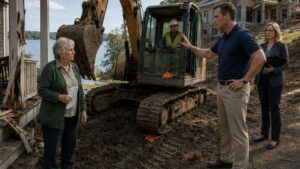
The first rail post came out of the ramp with a sharp wooden crack before Richard Hall even reached the porch.
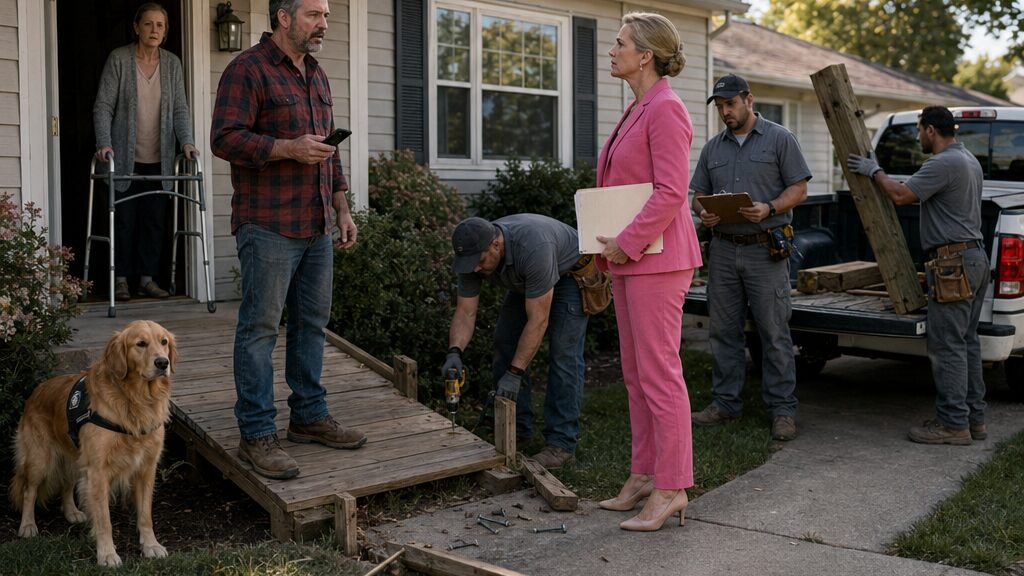
A worker in a gray shirt had one boot planted on the lower plank and both hands around a power driver. Two screws spun loose and dropped into the grass. Another worker caught the loosened post under one arm and carried it toward a white truck idling at the curb.
Richard froze in the open doorway.
At the bottom of the steps, his golden retriever, Baker, stood stiff as a statue, eyes moving from the workers to Richard, then back to the space where the ramp rail had been. The dog knew the morning routine better than most people did. Ramp clear. Door open. Sarah steady at the top. Baker waiting on the first landing until she had both hands where she needed them.
But there was no first landing anymore. Not whole.
“Stop,” Richard said.
The worker with the drill looked over his shoulder, then toward the curb.
That was when Richard saw Michelle Rivera.
She stepped out from behind the truck in a bright pink suit, a folder tucked against her ribs, sunglasses pushed up into her blonde hair like she had arrived for a luncheon instead of a demolition. Beside her, a crew supervisor held a clipboard and would not meet Richard’s eyes.
“Mr. Hall,” Michelle said, crisp and formal. “This is an HOA enforcement action. Please remain clear of the work area.”
Richard came down the porch steps slowly, one hand held low for Baker to stay. The dog obeyed, though his ears stayed forward.
“You’re removing my ramp.”
“We are removing an unapproved exterior modification.”
“It’s a medical accommodation.”
Michelle opened the folder as if the right paper could change the shape of what was happening in front of them. “Your request was incomplete, and construction began before approval. You were notified.”
Richard looked at the ramp. The workers had already loosened a second post. Orange cones marked a crooked line along the walkway. A length of rail lay in the grass with fresh scrape marks where it had hit the stone border Sarah liked because she could see the pale rocks from the front window.
“Notified when?”
Michelle removed a white notice from the folder and held it out.
Richard did not take it.
The crew supervisor cleared his throat. “Sir, we need to keep moving.”
“No,” Richard said, and stepped between him and the ramp.
The drill went quiet.
For one breath, the whole street seemed to hold itself still. Across the way, a neighbor stood half-hidden behind a porch column, phone raised at chest height. Richard saw the tiny black lens aimed at him, at Michelle, at the rail lying in the grass.
Michelle’s smile tightened. “Mr. Hall, refusing access will only increase your fines.”
Richard reached into his shirt pocket and pulled out his phone. His thumb shook once before he pressed record. He hated the shaking more than he hated the phone. He had spent most of his life fixing things without making a show of it. Pipes, cabinets, porch lights, Sarah’s walker when the front wheel stuck. You did the thing that needed doing, then shut the toolbox.
Now a woman in a pink suit was making him narrate his own front yard.
“Say that again,” he said.
Michelle’s eyes narrowed. “Excuse me?”
“For the record. You’re removing a medical access ramp before I’ve been handed the notice.”
“I am handing you the notice now.”
“The crew started before that.”
Michelle glanced at the workers. The supervisor shifted his weight.
“The board authorized removal,” Michelle said. “You received multiple opportunities to comply.”
Richard took one step closer, keeping his voice level. “What time did you authorize this crew to start?”
“That is not relevant.”
“It is to me.”
“Mr. Hall, the HOA has a duty to maintain community standards and prevent unsafe, non-compliant structures.”
Behind Richard, Baker whined once, low and uncertain.
Richard turned his phone slightly so the missing rail, the screws in the grass, and the notice in Michelle’s hand all fit in the frame. “This ramp is not decoration. My wife uses it to leave the house.”
Michelle’s face changed, not with sympathy, but with irritation at a fact arriving out of order. “Your application did not include sufficient documentation to justify emergency construction.”
“It included a medical note.”
“It included a note requesting accommodation review. That is not approval.”
Richard knew she had him there, and the truth burned because it was not the whole truth. He had submitted the papers. He had called. He had waited. Then Sarah had stood at the door three mornings in a row, looking at the two steps like they were a river, and he had called Tyler Davis.
Still, he had started before the final signature came.
Michelle knew it. She had built her whole morning on it.
“Give me the order in writing,” Richard said.
Michelle pushed the notice toward him again. “This is the order.”
“No. A court order. A stop-work order from the city. Something that gives you the right to come onto my property and tear out what I paid for.”
The crew supervisor finally looked at him. “We were contracted by the association.”
“That’s not the same thing.”
Michelle lowered the notice a fraction. “You agreed to the covenants when you purchased in this community.”
“I agreed to mow my lawn and not paint my house purple. I didn’t agree to trap my wife inside because your committee missed a meeting.”
A flicker crossed Michelle’s face. For the first time, the polish slipped. Not much. Enough.
Then she turned to the supervisor. “Proceed with removal of the non-compliant rail and lower platform. If Mr. Hall obstructs, document it.”
The worker bent toward the ramp again.
Richard stepped onto the lower platform and planted both boots on the boards. The wood flexed under his weight. It had been built for Sarah’s chair and walker, for careful turns and slow mornings, not for a standoff.
The drill stayed silent.
“Mr. Hall,” Michelle said, “you are escalating this.”
“No,” Richard said. “You brought a crew to my house before breakfast.”
The supervisor’s jaw worked. “Sir, if we can’t finish, the association may bill you for the return visit.”
Richard let the phone record his face then the truck then the rail post already loaded in the bed. “Say that too.”
The supervisor looked at Michelle.
Michelle said nothing.
Richard looked down at the screws scattered in the grass. One had rolled near Baker’s front paw. Baker did not move. He had been trained not to chase dropped things, not to crowd Sarah’s feet, not to pull when she leaned too hard on the leash. He had been trained to understand the difference between patience and danger.
Richard bent, picked up the screw, and held it in his palm. It was still warm from the drill.
Michelle took a breath through her nose. “This could have been avoided if you had waited for approval.”
Richard closed his fist around the screw. “Sarah waited long enough.”
From inside the house came a muffled sound. A chair leg dragging. Then Sarah’s voice, thinner through the door but clear enough to cut through the engine noise.
“Richard?”
He turned.
The front door was still open behind him. Sarah could not see the missing lower rail from where she was. She could only see Baker waiting at the bottom, the dog’s body angled toward her and not moving.
“Why can’t Baker bring me to the door?” she called.
Richard lowered the phone, and for the first time that morning, he had no answer ready.
Chapter 2: The Pink Notice On The Door
Two weeks earlier, Michelle Rivera took a photograph of Richard’s porch before she said good morning.
Richard saw her through the narrow front window: pink suit, white folder, phone raised toward the half-finished ramp like she was collecting evidence at a scene. Baker stood beside Richard’s knee, tail still, watching the woman on the walkway.
The ramp was only framed then. Tyler had set the posts and lower decking, leaving the rail wrapped in brown paper along the side of the house. It did not look pretty yet. Richard knew that. It looked like a thing in progress, all pressure-treated boards and chalk marks, with the old steps still visible underneath where Sarah used to pause and pretend she was only admiring the yard.
Michelle lowered her phone when Richard opened the door.
“Mr. Hall,” she said. “We need to discuss this structure.”
“It’s a ramp.”
“It is an exterior modification.”
“It’s a ramp,” Richard repeated.
Her smile stayed in place, but her eyes moved past him, into the house. Richard shifted half a step, blocking the view without meaning to. Or maybe he meant to. He had been doing that more and more lately.
Michelle held out the folder. “You are in violation of section seven point four of the community architectural standards. No exterior alteration may begin without written approval.”
“I filed the request.”
“You filed a request for review.”
“With a doctor’s note.”
“The file is incomplete.”
Richard stared at her. “Incomplete how?”
“You did not include final dimensions, finish color, contractor insurance, and board approval for variance from standard entry appearance.”
“Tyler sent the insurance.”
“I don’t have that in the file.”
“Then someone lost it.”
Michelle’s smile vanished. “Mr. Hall, accusing the association staff of mishandling documents will not help your case.”
Richard almost laughed, but there was no humor in him. Behind him, Sarah’s chair creaked in the living room. A small sound. Michelle’s eyes caught it.
Richard stepped onto the porch and pulled the door partly closed behind him.
“I’m not trying to make a case,” he said. “I’m trying to get my wife out of the house safely.”
Michelle glanced at the ramp frame. “And the board is not unsympathetic. But there is a process.”
“There’s been a process for four weeks.”
“The next architectural review is scheduled.”
“When?”
Michelle looked down at her folder. “Soon.”
“That isn’t a date.”
“It is the answer available to you right now.”
She handed him a notice. The top line read Preliminary Violation Warning. Beneath it was a paragraph about unauthorized construction, potential fines, and required removal if the structure remained non-compliant.
Richard read it twice, not because he failed to understand the words, but because he could not make them connect to the boards under his feet.
“Daily fines?” he asked.
“If work continues.”
“Work has to continue. Half a ramp is worse than no ramp.”
“Then you should have waited for approval.”
Baker pressed his nose against Richard’s hand. Richard realized he had crumpled the edge of the notice.
He had tried waiting. He had mailed the application. Then he had driven a copy to the HOA office because Sarah said mail could get lost. At the office, the clerk had pointed him to Kimberly Nelson, the board secretary, who had taken the folder with both hands like it weighed more than paper.
Kimberly had checked the list on the front. Medical note. Site sketch. Contractor estimate. Photos of the entry. Request for accommodation review.
“I’ll log it today,” she had said.
Richard remembered the way she paused before stamping the receipt. Not long enough to matter at the time. Long enough to matter later.
After Michelle left his porch, he drove to the HOA office with the warning notice on the passenger seat and Baker in the back. The office sat beside the clubhouse, all clean glass and seasonal wreaths, with a sign reminding residents that community standards protected community value.
Kimberly was behind the desk, sorting envelopes.
When she saw Richard, her expression tightened. “Mr. Hall.”
“I need a copy of my file.”
She looked toward the closed office door behind her. “Michelle is in a call.”
“I didn’t ask for Michelle.”
Kimberly lowered her voice. “Your packet isn’t showing as complete.”
“I gave it to you.”
“I know.”
The two words landed quietly.
Richard waited.
Kimberly opened a drawer and pulled out a thin folder. Too thin. She placed it on the counter and turned it so he could see without technically handing it over. The medical note was there. The sketch was there. The photos were there. The contractor insurance was not.
“I watched you put everything in,” Richard said.
“I logged what I was given.”
“That’s not the same answer.”
Her cheeks colored. “It’s the answer I can give you.”
A door opened behind her. Michelle appeared with a phone in her hand. Her suit was a different pink that day, softer, almost coral, but the effect was the same: bright authority in a room of beige forms.
“Mr. Hall,” she said. “The office is not the place for confrontation.”
Richard held up the warning notice. “You said my file was incomplete.”
“It is.”
“I have my receipt.”
Michelle’s gaze flickered to Kimberly.
Richard pulled the folded receipt from his pocket. The stamp was faint but readable: Received. Architectural Review Packet. Kimberly Nelson’s initials sat in the corner, small and careful.
Michelle took it without asking and studied it.
“This proves delivery of a packet,” she said. “Not completeness.”
Richard felt something in him harden. Not rage. Something worse because it was calmer.
“Then put in writing exactly what you say is missing.”
“We already have.”
“No. Put in writing what was missing on the day Kimberly stamped this.”
Kimberly looked down.
Michelle handed the receipt back. “Your tone is not helpful.”
“My wife’s not getting down those steps because my tone is helpful.”
For a second, Michelle’s face showed something almost human—annoyance tangled with worry. Then she closed the folder.
“Continuing construction after this warning will result in a fine of one hundred dollars per day. If the structure remains, the board may pursue removal and costs.”
Richard folded the receipt carefully and put it back in his pocket.
That evening, Sarah sat near the window while he measured the porch opening again, though he already knew every inch. Her hands rested on a blanket over her knees. She did not ask what Michelle had said until Baker settled beside her chair.
“Bad?” she asked.
“Paperwork bad.”
“That sounds like the kind of bad that grows teeth.”
He tried to smile. “Tyler can finish the lower platform in a day. Rail after that.”
“Richard.”
He looked at her.
“I don’t want them knowing everything.”
“I know.”
“I mean it.”
“So do I.”
She turned her face toward the window, where the unfinished ramp cut across the yard in raw lumber lines. “I don’t want to become a discussion item.”
Richard sat on the arm of the couch. “You’re not.”
“I heard her voice.”
He said nothing.
Sarah reached for Baker’s head and rubbed the soft place between his ears. “You promised.”
“I promised I wouldn’t make you neighborhood gossip.”
“And?”
“And I won’t.”
The next morning, Tyler Davis called before seven. Richard was in the garage, checking the rail brackets.
“Richard,” Tyler said, voice low and unhappy, “I just got a call from the HOA.”
Richard set down the bracket. “Michelle?”
“She didn’t give her name at first. Then she did. Said if I keep working, they can report the job as non-compliant and notify my insurer.”
Richard looked toward the half-built ramp through the open garage door.
Tyler exhaled. “I’m sorry, man. I need to know who has authority here.”
Richard picked up the receipt from the workbench and stared at Kimberly’s initials.
“So do I,” he said.
Chapter 3: A Dog Waited Beside Empty Steps
Baker pawed once at the closed front door and then looked back at Richard as if the house had forgotten its own rules.
The ramp was gone from the lower platform down. What remained was a raw rectangle of boards near the porch, a few upright posts, and empty holes where the rail had been fastened. The crew had taken the lower section before Richard could stop all of it. They had left behind sawdust, flattened grass, and two silver screws Richard had missed until Baker sniffed them out.
Inside, Sarah waited in the living room with her hands folded too neatly in her lap.
“Not today,” Richard told the dog.
Baker did not move.
“He thinks I’m still going,” Sarah said from behind him.
Richard turned. She had dressed anyway: blue cardigan, gray shoes, the scarf she wore when she wanted the world to know she had made an effort. The sight of those shoes hurt him more than the missing boards.
“I can help you down,” he said.
She looked at the doorway. The old steps had been uncovered when the ramp section came off, but Tyler had removed one side rail to make room for the new build. There was nothing steady enough to hold except Richard.
“And if I slip?”
“I won’t let you.”
“That’s not the same as safe.”
He heard his own words from the yard come back at him. Medical accommodation. Not decoration. Not convenience. Not a fight over lumber.
Sarah watched his face. “Did they take pictures?”
“The neighbor did.”
“Of course.”
“Not of you.”
“That’s something.”
He crossed to the coffee table, where the violation notice lay beside the warm screw he had taken from the grass. Michelle’s signature sat at the bottom in clean blue ink. The notice claimed previous warnings had been ignored. It said the association had authority to remove unsafe, unapproved structures after notice. It did not say the crew had started before the notice touched his hand.
Richard had watched the video four times already. Each time, he felt the same cold twist when Michelle said, I am handing you the notice now, with the ramp post already in the truck behind her.
Sarah reached for the paper.
He moved it without thinking.
Her hand stopped in midair.
“I’m not glass,” she said.
“I know.”
“No, you don’t. You know how to lift me. You know how to bring my pills. You know which rug edge catches my shoe. But sometimes you forget I can read a notice.”
Richard looked at the paper between them, then placed it in her hand.
She read slowly. Her mouth tightened at the phrase unauthorized alteration.
“They make it sound like we built a balcony for parties.”
“I’m going to fight it.”
“With what?”
“Receipts. The video. The application packet.”
“And the medical letter?”
He did not answer quickly enough.
Sarah folded the notice along its existing crease. “Richard.”
“You asked me not to make it public.”
“I asked you not to tell everyone every detail.”
“That line moves depending on who’s looking.”
“Yes,” she said. “It does. And now I’m looking at the door I can’t use.”
He sat across from her, elbows on his knees. Baker finally left the entry and came to rest beside Sarah’s chair, chin on her shoe.
“I thought I was protecting you,” Richard said.
“I know.” Her voice softened, which somehow made it worse. “But you were also protecting yourself from having to say it out loud.”
He looked toward the porch. The empty bolt holes made a dotted line in the wood.
Later that afternoon, Richard went through every paper again. The original application. The copy he had kept. The receipt Kimberly stamped. Tyler’s estimate. Tyler’s insurance certificate, printed from the email and clipped to the back. Photos of the old steps, the narrow turn, Sarah’s walker angled awkwardly at the threshold.
He built piles on the kitchen table: Sent. Received. Denied. Fined. Removed.
The denial letter should have belonged in Denied, but something about it bothered him. He had read it as an insult the first time. Now he read it like a measurement.
Dear Mr. Hall, the board has reviewed your exterior modification request and determined that the proposed structure does not meet architectural standards…
The date at the top was two days before Tyler dropped off lumber.
Richard checked Tyler’s invoice. Materials delivered on the ninth. Denial dated the seventh. But Michelle had told him the file was incomplete after that. If it was incomplete, what had the board reviewed on the seventh?
He picked up his phone and called the HOA office.
No one answered.
He left no message.
Instead, he drove to the clubhouse and found the door locked though the posted hours said open until four. Through the glass he could see the front desk empty, a stack of envelopes near Kimberly’s computer, and a pink folder lying on top of the incoming mail tray.
On the drive home, his phone buzzed.
Tyler.
“I got a certified letter,” Tyler said. “They’re naming me in it too. Says I participated in unauthorized work after notice.”
“They sent you notice before me?”
“They say they did.”
“When?”
“Letter says the seventh.”
Richard gripped the steering wheel. “You hadn’t delivered materials until the ninth.”
“I know.”
“Keep the envelope.”
“Already did.”
When Richard got home, Sarah was in the bedroom, sitting near the dresser where she kept old photographs in a cedar box. The medical letter lay beside her on the quilt.
“I called the clinic,” she said.
Richard stopped in the doorway.
“I asked them for a clearer letter. Not the gentle version.”
“Sarah.”
“No. You were right to keep one promise. But I was wrong about what it was costing.”
He entered slowly. “You weren’t wrong to want privacy.”
“I was wrong to think privacy meant pretending the steps were still just steps.”
The letter on the quilt had the clinic’s header. It described fall risk, mobility limitation, safe ingress and egress. It used words Sarah hated because they turned lived moments into categories. Necessary. Medically indicated. Accommodation.
She touched the page with two fingers.
“I would rather be talked about than trapped,” she said.
Richard sat beside her. For a while neither of them moved.
The summons arrived the next morning in a stiff white envelope delivered by a man who would not step past the walkway. Richard signed for it with Baker at his side and Sarah watching from the living room.
The document was heavier than the violation notice. It listed unpaid fines, removal costs, administrative fees, attorney review, and unauthorized exterior alteration. The HOA was asking the local court to affirm enforcement and allow recovery of costs.
Richard read the first page standing at the kitchen counter. Then the second. Then the third.
Michelle Rivera’s name appeared near the bottom under the association’s certification.
President: Michelle Rivera.
Acting Treasurer: Michelle Rivera.
Richard stared at the second title longer than the first.
Sarah rolled her chair to the doorway. “What is it?”
He turned the page so she could see.
“She’s the treasurer too?” Sarah asked.
Richard looked at the stacks on the table, at the denial letter dated before the materials, at the receipt Kimberly had stamped and then seemed afraid to discuss.
“I don’t know why that matters yet,” he said.
But he took the summons, placed it in a new pile by itself, and wrote one word on a sticky note.
Treasurer.
Chapter 4: The Board Made Safety Sound Cosmetic
Michelle Rivera opened the meeting with a photograph of Richard’s broken ramp projected across the clubhouse wall.
The image was larger than it had any right to be. Every screw hole looked like damage. Every raw board looked careless. The missing rail post, taken by the crew and loaded into a truck, left a dark rectangular scar where it had been fastened. From the back row, Richard could see the corner of Baker’s body in the photograph, just a blur of golden fur near the porch.
Michelle stood beside the screen in her pink suit, holding a remote.
“This,” she said, “is what happens when residents decide the rules do not apply to them.”
A few people shifted in their folding chairs. Someone whispered. Richard kept both hands on the folder in his lap and did not look toward Sarah, because Sarah was not there. He had asked if she wanted to come. She had looked at the ramp remnants, then at the narrow doorway, and said, “Not if you have to carry me in front of them.”
So he had come alone.
Baker lay under his chair, chin on his paws, vest straps smooth across his back. The clubhouse smelled faintly of coffee and floor polish. A banner over the side table read Community Standards, Community Strength. Richard stared at the words until they stopped meaning anything.
Michelle clicked to the next slide. A cropped photo of the lower platform appeared, then a close-up of the unfinished post bases.
“The structure was begun without final architectural approval,” she continued. “It does not match approved entry standards. The rail dimensions are not on file. The material finish is not on file. The slope variance, if one was intended, was not approved.”
Richard raised his hand.
Michelle did not acknowledge him.
A board member coughed. Kimberly Nelson sat near the front table with the meeting minutes open before her, a pen held too tightly between her fingers. Her eyes flicked to Richard and away again.
Michelle said, “We all understand that residents sometimes face personal situations. But individual circumstances cannot override the covenants that protect all homeowners.”
Richard stood.
Now she had to look at him.
“Mrs. Rivera,” he said, “that ramp was for safe access.”
“We will have a resident comment period.”
“You put my porch on the wall before letting me speak.”
“Please sit down until recognized.”
Richard felt the room turning toward him. Not loudly. That was worse. People wanted a show but did not want to admit they wanted one.
He stayed standing.
“My wife cannot safely use those steps.”
Michelle’s expression sharpened. “Mr. Hall, I would caution you against making unsupported medical claims in a public meeting.”
He opened the folder and removed a copy of the medical letter. Sarah’s name sat there in black ink. His thumb covered part of it before he realized what he was doing.
Not a discussion item, she had said.
He lowered the page.
“Then don’t discuss her,” he said. “Discuss the application I submitted.”
Michelle turned to Kimberly. “Please note that Mr. Hall is interrupting proceedings.”
Kimberly wrote something, but Richard saw her pen pause before it touched the page.
A man in the second row said, “Was it approved or not?”
Michelle seized the question like a rope. “No. The application was incomplete, and work continued after warning. This is not a matter of emotion. This is a matter of process.”
Richard heard the word process and thought of Baker waiting at the bottom of steps Sarah could not descend. He forced himself to sit before anger made him careless.
Michelle clicked again. The next slide showed the removal crew’s invoice.
Administrative enforcement: $850. Labor and removal: $1,275. Return inspection pending.
Murmurs rose. That number changed the air. It made the conflict less like a neighbor’s inconvenience and more like a bill everyone might one day be asked to share.
Michelle faced the room. “The association cannot absorb avoidable enforcement costs caused by one homeowner’s refusal to comply.”
Richard stood again, slower this time.
“My wife’s safe exit from her own home is not an avoidable cost.”
The room went quiet.
Michelle’s lips parted, but before she could speak, Kimberly cleared her throat.
“Madam President,” Kimberly said softly, “for the record, the accommodation packet was received before the removal notice.”
Michelle turned her head a few degrees. “The incomplete packet was received.”
Kimberly looked down at her minutes. “Yes. I mean, the initial packet was stamped before the notice.”
Richard watched Michelle’s jaw tighten. There it was again, that small disturbance under the polish.
“What date?” Richard asked.
Michelle answered first. “Mr. Hall, you are not questioning staff.”
“What date did Kimberly stamp it?”
Kimberly’s pen hovered.
Michelle said, “The packet date is already in the file.”
“Then read it.”
A few heads turned toward Kimberly. The board secretary’s face had gone pale, but she did not look confused. She looked like someone who knew exactly where the loose board was and had been stepping around it for weeks.
“Kimberly,” Michelle said.
Kimberly swallowed. “The file copy available to me tonight shows the packet entered as pending review on the twelfth.”
Richard opened his folder. “My receipt says the fifth.”
Michelle lifted her chin. “A receipt for delivery is not proof of completeness.”
The sentence was so practiced that Richard wondered how many times she had said it to herself before saying it to him.
A woman in the back row asked, “Are there other pending accommodations?”
Michelle’s hand tightened around the remote. “That is not relevant to this enforcement matter.”
“It is if the process is backed up,” the woman said.
Kimberly’s eyes closed for a second.
Richard saw it. Michelle saw it too.
“Kimberly,” Michelle said, colder now, “please read the motion.”
Kimberly turned a page. “Motion to authorize continued recovery of removal costs, accrued daily fines, attorney review fees, and any necessary legal action to enforce architectural standards at the Hall property.”
The words made the ramp sound like a fence built out of spite.
Richard could have pulled out Sarah’s letter then. He could have read every line. He could have made the room see what Sarah did not want seen.
Instead, he took out the warm screw from his pocket and placed it on the table in front of him.
“This came out of the rail before I was handed the notice,” he said. “That is not process. That is deciding first and paperwork after.”
Michelle stared at the screw as if it were vulgar.
A board member asked, “Is there proof of that timing?”
Richard held up his phone. “Yes.”
Michelle’s gaze snapped toward the phone.
The room shifted again. Curiosity now. Unease. A neighbor near the aisle leaned forward.
Michelle recovered quickly. “Recordings taken during enforcement actions may be subject to review and may not reflect full context.”
“Then review it,” Richard said.
But the motion moved anyway. Two board members voted yes. One hesitated, then followed. Kimberly did not vote. She only wrote down what happened, line by line, her pen moving with visible reluctance.
“Motion carries,” Michelle said.
The words landed like another post being pulled loose.
People began standing before Richard had closed his folder. Chairs scraped. Someone avoided his eyes. Someone else gave him the tight, sympathetic look people offered when they wanted to feel kind without getting involved.
Richard bent to clip Baker’s leash.
“Mr. Hall.”
He turned.
Kimberly stood beside the side table, holding a stack of papers against her chest. Michelle was near the front, speaking to a board member with her back turned.
Kimberly moved close enough that Richard could smell coffee on the paper cups behind her.
“I can’t get involved,” she whispered.
“You already are.”
Her eyes flashed, not with anger, but fear. “No. I mean I can’t be seen getting involved.”
She slid one page from the middle of her stack and folded it once. Her fingers trembled.
Richard did not take it immediately.
“What is that?”
“Something I should have noticed sooner.”
“Kimberly—”
“Don’t say I gave you this.”
She pressed the folded page against his folder and stepped away before he could answer.
Richard looked down.
Through the paper, faint yellow highlighter showed like a warning under skin.
Chapter 5: The Highlighted Transfer Changed Everything
Richard spread the folders across the kitchen table until there was no room left for dinner.
Baker lay beside Sarah’s empty chair, his head turned toward the front window. The lower porch light caught the raw edges where the ramp had been cut back. In the reflection on the glass, Richard saw himself hunched over paper in the same red-and-black flannel he had worn the morning Michelle’s crew came, as if he had not changed clothes so much as been trapped in that hour.
Sarah watched from the living room doorway.
“That table looks like an office exploded,” she said.
“It might have.”
He unfolded Kimberly’s page carefully and smoothed it under the yellow lamp. It was a ledger printout, not the full account record. A column of dates. A column of descriptions. A column of amounts. Most lines were ordinary enough to be boring: landscaping deposit, pool gate repair, insurance premium adjustment.
One line was highlighted.
Reserve Correction Transfer — $35,000.
The account name at the top read Accessibility / Emergency Repair Reserve.
Richard sat back.
Sarah rolled closer, but not too close. She had learned the exact distance where she could see his face without forcing him to make room around the papers.
“What does that mean?”
“I don’t know yet.”
“But it means something.”
“It means somebody moved money.”
“From the account that sounds like it should cover things like ramps.”
He looked at the page again. The transfer date was three days before Michelle claimed his packet was incomplete.
Richard pulled the summons closer. Acting Treasurer: Michelle Rivera. He set it beside the ledger.
Sarah said nothing. That was how he knew she had seen it too.
He spent the next hour building a timeline. He used sticky notes because he did not trust himself to keep the dates straight. Application delivered on the fifth. Receipt stamped by Kimberly. Denial letter dated the seventh. Tyler’s materials delivered on the ninth. Michelle’s warning on the twelfth. Crew removal on the morning of the fifteenth. Court summons after that.
Then he added the transfer date.
The fourth.
He stared at the notes until the pattern became too clear and still not clear enough.
“If the money moved on the fourth,” Sarah said, “and you gave them the packet on the fifth…”
“They knew the reserve was short before they had to answer.”
“Maybe the transfer was allowed.”
“Maybe.”
Richard pulled the board minutes from the HOA website. He had printed them months earlier out of habit after a dispute over mailbox paint had turned into three meetings and a special assessment. He had always thought boards buried trouble in boring documents. He had never been so sorry to be right.
He checked the month before. No vote on reserve correction.
He checked the month of the transfer. No vote.
He checked the next meeting. No vote.
There was a line in the treasurer report: reserve balances adjusted for liability exposure review.
“That’s not the same thing,” he muttered.
Sarah looked over. “As what?”
“As a vote.”
His phone buzzed. Tyler.
Richard put it on speaker.
“I found the email,” Tyler said without greeting. “The one I sent with insurance. I copied the office address and the architectural review address.”
“When?”
“Same day you delivered the packet. Afternoon.”
“Can you forward it again?”
“Already did. Also, Richard… they sent my letter from a law office. It says you represented that approval had been granted.”
Richard closed his eyes.
“I told you approval was pending.”
“You told me they hadn’t objected.”
“That’s not the same.”
“No,” Tyler said, and there was no accusation in his voice, which made it harder. “It isn’t.”
Richard opened his eyes. “I’m sorry.”
A pause. “I get why you did it. But I need to protect my license.”
“I know.”
“They’re making it sound like I knowingly helped you break rules.”
“I’ll put in writing that you didn’t.”
“Do that tonight.”
When the call ended, Richard sat with his hand still near the phone.
Sarah said, “You didn’t lie to him.”
“I leaned.”
“What?”
“I said what made it easier for him to keep working.”
She looked at the window. “Because of me.”
“No.”
“Because of the steps.”
“Because I was tired of asking permission for gravity.”
That almost made her smile. Almost.
He wrote Tyler a statement before he touched the ledger again. He kept it plain: approval pending, no final written approval received, contractor not responsible for HOA submission status. He hated every sentence because each one was true and each one helped Michelle’s version if cut in half.
That was the problem. Michelle had enough truth to build a wall.
Near midnight, Richard found the old architectural review email thread. Tyler’s insurance attachment sat there, time-stamped, addressed correctly. He printed it and placed it in the Sent pile.
Then he compared the denial letter to the packet checklist. The denial claimed missing insurance. But the email proved insurance was sent before Michelle’s warning. The denial claimed missing dimensions. Tyler’s estimate had dimensions. The denial claimed no medical urgency. Sarah’s first letter had been careful, too careful, but it still said safe access was medically recommended.
Richard took Sarah’s new letter from the side table. It was blunt in a way the first one had not been. Fall risk. Limited mobility. Unsafe ingress and egress. Necessary ramp accommodation.
He set it beside the highlighted transfer.
The two pages did not belong together, and that was exactly why they mattered.
By morning, his folder had become six folders. Application. Contractor. HOA Notices. Removal. Medical. Treasurer.
At ten, a delivery driver brought a flat envelope from Michelle’s attorney. Richard signed for it standing in the doorway, Baker pressed against his leg.
The envelope contained a motion and a statement.
The HOA now alleged that documents provided by Richard Hall appeared inconsistent with the association file and may have been altered after the fact.
Sarah read it once, then again.
“They’re saying you forged things?”
“Not directly.”
“They’re saying it politely.”
Richard took the page from her before his hands could shake hard enough for her to see. “They’re saying my copies don’t match theirs.”
“But yours are real.”
“Real doesn’t mean easy.”
He looked at the table. At the folders. At the receipt. At Kimberly’s ledger page. At Tyler’s email. At Sarah’s letter.
The thing he had feared was not that Michelle would lie. It was that she would use the places where he had been private, impatient, and imprecise to make the truth look like a story he had improved later.
That evening, Sarah rolled to the table while he was labeling exhibits in pencil. She had the medical letter in her hand.
“Don’t tuck it in the back,” she said.
He looked up.
She placed the letter on top of the folder, above the transfer page, above the notice, above the screw sealed in a plastic bag.
“Use my name.”
Richard stared at the letter.
Sarah kept her hand on it. “Not because I want them knowing. Because I want the judge knowing what they removed.”
Chapter 6: The Courtroom Heard The Wrong Story First
Michelle Rivera pointed at Richard before the judge had finished arranging the papers on the bench.
“He chose defiance over process,” she said.
The words carried cleanly across the small courtroom. They sounded rehearsed, polished, almost reasonable. Michelle stood at the opposite table in her pink suit, one hand resting on a slim folder, the other extended toward Richard as if he were the evidence.
Richard sat with six folders stacked in front of him and Baker lying quietly at his feet. Sarah had stayed home. That decision had taken all morning and no time at all. The courthouse steps were manageable, but the narrow hallways, the waiting, the possibility of being stared at while strangers discussed her body like a zoning matter—Richard had not asked twice.
The judge looked over the top of her glasses. “Mrs. Rivera, you will have your chance to present. Let us begin with appearances.”
Michelle lowered her hand, but not her chin.
Richard gave his name when asked. His voice sounded rougher than he wanted. The court clerk noted it. Michelle’s attorney sat beside her, expression smooth.
The HOA presented first. That was how it felt to Richard, anyway: not testimony so much as a story already trimmed into shape. Michelle described community standards, architectural review procedures, incomplete submissions, resident obligations, liability exposure, and the danger of allowing unapproved structures to remain.
A photograph of the ramp appeared in the judge’s packet. Richard recognized it immediately. Same angle as the clubhouse slide. Same missing rail. Same corner of Baker’s golden body blurred near the porch.
Michelle’s attorney said, “The association is not opposed to reasonable accommodations. It is opposed to unilateral construction that creates risk for the community and undermines the rules every homeowner agreed to follow.”
The judge turned a page. “Mr. Hall, did you begin construction before receiving written approval?”
Richard felt the whole case narrow around that one question.
“Yes,” he said.
Michelle’s attorney looked satisfied.
Richard kept his hands flat on the table. “I submitted the request first. I waited. My wife could not safely use the front steps. I began before written approval because the request was unanswered and the need wasn’t waiting.”
“That is not how the process works,” Michelle said.
The judge raised one finger. Michelle stopped.
“Mr. Hall,” the judge said, “you understand the court must consider the governing documents.”
“Yes.”
“And you understood approval had not been granted.”
“Yes.”
The word cost him something. Not because it was untrue. Because Michelle’s side of the room seemed to grow taller when he said it.
He opened the Medical folder and placed Sarah’s letter on top. “I also understood my wife could not safely leave the house.”
The judge accepted the page from the clerk. She read in silence.
Michelle’s attorney shifted. “Your Honor, the association file did not contain that letter at the time of review.”
“This is the updated letter,” Richard said. “The first letter was in the packet.”
“An insufficient letter,” Michelle said.
The judge looked at her. “You are not testifying at this moment.”
Richard took out the first letter, then the receipt. “This was delivered with the application packet. Stamped on the fifth.”
Michelle’s attorney rose. “The association disputes the completeness of that packet. Mr. Hall’s personal copies do not match the file maintained by the association.”
The word personal made Richard’s copies sound like souvenirs.
The judge asked, “What specifically does the association contend was missing?”
Michelle’s attorney listed them: contractor insurance, final dimensions, finish details, proof of medical necessity sufficient for variance consideration.
Richard passed forward Tyler’s email with the insurance certificate and time stamp. Then the estimate with dimensions. Then photos of the steps. Each document felt too small against the machinery that had already torn the boards out.
The judge read without expression.
Then she asked, “When was the ramp removed?”
Michelle answered. “On the fifteenth, after notice and continued noncompliance.”
Richard opened the Removal folder. “Before notice was handed to me.”
Michelle’s attorney objected to the phrasing.
The judge asked, “Do you have evidence?”
Richard’s thumb found the video on his phone. The clerk connected it to a small screen. The courtroom filled with the sound of a drill, then Richard’s own voice, flatter and calmer than he remembered.
Say that again. You’re removing a medical access ramp before I’ve been handed the notice.
On the screen, Michelle held the notice. Behind her, the rail post was already in the truck.
I am handing you the notice now.
The judge leaned forward slightly.
The clip continued. Michelle’s voice came through clearly: The board authorized removal.
Richard stopped the video before Sarah’s voice called from inside. He had promised himself he would not play that part unless forced.
The judge turned to Michelle. “Was removal begun before Mr. Hall acknowledged receipt of the notice?”
Michelle did not look at her attorney. “The enforcement action had been authorized.”
“That is not what I asked.”
A silence passed.
“The crew may have begun staging work,” Michelle said.
Richard said, “They had removed the rail.”
The judge looked back at the still image on the screen. The post in the truck answered before Michelle could.
Michelle’s attorney stood. “Your Honor, even if the timing of physical removal is imperfect, the board had already authorized the enforcement action due to Mr. Hall’s ongoing violation.”
The judge tapped a pen once against the file. “When did the appeal period end?”
Michelle blinked. “Excuse me?”
“The notice references an appeal period. Was the structure removed before that period expired?”
The attorney checked his copy. Michelle’s hand moved toward his folder, then stopped.
Richard watched that small movement. It reminded him of Kimberly’s pen hovering over the minutes.
The attorney said, “The board considered the matter urgent due to safety concerns.”
“Safety concerns about the ramp?” the judge asked.
“Yes.”
Richard could not stop himself. “They made it less safe by taking half of it.”
The judge looked at him.
He closed his mouth.
After a moment, the judge asked Michelle, “Did the board have a licensed inspection stating the ramp posed an immediate hazard requiring removal before appeal?”
Michelle’s face stayed composed, but color rose along her neck. “The association has discretion under the covenants to address non-compliant exterior structures.”
“That is also not what I asked.”
The courtroom was very quiet now. Even Baker seemed to breathe more softly.
Michelle’s attorney tried to redirect. “The central issue remains Mr. Hall’s decision to construct without approval.”
Richard stood before he could talk himself out of it. “That part is true.”
The judge looked at him. “Mr. Hall.”
“I started before approval. I shouldn’t have had to, but I did. I’m not asking the court to pretend I waited for a letter I didn’t have.”
Michelle watched him as if she could not decide whether he had helped or hurt himself.
Richard placed Sarah’s letter beside the photo of the torn ramp. “I’m asking the court to look at why there was no answer, why the file changed dates, and why a medical ramp was removed before I could appeal.”
The judge sat back.
For the first time that morning, the case no longer felt like a simple line drawn through Richard’s mistake.
The judge turned to Michelle. “Mrs. Rivera, I want the board minutes authorizing removal, the architectural review record for Mr. Hall’s application, and any reserve account records connected to accessibility or emergency repairs for the relevant period.”
Michelle’s attorney stood sharply. “Your Honor, reserve accounts are outside the scope of this enforcement action.”
“Then you may explain that after lunch,” the judge said. “Bring the records.”
The gavel struck once, not hard, but enough to make Baker lift his head.
Michelle gathered her folder with hands that were almost steady.
Richard looked down at his own folders, at the one labeled Treasurer, and felt the morning tilt toward a question nobody in the room could now avoid.
Chapter 7: The Treasurer Line Nobody Wanted Read
Michelle returned from lunch with only one folder.
Richard noticed before she reached the table. She had left the courthouse with her attorney carrying a briefcase and two board binders. Now she came back with a slim blue folder pressed beneath her arm and her lips set in a line that made her look less polished than braced.
The judge noticed too.
“Mrs. Rivera,” she said, “where are the reserve account records?”
Michelle’s attorney stood. “Your Honor, the association has produced the records relevant to the enforcement decision. We maintain that financial reserves are outside the scope of this matter.”
The judge held out her hand. “I will decide relevance after I see them.”
The attorney placed the blue folder with the clerk. The clerk carried it to the bench.
Richard sat very still. Baker’s head rested on his boot, warm and steady. The dog had slept through most of lunch under a courthouse bench while Richard ate nothing and replayed the morning over and over. He had admitted the thing Michelle could use against him. He had given the court the worst clean fact about himself before she could dirty it.
Now Michelle had come back with less paper than the judge requested.
That felt like an answer before anyone spoke.
The judge opened the folder. She turned one page. Then another.
“These are meeting minutes,” she said.
“Yes, Your Honor,” Michelle’s attorney replied. “They show the board’s authorization to proceed with enforcement.”
“I asked for board minutes and reserve account records.”
“The association will require additional time to collect detailed financial documentation.”
Richard looked down at his Treasurer folder. Inside was Kimberly’s ledger page, folded once along the crease she had made at the clubhouse. The highlighted line seemed too bright through the paper.
The judge looked at the top page. “The minutes reflect authorization on the fourteenth.”
Michelle said, “Correct.”
Richard’s hand tightened on the folder.
The judge continued. “The notice handed to Mr. Hall was dated the fifteenth. The video indicates removal began before receipt of that notice. You are now saying authorization occurred on the fourteenth.”
Michelle nodded once. “Yes.”
Richard stood. “Your Honor, may I ask which version of the minutes that is?”
Michelle’s eyes cut to him.
The judge looked at him. “Explain.”
Richard opened his folder and removed the printed minutes from the HOA website. “The version posted online after the meeting did not include that authorization. I printed it before the court date.”
Michelle’s attorney stepped forward. “Online posting delays are not unusual for volunteer associations.”
Richard placed his copy on the clerk’s table. “This isn’t a delay. It’s different wording.”
The judge accepted the page. She compared the two documents, expression unreadable.
“Mrs. Rivera,” she said, “why does the court copy include a removal authorization not present in the homeowner’s printed copy?”
Michelle’s fingers pressed flat against the table. “The online document may have been a draft.”
The judge turned to Kimberly Nelson, who had been sitting in the back row since lunch, shoulders rounded, hands locked around her purse. “Ms. Nelson, you are the board secretary?”
Kimberly stood too quickly. “Yes, Your Honor.”
“Were the minutes edited after posting?”
Kimberly looked at Michelle.
Michelle did not move.
“Ms. Nelson,” the judge said, “look at me.”
Kimberly did. Her face had lost all color.
“Yes,” she said.
Michelle’s attorney closed his eyes for half a second.
The judge’s voice remained even. “When?”
“After Mr. Hall filed his appeal.”
Richard felt the courtroom shift. Not dramatically. No gasp. No sudden collapse. Just a small, practical rearrangement of attention. People who had been looking at him now looked at Michelle.
Michelle stood. “The minutes were corrected to reflect the board’s intent.”
Kimberly’s voice came out thin but clear. “There was no vote that night.”
Michelle turned. “Kimberly.”
The judge struck the gavel once. “Mrs. Rivera.”
Baker lifted his head.
Kimberly gripped the back of the bench in front of her. “There was discussion. Michelle said the ramp had to be addressed quickly because it was setting a bad precedent. But no vote was called. I didn’t enter one because there wasn’t one.”
Michelle’s face hardened. “You were responsible for accurate minutes.”
“I know.”
“Then you should have corrected them.”
Kimberly flinched as if the sentence had been a slap she had expected. “You told me to add the authorization after the appeal came in.”
The judge leaned back. For the first time all day, she said nothing for several seconds.
Richard looked at Michelle, and what he saw surprised him. Not innocence. Not remorse. Fear.
It sat behind her eyes, trapped there under the foundation and the hair and the hard pink line of her jacket. For one strange moment, Richard could almost see how she had explained each step to herself. A temporary edit. A necessary enforcement. A resident who had broken process. A board that needed to look decisive. A reserve account that could be fixed before anyone asked.
Then the judge said, “Now we will address the financial records.”
Michelle’s attorney objected again, but softer this time.
Richard stood with Kimberly’s ledger page in his hand. “Your Honor, I have one page given to me after the board meeting. I can’t verify the whole account. But it shows a transfer from the accessibility and emergency repair reserve.”
“Approach.”
He carried the page forward. His boots sounded too loud on the courtroom floor. The clerk took the page and handed it to the judge.
The yellow line lay beside Sarah’s medical letter in the court file now.
Reserve Correction Transfer — $35,000.
The judge read the account name, the date, the amount. “Mrs. Rivera, you are listed as acting treasurer?”
Michelle did not answer immediately.
“Yes,” she said.
“What is this transfer?”
Michelle’s attorney touched her arm, but she pulled away slightly. “A temporary correction.”
“For what purpose?”
“To address an insurance-related liability exposure in another part of the community.”
“Was it approved by board vote?”
Michelle’s mouth opened. Closed.
The judge asked again. “Was it approved?”
Michelle looked at Kimberly, then at Richard, then at the folder on the bench.
“It was meant to be ratified,” she said.
“That is not approval.”
“No.”
The word was small, and the room took it in.
Richard felt no triumph. Only a slow, heavy understanding. The ramp had not been denied because Michelle could not see Sarah. It had been denied because seeing Sarah would have required opening a fund that had already been emptied into another problem.
The judge turned a page in Richard’s packet. “Mr. Hall’s request was submitted the day after this transfer.”
Michelle’s attorney said, “There is no evidence the transfer caused the denial.”
“No,” Richard said. “But it explains the delay.”
The judge looked at him.
Richard’s voice steadied. “My wife’s request would have required review under the accommodation rules. Maybe contribution from that reserve. Maybe disclosure to the board. Instead, the file became incomplete. The denial was dated before the missing documents were even due. The removal was authorized after the fact. And the ramp came out before I could appeal.”
Michelle whispered, “The ramp was non-compliant.”
The judge heard her. “It may have been incomplete. It may have required modification. That is very different from treating it as disposable.”
Michelle’s face changed then. The anger drained, leaving behind exhaustion and something more complicated than guilt.
“I was trying to keep the association solvent,” she said.
Her attorney murmured her name.
She kept going, quieter. “The prior board left claims unresolved. Insurance premiums jumped. Residents were already furious about dues. If I announced a reserve shortage before the annual meeting, we would have had panic, accusations, people refusing to pay. I thought we could move money, cover the exposure, and replenish it after assessments stabilized.”
Richard watched Kimberly lower her head.
Michelle looked at him for the first time without the shield of procedure. “Then your request came in.”
“Sarah’s request,” Richard said.
Michelle swallowed. “Your wife’s request came in.”
The correction mattered. Not enough to forgive anything. Enough to make the room feel different.
The judge folded her hands. “Mrs. Rivera, financial mismanagement does not authorize backdated minutes, premature enforcement, or denial of a legitimate accommodation review.”
“I understand.”
“I am not sure you do.”
Silence.
The judge turned to Richard. “Mr. Hall, you began construction before written approval. That fact remains.”
“Yes.”
“You placed your contractor in a difficult position.”
“Yes.”
“You also documented the removal, preserved correspondence, and provided evidence that raises serious concerns about the association’s process.”
Richard said nothing. He could feel Sarah’s letter in the room though it was on the judge’s bench now, not in his hand.
The judge continued. “I find the association has not established lawful grounds for recovery of removal costs or enforcement fines based on this record. The violation is withdrawn pending proper accommodation review. The association will permit a safe temporary access solution immediately, and a permanent ramp may proceed subject only to reasonable safety specifications, not aesthetic delay.”
Michelle’s attorney began to speak.
The gavel struck once.
“Additionally,” the judge said, “the altered minutes and reserve transfer will be referred for appropriate civil review. That is separate from Mr. Hall’s accommodation, and it will not be used to further delay it.”
Richard looked down at Baker. The dog’s tail moved once against the floor.
It was almost over. It should have felt clean. It did not.
The judge looked directly at him. “Mr. Hall, this court can address fines, costs, access, and documentation. What are you asking this court to restore?”
Richard had thought about that question in a dozen angry shapes. Repayment. Apology. A letter sent to every resident. Michelle removed from office. The rail post returned from wherever the crew had dumped it.
But when he opened his mouth, he saw Sarah at the window, dressed to leave and unable to cross her own threshold.
He placed one hand on Baker’s head.
“The ramp,” he said. “And the record that says why it mattered.”
Chapter 8: The Boards Came Back With New Screws
Tyler set the first rebuilt rail exactly where the crew had torn the old one out.
The board slid into place with a low wooden knock, its end covering the dark mark left by the removed post. Tyler paused before driving the screw. He looked at Richard, not asking permission exactly, but giving him the moment.
Richard nodded.
The drill bit caught. The new screw went in clean.
At the bottom of the walkway, Baker sat with his leash looped loose around Richard’s wrist, watching every movement like an inspector with fur. Sarah waited inside by the open door. Not hidden. Not on display. Just waiting, one hand resting on the frame, the other on the handle of her walker.
The corrected approval had come three days after court. It was not warm. It was not apologetic. It listed slope, rail height, edge protection, surface treatment, and approved finish options. It also stated that the previous violation and all related fines had been withdrawn.
Richard had read that line twice. Then he had folded the letter and placed it in the front of the folder, not because it healed anything, but because it stopped one kind of bleeding.
Tyler worked faster this time. Not carelessly. Just without looking over his shoulder every few minutes for a pink suit at the curb.
“I brought extra brackets,” he said.
“You billing me for those?”
Tyler glanced at him. “No.”
Richard almost argued out of habit, then let it go.
On the porch, Sarah said, “If you two are going to perform a silent apology ritual, I can go back inside.”
Tyler laughed under his breath. Richard looked up and found her smiling. Not broadly. Enough.
By late morning, the temporary rail was fully set. The permanent finish would come later, after inspection. The ramp still looked new and raw against the house, but it no longer looked wounded. The lower platform connected to the walkway again. The empty screw holes were covered by sound wood. What had been removed had not vanished; it had become a seam.
A neighbor passed on the sidewalk and slowed, then seemed to think better of speaking. Richard appreciated that more than a casserole.
At noon, Kimberly Nelson’s email arrived.
Richard read it standing in the garage, away from Sarah and Tyler and the open door.
The message was brief. Michelle Rivera had resigned from the board effective immediately. An outside review of reserve accounts would begin the following week. All accommodation applications pending in the last six months would be rechecked under corrected procedures.
Kimberly did not apologize in the email. She did not ask him to forgive her. At the bottom she wrote only: I should have read the date out loud the first time.
Richard stared at that sentence for a while.
Then he printed the email and put it in the folder.
He was learning that documentation could be both shield and burden. A page could protect you. It could also remind you how many chances people had to do the right thing before the page became necessary.
That afternoon, a board notice appeared on the clubhouse door and on the community website. Richard saw it because a neighbor sent him a screenshot without comment. Michelle’s resignation was listed in plain language, as if she had stepped down after a long term of ordinary service.
No mention of the ramp. No mention of the altered minutes. No mention of the transfer.
Sarah read the notice on Richard’s phone and handed it back.
“They made it small,” she said.
“They were always good at making things sound smaller.”
She looked toward the ramp. “Not that.”
“No,” he said. “Not that.”
The finish options were laid out on the kitchen table after Tyler left: three approved stains printed on a sheet from the HOA. Cedar tone. Weathered gray. Natural sealant.
Richard expected Sarah to choose quickly. She had always had firm opinions about the house, even after the house became harder for her to move through. But she studied the page as if the choice deserved time.
“What do you think?” she asked.
“I think whatever you pick, I’ll put on.”
“That is not an opinion.”
“It’s a survival skill.”
She tapped the weathered gray sample. “This one looks like it belongs without pretending nothing happened.”
Richard looked at the muted square of color. “Then that one.”
She kept her finger there. “I want the rail smooth. Not glossy. Just smooth.”
“I’ll sand it myself.”
“I know you will.”
The next morning, another letter arrived. This one came from the association’s attorney. It confirmed the violation withdrawal, reimbursement review for improper removal charges, and the court’s order allowing the ramp to proceed. The final paragraph warned that future emergency work still required prompt written notice, complete documentation, and reasonable cooperation with association procedures.
Richard read that paragraph three times.
Sarah watched him over her coffee. “You hate that part.”
“I hate that they’re not entirely wrong.”
She lifted one eyebrow.
He folded the letter. “I should have put more in writing before Tyler started.”
“You should have.”
He looked at her.
She did not soften the words. She did not need to.
“And they should have answered,” she said. “Both things can be true.”
Richard sat with that. It was not comfortable. It was fair, which was sometimes worse.
By the end of the week, the ramp was ready enough for Sarah to try.
Not finished. Not perfect. Ready.
Tyler stood near the lower end with his hands in his pockets. Kimberly had offered to come by with the temporary compliance sticker, but Richard told her to leave it in the mailbox. He did not want witnesses who had come to watch redemption happen. He wanted boards, screws, a rail that held, and Sarah deciding when to move.
Baker waited at the bottom, tail brushing the walkway.
Sarah stood at the open door with her walker. For a moment, no one spoke. The air carried the clean smell of cut wood and fresh sealant. Richard stood to her left, close enough to catch, far enough not to crowd.
“You ready?” he asked.
“No.”
He nodded.
She looked at him. “Ask me again.”
He did.
This time she said, “Yes.”
The first step onto the ramp was small. Her hand closed around the rail. Richard saw her test it, not with distrust, but with the right everyone should have: to lean on what was built to hold them.
Baker rose but did not rush.
Sarah took another step. Then another. The walker wheels moved smoothly over the boards. At the midpoint, she stopped and looked toward the yard. Not at the porch. Not at the old steps. The yard.
“I forgot the mailbox looked crooked from here,” she said.
Richard laughed once, surprised by it.
She reached the lower platform. Baker came beside her, shoulder near her knee. Tyler looked away toward his truck, blinking hard.
At the sidewalk, Sarah turned carefully. Her eyes met Richard’s.
Not gratitude. Not pity. Not victory.
Presence.
She was outside because the way had been restored, and because both of them had finally allowed the truth to be large enough to protect her.
Later, when everyone had gone and Sarah was resting, Richard sat at the kitchen table with the folder open. The withdrawn violation notice lay on top. For one foolish second, he imagined framing it in the garage, proof that he had been right.
Instead, he folded it along the old crease and slid it behind Sarah’s medical letter, Tyler’s email, Kimberly’s ledger page, and the court order.
Then he closed the folder.
Outside, Baker’s leash hung by the door again, ready for morning.
The story has ended.