The Weather Poles Everyone Wanted Gone Became the Warning Their Street Needed
Chapter 1: The Poles That Ruined Heather’s Perfect Walk-Through
“What exactly do you think you’re doing with those things in your yard?”
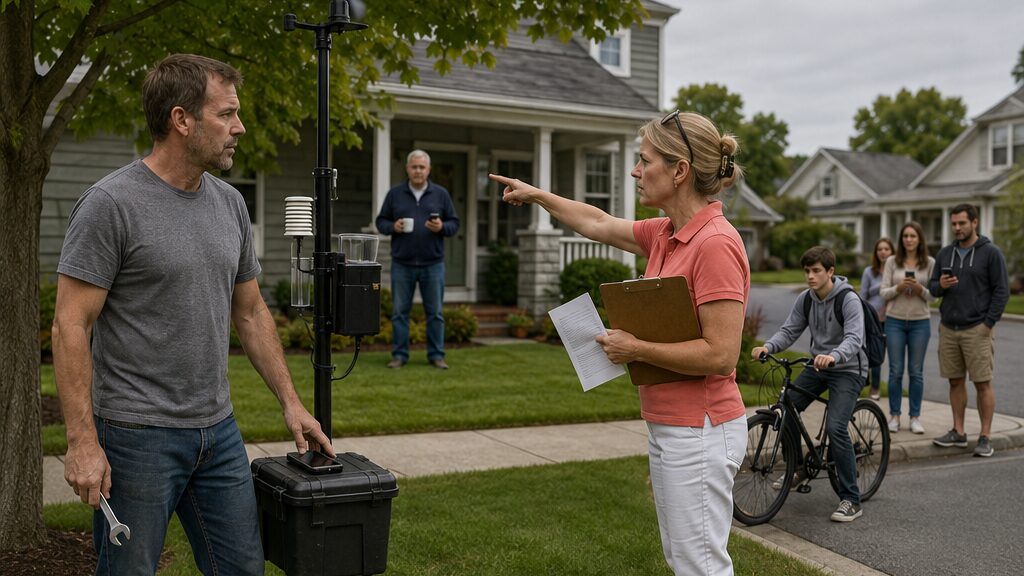
Heather Roberts stood at the edge of Edward Moore’s front lawn as if the grass itself had offended her. She wore a coral polo with the HOA logo stitched over the left side, white capri pants, and sunglasses pushed into her hair, though the morning was overcast. Her clipboard was tucked beneath one arm. With the other hand, she pointed toward the three black poles rising beside Edward’s maple tree.
The wind cups at the top of the tallest pole spun in a lazy circle. Beneath them, a small rain gauge caught the gray light. A narrow sensor box, bolted to a crossbar, blinked once.
Edward had been tightening a clamp near the base when the inspection group stopped in front of his house. He stood slowly, wiping his hands on the thighs of his jeans. Behind Heather, two board members lingered near the sidewalk, and a teen on a bike had stopped at the curb with one foot on the pavement.
“It’s a weather station,” Edward said.
Heather looked from him to the poles, then back to him. “I know what you call it. I’m asking why it’s in the front yard.”
“Because that’s where it gets the cleanest wind reading.”
“That is not an answer that helps you.”
Edward glanced up. The cups kept spinning. South-southwest, twelve miles an hour, gusting slightly. He knew without checking the dashboard in his garage. The front yard was ugly for weather, really. Too many rooflines, too much reflected heat from driveways. But it was still better than the backyard, where the privacy fence trapped the air and the neighbors’ oak branches turned every measurement into guesswork.
Heather took one step onto the lawn. “You installed three black utility poles in a community with exterior standards.”
“They’re not utility poles.”
“They look like junk poles.”
The teen on the bike shifted his weight. One of the board members pretended to study a hedge across the street. Edward felt the familiar pressure rise in his throat, the one that made explanation feel like pleading. He bent and picked up the wrench he had set beside the base mount.
“They’re mounted cleanly,” he said. “Nothing is loose. No wiring across the lawn.”
“That is not the issue.” Heather tapped her clipboard. “The issue is architectural harmony.”
Edward almost smiled. He did not.
Across the street, Thomas Green had come out onto his porch with a mug in his hand. He did not wave. He only watched, his shoulders set in the way of a man who had spent years reading danger before other people heard it.
Heather noticed him too. Her voice lifted a fraction. “This is exactly what people have been talking about, Edward. We have worked very hard to keep Willow Creek looking like a neighborhood people want to buy into.”
“It’s a neighborhood people live in,” Edward said.
Heather’s mouth tightened. “And people who live here agreed to the rules.”
Edward could feel the old habit take over: answer only the surface question, give nothing personal, leave no handle for anyone to grab. “I read the rules before I installed it.”
“Then you should have read section twelve.”
“Section twelve covers ornamental structures.”
Heather’s eyebrows rose. “So you’re calling this beautiful?”
A small laugh came from somewhere near the sidewalk. Edward did not turn to find out who.
The sensor box blinked again.
He looked at it too long, and Heather caught the glance. “Are you recording us?”
“No.”
“Because if you are, you need consent.”
“It records wind speed, rainfall, pressure, temperature, and local lightning distance.”
“And it broadcasts?”
Edward hesitated.
Heather saw it. “Edward.”
“It sends alerts,” he said.
“To whom?”
“To people who asked for them.”
“For what purpose?”
He let the wrench hang at his side. “Weather.”
The laugh came again, softer this time. Heather looked vindicated, as if Edward had confessed to something both absurd and dangerous.
“People have weather apps,” she said. “Nobody needs a homemade tower in somebody’s lawn to tell them it’s raining.”
Edward felt the words settle under his skin. Nobody needs that. Nobody needs you watching the sky. Nobody needs the warning after the warning comes too late.
He folded his fingers around the wrench until the metal pressed into his palm.
“It stays,” he said.
Heather stared at him. For the first time that morning, she looked less annoyed than surprised. “Excuse me?”
“I’m not removing it before the next system clears.”
“What system?”
“The one moving in midweek.”
She gave a small, controlled laugh. “This is not a negotiation with the clouds.”
Before Edward could answer, a phone chimed.
Not his.
The sound came from the sidewalk, sharp and familiar: three short pings, then a pause. The teen on the bike looked down at his screen. Thomas Green, across the street, looked down at his too. One of the board members reached into her pocket, then froze as if remembering whose side she was supposed to be on.
Heather noticed all of it.
Edward’s own phone, lying faceup on the toolbox near the pole, showed the same draft he had sent four minutes earlier.
Localized wind shift detected. Gusts increasing after 11:40. Secure loose bins before pickup route.
Heather stepped toward the toolbox before Edward moved between her and the phone.
“Is that from you?” she asked.
He did not answer quickly enough.
Thomas took one step off his porch, then stopped. His mug remained in his hand.
Heather’s face changed. It was not understanding. It was calculation. The station was no longer merely ugly; it was organized. It had users. It existed beneath the board’s sight.
“How many residents are you messaging?” she asked.
“It’s voluntary.”
“That was not my question.”
“Enough.”
Heather let out a breath through her nose. “Enough for what?”
Edward looked past her toward the curb. A recycling bin had already tipped at the end of the next driveway, its lid flapping against plastic. Small thing. Ordinary thing. The kind no one remembered when the day ended cleanly.
“Enough to be useful,” he said.
Heather turned to the board members. “Please note that Mr. Moore is operating an unapproved broadcast system from a nonconforming exterior installation.”
“It’s a text list,” Edward said.
“With equipment installed in plain view.”
“For weather alerts.”
“For unsanctioned communications.”
That brought his eyes back to hers. “You’re serious.”
“I am always serious about liability.”
The word landed differently from the others. Edward had expected appearance. Property values. Complaints. He had not expected liability, though he should have. Everything useful eventually became something someone could be blamed for.
Heather pulled a folded notice from the back of her clipboard. The paper was crisp, already prepared. She held it out.
Edward did not take it at first.
Her voice lowered, but not enough to keep the neighbors from hearing. “This is a courtesy warning from the Architectural Compliance Committee. You have seven days to remove the poles and restore the lawn to approved condition.”
The wind cups spun faster overhead. The soft clicking of the mechanism filled the pause between them.
Edward took the paper. He folded it once without reading it and slipped it into his back pocket.
Heather watched the gesture. “You may want to take this more seriously.”
“I do.”
“No, Edward. You don’t. You keep acting as if being quiet makes you reasonable.”
That one found him. He looked at her, and for a moment the street went narrow: Heather’s bright shirt, the clipboard, the blinking sensor, Thomas still across the way, the teen pretending not to watch.
“I’m not taking it down before the storm clears,” Edward said.
Heather’s smile was small and professional. “Then we’ll put it to a board vote.”
“Before the storm?”
“If you were concerned about timing, you should have submitted an application before building it.”
The board members began moving again, relieved to have the confrontation turned back into procedure. Heather stepped off his grass and returned to the sidewalk. The teen pushed his bike forward, slow enough to keep listening.
Thomas finally raised his mug, not quite a greeting, not quite support.
Edward stood alone beside the poles, the warning folded in his pocket like something hot. Above him, the cups turned steadily, measuring a wind that no one else believed mattered yet.
At the end of the sidewalk, Heather turned back.
“Seven days, Edward,” she said. “And the board meets before the next storm arrives.”
Chapter 2: The Private Alerts Nobody Wanted to Mention
The first fine notice was taped to Edward’s garage door before breakfast on Monday, sealed in a plastic sleeve as if it were evidence from a crime scene.
He found it when he went out to check the overnight rainfall total. The paper hung at eye level beneath the motion light, white against the gray door, the HOA letterhead crisp enough to look smug.
NOTICE OF CONTINUING VIOLATION.
Edward stood in the driveway with his coffee cooling in one hand.
The rain gauge had collected less than a tenth of an inch overnight. The grass still looked dry. The poles stood where they had stood on Saturday, black against the pale morning, clean and straight and, apparently, unforgivable.
He pulled the notice free and read only the first few lines.
Unapproved exterior installation. Nonconforming structure. Potential nuisance. Failure to submit application. Review pending. Fines may begin upon board confirmation.
He folded the notice and set it on the workbench inside the garage, beside his tablet. On the screen, the dashboard showed pressure falling in small, steady increments.
Not dramatic yet.
Enough to watch.
The garage smelled of plywood, machine oil, and the faint metallic heat of electronics. Edward had built most of the system there, not because he enjoyed tinkering but because commercial weather stations never cared about one street’s drainage dip or one cul-de-sac’s tendency to pool water before the county alert maps caught up.
He checked the connection logs. Twenty-three active subscribers. Three silent numbers that never replied but always opened the message. Two elderly households on the far side of the development. Thomas Green. Melissa Lewis.
He told himself he did not care who spoke up.
Then he looked again at the fine notice.
His phone buzzed.
Melissa: Did you see what they put on your garage?
Edward stared at the message. He could see her house from his driveway if he stepped to the edge: tan siding, a small porch, two scooters tipped against the rail. Her basement stairs sat lower than the street grade. Twice in the past year, water had come down the side path fast enough to reach the bottom landing.
He typed: Yes.
Three dots appeared. Vanished. Appeared again.
Melissa: I’m sorry. I would say something, but I can’t get into it with Heather right now.
Edward set the phone down without answering.
He spent the morning recalibrating the rain gauge, though it did not need recalibration. He cleaned the solar panel. Tightened the mount. Changed the backup battery in the receiver. When work emails came in, he answered them from the stool by the bench, moving between code reviews and wind data with the same blank efficiency.
At noon, a car slowed in front of his house.
Edward looked up. Heather drove by in a white SUV, her face forward, both hands on the wheel. She did not stop, but her eyes flicked toward the poles.
The shame came late, which made it worse. Not when she confronted him. Not when the neighbor laughed. But now, alone in the garage, with a paper on his bench and a woman driving past to confirm he had been properly marked.
He opened the private alert group and hovered over the option to pause notifications.
Just for the week, he told himself. Let the county handle it. Let everyone use their apps. Let the neighborhood have the clean silence it wanted.
A message appeared from Thomas.
Thomas: You seeing that pressure drop?
Edward closed the group settings.
Yes, he typed. Watching it.
Thomas: Feels early.
Edward: It is.
The answer sat there between them. Thomas had been a firefighter long enough to know when a man was saying less than he meant.
Thomas: Board giving you trouble?
Edward looked at the fine notice. Then at the poles through the open garage door.
Edward: It’s being handled.
Thomas did not reply.
Late afternoon brought Melissa to his driveway in person. She came without her children, wearing work slacks and a cardigan, her hair pulled back like she had left a meeting in a hurry. She stopped just outside the garage, not crossing the threshold.
“I only have a minute,” she said.
Edward nodded. “Okay.”
She glanced at the poles, then at the notice on the bench. “Heather told people you’re running some kind of unauthorized neighborhood warning service.”
“It’s a text list.”
“I know.”
“You asked to be on it.”
“I know that too.”
Her face tightened. She looked toward the street before lowering her voice. “Last spring, when the storm drain backed up, I got your alert before the water came over the curb. I had ten minutes. That was enough to get the boxes off the basement floor and move my car.”
Edward looked at the tablet instead of at her.
“I remember,” he said.
“My insurance deductible is high,” she added, and then gave a small, embarrassed laugh that was not laughter. “Everything is high.”
“You don’t have to explain.”
“I do, actually.” She rubbed her thumb across the strap of her purse. “Because I should say something at the board meeting.”
Edward waited.
“But I can’t be the person Heather decides is making this difficult. My kids ride bikes here. I need the pool passes approved this summer. I know that sounds stupid.”
“It doesn’t.”
“It does.” She looked at him then. “I’m sorry.”
The words were clean. Honest. Not enough.
Edward picked up the fine notice and placed it facedown. “You don’t owe me anything.”
Melissa looked relieved for half a second, then worse. “That’s not true.”
He wished she had not said it. He wished everyone who used his alerts would either stand beside him openly or pretend they had never heard of them. The private gratitude was harder to carry than the public complaint.
Her phone chimed. She looked at it, flinched, then turned the screen slightly away.
Edward recognized the sound anyway. One of his own automated reminders.
Wind advisory possible Wednesday evening. Monitor outdoor items and drainage areas.
Melissa gave him a helpless look. “See? This is why I came. I just wanted you to know it matters.”
He nodded once.
“But please don’t tell Heather I said that.”
There it was.
Edward felt his jaw tighten. “I won’t.”
After she left, the garage felt smaller. He opened the alert list again and stared at the names, numbers, initials, and saved labels. Some residents replied with thanks. Some never replied at all. Some nodded from their driveways as if the warnings were a neighborly courtesy, like borrowing a ladder.
None of them had stood on the sidewalk Saturday.
At five-thirty, another email arrived from the HOA. Benjamin Johnson’s name appeared beneath the subject line.
Architectural Compliance Matter — Weather Apparatus.
Edward opened it.
The message was polite, formal, and worse than Heather’s notice. The board would meet Wednesday evening. If the installation remained noncompliant after the vote, fines would accrue daily. If unresolved after seventy-two hours, the association could authorize removal and charge the owner’s account.
Owner’s account.
Not Edward. Not neighbor. Not resident.
Owner.
He looked out at the poles. The wind cups had slowed, then shifted direction, turning fitfully as the trees along the entrance road stirred.
The dashboard refreshed.
A new model track loaded in the corner of the screen, its colored band sliding farther east than it had that morning. Edward clicked it open, enlarged the county map, and sat very still.
The storm line was no longer passing north of them.
It was bending toward Willow Creek.
Chapter 3: A Rule Written for Garden Statues Meets a Weather Station
Edward’s weather station filled the clubhouse projector screen like a criminal suspect caught on a doorbell camera.
The photo had been taken from across the street, slightly crooked, zoomed just enough to make the poles look taller than they were. The maple tree behind them was cropped out. The clean wiring was invisible. The rain gauge looked like a black cup nailed to the sky.
Across the top of the slide, in Benjamin Johnson’s careful formatting, were the words: NONCONFORMING EXTERIOR STRUCTURE.
Edward sat in the second row with the folded fine notice in his shirt pocket. He had almost worn a button-down, then decided that pretending this was a professional meeting would only make him angrier. He wore the same gray T-shirt he had worn when tightening the clamp Saturday, clean now but still plain.
Heather sat at the board table beneath the screen, one hand resting beside a binder tabbed with colored notes. Benjamin sat two chairs away, glasses low on his nose, flipping through the bylaws. Three other board members faced the room with the tired expressions of people who had expected a quick agenda and found themselves in a neighborhood trial.
There were more residents than usual. Not many. Enough.
Thomas Green stood at the back wall with his arms folded. Melissa Lewis sat near the aisle, her purse in her lap, looking at the floor.
Benjamin cleared his throat. “Item four concerns the exterior installation at lot twenty-eight, owned by Edward Moore. The question before the board is whether the equipment violates Article Twelve regarding visible structures, attachments, and ornamental or non-ornamental yard fixtures.”
“It’s not ornamental,” Edward said.
Benjamin looked over his glasses. “You’ll have a chance to speak.”
Heather leaned toward her microphone, though the room was small enough not to need one. “The committee’s concern is not only visual. I want that clear from the beginning.”
That surprised Edward. He had expected her to repeat “junk poles” with better vocabulary.
Heather clicked to the next slide. A copy of the bylaw appeared, yellow highlights across several lines.
“No owner may place, construct, mount, or maintain visible structures, fixtures, poles, statuary, signage, mechanical apparatus, or similar objects in front-facing yard areas without prior written approval.”
She looked toward the residents. “This rule exists to prevent disputes before they spread. It protects sight lines, consistent appearance, safety, and property values. Once we allow one unapproved structure, every denial after that becomes harder to defend.”
A board member nodded. Benjamin did too.
Edward felt the room shifting into the calm, deadly comfort of procedure.
Heather continued. “We also have to consider liability. Mr. Moore has acknowledged sending weather-related messages to residents. If a resident relies on an unofficial alert and something goes wrong, questions may come back to the association.”
Edward’s hand moved toward the notice in his pocket. He stopped it.
“That’s not how the alerts work,” he said.
Benjamin raised a hand. “Mr. Moore.”
“No, if you’re saying I’m creating liability, I need to answer that.”
Heather’s expression did not change. “Then answer when recognized.”
The phrase made a few residents look down. Edward sat back, heat crawling up the back of his neck.
Benjamin sighed. “Mr. Moore, you may speak.”
Edward stood. He had printed a one-page description of the station: sensor types, mounting specifications, voluntary opt-in language, disclaimer, county weather links. It was the kind of document that should have been enough for reasonable people. Standing there, he knew it would not be.
“It’s a personal weather station,” he said. “It measures local conditions. The text alerts go only to residents who requested them. Every message advises people to check official sources. I don’t claim to replace county warnings.”
Heather folded her hands. “Was the structure submitted for approval?”
“No.”
“Why not?”
“Because the rule doesn’t clearly cover functional weather equipment.”
“It says mechanical apparatus.”
“It also says statuary.”
A small sound moved through the room. Not quite laughter this time. More like discomfort.
Edward continued. “That rule was written for garden statues, fountains, flag displays, oversized holiday installations. It wasn’t written for environmental monitoring.”
Benjamin glanced at the bylaw as if hoping it would clarify itself. “The language is broad.”
“Broad enough to make a mistake,” Edward said.
Heather’s eyes sharpened. “Or broad enough to prevent residents from deciding their personal projects are exempt.”
“There’s a storm line moving in.”
“We are not voting on a storm.”
“We should be.”
That quieted the room.
For the first time, Thomas shifted from the back wall. Melissa looked up.
Heather’s voice stayed controlled, but Edward saw the pressure under it now: not vanity, not only. Fear. A fear of losing the room, of every exception becoming proof that she had failed to hold the line.
“We had an audit last quarter,” she said, addressing the board more than Edward. “The association was specifically advised to enforce written standards consistently. We have homeowners already complaining about trailers, basketball hoops, yard signs, unapproved cameras, and drainage modifications. If this board starts making exceptions based on personal explanations after the fact, we invite selective enforcement claims.”
Benjamin nodded slowly. “That is a real concern.”
Edward hated that it was. He hated that she had found the one argument that was not ridiculous.
A board member asked, “Could the station be moved to the backyard temporarily while we review?”
“No,” Edward said.
The answer came too fast.
Every face turned toward him.
Benjamin leaned back. “No?”
Edward’s pulse beat once in his throat. He could have explained wind obstruction. Signal quality. The drainage dip. The way storms approached over the entrance road. All of that was true.
But under those answers waited another one, older and heavier, and he would not set it on the clubhouse floor for Heather Roberts to inspect.
“The front yard is the correct location,” he said.
Heather exhaled. “Correct according to you.”
“According to the data.”
“Data does not override a covenant.”
“No,” Edward said, quieter. “Sometimes it gets there first.”
Thomas looked at him then with something like recognition.
Benjamin rubbed the bridge of his nose. “Here’s a possible path. Mr. Moore removes the front-yard equipment temporarily. The board suspends daily fines for thirty days while he submits an application for a backyard or side-yard installation. The committee reviews options. Everyone preserves their position.”
It sounded reasonable. It sounded like a door.
Edward could see it: take down the poles, wait out the storm, let the county warnings do what they did. Let Willow Creek’s clean lawns stay clean. Let the next hard rain prove nothing because nobody would know what they had not been warned about.
Melissa’s basement stairs flashed in his mind. Thomas asking, Feels early. A house that used to stand two neighborhoods over, mud line across the siding, a porch light still on after the water receded.
Edward folded his hands to keep them from shaking.
“No,” he said again.
Heather’s binder closed with a soft click. “Then we don’t have a compromise.”
Benjamin looked genuinely disappointed. “Mr. Moore, refusal makes this much harder.”
“I understand.”
“I’m not sure you do. If the board confirms the violation tonight, you’ll have seventy-two hours to comply before the association can authorize removal.”
“The storm will be here before then.”
Heather’s reply came quickly. “Then I suggest you use a weather app like everyone else.”
The room went still. Even Benjamin looked at her.
For half a second, Heather seemed to know she had said too much. Then she straightened her binder and looked back at the board.
Benjamin called for discussion. It was brief. Too brief. The board spoke in terms of consistency, process, appearance, liability. No one said junk poles. No one said useful. Melissa did not speak. Thomas did not either.
The vote passed four to one.
Benjamin signed the notice at the table, tore off Edward’s copy, and walked it to him personally. That almost made it worse.
“I don’t want this to become ugly,” Benjamin said under his breath.
Edward took the paper. “It already is.”
Benjamin did not argue. “Seventy-two hours. After that, the association may remove the installation and bill your account.”
Edward looked past him at the projector screen, where his station still stood frozen under the label NONCONFORMING EXTERIOR STRUCTURE.
He folded the notice once, then again.
As he stepped out into the clubhouse parking lot, his phone vibrated in his hand. A model update had pushed a red band across their county, earlier than expected.
Behind him, the clubhouse door opened and Heather’s voice carried into the night.
“Seventy-two hours, Edward. Don’t make the board do this for you.”
Chapter 4: The Storm Line Moves Faster Than the Board
The severe-cell update flashed across Edward’s monitor before he finished reading the removal order.
The order lay beside his keyboard, signed by Benjamin Johnson and scanned to his email at 8:12 that morning. Seventy-two hours had become forty-one. The association had moved faster than its own language, adding a note that any continued “operation of unapproved exterior apparatus” would be treated as willful noncompliance.
Edward read that line twice while the radar model refreshed in red and orange.
The storm line had accelerated.
He pushed the order aside and enlarged the county map. The official alert box still sat two counties west, calm and rectangular, as if weather respected borders. But his station showed the pressure falling faster than the regional forecast expected. Wind direction had already swung south-southwest. Temperature had climbed. Humidity sat heavy in the numbers.
The poles outside turned in the dull afternoon light, measuring what the board had voted to remove.
His phone buzzed.
Thomas Green.
Edward let it ring twice before answering. “Yeah.”
“You seeing this?”
“I’m seeing it.”
Thomas did not waste time. “Is it real or just model noise?”
Edward looked at the live readings. “It’s real.”
A pause came through the line. In the background, Edward heard a cabinet close, maybe Thomas checking batteries the old firefighter way, by touch, by habit.
“County hasn’t pushed anything yet,” Thomas said.
“No.”
“How long?”
“If the line holds shape, outer gusts in ninety minutes. Heavy rain maybe an hour after that. Could weaken. Could also bow out.”
“Bow out toward us?”
Edward watched the newest frame load.
“Yes.”
Thomas cursed softly, not at him. “You sending?”
Edward looked at the HOA order.
Any continued operation.
His finger rested near the alert template. He had written and rewritten the disclaimer over the years until it sounded like something a cautious person could live with.
Local observation only. Monitor official sources. Secure loose outdoor items. Watch low-lying drainage.
It was not dramatic. It was not a siren. It was not authority.
It was ten minutes, sometimes twenty, when ten minutes mattered.
“I haven’t decided,” Edward said.
That silence from Thomas was worse than pressure.
“You haven’t decided,” Thomas repeated.
“The board ordered me to shut it down.”
“The board ordered you to take down poles.”
“They added operation language.”
“Because Heather learned a new word.”
Edward almost laughed, but it died before it reached his mouth. “If somebody acts on my alert and gets hurt—”
“If somebody doesn’t get an alert and gets hurt?”
Edward shut his eyes.
A different rain came back to him, not the one outside. Water in a street two neighborhoods over, brown and fast, shouldering garbage cans into parked cars. A porch light glowing in daylight. A message he had typed too late, unsent because he had wanted to verify one more data point before worrying anyone.
You always wanted to be sure, he thought. You wanted to be so sure that no one could blame you.
“Edward,” Thomas said, quieter. “I’m not asking for a legal opinion. I’m asking if I should move the grill off my back patio.”
Edward opened his eyes. “Yes.”
“Then send it.”
The call ended before Edward could answer.
He stood in the garage with the phone in his hand while the wind cups clicked outside. The neighborhood looked ordinary through the open door. Lawns trimmed. Porch flags limp. Trash bins standing like nothing was coming. Heather’s white SUV was parked three houses down near the curb, angled just enough to suggest she had stopped there to talk to another resident.
Edward opened the alert app.
He typed: Local update: wind shift and pressure drop indicate storm line may arrive earlier than official timing. Secure bins, patio furniture, and loose items now. Low areas should monitor drainage. Check official weather sources.
His thumb hovered over Send.
The garage seemed to narrow around him. On the shelf above the workbench sat a small plastic box he never opened when anyone else was present. Inside were old batteries, a folded map, and a laminated memorial notice from a neighborhood that was not Willow Creek.
He set the phone down.
Outside, a recycling bin rolled off a driveway and tipped into the street.
Edward picked up the phone again and sent the alert.
For three seconds, nothing happened.
Then the dashboard logged delivery. Twenty-three recipients. One failed. Twenty-two delivered.
His phone began to buzz almost immediately.
Melissa: Thank you. Moving car now.
Thomas: Got it.
Unknown saved only as Lot 16: Are you saying tornado?
Edward replied to the group: No tornado indicated. Gust and flash drainage concern. Stay alert.
A second message came from the same number: Should we be worried?
He typed: Be prepared, not panicked.
That was when Heather’s SUV door closed outside.
Edward looked up.
She crossed the street with a rain jacket folded over one arm and her phone in the other hand. She did not step into his driveway this time. She stopped on the sidewalk, as if an invisible property line might protect her from the weather station’s existence.
“Did you just send another message?” she asked.
Edward walked to the garage opening. “Yes.”
Heather held up her phone. “Three residents forwarded it to me in under five minutes.”
“They must have thought you should know.”
“That is not funny.”
“It wasn’t meant to be.”
Her hair was pulled back tighter than usual. Without sunglasses, she looked more tired. The polished edge was still there, but beneath it something pinched and human moved around her eyes.
“You were ordered to cease operation,” she said.
“I was ordered to remove unapproved equipment.”
“You know exactly what the board meant.”
“I know exactly what the weather is doing.”
Heather looked past him into the garage, at the monitor glowing on his workbench. “You are creating confusion.”
“No. I’m reducing it.”
“You are sending unofficial warnings under the umbrella of an HOA dispute.”
“I’m sending local readings to people who asked for them.”
“And if they rely on you instead of official channels?”
“They shouldn’t.”
“But they will.”
Edward did not answer.
Heather stepped closer, lowering her voice. “Do you understand what happens if someone says they moved a car because of your alert and got injured? Or ignored an official source because they thought your text was enough? Or claims the association knew about this and allowed it?”
The question was not absurd. That was the problem. It carried a shape Edward recognized: fear dressed as responsibility.
“Put that in the minutes,” he said.
Heather blinked. “What?”
“You’re worried about liability. Put it in the minutes that the board knew residents were using local alerts and decided the appearance rule mattered more.”
Her face hardened. “That is manipulative.”
“So is calling it junk before asking what it does.”
For a moment, neither of them spoke.
The sky darkened in a way the afternoon had not earned. A gust came over the rooftops and pushed through the maple leaves. The wind cups spun hard, clicking fast enough now to sound like teeth.
Heather glanced up despite herself.
Edward’s tablet chirped.
Lightning detection: 18 miles.
Heather heard the chirp. “What was that?”
“Lightning distance.”
“Edward.”
He turned back to the monitor. “Eighteen miles and closing.”
Her phone rang. She looked at the screen, rejected the call, then typed with quick, irritated thumbs. “I am notifying Benjamin.”
“Do that.”
“I’m also documenting that you continued operation after written notice.”
“Do that too.”
A gust shoved the tipped recycling bin farther into the street. It skidded, struck the curb, and spilled cardboard into the gutter. Across the way, Thomas came down his porch steps and dragged his grill closer to the house. Two doors beyond him, Melissa backed her car out of the low side of her driveway and parked it along the higher curb.
Heather watched the movement.
For the first time, Edward saw the argument leave her face and something else arrive. Not agreement. Not apology. A calculation she did not want to make.
“People are going to think you knew before the county,” she said.
“I don’t know before the county. I measure here.”
“That distinction will not matter to them.”
“It matters to the storm.”
The tablet chirped again.
Lightning detection: 14 miles.
Edward sent a second alert.
Local lightning detected within 15 miles. Move indoors. Secure pets. Avoid standing water near drainage paths.
Heather’s phone pinged in her hand as someone forwarded it again. She stared at the screen.
“You’re making this worse for yourself,” she said, but there was less force in it now.
Edward looked toward the entrance road. The clouds beyond the rooftops had lowered into a bruised, green-gray shelf. The official county siren near the school remained silent. No emergency banner had appeared on his phone from any government source. No weather app had interrupted the neighborhood’s afternoon.
Only the poles kept speaking in numbers.
He thought again of the porch light in daylight. Of waiting to be certain. Of a message unsent.
Edward tapped the group one more time, sending the alert before his fear could dress itself as caution.
The first fat drops hit the driveway, darkening the concrete in scattered coins.
A minute passed.
Then two.
The county siren stayed silent while Edward’s warning went out.
Chapter 5: Half the Street Heard the Ping Before the Thunder
Heather saw the first neighbor move a car before the official warning, and the look on her face made Edward forget the rain for half a second.
She stood near the curb with her phone clutched tight, watching Melissa’s sedan roll from the low driveway to the higher side of the street. Across from her, Thomas hauled patio chairs under his porch roof. Two houses down, a garage door opened and a resident dragged trash bins inside with the quick embarrassment of someone caught obeying a warning no one had publicly defended.
The rain thickened.
Edward stayed at the garage workbench, one eye on the dashboard, one on the street beyond the open door. The wind cups outside spun so fast they blurred. Water streaked down the black poles, gathered on the sensor housing, and dropped from the edges like the station was sweating under accusation.
His phone kept lighting up.
Got it.
Moving inside.
Thanks.
Should we unplug basement freezer?
Street drain already slow.
He answered only what needed answering. No reassurance beyond facts. No drama. Every word carried risk now.
Heather crossed the street toward Thomas first, not Edward.
“Did he tell you to move all that?” she called over the rain.
Thomas set the last chair upside down against the house. “He sent a weather alert.”
“The county hasn’t issued one.”
Thomas looked toward the sky, where thunder rolled low enough to rattle the porch rail. “The county isn’t standing on this street.”
Heather turned, as if the sentence had pushed her. Edward could see her mouth tighten even through the rain.
“This is exactly the problem,” she said.
Thomas came down one step. “What problem?”
“Residents relying on an unofficial source.”
Thomas’s face, usually mild with the practiced patience of retirement, changed. “Heather, half the street is relying on him because he’s been right.”
The words cut through the rain harder than thunder.
Edward looked down at the dashboard, though he had already seen the number. Rainfall rate rising fast. Nearly two inches per hour in the current burst. Not sustained yet. Maybe not long enough to flood. Maybe.
Heather heard it too. “Half the street?”
Thomas did not soften it. “At least.”
She looked toward Edward’s garage then, but he turned away before their eyes met.
A new message came in from Melissa.
Water already at first step. Kids inside. Thank you.
Edward exhaled and typed: Keep away from basement entry. If water reaches door seam, move upstairs and call non-emergency line.
Before he could send, the lights flickered.
The garage monitor blinked black, then returned. The receiver beeped twice as it switched to backup. Edward’s hand moved automatically to the battery indicator.
Eighty-three percent.
Good.
Another gust came, stronger, driving rain sideways into the garage. He stepped forward and pulled the door down halfway, leaving enough room to see the station. The wind shoved against it as if trying to flatten the whole neighborhood into one wet surface.
Heather was still in the street. Her rain jacket was on now, yellow against the gray, hood blown partly back. She looked smaller in the storm, less like a board chair and more like a woman realizing the rules did not cover water.
A county alert finally screamed from Edward’s phone.
SEVERE THUNDERSTORM WARNING.
It arrived thirteen minutes after his first local warning.
Phones across the street cried out in uneven echoes. The sound moved from porch to porch, delayed by pockets and kitchen counters and people already indoors because Edward had told them to go there.
Thomas raised his phone toward Heather without triumph. “There’s your official source.”
Heather looked at the screen, then toward Melissa’s driveway, where water was beginning to stream along the curb in a fast brown ribbon.
The storm drain at the corner gurgled and swallowed leaves, then spat them back.
Edward sent an update.
Official severe thunderstorm warning now active. Heavy rainfall rate. Low-driveway homes monitor water. Do not walk through moving runoff.
His thumb paused on the last sentence. Do not walk through moving runoff.
A memory tried to open. He shut it.
The station receiver beeped again.
Signal drop.
Edward leaned over the tablet. The wind sensor feed stuttered, came back, then stuttered again. Rainfall data held steady. Lightning distance dropped to nine miles.
“Not now,” he said under his breath.
He grabbed a flashlight and crouched by the backup receiver. The garage lights flickered once more, longer this time. The router clicked. The tablet struggled for connection.
Outside, something plastic scraped across the street and slammed against a curb.
Heather appeared at the half-open garage door, rain running off her jacket. “Is it still working?”
The question came out before she could make it sound official.
Edward looked up. “Mostly.”
“What does mostly mean?”
“It means the wind feed is unstable but rain and lightning are live.”
She swallowed. “And the alerts?”
“Still going.”
Her eyes flicked toward the monitor. Numbers, charts, timestamps. Nothing pretty. Nothing that would help a property listing.
“People are forwarding them to the neighborhood app,” she said.
Edward’s stomach tightened. “I didn’t ask them to.”
“I know.” She sounded almost annoyed by the fact. “Benjamin is asking whether you’ll post a disclaimer.”
“It already has one.”
“He wants it clearer.”
Edward laughed once, short and flat. “Now?”
Heather flinched at the word because she deserved it.
Another message appeared.
Melissa: Water over bottom step now.
Edward typed: Send photo if safe from inside.
The photo came ten seconds later, blurry through glass: brown water pooled at the bottom of the basement steps, leaves circling near the drain. Not at the door yet. Close.
He sent a direct reply. Towels at door base. Do not open lower door. Move valuables upstairs if safe.
The lights went out.
The garage fell into dim green-gray stormlight. The tablet stayed alive on battery. The receiver chirped, lower now, an irritated electronic pulse. Outside, porch lights across the street died in a row.
A child’s shout cut through the rain.
Edward stood.
Heather turned first, scanning the street. “What was that?”
Another shout. Smaller. Scared.
Edward ducked under the garage door into the rain.
Melissa’s front door was open across the street. She stood on the porch, one hand gripping the frame, looking toward the side path that led down along her house.
“No,” Edward said, already moving.
Heather followed him to the driveway edge. “Edward?”
The curb water was over his shoes before he reached the street. Cold soaked through canvas instantly. The runoff pushed against his ankles, stronger than it looked.
Melissa shouted something he could not make out.
Thomas came off his porch too, slower but ready, raincoat half-zipped.
Edward crossed the street, water dragging at his steps. His phone buzzed in his hand, but he did not look. The station behind him chirped again from the garage, the battery alarm now sharp and insistent.
At Melissa’s side yard, a small figure stood frozen halfway down the concrete steps toward the basement entrance, one hand pressed to the brick wall, the water swirling below.
Melissa’s child had gone after something. A scooter helmet bobbed in the pooling water at the bottom.
Edward did not think about the board order. He did not think about liability. He did not even think about the poles.
He stepped off the safe path and into the rising water as the alarm from his station cried behind him.
Chapter 6: The Warning Was Never Only About Weather
The water grabbed Edward at the shins the moment he stepped into Melissa’s side path.
It was not deep enough to look dangerous from the porch. That was what made it dangerous. Brown runoff slid fast along the narrow concrete trench between the house and the fence, carrying leaves, mulch, and the bright blue scooter helmet that had lured the child halfway down the steps.
“Don’t move,” Edward called.
The child froze with one hand flat against the wet brick, eyes wide, rain plastering hair to forehead.
Behind Edward, Melissa shouted from the porch, but Thomas caught her arm before she could rush down. “Let him get there,” Thomas said, his voice cutting through the rain with old command.
Edward moved sideways, keeping one hand on the fence. The water pushed around his legs, colder and stronger than his eyes wanted to admit. The station alarm chirped from his open garage across the street, a high, repeating complaint that chased him through the rain.
Battery low? Signal loss? Sensor damage?
He did not look back.
“Look at me,” Edward told the child. “Not the water.”
The child nodded once, chin trembling.
Heather stood at the top of the driveway now, hood blown back, both hands near her mouth. She had not followed into the side path. For once, she seemed to know that stepping in without knowing what to do would not help.
Edward reached the steps and planted one foot on the lowest visible edge. Water rolled over his shoe with enough force to shift his balance. He gripped the railing, then extended his other hand.
“Take my wrist,” he said. “Not my fingers.”
The child obeyed.
Small hand. Tight grip. Trust given because there was no time to earn it.
Edward backed up one step at a time. Twice the current shoved the child’s legs sideways. Twice Edward braced hard enough that pain shot through his knee. The helmet spun past them, bounced against the fence, and disappeared toward the drain.
When they reached the top, Melissa pulled the child into her arms with a sound Edward wished he had not heard because it belonged to a place inside him that was never fully closed.
Thomas guided them back toward the porch.
Edward stood in the rain, breathing hard.
Then a crack sounded from across the street.
He turned.
The mid-height sensor arm on the weather station had twisted sideways in the gust. One support bracket, stressed by wind and rain, hung at an angle. The wind cups still spun, but the alignment was wrong. The pole shuddered.
The alarm chirped again from the garage.
Edward took one step toward it.
Heather caught his sleeve.
He looked at her hand first, then at her face.
“Don’t,” she said.
The word was not an order. It was almost fear.
He pulled his arm free, but he did not run.
Across the street, the station rocked under another gust. The damaged sensor arm swung, hit the pole, and snapped loose at one end. It dangled by its cable, black against the gray sky.
Edward felt something inside him tear with it.
He had built that mount himself. Rebuilt it twice. Checked it every season. Logged every failure, every drift, every false reading. It was only equipment. He knew that. Plastic, metal, wires, screws.
A promise, if no one saw him holding it.
The power stayed out. Rain hammered the roofs. Melissa’s child cried into her coat.
Heather was staring at Edward now, not the station. Something had shifted in her expression when he chose the side path over the pole. She had expected obsession. Defiance. Maybe vanity dressed as service. What she had seen was a man abandon the thing he had fought for the moment a person needed him more.
Thomas came down from Melissa’s porch. “You all right?”
Edward nodded, though he was not sure.
“Sensor’s damaged,” Thomas said.
“I see it.”
“I can help you stabilize it when the wind drops.”
Edward gave a short shake of his head. “Not now.”
Heather heard that too.
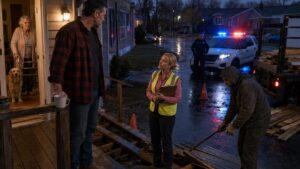
The storm moved through in waves. The heaviest rain eased after twenty minutes, leaving the street slick and littered. The curb still ran fast, but the roar softened to a steady rush. The county alert finally updated with flash-flood language that arrived after the worst of the water had already shown itself in Melissa’s side path.
Neighbors came out slowly, one by one, as if embarrassed by daylight after hiding.
Melissa kept one arm around her child and looked at Edward across the porch. “Thank you.”
He nodded.
There were other things people said. You were right. We got the bins in. I moved the car in time. The drain would’ve backed up worse. He heard the words from a distance. They landed around him, not in him.
His garage was still open.
Heather noticed before he did. The wind had blown papers off his workbench. One of them had skidded near the threshold, stuck to the damp concrete. The removal order lay plastered beneath it, ink bleeding slightly at one corner.
“I should close that,” Edward said.
He crossed the street, water squelching in his shoes. Heather followed, slower.
Inside the garage, the receiver chirped until Edward silenced it. The tablet showed partial data loss. The wind sensor feed was dead. Rainfall remained active. Lightning distance was moving away.
He set the damaged sensor status to inactive with a touch that felt like signing a hospital form.
Heather stood just inside the garage, arms wrapped around herself. She looked smaller among the shelves and cables and tools. Without the board table, without the clipboard, she seemed like someone who had walked into a room and found out the argument was older than she was.
“You knew that side path would flood,” she said.
Edward unplugged a loose cable. “I knew it could.”
“Because of the station.”
“Because of the station, the grade, the drain, and last spring.”
“And that’s why Melissa gets your alerts.”
Edward looked at her. “Melissa asked.”
Heather glanced toward the workbench. Her eyes moved over the tablet, the backup batteries, the printed calibration logs, the laminated county map. Then she saw the plastic box on the shelf, knocked crooked by the wind.
Its lid had slipped open.
Edward followed her gaze too late.
Inside, the old memorial notice had slid partly free, the lamination dulled at the edges. A photograph was printed near the top: a modest house from another neighborhood, waterline visible across the siding. Beneath it were the words IN MEMORY OF A NEIGHBOR WE COULD NOT BRING BACK, followed by a date from six years earlier.
Heather did not touch it.
Edward reached up and pushed the lid closed, harder than he meant to. The box struck the wall with a hollow knock.
“That’s private,” he said.
“I wasn’t—”
“That’s private.”
Heather stepped back. Rain dripped from her jacket onto the concrete.
For the first time since Saturday, she did not answer as a board chair. She did not quote a rule or say his name like a warning.
Outside, Thomas was helping Melissa clear leaves from the drain. Neighbors stood under porch roofs, checking phones that still held Edward’s alerts above the county warning.
Heather looked from the closed plastic box to the broken sensor status on the tablet.
“I didn’t know,” she said.
Edward wiped rainwater from the edge of the workbench with a towel. “You didn’t ask.”
The words hung between them, sharper than he had intended because they were not only for her.
Heather looked toward the open garage door, where the bent sensor arm swung uselessly from the pole.
Then, very carefully, as if any sudden movement might turn the room back into a hearing, she picked up the wet removal order from the floor and placed it on the bench beside the silent receiver.
Chapter 7: The Board Meeting After Everyone Used His Alert
Edward brought the broken sensor arm to the hearing instead of a lawyer.
He carried it in both hands, the way someone might carry a bent piece of a fence after a car accident. The cable still dangled from one end. Dried rain spots marked the black casing. A scrape along the bracket showed where it had slammed against the pole before snapping loose in the storm.
The clubhouse was fuller than last time.
That alone made Edward stop at the doorway.
The same folding chairs had been arranged in the same rows beneath the same fluorescent lights, but the room felt altered. People who had avoided his eyes at the first meeting now looked at the sensor in his hands and then quickly away. Melissa sat near the front this time, her child beside her with a bandage on one knee. Thomas stood at the back wall again, but his arms were not folded. Heather was already at the board table, wearing a navy cardigan instead of a bright polo, her binder closed in front of her.
Benjamin Johnson looked up from the agenda when Edward entered. His expression landed on the broken sensor, and whatever formal greeting he had prepared did not come out.
Edward walked to the front table and placed the damaged part beside the folded removal order, now dry but wrinkled from stormwater.
The room went quiet.
Benjamin cleared his throat. “Mr. Moore, we’ll call item two first.”
Edward sat.
Heather looked at the sensor but not at him.
The meeting began with procedure because procedure was what the board had when ordinary neighborliness failed. Benjamin read the date, confirmed a quorum, and stated that the hearing concerned the association’s enforcement action related to Edward’s exterior installation. His words were careful, but no one in the room could pretend the storm had not changed them.
When Benjamin asked Edward if he wanted to make a statement, Edward stood with one page in his hand.
He had written three pages the night before. Then two. Then one. At midnight, he had deleted the first paragraph because it sounded like anger, and the second because it sounded like begging.
“The station was damaged during the storm,” he said. “The wind sensor is offline. Rain and lightning still work. The alert list is paused except for emergency updates until this is resolved.”
A murmur moved through the room. Paused was not the word they had expected.
Heather looked up then.
Edward kept his eyes on the board. “I understand the HOA has rules. I understand the board has liability concerns. I should have submitted something before installing equipment in the front yard.”
A few faces shifted, surprised by the admission.
He made himself continue. “But the rule being used against it was not written for weather equipment. It does not distinguish between a decoration, a nuisance, and a tool people used during an actual storm.”
Benjamin folded his hands. “Thank you. Ms. Roberts, would you like to respond?”
Heather touched the edge of her binder but did not open it. “Before I do, I think residents who received the alerts should speak if they want the board to consider that use.”
The sentence landed softly and still managed to change the room.
Melissa rose before anyone else could decide whether courage was contagious.
Her voice trembled at first. “I didn’t want to get involved. That’s true. I told Edward not to mention my name.” She looked at him only once. “Last spring, his alert gave me enough time to move things out of my basement stairwell. During this storm, I moved my car before the county warning came through. My child also went outside when the water rose. Edward helped get them back.”
She sat down quickly, face flushed.
Thomas stood next. “I spent twenty-six years responding after people waited too long. Edward’s alerts aren’t official warnings. He never claimed they were. But local information has value, especially on a street with drainage problems.”
Benjamin wrote something down.
A board member asked, “How many residents are on this list?”
Edward answered, “Twenty-three before the storm. Twenty-two active. More asked afterward. I haven’t added them.”
“Why not?” someone in the room asked.
Edward turned slightly. It was one of the residents who had laughed during Heather’s walk-through. The man looked embarrassed as soon as the question left him.
“Because I’m not going to be the neighborhood’s workaround for rules it refuses to fix,” Edward said.
No one laughed this time.
Heather’s fingers tightened over each other.
Benjamin looked toward her. “Ms. Roberts?”
She stood slowly. The room seemed ready for defense, maybe even apology. Heather gave neither at first.
“I was not wrong to be concerned about liability,” she said.
A few people stiffened.
“I was not wrong that the equipment should have come through an application process. And I was not wrong that inconsistent enforcement can put the association in a difficult position.”
Edward felt the old irritation rise, but then Heather looked at the broken sensor and stopped reading from whatever mental script she had left.
“But I was wrong to treat the purpose as irrelevant,” she said.
The room settled.
Heather’s voice tightened, but she did not look away. “I called it junk before I understood what it did. I used the rule because the rule was available, not because it answered the question in front of us. That was my choice.”
Benjamin lowered his pen.
Heather glanced once toward Melissa, then toward Thomas, then finally at Edward. “After the storm, I went back through our insurance notes and the audit recommendations. I focused on enforcement because I was afraid the board would look careless. I was afraid residents would say standards were slipping under my watch. That fear made me more rigid than careful.”
Edward had not expected that. He had expected polished regret, a sentence that apologized for tone while defending action. This was not warmth. It was not friendship. But it was closer to truth than he had thought she would allow in public.
Then she opened the binder.
“I propose the board suspend all fines related to Mr. Moore’s weather station pending a new emergency-use equipment policy. I also propose an exemption allowing the station to remain in place if it meets safety, maintenance, and communication requirements.”
Several residents began whispering. Benjamin nodded carefully.
Edward should have felt relief.
Then Heather turned a page.
“The system should operate under board oversight,” she added. “Messages should be reviewed through an official HOA channel or committee so the association can manage risk.”
There it was.
Edward looked at the broken sensor beside the warped removal notice. The community had moved from wanting the poles gone to wanting to own the warning. It was progress, maybe. It was also another kind of silence, one where Edward’s name disappeared behind a committee while his responsibility remained.
Benjamin looked at him. “Mr. Moore?”
Edward stood again, slower this time.
“No,” he said.
Heather’s face closed a little. “Edward—”
“No,” he repeated, not loudly. “I’ll cooperate on safety standards. I’ll document the equipment. I’ll post disclaimers. I’ll show someone how to read the public dashboard. I’ll even help write a protocol for when alerts go out.”
He touched the broken sensor with one hand.
“But I won’t have a board that ordered it removed last week control it this week because people found out it was useful.”
A few residents shifted in their chairs.
Edward made himself look at them, not just at Heather. “And I won’t keep doing this as an invisible favor. Not anymore. If the neighborhood wants local alerts, then the neighborhood needs to acknowledge what they are, what they are not, and who is responsible for what.”
Melissa looked down, but not away. Thomas nodded once.
Heather did not answer immediately. When she did, the words came carefully. “What are you asking for?”
Edward looked at the room that had watched him stand alone under the spinning poles, then watched him send the warning they had used.
“A policy,” he said. “A real one. Not a favor to me. Not a loophole. Emergency-use equipment is allowed if it is safe, maintained, and clearly labeled. The alert list is voluntary. Official sources stay official. The HOA doesn’t own my station, and I don’t pretend to be the county.”
Benjamin tapped his pen once against the agenda. “That may be workable.”
Heather’s mouth pressed into a thin line. Not anger this time. Thought.
Edward picked up the warped removal order and held it beside the broken sensor. “You can decide whether this was a violation that happened to help people, or a rule that failed before the weather did.”
No one spoke for several seconds.
Then Benjamin looked down the board table. “I move that we table enforcement and draft an emergency-use equipment exemption for vote within thirty days.”
A board member seconded.
The vote passed quietly, without applause.
As people began standing, Heather remained at the table. Edward gathered the sensor and the old notice, but before he could leave, she spoke.
“I saw the memorial in your garage,” she said.
The words were low, meant only for him.
Edward went still.
Heather’s face held no triumph. That made it harder.
“I won’t bring it up,” she said. “Not unless you do.”
Edward tightened his grip around the sensor arm.
For years he had thought silence protected the dead from becoming evidence. Now silence had almost cost the living their warning.
He looked toward the residents filing out under the clubhouse lights, still checking phones, still glancing at him with gratitude they had not yet learned how to say openly.
“I’m not the neighborhood’s invisible warning system anymore,” Edward said.
Heather nodded once, and this time she did not argue.
Chapter 8: The Poles Stayed, But the Silence Did Not
Heather arrived one month later carrying the replacement sensor box like an apology she was not sure he would accept.
Edward saw her through the garage opening before she reached the driveway. She wore jeans, a pale sweater, and no HOA badge. The box in her hands was plain brown, shipping label peeled from one corner, the manufacturer’s name printed in small black letters along the side.
Behind her, Thomas walked with a ladder balanced on one shoulder. Melissa followed with a small cooler and a roll of laminated paper tucked beneath her arm. Her child rode slowly on a scooter near the curb, helmet buckled this time, stopping short of the storm drain as if the street had taught everyone a new map.
Edward stepped out of the garage.
Heather stopped at the edge of the driveway. For a second she looked as she had that first Saturday, waiting for him to explain why the thing in his yard deserved to exist.
Then she held out the box. “It came in yesterday.”
Edward looked at it but did not take it immediately. “The board didn’t need to buy that.”
“The board didn’t.” She glanced toward Thomas and Melissa. “A few residents chipped in.”
Thomas shifted the ladder. “Don’t make it weird. Take the sensor.”
Edward took the box.
It was heavier than he expected.
The poles still stood near the maple tree, one arm bare where the damaged sensor had been removed. In the month since the storm, Edward had left that gap visible. Not as drama. Not as punishment. He had simply not wanted to rush the repair before the vote.
The new policy had passed three nights earlier.
Emergency-use environmental monitoring equipment could remain visible if securely mounted, maintained by the owner, and registered with the association for safety documentation. No HOA officer could demand temporary removal during an active weather watch or warning. Any communication to residents had to include plain language stating that official county alerts remained primary. Participation had to be voluntary. Equipment operation remained Edward’s responsibility unless and until a separate resident group formed.
It was not perfect.
It was real.
Melissa unrolled the laminated paper on the hood of her car. “Benjamin said this should go near the community board at the entrance, but not on your actual pole unless you want it there.”
Edward read the heading.
LOCAL WEATHER ALERT INFORMATION
Below it were three simple lines: voluntary sign-up, official sources first, low-area drainage reminder. At the bottom was a small QR code leading to the public dashboard and the alert request form.
No drama. No speech. No hero language.
Good.
Heather watched him read it. “We removed the phrase association-operated.”
“I noticed.”
“You objected.”
“I did.”
“You were right to.”
The sentence sat there, awkward and clean.
Edward looked up.
Heather’s eyes moved toward the poles. “I still think they’re ugly.”
Thomas coughed into his fist. Melissa looked away, smiling despite herself.
Edward felt the corner of his own mouth move. “They are.”
Heather looked relieved by the honesty. “But they’re mounted safely.”
“They will be once that sensor’s up.”
“Then let’s get it up.”
The work should have taken fifteen minutes. It took forty because everyone had opinions.
Thomas insisted on setting the ladder himself and testing each foot against the grass. Melissa held the tool tray and kept reading the instructions out loud, though Edward already knew them. Heather stood near the base with the checklist Benjamin had drafted, making tick marks for bracket spacing, cable tie placement, and clearance from the sidewalk.
At first, Edward wanted to tell them all to step back.
His hands knew the station. His tools knew the screws. The poles knew the pressure of his weight against them. Letting other people near it felt like allowing strangers to touch a scar.
Then Melissa’s child, standing at a careful distance, asked, “Is that the part that tells the wind?”
Edward looked down from the ladder.
“This one measures wind direction,” he said. “The cups at the top measure speed.”
“So it knows before we do?”
Edward tightened the bracket. “It notices before we do. Knowing is what people do after.”
The child considered that and nodded as if it made perfect sense.
Heather looked up at him, and Edward realized she had heard the answer too.
Thomas handed him the cable. “Ready?”
Edward clicked the new sensor into place. The small connection light blinked once. Twice. Then steady green.
From inside the garage, the receiver chimed.
Not an alarm this time. A clean connection tone.
Edward climbed down slowly.
On his tablet, the dashboard filled the missing line. Wind direction active. Calibration pending. Data steady.
For a moment, no one spoke. The poles stood whole again, black against a clear afternoon sky, still strange, still not beautiful, no longer mistaken for meaningless.
Melissa set the cooler on the driveway. “I brought drinks.”
Thomas lowered himself onto the curb with the satisfaction of a man who had turned a small repair into a proper operation. Heather taped a temporary copy of the protocol to the inside of Edward’s garage wall, then hesitated.
“This one is yours,” she said. “The entrance board copy goes up tomorrow.”
Edward looked at the paper. “Leave it.”
She smoothed the top edge with her palm.
The old Edward would have hated the paper on the wall. He would have seen it as intrusion, as committee language nailed beside a promise that had belonged only to him. But the storm had changed the shape of that promise. A warning no one admitted needing was not protection. It was penance with better equipment.
Heather stepped back. “I didn’t tell anyone about the memorial.”
“I know.”
“I wanted to, once,” she admitted. “At the meeting. Not to hurt you. To explain.”
Edward watched the wind cups turn slowly overhead. “That’s why I never told anyone. People use grief like a key.”
Heather accepted that without defense. “I’m sorry.”
He looked at her then. There were apologies that wanted to be rewarded and apologies that knew they had arrived late. Hers was the second kind.
“Thank you,” he said.
It was not forgiveness entire. It was not friendship. It was a door left unlatched.
A little before sunset, they walked together to the neighborhood entrance. Melissa carried the laminated sign. Thomas brought a small level from his pocket, which made Melissa laugh. Heather unlocked the glass-covered community board with the HOA key.
Inside were pool notices, landscaping schedules, a reminder about trash pickup, and a faded flyer for a summer block party. Heather cleared a space near the bottom, not hidden, not centered like a proclamation.
Melissa held the sign while Thomas checked the level.
Edward stood back with his phone.
Heather glanced over. “You should send the test.”
He opened the alert app. The new group had thirty-one subscribers now. Some names he knew. Some he did not. Each one had checked a box acknowledging that official warnings came first.
He typed: Clear-weather test of local Willow Creek weather alert system. No action needed.
His thumb hovered for only a second this time.
Then he sent it.
Phones chimed around them.
Melissa’s. Thomas’s. Heather’s. From a porch nearby, another chime answered. Then another farther down the street. Not panic. Not warning. Just a small sound moving through the neighborhood, noticed and accepted.
Heather looked at her screen, then toward the poles visible above Edward’s roofline.
“No action needed,” she read.
Edward slid his phone into his pocket. “That’s the best kind.”
The wind cups turned in the clean evening air, measuring a quiet street that had finally learned the difference between an eyesore and a warning.
No one complained about the sound.
The story has ended.