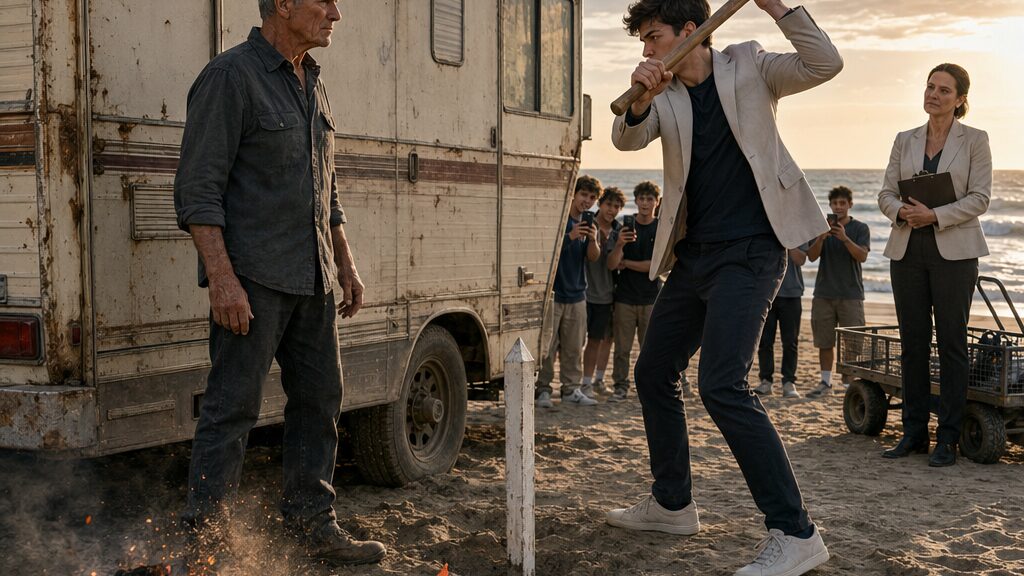
They Called the Old Man a Drifter Until the Beach Revealed Who Truly Owned the Boundary
Chapter 1: The Campfire They Thought They Could Extinguish
Jonathan Rivera’s shoe cut through the fire ring and sent a sheet of sand across Raymond Mitchell’s boots.
Three glowing coals bounced beneath the folding chair. One struck the cuff of Raymond’s trousers and went dark. Another rolled toward a pale concrete disk half buried near the RV’s rear wheel.
Raymond moved before anyone else noticed it.
He pinned the ember beneath his heel, twisted once, and left it smoking in the sand.
Behind Jonathan, two teenagers laughed. Nicole Green held her phone upright, its small red recording mark reflected in her sunglasses.
“Pack up, crazy drifter,” Jonathan said. “This beach belongs to us.”
Raymond looked first at the extinguished ember, then at the blackened coffee pot hanging over what remained of the fire. Only after that did he look at Jonathan.
The boy was seventeen, perhaps eighteen, broad in the shoulders but still carrying himself as if every room needed to be told he had entered it. His clothes were expensive in the careful way of someone who wanted people to recognize the expense. His hair was windblown for effect rather than neglect.
Raymond folded the paperback resting on his knee and placed it on the chair.
“You kicked hot coals toward your friends,” he said.
Jonathan glanced back at the phones pointed at him.
“They’re fine.”
“That was not what I said.”
A second phone shifted closer. Someone whispered that the old man was crazier than they had heard.
Raymond ignored it.
The RV behind him looked exactly as it was meant to look: sun-faded cream paint, rust along the wheel wells, mismatched curtains, and a patched roof seam that seemed to have survived several bad winters. Salt had eaten dull lines into the metal. One hubcap was missing. A strip of peeling trim hung loose beside the rear door.
Nothing about it invited a second look.
Raymond gave it one anyway.
The rear wheel remained aligned with the narrow wooden block beneath it. The side panel above the axle was still sealed. No vibration disturbed the sand packed against the lower frame.
Jonathan noticed the glance and smiled.
“Worried we might find something in there?”
Raymond picked up the coffee pot and poured what remained into a metal cup.
“I’m worried you’ll burn yourselves trying to impress people who will forget this by dinner.”
The laughter thinned.
Nicole lowered her phone half an inch, then raised it again when Jonathan looked at her.
Farther up the beach, residents had stopped along the paved path. Some wore exercise clothes. One woman held a small dog against her chest. A man in a golf shirt had already taken out his own phone.
None of them stepped onto the sand.
They had learned to watch from where responsibility became uncertain.
For six weeks, Raymond had occupied the same narrow plot at the end of the affluent coastal development. For six weeks, complaints had reached the police, the county, the management office, and at least one local council member. The reports had described him as homeless, unstable, threatening, possibly armed, and—most often—as bad for property values.
Each complaint had ended the same way.
Someone arrived.
Someone spoke quietly to Raymond.
Someone left without removing him.
Angela Davis had turned those failures into a story of bureaucratic weakness. She told residents the agencies were passing responsibility among themselves. She suggested outdated paperwork had created a loophole. She never said exactly what paperwork. She did not need to.
People preferred a loophole to the possibility that they had misunderstood the ground beneath their own feet.
Jonathan stepped closer to the folding chair.
“My parents pay more in community fees every month than this thing is worth.”
He slapped the side of the RV.
The sound was flat and heavy.
Raymond’s gaze hardened.
“Don’t touch it again.”
Jonathan’s smile widened because the warning had finally given him something that sounded like fear.
“There it is.”
He turned toward Nicole’s phone.
“He knows he’s not supposed to be here.”
The group laughed louder this time.
Raymond looked past them.
Angela stood on the public path beside a white utility cart, one hand resting on its steering wheel. She wore a pale management jacket despite the warmth. A clipboard was tucked beneath her arm.
She was not surprised to see Jonathan.
She was not alarmed by the phones.
And when Jonathan had kicked the fire, she had not moved.
That told Raymond enough.
The confrontation had not begun with the teenagers. It had merely been handed to them.
Angela met his eyes across the strip of sand.
Her expression held no pleasure, only calculation. She wanted him to react. She wanted a shove, a threat, perhaps a hand placed on a young shoulder while cameras were close enough to turn restraint into violence.
Raymond lifted his cup and drank.
Jonathan followed his gaze toward Angela.
“She says you’ve been given plenty of chances.”
Angela did not deny it.
Raymond set the cup beside his chair.
“Then she can produce the notice.”
“She doesn’t owe you anything.”
“No,” Raymond said. “She owes it to the office that employs her.”
The words reached Angela. Her fingers tightened on the clipboard.
Jonathan mistook that movement for encouragement.
He waved one of his friends forward. The boy carried a heavy wooden stake painted white at the top. Black letters ran down one side: PRIVATE COMMUNITY BOUNDARY.
The paint was fresh.
Jonathan took it and drove its point lightly into the sand beside the RV.
“We’re putting the line back where it belongs.”
Several residents on the path murmured their approval.
Raymond studied the placement.
The stake stood less than a foot from the pale concrete disk he had covered with loose sand that morning. Beneath it, protected by layers of conduit and compacted earth, ran a cable no resident knew existed.
The fire had been humiliation.
This was danger.
He rose slowly from the chair.
The teenagers quieted, perhaps because he was taller than they expected. Age had narrowed him but not softened the shape of his shoulders. His gray hair was cut close. His hands, resting loose at his sides, were marked by old scars too clean to have come from casual labor.
Jonathan held the stake steady.
“What are you going to do?”
Raymond stepped around the dead fire and stopped three feet away.
“Move it.”
Jonathan glanced toward the phones.
“Why?”
“Because that is not your boundary.”
“Our map says it is.”
“Your map is wrong.”
Jonathan pushed the stake deeper with his boot.
The pressure was slight, nowhere near enough to reach the conduit, but Raymond felt his own pulse sharpen.
A gull cried overhead. The wind dragged smoke from the scattered fire toward the water.
Angela left the utility cart and walked down from the path.
She stopped where the sand met the groomed grass, preserving the appearance that she had not joined the confrontation.
“Raymond,” she called, using his first name as if familiarity made her reasonable. “These residents have been patient.”
Raymond turned toward her.
“You sent them.”
“I did no such thing.”
Jonathan looked back at her. The brief confusion on his face vanished when she added, “But I understand why they are frustrated.”
There it was.
Not an order. Not on camera.
Permission disguised as sympathy.
Raymond looked again at the stake.
He thought of the sealed compartment beneath the RV floor, the live systems resting behind the weathered panel, and the warning beacon that would activate if the external line was breached. He thought of the review that was supposed to remain invisible for nine more days.
Then he looked at Jonathan.
The boy’s hand tightened around the white-painted wood.
Raymond’s voice remained quiet.
“Move that stake three feet, or do not touch it at all.”
Chapter 2: The Boundary Marker That Proved Too Little
Angela stepped onto the sand carrying a laminated map.
She held it high enough for the phones to catch the colored lines before Raymond could read the legend.
“This parcel,” she announced, “is maintained for the exclusive use of residents and their invited guests. Mr. Mitchell has no current residential agreement, no community permit, and no legal authorization from this management office.”
The crowd on the path grew still.
Jonathan spread his hands as if the matter had been settled.
“There. Pack your junk.”
Raymond looked at the map without reaching for it.
The document showed the development’s western boundary in a thick blue line that curved along the beach and ended beside the RV. A yellow section marked COMMUNITY RECREATION ACCESS extended over the plot where Raymond’s chair stood.
The map was not entirely false.
That made it useful.
It showed a proposed access plan submitted years earlier, before a federal easement had been renewed and the protected strip reclassified. The approval block in the lower corner had been cropped away.
Raymond could see the cut line beneath the plastic.
“Turn it over,” he said.
Angela’s chin lifted. “The relevant information is on this side.”
“The date is on the other.”
“This is the map residents were provided.”
“That was not my question.”
Jonathan laughed, but uncertainty had entered his eyes.
Angela lowered the map.
“You are occupying land without a visible permit and frightening families who have every right to be here.”
Raymond looked toward the residents. The woman holding the dog shifted her weight. A man near the utility cart stopped recording when Raymond met his gaze.
“I have not approached one family on this beach.”
“You keep equipment here.”
“I keep an RV here.”
“You light fires.”
“In the authorized ring.”
Angela pointed toward the scattered sand and charred stones. “That does not look authorized.”
Jonathan’s friends laughed again.
Raymond turned to the faded concrete post near the dune grass. Only its top four inches showed above the sand. Salt and wind had erased most of the lettering, leaving a sequence of shallow grooves.
He walked to it and brushed the surface with his thumb.
“Read that code.”
Angela did not move.
Jonathan squinted. “It’s garbage.”
“It is a site designation.”
“For what?”
Raymond straightened.
“That is not information I am required to give you.”
The answer landed badly.
Jonathan turned toward Nicole’s phone.
“You hear that? He admits he won’t say what he’s doing here.”
A low hum began inside the RV.
It lasted less than two seconds, just long enough to tremble through the metal wall. Raymond crossed the sand, opened a small exterior access hatch, and pressed a recessed switch.
The hum died.
The interior remained dark behind the curtains.
Jonathan stared at the hatch.
“What was that?”
“A power draw.”
“For what?”
Raymond closed the panel.
“You have been told to leave the stake alone.”
Angela’s eyes had fixed on the hatch. Unlike Jonathan, she did not look curious. She looked displeased.
That difference mattered.
A patrol vehicle appeared beyond the beach entrance.
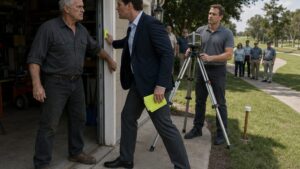
Its tires rolled from pavement onto the service lane, stopping beside Angela’s utility cart. Officer Daniel Perez stepped out, adjusted his belt, and surveyed the phones before looking at Raymond.
They had met twice before.
On both occasions, Daniel had arrived with enough caution to be respectful and enough doubt to be irritating.
Angela moved toward him immediately.
“Officer, thank you. He has threatened these minors and is refusing to vacate private property.”
“I told one of them not to drive a stake into the ground,” Raymond said.
Daniel looked at Jonathan.
“Did he threaten you?”
Jonathan glanced at Angela.
“He stood up like he was going to do something.”
“That is not what I asked.”
“He said we couldn’t touch the boundary marker.”
Daniel exhaled through his nose.
“Everybody lower the phones for a minute.”
No one did.
Daniel did not repeat himself. He walked past them to the concrete post Raymond had uncovered. He crouched, brushed away sand, and traced the faded grooves.
His expression changed.
Not recognition exactly. More like the return of a question he had hoped was finished.
He stood and faced Raymond.
“Do you have the card?”
Raymond reached beneath his overshirt and removed a weathered credential from a narrow leather holder.
He placed it in Daniel’s hand.
The card showed no agency name on the front, only Raymond’s photograph, an identification number, and the same letter sequence carved into the post.
Daniel turned it over.
A metallic strip crossed the back. The expiration field contained an authorization code rather than a date.
Jonathan leaned in.
“That thing looks twenty years old.”
Daniel moved it out of reach.
“It is valid enough that none of you should be inside the marked strip until this is clarified.”
Angela’s face tightened.
“Valid enough?”
Daniel handed the card back to Raymond.
“It confirms protected access. It does not tell me the scope.”
“Because you do not have the clearance for the scope,” Raymond said.
Silence spread across the beach.
Daniel’s jaw set.
He had been careful with Raymond, but care was not the same as trust. The words had reminded him that he was being allowed to see only the edge of something.
Jonathan seized on it.
“So even the police don’t know what he’s doing.”
Daniel turned sharply.
“What I know is that you need to step behind the concrete post.”
“My family owns one of the largest houses here.”
“The post does not care.”
A few residents looked away to hide smiles.
Jonathan saw them.
Color rose in his face.
He pulled the white stake from the sand and carried it two steps toward the path, but he did not drop it. His friends followed, slower now. Nicole lowered her phone completely.
Angela remained where she was.
“This is exactly the problem,” she told Daniel. “No agency will give us a straight answer, so one man gets to occupy community land indefinitely.”
Daniel studied the laminated map.
“Where is the approval block?”
Angela looked down.
“This is the resident version.”
“Where is the full version?”
“At the office.”
“Then do not represent this as a current survey.”
The rebuke was mild. It still struck her harder than Jonathan’s public embarrassment had struck him.
Raymond slid his credential back beneath his shirt.
Daniel faced him.
“You could end a lot of this by giving me one contact number.”
“I gave your department the verification line.”
“They confirm access and nothing else.”
“That is what they are authorized to confirm.”
“You understand how that sounds.”
“Yes.”
The answer frustrated Daniel because it contained no apology.
Jonathan heard only the refusal.
“He’s hiding behind a fake card and some secret phone number.”
Daniel stepped between him and the plot.
“You were told to move back.”
Jonathan looked at Nicole, then at the residents, then at the stake in his hand.
For the first time, the performance had failed him. He had arrived expecting laughter and left the sand because a police officer had ordered him to retreat from a man everyone called powerless.
He threw the stake down beside Angela’s utility cart.
“This isn’t over.”
Daniel watched the teenagers leave along the path.
Angela stayed behind until he returned to his vehicle. Then she picked up the stake and brushed sand from the fresh paint.
Jonathan had stopped near the clubhouse stairs, pretending to check his phone. His friends had gone ahead.
Angela joined him.
“You made me look stupid,” he said.
“I showed them the map.”
“And the cop still protected him.”
“He protected a code on an old post.”
Jonathan stared back toward the RV.
Raymond had returned to his chair and was rebuilding the fire ring one stone at a time.
“What’s in there?”
Angela followed his gaze.
“The inspectors always ask about the external power line.”
Jonathan looked at her.
“What power line?”
“The one running from the RV into the ground.”
“I didn’t see one.”
“It is buried close to the rear wheel.”
“Why?”
Angela slid the map beneath her arm.
“Because that cable is the only reason officials keep protecting his camp.”
Chapter 3: The Manager Who Needed a Public Hero
Angela deleted the federal warning while Jonathan sat across from her desk.
The message disappeared from the screen, but not before he saw the red banner at the top.
SECOND NOTICE: UNAUTHORIZED PUBLIC ACCESS WITHIN PROTECTED COASTAL EASEMENT.
“What was that?” he asked.
Angela closed the laptop.
“Routine correspondence.”
“It said unauthorized access.”
“It refers to an old survey dispute.”
Jonathan leaned back in the leather chair. The management office had glass walls overlooking the landscaped entrance to the development. Framed photographs showed families at beach cookouts, children on paddleboards, and holiday gatherings on the same stretch of sand where Raymond’s RV stood.
In every photograph, the protected strip looked like part of the community.
That illusion was one of Angela’s most successful projects.
“The corporate inspection is Friday,” she said. “They will see complaints, resident dissatisfaction, and an abandoned vehicle at the end of the beach.”
“You said he had no right to be there.”
“He has enough paperwork to confuse local officials.”
“That cop knew the code.”
“Daniel Perez knew it meant he should be cautious. That is not the same as knowing Raymond owns anything.”
Jonathan turned his phone over on the desk.
The video from the previous afternoon had spread through the neighborhood group before dinner. It had not spread the way he wanted.
The most shared clip was not the kick through the fire. It was Daniel telling him the post did not care who his family was.
Someone had added laughing icons.
His father had watched the clip without comment, which felt worse than anger.
“You told me putting the marker back would make it official,” Jonathan said.
“I said it would show residents where the line should be.”
“You knew about the cable.”
Angela’s expression changed by less than a breath.
“I know maintenance details for every parcel under my management.”
“Then why didn’t you tell the police?”
“Because once officials become involved, everything slows down.”
She stood and walked to the window.
Below them, gardeners trimmed hedges around the entrance sign. Beyond the roofs, a narrow band of ocean flashed in the sun.
“For years,” Angela said, “families here have used that beach safely. Then he arrives, sets up a camp, blocks the view, and makes people afraid to let their children walk alone.”
“He doesn’t talk to anyone.”
“That makes people more afraid.”
Jonathan frowned.
Angela turned back toward him.
“Your friends listen to you. The residents listen when young people take responsibility. If you establish the boundary and remove the external line, the city will have no excuse to keep overlooking him.”
“Remove it how?”
“Do not go inside the RV. Do not damage the vehicle.”
She opened a drawer and removed a printed diagram. Most of the labels had been covered with white correction tape.
A dark line ran from a square representing the RV toward the buried concrete post.
“Only the external line,” she said.
Neither of them noticed Nicole standing outside the half-open office door.
She had come to return Jonathan’s sunglasses, which he had left in her car. At first, she thought Angela was discussing a utility problem. Then she saw the diagram and heard the word remove.
She stopped breathing long enough to hear Angela add, “Once the line is disconnected, he cannot claim the site is operational.”
Nicole backed away before either of them looked toward the door.
She left the sunglasses on a lobby table.
That evening, Raymond sat alone inside the RV with the lights off.
The interior visible from the doorway matched the exterior: worn cabinets, a narrow bunk, stained linoleum, and a small gas stove. A torn section of decorative wall paneling curled beside the door.
Behind it was reinforced steel.
Raymond sat at a fold-down table with a secure terminal recessed beneath a false wooden cover. On the screen, a report waited for his signature.
UNAUTHORIZED ACCESS PATTERN: COASTAL SITE 14-C.
He had attached six photographs of moved boundary notices, three logs of after-hours beach events, and copies of complaints Angela had redirected away from federal review. The evidence was enough to trigger an immediate contract audit.
It was also enough to draw attention to the site.
The operation inside the RV had spent four months tracking irregular signal traffic along the coast. The source had not yet been identified. An audit would bring contractors, vehicles, questions, and perhaps news cameras if residents decided the mystery deserved publicity.
Nine more days.
That was all Raymond had been asked to preserve.
He placed the cursor over SUBMIT.
A memory came without invitation: a narrow equipment room years earlier, an older field specialist pointing at a pressure reading no one else believed. The supervisor had dismissed him. Raymond had seen doubt in the man’s face and said nothing because the chain of command had already spoken.
The failure that followed had injured three people.
Afterward, Raymond had built a rule out of guilt.
Give one clear warning.
Never waste time repeating it.
He had mistaken severity for certainty ever since.
His finger hovered over the key.
Then he closed the report without sending it.
Nine more days, he told himself.
Outside, a shadow moved past the narrow window.
Raymond rose.
He opened the door and found Jonathan standing beside the rear wheel, phone in hand.
“What are you doing?” Raymond asked.
Jonathan looked up too quickly.
“Public beach.”
“Not where you are standing.”
Jonathan stepped back, but his gaze slipped past Raymond into the dim interior.
For a second, the torn decorative panel exposed the dark steel beneath it.
Jonathan stared.
“You armor this thing?”
Raymond shifted into the doorway.
“Go home.”
“People are right about you.”
“Which people?”
“The ones who say you’re dangerous.”
Raymond looked toward the path. Angela’s office cart was parked near the clubhouse, but she was nowhere in sight.
Jonathan raised his phone and photographed the RV.
“You built some kind of bunker in there.”
Raymond stepped down onto the sand.
Jonathan retreated beyond the concrete post, smiling now because he believed he had found proof.
“You’re done,” he said.
The next morning, Nicole saw him return with three friends and an industrial sledgehammer.
The steel head was scarred from use. The wooden handle was nearly as long as Jonathan was tall.
A livestream notification appeared on her phone.
JONATHAN RIVERA: REMOVING THE BEACH SQUATTER FOR GOOD.
She found him near the path while his friends arranged themselves behind the camera.
“You can’t use that,” she said.
Jonathan rested the hammer across one shoulder.
“I’m driving in a marker.”
“Angela said external line.”
His eyes narrowed.
“You were listening?”
“She knows something is under there.”
“So does he.”
“That doesn’t mean you should hit it.”
Jonathan glanced toward the viewers joining the stream.
Forty-three.
Sixty-one.
Eighty.
“You weren’t worried yesterday when you filmed him.”
“That was different.”
“No, it wasn’t. You just don’t want to look bad if this works.”
Nicole felt the accusation land because part of it was true.
She had filmed the kick. She had waited for Raymond to react. She had imagined the numbers rising if he shouted or shoved someone.
She had told herself holding a phone made her separate from what happened in front of it.
Across the sand, Raymond emerged from the RV.
He saw the hammer first.
Then Angela, standing near the utility cart with her clipboard pressed against her body.
Then the white stake lying beside Jonathan’s feet.
Raymond’s face did not change, but Nicole saw his attention settle on the narrow stretch of sand between the stake and the rear wheel.
Jonathan started the livestream.
“Today we’re taking our beach back.”
His friends cheered.
Nicole opened her camera, but she did not join the live broadcast. She switched off the screen brightness, began a second recording, and held the phone against her leg.
Jonathan lifted the stake.
Raymond stepped away from the RV.
For the first time since Nicole had seen him, the old man did not look merely patient.
He looked as though he had finally understood th
Edit
Chapter 4: One Warning Before the Hammer Fell
Jonathan drove the white stake into the sand with both hands, then lifted the sledgehammer above it.
The steel head caught the sun. Below it, the point of the stake rested directly over the route Raymond had marked the day before.
Viewers climbed across the corner of Jonathan’s screen.
Two hundred twelve.
Two hundred forty.
Someone behind him read comments aloud.
“Hit it.”
“Make the old guy move.”
“Check the bunker.”
Jonathan adjusted his grip and smiled toward the phone.
Raymond crossed the fire ring without hurrying.
“Put it down.”
Jonathan’s friends shifted to give the camera a cleaner angle. Nicole remained near the path, her visible hand empty while her other hand held the second phone against her thigh.
Angela stood beside the utility cart.
Her clipboard concealed most of her face, but not her eyes.
Raymond stopped beyond the arc of the hammer.
“The line under that stake is active.”
Jonathan glanced toward his livestream.
“So you admit there’s something buried here.”
“I told you yesterday.”
“You said move it three feet. You didn’t say why.”
“You were told enough to stop.”
The words left Raymond’s mouth with the hard certainty of habit. As soon as he heard them, he knew what they sounded like.
Not protection.
Control.
Jonathan looked around at the people watching.
“There it is again. He thinks he gets to order everybody around without explaining anything.”
Angela stepped forward.
“Jonathan, establish the marker and come back.”
Her tone was measured. Official enough to sound responsible. Indirect enough to deny later.
Raymond looked at her.
“You know what that line serves.”
“I know you have attached unauthorized equipment to managed land.”
“You received the site notices.”
Angela’s expression tightened.
“I received unclear correspondence about an easement that no one has properly documented.”
“That is false.”
“Then show everyone.”
The crowd murmured.
It was the demand she had been building toward from the beginning. Open the RV. Expose the unit. Turn a restricted review into a neighborhood spectacle.
Raymond looked at the weathered vehicle.
Behind the faded siding, the monitoring array continued processing coastal signal traffic. A forced shutdown at the external relay would erase nothing, but it would blind the system during restart and announce the post’s existence to anyone watching the network.
Nine days of silence weighed against the hammer in Jonathan’s hands.
Raymond faced him again.
“Do not swing that.”
The beach went quiet.
Even the comments being read aloud stopped.
Nicole’s hidden camera caught Angela lowering her clipboard.
The manager gave Jonathan the smallest possible nod.
He saw it.
So did Raymond.
Jonathan raised the hammer another inch.
For one moment his confidence slipped. The steel head shifted behind him, pulling his shoulders off balance. He could still have lowered it. He could still have laughed and claimed the old man had ruined the video.
Then one of his friends said, “You’ve got five hundred watching.”
Jonathan’s jaw tightened.
He swung.
Raymond stepped inside the arc.
His left hand struck the handle below Jonathan’s forward grip, redirecting the head away from the stake. His right hand closed around the wood higher up.
The descent stopped with the steel head less than a foot above the sand.
Jonathan stared at him.
Raymond’s boots had not moved after the first step. His arms shook once under the transferred weight, then steadied.
The watching teenagers fell silent.
“Let go,” Raymond said.
Jonathan’s face changed.
Until that instant, the confrontation had belonged to the screen. Every shove of the stake, every insult, every step closer had been an image he could control by keeping the camera pointed in the right direction.
Now the hammer was trapped between them.
He pulled.
Raymond held it.
Jonathan pulled harder, twisting the handle toward Raymond’s ribs.
That ended the argument about a boundary marker.
Raymond shifted his hip, turned the wood with the force instead of against it, and tore the tool from Jonathan’s hands.
Jonathan stumbled forward.
Raymond caught his shoulder long enough to keep him from falling into the dead fire ring, then released him.
It was not mercy Jonathan understood. He mistook it for another humiliation.
“You attacked me!”
“You tried to bring the hammer into my body.”
“I was getting it back.”
“You lost the right to it.”
Raymond stepped away with the sledgehammer held low.
A muted tone sounded inside the RV.
Three descending notes.
The exterior access hatch snapped shut by itself.
Jonathan’s friends looked toward the vehicle.
A second tone followed, deeper than the first. Hidden locking bolts engaged inside the side panels with a sequence of heavy metallic knocks.
The sound did not belong inside a failing recreational vehicle.
Angela’s face drained.
Raymond heard the automatic system begin its threat response. The stake had not penetrated the ground, but the hammer’s steel head had crossed the proximity boundary fast enough to trigger a defensive lock.
The post was no longer invisible.
He looked down at the sledgehammer.
The handle was thick hickory, scarred near the head and weakened along an old split. Jonathan had brought a damaged tool without noticing it.
Raymond placed one hand above the fracture and the other below.
“Raymond,” Angela said, suddenly cautious. “Do not make this worse.”
He turned the weakened section across his knee.
The wood broke with a sharp crack.
Half the handle dropped beside the false stake.
Raymond twisted the remaining piece from the steel socket, carried the head toward the dune line, and threw it into the low woods beyond the path. It crashed through branches and disappeared where no frightened teenager could grab it again.
No one laughed.
Jonathan’s livestream phone remained pointed at Raymond, but Jonathan was no longer speaking to it.
The older man stood between him and the RV, holding the broken length of wood.
He did not look triumphant.
He looked tired.
Raymond had seen that same silence years ago in an equipment room after the pressure system failed.
The older specialist had given one warning. The supervisor had dismissed him. Raymond had known enough to question the decision and had remained quiet because a warning had already been issued.
Three people had been injured while everyone later argued about who should have spoken twice.
Raymond had spent years blaming the supervisor.
Then he had built his own rule from the same failure.
One warning.
No repetition.
No explanation.
Jonathan pointed toward the broken handle.
“You can’t do that.”
Raymond looked at the stake, the buried cable, and the phones.
“I should have stopped this before you came back with a hammer.”
Angela seized the sentence.
“You heard him. He admits responsibility.”
Raymond turned to her.
“For allowing you to believe silence protected this site.”
A narrow panel rose from the RV roof with a mechanical hiss.
What had appeared to be a rusted vent unfolded into a compact communications aerial. A red indicator pulsed once, then vanished behind dark glass.
Raymond recognized the sequence.
The system had sent an encrypted distress transmission.
He had less than ten minutes before the response team reached the access road.
Angela reached for her phone.
Jonathan backed away from Raymond, rubbing his palms where the handle had torn free.
Nicole ended the public livestream from Jonathan’s abandoned phone, but kept her hidden recording active.
Raymond placed the broken wood across the white stake.
Inside the weathered RV, another set of locks engaged.
Far beyond the development, sirens began moving toward the coast.
Chapter 5: The Recording That Exposed the Wrong Story
Angela told emergency dispatch that an armed homeless man had attacked several minors.
“He has some kind of fortified vehicle,” she said, turning away from Raymond as if distance could make the lie private. “He destroyed their property and threatened them with a weapon.”
Raymond still held one half of the wooden handle.
He set it down beside the stake.
“Tell them the weapon belonged to Jonathan.”
Angela covered the phone.
“Stay away from me.”
“No one is near you.”
She turned toward the residents gathering along the path.
“You all saw what he did.”
Several had seen only the end. Raymond standing with the hammer. Jonathan stumbling. The handle breaking across Raymond’s knee.
The beginning existed on phones, but beginnings could be cropped.
Jonathan understood that before anyone else.
“He grabbed it while I was putting in the marker,” he said. “I never swung at him.”
Nicole looked at him.
“You did.”
Jonathan stared back.
“You were filming from behind me.”
“I saw it.”
“So did the live.”
His voice carried a warning. The public video belonged to his account. He could delete it, shorten it, or claim the angle was unclear.
Nicole’s hand tightened around her second phone.
Angela resumed speaking to dispatch.
“Yes, there are children present. Please send officers immediately.”
“They’re already coming,” Raymond said.
The hidden aerial had lowered into the RV roof. Only a thin seam remained.
Angela looked toward the access road.
A local patrol vehicle arrived first.
Daniel Perez stepped out before it stopped rolling completely.
“Everybody stay where you are.”
Angela hurried toward him.
“He assaulted Jonathan with that sledgehammer and threw part of it into the woods.”
Daniel looked from the broken handle to Jonathan’s empty hands.
“Where is the head?”
Raymond pointed toward the dune trees.
“I removed it from reach.”
“You threw a steel hammer head into the woods?”
“Yes.”
Daniel stared at him for a beat.
“Anyone in that direction?”
“No.”
“How do you know?”
“I checked before I threw it.”
It was not the answer Daniel wanted, but it was delivered with the certainty of someone who had already measured the risk.
He ordered another officer to keep the residents behind the path, then crouched beside the false stake.
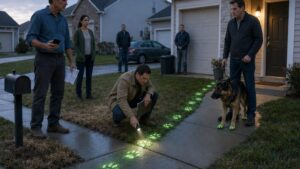
The white paint was chipped near the top. Jonathan’s shoe prints circled it. A shallow mark in the sand showed where the hammer head would have landed.
Daniel brushed away the loose grains.
The pale concrete disk emerged beneath them.
Its code matched the one on Raymond’s credential.
A second line of smaller lettering became visible along the edge.
RESTRICTED SUBSURFACE CONDUIT.
Daniel looked up.
“Did anyone read this before putting the stake here?”
Jonathan said nothing.
Angela answered for him.
“It was buried.”
“Partially.”
“No resident could be expected to recognize an obsolete marker.”
Raymond stepped closer but remained outside Daniel’s working space.
“She saw the maintenance diagram.”
Angela’s head snapped toward him.
“What diagram?”
“The one she gave Jonathan.”
Jonathan looked at her.
Daniel stood.
“Is there a diagram?”
“No.”
Jonathan’s confusion deepened.
“You showed me one this morning.”
Angela’s expression went still.
“I showed you the proposed community boundary.”
“It had the line from the RV.”
“That is not what it represented.”
The separation began then.
Jonathan had entered the beach believing Angela would stand behind every action she had encouraged. Now she spoke as if he had misunderstood a harmless map and invented the rest himself.
His friends drifted several steps away.
Daniel held out his hand.
“Phones. Anyone who recorded the full incident, do not delete or alter anything.”
Jonathan picked up his livestream phone.
“The account saved it.”
“Unlock it.”
“My parents need to be here.”
“You may call them after you preserve the recording.”
Jonathan looked toward Angela again.
She was speaking quietly to the other officer, no longer looking at him.
Nicole stepped forward.
“I have another video.”
Jonathan’s head turned.
“What do you mean, another?”
She brought the phone from beside her leg.
“I started before you walked onto the sand.”
His face hardened.
“You were recording me secretly?”
“I wanted to know what Angela would do.”
Angela stopped speaking.
Daniel took the phone but made Nicole unlock it herself. He played the recording with the sound low, holding the screen away from the crowd.
It showed Jonathan carrying the hammer.
It captured Raymond identifying the live line.
It captured the warning.
Then Angela lowered her clipboard and gave the slight nod.
Daniel replayed that moment.
Angela’s voice sharpened.
“That gesture means nothing.”
Nicole spoke without looking at her.
“You told him to damage only the external line.”
“I never used the word damage.”
“You said disconnect.”
“That is not the same thing.”
Jonathan stepped toward her.
“You said if the line was gone, officials couldn’t protect him.”
Angela’s composure cracked.
“I did not tell you to attack anyone.”
Raymond watched Jonathan absorb the distinction.
She had not ordered the swing. That choice remained his.
But she had placed him beside the stake, given him the diagram, and fed the part of him that needed the cameras to approve.
The evidence did not make him innocent.
It made him used.
Daniel handed Nicole’s phone to the other officer for preservation.
“Why didn’t you stop him?” he asked her.
Nicole’s mouth opened, then closed.
“I thought he would back down.”
“When?”
She looked at Raymond.
“When the old man got scared.”
Raymond did not rescue her from the answer.
A black sedan stopped at the edge of the service lane. Jonathan’s parents emerged before the doors had fully closed.
His father came first, already speaking.
“My attorney is on the phone. No one searches my son or takes his property without—”
Daniel raised one hand.
“Stay behind the path.”
“My son was attacked.”
“Your son is being investigated.”
“For defending community property?”
Daniel pointed toward the exposed conduit marker.
“For swinging a sledgehammer over restricted infrastructure after a direct warning.”
Jonathan’s mother looked at Angela.
“You said the man was an unlawful squatter.”
Angela’s lips parted.
Before she could answer, the distant sirens stopped.
Three dark federal vehicles rolled across the entrance in silence, positioning themselves nose to tail until the beachfront road was sealed.
People on the path lowered their phones.
Doors opened.
Personnel in plain field uniforms stepped out and formed a controlled perimeter without shouting or running.
The lead officer looked once at Raymond, then at the locked RV.
“Status?”
“External threat contained,” Raymond said. “No breach.”
The officer nodded as though receiving a report from a superior.
Jonathan’s father stopped talking.
Angela stared at the weathered vehicle.
Raymond faced Daniel.
“I am opening the unit. Clear everyone behind the fire ring.”
Chapter 6: What the Weathered RV Had Been Guarding
The RV door opened past a false wall.
Raymond entered a code beneath the loose trim, pressed his palm against what appeared to be stained paneling, and waited as the inner barrier disengaged.
The worn cabinet beside the doorway split along a hidden seam.
Behind it stood reinforced steel.
A section of the shabby interior slid inward, revealing a narrow corridor washed in cool white light. Locked screens lined one wall. Communications equipment filled the other from floor to ceiling, its indicator lights moving in disciplined patterns. Thick conduits disappeared beneath a raised armored floor.
The curtains covering the RV’s windows had never been curtains.
They were the fabric backing of shielded panels.
No one spoke.
Jonathan looked from the immaculate command interior to the rust streaks running down the exterior wall. The two surfaces seemed unable to belong to the same object.
Raymond stepped inside.
The vehicle recognized his credential and released the main console. Four screens came alive at once: a coastal map, a communications spectrum, a perimeter grid, and a list of archived access events.
Daniel remained at the threshold.
“What is this site monitoring?”
“Information above your clearance,” Raymond said.
Then, seeing the familiar frustration cross Daniel’s face, he added, “The buried line supports a protected coastal communications array. Striking it would have disabled monitoring during an active review and exposed the location of the relay.”
It was more than Raymond had given him before.
Not everything.
Enough.
Daniel looked at the stake outside.
“So the boy came within one swing of shutting it down.”
“Yes.”
“And you knew residents were crossing the easement?”
Raymond did not answer immediately.
The command team entered behind him and began securing the systems. One checked the external line. Another connected Nicole’s recording to an evidence terminal.
Angela remained beyond the fire ring with Jonathan’s family and the residents. Her posture had changed. She no longer looked like the person managing the scene. She looked like someone waiting to be identified within it.
Raymond opened the access archive.
The screen displayed months of perimeter activity: beach parties, maintenance vehicles, private events, residents moving signs to widen the usable sand.
He selected a date.
Video showed Angela lifting a federal notice from the concrete post and placing it inside her utility cart.
Another date showed her covering the marker with a decorative planter before a community gathering.
A third showed her instructing maintenance workers to turn a restricted-access sign toward the dunes.
Daniel watched.
“She knew.”
“She knew the boundary was protected,” Raymond said. “She did not know the operational purpose.”
“That was enough.”
“Yes.”
The admission sat between them.
It had been enough for Angela.
It should also have been enough for Raymond to act earlier.
A secured call request appeared on the central screen.
CORPORATE COMPLIANCE: ANNA WHITE.
Raymond accepted it.
Anna’s face appeared against a plain office background. She was composed, but the speed of her breathing suggested someone had briefed her only moments earlier.
“Mr. Mitchell, we have received an automated contract alert.”
“You received two manual notices before it.”
“I am reviewing those now.”
“They were sent to your regional management channel.”
“Yes. Angela’s reports characterized them as unresolved survey correspondence.”
Raymond brought up the deleted warning email recovered from the management server. Its time stamp appeared beside Angela’s user identification.
Anna’s eyes moved as she read.
“We need to conduct an internal investigation before making personnel decisions.”
“Your contractor encouraged unauthorized civilians to interfere with protected infrastructure.”
“Angela disputes that characterization.”
Raymond transferred Nicole’s video to the secured call.
The clip played.
Angela’s voice described the external line. Her nod followed Raymond’s warning. Then Jonathan swung.
Anna’s expression tightened.
“We will place her on administrative leave.”
“No.”
“Mr. Mitchell, termination requires review by human resources and legal counsel.”
Raymond opened the contract directory.
A clause appeared on the screen.
EMERGENCY REMOVAL OF SITE-RESPONSIBLE PERSONNEL.
Anna read it.
“That clause applies when a representative creates an immediate threat to federal property.”
Raymond indicated the frozen image of the falling hammer.
“She created one.”
“Her attorneys may argue the teenager acted independently.”
“He chose to swing independently. She provided the false map, concealed the notices, identified the external cable, and encouraged an unauthorized intervention while avoiding a written order.”
Anna looked away from the screen.
The company’s position was collapsing, but she still searched for a cleaner shape to give it.
“We could classify this as an isolated failure of judgment.”
Raymond selected another archive folder.
Six months of footage filled the display.
Moved markers.
Hidden notices.
Resident events within the protected strip.
Angela waving maintenance crews past the boundary.
“This was not isolated.”
Anna went quiet.
Outside, Jonathan’s father was demanding someone explain why the management company had encouraged residents to use federal land. Angela responded too softly to hear.
Raymond could have ended the call there.
Instead, he opened his own unfinished report.
Daniel saw the creation date.
Three weeks earlier.
“You already had this prepared,” he said.
Raymond looked at the evidence attached to it.
“I documented the pattern.”
“But you didn’t submit it.”
“No.”
Anna heard him.
“Why not?”
The answer was operationally defensible. A formal audit would have exposed the unit. It could have interrupted the signal review. It might have compromised work far larger than a boundary dispute.
Raymond had repeated those reasons to himself until they sounded complete.
“They asked me to preserve the cover for nine more days,” he said.
Daniel looked toward the broken hammer handle outside.
“And you decided the access violations could wait.”
“Yes.”
“You knew Angela was moving signs.”
“Yes.”
“You knew residents thought the beach belonged to them.”
“Yes.”
The command room seemed smaller.
Raymond remembered the older specialist standing beside the pressure gauge, explaining what the numbers meant while younger men treated his age as uncertainty. Raymond had believed him. He simply had not spoken forcefully enough to matter.
He had spent years refusing to repeat warnings because repetition reminded him of that room.
Now he saw the flaw clearly.
A warning offered without the context needed to understand it could become another form of silence.
Anna spoke carefully.
“Your delay will also require review.”
“I will include it in the incident record.”
Daniel studied him.
Raymond did not look away.
He could protect his image by describing the delay as operational necessity. He could let the contract language absorb the blame. No one outside the unit would know how many times he had watched Angela move the boundary and decided nine more days mattered more than correction.
He opened the report and added a sentence.
SITE SUPERVISOR OBSERVED REPEATED NONCOMPLIANCE AND DELAYED FORMAL ESCALATION TO PRESERVE OPERATIONAL COVER; DELAY CONTRIBUTED TO CIVILIAN MISUNDERSTANDING AND INCREASED RISK.
He signed it.
Anna read the updated line.
“This will be reviewed above both our offices.”
“It should be.”
Her face changed slightly. Not respect, perhaps, but the loss of an excuse. She could no longer claim Raymond was forcing the company to accept accountability he refused for himself.
“Administrative leave remains the immediate step,” she said.
Raymond placed his credential against the console.
The emergency clause unlocked.
“I am invoking federal removal authority under Section Twelve. Angela Davis is barred from all contracted coastal sites effective now. Your company may decide whether to terminate her employment, but she will not represent you on this contract again.”
Anna’s eyes widened.
“Mr. Mitchell—”
He selected EXECUTE.
Outside, Angela’s access badge emitted a sharp tone and went dark.
She pulled it from her jacket and stared at the blank display.
The utility cart shut down beside her.
The gate credential on her phone disappeared.
Anna received the confirmation on her end.
For several seconds she said nothing.
Then she straightened.
“Understood. We will process termination effective immediately and preserve all relevant records.”
Raymond closed the contract window.
Beyond the command room, Jonathan stood behind the fire ring with his parents. His anger had given way to the stunned stillness of someone discovering that the world he had performed for was larger than the screen.
Raymond looked at the unfinished question in the incident form.
RECOMMENDED CIVILIAN CHARGES.
He had authority to request the fullest available response.
He also had a responsibility not to confuse severity with justice.
The cursor waited while the broken handle lay across the false stake outside.
Chapter 7: The Warning He Finally Chose to Explain
Anna confirmed Angela’s termination while the recommendation field remained open on Raymond’s screen.
“The company will preserve her messages, access logs, and deleted correspondence,” she said. “Our legal department is opening a contract-wide review.”
Outside the RV, Angela stood beside the disabled utility cart while an officer collected her badge. The residents who had once gathered to watch Raymond be removed now kept their distance from her.
Anna glanced down at another document.
“I need your position regarding the civilians. Do you recommend prosecution to the fullest available extent?”
Raymond looked through the open doorway.
Jonathan stood between his parents, his hands reddened from the hammer handle. Nicole sat on the low curb near the path, answering Daniel’s questions while her phone was sealed inside an evidence pouch.
The broken pieces of hickory remained across the false stake.
“Jonathan entered restricted ground after being ordered away,” Raymond said. “He attempted to damage protected infrastructure and redirected the tool toward me when I stopped him.”
“So that is a yes?”
“It is a statement of what he did.”
Anna waited.
Raymond closed the recommendation field without submitting it.
“I will provide facts. Charging decisions belong to the appropriate authorities.”
“You have discretion to request enhanced federal treatment.”
“I know.”
He ended the secured call.
The command team continued working behind him. One member checked the buried line and reported no physical breach. Another removed the perimeter archive needed for the investigation. The RV’s clean interior no longer felt hidden. Every open compartment seemed to accuse the dull outer walls of having kept too much secret.
Raymond stepped down onto the sand.
Daniel met him beside the dead fire ring.
“The line is intact,” Raymond said.
Daniel nodded. “Jonathan’s parents want to take him home.”
“He is not under arrest?”
“Not at this moment. We are documenting the assault, trespass, and attempted damage. Federal review will determine what follows.”
Jonathan’s father approached but stopped when Daniel raised a hand.
“My son made a reckless mistake,” he said. “He was encouraged by the person responsible for managing this property.”
“He was encouraged,” Raymond said.
Jonathan looked up.
Raymond continued, “He was also warned.”
His mother placed a hand against Jonathan’s back.
“He is a teenager.”
“He is old enough to understand a hammer.”
The words were severe, but Raymond did not raise his voice.
Nicole stood from the curb.
“What happens to me?”
Daniel looked toward Raymond, not because Raymond controlled the answer, but because Nicole had directed the question to him.
“You trespassed,” Raymond said. “You helped turn harassment into entertainment.”
Her face tightened.
“I gave them the video.”
“After you recorded the fire being kicked out.”
“I know.”
“You expected me to become frightened.”
Nicole lowered her eyes.
“Yes.”
Raymond let the answer remain where she had placed it.
“You preserved evidence when it became easier to delete it,” he said. “That matters. It does not erase what came before.”
She nodded once.
Jonathan gave a bitter laugh.
“So she gets thanked because she switched sides?”
“No one thanked her.”
“She was filming too.”
“She did not swing the hammer.”
Jonathan looked toward the phones still held by residents behind the boundary.
His own livestream had ended, but the shape of the audience remained in his posture. His shoulders were pulled back too far. His chin stayed high even while his hands trembled.
Raymond walked to the false stake.
“Why did you continue after I warned you?”
Jonathan’s father stepped forward.
“He should not answer questions without counsel.”
Raymond looked at him.
“This is not an interrogation.”
Then he looked at Jonathan again.
“You knew the line was active. You heard Angela identify it. You saw the marker beneath the sand. Why did you swing?”
Jonathan stared at the broken handle.
“She said you were using it to keep the beach.”
“That explains why you came back.”
Silence stretched.
Raymond waited, resisting the old instinct to deliver one sentence and turn away.
Jonathan glanced at Nicole.
She did not help him.
Finally he said, “Everyone was watching.”
Raymond said nothing.
“If I put it down,” Jonathan continued, “it would have looked like I believed you.”
“You did believe me.”
Jonathan’s jaw tightened.
“Maybe.”
“But looking afraid mattered more.”
The boy looked toward the ocean.
“Backing down on camera would’ve been worse.”
“Worse than striking a live cable?”
“At the time.”
The honesty seemed to cost him more than any accusation.
Raymond understood the mistake without excusing it. Jonathan had not believed himself invulnerable. He had believed humiliation was a greater danger than consequence.
Raymond had spent years believing something similar—that explaining himself weakened authority, that repeating a warning made the warning smaller.
Both beliefs had placed pride above prevention.
Daniel held out a tablet.
“I need your incident statement finalized.”
Raymond took it.
The report contained his account of the confrontation, the operational necessity of the command post, and the surveillance evidence against Angela. Near the end was the sentence he had added inside the RV.
SITE SUPERVISOR OBSERVED REPEATED NONCOMPLIANCE AND DELAYED FORMAL ESCALATION.
Daniel read over his shoulder.
“You know they may question your judgment.”
“They should.”
“You could explain the delay as protection of the operation.”
“That was part of it.”
“But not all.”
Raymond looked at the pale concrete marker, exposed now for everyone to see.
“No.”
Years earlier, an older field specialist had pointed at a failing pressure gauge. His supervisor had ignored him. Raymond had recognized the danger and allowed rank, timing, and procedure to keep him quiet.
Afterward, he had sworn never to repeat a warning.
He had never asked whether the lesson should have been different.
Not repeat it harder.
Explain it sooner.
He signed the report and handed the tablet back.
Daniel studied him briefly, then accepted it.
Federal personnel began closing the command center. The reinforced inner wall slid into place. Worn cabinets returned across the doorway. The steel vanished behind peeling paneling, and the RV became battered and ordinary again.
Its appearance had not changed.
Only the assumptions around it had.
Raymond gathered the scattered stones and rebuilt the fire ring. No one tried to stop him.
He placed dry kindling at the center, struck a match, and sheltered the small flame with his hand until it caught.
Behind him, federal vehicles sealed the beachfront entrance. Angela was escorted toward the road without handcuffs or ceremony. Jonathan’s parents waited beside their car while Daniel finished the paperwork that would follow them beyond the beach.
Raymond picked up the two broken halves of the sledgehammer handle.
He laid them across the false white stake.
Jonathan watched.
Raymond faced him.
“A warning is not authority unless the person giving it is willing to explain what it protects.”
Jonathan looked from Raymond to the relit fire, then to the faded marker he had nearly driven through.
This time, he did not answer for the people watching.
Raymond returned to his folding chair.
The campfire cracked once in the evening air while the weathered RV stood behind him, concealing its steel beneath rust and salt exactly as before.
The story has ended.