The Neighborhood Watch Captain Called Him a Squatter on the Road He Quietly Owned
Chapter 1: The Man Across From the Clubhouse
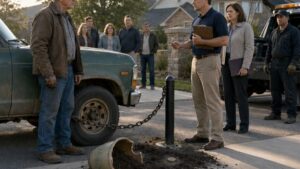
The orange placard went into the gravel with three hard blows.
Each strike carried across the cul-de-sac, sharp enough to turn heads on the clubhouse terrace. Conversations paused beneath the white umbrellas. A waiter stopped beside a table with a tray balanced on one hand. Across the private road, Eric Hall straightened and examined his work.
UNAUTHORIZED OCCUPANCY, the placard read.
Below that, in smaller letters: REPORT SUSPICIOUS ACTIVITY.
Eric had planted it less than two feet from the aluminum step of Ronald White’s RV.
Ronald watched through the screen door.
The RV’s paint had once been cream. Years of sun had faded it toward gray, and the lower panels bore scratches from roads that no longer appeared on most maps. The door looked no better from a distance, but its seams had been repaired carefully. A narrow row of hand-set rivets ran beside the latch, straighter than the factory line.
Eric lifted his phone.
“Day twenty-six,” he announced to the camera. “Still no permit displayed. Still no cooperation. Still parked directly across from the clubhouse.”
Ronald pushed open the screen door and stepped down.
He wore a charcoal work shirt with the sleeves rolled twice, dark trousers, and boots polished only where use had smoothed the leather. At seventy-three, his shoulders had narrowed but not collapsed. He moved without hurry, stopping beside the placard.
Eric turned the phone toward him.
“Care to explain why you’re occupying neighborhood property?”
Ronald looked at the sign, then at the crowd across the road.
“This yours?”
“The Neighborhood Watch placed it.”
“That wasn’t my question.”
A few people on the terrace leaned closer to one another.
Eric’s smile tightened. “You’ve been reported four times.”
“Five.”
The answer unsettled him for a moment.
Ronald crouched, gripped the metal post, and pulled it from the gravel in one controlled motion. He laid it flat, took a small camera from his shirt pocket, and photographed the hole, the sign, and Eric standing beside it.
“What are you doing?” Eric asked.
“Keeping the date.”
“You don’t get to remove official notices.”
Ronald turned the placard over. There was no municipal seal, no association signature, no citation number. Only a Neighborhood Watch emblem printed from a home computer.
“This isn’t official.”
Eric moved closer. “Then show me something that is.”
Ronald returned the camera to his pocket.
“You’re standing too close to my step.”
“Your step?”
Eric swung the phone toward the RV and then back to his own face. “You hear that? He’s claiming the lot now.”
Ronald picked up the sign and carried it inside.
The screen door closed softly.
That softness irritated Eric more than an argument would have.
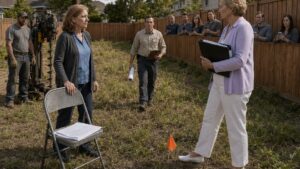
By late afternoon, the clubhouse lawn was crowded for a resident appreciation gathering. Music played from hidden speakers. Children ran between clipped hedges. The RV sat opposite it all like an object someone had forgotten to remove before photographs were taken.
Two maintenance workers arrived with a compact trenching machine and orange paint. One began marking a line near the roadside flower bed.
Ronald came out carrying a book.
“Don’t cut there,” he said.
The operator looked up. “We have the utility plan.”
“It’s wrong.”
Eric, still nearby, raised his phone again.
Ronald pointed with the edge of the book. “Drainage line crosses six feet east of your mark. Forty-two inches down. Cast joint at the bend.”
The worker checked the tablet mounted beside the controls.
“The plan says straight run.”
“The plan was revised after the slope failed inspection.”
Eric laughed loudly enough for the terrace to hear. “Now he designed the place.”
Ronald ignored him.
The older maintenance worker fetched a probe rod. After several pushes, metal rang beneath the soil exactly where Ronald had indicated. He scraped away the top layer with a shovel and exposed the lip of a concrete access collar.
The operator shut down the trencher.
“You just saved us a repair,” he told Ronald.
Ronald opened his book. “Saved yourself one by checking.”
Eric lowered his phone only after the workers moved away.
That evening, Ronald sat at the folding table inside the RV. He transferred the photograph of the placard into a thick brown folder. Behind it were images of tire tracks, bags of clubhouse trash, lawn chairs left near the overlook, and three earlier warning notices. Each page carried a date in his compact handwriting.
Through the window, the wooded corridor beyond the lot held the last sunlight between the trees.
He had almost finished filing the new page when his tablet chimed.
A resident had sent him a link without comment.
Eric’s video began with Ronald pulling out the placard. The earlier question—This yours?—had been removed. So had the blank reverse side showing no official authority.
The edited clip jumped directly to Ronald saying, “This isn’t official.”
Then Eric’s voice appeared over a frozen image of Ronald’s face.
Man refuses neighborhood safety notice. Claims public property as his own.
The comments were already multiplying.
Why won’t he show a permit?
Someone should inspect that vehicle.
It looks abandoned.
Ronald’s finger stopped on the screen.
Abandoned.
He looked toward the door.
Virginia had sat on the ground beside it for two full afternoons, passing him rivets one by one while he rebuilt the warped frame. She had complained about the heat, laughed at the crooked first row, then removed every one and made him start again.
Nothing about that door had been abandoned.
Ronald closed the video and returned the tablet to the table. He told himself the word did not matter.
After dark, a faint scrape sounded outside.
He waited until the footsteps retreated toward the clubhouse, then opened the door.
A white sheet had been fixed across the aluminum panel with heavy tape. At the top was the same Neighborhood Watch emblem.
NOTICE OF REMOVAL.
FORTY-EIGHT HOURS TO VACATE.
One strip of tape crossed the row of rivets Virginia had set by hand.
Chapter 2: Forty-Eight Hours to Leave His Own Land
Melissa Brown slid the folded hearing notice beneath Ronald’s windshield wiper just as he stepped around the rear of the RV.
She froze with one hand still against the glass.
“I was going to knock,” she said.
“No, you weren’t.”
Melissa withdrew her hand and smoothed the front of her pale clubhouse jacket. “The board is meeting at six. You’ll have an opportunity to explain your situation.”
Ronald removed the paper, read the first line, and handed it back.
“The board has no jurisdiction over my address.”
“It’s not really an address.”
“It receives tax bills.”
Melissa glanced toward the clubhouse. Several residents were watching from the entrance.
“This doesn’t need to become hostile,” she said.
“It became hostile when someone taped a removal order to my door.”
“That notice wasn’t approved by the full board.”
“Was it approved by you?”
Her pause was small, but it answered him.
“I approved a request for compliance,” she said. “Eric chose the format.”
Ronald stepped past her and began peeling the remaining adhesive from the aluminum. The tape had left a dull stripe across the rivets.
Melissa held out the hearing notice again.
“People are concerned. There have been package thefts. Cars have been checked at night. No one knows who you are.”
“The police do.”
“The police only said they had no reason to remove you.”
“That should have told you something.”
“It told us they weren’t resolving it.”
Ronald pressed a cloth against the door and worked slowly along the seam. “Not every refusal to satisfy you is a failure to resolve something.”
Melissa’s expression hardened. “Six o’clock.”
He did not answer.
An hour later, Jonathan Adams arrived in a dusty survey truck. He was sixty now, with a stiff walk and a habit of pushing his glasses up with the back of his wrist when his hands were dirty.
He found Ronald beside the road.
“Show me where the marker was,” Jonathan said.
Ronald pointed toward a decorative wooden stake painted forest green. The clubhouse emblem had been burned into its top.
Jonathan stared at it. “That thing?”
“That thing is six feet south of the iron pin.”
They dug beside the stake and found disturbed soil. The original pin was gone.
Jonathan stood, breathing harder than the work justified. “Somebody pulled a registered boundary monument.”
“Or a landscaper thought it was ugly.”
“A landscaper doesn’t move six feet in the convenient direction.”
He took measurements from two fixed corners and entered them into his receiver. The instrument chirped.
“They’ve widened the shoulder again,” he said. “Half the new mulch bed is over.”
Ronald looked toward the clubhouse entrance, where ornamental grasses now curved onto ground that had once been bare gravel.
Jonathan lowered his voice. “Put up temporary barriers.”
“No.”
“Posts and rope. Nothing permanent.”
“No.”
“They’re parking on your parcel.”
Ronald opened the folder he had brought from the RV. He showed Jonathan photographs arranged by year. The earliest depicted a narrow footpath leading toward the overlook. Later images showed benches, bicycles, golf carts, and finally cars angled beneath the trees during clubhouse events.
Jonathan turned a page.
“You documented all this and said nothing?”
“I asked them not to leave trash.”
“That isn’t the same as defending the line.”
“It was never meant to feel like a line.”
Jonathan looked across the wooded corridor. Through the opening, the valley fell away in long green ridges. Virginia had insisted that no house be built there. She had said a view did not become more beautiful merely because someone charged for it.
“You can’t keep pretending she wanted strangers driving across it,” Jonathan said.
Ronald closed the folder.
“She wanted it open.”
“She wanted it respected.”
The words landed harder than Jonathan intended. He adjusted his glasses and looked away.
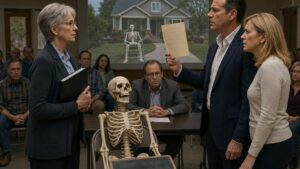
At six, the clubhouse meeting room filled beyond its chairs.
Ronald did not attend.
Melissa sat beneath a framed subdivision rendering while Eric stood beside a screen displaying a photograph of the RV. He had chosen an angle that hid the trees and made the gravel lot look like discarded ground.
“The deadline is tomorrow afternoon,” Eric said. “We cannot keep waiting for agencies to do what they refuse to do.”
A resident near the back raised a hand. “Did the county confirm he’s trespassing?”
“The county has been unresponsive.”
“That isn’t what I asked.”
Eric clicked to a slide labeled OPEN VIEW EASEMENT.
Melissa recognized the phrase from the association files. She had spent the afternoon searching for the deed that created it. She had found maintenance references, landscaping invoices, and old promotional brochures promising “permanent scenic access.”
She had not found a recorded easement.
“The governing documents identify the area for community use,” Eric said.
Melissa looked down at the copy before her. The wording did not say that. It described the area as adjacent to community use.
One word. An old legal precaution, perhaps. Or something more.
She should have corrected him.
Instead she said, “The records are still under review.”
Eric took that as support.
After the meeting, he posted a new video. This time he stood beside the decorative boundary stake with the clubhouse lights behind him.
“Tomorrow,” he told the camera, “the Neighborhood Watch will conduct a peaceful citizen eviction. Everything will be recorded. We will remove unauthorized occupation from property belonging to this community.”
Across the road, Ronald watched the video from the RV step.
Jonathan stood beside him, holding a roll of bright survey ribbon.
“One rope,” Jonathan said. “Give me ten minutes.”
Ronald looked past the road to the view between the trees.
At that hour, the valley darkened first, while the upper ridges kept a narrow edge of gold. Virginia used to bring two metal cups outside and wait for that line to disappear.
“A barrier cuts the view,” he said.
“A rope doesn’t cut anything.”
“It says the gift is over.”
Jonathan tied the unused ribbon back onto his belt.
From the clubhouse terrace came a burst of applause as Eric’s announcement played on someone’s phone.
Ronald remained on the step until the last gold line vanished.
Chapter 3: The Maps Beneath the Folding Table
The tire tracks crossed the missing boundary before sunrise.
Ronald found them while carrying water around the RV. Two deep impressions ran over the disturbed earth where the iron pin had stood, curved through the gravel, and ended near the clubhouse service lane.
Fresh mud clung to the ruts.
He set down the water container and followed them to a scraped patch beneath his rear axle. Whoever had driven through had passed close enough to crush a stack of wooden leveling blocks.
Jonathan arrived twenty minutes later.
“That’s not ignorance anymore,” he said.
He photographed the tracks, then opened the back of his truck and removed a yellow case containing survey equipment.
Ronald watched him set the receiver over a known corner.
“You brought the final drawing.”
“I brought three copies and the patience I have left.”
Inside the RV, they cleared the folding table. Ronald lifted a loose panel beneath it and withdrew a flat metal box.
The maps inside smelled faintly of dust and machine oil.
Some were county plats. Others were hand-drawn grading studies on translucent sheets. Along the margins, numbers had been revised in Ronald’s writing and circled in Virginia’s.
Jonathan unfolded the oldest subdivision plan.
“You still keep everything under here?”
“The roof leaked once. This stayed dry.”
They weighted the corners with coffee cups.
Jonathan placed a current survey over the original layout. The mismatch appeared immediately. Clubhouse landscaping crossed the parcel line. Three parking spaces touched Ronald’s land. The stone base of the entrance sign extended almost two feet past the recorded boundary.
“That’s not all,” Jonathan said. He traced the private road with one finger. “The shoulder widening put another strip inside your parcel. They’ve been maintaining it, so they assume it belongs to them.”
“Maintenance doesn’t transfer title.”
“No, but silence makes people inventive.”
Ronald looked at him.
Jonathan did not apologize.
Years earlier, before the first luxury house had been framed, Jonathan had been a young field assistant carrying stakes for Ronald. Ronald had arrived from military engineering with little patience for decorative plans and an instinct for water, soil, and load. He had shifted the road twice to avoid unstable ground and preserved the view corridor when every financial projection said to divide it.
Virginia had sat at this same folding table, making notes on the maps while the RV served as their field office.
Jonathan slid a formal survey across the table.
“Sign this. It records the restored monuments and the encroachments. Nothing emotional about it.”
Ronald signed.
Jonathan placed a second document beside it.
Revocation of Permissive Access.
Ronald left the pen on the table.
“You own the road,” Jonathan said. “You retained it in every sale. You own the gravel parcel, the wooded corridor, and the access strip beside the clubhouse. I know it. You know it. The county knows it. Eric doesn’t care because you keep behaving as if the record will stand up and speak.”
“It will when it has to.”
“It already had to.”
Ronald walked to the window.
The road curved between stone walls and carefully spaced trees. Residents called it their road because their houses opened onto it. None of their deeds said so. Each property carried a right of passage, limited to reaching the homes. The overlook, parking shoulder, and gravel parcel had never been included.
Virginia had insisted on that distinction.
Keep the road, she had told him. Once people own a path, they start believing they own wherever it leads.
Jonathan tapped the unsigned revocation.
“This doesn’t sell the land. It doesn’t build on it. It tells them the extra use is over.”
“She didn’t want it closed.”
“She also didn’t want warning notices taped to her door.”
Ronald’s eyes moved toward the row of rivets.
Jonathan softened. “You could live in the model house. It’s empty. It has heat, plumbing, a roof that doesn’t need patching.”
“I know what it has.”
“Then why are you still in here?”
Ronald rested one hand on the folding table.
The answer had always seemed too simple to explain without making it smaller.
“Because this is the last place where nothing has been rearranged.”
Jonathan said nothing.
“The house was staged after she died,” Ronald continued. “Furniture moved. Walls repainted. Her desk emptied. In here, the cup hook is where she put it. The dent above the stove is where she dropped the wrench. That door still closes the way it did when we finished it.”
“You’re preserving a room,” Jonathan said.
“I’m preserving what’s left.”
Outside, a vehicle door slammed.
Both men turned.
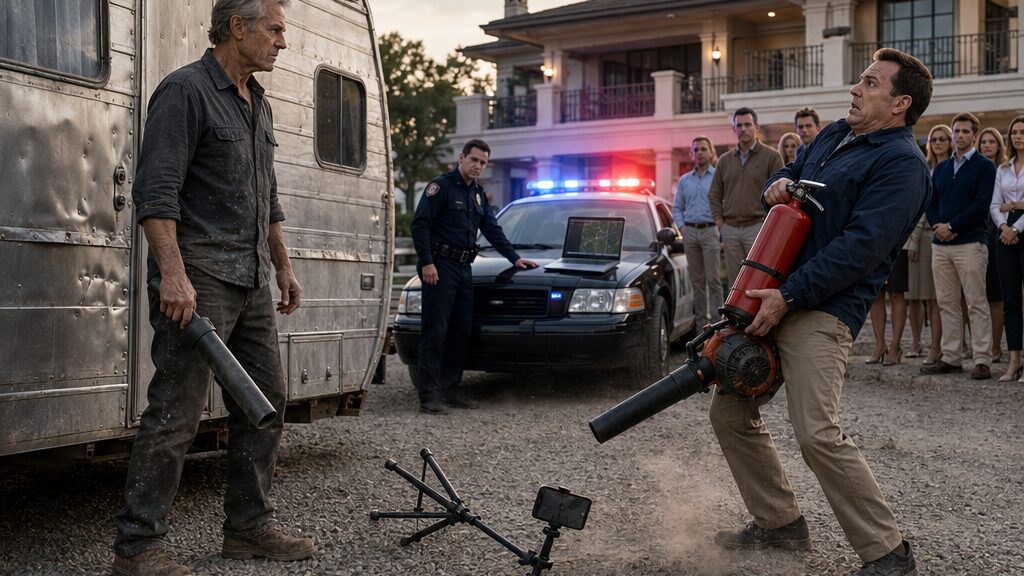
Eric’s sport utility vehicle had stopped near the decorative stake. He opened the rear hatch and began unloading equipment onto the gravel.
First came a black tripod.
Then a long leaf blower.
Then a thick-walled fire extinguisher with a metal handle.
He placed a heavy Maglite on top of the extinguisher and propped his phone against the tripod mount, testing the angle toward the RV.
Jonathan moved to the door.
“I’m calling Daniel.”
“He’ll come when there’s an offense.”
“There is about to be one.”
Across the road, clubhouse employees carried tables onto the terrace. Residents were already gathering for the Saturday event, glancing toward Eric as he arranged his equipment like a man preparing a demonstration.
Ronald returned to the folding table.
He slid the signed survey into the brown folder.
The access revocation remained beneath his hand.
For a moment, he imagined signing it before Eric began. The confrontation could be reduced to paper, timestamps, and a notice properly served.
Then he looked through the window at the wooded opening Virginia had refused to sell.
He put the unsigned document back into the folder.
Outside, Eric lifted the Maglite and walked toward the aluminum door.
Chapter 4: Three Blows Against Virginia’s Door
The first blow against the RV door silenced the clubhouse music.
Metal boomed across the gravel lot. A second strike followed before the echo faded, then a third, harder than the others.
Ronald stood inside with one hand resting on the brown folder.
The row of rivets beside the latch trembled.
Outside, Eric Hall shouted, “Come out, squatter!”
Jonathan reached for his phone. “I’m calling Daniel.”
Ronald slipped the unsigned access revocation into the folder and closed it.
Another blow landed, lower this time. The aluminum skin folded inward with a dry pop.
“Stop hitting the door,” Ronald called.
Eric answered by striking it once more.
Through the window, Ronald saw residents gathering along the clubhouse terrace. Some held drinks. Others held phones. Eric’s tripod faced the RV, and his own phone sat clamped at eye level, livestreaming the doorway.
The fire extinguisher stood beside him like a shield.
Jonathan spoke rapidly into his phone, giving the address and describing the equipment.
Ronald opened the door.
Eric stepped back, lifting the Maglite toward his camera.
“There he is,” he said. “The man refusing a lawful community order.”
The dent beside the latch caught Ronald’s eye. One rivet had pulled partly free. Another leaned at an angle Virginia would never have tolerated.
He stepped down onto the gravel.
“Put the flashlight away.”
Eric looked toward the terrace as if checking whether everyone had heard.
“This vehicle is being removed from community property.”
“You have no authority to remove it.”
“Then prove you belong here.”
“I’ve told you before. You’re on private land.”
“You’ve claimed that before.”
Melissa pushed through the spectators near the road. “Eric, the board did not authorize you to damage anything.”
“I’m protecting the neighborhood.”
“You said this would be peaceful.”
“It is peaceful. He’s the one refusing to cooperate.”
Ronald looked at the tripod. A small red light glowed beneath the phone camera.
“How many people are watching?” he asked.
Eric’s mouth curved. “Enough.”
“That why you brought the equipment?”
“I brought what’s necessary to clear abandoned debris.”
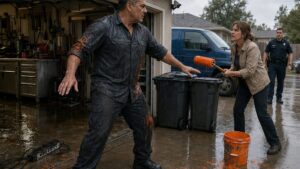
He dropped the Maglite beside the extinguisher and pulled the starter cord on the leaf blower.
The engine coughed, caught, and rose into a hard mechanical roar.
Jonathan moved between the tripod and the RV. “Shut it down.”
Eric swung the long nozzle toward the ground.
Air tore through the gravel. Dust and small stones sprayed beneath the RV, rattling against its metal underside.
Ronald stepped forward.
“Turn it off.”
Eric grinned. “Make me.”
He angled the nozzle closer to the rear wheel. Gravel shot into the leveling blocks, then beneath the chassis where the fuel line, battery cable, and patched electrical conduit ran along brackets Ronald had installed himself.
Ronald moved into the blast.
Dust struck his shirt and face. Fine stones snapped against his boots.
Eric lifted the nozzle.
“Back away,” he shouted over the engine. “You’re obstructing a safety operation.”
“There is no operation.”
“He’s threatening me,” Eric said, turning slightly toward the livestream. “Everyone can see this.”
Ronald did not raise his voice.
“You were warned by police not to touch the vehicle.”
Eric’s eyes flickered.
Jonathan heard it. So did Melissa.
She stepped into the gravel. “You told us the police had done nothing.”
“They refused to act. That’s different.”
“Did they warn you?”
Eric swung the blower back toward the RV. “The board asked for results.”
“I asked for documentation,” Melissa said. “I never authorized this.”
The statement moved through the watching residents in a murmur. Eric’s face tightened as the public support he had counted on shifted beneath him.
“You approved the notice,” he said.
“I did. That was a mistake. This is worse.”
Eric turned the blower toward Ronald again.
The nozzle rose from Ronald’s boots to his chest.
A stone struck Ronald beneath the eye. Another cut the side of his cheek.
He did not flinch.
Behind him, the loosened door vibrated in its frame. The damaged rivet clicked faintly with each pulse from the blower.
Virginia had held that door upright while Ronald aligned the hinges. She had complained that he measured everything twice except his own patience. When the first row of rivets came out crooked, she had sat cross-legged in the gravel and drilled them free herself.
Do it properly, she had told him. Or don’t pretend it’s finished.
Eric advanced half a step.
“Move.”
Ronald saw the nozzle dip toward the exposed underside again.
He moved first.
His left hand caught the tube near its joint. His right locked around the ribbed plastic collar. He twisted sharply across Eric’s grip, using the blower’s own weight against the connection.
The nozzle cracked free.
Eric stumbled backward, still holding the screaming motor unit.
For one second, no one moved.
Then Ronald turned and drove the detached nozzle down across the phone clamped to the tripod.
The screen shattered.
The tripod collapsed into the gravel.
The livestream died.
Eric released the blower. It struck the ground and sputtered sideways until Jonathan kicked the switch off.
Silence fell so suddenly that Ronald could hear the clubhouse fountain across the road.
Eric stared at the broken phone.
“You attacked me.”
“I stopped the machine.”
“You destroyed my property.”
“Yes.”
The answer seemed to confuse him.
Eric backed toward the fire extinguisher and seized its handle. He did not pull the pin, but he held the cylinder between them.
“You all saw that,” he shouted. “He came at me.”
Melissa looked at the cut on Ronald’s cheek, then at the gravel scattered under the RV.
“We saw what you did first.”
“He could have killed me.”
“With a plastic tube?” Jonathan asked.
Eric pointed at Ronald. “He’s dangerous. He’s been hiding here for months, and now he’s destroyed evidence.”
“The recording may still be in the cloud,” Melissa said.
Eric turned on her. “Whose side are you on?”
The question exposed more than he intended.
Melissa’s face changed.
“This isn’t about sides.”
“It has always been about sides.”
“No,” Ronald said. “It’s about lines.”
Sirens sounded beyond the trees.
Eric looked toward the road, relief flooding his expression.
“Good,” he said. “Now we’ll see who owns what.”
Ronald set the cracked blower nozzle beside the ruined tripod.
The patrol car entered the cul-de-sac with its lights washing blue and red across the clubhouse walls. Residents stepped back from the road. Daniel King stopped near the decorative boundary stake, exactly where the old iron pin had been removed.
Ronald picked up the brown folder and waited beside Virginia’s dented door.
Chapter 5: The Road Under Eric’s Shoes
“Arrest him!”
Eric pointed at the shattered phone before Daniel had fully opened the patrol car door.
“He attacked me, destroyed my property, and threatened everyone here.”
Daniel stepped out, surveyed the crowd, then looked at Ronald’s bleeding cheek and the dented RV door.
“Put down the extinguisher, Eric.”
“I’m protecting myself.”
“Put it down.”
Eric lowered the cylinder but kept one hand on its handle.
A second officer remained near the patrol car while Daniel walked through the gravel. His gaze moved from the broken tripod to the detached blower nozzle, the scattered stones beneath the RV, and the Maglite lying beside the step.
“Anybody need medical attention?”
“No,” Ronald said.
“He assaulted me,” Eric repeated.
Daniel looked at him. “Did he strike you?”
“He ripped the machine out of my hands.”
“Did he strike you?”
“No, but—”
“Then let me ask the questions.”
Daniel turned to Ronald. “Did you break the phone?”
“Yes.”
Eric threw up both hands. “There. You heard him.”
Daniel ignored the interruption. “Why?”
“It was recording while he directed the blower at me and under the vehicle. I removed the nozzle. Then I broke the phone.”
“You could have set it down.”
“Yes.”
Ronald did not soften the admission.
Daniel studied him for a moment. “Stay here.”
He began separating witnesses.
Melissa described the blows against the door and stated twice that the board had not authorized physical action. Jonathan showed the photographs of the tire tracks and the moved boundary marker. Several residents offered videos from the terrace.
Eric spoke last and longest.
He called the RV a public hazard, the gravel lot common property, and Ronald’s refusal to attend the hearing proof of bad faith. He insisted the blower had been used only to clear debris.
Daniel held up one of the residents’ phones. The video showed Eric lifting the nozzle toward Ronald’s chest.
“That angle look like debris to you?”
Eric’s jaw worked. “He stepped into it.”
“After telling you to stop.”
“He had no right to order me off community land.”
Daniel looked toward the decorative stake.
“We’ve discussed that before.”
Eric’s expression changed.
Melissa heard it. “You warned him?”
Daniel did not answer her immediately.
He faced Eric. “Two weeks ago, I told you this was a civil property issue and that you were not to touch the vehicle, move belongings, or attempt an eviction.”
“You said the ownership was unclear.”
“I said I wasn’t determining ownership from the roadside. I also said uncertainty did not give you authority.”
Eric glanced at the crowd.
“That isn’t how I remember it.”
Daniel pointed toward the damaged phone. “Was your stream recording before this began?”
“Yes.”
“Did you mention that warning?”
Eric said nothing.
Jonathan crouched beside the broken device. The screen was destroyed, but the case remained intact.
“The account may have archived it,” he said.
Daniel asked Eric to unlock a tablet he had left in his vehicle. After several objections, Eric complied.
The livestream account opened to a saved recording.
They watched the beginning in silence.
Eric stood before the camera, smiling with the Maglite in one hand.
Law enforcement has refused to act, he had told his audience, and they specifically advised me this was a civil matter. That means the community must defend itself.
Daniel stopped the video.
“You knew.”
“I knew you wouldn’t help.”
“That is not the same thing.”
Eric’s certainty began to fray. He shifted from accusation to explanation, speaking of package thefts, suspicious cars, and residents who expected him to do something.
“I’m the one they call,” he said. “Every time something happens, they ask where the Watch was. Then when I take action, everyone pretends they never wanted it.”
Some residents looked away.
The complaint was not invented. Ronald could see that. Eric had built his authority from their fear and their convenience. They had wanted a protector until protection became embarrassing.
Daniel returned to the patrol car and opened a laptop.
“Ronald, identification.”
Ronald handed it over with the deed and signed survey.
Daniel entered the parcel number first. Then he opened the county mapping system and overlaid the subdivision plat. Jonathan pointed out the restored coordinates, but Daniel verified each against the digital record.
The clubhouse crowd edged closer.
The map showed the gravel lot outlined separately from every residential parcel. The private road ran through the subdivision under Ronald White’s ownership, burdened only by specific rights of passage to the houses. The wooded corridor carried no recorded community easement.
Daniel checked the deed twice.
Then he stepped away from the laptop.
“Eric.”
Eric folded his arms.
“This parcel belongs to Mr. White. So does the wooded strip behind it.”
“What about the road?”
Daniel looked down at the asphalt beneath Eric’s shoes.
“The road is his private property. Residents have deeded passage to reach their homes. That does not make the shoulders, overlook, or gravel lot community land.”
No one spoke.
The fountain continued splashing across the road.
Eric looked toward Melissa. “The brochures promised scenic access.”
“Brochures aren’t deeds,” Daniel said.
“People have used that overlook for decades.”
“With permission,” Ronald said.
It was the first time he had addressed the crowd directly.
Eric turned toward him. “You never gave permission.”
“I never stopped it.”
“That means it was public.”
“No. It means I tolerated it.”
The distinction hung between them.
Daniel photographed the dented door, including the pulled rivets. He photographed the Maglite and the gravel beneath the RV. Jonathan showed him where the decorative stake stood six feet inside Ronald’s surveyed line.
Melissa stared at the clubhouse emblem burned into its top.
“We put that there,” she said quietly.
Ronald looked at her. “Yes.”
“Why didn’t you tell us?”
“I did. You asked for proof instead of listening.”
“You could have shown the deed months ago.”
“I could have.”
His answer held no triumph. That made it harder to dismiss.
Daniel returned Ronald’s documents. “The property damage to the phone may still be a civil matter, possibly more depending on value and circumstances. I’m documenting it.”
“I understand.”
Eric stepped forward. “Possibly? He admitted it.”
“And you admitted you entered private property after being warned, damaged the RV, and used equipment against its owner. Those facts are also being documented.”
Eric’s face drained of color, but pride kept him upright.
“You can’t let him close the road.”
“I can’t tell him what to do with property he owns, except where recorded access rights apply.”
Ronald opened the brown folder.
The unsigned revocation lay beneath the survey.
For years, the neighborhood had crossed the gravel to reach the overlook. Residents parked under the trees during parties. Children rode bicycles along the shoulder. Virginia had wanted that life around the view.
Ronald saw the dent beside the latch.
He placed the paper on the hood of Daniel’s patrol car.
Jonathan handed him a pen.
Melissa took one step forward. “Ronald, don’t decide this because of today.”
He looked at the document.
“Today didn’t begin it.”
He signed his name beneath the revocation of permissive access.
Chapter 6
Chapter 7: The View Behind the Locked Fence
The chain rattled through the final gatepost just after eight in the morning.
Its metallic scrape drew residents from the clubhouse terrace and from houses along the cul-de-sac. By the time a worker fed the last length through the steel latch, a loose crowd had formed on the road shoulder.
The familiar path to the overlook now ended at a locked gate.
Behind it, the trees stood exactly where they had always stood. Morning light passed through the chain-link mesh. The valley remained visible beyond the trunks, but the gravel turnout, the informal parking area, and the worn trail beneath the trees were no longer open.
Ronald stood beside the RV with a cup of coffee.
The repaired door carried the shape of Eric’s blows. Ronald had pushed the worst dent outward and replaced the torn rivets, but he had not tried to hide the shallow creases in the aluminum.
Jonathan walked the fence line with a level and a rolled survey plan. Every post followed the registered boundary. Bright markers showed where the association’s mulch bed and decorative stake had crossed onto Ronald’s parcel.
A resident near the clubhouse entrance called out, “How are people supposed to reach the overlook?”
Jonathan continued checking the posts.
Ronald answered. “They aren’t.”
Several voices rose at once.
“You can’t close a community trail.”
“My children ride there.”
“We’ve used that path for fifteen years.”
Melissa stepped from the clubhouse carrying the association binder. She looked exhausted, as if the emergency meeting had never truly ended.
“The board has confirmed the fence is within Mr. White’s recorded property,” she said.
A man in a golf shirt pointed toward the trees. “Then why did every sales brochure show the view?”
“Because the view was visible,” Melissa replied. “Not because the land was included.”
That answer satisfied no one, but it changed the argument. Residents stopped speaking as owners and began speaking as people asking not to lose something.
Ronald heard the difference.
Eric arrived with a new phone mounted on a short handheld grip.
He began recording before he reached the crowd.
“This is collective punishment,” he announced. “One man has decided to retaliate against an entire neighborhood because he lost his temper.”
Melissa turned toward him.
“Do not identify yourself as representing the association.”
Eric kept the camera raised. “I’m the Neighborhood Watch captain.”
“Not anymore.”
The words stopped him.
Melissa opened the binder and removed a single page.
“The board voted last night to suspend the Watch program and withdraw authorization for its name and emblem. You are not to act on behalf of the association.”
Eric stared at her. “After everything I did for this place?”
“You damaged private property after being warned not to intervene.”
“I was trying to protect residents.”
“You were trying to be seen protecting them.”
A few people looked down.
Eric’s camera shifted toward Ronald. “And he gets rewarded?”
Ronald set his coffee on the RV step.
“This is not a reward.”
“You shut out people who had nothing to do with me.”
“I shut the boundary you crossed.”
Eric gestured at the fence. “That’s the same thing.”
“No.”
Ronald walked to the gate.
Outside the fence, Jonathan had left a narrow pedestrian route along the public side of the parcel. Fresh stakes marked it clearly. It did not enter the wooded corridor or connect to the overlook, but it allowed walkers to pass without stepping into the road.
Ronald pointed to it.
“That path remains outside my line. The road access written into each deed remains untouched. No one is being blocked from a home.”
“What about the view?” someone asked.
Ronald looked through the mesh toward the valley.
“You can still see it.”
The crowd fell quieter.
An opaque wall would have erased the landscape entirely. Ronald had rejected that. The fence ended assumptions, not sight.
Eric raised the phone closer. “You expect people to stand behind wire and thank you?”
“No.”
Ronald returned to the RV.
A patrol car entered the cul-de-sac and stopped near the gate. Daniel stepped out carrying a thin case file.
Eric smiled bitterly. “Here to arrest him at last?”
Daniel ignored him and approached Ronald.
“I finished the supplemental report,” he said. “The damage to the phone will likely be handled through restitution or a civil claim unless the prosecutor decides otherwise.”
Ronald nodded. “I’ll answer whatever is filed.”
Eric looked surprised by the lack of resistance.
Daniel continued. “Your trespass and property-damage complaints are also documented. The videos support both.”
“I understand.”
“You could each decide not to pursue parts of this.”
Ronald glanced at the repaired door.
“I’ll follow the lawful process.”
Eric lowered his phone slightly. “So he buys me a new phone and pretends none of this happened?”
“I didn’t say that,” Daniel replied.
Ronald faced Eric.
“I broke what belonged to you. I’ll pay what the law says I owe. You struck what belonged to me. You’ll answer for that.”
There was no anger in his voice. No performance. The balance of it left Eric with nothing to push against.
Daniel walked toward Jonathan to inspect the gate clearance.
Melissa remained near the RV.
“I owe you an apology,” she said.
Ronald picked up his coffee.
“You owe the next person you doubt a question before a warning notice.”
She accepted that.
After a moment, she looked toward the trees.
“Virginia really wanted people to enjoy it?”
“Yes.”
“Then this must feel like losing her plan.”
Ronald studied the fence.
“No. I misunderstood her plan.”
Melissa waited.
“She wanted people to enjoy the land. She didn’t ask me to let them own my silence.”
The workers tightened the gate chain. The lock snapped shut.
Some residents left angry. Others stayed, staring through the metal grid at the ground they had crossed without ever wondering whose permission made it possible.
Eric was the last to leave. He filmed the fence as he walked away, but he no longer spoke into the camera.
Several days later, the decorative community stake was gone. The mulch bed had been trimmed back to the recorded line. No cars parked beneath the trees. No discarded cups appeared beside the trail.
The view remained.
Ronald sat at the folding table inside the RV with the brown folder open before him. He placed Virginia’s note above the survey, the deed, and the signed access revocation.
Not behind the door.
Not inside the wall.
With the records still in use.
He closed the folder, lifted his book, and stepped outside.
The repaired door resisted slightly at the dent before opening. Ronald adjusted his grip and pushed until the latch cleared.
Then he sat beside the RV with his coffee while the morning sun passed through the fence and touched the road he had finally chosen to name as his own.
The story has ended.