He Aimed a Floodlight Through My Windows Until the Property Line Cut Through His House
Chapter 1: The Night Christopher Turned Richard’s Windows White
The living room exploded into white light.
Richard Thomas had been standing beside the sofa with a mug in his hand when every window facing the backyard turned into a sheet of glare. The framed photographs on the opposite wall threw hard black shadows. The television vanished beneath the brightness. Even the glass in the cabinet flashed as if someone had opened a furnace door outside.
Coffee jumped over the rim and burned his fingers.
Richard set the mug down carefully.
Beyond the curtains, an engine idled with the low uneven vibration he had learned to recognize through the walls. One of Christopher Walker’s commercial vans. The third white van had arrived that afternoon, nosed through the narrow opening where the new wooden fence ended near the driveways.
Richard had photographed it at 4:17.
He had photographed it again at 6:02 after its rear wheels crossed the orange survey string.
Now, at 9:36, Christopher had added the light.
Richard drew one curtain aside by two inches.
An industrial floodlight stood on a yellow tripod in the backyard, its rectangular lamp aimed directly at his living-room windows. Christopher was beside it, one hand on the battery pack and the other holding a phone.
He was not filming the light.
He was filming Richard’s back door.
Richard let the curtain fall.
For months, Christopher had treated the strip between the properties as if it belonged to whichever vehicle reached it first. His vans used it to reverse, turn, and wait between jobs. Drivers left engines running beneath Richard’s bedroom window. Muddy tires crushed the grass. Once, a van had blocked Richard’s side gate for eleven hours.
Each time Richard complained, Christopher called it temporary.
Each time temporary lasted longer.
The fence had gone up three days earlier: cedar boards, clean posts, every footing measured six inches inside Richard’s surveyed boundary. Richard had paid extra to keep it entirely on his own land. No shared maintenance. No argument over ownership. No excuse.
Christopher had watched the installers from his driveway and laughed.
“Building yourself a fortress?”
Richard had answered, “Building a fence.”
Now the fortress glowed like an interrogation room.
He crossed to the hall closet and took out a small light meter, the one he had used during his years supervising municipal maintenance crews. He also took a camera, a notebook, and the folder containing the survey.
The old instinct to walk outside empty-handed and settle the matter face-to-face pressed against his ribs.
He remembered another yard years earlier. Two men shouting near a broken trench barrier. A coworker’s mouth red with blood after Richard shoved him away harder than necessary. The investigation had cleared Richard of deliberate assault, but the sound of the man’s shoulder hitting a steel cabinet had stayed.
Richard opened the camera application instead.
He photographed the meter reading from three positions in the living room. He recorded the glare across the television, the photographs, the sofa where he usually sat at night. Then he moved to the kitchen and filmed through the glass of the back door.
Christopher stepped into view as if summoned.
“Getting everything you need?” he called.
Richard opened the door but remained inside.
“Move the light.”
Christopher smiled toward his phone. “Maybe now you’ll stop whining about my vans.”
“The light is across the marked line.”
“Your marked line.”
“The surveyor’s.”
Christopher turned the phone slightly, keeping Richard centered. The angle excluded the tripod’s feet.
Richard noticed that and felt something colder than anger.
Christopher wanted a reaction clean enough to show someone else.
Richard raised his own camera. “I’m documenting the placement.”
“Document whatever makes you feel important.”
Christopher gripped the tripod and dragged it forward. One metal foot crossed the orange string. Then another. He moved the lamp nearly a yard closer to Richard’s fence opening and planted it there.
“That strip has always been mine,” he said.
The van behind him sat at an angle, its back tires on Richard’s grass and its front end pointed toward Christopher’s driveway. There was plenty of room to park it elsewhere only if Christopher removed two other vans and stopped using the backyard as a business lot.
Richard photographed the tires, the string, and the survey stake half hidden beneath the rear bumper.
“You received written notice,” Richard said.
“I received a letter from a man who bought a house and decided history started with him.”
Richard’s hand tightened around the camera.
He wanted to remind Christopher that he had lived there four years. He wanted to list every blocked gate, every midnight engine, every apology that became another trespass. He wanted, with a clarity that frightened him, to walk across the line and knock the phone out of Christopher’s hand.
Instead he said, “Move the equipment and the van before morning.”
Christopher gave a short laugh. “Or what?”
Richard closed the door.
The floodlight stayed on.
He covered the windows with blankets, but the white beam burned around their edges. At ten, the van engine stopped. At eleven, the light remained. At midnight, Richard went outside through the side door with his camera and flashlight.
The cedar fence smelled fresh where the boards had been cut. The orange survey string ran low between two stakes, visible beneath the floodlight’s glare. Richard followed it toward the rear of the property, documenting the tripod, the tire tracks, and the van.
At the final stake, he crouched.
The string continued beyond the fence line toward Christopher’s house extension, a boxy room added onto the back corner of the original structure. Christopher used it as his office. Through its windows, Richard could see metal shelves, stacked invoices, and the blue glow of computer monitors.
He had always assumed the extension sat close to the boundary.
From this angle, with the string pulled straight, close was not the word.
The orange line appeared to pass beneath the extension’s outer wall.
Richard shifted left, then right, checking the sightline. The van’s rear tire, the floodlight tripod, and the corner of Christopher’s office all stood on the same side of the string.
His side.
Behind him, Christopher’s floodlight hummed against the darkness.
Richard lifted the camera and took one final photograph.
Chapter 2: The Fence That Threatened More Than Parking
The scrape crossed three cedar boards at bumper height.
Richard found it just after sunrise, a pale wound cut through the stain on his new fence. Below it, thick tire tracks pressed into the damp soil and rolled directly over the orange survey stake. The stake leaned almost flat, its bright cap buried under mud.
The white commercial van was gone.
Richard crouched beside the damage and placed a ruler against the deepest groove before photographing it. He recorded the tire pattern, the crushed grass, and the bent stake. Then he straightened the marker without pulling it from the ground.
Across the opening, Christopher stood with a travel mug in one hand.
“Your fence is too tight,” he said.
Richard kept the camera aimed downward. “Your driver hit it.”
“My driver was using the access lane.”
“There is no access lane.”
Christopher stepped closer. Without the floodlight behind him, he looked older than he had the night before. His face was drawn, and his work shirt carried the sharp folds of something put on in a hurry.
“My vans have used that strip for years,” he said. “Before you lived here. Before you decided to turn six feet of grass into a federal border.”
Richard rose. “You don’t gain ownership by driving over someone else’s property.”
“You can gain access rights.”
“Show me the easement.”
Christopher’s jaw shifted. “Remove the last two fence panels. We can settle it like adults.”
“The panels are inside my line.”
“You built them to choke my business.”
Richard looked past him. Two vans were parked nose-to-tail along Christopher’s driveway. Another sat beside the house extension, wedged so close to the wall that its passenger door could not open. A fourth vehicle waited at the curb with its hazard lights blinking.
The business had not merely used Richard’s strip out of convenience.
It needed the strip to function.
A woman in a navy jacket came from the extension carrying a clipboard. Richard recognized her as Sharon Lee, Christopher’s office manager. She often directed drivers in the mornings, waving vans through the gap while speaking into a headset.
She stopped beside Christopher but addressed Richard.
“We have crews due across town,” she said. “If the vans can’t turn here, two routes don’t leave.”
“That isn’t my doing.”
“No,” Sharon said, glancing at the fence. “But people could lose hours over it.”
Christopher gave her a warning look, as if she had weakened his position by sounding reasonable.
Richard studied the line of vans. The drivers inside avoided looking at him. They were not the ones who had aimed a floodlight into his living room.
For a moment, the fence felt different. Less like protection and more like a lever placed beneath several people’s wages.
Then he looked down at the scrape.
“Christopher had months to arrange lawful parking,” Richard said.
Christopher stepped between him and Sharon. “You don’t know what I had.”
“I know what you used.”
The answer came too sharply. Richard saw satisfaction flicker across Christopher’s face.
Another reaction collected.
Richard turned away before the exchange could grow.
At the municipal records office, the clerk searched the property database by parcel number. Richard stood at the counter while pages appeared and vanished on the monitor: tax maps, utility diagrams, drainage notes, permit summaries.
“No recorded easement,” the clerk said.
“Not even temporary access?”
“Nothing attached to either deed.”
Richard placed Christopher’s claim in the notebook. “Could long use create one?”
“That is a legal question, not a records question. But if you are asking whether we have a registered right-of-way through your parcel, we do not.”
It was a small victory, but not the one Richard had expected. Christopher could not point to a filed document granting access. The vans had crossed because the previous owner allowed it or failed to stop it.
Tolerance had hardened into entitlement.
The clerk brought up an older scanned parcel drawing. The image was faded, its measurements typed beside hand-drawn lot lines.
Richard unfolded the current survey on the counter.
The clerk compared them. “Your recent fence appears conservative. Looks like it sits within your parcel.”
“How far within?”
“Depends on the segment. Four to seven inches.”
“So his driver crossed the boundary before hitting it.”
“That would be consistent with these drawings.”
Richard hesitated before pointing to the rear corner. “What about this structure?”
The clerk enlarged the scan.
Christopher’s house extension did not appear on the oldest image. On a later aerial overlay, it projected toward the boundary. The drawing and photograph were not aligned precisely enough to establish the exact distance, but the concern was obvious.
The clerk leaned closer.
“That addition may require a field verification.”
“May?”
“These records can show a discrepancy. They cannot establish an enforcement line by themselves.”
Richard felt the edge of his folded survey beneath his palm. “Who can?”
“Survey division first. Planning after that. If the structure crosses the parcel boundary, they will need the permit history.”
She printed the older drawing and stamped it as an unofficial copy.
On the way home, Richard passed Christopher’s business yard twice before turning into his own driveway. A van was again positioned near the fence opening. Sharon stood beside it, guiding the driver through a turn that used every inch of available space.
She raised a hand, asking him to wait.
Richard stopped his car.
The van reversed. Its bumper came within inches of the scraped boards, then swung across the orange line. Sharon winced as the rear tire rolled onto Richard’s grass.
When the van cleared, she approached his window.
“I told him this setup wouldn’t last,” she said quietly.
Richard looked toward Christopher’s extension. “How long has the office been there?”
“Longer than I have.”
“That isn’t what I asked.”
Sharon’s expression closed. “I’m trying to keep people working.”
“So am I.”
He drove into his garage.
Inside the house, he spread the current survey and the older parcel drawing across the kitchen table. He aligned the street edge, the rear corners, and the printed dimensions. The two documents were not identical, but the boundary remained consistent.
He laid a ruler along it.
The line passed beneath the outer room of Christopher’s extension.
Not along the siding.
Not through the gutter.
Beneath the room itself.
Richard stared at the measured distance printed beside the rear lot marker.
If the plan was accurate, Christopher’s office stood several feet inside Richard’s property.
The vans were not the largest thing Christopher had placed across the line.
Chapter 3: A Blueprint That Proved Less Than Richard Hoped
Emily Martinez placed a steel ruler across the municipal plan and held it there with one finger.
“If these reference points match the current survey,” she said, “the boundary appears to enter the extension by approximately six feet.”
Richard looked from the ruler to her face.
“Six feet,” he repeated.
“Approximately.”
“That is not close.”
“No.”
“So the structure is on my land.”
Emily removed the ruler. “That is not what I said.”
They sat in a small meeting room inside the planning office. The table was crowded with Richard’s survey, the older parcel drawing, printed photographs, and the unofficial copy from records. Fluorescent light flattened every page to the same dull gray.
Emily turned the current survey toward herself.
“This document establishes the surveyed boundary based on the fieldwork completed for your fence,” she said. “The archived plan suggests a conflict with the extension. Before enforcement, we need to confirm control points, inspect the structure, and review the permit file.”
“The line either goes through it or it doesn’t.”
“In the field, yes. In an enforcement action, every step matters.”
Richard leaned back. He knew she was right. He had spent years telling residents the same thing when they demanded immediate repairs based on what looked obvious from a driveway. Measurements had to be tied to records. Records had to be tied to authority.
Knowing the process did not make it feel less like delay.
Emily lifted one of his photographs. It showed the floodlight tripod across the orange string, the commercial van behind it, and the extension in the background.
“When was this taken?”
“Last night.”
“And the fence damage?”
“This morning.”
“You have active trespass concerns separate from the structure.”
“Yes.”
“Those may justify an expedited site visit.”
Richard nodded, but Emily did not make a note yet. Her attention had shifted to a date printed in the lower corner of another page.
“You requested this archived plan three weeks ago.”
He said nothing.
Emily looked up. “Did you notice the extension conflict then?”
“I noticed it might be close.”
“You worked in municipal maintenance.”
“Not surveying.”
“But you understand plans.”
Richard’s eyes returned to the ruler.
He had understood enough.
Three weeks earlier, he had stood in the records lobby with the same drawing folded under his arm. He had gone home, measured from the visible marker to Christopher’s siding, and reached a distance near six feet. Then he had put the document in a drawer.
At the time, Christopher’s vans were the problem he wanted solved. Filing a structural complaint felt like using a hammer where a gate might work. The extension was not a shed or a concrete pad. It was part of a house. Christopher ran his company from it. People worked there.
There had also been another reason, one Richard disliked more.
He had been furious when he found the first measurement.
Too furious to trust what he wanted done.
“I did not file,” Richard said.
“I can see that.”
“I thought the fence would end the access problem.”
“And if it had?”
Richard looked at her.
Emily’s voice remained even. “Would you have ignored the possible encroachment?”
“I don’t know.”
That was the cleanest answer he had.
She studied him for a moment, then wrote on the inspection form.
“I will schedule a field verification for tomorrow afternoon,” she said. “The floodlight, vehicle use, disturbed marker, and fence damage make the boundary active enough to prioritize.”
Richard felt relief, followed immediately by unease.
“What happens if you confirm it?”
“Planning reviews the permit history. Ownership disputes can involve civil action, but unpermitted construction is an enforcement issue.”
“Demolition?”
“Possibly. Correction, removal, redesign. It depends on what was approved and whether legal alternatives exist.”
Richard imagined the room split open, desks carried out, siding torn away. The image brought no satisfaction.
Emily gathered the photographs. “Do not move the survey stakes. Do not obstruct inspection access. And do not engage in physical confrontation.”
“I haven’t.”
She looked at the image of Christopher’s tripod across the line.
“Keep it that way.”
By the time Richard returned home, a municipal notice had already been taped to Christopher’s front door.
Christopher stood in the driveway beneath it, reading. Sharon was beside him, and two drivers lingered near the vans. The moment Richard stepped from his car, Christopher tore the notice from the door.
“You went after my house.”
Richard closed the car door. “I requested an inspection.”
“In front of my employees? With an official notice stuck where customers can see it?”
“You put a floodlight through my windows.”
“This is about six inches of grass.”
“The inspection will establish what it is about.”
Christopher crossed the driveway. Several neighbors had come outside, drawn by the raised voice and the municipal vehicle that had delivered the notice.
“You couldn’t beat me on the vans,” Christopher said, loud enough for everyone to hear, “so now you’re trying to have my home torn apart.”
Richard felt the accusation enter him more easily than it should have.
He had delayed because he did not want exactly that. Now the delay made the complaint look strategic, almost cruel.
Sharon stepped forward. “Christopher, not here.”
He ignored her.
“My office supports five households,” he said. “That fence already blocks our routes. If you take the extension too, you don’t hurt me alone.”
Richard looked at the drivers. One lowered his eyes.
“I did not build your office,” Richard said.
“No. You just waited until you were angry enough to destroy it.”
The words landed close to the truth.
Richard took the folded survey from his car but did not open it. “If the structure is legal, the inspection will show that.”
Christopher laughed once.
Not loudly. Not for the neighbors.
For Richard.
“You really think your drawing is the only paper that matters?”
Richard said nothing.
Christopher stepped closer, lowering his voice.
“The man who owned your house before you knew exactly how that strip was used. He signed consent. Vans, construction, all of it.”
Richard’s grip tightened on the survey.
“What consent?”
Christopher smiled without warmth.
“Yo
Chapter 4: The Consent Letter With the Missing Page
The laminated letter slid beneath Richard’s gate before sunrise.
He found it when he opened the side door and nearly stepped on it. The plastic sleeve was wet with dew, but the page inside had been protected. Christopher had highlighted three lines in yellow.
Permission is granted for temporary vehicle access along the eastern side of the property during construction and related works.
Richard read the sentence twice.
At the bottom was the previous owner’s signature.
Above it, Christopher’s.
Across the top, written in thick black marker, were four words.
YOU KNEW WHAT YOU BOUGHT.
Richard carried the letter into the kitchen and placed it beside the municipal blueprint. For several minutes, the two documents lay under the pendant light like opposing claims in a courtroom.
The signature looked genuine.
The date was eight years earlier, close to when the extension had been added. The letter mentioned vehicle access, construction deliveries, and the narrow strip now blocked by Richard’s fence. Christopher had not invented the relationship with the previous owner.
But the page ended too neatly.
There was no closing paragraph explaining when access expired. No second page. No legal description. No mention of an easement, ownership transfer, or permanent building permission. The lower edge of the text stopped halfway down the sheet, leaving a broad empty space above the signatures.
Richard removed the page from its sleeve and held it toward the light.
Two staple holes marked the upper-left corner.
A faint pressure line crossed the back where another page had once rested against it.
He photographed both.
At eight, he called the planning archive. The clerk searched the property file while he waited at the kitchen table.
“We have a reference to owner consent,” she said at last, “but the attachment was not digitized with the main permit application.”
“Can I see the paper file?”
“It has been requested for tomorrow’s inspection review.”
“By whom?”
There was a pause. “The applicant contacted us yesterday.”
Christopher.
Richard looked through the kitchen window toward the extension. Its blinds were shut. Two commercial vans stood in the driveway, but the strip beside the fence was empty.
For the moment.
The clerk added, “You may inspect the archive copy after staff logs it. Do not rely on a document supplied by either party until we compare it with the official file.”
Richard thanked her and ended the call.
He wanted to believe the missing page contained nothing important. Perhaps the signatures had simply been moved to a separate sheet. Perhaps the staple holes came from another attachment.
But Christopher had laminated only one page.
That choice bothered him more than the letter itself.
Near noon, a van engine started beyond the fence. Richard went outside and saw Sharon directing a driver toward the opening. The vehicle stopped before crossing the orange string.
Christopher was nowhere visible.
Sharon walked to the fence with her clipboard tucked under one arm.
“You got the letter,” she said.
Richard held it up.
“Is there another page?”
Her gaze dropped to the staple holes.
“I don’t handle his property records.”
“That isn’t an answer.”
“No.” She looked toward the extension. “It isn’t.”
Richard waited.
Sharon exhaled through her nose. “Christopher told us the old owner allowed access. That part is true. Drivers used this strip during construction, and afterward nobody stopped them.”
“Did the old owner allow the extension onto the land?”
“I wasn’t here when it was built.”
“But you know where the permit file is.”
Her expression changed so slightly that someone who had not spent years reading reluctant contractors might have missed it.
Richard lowered his voice. “Emily is inspecting tomorrow. If there is an approval, it will surface. If there isn’t, hiding the file makes this worse.”
“You think I don’t know that?”
The sharpness surprised him.
Sharon glanced back at the office windows. “He keeps the original construction folder in the locked cabinet behind his desk. He told everyone that no one discusses it. Not with inspectors. Not with neighbors. Not even with the insurance company unless he is present.”
“Why?”
“He says people misunderstand paperwork.”
“Do you?”
She looked at the vans. “I understand that five crews depend on this yard opening every morning.”
Richard followed her gaze. “And that excuses using my land?”
“No. It explains why I kept helping.”
The admission hung between them.
Sharon’s loyalty was not to Christopher alone. It was to the drivers waiting for routes, the invoices processed inside the extension, and the paychecks attached to a business that had grown beyond its walls.
Richard understood the pressure.
He did not accept the trespass.
“The previous owner may have wanted to help,” he said. “Temporary access is not ownership.”
Sharon gave a tired nod. “He was older. Christopher drove him to appointments sometimes. Fixed his gate. Cleared snow. The arrangement was informal.”
“And Christopher made it permanent.”
“He makes most things permanent if nobody stops him.”
A door slammed on the other side.
Christopher emerged from the extension carrying a set of van keys.
Sharon stepped away from the fence.
“What are you telling him?” Christopher called.
“That tomorrow’s schedule needs changing.”
“It doesn’t.”
Christopher tossed the keys to a driver. “Move the blue-marked van into the side strip.”
The driver hesitated. “There’s not enough clearance.”
“There was enough before the fence.”
Richard moved toward the opening. “Do not cross the survey line.”
Christopher smiled. “You have a signed consent letter.”
“For temporary construction access.”
“It says related works.”
“Eight years ago.”
“My business is related work.”
The driver remained behind the wheel, looking from one man to the other.
Christopher pointed toward Richard’s property. “Move it.”
The van rolled forward.
Its front tire crossed the orange string and climbed onto Richard’s grass.
Richard raised his camera.
Christopher watched him photograph the trespass, then walked to the final fence panel and slapped the wood with his palm.
“This opening is coming out before the inspection,” he said.
“You touch the fence, I call the police.”
“You should have called them last night. Maybe they could explain consent to you.”
Richard held up the laminated page. “Where is the second sheet?”
For the first time, Christopher’s confidence faltered.
Only for a second.
Then his face hardened. “There is no second sheet.”
“The staple holes say otherwise.”
“You are examining paper now?”
“I am examining what you chose not to show.”
Christopher stepped closer. “Tomorrow, when the inspector sees that signature, this ends.”
“Then give her the complete file.”
The driver killed the van engine. Silence dropped over the strip.
Christopher turned toward Sharon. “Get everyone inside.”
She did not move.
“Now.”
Sharon lowered her eyes and walked back toward the extension. The drivers followed more slowly.
Richard returned to his kitchen with the letter. He aligned it once more beside the blueprint. The previous owner’s signature no longer looked like surrender. It looked like an attempt to help a neighbor for a limited time.
Kindness had been converted into a claim.
At three in the afternoon, Richard’s phone vibrated.
The message came from Sharon.
No greeting. No explanation.
Only a photograph.
It showed a permit application lying open on a dark desk. Christopher’s signature appeared beneath a description of the house extension. Across the review box, in red capital letters, someone had stamped:
ENCROACHMENT—REVISE REQUIRED.
Below the stamp was a date from eight years earlier.
The extension had been built six months later.
Chapter 5: The Roar Along the Wooden Boundary
Richard heard the leaf blower before the debris struck.
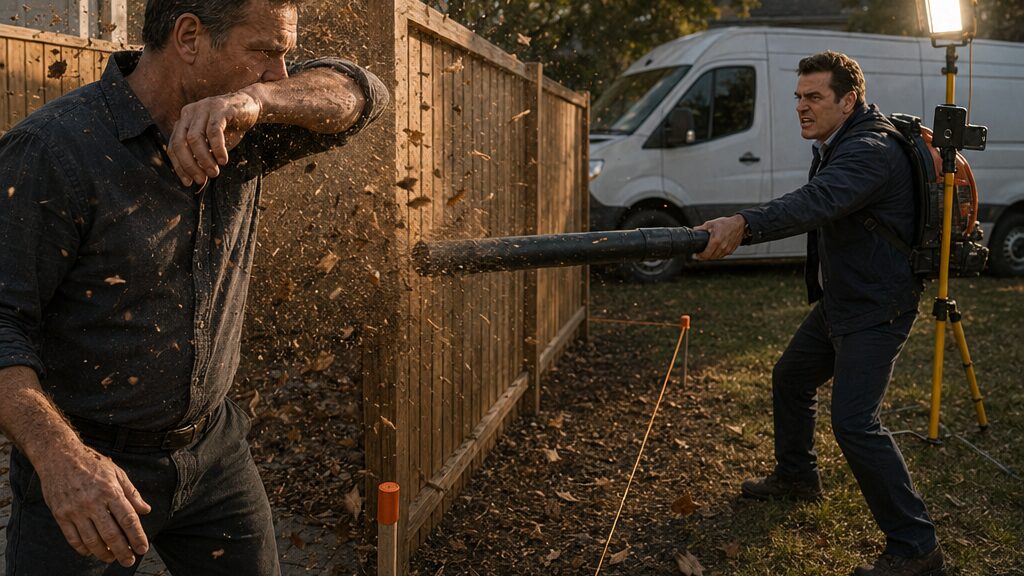
The engine rose into a full mechanical scream, and a burst of dirt, splinters, and dry leaves shot through the fence gaps across his patio. A plastic planter tipped over. Soil scattered across the concrete. Something small and sharp struck the kitchen door.
Richard stepped outside.
Christopher stood beyond the opening with a commercial leaf blower strapped across his back. The long black nozzle extended through the gap between the final fence post and the survey stake. Behind him, the industrial floodlight had been mounted on its tripod even though the afternoon sun was still high.
The lamp was not aimed at the windows this time.
It was aimed at the fence opening.
A phone had been clamped to one of the tripod legs.
Its camera faced Richard.
Christopher swept the blower nozzle from side to side. Another stream of grit blasted across the patio.
“Turn it off,” Richard shouted.
The engine swallowed his words.
Christopher pointed toward the orange survey marker with the nozzle. The blast bent the string nearly horizontal. Dust swirled around the stake.
Richard moved down the patio steps.
The photograph Sharon had sent remained on his phone inside the house. He had forwarded it to himself, saved two copies, and tried to call her. She had not answered.
The municipal inspection was scheduled for the next afternoon.
Christopher knew the file had surfaced.
Richard stopped on his side of the string.
“Turn it off.”
Christopher reduced the throttle but left the engine roaring at idle.
“What?” he called, cupping a hand behind his ear.
“You heard me.”
“I’m clearing my access lane.”
“You’re blowing debris onto my property and disturbing a survey marker.”
Christopher looked toward the phone attached to the floodlight tripod. “Your property. Your marker. Your fence. You say those words enough, maybe someone will believe you.”
Richard followed his glance.
The camera angle showed Richard, the fence, and the blower nozzle. It did not show Christopher’s feet or the orange string. From that view, the dispute could look like a man cleaning his yard while an angry neighbor approached.
Richard raised his own phone and started recording.
Christopher laughed. “Good. Get both sides.”
“Move the equipment back.”
“Move the fence.”
“No.”
The blower surged.
Christopher thrust the nozzle through the opening, directing a concentrated blast toward the base of the fence. Wood chips and loose soil flew into Richard’s face. He turned his head, shielding his eyes.
The survey string snapped free from one stake.
Richard’s body moved before his thoughts did. He stepped between the blower and the marker, planting his boots on the narrow strip of grass.
The nozzle swung toward his chest.
“Back away,” he said.
Christopher advanced half a step. “Inspection won’t matter after the opening comes down.”
“You touch the fence, you add property damage.”
“I’m restoring access.”
“You had no permanent access.”
“I have a signed letter.”
“You have one page of a two-page letter.”
The blower’s pitch dipped.
Christopher’s eyes narrowed. “Sharon talked to you.”
“She showed me the rejected permit.”
Something passed across Christopher’s face—not surprise, but calculation.
Then he smiled.
“You have a photograph of paper you were never authorized to see.”
“It has your signature.”
“You don’t know what happened after that review.”
“Then show the revised permit.”
Christopher squeezed the throttle.
The machine screamed again.
The nozzle rose until its mouth pointed directly at Richard’s face. The force pushed air against his cheeks and drove grit beneath his collar.
Richard lifted one arm over his eyes.
“Move,” Christopher shouted over the engine. “The fence comes down today.”
For one instant Richard saw the entire scene as the phone would see it: Christopher steady behind the blower, Richard advancing, the boundary invisible from the chosen angle.
He also saw the orange survey stake at his heel, half loosened from the ground.
If Christopher tore it out before Emily arrived, the official measurement would still be possible, but the immediate evidence of deliberate disturbance would be gone.
Richard reached for the nozzle.
His left hand closed around the long plastic tube near its mouth. Christopher jerked backward, but the blower harness held him in place. The nozzle twisted between them.
“Let go,” Christopher shouted.
Richard pulled it away from his face.
The plastic bowed.
Christopher drove forward.
Richard turned his hips and wrenched the tube sideways.
It snapped with a sharp crack.
The broken end remained in Richard’s hands. The shorter section attached to the blower whipped toward Christopher’s leg before the engine choked and fell silent.
The sudden quiet felt enormous.
Christopher stared at the jagged edge.
Richard stood breathing hard, gripping the detached tube.
The threat had stopped.
He knew it.
Christopher knew it.
The phone on the tripod continued recording.
“Look what you did,” Christopher said softly.
Richard should have dropped the plastic.
He should have stepped back across the line and called the police.
Instead he saw the floodlight through his living-room windows. He saw the tire marks over the survey stake, the scrape across the cedar boards, the single laminated page pushed beneath his gate. He heard the old metal cabinet from years before, the hollow crash when another man’s body struck it.
His anger did not feel wild.
That was what made it dangerous.
It felt precise.
Richard shoved the broken tube into Christopher’s chest.
Not hard enough to knock him down.
Hard enough to make him stagger.
“That line is not a suggestion,” Richard said.
The words came out low and controlled.
Christopher stumbled backward, one hand catching the plastic. His expression changed from shock to triumph.
Richard released the tube.
It fell between them.
The final shove had lasted less than a second. The evidence of it would last much longer.
Christopher reached for the phone on the tripod and stopped the recording. His thumb moved quickly over the screen.
“You just attacked me with a weapon.”
“You aimed a running blower at my face.”
“I was cleaning my property.”
“You crossed the line.”
“Your line.”
Richard looked at the broken nozzle on the ground. His hands had begun to shake.
The first movement had protected him and the marker.
The last had protected nothing.
Christopher lifted his phone and backed toward the extension. “Don’t come closer.”
Richard did not move.
Christopher tapped the emergency number and raised his voice before anyone answered.
“My neighbor attacked me,” he said. “He broke my equipment and shoved a piece of it into my chest.”
Richard turned toward the fixed camera mounted beneath his roofline. Its small red indicator remained lit.
It had seen the whole yard.
Every crossing.
Every blast.
Every movement of Richard’s hands.
Christopher looked from the rooftop camera to Richard’s face. For the first time, uncertainty touched him.
Then he held up his phone, where the video already began with Richard gripping the nozzle.
“I have it recorded,” he told the emergency operator. “He came at me with a weapon.”
Chapter 6: The Footage Richard Refused to Edit
Sergeant Joseph Brown watched Christopher’s video twice before asking Richard to place his hands where they could be seen.
They stood beneath the blue-white flash of two police vehicles parked along the curb. The floodlight still burned beside the fence, throwing its harsher glare across the backyard. Christopher had turned it toward the broken blower tube as if illuminating evidence.
Richard rested both hands on the patio table.
Joseph was broad-shouldered, with a tired expression that suggested he had arrived expecting another argument over hedges and noise. The cropped phone video had changed that. On Christopher’s screen, it began with Richard already holding the nozzle. There was no dirt blasting through the fence, no advance toward the survey marker, no blower aimed at Richard’s face.
Only the snap.
Then the shove.
“Did you push this object into his chest?” Joseph asked.
“Yes.”
Christopher stood several yards away with another officer. He had opened the top buttons of his shirt to display a red mark below his collarbone.
“He threatened me,” Christopher said. “He said the property line was not a suggestion.”
Joseph looked at Richard. “Did you say that?”
“Yes.”
“You understand how that sounds with the video?”
“Yes.”
The honest answers felt heavier than excuses would have.
Joseph picked up the broken tube using gloves and placed it on the patio table. “Was the blower running?”
“Yes.”
“Was the nozzle aimed at you?”
“Yes.”
Christopher called across the yard, “He walked onto my side.”
Richard pointed toward the orange string, one end hanging loose from the disturbed stake. “The fixed camera shows where everyone stood.”
Joseph followed his gesture to the camera beneath the eaves.
“You have footage?”
“I do.”
“Unedited?”
Richard looked toward Christopher’s phone.
That single cropped recording had turned a provocation into an apparent attack. Richard could answer with an angle of his own. His system used four cameras. One focused tightly on the patio and fence opening. It clearly showed Christopher crossing the line, pushing the nozzle forward, and blasting debris.
It also cut off the area where Richard delivered the shove.
The wider camera showed everything.
Richard could provide the tight view first and say he needed time to retrieve the rest. He could let the cleanest angle shape Joseph’s first conclusion.
The temptation came quietly.
Not as a plan to lie.
As a delay.
Joseph said, “Mr. Thomas?”
Richard lifted his hands from the table. “The recorder is inside.”
Joseph followed him into the living room.
Blankets still covered the windows. White light pressed through the edges, framing each cloth panel in brightness. Richard removed the recorder from a cabinet beneath the television and opened the camera archive on the screen.
Four views appeared.
Joseph pointed to the widest one. “Start five minutes before contact.”
Richard selected the file.
The footage played without sound at first. Christopher entered carrying the blower. He positioned the floodlight tripod and adjusted the phone attached to it. He walked to the orange string, looked directly at the rooftop camera, then turned the fixed phone so the tripod blocked part of the boundary.
Joseph leaned closer.
“He set the frame before you came out.”
“Yes.”
Richard enabled audio.
The leaf blower filled the room with a harsh mechanical roar. Dirt burst through the fence. Christopher swept the nozzle across the patio. Richard emerged, raised his phone, and stopped at the string.
The officer watched the argument. He watched Christopher push the nozzle through the opening. He watched Richard step between it and the marker.
Then came the snap.
The engine died.
The room fell silent on the recording and in the house.
Richard’s recorded self held the broken plastic while Christopher stood empty-handed.
There was a pause.
Long enough to choose.
Then Richard shoved the tube into Christopher’s chest.
Joseph stopped the video.
“That part was after the machine was disabled.”
“Yes.”
“You could have stepped away.”
“Yes.”
Joseph studied him. “Most people would tell me they don’t remember.”
“I remember.”
Through the covered windows came the murmur of Christopher speaking to the other officer.
Joseph restarted the video and watched the remaining seconds. Christopher lifted his phone, backed away, and began the emergency call. Richard stayed by the survey marker.
“You didn’t follow him,” Joseph said.
“No.”
“You didn’t strike him again.”
“No.”
Joseph looked at the file list. “Are there other angles?”
Richard opened them all.
The tight patio view favored him. The driveway camera showed the van trespass from earlier. The side camera captured Christopher moving the floodlight across the line the previous night. The wide camera preserved the shove.
Richard exported the complete set.
Joseph glanced at him. “You understand you have just given me evidence against yourself.”
“If I leave that part out, I’m doing what he did.”
Joseph said nothing for several seconds.
Back outside, he spoke first to the other officer and then to Christopher. The conversation grew sharp.
Christopher pointed toward Richard’s house. “He admits it.”
“He admits physical contact,” Joseph said. “The full footage also shows you entering the disputed area, directing a running blower at him, damaging the survey string, and positioning your phone to omit those actions.”
“I was on my property.”
“That is not something I determine tonight.”
“I have consent.”
“You can provide that to the municipal inspector.”
Christopher’s voice rose. “So he gets to break equipment and push me?”
“No.”
Joseph turned toward Richard. “And you do not get to use a broken object to make a point after the immediate threat has ended.”
Richard nodded.
Joseph issued him a citation for unlawful physical contact. Not an arrest. Not the felony allegation Christopher had demanded. A court date and a written record of the shove.
Christopher received citations for harassment, property interference, and alleged trespass pending boundary confirmation. The blower was photographed. The broken tube was bagged. Copies of the recordings were logged.
Neither man walked away clean.
As Joseph completed the incident report on the hood of his vehicle, Richard unfolded the municipal blueprint beneath the police lights. The boundary line crossed the page in blue ink and disappeared beneath the drawn extension.
Joseph examined it without touching.
“This is for planning,” he said. “Not me.”
“I know.”
“Good. Because people get into trouble when they expect one badge to solve every kind of dispute.”
Richard looked toward Christopher, who stood near the extension speaking rapidly into his phone.
“I should have filed sooner,” Richard said.
Joseph capped his pen. “Maybe.”
“I thought staying quiet would keep it from becoming this.”
Joseph glanced at the bagged nozzle. “Quiet and controlled are not always the same thing.”
Headlights turned into the street.
A small car stopped behind the police vehicles. Sharon stepped out carrying a thick brown folder against her chest.
Christopher saw her and went still.
“Go home,” he said.
She closed the car door. “No.”
“Sharon.”
“You told me to destroy this.”
The officers looked up.
She walked past Christopher and placed the folder on the hood beside Joseph’s report. Its metal clasp was bent. A municipal application number had been written across the front.
Christopher reached for it.
Joseph moved between them.
Sharon’s hands trembled, but her voice did not.
“This is the original extension permit file,” she said. “He ordered me to shred it this morning.”
Chapter 7: The Line That Entered Christopher’s House
The red survey laser crossed Christopher’s desk and continued through the wall behind it.
Emily Martinez stood near the office door with the measuring unit mounted on a tripod. A second municipal inspector held the field notes while the thin beam cut across a stack of invoices, a computer keyboard, and the edge of Christopher’s leather chair.
“This is the verified parcel boundary,” Emily said.
Christopher remained behind the desk as though refusing to move might alter the measurement. The laser passed across his abdomen.
“That cannot be right.”
Emily checked the display again. “The control points match the recorded survey.”
Richard stood inside the extension for the first time. From his backyard, the room had looked like a solid intrusion. Inside, it was cramped and ordinary: filing cabinets, route maps, a humming printer, coffee rings on the windowsill. Five people had worked from this room. Christopher had built his business decisions here, six feet inside land that did not belong to him.
Bright survey paint marked the floor beneath the laser.
The line entered through one wall, crossed beneath the desk, and exited near a locked filing cabinet.
Christopher looked toward Sharon.
She stood beside the inspectors with the brown permit folder held against her chest.
“You brought them into my office,” he said.
“I brought the file you told me to destroy.”
“You stole company property.”
“I protected myself.”
The answer was not defiant. It was exhausted.
Emily opened the folder on the desk. Inside were the rejected permit application, structural sketches, correspondence from the planning department, and the original two-page consent letter.
Richard recognized the first page immediately.
The second page began with a sentence Christopher had omitted from the laminated copy.
Access is temporary and shall terminate upon completion of approved construction. No permission is granted for permanent occupancy, structural encroachment, or transfer of property rights.
The previous owner had signed beneath that paragraph too.
Christopher had not inherited confusion.
He had removed the part that made the truth clear.
The administrative hearing took place three days later in a municipal room with no windows. Richard sat on one side of a narrow aisle with the complete camera files, the citation, and his survey documents arranged in front of him. Christopher sat opposite with a legal representative and several binders.
The hearing officer reviewed the permit history before allowing either man to speak.
The extension had been rejected because its proposed footprint crossed the parcel boundary and failed setback requirements. No revised plan had been approved. No final inspection had occurred. Utility work had been completed under a permit issued for repairs to the original house, not construction of a new room.
Christopher argued that the previous owner had consented.
The hearing officer placed both pages of the letter beside each other.
“Temporary construction access is not permission to build on another parcel.”
“The owner knew the extension was there,” Christopher said. “He saw it every day.”
“Knowledge is not approval.”
“He never complained.”
Richard watched Christopher’s hands. They stayed flat on the table, but his thumbs moved against the wood.
For the first time, Christopher did not look arrogant. He looked cornered by something he had spent years pretending was settled.
“My business could not operate from the original house,” he said. “The room was necessary.”
The hearing officer asked, “Necessary to whom?”
Christopher glanced toward Sharon, then toward Richard.
“The previous owner relied on me,” he said. “I fixed things for him. Drove him to appointments. Cleared his driveway. He was not going to object over a strip he never used.”
The room grew still.
Richard had expected another denial. Instead Christopher had admitted the deeper arrangement without understanding what it revealed.
He had mistaken dependence for permission.
Kindness for surrender.
Silence for ownership.
Sharon looked down at her hands.
The hearing officer turned to Richard. “You possessed an archived parcel plan before filing the formal complaint.”
“Yes.”
“How long?”
“Three weeks.”
“And you suspected the extension crossed the boundary?”
“Yes.”
“Why did you wait?”
Richard felt Christopher’s attention sharpen.
This was the question he had avoided in Emily’s office, the one that made his own conduct less clean.
“I thought the fence would solve the vehicle problem,” he said. “I did not want to trigger removal of part of a house if I could avoid it.”
“Yet you later used physical force during the dispute.”
“Yes.”
“Why?”
Richard looked at the photographs of the broken blower nozzle.
“Christopher aimed the running blower at me and the survey marker. I grabbed it to stop him. Once the nozzle broke, the threat had ended. I shoved the broken piece into his chest anyway.”
Christopher’s representative shifted, perhaps surprised by the admission.
Richard continued before fear could return him to silence.
“That part was anger. It was not necessary.”
The hearing officer studied him. “Are you seeking punitive damages?”
Richard had considered them after the police left. Damaged fence boards. Lost time. Harassment. Legal expenses. The floodlight burning through his windows while Christopher waited for him to react.
He had imagined a number large enough to make Christopher feel what pressure felt like.
Now he looked at Sharon and remembered the drivers sitting in their vans, watching two homeowners decide what happened to their wages.
“I am seeking restoration of my property,” Richard said. “Removal of the extension from my parcel. No commercial vehicles crossing the boundary. Protection against lights, equipment, and debris being directed into my home.”
“And additional damages?”
“Only documented costs.”
Christopher turned toward him, disbelief tightening his face.
The hearing officer reviewed the evidence for several minutes. Paper moved softly across the table.
When the decision came, it did not sound dramatic.
That made it heavier.
The extension was declared unpermitted and unlawfully encroaching. The portion crossing Richard’s parcel had to be removed. Because the structure could not meet required setbacks after partial removal, the entire addition would require redesign or demolition. Christopher would bear inspection, demolition, drainage correction, and restoration costs.
The commercial vans were prohibited from entering Richard’s parcel immediately.
Christopher stared forward.
His representative whispered to him, but he did not answer.
The hearing officer then addressed the repeated harassment, the floodlight placement, and the risk of future conflict.
“A permanent separation measure will be incorporated into the compliance order,” she said. “The cost will be assigned to the responsible property owner.”
Christopher finally looked up. “What kind of measure?”
“That will be determined through settlement design review. It must prevent vehicle access, equipment projection, direct lighting, and further boundary interference.”
Richard pictured a taller fence.
Christopher seemed to picture a fine.
Neither understood until the officer added, “Given the documented destruction and manipulation of temporary markers, a masonry barrier may be required.”
The survey line on the floor of Christopher’s office had been temporary paint.
The next line would not move.
Chapter 8: The Last Brick Between Two Backyards
The first demolition strike opened Christopher’s office exactly where the red survey paint crossed the wall.
A hydraulic breaker punched through the siding, folding insulation and plaster inward. Dust rolled through the gap. For a moment, Richard could see the room in section: the desk pushed against the far wall, wires hanging from the ceiling, the painted boundary line disappearing beneath broken flooring.
Christopher stood beside the contractor with his arms folded.
He had sold one commercial van the week before.
The remaining vehicles were being moved to a rented lot near the industrial district. Sharon had reorganized the routes so the drivers could report there instead of the house. The change cost money, but the company was still operating.
That had become part of the settlement.
Richard agreed not to pursue additional punitive damages if Christopher funded the demolition, repaired the drainage, paid for the damaged fence and survey work, and built the required barrier entirely on his own side of the verified line.
The barrier was not cedar.
It was a ten-foot solid brick wall.
The approved design included no openings, no decorative gaps, no elevated fixtures, and no platform from which equipment could be aimed over the top. Its foundation sat several inches within Christopher’s parcel. A drainage channel ran along its base so runoff could not be redirected toward Richard’s yard.
Christopher objected to the height until the final design meeting.
“I can build eight feet,” he said. “Same privacy. Lower cost.”
Richard looked at the elevation drawing.
At eight feet, the upper window of any rebuilt office could still overlook his living room. A tripod-mounted light could still clear the top from the raised patio near Christopher’s house.
“Ten,” Richard said.
Christopher leaned forward. “You already got the extension removed.”
“This is not about the extension.”
“It is about punishing me.”
Richard met his eyes. “It is about never having to measure where your equipment stands again.”
Christopher offered a cash payment in exchange for lowering the wall.
Richard refused.
He did not raise his voice. He did not mention the blower, the floodlight, or the police. The approved conditions already contained every argument that mattered.
Now, as demolition continued, he watched workers remove the last section of illegal flooring. The painted boundary emerged beneath it, bright and straight across the exposed ground.
For years, that line had existed only in records and tolerances. Christopher’s tires had crossed it because no wall stopped them. The extension had crossed it because the previous owner had not forced the issue. Richard had let the vans continue because he feared what direct action might turn him into.
The line had never been weak.
The people around it had treated it as optional.
Sharon approached from the temporary job trailer carrying two cups of coffee. She offered one to Richard.
He accepted it.
“The crews start from the new lot Monday,” she said.
“How many stayed?”
“All of them.”
Richard nodded.
“Christopher had to cut his own pay,” she added. “And sell the newest van.”
There was no satisfaction in hearing it.
Only proportion.
“He could have moved them years ago,” Richard said.
“I told him that.”
“Why didn’t you leave?”
Sharon watched the breaker tear through another section of wall. “At first, because he gave me work when I needed it. Later, because other people needed me to keep the place running. Somewhere in between, I started calling loyalty what was really fear of making the collapse happen.”
Richard looked at the citation notice still folded in his wallet. He understood how easily delay could borrow a more respectable name.
The brickwork began after the rubble was cleared.
For several weeks, the wall rose course by course behind what remained of Richard’s wooden fence. Mortar lines replaced the orange survey string. Each morning, masons checked the foundation against fixed points. Each evening, the growing barrier cast a longer shadow across Christopher’s shortened backyard.
The floodlight never returned.
The remaining vans never crossed Richard’s grass.
Christopher spoke to him only once.
It happened when the wall had reached seven feet. He stood near the construction gate holding the revised invoice.
“This cost more than the room did,” he said.
Richard looked at the wall.
“The room was built with someone else paying part of the price.”
Christopher’s mouth tightened. “You think you won.”
“No.”
The answer seemed to unsettle him more than triumph would have.
Richard continued, “I think it ended.”
Christopher looked toward the exposed side of his house, where new siding covered the scar left by the extension. He appeared smaller without the office behind him and the vans filling the strip.
After a moment, he walked away.
On the final afternoon, one mason lifted the last brick to the top course. Richard watched from his living room.
The wall filled the view beyond his windows, plain and solid. No tripod could shine through it. No nozzle could enter a gap. No commercial bumper could press across the line.
The mason set the brick into mortar, tapped it level, and scraped away the excess.
Across the wall, unseen except for the top of his head, Christopher stood in what remained of his yard.
Richard drew the curtains.
The room became dark.
Not the strained darkness of blankets pinned over windows. Not darkness edged by industrial glare. Ordinary evening darkness settled across the photographs, the sofa, and the glass cabinet.
Richard stood without checking the cameras.
For the first time since the fence had gone up, he did not look toward the property line.
He no longer needed to.
The story has ended.