She Planted Sunflowers for One Lost Neighbor, Then the HOA Ordered Every Stem Removed
Chapter 1: The Morning a White Notice Appeared Beneath the Sunflowers
The white paper was clipped to the tallest sunflower as if someone had served legal papers on a plant.
Michelle Walker saw it from her kitchen window at 6:14 in the morning.
For several seconds she stood with one hand around her coffee mug, staring through the glass. The paper lifted and snapped in the breeze between two yellow heads. Its bottom edge struck the stalk again and again.
She knew the logo before she crossed the room.
She set the mug down too hard. Coffee climbed the rim and spread across the counter.
Outside, the grass was damp beneath her sandals. The sunflowers stood along the side-front edge of her lot, beginning near the porch and running toward the corner where the sidewalk curved away. Some were taller than she was. The tallest had opened three days earlier.
The notice was fastened with a black binder clip.
Michelle removed it carefully so she would not scar the stalk.
NOTICE OF LANDSCAPE NONCOMPLIANCE.
She read the first line twice.
Excessive plant height. Obstruction of neighborhood sightline. Unapproved alteration of visible landscape profile.
Ten calendar days to remove or reduce the planting to the permitted height.
Failure to comply could result in daily fines and corrective action at owner expense.
Michelle looked from the paper to the street.
A delivery van passed the corner without slowing. From where she stood, she could see the stop sign clearly. She could see the fire hydrant across the street, Rachel Adams’s mailbox, the front wheel of a bicycle left in a driveway three houses down.
She folded the notice once.
Then again.
The tallest sunflower brushed her shoulder.
“No,” she said.
The word was quiet enough that no one could have heard it from the sidewalk.
She went inside, found the HOA management portal on her laptop, and read the violation again. There was a photograph attached. The image had been taken from low inside a vehicle, making the sunflower row appear like a wall.
Michelle enlarged it.
The angle was wrong.
Not false, exactly. Worse than false. Chosen.
She clicked through the community standards. Decorative plantings in visible yards were to be “maintained in a manner consistent with neighborhood character.” Corner-lot vegetation could not obstruct vehicular lines of sight.
She did not own a corner lot.
Her property sat one house away from the intersection.
She opened the appeal form.
The first box asked for grounds.
She stared at it.
Then closed the page.
A knock sounded at the front door.
Michelle stiffened before she looked up.
Rachel stood on the porch in running clothes, her hair pulled back, one earbud hanging loose. She held the folded notice Michelle had apparently dropped near the threshold.
“You lose this?”
Michelle opened the door only as far as necessary.
Rachel’s eyes moved past her toward the sunflowers.
“I saw the paper out there,” she said. “I thought somebody had stuck an ad on them.”
“They did.”
Rachel handed it over. “That bad?”
Michelle slipped the notice behind her back.
“It’s nothing.”
Rachel gave her a look that was too direct for seven in the morning.
“Nothing usually doesn’t make you leave coffee all over your kitchen.”
Michelle glanced behind her.
A brown trail had reached the cabinet edge.
Rachel smiled a little, but it vanished when Michelle did not.
“What are they saying?”
“Too tall.”
“The flowers?”
“Yes, Rachel. The flowers.”
Rachel turned toward the yard. The sunflower heads leaned in different directions, some facing the strengthening light, others drooping under their own weight. Bees moved lazily among them.
“They’ve been there since I moved in.”
“They’ve been there longer.”
“How long?”
Michelle almost answered with a year.
Instead she said, “Seven summers.”
Rachel looked back at her.
Something in Michelle’s voice had changed. She knew it because Rachel stopped leaning against the porch post.
“Seven exactly?”
Michelle folded the paper smaller.
Rachel’s gaze shifted to the row again. “You plant them every year?”
“Yes.”
“Same place?”
Michelle did not answer.
That was answer enough.
Rachel lowered her voice. “Is there a reason?”
The question landed where Michelle had spent years making sure questions did not land.
She stepped backward.
“I have to get ready for work.”
“Michelle.”
“I said it’s nothing.”
She closed the door before Rachel could soften her face.
That was the part Michelle could not stand—the softening.
By nine thirty, she was at the garden center arranging trays of marigolds beneath a shade canopy and pretending she had not checked her phone eleven times.
At ten twelve, an email arrived from Patricia Harris.
Patricia lived four streets over and had been HOA president for almost two years. She was not loud. Michelle might have preferred loud. Patricia spoke in the careful tone of someone who wanted every sentence to survive being forwarded.
Michelle,
Please note that the violation was issued through the management process following a resident complaint and site review. The Association is obligated to enforce applicable standards consistently.
You may submit a variance request or attend the next compliance hearing.
Michelle read the sentence about consistency twice.
Three months earlier, Patricia had defended a board member’s stone fountain after residents complained it had been installed without approval. Michelle remembered the phrase used then.
Reasonable flexibility.
Her thumb hovered over Reply.
The sensible response would have been to ask for the complaint details. To request measurements. To attach photographs from street level. To complete the variance form.
Instead she typed:
The sunflowers will not be removed or cut down.
She looked at the sentence.
Added:
The stated sightline issue is not supported by the actual location of my property.
Then, after a moment:
I do not consent to entry onto my lot for removal.
She sent it.
Almost immediately, she regretted the last sentence.
Not because she meant anything different.
Because it sounded like a challenge.
At lunch she drove home and parked at the curb rather than in the driveway.
She stood where a driver would stand at the nearest intersection.
The stop sign was visible.
She crouched lower.
Still visible.
She walked ten feet left, then right.
From one narrow angle near a decorative utility box, three of the tallest stalks overlapped the lower corner of the sign.
Michelle felt a coldness beneath her ribs.
Not because Patricia was right.
Because the complaint was not entirely invented.
A car door shut behind her.
Rachel approached carrying two iced drinks.
“I come in peace.”
Michelle straightened.
“I’m measuring.”
“I can see that.”
Rachel held out one cup. Michelle took it despite herself.
For a while they stood without speaking.
Then Rachel said, “Seven summers.”
Michelle looked at her sharply.
“I’m not interrogating you.”
“That’s usually what people say before questions.”
Rachel nodded. “Fair.”
A breeze passed through the row. The stalks knocked softly against one another.
Rachel watched them.
“Same date every year?”
Michelle’s fingers tightened around the plastic cup.
Rachel had noticed.
Not just seven summers.
The date.
Michelle planted during the same week every June, even when rain delayed the rest of the yard. Even when she was sick. Even the year her wrist had been in a brace.
“Close enough,” she said.
Rachel did not press.
That restraint almost made Michelle tell her.
Almost.
Instead Michelle walked to the first sunflower near the porch and pressed loose soil around its base with the toe of her sandal.
Rachel said, “You know, you could file for a variance.”
“No.”
“Why not?”
“Because asking permission suggests this started as a mistake.”
Rachel stared at her.
“That,” she said carefully, “doesn’t sound like a landscaping opinion.”
Michelle turned toward the house.
Her phone vibrated.
She expected another management email.
It was Patricia.
Michelle opened the message while standing beneath the tallest sunflower.
Thank you for your response. Because you have disputed the violation and expressly denied access, the Association will proceed with an on-site inspection before further action.
Inspection has been scheduled for Thursday at 8:00 a.m.
Board representation and management contractor may be present.
Michelle read it once.
Then looked at the calendar on her phone.
Thursday.
Two days away.
Behind her, Rachel asked, “What is it?”
Michelle lifted her eyes to the sunflower heads moving above them.
For seven summers, she had managed to keep one promise by never explaining it.
Now strangers had scheduled a morning to measure how much of it they intended to cut away.
Chapter 2: Everyone Thought the Flowers Were Only About Grief
Rachel saw the photograph for less than three seconds before Michelle turned it facedown.
Three seconds was enough.
Six young sunflower seedlings stood in a bare strip of dirt beside Michelle’s porch. Behind them, two women crouched shoulder to shoulder, both laughing at something outside the frame.
One was Michelle.
The other woman had dark hair tied in a scarf and dirt smeared across one cheek.
Michelle’s eyes were wet.
Not almost wet.
Wet.
Rachel stopped in the doorway.
“I should come back.”
Michelle wiped her face with the heel of her hand. “You should knock louder.”
“I knocked twice.”
“Well.”
The photograph disappeared into a kitchen drawer.
Rachel had come carrying printed screenshots of the HOA guidelines and a notebook filled with questions about sightline language. She set them on the counter without mentioning the picture.
Michelle looked at the pages.
“What’s this?”
“A less hostile version of what you should have done yesterday.”
“I wasn’t hostile.”
“You told the HOA not to enter your land.”
“It is my land.”
Rachel pulled out a chair. “Please sit down before you make me defend an HOA.”
That almost earned a smile.
Almost.
Michelle remained standing.
Rachel opened the guidelines. “Look. They have a variance process. We show the sightline is limited, offer trimming near the corner, keep the rest.”
“No.”
“Michelle.”
“No relocation. No shortening the row to some decorative little patch. They stay until they finish blooming.”
Rachel studied her.
“Because of the woman in the picture?”
The kitchen went still.
Michelle’s hand moved toward the drawer, then stopped.
Rachel said, “I’m sorry.”
“You looked.”
“You turned it over after I saw it.”
“That isn’t permission.”
“No. It isn’t.”
Rachel closed the guidelines.
She waited.
Michelle walked to the sink and looked through the window at the row outside.
For a long time she said nothing.
Then, without turning, she spoke.
“Her name was Melissa.”
Rachel did not move.
“She lived two houses down. Before you moved here.”
The words came flat at first, as if Michelle were reading them from something internal and damaged.
“She hated roses. Said people planted them because they thought a yard was supposed to look respectable. She liked things that got too big.”
A faint breath escaped Rachel that might have been a laugh.
Michelle looked down.
“She planted the first six sunflowers with me.”
Rachel’s attention flicked toward the drawer.
“The six in the picture.”
“Yes.”
“What happened to her?”
Michelle’s shoulders tightened.
“She died.”
Rachel felt the room narrow around the answer.
“I’m sorry.”
“There it is.”
“What?”
“That voice.”
Rachel blinked.
Michelle turned. “People use that voice and then they want the rest.”
“I don’t.”
“You do. You’re a reporter.”
“I’m your neighbor.”
“You’re both.”
The accusation was not entirely unfair.
Rachel looked at the notebook she had brought. She closed it.
“I won’t write anything.”
Michelle’s expression changed slightly.
Not relief.
Something more complicated.
“Good.”
Rachel left ten minutes later with the HOA pages still on the counter.
By noon, three different residents had posted about the sunflowers in the neighborhood group.
Rachel did not start it.
An elderly neighbor uploaded a photograph of the white notice and wrote that the flowers had been there “for years without hurting anyone.”
Someone else commented that tall vegetation near intersections was dangerous.
Another resident wrote that the board had ignored worse violations.
Then a teenager posted a picture of Michelle kneeling among the stalks the previous summer, wearing a bright yellow rain jacket.
The comments multiplied.
Rachel watched from her desk.
She told herself not to touch it.
At two seventeen, someone wrote:
Does anyone even know why she keeps planting them?
Rachel stared at the question.
She thought of six seedlings.
She thought of Michelle saying, Her name was Melissa.
She typed a reply.
Deleted it.
Typed again.
For those asking, the flowers are not random. They were first planted years ago with a former resident who has since passed away. I’m not sharing private details, but this is a memorial planting, not an abandoned yard.
She read it carefully.
No surname.
No cause of death.
No photograph.
No claim that Michelle had authorized the post.
She pressed Send.
Within twenty minutes, the tone changed.
People began sharing memories.
A resident remembered Melissa bringing soup after surgery.
Another remembered her arguing with a delivery company that had blocked a wheelchair ramp.
Someone posted that Melissa once helped search for a missing dog until midnight.
Rachel sat back.
For the first time since the notice appeared, the neighborhood was talking about a person rather than a rule.
That felt good.
Too good.
At four, a local community page copied Rachel’s comment beneath a photograph of the sunflower row.
HOA THREATENS MEMORIAL GARDEN FOR DECEASED NEIGHBOR.
Rachel’s stomach dropped.
She clicked.
The post had already been shared sixty-three times.
The comments were worse than the neighborhood group.
Power-hungry busybodies.
Sue them.
Name the board president.
Someone posted Patricia Harris’s public real estate profile.
Rachel closed the laptop.
Her phone rang almost at once.
Michelle.
Rachel answered.
“Before you say anything—”
“You posted about Melissa.”
Rachel stood. “I didn’t use her last name.”
“You posted about her.”
“I said it was a memorial because people were making you sound like some irresponsible homeowner who lets weeds block traffic.”
“They are not weeds.”
“I know that.”
“That is not the point.”
Rachel walked toward her window. Across the street, Michelle’s sunflowers rose above the parked cars.
“I was trying to help.”
“I told you not to write anything.”
“You told me that after I said I wouldn’t write a story. I didn’t write a story.”
Silence.
Rachel heard herself and winced.
“That sounded terrible.”
“Yes.”
“I’m sorry.”
Michelle did not answer.
Rachel lowered her voice. “People are remembering her.”
“That does not make it yours.”
“No.”
Another silence.
Then Michelle said, “Take it down.”
Rachel looked at the copied community post on her screen.
“I can delete my comment. I can’t delete what they copied.”
Michelle ended the call.
By evening, small things began appearing near the sunflower row.
A handwritten card.
A jar with three daisies.
Someone left a packet of sunflower seeds on the porch.
Michelle carried each item inside before dark.
Rachel watched from a distance and did not approach.
The next morning, she went to the property-management office in person.
She told herself she was gathering public information, not writing a story.
The distinction felt thinner every hour.
The office occupied a suite between an insurance agency and a tax preparer. A representative met her at the front counter.
Rachel asked whether a memorial planting changed the enforcement process.
The representative’s expression became guarded.
“We cannot discuss an individual owner’s account.”
“I’m asking generally.”
“Generally, the Association applies recorded standards without regard to the emotional significance of a violation.”
“That sounds rehearsed.”
“It is accurate.”
“Does an appeal pause corrective action?”
The representative hesitated.
Rachel noticed.
“Usually?”
“Procedures depend on the governing documents and the nature of the issue.”
“So that’s not a yes.”
“No, ma’am.”
Rachel left with less certainty than she had entered.
Outside, she checked her phone.
Thirty-one unread messages.
Several praised her for “exposing” the HOA.
One called Michelle a grieving widow, which was not true.
Another claimed Melissa had died of cancer. Rachel had no idea whether that was true.
A third said the board was planning to bulldoze the entire yard.
None of those claims came from Rachel.
All of them had grown from what she posted.
She drove straight to Michelle’s house.
Michelle was outside with pruning shears, cutting dead leaves from the lower stalks.
“I deleted my comment,” Rachel said.
Michelle did not look up.
“I posted a correction too.”
Still nothing.
“I said I did not have permission to speak for you and that people were inventing details.”
Michelle clipped one brown leaf.
“Thank you.”
Rachel almost relaxed.
Then Michelle added, “You should have done that before.”
“Yes.”
Across the street, an SUV slowed.
The driver lifted a phone toward the yard.
Michelle saw it.
Her face hardened.
Rachel stepped toward the curb. The SUV accelerated away.
“That’s what I was trying to stop,” Rachel said.
“No. You were trying to make people understand.”
“Is that so wrong?”
Michelle looked at her.
“Yes,” she said. “When you don’t know what you’re asking them to understand.”
Rachel felt the rebuke land.
She thought of the photograph again.
“Was Melissa’s husband named Brian?”
Michelle went motionless.
Rachel regretted the question immediately.
“Someone mentioned him in an old neighborhood comment,” she said quickly. “I didn’t contact him.”
“Don’t.”
“I won’t.”
“Do not bring Brian into this.”
The force of it startled Rachel more than shouting would have.
“Okay.”
Michelle gathered the clipped leaves into a bucket.
Rachel watched her walk toward the garage.
“Michelle.”
She stopped.
“Why not Brian?”
Michelle did not turn around.
“Because some things are over.”
That evening, Rachel sat on her porch while the neighborhood group continued to churn.
She ignored it.
At 9:08, a private message appeared from an account she did not recognize.
The name was Brian Clark.
Rachel stared at it before opening.
The message contained one sentence.
You do not know what those flowers are really about.
Chapter 3: One Cut Sunflower Changed What the Neighborhood Believed
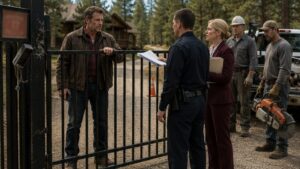
Michelle heard the hedge clippers before she saw the truck.
The sound came through her bedroom window at 7:42 Thursday morning.
A hard mechanical chewing.
She sat upright.
For one stunned second, she thought it came from another yard.
Then the motor stopped.
A man’s voice said, “Take the tall ones first.”
Michelle was out of bed before she fully understood she was moving.
She reached the front hall, yanked open the door, and saw a landscaping truck parked crookedly at the curb.
Two workers stood beside her sunflowers.
One held long-handled powered clippers.
A third man was unfolding a paper from a clipboard.
“No.”
The word came louder than she intended.
Everyone turned.
Michelle stepped onto the porch barefoot.
“What are you doing?”
The man with the clipboard lifted one hand. “Ma’am, we have a work authorization.”
“For what?”
“Vegetation reduction.”
“My inspection is at eight.”
He checked his paper.
“We were told access was scheduled.”
“Inspection. Not removal.”
A car door shut behind the landscaping truck.
Patricia Harris emerged wearing navy slacks and a pale blouse, carrying a binder against her chest.
Michelle stared at her.
“You authorized this?”
Patricia’s jaw tightened.
“Good morning, Michelle.”
“Did you authorize them to cut my flowers?”
“The compliance order permits corrective work if an obstruction presents an ongoing safety concern.”
“My appeal has not been heard.”
“This is not the appeal hearing.”
“Exactly.”
One of the workers shifted uneasily.
Michelle stepped off the porch.
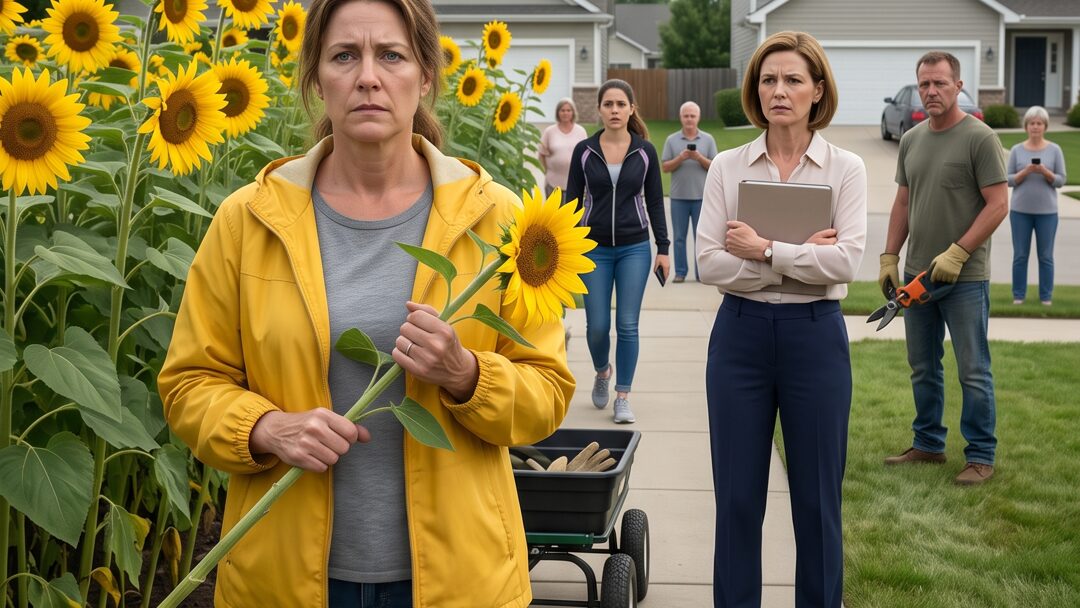
She was still in sleep pants and an old shirt. Then she saw the yellow gardening jacket hanging over the back of a chair near the doorway, grabbed it without thinking, and pulled it on as she crossed the yard.
The clipboard man held out the paper.
Michelle did not take it.
“Read me the authorization date.”
“Ma’am—”
“Read it.”
Patricia said, “There is no need to turn this into a scene.”
Across the street, a garage door had begun rising.
Michelle looked at Patricia.
“You brought a cutting crew before eight in the morning.”
“I brought a contractor to address a documented condition.”
A motor coughed to life.
Michelle turned.
The worker with the clippers had moved behind the first row.
“Stop.”
He hesitated.
The clipboard man said, “Go ahead.”
The blades closed.
The stalk snapped with a sound too small for what it did.
The sunflower fell sideways.
Its broad yellow head struck Michelle across the chest before sliding down the front of her jacket. Her gardening gloves, left on a low cart near the row, fell with it into the grass.
Everything stopped.
Michelle looked down.
A clean green cut showed at the base of the stalk.
Sap shone around the pale center.
The flower lay across her yellow jacket as if it had been placed there.
Someone across the street said, “Oh my God.”
Michelle bent slowly.
Her hands shook once.
She picked up the sunflower by the stalk.
Rachel came running from two houses away.
“What happened?”
Michelle did not answer.
Patricia said, “The contractor was proceeding under authorization.”
Rachel looked from the cut stem to Patricia.
“Before the inspection?”
“The condition had already been documented.”
“Michelle has an appeal.”
Patricia’s mouth tightened. “Rachel, this is precisely why public speculation has made the situation harder.”
More doors opened.
A teenager stopped on the sidewalk with a phone in his hand. An elderly neighbor stood near her mailbox. A man in business clothes paused beside his car.
Michelle became aware of all of them at once.
The audience Rachel had accidentally created.
She hated them for looking.
She hated herself more for wanting them to understand.
The worker lowered the clippers.
“Ma’am,” the clipboard man said, “I need you to clear the work area.”
Michelle set the severed flower carefully on her gardening cart.
Then she rolled the cart sideways.
Directly across the narrow strip between the crew and the remaining sunflowers.
Patricia inhaled.
“Michelle.”
Michelle gripped the cart handle.
“I am not threatening anyone. I am not touching anyone. I am asking you to confirm, in writing, that you have authority to perform corrective removal before my appeal is heard.”
“The work order is written.”
“That is not what I asked.”
The clipboard man looked at Patricia.
Michelle continued.
“Call management. Confirm that this order authorizes removal today, with a pending appeal, on private property, before the scheduled inspection.”
Patricia opened her binder.
“You denied access.”
“I denied access for removal.”
“You disputed the violation.”
“Yes.”
“You refused compliance.”
“I refused to cut them.”
Rachel stepped closer but did not interrupt.
Michelle saw her phone in her hand.
“Do not film me.”
Rachel immediately lowered it.
The teenager across the street did not.
Michelle could not control all of them.
Patricia pulled a sheet from the binder.
“This is the work order.”
Heather Brown appeared at the end of the sidewalk carrying a travel mug and a folder. She was the board secretary, a woman Michelle knew mostly through nods at mailboxes and one tense budget meeting.
Heather looked at the crew.
Then at the cut sunflower.
“What happened?”
“Corrective work commenced,” Patricia said.
Heather frowned. “Before the site review?”
“The condition was already documented.”
Heather put down her mug on the curb.
“I thought today was verification before enforcement.”
Patricia’s face changed by a fraction.
“You were copied.”
“I was copied on the inspection.”
The workers looked increasingly interested in being elsewhere.
Michelle pushed the cart another inch.
“Call management.”
The clipboard man sighed and took out his phone.
For the next four minutes, nobody spoke above a murmur.
The neighborhood watched.
Michelle kept both hands on the cart because if she let go, she feared they would see them shaking.
The man walked toward the truck as he spoke.
Patricia stood with the binder pressed against her ribs.
Rachel moved beside Michelle.
Quietly, she said, “I’m sorry.”
Michelle kept her eyes ahead.
“For what?”
“All of it.”
“This is not the time.”
“No.”
A bee landed on the severed sunflower.
Michelle looked away.
The clipboard man returned.
“We’re pausing.”
Patricia turned sharply. “On whose instruction?”
“Management wants written confirmation from counsel before corrective removal while the appeal request is pending.”
A murmur passed through the people near the street.
Patricia flushed.
Michelle did not feel victorious.
She looked at the single empty place in the row.
A gap no wider than a person.
It seemed enormous.
The worker set down the clippers.
The teenager across the street whispered something to another resident.
Patricia heard him.
“This is not a memorial exemption,” she said.
Michelle’s head lifted.
Rachel went still.
Patricia continued, more carefully now. “Whatever private significance the planting may have does not eliminate the Association’s responsibility.”
Michelle looked at the people watching.
Private significance.
The phrase struck something raw.
“She planted the first six here.”
Her own voice surprised her.
No one moved.
Michelle touched the severed stalk.
“Right here,” she said. “Not in the backyard. Not somewhere prettier. Here.”
Rachel’s eyes filled.
Patricia’s expression shifted, but only for a second.
“Who?” the elderly neighbor asked softly.
Michelle should have stopped.
She knew it.
Instead she said, “Melissa.”
A car pulled up behind the landscaping truck.
Michelle saw the driver before the engine shut off.
Brian Clark had aged in the seven years since she last stood close enough to see the lines around his mouth.
He got out slowly.
Rachel whispered, “Oh.”
Michelle’s grip tightened on the cart.
Brian looked at the crowd, the contractor, Patricia’s binder, the phones, and finally the severed sunflower.
Then he looked at Michelle.
“What are you doing here?” she asked.
His face gave nothing away.
“I saw the post.”
Rachel stepped forward. “I’m the one who—”
Brian raised a hand.
“Not now.”
Michelle felt the old shape of him in the yard, the old arrangement of the three of them that no longer existed.
Patricia said, “Mr. Clark, I assume you are connected to the memorial?”
Brian looked at her.
Then at Michelle.
“That depends what she told you.”
The sentence changed the street.
Michelle heard it happen in the silence.
Rachel’s face lost color.
Patricia lowered the binder slightly.
Brian walked to the sunflower row and stopped beside the empty space.
He did not touch the cut stalk.
He looked at Michelle instead.
“You told them she planted these with you?”
“She did.”
“You told them they were for her?”
Michelle said nothing.
Brian’s jaw worked once.
Rachel stepped between words before they could sharpen.
“Brian, whatever happened, the HOA sent a crew before the appeal.”
“I can see that.”
“They cut one.”
“I can see that too.”
“Then maybe this isn’t the
Chapter 4: The Night Michelle Never Included in Her Version
Brian placed the seed envelope on Michelle’s kitchen table as if it might explode if he kept holding it.
The paper was soft with age, its corners rounded, one side stained by something pale and circular. Michelle recognized Melissa’s handwriting before she read a word.
SUNFLOWERS — SAVE FOR JUNE.
Her knees nearly gave.
“Where did you get that?”
Brian pulled out a chair but did not sit. “Garage cabinet. Behind a box of Christmas lights.”
Michelle did not touch the envelope.
Outside the kitchen window, the sunflower row moved in the late-evening breeze. The gap where the contractor had cut one stalk looked darker now.
Rachel had gone home hours earlier. Patricia had left after the landscaping crew packed up. The neighbors had scattered slowly, carrying fragments of the scene with them.
Brian had stayed.
He had waited until Michelle finally said, “Inside.”
Now the old envelope lay between them.
“You had no right to say that out there,” Michelle said.
Brian looked tired rather than angry.
“No right to say you two weren’t speaking?”
“You made it sound like—”
“Like what?”
Michelle crossed her arms.
“Like the flowers were a lie.”
“I said Melissa loved sunflowers.”
“And then you made sure everyone understood I wasn’t some grieving saint.”
“That bothered you?”
Her face burned.
“What bothered me was you turning seven years into one sentence in front of people with phones.”
Brian glanced toward the window.
“Funny.”
Michelle’s eyes narrowed.
“What?”
“That’s almost exactly what you were angry at Rachel for.”
The kitchen seemed to tighten around her.
She moved to the sink and ran water into a glass she did not drink.
Brian finally sat.
“Do you want me to go?”
“Yes.”
He nodded once.
Then he touched the envelope with one finger.
“But if I go, you’ll still have to explain this tomorrow.”
Michelle turned.
“The hearing is about the HOA.”
“No. The hearing is about why you won’t move six feet of flowers.”
“It’s an appeal.”
“Call it whatever makes you comfortable.”
She gripped the edge of the counter.
Brian looked toward the sunflowers again.
“You know what I remember about that picture Rachel saw?”
Michelle said nothing.
“Melissa had already been taking care of her mother for almost a year.”
The words arrived quietly.
Michelle looked down.
“She was exhausted,” Brian continued. “She missed appointments. Forgot groceries. Cried in the laundry room because the dryer broke.”
“I know.”
“Do you?”
Michelle’s head snapped up.
“I was there.”
“You were there until you decided she wasn’t doing enough.”
“That is not what happened.”
Brian leaned back.
“Then tell me.”
The old accusation rose with frightening ease.
Michelle could see the afternoon again: Melissa on her front steps, phone buzzing in her hand, saying she could not drive her mother to another specialist appointment because she had not slept. Michelle had been carrying groceries. She had been tired too. Her own husband had been dead less than two years.
She had said, Someone has to show up.
Melissa had stared at her.
Michelle had continued.
You keep acting like being overwhelmed means no one can count on you.
The sentence had gone deeper than Michelle intended.
Melissa answered with one of her own.
At least I’m not making a religion out of being needed because I’m afraid of being alone.
They had stood three feet apart.
Neither apologized.
Michelle set the untouched glass down.
“She said something cruel too.”
Brian’s expression did not change.
“I know.”
“She knew exactly where to put the knife.”
“I know that too.”
“She accused me of using people.”
“She accused you of needing to rescue them.”
“That isn’t better.”
“No.”
Brian rubbed both hands over his face.
For a moment he looked older than Michelle remembered.
“I’m not here to tell you she was right about everything.”
Michelle’s anger lost a little shape.
“Then why are you here?”
“Because tomorrow you’re going to stand in front of that board and pretend the only reason you refused a compromise is love.”
Michelle went cold.
“There has been no compromise.”
Brian looked at her.
“Hasn’t there?”
She did not answer.
At noon, after the cutting scene, a property-management representative had called. Michelle had let it go to voicemail.
The message said the board would consider alternative placement if she submitted a revised plan before the hearing.
She had deleted it without responding.
Brian watched her face.
“There it is.”
“You don’t know anything about the HOA process.”
“No. But I know you.”
“That line doesn’t work anymore.”
“Maybe not.”
He stood.
Then he said, “Melissa contacted you that night.”
Michelle stopped breathing.
Outside, a sprinkler clicked on somewhere down the street.
Brian’s voice remained level.
“She told me.”
Michelle’s fingers curled around the edge of the counter.
“When?”
“The afternoon before.”
“No.”
“Yes.”
“No, she didn’t.”
“She said she was tired of the fight. Said she’d probably call you.”
Michelle looked toward the drawer where she kept old batteries, takeout menus, and a photograph she had hidden from Rachel.
Brian’s gaze followed.
“You still have it?”
Michelle said nothing.
“Her message?”
“Leave.”
“Michelle.”
“Leave.”
He picked up the seed envelope.
She moved faster than either of them expected.
“Don’t.”
Her hand closed over his wrist.
They both froze.
Michelle released him.
Brian set the envelope back down.
“You saw the message,” he said.
The truth entered the room without drama.
Michelle looked at the floor.
“Yes.”
Brian’s face changed.
Not surprise.
Something worse.
Confirmation.
“When?”
“That night.”
“What time?”
She shook her head.
“What time?”
“Brian.”
“What time?”
“Eleven sixteen.”
His mouth opened slightly.
Michelle could hear her own pulse.
“She said, ‘Can you come over?’”
Brian stared at her.
Michelle’s throat tightened.
“She said she didn’t want to keep doing this. She said she was sorry for what she said.”
Brian looked away.
“And?”
Michelle pressed her lips together.
“And I saw it.”
The words were almost soundless.
“What did you do?”
“I waited.”
Brian turned back slowly.
“Why?”
Michelle could not answer.
Not yet.
The next afternoon, the HOA hearing room smelled faintly of copier toner and burnt coffee.
Michelle sat at one end of a folding table with Rachel behind her. Patricia sat opposite, Heather beside her, two other board members arranged between stacks of paper.
The property-management representative read the violation history.
Patricia’s tone, when she spoke, was controlled.
“The Association’s concern is not whether the planting has personal meaning. The concern is height and visibility.”
Michelle stared at the printed photograph.
The same low angle.
Patricia slid another sheet forward.
“We are prepared to offer an alternative.”
Michelle looked up.
“A rear-yard relocation of the majority of the planting, with a reduced-height border in the visible front-side area.”
Rachel leaned forward.
“Michelle,” she whispered.
Patricia continued.
“The Association would suspend fines during relocation and waive contractor costs from yesterday’s incomplete work.”
Michelle looked at the diagram.
A neat rectangle behind her fence.
A smaller decorative strip near the porch.
Six feet away from the place Melissa had knelt in the dirt.
Six feet.
It might as well have been another state.
“No.”
Heather shifted.
“Michelle, perhaps you could review—”
“No.”
Patricia folded her hands.
“Then I need to understand what remedy you are requesting.”
“The violation should be withdrawn.”
“Entirely?”
“Yes.”
“Without modification?”
“Yes.”
Rachel touched Michelle’s elbow.
Michelle pulled away.
Patricia’s voice hardened by a degree.
“So the board is being asked to exempt one owner from a visible-landscape standard because the owner refuses any alternative.”
“They are not obstructing traffic.”
“We have photographs showing partial interference.”
“From a manipulated angle.”
“From a vehicle-height angle.”
“It’s one narrow point.”
“Then move the plants at that point.”
“No.”
Silence settled over the table.
Rachel whispered, “Michelle, this is the part where you explain.”
Michelle looked at her.
She saw pity again.
She hated it.
She turned back to Patricia.
“You cut one before hearing me.”
Patricia’s jaw tightened.
“And that was paused pending review.”
“After I stopped it.”
“Yes.”
“You don’t get to use a compromise after that and pretend this is reasonable.”
Patricia’s face changed.
Not much.
Enough.
“Reasonableness requires participation from both sides.”
Michelle stood.
“The flowers stay.”
Heather said, “Please sit down.”
Michelle did not.
Patricia looked at the other board members.
“We have a motion before us regarding continued enforcement.”
Rachel rose halfway from her chair.
“Wait.”
But the vote had already begun.
One yes.
Then another.
Heather hesitated.
Michelle watched her.
Heather finally said, “Yes, with reservation.”
Patricia cast the last vote.
The violation remained active.
Fines would continue.
The relocation offer would stay open for forty-eight hours.
Michelle walked out before the property-management representative finished reading the appeal language.
In the parking lot, Rachel caught up.
“You had a way out.”
Michelle kept walking.
“Not a way out.”
“Yes, you did.”
“You don’t understand.”
“Then tell me.”
Michelle stopped beside her car.
Rachel’s face was angry now, not soft.
For once, Michelle preferred it.
“You want everyone to respect what those flowers mean,” Rachel said, “but every time someone asks what they mean, you punish them for not already knowing.”
Michelle flinched.
Rachel saw it.
Neither spoke.
Michelle got into her car.
Before she could close the door, Rachel said, “Why didn’t you answer Melissa?”
Michelle froze.
Rachel’s expression shifted.
“Brian told me only that she called you.”
Michelle gripped the steering wheel.
At last she said, “Because I wanted her to wait.”
Rachel did not move.
Michelle shut the door.
Her phone vibrated before she started the engine.
HOA Compliance Determination.
She opened the email.
The board had voted to continue fines.
The first daily charge would post at midnight.
Chapter 5: The Board Won Its Vote and Lost Control of the Truth
Patricia Harris discovered the video because someone emailed it to her husband with the subject line, Is this your wife?
She watched it in her car outside the grocery store.
Twenty-seven seconds.
The framing was shaky. The beginning showed only the yellow blur of Michelle’s jacket and the contractor’s clippers.
Then the stalk fell.
The sunflower struck Michelle across the chest.
Someone gasped.
Michelle bent and lifted it.
The clip ended on Patricia’s voice saying, “There is no need to turn this into a scene.”
Patricia closed her eyes.
When she opened them, the view count had passed twelve thousand.
The caption read:
HOA PRESIDENT ORDERS MEMORIAL FLOWERS CUT BEFORE HOMEOWNER CAN APPEAL.
She watched it again.
Not because she wanted to.
Because she needed to know what people thought they had seen.
The answer was obvious.
A grieving woman.
A severed flower.
A cold official.
There was no footage of the complaint photograph. No violation history. No resident emails accusing the board of favoritism. No months of meetings where homeowners demanded consistent enforcement.
No fountain.
Patricia locked her phone.
The fountain had become the word she hated most.
A friend on the board had installed it without architectural approval the previous spring. Patricia had argued for after-the-fact review rather than immediate removal.
Reasonable flexibility, she had called it.
Residents remembered.
Of course they remembered.
At the next annual meeting, three people accused the board of protecting friends.
One had stood up and said, “Rules only seem strict when Patricia doesn’t know you.”
The sentence had stayed.
So when the sunflower complaint arrived, Patricia saw more than flowers.
She saw another test.
Another accusation waiting.
She saw the board losing authority one exception at a time.
That did not explain the video.
It did not excuse the work order.
But it explained why, when management asked whether to treat the vegetation as an active safety issue, she had answered yes.
At ten that morning, Heather entered the HOA office carrying a blue folder.
She closed the door behind her.
“We need to talk.”
Patricia did not look up from her laptop.
“We are talking constantly.”
“About the relocation diagram.”
Patricia stopped typing.
Heather placed the folder on the desk.
Inside was a site sketch showing three alternatives.
Option A: full removal.
Option B: rear relocation.
Option C: selective removal of four stalks nearest the disputed visual angle, with seasonal monitoring.
Patricia stared at it.
Heather said, “This was in the management packet before the work order.”
“I know.”
“You presented only rear relocation at the hearing.”
“Because Option C did not resolve the broader height issue.”
“That isn’t what the note says.”
Patricia closed the folder.
“Heather.”
“The note says the municipal code clerk found no public sightline violation and management recommended selective trimming as sufficient for Association concerns.”
“The municipality is not the HOA.”
“I know that.”
“Then why are we having this conversation?”
Heather’s face tightened.
“Because you made it sound yesterday like Michelle rejected the only workable compromise.”
“She rejected compromise.”
“She rejected the one you offered.”
Patricia stood.
“Do you remember the annual meeting?”
Heather stared at her.
“Do you remember the fountain?”
“Yes.”
“Do you remember being called corrupt because we allowed a correction instead of immediate removal?”
“Yes.”
“Do you remember who had to answer those emails for three months?”
Heather’s voice lowered.
“That does not make this document disappear.”
Patricia looked away.
Through the office blinds, a maintenance worker pushed a trash bin across the lot.
“I was trying to avoid another special exception.”
Heather’s expression softened, which irritated Patricia more.
“You were trying to look consistent.”
“I was trying to be consistent.”
“No.”
Heather touched the folder.
“You were trying to make sure no one could accuse you of being weak again.”
Patricia said nothing.
The accusation hurt because it was not entirely wrong.
Her phone buzzed.
Another message.
Another link.
The video had spread to a regional community page.
Patricia sat down.
“People are calling my house.”
Heather’s anger flickered.
“What?”
“My husband got two messages this morning. One said I should stay away from gardens. One called me a monster.”
“That’s not acceptable.”
“No.”
For a moment they were simply two women in a small office, both tired.
Then Heather said, “Neither was sending that crew.”
Patricia looked at the folder again.
“I did not tell them to cut before the inspection.”
“You classified it as corrective access.”
“I expected verification.”
“You signed the authorization.”
Patricia’s mouth went dry.
There it was.
Responsibility in one sentence.
Not evil.
Not intention.
A signature.
By afternoon, the neighborhood email chain had become impossible to control.
Residents demanded Patricia resign.
Others defended the board.
One message included screenshots of Rachel’s correction, accusing the neighborhood of exploiting Melissa’s death.
Another resident argued that Michelle’s refusal to relocate proved she wanted publicity.
Patricia read every message.
Then she saw one from the property-management representative.
Subject: Employment-related contact.
The garden center where Michelle worked had received calls asking whether “the sunflower woman” was available for interviews.
Patricia stared at the sentence.
She had not anticipated that.
Later, she drove past Michelle’s house.
She told herself it was to inspect the disputed angle.
Behind the garage, cut stalks had been stacked in a neat bundle.
Michelle had saved them.
Patricia slowed.
The original gap remained in the row.
One missing sunflower.
The image from the video returned.
Her own voice.
No need to turn this into a scene.
She drove on.
At the garden center, Michelle stood beneath a shade canopy while the manager spoke quietly beside a display of ceramic pots.
“We’re not firing you,” the manager said.
Michelle’s face remained still.
“I didn’t ask.”
“I know.”
“So why are we having this conversation?”
The manager glanced toward the register.
Two customers had already recognized her that week. One asked for a photograph. Another wanted to donate money to her “legal fight.”
“We need the attention to stay away from the store.”
Michelle looked down at the tray of seedlings she had been labeling.
“I never invited anyone here.”
“I know that too.”
“Then tell them to leave.”
“We have. I’m asking you to avoid media interviews on the property.”
“I’m not doing interviews anywhere.”
The manager hesitated.
“That’s not what people online think.”
Michelle gave a short laugh without humor.
“People online think a lot of things.”
She removed her apron at the end of the shift and found three missed calls from unknown numbers.
One voicemail asked whether Melissa had been her sister.
Another asked whether she planned to sue.
The third voice said, “I just want you to know the whole country is behind you.”
Michelle deleted all three.
When she got home, Rachel was sitting on the porch steps.
“I’m not posting anything,” Rachel said immediately.
Michelle unlocked the door.
“Good.”
“I came to apologize.”
“You did that already.”
“I know. I’m doing it again.”
Michelle went inside.
Rachel followed only after Michelle left the door open.
“I made you understandable too fast,” Rachel said.
Michelle set her keys down.
“What does that mean?”
“It means I took one true thing and let it become the whole story.”
Michelle looked toward the kitchen drawer.
The photograph was still there.
Rachel continued.
“Memorial flowers. Dead friend. Cruel HOA. It fit.”
“And now?”
“Now I know fitting isn’t the same as being true.”
Michelle’s phone chimed.
A new email.
She almost ignored it.
Then saw the sender.
Heather Brown.
Michelle opened the attachment.
Scanned the first page.
Then the second.
A site diagram appeared.
Three options.
Her eyes stopped on Option C.
Selective removal of four stalks.
Seasonal monitoring.
No rear relocation required.
She read the management note beneath it.
Municipal review indicates no public-code sightline violation.
Michelle sat down.
Rachel moved closer.
“What is it?”
Michelle did not answer.
She reached the final page.
The distribution history showed Patricia had received the document before the work order.
Before the cutting.
Before the hearing.
A message from Heather sat above the attachment.
I should have raised this sooner. I did not. You deserved the complete record.
Michelle stared at the screen.
Here it was.
Proof that Patricia had withheld an easier option.
A clean weapon.
A way to turn the entire neighborhood against her.
Rachel read over Michelle’s shoulder and whispered, “Oh my God.”
Michelle’s first feeling was triumph.
Her second was shame.
Because Brian’s question returned immediately.
What did you do?
And beneath it, Melissa’s old message waited in the phone Michelle had refused to replace for seven years.
Michelle closed the appeal record.
Then opened the drawer.
Chapter 6: The Message She Read and Chose Not to Answer
Melissa’s voice had aged better than Michelle had.
Seven years passed.
Phones changed.
Houses were repainted.
People left neighborhoods and returned as visitors.
But when Michelle pressed Play, Melissa sounded exactly as she had at 11:16 that night.
“Hey.”
A pause.
“I know it’s late.”
Michelle sat alone at her kitchen table.
The seed envelope lay in front of her.
Outside, the surviving sunflowers were dark silhouettes against the streetlights.
Melissa’s recorded voice continued.
“I don’t want to keep doing this.”
Another pause.
A breath.
“I’m sorry for what I said. Some of it. Not all of it.”
A tiny laugh.
Michelle shut her eyes.
That was Melissa.
Even apologizing, she negotiated.
“I’m serious, though. Can you come over? Just for a minute?”
The recording crackled softly.
“I made tea. It’s probably terrible by now.”
Then:
“Please, Michelle.”
The message ended.
Michelle did not move.
Her phone screen showed the date.
Seven years earlier.
For years she had preserved the voicemail through backups, device transfers, cloud restores. She had never listened to it more than once in a sitting.
Tonight she played it again.
Please, Michelle.
The second time hurt differently.
A knock sounded at the back door.
Michelle nearly dropped the phone.
Brian stood outside.
She opened the door.
“How did you know?”
“Rachel called.”
Michelle’s expression hardened.
“She said you had the envelope and might finally listen.”
“Everyone keeps deciding what I need.”
Brian looked at her.
“Should I go?”
Michelle almost said yes.
Instead she stepped aside.
He entered and sat at the opposite end of the table.
The voicemail screen remained lit between them.
Brian saw it.
“You kept it.”
“Yes.”
“Why?”
Michelle laughed once.
“You know why.”
“No. I know why I thought you kept it.”
She looked up.
“What does that mean?”
Brian leaned forward.
“Tell me what happened after you heard it.”
Michelle stared at the seed envelope.
“I was angry.”
“At her?”
“Yes.”
“Why?”
“Because she knew I would come.”
Brian waited.
Michelle’s voice tightened.
“She knew one message would erase everything she’d said. She knew I’d put on shoes and walk over and sit with her and make tea and act like I wasn’t hurt.”
“So you didn’t.”
“No.”
“What did you do?”
Michelle looked toward the dark window.
“I put the phone facedown.”
Brian’s breathing changed.
“I told myself I’d go in the morning.”
“Did you answer?”
“No.”
“Text?”
“No.”
“You wanted her to wait.”
Michelle’s eyes filled.
“Yes.”
The word broke something.
She covered her mouth.
Brian looked away.
Michelle forced herself to continue.
“I wanted her to have one night where she didn’t get to decide I would always show up.”
The confession sounded smaller than seven years of punishment.
Petty.
Human.
Irreversible.
“I wanted her to wonder if I was still angry.”
Brian’s jaw tightened.
“And in the morning?”
Michelle’s face crumpled before she could stop it.
“In the morning there was an ambulance.”
Silence.
She pressed both hands flat against the table.
“Unexpected cardiac event. That’s what they said. She’d been exhausted for months. Stress. Her mother. Everything.”
Brian closed his eyes.
Michelle continued because stopping would mean retreat.
“I know I didn’t cause it.”
He opened his eyes.
“Do you?”
“I know the sentence.”
“That isn’t what I asked.”
Michelle looked down.
“No.”
The answer sat between them.
Brian rubbed his thumb over the edge of the seed envelope.
“For years I thought you planted those flowers because you wanted people to see how much you loved her.”
Michelle flinched.
“I never told people.”
“You didn’t have to. You put them in the most visible part of the yard.”
“That’s where she planted them.”
“Yes.”
His voice softened.
“And it’s also where you could see them every time you opened your door.”
Michelle looked toward the front hall.
The threshold.
The row.
Every June, every morning.
A sentence she had made herself read in living color.
Brian said, “You weren’t keeping a promise.”
Michelle’s eyes lifted.
“Don’t.”
“You were serving one.”
She stood so quickly the chair scraped backward.
“You don’t get to tell me what they mean.”
“No.”
Brian rose too.
“But I get to tell you what I did.”
Michelle stopped.
He looked at the envelope.
“I withheld something.”
The room changed.
“What?”
Brian’s face tightened.
“After Melissa died, I found a note in her calendar.”
Michelle stared.
“What note?”
“It wasn’t formal. Just something she wrote.”
“About me?”
“Yes.”
“Where is it?”
“I don’t have it with me.”
Michelle moved around the table.
“What did it say?”
Brian did not answer immediately.
She grabbed the back of a chair.
“What did it say?”
“She wrote that she’d been cruel.”
Michelle’s face went still.
“She wrote that you had been too.”
A broken sound escaped Michelle.
Brian continued.
“She said she was tired of both of you keeping score.”
Michelle looked at the phone.
Please, Michelle.
“Why didn’t you tell me?”
Brian’s expression hardened with shame.
“Because I was angry.”
“At me?”
“Yes.”
“For not answering.”
“Yes.”
“You knew?”
“Not that night. Later. I figured it out from the call log and what she’d told me.”
Michelle took a step backward.
“You let me think—”
“I let you think exactly what I thought.”
“That she died believing I hated her.”
Brian’s eyes filled.
“Yes.”
Michelle slapped one hand against the table.
The seed envelope jumped.
“Seven years.”
“I know.”
“You knew for seven years.”
“I know.”
“Why?”
He looked at her then with an honesty she had not expected.
“Because blaming you was easier than admitting I wasn’t there much either.”
Michelle froze.
Brian sat down again.
“Her mother was sick. Melissa was drowning. I worked late. I told myself she wanted space. I told myself you were the friend who always showed up.”
His mouth twisted.
“Then you didn’t.”
Michelle looked at him.
“And I hated you for proving I had left too much on you.”
Neither moved.
The anger between them did not disappear.
It changed shape.
Michelle sat slowly.
“Did she forgive me?”
Brian shook his head.
“I don’t know.”
The answer hurt.
He continued.
“I’m not giving you a clean ending. The note didn’t say that.”
Michelle closed her eyes.
“But she regretted the fight?”
“Yes.”
“And she wanted me to come over.”
“Yes.”
“And I didn’t.”
“Yes.”
There it was.
Not innocence.
Not absolution.
Just the whole truth, finally large enough to contain more than one person’s failure.
Michelle picked up the seed envelope.
For years the seeds inside had meant obligation.
Plant again.
Remember again.
Punish again.
Now she heard Melissa’s laugh inside the voicemail.
Some of it. Not all of it.
Michelle let out a breath that shook.
“I have evidence Patricia withheld an option.”
Brian nodded.
“Rachel told me.”
“I could destroy her with it.”
“Probably.”
“The neighborhood already wants her gone.”
“Probably.”
Michelle looked at him.
“You don’t think I should?”
Brian’s expression was careful.
“I think what Patricia did was wrong.”
“But?”
“But if you use her wrongdoing to avoid talking about yours, you’ll plant another row next summer for the same reason.”
Michelle’s anger flared.
Then faded.
Because he was right enough to be unbearable.
The next morning, she walked to the edge of the old garden strip.
One sunflower had been cut.
The rest stood tall.
She pressed the seed envelope between both palms.
Rachel approached from the sidewalk but stopped several feet away.
“I won’t come closer unless you ask.”
Michelle almost smiled.
“Thank you.”
Rachel waited.
Michelle looked at the row.
“I’m requesting another hearing.”
Rachel’s eyes widened.
“You have the record.”
“Yes.”
“You can win.”
“Maybe.”
“What are you going to say?”
Michelle stared at the empty gap.
“The part I left out.”
Rachel went still.
“Do you want me there?”
“Yes.”
“Do you want Brian there?”
Michelle thought for a long moment.
“No.”
Rachel looked surprised.
Michelle continued.
“I need to do it without your version.”
Rachel lowered her eyes.
“And without his forgiveness.”
She took out her phone.
This time she did not play Melissa’s message.
She opened the HOA portal.
Requested special reconsideration.
Attached the omitted site record.
Then typed one final sentence into the statement field.
I will address both the Association’s conduct and my own refusal of a reasonable solution.
Michelle pressed Submit.
For the first time in seven summers, she had no idea where the next sunflowers would be planted.
Chapter 7: She Could Have Defeated the Board but Chose a Harder Truth
“Patricia was wrong.”
Michelle let the sentence settle in the community meeting room.
Then she looked down at the dried sunflower head in her hands and added, “And so was I.”
Someone in the back stopped whispering.
The room was fuller than Michelle had expected. Folding chairs ran in crooked rows beneath fluorescent lights. Residents lined the wall. Rachel sat near the aisle, her phone turned facedown in her lap. Heather occupied the board table with two other members. Patricia sat at the center.
No one applauded.
Michelle was grateful.
She placed the dried flower head beside a rolled site plan.
It was the one the contractor had cut.
The petals had browned at the edges. The stalk was brittle now.
Patricia watched her without expression.
Michelle took a breath.
“The Association authorized corrective work before my appeal was heard. That should not have happened.”
She unrolled the site plan.
“This document was available before the work order. It showed a selective-trimming option that would have addressed the disputed sightline without removing or relocating the full planting.”
A murmur moved through the room.
Patricia’s shoulders tightened.
Michelle continued.
“That option was not presented to me before the cutting, and it was not presented at my first hearing.”
Someone near the wall said, “Then she should resign.”
Another voice answered, “Absolutely.”
Patricia looked down.
Michelle felt the power of the moment.
She could have used it.
For days she had imagined this room differently: Patricia cornered by her own signature, residents demanding explanations, Michelle standing cleanly on one side of the truth.
She looked at the severed flower.
Then at Rachel.
Then at Heather.
“No,” Michelle said.
The room quieted again.
A man in the second row frowned. “No what?”
“I’m not asking for Patricia’s resignation.”
The reaction was immediate.
“Why not?”
“She hid it.”
“That crew came onto your property.”
Michelle raised one hand.
“I know what happened.”
The room resisted silence, but eventually gave it to her.
She turned toward Patricia.
“You should answer for the work order.”
Patricia met her eyes.
“Yes.”
The single word changed the room more than a denial would have.
Michelle continued.
“But this meeting is not only about what the board did.”
Rachel’s head lifted.
Michelle’s hands began to shake. She placed them flat on the table.
“The sunflowers were planted with my friend Melissa.”
Several residents nodded. That part they knew.
“She died seven years ago.”
A woman near the front lowered her eyes.
Michelle swallowed.
“What most of you do not know is that Melissa and I were not speaking when she died.”
The room became very still.
Rachel’s face tightened, though she had heard enough to understand where this was going.
Michelle looked at no one in particular.
“We had a fight. A bad one. We both said things meant to hurt.”
She heard Melissa’s voice in memory.
Some of it. Not all of it.
“On the last night of her life, she called me.”
Michelle’s throat closed.
She stopped.
No one rescued her.
For once, that was what she needed.
“She asked me to come over.”
A chair creaked.
“I saw the message.”
Michelle forced herself onward.
“And I did not answer.”
The words landed without ornament.
No one gasped.
The absence of drama made them heavier.
“I was angry,” she said. “I wanted her to wait. I wanted her to know that I would not always come running just because she asked.”
Michelle looked at the dried sunflower.
“In the morning, there was an ambulance.”
A long silence followed.
Someone in the back whispered, “Oh.”
Michelle nodded once, as if answering.
“I did not cause her death. I know that.”
She paused.
“But for seven years, I planted those flowers as though keeping every stalk alive could undo the fact that I chose not to answer.”
Patricia’s face had changed.
Not softened exactly.
Opened.
Michelle continued.
“So when the board offered to move them, I did not hear a compromise.”
She looked toward the rolled diagram of the rear-yard proposal.
“I heard abandonment.”
Her voice shook.
“I rejected a solution because I thought moving the flowers meant leaving Melissa again.”
Rachel covered her mouth.
Michelle looked at the residents.
“That was not fair to anyone trying to solve the actual sightline question.”
A man near the aisle shifted uncomfortably.
Michelle went on.
“It also does not excuse what the Association did.”
She touched the omitted site record.
“Both things can be true.”
Patricia’s gaze remained fixed on her.
Michelle unrolled a second plan.
This one she had drawn herself with help from the municipal measurements.
“A smaller shared planting strip could go here.”
She pointed beyond the disputed visual angle, along a common green edge near the sidewalk.
“The four stalk positions closest to the sightline would stay clear. My current row would be reduced after the season. One section would remain on my property, within the height line.”
Someone asked, “You’d move them?”
Michelle looked at the old planting bed.
Not physically visible from the meeting room, but present in her mind.
“Yes.”
The answer hurt.
It also did not destroy her.
Heather leaned forward.
“Would you be requesting a formal memorial variance?”
“Yes.”
“For the reduced private section and the shared strip?”
“Yes.”
A resident near the back said, “Why should she need a variance after what the board did?”
Michelle turned.
“Because I live here too.”
The room went quiet.
She continued.
“I don’t get to say rules are meaningless because my grief is real.”
Patricia closed her eyes briefly.
Michelle looked at her.
“And the board does not get to say context is meaningless because consistency is easier.”
Patricia nodded once.
Heather opened the folder in front of her.
“I have a motion.”
The room stirred.
Heather read carefully.
“To rescind all forced-removal charges arising from the premature corrective action, suspend current fines pending approval of a revised planting plan, and establish a formal memorial and legacy-garden variance procedure with documented review standards.”
One board member asked, “And the existing violation?”
Heather looked at Michelle.
“Modified upon plan approval.”
Patricia said, “Second.”
Everyone turned toward her.
Her face was pale.
The vote passed.
Not unanimously.
One member abstained.
No one cheered.
Michelle preferred that too.
Then a resident stood.
“Patricia still needs to apologize.”
Voices rose.
“Yes.”
“In public.”
“She should say exactly what she did.”
Patricia’s spine stiffened.
Michelle felt the room pivot toward spectacle.
She knew that feeling now.
Rachel knew it too. Michelle saw her glance at the phones coming out.
Patricia spoke before anyone could demand more.
“I accept the correction to the process.”
The resident interrupted. “That’s not an apology.”
Patricia’s jaw tightened.
“No. It is not.”
More murmurs.
She looked at Michelle.
“I should not have signed corrective access before the pending review was clarified. I should have provided the complete options record.”
Michelle waited.
Patricia continued.
“I will not perform remorse for a room full of cameras.”
A few people scoffed.
Michelle looked at the phones.
Then at the dried sunflower head on the table.
“No cameras,” she said.
Rachel immediately picked up her phone and slipped it into her bag.
Others hesitated.
Michelle looked toward the back.
“This is exactly how the story got distorted the first time.”
Slowly, several screens disappeared.
Not all.
Enough.
Patricia looked at Michelle.
“Thank you.”
Michelle did not say, You’re welcome.
The meeting ended forty minutes later.
Residents clustered in groups outside. Some praised Michelle. Others wanted details she would not give. One woman told her she was brave.
Michelle almost corrected her.
Instead she said, “I was late.”
The woman looked confused.
Michelle walked away.
At home, she placed the dried sunflower head on the porch rail.
The remaining row moved gently in the dark.
She stood at the doorway for a long time.
Then she went inside.
The next morning, someone knocked before eight.
Michelle opened the door.
Rachel stood on the sidewalk.
Behind her were twelve residents.
Then fifteen.
An elderly neighbor held a paper seed packet.
A teenager carried a bag of potting soil.
Two people Michelle barely knew had small garden tools.
More residents were walking toward the house.
Michelle stared.
Rachel lifted both hands.
“I didn’t invite them.”
Michelle looked past her.
Another car stopped.
A woman got out carrying three mismatched packets of sunflower seeds.
Then a man from the next street.
Then a family with a plastic bucket.
People kept arriving.
Chapter 8: When People Started Arriving, Michelle Finally Let the Flowers Belong to Everyone
By eight fifteen, twenty-three people stood outside Michelle’s house carrying sunflower seeds.
No two packets matched.
Some were bright commercial envelopes from garden stores. One was a plain paper bag folded at the top. Another had SUNFLOWERS written across it in blue marker.
Michelle remained in the doorway.
Rachel stood below the porch steps.
“I swear I did not organize this.”
“Then who did?”
“I don’t know.”
An elderly neighbor raised one hand.
“Not one person.”
Michelle looked at her.
The woman shrugged.
“People started emailing after the corrected hearing record went out.”
A man near the sidewalk said, “Someone suggested planting the shared strip.”
“Then someone else said today.”
The teenager with the potting soil added, “Then everybody argued about what time.”
A few people laughed.
Michelle did not.
Not yet.
She looked at the seed packets.
For seven years, seeds had been private things.
Measured.
Saved.
Planted on schedule.
Six first.
Then more.
Always in the same ground.
Rachel stepped closer.
“You can tell everyone to go home.”
Michelle knew she meant it.
That mattered.
A woman from the next street held up a packet.
“We will, if you want.”
The crowd waited.
No chanting.
No signs.
No cameras that Michelle could see.
Just people standing awkwardly in driveways and along the curb, uncertain whether grief had invited them or whether they had invited themselves.
Michelle looked toward the current row.
One gap remained.
The cut stalk had never grown back.
She stepped onto the porch.
“The shared strip isn’t approved yet.”
The teenager said, “Heather said the temporary soil prep could happen.”
Michelle turned.
Heather stood near the back of the group holding a clipboard.
“You’re here too?”
Heather looked embarrassed.
“Procedure.”
That earned the first real laugh from Michelle in days.
Small.
Unexpected.
The crowd relaxed.
Heather came forward.
“The board approved preliminary preparation outside the sightline. Final planting remains subject to the signed variance language.”
Michelle nodded.
“Of course it does.”
Rachel smiled.
Then a car pulled up.
The reaction in the crowd changed before Michelle saw who was driving.
Patricia stepped out.
She carried no seeds.
No shovel.
Only a large white envelope.
Several residents went silent.
One man muttered something under his breath.
Patricia ignored him.
She walked toward Michelle and stopped at the base of the porch.
“I brought this.”
She held out the envelope.
Michelle did not take it immediately.
“What is it?”
“The executed policy notice.”
Heather’s eyebrows rose.
“Already?”
Patricia looked at her.
“I stayed late.”
Heather accepted that with a small nod.
Michelle took the envelope.
Inside was the signed interim procedure for memorial and legacy plantings: written criteria, response deadlines, documented alternatives before forced corrective action, appeal stays except for verified immediate hazards.
Michelle read the first page.
Then the second.
No grand language.
No mention of Melissa.
Just procedure.
For some reason, that moved her more than an apology would have.
“You came to deliver paperwork?”
Patricia glanced at the people holding seeds.
“I assumed paperwork would be more useful.”
A few residents laughed nervously.
Michelle folded the notice.
“Thank you.”
Patricia nodded.
She looked toward the sunflower row.
“I am still not planting.”
Michelle almost smiled.
“I didn’t ask.”
“No.”
They stood there for a moment, not reconciled, not enemies in the simple way the internet preferred.
Patricia left ten minutes later.
No photograph was taken.
The work began slowly.
Heather marked the approved preparation boundary with small flags. Residents loosened the soil beyond the sightline. Someone brought water. Someone else produced gloves in three sizes.
Michelle corrected people constantly.
“Not that deep.”
“Give them more space.”
“No, that soil is too compacted.”
At one point the teenager rolled his eyes.
Michelle caught him.
“You want flowers or not?”
He grinned.
“Yes, ma’am.”
“Then stop burying them like evidence.”
Laughter moved through the group.
The sound startled her.
Not because it was joyful.
Because it belonged near sunflowers and did not hurt.
Rachel stood at the edge holding her phone.
Michelle noticed.
Rachel raised it slightly.
“Can I ask?”
The old fear returned at once.
The image.
The caption.
The story simplified before she could stop it.
Rachel said, “I thought maybe just the hands. No faces. No posting unless you see it first.”
Michelle looked at the people kneeling in the soil.
An elderly hand pressing down earth.
A child’s small plastic scoop.
A teenager passing seeds to a board secretary.
Many hands.
One strip.
She shook her head.
“Not yet.”
Rachel lowered the phone immediately.
“Okay.”
“After we finish.”
Rachel looked surprised.
Michelle added, “Maybe.”
“That’s enough.”
Near noon, the crowd thinned.
Some residents left for work. Others carried empty water bottles and dirty gloves home.
Michelle stayed.
She knelt at the edge of the shared strip, pressing soil around a final seed.
A shadow fell across her hands.
She looked up.
Brian stood there.
No one had announced him.
He held one seed between his fingers.
Michelle sat back on her heels.
“I didn’t invite you.”
“I know.”
“Rachel?”
“No.”
“Then how—”
“People talk.”
Michelle almost laughed.
“Yes. Apparently.”
Brian looked toward the planting strip.
“Can I?”
She stared at the seed.
For seven years, Brian had remained outside the ritual.
By anger.
By distance.
By choice.
Michelle moved aside.
He knelt.
No speech.
No explanation.
He pressed one finger into the earth, placed the seed, and covered it.
Then he stood.
Michelle looked up at him.
“Was that hers?”
“No.”
She frowned.
Brian shrugged.
“Just a sunflower seed.”
The answer broke something loose in her chest.
Not grief.
Not exactly.
The belief that every seed had to carry a debt.
Brian wiped soil from his hand.
“I should go.”
Michelle nodded.
He took two steps.
Then stopped.
“She would have hated the committee.”
Michelle laughed before she could stop herself.
Brian looked back.
“She would have called it bureaucratic gardening.”
Michelle covered her mouth, laughing and crying at once.
“Yes.”
He nodded.
Then left.
No hug.
No forgiveness declared.
Just one seed in shared ground.
By early autumn, the old row had finished blooming.
Michelle cut the stalks herself.
The first snip made her hand shake.
The second did not.
She left a reduced section near the porch according to the new plan. The disputed sightline remained open. The shared strip was mulched and marked for the following season.
The exact patch where Melissa had planted the first six was different.
Michelle did not replant it.
Not then.
She cleared the old stalks.
Turned the soil.
Then left that narrow piece of earth bare.
Rachel noticed but did not ask.
Months passed.
Winter flattened the neighborhood into gray roofs and dormant lawns.
Spring returned.
Then June.
The shared sunflower strip came up unevenly.
Some plants grew straight.
Some leaned.
Several seeds never germinated.
Michelle resisted the urge to replace every missing one.
By July, yellow heads stood along the approved strip beyond the sightline.
Residents stopped to look.
Children counted them.
Patricia walked past once and checked the boundary flags out of habit. Michelle saw her do it and said nothing.
The reduced planting beside Michelle’s porch bloomed too.
Smaller than before.
Still alive.
One afternoon, Rachel came with her phone.
“Now?”
Michelle looked toward the shared strip.
People were not gathered dramatically.
An elderly neighbor watered one end.
The teenager who had buried seeds too deep was pulling weeds badly.
Heather stood with a clipboard, arguing with someone about mulch.
Ordinary.
Messy.
Michelle nodded.
“Now.”
Rachel filmed only a few seconds.
Hands.
Flowers.
The open sightline.
Then she lowered the phone.
“What should I call it?”
Michelle looked at her.
“Nothing.”
Rachel smiled.
“Fair.”
She put the phone away.
Later that evening, Michelle stood in her doorway.
The summer light stretched across the street.
The shared sunflowers moved beyond the corner.
Near the porch, the reduced row glowed gold.
And between them lay the original six-stem patch.
Bare.
Michelle looked at it.
For years she had believed emptiness meant failure.
A missed call.
A closed door.
A morning too late.
Now the bare earth held no stalks, no signs, no memorial plaque.
Nothing to explain.
Nothing to defend.
She stepped off the porch and walked toward the sidewalk.
At the shared strip, a sunflower leaned across the path. Michelle reached out and gently moved it back.
Then she continued down the street.
She passed the original patch without turning around.
The story has ended.