They Laughed at the Retired Woman by the Marsh Until the HOA’s New Foundations Began to Crack
Chapter 1: The Morning the Trucks Crossed the Black Water
The dump truck began backing into the marsh at 6:17 on Monday morning.
Debra Green knew the time because the microwave clock glowed red above the kitchen counter when the first warning beep came through her open bedroom window.
Beep.
Beep.
Beep.
She was halfway down the hall before she understood what she was hearing.
By the time she reached the back door, a yellow truck was already descending the rough grade beyond the row of mailboxes, its rear wheels sinking into ground that had held six inches of dark water the night before.
“No,” Debra said.
The word fogged the glass.
She shoved her feet into rubber boots without socks, pulled an old field jacket over her nightshirt, and stepped into the cold.
The marsh behind Cedar Ridge had never looked dramatic. That was part of its problem. No broad lake. No postcard birds lifting in white clouds. Just cattails, sedges, red maple saplings, and water the color of strong coffee moving so slowly most people thought it stood still.
Debra had watched that water for twenty-three years.
Now pale fill spilled from the truck bed in a grinding avalanche.
The black surface vanished beneath it.
She crossed her yard fast enough to feel the pull in her left knee. At the property line, a fresh orange mesh barrier had been tied between metal posts. Beyond it, two equipment operators in reflective vests guided the truck while an excavator waited on higher ground.
“Stop the truck!”
One operator looked toward her, then away.
Debra gripped the mesh. “You’re placing material into standing water.”
The excavator engine revved.
A second truck appeared at the far end of the access lane.
Someone had moved quickly. Faster than the board notices had suggested. At Thursday’s HOA meeting, the expansion had still been described as entering “site preparation.” The phrase had sounded deliberately bloodless.
A white SUV rolled up behind the equipment.
Brandon Miller stepped out wearing tan slacks, clean boots, and a navy quarter-zip with the Cedar Ridge logo stitched over the chest. Even at that hour he looked prepared for a photograph.
“Debra.”
“You need to stop them.”
He glanced toward the trucks. “Good morning to you too.”
“That area was inundated yesterday.”
“It rained.”
“It has been inundated since March.”
“We’ve been through this.”
“No. The board has talked around it. That isn’t the same thing.”
Brandon exhaled through his nose. He had a folder under one arm. “The association has approvals for the work being performed.”
“From whom?”
“You know exactly how many reviews this went through.”
“That wasn’t my question.”
Another load dropped.
The sound struck Debra harder than she expected. Not because it was loud, but because she recognized the direction of spread. The first truck had been positioned over the shallow channel that carried water east after heavy rain.
She stepped sideways along the mesh.
Brandon followed. “You cannot enter the work zone.”
“I’m not entering anything.”
“You are interfering with a contracted project.”
“I’m standing on my property.”
“That line is disputed.”
Debra stopped.
“What did you say?”
Brandon opened the folder. “The construction boundary was staked by a licensed survey crew.”
She looked past him.
Pink flags ran through the reeds in a staggered line.
Yesterday there had been three near the access lane.
Now there were dozens.
Debra moved along her fence until she reached the old cedar post at the corner. A pink ribbon fluttered less than a yard beyond it. Then another. Then a third flag continued downslope toward the narrow depression where water usually curved behind her lot.
Her irritation sharpened into something colder.
“You extended the footprint.”
“The final layout reflects the approved grading plan.”
“This reaches my drainage edge.”
“It reaches the project boundary.”
She looked at him. “Show me.”
Brandon’s expression changed just enough for her to notice. Not fear. Annoyance.
“That is board material.”
“I’m a homeowner.”
“You can submit a records request.”
“A truck is filling it now.”
“And the board is not required to halt a lawful project because one resident objects at six in the morning.”
The second truck began backing.
Debra took out her phone and photographed the tires, the flag line, the excavator bucket, the wet sheen visible ahead of the new fill.
Brandon watched her.
“Take all the pictures you want.”
She ignored him.
At 6:31, she photographed a thin line of black water squeezing around the first mound of imported soil.
At 6:34, she photographed the truck number.
At 6:36, she went back inside.
Not because Brandon had won.
Because she needed something older than his folder.
Her garage smelled of cardboard, motor oil, and the cedar shelving her husband had built before he died. Debra climbed onto a step stool and pulled down a gray archive box marked SPRING SITE NOTES.
The lid resisted.
Inside were field notebooks, folded plats, county drainage maps, and photo envelopes from years when people still printed images because trusting a hard drive felt foolish.
She found the spring photographs in the third envelope.
One showed the marsh in April: cattails bent under rain, dark water extending from the western swale toward the exact place the first truck had dumped its load.
Debra carried the photograph to the kitchen window.
Outside, pale soil spread over the same curve.
She set the old image beside the new photograph on her phone.
The match was not perfect. Vegetation had shifted. A maple had grown. The fence had been replaced.
But the water path was the same.
She felt the first small release of the morning. Not victory. Something firmer.
Proof that memory had not exaggerated what she saw.
At 8:12, an email arrived from the HOA property manager.
Subject: CEDAR RIDGE EXPANSION — RESIDENT CONCERN
The message thanked her for raising the issue and attached a one-page project exhibit “for reference.” It stated that the board had authorized grading associated with future residential lots intended to improve long-term association finances.
Debra opened the attachment.
She saw the familiar language before she saw the map.
Seasonally saturated low area with limited functional connection beyond the evaluated footprint.
Her hand left the mouse.
She read it again.
Not because the sentence was technically remarkable.
Because she knew its rhythm.
She knew the caution buried inside “evaluated footprint.” She knew why “seasonally saturated” had been chosen instead of a broader term. She knew the exact argument that sentence had once been designed to prevent.
Debra enlarged the PDF.
At the lower corner, a citation had been reduced to text so small she had to lean toward the screen.
Technical Assessment, revised.
Her chest tightened.
She had written those words seventeen years earlier.
And someone had carried them into this project.
Chapter 2: One Neighbor with Old Pictures and a Soil Auger
“Cedar Ridge cannot be derailed by one neighbor with old pictures.”
Brandon said it loudly enough for everyone to hear.
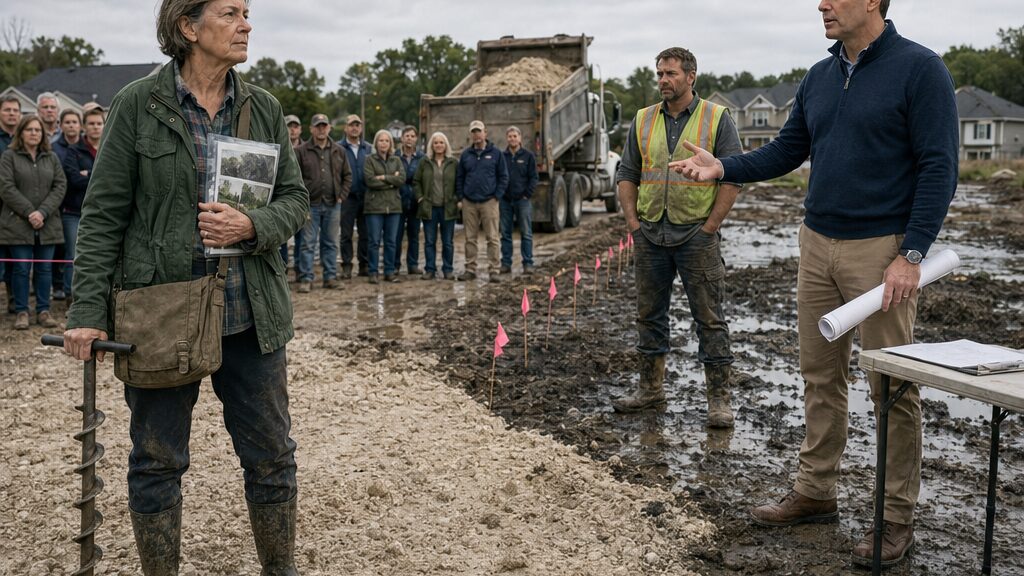
The Wednesday site walkthrough had been advertised as an opportunity for transparency. At nine in the morning, twenty-three homeowners stood along the taped edge of the expansion area while a dump truck idled behind them and pink survey flags snapped above the mud.
Debra had brought three photographs in a clear plastic sleeve.
She had also brought a hand auger.
Brandon noticed the photographs first.
He stood beside the property manager with a rolled plan under one arm, speaking in the calm public voice he used at annual meetings.
“We understand that change is difficult,” he said. “Especially for residents who have lived beside undeveloped land for many years.”
Undeveloped.
Debra watched several people nod.
The word did useful work. It made the marsh sound empty.
Brandon continued. “But personal attachment is not the same as a technical basis for stopping approved improvements.”
A man near the back folded his arms. Someone else murmured agreement.
Emma stood ten feet from Debra, hands tucked into her jacket pockets. She had arrived late and said little. Her townhouse sat near the front entrance, far from the marsh, but she had insisted on coming after Debra’s call the night before.
Brandon looked directly at Debra.
“We have plans. We have professional review. We have an association obligation to consider all homeowners, not just one view from one backyard.”
A woman beside Michelle Rivera glanced toward the photographs in Debra’s hand.
Debra did not answer immediately.
That irritated Brandon more than an interruption would have.
He unrolled the site plan across a folding table.
“The project area is here. The work remains within the designated footprint. Drainage improvements are incorporated. Future lots will strengthen the reserve position of the association.”
Debra stepped closer.
“May I ask one question?”
Brandon gave a brief smile. “Of course.”
“What is the depth of imported fill at Station Four?”
Samuel Scott, the contractor, looked up from his phone.
Brandon said, “That level of construction detail is not the purpose of today’s walkthrough.”
“It matters if you are describing what was beneath it.”
Samuel shifted his weight.
Debra looked at him. “How deep?”
He gave Brandon a quick glance. “Variable.”
“Approximately.”
“Two feet in some sections.”
“And at the southern edge?”
“I’d have to check.”
“You don’t.”
Brandon’s smile disappeared.
Debra set the photographs on the folding table and lifted the auger from the grass.
Several people moved closer.
“What are you doing?” the property manager asked.
“Sampling the edge.”
“That’s an active site.”
“I’m outside the equipment lane.”
Brandon stepped in front of her. “No.”
Debra stopped.
The truck behind him gave a sharp pneumatic hiss.
“I’m not asking the association to accept a conclusion,” she said. “I’m asking everyone standing here to look at what is physically present.”
“This is exactly the problem,” Brandon said. “You keep trying to turn a board matter into a personal field exercise.”
Emma’s voice came from behind them. “Then let her be wrong.”
The group went quiet.
Brandon looked at Emma.
She shrugged. “If it’s dry upland under there, she’ll pull up dry upland.”
Debra wished Emma had not said it. Not because she disagreed, but because the confidence in her daughter’s voice rested on assumptions Debra had not earned the right to encourage.
Samuel spoke before Brandon could.
“One core. At the perimeter.”
Brandon turned. “Samuel.”
“It’s already disturbed ground.”
The contractor’s tone made clear that he wanted the matter over.
Debra walked to the pale shoulder of fill near the southern flag line. She tested the surface with one boot, chose a spot beside—not inside—the compacted track, and set the auger vertically.
The first turn was easy.
Loose imported material.
The second resisted.
She leaned her weight into the handle.
A few homeowners drifted closer.
Brandon said, “For context, anyone can push a tool into wet soil after rain.”
Debra kept turning.
At eighteen inches, the color changed.
She felt it before she saw it: the drag of denser material, the slick resistance of saturated mineral soil beneath the coarse fill.
She drew the auger upward.
Pale brown material filled the upper section.
Below it was a dark gray-black core.
For several seconds no one spoke.
Then a bead of water formed along the lower edge.
It thickened.
Dropped.
Another followed.
The black water collected in the shallow cut.
Michelle crouched slightly, not touching it.
“What does that mean?”
Debra took a tape measure from her vest pocket.
“It means imported fill overlies saturated dark soil at this location.”
Brandon gave a short laugh. “That’s it?”
“That is what this core proves.”
“You’re not going to call it a protected wetland now?”
“Not from one core.”
The answer seemed to surprise him.
Debra marked the depth in her notebook.
Samuel watched more carefully now.
She photographed the core beside the measuring tape, then photographed the hole, the flag number, and the wider site.
A homeowner near the back said, “You’ve done this before.”
Debra cleaned the auger blade with a rag.
“Yes.”
“How much before?”
She looked up.
The question hung there.
Brandon answered for her.
“Apparently enough to put on a show.”
Emma’s face tightened.
Debra slid the auger back into its canvas sleeve. “I worked in wetland hydrology.”
There was a small shift in the group. Nothing dramatic. No applause. A few people simply looked at her differently.
Michelle straightened. “For who?”
“The state.”
Brandon’s jaw moved.
Debra could see him deciding whether to minimize that too.
He chose another path.
“Then you should understand why we rely on formal review rather than improvised demonstrations.”
“I do.”
“Good.”
He returned to the table and reached beneath the rolled plan.
“I also think, in the interest of transparency, homeowners should know that the project team did not ignore technical history.”
He lifted a stapled document.
Debra recognized the cover format immediately.
Her stomach went hollow.
Brandon held it where the group could see.
“This site has been assessed before.”
Debra did not move.
He read from the page.
“Seasonally saturated low area with limited functional connection beyond the evaluated footprint.”
The exact sentence from the attachment.
Her sentence.
Brandon looked toward the homeowners.
“That is not my language. It comes from a technical assessment completed years ago.”
Debra heard the truck engine, the wind in the flags, someone shifting boots in wet grass.
Emma was watching her now.
Not Brandon.
Her.
Brandon continued. “So when residents are told this board simply bulldozed into a known protected area, that characterization is at least incomplete.”
Debra found her voice. “What is the date on that report?”
“Seventeen years ago.”
“What footprint?”
He tapped the document. “The assessment is available for review.”
“That wasn’t my question.”
“And this is not a trial.”
“No,” Debra said. “It isn’t.”
She stepped toward the table.
“Let me see the appendices.”
For the first time that morning, Brandon hesitated.
Only half a second.
But Emma saw it too.
“What appendices?” Michelle asked.
Brandon placed the document flat. “The relevant pages are here.”
Debra stared at the staple.
Too thin.
Much too thin.
The original assessment had included maps, seasonal observations, photographs, and a limitations appendix.
This copy held perhaps twelve pages.
The core in the mud no longer felt like a victory.
It felt like a door she had tried not to open.
Emma came beside her.
Her voice was low enough that only Debra could hear.
“Mom.”
Debra kept looking at the report.
Emma touched the bottom corner of the page where the author line had been partially covered by Brandon’s thumb.
Then she looked at Debra.
“Did you write this?”
Chapter 3: The Report She Never Told Her Neighbors About
Emma placed the old signature beside the HOA map and said nothing.
She had found it before Debra could decide how much to tell her.
The kitchen table was covered with records pulled from the garage archive: county plats, field notebooks, a faded aerial photograph, and the twelve-page copy Brandon had distributed after the walkthrough.
Beside them lay Debra’s original report.
On its cover:
Technical Assessment of Hydrologic Conditions Within Proposed Western Access Corridor.
Prepared by Debra Green.
Emma tapped the signature page once.
“So yes.”
Debra remained standing.
“Yes.”
“You wrote the report he used.”
“I wrote a report.”
“That sounds like the kind of distinction you make when you already know you’re in trouble.”
Debra looked toward the window.
The trucks had stopped for the evening, but pale fill now occupied a broad wedge where the spring water used to widen.
“Sit down,” Emma said.
“I’m fine.”
“I’m not.”
That made Debra turn.
Emma’s anger was not loud. That was worse. She had inherited Debra’s habit of compressing emotion until every word became clean-edged.
“At the walkthrough,” Emma said, “you let me stand there and act like Brandon had ambushed you with something false.”
“He did not present the complete assessment.”
“But you wrote it.”
“Yes.”
“And you didn’t tell me.”
“No.”
“Did you tell anyone?”
Debra pulled out a chair.
“No.”
Emma laughed once without humor. “Of course.”
The old report had been commissioned long before Cedar Ridge became the neighborhood it was now. At the time, the western parcel had been considered for a narrow utility access route. Debra had been working for the state, though the assessment itself came through a technical review arrangement she was allowed to complete.
She opened the original to the map section.
“This was the evaluated footprint.”
Emma leaned in.
A narrow shaded corridor crossed the northern edge of the property.
Debra placed Brandon’s HOA exhibit beside it.
The new fill zone extended far south.
“They’re not the same,” Emma said.
“No.”
“Then why is he using your report?”
“Because the sentence is useful without the boundaries around it.”
Emma read the highlighted line again.
Seasonally saturated low area with limited functional connection beyond the evaluated footprint.
“You wrote that.”
“I did.”
“Was it true?”
Debra hated how quickly the professional answer came.
“For the corridor we evaluated, based on the observations available then, it was supportable.”
Emma sat back. “Supportable.”
“It means I would not call it fabricated.”
“I know what the word means.”
Debra closed her eyes briefly.
There it was. The old mistake repeating itself in miniature: retreating into precision when a person was asking for honesty.
She opened the report to the back.
“Look here.”
The appendices were tabbed A through D.
Seasonal water observations.
Photo points.
Hydrologic limitations.
Extrapolation restrictions.
Emma flipped through them.
“These aren’t in Brandon’s copy.”
“No.”
“Did he remove them?”
“I don’t know.”
“You always say that when you mean you have a theory.”
“I have several.”
“Pick the one you’re afraid of.”
Debra’s hand tightened on the chair.
For a moment, neither spoke.
Then Debra said, “The final report was revised.”
Emma waited.
“The original language was broader. I raised concerns about relying on a short observation period. The project scope was narrowed. The wording changed.”
“Who wanted it changed?”
“The people trying to move the access project forward.”
“And you agreed.”
Debra looked down.
“Yes.”
Emma went still.
Not shocked. Something more painful: disappointed in a way that suggested an old pattern had finally acquired a name.
“Why?”
“I was tired.”
“That’s not an answer.”
“It is, just not a good one.”
Debra sat.
Seventeen years earlier, she had been finishing a difficult stretch of state work, spending weeks in meetings where every caution became an obstacle someone wanted softened. Her husband had been ill then, though not yet dying. Emma had been angry that Debra missed dinner, angry that every call from work became urgent.
Debra did not tell that history as an excuse.
She kept it to the part that mattered.
“I told myself the narrowed footprint solved the problem,” she said. “I put the limitations in writing. I thought if someone wanted to go beyond that area later, they would have to do new work.”
Emma stared at the missing appendix pages.
“And when you saw people stretching it?”
Debra did not answer quickly enough.
Emma’s eyes hardened.
“You saw it before now.”
“Years later. In a planning reference.”
“And?”
“I objected privately.”
“To who?”
“A consultant. Then a project contact.”
“What happened?”
“They stopped using the wording in that proposal.”
“That proposal.”
“Yes.”
Emma pushed back from the table.
“So you knew your report could be misused.”
“I knew it had been misused once.”
“And you never forced a correction into the public record.”
“No.”
The word changed the room.
Outside, a truck door slammed somewhere beyond the houses.
Emma walked to the sink, then turned.
“You always made silence look like discipline.”
Debra felt that one.
“Emma—”
“No. I grew up thinking you were the calm one. Dad got sick, you handled forms. He died, you handled accounts. I got angry, you waited until I stopped. Now I find out sometimes you’re not calm. Sometimes you’re hiding until the argument gets tired.”
Debra’s first instinct was to defend herself.
She let it pass.
“I should have corrected the record.”
Emma folded her arms. “Yes.”
“I should have told the neighborhood before I challenged Brandon publicly.”
“Yes.”
“I was afraid the moment I did, everything else I said would be treated as self-protection.”
Emma looked at her for a long time.
“And now?”
“Now it might be.”
The following morning Debra went to the HOA office before nine.
The property manager gave her access to the project file after she cited the association records provision and refused to leave with a promise of later review.
She sat at a small conference table under fluorescent lights while the manager brought folders one at a time.
Brandon’s copy of her assessment was there.
Twelve pages.
No appendices.
But the more important fact was subtler.
The copy was not fake.
The pages were real.
The cover had been reproduced accurately. The selected text had not been rewritten. Even the revision date matched.
Someone had not invented evidence.
Someone had separated it.
Debra photographed the table of contents, then the final page.
Appendix references remained in the text.
A reader paying attention would know something was missing.
Her phone vibrated.
Emma.
Debra let it ring out.
Then she found an email printout clipped behind the report.
Project team note: historical assessment supports low-function characterization. Current delineation not anticipated unless required by reviewing authority.
She read it twice.
No author listed on the printout.
No proof yet of who had made the decision.
The office door opened.
Michelle Rivera entered carrying a laptop and a paper cup.
She saw Debra, stopped, and shut the door behind her.
“You found the old assessment.”
Debra studied her. “You knew about it.”
“I knew Brandon had one.”
“You’re the treasurer.”
“That doesn’t make me the project engineer.”
“No. It makes you a board officer.”
Michelle set down the cup.
“I voted to continue.”
Debra waited.
Michelle pulled out the chair opposite her.
“You think this is about Brandon wanting more houses.”
“Isn’t it?”
“Partly.”
“What is the other part?”
Michelle opened her laptop.
For the first time since the trucks arrived, Debra saw genuine fear in someone on the other side of the table.
Not irritation.
Not embarrassment.
Fear.
Michelle rotated the screen.
A reserve forecast filled it.
Red numbers ran down three columns.
Deferred drainage repairs. Private road resurfacing. Stormwater basin work. Insurance increase.
At the bottom was a projected special assessment.
Debra leaned closer.
The amount per household was five figures.
Michelle lowered her voice.
“My mother owns her house outright,” she said. “She lives three streets over. Fixed income. If this project fails, she cannot pay that.”
Debra looked from the number to Michelle.
Michelle swallowed.
“And she’s not the only one.”
She closed the laptop halfway, as if even the screen were dangerous.
“You wanted to know why Brandon kept pushing?”
Her hand remained on the lid.
“Because if the expansion collapses, Debra, there is a real chance the HOA cannot survive what comes next.”
Chapter 4: The Price of Saving Property Values
Michelle reopened the laptop and turned it fully toward Debra.
“This is the version we didn’t show at the annual meeting.”
The reserve forecast looked less frightening when reduced to columns. That was one reason boards loved spreadsheets. Red numbers could still pretend to be orderly.
Debra read them twice.
Stormwater basin rehabilitation.
Private road resurfacing.
Culvert replacement.
Insurance adjustment.
Deferred common-area drainage.
At the bottom, beneath three projected funding scenarios, was the figure Michelle had warned her about.
$18,640 per household.
Debra sat back.
“You’re serious.”
“I wish I weren’t.”
The HOA office was still closed to residents, but Michelle had used her board access to bring Debra into the small conference room before sunrise. Outside the glass door, the subdivision looked ordinary: porch lights switching off, garage doors opening, a school bus sighing at the corner.
Inside, one number could rearrange every life on those streets.
Michelle closed the blinds.
“Brandon’s been saying expansion revenue will stabilize reserves. That part isn’t made up.”
“How many lots?”
“Fourteen if the final grading works.”
“If.”
Michelle looked away.
Debra pointed to the projection. “This assumes full sale value.”
“Yes.”
“And no major remediation.”
“Yes.”
“And no delay.”
Michelle’s mouth tightened.
“Yes.”
Debra leaned back. “Then this is not a rescue plan. It’s a narrow bridge over a hole.”
“It’s the only bridge we have.”
“No.”
Michelle’s eyes flashed. “That is easy for you to say.”
Debra said nothing.
Michelle continued before she could.
“My mother’s house is paid off. She still counts grocery money before the end of the month. You think she can write a check for eighteen thousand dollars because the board chose purity over a project?”
“I didn’t say that.”
“You don’t have to.”
The words landed harder because there was no cruelty in them. Only exhaustion.
Debra folded her hands.
“How long has Brandon known?”
“About the reserve gap? Years.”
“About this amount?”
“Since the updated study in January.”
“And the rest of the homeowners?”
“Not the full number.”
Debra looked at her.
Michelle stared down at the table.
“I told myself we were preventing panic.”
“You were.”
Michelle’s eyes lifted.
“And?”
“And sometimes preventing panic is responsible.”
Michelle waited.
“Until the thing being hidden becomes the reason people cannot make informed choices.”
The treasurer’s expression hardened again, but more slowly this time.
“You sound very certain for someone who hid her own report.”
Debra felt the old reflex rise: explain the scope, distinguish silence from concealment, restore technical order.
She let the silence remain.
“You’re right,” she said.
Michelle blinked.
Debra stood and walked to the window. Between two houses, she could see the tops of the pink survey flags on the slope.
Rain overnight had left shallow water pooled around them. Their bright reflections trembled in the dark surface.
For the first time, the flags did not look like simple arrogance.
They looked like debt.
By noon, Debra was in a closed budget session she had not been invited to until Michelle insisted.
Brandon sat at the head of the table. The property manager was beside him. A stack of financial packets lay near his hand.
“You are not a board member,” Brandon said.
“No.”
“This is an executive financial discussion.”
Michelle said, “She’s here because the technical risk affects the projections.”
Brandon turned to her. “You made that decision alone?”
“I made a request.”
“And I’m denying it.”
Debra began gathering her papers.
“Fine.”
Brandon frowned. “That’s it?”
“You said no.”
She moved toward the door.
“Debra.”
She stopped.
He looked around the room, then rubbed the bridge of his nose.
“Sit down.”
The irritation in his voice was real, but beneath it she heard something else now.
Pressure.
He waited until the property manager shut the door.
Then he pushed a sheet across the table.
“Do you know what happens if we stop?”
Debra glanced at the page. “I’ve seen the reserve forecast.”
“Not this.”
It was a lender timeline.
A development financing commitment tied to specific construction milestones.
“Miss the grading window,” Brandon said, “and the financing changes.”
“Changes how?”
“Higher carry cost. Potential withdrawal.”
“And you signed based on the assumption the lots would proceed.”
“The board approved it.”
“You led it.”
“Yes.”
There was no hesitation.
Debra studied him.
“What warnings did you have before the trucks started?”
Brandon’s face changed.
Not much.
Enough.
“That question is outside the budget discussion.”
“Then the budget discussion is theater.”
Michelle looked between them.
Brandon leaned back.
“You think I woke up one morning wanting to fill mud?”
“Marsh.”
“Fine. Marsh. You think I enjoy being the person who tells seventy-two families their dues may jump, their roads still won’t be fixed, and the insurance renewal is worse than last year?”
“You don’t get to redefine the ground because the budget is bad.”
“And you don’t get to pretend there’s no human cost to stopping.”
Debra felt anger rise, then fail to settle cleanly.
Brandon opened a folder.
“One homeowner has already asked about a payment plan for the current dues increase. Another is behind six months. Michelle’s mother is not unique.”
Michelle looked down.
Brandon’s voice lowered.
“I ran for this board because the previous one deferred everything. Every ugly decision. Every reserve contribution. Every repair. They kept dues low and called it stewardship.”
Debra said, “And now you’ve tied the neighborhood to fourteen lots.”
“Yes.”
“On ground you were warned about.”
His jaw tightened.
There it was.
Michelle heard it too.
“What warning?” she asked.
Brandon looked at her.
“Don’t.”
“What warning?”
He stood and walked toward the closed blinds.
“The engineer raised drainage concerns.”
“When?”
“Preliminary review.”
“Before financing?”
“No.”
“Before fill?”
He did not answer.
Debra’s pulse slowed.
“When, Brandon?”
He turned.
“A week before mobilization.”
Michelle stared at him.
“You told us all conditions were cleared.”
“I told you no agency had ordered a stop.”
“That is not the same thing.”
“No,” he snapped. “It isn’t.”
The room went silent.
Brandon pressed both hands to the table.
“The contractor was scheduled. Financing was tied to start. A delay would have triggered another review. Another review could have killed the loan.”
“So you continued,” Debra said.
“I continued because seventy-two households were not going to thank me for bankrupting the association over an unconfirmed concern.”
“You had saturated soil.”
“I had questions.”
“You had my written objection.”
“I had an objection from a homeowner who failed to disclose she authored the historical assessment everyone was arguing about.”
The sentence struck cleanly because it was true enough to hurt.
Debra did not answer.
Brandon saw it.
His voice softened.
“That’s what you still don’t understand. You think this is you against me. It isn’t. It’s every bad decision this neighborhood postponed for fifteen years arriving at once.”
For a moment, Debra saw him not as the man smiling beside the trucks, but as someone who had mistaken urgency for permission.
That did not absolve him.
It made the situation worse.
At four that afternoon, her phone chimed with an email from the county stormwater office.
She opened it standing at the edge of her backyard.
The message acknowledged receipt of her photographs and site concerns. Based on the materials submitted, county staff stated that the dispute could involve private drainage conditions within association-controlled property and recommended resolution through the HOA and project engineer unless additional evidence established county jurisdiction.
Debra read the paragraph again.
Behind the fence, a machine started.
Across the shallow water, pink flags shook in the vibration.
Her own old report had given Brandon a defense.
The county had given him room.
And before she could decide what to do next, the excavator bucket dropped into the ground.
Chapter 5: The Victory That Lasted Until the Concrete Split
The crack sounded like a rifle shot.
Debra was at her kitchen sink when it came from beyond the marsh edge—one sharp report, then a second, softer pop.
She set down the glass in her hand and went outside.
Three weeks had passed since the county email.
Three weeks of accelerated work.
Fill compacted.
Forms set.
Concrete poured.
Brandon had stopped answering her directly. HOA updates arrived through the property manager in neutral phrases: construction proceeding, no formal stop order, concerns under review.
By the time Debra reached the expansion area, two workers were already standing over the nearest footing.
A line ran across the concrete.
Not a hairline.
A fresh break wide enough to catch shadow.
Samuel Scott crouched beside it with one hand on his knee.
He looked up when Debra approached.
“You can’t be here.”
“I’m outside the barrier.”
“You need to leave.”
She looked past him.
At the lower edge of the footing, water darkened the soil.
Not rainwater.
The morning had been dry.
A black thread emerged from beneath the pale fill, collected beside the concrete, and disappeared into the crack.
Debra took out her phone.
Samuel stood.
“No photos.”
“Why?”
“Active investigation.”
“By whom?”
He stepped between her and the footing.
“Debra.”
The use of her name made her pause.
His voice was lower now.
“Don’t make this harder.”
“For who?”
He looked toward the equipment yard.
That was answer enough.
She photographed from where she stood.
The first image showed the cracked footing.
The second showed the seepage.
The third included a pink survey flag in the background.
Samuel swore under his breath and walked away.
By noon, the site had been partially covered with tarps.
Debra returned home and opened the photo archive from the first week.
Truck number.
Time stamp.
Fill edge.
Standing water.
She arranged them beside the spring photographs and the map.
Then she found the sequence.
A dump truck had crossed the southern channel on Monday.
The footing that cracked sat directly above the expanded fill line placed over that route.
It proved sequence.
Not cause.
Debra wrote that distinction at the top of her notebook in block letters.
SEQUENCE IS NOT CAUSATION.
She underlined it twice.
At two, Emma arrived carrying coffee.
“You look terrible.”
“Thank you.”
“Was that the foundation?”
“Yes.”
Emma set down the cups and examined the photographs.
“So you were right.”
“No.”
Emma looked at her.
“The concrete cracked.”
“Yes.”
“The water came back.”
“Yes.”
“And?”
“And I don’t know why the footing cracked.”
Emma exhaled. “You can be exhausting.”
“I know.”
That made Emma almost smile.
Almost.
Debra opened another folder.
“I need construction logs.”
“From the HOA?”
“From Samuel.”
“Why would he give them to you?”
“He won’t.”
“Good plan.”
Debra ignored that.
At four-thirty, Samuel knocked on her back door.
He looked older than he had that morning.
No reflective vest. No hard hat. Just a work shirt with dried mud on one sleeve.
Debra let him in.
He remained standing.
“You said you wanted logs.”
She waited.
“I didn’t say that to you.”
“You said it loud enough to somebody.”
He placed a photocopied sheet on the counter.
Daily field record.
The first week of fill.
Debra read.
Subgrade soft at southern limit.
Pumping observed under equipment load.
Additional aggregate requested.
She looked up.
Samuel’s face was tight.
“This doesn’t prove your wetland claim.”
“I know.”
“It doesn’t prove the crack.”
“I know.”
“You keep saying that.”
“Because it matters.”
He stared at her for a moment.
Then put down two more pages.
One contained a note from later that same week.
Saturated material encountered below planned lift. Proceeded per direction.
Debra touched the line.
“Whose direction?”
Samuel looked toward the window.
“Board wanted schedule maintained.”
“Brandon?”
“I’m not doing this.”
“You came here.”
“I came because if this turns into everybody pretending the field conditions were a surprise, I’m not carrying that alone.”
There was no confession in his voice.
Only self-protection.
Debra understood that too well.
“Did you object?”
“I documented.”
“That’s not what I asked.”
His eyes narrowed.
“No.”
The answer sat between them.
Two people who had once believed writing something down was enough.
Samuel left without taking the copies.
At six, Brandon arrived.
He did not knock on the back door. He came to the front.
Debra opened it and found him holding a thin envelope.
“You have five minutes,” she said.
“I need ten.”
“You have five.”
He stepped inside.
His eyes moved once toward the kitchen table, where the logs were visible.
“I heard Samuel visited.”
“You hear quickly.”
“He works for the association.”
“He works for a contractor.”
“Today that distinction is not useful.”
Brandon placed the envelope on the table.
“What is it?”
“A proposal.”
“I’m not selling my house.”
“That isn’t what this is.”
Debra opened the envelope.
The first page offered repairs and drainage improvements along her property edge at association expense. Additional monitoring. Landscape restoration. Legal fees.
She read the amount.
Then the confidentiality clause.
Her eyes stopped.
Brandon spoke before she did.
“You get protection. The association gets time.”
“Time for what?”
“To determine the actual cause before everyone destroys each other.”
“You mean before homeowners learn the footing cracked.”
“They’ll learn.”
“When?”
“When we have facts.”
Debra looked at the clause again.
“No public statements concerning historical reports, regulatory characterization, project decision-making, or association disclosures.”
She raised her eyes.
“This isn’t a settlement over my property.”
“It includes your property.”
“It releases the HOA from disclosure.”
“It creates a controlled process.”
“It buys silence.”
His face hardened.
“It prevents speculation.”
“You kept building after a drainage warning.”
“You hid your authorship.”
“Yes.”
The speed of her answer stopped him.
Debra put the papers down.
“Yes,” she repeated. “I did.”
Brandon stared at her.
For the first time since the trucks came, he seemed unsure what argument to use.
Debra turned the packet over.
On the final page was a broader release than she had expected.
Claims known or unknown.
Project disclosures.
Board communications.
Historical technical reliance.
She read it once.
Then again.
The cracked footing had not simply changed the engineering problem.
It had changed what silence was worth.
Brandon took a step closer.
“You think exposing everything saves this neighborhood?”
“No.”
“Then be careful.”
“I am.”
“You don’t look careful.”
Debra closed the packet.
“I look late.”
He said nothing.
She handed the papers back except for one copy.
“I’m keeping this.”
“You haven’t signed.”
“That is why I’m keeping it.”
After he left, Debra called Emma.
She did not ask for advice.
She said only, “I’m going to have to tell them all of it.”
There was a long silence.
Then Emma said, “Including your part?”
Debra looked through the kitchen window.
Beyond the houses, black water had begun collecting again along the fill edge.
“Yes.”
This time, she did not soften the word.
“Yes.”
Chapter 6: What Debra Had to Admit Before Anyone Believed Her
Brandon opened the emergency meeting by accusing Debra of hiding a conflict of interest.
He did it before the board secretary finished checking attendance.
The clubhouse was full enough that people stood along the back wall. Folding chairs scraped. Phones glowed in laps. Near the entrance, the property manager kept whispering to homeowners that no final agency determination had been made.
Brandon stood behind the long board table.
“This community deserves complete information,” he said. “Especially when accusations threaten property values, association solvency, and active construction.”
Debra sat in the second row with a folder on her knees.
Emma was beside her.
Michelle sat at the board table but had not looked at Brandon once.
He lifted a copy of the old assessment.
“Some residents have been led to believe that Debra Green is simply a concerned neighbor who independently discovered a technical problem.”
A murmur moved through the room.
Brandon continued.
“What many were not told is that Ms. Green authored the historical assessment now at the center of this dispute.”
Someone behind Debra whispered, “What?”
Brandon turned a page.
“She challenged this board’s reliance on the document without disclosing that personal connection during the initial public walkthrough.”
Emma shifted beside her.
Debra touched her daughter’s wrist once.
Wait.
Brandon’s voice remained controlled.
“I am not saying that invalidates every concern. I am saying homeowners deserve to know when a person presenting herself as an independent critic has prior involvement.”
He looked directly at Debra.
“Would you like to deny that?”
The room held still.
Debra stood.
“No.”
The word seemed to disappoint everyone at once.
Brandon blinked.
Debra stepped into the aisle.
“No, I won’t deny it.”
A woman near the front folded her arms.
Debra continued.
“I wrote the assessment seventeen years ago.”
The murmuring grew.
Emma looked straight ahead.
Brandon sat down slowly, as if unsure whether he had just won too easily.
Debra opened her folder.
“It evaluated a narrower corridor than the area being filled now. It contained appendices describing seasonal observations, photo points, hydrologic limitations, and restrictions against extending the conclusions beyond the evaluated footprint.”
She held up the complete report.
“The copy used by the project team is incomplete.”
Brandon leaned toward his microphone.
“But authentic.”
Debra looked at him.
“Yes.”
Another murmur.
She let it happen.
“That matters,” she said. “Because I am not accusing this board of inventing my words.”
Brandon’s expression tightened.
“I am accusing people of using real words beyond the conditions that made them defensible.”
A homeowner called from the back, “Then why didn’t you say this from day one?”
Debra turned.
She could not see who had spoken.
The question did not need a face.
“Because I was ashamed.”
The room changed.
Not softened.
Changed.
Debra felt Emma look at her.
She continued before she could retreat into technical language.
“Years ago, I agreed to narrow wording in that assessment after the project scope was narrowed. I documented the limits. I told myself that was enough.”
She placed the report on the table nearest the aisle.
“Later, I learned the language had been stretched in another planning context. I objected privately. That use stopped.”
“Then what’s the problem?” someone asked.
“The problem is that I never forced a public correction into the record.”
Silence.
Debra’s mouth had gone dry.
“I was tired of the fight. I told myself the next professional would read carefully. I told myself appendices existed for a reason. I told myself accurate documents protected themselves.”
Emma lowered her eyes.
Debra looked around the room.
“They do not.”
Brandon reached for the microphone.
“This is precisely why—”
“No,” Michelle said.
It was the first word she had spoken.
Everyone turned.
Brandon stared at her.
Michelle placed a stack of printed emails on the table.
“No. You don’t get to use her admission to erase yours.”
His face went still.
“What are those?”
“Board records.”
“You had no authority to distribute privileged—”
“Not privileged.”
Michelle’s voice shook, but she kept going.
“Project scheduling communications. Budget communications. Warning notices.”
The room erupted.
The board secretary called for order.
Michelle did not wait.
She held up the first page.
“Eleven days before mobilization, the project engineer warned of saturated subgrade conditions near the southern limit and recommended additional review before full placement.”
Brandon leaned toward her.
“We discussed that.”
“Yes.”
“Context matters.”
“It does.”
Michelle lifted another page.
“Seven days before mobilization, you wrote that delay could jeopardize financing and instructed the manager to keep the work start unchanged unless an agency issued a formal stop.”
Brandon’s face reddened.
“That was a board decision.”
“No.”
Michelle looked at the other board seats.
“That specific direction was not voted.”
The room became very quiet.
Debra felt no triumph.
Only the slow collapse of excuses.
Brandon stood.
“You all wanted this project.”
A man in the front row said, “Not like this.”
Brandon turned toward him.
“You wanted roads without higher dues. You wanted drainage repairs. You wanted reserves rebuilt. Every annual meeting, everybody demanded something and voted down the money to pay for it.”
No one answered.
His voice rose, not theatrically, but with something frayed underneath.
“I was trying to keep people in their homes.”
Michelle flinched.
Debra saw it.
Brandon continued.
“You think I don’t know who can’t afford an assessment? I know. I know exactly.”
He looked at Michelle.
Her face went pale.
For one moment, Debra understood that his motive had never been clean enough to be called noble, but neither had it begun as simple greed.
Then he made the choice that belonged to him.
“I kept the schedule because waiting for perfect certainty would have killed the financing.”
Debra said, “After the warning.”
He looked at her.
“Yes.”
The single word traveled farther than a denial would have.
The property manager’s phone began vibrating on the table.
She ignored it.
It stopped.
Then started again.
Emma leaned toward Debra.
“Are you okay?”
“No.”
It was the honest answer.
Debra picked up the spring photograph from her folder.
The one showing the black-water channel before fill.
She handed it to the homeowner nearest the aisle.
“Pass this back.”
The photograph moved from hand to hand.
No speech accompanied it.
Just water.
Cattails.
The curve beneath what was now concrete.
By the time it reached the rear of the room, the property manager’s phone rang a third time.
She answered.
“Yes?”
Her expression changed.
She turned away from the room, listened, then looked directly at Debra.
“Ms. Green.”
Everyone went quiet again.
The manager covered the phone.
“A federal wetlands field officer received the chronology and attachments.”
Brandon sat down.
The manager continued.
“They’re requesting immediate site access.”
No one spoke.
Debra looked at the complete report on the table, at Michelle’s emails, at the spring photograph still moving through strangers’ hands.
For years she had believed the most dangerous thing was being wrong.
Now she understood there was something worse.
Being right too late.
Chapter 7: The Day the Board Could No Longer Call It Drainage
The federal wetlands field officer stepped over the first pink survey flag, looked at the exposed soil beneath the cracked footing, and asked, “Who authorized continued placement after saturation was documented?”
No one answered.
The question carried across the site more cleanly than the machinery ever had. There were no trucks running that morning. No excavator bucket dropping fill. Only the scrape of boots, the click of cameras, and water moving somewhere beneath the pale compacted surface.
Debra stood outside the marked inspection corridor with her field notebook closed against her thigh.
Brandon was ten feet away.
Michelle stood beside the property manager. Samuel had arrived early and remained near the contractor’s trailer with his arms folded. A county stormwater inspector had joined the visit, along with a foundation engineer retained after the crack appeared.
The federal officer crouched near the southern fill edge.
“Who?”
Brandon cleared his throat.
“The association relied on the project team and the absence of a formal stop directive.”
The officer looked up.
“That wasn’t my question.”
Debra felt something almost like recognition.
Not pleasure.
Recognition.
Brandon’s eyes moved toward Samuel.
Samuel did not help him.
Finally Brandon said, “The board maintained the schedule.”
Michelle spoke quietly.
“There was no board vote after the warning.”
The property manager closed her eyes for half a second.
The officer wrote something on her clipboard.
Debra could feel homeowners watching from beyond the temporary barrier. Word of the inspection had spread despite the board’s request that residents avoid the work zone. Some stood on the sidewalk. Others watched from decks.
Brandon looked toward them and lowered his voice.
“Can we keep this technical?”
The officer said, “That is what I’m doing.”
She motioned toward the cut Samuel’s crew had opened the previous afternoon at the foundation engineer’s request.
Pale imported fill formed the upper layer.
Below it, dark gray soil ran laterally beneath the construction area.
Along the exposed face, black water gathered in small beads.
One became heavy and fell.
Then another.
Debra remembered the walkthrough.
The auger.
Brandon laughing at one neighbor with old pictures.
The officer pointed to the dark layer.
“Ms. Green, you submitted historical photo points associated with this alignment?”
Debra stepped forward only when invited.
“Yes.”
“Were all locations established by survey?”
“No. Some were repeatable landscape references. Two had coordinates from later monitoring.”
“Good.”
The officer looked at her.
The single word mattered.
Not because it praised her.
Because it acknowledged uncertainty without treating uncertainty as useless.
Debra opened her notebook.
“The spring sequence begins here.”
She indicated the southern channel on the map.
“Water moved east during high conditions. I have repeated observations across several years, but not continuous instrumentation.”
“Any claim of continuous surface flow?”
“No.”
“Any claim that one soil core establishes jurisdiction?”
“No.”
Brandon glanced at her.
Debra kept her eyes on the map.
The officer moved toward the footing.
“Then what are you claiming?”
“That the current characterization as private seasonal drainage is incomplete. The physical conditions, historical hydrology, and disturbed soil profile justify a formal review of connection and extent.”
The officer nodded once.
“That is also my preliminary view.”
The words passed through the gathered group without noise.
Brandon’s face changed.
It was not collapse.
Not yet.
But the polished certainty he had worn beside the trucks was gone.
The county inspector asked, “Are you asserting federal jurisdiction today?”
“No,” the officer said. “I am saying there is enough here that continued reliance on the existing characterization is not appropriate.”
Samuel looked down.
The foundation engineer spoke next.
“We also need to separate the structural issue. The crack may involve settlement, bearing conditions, placement, drainage, or a combination. We are not assigning cause from appearance.”
Debra felt a small, strange relief.
Someone else refusing to overclaim.
The officer walked farther along the exposed cut.
A pink flag stood at the edge of returning water.
Its reflection shook in the dark surface.
“Work in the affected area should remain paused pending review,” she said. “Additional delineation and record reconstruction will be necessary.”
The property manager asked the question everyone feared.
“And if the fill was placed in a regulated area?”
The officer straightened.
“Then corrective action may be required.”
“How much corrective action?”
“That depends on findings.”
Brandon said, “Could that include removal?”
The officer looked at the pale embankment, then at the cracked concrete.
“Yes.”
The homeowners behind the barrier began talking at once.
Michelle pressed a hand to her forehead.
Debra heard fragments.
Assessment.
Lawyers.
Sell now.
How could they not know?
Brandon turned toward her.
“Debra.”
She knew from his tone that he did not mean to speak in front of everyone.
He walked away from the group toward the older fence line.
She followed only far enough to keep the inspection in sight.
“What?”
His voice dropped.
“We can still settle this between neighbors.”
For a moment, the sentence was so close to what she had expected that it felt unreal.
Debra looked at him.
“Now?”
“I’m serious.”
“You were serious before.”
“The situation has changed.”
“Yes.”
He rubbed his hands together once.
“We can withdraw the release language you objected to.”
“That isn’t enough.”
“We can protect your property. Fund monitoring. Create an independent review.”
“You already have a formal review.”
“I mean one we control locally.”
There it was.
Not evil.
Fear.
He glanced toward the homeowners.
“You heard them. If this becomes full restoration, the association could be destroyed.”
“You knew that risk existed.”
“I knew there were questions.”
“You kept building.”
“I thought we could finish before uncertainty swallowed the financing.”
Debra’s anger returned, but it no longer came cleanly. She thought of Michelle’s mother counting grocery money. Of homeowners who had voted down reserve increases for years. Of her own report sitting quietly in a file while others used it.
Brandon leaned closer.
“I am asking you not to push this farther than it has to go.”
Debra studied his face.
“You still think I control it.”
“You started this.”
“No.”
She looked toward the exposed dark soil.
“The water started before either of us.”
He flinched as if she had chosen a poetic answer to avoid him.
So she made it plain.
“I submitted evidence. I admitted my role. Michelle released board records. Samuel documented field conditions. The officer is here because the full chronology exists now.”
“You can still recommend restraint.”
“I can recommend accuracy.”
“People may lose their homes.”
“I know.”
He stared at her.
Perhaps he had expected triumph.
Debra had expected it too, once.
Instead she felt the weight of every answer.
“I will not sign anything that hides what happened,” she said. “And I will not stand in front of the neighborhood pretending restoration is free.”
Brandon looked away.
Behind them, the officer called Debra’s name.
She returned to the inspection area.
The foundation engineer had opened another section beside the footing. Beneath the compacted fill, the dark layer continued farther than the project map suggested.
The federal officer pointed to it.
“This appears consistent with the area shown in your spring photographs.”
“Appears,” Debra said.
The officer looked at her.
“Yes. Appears.”
Michelle approached carrying her tablet.
“What happens now?”
“Formal follow-up,” the officer said. “Additional field work. Records review. Likely coordination with other authorities.”
“And the cost?”
“No responsible person can give you a final number today.”
The property manager asked, “Can you give a range?”
The officer shook her head.
The foundation engineer was less cautious about one thing.
“If removal and stabilization extend across this footprint,” he said, “the association should prepare for a significant exposure.”
Michelle’s face drained.
“How significant?”
He named no exact figure.
He did not need to.
The preliminary components alone—removal, disposal, engineering, stabilization, monitoring—were enough to exceed the remaining project contingency several times over.
The crowd beyond the barrier heard enough.
A homeowner shouted, “Who pays for this?”
Another answered, “We do.”
The anger shifted direction so quickly Debra almost stepped back.
Some voices aimed at Brandon.
Some at the board.
One at Debra.
“This is what you wanted!”
Emma had arrived at the sidewalk and turned toward the speaker.
Debra raised one hand.
Not to silence the homeowner.
To stop Emma.
The accusation hurt because some version of it would remain true in people’s minds. Debra had wanted the work stopped. She had wanted the risk exposed.
She had not wanted the bill.
But consequences did not become unreal because no one wanted them.
The federal officer closed her clipboard.
Before leaving, she spoke to Debra privately.
“We’ll need historical monitoring support.”
“I’ve submitted what I have.”
“I mean going forward.”
Debra looked at her.
The officer nodded toward the disturbed edge.
“If corrective work is required, someone will need to help design a monitoring framework that understands the site history.”
Debra felt the old instinct rise immediately.
Take control.
Build the protocol.
Correct the mistakes.
Make herself useful enough that usefulness could replace guilt.
She looked at the black water collecting beneath the flag.
“What exactly are you asking?”
“Whether you would participate.”
Not lead.
Participate.
Debra heard the difference.
Behind her, homeowners were arguing about assessments.
Brandon stood alone beside the folding table.
Michelle was crying quietly while the property manager talked to her.
Emma watched Debra from the sidewalk.
The officer waited.
Years earlier, Debra had walked away from a fight and trusted paper to carry the burden.
Now she was being asked to step back into the same ground.
She closed her notebook.
“I need to think about the terms.”
The officer nodded.
“Good.”
Debra looked once more at the exposed soil, the cracked footing, and the slow dark water working its way around what had been placed over it.
For the first time, the question was no longer whether she could prove she had been right.
It was whether she could help repair anything without making herself the person who owned the truth again.
Chapter 8: When the Pink Flags Marked What Would Be Restored
The pink flags returned in October.
This time, they marked what had to come out.
Debra stood at her back fence while a restoration crew measured the first removal boundary. The flags ran across the same pale fill where Brandon had once described future lots, but their spacing had changed. No neat rectangles. No building pads.
They followed water.
A crew member pressed one flag beside the reopened southern channel. Another placed one near the failed footing, now cut into sections for removal.
The HOA had survived.
Barely.
The final arrangement was uglier than anyone had wanted and less catastrophic than everyone had feared.
The expansion plan was abandoned.
Construction financing was unwound at a loss.
The association entered a phased corrective program with engineering oversight, required disclosures, and several years of monitoring. Insurance costs increased. Legal expenses remained disputed. The road work was delayed again.
Homeowners paid a special assessment.
Not the eighteen thousand dollars from the worst reserve scenario.
Still enough to hurt.
Some paid from savings.
Some used payment plans.
Some cursed the board at every meeting.
Michelle’s mother kept her house because the association approved a hardship schedule after months of argument. Other residents said that arrangement was unfair.
Nothing stayed morally simple once invoices arrived.
Brandon no longer presided over meetings.
He had not been led out in disgrace. No crowd had applauded his removal. He resigned after the board commissioned an independent review of project decisions and disclosure failures.
Debra saw him sometimes.
At the mailbox.
In the grocery store parking lot.
Once, near the old access lane.
They did not pretend friendship.
They also did not perform hatred.
That morning in October, he stood on the sidewalk for several minutes watching the crew move the boundary flags.
Debra noticed him.
He noticed her.
Neither waved.
Then he left.
A restoration contractor called from the marsh edge.
“Ms. Green?”
Debra walked down in rubber boots.
She had accepted the monitoring role only after insisting on written limits. She would not be sole technical authority. She would not review her own historical conclusions as if she were independent. Her field observations would be part of a team record.
The first time she proposed those conditions, the federal officer had simply said, “That sounds appropriate.”
Debra had needed more time than she liked to understand why the answer relieved her.
At the southern channel, the contractor showed her a staff gauge.
“We’re getting return flow after removal.”
Debra crouched.
The water was shallow.
Dark.
Almost black where it passed beneath the reeds.
It did not rush.
The marsh had never rushed.
That afternoon Emma came over carrying two paper cups of coffee.
She found Debra seated on the old cedar step behind the house, reviewing a monitoring sheet.
“You promised you weren’t going to become impossible again.”
“I’m recording water level.”
“You’ve been recording water level since seven.”
“Conditions change.”
Emma sat beside her.
“So do people, allegedly.”
Debra put the clipboard down.
Across the fence, crews loaded broken concrete into a truck. One fragment from the failed footing remained near the removal boundary, too heavy to move until the larger excavator returned.
Black water curved around its lower edge.
Emma followed Debra’s gaze.
“Mom.”
“Yes?”
“Was it worth it?”
Debra did not answer immediately.
Emma sipped her coffee.
“I’m not asking whether the project was wrong.”
“I know.”
“I’m asking whether stopping it was worth what it cost everyone.”
The old Debra would have reached for categories.
Avoided loss.
Prevented exposure.
Long-term risk.
She could have listed them all.
Instead she looked at the houses beyond the marsh.
A new pickup in one driveway.
A FOR SALE sign two streets over.
Michelle’s mother walking slowly toward a mailbox.
The clubhouse roof still waiting for repairs.
“I don’t know how to calculate that,” Debra said.
Emma glanced at her.
Debra continued.
“I know continuing would have carried costs too. Maybe larger ones. Maybe different ones. I know the board hid information. I know I hid part of my own history.”
“That isn’t an answer.”
“No.”
Emma waited.
Debra wrapped both hands around the coffee.
“I think stopping was necessary.”
“And worth it?”
“I don’t know.”
Emma looked toward the restoration crew.
After a moment she nodded.
“That might be the first normal thing you’ve said about this marsh.”
Debra laughed.
A real laugh.
Small, but enough.
The next HOA meeting was worse than the one before it.
A homeowner stood during open comment and said Debra had destroyed property values.
Another said she had saved the neighborhood from a larger failure.
A third accused both sides of using homeowners as leverage.
Debra spoke for less than two minutes.
She gave the monitoring update.
No defense.
No history lesson.
When someone asked whether the restored area would become “the way it was,” she said, “No.”
The room quieted.
“Restoration is not reversal,” she continued. “The disturbance happened. We can improve conditions. We can monitor function. We cannot honestly promise the ground never changed.”
The answer angered a few people.
It reassured others.
Debra sat down.
Afterward Michelle caught her near the door.
“You could have made that sound more hopeful.”
“I could have.”
Michelle gave her a tired smile.
“You’re learning slowly.”
“So are you.”
They stood together while homeowners filed out.
Michelle had changed too, though not into the fearless ally people liked to imagine after a crisis. She still worried about every expense. Still questioned technical recommendations. Still defended hardship plans and complained about consultant invoices.
But when records requests came in, she no longer argued for delay simply because disclosure was uncomfortable.
Before leaving, she touched Debra’s arm.
“My mother asked about you.”
“What did she say?”
“She said you still owe her tomatoes from last summer.”
Debra nodded.
“That seems fair.”
By November, the southern channel held water after ordinary rain again.
Not everywhere.
Some areas remained compacted.
Some plantings failed.
One section required regrading when water ponded in the wrong place.
The monitoring reports contained more corrections than Debra liked.
She signed none of them alone.
One cold morning, a crew member found her adjusting a photo-point marker.
“You wrote the old site report, didn’t you?”
Debra stopped.
“Yes.”
He looked embarrassed.
“I heard people talking.”
“They do that.”
“Were you wrong?”
The question might once have offended her.
She considered it.
“Some conclusions were limited and later stretched beyond what they supported.”
“That’s not what I asked.”
Debra smiled despite herself.
“No.”
She looked across the recovering channel.
“I was not wrong about everything.”
He waited.
“And I was not right in every way that mattered.”
The crew member seemed unsure what to do with that.
So was Debra.
That was all right.
Several months after the trucks first crossed the marsh, the final large fragment of footing was scheduled for removal.
Debra watched from her property edge.
Emma stood beside her.
The excavator lowered its chain.
The broken concrete lifted slowly from the mud, leaving a deep impression beneath it.
Water entered almost at once.
Not dramatically.
No sudden surge.
A thin dark line first.
Then a shallow pool.
The operator moved the fragment to higher ground.
One pink flag bent beneath the wash of a tire and sprang upright again.
Emma said, “You going to photograph it?”
Debra already had her phone in hand.
She looked at the screen.
Then lowered it.
“In a minute.”
They stood without speaking.
The water moved around the hollow left by the concrete.
Past sedge roots.
Under a broken reed.
Toward the old southern curve that appeared in Debra’s spring photographs and in the notebooks she had once trusted too much.
She no longer thought the marsh had won.
Land did not keep score that way.
Brandon had not simply lost.
Debra had not simply been vindicated.
The HOA remained.
The bills remained.
The cracked relationships remained too.
Some neighbors still turned away when they saw her.
Others stopped to ask about water levels as though she had always been the person they trusted.
She had learned to distrust both reactions.
Emma slipped one arm through hers.
Debra did not pull away.
Across the restoration boundary, the pink flags trembled in the breeze.
Months earlier they had marked where someone intended to build.
Now they marked where people had agreed, reluctantly and expensively, to step back.
At Debra’s feet, the slow black water passed around one last broken piece of foundation and continued on.
The story has ended.