While He Was Deployed, the HOA Moved His Property Line—Then He Refused the Easy Victory
Chapter 1: The Bulldozer Was Already Inside His Fence
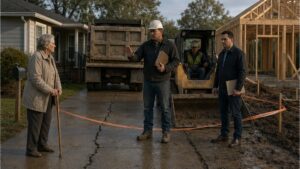
The bulldozer blade struck Kevin Rivera’s fence before the video had been running three seconds.
One cedar panel bowed inward. The next post snapped at ground level. A section of fencing Kevin had stained himself folded into the churned earth while the machine kept moving.
Kevin watched from eight thousand miles away.
He stood in a fluorescent-lit operations room with one hand braced against a metal desk, his phone held low enough that no one passing behind him could see the screen. The video shook as whoever was filming backed across his side yard.
A man’s voice said, “They’re actually doing it.”
Kevin replayed the first five seconds.
This time he ignored the fence.
He watched the ground.
There.
An orange stake stood two feet from the bulldozer’s left track.
Another appeared farther back, near the maple tree.
A third flashed beside the machine as the camera swung toward the common green behind the houses.
Kevin stopped the video.
His thumb stayed against the screen.
Those were not utility flags. Not landscaping markers. Not something a lawn crew had pushed into the dirt that morning.
George Thompson had set them.
Kevin had watched him do it two months earlier.
“Rivera?”
Kevin locked the phone.
His Army supervisor stood at the end of the table holding a folder. Around them, keyboards clicked and a printer spat out pages in uneven bursts.
“You with me?”
“Yes.”
“You don’t look with me.”
Kevin slid the phone into his pocket. “Home issue.”
His supervisor waited.
Kevin had never been good at using more words than he considered necessary. Years of inventories, convoy schedules, missing equipment reports, deployment manifests—he trusted facts because facts did not require anyone to guess what he needed.
“I’ll handle it,” he said.
His supervisor looked at him another second, then set the folder down. “You have ten minutes before briefing.”
Kevin nodded.
The moment the man walked away, Kevin pulled out the phone again.
The video had come from Catherine Walker, his next-door neighbor. No message beyond a single line.
You need to see this now.
He pressed play.
The machine moved through the opening it had made, crushing fragments of Kevin’s fence beneath its tracks. Beyond it stood Robert Nelson, the HOA president, wearing a dark vest over a collared shirt as though he had dressed for both a board meeting and a construction site.
Robert pointed toward Kevin’s yard.
The operator adjusted course.
Kevin felt something cold settle behind his ribs.
The disputed strip ran along the side of his property, narrowing near the rear corner before meeting land the association maintained as common space. The HOA’s old site map showed a utility and drainage corridor wider than the county plat appeared to support. Kevin had noticed the discrepancy when a maintenance crew marked trees for removal.
He had not accused anyone.
He had hired George.
George had found enough inconsistency to recommend that Kevin treat the recorded survey seriously and resolve the association map conflict before any work began.
So Kevin had done what he always did.
He made a file.
Deed.
County plat.
Survey invoice.
Photographs.
Email drafts.
He saved all of it.
Then deployment orders accelerated. Dates shifted. Equipment had to move. His own house became one more problem placed in a folder for later.
On the video, Robert stepped around the broken fence.
Someone behind the camera called, “What about those orange things?”
Robert glanced at a stake.
Even through the phone speaker, Kevin heard his answer.
“Temporary markers.”
The bulldozer continued.
Kevin paused the video again.
He opened his email and typed Robert’s name into the search bar.
The newest message was from that morning.
SUBJECT: COMMUNITY DRAINAGE AND BEAUTIFICATION ACCESS
Kevin read it once.
Then again.
The message stated that urgent work had begun to connect a drainage improvement along the common area and that affected landscaping might be removed. It referred to board authority, community safety, and an association map.
Near the bottom was one sentence that made Kevin sit down.
Temporary owner-installed markers do not supersede recorded association easements.
Kevin opened the attached map.
It was the same old HOA drawing.
No survey seal.
No county recording number visible.
No reference to George’s work.
He called Robert.
The call rang four times.
Voicemail.
Kevin hung up and tried Catherine instead.
No answer.
He sent her a message.
How far are they into my lot?
The typing indicator appeared.
Vanished.
Appeared again.
Finally:
I don’t know exactly.
Kevin looked at the frozen video frame. The bulldozer’s track sat beside the maple tree.
He knew exactly.
He opened the county property viewer on his laptop, then George’s PDF from his cloud folder. The connection dragged. The survey loaded line by line.
He zoomed in.
George’s boundary ran inside the area where the machine now stood.
Not by inches.
Several feet at the rear portion.
Kevin took a screenshot of the survey. Then one of the HOA map. He created a new folder and named it with the date.
His supervisor returned.
“Briefing.”
Kevin closed the laptop halfway.
“I need to make one call first.”
“You said ten minutes.”
“I know.”
His supervisor studied his face, then the phone in his hand. “Is your family all right?”
The question caught Kevin more sharply than it should have.
He had no wife waiting in the house. No children. His parents lived in another state. Catherine had the spare key because someone needed one, and Kevin had spent nearly five minutes explaining that it was for emergencies only.
“My property is being excavated.”
“While you’re here?”
“Yes.”
“By who?”
“My HOA.”
His supervisor blinked. “Your what?”
Kevin almost laughed. Nothing came out.
He called Robert again.
This time Robert answered.
“Kevin. I was planning to reach you.”
“You emailed after the machine entered my yard.”
A pause.
“We’re working from the approved community plan.”
“Stop the equipment.”
“Kevin, I understand this looks abrupt from where you are.”
“Stop the equipment.”
Robert’s voice tightened without rising. “There has been standing-water damage behind six homes. We have contractor scheduling, insurance deadlines, resident concerns—”
“You crossed marked land.”
“Those markers are not controlling.”
“Who told you that?”
“The board’s map reflects the common drainage alignment.”
“That isn’t what I asked.”
Another pause.
Kevin could hear machinery behind Robert now.
“Kevin, you’re overseas. I’m trying to manage a neighborhood problem on the ground.”
There it was.
Not an insult exactly.
Something worse.
A conclusion.
Kevin looked at the survey on his screen.
“Do not remove those stakes.”
Robert exhaled. “We are not allowing temporary obstructions to derail emergency work.”
“Robert.”
“I have to go.”
The call ended.
Kevin sat motionless for one second.
Then he reopened the video.
He advanced frame by frame until the orange stake appeared nearest the broken fence. He captured the image. Then the next stake. Then the machine.
Time stamp visible.
Robert visible.
Markers visible.
He emailed the images to himself, George, and a new address he created specifically for the dispute.
His anger did not disappear. It narrowed.
That was familiar.
Anger could be inventoried.
What happened?
Who knew?
What record existed?
What had changed?
He sent George a message marked urgent.
Need confirmation whether your marked line crosses current excavation. Video attached.
Then he pulled his deployment folder from the locked cabinet beside his bunk area later that evening. Orders, amendments, travel documentation. He hated that he was already thinking about proving where he had been, as if absence itself required a receipt.
His phone vibrated.
Catherine.
Kevin opened the message.
It was not an answer to his question about the excavation.
Kevin, there is something I should have told you before they started.
Chapter 2: The Survey He Never Finished Explaining
Kevin found the unsent email at 02:13 local time.
He had been searching for evidence against Robert.
Instead, he found evidence against his own certainty.
The draft sat beneath three newer messages in a folder labeled PROPERTY—BOUNDARY. He opened it expecting photographs.
The recipient field contained the HOA management address.
Robert was copied.
The subject line read:
FORMAL NOTICE OF DISPUTED BOUNDARY BEFORE DRAINAGE WORK
Kevin stared at it.
No sent date.
Because he had never sent it.
He read the draft slowly.
Attached please find the survey completed by licensed surveyor George Thompson concerning the western side boundary of my parcel. The marked line appears inconsistent with the association site plan currently being used for proposed work. I object to entry, removal of fencing, or disturbance until the discrepancy is resolved.
Clean.
Direct.
Exactly the kind of message Kevin trusted.
And still a draft.
He leaned back in the chair.
Two months earlier, George had stood in Kevin’s yard with a survey pole balanced against one shoulder and said, “I’m not telling you the HOA map is fraudulent.”
“I didn’t ask that.”
“I know. I’m telling you because people hear ‘discrepancy’ and become amateur prosecutors.”
Kevin had folded his arms.
George pointed toward the rear corner.
“The recorded information I’m working from puts your line here. The association drawing appears to treat part of that area as though it belongs to the common corridor. That could be an old drafting carryover. It could be a misunderstood easement. It could be somebody relied on the wrong exhibit twenty years ago.”
“But my fence?”
“Appears inside your surveyed boundary.”
“Appears?”
George had looked at him over the top of his glasses. “You hired a surveyor, not a magician. I can tell you what my work supports. I can’t promise nobody will dispute it.”
Then he had driven the first orange stake into the ground.
Kevin remembered the clean shock of the color against the grass.
A line made visible.
Something nobody could pretend not to see.
By that evening, Kevin had photographed every stake.
By the next morning, he had scanned his deed.
By the end of the week, deployment dates had shifted forward.
His house filled with open duffel bags and labeled piles. He told himself he would send the objection after one last check of the attachments.
He never did.
Kevin clicked through his sent mail.
He had sent Robert a shorter message.
I have commissioned a survey regarding the western boundary. Please do not finalize work affecting that area until I review the results.
Robert had replied:
Understood. Send documentation when available.
Kevin closed his eyes.
Available.
He had received George’s signed PDF six days later.
Then left.
His phone buzzed on the desk.
George.
Kevin answered immediately.
“I saw the video,” George said. No greeting. “How much did they remove?”
“Fence section. Grading. Maybe more by now.”
“And the markers?”
“Some still visible in the video.”
“Still?”
Kevin heard the question.
“I don’t know.”
George was quiet.
Kevin opened the survey on-screen. “Your line puts the machine inside my parcel.”
“My line puts the rear portion of that excavation inside the boundary I surveyed, yes.”
“Good.”
“No.”
Kevin frowned. “No?”
“Don’t turn me into a slogan. The survey supports your position. Strongly. But you have an association map showing something different, and I don’t know what easement language they think they have.”
“Their map doesn’t change my deed.”
“I didn’t say it did.”
Kevin rubbed the bridge of his nose.
George continued. “Did the board acknowledge the full survey?”
Kevin looked at the unsent draft.
“No.”
A pause.
“You didn’t send it?”
“I sent notice that a survey was underway.”
“That isn’t what I asked.”
Kevin almost ended the call.
The impulse came fast and familiar. Close the door. Fix the problem. Return when the answer was complete.
Instead he said, “I didn’t send the final package.”
George let out a slow breath.
“I assumed you had.”
“Why?”
“Because you asked me for a board-ready PDF. Because you photographed the stakes. Because you told me they had proposed work.”
“I got deployed.”
“I know.”
The words were not accusing. That made them worse.
Kevin opened the county plat beside George’s survey. The two aligned closely. The HOA map did not.
“So what do I have?” he asked.
“You have a deed. A recorded plat. My survey. Photographs of marked points. A message telling them not to finalize work before review. And apparently video of work proceeding.”
“But no completed board objection.”
“Correct.”
Kevin wrote it down.
Not because he might forget.
Because writing stopped him from arguing with the fact.
Later that morning, a county records clerk sent copies of subdivision documents Kevin had requested. He reviewed them between duties.
The original plat.
A later drainage easement.
An amendment affecting the common tract.
Nothing he found clearly granted the HOA ownership of the strip behind his fence. The drainage easement language was narrower than the shaded corridor on Robert’s map.
That was the first good news.
The second came from George, who sent a marked comparison.
Three overlays.
County plat in black.
Surveyed boundary in blue.
HOA project map in red.
At the rear of Kevin’s property, the red corridor crossed the blue line.
Kevin zoomed in until the pixels blurred.
He felt relief.
Then shame at feeling relieved, because the fence was still gone.
He called Catherine.
This time she answered.
“Kevin.”
“What did you need to tell me?”
Silence.
“Catherine.”
“I should have called sooner.”
“You sent me the video.”
“I mean before today.”
Kevin stood and walked away from the others in the room.
“How much before?”
“I don’t want to do this while you’re over there.”
“That choice is gone.”
“I know.”
He waited.
She said, “Robert held a meeting about the drainage project.”
“When?”
“Last week.”
“And?”
“He said your side strip was part of the common alignment.”
Kevin looked at the unsent email on his laptop.
“What did you say?”
Another silence.
“I said there were survey stakes.”
His grip tightened on the phone.
“What did he say?”
“That they were temporary. That you hadn’t filed anything formal with the board.”
Kevin said nothing.
Catherine’s voice softened. “Was that true?”
He hated the question because he knew exactly how to answer it.
“I told them not to proceed until I reviewed the survey.”
“That isn’t what I asked.”
Twice in one day.
Kevin looked through the window at a blank wall beyond the temporary facility.
“I did not send the final survey package.”
Catherine exhaled.
“Kevin—”
“That doesn’t authorize excavation.”
“I didn’t say it did.”
“Then tell me what you should have told me.”
“I can’t right now.”
“You can.”
“No. Not like this.”
The line went dead.
Kevin stood with the phone against his ear after the call had ended.
That evening he began reconstructing the project from publicly available HOA material Catherine forwarded without comment.
Board minutes.
Resident notice.
Contractor scope.
A preliminary budget.
The language was bland: drainage stabilization, erosion mitigation, common-area enhancement.
Then he found an invoice attachment buried in a meeting packet.
The excavation contractor had billed for mobilization, fence removal, grading, and debris hauling.
Kevin scanned the line items.
One sentence stopped him.
Site preparation per association direction, including remove owner stakes as required for access.
He read it three times.
Not survey markers.
Not temporary obstructions.
Owner stakes.
As required.
Kevin printed the invoice.
For the first time since the video arrived, the question shifted.
It was no longer simply whether the bulldozer had crossed his line.
Someone had told the contractor the stakes could be removed.
Kevin placed the invoice beside George’s survey and his unsent email.
Then he wrote one line at the top of a blank page.
Who required it?
Chapter 3: Welcome Home, Sign Here, Soldier
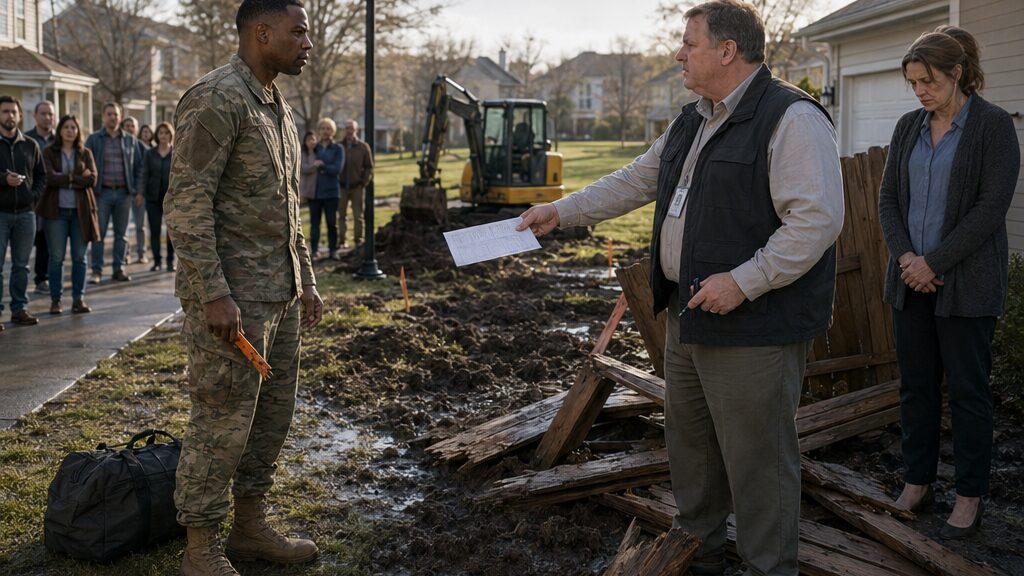
Kevin saw the hole before he saw his house.
The ride from the airport turned into the subdivision, passed the stone entrance sign, and rounded the familiar curve. Catherine’s roof appeared first. Then his maple tree.
Then open earth where the side fence should have been.
“Stop here,” Kevin said.
The driver glanced toward his driveway. “You sure?”
“Yes.”
Kevin stepped out in uniform with his duffel over one shoulder.
The smell hit him first.
Wet clay.
Cut roots.
Diesel.
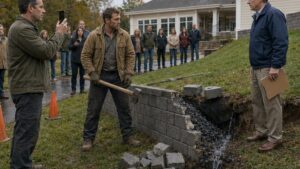
A trench-like graded strip ran from the common area behind the houses toward the street-side drainage path. His fence had not merely been opened for equipment. Whole sections were gone. Broken boards lay stacked near a contractor machine parked beyond the property.
Several residents stood near the sidewalk.
And Robert Nelson was waiting.
He came forward smiling with a folder in one hand.
“Kevin. Welcome home.”
Kevin set down his duffel.
Robert extended his hand.
Kevin looked at it, then at the yard.
Robert lowered it.
“I know this is a lot to come back to.”
“Where are my stakes?”
Robert’s expression changed by half a degree. “We can go through everything.”
“Where are they?”
“The contractor cleared necessary obstructions.”
Kevin walked toward the excavated strip.
His boots sank slightly into soft dirt.
Near the maple tree he saw a flash of orange.
He bent down.
Half a survey stake protruded from the mud, snapped at an angle. The upper piece was gone.
Behind him, someone whispered.
Kevin pulled the broken stake free.
Robert approached carefully.
“This is exactly why I wanted to speak before assumptions start.”
Kevin turned.
Robert opened the folder.
On top was a form.
TEMPORARY ACCESS AND RESTORATION ACKNOWLEDGMENT.
Kevin read the first paragraph.
The document described emergency community drainage work, restoration of affected private improvements, and owner acknowledgment of access.
He looked at the date line.
Blank.
“You want me to sign this now?”
“It formalizes restoration. We replace the fence, repair landscaping, close out the contractor access.”
“After the work.”
Robert kept his tone calm. “The work became time-sensitive.”
“You want retroactive permission.”
“I want a clean record.”
A few more residents had stopped nearby.
Catherine stood beside her driveway.
Kevin saw her and waited for some signal.
She looked at the broken stake in his hand.
Then away.
Robert lowered his voice. “Kevin, nobody wanted your return home to become this.”
“My return?”
“You were unavailable.”
“I answered email.”
“You were deployed.”
“And?”
Robert glanced toward the residents. “And the board cannot allow one absent owner to block a project protecting multiple homes.”
There it was again.
Absent.
Not serving.
Not temporarily away.
Absent, as though the empty driveway had erased him from the parcel.
Kevin looked down at the form.
Then he placed it on the hood of Robert’s parked vehicle.
The broken orange stake went beside it.
“Who authorized removal of a marked survey point after notice that a licensed survey was underway?”
Robert’s jaw tightened.
“I don’t accept the premise.”
“It was a simple question.”
“They were not established monuments.”
“I didn’t call them monuments.”
Robert stopped.
Kevin heard someone behind them shift position.
“The survey markers indicated a licensed boundary survey,” Kevin said. “You knew that.”
“What I knew was that you had hired someone and never completed a formal challenge to the association map.”
That landed because it was true.
Kevin felt the eyes around him.
Robert saw it.
His confidence returned.
“We had six homes reporting standing water,” he continued. “One retaining edge already failed. The contractor had a limited window. Delaying would have increased costs for every dues-paying owner here.”
A woman near the sidewalk said, “That’s true.”
Another resident folded his arms.
Robert gestured toward the excavated strip. “This was not a vanity project.”
Kevin looked along the graded earth.
For the first time, he noticed new drainage stone at the rear. Fabric beneath it. A shallow channel shaped toward the common area.
Real work.
Not just destruction.
Robert stepped closer.
“You may dislike the process. Fine. But I had a neighborhood to protect.”
Kevin raised the broken stake.
“And that required this?”
“The association map placed the work corridor there.”
“A licensed surveyor placed my boundary here.”
Robert gave a short, controlled laugh. “You don’t get to create property rights by putting orange sticks in dirt.”
“No.”
Kevin’s voice stayed quiet.
“A licensed surveyor determines the line from recorded evidence. Not me. Not you.”
The sidewalk went still.
Robert’s smile disappeared.
Kevin pointed toward the excavated rear section.
“George Thompson surveyed this parcel before I left. His line places part of your excavation inside my deeded boundary.”
Robert’s eyes flicked toward Catherine.
Small movement.
Kevin saw it.
“You never submitted a completed objection,” Robert said.
“That is not permission.”
“You were warned the project was moving.”
“I was told not to worry about a map conflict until I returned.”
“By whom?”
Kevin looked at Catherine.
She stood rigid beside her mailbox.
He had not intended to involve her publicly. He had expected, perhaps stupidly, that she would step forward on her own.
“Catherine knew the survey stakes were there,” he said.
Every face turned.
Catherine’s mouth opened.
Robert spoke first.
“She knew there were markers. That doesn’t establish ownership.”
Kevin kept looking at her.
“Did you tell him I disputed the line?”
Her face changed.
Not surprise.
Pain.
“Kevin, not here.”
It felt like a door closing.
He heard Robert say something about board procedure, but the words blurred.
“Not here?” Kevin repeated.
Catherine took one step toward him. “Please.”
“You had a key to my house.”
“I know.”
“You were the person I asked to call if something changed.”
“I know.”
“Did you tell him?”
Her eyes shone, but her voice stayed steady.
“I told the board there was a survey.”
Kevin waited.
“That is not what I asked.”
Catherine looked toward the gathered residents.
Then back at him.
“I’m not doing this in the street.”
The answer struck harder than Robert’s form.
Kevin nodded once.
“Fine.”
He picked up the unsigned access document from the vehicle hood and handed it to Robert.
“I’m not signing.”
Robert did not take it immediately.
“Then you may delay restoration of your own property.”
Kevin released the paper only when Robert gripped it.
“Preserve every project record.”
Robert’s face hardened. “Excuse me?”
“Emails. Work orders. photographs. Board messages. Contractor instructions.”
“You’re threatening the association?”
“No.”
Kevin picked up his duffel.
“I’m telling you not to lose anything.”
He walked to his front door without looking at the residents.
Inside, the house smelled closed and faintly dusty. Everything sat where he had left it. Catherine had watered the plant near the kitchen window. Mail was stacked in neat bundles.
His world looked preserved.
Except through the side window, where the fence was gone.
Kevin set his duffel down and opened his laptop.
He had promised himself he would shower first.
Eat.
Sleep.
Instead he opened the evidence folder.
Robert’s emails.
George’s survey.
County records.
The contractor invoice.
Catherine’s messages.
He searched the HOA files for every mention of the drainage project.
An email chain appeared.
Three days before excavation.
The subject line read:
RE: WESTERN ALIGNMENT / RIVERA PROPERTY
Kevin opened it.
The first message was from George’s office.
Attached was a notice stating that the proposed project alignment appeared to cross a recently surveyed private boundary and recommending that work pause pending reconciliation of recorded documents.
Robert Nelson was a recipient.
Kevin’s pulse slowed.
Explicit notice.
Before excavation.
He scrolled farther.
Another recipient appeared in the copied line.
Catherine Walker.
Kevin sat back from the screen.
Outside, beyond the missing fence, a machine started and idled in the common area.
On the laptop, Catherine’s name remained beside Robert’s.
Three days before they entered his yard.
Chapter 4: The Neighbor Who Chose Not to Warn Him
Catherine placed the orange stake on the kitchen table before Kevin sat down.
It was whole.
Mud had dried in a rough band around the lower end. The top was scarred where something metal had struck it, but the wood had not snapped.
Kevin stood across from her, still wearing the same expression he had carried through two nights of unanswered questions.
“Where did you get that?”
“Behind my garage.”
“When?”
“The day they started.”
Kevin looked at the stake, then at Catherine.
“You picked it up.”
“Yes.”
“And kept it.”
“Yes.”
The kitchen was too familiar for the conversation. He had eaten there before deployment. Changed a smoke detector battery over that sink. Left Catherine his spare key at this same table after telling her, three separate times, that she probably would never need it.
Now she wrapped both hands around a coffee mug and did not offer him one.
“You were copied on George’s notice,” Kevin said.
“I know.”
“Three days before excavation.”
“I know.”
“And you told me nothing.”
Her jaw tightened. “That part is not true.”
Kevin’s voice stayed level. “You sent me a video after the bulldozer was already inside my fence.”
“I messaged you before that.”
“About what?”
“That Robert was pushing the project through.”
“You wrote, ‘The board is being aggressive about drainage.’”
“I thought you understood.”
Kevin laughed once without humor. “That is not a warning that someone plans to remove my fence.”
“No.”
“Then what did you think I understood?”
Catherine looked toward the back window.
Beyond it, the common area sloped gently toward the drainage channel. Kevin had seen standing water there before. After hard rain, the ground stayed soft for days.
She said, “I thought you knew more than I did.”
“That’s convenient.”
Her eyes came back to him.
“No. It’s embarrassing.”
Kevin did not answer.
Catherine pushed the stake toward him.
“I told Robert the markers mattered.”
“He said otherwise.”
“He said the board map had already been reviewed.”
“By whom?”
“I don’t know.”
“You didn’t ask?”
“I did.”
“And?”
“He said the contractor, the management company, and the association’s consultant were all working from the same alignment.”
Kevin folded his arms.
“You believed him.”
“At first.”
The words stopped him.
“At first?”
Catherine stood and walked to a drawer near the refrigerator. She pulled out a folded packet and placed it beside the stake.
Kevin opened it.
A budget projection.
Three columns.
Proceed immediately.
Delay and redesign.
Emergency repair after failure.
The numbers in the last two columns were large enough to change the temperature of the room.
A special assessment estimate appeared near the bottom.
Kevin looked up.
“What is this?”
“What Robert showed residents at the drainage meeting.”
“How many residents?”
“Maybe twenty.”
“And this is why nobody objected?”
“That’s not fair.”
“I asked a question.”
Catherine’s voice sharpened. “And I’m answering it. People were scared.”
She tapped the page.
“There are older owners here on fixed incomes. There’s a couple behind the south entrance already talking about selling because dues went up. Robert said if the contractor lost the scheduling window, redesign costs and emergency stabilization could force an assessment.”
Kevin scanned the numbers again.
“Did anyone verify this?”
“I don’t know.”
“You keep saying that.”
“Because I don’t know.”
The force in her answer silenced him.
Catherine lowered her voice.
“You think everyone here had the same information you did. We didn’t.”
“I didn’t have much.”
“You had a survey.”
“I had a survey I should have sent.”
“Yes.”
The word landed cleanly.
Kevin stared at her.
Catherine looked exhausted now, not defensive.
“You want me to say Robert had no reason,” she said. “I can’t.”
“He crossed my land.”
“Yes.”
“He removed my fence.”
“Yes.”
“He ignored notice.”
“Yes.”
“Then stop explaining him.”
“I’m not explaining him for his sake.”
The room went quiet.
Catherine sat again.
“I’m explaining why people listened.”
Kevin looked down at the assessment sheet.
For the first time, Robert’s claim about community harm had shape.
Not moral authority.
Not legal permission.
But shape.
He said, “What did you do after George’s notice came in?”
Catherine rubbed her thumb along the mug handle.
“I called Robert.”
“And?”
“I asked him to pause.”
Kevin looked at her.
“He told me the notice was preliminary. He said you had never filed a formal objection, that George’s letter was just a professional caution, and that stopping work could expose everyone to costs the association couldn’t absorb.”
“Did you believe him?”
“I wanted to.”
“That isn’t an answer.”
“It is the answer.”
Catherine’s eyes filled, but she did not look away.
“I wanted to believe there was a version where nobody was stealing your land and nobody else was losing their house over drainage.”
Kevin felt something in his anger shift.
Not disappear.
Change weight.
Catherine continued.
“The morning work started, I went outside. I told the contractor there was a survey dispute.”
“What did he say?”
“That he had written direction from the association.”
“And then?”
“I called Robert again.”
Kevin waited.
“He told me the decision was made.”
“And you let it happen.”
Her mouth tightened.
“Yes.”
The answer was quieter than any defense.
Kevin looked at the unbroken stake.
“Why keep this?”
“I pulled it out of the grass after the machine knocked it loose.”
“For evidence?”
“At first, I think I just didn’t want them to throw away all of them.”
Kevin sat down finally.
The chair scraped against tile.
Catherine said, “I should have called you and said exactly what was happening.”
“Yes.”
“I was afraid you would tell me to stop them.”
“I would have.”
“I know.”
“And that was too much responsibility.”
She flinched.
Kevin regretted the sentence before it fully left him, but did not take it back.
Catherine looked at him for a long time.
Then she said, “You gave me a key and called that trust.”
Kevin’s hands went still.
“You never told me about the survey problem. You never asked me to go to the board meeting. You never said, ‘If they touch this line, I need you to act.’ You handed me metal and instructions for a burst pipe.”
“That doesn’t excuse—”
“I know.”
Her voice broke slightly.
“I know what it doesn’t excuse.”
Kevin looked away.
Outside, a truck passed slowly along the street.
Catherine reached for the packet again.
“There’s something else.”
She turned to the last page.
A drainage photograph showed pooled water behind several homes after a storm. One retaining edge had slumped. Mud pressed against a fence line.
“This part was real,” she said. “The water problem.”
Kevin studied the image.
“You saw this?”
“Yes.”
“How bad?”
“Bad enough that one resident had water in a crawlspace.”
Kevin leaned back.
The project had not been invented.
That truth irritated him because it complicated the clean shape he had given the conflict.
Catherine said, “Robert was wrong.”
Kevin looked up.
“Not mistaken. Wrong. He knew there was a dispute and chose to move anyway.”
“You’re sure?”
She nodded.
Then she reached beneath the budget packet and removed a printed email.
Kevin recognized George’s office header immediately.
The notice.
Same date.
Same subject.
But this version included delivery details.
Catherine pointed to the top.
“George’s office asked for confirmation.”
Kevin read.
Delivered.
Opened.
Three days before excavation.
Recipient: Robert Nelson.
Kevin’s eyes moved down the page.
A reply existed beneath it.
Not from Robert.
From the HOA management address.
Received. Board president reviewing.
Kevin looked at Catherine.
“Why didn’t you show me this before?”
“Because until two days ago, I was still trying to believe Robert had relied on something I hadn’t seen.”
“And now?”
Catherine pushed the orange stake closer.
“Now I think he proceeded because stopping would force him to explain why the board map was wrong.”
Kevin looked from the stake to the delivery confirmation.
The question had changed again.
Robert had not simply seen orange markers.
He had received professional notice.
Opened it.
And gone forward anyway.
Chapter 5: The Decision Hidden Behind Community Safety
The contractor slid the work order across the desk with two fingers.
“I’m giving you a copy because my insurer told me to preserve everything.”
Kevin looked down.
The paper was creased and stained at one corner. Near the bottom, beneath typed instructions about grading and drainage stone, a handwritten note appeared in dark ink.
Owner stakes in conflict zone may be removed as needed. Proceed per association map.
The initials beside it were unmistakable.
RN.
Kevin did not touch the page immediately.
“Who wrote that?”
The contractor leaned back.
“You know who.”
“I want you to say it.”
“Robert Nelson.”
The small office smelled of coffee, printer toner, and damp work jackets. Through the window, two dump trucks sat behind a chain-link fence.
Kevin placed his phone face down on the desk.
“When did he add it?”
“Morning of mobilization.”
“Before or after you saw the stakes?”
“Before we moved equipment. After my foreman called about them.”
Kevin looked up.
“Your foreman questioned the markers?”
“He asked if we were crossing a surveyed line.”
“And Robert said proceed.”
“He said they were owner-placed temporary markers and that the association alignment controlled.”
Kevin opened his folder.
He laid down George’s notice.
“Had you seen this?”
The contractor read the first page.
“No.”
“Were you told a licensed surveyor had warned of a boundary conflict?”
“No.”
“Were you told I had objected to work affecting the area?”
“I was told you were away and hadn’t completed the association process.”
Kevin felt the familiar urge to sharpen the facts until they cut only one direction.
He resisted it.
“I had not completed the process,” he said.
The contractor studied him.
“But you had objected?”
“Yes.”
“That would have mattered.”
“How much?”
“Enough that I would’ve wanted written indemnity before crossing anything.”
Kevin nodded.
There it was.
Not absolution.
A missing fact with consequences.
The contractor made a copy of the work order.
As the machine hummed, he said, “For what it’s worth, I don’t think Robert believed he was stealing your property.”
Kevin looked at him.
“That supposed to help?”
“No.”
The contractor handed him the copy.
“I think he believed finishing the job would make the argument disappear.”
That sentence stayed with Kevin through the HOA records review two days later.
The board had agreed, under pressure from the insurer, to provide project files. Kevin sat at one end of a conference table while Sandra Lee arranged documents in labeled stacks.
She wore a dark suit and spoke without wasted motion.
“I am not here to determine title,” she said.
“Understood.”
“I am not conceding criminal conduct.”
“I didn’t ask you to.”
“And I strongly recommend you stop using that phrase in email.”
Kevin held her gaze.
“I used ‘potential statutory issues.’”
“You used it twelve times.”
“Because Robert removed marked survey points after notice.”
Sandra exhaled.
“This is what I mean. Precision helps you. Overstatement does not.”
Kevin almost smiled.
He liked her more than he wanted to.
Sandra opened a file.
“What we can establish so far is this. The association possessed an older project map. The contractor relied on that map. George Thompson’s office sent a boundary-conflict notice before excavation. Robert received it.”
Kevin placed the copied work order beside her file.
“And instructed removal anyway.”
Sandra read the handwritten note.
Her face changed very little.
Enough.
“Where did you get this?”
“Contractor.”
“Did he provide it voluntarily?”
“Yes.”
Sandra looked at Kevin.
“Do not post this.”
“I haven’t posted anything.”
“Good.”
Kevin thought of the neighborhood email chains already circulating screenshots and accusations.
“I want records corrected.”
“We’re not there yet.”
“Why not?”
“Because the legal boundary question and the coverage question are separate.”
Kevin leaned back.
Sandra folded her hands.
“If the board acted negligently under a mistaken map, coverage may respond one way. If an individual officer knowingly directed intentional entry after explicit notice, exclusions may become relevant.”
Kevin understood immediately.
“If coverage narrows, the association pays.”
“Potentially.”
“Meaning residents.”
“Potentially.”
The word irritated him until he remembered Catherine’s budget sheet.
Sandra slid another document forward.
Board executive-session notes.
Most of the page was dry discussion: contractor timing, water intrusion complaints, reserve balance, redesign estimate.
Then Kevin found Robert’s comment.
Pause likely causes contractor remobilization and may require revised engineering. Special assessment exposure significant. Proceeding under existing association map recommended unless owner obtains injunction.
Kevin read it twice.
“Unless I obtained an injunction.”
Sandra nodded.
“He knew I disputed the line.”
“Yes.”
“And decided the burden was on me to stop him from overseas.”
“That is one interpretation.”
“What is yours?”
Sandra looked at the page.
“My interpretation is that he treated uncertainty as permission because delay was expensive.”
Kevin sat still.
The records filled in the rest.
The drainage failure was real.
The reserve fund was thin.
The board had already approved spending based on the old alignment.
A redesign estimate would have exposed the fact that earlier planning rested on a map inconsistent with newer boundary evidence.
Robert had not invented every threat.
He had compressed them into one decision.
Move now.
Explain later.
Kevin found an email from one board member asking whether work should pause.
Robert’s reply:
We cannot allow an unresolved owner claim to jeopardize community safety and project solvency.
Another message:
If Rivera returns and objects, restoration can be addressed.
Kevin closed the folder.
“He expected to pay me afterward.”
Sandra said nothing.
“He thought damage was cheaper than delay.”
“That appears possible.”
“Say it.”
“I’m not your witness.”
The answer stopped him.
Sandra continued.
“You have strong evidence of notice. You also have a genuine project need, a disputed process, incomplete communication from multiple parties, and an association whose finances affect people who did not make Robert’s decision.”
Kevin looked at the stacks of paper.
For weeks he had imagined evidence as a ladder.
Each document taking him higher.
Now the same evidence opened a view he did not want.
Below Robert stood the board.
Below the board, the association.
Below the association, his neighbors.
Sandra turned to another file.
“Your repair estimate is just under eight thousand dollars for fencing, grading correction, and landscaping.”
Kevin nodded.
“There may be additional damages. There may be legal fees. There may be governance remedies.”
“And the markers?”
“George will need to testify to what was set, what was disturbed, and what legal significance applies. I will not guess.”
Kevin appreciated that despite himself.
Sandra gathered several pages into a smaller stack.
“One more issue.”
She placed the contractor work order on top.
“If the carrier determines Robert’s instruction falls outside covered conduct, some defense and indemnity positions may change.”
“Meaning the association gets less protection.”
“Possibly.”
“And the people he claimed to be protecting pay more.”
Sandra’s expression remained neutral.
“Yes.”
Kevin looked through the conference-room glass at the hallway.
He had wanted Robert cornered.
Now he could see the shape of the corner.
It contained other people.
Three days later, Sandra called him back.
Same room.
Fewer files.
A settlement agreement waited at his seat.
Kevin did not sit.
“What is it?”
“Full documented repair costs,” Sandra said. “Additional compensation for loss of use and inconvenience. Reasonable survey expenses. Contribution toward legal fees.”
Kevin scanned the number.
It was more than the direct damage.
Enough to rebuild.
Enough to make the entire fight feel suddenly close to over.
Then he saw the confidentiality clause.
He looked up.
Sandra said, “Standard.”
“No.”
“You haven’t read the full agreement.”
“I read the part that matters.”
“There are also non-disparagement provisions and a mutual release.”
“Does the HOA correct the project map?”
Sandra paused.
“Not in this agreement.”
“Does it acknowledge the boundary?”
“This settles claims without admission.”
“Does it require an independent redesign?”
“No.”
Kevin turned another page.
“If I sign this, they restore my fence and keep the same map.”
“The association would still be responsible for future compliance.”
“That is not an answer.”
Sandra met his eyes.
“No. The map is not corrected by this agreement.”
Kevin looked down at the number again.
A clean exit.
Money.
Repairs.
Silence.
On paper, victory.
Sandra pushed a pen toward him.
Chapter 6: The Settlement That Would Leave the Lie Standing
The settlement amount was high enough to make Kevin angry at himself for hesitating.
Sandra had placed the pen beside the signature line and then leaned back, giving him the privacy of not being watched too obviously.
Kevin read the number again.
Repairs.
Survey costs.
Legal contribution.
Additional compensation.
He could sign, hire a contractor, rebuild the fence, and be finished.
No more HOA records.
No more neighbors staring.
No more waking at 3:00 a.m. to compare maps.
He turned the page.
Confidentiality.
Mutual non-disparagement.
No admission.
Full release.
Kevin tapped the paragraph with one finger.
“This lets the association keep using the same project alignment.”
Sandra said, “The agreement resolves your claim.”
“I know what it resolves.”
He looked at her.
“What happens when I sell?”
“That depends on future disclosures and records.”
“What happens when the next owner sees an association map showing a corridor across the same strip?”
Sandra did not answer immediately.
“Your recorded property documents remain what they are.”
“And the HOA map remains what it is.”
“Yes.”
Kevin sat back.
The conference room became very quiet.
He had spent most of his adult life believing that a complete file was a form of protection. If every receipt existed, every order was signed, every date captured, then eventually the right answer could be forced into the open.
But here was a complete file offering him an incomplete truth.
Sandra said, “Kevin, this is a substantial offer.”
“I know.”
“It gets your property restored.”
“I know.”
“It compensates you beyond direct repair.”
“I can read.”
Her expression cooled.
Kevin looked down.
“Sorry.”
Sandra nodded once.
He turned another page.
“Why so much?”
“Because litigation is expensive.”
“That’s not all.”
“No.”
Kevin waited.
Sandra folded her hands.
“Because the notice evidence is serious.”
“And Robert’s instruction.”
“Yes.”
“And coverage.”
Her eyes narrowed slightly.
“I did not say coverage was denied.”
“You didn’t have to.”
Sandra gave him the first almost-smile he had seen from her.
“You are difficult.”
“I’ve heard that.”
The mediation broke for lunch without a signature.
Kevin drove home instead of eating.
George’s truck was parked near the side yard.
In the bed lay a bundle of fresh orange stakes.
Kevin stopped beside them.
George stood near the rear corner with equipment set up but not active.
“You’re early,” Kevin said.
“I’m not setting anything.”
Kevin looked at the stakes.
“Then why bring those?”
“Because eventually somebody will have to.”
George adjusted a tripod leg.
“I’m checking control points outside the disturbed area.”
Kevin stared at the bright orange wood.
The same color that had once made him feel certain.
Now it looked provisional.
George said, “Settlement day?”
“How do you know?”
“Sandra called about documentation.”
Kevin nodded.
“Good offer?”
“Yes.”
“You taking it?”
“I don’t know.”
George looked toward the damaged strip.
“That means no.”
Kevin almost objected.
Instead he said, “The map stays wrong.”
George was silent.
“Future owner inherits it,” Kevin continued. “Future board uses it. Ten years from now someone says the same thing Robert said. Association map controls.”
“You could record additional survey material.”
“That doesn’t fix their records.”
“No.”
Kevin leaned against George’s truck.
“What would fix it?”
“Independent reconciliation. Updated association exhibits. Maybe redesigned drainage depending on engineering.”
“How much?”
George gave him a look.
“More than orange stakes.”
By late afternoon, Kevin was back at mediation.
Robert had joined the session.
It was the first time they had been alone in the same room since the yard confrontation, though Sandra remained just outside with claims counsel.
Robert looked older.
Not broken.
Not defeated.
Just tired.
He sat with both hands flat on the table.
“You should take the offer,” he said.
Kevin closed the door.
“You knew George sent notice.”
“Yes.”
The direct answer surprised him.
“You told the contractor to proceed.”
“Yes.”
“Why?”
Robert looked toward the blank wall.
“Because if I stopped the project, the contractor remobilization alone would have added costs we did not have.”
“That isn’t why.”
Robert’s jaw moved.
Kevin placed the executive-session note on the table.
“You knew redesign would expose the map problem.”
Robert read the page without touching it.
“You think I was protecting myself.”
“Were you?”
“Partly.”
Kevin waited.
Robert looked up.
“Do you know how many residents came to me about water?”
“Six homes.”
“More by the end.”
“That does not authorize—”
“I know.”
Robert’s voice sharpened.
Then dropped.
“I know what it does not authorize.”
The echo of Catherine’s words unsettled Kevin.
Robert continued.
“The board had delayed for a year. Every meeting, somebody wanted another estimate. Another consultant. Another vote. Then the retaining edge failed.”
“So you decided.”
“Yes.”
“You decided my land was cheaper.”
Robert flinched.
Kevin saw it.
“I decided one forced project might prevent dozens of families from getting hit with a special assessment.”
“That’s not the same sentence.”
“No.”
For the first time, Robert looked directly ashamed.
Not sorry enough to undo anything.
But ashamed.
“I believed,” he said slowly, “that once the drainage was in, we could restore your fence, compensate you if necessary, and nobody would lose their home over a delay.”
Kevin stared at him.
“You made me the assessment.”
Robert looked away.
That was the small truth Kevin had needed and did not want.
Robert had not mistaken the line at the end.
He had converted Kevin into a cost category.
Sandra returned.
“Are we continuing?”
Kevin looked at the settlement.
Then at Robert.
Then through the glass wall toward the parking lot, where beyond several buildings his neighborhood sat under the same association budget.
He thought of Catherine’s saved stake.
The older residents.
The flawed map.
The clean payout.
He picked up the pen.
Sandra watched him.
Kevin drew a line through the confidentiality clause.
Then another through the release language tied to boundary correction.
Sandra’s expression hardened.
“What are you doing?”
“Making a counteroffer.”
“This is not how—”
“I’ll accept less.”
Robert looked up.
Kevin continued.
“Reduce my additional compensation. Keep full repair, survey costs, and reasonable fees. In exchange, the association funds an independent boundary and drainage review, corrects its records, phases any redesign costs, and discloses the board decision in the special meeting minutes.”
Sandra stared at him.
“That is materially different.”
“Yes.”
“It may cost the association more than paying you.”
“Then the offer was never about fixing the problem.”
Robert pushed back from the table.
“Residents will blame me.”
Kevin looked at him.
“They should know what you decided.”
Robert’s face tightened.
Kevin added, “They should also know why.”
Silence.
Sandra collected the marked agreement.
“This will require authority beyond me.”
“Then get it.”
“And if they refuse?”
Kevin looked through the window toward the late afternoon light.
For most of his life, he had kept leverage private until the moment it could no longer be ignored.
Now he opened his folder and placed the work order, George’s notice, and his own unsent draft side by side.
“Then I stop negotiating in private.”
Chapter 7: The Line They Reset in Front of Everyone
Kevin began the special meeting by admitting what Robert had been waiting a month to say for him.
“I did not send the final survey package before I deployed.”
The room changed immediately.
Not loudly.
No gasps, no dramatic whispers. Just chairs shifting against the clubhouse floor and several faces turning toward Robert Nelson.
Kevin stood beside a folding table with his documents arranged in three thin stacks. He had deliberately left the military uniform at home. Dark shirt. Plain pants. Nothing that could turn the meeting into a contest over who deserved respect more.
Robert sat at the end of the board table.
Sandra Lee occupied a chair against the wall, legal pad closed on her lap. George Thompson stood near a rolled site drawing. Catherine sat in the second row, not beside Kevin.
Kevin continued.
“I had the completed survey. I drafted a formal objection. I failed to send it.”
One board member leaned toward the microphone.
“So the board never received a formal challenge.”
Kevin looked at him.
“The board president received written notice from the licensed surveyor that the project alignment appeared to cross a recently surveyed private boundary.”
Robert folded his hands.
“But not the owner’s completed appeal.”
“No.”
A few residents murmured.
Kevin let them.
He could have started with Robert’s handwritten work order. Could have projected the email receipt. Could have made the first five minutes a demolition.
Instead he had begun with his own mistake.
It felt worse than he expected.
The unsent draft lay on the table before him, printed and dated by the system metadata. He touched one corner.
“I believed having the right documents was the same as making sure the right people understood the situation. It wasn’t.”
Catherine looked down.
Robert spoke.
“And that distinction matters.”
Kevin turned toward him.
“Yes.”
Robert seemed almost surprised.
Kevin continued.
“It matters because my silence created uncertainty. It does not matter in the way you want it to.”
The room stilled.
Kevin lifted George’s notice.
“This was delivered three days before excavation.”
Then the contractor work order.
“This instruction was added the morning work began.”
Then photographs.
“Those are the marked points before equipment entered.”
He placed the pages down one by one.
“I’m not asking anyone here to pretend I handled this perfectly. I am asking you to look at what happened after the board president knew the line was disputed.”
Robert’s mouth tightened.
A resident in the back called, “We also need to talk about the drainage.”
Kevin nodded.
“Yes.”
That unsettled the room more than an argument would have.
He walked to George’s rolled drawing.
“Open it.”
George unrolled the plan across the table.
Three alignments appeared.
The recorded parcel information.
George’s surveyed boundary.
The association project corridor.
Kevin pointed to the overlap.
“The water problem was real. The failed retaining edge was real. The cost pressure was real.”
Robert looked up.
Kevin met his eyes.
“None of that made my property imaginary.”
Silence followed.
Not applause.
Something harder.
Attention.
A resident near the aisle raised her hand.
“If the insurance company refuses to cover this because Robert acted intentionally, what happens to us?”
Sandra shifted slightly but did not speak.
Kevin said, “That is one reason I rejected the first settlement.”
Several people turned toward him.
Robert stared.
The same resident frowned.
“You rejected money?”
“I rejected confidentiality tied to a settlement that repaired my fence and left the association map unchanged.”
The room broke into overlapping voices.
Kevin waited until the board member struck the table lightly with a gavel.
Then he placed a new packet in front of the board.
“This is my counterproposal.”
Robert gave a short laugh.
“You’re negotiating in a membership meeting now?”
“No.”
Kevin faced the residents.
“I’m telling people what I’m asking for because they may help pay for it.”
That quieted them again.
The proposal was simple enough to explain without a speech.
Independent boundary reconciliation.
Independent drainage review.
Correction of association exhibits where they conflicted with verified parcel information.
Phased project costs rather than one immediate assessment.
Full repair of Kevin’s damaged property.
Survey and reasonable legal expenses.
Reduced additional compensation to Kevin compared with the insurer’s private offer.
No confidentiality regarding the board’s decision process.
A man in the front row lifted the packet.
“You’re giving up part of your payout?”
“I’m accepting less additional compensation than was offered.”
“Why?”
Kevin looked toward the window.
Outside, beyond the parking lot, the roofs of the subdivision sat close together.
“Because paying me to leave the map wrong is not a solution.”
Robert pushed his chair back.
“This is theater.”
Kevin turned.
“No.”
Robert’s face had gone pale around the mouth.
“You want to make me the villain so you can look generous.”
“I want the records corrected.”
“You want my resignation.”
Kevin paused.
“I did not put your resignation in the proposal.”
The truth of that seemed to anger Robert more.
One board member cleared her throat.
“We should discuss the independent review.”
Robert looked at her.
“We already reviewed this.”
“No,” she said. “We reviewed the project.”
The distinction landed.
Sandra finally opened her legal pad.
“The carrier is prepared to contribute to a structured resolution if independent review and record correction are included.”
Every head turned toward her.
Robert’s voice dropped.
“You told me that was not approved.”
“It was not approved then.”
“And now?”
Sandra looked at Kevin’s proposal.
“Now there is a framework that addresses future exposure rather than only past damage.”
Robert sat motionless.
The vote did not happen quickly.
Residents argued.
One wanted the HOA to fight Kevin in court on principle.
Another demanded Robert be removed immediately.
Several feared any redesign cost.
Catherine spoke only once.
She stood without looking at Kevin.
“I believed quiet decisions could protect people from panic.”
Her hands were clenched at her sides.
“I was wrong.”
Someone asked what she meant.
Catherine looked toward Robert.
“I knew there was a boundary warning. I did not warn Kevin clearly enough because I believed the project delay might hurt neighbors who could not afford it.”
A resident said, “So you helped him?”
Catherine’s face tightened.
“I helped silence.”
Then she sat.
Kevin felt the sentence more than he showed.
The vote came after two hours.
Independent review approved.
Record correction process approved.
Phased funding authority approved, contingent on engineering results.
Kevin’s property restoration approved.
No one clapped.
The board member simply read the numbers twice because the first time people were too tense to trust them.
Robert remained still.
Then he reached for the microphone.
“I will not endorse findings that rewrite the board’s actions as malicious.”
Kevin watched him.
Robert continued.
“But I did authorize work to proceed after receiving notice that the boundary was disputed.”
The room went silent.
One board member closed her eyes.
Robert looked at the residents.
“I believed delay created greater harm.”
He swallowed.
“I made that decision.”
Kevin had imagined this moment in harsher forms.
Robert trapped by a video.
Robert contradicted by documents.
Robert reduced to silence.
Instead he looked like a man finally standing inside the full size of his own choice.
Robert pushed a sheet of paper toward the board.
“My resignation is effective at the close of this meeting.”
He stood and left without looking at Kevin.
A month later, residents gathered again.
This time in Kevin’s yard.
George set the first fresh orange stake while two board members watched the instrument readings. The independent reviewer had completed the reconciliation. The verified line followed George’s earlier work closely enough that Kevin felt no triumph, only a deep release of breath he had not known he was holding.
George drove the stake into the soil.
Once.
Twice.
The orange top stood bright against the restored grade.
No one called it temporary.
No one called it an obstruction.
George moved toward the rear corner.
Kevin watched neighbors follow at a distance, reading the marked plan instead of relying on someone’s summary.
Catherine stood near her own fence.
When the last public explanation ended and people began drifting home, she approached Kevin.
She held a single key between two fingers.
His old spare.
“I found this in the kitchen drawer,” she said.
Kevin looked at it.
Catherine did not try to place it in his hand.
“Do you want it back?”
Chapter 8: A Boundary Is Not the Same as a Wall
Kevin returned from three weeks of training and found the fence exactly where he had left it.
For several seconds, he remained in his driveway with his bag beside his boot.
The new cedar boards ran along the side yard in a clean line. No tire marks crossed the grass. No orange fragments lay in the mud. The redesigned drainage edge curved behind the property without entering his parcel, stone set low enough that from the street most people would never notice the engineering compromise that had taken months to produce.
He walked to the gate.
Locked.
Untouched.
Kevin put his key into the latch and stopped.
One orange survey stake still stood near the rear corner.
George had left it temporarily visible while final record corrections moved through the association files.
Kevin had asked him to.
That fact bothered him more than the stake itself.
Inside the house, the air smelled closed again, but not abandoned. Mail waited on the counter in a neat stack.
Not Catherine’s work this time.
Kevin had arranged a hold with the postal service.
He had asked for help from nobody.
Almost nobody.
His phone buzzed.
A message from Catherine.
Saw you got back. I won’t come over unless you say so.
Kevin read it twice.
Then set the phone down.
The special assessment the neighborhood had feared never arrived in the form Robert had predicted. The independent drainage review found a narrower alternative route, more expensive than the original project but less catastrophic than the emergency numbers used to pressure residents.
Costs were phased.
Insurance contributed.
The association reserve absorbed part.
Residents paid some.
Kevin paid less emotionally for that outcome than he expected and more financially than the first settlement would have required.
His fence was restored.
His survey expenses covered.
His reasonable legal costs paid.
He accepted reduced additional compensation under the public corrective agreement.
Sandra had called it “an unusual resolution.”
Kevin had replied, “That sounds expensive.”
She had almost laughed.
Two days after his return, Catherine caught him near the mailbox.
Not by accident, he suspected.
She held a grocery bag against one hip.
“Training go all right?”
“Yes.”
“That still means I shouldn’t ask details?”
Kevin considered the question.
“Mostly.”
She nodded.
The old pattern might have ended there.
Instead Kevin said, “How’s the board?”
Catherine made a face.
“I wouldn’t know.”
He looked at her.
“They asked me to fill the vacant seat until elections.”
“You said no?”
“Yes.”
“Why?”
She shifted the bag.
“Because half the neighborhood decided my guilt qualified me as a reform candidate.”
Kevin looked toward the clubhouse roof in the distance.
“And the other half?”
“Think I betrayed Robert.”
“That sounds like HOA experience.”
Catherine smiled despite herself.
Then the expression faded.
“I said no because I don’t trust myself with quiet decisions made for everyone.”
Kevin heard the phrase.
For everyone.
The same justification that had crossed his boundary.
Catherine continued.
“I kept thinking I was preventing panic. Really, I was choosing who deserved information.”
Kevin leaned against the mailbox post.
“You tried to slow the contractor.”
“Yes.”
“You should have called me.”
“Yes.”
“I should have sent the survey.”
“Yes.”
Kevin looked at her.
“You enjoy that word.”
“Recently.”
A truck passed between them and the street noise filled the pause.
Catherine adjusted the grocery bag again.
“I still have your key.”
Kevin had never answered her in the yard when she offered it back.
“I know.”
“I can bring it over.”
He looked toward his house.
During deployment, he had told himself Catherine possessed only a tool.
Emergency access.
Metal cut to a lock.
Nothing personal.
Then he had felt betrayed as though she had violated a trust he had never been willing to name.
“Bring it tomorrow,” he said.
Her face closed slightly.
“Okay.”
“At six.”
Catherine nodded.
The next evening she arrived at exactly six.
Kevin opened the door before she knocked.
She held the old key on a plain ring.
“No ceremony,” she said.
“Good.”
She extended it.
Kevin took the key.
For a moment neither moved.
Then he reached to the entry table and picked up another key.
New cut.
New ring.
He held it out.
Catherine stared.
“What is that?”
“Emergency key.”
Her expression changed so quickly he almost looked away.
“You just took the other one back.”
“That key fit the old lock.”
“You changed the locks?”
“Yes.”
“When?”
“After I returned from deployment.”
Catherine looked down at the new key.
“You never told me.”
“I’m telling you now.”
She did not take it.
“Kevin.”
“If there’s a burst pipe, fire alarm, something wrong when I’m gone—”
“I know what an emergency key is.”
He stopped.
Catherine looked at him steadily.
“Do you trust me?”
The question had no document attached.
No map.
No safe answer.
Kevin glanced toward the side window.
The new fence was visible through the glass.
“I trust you enough to tell you what I need this time.”
Catherine’s eyes filled.
She took the key.
“That is not the same thing as before.”
“No.”
“Good.”
She slipped it into her pocket.
No hug followed.
No promise that everything was repaired.
She left after ten minutes, and Kevin watched her cross the narrow stretch between their homes.
A week later, George emailed confirmation that the corrected association exhibits had been adopted and filed with the HOA’s official property records. The independent plan showed the drainage alignment curving clear of Kevin’s parcel.
Kevin printed the page.
He almost placed it in the deployment folder.
Instead he stopped.
The folder had grown thick over the months.
Orders.
Travel records.
Survey.
Photographs.
Contractor invoice.
Emails.
Settlement terms.
Proof of absence.
Proof of ownership.
Proof of notice.
Proof of damage.
Kevin carried it to the cabinet, then changed direction and placed it on an ordinary bookshelf.
Available.
Not hidden.
That Saturday he walked to the rear corner with a hammer and his phone.
The final temporary orange stake still stood beside the rebuilt fence.
He photographed it from three angles.
Habit survived transformation.
Kevin checked the images.
Clear.
Date recorded.
Location visible.
Then he put the phone in his pocket.
He gripped the stake and pulled.
The soil held for a moment.
Then released.
A small dark opening remained where the wood had been.
Kevin filled it with his boot.
From the other side of the fence came Catherine’s voice.
“You know I’m coming through the gate in five minutes, right?”
Kevin looked toward the latch.
They had agreed to review a list of plants for the restored strip because Catherine knew which ones survived the neighborhood’s summer heat better than he did.
The old Kevin would have locked the gate automatically and opened it when she arrived.
He walked toward it.
His hand touched the latch.
Then stopped.
He left the gate unlocked.
Behind him, the orange stake lay on the grass beside the fence it had once been needed to defend.
The story has ended.