The HOA Called His Family Road a Community Shortcut Until Every Broken Lock Became Evidence
Chapter 1: The Eighth Lock Fell Beside the Others
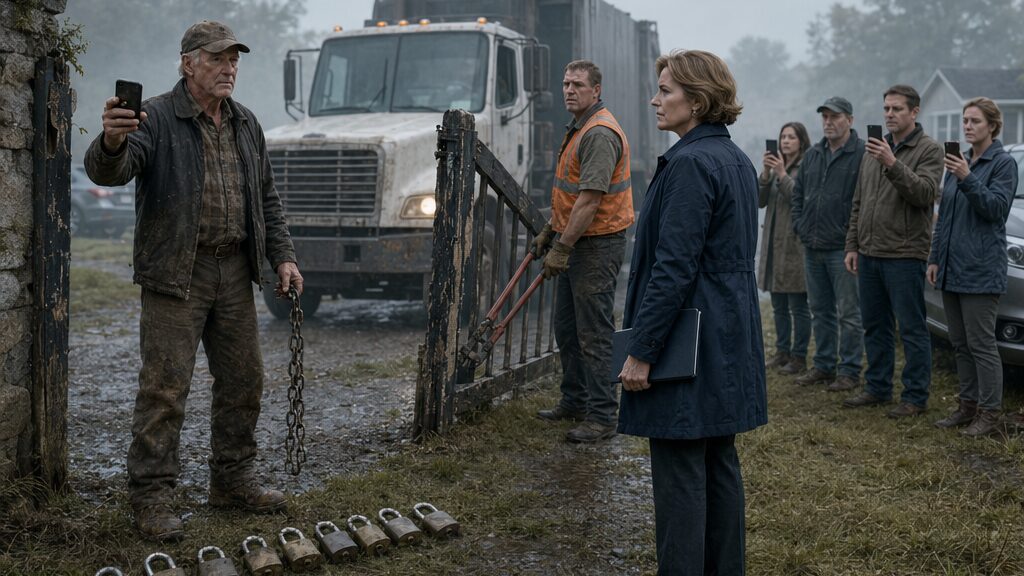
The jaws of the bolt cutters closed around Ronald White’s chain just as the waste truck came out of the fog.
Christopher Wright planted one boot against the gatepost and pulled. The chain gave with a hard metallic snap. The new padlock struck the gravel, bounced once, and rolled into the wet grass beside seven others.
Ronald stood ten feet away with a stainless-steel coffee cup in one hand and his phone in the other.
“Hold it there,” he said.
Christopher looked up from the cutters. His orange vest flashed in the truck’s headlights. “I’m already behind schedule.”
“I didn’t ask about your schedule.”
Behind the truck, three cars had stopped along the subdivision road. Residents stood beside open doors, filming. A woman in running clothes held her phone at chest height. Two men in work jackets watched with the guarded interest of people who expected inconvenience and wanted someone else blamed for it.
Rebecca Davis stepped around the front of the truck. Her navy coat was buttoned neatly despite the mist, and a folder was tucked beneath her arm.
“Ronald,” she said, “we discussed this.”
“You sent me an email.”
“We notified you that bulk collection begins at seven.”
“You notified me you planned to trespass.”
A low murmur moved through the residents.
Rebecca glanced toward the phones. “This road has been used by the community for years. You cannot suddenly obstruct essential services.”
Ronald lifted his phone and photographed the severed chain where it hung from the gate. Then he photographed the padlock in the grass.
Christopher sighed. “Can we do this later?”
“No.” Ronald lowered the phone. “Tell me who instructed you to cut it.”
Christopher shifted the bolt cutters from one hand to the other. “The association authorized access.”
“Who?”
Rebecca answered before he could. “I did, acting as HOA president.”
Ronald looked at Christopher. “I asked you.”
The truck driver’s expression hardened. He was younger than Ronald by at least thirty years, broad through the shoulders, with the impatience of a man accustomed to being the largest moving object in any disagreement.
“Rebecca Davis authorized it,” he said. “Dispatch told us the route was clear.”
“Did dispatch tell you the gate belonged to me?”
Christopher glanced toward Rebecca.
“That’s a yes,” Ronald said.
Rebecca opened her folder. “Your gate is interfering with established access. If you force the contractor to reroute, missed pickups and additional fees may be charged to the responsible property owner.”
Ronald almost laughed. Instead, he took another photograph.
The gate marked the beginning of a gravel road his grandfather had laid before the subdivision existed. It crossed Ronald’s acreage, curved past a stand of sycamores, and reached the county road near the old mill bridge. Since weight restrictions had been posted on the subdivision’s newer entrance bridge, service trucks had discovered that Ronald’s road saved them nearly four miles.
At first they had used it during repairs. Then during storms. Then on Fridays. By spring, garbage trucks, landscaping trailers, roofing deliveries, and concrete mixers came through as if the gate were decorative.
Ronald had replaced the chain each time.
He had also called Rebecca each time.
The first broken lock had angered him. The third had embarrassed him. By the seventh, he had begun laying them in a row and writing the date on a strip of masking tape around each shackle.
Christopher noticed them now.
“You collecting those?” he asked.
“I am.”
“For what?”
Ronald ignored him and walked to the private-road sign. Water ran from its lower edge. He photographed the sign, the truck’s front plate, the company name on the cab, and all three axles visible from the side.
Rebecca’s voice tightened. “You’re turning a service problem into a spectacle.”
“No,” Ronald said. “You brought the audience.”
A resident near the cars spoke up. “My garage is full of old furniture. We were told today was the only pickup.”
Another added, “The bridge route costs the contractor extra. That comes back on all of us.”
Ronald looked at them. He recognized both faces. One had borrowed his tractor after a windstorm. The other had driven across this same road years ago when floodwater covered the subdivision entrance.
“That doesn’t make this road yours,” he said.
Rebecca seized on the opening. “You allowed community access before.”
“For emergencies.”
“You allowed residents through.”
“When the public road was underwater.”
“You never issued written restrictions.”
The words landed more sharply than Ronald expected.
For a moment he saw his late wife at their kitchen table, holding a yellow legal pad and telling him they should put the storm arrangement in writing. He had waved it away. Neighbors knew what a favor was, he had said. Paper would only make people suspicious.
Now Rebecca stood on his gravel using that silence as permission.
Christopher set the bolt cutters in the truck’s side compartment. “Look, nobody’s trying to take your land. We’re just saving twenty minutes.”
“You cut my lock.”
“Because you keep blocking the route.”
“My route.”
“Nobody’s getting hurt.”
Ronald looked past him to the truck. Its rear container sagged under broken cabinets, mattresses, and construction debris. The tires were already pressing dark hollows into the wet shoulder.
He felt the old impulse rise in him—to drag the chain back across the entrance, stand in the center of the road, and force somebody in uniform to decide who was right.
Instead, he walked to the gate.
Rebecca watched carefully. “What are you doing?”
Ronald lifted the loose chain from the gravel and pulled the gate open.
Christopher grinned. One resident lowered her phone.
“Thank you,” Rebecca said, with the measured satisfaction of someone who believed procedure had worked.
Ronald stepped aside. “Go ahead.”
The truck’s engine deepened. Christopher climbed into the cab, released the brake, and rolled forward.
As the front wheels crossed the property line, Ronald raised his phone and began recording.
“Seven forty-three,” he said clearly. “Monday. Wright County Waste Services. Plate ending four-six-two. Three axles entering after verbal and written objection. Gate chain cut under authorization of Rebecca Davis.”
Christopher’s grin disappeared.
The truck passed within six feet of Ronald. Its tires cracked across the gravel, carrying mud toward the drainage ditch.
Rebecca remained by the gate. “What exactly do you think this accomplishes?”
“I don’t know yet.”
“That sounds like a threat.”
“It’s a record.”
She studied him, and for the first time that morning, her confidence shifted—not gone, only disturbed.
The truck disappeared around the sycamores. Another contracted vehicle waited beyond the fog, a landscaping rig pulling two loaded trailers.
Ronald photographed that plate too.
Rebecca closed her folder. “The board will address your obstruction at Thursday’s meeting.”
“Put it in the minutes.”
“We always do.”
“I hope so.”
She walked back toward the subdivision road. The residents followed, some still filming, others avoiding Ronald’s eyes. No one offered to help retrieve the broken chain.
Ronald waited until they were gone. Then he gathered the eighth padlock from the grass and carried all eight to the workbench inside his barn.
He placed the newest one at the end of the row, wrapped masking tape around its body, and wrote the date in block letters.
From a drawer he removed a fresh black ledger.
On the first line, beneath the address of the gate, he wrote:
Crossing One—after written objection.
Outside, the second truck shifted into gear.
Chapter 2: The Favor Nobody Remembered Correctly
By noon, the HOA had named Ronald’s gate an “unauthorized service obstruction.”
The phrase appeared in the subject line of a neighborhood email Rebecca sent to every homeowner. Ronald read it on the computer in his kitchen while another truck rattled the glass in the cabinet doors.
The message said the board was taking steps to preserve “customary community access” and prevent one property owner from disrupting contracted services. It reminded residents that emergency and maintenance vehicles had used the route for many years.
It did not mention chains, bolt cutters, or the private-road sign.
Ronald printed the email.
He carried it to the barn and placed it beside the ledger. Then he lifted the eight broken locks from his workbench and dropped them one by one into an old galvanized feed bucket. Each struck the bottom with a different note.
He told himself he was organizing evidence.
The truth was that he no longer wanted them where he could see them.
That afternoon he walked the road from the gate to the lower field. The waste truck had left twin ruts along the outer curve where the gravel base narrowed near the drainage ditch. He pushed the steel tip of his measuring rod into the deepest mark and felt it sink almost six inches.
A loaded commercial truck should have stayed near the crowned center. Christopher had swung wide to avoid low branches, putting the heaviest wheels over the soft shoulder.
Ronald took measurements, photographs, and notes.
At the culvert below the curve, water seeped through soil that should have been dry. He crouched slowly, bracing one hand against his knee, and scraped away the mud. The corrugated drainage pipe had split along its upper seam. Each passing wheel forced the damaged section lower.
If the pipe collapsed, runoff would cross the road and cut toward his lower field.
A pickup stopped behind him.
Jennifer Rivera stepped out carrying a folder and wearing the expression of someone who had rehearsed an apology without deciding whether to use it.
“I didn’t know they were going to cut the chain in front of everyone,” she said.
Ronald stayed crouched. “Would it have been better without witnesses?”
“No.”
She came closer and looked at the exposed pipe. “Is that from today?”
“Today finished what the other trucks started.”
Jennifer was Rebecca’s daughter, though she used her former husband’s surname. She had grown up in one of the first houses built beyond Ronald’s eastern fence. During the flood fifteen years earlier, she had been among the residents who drove out through his property.
Now she served as HOA treasurer.
“My mother says you gave permanent access,” she said.
“Your mother says a lot in emails.”
“She says the road has been open since the flood.”
“It was open during the flood.”
“And afterward.”
“For a while.”
“How long?”
Ronald straightened. His back protested.
“That depends which storm you mean.”
Jennifer’s eyes narrowed slightly. “There was more than one arrangement?”
The question irritated him because he did not know the answer cleanly.
The first flood had closed the subdivision entrance for eleven days. Ronald had opened his gate and moved equipment so residents could reach the county road. Two winters later, an ice storm brought down trees along the public entrance, and he opened it again. When an ambulance needed access during bridge repairs, he had given the fire department a spare key.
Later, certain neighbors had asked permission individually. A nurse working night shifts. A family hauling supplies after a house fire. Jennifer herself, once, when her father was in the hospital.
He had said yes often enough that the occasions blurred.
But he had never said the road belonged to the HOA.
“My wife wanted signs with dates,” Ronald said.
Jennifer waited.
“She thought temporary meant nothing if we didn’t say when temporary ended.”
“What did you think?”
“That neighbors understood.”
Jennifer looked toward the split culvert. “Some probably did.”
“And the rest?”
“The rest remember what helps them.”
They stood without speaking while a landscaping rig approached from behind. The driver slowed, saw Ronald’s phone in his hand, and kept both wheels carefully on the center crown.
Ronald recorded the plate and time.
Jennifer watched him write in the ledger. “Are you counting every vehicle?”
“Every commercial crossing.”
“What about residents?”
“If they’ve asked permission, I write that too.”
Her gaze moved to him. “That could hurt your argument.”
“It could make the record accurate.”
The following morning, Ronald searched the house.
He opened drawers that had not been disturbed since his wife died. He went through tax receipts, equipment manuals, bridge notices, and envelopes filled with photographs she had meant to label. In the bottom drawer of her desk, beneath a stack of church bulletins, he found a folded sheet of yellow paper.
Across the top she had written:
TEMPORARY STORM ACCESS—PRIVATE ROAD
Below it were dates, conditions, and a sentence stating that access would expire when the county reopened the subdivision entrance. Ronald recognized his own signature near the bottom.
His wife’s signature appeared beside it.
For several minutes he remained seated at the desk, holding the paper by its edges.
The notice vindicated him. It also exposed how little he had done afterward.
He remembered her asking whether they should file it with the county or send copies to the HOA board. He had told her there was no need. People knew the difference between help and ownership.
She had looked at him over her glasses and said, “People know the difference until the difference costs them something.”
Ronald folded the notice along its original crease.
Outside, a heavy engine climbed the road.
He reached the damaged curve as a construction supply truck came through pulling a trailer of retaining-wall blocks. The rear trailer wheel dropped into the rut. The ground gave way with a dull crunch.
Water surged from beneath the tire.
The driver stopped, climbed down, and stared at the broken shoulder. “That was already soft.”
Ronald photographed the wheel, the cracked culvert, and the muddy stream beginning to cut downhill.
“Back out the way you came,” he said.
“I’ve got a delivery.”
“You’ve got a broken drainage pipe under you.”
The driver called dispatch. Ten minutes later, Rebecca called Ronald.
“If you block that truck,” she said, “the contractor may charge the association for unloading delays.”
“The road may wash into my field.”
“We’ll inspect it.”
“You’ll inspect it before another commercial vehicle crosses.”
“You don’t have authority to interrupt contracted services.”
Ronald looked at the storm notice in his hand.
“I have authority over my culvert.”
He ended the call.
By afternoon, the truck had backed out. Ronald placed cones at the damaged curve and sent Rebecca photographs with a written demand for inspection. Her reply said the HOA accepted no responsibility pending review.
He then drove to the county recorder’s office.
Maria Lopez sat behind the public counter beneath fluorescent lights, sorting plats into flat archival folders. She knew Ronald from subdivision meetings and from the years when he had maintained county roads.
“I heard about Monday,” she said.
“Most people did.”
“I also heard you blocked a delivery this morning.”
“The ground blocked it.”
Maria studied the faded storm notice he placed before her.
“This proves a temporary arrangement existed,” she said. “It doesn’t tell us whether something else was recorded later.”
“That’s why I’m here.”
She searched the computer by parcel number, then frowned and switched to an older index. “Your deed references a road instrument, but it isn’t digitized.”
“Whose instrument?”
“Your grandfather’s, I think.”
She disappeared into the back room. When she returned, she carried an index card inside a clear sleeve.
“Filed in 1960,” she said. “Book forty-eight, page two hundred sixteen. It may control the road, or it may only describe it.”
“What does it say?”
“I haven’t seen the document.”
“Can you get it?”
Maria glanced toward the records room. “Not today. That volume is in off-site storage.”
“When?”
“Friday morning.”
Ronald picked up the storm notice.
As he turned away, Maria said, “Ronald, don’t assume an old document will say what you want.”
He looked back at her.
“I’m past wanting,” he said. “I need to know what it says.”
Chapter 3: The Covenant Gave Him Less Than Revenge
Ronald found his grandfather’s signature beneath the words COMMERCIAL USE REQUIRES WRITTEN CONSENT.
The letters were typed on yellowed paper, uneven and faint at the edges. Below them, an ink line crossed the page where his grandfather had signed in 1960.
Ronald read the sentence twice.
Then a third time.
Maria stood on the opposite side of the archive table. “Keep going.”
The old instrument described a twelve-foot private access road across the White property. It reserved passage for family parcels and permitted temporary public use during declared emergencies. Commercial carriers could use the road only with the owner’s written consent and subject to maintenance charges based on vehicle weight and frequency.
Ronald felt a slow warmth spread through his chest.
“There,” he said, tapping the paragraph. “That’s it.”
“That’s part of it.”
“It says written consent.”
“Yes.”
“I never gave the HOA written consent.”
Maria did not answer. She turned the page.
A small brass key slid from the fold and clicked against the table.
Ronald picked it up. It was dark with age but unbroken, the kind used for the heavy warded padlocks his grandfather had once hung at the cattle gate. A paper tag was tied to it with string.
East road gate.
He closed his fingers around it.
Maria pointed to a later paragraph. “Read this section.”
It allowed the owner to waive charges by custom or separate agreement. It also stated that prolonged permitted use might affect which remedies remained available, depending on later conduct and applicable law.
The warmth in Ronald’s chest cooled.
“That doesn’t give them ownership.”
“I didn’t say it did.”
“It doesn’t give them commercial access.”
“No. But I work for the recorder. I can show you what was filed. I cannot tell you what a judge would do with sixty-six years of conduct.”
Ronald looked again at the first paragraph—the one he wanted to carry into the HOA office and lay in front of Rebecca.
Commercial use requires written consent.
It remained useful. It simply was not the hammer he had imagined.
Maria made certified copies of the instrument, the parcel plat, and the filing index. She also located three storm-related notices from county emergency management. Two named Ronald’s road as temporary secondary access.
The third contained no expiration date.
“I didn’t sign that one,” Ronald said.
“It’s a county notice, not an agreement.”
“It makes it look permanent.”
“It makes it look like the county expected access during that emergency.”
Ronald placed the papers in order. “Rebecca will use it.”
“If she has it.”
“She’ll have it now.”
Maria’s expression changed. “I didn’t send her anything.”
“She’ll request it once she learns I was here.”
Before leaving, Ronald slipped the old gate key into the inner pocket of his coat.
Samuel Johnson’s office occupied the second floor above a pharmacy near the courthouse. The waiting room held two wooden chairs, a dead plant, and a framed aerial photograph of the county taken before most of the subdivisions existed.
Samuel read the 1960 instrument without speaking.
Ronald sat across from him with the certified documents, photographs of the locks, and his new ledger spread between them.
At last Samuel said, “You have a real claim.”
Ronald leaned back slightly.
“You sound disappointed.”
“I’m waiting for the part after ‘real.’”
Samuel tapped the commercial-use paragraph. “The HOA has no recorded easement for unrestricted commercial traffic. I checked the later deed references before you arrived. Nothing grants it.”
“That should end the argument.”
“It should end their claim that the access is unquestionably theirs.”
“Same thing.”
“No.”
Samuel turned the instrument sideways so Ronald could see it. “You allowed emergency use. You allowed residents to cross at different times. You gave a key to the fire department. You did not consistently close the road after each emergency.”
“Commercial trucks are not residents.”
“That distinction helps you. Your conduct still matters.”
Ronald folded his arms.
“How long have garbage trucks used the road?”
“Regularly? Maybe three years.”
“And before that?”
“Some contractors. Utility crews.”
“With permission?”
“Sometimes.”
“Written?”
“No.”
Samuel nodded once, as though Ronald had confirmed an unpleasant measurement. “Their attorneys will argue implied permission, waiver, reliance, maybe necessity while the bridge restriction remains in place.”
“Will they win?”
“Not all of it.”
“That wasn’t my question.”
“It’s the honest answer.”
Ronald looked toward the aerial photograph. His road appeared as a pale line through open fields. No cul-de-sacs. No clubhouse. No rows of roofs.
“What about the maintenance charges?” he asked. “It says vehicle weight and frequency. I have axle counts.”
“For recent crossings after you objected, the clause may support compensation. Historic charges will be harder.”
“The company has used the road for years.”
“And you did not invoice them.”
“I did not know I had to invoice people for cutting through my land.”
Samuel’s voice remained calm. “A judge may agree with your anger and still reject fifteen years of retroactive toll calculations.”
Ronald heard Christopher again: Nobody’s getting hurt.
He had imagined the old covenant converting every crossing into a number, every number into a debt large enough to make Rebecca understand. Now Samuel was taking that clean arithmetic apart.
“What can I recover?” Ronald asked.
“Documented road damage. Destroyed chains and locks. Potential trespass damages after clear notice. Possibly commercial-use compensation under the instrument. Injunctive relief if we prove no permanent right exists.”
“And before clear notice?”
“We need more facts.”
“I told Rebecca repeatedly.”
“By phone?”
“Yes.”
“Letters?”
“One certified letter last month.”
“Meeting minutes?”
“I don’t attend.”
Samuel sat back. “That is going to be a problem.”
“I shouldn’t have to join their meetings to protect my road.”
“You shouldn’t. But if they have years of minutes describing this as community access, and you never objected on the record, they will use that silence.”
Ronald took the brass key from his pocket and set it on the desk.
“My grandfather locked that road.”
Samuel glanced at it. “Your grandfather also wrote an emergency-use provision.”
“He knew the difference.”
“Then we need to show that you preserved the difference.”
The words stung because Ronald knew he had not. He had trusted conversations, handshakes, and common sense. When those failed, he bought stronger locks.
Samuel picked up Ronald’s ledger. He read the entries carefully: plate numbers, axle counts, times, direction, weather, loads, photographs, and the precise location of fresh damage.
“This is good,” he said.
Ronald said nothing.
“It’s better because you included permitted resident crossings.”
“That weakens me, according to you.”
“It weakens an exaggerated claim. It strengthens your credibility.”
Samuel reached the entry for the construction truck and the damaged culvert. “We’ll hire a road engineer. They can separate ordinary deterioration from heavy-vehicle damage.”
“I can do that.”
“You can explain it. An independent engineer can testify to it.”
Ronald disliked the distinction but understood it.
Samuel made a list. Certified title search. Contractor agreements. Insurance correspondence. HOA minutes. Bridge restrictions. Dispatch instructions. Repair estimates.
Then he paused.
“What?”
Samuel turned his computer monitor. On the screen was a set of HOA meeting minutes filed as an exhibit in an unrelated county dispute. A line near the bottom referenced renewal of the waste contract.
Insurance review pending regarding private-road commercial access.
The date was four months earlier.
Ronald leaned closer. “They knew?”
“It says someone knew there was an insurance question.”
“Rebecca signed those minutes.”
“She signed the approval page.”
“Then she knew.”
“Possibly. We need the underlying correspondence.”
Ronald read the line again. Four months earlier, before the seventh lock, before the eighth, before Rebecca stood in front of the residents and described the road as established access.
Samuel scrolled through the next month’s minutes.
The insurance reference had disappeared.
In its place was a motion approving continued use of the “existing service route” without discussion.
“Who receives the association’s insurance notices?” Ronald asked.
“Usually the president, property manager, treasurer, or all three.”
“Rebecca is president and property manager.”
Samuel nodded. “Jennifer Rivera is listed as treasurer.”
Ronald stared at the two sets of minutes. One acknowledged a warning. The next behaved as though no warning had existed.
Samuel closed the file.
“The covenant matters,” he said. “But this may matter more.”
“Why?”
“Because a dispute over old access can be an honest disagreement. Cutting locks after your insurer tells you commercial permission is required is something else.”
Ronald slipped the brass key back into his pocket.
“Then find out who received that warning.”
Samuel looked at the signed minutes once more.
“I intend to.”
Chapter 4: Every Easy Crossing Raised the Cost
The driver smiled directly into Ronald’s camera as the debris container rolled across the property line.
He lifted two fingers from the steering wheel in a lazy salute, then accelerated hard enough to scatter gravel against the gatepost. The loaded container leaned on the turn, its rear tandem tires grinding into the repaired shoulder beside the culvert.
Ronald lowered the camera and wrote the time.
8:12 a.m. Four axles. Demolition debris. Entering eastbound. Driver acknowledged camera.
He added a second note beneath it.
Right rear tires outside crowned travel lane.
The road engineer had visited the day before and marked the damaged areas with orange paint. Ordinary wear appeared as shallow washboarding along the center. The truck damage was different: deep edge rutting, crushed aggregate, displaced soil above the culvert, and a widening fracture where repeated heavy loads had pushed beyond the road’s compacted base.
Ronald had known that before the engineer arrived. He had spent thirty-two years maintaining county roads.
Still, when the engineer’s written estimate came that morning, Ronald read it twice.
The repair would require excavation, a new culvert section, fresh base stone, grading, compaction, and drainage work. The cost was more than he had expected and less than he feared.
It was also independent proof.
He photographed the debris truck as it passed the orange markings. Then he attached the image to the day’s ledger page beside a photograph of the corresponding broken lock.
The dates matched.
The lock cut on Monday matched the first truck after formal objection. The next lock matched the landscaping rig. Another matched the concrete delivery. Each piece of bent metal now belonged to a crossing, a plate, a load, and a measured injury to the road.
By the fourth day, Rebecca sent a letter through the HOA’s attorney.
It warned that any attempt to close the road could lead to an emergency injunction and recovery of legal costs, service penalties, and resident damages. The letter described Ronald’s route as “long-established access relied upon by the community and its contractors.”
Samuel called five minutes after forwarding it.
“Do not put up another chain,” he said.
“They cut the last one.”
“I know.”
“You told me I could control my property.”
“You can. I’m telling you not to hand them a clean argument that you created an immediate service crisis.”
Ronald looked through the kitchen window as another truck passed behind the sycamores.
“So I let them keep doing it.”
“For now.”
“That sounds like permission.”
“It is not permission if we keep objecting in writing and preserving the record.”
Ronald glanced toward the feed bucket in the corner of the mudroom. The broken locks sat inside it, dull and heavy.
“Rebecca thinks I’ve backed down.”
“Let her.”
Ronald disliked how much that sounded like strategy and how much strategy resembled surrender when practiced on one’s own land.
Over nine days, he logged fifty-seven commercial crossings.
He noted weather, direction, load type, axle count, visible company markings, and whether each driver slowed at the damaged curve. Some avoided his camera. Others waved. One stopped and asked whether Ronald planned to charge admission.
Ronald wrote the comment down verbatim.
On the sixth evening, a dark SUV entered the road at 6:34.
Ronald raised his phone automatically, then recognized the driver.
It was the nurse who lived near the subdivision’s western pond. Years earlier, she had asked to use the road during winter shifts because the main entrance iced badly before sunrise. Ronald had given her permission and never withdrawn it.
She stopped beside him and lowered the window.
“Am I not supposed to come through anymore?”
“You’re fine.”
“Rebecca’s email says this is community access.”
“It isn’t.”
Her face tightened. “Then what am I?”
“Someone who asked.”
She looked past him toward the gate. “I don’t remember getting anything in writing.”
“You didn’t.”
“Would you tell a judge that?”
Ronald hesitated only a second.
“Yes.”
She nodded, though not with relief. “Then your situation is messier than people think.”
“I know.”
Her SUV continued down the road. The camera captured the entire exchange.
That night Ronald entered the crossing in his ledger under a separate heading.
Permitted personal use—prior verbal authorization.
He stared at the line for a long time. Samuel had said accuracy would strengthen him. Ronald understood that in principle. In practice, every honest entry seemed to remove another brick from the wall he wanted to build.
At the HOA clubhouse, Jennifer Rivera sat with the association’s financial records spread across the conference table.
She had begun reviewing them because Samuel’s document request was broad enough to expose mistakes even if the board refused to cooperate. Rebecca wanted the files organized before their attorney responded.
“Only provide what is requested,” Rebecca had said.
Jennifer had heard the instruction beneath the instruction.
She opened the waste-hauling contract and compared the current route price with the previous year’s bid. The contractor had reduced its monthly charge after switching more service traffic to Ronald’s road. The savings appeared in board reports as efficient contract management.
A separate page showed Rebecca’s management-company bonus.
The bonus rose when annual operating costs stayed beneath a fixed threshold.
Jennifer sat back.
The shortcut did not merely avoid the damaged bridge. It kept the HOA below the line that triggered Rebecca’s payment.
That alone did not prove misconduct. The board had approved the compensation structure. Lower costs benefited residents.
Then Jennifer opened the insurance folder.
Near the bottom was an email dated four months earlier.
The subject line read: PRIVATE ROAD ACCESS—COMMERCIAL LIABILITY CONCERN.
She read the first paragraph standing up.
The insurer stated that emergency access and historical residential tolerance did not establish unrestricted commercial permission. Continued contractor use without written owner authorization could expose the association to trespass claims, road-damage liability, and loss of coverage for intentional acts.
The message recommended immediate suspension of commercial crossings pending legal review.
Jennifer checked the recipients.
Rebecca Davis.
Jennifer Rivera.
The HOA’s general inbox.
Jennifer remembered the email arriving. She had been preparing quarterly statements and had skimmed it on her phone. Later, Rebecca told her the insurer had clarified the issue and approved temporary continued use while the bridge restriction remained.
Jennifer searched for the clarification.
There was none.
She searched the general inbox.
The original warning had been moved into an archive folder labeled CLOSED MATTERS.
The board packet for the following month contained the contract renewal but not the insurance email. The meeting minutes referenced no legal risk. They described Ronald’s road only as the “existing service route.”
Jennifer opened the document history.
The first draft of the board packet included the insurer’s warning as an attachment.
The final version did not.
The deletion was made from Rebecca’s account the night before the meeting.
Jennifer’s hand remained on the mouse.
From the hallway came the sound of Rebecca speaking to a resident about dues, her voice calm and confident. She was explaining that the board had kept costs stable despite fuel increases and bridge restrictions.
Jennifer looked again at the bonus agreement.
Then at the deleted warning.
Then at Ronald’s latest photograph, attached to Samuel’s request: a broken lock laid beside a ruler, the date written around its body in white tape.
Rebecca entered the conference room.
“You’re still here.”
Jennifer minimized the screen. “I’m checking the contractor files.”
“Good. Their attorney wants everything by Monday.”
“Did the insurer ever approve continued use of Ronald’s road?”
Rebecca stopped beside the table.
“We discussed this.”
“You told me there was a clarification.”
“There was a phone conversation.”
“With whom?”
Rebecca removed her glasses. “Jennifer, do not turn a coverage question into an accusation.”
“I’m asking where the approval is.”
“The insurer refused to give practical guidance. They protect themselves. I had to protect the association.”
“By leaving the warning out of the board packet?”
Rebecca’s face changed very slightly.
“You found the draft.”
“I found the deletion history.”
For several seconds, neither woman moved.
Rebecca set her glasses on the table. “If that warning had gone to the board, they would have suspended the route immediately. Waste service would have been rerouted. Landscaping fees would have increased. The special assessment would have landed before summer.”
“And your bonus?”
Rebecca’s jaw tightened.
“My bonus was approved by the board.”
“That wasn’t my question.”
Outside the clubhouse, a truck downshifted toward Ronald’s road.
Jennifer reopened the deleted email.
Rebecca reached toward the laptop, then stopped herself.
“You need to decide whether you’re the treasurer of this association or Ronald White’s witness.”
Jennifer looked at her mother.
“I think that email already decided.”
Chapter 5: The Treasurer Chose the Record Over Blood
Jennifer placed the deleted insurance warning beside her mother’s bonus agreement.
The two documents barely filled one corner of Rebecca’s dining table, but Rebecca stared at them as though they had occupied the entire room.
“You printed confidential files,” she said.
“They’re association records.”
“They’re privileged.”
“The insurer’s warning isn’t legal advice.”
“You are not qualified to decide that.”
Jennifer remained standing. “Did you tell the board the insurer recommended stopping commercial traffic?”
Rebecca folded her arms.
“I told the board we had a service continuity problem.”
“That isn’t an answer.”
“It is the answer that mattered at the time.”
The kitchen was immaculate. Rebecca had already placed her coffee cup in the dishwasher, though it was not yet eight in the evening. A folder of homeowner complaints sat squared with the edge of the counter.
Jennifer remembered doing homework at this table while her mother worked beside her. Budgets, tenant disputes, vendor calls. Rebecca had built order out of other people’s carelessness for as long as Jennifer could remember.
That was part of the problem. She believed disorder justified almost any correction.
“The bridge restriction was supposed to last six months,” Rebecca said. “The county extended it twice. The waste company threatened surcharges. The landscaper wanted a new fuel allowance. Residents were already furious about dues.”
“So you used Ronald’s road.”
“He had allowed access for years.”
“For residents during storms.”
“He never clearly withdrew it.”
“He put up chains.”
“After contractors had relied on the route.”
“And you ordered the chains cut.”
Rebecca looked away for the first time.
“I instructed them to maintain scheduled service.”
“With bolt cutters.”
“The contractor chose the method.”
Jennifer pushed the insurance warning closer. “This says continued use could be considered intentional trespass.”
“It says could.”
“It told you to suspend traffic.”
“And if I had?” Rebecca’s voice sharpened. “The waste contract would have increased by eighteen percent. Landscaping by eleven. Bulk pickup would have been reduced. Then everyone who is angry at Ronald now would have been angry at me.”
“That’s your job.”
“Yes,” Rebecca said. “It is. My job is to make decisions people don’t understand until something fails.”
Jennifer tapped the bonus agreement. “And this?”
Rebecca’s expression hardened.
“I earned that bonus by keeping the association solvent.”
“You kept it under budget by transferring the cost to Ronald.”
“I believed the road had become customary access.”
“No. You believed he wouldn’t fight long enough to make the distinction matter.”
Rebecca stood very still.
When she spoke again, her voice was quieter. “Be careful.”
“Is that advice?”
“It is what a mother says when her daughter is about to damage her own community.”
Jennifer gathered the papers.
“I thought loyalty meant helping you fix this before someone else found it.”
“And now?”
“Now I think you already decided not to fix it.”
At the clubhouse the next morning, Jennifer copied the complete board packet, including the draft history, insurance warning, contract route maps, bonus agreement, and meeting attachments. She placed one set in the association’s official records file.
She sealed another in a large envelope.
Before leaving, she logged the disclosure in the treasurer’s register.
No one could later claim the documents had appeared from nowhere.
Ronald was repairing a fence brace when Jennifer drove up his lane. He set down the wrench but did not invite her inside.
She carried the envelope in both hands.
“My mother received the warning,” she said.
Ronald looked at the envelope, not at her.
“You received it too.”
Jennifer swallowed. “Yes.”
“Did you read it?”
“Not carefully enough.”
“That different from not reading it?”
“No.”
He wiped his hands on a rag. “Why bring it now?”
“Because she removed it from the board packet. And because the route savings affected her management bonus.”
Ronald’s face remained controlled, but his fingers tightened around the rag.
Jennifer opened the envelope and removed the first page.
“The insurer told the HOA to stop commercial crossings until written permission was obtained. Four months ago.”
“Before the last six locks.”
“Yes.”
“Before Rebecca stood at my gate and called it established access.”
“Yes.”
He took the page.
The wind lifted one corner. Ronald held it flat against the porch rail and read every line.
Jennifer reached into her coat pocket and placed a broken padlock beside the envelope.
Ronald recognized the strip of faded white tape around its body. It was the first lock cut after the insurer’s warning, before he had started arranging them by date.
“Where did you get this?”
“My mother kept it in her garage cabinet with old gate hardware. I think the contractor gave it to her after she approved the first cut.”
Ronald picked it up. One side bore a clean bite from large cutters.
“She kept it?”
“I don’t know why.”
He turned the lock in his hand. It was not proof of permission or guilt by itself. It was simply something Rebecca had chosen not to throw away.
“Samuel needs the packet,” Ronald said.
“I expected that.”
Jennifer handed him the envelope. “The originals remain in the HOA records.”
“Your mother know?”
“She knows I found them.”
“That wasn’t what I asked.”
“No. She doesn’t know I brought them here.”
Ronald studied her. “When she does, this won’t stay a board disagreement.”
“I know.”
He set the lock on the porch rail.
“You used this road when your father was sick.”
Jennifer’s eyes dropped. “I remember.”
“I gave you permission.”
“Yes.”
“I never told you it ended.”
“No.”
“And you crossed after the flood repairs were finished.”
A long pause followed.
“Yes,” she said.
Ronald looked down the lane. He could see the pale shape of his gate beyond the trees.
“How many others?”
“I don’t know.”
“I need names.”
“For your lawsuit?”
“For the truth.”
Jennifer looked at him again. “That truth may reduce what you can claim.”
“I know.”
Samuel arrived an hour later.
They spread the board packet across Ronald’s kitchen table. The deleted warning strengthened the case after formal notice and possibly before it. The route maps connected contractors to board-approved instructions. The bonus agreement established motive but not necessarily fraud.
Then Ronald placed his handwritten ledger beside them.
“There’s more,” he said.
Samuel read the entries for residents, emergency vehicles, the nurse, Jennifer, and several utility crews.
“How far back?”
“Fifteen years, off and on.”
“You have records?”
“Not complete ones.”
“Did you ever charge them?”
“No.”
“Did you ever tell them in writing that permission had ended?”
“No.”
Samuel leaned back.
Jennifer remained silent at the far end of the table.
Ronald continued before he could change his mind. “Some contractors asked me directly. Years ago. I let them through when the bridge was under repair.”
“How many?”
“Maybe a dozen crossings. Maybe more.”
Samuel removed his glasses. “That matters.”
“I know.”
“It could shorten the strongest damages period. Their attorneys will argue that commercial use was tolerated until your certified objection.”
“I know.”
“Why didn’t you tell me this at the office?”
Ronald looked toward the empty chair where his wife had once sat.
“Because I wanted the old paper to make everything simple.”
Samuel waited.
“And because I wanted every crossing to count against them.”
The admission left the room quieter than Ronald expected.
Jennifer looked down at her hands.
Samuel put his glasses back on. “Then we revise the claim.”
“How much does it cost me?”
“Possibly several years of historic compensation. Maybe more.”
Ronald nodded once.
Samuel gathered the ledger and complete packet. “It buys credibility. That may be worth more than an inflated number we cannot defend.”
A courier arrived before noon.
The envelope bore the name of the HOA’s law firm. Inside was a petition for an emergency order alleging that Ronald’s threatened closure endangered waste collection, property maintenance, emergency access, and public safety during the bridge restriction.
A preliminary hearing was set for the following week.
Jennifer read the petition over Samuel’s shoulder.
“They’re saying he plans to block ambulances.”
“I never said that,” Ronald replied.
Samuel turned to the attached affidavit.
Rebecca had signed it.
She stated that Ronald’s recent conduct created an imminent risk to essential services and that the HOA had relied on longstanding, unrestricted access.
Jennifer stared at her mother’s signature.
Samuel closed the packet.
“They want the judge to treat all access as one thing,” he said. “Emergency vehicles, residents, contractors, garbage trucks. If they succeed, your gate becomes the danger instead of their conduct.”
Ronald picked up the first broken lock Rebecca had kept.
For years he had refused to put limits in writing because he feared becoming the kind of neighbor who needed paper before offering help.
Now Rebecca was using that absence to claim he had never kept any limit at all.
“What happens if I close the road today?” he asked.
Samuel’s answer came immediately.
“You strengthen their emergency argument.”
“And if I leave it open?”
“We show the court that you are protecting emergency access while objecting to commercial exploitation.”
Ronald looked toward the gate.
Rebecca had forced the question he had avoided for fifteen years. He could no longer defend his property simply by saying no. He would have to say precisely who could enter, for what reason, and under whose authority.
The lock felt heavy in his palm.
“Then write it,” he said. “Emergency vehicles can pass. Everyone else needs permission.”
Samuel nodded.
Before he could begin, his phone rang.
He listened without speaking, then opened his notebook.
When the call ended, he looked at Ronald.
“The judge granted an expedited hearing. And the HOA is asking for legal fees if it wins.”
“How much?”
“Enough that they expect you to be afraid.”
Chapter 6: He Refused the Victory That Would Poison Everything
The HOA’s attorney held up Ronald’s old storm notice as if it were a deed.
“Mr. White opened this road to residents, emergency vehicles, contractors, and service providers for more than a decade,” she said. “The association relied on that access. Now, without warning, he seeks to close the only practical route available while the public bridge remains restricted.”
Ronald sat beside Samuel at the courthouse table.
The feed bucket was on the floor by his chair. Inside it were eight broken padlocks. The ninth—the one Jennifer had brought—rested on top.
Across the aisle, Rebecca sat with her attorneys. Jennifer was two seats behind her, separated from the board members by an empty chair.
The judge examined the storm notice.
“It states temporary access during a declared emergency,” he said.
“The use continued afterward,” the HOA’s attorney replied.
“By whom?”
“Residents and community service providers.”
Samuel rose. “Those categories are not interchangeable.”
The judge gestured for him to continue.
“Mr. White does not seek to block ambulances, fire apparatus, or authorized emergency traffic. He objects to private contractors using his land for economic convenience after written notice, after physical damage, and after repeated destruction of his barriers.”
The attorney turned toward Ronald. “His barriers blocked the same road used by emergency vehicles.”
“His gate includes a fire-department lockbox,” Samuel said. “The HOA omitted that from its petition.”
Rebecca whispered to her attorney.
Ronald watched the judge’s expression. It gave away little.
The hearing shifted into court-ordered mediation before noon. The parties moved to a smaller room where the air smelled faintly of coffee and copier toner.
Ronald placed the broken locks on the table in date order.
The mediator looked at them but said nothing.
Rebecca’s attorney slid a settlement proposal across the table.
The HOA would pay for part of the culvert repair, reimburse the cost of documented locks, and provide Ronald with an annual access fee.
In return, he would grant permanent, unrestricted commercial use of the road to the HOA and its contractors.
Ronald read the final line twice.
“They want to buy what they already took,” he said.
Rebecca leaned forward. “We are offering certainty.”
“For you.”
“For everyone. Waste collection. Landscaping. Deliveries. Emergency access. Property values.”
“Emergency access is not in dispute.”
“It becomes a problem every time you put up a chain.”
“The fire department has a key.”
“Contractors don’t.”
“They aren’t the fire department.”
The mediator raised a hand. “Let’s keep the categories separate.”
Rebecca sat back, though her eyes remained on Ronald.
Samuel spoke quietly. “There is another route.”
The HOA’s attorney shook her head. “It is financially impractical.”
“Not impossible.”
Samuel placed the county engineer’s map on the table. A proposed service entrance could connect the subdivision’s maintenance lane to the county road north of Ronald’s property. It required drainage work, tree removal, and a reinforced apron.
Rebecca glanced at the map.
“That option was reviewed,” she said.
“When?” Jennifer asked from the end of the table.
Rebecca did not look at her. “During contract renewal.”
“And rejected because of cost,” Samuel said.
“Because it would require a special assessment.”
The mediator studied the estimate. “This is less than the association’s potential exposure if intentional trespass is established.”
Rebecca’s attorney objected to the phrase.
Samuel opened the insurance email.
“You were advised to stop commercial traffic pending written permission.”
“We dispute the meaning of that correspondence.”
“You deleted it from the board packet.”
Rebecca’s gaze moved toward Jennifer.
The mediator interrupted before either woman spoke. “We are not trying liability today. We are determining whether a workable agreement exists.”
Ronald looked at the line of locks.
He had brought them because he wanted Rebecca to see each choice made visible. Instead they sat between everyone like an argument already understood.
He gathered them one by one and returned them to the bucket.
The mediator watched him. “Why are you removing those?”
“Because they tell us what happened. They don’t tell us what should happen next.”
Rebecca’s expression shifted.
Samuel said nothing.
The afternoon hearing resumed when mediation stalled.
Christopher Wright was called to testify about contractor instructions.
He entered in a clean work shirt without the reflective vest. At the gate he had seemed large enough to fill the road. In the witness chair he looked tired.
“Who told you the road was authorized?” Samuel asked.
“Dispatch.”
“On whose information?”
“The HOA management office.”
“Did anyone tell you the owner objected?”
“Yes.”
“When?”
“Before the last few crossings.”
“Did anyone tell you the association’s insurer had approved continued use?”
Christopher glanced toward Rebecca.
“Yes.”
“Who?”
“Rebecca Davis.”
The courtroom remained quiet.
Rebecca’s attorney stood. “Objection to characterization. The witness is not qualified to interpret insurance coverage.”
“I’m not asking him to interpret it,” Samuel said. “I’m asking what he was told.”
The judge allowed the answer.
Christopher rubbed his palms against his trousers. “She said the insurance issue had been handled and we were cleared to keep the route.”
“Did she instruct you to cut the chain?”
“She said service was authorized and the obstruction could be removed.”
“With bolt cutters?”
“She didn’t specify the tool.”
“Did you know the gate belonged to Ronald White?”
“Yes.”
“Did you know he had objected?”
“Yes.”
“Why did you proceed?”
Christopher looked at Ronald.
“Because I thought the company and the HOA would carry the responsibility.”
It was not an apology. It was also not the careless confidence Ronald remembered.
The judge reviewed the certified road instrument, the storm notices, the photographs, the engineer’s report, and the sequence of written objections.
When he spoke, his ruling was narrow.
The HOA had not established an unrestricted commercial easement. Emergency access would remain protected. Ronald could not interfere with authorized emergency vehicles while bridge restrictions continued. Commercial contractors, however, could not treat his road as open merely because residents had once received permission.
The court declined to decide final damages that day.
But the judge stated that crossings after clear written objection, particularly those involving cut locks and documented damage, presented a substantial trespass claim.
Rebecca’s attorney requested that the injunction remain in place for all service traffic until another route was secured.
The judge refused.
“Convenience,” he said, “is not the same as necessity.”
Ronald felt no rush of triumph. He felt the pressure move elsewhere.
Without his road, service costs would rise immediately. Garbage routes would lengthen. The damaged public bridge still limited heavy traffic. If he closed the gate to every vehicle except ambulances and fire trucks, some residents would suffer for decisions they had not made.
During a recess, Samuel showed him revised damage estimates and a projected settlement range.
“We have leverage now,” he said. “Enough to demand substantial compensation and immediate closure.”
“How long until the service entrance is built?”
“Six months, perhaps more.”
“What happens meanwhile?”
“The contractors reroute.”
“And emergency response?”
“Legally protected.”
“That wasn’t my question.”
Samuel studied him. “The north side of the subdivision could lose several minutes during peak traffic if responders cannot use your road.”
Ronald looked across the hallway at Rebecca. She stood alone near a window, reading messages on her phone. For years she had converted every problem into a budget line. He had converted every disagreement into silence until a lock became necessary.
His wife had understood the flaw in both habits.
Put it in writing, she had said.
Not to keep people out. To make sure help remained help.
The parties returned to mediation before evening.
Rebecca’s new offer included full culvert repair, lock reimbursement, and a commercial fee, but still demanded permanent access.
Ronald pushed it back.
“I will not sell unrestricted use.”
“Then what do you want?” Rebecca asked.
The exhaustion in her voice stripped away some of its authority.
Ronald unfolded the county map.
“The HOA funds the separate service entrance.”
Rebecca shook her head. “Residents cannot absorb that all at once.”
“Finance it.”
“Our reserves are not unlimited.”
“Neither is my road.”
He pointed to the existing gate.
“Emergency vehicles receive written access. The fire department keeps its lockbox key. During a declared emergency or documented closure of the public entrance, residents may use the road under defined conditions.”
“And contractors?”
“No commercial traffic without a separate written agreement.”
Rebecca’s attorney began to speak, but Ronald continued.
“The HOA pays for full road restoration, the culvert, the barriers, and the engineer’s costs. The contractor contributes to the damage it caused. The association publishes corrected access rules.”
Rebecca’s face tightened. “You want us to announce fault to the entire neighborhood.”
“I want you to announce that cutting the chains was unauthorized.”
“That language exposes the board.”
“The board was already exposed when you ignored the warning.”
Jennifer looked down.
Rebecca’s gaze remained on Ronald. “You are asking hundreds of families to pay for a road they will not be allowed to use.”
“They are paying for the service entrance they should have built instead of using mine.”
The mediator asked whether Ronald would accept staged construction and temporary limited service access.
Ronald considered it.
For several minutes, he heard only the faint hum of the ventilation system.
Then he looked at the bucket beneath his chair.
He had wanted Rebecca to experience loss in a number large enough to equal his humiliation. But there was no number that could do that cleanly. Too little would feel insulting. Too much would punish residents who had never held the bolt cutters.
He moved the bucket away from the table with his foot.
“Temporary commercial access,” he said, “only on scheduled days, only for named contractors, only under weight limits, and only until the new entrance opens.”
Rebecca stared at him.
“Every crossing logged,” Ronald continued. “Every damage repair billed. No cutting locks. No claim of permanent rights. Miss one condition, and commercial access ends.”
Samuel wrote quickly.
The mediator turned to Rebecca. “Can the association work with that?”
Rebecca looked toward Jennifer, but Jennifer did not rescue her.
“If the assessment fails,” Rebecca said, “the entrance cannot be built.”
“Then the board explains why it costs money now,” Ronald replied. “Tell them the truth. The low fees came from using something you did not own.”
Rebecca’s mouth pressed into a thin line.
The mediator asked for a private caucus. Rebecca and her attorneys left the room.
Ronald remained with Samuel.
“You gave them more than the court required,” Samuel said.
“I gave the ambulances what they need.”
“And the contractors.”
“For a deadline. Not forever.”
Samuel closed his notebook. “That distinction is the whole case.”
Nearly an hour later, Rebecca returned.
The board would submit the service-road assessment to residents, accept full restoration costs, and negotiate temporary commercial access under Ronald’s conditions. The agreement would state that prior lock cutting was not authorized by any recorded easement and would not create future rights.
Rebecca did not apologize.
Ronald had not expected her to.
She signed the interim terms with a hand that remained steady until the final page.
Before leaving, she paused beside the bucket.
“You could have shut us out,” she said.
“Yes.”
“Why didn’t you?”
Ronald lifted the county map and folded it along its worn crease.
“Because the road is mine,” he said. “So is the decision about what kind of n
Chapter 7: The Gate Stayed Closed Without Closing the Neighborhood
The first waste truck reached Ronald’s entrance at 7:06 and did not slow down.
For one sharp second, his hand tightened around the coffee cup.
Then the driver continued past the private-road sign, followed the new painted arrows along the subdivision boundary, and turned onto the service entrance built north of Ronald’s property.
The truck disappeared behind a stand of young pines without touching his gravel.
Ronald remained beside the gate until the engine noise faded.
Six months earlier, trucks had crossed there as though the road had no owner. Now the gate stood between two repaired posts, its chain uncut, the drainage ditch running clear beneath a new culvert. Fresh gravel covered the old ruts. The road engineer had restored the crown and reinforced the shoulder at the curve.
Beside the gate, a new sign read:
PRIVATE ROAD
EMERGENCY ACCESS BY WRITTEN AGREEMENT
A red lockbox approved by the fire department was fixed to the nearest post. Inside it rested a gate key and a laminated card listing the conditions under which emergency vehicles and residents could use the route.
Ronald had read those conditions enough times to know every comma.
The settlement had required the HOA and contractors to pay for the road restoration, destroyed barriers, engineering work, and documented commercial use after formal notice. The association had financed the new service entrance through reserves, a temporary assessment, and reduced landscaping work for one season.
No one had enjoyed that part.
Several residents still blamed Ronald for the higher dues. Others blamed Rebecca. Most blamed whichever person was not standing close enough to hear them.
The court-approved agreement did not assign every feeling a dollar amount. It did not restore the years when neighbors had crossed without asking. It did not erase the video of Christopher cutting the eighth chain while residents watched.
It did make the boundaries legible.
Ronald opened the gate and walked a hundred yards along the road. The restored surface was firm beneath his boots. At the repaired curve, water entered the culvert cleanly and emerged below without carrying soil toward the field.
A truck engine sounded from the new route beyond the trees.
It was farther away now.
That distance felt less like victory than room to breathe.
The annual HOA meeting began at seven that evening.
Ronald arrived ten minutes early and took a seat in the second row of the clubhouse. He had avoided the room for years, preferring phone calls that ended quickly and letters that said only what was necessary. Now a copy of the emergency-access agreement rested on his lap.
At the front, Jennifer arranged financial statements beside a projected budget. She had remained treasurer after the board voted to disclose the insurance warning and revise the association’s records policy.
Rebecca was not seated at the board table.
Her resignation from HOA management had taken effect after the settlement. She still owned her house and remained a resident, but she had declined to run for the board again.
Ronald saw her near the back wall.
They acknowledged each other with a brief nod.
Nothing more.
Jennifer called the meeting to order.
The service entrance dominated the first half hour. Residents asked why the project had cost more than the early estimate. They challenged the temporary assessment, the attorney’s fees, the insurance deductible, and the decision to reduce common-area planting.
Jennifer answered without defending anyone.
“The old budget was lower because commercial service costs were being shifted onto private property,” she said. “The revised budget shows the actual cost of access.”
A man near the aisle raised his hand. “We used that road for years. Why did nobody tell us it wasn’t ours?”
Jennifer looked toward Ronald before answering.
“Because permission, emergency use, and permanent rights were treated as if they were the same thing. They were not.”
Another resident turned in his seat. “Mr. White didn’t complain for fifteen years.”
A few faces moved toward Ronald.
He felt the familiar urge to remain still until someone else carried the argument away.
Jennifer waited.
The silence became his.
Ronald stood.
“I complained,” he said. “Not well enough.”
The room quieted.
“I made phone calls. I replaced locks. I told drivers to turn around. What I didn’t do was put the limits in writing when this started.”
A woman in the first row frowned. “So the board was partly right?”
“No.”
The answer came more sharply than he intended. He let the edge leave his voice before continuing.
“The board was wrong to order commercial traffic across private land. It was wrong to cut chains after written objection. It was wrong to hide the insurer’s warning.”
Rebecca did not move at the back wall.
Ronald held up the agreement.
“But I was wrong to believe everyone would remember a favor the same way I did. My wife told me temporary access needed dates and conditions. I thought paper made bad neighbors. Avoiding the paper helped create this.”
No one interrupted him.
He looked at the residents who had crossed his road during floods, ice storms, bridge repairs, medical emergencies, and ordinary mornings when the route was simply easier.
“I opened the road because people needed help. I do not regret that. I regret pretending generosity could protect its own boundaries.”
A resident near the wall asked, “Can we still use it if the main entrance floods?”
“Yes. Under the agreement.”
“Do we call you?”
“The county activates emergency access. The fire department has the key. The conditions are posted online and in the lockbox.”
“What about an individual emergency?”
Ronald glanced at Jennifer.
She answered. “The agreement includes a procedure for that. It does not require waiting for a board vote.”
The same resident nodded, satisfied enough to sit back.
Jennifer moved to the formal motion.
The board proposed adopting the emergency-access agreement as association policy, publishing the corrected road map, and requiring all future service contracts to identify lawful routes before approval.
The vote passed without applause.
Ronald preferred it that way.
During the break, Maria Lopez stood beside the map posted near the clubhouse entrance. She had helped prepare it from the county plats and the new service-road survey. Ronald’s private road appeared as a narrow line marked with restricted emergency access. The new service entrance was shown separately.
“No one should be able to confuse them now,” she said.
“Someone will try.”
“Then they’ll have to ignore a very clear map.”
Samuel joined them carrying a paper cup of coffee. “Clarity is not the same as peace.”
“No,” Ronald said. “But it gives peace somewhere to start.”
Across the room, Christopher waited near the exit.
He approached only after Maria and Samuel moved away.
“I’m on the north route now,” he said.
“I saw.”
Christopher put both hands in his jacket pockets. “Dispatch changed the training. Drivers aren’t allowed to remove barriers unless law enforcement or the property owner is present.”
“That should have been the rule before.”
“Yes.”
He looked down. “I told the truth in court.”
“You did.”
Christopher waited, perhaps expecting forgiveness to follow.
Ronald did not offer it.
After a moment, Christopher nodded. “Road looks good.”
“It is.”
That was all.
Near the end of the meeting, Jennifer announced that Rebecca had repaid the disputed portion of her management bonus as part of a separate agreement with the HOA. No criminal accusation had been made. No dramatic removal followed. Rebecca had simply lost the position she had once treated as proof that only she could keep the neighborhood functioning.
When the chairs began folding and residents drifted toward the doors, she approached Ronald.
“You spoke well,” she said.
“I spoke late.”
Rebecca glanced toward the posted map. “The assessment passed because people were afraid of another lawsuit.”
“Maybe.”
“They will remember the increase longer than they remember the road damage.”
“Probably.”
Her eyes returned to him. “You got what you wanted.”
Ronald considered the statement.
The first months of the dispute, he had wanted the trucks stopped. Then he had wanted the covenant to punish every crossing. Later, he had wanted Rebecca forced to admit she had known.
What he had now was smaller and more durable.
“I got the road back,” he said.
Rebecca looked as though she might say something else. Instead, she nodded and walked toward the exit.
She did not apologize.
Ronald did not ask her to.
The following morning, he carried the feed bucket of broken locks to his workshop.
He had already removed the masking tape and photographed each one for the final settlement file. Their dates remained in the ledger, along with plates, axles, loads, permitted crossings, and the entries that weakened his own claim.
He kept one lock.
It was the first one Rebecca had ordered cut, the one Jennifer had found in the garage cabinet. Ronald cleaned the rust from its body, replaced the damaged shackle, and set it on a shelf beside his grandfather’s brass key.
The remaining locks went to the county recycling bin.
At the gate, he fitted the repaired lock through the chain and tested it once.
The mechanism turned smoothly.
He locked the gate, then opened the red emergency box and placed a duplicate key inside.
For years, he had checked every lock twice—pulling the chain, testing the post, walking several steps away and returning to make certain nothing had been missed.
This time he closed the box and turned toward the house.
Behind him, the gate remained locked.
Beyond the trees, a service truck followed the road built for it.
Ronald walked away without lookin