The HOA Said Her Evidence Was Missing Until She Opened Their Own Archived Files
Chapter 1: The Notice Taped Above Her Dead Husband’s Garden
The notice had been taped directly over the small brass approval plaque Katherine Martin’s husband had mounted beside the rain garden.
For a moment, she thought the white sheet was a contractor’s flyer blown against the post. Then she saw the red border, the community association seal, and the words FINAL COMPLIANCE NOTICE.
Below them, in smaller type, was a sentence that made her grip the paper hard enough to crease it.
Failure to correct the violation may result in referral for lien review.
Katherine looked from the notice to the shallow garden curving along the edge of her yard. Early spring shoots pushed through the dark mulch. Blue flag iris, sedges, and low shrubs filled the depression where runoff collected before entering the stone-lined channel between her property and Joseph Allen’s.
Nothing about it looked dangerous. Untidy, perhaps, if someone expected clipped hedges and empty mulch beds. But it had been approved.
The proof was under the notice.
She peeled away the tape and uncovered the plaque.
DRAINAGE LANDSCAPE APPROVED.
The lettering had faded after four years, but it remained readable. Her husband had insisted on mounting it himself.
“Then nobody can pretend they didn’t know,” he had said.
Katherine folded the violation notice once and carried it into the house.
She did not call the management office.
Calling meant explaining. Explaining meant being transferred, interrupted, or told to submit what she had already submitted. She had spent thirty-one years working in municipal records. Paper lasted. Dates lasted. Confirmation numbers lasted. People remembered selectively.
In her home office, she opened the bottom drawer of the file cabinet and removed a blue folder labeled DRAINAGE—FINAL. Inside were county inspection copies, a landscaping plan, and a printed approval email from the HOA’s architectural committee.
She placed them in a straight line across the desk.
The notice said the garden lacked approval documentation. The approval email said otherwise.
Katherine logged into the association portal.
A red banner filled the top of the screen.
ACCOUNT UNDER ENFORCEMENT REVIEW.
She clicked the case number. The violation history opened in reverse order: first warning, second warning, hearing notice, fine assessment, final compliance notice.
She had read the early notices and set them aside. That was the part she could not blame on anyone else.
The first had arrived six weeks after her husband’s death. It called the garden “overgrown landscaping.” She had assumed the matter would disappear once someone checked the property file. The second demanded documentation. She had uploaded everything again and received an automated confirmation. When the hearing notice came, she had written a response rather than appearing.
A complete file should have settled it.
Instead, the fine had grown.
Katherine clicked the attachments tab.
A gray broken-paperclip icon appeared beside the words:
No attachments available.
She stared at it.
Then she opened her email archive and searched the case number.
The confirmation appeared immediately.
Submission received.
Three attachments uploaded successfully.
She printed it, though the page already existed in the blue folder.
At the bottom of the portal window, almost hidden beneath the gray attachment panel, was a line of smaller text.
Files: 3.
Katherine leaned closer.
The attachment field showed nothing, but the counter said three.
She refreshed the page. The number remained.
She tried another browser. Same result.
She clicked the broken-paperclip icon. Nothing opened.
Her pulse began to steady rather than quicken. Confusion had always made her anxious. Contradictions made her precise.
She took out a legal pad and wrote:
Portal displays zero visible attachments.
System counter displays three stored files.
She added the date and time.
Then she called the management office.
A recorded voice thanked her for contacting the company and reminded residents that abusive language would not be tolerated. After four menu selections, a woman answered.
“Community management, this is Christine.”
“My name is Katherine Martin. I’m calling about enforcement case 18-447.”
There was a pause while keys clicked.
“Yes, Ms. Martin. I see a landscaping violation with an upcoming compliance hearing.”
“The portal says I have no attachments.”
“That is correct. No supporting documents are visible in the case.”
“The same screen says there are three files.”
Another pause.
“I’m not seeing accessible documents.”
“I didn’t ask whether they were accessible. I asked why the system counts three.”
“I can only tell you what appears in the resident-facing record.”
Katherine looked at the confirmation email.
“The system sent me proof that three documents were uploaded.”
“You may resubmit them for board consideration.”
“They were already submitted.”
“I understand your concern.”
“No,” Katherine said, still calm. “You understand my sentence. That isn’t the same thing.”
Silence filled the line.
Christine lowered her voice slightly. “The hearing is scheduled for Thursday at seven.”
Katherine looked at the notice. “This says lien review.”
“That is the next available enforcement step if the violation remains unresolved.”
“Forty-eight hours.”
“Yes.”
“Can you email me the complete case history, including attachment metadata?”
“I can request it.”
“From whom?”
“The records administrator.”
“Aren’t you the records administrator?”
“I manage resident correspondence.”
The distinction was careful enough to sound practiced.
Katherine wrote it down.
“Please make the request,” she said.
After the call, she returned to the portal and opened the page source information available through the browser’s download function. Most of it was unreadable code. But the file entries contained timestamps.
Three lines.
Three upload records.
The first two matched the afternoon she had resubmitted the county approval and landscape plan.
The third stopped her.
May 14, four years earlier, 8:17 p.m.
She opened the blue folder and found the original confirmation her husband had printed.
May 14, 8:17 p.m.
That evening, he had sat at this desk while she read the attachment names aloud. He had complained that the portal kept shrinking the survey image. She had told him to convert it to a PDF. He had laughed and said the system was designed to make competent people feel old.
It was the final application he had submitted before his illness worsened.
Katherine looked again at the gray broken-paperclip icon.
The file was not gone.
Something inside the HOA’s own system still remembered the exact minute her husband had sent it.
Chapter 2: The Neighbor Complaint That Said Something Else
Joseph Allen was standing in his driveway with his phone already in his hand when Katherine crossed the street.
“I figured you’d come over,” he said.
She stopped near the edge of the concrete. “Then you know why.”
“I know what the board put in your case file.”
“That you complained about my yard.”
Joseph’s mouth tightened. He was a broad man in his late sixties who still dressed for outdoor work even after retiring—canvas jacket, faded jeans, boots with dry mud in the seams. He had helped her husband lay the first row of drainage stone. For the past year, he and Katherine had rarely exchanged more than a wave.
He turned the phone toward her before she could say anything else.
“This is what I sent.”
The email was dated three months earlier.
Katherine read the first line.
Water is backing up at the east drainage channel after heavy rain.
She scrolled.
Joseph had included photographs of standing water near his foundation and asked the board to inspect whether recent maintenance near the shared easement had blocked the approved runoff path.
There was no complaint about weeds.
No demand to remove the garden.
No accusation that Katherine had violated the landscaping rules.
She took out her own phone and opened the case summary.
Neighbor reports unapproved overgrown landscaping causing drainage concerns.
They stood side by side, holding two versions of the same event.
Joseph gave a short, bitter laugh. “That’s not what I wrote.”
Katherine read both again, as if repetition might make them match.
“Did you call them afterward?”
“Twice. I told them the garden wasn’t the problem. The water stopped moving after the landscaping crew filled part of the channel with mulch.”
“You never told me.”
“I tried.”
“When?”
“The week after I sent it. You said you had paperwork and didn’t want to discuss it.”
Katherine remembered the conversation. Joseph had caught her bringing in groceries and mentioned runoff. She had answered that the garden was approved. When he tried to continue, she had said the HOA had the records and gone inside.
At the time, his concern had sounded like another attempt to make her defend something that had already been settled.
“I thought you wanted it removed,” she said.
“I wanted the water to move where it was supposed to.”
A delivery truck passed between them and rattled over a storm drain. Neither spoke until it was gone.
Joseph pointed toward the narrow strip between their yards. Beneath the shrubs, the stone-lined channel curved toward the street. One section had nearly disappeared under a ridge of fresh mulch.
“They cleaned the common beds last fall,” he said. “Pushed half of that stuff downhill. Your garden catches the water, but the outlet’s pinched.”
Katherine crouched near the property line. Damp soil had collected behind the buried stones.
“The county plan required an open channel.”
“I know. Your husband made me read the whole thing before I helped him dig.”
The mention of him landed without warning.
Katherine stood too quickly and brushed dirt from her hands.
“Why didn’t you send me the email?”
Joseph looked at her for a moment. “Because every time I brought up the garden, you acted like I was asking permission to speak about him.”
“That isn’t fair.”
“No. It probably isn’t.”
He slipped the phone into his jacket. “But it’s true.”
Katherine wanted to tell him grief was not a public project. That the garden was the last thing her husband had finished with his own hands. That she had spent four years preserving every plant exactly where he had placed it because moving even one seemed like agreeing he would never come back to correct her.
Instead, she said, “I need a copy of your original complaint.”
Joseph sent it to her while she stood there.
The email arrived with four photographs attached.
Back in her office, Katherine opened the HOA case summary beside Joseph’s original message. The differences were small enough to appear administrative and large enough to reverse responsibility.
Blocked shared drainage had become unapproved landscaping.
A request for inspection had become a neighbor complaint against her.
She called Christine again.
“I’m requesting the original complaint and every internal note connected to it.”
“I can send the summary already available in your case.”
“I have the summary. It does not match the complainant’s email.”
Christine’s breathing changed faintly on the line.
“Where did you obtain the complainant’s correspondence?”
“From the complainant.”
“I’m not authorized to discuss another homeowner’s communication.”
“You’re using that communication as evidence against me.”
“The board uses case summaries to protect resident privacy.”
“Who wrote the summary?”
“I don’t have that information.”
“Then provide the edit history.”
“I can submit a records request.”
“You said that yesterday.”
“And the request is pending.”
Katherine looked through Joseph’s photographs. In one, water pooled behind the mulch ridge. In another, the rain garden itself was draining properly.
“Did anyone inspect the site?”
“I’m not seeing an inspection report.”
“That wasn’t my question.”
Christine was quiet long enough that Katherine knew there was an answer.
“I cannot confirm board activity that is not documented in the resident record.”
Katherine wrote the sentence down.
After they hung up, she opened the architectural approval. The county drainage map showed the garden, the stone channel, and the final outlet near the street. Her husband’s handwritten note remained in the margin of their copy.
Keep this open. Water needs somewhere to go.
She had always read the sentence as a technical reminder.
Now it sounded like a warning about more than water.
Near dusk, Joseph knocked on her door.
He did not step inside. He held a folded sheet of paper.
“I found this in my mailbox last month.”
It was a notice from the HOA stating that a board representative had inspected the shared drainage area and determined Katherine’s landscaping was the likely obstruction.
“No report?” she asked.
“Just that.”
“You said the channel was blocked by mulch.”
“I showed them.”
“Who came?”
“Gregory and one of the architectural committee members.”
Katherine looked toward the garden. From the porch, the depression and plants hid most of the stone channel.
“Did they walk the full easement?”
Joseph shook his head. “Gregory stopped at your property line.”
“What did he say?”
“That the board couldn’t evaluate an unapproved feature.”
Katherine held the paper more tightly.
“It was already approved.”
“I told him that.”
“And?”
Joseph looked past her toward the brass plaque beside the garden.
“He said your file contained no proof.”
Chapter 3: Three Files Hidden Behind a Broken Paperclip
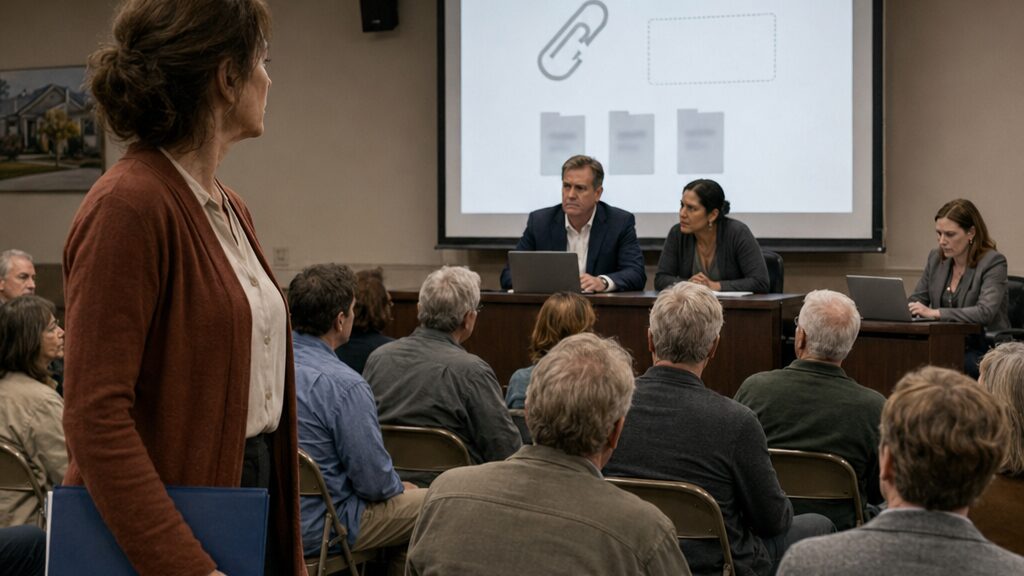
Gregory Wright projected Katherine’s empty case file onto the clubhouse wall before she had taken her seat.
The gray broken-paperclip icon appeared nearly two feet tall.
Beneath it were the words ATTACHMENT UNAVAILABLE.
Around forty homeowners sat in folding chairs facing the board table. Some had come for their own agenda items. Others had heard about the lien notice. Katherine recognized several neighbors who had stopped speaking when she entered.
Gregory adjusted the microphone.
“This hearing concerns repeated noncompliance after multiple opportunities to provide supporting documentation.”
His voice was measured, almost regretful. He wore a navy jacket without a tie and kept both hands folded over Katherine’s case packet.
“We are not here to debate whether Mrs. Martin values her property. We are here because standards must be applied consistently.”
Katherine placed her blue folder on the table reserved for residents.
Anna Rivera sat two seats from Gregory, a printed copy of the landscaping guidelines in front of her. She had signed the original recommendation declaring the garden noncompliant. When Katherine looked at her, Anna lowered her eyes to the packet.
Gregory continued.
“The association requested approval records on three occasions. None were available in the case portal. The feature remains materially inconsistent with the approved neighborhood plan.”
A homeowner in the second row whispered something about weeds.
Katherine heard it. She also heard Joseph shift in his chair near the back.
Gregory turned toward her. “Mrs. Martin, you may make a brief statement before the board considers referral for lien review.”
Katherine had prepared six pages.
She left them in the folder.
“Open the archive panel,” she said.
Gregory frowned. “You’ll have an opportunity to present whatever documents you brought.”
“I’m asking you to open the archive panel for the case currently on the screen.”
“The resident-facing record is already displayed.”
“At the bottom right, it says ‘Files: 3.’”
Several people leaned forward.
Gregory glanced at the projected screen.
The file count was small, almost hidden by the toolbar.
Files: 3.
“That may be a system artifact,” he said.
“Then opening it will establish that.”
The HOA attorney, seated at the end of the table, whispered to Gregory. Gregory answered without covering the microphone.
“This is not a technical review.”
“It became one when you said my evidence was missing.”
A murmur moved through the room.
Gregory’s expression hardened, though his voice remained even. “Mrs. Martin, the board is trying to resolve a landscaping violation, not conduct an audit of management software.”
“You’re threatening my home based on that software.”
The room went quiet.
Katherine could feel every eye on her. Public disagreement had always struck her as wasteful. Facts did not improve when spoken louder. But silence had allowed a summary to replace Joseph’s complaint and an empty icon to replace three documents.
She pointed to the screen.
“Please open the archive.”
Anna leaned toward the laptop. “There should be an administrative menu on the left.”
Gregory looked at her.
She did not look back. “If the counter is active, there may be retained files.”
The attorney whispered again. This time Gregory listened.
Then he clicked.
A narrow panel opened.
Three file entries appeared.
IMG_00471
DOC_1189
UPLOAD_TEMP_03
A sound passed through the audience—not surprise exactly, but recognition that the empty field was not empty.
Gregory said, “These names do not establish content.”
“No,” Katherine replied. “The timestamps do.”
She did not need to consult her notes.
“Open the first file uploaded on March sixth at 2:14 p.m.”
Gregory hesitated, then clicked IMG_00471.
A scanned county drainage approval filled the wall.
The document bore Katherine’s address, the county seal, and the inspector’s signature.
No one spoke.
The broken-paperclip icon had disappeared behind proof the board had said did not exist.
Katherine heard Joseph release a breath.
Anna leaned closer to the screen. “That is the drainage approval.”
“Yes,” Katherine said.
Gregory recovered quickly. “We do not know when this document became associated with the archive.”
“The timestamp is visible.”
“Timestamps may reflect migration or system processing.”
“Then open the second file.”
DOC_1189 contained the approved landscape plan. The rain garden was outlined in blue. The stone channel appeared along the east property line.
The third entry would not open.
Gregory clicked twice. A loading circle turned, then vanished.
“Unavailable,” he said.
Katherine opened her blue folder and removed the original confirmation email.
“The third file was uploaded May fourteenth, four years ago, at 8:17 p.m.”
She placed the paper on the document camera.
The same timestamp appeared on the wall.
“My husband submitted it. The system confirmed receipt. Your archive still records the exact minute.”
Someone behind her said, “Then why were they fining her?”
Gregory looked toward the audience. “Please hold comments.”
Katherine turned one page in her folder.
“Joseph Allen’s complaint also appears inaccurately summarized. He reported a blocked shared drainage outlet, not unapproved landscaping.”
Joseph stood.
“That’s correct.”
Gregory’s jaw tightened. “Mr. Allen, this is Mrs. Martin’s hearing.”
“My name is being used in her file.”
The attorney raised a hand. “The board should remain focused on whether the documents currently displayed were available to reviewers at the relevant time.”
Katherine looked at him. “That is exactly the question.”
Gregory leaned back in his chair.
“The management company migrated its portal last year. It is possible older documents were moved into an archive that did not display correctly.”
“Possible?” Katherine asked. “Or known?”
Christine Carter sat at a small side table near the wall, managing the meeting laptop. Until then, she had kept her attention fixed on the screen.
Katherine turned toward her.
“When did management first learn that attachment names had been detached from case records?”
Christine’s hands stopped over the keyboard.
Gregory answered for her. “Mrs. Carter is not here to provide technical testimony.”
“I asked her a factual question.”
“And I’m directing this hearing.”
Katherine felt the old instinct rise—the urge to sit down, submit a written request, and wait for the record to correct itself.
She closed the blue folder instead.
“Then put your direction in the minutes,” she said. “Write that the board displayed three archived files after stating none existed, opened two valid approvals, and refused to ask management when it learned the system was unreliable.”
The silence that followed was different from the first. It did not belong to Katherine anymore.
Anna looked at Gregory. “We can’t authorize lien review tonight.”
One of the other board members shifted in his seat. “We should postpone.”
Gregory stared at the county approval projected behind him.
“The board will table enforcement pending verification of the archive timestamps,” he said. “This is not a finding that the violation was issued improperly.”
It was not an apology. It was not even a reversal.
But the lien review did not move forward.
Katherine gathered her papers while homeowners began talking over one another. A woman near the aisle asked whether old fence approvals might also be archived. Another man said he had been fined for failing to provide a roof-color form he knew he had uploaded.
Gregory struck the gavel once.
“The meeting will come to order.”
It did not.
As Katherine stepped into the hallway, Christine followed her.
“Mrs. Martin.”
Katherine turned.
Christine glanced back toward the meeting room. Her face had lost the neutral expression she used on the phone.
“The file names detached during migration,” she said quietly.
“You knew.”
“I knew it had happened in some records.”
“How many?”
Christine looked down at the blue folder in Katherine’s hands.
“Your case was not the first.”
Chapter 4: The Warning Email Nobody Put in the Minutes
Christine Carter found the missing email at 8:06 Monday morning, buried beneath a meeting packet that claimed it had never existed.
She sat alone in the management office with the blinds still closed and the overhead lights only half on. The board packet filled her screen: Katherine Martin’s case summary, photographs of the rain garden, violation notices, Gregory Wright’s recommendation to suspend enforcement pending “verification of newly surfaced documents.”
Newly surfaced.
Christine read the phrase twice.
Then she opened her sent folder and searched the subject line she remembered too clearly.
PORTAL MIGRATION—ATTACHMENT DISPLAY ERRORS.
The email had gone to Gregory, the property-management regional supervisor, and the HOA attorney eleven weeks earlier. Christine had attached a spreadsheet listing cases in which the resident-facing portal showed no documents while the administrative archive retained file counts.
Katherine’s case number was on the fifth row.
Christine printed the email.
The office printer clicked and whirred in the silence. When the page emerged, she held it by the edges, as though fingerprints might make it less true.
Her warning had not been included in the official board packet. Neither had the spreadsheet.
She opened the meeting minutes from the week after she sent it.
Management reported minor display inconsistencies following routine system maintenance. No impact on active enforcement was identified.
Christine remembered that meeting. She had not said there was no impact. Gregory had asked whether the files were permanently lost. She had said she did not think so. He had asked whether residents could still submit new copies. She had said yes.
Then he had summarized the problem as temporary inconvenience.
She had let him.
At nine, Katherine called.
“I want the complete archive index,” she said.
Christine looked at the printed warning beside her keyboard. “That information isn’t part of the standard resident record.”
“Neither was my approval, apparently.”
“I understand why you’re asking.”
“I’m going to the county this morning. By noon, I’ll have certified copies of everything your portal says is unavailable.”
Christine lowered her voice. “Certified copies prove the approvals exist. They don’t prove when the association received them.”
“The archive timestamps do.”
“Yes.”
It was the first time Christine had answered without qualification.
Katherine was silent.
“How many cases?” she asked.
Christine glanced toward the closed office door. “I can’t discuss other homeowners’ files.”
“How many show the same mismatch?”
“I’m not authorized—”
“How many, Christine?”
The question was not loud. That made it harder to escape.
Christine opened the migration spreadsheet.
Twenty-seven rows were highlighted yellow. Fences, roofs, tree removals, paint colors, drainage plans. Some cases had been closed after residents resubmitted documents. Others had progressed to fines.
“More than a few,” she said.
“That isn’t a number.”
“No.”
“Will you give the number to the board?”
Christine looked at the email she had printed.
“If I’m asked through the proper process.”
Katherine’s breath moved softly across the line. “You were asked at the hearing.”
“Gregory stopped the question.”
“And you let him.”
Christine closed her eyes.
“Yes.”
At the county records counter, Katherine waited while a clerk searched permits by parcel number. The building smelled faintly of paper, dust, and the burnt coffee from a machine near the elevators. It was familiar enough to make her miss working life—not the meetings or the fluorescent lights, but the certainty that a record could be followed from intake to retention if someone cared enough to trace it.
The clerk returned with a stamped drainage approval, the landscape plan, and the inspection signoff.
“These are all final,” the clerk said. “No revocations or amendments.”
“Can you certify the copies?”
“Of course.”
Katherine watched the seal press into each page.
The documents gave her something solid, but not everything. They proved the rain garden had been approved. They did not explain why the HOA had continued enforcement after its own system showed three stored files.
When she returned home, an envelope from the association waited beneath the doormat.
PRIVATE RESOLUTION PROPOSAL.
Inside was a two-page settlement.
The board would waive all fines, remove the lien referral, and close the enforcement matter if Katherine agreed to remove the rain garden within thirty days. She would also acknowledge that supporting documentation had not been provided in a timely form accessible to the association.
Katherine read that sentence three times.
The offer returned her money and preserved their version of events.
Her phone rang before she had finished.
Gregory.
“I wanted to make sure you received the proposal,” he said.
“I did.”
“It gives everyone a practical way forward.”
“Everyone?”
“The board avoids additional expense. You avoid enforcement. The landscaping concern is resolved.”
“The drainage feature is approved.”
“The county approved a functional plan. The association retains authority over visible landscaping.”
“My documents were in your archive.”
“We still have to determine when and how they became accessible.”
“You saw the timestamps.”
“I saw metadata after a migration. Our attorney has advised caution about assuming what it proves.”
Katherine placed the settlement beside the certified county copies.
“What did Christine tell you eleven weeks ago?”
Gregory did not answer immediately.
“This is exactly why legal counsel recommended a private resolution,” he said. “Technical uncertainty can become expensive for everyone.”
“For everyone or for the board?”
“The association is every homeowner, Katherine. Any legal cost, audit cost, or refund comes out of the same community budget.”
She could hear strain beneath his controlled tone now.
Gregory was not afraid only of embarrassment. He was counting insurance deductibles, special assessments, angry homeowners, and votes.
That did not make the settlement honest.
“I’ll respond in writing,” she said.
“Katherine, think carefully. You can end this today.”
“No. I can end my part of it today. That isn’t the same thing.”
She hung up.
Across town, Christine remained after closing. With the office door locked, she ran the archive mismatch report again.
Twenty-seven active or recently closed cases.
Each showed the same broken-paperclip icon in the resident view.
Each retained at least one file in the administrative archive.
She scrolled through them until the icons blurred into a column of small gray fractures.
At 6:14, an internal message from the regional supervisor appeared.
Do not distribute migration reports externally. Direct all homeowner inquiries to legal.
Christine placed the printed warning email in her bag.
At Katherine’s kitchen table, the certified county records lay beside Gregory’s settlement. Joseph’s original complaint was there too, along with the altered summary and screenshots from the portal.
Katherine drafted her response in four sentences.
I reject the proposed settlement because it requires me to accept a false statement regarding timely submission. I request suspension of all enforcement related to archive-dependent records. I further request an independent audit of cases affected by the portal migration. Please preserve all emails, reports, metadata, and meeting materials concerning attachment-display failures.
She read it once, then sent it to Gregory, Christine, the management supervisor, and the HOA attorney.
A minute later, the portal generated an automatic receipt.
Submission received.
Attachments uploaded successfully.
Katherine looked at the new confirmation, then at the same gray broken-paperclip icon already appearing beside her message.
Chapter 5: The Easy Settlement That Required a False Confession
The settlement gave Katherine everything she had asked for except the truth.
The fines would vanish. The lien referral would close. No attorney fees would be charged to her account.
All she had to do was remove the garden and sign beneath a sentence stating that she had failed to provide usable documentation on time.
She left the unsigned pages on the kitchen table for two days.
Each time she passed them, the offer seemed to become more reasonable. The lien threat had kept her awake. An audit could take months. Legal expenses might be added to association dues, turning neighbors who were merely curious into people who blamed her directly.
Removing the garden would be painful, but pain was not the same as injustice. She could save seeds. Move the plaque. Keep the certified records in the blue folder.
The argument almost persuaded her.
Then she noticed the handwritten notes beneath the landscape plan.
Her husband’s block printing filled the left margin.
SLOPE HERE.
STONE BELOW GRADE.
Joseph’s narrower handwriting crossed beneath it.
CHECK FLOW AFTER FIRST HARD RAIN.
Katherine touched the paper.
She had forgotten Joseph’s notes were there.
That afternoon, she carried the plan next door.
Joseph was clearing leaves from the storm drain at the curb. When he saw the pages in her hand, he set down the rake.
“I’m not signing the settlement,” she said.
He nodded once. “Good.”
“You haven’t read it.”
“You carried it like bad news.”
She unfolded the drainage plan across the hood of his truck. The paper lifted in the breeze, and Joseph pinned one corner with his palm.
“You wrote this,” Katherine said, pointing to the note.
“Your husband’s level was off.”
“It was not.”
“It was. He blamed the ground.”
Despite herself, Katherine almost smiled.
Joseph traced the blue drainage line from her yard toward his foundation.
“The year before we built this, water came through the basement window well,” he said. “Three inches in the utility room. Your husband helped me pull everything out.”
“I remember.”
“You remember him coming home wet. You didn’t see the room.”
“No.”
“He said the association would keep sending landscapers to patch the low spot unless we gave the water somewhere permanent to go.”
Katherine looked toward her yard. From Joseph’s driveway, the rain garden appeared as a low sweep of dormant stems and dark earth.
“I thought he built it because he liked fixing things,” she said.
“He did. He also built it because I couldn’t afford another repair.”
The words settled between them.
Katherine had preserved the garden as if it belonged only to her marriage. She had treated every question about it as an intrusion into private grief. Yet Joseph’s handwriting had been on the plan all along.
“Why did you stop coming over?” she asked.
Joseph rubbed dirt from his thumb.
“After the funeral, I checked the outlet every time it rained. One day you saw me and told me not to touch anything.”
“I thought you were changing it.”
“I was pulling leaves out.”
Katherine remembered the sharpness in her voice. She had been standing on the porch holding one of her husband’s old jackets, angry at Joseph for being alive in the same place where they had once worked together.
“I’m sorry,” she said.
Joseph looked down at the plan. “I should’ve told you what the board was doing sooner.”
“You tried.”
“Not very hard.”
Neither of them offered more than that.
At the board’s executive session that evening, Gregory placed Katherine’s rejection letter in front of the other members.
“She is no longer seeking resolution of an individual violation,” he said. “She is attempting to force a community-wide records review.”
Anna Rivera sat across from him. “If the same defect affected other cases, a review is necessary.”
“We don’t know that the defect affected outcomes.”
“We know Katherine’s case reached lien review while her approvals were in the archive.”
“The approvals were not visible to reviewers.”
“That is not her failure.”
One board member asked what an independent audit would cost. The HOA attorney gave a range high enough to change the room.
Gregory folded his hands. “This is what I’ve been trying to avoid. The reserve account is already below target. Insurance renewal is next quarter. If we open every closed enforcement case, we may create obligations the association cannot absorb.”
Anna looked at him. “So we keep decisions we know might be wrong?”
“We verify before creating panic.”
“You’ve had eleven weeks.”
Gregory’s eyes moved toward her. “You signed the original violation recommendation.”
Anna did not flinch. “I did. Based on a file I now know was incomplete.”
The room became still.
Gregory looked away first.
Katherine received the removal notice the next morning.
The association had determined that, regardless of document status, the current condition of the garden constituted an unresolved maintenance concern. A landscaping contractor would restore the area to standard turf and approved foundation shrubs.
Work was scheduled for the following Tuesday.
She called the management office.
Christine answered.
“Did you know about this?”
“I saw the work order after it was issued.”
“Can they remove a county-approved drainage feature?”
“The board’s position is that the underlying drainage path will remain.”
“The plants and basin are the drainage path.”
“I know.”
The admission came so quietly Katherine almost missed it.
“Then say that.”
“I’m not an engineer.”
“You don’t have to be an engineer to tell the board its records failed.”
Christine was silent.
Katherine looked through the window at the garden.
“You said my case wasn’t the first.”
“I shouldn’t have said that.”
“Was it false?”
“No.”
“Then what are you waiting for?”
“My job pays for my mother’s assisted-living apartment.”
Katherine’s anger stopped before it reached her mouth.
Christine continued, words coming faster now.
“The management company says no files were destroyed. The board says residents could have resubmitted. Legal says we must avoid language suggesting enforcement was invalid. Everyone has a sentence that keeps responsibility somewhere else.”
“And yours?”
Christine breathed in.
“That I reported the problem.”
“Did you?”
“Yes.”
“Will you prove it?”
“I don’t know.”
Katherine pressed her fingertips to the glass.
“Neither did I,” she said. “For months, I thought having the right documents meant I didn’t have to stand in front of anyone and explain myself. That helped them get this far.”
After the call, she removed the approval plaque from beside the garden. The screws resisted, rusted into the post, and she had to use one of her husband’s old drivers.
For a moment, Joseph watched from his yard without approaching.
Then he crossed over and held the post steady.
Katherine took the plaque inside, cleaned the dirt from its corners, and placed it beside the blue folder.
She spent the afternoon writing—not another records request, but a statement.
The rain garden had been built after repeated flooding.
It protected two properties.
It had been designed by her husband with Joseph’s help.
She had refused to discuss it because doing so made its loss feel possible.
The words looked exposed on the page. She nearly deleted the last sentence.
Instead, she printed the statement and attached it to her audit request.
Before dawn on Tuesday, a truck door slammed outside.
Katherine went to the window.
Orange flags had appeared around the garden, each marked REMOVE. White paint outlined the basin. A contractor’s trailer stood at the curb.
At the far end of the street, a small backhoe turned the corner toward her house.
Chapter 6: The Morning the Board Tried to Erase the Evidence
The backhoe stopped with its front bucket hanging over the rain garden.
Katherine stepped between the machine and the first orange flag.
The engine idled hard enough to shake the metal approval plaque in her hands.
The landscaping contractor climbed down from the cab. He wore a reflective vest and carried a clipboard inside a clear plastic sleeve.
“Ma’am, you can’t stand in the work area.”
“This is my property.”
“We have authorization from the association.”
“You have authorization to remove an approved drainage structure.”
He looked toward the shallow basin. “The order says overgrown landscape bed.”
“The order is wrong.”
The contractor exhaled through his nose. “You’ll need to take that up with the HOA. I’m not getting in the middle.”
“You are already in the middle.”
Dark clouds pressed low over the rooftops. The forecast had called for heavy rain by afternoon. Water from the previous night’s shower still gleamed between the stones at the bottom of the basin.
Joseph came across the lawn carrying a shovel.
The contractor raised a hand. “Sir, please don’t bring tools into the work zone.”
Joseph planted the shovel outside the painted line. “I’m not working. I’m showing you where your bucket will send the water.”
He pointed toward the outlet channel. Mulch still narrowed it near the property line.
“If you flatten that basin before the storm, runoff goes straight along my foundation.”
The contractor looked from Joseph to Katherine.
“My instructions are to remove vegetation and grade level.”
“Exactly,” Katherine said.
A black sedan pulled up behind the trailer.
Gregory got out.
He wore a raincoat over office clothes and carried a folder beneath one arm. Anna Rivera emerged from the passenger side, her expression tight.
Gregory approached without stepping onto the grass.
“Katherine, the contractor has a valid work order.”
“The county plan says this basin must remain.”
“The board is not altering the drainage easement. We are correcting unapproved landscaping within it.”
Katherine held up the certified plan. Wind tugged at the edges.
“It labels the planted basin as part of the stormwater design.”
“The board’s attorney reviewed the matter.”
“Did the attorney review the document before or after you found it in the archive?”
Gregory glanced at the contractor. “This is not the place for another hearing.”
“No. This is where the consequence arrives.”
A few neighbors had begun watching from porches. Someone farther down the sidewalk held up a phone, but Katherine barely noticed. The backhoe’s engine, the damp smell of soil, and the orange flags narrowed the world.
Gregory lowered his voice.
“You were offered a full waiver.”
“In exchange for a false confession.”
“In exchange for closure.”
“For me.”
“For the community,” he said, sharper now. “Do you understand what an audit may cost? Every disputed fine, every attorney letter, every closed case could reopen. Dues could rise. Insurance could refuse renewal.”
“And that makes the records accurate?”
“It makes caution necessary.”
“You were cautious with the association’s money. Not with my home.”
The words landed harder than Katherine intended. Gregory’s face changed, not with guilt but exhaustion.
“You think I wanted this?” he said. “I took over a board with unpaid assessments, two lawsuits, and homeowners demanding stricter enforcement in one breath and exceptions in the next. Management told us the files still existed. Legal told us residents could resubmit. We needed the process to keep moving.”
“You knew the process could not see the evidence.”
“I knew the portal had display issues.”
“And you kept fining people.”
Gregory looked toward the neighbors gathering near the curb.
Then he made the choice Katherine had feared he would make.
“Proceed,” he told the contractor.
The contractor did not move.
Anna opened the county plan she had brought and placed it on the hood of Gregory’s sedan.
“I called the county engineering desk this morning,” she said. “The drainage approval is tied to the parcel. The association cannot materially alter the basin without review.”
Gregory stared at her. “You contacted the county without board authorization?”
“I asked a question as a homeowner.”
“You are a committee representative.”
“I was also the person who signed Katherine’s violation recommendation.”
The first drops of rain struck the plastic covering the contractor’s clipboard.
Anna pointed to a shaded contour on the plan.
“This depression stores runoff before releasing it into the side channel. Leveling it changes the approved grade.”
The contractor stepped closer to inspect the page.
“If that’s accurate,” he said, “I need a revised work order. I’m not touching drainage infrastructure based on a landscaping ticket.”
Gregory’s jaw tightened. “It is not infrastructure. It is decorative planting.”
Katherine walked to the edge of the basin. Water had begun collecting behind the sedges, silvering the dark soil.
She set the brass plaque on top of the county plan and held both against the wind.
“This is the approved feature,” she said. “This is the approval your system hid. And that water is the reason it exists.”
Gregory looked at the basin.
Rain began falling steadily.
Within minutes, runoff came down Katherine’s sloped driveway in thin streams. It entered the garden, spread between the plants, and slowed. At the far end, a narrow current moved toward the stone outlet.
Then it stopped.
Water rose against the ridge of mulch near Joseph’s property.
Joseph picked up his shovel.
The contractor blocked him with one arm. “Not until we know where the utilities are.”
“The channel is stone-lined,” Joseph said. “No digging.”
Katherine stepped into the basin. Mud pressed around her shoes as she reached the blocked outlet. She pulled mulch away with her hands, exposing the top course of stones.
Water broke through in a brown rush and moved down the channel toward the street.
The gathered neighbors watched it pass Joseph’s foundation instead of pooling beside it.
No one applauded.
The visible flow was enough.
Gregory looked at Anna. “This does not resolve the archive issue.”
“No,” she said. “It proves the archive issue created a dangerous work order.”
The contractor returned to the cab and shut off the engine.
The sudden quiet made the rain sound louder.
“I’m suspending work,” he said. “You can call my office when the authorization is clear.”
Gregory took out his phone. “The board can obtain clarification.”
Katherine climbed out of the basin, mud on her hands and trousers.
“You had eleven weeks to obtain clarification.”
A car pulled up behind Gregory’s sedan.
Christine stepped out carrying a thick white binder beneath her coat. She had no umbrella. By the time she reached the yard, rain had darkened her hair and soaked the shoulders of her blouse.
Gregory’s expression hardened.
“Christine, why are you here?”
She looked at the backhoe, the exposed channel, and the county plan spread across the hood.
Then she handed the binder to Katherine.
A property-management logo appeared above the title.
POST-MIGRATION EXCEPTION REPORT.
The date was eleven weeks earlier.
“This is the original report,” Christine said. “It identifies every case where the resident view lost attachment names while the administrative archive retained the files.”
Gregory did not reach for it.
“How many?” Anna asked.
Christine looked directly at her.
“Twenty-seven.”
Rain tapped against the binder’s plastic cover.
Katherine opened it.
Her case was on page five, highlighted in yellow.
Beside it, under recommended action, were six words:
Suspend enforcement pending manual file review.
Chapter 7: The Record Was Corrected but the Trust Was Not
Twenty-seven case numbers filled the clubhouse screen in three narrow columns.
No names appeared beside them, but several homeowners recognized their own numbers anyway. A woman near the aisle covered her mouth. A man in the back unfolded an old violation letter and compared its heading to the list.
Katherine sat at the same table where Gregory had displayed her supposedly empty file two weeks earlier.
This time, the broken-paperclip icon was gone.
Beside every case number was a folder symbol and a count of the files recovered from the administrative archive.
One. Two. Four. Three.
Evidence had appeared everywhere the association had once claimed there was none.
Gregory sat at the center of the board table. His face looked thinner than it had at Katherine’s hearing. Two unopened water bottles stood in front of him, along with a statement prepared by the HOA attorney.
Christine sat near the wall, the original migration report closed on her lap.
Anna arranged printed copies of the proposed audit resolution in neat stacks.
When Gregory called the special meeting to order, the room quieted slowly.
“The board has confirmed,” he began, “that a portal migration caused certain attachment names and links to become unavailable in the resident-facing system.”
A homeowner interrupted. “Unavailable to us or unavailable to you?”
Gregory looked toward the attorney.
“Comments will be taken after the presentation.”
“That wasn’t an answer,” someone else said.
Katherine kept her hands on the blue folder. She had learned that silence could sharpen a room when it was chosen rather than feared.
Gregory continued.
“The underlying files remained stored in the administrative archive. Management has begun restoring links and reviewing affected matters.”
On the screen, Katherine’s case number sat fifth in the first column.
The board’s proposed motion appeared beneath the list.
Rescind all fines and enforcement actions against Katherine Martin. Confirm the rain garden as an approved drainage feature. Close case 18-447 with no admission of liability.
Katherine read the last line twice.
No admission of liability.
Gregory turned toward her.
“Mrs. Martin, this motion provides the complete individual relief you requested.”
“No,” Katherine said.
The microphone carried her voice farther than she expected.
Gregory’s expression tightened. “It rescinds the fines, closes the lien matter, and recognizes the approval.”
“It corrects my account.”
“That is the matter before us.”
Katherine looked up at the twenty-six other case numbers.
“No. Those are the matter before us.”
A murmur moved through the room.
The attorney leaned toward his microphone. “The board must review each case individually. Different facts and enforcement histories may apply.”
“I agree,” Katherine said. “Review them individually.”
“That process may require considerable time.”
“Then start.”
Gregory folded his hands.
“Katherine, no one is suggesting the others will be ignored. But your case can be resolved tonight.”
“That was the settlement offer too.”
“This is not a settlement. It is a board correction.”
“A correction that stops one number short of admitting the system affected decisions.”
Gregory glanced at the residents.
“The association has obligations beyond any single dispute. We must consider insurance, reserves, and legal exposure.”
There it was again—not greed, not cruelty, but the calculation that had carried the harm forward.
Gregory opened the prepared statement.
“After management first reported display inconsistencies, the association consulted its insurer. We were advised that a broad suspension of enforcement could create uncertainty regarding existing covenants and pending matters.”
Anna looked at him sharply. “When did the insurer advise that?”
Gregory did not answer her directly.
“The board believed continued enforcement, with opportunities for residents to resubmit documents, was the most stable course.”
Katherine felt the room change.
This was the deeper truth Christine’s report had pointed toward. The board had not merely overlooked the defect. It had chosen continuity over accuracy because uncertainty threatened the association’s finances.
A homeowner stood without waiting to be recognized.
“I resubmitted my fence approval three times.”
Another called from the back, “They fined me while telling me the roof form was missing.”
Gregory struck the gavel.
“Please. We will take comments in order.”
Anna pulled her microphone closer.
“Did the board receive Christine’s warning before Katherine’s first fine?”
Gregory stared at the resolution.
“Yes.”
The word was quiet, but nothing in the room covered it.
Christine opened the binder on her lap.
“I sent the warning on January ninth,” she said. “The attachment included the twenty-seven affected case numbers and recommended suspending enforcement until manual review.”
The regional supervisor was not present. Neither was anyone from the management company except Christine.
Gregory turned toward her. “You were instructed to direct technical findings through management.”
“I did.”
“Your report also stated that no files appeared permanently deleted.”
“That did not mean reviewers could see them.”
The attorney lifted a hand. “We should avoid assigning conclusions beyond the report’s language.”
Christine removed a printed email from the binder.
“This is the language.”
She read without raising her voice.
“Resident-facing records may falsely indicate that required documents were never submitted. Enforcement decisions relying on visible attachments should be suspended pending archive verification.”
The room remained still after she finished.
Christine set the page down.
“I wrote that because I knew what could happen,” she said. “Then I kept sending notices anyway.”
She did not ask to be forgiven.
Katherine respected her more for that.
Anna placed a new motion on the table.
“I move that the board suspend all enforcement in the twenty-seven identified cases, authorize an independent audit, refund fines found to depend on inaccessible evidence, and require management to provide residents with readable copies of every stored attachment upon submission.”
One board member looked at Gregory. “What will that cost?”
“We don’t know,” Anna said.
“That is not responsible budgeting.”
“Neither is pretending a liability disappears because we refuse to count it.”
Gregory removed his glasses and pressed two fingers to the bridge of his nose.
Katherine saw, perhaps for the first time, the full shape of what he had done. He had believed he was holding the community together. Each delayed disclosure had made the next one more dangerous. By the time her case reached the hearing, admitting uncertainty meant admitting that months of board action might be unreliable.
He had not invented the broken system.
He had chosen to use it.
Gregory put his glasses back on.
“I will support the audit,” he said, “but I will not agree that every enforcement action was invalid.”
“No one asked you to,” Katherine replied. “We asked you to find out which ones were.”
He looked at her across the room.
For a moment, she remembered him carrying folding chairs after neighborhood picnics, asking after her husband during his illness, and speaking about board service as if it were an unpleasant duty someone responsible had to accept.
Then she remembered the backhoe.
Gregory nodded once.
The motion passed four votes to one.
No one applauded.
The residents began lining up at a side table where Anna and Christine distributed printed archive inventories. Each homeowner received a list of stored files associated with their case, including documents they had never been able to open after submission.
Katherine watched a man hold up a recovered paint approval and shake his head. A woman ran her finger over the timestamp on a tree-removal permit as though testing whether the ink was real.
Christine approached Katherine last.
“Your three files have been restored,” she said.
She handed over a fresh case record.
The broken-paperclip icon had been replaced by three readable links:
County Drainage Approval.
Approved Landscape Plan.
Final Site Inspection.
The third file—the one submitted at 8:17 p.m. four years earlier—was her husband’s final inspection scan.
Katherine opened it on Christine’s tablet.
At the bottom of the page, beneath the inspector’s signature, her husband had typed one sentence in the comment field.
Shared outlet cleared with Joseph Allen. System functioning as designed.
Katherine read it twice.
She had spent months treating the garden as the last private thing he had left her.
Even his final note said shared.
Gregory stopped beside her as the room emptied.
“The board will issue a written correction,” he said. “Your account balance is already zero.”
“Thank you.”
He seemed surprised by the words.
Katherine closed the tablet.
“That does not make what happened acceptable.”
“I know.”
“Do you?”
Gregory looked toward the screen, where the twenty-seven case numbers remained.
“I thought if we stopped enforcement, the association would lose control of every dispute at once.”
“So you let the wrong decisions continue.”
“Yes.”
It was not a complete apology, but it was no longer a defense.
“Will you resign?” Katherine asked.
“Not tonight.”
She had expected that answer.
“The board has an audit to complete,” he said. “Leaving now would be easier for me.”
“And staying may be easier for the board.”
His face tightened.
“Possibly.”
Katherine slipped the restored record into her blue folder.
“Then make sure staying costs you something.”
Gregory met her eyes.
“It already has.”
“That isn’t what I meant.”
She left him standing beneath the screen.
The rain came hard that evening.
Katherine stood beneath her porch roof while water streamed down the driveway and entered the garden. The basin filled slowly around the sedges, holding the runoff before releasing it into the stone channel.
Joseph walked over without an umbrella.
He stopped beside her, both of them watching the current pass between their properties.
“They cleared the mulch this afternoon,” he said.
“I saw.”
“The outlet’s moving well.”
“Yes.”
Joseph looked toward the brass plaque, which Katherine had returned to its post.
“You put it back.”
She nodded.
For years, the plaque had meant that no one could question what her husband had built. Now it seemed smaller than that. An approval was not a shield. It was a promise that someone had looked, understood, and taken responsibility.
“I found his final inspection note,” she said.
Joseph waited.
“He mentioned you.”
“That sounds like him.”
“He called it a shared outlet.”
Joseph smiled faintly. “He called everything shared when he wanted help maintaining it.”
Katherine looked at the rain garden. Some of the plants leaned beneath the force of the water, but their roots held the soil in place.
“I made it too private,” she said.
Joseph did not rush to disagree.
After a while, he said, “You were trying not to lose another thing.”
The water moved through the open channel and disappeared beneath the street.
Katherine reached for the porch umbrella.
“The county plan says we should inspect the stones after a heavy storm.”
Joseph looked at her.
“Tonight?”
“Before the leaves collect.”
He took the umbrella while she brought the flashlight.
They walked along the channel together, not speaking, following the water to where it was supposed to go.
The story has ended.